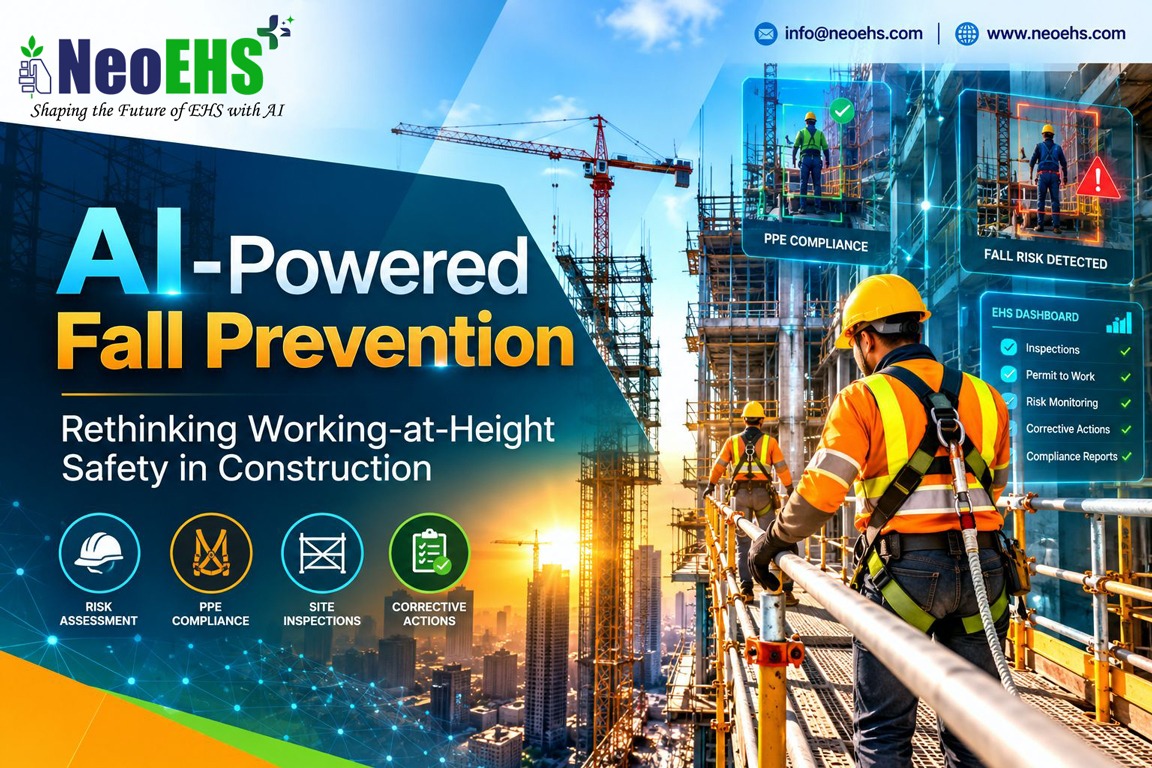
AI-Powered Fall Prevention: Rethinking Working-at-Height Safety in Construction
The Most Dangerous Step on a Construction Site May Be the One Nobody Questions
A construction worker climbs a scaffold to complete a routine installation. The team has performed the same activity dozens of times. The work permit is approved, the supervisor has completed the morning briefing, and everyone believes the risks are understood.
But something has changed.
An edge protection barrier was temporarily removed to allow material movement. A scaffold platform was modified during the previous shift. A worker's fall-arrest connection is not properly secured.
Each issue may appear small in isolation. Together, they can create the conditions for a serious fall.
This is one of the biggest challenges in construction safety: working-at-height risks are dynamic, while many safety management processes remain periodic and document-driven.
As construction projects become larger, more complex and increasingly dependent on multiple contractors, safety teams need better ways to identify changing conditions before someone gets hurt.
AI-powered safety technologies, combined with structured digital EHS management, offer an opportunity to strengthen that process.
What Is AI-Powered Fall Prevention in Construction?
AI-powered fall prevention uses technologies such as computer vision, predictive analytics, digital risk assessments and intelligent safety monitoring to help identify working-at-height hazards, prioritise interventions and support safer construction activities.
Depending on the system and deployment, these technologies may help safety teams recognise missing protective equipment, detect unsafe access conditions, identify recurring high-risk activities and monitor whether corrective actions have been completed.
However, AI does not physically prevent a fall.
Effective fall prevention still depends on engineering controls, properly designed access systems, competent workers, reliable equipment, supervision and emergency preparedness.
AI adds value by helping organisations recognise and respond to hazards earlier.
Why Working-at-Height Safety Remains a Major Construction Challenge
Construction sites rarely remain unchanged for long.
Scaffolding is assembled, modified and dismantled. Temporary platforms are installed. Floor openings appear as work progresses. Cranes move materials between levels, and multiple subcontractors operate in overlapping work zones.
A control that was adequate yesterday may no longer be adequate today.
Common working-at-height hazards include:
-
Unprotected roof edges and floor openings.
-
Incomplete or improperly modified scaffolding.
-
Unsafe ladders and temporary access arrangements.
-
Incorrectly selected or connected fall-arrest equipment.
-
Poorly controlled work near fragile surfaces.
-
Falling tools and materials that endanger workers below.
-
Inadequate rescue arrangements following a fall-arrest event.
These risks are not solved by increasing paperwork alone.
They require a reliable process for recognising hazards, assigning responsibility, implementing controls and verifying that the work environment remains safe.
From Reactive Safety Management to Proactive Risk Prevention
Traditional construction safety programmes often depend on scheduled inspections, toolbox meetings, manual permit approvals and incident investigations.
These practices remain essential, but their effectiveness can be limited when information moves slowly between workers, supervisors, contractors and corporate safety teams.
Consider a typical construction project.
A safety officer identifies missing edge protection on Level 12 and records the observation. The responsible contractor receives the instruction later. Meanwhile, another crew arrives to begin installation work in the same area.
The problem is not necessarily that the hazard was missed.
The problem is that the information did not reach the right people quickly enough.
Digital EHS systems can help close this communication gap by supporting faster reporting, responsibility assignment, corrective-action tracking and management visibility.
Where suitable AI capabilities are available, they can also assist with hazard classification, trend identification and prioritisation.
The objective is straightforward: move safety information closer to the moment when a decision must be made.
Five Ways AI Can Strengthen Working-at-Height Safety
1. Identifying unsafe conditions before work begins
Working-at-height activities should begin with a suitable risk assessment that considers the task, location, access arrangements, weather, equipment and potential consequences of a fall.
AI-assisted assessment tools may help safety professionals identify overlooked hazards or recommend additional considerations based on approved safety procedures and previous observations.
For example, a planned roofing activity might require reviewing fragile surfaces, weather exposure, edge protection, safe access and rescue arrangements.
The final assessment and approval must remain with competent personnel.
2. Supporting smarter permit-to-work decisions
High-risk work often requires formal authorisation, particularly where site procedures mandate permits for working at height.
A digital permit-to-work process can connect task descriptions, risk assessments, equipment checks, contractor information and approval responsibilities.
Intelligent rules may flag missing prerequisites, expired training records or incomplete safety inspections before authorisation.
For a large EPC project, this can provide better consistency across multiple work fronts.
Importantly, permit approval must reflect actual site conditions. A digitally approved permit is not evidence that a work area is physically safe.
3. Improving visibility through computer vision
AI-enabled cameras and image-analysis systems may be used to detect certain observable safety conditions, such as the presence of helmets, visible harnesses or workers approaching designated restricted areas.
Such systems require careful configuration and validation.
A camera may recognise that a worker is wearing a harness, but it may not reliably determine whether the harness is correctly fitted, connected to a suitable anchor or appropriate for the task.
Computer vision should therefore supplement competent inspection and supervision rather than replace them.
4. Learning from near misses and recurring hazards
A single near miss can reveal a problem. Hundreds of observations can reveal a pattern.
AI-assisted analysis may help identify recurring issues across construction projects, including repeated scaffold defects, incomplete barricading, poor housekeeping around access routes or recurring permit deviations.
These findings can help HSE leaders direct inspections, training and preventive interventions toward higher-priority activities.
The quality of these insights depends on accurate reporting, consistent hazard classifications and representative data.
5. Accelerating corrective-action closure
Identifying a hazard is only the beginning.
A working-at-height observation should have a clear owner, an appropriate control, a target completion date and evidence of verification.
Digital workflows can support reminders, escalation, photographic evidence and closure tracking.
For critical hazards, the priority is immediate risk control, including stopping affected work when necessary. A software notification should never substitute for urgent on-site intervention.
Why the Hierarchy of Controls Must Come Before AI
Technology is most effective when it supports sound safety engineering.
For working at height, organisations should first consider whether the activity can be eliminated or performed from ground level.
Where work at height cannot be avoided, suitable collective protection measures—such as properly designed guardrails, protected platforms and other engineered solutions—should generally take priority over reliance on personal protective equipment alone, subject to applicable regulations and task-specific risk assessment.
Personal fall protection, including restraint and fall-arrest systems, requires appropriate selection, anchorage, inspection, training and rescue planning.
Illustrative hierarchy for working-at-height risk control
1
Eliminate work at height
Prefabrication, ground-level assembly or alternative methods
2
Provide collective protection
Guardrails, protected platforms and engineered access
3
Use suitable personal protection
Restraint or fall-arrest systems with rescue arrangements
4
Strengthen administrative controls
Risk assessments, permits, inspections and supervision
5
Add digital and AI-enabled assurance
Monitoring, reporting, analytics and corrective-action visibility
AI is an additional assurance layer, not a substitute for higher-order controls. The sequence is illustrative and must be adapted to the applicable regulatory hierarchy.
A company can deploy advanced analytics and still have an unsafe site if physical fall protection is missing.
The goal is to combine reliable engineering controls with better operational information.
Connecting Working-at-Height Safety with a Digital EHS Platform
Fall prevention does not operate independently from the rest of construction safety management.
It connects with contractor competency, training, inspections, risk assessments, permit approvals, incident investigations and corrective-action management.
When these processes operate through disconnected spreadsheets, messaging applications and paper records, management visibility can become fragmented.
An integrated EHS approach helps organisations build a more consistent safety management process across sites and contractors.
This is the context in which NeoEHS—an AI-powered Environment, Health and Safety software platform—can be positioned as part of construction safety digitalisation.
For working-at-height management, organisations should evaluate how their EHS platform supports:
-
Hazard and near-miss reporting.
-
Task-specific risk assessments.
-
Working-at-height permit workflows.
-
Scaffold and access-equipment inspection records.
-
Contractor safety responsibilities.
-
Corrective and preventive action management.
-
Incident investigation and lessons learned.
-
Safety performance dashboards and management reporting.
The exact functionality, available AI features and integration options should be confirmed against the deployed NeoEHS configuration.
A Practical Construction Scenario: Managing Work at Height Across Multiple Contractors
Imagine a large commercial development where civil, mechanical, electrical and façade contractors operate simultaneously.
The project safety team needs to coordinate rooftop activities, temporary scaffolds, elevated work platforms and open-floor penetrations.
A digitally connected process could work as follows.
Before work: The contractor submits a task-specific risk assessment and the required permit documentation. The supervisor checks access arrangements, collective protection, worker competency and rescue preparedness.
During work: Safety officers record inspections and observations against the relevant location, activity and contractor. Critical hazards are communicated immediately, and affected work is suspended where required.
After a hazard is identified: The responsible team implements the necessary controls, attaches supporting evidence and requests verification.
At management level: Project leaders review overdue critical actions, repeated hazard categories and contractor performance trends.
Where AI-based analytical capabilities are implemented and validated, historical data may also help identify patterns that deserve additional management attention.
This scenario illustrates a potential operating model, not a claim that every function is currently available in NeoEHS.
What Construction Leaders Should Measure
A successful fall-prevention programme should not be evaluated solely by the number of incidents reported.
Construction leaders should also monitor the effectiveness of preventive controls.
|
Performance indicator |
Why it matters |
|---|---|
|
Critical fall hazards identified and controlled |
Measures hazard-control responsiveness |
|
Overdue high-risk corrective actions |
Highlights unresolved exposure |
|
Scaffold inspection compliance |
Tracks inspection completion against requirements |
|
Permit and risk assessment quality |
Assesses the adequacy of pre-work controls |
|
Worker competency and training validity |
Supports appropriate task authorisation |
|
Repeat working-at-height observations |
Reveals recurring weaknesses |
|
Verified corrective-action effectiveness |
Measures whether controls remain effective |
These indicators should be interpreted alongside workforce exposure, project activities and the quality of reporting. More hazard observations do not automatically mean a site is becoming less safe.
Responsible AI Adoption in Construction Safety
Before deploying AI-assisted fall-prevention technologies, construction companies should ask several important questions.
How accurately does the system detect the hazards it claims to recognise? How are false alerts managed? Can supervisors explain and challenge the system's recommendations? Who is responsible for final safety decisions?
For camera-based systems, organisations must also address worker privacy, data retention, access controls and applicable employment and data-protection requirements.
Any AI system used in a safety-critical process should undergo appropriate testing, site-specific validation and ongoing performance review.
Human accountability must remain central to every safety-critical decision.
The Future of Working-at-Height Safety Is Connected, Not Just Automated
Construction safety is moving toward a more connected operating model in which risk assessments, field inspections, permit approvals, contractor records and management information can work together.
AI may help identify patterns that are difficult to recognise manually. Digital workflows can improve coordination and accountability. Engineering controls and competent supervision remain the foundation of protection.
For construction and EPC organisations, the opportunity is not simply to collect more safety data.
It is to turn reliable information into timely preventive action.
Build a Stronger Construction Safety Management Process with NeoEHS
Working-at-height safety demands more than completed checklists and periodic reporting.
Construction companies need clear responsibilities, effective physical controls, consistent risk assessment, responsive corrective-action management and meaningful visibility across projects.
NeoEHS supports the broader vision of digital, AI-powered EHS transformation for organisations seeking to strengthen their safety management approach.
Explore NeoEHS to learn more about the platform and discuss how digital EHS processes can support your construction safety programme.
Contact: info@neoehs.com Website: www.neoehs.com
Frequently Asked Questions
What is AI-powered fall prevention in construction?
AI-powered fall prevention uses tools such as intelligent analytics, computer vision and digital safety workflows to help identify working-at-height hazards and support earlier preventive action. It supplements, rather than replaces, physical fall protection and human supervision.
Can AI detect whether construction workers are wearing safety harnesses?
Some computer-vision systems can identify visible harnesses under suitable conditions. However, recognising a harness does not prove that it is properly fitted, correctly anchored or safe for the task.
How can EHS software improve working-at-height safety?
EHS software can support hazard reporting, risk assessments, inspection records, permit management, corrective-action tracking and safety performance monitoring. These processes help improve coordination and accountability.
What is the difference between fall prevention and fall arrest?
Fall prevention aims to stop a fall from occurring, while fall-arrest systems are designed to stop a fall after it begins and limit its consequences. Suitable rescue arrangements are essential when fall-arrest equipment is used.
Can AI replace construction safety officers?
No. AI can assist with information analysis, monitoring and workflow support, but competent safety professionals remain responsible for assessing hazards, verifying controls and making safety-critical decisions.
What should construction companies prioritise when digitalising working-at-height safety?
Start with clearly defined safety procedures, effective physical controls, reliable inspections, contractor competency and corrective-action accountability. Digital tools should strengthen these established foundations.
Verified industry evidence and internal hyperlinks
To strengthen credibility and AI-search visibility, I recommend inserting this evidence paragraph after the opening section:
The scale of the challenge is significant. According to the U.S. Occupational Safety and Health Administration (OSHA), 389 of the 1,034 construction fatalities recorded in the United States in 2024 involved falls to a lower level. This reinforces why construction companies must combine physical fall protection, worker training, effective supervision and timely hazard identification.
Occupational Safety and Health Administration
+1
The following NeoEHS pages have been identified as relevant existing destinations:
|
Suggested anchor text |
Verified destination |
|---|---|
|
NeoEHS Construction Safety Management Software |
|
|
Digital Permit-to-Work Software |
|
|
AI-Powered EHS Software |
|
|
Integrated HSE Management System |
|
|
General Work Permit Management |
The construction page specifically describes working-at-height permits, inspections, hazard management and contractor safety, making it the strongest commercial landing page for this article.
READ MORE ❯
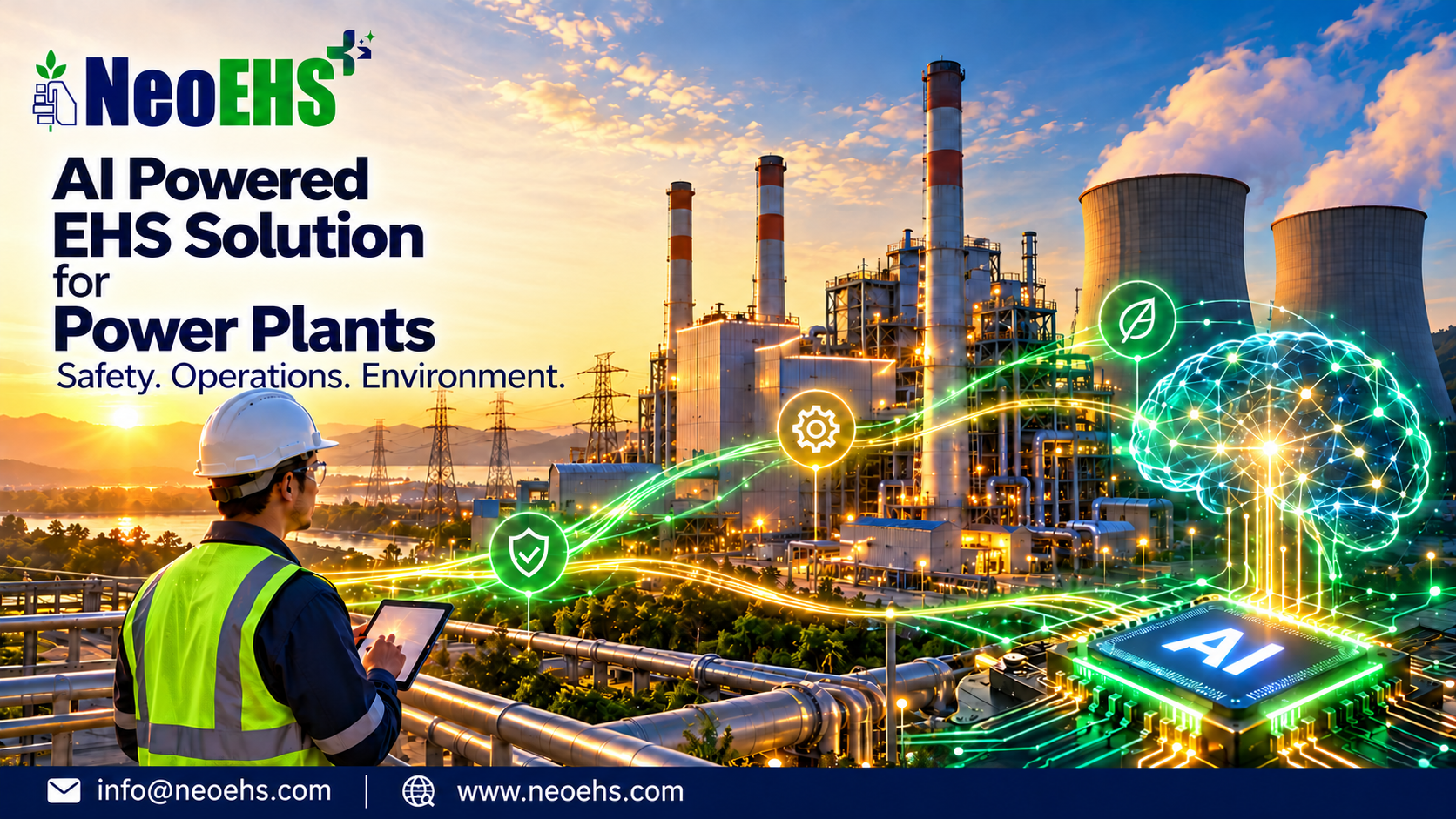
AI-Powered EHS for Power Plants: Connecting Safety, Operations and Environmental Management
What is AI-powered EHS for power plants?
AI-powered EHS for power plants combines digital safety and environmental workflows with artificial intelligence to help teams review information, identify patterns and prioritise follow-up. It connects activities such as hazard reporting, work authorisation, inspections, incident investigation and environmental monitoring. Its effectiveness depends on reliable data, suitable configuration and accountable human decisions.
NeoEHS brings this approach to the energy sector through its EHS solutions for power and energy.
Why safety, operations and environmental management belong together
These responsibilities meet in everyday work. A leaking component may create a maintenance requirement, a worker-exposure concern and an environmental issue. If each team records only its part, the overall picture can remain incomplete.
A useful shared record should answer five questions: What happened? Where? What work is affected? Who owns the response? What evidence will show that the issue is resolved?
This does not mean every employee needs access to every record. Occupational health and other sensitive information require appropriate access restrictions. The aim is to share the information necessary for each person’s responsibility.
Five practical ways connected EHS supports plant teams
1. Make work authorisation easier to follow
During busy maintenance periods, teams need to understand which activities are planned, which are authorised and which remain on hold. A digital permit record can bring the work scope, approval status and relevant checks together.
NeoEHS Permit to Work software supports digital approvals and isolation-related verification workflows. The operational value comes from making responsibilities and status visible. A digital approval does not itself establish that physical conditions are safe; authorised personnel must still complete the required site checks.
2. Learn from observations before they become forgotten records
A single near-miss report may describe a local concern. Several reports, written differently across shifts, may point to a recurring issue.
AI-assisted analysis can help group similar observations and bring them to a reviewer’s attention. For example, reports about difficult access, obstructed walkways and temporary materials may deserve a joint review of how a work area is being used.
NeoEHS Incident Management connects reporting, investigation and corrective-action tracking. The essential step is to verify whether the response addressed the underlying problem, rather than treating administrative closure as the end of the work.
3. Connect environmental observations with operational action
An unusual reading is more useful when it can be reviewed alongside its location, timestamp, measurement method and relevant operational context.
NeoEHS Environmental Management provides workflows for environmental risks, monitoring and waste records. Depending on the implementation, teams can bring observations and measurements into a shared review process and assign follow-up actions.
A suspected anomaly should prompt investigation. It may reflect a genuine operational change, a measurement problem or missing context. AI-generated alerts need that distinction before teams draw conclusions.
4. Keep responsibilities clear across shifts and contractors
A shift change should not make an unresolved concern disappear. The incoming team needs a concise view of outstanding work, relevant restrictions and the people responsible for follow-up.
For contractors, the same principle applies to readiness records and work coordination. A practical implementation should define who maintains these records, how changes are communicated and which information supervisors need before work starts.
Design these workflows around actual handovers. If field teams must enter the same information several times, adoption will suffer.
5. Give managers a clearer basis for review
A dashboard is valuable when it helps someone decide what needs attention. Useful measures include the age of overdue actions, repeat findings in the same area, time taken to review reports and the proportion of actions with verified completion evidence.
NeoEHS predictive analytics offers a way to explore patterns in EHS information. Treat a risk score as a prompt for investigation, with a clear explanation of its inputs and limitations. A low score must never be interpreted as permission to bypass established controls.
What could this look like during maintenance?
Illustrative workflow—not a customer case study or a claim about a default configuration.
Imagine maintenance is planned in an area where a recent inspection recorded a recurring leak. Another team has raised an environmental observation nearby.
In a configured connected workflow, the supervisor reviews the related records before authorisation. The responsible teams assess whether the work plan needs to change, assign actions and document their decisions. The next shift can see what remains outstanding. After the work, a reviewer checks the completion evidence and whether the concern has recurred.
AI may help surface similar historical reports. People establish the relevance, decide the response and verify the outcome.
Start with one workflow and measure what changes
A focused starting point is often more useful than attempting to digitise every activity at once. Choose a workflow with clear ownership—for example, inspection findings through to verified action closure.
- Map the handovers. Identify where information is delayed, repeated or lost.
- Agree on the records. Use consistent location, equipment and activity references.
- Define decisions. Specify who reviews, approves, escalates and verifies.
- Test with field users. Check mobile access and connectivity needs in actual working conditions.
- Compare with a baseline. Review response times, repeat findings and closure quality before expanding.
More reports after rollout may indicate improved participation. Interpret the numbers alongside workforce feedback and operational context.
Frequently asked questions
Can AI-powered EHS prevent every power plant incident?
No. AI can support pattern recognition and prioritisation, but its outputs depend on the information available. Engineering controls, competent personnel, supervision and verified work practices remain essential.
Does EHS software replace a plant control system?
No. EHS software manages workflows, records and oversight. Plant control and safety systems have separate functions. Any exchange of data requires a defined integration scope and appropriate technical review.
Can one EHS platform support different types of power plants?
Common workflows can be adapted across facilities, but their hazards, responsibilities and reporting needs differ. The implementation should reflect each site; specialised environments require additional assessment.
Does installing EHS software guarantee compliance?
No. Software can help organise evidence, responsibilities and deadlines. Compliance depends on applicable requirements, correct configuration and what the organisation actually does.
Bring the right information into the next decision
The practical test of connected EHS is simple: can the person responsible see what matters, act on it and confirm the result?
For power plants, that means connecting safety observations, operational work and environmental responsibilities in a way people can use every day.
Request a NeoEHS demonstration to discuss your plant’s workflows, data needs and implementation priorities.
READ MORE ❯
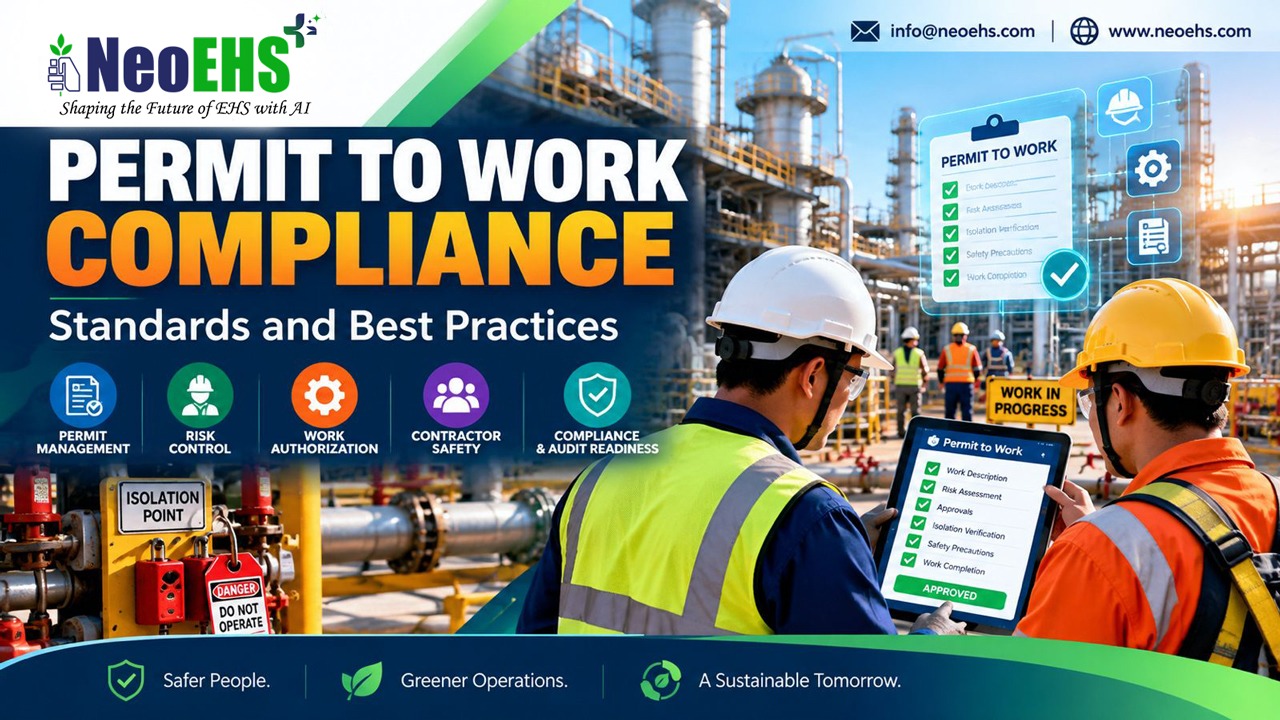
Permit To Work Compliance: Standards and Best Practices
A guide to managing high-risk work, meeting applicable safety requirements, and strengthening work authorization with digital Permit To Work systems.
A maintenance contractor is preparing to enter a vessel at a manufacturing plant. The work has been scheduled, the team has arrived, and production wants the equipment returned to service before the next shift.
The permit form appears complete.
But has the equipment been positively isolated? Has the atmosphere been tested by a competent person? Is the rescue arrangement suitable? Are nearby hot-work activities creating additional hazards? And who will stop the job if conditions change?
These questions illustrate an important principle: a signed permit does not, by itself, make hazardous work safe.
An effective Permit to Work (PTW) system coordinates the people, precautions, authorizations, and operational controls needed to carry out specified high-risk activities.
For organizations managing manufacturing plants, construction sites, power stations, ports, mines, and transport infrastructure, PTW compliance is not simply about maintaining documents. It is about ensuring that hazardous work begins only when the necessary conditions have been established and verified.
This guide explains the relevant standards, common permit types, essential controls, frequent failures, and how digital Permit to Work software can support a more reliable process.
What Is a Permit to Work System?
A Permit to Work (PTW) system is a formal work authorization process used to control specified hazardous activities. It establishes the work to be performed, associated hazards, required precautions, responsible personnel, authorization conditions, and arrangements for completion or handback.
A permit may be required when the potential consequences of an activity justify additional coordination and authorization beyond routine work instructions.
Typical examples include hot work, confined space entry, electrical maintenance, excavation, work at height, and activities involving hazardous energy.
A properly designed system answers six questions:
-
What work is being performed? Define the task, equipment, location, and scope.
-
What could go wrong? Identify relevant hazards and interfaces with other activities.
-
What controls are required? Specify isolations, testing, access restrictions, supervision, and emergency arrangements.
-
Who is responsible? Identify competent persons authorized to request, review, issue, accept, suspend, and close the permit.
-
When is work authorized? Establish the validity period, conditions, and reassessment requirements.
-
How is the work safely completed? Confirm handback, removal of temporary controls where appropriate, and authorization for restoration.
The permit is part of the control system. It does not replace the risk assessment, method statement, isolation procedure, or direct supervision.
Why Permit to Work Compliance Matters
High-risk work frequently involves several departments and contractors. Maintenance may need to coordinate with production, operations, engineering, utilities, and emergency-response personnel.
Without clear authorization arrangements, serious gaps can develop.
A contractor may assume that equipment is isolated because production has stopped. Two work groups may unknowingly perform incompatible tasks in the same area. A permit may remain open after the original conditions have changed.
An effective PTW system helps organizations:
-
Prevent unauthorized hazardous work.
-
Clarify responsibilities and approval authority.
-
Verify that required precautions have been established.
-
Coordinate simultaneous operations.
-
Control permit validity, suspension, and handback.
-
Improve contractor communication.
-
Maintain evidence for internal review and applicable compliance obligations.
-
Learn from permit deviations and recurring control weaknesses.
The goal is not to issue more permits. It is to make sure the right activities are controlled through the right level of authorization.
Permit to Work Standards and Regulatory Requirements
One of the most common questions is whether there is a single international Permit to Work standard.
There is no single PTW standard that automatically governs every industry and country. Requirements depend on local legislation, the type of work, sector-specific rules, and the organization's operating conditions.
Several established standards and guidance documents help organizations design and evaluate their systems.
ISO 45001: Occupational Health and Safety Management Systems
ISO 45001 provides requirements for an occupational health and safety management system.
Although it is not a dedicated PTW technical standard, its requirements concerning hazard identification, risk assessment, operational planning and control, contractor coordination, competence, and continual improvement are relevant to permit-controlled work.
A PTW process can form part of the operational controls used to manage identified OH&S risks.
However, using digital PTW software does not automatically establish conformity with ISO 45001 or guarantee certification.
UK HSE HSG250: Guidance on Permit-to-Work Systems
The UK Health and Safety Executive's HSG250, Guidance on Permit-to-Work Systems, is an established reference for petroleum, chemical, and related industries.
It discusses the organization and management of permit systems, including work planning, risk assessment, competence, monitoring, audits, and reviews.
Although developed for particular industrial settings, its principles can inform PTW design in other sectors when appropriately adapted.
OSHA Requirements in the United States
In the United States, specific Occupational Safety and Health Administration requirements apply to particular hazardous activities.
For example:
-
29 CFR 1910.146: Permit-required confined spaces in general industry.
-
29 CFR 1910.147: Control of hazardous energy, commonly known as lockout/tagout.
-
29 CFR 1910.252: Fire prevention and protection requirements relevant to welding and cutting.
-
29 CFR 1926 Subpart AA: Confined spaces in construction.
These provisions do not create a universal requirement to use one PTW form for every hazardous task.
Organizations must identify the provisions that actually apply to their activities.
Malaysia: DOSH and Applicable Safety Legislation
In Malaysia, organizations should evaluate their duties under the Occupational Safety and Health Act 1994 (Act 514), as amended, relevant subsidiary regulations, and applicable Department of Occupational Safety and Health (DOSH/JKKP) guidance.
Particular activities, including confined space entry, may be subject to additional requirements and industry-specific codes of practice.
A digital permit process should be configured around those obligations rather than assuming that one international template satisfies every Malaysian workplace.
Other Sector-Specific Requirements
Additional requirements may apply in mining, maritime operations, electrical installations, construction, rail infrastructure, and energy facilities.
A reliable compliance approach therefore begins with a legal and technical requirements review for each jurisdiction and operation.
Best practice: Maintain a clear distinction between mandatory legal obligations, recognized standards, industry guidance, and company procedures.
Common Types of Permit to Work
Not every workplace needs the same permit categories. The permit structure should reflect the organization's risk profile.
| Permit type | Typical activities | Key control considerations |
|---|---|---|
| Hot work | Welding, cutting, grinding | Combustibles, fire prevention, atmosphere, fire watch |
| Confined space entry | Vessel, tank, pit, or chamber entry | Isolation, atmospheric testing, ventilation, attendant, rescue |
| Electrical work | Maintenance of electrical installations | De-energization, isolation, verification, authorized personnel |
| Work at height | Roof work, elevated maintenance | Fall prevention, access, rescue planning, dropped objects |
| Excavation | Trenching, underground works | Buried services, ground stability, access, adjacent activities |
| Lifting operations | Complex or high-risk lifting | Lift planning, equipment suitability, exclusion zones |
| Line breaking | Opening process piping | Pressure, temperature, hazardous substances, isolation |
| General high-risk maintenance | Nonroutine equipment work | Task-specific hazards, energy control, interfaces |
Some organizations use a general work permit with additional certificates or task-specific authorizations.
Others use separate permit categories.
The important requirement is that the system clearly identifies all necessary precautions without creating conflicting or duplicated approvals.
The Permit to Work Lifecycle: Eight Essential Stages
1. Plan the Work
Define the work scope, equipment, location, workforce, timing, and expected operational interfaces.
Check whether the activity requires a permit and whether other permits or certificates must be coordinated.
2. Assess the Risks
Conduct an appropriate risk assessment, such as HIRA, HIRARC, JSA, or JHA, using the methodology required by the organization.
Consider normal conditions, credible deviations, environmental conditions, and simultaneous activities.
3. Establish the Controls
Identify the required engineering, isolation, procedural, access, and emergency controls.
Apply the hierarchy of controls. Personal protective equipment must not be used as a substitute for practicable higher-order safeguards.
4. Verify Site Readiness
Competent and authorized personnel should verify relevant conditions at the worksite.
Examples include isolation verification, atmospheric testing, barriers, equipment condition, and rescue arrangements.
A completed digital checklist is evidence of a recorded verification step, not proof that the physical condition is safe.
5. Review and Authorize
The designated issuing authority reviews the permit conditions and confirms that the required prerequisites have been satisfied.
Approval responsibilities should be separated or independently verified where the risks and operating rules require it.
6. Communicate and Execute
Workers must understand the task, permit boundaries, hazards, controls, stop-work conditions, and emergency arrangements.
The permit should remain accessible as required by site procedures.
7. Monitor, Suspend, or Revalidate
Conditions may change during the job.
A change in work scope, atmosphere, isolation status, weather, adjacent activities, or shift may require suspension, reassessment, revalidation, or a new permit.
An expired permit must not be treated as valid merely because the work is unfinished.
8. Close and Hand Back
Confirm that the work is complete or otherwise left in a controlled condition, personnel are accounted for, and equipment is ready for the appropriate restoration process.
Permit closure and return-to-service authorization must follow the organization's approved procedures.
Ten Permit to Work Best Practices
1. Use a Risk-Based Permit Matrix
Define which tasks require permits, additional certificates, or specialist authorization.
Avoid requiring the same process for every low-risk routine task while overlooking activities with severe potential consequences.
2. Make Responsibilities Unambiguous
Clearly distinguish the permit requester, issuing authority, performing authority, area owner, isolating authority, and other required roles.
Job titles may differ across organizations, but responsibilities must be understood.
3. Link Permits to Risk Assessments
A permit should reference the relevant task risk assessment and controls.
If the work changes, both the assessment and authorization may need review.
4. Verify Hazardous Energy Isolation
Electrical, mechanical, hydraulic, pneumatic, thermal, gravitational, and stored-energy hazards may require isolation or other controls.
Follow the applicable energy-control procedures and verification requirements.
5. Coordinate Simultaneous Operations
Review whether nearby work creates additional hazards.
For example, welding near solvent handling, lifting over active work areas, or excavation beside energized services may require additional restrictions or coordination.
6. Control Permit Validity
Set clear start and end conditions, shift handover arrangements, suspension rules, and reauthorization requirements.
7. Verify Contractor Competence
Check that contractor personnel possess the required training, qualifications, authorizations, and task-specific understanding.
A valid induction record does not establish competence for every hazardous activity.
8. Maintain Effective Emergency Arrangements
High-risk work may require task-specific rescue, emergency communication, firefighting provisions, or standby personnel.
These arrangements should be practicable and understood before work starts.
9. Audit Permit Quality, Not Just Permit Numbers
Review whether permits accurately describe the work, identify relevant hazards, and document effective controls.
Counting completed permits is not a meaningful safety-performance measure by itself.
10. Learn From Deviations and Near Misses
Investigate recurring permit problems, incomplete isolation records, unauthorized work, poor handovers, and failed control verification.
Use findings to improve the system rather than treating every deviation as an isolated paperwork error.
Common Permit to Work Failures
Even mature organizations can experience weaknesses in PTW implementation.
Copy-and-paste risk assessments: Generic hazards and precautions are repeated without considering actual worksite conditions.
Approval without verification: A permit is signed before the required physical controls have been confirmed.
Unclear work boundaries: Workers misunderstand the authorized location, equipment, or scope.
Poor shift handover: Incoming teams do not receive accurate information about permit status and outstanding hazards.
Disconnected isolations: Energy-control records are not adequately coordinated with the authorized work.
Permit overload: Excessive paperwork makes it harder to distinguish significant risks.
Premature closure: A permit is closed without completing the required handback checks.
Weak contractor coordination: Different organizations assume that another party is responsible for critical precautions.
These are management-system problems. Simply converting a paper form into an electronic form will not eliminate them.
How Digital Permit to Work Software Supports Compliance
A digital Permit to Work system can improve the consistency and traceability of work authorization.
Depending on the product and configuration, digital PTW capabilities may include:
-
Structured permit requests and task-specific forms.
-
Defined review and approval workflows.
-
Links to risk assessments and supporting documents.
-
Permit validity and status tracking.
-
Mobile access for authorized field personnel.
-
Evidence attachments and inspection records.
-
Visibility of outstanding or active permits.
-
Audit trails and management reporting.
-
Connections to contractor and corrective-action workflows.
For a plant with multiple maintenance teams, these capabilities can make it easier to understand which permits are awaiting review, which are active, and which require attention.
However, digital approval is not equivalent to physical worksite verification.
A reliable digital process must reinforce—not bypass—the competence, authority, and operational controls required for safe work.
How NeoEHS Supports Permit to Work Management
NeoEHS is an AI-powered Environment, Health and Safety management software platform that includes digital Permit to Work functionality.
Its dedicated Permit to Work Software solution describes capabilities including mobile approvals, QR-based permit verification, geotagged worksite evidence, photo documentation, and connections with related EHS workflows.
NeoEHS also provides a General Permit to Work solution for organizing work authorization processes.
The wider NeoEHS EHS Software platform connects permit management with risk assessment, incidents, inspections, audits, contractor management, and reporting.
Connected Risk Assessment
Linking a permit to relevant risk information can help reviewers understand the identified hazards and required precautions.
Digital Authorization
Defined approval workflows can improve traceability and reduce uncertainty about who has reviewed or authorized a permit.
Field Documentation
Mobile photographs, location information, and permit verification records can support worksite documentation when appropriately configured.
Contractor Coordination
Connections with contractor-related information can help organizations review relevant documentation and responsibilities.
Audit and Management Visibility
Permit records can support internal reviews, investigation of deviations, and identification of recurring authorization problems.
AI-Assisted Compliance Intelligence
NeoEHS describes intelligent validation, automated compliance checks, and predictive risk alerts within its PTW offering.
These functions should be assessed through a demonstration using representative customer workflows. Any AI-generated recommendation or alert must remain subject to competent human review, particularly for safety-critical decisions.
Specific functionality, integration requirements, and deployment arrangements should be confirmed during solution evaluation.
Practical Example: A Hot Work Permit at a Manufacturing Plant
Consider a hypothetical food-processing plant preparing to repair a steel support near an operating production line.
The repair requires welding.
The maintenance supervisor submits a hot-work request, identifying the equipment, location, task, personnel, and proposed work period.
The risk assessment identifies combustible packaging materials, adjacent operations, electrical equipment, and possible exposure to fumes.
Before authorization, the responsible personnel arrange the necessary fire-prevention measures, work-area controls, equipment checks, and emergency provisions.
If required by the site's procedure, a fire watch is assigned.
The issuing authority reviews the conditions and verifies that the necessary prerequisites have been met.
During the work, production plans change and combustible materials are moved closer to the area.
The work must be reassessed and, where necessary, stopped until the controls are restored and authorization requirements are satisfied.
Once the repair is complete, the team follows the required inspection and handback process.
A connected digital PTW system can support documentation, approvals, status visibility, and follow-up throughout this sequence.
It cannot independently determine whether the welding area is safe.
That responsibility remains with competent personnel following the approved work controls.
This example is illustrative and does not represent a claimed customer implementation or measured result.
Permit to Work Audit Checklist
Organizations can use the following questions when reviewing their PTW arrangements.
| Audit question | Evidence to examine |
|---|---|
| Are permit-controlled activities clearly defined? | PTW procedure and permit matrix |
| Are authorized roles and responsibilities documented? | Role definitions and authorization records |
| Are task-specific hazards identified? | Risk assessments and permit records |
| Are required isolations verified? | Isolation records and field checks |
| Are simultaneous activities considered? | Coordination records and work plans |
| Are contractors appropriately assessed? | Competency and contractor documentation |
| Are permit validity and handovers controlled? | Permit history and shift records |
| Are stop-work and suspension rules understood? | Procedures, briefings, interviews |
| Is closure and handback properly verified? | Completion and restoration records |
| Are PTW weaknesses reviewed and corrected? | Audits, incident findings, CAPA records |
A strong audit should include field observation and interviews, not only a document review.
Measuring Permit to Work Performance
Organizations should avoid relying exclusively on the number of permits issued.
More useful indicators may include:
-
Percentage of sampled permits meeting defined quality criteria.
-
Percentage of required field verifications completed correctly.
-
Number and severity of unauthorized-work events.
-
Repeated isolation or handover deficiencies.
-
Overdue high-risk corrective actions.
-
Frequency of permit suspensions caused by changing conditions.
-
Findings from contractor PTW audits.
-
Evidence that corrective actions address underlying causes.
These indicators need context.
For example, an increase in recorded permit suspensions may reflect better reporting and stronger stop-work behavior rather than deteriorating safety.
The objective is to understand whether critical controls are working reliably.
Frequently Asked Questions
What is Permit to Work compliance?
Permit to Work compliance means following the applicable legal requirements, operating procedures, authorization rules, and safety controls governing specified hazardous work. It involves more than completing a permit form.
Is a Permit to Work legally mandatory?
It depends on the jurisdiction, industry, and activity. Some regulations require specific permits or formal authorization processes, while other activities are governed by broader risk-control duties. Organizations must identify their applicable requirements.
What is the difference between a work permit and a risk assessment?
A risk assessment identifies hazards, evaluates risks, and determines controls. A work permit authorizes specified work under defined conditions and responsibilities. The two processes should complement each other.
Who should approve a Permit to Work?
Approval should be performed by personnel formally authorized and competent for the relevant work and operating area, in accordance with the organization's procedures and applicable requirements.
What is the difference between Permit to Work and lockout/tagout?
Permit to Work coordinates authorization and controls for hazardous activities. Lockout/tagout is a hazardous-energy control process. A permit does not replace the physical isolation and verification steps required for energy control.
Can Permit to Work be managed digitally?
Yes. Digital PTW systems can support requests, reviews, approvals, documentation, status tracking, and audit trails. They must still preserve required field verification and safety-critical controls.
Does digital Permit to Work software guarantee ISO 45001 compliance?
No. Software can support relevant management-system processes and evidence, but ISO 45001 conformity depends on the organization's implemented OH&S management system.
How does AI help with Permit to Work management?
AI may assist with identifying incomplete information, detecting recurring permit issues, or highlighting conditions that deserve review. Its effectiveness depends on validated capabilities, reliable data, and human oversight.
Which industries benefit from digital PTW?
Manufacturing, construction, power generation, oil and gas, mining, ports, logistics, and transport infrastructure can benefit where their operations involve permit-controlled hazardous work.
What should organizations look for in PTW software?
Evaluate configurable permit types, approval responsibilities, risk-assessment links, isolation coordination, field usability, contractor controls, audit trails, reporting, security, and integration requirements.
Conclusion: Effective PTW Compliance Is About Control, Not Paperwork
A reliable Permit to Work system helps organizations coordinate hazardous activities, communicate responsibilities, verify precautions, and maintain control as conditions change.
Standards and guidance provide a framework, but the effectiveness of PTW depends on what happens at the worksite.
Digital systems can strengthen consistency, traceability, and visibility. AI-assisted features may provide additional support when properly validated.
The essential principle remains unchanged:
Work should begin only when the required controls are established, understood, and verified—and it should stop when those conditions are no longer satisfied.
For organizations seeking to improve their PTW processes, NeoEHS offers connected digital Permit to Work capabilities within a broader EHS management platform.
Explore NeoEHS Permit to Work Software: https://www.neoehs.com/solutions/permit-to-work-software
Website: https://www.neoehs.com/
Email: info@neoehs.com
NeoEHS — Safer People. Greener Operations. A Sustainable Tomorrow.
READ MORE ❯
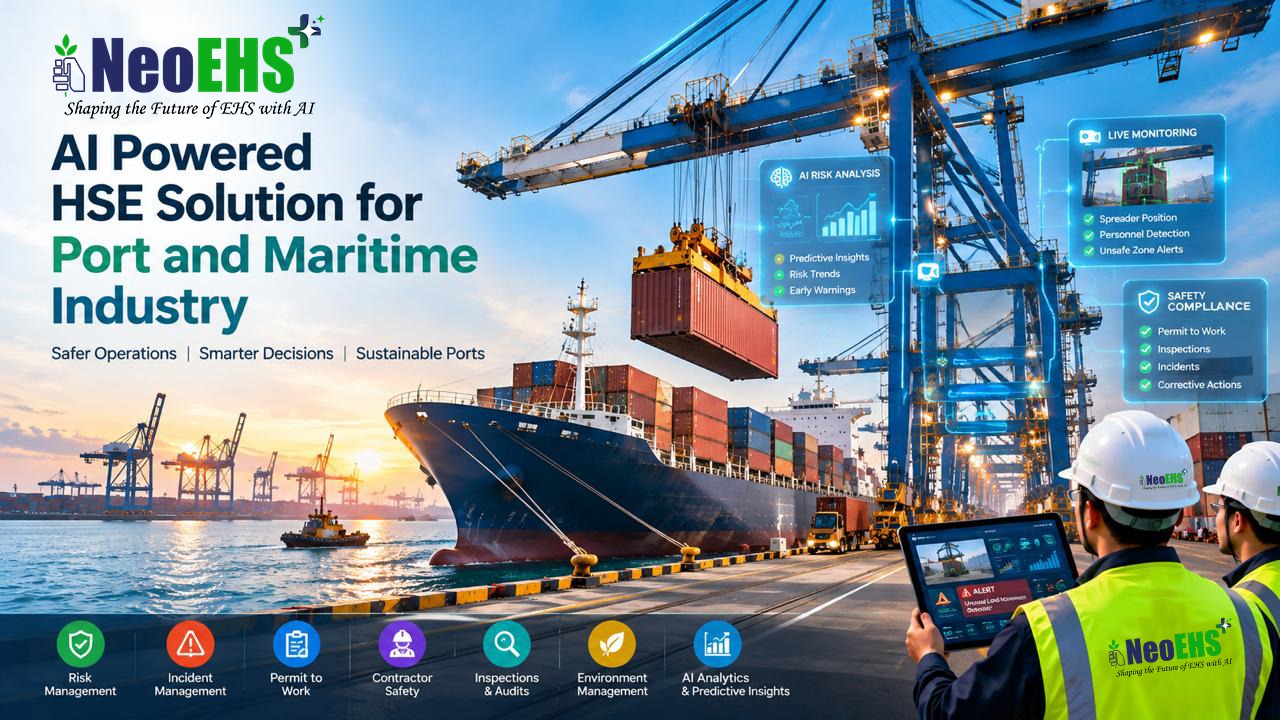
Ship-to-Shore Crane Lifting Risk Assessments: A Practical EHS Guide for Port and Maritime Industries
Crane lifting hazards, assessing operational risks, implementing critical safety controls, and strengthening EHS performance across container terminals and maritime operations.
Ship-to-shore (STS) container cranes are essential to modern port operations. They move containers between vessels and terminals, often under demanding schedules, changing weather conditions, and complex coordination between crane operators, vessel crews, lashers, terminal equipment operators, and maintenance personnel.
The scale of these operations creates significant safety challenges. A single uncontrolled lift can expose workers to suspended loads, moving machinery, falling objects, equipment collisions, and serious injuries. In addition to human consequences, crane incidents can disrupt terminal operations, damage vessels or infrastructure, and create substantial commercial losses.
For port and terminal operators, ship-to-shore crane lifting risk assessment is not simply a compliance exercise. It is a fundamental operational safety process.
This guide explains how to identify STS crane hazards, assess lifting risks, select appropriate controls, investigate incidents, and use digital EHS systems to strengthen safety assurance.
What Is a Ship-to-Shore Crane Lifting Risk Assessment?
A ship-to-shore crane lifting risk assessment is a structured process used to identify hazards associated with loading and unloading containers between vessels and terminals, evaluate the likelihood and potential severity of harm, and establish controls to reduce the risk.
The assessment should consider the crane, lifting accessories, container, vessel, quay, personnel, traffic movements, weather conditions, and operational interfaces.
A practical STS crane assessment typically covers:
-
Crane structural and mechanical integrity
-
Hoisting, trolley, gantry, and spreader operations
-
Container weight, condition, and securing arrangements
-
Suspended-load and dropped-object exposure
-
Crane-to-crane and crane-to-vessel clearances
-
Vessel movement and operational coordination
-
Wind, lightning, visibility, and other weather conditions
-
Personnel access and exclusion zones
-
Maintenance, inspection, and emergency arrangements
The assessment must be appropriate to the specific crane, terminal, task, operating conditions, and applicable legal requirements.
Why STS Crane Lifting Operations Are High Risk
Unlike many conventional lifting operations, STS crane activities involve repeated container movements between two operating environments: a moving or potentially moving vessel and a fixed shore-based terminal.
The working environment may change throughout a shift.
A vessel's position, container stack configuration, operational visibility, weather conditions, and the movement of personnel or terminal vehicles can all influence lifting safety.
Consider a typical container discharge operation.
The crane operator positions the spreader over a container, engages the twistlocks, lifts the load, moves it across the vessel-to-shore interface, and lowers it onto a waiting terminal vehicle or designated transfer location.
At every stage, an unexpected event can introduce risk.
A twistlock may fail to release correctly. A container may be damaged or incorrectly declared. A person may enter an exclusion zone. The crane may experience an equipment fault. Wind conditions may deteriorate.
A robust risk assessment must anticipate these scenarios before an incident occurs.
1. Identify the Major Hazards in Ship-to-Shore Crane Operations
Suspended Loads and Dropped Containers
One of the most serious hazards is the uncontrolled release or fall of a container or lifting component.
Potential contributing factors include:
-
Incorrect spreader engagement
-
Twistlock malfunction or incomplete engagement
-
Damaged container corner castings
-
Incorrect container weight information
-
Lifting equipment defects
-
Improper handling of snagged or obstructed containers
-
Unexpected load movement
Recommended controls: Verify spreader engagement and equipment condition, use appropriate lifting procedures, enforce exclusion zones, and establish clear stop-work arrangements for abnormal lifts.
Personnel should never be permitted beneath suspended containers.
Crane Structural and Mechanical Failure
STS cranes are complex structures containing hoisting systems, wire ropes, sheaves, brakes, drives, trolley mechanisms, gantry systems, and structural members.
Failures involving these components may result in uncontrolled movement, dropped loads, or crane instability.
Risk assessments should consider inspection findings, maintenance history, manufacturer requirements, structural condition, operational limits, and any outstanding defects.
Crane-to-Crane and Crane-to-Vessel Collisions
Container terminals may operate multiple cranes along the same quay.
Potential collision scenarios include adjacent cranes operating too close together, gantry movements near obstructions, and crane components contacting vessel structures.
Controls may include approved operating clearances, anti-collision systems, communication protocols, travel restrictions, and effective coordination between crane operators and terminal control personnel.
High Winds and Adverse Weather
Wind can affect suspended-container stability and crane operation. Lightning, poor visibility, heavy rainfall, and other adverse conditions may introduce additional hazards.
The applicable operating and shutdown limits must come from the crane manufacturer's instructions, terminal procedures, engineering assessments, and relevant regulations.
A single generic wind-speed threshold should not be assumed suitable for every crane or terminal.
Personnel and Vehicle Interaction
Crane operations frequently involve workers and mobile equipment within or near operational areas.
Risks include personnel entering lifting zones, terminal vehicles moving beneath loads, and workers being exposed to crane travel or container movement.
Traffic separation, access control, communication, designated operating zones, and supervision are essential.
Maintenance and Unexpected Energization
Maintenance work introduces different hazards from routine container handling.
Electrical systems, stored mechanical energy, elevated work locations, hydraulic systems, and moving machinery can create serious exposure.
Maintenance risk assessments should address isolation, lockout/tagout, verification of zero-energy state where applicable, working at height, rescue arrangements, and controlled return to service.
2. Conduct a Step-by-Step STS Crane Lifting Risk Assessment
A useful assessment should follow the actual lifting operation rather than rely on a generic checklist.
Step 1: Define the Task and Operating Conditions
Identify the crane, vessel, berth, container-handling activity, personnel involved, and operating environment.
Confirm the planned lifting sequence and any non-routine circumstances, such as abnormal cargo, maintenance restrictions, reduced visibility, or unusual vessel arrangements.
Step 2: Break the Operation Into Activities
Typical activities include:
-
Pre-operational crane inspection
-
Vessel and terminal coordination
-
Crane and spreader positioning
-
Spreader engagement
-
Container lifting and clearance
-
Trolley travel and load transfer
-
Container landing
-
Spreader disengagement
-
Crane repositioning
-
Shutdown or handover
Each activity may require different safety controls.
Step 3: Identify Hazards and Exposed Persons
Identify what could go wrong, who may be harmed, and how the event could occur.
Include crane operators, maintenance technicians, lashers, vessel crew, terminal vehicle operators, contractors, and other personnel who may enter the affected area.
Step 4: Evaluate Risk
Use the organization's approved risk assessment methodology.
A risk matrix may consider likelihood and consequence, but numerical scores should not replace engineering judgment or the assessment of potentially catastrophic events.
For high-consequence lifting scenarios, particular attention should be given to the reliability of critical controls.
Step 5: Apply the Hierarchy of Controls
Controls should be selected using the hierarchy of controls:
-
Elimination: Remove unnecessary exposure or avoid an unsafe lift.
-
Substitution: Use a safer handling method where feasible.
-
Engineering controls: Use suitable interlocks, overload protection, anti-collision systems, and physical segregation.
-
Administrative controls: Establish approved procedures, lift plans, competency requirements, inspections, communication, and supervision.
-
Personal protective equipment: Provide appropriate PPE for residual exposure.
PPE should not be treated as the primary safeguard against falling containers or major crane failures.
Step 6: Verify Controls Before Lifting
Before the operation begins, confirm that the required controls are in place and functioning.
Critical checks may include crane fitness for service, spreader condition, weather suitability, communication arrangements, exclusion zones, and the availability of competent personnel.
Step 7: Monitor and Reassess
Risk assessment is not completed when the form is signed.
The assessment should be reviewed when conditions change, defects are discovered, abnormal loads are encountered, or the operation deviates from the approved method.
Workers must have a clear means of stopping work when conditions become unsafe.
3. Example STS Crane Lifting Risk Assessment
The following example illustrates how a port safety team might structure an assessment. It is not a substitute for a site-specific assessment by competent personnel.
| Activity | Hazard | Potential Consequence | Example Control |
|---|---|---|---|
| Container lifting | Incorrect spreader engagement | Dropped container, fatal injury | Engagement verification, equipment checks, exclusion zones |
| Trolley movement | Suspended-load movement | Collision or struck-by injury | Operating procedures, clear travel path, access restrictions |
| Gantry movement | Adjacent crane or obstruction | Structural damage, serious injury | Clearance verification, anti-collision safeguards |
| Vessel interface | Unexpected vessel movement | Contact or unstable lifting conditions | Vessel–terminal coordination and operational monitoring |
| Adverse weather | High wind or lightning | Loss of control, crane damage | Site-specific weather limits and shutdown procedures |
| Maintenance | Unexpected energization | Electric shock or crush injury | Energy isolation, verification and controlled handback |
For every significant hazard, the assessment should also identify the responsible person, control verification method, residual risk, and required authorization.
4. Critical Safety Controls for STS Crane Operations
A critical control is a safeguard whose failure could materially increase the likelihood or consequences of a major unwanted event.
In STS crane operations, critical controls may include:
-
Functional lifting and overload protection
-
Effective spreader engagement verification
-
Suitable crane inspection and maintenance
-
Controlled exclusion zones
-
Crane movement and collision safeguards
-
Weather-related operating restrictions
-
Competent operators and clear communications
-
Effective maintenance isolation
-
Emergency stop and response arrangements
The important question is not simply whether a control is documented.
Can the terminal demonstrate that the control is effective when it is needed?
For example, recording that an anti-collision system exists is different from confirming that it has been inspected, tested, and maintained according to the applicable requirements.
Critical-control verification should be based on the site's engineering and safety management arrangements.
5. Common STS Crane Incidents and Near Misses
Port safety teams should learn from both actual incidents and events that could have resulted in serious harm.
Dropped Container Incidents
Investigations should consider equipment condition, spreader engagement, container integrity, operating methods, and supervision.
Crane Collision Near Misses
These may involve inadequate clearance, communication failures, equipment faults, or poor coordination between simultaneous operations.
Unexpected Load Movement
Possible contributing factors include snagged containers, unexpected restraint, handling conditions, and procedural deviations.
Maintenance Injuries
Maintenance investigations should examine isolation effectiveness, access arrangements, task planning, competency, and handover procedures.
Unauthorized Entry Into Lifting Zones
Investigations should examine traffic management, physical barriers, signage, operational communication, and whether the exclusion zone was practical and consistently enforced.
A strong investigation looks beyond individual mistakes to identify system weaknesses and recurring patterns.
6. Why Traditional Paper-Based Risk Assessments Often Fall Short
Paper-based risk assessments can support safe operations when they are properly prepared, communicated, reviewed, and implemented.
However, large terminals may face practical difficulties when assessments are managed across multiple shifts, cranes, berths, contractors, and departments.
Common challenges include outdated forms, inconsistent hazard classifications, delayed corrective actions, fragmented inspection records, and limited visibility of repeated incidents.
A digital EHS system can help standardize information and improve traceability.
For example, a crane inspection finding can be linked to a corrective action, assigned to a responsible person, and reviewed alongside maintenance and incident records.
The benefit comes from better control of information and follow-through, not simply replacing paper with a screen.
7. How AI-Powered EHS Software Can Support Port Crane Safety
AI-assisted EHS technologies can help safety teams identify patterns and prioritize attention, provided that their outputs are validated and used with appropriate human oversight.
Potential applications include:
Incident Pattern Analysis
AI-assisted analysis may help identify recurring incident categories, contributing factors, or trends across cranes, shifts, and operational locations.
Risk Assessment Assistance
Digital tools can help teams reuse approved hazard libraries, review historical findings, and identify potentially missing considerations.
Any AI-generated recommendation should be checked by competent personnel before being used in a safety-critical decision.
Inspection and Corrective Action Tracking
Digital workflows can help connect inspection findings to responsible personnel, corrective actions, deadlines, and verification records.
Predictive Risk Intelligence
Where reliable operational and historical data are available, analytics may help identify patterns associated with increased exposure or recurring failures.
Such systems require validation and should not be treated as capable of predicting every accident.
Computer Vision and Connected Systems
Where appropriately designed and authorized, camera-based and connected systems may support monitoring of defined operational conditions.
Their effectiveness depends on camera coverage, environmental conditions, data quality, integration, and site-specific testing.
They should not replace engineered crane safety systems, approved operating procedures, or direct operational supervision.
8. Supporting Port and Maritime Safety With NeoEHS
NeoEHS is an AI-powered Environment, Health and Safety management platform designed to support organizations in managing operational risks, incidents, inspections, corrective actions, compliance information, and EHS performance.
For port and maritime organizations, a unified EHS approach can help connect activities that are often managed separately:
-
Crane and lifting risk assessments
-
Hazard and near-miss reporting
-
Safety inspections and observations
-
Incident investigation and corrective actions
-
Contractor and workforce safety
-
Permit-to-work processes
-
EHS reporting and management dashboards
By bringing related safety information into a consistent management process, port operators can strengthen accountability, improve visibility, and support more timely follow-up.
The suitability and availability of individual NeoEHS features, integrations, and AI capabilities should be confirmed during solution evaluation.
Explore NeoEHS to discuss how digital EHS workflows can support your port and maritime safety operations.
9. Practical STS Crane Safety Checklist
Before commencing crane operations, supervisors and responsible personnel should confirm the following, as applicable:
-
The crane is authorized and fit for the intended operation.
-
Required pre-operational inspections have been completed.
-
Reported defects and operating restrictions have been reviewed.
-
Lifting accessories and spreader arrangements are suitable.
-
The vessel and terminal teams understand the operating plan.
-
Container handling arrangements are appropriate for the task.
-
Personnel exclusion zones are established.
-
Terminal vehicle movements are controlled.
-
Communication systems and responsibilities are clear.
-
Weather conditions remain within approved operating limits.
-
Emergency and stop-work arrangements are understood.
-
Any non-routine lift has received the necessary additional assessment and authorization.
This checklist is illustrative and must be adapted to the crane manufacturer's instructions, terminal procedures, and applicable regulations.
10. Frequently Asked Questions
What are the main hazards of ship-to-shore crane lifting?
The principal hazards include dropped containers, suspended loads, crane mechanical failure, crane collisions, unexpected load movement, adverse weather, personnel entering lifting zones, and hazardous maintenance activities.
How often should an STS crane lifting risk assessment be reviewed?
It should be reviewed according to applicable requirements and the organization's risk management procedures, and whenever relevant conditions change. Changes in equipment condition, lifting methods, operating environment, or incident findings may require reassessment.
What is the difference between a lifting risk assessment and a lifting plan?
A risk assessment identifies hazards, evaluates risk, and determines controls. A lifting plan describes how a lifting operation will be performed safely, including the equipment, personnel, sequence, responsibilities, and controls. The documents should support one another.
Can AI prevent ship-to-shore crane accidents?
AI may help identify trends, improve reporting, and support risk analysis. It cannot guarantee accident prevention and should not replace engineered safeguards, competent supervision, inspections, or approved operational controls.
Why are exclusion zones important during container lifting?
Exclusion zones reduce the likelihood of people being exposed to suspended loads, falling objects, crane movement, and other hazardous operating conditions.
What records should a terminal retain for crane lifting safety?
Relevant records may include risk assessments, lifting plans, crane inspections, maintenance history, operator competency, incident investigations, corrective actions, equipment defects, and critical-control verification.
How can EHS software improve crane lifting risk management?
EHS software can help organize risk assessments, inspection findings, incident records, action tracking, and management reporting. Its value depends on the quality of the underlying processes, data, and implementation.
11. Final Thoughts: Safer Lifting Starts Before the Container Moves
Ship-to-shore crane safety depends on much more than the crane operator's skill.
It requires suitable equipment, effective engineering safeguards, competent personnel, coordinated terminal operations, reliable communication, and continuous verification of critical controls.
The strongest risk assessments are not the longest documents. They are the assessments that identify credible hazards, establish practical controls, and influence how work is actually performed.
For ports and container terminals looking to strengthen their EHS management processes, digital systems can help connect risk assessment, inspections, incident learning, and corrective actions into a more consistent approach.
NeoEHS — Safer People. Greener Operations. A Sustainable Tomorrow.
Editorial note: This article provides general EHS guidance. It does not replace a site-specific lifting assessment, manufacturer instructions, competent engineering advice, or applicable port and maritime regulations.
READ MORE ❯
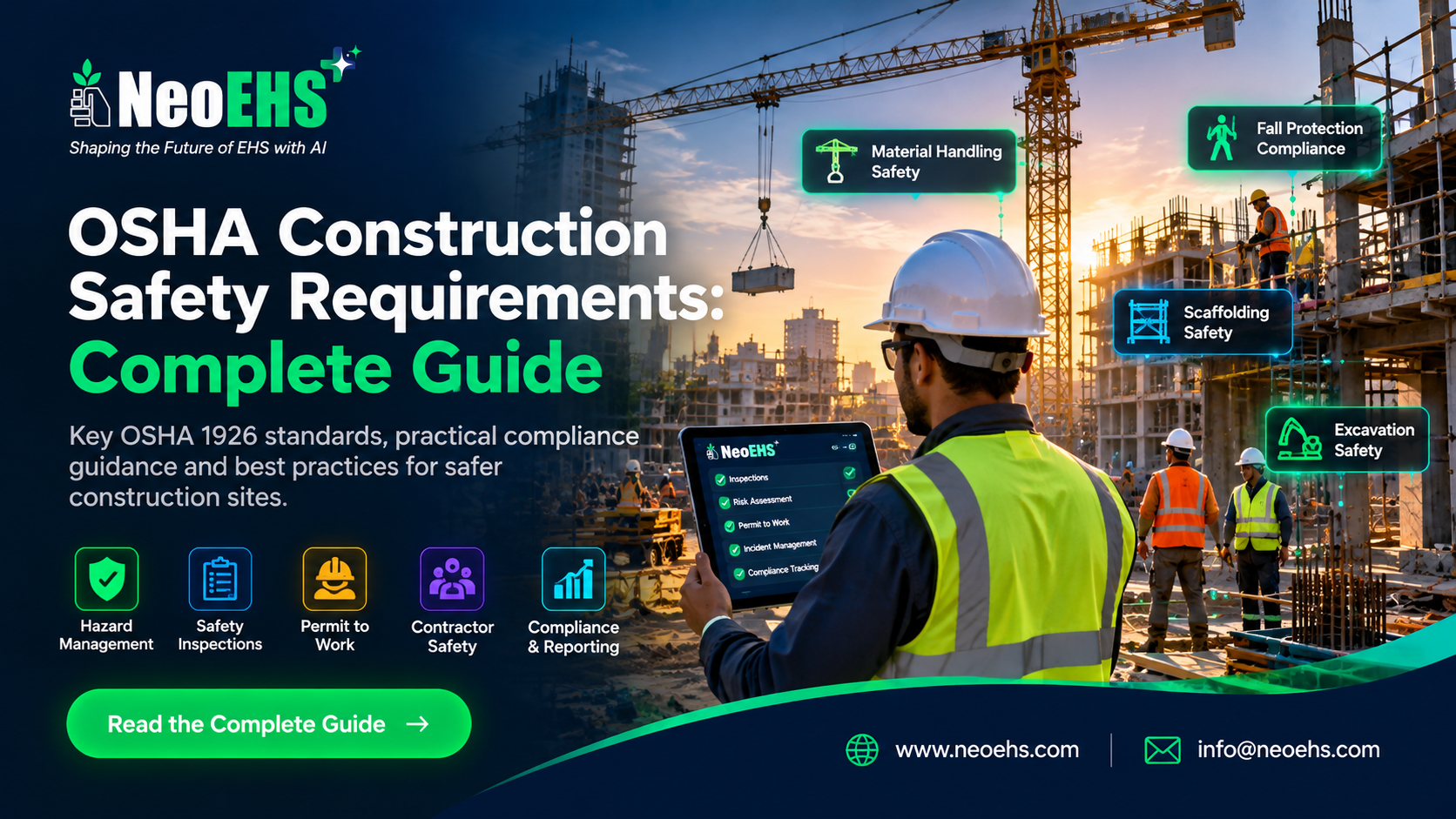
OSHA Construction Safety Requirements: Complete Guide for Contractors and Safety Managers
Why OSHA compliance matters on every construction project
Construction sites are constantly changing. A safe work area in the morning can become hazardous by the afternoon as new contractors arrive, scaffolding is modified, excavation progresses and heavy equipment moves through active work zones.
For contractors and project owners, managing these changing conditions is one of the greatest challenges in workplace safety.
The Occupational Safety and Health Administration (OSHA) establishes workplace safety and health requirements intended to protect employees from recognized hazards. In the United States, construction work is principally governed by 29 CFR Part 1926, together with other applicable OSHA provisions.
These regulations address hazards such as falls, electrical exposure, excavation collapse, struck-by incidents, hazardous substances, equipment operations and unsafe access.
However, effective OSHA compliance requires more than maintaining a collection of safety documents.
Contractors must identify hazards, implement appropriate controls, train workers, inspect work areas, correct unsafe conditions and maintain required records.
This guide explains the major OSHA construction safety requirements, their practical application and how AI-powered EHS software such as NeoEHS can support more consistent construction safety management.
What are OSHA construction safety requirements?
OSHA construction safety requirements are federal occupational safety and health rules that establish minimum protections for employees performing construction activities in the United States.
The primary standards are contained in 29 CFR Part 1926.
They cover activities including construction, alteration, repair, painting and decorating, subject to the applicable regulatory definitions and scope.
OSHA construction requirements address several essential areas:
-
Hazard identification and control
-
Fall protection and working at height
-
Scaffolding and ladder safety
-
Excavation and trenching
-
Electrical safety
-
Personal protective equipment
-
Cranes and material handling
-
Hazard communication
-
Worker training
-
Emergency preparedness
-
Occupational exposure and health protection
Employers must also consider applicable recordkeeping and reporting requirements, state-plan rules and the OSH Act's general duty requirements where relevant.
The exact obligations depend on the work being performed, the hazards involved and the applicable standards.
OSHA construction safety requirements at a glance
|
Safety area |
Primary OSHA reference |
Main requirement |
|---|---|---|
|
General construction safety |
29 CFR 1926 Subpart C |
General safety provisions, training and accident prevention responsibilities |
|
Fall protection |
Subpart M |
Protection against specified fall hazards |
|
Scaffolding |
Subpart L |
Scaffold design, access, inspection and safe use |
|
Ladders and stairways |
Subpart X |
Safe access and ladder requirements |
|
Excavation and trenching |
Subpart P |
Protective systems, access and competent-person inspections |
|
Electrical safety |
Subpart K |
Electrical installation and safe work requirements |
|
PPE |
Subpart E |
Appropriate personal protective equipment |
|
Cranes and derricks |
Subpart CC |
Crane operation, inspection and personnel qualification |
|
Hazard communication |
1926.59 and applicable 1910.1200 provisions |
Chemical hazard information, labels, SDS and training |
|
Silica exposure |
1926.1153 |
Control of respirable crystalline silica exposure |
|
Confined spaces |
Subpart AA |
Identification and control of confined-space hazards |
|
Fire protection |
Subpart F |
Fire prevention and protection arrangements |
This table is a practical overview, not a substitute for reviewing the full standard and any applicable exceptions.
1. OSHA fall protection requirements in construction
Falls remain a major hazard in construction, particularly during roofing, structural steel erection, scaffolding, elevated maintenance and work near unprotected edges.
Under 29 CFR 1926.501, conventional fall protection is generally required for employees on walking or working surfaces with unprotected sides or edges 6 feet (1.8 metres) or more above a lower level.
However, the applicable threshold and protection method depend on the activity. Some situations require protection at different heights or regardless of height, while certain operations have specific rules or exceptions.
Employers may need to provide guardrail systems, safety net systems or personal fall arrest systems, depending on the work and the standard.
Practical fall protection measures
Before elevated work begins, contractors should:
-
Identify exposed edges, floor openings, roof openings and other fall hazards.
-
Determine the applicable OSHA requirements for the activity.
-
Select and install suitable fall protection.
-
Verify anchorage and equipment compatibility where personal fall arrest systems are used.
-
Train exposed employees.
-
Inspect equipment and work conditions.
-
Establish appropriate rescue arrangements.
Fall protection must be incorporated into the work plan rather than treated as an afterthought.
For example, when a construction crew begins work on an elevated concrete slab, the project team should verify edge protection before workers enter the exposed area.
Relevant OSHA references: 1926.501, 1926.502 and 1926.503.
2. Scaffolding safety requirements
Scaffolds are common on construction projects, but improper erection, unstable foundations, inadequate access and unauthorized modifications can create serious hazards.
OSHA's scaffolding requirements are primarily contained in 29 CFR 1926 Subpart L.
Among other requirements, supported scaffolds must generally be capable of supporting their own weight and at least four times the maximum intended load applied or transmitted to them, subject to the specific scaffold provisions.
Scaffolds and their components must be inspected for visible defects by a competent person before each work shift and after occurrences that could affect structural integrity.
Workers must also receive the training required by the applicable scaffolding provisions.
A digital inspection process can help project teams record scaffold locations, inspection findings, corrective actions and evidence of follow-up.
Relevant OSHA references: 1926.451 and 1926.454.
3. Excavation and trenching safety requirements
Excavation work presents serious risks involving cave-ins, underground utilities, hazardous atmospheres, mobile equipment and unsafe access.
Under 29 CFR 1926 Subpart P, excavations must be assessed and managed according to the applicable requirements.
A key requirement is that employees in excavations generally need protection from cave-ins unless the excavation is made entirely in stable rock or is less than 5 feet deep and a competent person finds no indication of a potential cave-in.
Even a relatively shallow excavation can be dangerous when soil conditions, vibration, water or nearby loads create instability.
Important trenching controls
-
Have a competent person evaluate excavation conditions.
-
Use appropriate sloping, benching, shoring or shielding where required.
-
Provide safe access and egress where applicable.
-
Keep spoil piles and equipment at safe distances.
-
Evaluate underground utility hazards.
-
Inspect excavations as required.
-
Stop work and remove exposed employees when evidence of hazardous conditions is found.
For trenches 4 feet or more in depth, OSHA generally requires a stairway, ladder, ramp or other safe means of egress so that employees need no more than 25 feet of lateral travel.
Inspections by a competent person are required daily before work starts and as needed throughout the shift, including after rainstorms or other hazard-increasing events.
Relevant OSHA references: 1926.651 and 1926.652.
4. Electrical safety requirements
Temporary electrical installations, damaged cables, energized equipment and unsuitable grounding arrangements can create electrocution and fire hazards on construction sites.
OSHA electrical requirements for construction are principally covered by 29 CFR 1926 Subpart K.
Relevant controls include appropriate electrical installations, guarding, protection against electric shock, inspection of equipment and compliance with applicable ground-fault protection requirements.
For example, OSHA requires specified ground-fault protection arrangements for certain construction-site receptacle use, subject to the standard's conditions and alternatives.
Electrical work should be planned around safe isolation and verification of de-energization where required.
Digital Permit to Work systems can help coordinate work authorization, isolation requirements and evidence of approvals. However, a digital permit does not replace the physical isolation and verification required for safe work.
Relevant OSHA reference: 1926 Subpart K.
5. Personal protective equipment requirements
Personal protective equipment (PPE) is an important element of construction safety, but it should not be used as a substitute for feasible engineering and other more effective controls.
Under 29 CFR 1926 Subpart E, employers must provide and ensure the use of appropriate protective equipment as required by the applicable standards.
Depending on exposure, this may include:
-
Head protection
-
Eye and face protection
-
Hearing protection
-
Hand protection
-
Foot protection
-
Respiratory protection
-
High-visibility clothing where required by applicable work conditions or standards
PPE selection should be based on the actual hazard and relevant regulatory requirements.
For example, employees cutting concrete may need controls for respirable crystalline silica exposure, appropriate eye protection and hearing protection, depending on the equipment and task.
AI computer vision may help identify some visible PPE-related concerns in monitored areas, but it cannot determine every exposure or replace competent supervision.
Relevant OSHA reference: 1926 Subpart E.
6. Crane, lifting and material-handling safety
Cranes and lifting equipment introduce hazards involving suspended loads, equipment instability, power lines, inadequate ground conditions and communication failures.
OSHA requirements for cranes and derricks in construction are addressed in 29 CFR 1926 Subpart CC.
Depending on the equipment and operation, requirements include inspections, operator certification or licensing, signal-person qualifications, power-line safety, assembly and disassembly procedures, and safe operating practices.
Construction teams should establish lifting arrangements appropriate to the load, equipment, site conditions and applicable standard.
High-risk or nonroutine lifting activities may require additional planning and authorization.
A connected EHS system can help organize lifting inspections, competency information, risk assessments and associated work approvals.
Relevant OSHA reference: 1926 Subpart CC.
7. Hazard communication and chemical safety
Construction employees may encounter paints, solvents, adhesives, fuels, welding fumes and other hazardous substances.
OSHA's Hazard Communication Standard requires covered employers to communicate chemical hazards through applicable labels, safety data sheets, information and training.
Construction employers should ensure that workers understand the hazards associated with the chemicals they use and the protective measures required.
Relevant chemical information should be available to workers in accordance with the standard.
A digital EHS platform can help maintain chemical inventories, inspection findings, corrective actions and access to safety information.
Relevant OSHA references: 1926.59 and 1910.1200.
8. Silica, dust and occupational health protection
Construction workers may be exposed to respirable crystalline silica during concrete cutting, grinding, drilling and similar activities.
Under 29 CFR 1926.1153, employers must comply with applicable exposure-control requirements.
The standard provides specified control methods in Table 1 for covered tasks and an alternative exposure-control approach.
Depending on the chosen compliance pathway and exposure conditions, employers may need engineering controls, respiratory protection, exposure assessments, medical surveillance and other measures.
For many construction activities, water delivery systems and local exhaust ventilation are important exposure-control methods.
The aim is to prevent harmful exposure—not simply distribute respirators.
Relevant OSHA reference: 1926.1153.
9. Confined-space safety in construction
Construction work may involve tanks, manholes, vaults, pits and other spaces with restricted access and potential hazards.
OSHA's construction confined-space requirements are addressed in 29 CFR 1926 Subpart AA.
Employers must determine whether covered work areas contain confined spaces and whether those spaces are permit-required confined spaces.
Where permit-required confined-space entry occurs, the applicable requirements may include hazard evaluation, atmospheric testing, entry procedures, attendant responsibilities, rescue arrangements and coordination among employers.
Not every confined space is a permit-required confined space, and the specific regulatory conditions must be evaluated.
Digital permit workflows can help organize entry documentation and approvals, but they do not replace atmospheric testing, isolation, rescue capability or other required safeguards.
Relevant OSHA reference: 1926 Subpart AA.
10. Construction safety training and competent-person responsibilities
Training is essential because construction hazards frequently change as projects progress.
OSHA's construction standards contain both general and task-specific training requirements.
Under 29 CFR 1926.21(b)(2), employers must instruct employees in recognizing and avoiding unsafe conditions and in the regulations applicable to their work environment.
Other standards contain more specific requirements for activities such as scaffolding, fall protection, excavations and crane operations.
A competent person, as defined in OSHA's construction regulations, is someone capable of identifying existing and predictable hazards and authorized to take prompt corrective measures to eliminate them.
Some tasks require a competent person, while others require a qualified person or additional specific credentials. These roles should not be treated as interchangeable.
Contractors should maintain suitable evidence of required training, competency and authorization.
11. OSHA construction incident reporting and recordkeeping
Incident reporting serves two distinct purposes:
Internal safety management: Recording incidents, near misses, unsafe conditions and corrective actions to support investigation and prevention.
Regulatory reporting and recordkeeping: Meeting applicable OSHA requirements for reporting severe events and recording occupational injuries and illnesses.
Under federal OSHA rules, employers generally must report a work-related fatality within 8 hours and a work-related in-patient hospitalization, amputation or loss of an eye within 24 hours, subject to the detailed reporting criteria and timing rules.
Certain employers must also maintain OSHA injury and illness records, including Forms 300, 300A and 301, unless an exemption applies. Electronic submission obligations depend on establishment characteristics and applicable rules.
Importantly, not every near miss is an OSHA-recordable injury or illness. Nevertheless, near misses can provide valuable information for internal safety improvement.
A connected incident management system can help coordinate event documentation, investigations, CAPA and internal reporting, while the employer remains responsible for determining and fulfilling regulatory obligations.
Relevant OSHA references: 1904.39 and OSHA Recordkeeping.
12. Emergency preparedness and response
Construction projects should prepare for reasonably foreseeable emergencies such as fires, falls, structural failures, hazardous releases, severe weather and medical incidents.
OSHA's construction standards contain applicable emergency, first-aid, fire-protection and related requirements.
Where a specific emergency action plan is required, the employer must comply with the applicable provisions.
Practical preparation may include emergency communications, evacuation arrangements, rescue planning, first-aid provisions and coordination with emergency responders.
For example, a project involving elevated work should consider how an injured or suspended worker will be rescued promptly and safely.
Emergency arrangements should be appropriate to the site rather than copied unchanged from another project.
13. OSHA construction safety checklist
The following checklist can help contractors structure internal site reviews.
Construction Site Safety Review
0 of 14 checked
Hazards identified for current work activities
Applicable fall protection installed and verified
Scaffolds inspected by the required competent person
Excavations assessed and protective systems verified
Electrical equipment and temporary installations checked
Required PPE available and correctly used
Lifting operations and equipment requirements verified
Chemical hazard information and SDS accessible
Silica and other occupational exposures controlled
Confined-space requirements evaluated
Worker training and competency verified
Incident reporting and recordkeeping responsibilities assigned
Emergency and rescue arrangements reviewed
Corrective actions tracked and verified
Reset Copy checklist
This is a general review aid, not a comprehensive OSHA compliance inspection or a substitute for task-specific regulatory requirements.
14. The role of AI-powered EHS software in construction safety
Construction safety management becomes more difficult as the number of subcontractors, work locations, permits and inspection activities increases.
Information may be spread across spreadsheets, paper forms, email approvals and separate contractor systems.
This fragmentation can delay corrective action and reduce management visibility.
An integrated EHS platform can connect operational safety activities.
For example, an inspection finding involving missing edge protection can be linked to a hazard record, assigned to a responsible person, escalated where appropriate and verified before closure.
AI-assisted analytics may help identify repeated findings, overdue actions or unusual patterns across projects.
However, AI-generated insights must be reviewed by competent personnel. The software does not itself determine legal compliance or replace required physical safeguards.
15. How NeoEHS supports construction safety management
NeoEHS is an AI-powered Environment, Health and Safety management platform designed to connect safety workflows, operational data and management oversight.
For construction companies, relevant capabilities include:
Incident and Near-Miss Management: Digital reporting, investigations, root cause analysis and corrective actions.
Risk Assessment: Structured hazard identification, risk evaluation and control planning.
Safety Inspections and Audits: Mobile checklists, findings, evidence collection and action tracking.
Permit to Work: Work authorization workflows for high-risk construction activities.
Contractor Safety: Contractor-related safety processes, training and competency information.
Mobile EHS: Field reporting and safety workflows, including offline capabilities where supported.
AI-Assisted Analytics: Connected safety information to help identify trends and recurring concerns.
Computer Vision and IoT Integration: Opportunities to incorporate relevant operational monitoring information where deployed.
Explore the relevant NeoEHS solutions:
Incident Management Software | Risk Management Software | Inspection Management Software | Permit to Work Software
The goal is not simply to digitize paperwork. It is to help construction teams maintain clearer visibility of hazards, assigned actions and safety performance across projects.
16. A practical construction safety scenario
Consider a multistorey construction project where several subcontractors work simultaneously.
During a routine inspection, a safety officer identifies missing edge protection on an elevated floor.
In a disconnected process, the finding may be recorded on paper and passed to a supervisor later.
In a connected EHS workflow, the inspector can capture the finding digitally, attach photographs, record the location and notify the responsible team.
The affected area can be controlled immediately under the site's safety procedures.
The corrective action is assigned, supporting evidence is collected and an authorized person verifies that suitable protection has been restored before the finding is closed.
If similar deficiencies occur across several floors or projects, management can investigate whether the issue reflects a broader planning, supervision or contractor coordination problem.
This example demonstrates how digital safety management can support regulatory responsibilities through better information flow and follow-up.
17. Frequently asked questions about OSHA construction safety
What are the main OSHA construction safety requirements?
The principal federal construction requirements are found in 29 CFR Part 1926. They address fall protection, scaffolding, excavations, electrical hazards, PPE, cranes, training, occupational exposures and other construction risks.
What is the OSHA fall protection height for construction?
For many construction activities involving unprotected sides and edges, the general threshold is 6 feet above a lower level. However, different activities and situations have specific requirements, exceptions or different thresholds.
Does OSHA require a safety officer on every construction site?
Federal OSHA does not impose a universal requirement that every construction project employ a person with the job title "safety officer." However, employers must meet applicable safety obligations, including requirements for competent or qualified persons in specified activities.
What is an OSHA competent person?
A competent person is someone capable of identifying existing and predictable hazards in the surroundings or working conditions and authorized to take prompt corrective measures to eliminate them.
Are daily construction safety inspections mandatory?
Inspection frequency depends on the applicable standard and activity. For example, OSHA establishes specific inspection requirements for excavations and scaffolds. A universal daily inspection requirement for every aspect of every construction project should not be assumed.
What incidents must be reported to OSHA?
Under federal OSHA reporting rules, work-related fatalities generally must be reported within 8 hours, and qualifying in-patient hospitalizations, amputations and losses of an eye within 24 hours, subject to the detailed criteria.
Is OSHA 10 or OSHA 30 training mandatory for every construction worker?
Federal OSHA does not universally require OSHA 10-hour or 30-hour Outreach Training for every construction employee. However, certain states, local authorities, project owners or contracts may require it, and employers must provide the training mandated by applicable OSHA standards.
Can EHS software ensure OSHA compliance?
EHS software can support documentation, inspections, corrective action management, training records and safety oversight. It cannot guarantee compliance, which depends on actual workplace conditions, applicable requirements and effective implementation.
Does OSHA apply to construction projects outside the United States?
OSHA's federal construction standards principally apply within its legal jurisdiction. Other countries have their own occupational safety laws. International construction companies may use OSHA guidance as a reference, but they must comply with the laws applicable to each project.
Conclusion: OSHA compliance begins with effective risk control
OSHA construction safety requirements establish important protections for workers exposed to serious construction hazards.
Yet effective safety management goes beyond knowing which regulation applies.
Contractors must translate requirements into practical controls, communicate expectations, verify worksite conditions and correct unsafe situations before they result in harm.
As construction projects become more complex, connected EHS systems can help teams manage inspections, incidents, risk assessments, permits, contractors and corrective actions with greater consistency.
The objective is not merely to demonstrate compliance during an inspection. It is to create safer construction environments through effective controls, accountable action and continuous improvement.
Discover how NeoEHS AI-Powered EHS Software can support connected construction safety management.
READ MORE ❯
Mining Incident Management and Risk Control: From Reactive Response to Predictive Prevention
Why mining safety requires a different approach
Mining is one of the most demanding environments for occupational health and safety management. Unlike many conventional workplaces, mining operations involve constantly changing ground conditions, large mobile equipment, explosives, high-energy systems, remote work locations and multiple contractors working simultaneously.
A hazard that appears manageable during the morning shift may become critical later because of changing weather, equipment movement, blasting activities or ground instability.
For mining companies, the challenge is not simply recording incidents. It is understanding why they occur, verifying whether critical controls are working and identifying warning signs before workers are exposed to serious harm.
This is where mining incident management and risk control must work together.
A modern approach connects incident reporting, near-miss management, hazard identification, risk assessment, inspections, Permit to Work, investigations and corrective actions in a single operational safety process.
AI-powered EHS platforms such as NeoEHS can help mining organizations connect this information, identify recurring risk patterns and support more timely preventive decisions.
What is mining incident management?
Mining incident management is the structured process of reporting, responding to, investigating and learning from accidents, near misses, unsafe conditions and high-potential events across mining operations.
It includes immediate response, evidence collection, root cause analysis, corrective and preventive actions (CAPA), management review and verification that implemented controls are effective.
Mining incident management should cover both events that cause harm and events that reveal a serious weakness in safety controls.
For example, a haul truck narrowly avoiding a collision with a light vehicle may not result in an injury. However, the event could expose deficiencies in traffic segregation, visibility, communication or vehicle proximity controls.
If the organization records the event but does not investigate those weaknesses, the underlying risk remains.
A strong incident management process converts such events into actionable safety intelligence.
What is risk control in mining?
Mining risk control is the application and verification of measures designed to eliminate hazards or reduce the likelihood and consequences of harmful events during mining activities.
Controls may include mine design, ground support, traffic separation, equipment guarding, isolation systems, ventilation, exclusion zones, operating procedures and competency requirements.
Risk control is not complete when a control is merely documented in a risk assessment.
The critical question is:
Is the control present, effective and functioning under actual operating conditions?
A mining operation may have an approved traffic management plan, but if haul-road intersections have poor visibility or light vehicles routinely enter heavy-equipment zones, the documented control may not reflect operational reality.
Effective risk management therefore requires regular verification of controls at the worksite.
Why traditional incident reporting alone is insufficient
Many mining organizations already have incident registers, inspection checklists, risk assessments and investigation procedures.
The problem arises when these processes operate independently.
Consider a typical sequence:
-
An operator reports poor visibility at a haul-road intersection.
-
A supervisor records a near miss involving a light vehicle.
-
An inspection identifies damaged warning signage.
-
A risk assessment recommends improved traffic separation.
-
A corrective action is closed after the signage is replaced.
Each activity may be completed correctly within its own system.
However, unless the information is connected, management may fail to recognize that the same intersection has experienced repeated exposure to vehicle interaction risk.
The organization may also overlook whether the corrective action addressed the underlying traffic design problem.
Closing an incident report is not the same as controlling the risk that caused it.
This distinction is central to effective mining safety management.
Seven critical mining risks that incident management must address
Mining operations should prioritize risks based on their specific activities, geological conditions, equipment, workforce exposure and potential severity.
The following categories deserve particular attention.
|
Critical risk |
Typical exposure |
Important controls |
|---|---|---|
|
Mobile equipment interactions |
Haul trucks, loaders, light vehicles and pedestrians |
Traffic segregation, proximity detection, visibility, exclusion zones |
|
Ground instability |
Open-pit walls, underground roofs and unsupported ground |
Geotechnical assessment, ground support, monitoring, exclusion |
|
Blasting and explosives |
Misfires, flyrock, premature entry, explosive handling |
Blast plans, controlled access, clearance, authorization |
|
Energy isolation |
Electrical, hydraulic, pneumatic and stored energy |
LOTO, isolation verification, zero-energy testing |
|
Confined and hazardous atmospheres |
Underground workings, tanks, enclosed plant areas |
Ventilation, gas monitoring, atmospheric testing, rescue readiness |
|
Working at height |
Conveyors, crushers, platforms and maintenance structures |
Engineered access, edge protection, fall prevention |
|
Fire and hazardous substances |
Fuel storage, conveyors, equipment, chemical handling |
Fire protection, containment, inspections, emergency planning |
These are not interchangeable risks. Each requires appropriately designed preventive and mitigating controls.
For high-consequence mining hazards, organizations should distinguish between routine procedural requirements and critical controls whose failure could contribute to a fatal or catastrophic event.
Building an integrated mining incident management lifecycle
A reliable mining safety system should connect the full incident lifecycle.
CONNECTED INCIDENT-TO-PREVENTION LIFECYCLE
01
Report
02
Respond
03
Investigate
04
Identify Causes
05
Implement CAPA
06
Verify Controls
07
Analyze Trends
08
Prevent Recurrence
1. Report incidents and near misses immediately
Workers and contractors should be able to report incidents, hazards and unsafe conditions from the field without unnecessary administrative delays.
Mobile reporting can capture photographs, location details, equipment information, event descriptions and immediate actions.
In remote mining areas, offline data capture can be particularly useful where connectivity is limited.
2. Prioritize the immediate response
Not every event requires the same escalation.
A first-aid event, a high-potential near miss and a major ground-control incident have different response requirements.
Incident classification should consider actual consequences, credible potential consequences and the effectiveness of existing controls.
3. Investigate beyond individual error
An effective investigation should examine the conditions that allowed the event to occur.
For example, when a maintenance worker enters an unsafe area, the investigation should not stop at a conclusion of procedural noncompliance.
It should consider supervision, equipment design, access arrangements, isolation procedures, training, workload and organizational factors.
Structured techniques such as the 5 Whys, Fishbone Analysis and Fault Tree Analysis can support investigation teams.
NeoEHS provides a dedicated Incident Management Software solution for connecting incident records, investigation activities and corrective actions.
4. Assign corrective and preventive actions
Corrective actions should address verified causes rather than merely closing investigation findings.
Where practicable, engineering and other higher-order controls should be considered before relying primarily on training, reminders or additional procedures.
Each action needs an owner, completion date, evidence and verification requirements.
5. Verify that risk has actually been reduced
A corrective action should not be considered effective simply because a task has been marked complete.
For example, after redesigning a haul-road intersection, the mine should verify whether the changes have improved visibility, traffic separation and compliance under real operating conditions.
6. Learn across sites, contractors and shifts
Mining companies operating multiple pits, processing plants or underground sections should be able to identify repeated hazards across locations.
Lessons learned should reach the people and operations exposed to similar risks.
Critical Control Management: The missing link between incidents and prevention
One of the most valuable improvements mining companies can make is to connect incident management with Critical Control Management (CCM).
CCM focuses on identifying the controls essential for preventing or mitigating material unwanted events and verifying their effectiveness.
Consider a vehicle–pedestrian collision scenario.
The unwanted event is a collision between mobile equipment and a person.
Critical controls may include physically separated pedestrian routes, effective traffic management, functioning proximity warning systems and controlled access to operational zones.
The organization should establish what each control must achieve, how it will be verified, who is responsible and what happens if it fails.
A digital EHS system can support this process by connecting:
Critical Risk → Critical Control → Verification Activity → Failed Control → Corrective Action → Reverification
This allows mining leaders to examine not only incident counts but also whether important preventive controls are functioning.
How AI can improve mining incident management
Artificial intelligence can provide additional value when it analyzes connected, relevant and sufficiently reliable operational safety information.
Its role is to support human judgment, not replace competent mining professionals or established engineering controls.
Identify recurring incident patterns
AI-assisted analytics can examine incident descriptions, near misses, observations and historical findings to identify repeated event types or locations.
For example, recurring maintenance-related near misses involving the same conveyor system may indicate weaknesses that deserve further investigation.
Prioritize emerging risk signals
Changes in inspection findings, failed control checks, overdue actions or exposure patterns can help identify operational areas requiring management attention.
Such signals should trigger review and verification rather than be treated as definitive predictions of an accident.
Support incident investigation
AI can assist with organizing evidence, identifying similarities with previous events and highlighting potential contributing factors.
Investigation conclusions must still be validated by qualified personnel.
Improve corrective action monitoring
Connected analytics can highlight recurring overdue actions, repeated findings and corrective measures that have not demonstrated sustained effectiveness.
Connect computer vision and IoT observations
Where properly deployed and validated, computer vision and connected sensors can contribute additional evidence about PPE use, restricted-zone entry, vehicle interactions or changing environmental conditions.
However, these systems require suitable coverage, calibration, governance and human oversight.
Mining risk assessments: Connecting HIRA, JSA and operational controls
Risk assessment should remain closely connected to daily mining activities.
A mine may conduct formal risk assessments for high-level operational hazards while using task-level Job Safety Analysis (JSA) or Job Hazard Analysis (JHA) for specific work.
Both approaches have value.
A site-level assessment may identify the risks associated with crusher maintenance, while a task-level assessment identifies the specific hazards of removing guards, isolating equipment and working near stored energy.
The assessment should connect to the actual controls required before work begins.
NeoEHS offers Risk Management Software for structured risk identification, assessment, control planning and connected safety workflows.
Digital Permit to Work for high-risk mining activities
Permit to Work (PTW) is especially important for nonroutine and high-risk activities, including:
-
Electrical maintenance and isolation
-
Hot work near combustible materials
-
Confined-space entry
-
Working at height
-
Excavation and ground-disturbance activities
-
Equipment maintenance involving stored energy
-
Simultaneous operations involving contractors
A permit should not function as an isolated approval form.
It should reference the relevant hazards, risk assessment, isolation requirements, competency checks, authorizations and worksite conditions.
For example, maintenance on a conveyor may require verified isolation, confirmation that stored energy has been released, suitable access controls and authorization before work begins.
The NeoEHS Permit to Work Software provides a digital approach to managing work authorization and related safety controls.
The importance of mobile safety inspections in mining
Mining workplaces are geographically dispersed and operationally dynamic.
Inspection teams may need to examine haul roads, workshops, processing plants, conveyor systems, underground workings and contractor work areas.
Paper-based inspections can delay the visibility of critical findings, particularly when information must be transferred manually into a separate action register.
Mobile inspection workflows can help capture findings, photographs, location information and assigned actions closer to the point of observation.
The NeoEHS Inspection Management Software supports digital inspections and connected follow-up processes.
The real value comes when inspection findings are linked to hazards, risk assessments, incidents and corrective action verification.
Contractor safety: Managing risk across multiple employers
Mining operations frequently depend on contractors for drilling, blasting, equipment maintenance, construction, transport and specialist services.
Contractor safety should not operate as a separate administrative process.
Contractors need appropriate induction, competency verification, risk communication, work authorization and supervision.
Incident and near-miss information should be available to authorized teams responsible for identifying common risks across employers and work areas.
For example, if several contractors experience similar isolation failures, the mine should examine whether a site-wide control weakness exists rather than treating each event independently.
Mining safety KPIs: What should management measure?
Incident frequency rates are important, but they provide only part of the picture.
A balanced mining safety dashboard should include both lagging indicators, which describe events that have occurred, and leading indicators, which help evaluate preventive activity and control effectiveness.
|
Indicator |
Type |
Management value |
|---|---|---|
|
Recordable incident rate |
Lagging |
Tracks recorded injury outcomes |
|
High-potential incidents |
Lagging/event-based |
Highlights serious potential consequences |
|
Repeat incident themes |
Lagging/trend |
Identifies recurring weaknesses |
|
Critical control verification completion |
Leading |
Measures whether planned checks are performed |
|
Critical control failure rate |
Leading |
Identifies ineffective or unavailable controls |
|
Overdue high-priority CAPA |
Leading |
Highlights unresolved safety actions |
|
Permit compliance findings |
Leading |
Reveals work authorization weaknesses |
|
Contractor competency compliance |
Leading |
Monitors workforce readiness |
|
Repeated inspection findings |
Leading/trend |
Indicates potentially ineffective interventions |
These measures must be interpreted in context. An increase in near-miss reporting, for example, may reflect better reporting culture rather than worsening safety performance.
Management should focus on the quality of risk information and verified control effectiveness—not simply improving dashboard numbers.
Practical mining scenario: Preventing a haul-truck collision
Consider a hypothetical open-pit mine where several near misses have occurred between haul trucks and light vehicles.
Traditional response: Each event is recorded, drivers are reminded of traffic rules and supervisors conduct additional toolbox talks.
Connected risk-control response: The safety team combines near-miss reports, vehicle movement information, inspection findings and traffic risk assessments.
The investigation identifies poor intersection visibility, inconsistent separation and repeated access-control failures.
The mine reviews the traffic layout, strengthens engineering controls, verifies the effectiveness of proximity systems where applicable and assigns measurable follow-up inspections.
Management then monitors whether the relevant critical controls are consistently functioning.
AI-assisted analysis may help reveal the repeated pattern earlier, but the preventive improvement comes from implementing and verifying effective controls.
This is the difference between managing incident records and managing operational risk.
How NeoEHS supports connected mining safety
NeoEHS is an AI-powered Environment, Health and Safety management platform designed to connect core safety processes and provide greater visibility into operational risk.
For mining organizations, its relevant capabilities include:
-
Incident and near-miss reporting, investigations and CAPA
-
Hazard identification and risk assessment
-
Digital inspections and audits
-
Permit to Work and related operational controls
-
Contractor safety and workforce competency
-
Mobile and offline field reporting
-
EHS dashboards, analytics and AI-assisted insights
-
Integration opportunities for computer vision and IoT data
-
Environmental management and ESG-related processes
The strategic advantage is the ability to connect safety information across operational processes rather than manage every activity as an independent record.
Specific AI, computer vision, IoT and integration capabilities should be confirmed against the proposed deployment and mine operating environment.
A practical roadmap for mining companies
Mining organizations do not need to digitize every safety process simultaneously.
A phased approach is often more manageable.
Phase 1 — Establish incident and hazard visibility. Standardize incident classification, near-miss reporting, mobile evidence collection and corrective action ownership.
Phase 2 — Connect risk and critical controls. Link material unwanted events, critical controls, verification activities and control failures.
Phase 3 — Integrate operational safety. Connect inspections, PTW, contractor safety and competency information.
Phase 4 — Introduce advanced analytics. Use validated safety data to identify recurring patterns, exposure trends and emerging concerns.
Phase 5 — Strengthen continuous improvement. Verify corrective action effectiveness and share lessons across sites, shifts and contractors.
The objective is not merely a paperless mine. It is a mining operation where safety information leads to earlier, better-informed decisions.
Frequently asked questions
What is mining incident management software?
Mining incident management software is a digital system for reporting, investigating, tracking and analyzing accidents, near misses, high-potential incidents and unsafe conditions in mining operations. It helps coordinate corrective actions and preserve information for operational learning.
What is the difference between incident management and risk management in mining?
Incident management addresses events that have occurred or nearly occurred. Risk management identifies potential hazards, evaluates exposure and establishes controls before an event. The two processes are most effective when incident findings continuously inform risk assessments and control verification.
How can AI help prevent mining incidents?
AI can analyze connected safety records and operational data to identify recurring patterns, anomalies and emerging risk indicators. These insights can support preventive action, but AI cannot guarantee that an incident will be predicted or prevented.
What are critical controls in mining?
Critical controls are measures considered essential for preventing or mitigating material unwanted events, such as serious vehicle collisions, ground failures or uncontrolled energy releases. Their performance should be defined, verified and monitored.
What are the most important mining safety KPIs?
Important measures include high-potential incidents, recordable injuries, critical control failures, verification completion, overdue high-priority corrective actions, repeat findings and relevant contractor safety indicators. The right combination depends on the mine's risk profile.
Why is mobile incident reporting important in mining?
Mobile reporting enables workers and supervisors to record events and evidence closer to where they occur. Offline functionality is valuable in remote or underground areas with unreliable connectivity.
Can one EHS platform manage both surface and underground mining?
An integrated EHS platform can support shared incident, risk, inspection, permit and compliance workflows across surface and underground operations. However, each mine requires site-specific hazard assessments, controls, configurations and appropriate technology integration.
How does NeoEHS support mining risk control?
NeoEHS connects incident management, risk assessment, inspections, audits, PTW, contractor safety and corrective actions within an enterprise EHS environment. AI-assisted analytics can support identification of trends and emerging safety concerns.
Conclusion: From recording incidents to controlling risk
Mining safety performance cannot be measured by incident counts alone.
A mine may report fewer injuries while still experiencing repeated critical control failures, unresolved high-potential events or deteriorating operational conditions.
The stronger approach is to connect incidents with the risks and controls behind them.
When hazard reports, near misses, inspections, investigations, permits and corrective actions contribute to a common safety picture, management can identify recurring weaknesses and take more informed preventive action.
AI-powered systems can support this transition by improving the visibility and analysis of connected safety information.
The future of mining safety is not simply faster incident reporting. It is better risk control, verified preventive action and continuous operational learning.
Explore NeoEHS AI-Powered EHS Software or Incident Management Software to learn how connected safety workflows can support mining operations.
READ MORE ❯
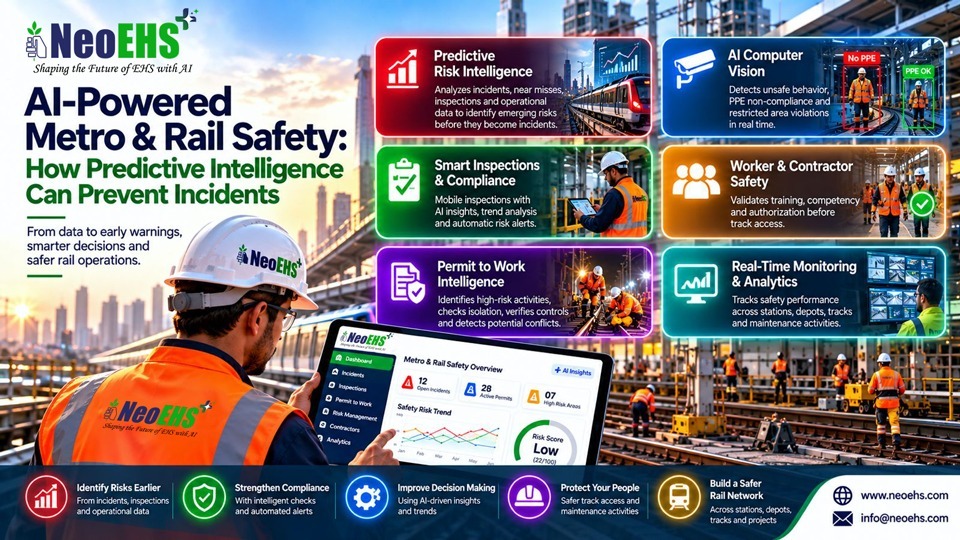
Metro / Rail Safety: How AI Powered Predictive Intelligence Can Prevent Incidents
Turning incidents, near misses, inspections and operational safety data into earlier warnings and preventive action.
Railway safety has always depended on one fundamental principle: identify the hazard, control the risk and protect people.
What is changing is our ability to recognize risk earlier.
A modern railway generates enormous amounts of safety information every day. Incidents are reported. Near misses are recorded. Inspections identify deficiencies. Workers report unsafe conditions. Contractors perform high-risk activities. Permits are issued. Corrective actions are assigned. CCTV monitors stations and depots.
Individually, each record tells us something.
But the real safety intelligence often exists between those records.
A recurring inspection finding at one depot may appear minor. A few near misses during maintenance may also seem unrelated. A rise in permit deviations might be handled separately.
But what if all three are connected?
This is where artificial intelligence and predictive safety intelligence can add genuine value.
The objective is not to ask AI to predict exactly when an accident will occur.
The better question is:
Can we recognize the conditions that increase risk early enough to intervene before someone gets hurt?
That is the real opportunity behind AI-powered rail safety.
NeoEHS is already designed around this connected approach for Metro and Rail environments, bringing incidents, observations, risks, inspections, audits, permits, corrective actions and field operations into an integrated EHS environment. NeoEHS
What Is AI-Powered Rail Safety?
AI-powered rail safety is the use of artificial intelligence, predictive analytics, computer vision and connected EHS data to identify emerging risk patterns and support preventive safety decisions across railway operations.
It does not replace railway engineering controls, signalling systems, operating rules or competent safety professionals.
Instead, AI provides an additional layer of intelligence.
A railway organization may already have data relating to:
- Incidents and near misses
- Unsafe acts and unsafe conditions
- Safety observations
- Risk assessments
- Inspections and audits
- Corrective and preventive actions
- Permit to Work
- Contractor safety
- Training and competency
- Equipment and maintenance
- CCTV
- IoT and environmental sensors
- Stations, depots and work locations
The challenge is connecting these datasets in a meaningful way.
NeoEHS's dedicated Metro & Rail Safety EHS Management Software is built around this connected model, including mobile field reporting, incident and near-miss tracking, inspections, PTW, workforce competency, predictive analytics and computer-vision integration. NeoEHS
Why Traditional Rail Safety Data Is Not Enough
Most rail organizations already collect substantial amounts of safety data.
The problem is often not lack of information.
It is fragmentation.
Imagine this situation:
A maintenance depot records repeated housekeeping observations.
The same depot has several near misses during nighttime maintenance.
An inspection identifies deteriorating equipment.
Corrective actions are taking longer to close.
A contractor repeatedly receives similar findings.
Each issue may be managed by a different person or system.
Individually, none may appear critical.
Together, however, they may indicate something more important.
This is the transition predictive safety is trying to achieve:
Reactive Safety
Incident → Investigation → Corrective Action
Digital Safety
Observe → Report → Analyze → Correct
Predictive Safety
Data → Pattern → Risk Signal → Preventive Action
Connected Safety Intelligence
Incidents + Near Misses + Inspections + Risk + PTW + Workforce + CCTV + IoT → Earlier Intervention
The objective is not more dashboards.
The objective is earlier action.
How Predictive Intelligence Can Help Prevent Rail Incidents
1. Identifying Emerging Risk Patterns
One of AI's most practical applications is analyzing large quantities of safety information for recurring patterns.
Consider a simple example.
Over several months, a railway organization records:
Incident A: Electrical maintenance + contractor + night shift
Near Miss B: Electrical maintenance + contractor + night shift
Observation C: Electrical maintenance + inadequate supervision + night shift
Inspection D: Electrical isolation documentation deficiency + night shift
Each record may have been managed correctly.
But viewed together, they deserve another question:
Why are similar conditions repeatedly appearing around the same activity?
AI can help bring those relationships to the attention of safety teams.
NeoEHS's existing Risk Management solution uses predictive analytics across incidents, near misses, inspections and behavioral trends to identify potential future risk patterns. NeoEHS
Explore NeoEHS Risk Management Software
2. Turning Near Misses Into Early-Warning Signals
Near misses are among the most valuable sources of preventive safety information.
Nothing serious happened.
But something could have happened.
That makes near misses particularly useful for predictive analysis.
Suppose a depot records repeated near misses involving maintenance vehicles entering an active work area.
One event may result from an individual mistake.
Several similar events could indicate something more systemic:
- Poor traffic segregation
- Inadequate communication
- Visibility problems
- Shift-handover weakness
- Contractor induction gaps
- Inadequate supervision
- Work planning issues
AI can help group similar events and identify common characteristics.
The safety professional then investigates why the pattern exists.
That distinction is important.
AI finds the signal. People determine what it means.
3. Predictive Intelligence From Safety Inspections
Inspections generate some of the richest leading-indicator data available to a railway EHS team.
Every inspection can tell us something about the condition of the workplace before an incident occurs.
Typical findings may involve:
- Access and egress
- Electrical hazards
- Housekeeping
- PPE
- Tools and equipment
- Barricading
- Fire protection
- Trackside conditions
- Platforms
- Workshops
- Depot activities
- Work at height
- Contractor activities
A traditional inspection system records the finding and assigns corrective action.
An intelligent system can ask additional questions:
Has this finding occurred before?
Does it repeatedly occur at this location?
Was a previous corrective action supposedly completed?
Are similar findings appearing elsewhere?
Has this condition previously been associated with a near miss or incident?
NeoEHS's Inspection Management Software supports mobile and offline inspections, evidence capture, CAPA tracking, trend analysis and connections with incidents, permits, risks and other EHS processes. NeoEHS
That connected information is far more valuable than an isolated checklist.
4. Identifying High-Risk Locations
Not every part of a rail network has the same risk profile.
A railway organization may operate:
Stations.
Depots.
Maintenance workshops.
Tracks.
Tunnels.
Electrical substations.
Construction sites.
Control facilities.
AI-supported analytics can help compare safety information by location and identify areas generating disproportionate numbers of:
- Incidents
- Near misses
- Unsafe conditions
- Inspection findings
- Repeat findings
- High-risk observations
- Permit deviations
- Overdue corrective actions
This does not automatically mean that a location is unsafe.
A busy depot, for example, may naturally generate more reports because it has greater activity.
Good analysis therefore needs context—exposure hours, workforce size, activity type and reporting behavior matter.
That is an important principle for responsible predictive safety:
A high number is not automatically a high risk. Context matters.
5. Predictive Safety for Railway Maintenance
Maintenance is one of the most important applications of predictive safety intelligence.
Track, rolling stock, electrical and infrastructure maintenance can involve workers operating close to hazardous energy, moving equipment and operational infrastructure.
Relevant data might include:
Work activity + location + shift + contractor + PTW + risk assessment + inspection history + near misses + equipment condition
Connecting those datasets can help reveal recurring combinations associated with elevated concern.
For example, suppose several observations and near misses occur during nighttime maintenance at the same track section.
The appropriate response is not for AI to declare the work unsafe.
It is to alert the responsible team:
"This combination of activity, location and previous findings deserves closer review."
The team can then examine lighting, access, communication, supervision, competency, work sequencing and other relevant factors.
That is predictive intelligence being used responsibly.
6. AI-Powered Incident Investigation
Every incident should teach the organization something.
Unfortunately, those lessons can become trapped inside individual investigation reports.
AI can help safety teams analyze larger collections of historical incidents and identify similarities involving:
- Activity
- Location
- Equipment
- Contractor
- Shift
- Immediate causes
- Contributing factors
- Root causes
- Corrective actions
Imagine that five incidents occurred at five different locations.
At first glance, they appear unrelated.
But further analysis reveals that all five involved the same maintenance procedure.
That is valuable organizational knowledge.
The objective is to move from:
"Why did this incident happen?"
toward:
"Where else could the same conditions exist?"
That second question is where incident investigation begins contributing directly to prevention.
7. Computer Vision for Railway Safety
Railways and metros already operate extensive CCTV infrastructure.
Traditionally, cameras are primarily used for surveillance, security and post-event investigation.
Computer vision creates an opportunity to use selected video streams as another source of safety information.
Depending on the camera infrastructure, environment and models deployed, AI may help identify predefined visual conditions such as:
- Missing PPE
- Entry into designated restricted areas
- Unsafe proximity
- Defined zone violations
- Selected unsafe activities
- Other configured visual safety events
NeoEHS's Metro & Rail solution supports computer-vision integration for use cases including PPE and restricted-area monitoring. NeoEHS
This technology needs to be applied carefully.
Lighting, weather, camera angle, occlusion and model performance can affect accuracy.
Computer vision should therefore complement—not replace—supervision, engineering controls and established railway safety systems.
8. Connecting Permit to Work With Predictive Safety
High-risk railway maintenance frequently involves activities such as:
- Electrical isolation
- Work at height
- Excavation
- Lifting
- Hot work
- Confined-space work
- Track access
- Contractor maintenance
Permit information can become another valuable predictive dataset.
For example, analytics may identify that a particular work type repeatedly experiences:
permit suspension + inspection finding + near miss + corrective action
That pattern deserves attention.
By connecting PTW with risk assessment, incidents and inspections, organizations can move beyond simply measuring how many permits were issued.
The more valuable question becomes:
What is our permit history telling us about the effectiveness of high-risk work controls?
9. Contractor Risk Intelligence
Contractors are essential to railway construction, maintenance and infrastructure projects.
But contractor safety information is frequently fragmented across induction records, training systems, permits, observations, inspections and incidents.
Connecting these records allows a different type of analysis.
Instead of judging contractor safety solely by incident numbers, organizations can examine leading indicators such as:
- Repeated unsafe conditions
- Competency gaps
- Permit deviations
- Inspection findings
- Corrective-action performance
- Near-miss reporting
- Recurring work-related risks
This can help safety teams focus their attention on specific activities and controls requiring improvement.
Predictive safety should be used to strengthen contractor management—not to make unsupported judgments about individual workers.
10. Corrective Actions: Are We Actually Fixing the Problem?
Closing a corrective action does not necessarily mean that the underlying risk has been eliminated.
Consider this pattern:
Inspection identifies hazard → CAPA assigned → CAPA closed → Same hazard returns three months later
Administratively, the action was completed.
Operationally, the problem may not have been solved.
Predictive analysis can help identify recurring findings after corrective actions have been closed.
This allows safety teams to ask:
Was the corrective action effective?
That is an important shift from measuring closure to measuring effectiveness.
NeoEHS's rail-specific platform connects findings, CAPA execution, verification and management analytics as part of its end-to-end safety lifecycle. NeoEHS
11. Leading Indicators Matter More When They Are Connected
Rail organizations commonly track both lagging and leading safety indicators.
Lagging indicators tell us what has already happened:
- Injuries
- Incidents
- Lost-time events
- Damage events
Leading indicators can tell us something about the conditions developing before an incident:
- Near misses
- Safety observations
- Inspection findings
- Overdue CAPAs
- Permit deviations
- Training gaps
- Repeated hazards
- Control failures
Individually, these metrics are useful.
Connected, they become much more powerful.
For example:
Increase in unsafe-condition reports + repeated inspection findings + slower CAPA closure + increasing near misses
may deserve considerably more attention than any one metric alone.
This is where predictive intelligence begins moving EHS analytics from reporting toward decision support.
12. A Practical Rail Safety Scenario
Consider an illustrative railway maintenance depot.
Over six weeks, the organization records:
7 near misses associated with vehicle and pedestrian interaction.
11 inspection findings involving segregation and access control.
4 overdue corrective actions concerning barriers and traffic routes.
3 contractor observations involving the same work area.
No serious injury has occurred.
A conventional reporting process may treat these as separate records.
Predictive analysis can bring them together as a potential emerging pattern.
The EHS team investigates.
They find that temporary maintenance activities have changed normal pedestrian routes and increased interaction with maintenance vehicles.
The organization can then consider appropriate controls—redesigning routes, strengthening segregation, improving signage, reviewing work scheduling and reinforcing contractor communication.
The important part is what happened before an injury.
That is the purpose of predictive safety.
This scenario is illustrative and should not be presented as a measured NeoEHS customer outcome.
13. IoT and Connected Railway Safety
IoT can add another layer of information to the predictive environment.
Depending on the railway infrastructure and integrations, relevant information could come from:
- Environmental monitoring
- Equipment-condition sensors
- Worker-safety devices
- Location-aware systems
- Other operational technologies
But simply collecting more sensor data does not make an organization safer.
The value comes when that information is interpreted alongside operational and EHS context.
A sensor alert becomes more meaningful when the organization understands:
Where did it occur?
What activity was happening?
Who was exposed?
What risk controls were required?
Were there previous related findings?
Connected safety intelligence is about relationships—not simply volume of data.
14. What AI Can — and Cannot — Do in Rail Safety
This distinction matters.
AI can help:
Analyze large volumes of safety information.
Recognize recurring patterns.
Prioritize information for review.
Identify potentially emerging risks.
Analyze incident and inspection trends.
Support risk assessment.
Analyze selected visual information.
Provide management insights.
AI cannot:
Guarantee that an accident will not occur.
Replace railway engineering controls.
Replace competent safety professionals.
Make every operational decision.
Understand every worksite context automatically.
Eliminate the need for investigation.
Remove management accountability.
The most effective model remains:
Human Expertise + Connected Data + AI Intelligence + Strong Safety Governance
AI finds patterns.
People understand context.
AI highlights potential risk.
Safety professionals determine controls.
Management remains accountable.
15. How NeoEHS Supports Predictive Rail Safety
NeoEHS provides a dedicated Metro & Rail EHS environment designed to connect field operations with enterprise safety intelligence. Its current rail solution covers incidents and near misses, observations, inspections and audits, corrective actions, PTW, workforce competency, dashboards, predictive analytics, computer vision and integration with enterprise and operational systems. NeoEHS
The platform's connected safety lifecycle can be summarized as:
Identify → Assess → Control → Monitor → Report → Investigate → Correct → Verify → Analyze → Improve.
This is important because predictive safety cannot operate effectively when safety information remains isolated.
A near miss should inform risk management.
An inspection should inform corrective action.
An incident investigation should improve future controls.
Permit history should contribute to high-risk work intelligence.
Contractor information should inform supervision.
And management should be able to see emerging patterns across the network.
That is the direction of connected, predictive EHS.
Explore NeoEHS Metro & Rail Safety EHS Management Software
Frequently Asked Questions
What is AI-powered rail safety?
AI-powered rail safety uses artificial intelligence, predictive analytics, computer vision and connected safety data to help railway organizations identify emerging risk patterns and support preventive decisions.
What is predictive safety intelligence in railways?
Predictive safety intelligence analyzes historical and current safety information to identify patterns and leading indicators that may suggest changing risk conditions.
Can AI prevent railway accidents?
AI cannot guarantee accident prevention. It can help identify recurring hazards, unusual patterns and other risk indicators earlier, allowing competent professionals to investigate and take preventive action.
What railway safety data can AI analyze?
Depending on the platform and integrations, AI can analyze incidents, near misses, observations, inspections, audits, risk assessments, permits, corrective actions, contractor information and selected operational or sensor data.
How does AI improve railway inspections?
AI can help identify recurring inspection findings, repeated hazards, high-risk locations and relationships between inspection results and other safety information.
Can CCTV be used for predictive rail safety?
Computer vision can analyze selected CCTV feeds for predefined conditions such as PPE non-compliance or restricted-zone entry, subject to appropriate infrastructure, model capability and human oversight.
What is the role of near misses in predictive safety?
Near misses provide valuable leading-indicator information. Repeated near misses involving similar locations, activities or conditions can indicate an emerging problem before a more serious event occurs.
What is the role of NeoEHS in railway safety?
NeoEHS connects incidents, observations, risks, inspections, audits, permits, corrective actions and other EHS processes within an integrated Metro & Rail safety environment, supported by mobile workflows, analytics, AI and connected technologies. NeoEHS
Conclusion: The Best Incident Is the One That Never Happens
For decades, safety management has become increasingly effective at investigating incidents and learning from what went wrong.
The next opportunity is to learn before something goes wrong.
Rail organizations already possess enormous amounts of safety information.
The challenge is turning that information into intelligence.
AI-powered predictive safety can help organizations recognize patterns across incidents, near misses, observations, inspections, permits, corrective actions and operational information.
But technology alone will never create a safe railway.
The real value comes when AI gives experienced people better information early enough to act.
That is the future NeoEHS is working toward:
See the signal earlier. Understand the risk sooner. Act before the incident.
READ MORE ❯
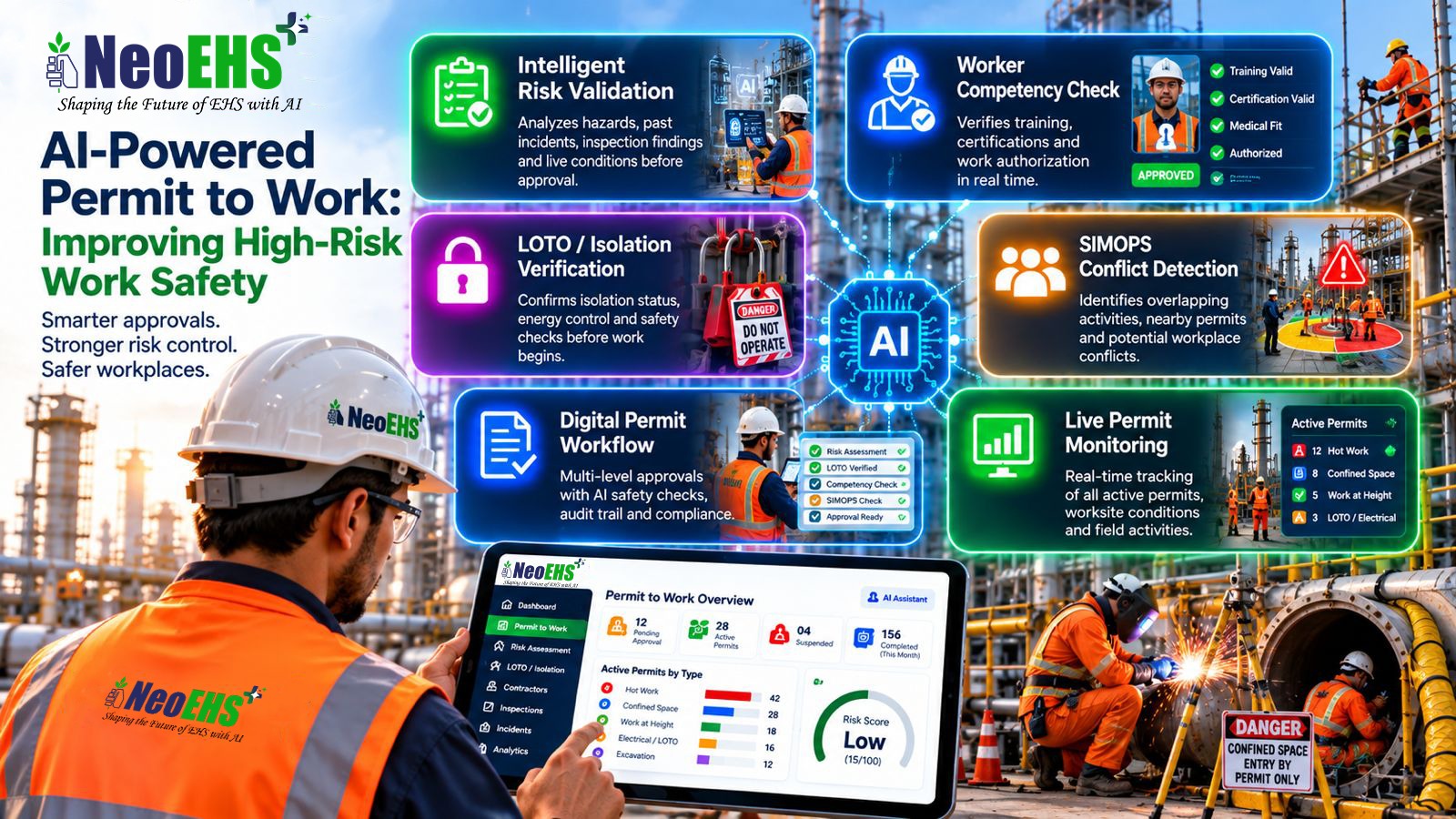
AI-Powered Permit to Work: Improving High-Risk Work Safety
How intelligent risk validation, connected EHS data and real-time monitoring can strengthen control of hazardous work.
AI-Powered Permit to Work: Improving High-Risk Work Safety
A Permit to Work should never become just another form to complete.
In high-risk industries, a PTW represents something much more important: a formal decision that a hazardous activity can proceed because the hazards have been identified, necessary controls have been established, responsible people have been authorized and the worksite is ready.
Yet this is also where traditional permit systems can struggle.
A permit may be correctly completed while conditions at the worksite have changed. A contractor's competency certificate may have expired. An isolation point may not have been properly verified. Two individually acceptable jobs may create a new risk when performed simultaneously. An important corrective action from an earlier inspection may still be open.
Digitizing the permit form solves only part of this problem.
The next evolution is an AI-powered Permit to Work system that connects permits with risk assessments, isolations, contractor competency, inspections, incidents and real-time safety information.
The objective is straightforward:
Before high-risk work starts, give the responsible people better information to determine whether the work is genuinely ready to proceed.
That is the direction behind the NeoEHS Permit to Work Software approach, which combines digital PTW workflows with safety verification, contractor controls, LOTO and connected EHS processes. NeoEHS
What Is an AI-Powered Permit to Work System?
An AI-powered Permit to Work system is a digital work-authorization system that uses connected safety data, intelligent validation, automation and analytical capabilities to help identify missing controls, conflicting activities and changing risk conditions before and during high-risk work.
A conventional electronic PTW may digitize:
Permit request → review → approval → work execution → extension → closure.
An intelligent PTW should go further:
Hazard identification → risk verification → competency check → isolation verification → conflict detection → authorization → active monitoring → worksite verification → safe closure → learning.
The distinction matters.
A digital form makes the permit process faster and more traceable.
An intelligent PTW should make the safety decision surrounding the permit better informed.
AI should support this decision. It should not replace the competent persons responsible for issuing, accepting, supervising or closing permits.
Why Permit to Work Is Critical for High-Risk Activities
PTW systems are particularly important where routine administrative controls are insufficient for the hazards involved.
Depending on the organization and industry, controlled activities may include:
- Hot work
- Cold work
- Confined-space entry
- Electrical work
- Energized work
- Work at height
- Excavation
- Lifting operations
- Equipment isolation and LOTO
- Breaking containment or line breaking
- Radiography
- Pressure testing
- Chemical handling
- Vehicle entry
- Scaffolding
- Tank cleaning
- Diving or marine work
- Blasting
- SIMOPS
NeoEHS already supports configurable digital workflows for numerous high-risk permit categories. NeoEHS
But the number of permits an organization processes is not, by itself, an indicator of safety.
The more meaningful question is:
Did the permit process identify the actual conditions that could make the work unsafe?
From Digital PTW to Intelligent Control of Work
Many organizations have already moved from paper permits to electronic systems.
That is valuable. Electronic PTW can improve workflow speed, traceability, standardization and visibility.
But converting a paper permit into a digital form does not automatically make the underlying risk control intelligent.
Consider a hot-work permit.
The form might correctly record:
- Work location
- Job description
- Fire watch
- Gas-test results
- PPE
- Isolation requirements
- Responsible persons
- Start and expiry times
Everything may appear complete.
But what if another contractor is simultaneously performing an activity nearby that changes the risk?
What if previous inspections repeatedly identified combustible materials in that location?
What if the assigned worker's required certification expired yesterday?
What if a related isolation has not been independently verified?
A traditional workflow may not automatically bring all of this information together.
This is where connected intelligence can strengthen PTW.
How AI Can Improve Permit to Work Safety
1. Intelligent Pre-Permit Risk Validation
One of the most useful applications of AI is before the permit is approved.
Instead of checking only whether mandatory fields have been completed, an intelligent system can evaluate relevant information surrounding the proposed work.
Depending on system configuration and integrations, this may include:
- Work type
- Location
- Identified hazards
- Risk rating
- Required controls
- Previous incidents
- Near misses
- Inspection findings
- Contractor performance
- Worker competency
- Isolation requirements
- Simultaneous activities
- Outstanding corrective actions
Suppose a contractor requests a confined-space permit.
The system could help the responsible person identify that the location has previously generated atmospheric monitoring concerns or that a required competency record is no longer valid.
The AI has not made the permit decision.
It has identified information that deserves human attention before authorization.
That distinction is fundamental to responsible AI in safety management.
2. Connecting PTW With Risk Assessment
A Permit to Work should not operate independently from risk assessment.
Before hazardous work begins, the responsible team needs to understand the hazards, controls and residual risks associated with the activity.
Connecting PTW with NeoEHS Risk Management Software can allow relevant HIRA, HIRARC, JSA or JHA information to become part of the authorization process.
NeoEHS's existing PTW platform supports linking permit workflows with operational risk assessments. NeoEHS
This creates an important opportunity.
If the work conditions change, the system can help prompt the team to reconsider whether the original risk assessment remains appropriate.
For example:
Original condition: routine maintenance at ground level.
Changed condition: access now requires temporary work at height.
The permit should not simply continue because it was already approved.
The changed condition may require additional hazard assessment, controls and authorization.
3. AI-Powered Worker Competency Validation
A technically correct permit is not enough if the person carrying out the work is not competent or authorized.
Before permit approval, organizations may need to verify:
- Safety induction
- Job-specific training
- Trade competency
- Equipment authorization
- Operator licences
- Required certifications
- Medical fitness where applicable
- Contractor authorization
- Site-specific competency
- Supervisor authorization
NeoEHS already connects worker competency information with PTW and can identify missing or expired requirements during the permit process. NeoEHS
This turns an important question—
"Is this worker authorized to perform this task?"
—from a manual document search into a structured validation step.
This is especially useful on large construction, power, mining, oil and gas, manufacturing, rail and infrastructure projects where thousands of workers and contractors may operate across multiple work fronts.
4. Intelligent Isolation and LOTO Verification
For work involving hazardous energy, permit authorization must be closely connected with isolation control.
Electrical, mechanical, hydraulic, pneumatic, thermal, chemical or stored energy can create severe consequences if isolation is incomplete or incorrectly managed.
An intelligent PTW workflow can help verify configured requirements such as:
Equipment identified → isolation points defined → LOTO applied → verification recorded → responsible persons confirmed → permit authorized.
NeoEHS's current PTW platform includes isolation and LOTO validation as part of its high-risk work-control workflow. NeoEHS
The system can also preserve evidence of verification and authorization for later review.
Technology, however, must never substitute for physical isolation procedures, competent verification or organization-specific LOTO requirements.
5. Detecting Simultaneous Operations — SIMOPS Risk
One of the most valuable future applications of intelligent PTW is the ability to understand interaction between active permits.
Two activities may be acceptable independently but unsafe when conducted together.
Consider these situations:
Hot work near chemical transfer.
Lifting operations above another contractor's work area.
Electrical maintenance while connected equipment is being tested.
Excavation close to underground utilities.
Vehicle movement through a work-at-height exclusion zone.
Confined-space work occurring near another process capable of changing atmospheric conditions.
Instead of assessing permits only individually, an intelligent PTW system can potentially compare:
Activity + location + time + hazard + isolation + nearby permits.
When configured conditions indicate a possible conflict, the responsible safety team can be alerted to review the situation.
This moves PTW closer to dynamic control of work rather than isolated permit administration.
6. Learning From Previous Incidents and Near Misses
Imagine a maintenance team applying for hot work in a particular plant area.
Three months earlier, a near miss occurred there because combustible material had not been adequately removed.
Should that information be visible during the new permit review?
It should.
When PTW is connected with NeoEHS Incident Management Software, previous incidents and near misses can provide valuable context for current work.
Instead of allowing lessons from investigations to remain inside historical reports, connected safety information can help bring relevant experience back into operational decision-making.
This creates an important safety-learning loop:
Incident → Investigation → Root Cause → Corrective Action → Future Risk Assessment → Future Permit.
That is considerably more powerful than treating incident management and PTW as separate systems.
7. Connecting Inspection Findings With Permit Decisions
The same principle applies to inspections.
Suppose yesterday's inspection identified a damaged guardrail on an elevated work platform.
Today, a contractor requests a work-at-height permit for the same location.
A disconnected PTW system may not recognize the relationship.
A connected EHS environment can potentially make the outstanding inspection finding visible during permit review.
This allows the responsible person to ask:
Has this condition been corrected before we authorize the work?
This is one reason an integrated NeoEHS EHS Software platform can provide greater operational value than isolated safety applications. NeoEHS brings PTW, incident management, risk assessment, inspection, contractor management and other EHS workflows into one platform. NeoEHS
8. AI-Powered Contractor Safety Checks
Contractors often perform some of the highest-risk activities at industrial sites.
PTW therefore needs to answer more than:
"Has this contractor been registered?"
Relevant questions may include:
- Is the contractor currently approved?
- Has the workforce completed site induction?
- Are required competencies current?
- Are equipment licences valid?
- Are required documents current?
- Has the supervisor been authorized?
- Are there unresolved safety concerns relevant to this work?
- Are workers assigned to the permit actually approved for the task?
NeoEHS's PTW platform already incorporates contractor visibility and competency validation into permit workflows. NeoEHS
Connecting contractor safety and PTW reduces dependence on fragmented spreadsheets, emails and paper certificates.
9. Mobile PTW: Taking Authorization to the Worksite
A PTW process loses some of its effectiveness when the permit exists in an office but the hazardous work takes place hundreds of metres away.
Mobile PTW changes this.
Supervisors and safety personnel can perform important workflow activities directly from the field.
NeoEHS currently supports mobile permit approval, QR permit validation, geo-tagged work verification and photo documentation. NeoEHS
This can help establish a stronger relationship between the digital permit and the actual worksite.
For example, field personnel can document isolation evidence or site conditions and verify permit status close to where the activity is being performed.
The aim should not simply be faster approvals.
It should be better verification at the point of work.
10. QR Codes and Digital Permit Verification
Printed permits can become outdated.
A permit displayed at the worksite may have been suspended, extended, modified or closed elsewhere.
QR-based verification can provide workers and supervisors with access to the current permit status where appropriately configured.
A scan might confirm:
- Permit number
- Activity
- Location
- Current status
- Validity period
- Responsible personnel
- Relevant authorization status
NeoEHS includes QR-based permit validation within its field PTW capabilities. NeoEHS
This creates a simple but important principle:
The permit being followed at the worksite should reflect the current authorized state of the work.
11. Biometric Verification for Critical Work
For certain high-risk environments, organizations may require stronger identity verification.
NeoEHS has developed PTW capabilities around biometric worker authentication to help organizations verify that the individual associated with an authorization is the person presenting for the work. NeoEHS
Used appropriately, this can strengthen controls for critical activities where worker identity, competency and authorization must be reliably connected.
Biometric deployments should, of course, be implemented in accordance with applicable privacy, employment and data-protection requirements.
12. Real-Time Monitoring of Active Permits
Permit safety does not end when someone presses Approve.
Conditions can change after work begins.
An effective PTW system therefore needs visibility into active work.
Safety teams should be able to understand:
- What hazardous work is currently active?
- Where is it occurring?
- Who is responsible?
- Which contractor is involved?
- When does the permit expire?
- Which isolations apply?
- Are there relevant safety alerts?
- Are overlapping permits active nearby?
NeoEHS provides centralized live permit tracking, operational status visibility and safety alerts within its PTW solution. NeoEHS
This is particularly valuable during shutdowns, turnarounds and major projects where hundreds of permits may be active simultaneously.
13. Predictive Intelligence for Permit Risk
This is where AI can take PTW beyond workflow automation.
Over time, organizations accumulate significant permit history.
Patterns may begin to emerge.
For example:
- One work type repeatedly generates permit deviations.
- A particular location experiences more suspensions.
- Certain permit combinations frequently require intervention.
- One category of work repeatedly produces near misses.
- Particular controls are frequently found incomplete during inspections.
- Certain contractors generate recurring permit-related findings.
AI-supported analytics can help identify these patterns for review.
The important point is not that AI "predicts an accident."
Safety outcomes are too complex for such simplistic claims.
Instead, predictive intelligence can help identify conditions, combinations and trends associated with elevated concern, enabling competent people to investigate and intervene earlier.
14. AI + Computer Vision for Active Permit Areas
Another emerging opportunity is connecting PTW with computer vision.
Consider a designated hot-work area.
The digital system knows:
where the permit applies,
what activity has been authorized,
when it is valid, and
which controls are expected.
A suitably designed computer-vision system may provide additional information about observable worksite conditions, such as PPE compliance or entry into defined restricted areas.
NeoEHS already supports connections between its PTW environment and AI-powered CCTV safety monitoring. NeoEHS
The long-term opportunity is significant:
Permit authorization + physical worksite verification + real-time safety intelligence.
Computer vision should nevertheless be treated as an additional safety layer. Detection performance depends on factors such as camera placement, visibility and model accuracy and does not replace physical supervision or mandatory controls.
15. Permit Extension, Suspension and Shift Handover
Some of the greatest PTW risks occur not during initial approval, but when circumstances change.
Examples include:
- Work continues beyond the original period.
- A new shift takes over.
- Weather deteriorates.
- Equipment status changes.
- A process starts nearby.
- The work scope changes.
- An emergency interrupts the activity.
- Isolation conditions are modified.
A mature digital PTW system should therefore manage the entire permit lifecycle rather than simply issuing permits.
Any material change should trigger the appropriate review, revalidation or reauthorization based on the organization's procedures.
An intelligent system can support this by identifying changed information and prompting responsible personnel to reconsider whether the existing authorization remains valid.
16. Safe Permit Closure Matters Too
Closing a permit is not merely an administrative action.
Before returning equipment or an area to normal operation, the responsible team may need to verify that:
- Work has been completed.
- Personnel are clear.
- Tools and temporary materials have been removed.
- Guards have been restored.
- The worksite has been inspected.
- Isolations can be safely removed according to procedure.
- Outstanding conditions have been documented.
- Relevant operating personnel have been informed.
Digital closure creates a traceable record of these steps.
More importantly, it ensures that the end of the job receives the same disciplined attention as the beginning.
17. Example: How Intelligent PTW Can Prevent a High-Risk Situation
Consider an illustrative example in a power plant.
A contractor requests a hot-work permit for welding maintenance near process equipment.
A basic electronic PTW verifies that all required form fields have been completed.
A connected intelligent workflow could provide additional context:
Risk Assessment: Hot-work hazards and controls confirmed.
Competency: Welder certification valid.
Contractor: Approved for the activity.
Isolation: Required equipment isolation awaiting final verification.
Inspection: A recent housekeeping inspection identified combustible material nearby.
Incident History: A previous near miss in the area involved inadequate hot-work segregation.
SIMOPS: Another contractor has an active permit for nearby maintenance.
Instead of automatically allowing the workflow to continue, the system brings the relevant conditions to the attention of the authorized personnel.
The permit issuer can investigate, ensure the combustible material is removed, verify isolation, review simultaneous work and confirm appropriate controls before authorization.
The AI has not "prevented an accident" by itself.
It has helped ensure that critical information was available at the moment a safety decision was being made.
That is the practical value of intelligent PTW.
18. AI-Powered PTW Across High-Risk Industries
The principles apply across many sectors, although permit types and control requirements differ.
Power & Energy: electrical isolation, high-voltage work, confined spaces, hot work, maintenance and lifting.
Oil & Gas: hot work, line breaking, vessel entry, excavation, process isolation and SIMOPS. NeoEHS's oil and gas platform already combines PTW with isolation control and AI-based permit risk assessment. NeoEHS
Manufacturing: machine maintenance, LOTO, contractor activities, work at height and hot work.
Construction: excavation, lifting, scaffolding, work at height, electrical activities and confined spaces. NeoEHS's construction platform integrates permits with contractor and project safety workflows. NeoEHS
Mining: blasting, heavy equipment maintenance, confined spaces, electrical work and lifting.
Metro & Rail: track access, electrical isolation, maintenance activities, lifting, excavation, work at height and contractor operations.
Ports & Maritime: vessel-related maintenance, lifting, diving, confined-space entry, hot work and cargo-area activities.
The permit system should therefore be configurable around the organization's hazards and control philosophy rather than forcing every industry into the same workflow.
19. What Should an AI-Powered PTW System Include?
Organizations evaluating modern Permit to Work software should look beyond electronic forms.
A strong platform should support:
| Capability | Safety purpose |
|---|---|
| Configurable permit types | Match workflows to actual hazardous activities |
| Risk assessment integration | Connect authorization with identified hazards |
| Intelligent safety validation | Highlight missing or inconsistent requirements |
| LOTO/isolation control | Strengthen hazardous-energy management |
| Competency validation | Verify appropriately qualified personnel |
| Contractor integration | Control third-party work |
| SIMOPS awareness | Identify potentially conflicting activities |
| Mobile PTW | Bring permit controls to the field |
| QR verification | Confirm current permit status |
| Geo-tagged evidence | Support location-based verification |
| Active permit dashboard | Provide real-time operational visibility |
| Alerts and escalation | Surface conditions requiring attention |
| Incident integration | Apply previous safety learning |
| Inspection integration | Identify unresolved worksite conditions |
| Audit trail | Maintain traceability |
| Analytics | Identify recurring PTW patterns |
| AI/CCTV integration | Add visual monitoring where appropriate |
The objective is not simply to digitize permits.
It is to create a connected control-of-work environment.
20. What AI Should Not Do in Permit to Work
AI brings valuable capabilities, but PTW is a safety-critical process.
There must be clear boundaries.
AI should not:
- Replace competent permit issuers.
- Independently declare hazardous work safe.
- Override mandatory isolation procedures.
- Ignore engineering controls.
- Replace atmospheric testing.
- Replace required worksite inspections.
- Remove human accountability.
- Treat historical correlations as guaranteed predictions.
Instead, AI should help responsible personnel:
find relevant information faster, detect inconsistencies, recognize patterns, identify potential conflicts and make better-informed decisions.
The final authorization for hazardous work remains a human and organizational responsibility.
21. How NeoEHS Approaches Intelligent Permit to Work
NeoEHS treats PTW as part of a wider safety ecosystem rather than an isolated electronic form.
Its existing PTW platform supports digital permit creation, multi-level approvals, LOTO and isolation validation, mobile operations, QR verification, geo-tagged worksite evidence, contractor visibility, permit analytics and integration with risk assessment and other EHS processes. NeoEHS
NeoEHS also connects Permit to Work with capabilities including:
- Incident Management
- Risk Assessment
- Audit & Inspection
- Contractor Management
- Workforce competency
- CCTV safety monitoring
- Compliance processes
That connected architecture matters because high-risk work rarely depends on one safety process alone.
A permit may require information from risk assessment, training, contractor management, inspection and isolation management before the responsible person can make a sound authorization decision.
Explore the NeoEHS AI-Powered EHS Platform to understand how PTW fits within a broader connected safety environment. NeoEHS
22. Frequently Asked Questions
What is AI-powered Permit to Work?
AI-powered Permit to Work is a digital work-authorization approach that combines PTW workflows with intelligent validation, connected safety information, automation and analytics to support safer decisions before and during hazardous work.
How can AI improve Permit to Work safety?
AI can help identify missing information, expired competencies, recurring permit issues, relevant historical safety information and other configured risk factors requiring review. Human authorization remains essential.
What is the difference between digital PTW and AI-powered PTW?
Digital PTW primarily replaces paper permits with electronic workflows. AI-powered PTW adds intelligent analysis and connected safety context to help responsible personnel identify conditions requiring additional attention.
Can AI approve a Permit to Work automatically?
For safety-critical work, organizations should maintain appropriate competent-person authorization and governance. AI is better used as decision support rather than as a substitute for accountable permit approval.
Can PTW software integrate with LOTO?
Yes. NeoEHS includes isolation and LOTO validation within its PTW workflows, helping connect hazardous-energy controls with work authorization. NeoEHS
Can PTW software verify contractor competency?
NeoEHS can connect permit workflows with contractor competency, training, certification, induction and authorization information. NeoEHS
Can Permit to Work be managed from mobile devices?
Yes. NeoEHS supports field-based permit workflows including mobile approval, QR verification, geo-tagging and photo documentation. NeoEHS
Which industries benefit from AI-powered PTW?
PTW is particularly relevant to high-risk sectors including power and energy, oil and gas, manufacturing, construction, mining, rail and metro, ports and maritime, chemical processing and infrastructure.
Conclusion: From Permit Administration to Intelligent Work Control
The future of Permit to Work is not simply paperless.
It is connected, risk-aware and increasingly intelligent.
The strongest PTW systems will bring together information that safety professionals previously had to find across multiple systems: risk assessments, isolations, worker competency, contractor compliance, inspections, incidents and active work conditions.
AI can help identify relationships within that information and bring potential concerns to the attention of responsible personnel before and during high-risk work.
But the fundamental principle remains unchanged:
Technology supports the safety decision. Competent people remain accountable for making it.
For organizations seeking to modernize high-risk work control, NeoEHS Intelligent Permit to Work Software provides a digital foundation for connecting permit workflows with broader EHS intelligence.
AI-Powered Permit to Work articleProposed new article: https://www.neoehs.com/blogs/ai-powered-permit-to-work-high-risk-safety
Permit to Work Softwarehttps://www.neoehs.com/solutions/permit-to-work-software NeoEHS
Control of WorkNo dedicated page found — recommended new page: https://www.neoehs.com/solutions/control-of-work-software
LOTO / Energy Isolation https://www.neoehs.com/solutions/loto-energy-isolation-software
Hot Work: https://www.neoehs.com/solutions/hot-work-permit-software
Confined Space: https://www.neoehs.com/solutions/confined-space-permit-software
Work at Heighthttps://www.neoehs.com/solutions/work-at-height-permit NeoEHS
SIMOPS: https://www.neoehs.com/solutions/simops-management-software
Risk Assessment / Risk Managementhttps://www.neoehs.com/solutions/risk-management-software
READ MORE ❯
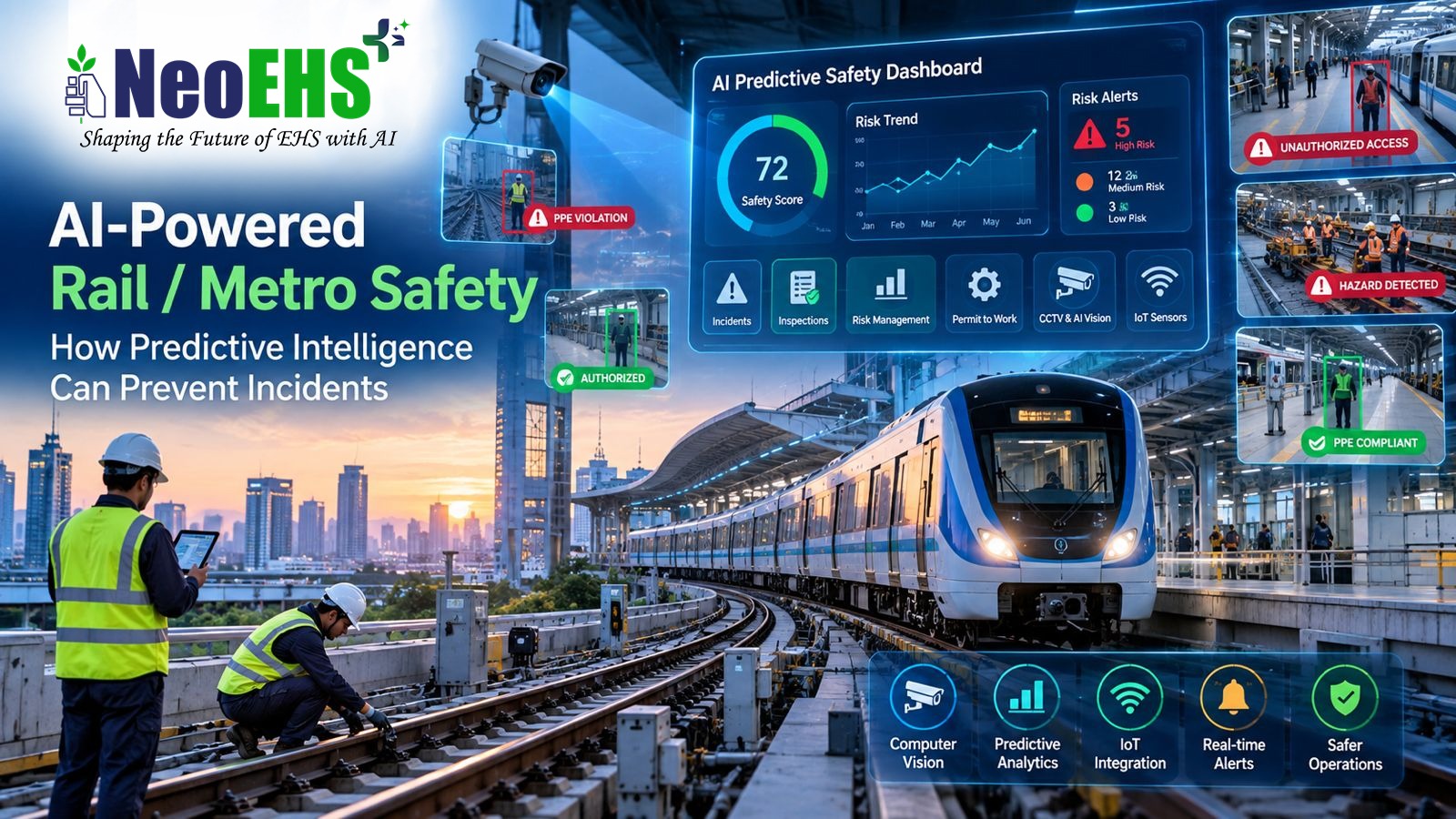
AI-Powered Rail / Metro Safety: How Predictive Intelligence Can Prevent Incident
Metro/ Rail Health, Safety, and Environment System
Railways and metro systems are designed around precision. Trains must move safely, passengers must be protected, infrastructure must remain reliable, and thousands of employees and contractors may work across stations, depots, workshops, tunnels and trackside environments every day.
But modern rail safety is becoming more complex.
A single transportation network may involve rolling stock, tracks, signalling systems, electrical infrastructure, stations, depots, maintenance activities, contractors, passenger areas, CCTV systems, environmental sensors and thousands of safety records.
The question is no longer simply:
“What happened?”
The more important question is:
“What is changing, where is the risk increasing, and what can we do before an incident occurs?”
This is where AI-powered rail safety and predictive intelligence can make a meaningful difference.
By connecting incidents, near misses, safety observations, inspections, risk assessments, permits, audits, workforce information, CCTV and IoT data, modern EHS platforms can help safety teams identify patterns that may otherwise remain hidden.
NeoEHS brings these capabilities together through an integrated EHS platform designed for complex and high-risk operations, including Metro & Rail environments.
What Is AI-Powered Rail Safety?
AI-powered rail safety refers to the use of artificial intelligence, predictive analytics, computer vision, connected data and workflow automation to help railway and metro organizations identify hazards, understand changing risk conditions and take preventive action.
Traditional safety systems are often focused on recording events after they happen.
A digital safety system goes further by connecting:
- Incidents
- Near misses
- Safety observations
- Unsafe acts and unsafe conditions
- Risk assessments
- Inspections
- Audits
- Permit to Work activities
- Corrective and preventive actions
- Contractor activities
- Training and competency
- CCTV and computer vision
- IoT and environmental sensors
- Workforce and operational data
When these information sources are connected, organizations can begin to see relationships and recurring patterns rather than isolated events.
NeoEHS is designed around this connected approach, combining AI-powered risk intelligence, incident analytics, computer vision, mobile safety and EHS workflows within one platform.
Why Traditional Rail Safety Management Is Not Enough
Rail and metro organizations already conduct inspections, audits, risk assessments and incident investigations.
The challenge is that safety information can become fragmented.
For example, imagine that:
- A depot records repeated housekeeping observations.
- A maintenance team reports several near misses.
- An inspection identifies deteriorating equipment.
- A contractor receives repeated corrective actions.
- CCTV identifies recurring unsafe behaviour in a particular work zone.
- A particular maintenance activity generates several permit deviations.
Individually, each event may appear manageable.
Together, they may indicate an emerging risk pattern.
A conventional reporting system may store these records separately.
Predictive safety intelligence aims to connect them.
This creates a fundamental shift:
Reactive Safety
Incident → Investigation → Corrective Action
Digital Safety
Observe → Report → Analyse → Correct
Predictive Safety
Data → Pattern → Risk Signal → Preventive Action
The objective is not to replace experienced safety professionals.
It is to give them better information earlier.
How Predictive Intelligence Can Help Prevent Rail Incidents
Predictive intelligence does not mean that an AI system can guarantee that an accident will never happen.
Instead, it can help organizations identify risk indicators and patterns early enough to support preventive decisions.
Here are some of the most important applications.
1. Predictive Risk Identification
One of the most valuable applications of AI in railway safety is identifying areas where risk may be increasing.
Historical incidents, near misses, inspections, observations and operational information can be analysed to identify:
- Recurring hazards
- High-risk locations
- Repeated unsafe acts
- Increasing observation frequency
- Recurring equipment-related issues
- High-risk activities
- Corrective-action delays
- Areas with declining compliance
For example, if several maintenance-related observations are repeatedly recorded at the same depot, the organization may want to investigate whether the issue is related to equipment condition, procedures, competency, workload or environmental conditions.
A predictive safety system can help bring that pattern to attention.
NeoEHS uses AI-powered risk intelligence and predictive analytics to identify emerging safety trends and support proactive risk management.
2. AI-Powered Incident and Near-Miss Analysis
Incident reporting remains essential in rail safety.
However, the real value of incident management comes from learning from events and near misses.
AI can assist safety teams by analysing large volumes of records and identifying common characteristics.
For example:
Incident A
Electrical maintenance + contractor + night shift
Incident B
Electrical maintenance + contractor + night shift
Near Miss C
Electrical maintenance + contractor + night shift
A human reviewer may notice the pattern immediately when reviewing the records together.
But in a large railway organization with thousands of records, finding such relationships manually can become difficult.
AI-assisted incident analysis can help identify:
- Recurring root causes
- Similar incident types
- Common locations
- Repeated contractor-related issues
- Frequently involved activities
- Recurring corrective actions
- Emerging trends
NeoEHS Incident Management supports digital incident reporting, investigation, root-cause analysis, corrective actions and safety analytics.
3. Computer Vision for Rail and Metro Safety
Rail and metro organizations increasingly use CCTV across stations, depots, workshops and other operational areas.
The next step is making those video systems more intelligent.
AI-powered computer vision can potentially assist with detecting predefined safety conditions such as:
- PPE violations
- Unauthorized access
- Unsafe behaviour
- Restricted-area entry
- Fire or smoke indicators
- Unsafe activities within designated zones
For example, in a maintenance depot, an AI-enabled camera system could identify a predefined PPE non-compliance condition and generate an alert for review.
This can complement—not replace—existing safety supervision.
NeoEHS includes AI-powered computer vision capabilities designed to detect selected workplace safety conditions and connect those signals with the broader EHS ecosystem.
4. Predictive Safety Analytics From Inspections
Inspections generate enormous amounts of safety information.
But collecting inspection data is only the beginning.
The real opportunity comes from understanding what the data is telling the organization.
Consider a railway network with:
- 50 stations
- Multiple depots
- Hundreds of maintenance activities
- Thousands of inspection findings
A traditional system may produce inspection reports.
A predictive platform can help answer more useful questions:
Which locations have recurring findings?
Which hazards are increasing?
Which corrective actions remain overdue?
Which assets or activities repeatedly appear in observations?
Which sites are showing declining safety performance?
NeoEHS Inspection Management enables organizations to digitize inspections, capture findings, assign corrective actions and analyse inspection trends across locations.
5. Intelligent Permit to Work for High-Risk Rail Activities
Railway maintenance often involves high-risk work.
Examples include:
- Electrical work
- Isolation and LOTO
- Confined-space entry
- Hot work
- Work at height
- Excavation
- Lifting operations
- Trackside maintenance
- Equipment maintenance
A digital Permit to Work system can connect authorization with risk controls.
Instead of simply asking:
“Was the permit approved?”
a connected safety platform can help teams ask:
“Were the required controls verified?”
“Was isolation completed?”
“Are contractor competencies valid?”
“Are there conflicting activities in the same area?”
“Has the permit expired?”
NeoEHS provides digital Permit to Work workflows including approval, isolation verification, contractor coordination, safety validation and real-time permit monitoring.
6. Connecting IoT Data With Safety Intelligence
Rail and metro infrastructure can generate data from many sources.
These may include:
- Environmental sensors
- Equipment sensors
- Wearable devices
- Gas detection systems
- Vibration monitoring
- Worker location systems
- Smart helmets
- Machinery monitoring
- Other industrial IoT systems
The challenge is turning these individual data streams into useful safety information.
An integrated EHS platform can connect relevant IoT signals with safety workflows.
For example:
Sensor → Abnormal condition → Risk alert → Safety review → Corrective action
This is particularly useful where a condition can change quickly and waiting for the next scheduled inspection may not be sufficient.
NeoEHS provides an IoT-based safety architecture designed to connect workers, machines, equipment, sensors and safety systems and use AI analytics to identify emerging patterns.
7. From Safety Observations to Predictive Intelligence
Safety observations are one of the most valuable sources of leading-indicator data.
An observation may appear minor:
- Missing PPE
- Poor housekeeping
- Unsafe access
- Improper storage
- Inadequate barricading
- Unsafe behaviour
- Defective equipment
- Procedure deviation
But repeated observations can reveal something more important.
For example:
One observation = local issue
Ten similar observations = recurring issue
Repeated observations across several sites = potential systemic issue
AI can help classify, prioritize and analyse observations so safety teams can focus on patterns rather than treating every record as an isolated event.
NeoEHS supports AI-powered observation management, including classification, risk detection, severity scoring, routing and preventive-action workflows.
8. Identifying High-Risk Locations
Not every location in a railway network carries the same risk profile.
A predictive safety platform can help organizations analyse safety information by:
- Station
- Depot
- Workshop
- Track section
- Maintenance area
- Project
- Contractor
- Activity
- Equipment
- Shift
- Department
This can help create a dynamic view of safety performance.
Instead of relying only on an annual or monthly report, safety leaders can investigate where risk signals are becoming more frequent.
For example:
Station A: Stable
Station B: Increasing observations
Depot C: Repeated maintenance findings
Workshop D: Increasing permit deviations
The purpose is not simply to produce another dashboard.
The purpose is to help safety teams decide where attention may be required first.
9. Contractor Safety Intelligence
Contractors play an important role in railway construction, maintenance and infrastructure projects.
However, contractor safety information is often distributed across different systems.
A connected platform can bring together:
- Contractor onboarding
- Safety induction
- Competency
- Certifications
- Training
- Permit activity
- Safety observations
- Inspection findings
- Incidents
- Corrective actions
This creates a more complete view of contractor safety performance.
For rail organizations managing multiple contractors across stations, depots and infrastructure projects, this connected approach can significantly improve visibility and accountability.
NeoEHS's Metro & Rail platform includes contractor safety, training, competency, compliance and mobile field workflows as part of its transportation safety architecture.
10. Predictive Corrective Action Management
Finding a hazard is only the first step.
The real question is whether the organization actually controls it.
A predictive safety system can analyse:
- Open corrective actions
- Overdue actions
- Repeat findings
- Action severity
- Responsible departments
- Closure times
- Verification results
This helps identify where corrective-action processes themselves may be becoming a risk.
For example, if the same type of corrective action repeatedly remains overdue across several sites, the organization may need to address the underlying management process rather than simply sending another reminder.
This is where connected CAPA management becomes an important part of predictive safety.
The Rail Safety Data Loop
A modern AI-powered rail safety ecosystem can be viewed as a continuous cycle:
1. Identify
Capture hazards, observations and unsafe conditions.
↓
2. Assess
Evaluate risk and existing controls.
↓
3. Control
Apply preventive and corrective measures.
↓
4. Monitor
Track inspections, permits, incidents and operational conditions.
↓
5. Report
Capture incidents and near misses.
↓
6. Investigate
Understand contributing factors and root causes.
↓
7. Correct
Assign and execute CAPA.
↓
8. Verify
Confirm that controls are effective.
↓
9. Analyse
Use AI and analytics to identify patterns.
↓
10. Improve
Strengthen processes based on the intelligence generated.
This creates a continuous feedback loop rather than a collection of disconnected safety activities.
What Data Does AI Need to Predict Safety Risks?
AI is only as useful as the quality and relevance of the information available to it.
For rail and metro safety, useful data sources may include:
| Data Source | Potential Safety Intelligence |
|---|---|
| Incidents | Recurring causes and event patterns |
| Near Misses | Leading indicators |
| Safety Observations | Unsafe acts and conditions |
| Inspections | Recurring physical and procedural issues |
| Audits | Compliance gaps |
| Risk Assessments | Existing risk exposure |
| PTW | High-risk work activities |
| CAPA | Control effectiveness |
| Training | Competency gaps |
| Contractor Data | Contractor performance patterns |
| CCTV | Selected visual safety conditions |
| IoT | Real-time operational signals |
| Environmental Data | Changing workplace conditions |
The goal is not to collect data simply because it is available.
The goal is to connect relevant safety data to meaningful decisions.
AI + Human Expertise: The Right Model for Rail Safety
Rail safety is too important to be delegated blindly to an algorithm.
AI should support safety professionals—not replace them.
Experienced railway engineers, HSE professionals, supervisors and operational leaders understand context that may not be visible in historical datasets.
The most effective model is therefore:
Human Expertise + Connected Data + AI Intelligence + Strong Safety Governance
AI can identify patterns.
People investigate the context.
AI can highlight a potential risk.
Safety professionals determine the appropriate control.
AI can prioritize information.
Management makes the operational decision.
This combination allows technology to strengthen—not weaken—the human side of safety management.
How NeoEHS Supports AI-Powered Rail & Metro Safety
NeoEHS is designed to connect the different components of enterprise EHS management into a unified safety ecosystem.
For rail and metro organizations, this can include:
- AI-powered Incident Management
- Risk Management
- Hazard Management
- Safety Observation Management
- Inspection Management
- Audit Management
- Permit to Work
- Contractor Safety
- Training & Competency
- Emergency Management
- Compliance Management
- Environmental Management
- Mobile Field Safety
- AI Predictive Analytics
- Computer Vision
- IoT Safety Integration
- Executive Safety Dashboards
The NeoEHS Metro & Rail solution specifically addresses distributed transportation environments including stations, depots, workshops, trackside activities, rolling stock operations and corporate functions.
Its underlying approach is to connect field-level safety information with automated workflows, corrective actions, analytics and management oversight.
What Does the Future of Railway Safety Look Like?
The future of rail safety is unlikely to be defined by one technology.
It will be defined by how different technologies work together.
Imagine a connected railway safety ecosystem where:
CCTV identifies a predefined safety condition.
↓
AI classifies the event.
↓
EHS platform creates a safety observation.
↓
Risk engine evaluates its significance.
↓
Workflow automation alerts the responsible team.
↓
Supervisor investigates the condition.
↓
CAPA is assigned.
↓
Inspection verifies the corrective action.
↓
Analytics learns from the outcome.
↓
Management dashboard identifies whether the issue is recurring.
That is the difference between simply digitizing safety and creating connected safety intelligence.
Key Benefits of AI-Powered Rail Safety
When implemented appropriately, AI-powered EHS technology can help railway and metro organizations:
Improve Early Risk Visibility
Identify recurring hazards and emerging risk indicators earlier.
Strengthen Incident Prevention
Use leading indicators and connected safety information to support preventive action.
Improve Field Reporting
Enable workers and supervisors to report observations, incidents and inspections from the field.
Strengthen Corrective Actions
Track actions from identification through closure and verification.
Improve Contractor Oversight
Connect contractor competency, permits, observations, incidents and compliance information.
Increase Management Visibility
Provide consolidated safety information across stations, depots, projects and business units.
Support Data-Driven Decisions
Transform large volumes of safety information into actionable intelligence.
Build a Proactive Safety Culture
Move the organizational mindset from “investigate what happened” toward “understand what could happen and act early.”
Frequently Asked Questions
What is AI-powered rail safety?
AI-powered rail safety uses artificial intelligence, predictive analytics, computer vision, connected data and digital workflows to help railway and metro organizations identify safety risks, analyse patterns and support preventive actions.
How can AI prevent railway accidents?
AI cannot guarantee that an accident will not occur. However, it can analyse relevant safety data to identify recurring hazards, unusual patterns, high-risk activities and other indicators that may warrant preventive intervention.
What is predictive safety analytics in railways?
Predictive safety analytics uses historical and current safety information to identify patterns and leading indicators that may signal increasing risk, helping safety teams prioritize preventive action.
Can AI analyse railway incident data?
Yes. AI can assist in analysing incident, near-miss and observation data to identify recurring patterns, contributing factors, locations, activities and other characteristics.
Can AI CCTV be used for railway safety?
AI-enabled computer vision can be used for selected safety-monitoring applications, such as detecting predefined PPE violations, restricted-area access or other visual conditions, depending on the camera infrastructure and configured AI models.
What is a Railway EHS Management System?
A Railway EHS Management System is a digital platform used to manage health, safety, environmental, risk, compliance and operational safety processes across railway and metro operations.
What should a rail safety software platform include?
A modern rail safety platform may include incident management, risk assessment, hazard management, inspections, audits, Permit to Work, contractor safety, training, compliance, corrective actions, mobile field reporting, analytics and integration with relevant operational technologies.
How does NeoEHS support metro and railway safety?
NeoEHS connects incidents, observations, risks, inspections, audits, permits, contractor safety, compliance and other EHS processes through an integrated platform, with AI-powered predictive analytics, computer vision and connected safety capabilities.
Conclusion: From Reactive Rail Safety to Predictive Safety Intelligence
Rail and metro safety is entering a new phase.
The objective is no longer simply to record incidents faster or produce reports more efficiently.
The larger opportunity is to use connected safety data to understand why risks emerge, where they are increasing and what preventive action can be taken earlier.
AI-powered predictive intelligence can help make that possible.
By connecting incidents, near misses, observations, inspections, risk assessments, permits, contractor activities, CCTV, IoT and operational information, rail organizations can create a more complete picture of safety performance.
The future is not AI instead of safety professionals.
It is AI working with safety professionals.
And the ultimate goal remains simple:
Identify risk earlier. Act sooner. Protect people. Keep rail operations moving safely.
NeoEHS is helping organizations move from reactive EHS management toward connected, predictive and intelligent safety management.
- Metro & Rail Safety Management Software — use in the introduction and "How NeoEHS Supports..." section. NeoEHS Metro & Rail Safety Management Software
- AI-Powered Incident Management Software — link from "Incident and Near-Miss Analysis." NeoEHS Incident Management Software
- AI-Enabled Risk Management Software — link from "Predictive Risk Identification." NeoEHS Risk Management Software
- AI-Powered Hazard Management Software — link from "Predictive Hazard Detection" and "Safety Observations." NeoEHS Hazard Management Software
- Inspection Management Software — link from "Predictive Safety Analytics From Inspections." NeoEHS Inspection Management Software
- Permit to Work Software — link from "Intelligent Permit to Work." NeoEHS Permit to Work Software
- AI-Powered Safety & Security Observation Software — link from "Safety Observations to Predictive Intelligence." NeoEHS Safety & Security Observation Software
- IoT-Based Safety Management — link from "Connecting IoT Data With Safety Intelligence." NeoEHS IoT-Based Safety Management
READ MORE ❯
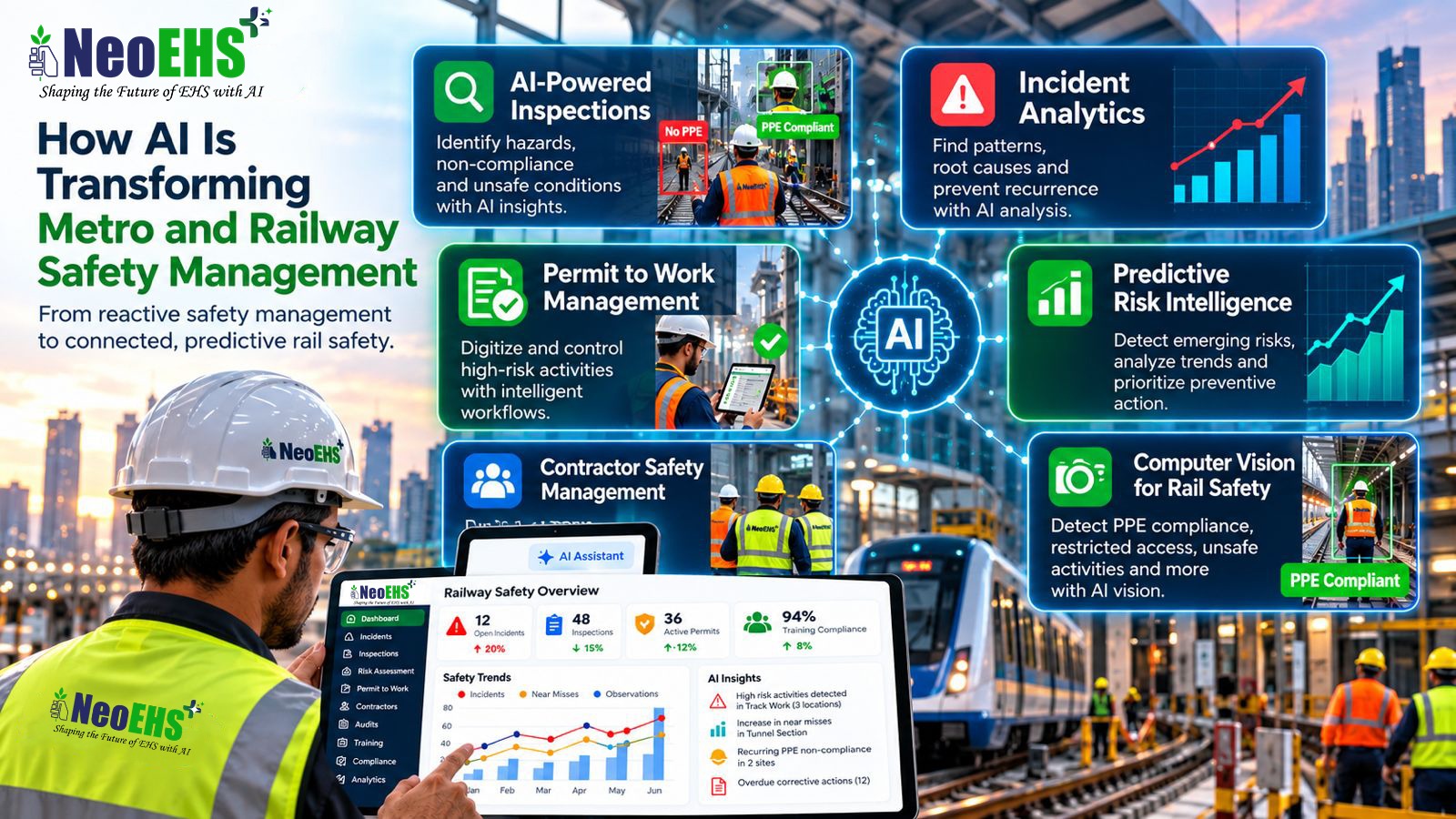
How AI Is Transforming Metro and Railway Safety Management
Reactive safety management to connected, predictive rail safety
Metro and railway systems are among the most complex operating environments in the world. A single network can involve trains, tracks, stations, tunnels, depots, electrical systems, signaling infrastructure, maintenance activities, contractors and large numbers of workers operating around the clock.
In such an environment, safety cannot depend only on periodic inspections and incident reporting.
Rail and metro organizations need to understand where risks are emerging, whether controls are working, and how different safety events are connected.
This is where Artificial Intelligence is beginning to change the way railway and metro safety is managed.
AI can help EHS teams analyze large volumes of safety information, identify recurring patterns, support risk assessment, improve inspections and incident investigations, and provide earlier visibility into conditions that may require attention.
The goal is not to replace railway safety professionals.
The goal is to give them better information, faster analysis and stronger decision support.
What Is AI-Powered Metro and Railway Safety Management?
AI-powered metro and railway safety management is the use of artificial intelligence, analytics, connected data and digital EHS workflows to help rail organizations identify hazards, assess risks, manage incidents, monitor safety performance and strengthen preventive controls.
A modern AI-enabled rail safety system can bring together information from:
- Safety inspections
- Incidents and near misses
- Risk assessments
- HIRA and HIRARC
- JSA and JHA
- Permit to Work
- Safety observations
- Audits
- Contractor activities
- Training and competency
- Asset and equipment inspections
- Corrective actions
- CCTV and computer vision
- IoT and connected devices
The value comes from connecting these sources rather than treating every safety activity as a separate process.
NeoEHS follows this integrated approach by combining incident management, hazard identification, risk assessment, audits, inspections, Permit to Work, contractor management, analytics and other EHS workflows within one platform.
Why Metro and Railway Safety Needs a Different Approach
Railway safety is not simply about preventing one type of accident.
A metro or railway project may involve:
- Track construction
- Tunnel construction
- Station construction
- Electrical installation
- Signaling and communication
- Rolling stock maintenance
- Depot operations
- Work at height
- Excavation
- Lifting operations
- Confined spaces
- Hot work
- Energized electrical systems
- Contractor activities
- Passenger interfaces
- Emergency response
The risks also change as the project or operation changes.
A construction site today may become an operational railway tomorrow. A maintenance activity may introduce risks that were not present during normal train operations.
This means safety management needs to be continuous, connected and context-aware.
1. AI Can Strengthen Railway Risk Assessment
Risk assessment is at the heart of railway safety.
EHS teams may use HIRA, HIRARC, JSA, JHA, task risk assessments, Bowtie analysis and other methodologies depending on the organization and activity.
AI can support this process by analyzing information from:
- Previous incidents
- Near misses
- Safety observations
- Inspection findings
- Existing risk assessments
- Work activities
- Equipment
- Locations
- Contractor performance
- Historical trends
For example, if several inspections identify recurring risks around track maintenance, the organization can review whether the existing risk assessment adequately addresses those conditions.
NeoEHS supports HIRA, HIRARC, JSA and configurable risk assessment workflows, together with AI-enabled risk intelligence and analytics.
The important principle is:
AI can identify patterns in risk data; competent safety professionals determine what those patterns mean operationally.
2. Predictive Safety Analytics for Rail Operations
Traditional safety reporting often focuses on what has already happened.
For example:
- Number of incidents
- Lost-time injuries
- Near misses
- Audit findings
- Inspection findings
These metrics remain important.
But AI allows organizations to examine the relationships between different datasets.
For example:
Inspection findings + near misses + incidents + corrective actions + risk assessments
may reveal a pattern that is difficult to identify by looking at individual reports.
Predictive safety analytics can help identify:
- Recurring hazards
- Repeated unsafe conditions
- High-risk locations
- Repeated corrective actions
- Changing risk patterns
- Areas requiring additional investigation
NeoEHS describes predictive risk analytics as a capability that can analyze incidents, near misses, inspections and behavioral trends to support identification of future risk patterns.
This should be understood as risk intelligence, not a guarantee that AI can predict a specific accident.
3. AI-Powered Railway Safety Inspections
Inspections generate some of the most valuable frontline safety data in a railway organization.
A digital inspection can capture:
- Findings
- Photographs
- Location
- Equipment
- Hazard category
- Risk level
- Corrective actions
- Responsible person
- Due date
AI can take this information further by identifying recurring findings and relationships across inspections.
For example:
Missing guard → repeated at three locations → similar previous finding → corrective action previously closed → issue reappeared.
That pattern deserves more attention than a single isolated observation.
NeoEHS supports digital inspections with mobile checklists, findings, corrective actions and analytics.
4. AI Can Improve Railway Incident Management
When an incident occurs, the investigation should not stop at identifying what happened.
Investigators need to understand:
Why did it happen?
Which controls failed?
Was the hazard previously identified?
Were similar events reported elsewhere?
Were previous corrective actions effective?
AI can help investigators analyze historical records and identify similar incidents, recurring hazards and related risk assessments.
NeoEHS's incident-management capability includes AI-assisted incident analysis, investigation workflows, root cause analysis, pattern detection and corrective-action tracking.
This creates a stronger connection:
Incident → Investigation → Root Cause → Corrective Action → Learning → Prevention
5. AI Can Support Root Cause Analysis
Rail incidents can have multiple contributing factors.
For example, an incident involving maintenance equipment could involve:
People
Training, competency or communication
Equipment
Condition, maintenance or guarding
Process
Procedure, permit or isolation
Environment
Lighting, weather, access or housekeeping
Management
Supervision, planning, risk assessment or change management
AI can help organize evidence and identify relationships that investigators should examine.
NeoEHS supports structured root cause methodologies including 5 Why, Fishbone/Ishikawa, Fault Tree Analysis and TapRooT, according to its incident-management documentation.
AI should support the investigation—not automatically determine blame or replace professional judgment.
6. AI and Railway Computer Vision
Computer vision is another important area of AI for rail safety.
Depending on the implementation and available data, computer vision can support detection of visually identifiable conditions such as:
- PPE compliance
- Restricted-area access
- Unsafe activities
- Certain unsafe conditions
- Worker proximity
- Site conditions
For example, a camera-based system could identify a worker entering a restricted area and generate an alert for review.
NeoEHS describes AI vision-based monitoring for areas such as PPE compliance, restricted-area access, crowd density and unsafe activities.
The purpose is not to replace physical inspections.
Instead, computer vision can provide additional continuous visibility between inspections.
7. AI Can Improve Contractor Safety
Metro and railway projects frequently involve multiple contractors and subcontractors.
This can make contractor safety management challenging.
Organizations may need to monitor:
- Contractor onboarding
- Competency
- Training
- Certifications
- Site access
- Safety observations
- Incidents
- Inspections
- Permit compliance
- Corrective actions
- Contractor performance
AI can help analyze contractor safety data and identify recurring patterns.
For example, if several contractors working on similar activities repeatedly generate the same findings, the organization can investigate whether the problem relates to:
- Training
- Supervision
- Work planning
- Procedures
- Competency
- Contractor selection
- Site controls
This is more useful than simply counting contractor incidents.
8. AI-Powered Permit to Work for Railway Projects
Metro construction and railway maintenance involve many high-risk activities.
Examples include:
- Hot work
- Electrical work
- Confined-space entry
- Excavation
- Work at height
- Lifting
- Isolation and LOTO
- Breaking containment
A digital Permit to Work system can connect permit information with risk assessments, workers, contractors and operational controls.
AI can potentially help identify inconsistencies between:
Work activity → Risk assessment → Permit → Required controls
For example, if a particular type of maintenance work repeatedly generates safety findings, the organization can review whether the permit process adequately controls the associated risk.
NeoEHS includes digital Permit to Work capabilities covering high-risk activities such as hot work, confined space, excavation and isolation.
9. AI Can Connect Safety Data Across the Railway Organization
This is where an integrated EHS platform becomes particularly valuable.
Imagine a railway organization has:
- 25 stations
- 5 depots
- Multiple construction packages
- Hundreds of contractors
- Thousands of workers
- Thousands of inspections
If every safety function operates separately, management may see fragmented information.
An integrated platform can connect:
Hazards
↓
Risk Assessments
↓
Inspections
↓
Incidents
↓
Audits
↓
Corrective Actions
↓
Training
↓
Permit to Work
This provides a more complete view of safety performance.
NeoEHS is designed around this integrated EHS model, bringing incident management, hazard management, risk assessment, audits, inspections, PTW, contractor management and other workflows into a centralized platform.
10. AI Can Help Railway EHS Teams Identify Recurring Problems
One of the strongest applications of AI is pattern recognition.
Suppose a railway organization records:
- 15 housekeeping findings
- 9 similar inspection findings
- 4 near misses
- 2 incidents
across different locations.
A traditional reporting system may show these as separate events.
AI can help identify whether they share common characteristics.
The EHS team can then investigate whether the underlying issue relates to:
- Work planning
- Maintenance
- Supervision
- Contractor management
- Training
- Procedures
- Equipment
- Site conditions
This moves the organization from closing individual findings to learning from recurring patterns.
11. AI Can Strengthen Emergency Management
Metro systems require robust emergency preparedness because incidents can involve large numbers of people and complex infrastructure.
Digital emergency management can support:
- Emergency response plans
- Evacuation procedures
- Emergency contacts
- Drill management
- Incident communication
- Emergency equipment
- Response responsibilities
- Corrective actions after drills
AI can help analyze historical emergency drills, findings and incident information to identify recurring weaknesses.
The objective is to make emergency preparedness a continuous management process rather than something reviewed only during an annual drill.
12. AI Can Improve Railway Safety Audits
Audits provide another valuable source of organizational intelligence.
An AI-enabled audit system can help identify recurring findings across:
- Stations
- Depots
- Projects
- Contractors
- Maintenance teams
- Operational units
For example:
Finding repeated at Station A → Station B → Station C
may indicate a system-level issue rather than three independent problems.
AI can help management recognize these patterns and investigate whether a corporate-level control needs improvement.
13. AI Can Help EHS Leaders Prioritize Attention
A railway EHS manager may have hundreds of open findings.
The challenge is not simply knowing how many findings exist.
The challenge is understanding:
Which issues deserve immediate attention?
AI-supported analytics can help organize information using factors such as:
- Potential severity
- Recurrence
- Location
- Exposure
- Historical incidents
- Control effectiveness
- Overdue corrective actions
This allows safety professionals to focus their time where the available evidence indicates greater concern.
14. Connected Worker Technology
The connected worker is becoming an important part of modern railway safety.
Workers can use mobile devices to:
- Report hazards
- Report near misses
- Complete inspections
- Access procedures
- Receive alerts
- Review permits
- Submit observations
- Record photographs
- Track corrective actions
This brings safety management closer to the people actually performing the work.
For rail maintenance and construction environments, where workers may spend most of their time away from offices, mobile-first EHS technology is particularly useful.
NeoEHS supports mobile reporting and field-oriented EHS workflows, including offline incident reporting and GPS-enabled reporting capabilities.
15. From Reactive Railway Safety to Predictive Prevention
The evolution of railway safety technology can be viewed in five stages:
Stage 1 — Paper-Based Safety
Forms, registers and manual reports.
Stage 2 — Digital Safety
Electronic inspections, incidents and audits.
Stage 3 — Connected EHS
Incidents, inspections, risks, audits and corrective actions become connected.
Stage 4 — Intelligent EHS
AI identifies patterns and provides decision support.
Stage 5 — Predictive Safety Intelligence
Organizations use connected historical and operational data to identify emerging risk signals and strengthen preventive controls.
The objective is not to remove humans from safety management.
It is to help safety professionals see more, understand faster and act earlier.
What Should an AI-Powered Railway Safety System Include?
A mature platform should go beyond an AI chatbot or a dashboard.
For Metro and Rail organizations, the technology architecture should ideally include:
Risk Management
- HIRA
- HIRARC
- JSA/JHA
- Dynamic risk assessment
- Bowtie analysis
Incident Management
- Incident reporting
- Near misses
- Investigation
- Root cause analysis
- CAPA
Inspection & Audit
- Digital inspections
- Mobile checklists
- Audit management
- Findings
- Corrective actions
Operational Safety
- Permit to Work
- LOTO
- Contractor management
- Training
- Emergency management
AI & Analytics
- Pattern detection
- Predictive risk analytics
- AI recommendations
- Computer vision
- Safety dashboards
- Trend analysis
The important point is that these capabilities should work together.
What AI Cannot Replace in Railway Safety
There is a temptation to describe AI as if it can independently manage safety.
That is not how responsible EHS technology should be implemented.
AI cannot replace:
- Competent railway safety professionals
- Field inspections
- Worker consultation
- Engineering judgment
- Investigation interviews
- Operational knowledge
- Emergency leadership
- Management accountability
AI can process information and identify patterns.
People provide context, verification and judgment.
That human-AI partnership is particularly important in safety-critical railway environments.
How NeoEHS Supports AI-Powered Metro & Railway Safety
NeoEHS is an AI-powered Environment, Health and Safety system designed to connect safety processes across organizations.
For Metro and Rail organizations, relevant capabilities include:
- Incident management
- Hazard management
- Risk assessment
- HIRA/HIRARC
- JSA/JHA
- Inspection management
- Audit management
- Permit to Work
- Contractor safety
- Training management
- Emergency management
- Corrective actions
- AI-powered analytics
- AI vision-based monitoring
- Predictive risk intelligence
NeoEHS's platform documentation describes these capabilities as connected EHS workflows rather than isolated modules.
For example, a safety observation identified during a railway inspection can become part of the organization's hazard and risk-management process. An incident can be investigated against previous inspections and risk assessments. Corrective actions can then be tracked and verified.
That connected approach is the foundation of rail safety intelligence.
Frequently Asked Questions
What is AI-powered railway safety management?
AI-powered railway safety management combines artificial intelligence, analytics, digital EHS workflows and operational safety data to help rail organizations identify hazards, assess risks, investigate incidents, monitor safety performance and strengthen preventive controls.
How can AI improve metro safety?
AI can analyze information from incidents, inspections, risk assessments, audits and other EHS processes to identify patterns, recurring hazards and emerging risk signals.
Can AI predict railway accidents?
AI can identify patterns and risk indicators in historical and operational data, but it should not be represented as being able to guarantee that a specific railway accident will or will not occur.
How does AI help railway risk assessment?
AI can analyze previous incidents, near misses, inspections, hazards and other safety data to help EHS teams identify relevant patterns and review whether existing risk controls remain appropriate.
How is computer vision used in railway safety?
Computer vision can support detection of certain visually identifiable conditions, such as PPE compliance, restricted-area access and selected unsafe activities, depending on the technology and deployment.
Can AI improve railway incident investigation?
Yes. AI can help investigators organize information, identify similar historical incidents, analyze recurring patterns and support root cause analysis. Qualified investigators should validate the evidence and conclusions.
What is digital EHS for railway projects?
Digital EHS uses software to manage railway safety activities such as incidents, inspections, audits, risk assessments, permits, contractors, training and corrective actions through connected digital workflows.
What should a railway EHS software system include?
A comprehensive system should support risk assessment, incident management, inspections, audits, Permit to Work, contractor management, training, emergency management, corrective actions, compliance and analytics.
Can NeoEHS be used for Metro and Rail safety?
NeoEHS provides integrated EHS capabilities relevant to infrastructure and high-risk operations, including incident management, risk assessment, inspections, audits, PTW, contractor safety, AI analytics and hazard management.
Conclusion
The future of Metro and Railway safety will not be defined by one technology.
It will come from connecting people, processes, operational data and intelligent technology.
AI can help railway organizations move beyond simply recording incidents and completing inspections.
It can help them recognize patterns.
It can connect information that previously existed in separate systems.
It can help EHS professionals understand where risks are recurring.
And, when combined with sound safety management practices, it can support earlier and more informed preventive action.
The journey is:
Digitize → Connect → Analyze → Learn → Predict → Prevent
For NeoEHS, the vision is to help organizations move from traditional EHS management toward AI-powered safety intelligence—where every incident, inspection, hazard, audit and observation contributes to a better understanding of risk.
Because the real goal of digital railway safety is not simply to produce more data.
It is to use safety data to make the railway safer.
READ MORE ❯
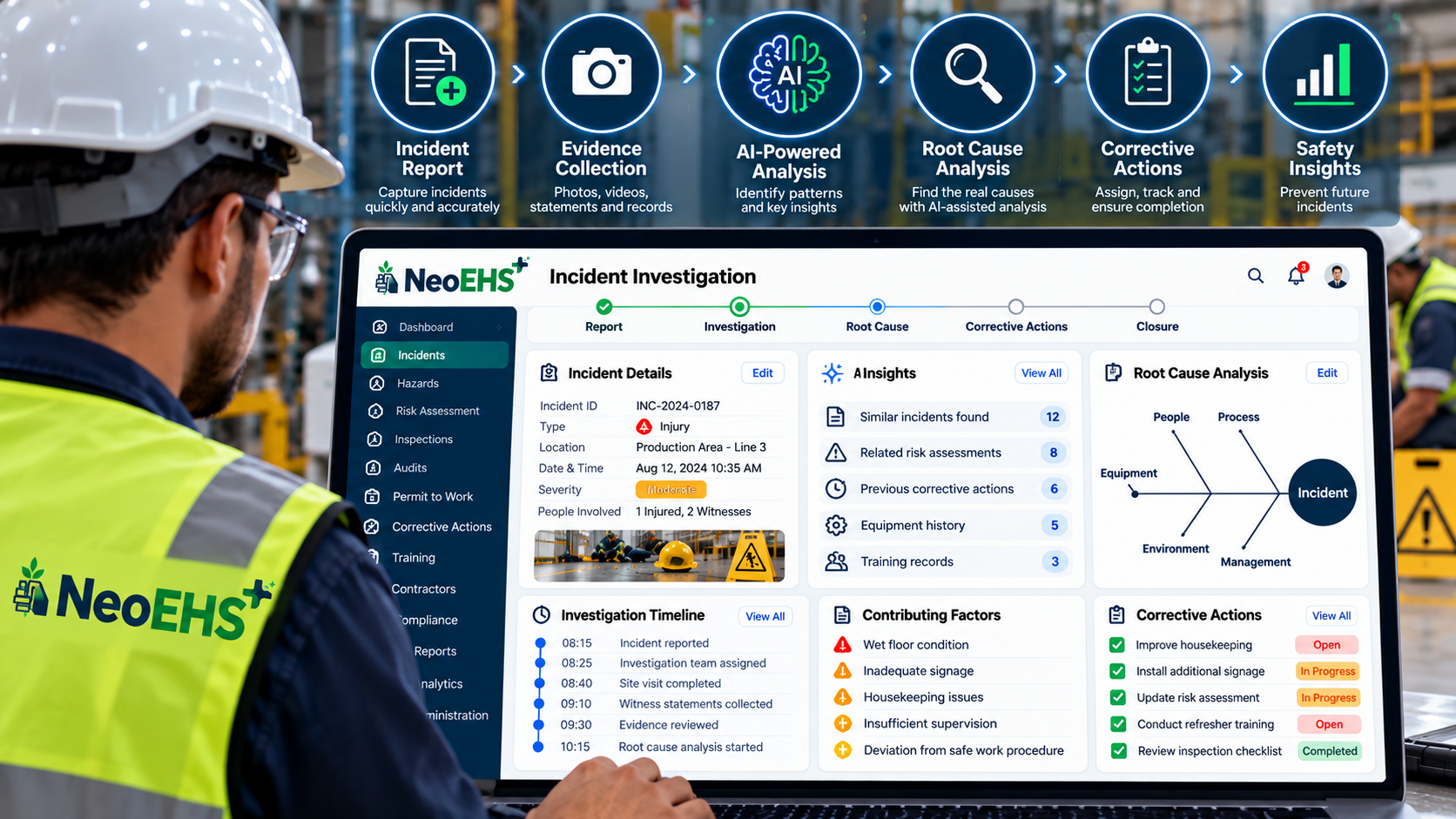
How AI Helps Organizations Investigate Workplace Incidents
What Is a Workplace Incident Investigation?
A workplace incident investigation is a structured process used to understand the circumstances, causes and contributing factors behind an incident, near miss, injury, environmental event or other safety-related occurrence.
A good investigation normally asks:
- What happened?
- Where and when did it happen?
- Who and what were involved?
- What conditions existed at the time?
- What immediate causes contributed to the event?
- Which underlying or systemic factors were involved?
- Which controls were missing, ineffective or bypassed?
- What corrective actions are required?
- How will we verify that those actions actually worked?
Traditional investigations often depend on paper forms, spreadsheets, emails, photographs, interview notes and separate documents. That can make it difficult to connect information across an organization.
Digital incident management changes this by bringing the investigation process into one structured workflow. NeoEHS, for example, provides digital incident reporting, investigation workflows, root cause analysis and corrective-action tracking.
Why Traditional Incident Investigations Can Be Difficult
Experienced safety professionals know that the difficult part of an investigation is rarely completing the incident form.
The difficult part is finding the story hidden inside the information.
An investigation may contain:
- Incident descriptions
- Witness statements
- Photographs and videos
- Inspection records
- Previous incident reports
- Risk assessments
- JSA/JHA documents
- HIRA records
- Permit-to-work information
- Training and competency records
- Equipment inspection history
- Maintenance information
- Safety observations
- Corrective actions
- Environmental conditions
- Contractor information
When this information is stored across different systems, investigators may have to manually search through records before they can see the complete picture.
This is where AI can provide practical assistance.
How AI Helps Investigate Workplace Incidents
AI can support incident investigation at several stages of the process.
1. Faster Incident Reporting and Classification
The quality of an investigation begins with the quality of the initial information.
AI can assist employees and supervisors by analyzing incident descriptions and helping classify events according to factors such as:
- Incident type
- Injury type
- Potential severity
- Location
- Activity involved
- Equipment involved
- Hazard category
- Environmental impact
- Unsafe act
- Unsafe condition
- Near miss
For example, an employee might enter:
"Worker slipped while carrying material near the loading area. Floor was wet and no warning sign was visible."
AI can identify potentially relevant factors such as slip hazard, wet surface, material handling and inadequate warning controls, while the responsible EHS professional validates the classification.
This reduces the amount of manual sorting required at the beginning of the investigation.
2. AI Can Help Organize Investigation Evidence
An incident investigation can generate a significant amount of information.
AI can help organize and summarize:
- Witness statements
- Investigation notes
- Photographs
- Incident descriptions
- Inspection findings
- Previous incidents
- Corrective actions
- Risk assessments
- Permit records
- Training records
Instead of an investigator manually reviewing every related record, AI can help surface potentially relevant information.
For example:
Current incident: Worker injured during maintenance activity.
AI-assisted analysis could identify:
- Previous incidents involving the same equipment
- Previous inspection findings
- Similar near misses
- Existing risk assessments
- Previous corrective actions
- Training records
- Permit-to-work history
The investigator can then decide which information is actually relevant.
That distinction is important: AI can identify relationships; the investigator validates their significance.
3. AI-Assisted Root Cause Analysis
Finding the immediate cause of an incident is often relatively easy.
Finding the underlying cause is much harder.
Consider a simple example:
Incident: Worker suffered a hand injury while operating machinery.
A superficial investigation might conclude:
"Worker did not follow the procedure."
But that may not be the end of the investigation.
An effective investigation should ask:
- Was the procedure available?
- Was the worker trained?
- Was the procedure practical?
- Was the machine properly guarded?
- Was there pressure to maintain production?
- Had similar problems been reported?
- Was maintenance completed?
- Was the risk assessment current?
- Were supervisors aware of the unsafe condition?
- Was the equipment modified?
- Were previous corrective actions completed?
AI can help investigators examine these relationships and identify potential contributing factors.
This makes AI-assisted root cause analysis particularly useful when incidents involve multiple interacting conditions.
NeoEHS positions its incident-management capability around intelligent investigations, root cause analysis, corrective actions and predictive insights.
4. AI Can Identify Repeated Patterns
One incident by itself may not reveal a significant trend.
Ten apparently unrelated incidents might.
For example:
| Incident | Location | Activity | Contributing Factor |
|---|---|---|---|
| 1 | Plant A | Material handling | Poor housekeeping |
| 2 | Plant B | Material handling | Poor housekeeping |
| 3 | Plant A | Maintenance | Inadequate access |
| 4 | Plant C | Material handling | Poor housekeeping |
| 5 | Plant B | Maintenance | Inadequate access |
A human investigator looking at one incident may see an isolated event.
AI analyzing thousands of records may identify recurring relationships across:
- Sites
- Departments
- Equipment
- Activities
- Contractors
- Shifts
- Incident types
- Hazards
- Root causes
- Corrective actions
This moves the organization from incident-by-incident investigation toward organizational learning.
5. AI Can Connect Incidents With Near Misses
Near misses are particularly valuable because they can provide early warning signals.
Suppose an organization records:
- 2 injuries
- 15 near misses
- 42 unsafe-condition observations
If all of them involve similar equipment or activities, the organization may have a broader control problem.
AI can analyze these records together and identify relationships that may not be obvious when each event is reviewed independently.
This is one reason a modern EHS platform should connect incident management, safety observations, hazard management and risk assessment rather than treating them as isolated applications.
NeoEHS provides these capabilities as part of its broader EHS platform.
6. AI Can Compare an Incident With Existing Risk Assessments
A valuable investigation question is:
"Did we already know this risk existed?"
This question can reveal important weaknesses in the organization's risk-management process.
AI can help compare incident information with:
- HIRA
- HIRARC
- JSA
- JHA
- Risk registers
- Job procedures
- Safety observations
- Permit-to-work controls
For example, an incident may occur during confined-space maintenance.
The investigation could examine whether:
- The hazard was identified in the HIRA.
- The risk rating was appropriate.
- Required controls were defined.
- The permit reflected those controls.
- Workers were trained.
- The controls were actually implemented.
This creates an important connection between risk assessment and incident investigation.
7. AI Can Analyze Previous Corrective Actions
Corrective actions are only useful if they address the underlying problem.
One common EHS challenge is repeatedly creating corrective actions that look different on paper but address the same symptom.
AI can help identify:
- Similar corrective actions from previous incidents
- Repeated recommendations
- Overdue actions
- Recurring findings
- Actions that have been closed repeatedly without eliminating recurrence
- Similar incidents after corrective actions were completed
This supports a more important question:
Did the corrective action actually prevent recurrence?
That is the difference between simply closing an action and demonstrating corrective-action effectiveness.
8. AI Can Help Investigators Prioritize Evidence
Not every piece of information in an investigation has equal importance.
AI can help investigators prioritize potentially relevant evidence based on the incident context.
For example, following a machinery incident, the system might surface:
High relevance
- Machine inspection records
- Maintenance history
- Previous machine incidents
- Operator training
- Machine guarding findings
Potentially relevant
- Similar incidents at other facilities
- Previous safety observations
- Related risk assessments
The investigator can then review the evidence and determine what belongs in the final investigation.
This can reduce investigation time without removing professional judgment.
9. AI Can Support Investigation Timelines
Understanding what happened before, during and after an incident is often critical.
AI can help organize available information into a chronological timeline.
For example:
08:05 – Maintenance permit issued
08:15 – Equipment isolation recorded
08:42 – Worker entered work area
08:48 – Equipment inspection completed
08:55 – Incident reported
09:02 – Emergency response initiated
09:20 – Investigation started
A structured timeline helps investigators identify gaps between the documented procedure and what actually occurred.
10. AI Can Analyze Large Incident Databases
Large organizations may have thousands of historical records.
Manually reviewing that information is difficult.
AI can help analyze historical data to identify patterns involving:
- Incident frequency
- Severity
- Equipment
- Locations
- Work activities
- Departments
- Contractors
- Shifts
- Root causes
- Unsafe acts
- Unsafe conditions
- Corrective actions
- Recurrence
This is particularly valuable for organizations operating multiple plants, projects or countries.
NeoEHS is designed as a multi-site EHS platform with centralized incident, risk, audit, inspection and compliance capabilities.
11. AI Can Help Identify Potential Recurrence Risk
AI should not be presented as a machine that can guarantee which accident will happen next.
Workplace safety is influenced by human behavior, equipment condition, work environment, management systems and changing operational conditions.
However, AI can identify patterns associated with previous incidents and emerging risk signals.
For example, an organization may discover that incidents are more frequently associated with:
- Specific equipment
- Certain activities
- Particular locations
- Repeated housekeeping findings
- Expired training
- Contractor activities
- High-risk permits
- Repeated inspection findings
This allows EHS teams to investigate and address the underlying conditions before another event occurs.
12. AI Can Generate Investigation Summaries
Investigators often spend considerable time preparing reports for management.
AI can assist by summarizing:
- What happened
- Immediate causes
- Contributing factors
- Root causes identified by the investigation
- Evidence reviewed
- Corrective actions
- Responsible persons
- Due dates
- Recurrence concerns
The investigator should review and approve the final report rather than automatically accepting AI-generated conclusions.
This provides a useful principle for AI-powered EHS:
AI assists with analysis and documentation; qualified EHS professionals remain responsible for decisions.
AI-Powered Incident Investigation: A Practical Workflow
A modern AI-supported investigation can follow this process:
Incident Report → Evidence Collection → AI-Assisted Analysis → Investigation → Root Cause Analysis → Corrective Actions → Effectiveness Verification → Trend Analysis → Preventive Learning
Step 1 — Report
Capture the incident immediately through web or mobile reporting.
Step 2 — Collect Evidence
Bring together photographs, videos, statements, inspection records and relevant EHS information.
Step 3 — Analyze
Use AI to classify information and identify potentially relevant patterns.
Step 4 — Investigate
The investigator validates evidence, interviews personnel and establishes what actually happened.
Step 5 — Determine Causes
Use structured root cause methodologies supported by relevant evidence.
Step 6 — Correct
Assign corrective and preventive actions with responsibilities and deadlines.
Step 7 — Verify
Check whether the actions were implemented and whether they were effective.
Step 8 — Learn
Analyze the incident alongside previous incidents, near misses and safety observations.
Step 9 — Prevent
Update risk assessments, procedures, training, controls or other parts of the EHS management system where necessary.
AI Incident Investigation Should Not Become "AI Blame"
There is an important distinction between AI-assisted investigation and automated blame assignment.
An incident may involve several contributing factors.
For example:
Worker factor
Training or competency
Equipment factor
Guarding or maintenance
Work environment
Lighting, housekeeping or access
Process factor
Procedure or permit
Management-system factor
Risk assessment, supervision or change management
A mature EHS investigation should look at the entire system rather than automatically attributing the event to an individual worker.
AI should therefore help investigators expand the investigation, not prematurely narrow it.
The Role of Human Expertise in AI-Powered Investigations
Artificial Intelligence is powerful at processing information and identifying patterns.
Experienced EHS professionals remain essential for:
- Understanding operational context
- Interviewing workers and witnesses
- Validating evidence
- Determining causal relationships
- Understanding organizational conditions
- Evaluating control effectiveness
- Making safety decisions
- Communicating lessons learned
The strongest model is therefore not Human versus AI.
It is:
Human Expertise + AI Intelligence
AI can process large volumes of information quickly.
The EHS professional brings experience, judgment and knowledge of the workplace.
Together, they can create a stronger investigation process.
How NeoEHS Supports AI-Powered Incident Investigation
NeoEHS AI-Powered Incident Management Software brings incident reporting, investigation, root cause analysis, corrective actions and safety analytics into a structured digital workflow.
For organizations looking beyond incident reporting, the wider NeoEHS EHS Management Software platform connects incident management with risk assessment, audits, inspections, permit-to-work, compliance, environmental management and AI-powered analytics.
Relevant NeoEHS capabilities include:
- Incident and near-miss reporting
- Digital investigation workflows
- Root cause analysis
- Corrective and preventive action management
- Safety trend analysis
- Risk assessment
- Hazard management
- Audit and inspection management
- Permit-to-work management
- Contractor safety
- Mobile EHS reporting
- AI-powered safety intelligence
- Enterprise dashboards and analytics
This integrated approach is important because an incident should not end when the investigation report is approved. The lessons learned should flow back into the organization's risk assessments, controls, inspections, training and preventive actions.
AI Incident Investigation Across Different Industries
The investigation process varies by industry, but AI-assisted analysis can be applied across many operational environments.
Manufacturing
Analyze machinery incidents, machine guarding, maintenance history, operator training and recurring unsafe conditions.
Construction
Connect incidents with permits, contractor activities, site inspections, JSA/JHA records and changing site conditions.
Mining
Analyze incidents involving mobile equipment, ground conditions, blasting, heavy machinery and contractor activities.
NeoEHS has also addressed AI-powered incident management specifically for mining operations, including the use of incident data to support predictive safety intelligence.
Power & Energy
Connect incidents with electrical safety, LOTO, maintenance activities, permits and equipment conditions.
Oil & Gas
Analyze incidents in relation to process safety, permit-to-work, isolation, contractor activities and operational changes.
Ports & Maritime
Investigate incidents involving cargo handling, vehicle movement, lifting operations, marine activities and contractor safety.
From Incident Investigation to Safety Intelligence
The real opportunity with AI is not simply making an investigation report faster.
It is turning every incident into organizational knowledge.
A mature EHS system should allow an organization to move through four stages:
Incident → Investigation → Learning → Prevention
When the information from thousands of investigations is connected, the organization can begin to understand:
- Which hazards repeatedly appear
- Which controls frequently fail
- Which activities generate recurring incidents
- Where corrective actions are ineffective
- Which sites have similar risk patterns
- Which near misses deserve greater attention
- Where preventive controls should be strengthened
That is where an EHS platform begins to evolve from a recordkeeping system into a safety intelligence system.
Frequently Asked Questions
What is AI-powered incident investigation?
AI-powered incident investigation uses artificial intelligence to assist EHS teams in organizing incident information, analyzing evidence, identifying patterns, supporting root cause analysis, tracking corrective actions and generating safety insights.
Can AI investigate a workplace accident?
AI can assist with parts of an investigation, including information analysis, classification, pattern identification and documentation. A qualified investigator should validate evidence, establish causation and make the final investigation decisions.
How does AI help with root cause analysis?
AI can analyze incident information alongside historical incidents, risk assessments, inspections, observations and corrective actions to identify potential contributing factors and recurring patterns. The investigator should validate the findings.
Can AI identify recurring workplace incidents?
Yes. AI can analyze large historical datasets to identify recurring relationships involving equipment, activities, locations, hazards, root causes, contractors and other factors.
Can AI analyze near misses?
Yes. Near-miss information can be analyzed alongside incidents and safety observations to identify recurring hazards and early warning signals.
Can AI help prevent workplace incidents?
AI can support prevention by identifying recurring patterns, emerging risk signals and weaknesses in existing controls. It cannot guarantee that a particular accident will or will not occur.
Does AI replace EHS investigators?
No. AI should support EHS professionals rather than replace their operational knowledge, investigation skills and professional judgment.
What should an AI-powered incident management system include?
A comprehensive system should ideally include incident reporting, near-miss management, investigation workflows, evidence management, root cause analysis, corrective actions, effectiveness verification, analytics and integration with risk, audit, inspection and compliance processes.
How does NeoEHS help with incident investigation?
NeoEHS provides digital incident reporting, investigation workflows, root cause analysis, corrective-action management and safety analytics, while connecting incident management with broader EHS processes.
Conclusion
The purpose of an incident investigation is not simply to explain yesterday's event.
It is to improve tomorrow's workplace.
AI can help EHS teams process more information, identify relationships across incidents, connect events with risk assessments and previous findings, support root cause analysis and turn historical safety data into practical intelligence.
But technology alone does not create a safer workplace.
The strongest approach combines quality data, sound investigation methodology, experienced EHS professionals and responsible use of AI.
For organizations moving from reactive safety management toward proactive and predictive EHS, AI-powered incident investigation can become an important part of that journey.
Report → Investigate → Understand → Learn → Prevent.
And that is the real value of bringing AI into workplace incident management.
READ MORE ❯
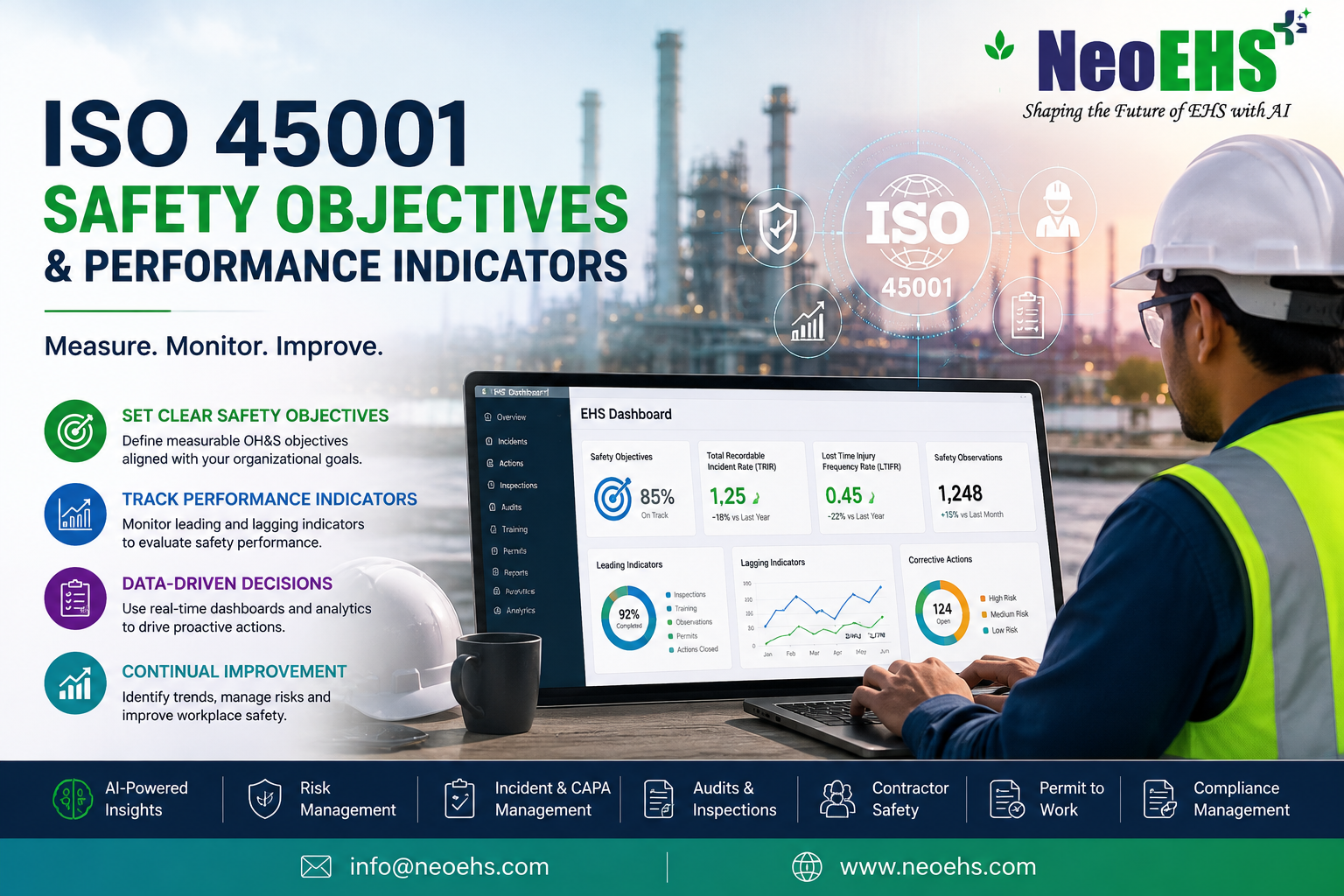
ISO 45001 Safety Objectives and Performance Indicators
An effective occupational health and safety management system should do more than document policies and procedures. It should help an organization understand whether its safety efforts are actually working.
That is why ISO 45001 safety objectives and performance indicators are so important.
Safety objectives define what an organization wants to achieve. Performance indicators provide the evidence needed to understand whether it is moving in the right direction.
For example, an organization may set an objective to reduce high-risk workplace exposures. Its performance indicators could then measure the percentage of high-risk activities assessed, corrective actions completed on time, repeat hazards identified, safety observations closed and exposure-related incidents.
The important point is that a safety objective should not exist in isolation.
It needs a measurable target, clear ownership, defined actions and regular performance review.
ISO 45001 provides a framework for organizations to establish, implement and continually improve an occupational health and safety management system. The standard covers areas including OH&S policy, objectives, planning, implementation, monitoring, performance evaluation and continual improvement.
For organizations managing these activities digitally, NeoEHS EHS Management Software brings together risk management, incidents, inspections, audits, corrective actions, compliance and AI-powered safety intelligence in one platform.
What Are ISO 45001 Safety Objectives?
ISO 45001 safety objectives are defined OH&S goals that an organization establishes to improve occupational health and safety performance and achieve the intended outcomes of its OH&S management system.
A good safety objective should be:
- Relevant to the organization's OH&S risks and opportunities
- Consistent with its OH&S policy
- Measurable where practicable
- Monitored
- Communicated to relevant people
- Reviewed periodically
- Supported by defined actions and responsibilities
The objective should answer a simple question:
What safety improvement are we trying to achieve?
For example:
Objective: Reduce high-risk unsafe conditions across operational sites.
This is a useful starting point, but it becomes much stronger when converted into a measurable target:
Target: Reduce repeat high-risk findings by 25% within 12 months.
The organization can then establish indicators that show whether the target is being achieved.
Safety Objective vs KPI vs Performance Indicator
These terms are often used interchangeably, but they are not exactly the same.
| Term | What it means | Example |
|---|---|---|
| Safety Objective | What the organization wants to achieve | Reduce workplace injuries |
| Target | The desired measurable result | Reduce recordable injuries by 15% |
| KPI | A key measure used to track important performance | TRIR |
| Performance Indicator | A measure used to evaluate performance | Inspection completion rate |
| Action | What will be done to achieve the objective | Implement monthly high-risk inspections |
A simple way to remember the relationship is:
Objective → Target → Action → Indicator → Measurement → Review → Improvement
This connection is critical.
If an organization establishes objectives but does not measure them, it cannot confidently determine whether its safety management system is improving.
Why Safety Performance Indicators Matter in ISO 45001
Safety performance indicators turn EHS activities into measurable information.
They help management answer questions such as:
- Are workplace injuries increasing or decreasing?
- Are high-risk hazards being identified early?
- Are corrective actions being closed on time?
- Are safety inspections being completed?
- Are workers reporting near misses?
- Are contractors meeting safety requirements?
- Are high-risk permits being properly controlled?
- Are repeated hazards occurring?
- Are training and competency requirements being met?
- Are emergency preparedness activities effective?
ISO 45004:2024 specifically provides guidance on establishing monitoring, measurement, analysis and evaluation processes and developing relevant OH&S indicators to assess performance and support continual improvement.
That makes performance measurement more than a reporting exercise.
It becomes part of the organization's improvement cycle.
Leading and Lagging Safety Indicators
One of the most important concepts in safety performance management is the difference between leading indicators and lagging indicators.
What Are Lagging Safety Indicators?
Lagging indicators measure events or outcomes that have already happened.
Common examples include:
- Lost Time Injury Frequency Rate
- Total Recordable Incident Rate
- Number of lost-time injuries
- Occupational illness cases
- Fatalities
- Restricted work cases
- Days away from work
- Workers' compensation cases
- Property damage incidents
Lagging indicators are important because they show the results of past performance.
However, there is an obvious limitation:
By the time a serious incident appears in a lagging indicator, the incident has already happened.
That is why organizations should not rely on lagging indicators alone.
What Are Leading Safety Indicators?
Leading indicators focus more on activities, conditions and controls that can influence future safety performance.
Examples include:
- Safety inspections completed
- Hazard reports submitted
- Near misses reported
- Corrective actions closed on time
- Safety observations completed
- High-risk activities reviewed
- Permit compliance
- Toolbox talks completed
- Safety training completion
- Competency verification
- Emergency drills conducted
- Critical controls verified
- Preventive maintenance completed
- Contractor safety assessments completed
Leading indicators help organizations understand whether preventive activities are actually taking place.
For example:
A company may have zero lost-time injuries during a quarter.
That sounds positive.
But suppose the same organization has:
- 40 overdue corrective actions
- Falling near-miss reporting
- Reduced safety inspections
- Several repeat hazards
- Low training completion
- Poor permit compliance
The lagging indicator looks good.
The leading indicators suggest that the risk environment may not be improving.
This is why a balanced safety dashboard needs both.
Leading vs Lagging Indicators: A Simple Example
| Safety Area | Leading Indicator | Lagging Indicator |
|---|---|---|
| Hazard Management | High-risk hazards closed on time | Incidents caused by hazards |
| Training | Training completion rate | Training-related incident |
| Inspections | Planned inspections completed | Findings resulting in incidents |
| Corrective Actions | Actions closed within target | Repeat incidents |
| Permit to Work | Permit compliance rate | PTW-related incident |
| Contractor Safety | Contractor assessments completed | Contractor incidents |
| Emergency Preparedness | Drills completed | Emergency-related consequences |
| PPE | PPE compliance observations | PPE-related injury |
The strongest ISO 45001 performance system does not ask only:
"How many incidents did we have?"
It also asks:
"What are we doing today to prevent the next incident?"
10 Practical ISO 45001 Safety Objectives
There is no universal list of safety objectives that every organization must use.
ISO 45001 does not prescribe a fixed set of numerical OH&S performance criteria. Organizations need to establish objectives appropriate to their context, risks, opportunities and intended outcomes.
However, the following objectives can provide a useful starting point.
1. Reduce Workplace Injuries
Objective: Reduce the frequency and severity of occupational injuries.
Possible indicators:
- Total recordable injuries
- Lost-time injuries
- Injury frequency rate
- Injury severity rate
- Days lost due to injury
2. Improve Hazard Identification
Objective: Identify and control hazards before they result in incidents.
Possible indicators:
- Number of hazard reports
- High-risk hazards identified
- Percentage of hazards risk assessed
- Percentage of high-risk hazards controlled
- Repeat hazard rate
3. Improve Corrective Action Closure
Objective: Close safety corrective actions within defined timeframes.
Possible indicators:
- Corrective actions closed on time
- Overdue actions
- Average closure time
- Repeat findings
- High-risk actions outstanding
4. Improve Safety Inspection Performance
Objective: Improve the effectiveness and consistency of workplace safety inspections.
Possible indicators:
- Planned inspections completed
- Inspection completion rate
- High-risk findings
- Repeat findings
- Inspection action closure rate
5. Strengthen Worker Participation
Objective: Increase meaningful worker participation in safety activities.
Possible indicators:
- Safety observations submitted
- Near misses reported
- Toolbox talks completed
- Safety committee participation
- Worker safety suggestions implemented
6. Improve Contractor Safety
Objective: Improve the safety performance and compliance of contractors.
Possible indicators:
- Contractor safety assessments completed
- Contractor training compliance
- Contractor incidents
- Contractor inspection findings
- Contractor corrective-action closure
- Permit compliance
7. Improve Permit to Work Compliance
Objective: Ensure high-risk activities are properly authorized and controlled.
Possible indicators:
- Permit compliance rate
- Expired permits
- Permit deviations
- High-risk permits reviewed
- Isolation verification rate
8. Strengthen Emergency Preparedness
Objective: Improve readiness to respond to workplace emergencies.
Possible indicators:
- Emergency drills completed
- Drill response time
- Emergency equipment inspection completion
- Emergency action closure rate
- Personnel participation
9. Improve Safety Training and Competency
Objective: Ensure workers have the knowledge and competence required for their roles.
Possible indicators:
- Mandatory training completion
- Competency assessment completion
- Expired certifications
- Refresher training completion
- High-risk role competency compliance
10. Reduce Repeat Safety Findings
Objective: Reduce recurring safety deficiencies.
Possible indicators:
- Repeat findings
- Repeat hazards
- Recurrence rate
- Corrective action effectiveness
- Root-cause closure rate
This last objective is particularly valuable because simply closing an action does not necessarily mean that the underlying problem has been solved.
How to Set Effective ISO 45001 Safety Objectives
A practical objective-setting process can follow these steps.
Step 1: Understand the Organization's Context
Start by considering:
- Business activities
- Workplace conditions
- Workforce
- Contractors
- Interested parties
- Legal requirements
- Operational risks
- Significant hazards
- Previous incidents
- Safety performance trends
The objective should reflect the organization's actual risk profile.
Step 2: Review the Significant OH&S Risks
Not every risk deserves the same management priority.
A manufacturing organization may focus heavily on machinery and energy isolation.
A construction company may prioritize:
- Work at height
- Lifting operations
- Excavation
- Mobile equipment
- Electrical work
- Temporary structures
An oil and gas organization may focus on:
- Process safety
- Permit to Work
- Energy isolation
- Confined spaces
- Fire and explosion risks
The objective should be connected to the organization's real operational risks.
Step 3: Convert Risks Into Objectives
Suppose an organization identifies repeated work-at-height findings.
Instead of creating a vague objective:
"Improve work-at-height safety."
Create a measurable objective:
"Reduce repeat work-at-height safety findings by 30% within 12 months."
Now the organization has something that can be measured.
Step 4: Define Indicators
The objective needs indicators.
For the work-at-height example:
Leading indicators
- Work-at-height inspections completed
- Harness inspection compliance
- Edge-protection inspection completion
- Training completion
- Corrective actions closed
Lagging indicators
- Falls
- Work-at-height incidents
- Lost-time injuries associated with falls
This creates a much more complete picture.
Step 5: Assign Responsibility
Every objective should have an accountable owner.
For example:
| Objective | Owner | Review |
|---|---|---|
| Reduce high-risk findings | Site HSE Manager | Monthly |
| Improve training compliance | Training Manager | Monthly |
| Improve contractor safety | Project Manager | Monthly |
| Improve PTW compliance | Operations Manager | Weekly |
| Reduce repeat incidents | Corporate HSE Manager | Monthly |
Without ownership, objectives can easily become passive targets sitting inside a management system.
Step 6: Establish Baselines and Targets
A target should be based on meaningful information.
For example:
Baseline: 78% corrective actions closed on time
Target: 95% closure within agreed timeframe
Measurement frequency: Monthly
Owner: HSE Manager
Escalation: Actions below 90% trigger management review
This makes the objective operational rather than theoretical.
Step 7: Monitor Trends Instead of Single Numbers
A single KPI value can be misleading.
Suppose safety inspection completion is:
- January: 86%
- February: 89%
- March: 91%
- April: 94%
The trend indicates improvement.
But if the number is:
- January: 96%
- February: 95%
- March: 92%
- April: 87%
the organization should investigate why performance is declining.
This is where dashboards and analytics become particularly valuable.
ISO 45001 Safety KPI Dashboard
A useful management dashboard should allow executives and EHS teams to see the safety picture quickly.
A practical dashboard could include:
Safety Outcomes
- Recordable incidents
- Lost-time injuries
- Injury frequency
- Severity
- Occupational illness
Preventive Performance
- Safety observations
- Near misses
- Inspections
- Hazard reports
- Training completion
Corrective Actions
- Open actions
- Overdue actions
- High-risk actions
- Closure rate
- Repeat findings
Risk
- High-risk activities
- High-risk hazards
- Critical control status
- Risk trends
Compliance
- Audit findings
- Compliance percentage
- Permit compliance
- Certification status
- Legal obligations
Contractor Safety
- Contractor incidents
- Contractor assessments
- Training compliance
- Contractor findings
This turns the safety management system into a management decision tool rather than simply a compliance database.
How AI Can Improve ISO 45001 Performance Monitoring
Traditional EHS systems are good at storing information.
The next opportunity is making that information more intelligent.
AI-powered EHS technology can help organizations analyze large amounts of safety information and identify patterns that may otherwise be difficult to see.
For example, AI can help identify:
- Recurring hazards
- Repeated incidents
- High-risk locations
- Contractor performance patterns
- Overdue corrective actions
- Declining leading indicators
- Relationships between different safety events
- Emerging risk patterns
The value of AI is not simply producing another dashboard.
The value is helping safety teams answer:
Where should we focus our attention next?
NeoEHS positions its platform around AI-powered safety intelligence, predictive risk analytics, incident and CAPA management, risk assessment, audits, inspections and real-time HSE visibility.
From KPI Reporting to Predictive Safety Intelligence
There is an important difference between reporting a KPI and understanding what it means.
Consider this example.
A company records a decrease in safety observations.
At first glance, this could appear positive.
But there are two possible explanations:
Scenario A:
Unsafe conditions have genuinely decreased.
Scenario B:
Workers are reporting fewer hazards.
Those two situations have completely different safety implications.
AI-powered analytics can help organizations compare multiple data sources rather than interpreting one KPI in isolation.
For example:
Safety observations ↓
Near-miss reporting ↓
Inspection findings ↑
Repeat hazards ↑
Corrective actions overdue ↑
Taken together, these indicators may tell a very different story from any single metric.
That is the direction in which modern EHS management is moving—from isolated KPIs toward connected safety intelligence.
How NeoEHS Supports ISO 45001 Performance Management
NeoEHS EHS Management Software is designed to connect core EHS processes such as incident management, risk assessment, inspections, audits, corrective actions, Permit to Work and contractor management with analytics and safety intelligence.
For organizations working toward ISO 45001 requirements, this connected approach can help bring safety objectives and performance data into a centralized environment.
For example:
Safety Objective
↓
KPI / Indicator
↓
Data Collection
↓
Dashboard
↓
Trend Analysis
↓
Corrective Action
↓
Management Review
↓
Continual Improvement
This is much more effective than maintaining separate spreadsheets for incidents, inspections, corrective actions and KPI reporting.
NeoEHS also specifically positions its HSE platform as ISO 45001 ready, with capabilities covering risk management, audits, inspections, incident investigations and corrective-action tracking.
Using Mobile Technology for Safety Performance Data
Performance indicators are only as useful as the data behind them.
If safety teams have to return to an office to enter every inspection, hazard or observation, there can be delays between what happens on the site and what management sees.
Mobile EHS systems can allow workers and safety professionals to capture information closer to the point of work.
For example:
Site → Mobile Inspection → Finding → Risk Classification → Action → Verification → Dashboard
This shortens the distance between an unsafe condition and management visibility.
NeoEHS supports cloud and mobile-based EHS management as part of its broader platform.
Common Mistakes When Setting ISO 45001 Safety Objectives
1. Choosing Too Many KPIs
More KPIs do not automatically mean better safety management.
A dashboard containing 100 indicators can become difficult to understand.
Focus on indicators that actually help decision-making.
2. Measuring Only Incidents
Incident rates are important, but they are lagging indicators.
Organizations should also monitor preventive activities and critical controls.
3. Setting Unmeasurable Objectives
"Improve safety culture" is a useful aspiration, but it needs supporting measures.
For example:
- Increase worker safety observations by 20%
- Achieve 95% participation in safety meetings
- Complete safety culture assessments annually
4. Focusing on Numbers Instead of Risk
A high number of hazard reports does not necessarily mean safety performance is getting worse.
It could mean workers are becoming more engaged in identifying hazards.
Context matters.
5. Ignoring Repeat Findings
A corrective action marked "closed" does not necessarily mean the risk has been permanently controlled.
Repeat findings should be monitored carefully.
6. Treating KPIs as a Reporting Exercise
The purpose of a KPI is not to make a dashboard look good.
The purpose is to identify where action is required.
How Often Should ISO 45001 Safety KPIs Be Reviewed?
There is no single review frequency suitable for every indicator.
The frequency should reflect the organization's risks and operational conditions.
A practical model might be:
| Indicator | Suggested Review |
|---|---|
| High-risk incidents | Immediate |
| Critical safety alerts | Daily |
| Permit compliance | Daily/Weekly |
| High-risk corrective actions | Weekly |
| Safety inspections | Weekly/Monthly |
| Training compliance | Monthly |
| Contractor performance | Monthly |
| Safety objectives | Monthly/Quarterly |
| Strategic OH&S performance | Quarterly |
| Management system performance | Management review cycle |
The important principle is that high-risk information should reach decision-makers quickly.
ISO 45001 Objectives and the PDCA Cycle
ISO 45001 follows the Plan-Do-Check-Act approach for systematic OH&S management.
Safety objectives fit naturally into this cycle.
PLAN
Identify risks, opportunities and priorities.
Set objectives and targets.
DO
Implement controls, programs, training and operational processes.
CHECK
Measure KPIs, conduct inspections, audits and performance reviews.
ACT
Correct problems, address root causes and improve the system.
This creates a continuous improvement loop:
Plan → Do → Check → Act → Improve
Frequently Asked Questions
What are ISO 45001 safety objectives?
ISO 45001 safety objectives are defined occupational health and safety goals established by an organization to improve OH&S performance and achieve the intended outcomes of its management system.
What are examples of ISO 45001 objectives?
Examples include reducing workplace injuries, improving hazard identification, increasing corrective-action closure, improving training compliance, strengthening contractor safety, improving Permit to Work compliance and reducing repeat safety findings.
What are ISO 45001 performance indicators?
Performance indicators are measurable values used to monitor and evaluate OH&S performance. They can include both leading indicators, such as inspections and corrective-action closure, and lagging indicators, such as injuries and lost-time incidents.
What is the difference between a safety objective and a KPI?
A safety objective describes what the organization wants to achieve. A KPI or performance indicator measures how performance is progressing toward that objective.
What are leading safety indicators?
Leading safety indicators measure preventive activities and conditions that can influence future safety performance. Examples include safety inspections, hazard reports, training completion, critical-control verification and corrective-action closure.
What are lagging safety indicators?
Lagging indicators measure safety outcomes that have already occurred, such as injuries, illnesses, lost-time incidents and recordable incidents.
Does ISO 45001 prescribe specific safety KPIs?
No. ISO 45001 does not prescribe a universal list of numerical OH&S performance criteria. Organizations should establish appropriate objectives and indicators based on their context, risks, opportunities and intended outcomes.
How can technology help manage ISO 45001 objectives?
EHS software can centralize safety data, automate workflows, track objectives and corrective actions, monitor KPIs, generate dashboards and provide trend analysis. AI-powered platforms can additionally help identify patterns and emerging risks.
Can NeoEHS support ISO 45001 management?
NeoEHS positions its EHS platform as ISO 45001 ready and provides capabilities including risk management, incident management, audits, inspections and corrective-action tracking.
What is ISO 45004 and how does it relate to ISO 45001 KPIs?
ISO 45004:2024 provides guidance on monitoring, measurement, analysis and evaluation of OH&S performance, including the development of relevant indicators. It can be used alongside an OH&S management system based on ISO 45001.
Conclusion
A safety objective is more than a statement of intent.
A KPI is more than a number on a dashboard.
Together, well-designed ISO 45001 safety objectives and performance indicators create a mechanism for understanding whether an organization's occupational health and safety management system is actually improving.
The strongest approach combines:
Clear objectives
- Measurable targets
- Leading indicators
- Lagging indicators
- Reliable data
- Clear accountability
- Regular review
- Continual improvement
And increasingly, organizations can add another layer:
AI-powered safety intelligence.
Instead of waiting for an incident to tell the organization that something went wrong, AI can help safety teams identify patterns, prioritize risks and focus preventive action where it can have the greatest impact.
That is the opportunity for modern EHS management.
With an integrated platform such as NeoEHS, organizations can bring safety objectives, performance indicators, risk management, inspections, incidents, audits, corrective actions and analytics into a connected EHS environment.
Measure what matters. Understand what the data is telling you. Act before risks become incidents.
That is how safety performance becomes continual improvement.
AI-Powered EHS Management Software NeoEHS EHS Management Software
HSE Management Software. NeoEHS HSE Management Software
ISO 45001 compliance. NeoEHS EHS Compliance
AI-powered EHS software in India. NeoEHS EHS Software India
READ MORE ❯
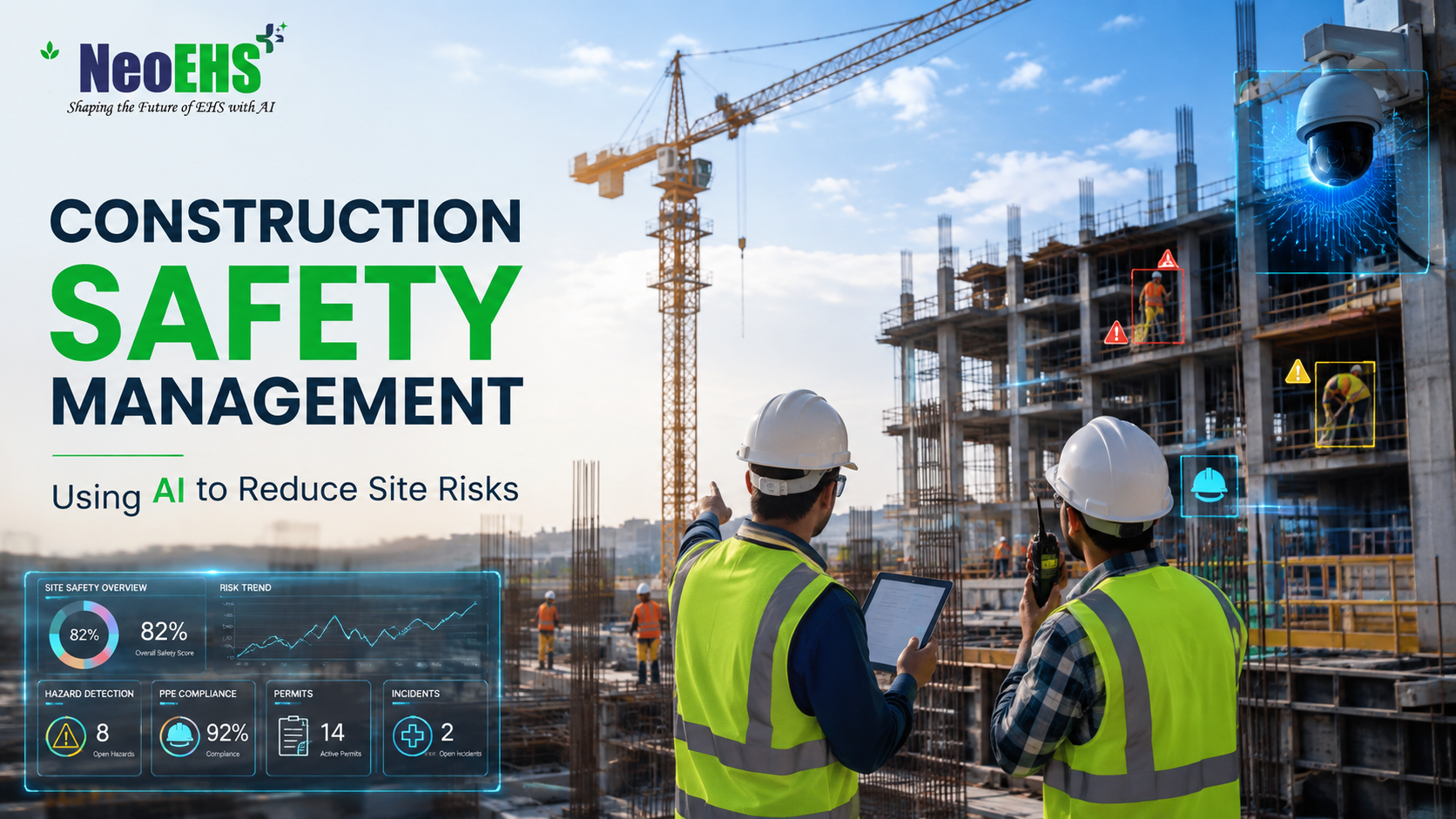
Construction Safety Management: Using AI to Reduce Site Risks
Construction sites are changing faster than ever. Projects are becoming larger, schedules are getting tighter, workforces are more distributed, and multiple contractors may be working simultaneously across the same site.
But one thing has not changed: construction remains an industry where a small unsafe condition can quickly become a serious incident.
A worker may enter a restricted area. A permit may not be properly verified. Personal protective equipment may be missing. A temporary structure may become unstable. A high-risk activity may continue even though the conditions around it have changed.
Traditionally, construction safety management has depended heavily on inspections, checklists, toolbox talks, safety observations and the experience of site safety teams. These remain essential. The challenge is that many of these processes are reactive or periodic.
Artificial Intelligence is changing that model.
Instead of using technology simply to record what happened, construction companies can increasingly use AI to identify patterns, detect unsafe conditions, prioritize risks and support safety teams before an incident occurs.
That is where AI-powered EHS platforms such as NeoEHS can make a practical difference.
What Is Construction Safety Management?
Construction safety management is the systematic process of identifying hazards, assessing risks, implementing controls, monitoring work activities and continuously improving safety performance throughout a construction project.
It covers activities such as:
- Hazard identification and risk assessment
- Job Safety Analysis (JSA) and Job Hazard Analysis (JHA)
- Safety inspections
- Incident and near-miss reporting
- Permit to Work management
- Work-at-height safety
- Excavation and trench safety
- Electrical safety
- Lifting and rigging safety
- Equipment and machinery inspections
- Contractor safety management
- Toolbox talks and safety observations
- Corrective and preventive actions
- Emergency preparedness
- Regulatory and compliance management
The objective is not simply to produce more safety reports.
The real objective is to identify risks early, control them effectively and prevent people from being harmed.
For organizations looking to digitize these processes, NeoEHS Construction Safety Management Software provides a centralized platform for construction safety activities, including hazards, inspections, permits, incidents, contractor activities and compliance.
Why Construction Sites Need a More Proactive Approach to Safety
A construction project is a constantly changing environment.
The risk profile of a site can change from one hour to the next because of:
- New work activities
- Changing weather conditions
- Different contractors entering the site
- Equipment movement
- Changes in site layout
- Temporary structures
- Work at height
- Excavation activities
- Simultaneous operations
- Changes in workforce competency
- Expired permits or certifications
A safety inspection performed in the morning cannot necessarily tell you what will happen later in the afternoon.
This is one of the biggest opportunities for digital construction safety management.
Instead of relying only on periodic checks, organizations can bring together information from inspections, observations, incidents, permits, contractors and other operational activities.
AI can then help safety teams identify relationships and patterns that may be difficult to see manually.
How AI Is Changing Construction Safety Management
AI does not replace safety professionals.
It gives them better information to make faster and more informed decisions.
An AI-powered construction safety system can support safety teams in several important ways.
1. Predicting Emerging Safety Risks
One of the most valuable applications of AI in construction safety is risk prediction.
Traditional safety management often asks:
"What went wrong?"
A proactive safety program asks:
"Where are we likely to have a problem next?"
AI can analyze historical and current safety information such as incidents, near misses, safety observations, inspection findings, permit activities and corrective actions.
Patterns can then be used to identify areas that deserve additional attention.
For example, if a particular project repeatedly reports unsafe work-at-height observations, overdue corrective actions and repeated inspection findings, the system can highlight that activity as a higher-priority risk.
NeoEHS uses AI-powered risk intelligence to identify emerging risks and high-risk activities from EHS data.
2. AI-Powered Hazard Identification
Hazard identification is the foundation of construction safety.
However, hazards are not always obvious.
A hazard may be hidden in a combination of conditions rather than a single event.
For example:
Work at height + incomplete edge protection + unsuitable access + changing work conditions = elevated risk.
AI can help safety teams analyze large volumes of safety observations and inspection information to identify recurring patterns.
This can help answer questions such as:
- Which hazards are appearing repeatedly?
- Which locations have the highest number of findings?
- Which contractors have recurring safety issues?
- Which corrective actions remain open?
- Which activities generate the most observations?
- Are similar hazards appearing across different projects?
The value is not simply collecting more observations.
The value is converting observations into actionable safety intelligence.
3. Computer Vision for Construction Site Safety
Construction sites are highly visual environments.
Cameras can see conditions that humans may not continuously monitor.
Computer vision and AI-powered CCTV analytics can assist with detecting specific safety conditions, depending on the cameras, configuration and AI models being used.
Examples can include:
- PPE compliance
- Restricted-area access
- Unsafe behavior
- Safety-zone violations
- Fire and smoke indicators
- Movement in designated areas
- Other predefined visual safety conditions
NeoEHS supports AI-powered computer vision capabilities designed to help organizations detect safety conditions such as PPE violations, unsafe behavior and restricted-area access.
The important point is that computer vision should complement—not replace—site safety professionals.
AI can identify a potential issue.
A competent safety professional still needs to understand the context, verify the condition and determine the appropriate control.
4. Smarter Permit to Work Management
High-risk construction activities often require formal authorization before work begins.
Examples include:
- Hot work
- Confined space entry
- Electrical work
- Excavation
- Work at height
- Lifting operations
- Energy isolation
- Other hazardous activities
A Permit to Work system creates a structured process for verifying that required controls are in place.
Digital PTW can make this process easier to monitor by providing visibility into:
- Pending permits
- Approved permits
- Expired permits
- Permit conditions
- Required approvals
- Isolation requirements
- Contractor information
- High-risk activities
NeoEHS provides digital Permit to Work capabilities for high-risk activities, including approval workflows, hazard verification and isolation controls.
The next step is using intelligence around that data.
For example, a safety team could prioritize monitoring when multiple high-risk permits are active in the same area at the same time.
5. Contractor Safety Management
Large construction projects rarely involve only one organization.
There may be dozens—or hundreds—of contractors and subcontractors working across different packages.
Managing contractor safety manually can become difficult.
A construction safety management platform can centralize information such as:
- Contractor profiles
- Safety performance
- Training status
- Competency records
- Certifications
- Incident history
- Safety observations
- Inspection results
- Corrective actions
- Permit activities
AI can add another layer by identifying contractor performance trends.
For example, if a contractor shows an increasing number of safety observations, overdue actions and permit violations, the system can help EHS managers identify that trend earlier.
This makes contractor management more proactive.
6. Turning Incident Data Into Prevention
Incident management should not end when an incident report is submitted.
The more important question is:
What can we learn from the incident so that it does not happen again?
A modern EHS system can connect:
Incident → Investigation → Root Cause → Corrective Action → Verification → Learning
AI can assist safety teams by analyzing incident information and identifying recurring contributing factors.
NeoEHS includes digital incident management, investigation, root-cause analysis and corrective-action workflows, with AI-assisted capabilities designed to support proactive safety management.
This creates a shift from simply recording incidents to building organizational learning.
7. Predictive Safety Analytics for Project Managers
Construction project managers need more than a list of open safety actions.
They need to understand the overall risk picture.
A digital construction safety platform can bring together information from:
- Incidents
- Near misses
- Hazards
- Safety observations
- Inspections
- Audits
- Permits
- Contractor performance
- Corrective actions
- Training
- Equipment inspections
AI-powered analytics can then help identify trends and prioritize attention.
For example:
"Which project currently has the highest concentration of unresolved high-risk findings?"
Or:
"Which safety category has deteriorated over the last three months?"
Or:
"Which corrective actions are repeatedly overdue?"
These are the kinds of questions that turn safety data into management intelligence.
8. AI Can Help Safety Teams Prioritize, Not Just Report
One of the biggest problems with traditional safety reporting is information overload.
A project may generate hundreds or thousands of observations, inspection findings and corrective actions.
Not every item has the same level of risk.
AI can help prioritize information based on factors such as:
- Risk severity
- Recurrence
- Location
- Activity
- Historical incidents
- Corrective-action status
- Contractor performance
- Frequency of observations
This allows safety professionals to focus their time where it matters most.
The goal is not more data. The goal is better decisions.
9. A Practical AI-Powered Construction Safety Workflow
A useful AI-enabled construction safety workflow can look like this:
Step 1: Capture
Collect information from mobile inspections, safety observations, incidents, permits, audits and other site activities.
Step 2: Connect
Bring the information together in a centralized EHS platform.
Step 3: Analyze
Use analytics and AI to identify trends, recurring hazards and emerging risk patterns.
Step 4: Prioritize
Highlight activities, locations, contractors or findings that require greater attention.
Step 5: Act
Assign corrective and preventive actions to responsible people.
Step 6: Verify
Confirm that controls have been implemented and findings have been closed effectively.
Step 7: Learn
Use historical information to improve future risk assessments, inspections and preventive controls.
This creates a continuous safety improvement loop rather than a collection of disconnected safety processes.
10. Construction Safety Use Cases for AI
AI can support different stages of a construction project.
| Construction Safety Area | How AI Can Help |
|---|---|
| Hazard Identification | Identify recurring and emerging hazard patterns |
| Risk Assessment | Support risk prioritization using historical data |
| PPE Monitoring | Detect predefined PPE compliance conditions using computer vision |
| Permit to Work | Improve visibility of high-risk work and permit status |
| Contractor Safety | Identify performance trends and recurring issues |
| Incident Management | Analyze incidents and contributing factors |
| Inspections | Highlight recurring inspection findings |
| Corrective Actions | Identify overdue or repeatedly recurring actions |
| Safety Observations | Analyze large volumes of observations |
| Project Dashboards | Provide management-level risk intelligence |
| Compliance | Identify potential gaps and overdue requirements |
11. AI + Human Expertise: The Right Safety Model
There is a common misconception that AI will replace safety professionals.
That is not the right way to look at it.
Construction safety involves judgment, communication, leadership and understanding of real-world conditions.
AI cannot walk onto a site and understand every operational nuance.
A safety professional can.
The strongest model is therefore:
AI + Safety Professional + Operational Data = Better Safety Decisions
AI can monitor patterns.
AI can prioritize information.
AI can identify potential risks.
AI can support investigations.
But people remain responsible for interpreting the situation, implementing controls and leading the safety culture.
12. What Should Construction Companies Look for in an AI-Powered EHS Platform?
Not every system described as "AI-powered" provides the same practical value.
Construction companies should evaluate whether the platform can actually connect AI with day-to-day EHS processes.
Important capabilities include:
Integrated Risk Management
The system should connect hazard identification, risk assessment and corrective actions.
Mobile Safety Management
Site teams should be able to report hazards, incidents and inspections from mobile devices.
Digital Permit to Work
High-risk activities should be managed through structured digital workflows.
Contractor Management
The platform should provide visibility into contractor competency, compliance and performance.
AI Risk Intelligence
AI should help identify patterns and emerging risks rather than simply display historical statistics.
Computer Vision
Where appropriate, computer vision can provide an additional layer of site monitoring.
Incident & Near-Miss Management
The platform should support investigation, root-cause analysis and corrective actions.
Dashboards & Analytics
Project managers and EHS leaders need clear, actionable information—not just large volumes of data.
Multi-Project Management
Large organizations should be able to compare safety performance across projects, contractors and locations.
NeoEHS combines these capabilities within an integrated EHS platform designed for construction and other high-risk industries.
13. How NeoEHS Supports Construction Safety Management
NeoEHS is an AI-powered Environmental, Health and Safety platform designed to connect safety processes, operational data and intelligent insights.
For construction organizations, the platform can support:
- Incident and near-miss management
- Hazard identification
- Risk assessment
- Safety observations
- Inspections
- Audits
- Permit to Work
- Contractor management
- Corrective and preventive actions
- Training and competency management
- AI-powered risk intelligence
- Computer vision safety monitoring
- Mobile workforce safety
- Dashboards and analytics
The construction-specific NeoEHS solution brings these capabilities together to help project teams improve visibility across hazards, permits, incidents, inspections, contractors and compliance activities.
For organizations looking for a broader enterprise platform, the NeoEHS EHS Software Platform provides an integrated approach to EHS, risk management, compliance and ESG.
14. The Future of Construction Safety Is Predictive
Construction safety is moving from a reactive model toward a more connected and predictive model.
The progression looks something like this:
Paper-based safety
↓
Digital safety reporting
↓
Connected EHS management
↓
Real-time safety intelligence
↓
AI-assisted risk prediction
The purpose is not to remove human involvement.
It is to give safety teams earlier visibility into the conditions that could lead to harm.
A near miss should become a learning opportunity.
A recurring hazard should become a signal.
An overdue corrective action should become a priority.
A high-risk activity should receive greater attention before something goes wrong.
That is the real promise of AI in construction safety management.
Frequently Asked Questions
What is construction safety management?
Construction safety management is the structured process of identifying hazards, assessing risks, implementing controls, monitoring work activities and improving safety performance throughout a construction project.
How can AI improve construction safety?
AI can analyze safety data, identify recurring patterns, support risk prediction, prioritize hazards, assist incident analysis and provide intelligent insights that help safety teams make more proactive decisions.
Can AI detect hazards on construction sites?
AI can assist with detecting certain predefined hazards or unsafe conditions, particularly when combined with computer vision, CCTV and connected data sources. However, AI should complement qualified safety professionals rather than replace human judgment.
How does AI help with contractor safety?
AI can analyze contractor-related safety data such as incidents, observations, inspection findings, training status and corrective actions to identify performance trends and areas requiring additional attention.
Can AI be used with Permit to Work systems?
Yes. AI can add intelligence to digital Permit to Work processes by analyzing permit activity, high-risk work patterns and operational data. Digital PTW platforms can also provide real-time visibility of active, pending and expired permits.
Is AI-powered EHS software suitable for large construction projects?
Yes. An enterprise EHS platform can help standardize safety processes across multiple projects, contractors and locations while providing centralized dashboards and analytics.
Does AI replace construction safety officers?
No. AI should support safety professionals by reducing manual analysis, identifying patterns and prioritizing risks. Safety professionals remain essential for site verification, decision-making, leadership and implementing effective controls.
What is the difference between traditional EHS software and AI-powered EHS software?
Traditional EHS software primarily digitizes and manages safety processes. AI-powered EHS software can additionally analyze large volumes of data, identify patterns, support predictions and provide intelligent recommendations to help organizations move toward proactive risk management.
From Safety Reporting to Safety Intelligence
Construction safety management is no longer just about collecting inspection forms and closing corrective actions.
The next generation of safety management is about understanding what the data is telling us—and acting before risks become incidents.
AI can help construction organizations connect information from hazards, inspections, incidents, permits, contractors and site activities to create a clearer picture of operational risk.
But technology alone does not create a safe construction site.
People, leadership, effective controls and a strong safety culture remain at the heart of construction safety.
AI simply gives those people better information, earlier visibility and a stronger foundation for making safety decisions.
With an integrated AI-powered EHS platform such as NeoEHS, construction companies can move from fragmented safety processes toward connected, proactive and intelligence-driven safety management.
The future of construction safety is not simply digital. It is predictive, connected and human-led.
eadcrumbListFAQPage— only if the visible FAQ content remains on the page and complies with Google's current structured-data requirements.ImageObject
This gives search engines and AI systems clearer relationships between NeoEHS → Construction Safety → AI → EHS Software → specific capabilities.
1. Construction Solution
Anchor text: NeoEHS Construction Safety Management Software. NeoEHS Construction Safety Management Software
2. EHS Software
Anchor text: AI-powered EHS software. AI-Powered EHS Software
3. HSE Software.
Anchor text: HSE Management Software. NeoEHS HSE Software
4. AI-Powered EHS Application
Anchor text: AI-powered EHS application. NeoEHS AI-Powered EHS Application
READ MORE ❯
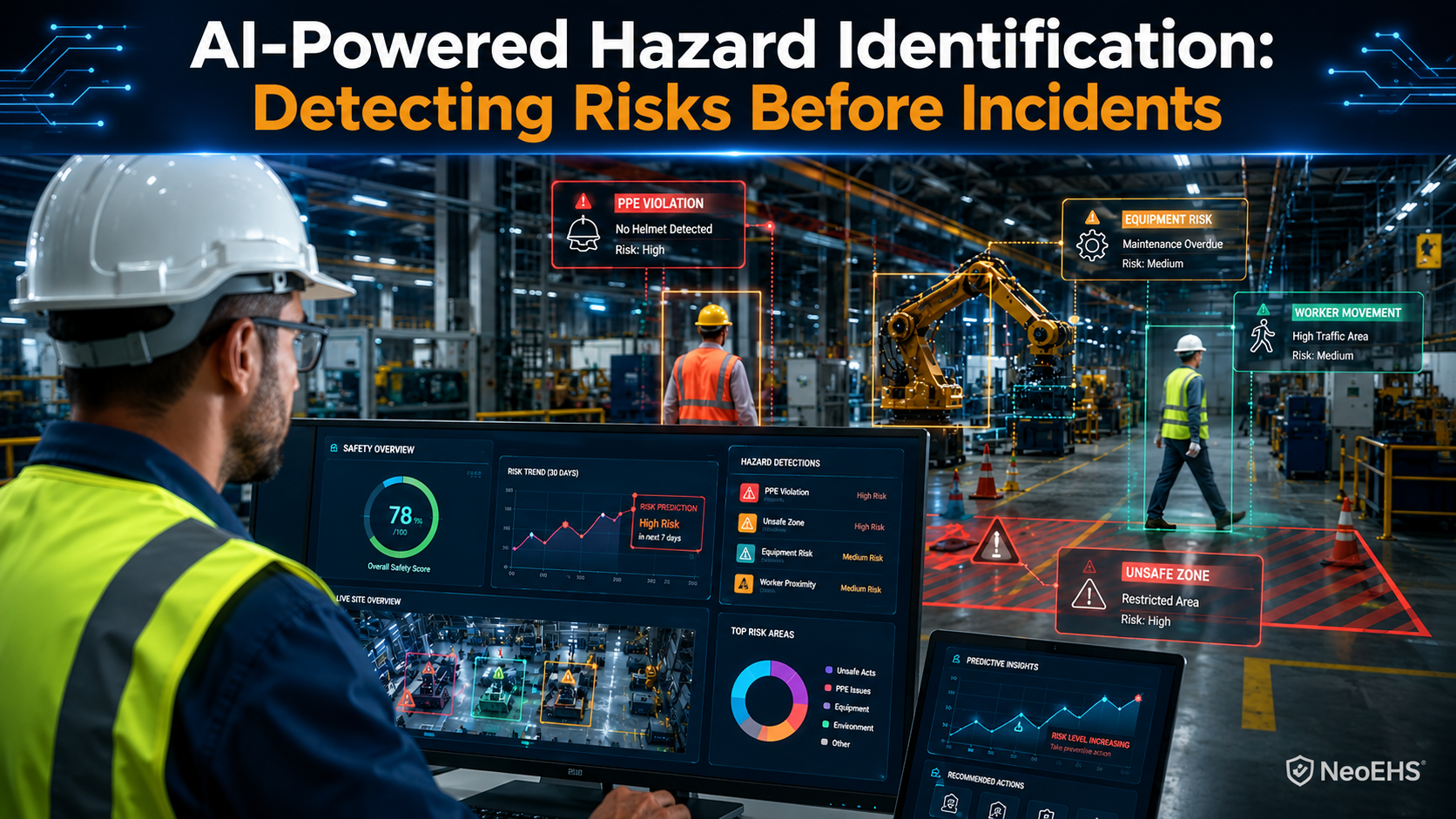
AI-Powered Hazard Identification: Detecting Risks Before Incidents
AI-Powered Hazard Identification: Detecting Risks Before Incidents
A workplace incident rarely happens without warning.
Before an accident, there is often a sequence of smaller signals: an unsafe condition, a missed control, a repeated unsafe behavior, an overdue corrective action, a near miss, or a work activity that gradually becomes higher risk.
The challenge is that traditional safety management systems are often designed to record what has already happened. Safety teams may identify hazards during inspections, document them in spreadsheets, assign corrective actions and review them later.
That approach is necessary—but it is no longer enough.
Modern organizations are moving toward AI-powered hazard identification, where safety data, inspections, observations, incidents, operational information, images, CCTV feeds and connected devices can be brought together to identify emerging risks earlier.
This is where an intelligent EHS platform such as NeoEHS can change the way organizations approach workplace risk.
Instead of asking only:
“What went wrong?”
organizations can begin asking:
“What risk is developing right now, and what can we do before it becomes an incident?”
NeoEHS AI-Powered Hazard Management Software
What Is AI-Powered Hazard Identification?
AI-powered hazard identification is the use of artificial intelligence, machine learning, computer vision, predictive analytics and operational data to identify potential workplace hazards and emerging risks before they result in incidents.
Traditional hazard identification usually depends on inspections, employee observations, safety walks, checklists and incident investigations.
AI can extend this process by continuously analyzing large volumes of information and identifying patterns that may be difficult to detect manually.
For example, an AI-enabled EHS system may help identify:
- Repeated unsafe acts in a particular work area
- PPE compliance issues
- Frequently occurring hazards
- High-risk activities
- Recurring near-miss patterns
- Unsafe conditions captured through images
- Risks associated with specific equipment or processes
- High-risk locations
- Overdue corrective actions
- Changes in risk patterns over time
The objective is not to replace safety professionals.
It is to give them better information, earlier signals and greater visibility into developing risks.
Why Traditional Hazard Identification Is No Longer Enough
Many organizations still rely heavily on spreadsheets, paper-based inspections, manual reporting and periodic safety reviews.
These methods can work, but they create a significant limitation: safety information is often reviewed after the event or at fixed intervals.
Consider a simple example.
A manufacturing facility records five similar unsafe observations around a particular machine over three months.
Individually, each observation may appear manageable.
But when those observations are analyzed together, they may reveal a recurring hazard.
That is where AI can add value.
Instead of treating every observation as an isolated record, an intelligent EHS platform can connect information across:
Hazards → Observations → Inspections → Near Misses → Incidents → Corrective Actions → Risk Assessments
The result is a more connected view of risk.
NeoEHS is designed around this broader EHS lifecycle, combining hazard management with risk assessment, incident management, inspections, audits, permits and corrective action workflows.
How AI Changes Hazard Identification
AI does not make hazard identification a single automated activity.
Its real value comes from creating a continuous safety intelligence cycle.
1. Detect
The system collects information from multiple sources.
This may include:
- Mobile hazard reports
- Safety observations
- Inspection findings
- Incident and near-miss records
- CCTV and computer vision
- IoT sensors
- Permit-to-Work information
- Risk assessments
- Contractor activities
- Environmental conditions
This creates a broader safety information base than a conventional spreadsheet or standalone inspection system.
2. Understand
AI can classify and organize safety information.
A reported observation, for example, can be categorized according to hazard type, location, activity, severity or risk level.
Images and documents can also provide additional evidence for safety teams.
3. Identify Patterns
This is where AI becomes particularly useful.
Suppose a facility experiences repeated observations involving:
- Forklift movement
- Pedestrian interaction
- Poor segregation
- Similar locations
- Similar shifts
Individually, these records may not appear critical.
Together, they may indicate an emerging operational risk.
4. Predict
Historical and real-time information can be analyzed to identify areas where risk is increasing.
Predictive analytics can help safety teams prioritize attention toward:
- High-risk activities
- Recurring hazards
- High-risk locations
- Repeated unsafe behaviors
- Poorly performing controls
- Outstanding corrective actions
5. Prevent
The final step is action.
An intelligent system should not simply produce another dashboard.
It should help organizations act on the risk.
That can include creating corrective actions, escalating overdue actions, notifying responsible personnel, initiating inspections or triggering additional risk assessments.
AI + HIRA: Moving from Static Risk Assessment to Living Risk Intelligence
Hazard Identification and Risk Assessment—commonly known as HIRA—is one of the foundations of workplace safety.
Traditionally, a HIRA may be prepared for an activity, approved and then reviewed periodically.
The problem is that operational conditions change.
People change. Equipment changes. Processes change. Contractors change. Production pressures change. Environmental conditions change.
The risk assessment therefore needs to evolve as well.
An AI-enabled approach can connect HIRA with real operational information.
For example:
Hazard Identified → Risk Assessed → Controls Defined → Work Begins → Safety Data Collected → Risk Pattern Detected → Risk Reassessed → Controls Improved
This transforms HIRA from a static document into a living risk management process.
NeoEHS supports digital risk assessment approaches including HIRA, HIRARC, JSA and JHA, alongside broader hazard and risk management workflows.
Explore NeoEHS Risk Assessment & Hazard Management
Computer Vision: Seeing Hazards That Humans May Miss
One of the most visible applications of AI in workplace safety is computer vision.
CCTV cameras are already present in many industrial facilities, construction sites, warehouses, plants and infrastructure projects.
AI can add an additional layer of safety intelligence to those existing video feeds.
Depending on the configured use case, computer vision can help detect:
- Missing PPE
- Unsafe acts
- Restricted-area access
- Unsafe movement
- Fire or smoke indicators
- Unsafe workplace conditions
- Safety-zone violations
This allows safety teams to move from relying exclusively on periodic physical observations toward continuous digital monitoring of selected risk conditions.
NeoEHS integrates AI-powered CCTV and computer vision capabilities into its broader hazard management approach.
NeoEHS AI-Powered EHS Platform
AI-Powered Mobile Hazard Reporting
Technology is only useful when people can actually use it.
Frontline workers are often the first people to notice a hazard.
A damaged guard, oil spill, unsafe stacking condition, exposed cable or unusual equipment behavior may be visible to a worker long before it appears in an inspection report.
AI-powered mobile hazard reporting can make it easier to capture this information immediately.
Workers can potentially submit:
- Photos
- Videos
- Voice reports
- Location information
- Hazard descriptions
- Safety observations
- Near misses
AI can then assist with categorization and prioritization.
NeoEHS supports mobile hazard reporting, image and video evidence, QR-based reporting and AI-assisted hazard categorization.
The result is an important shift:
From “report it later” to “capture it when you see it.”
Predictive Risk Analytics: Finding the Warning Signs
The greatest opportunity for AI in EHS may not be detecting an obvious hazard.
It may be identifying the relationship between multiple smaller warning signs.
Imagine a construction project where the system identifies:
- Increasing near misses
- More observations involving work at height
- Repeated permit deviations
- Several overdue corrective actions
- Increased contractor activity
- Similar findings during inspections
Each data point matters.
But together, they may represent a growing risk pattern.
Predictive risk analytics can help safety professionals recognize these connections earlier and focus their resources where they matter most.
NeoEHS describes this approach as predictive safety intelligence—using incident trends, unsafe behaviors, inspection history and operational information to identify emerging workplace risks.
From Hazard Detection to Corrective Action
Identifying a hazard is only the beginning.
A safety system creates real value when it helps ensure that the hazard is controlled and does not simply remain open in a database.
An effective digital workflow should connect:
Hazard → Risk → Control → Action → Owner → Due Date → Verification → Closure
For example:
A hazard is identified during a mobile inspection.
The system records the evidence and assigns a risk level.
A corrective action is automatically created.
The responsible person receives the task.
If the action becomes overdue, an escalation can be triggered.
Once completed, the safety team verifies the control.
The hazard record is updated.
The information then becomes part of the organization's historical safety intelligence.
This creates a continuous improvement loop rather than a collection of disconnected safety records.
AI-Powered Hazard Identification Across Industries
Different industries have different risk profiles, but the underlying principle remains the same: identify risk early and control it before it becomes an incident.
Manufacturing
AI can help identify machine safety risks, PPE violations, unsafe behaviors, material-handling hazards and recurring shop-floor risks.
Construction
Construction organizations can use AI-enabled hazard management to monitor high-risk activities, work-at-height risks, site conditions, contractor activities and PPE compliance.
Oil & Gas
In high-risk oil and gas environments, AI can support hazard identification, permit-related risk management, operational risk monitoring and predictive safety analysis.
Warehousing & Logistics
AI can help identify forklift risks, pedestrian movement issues, unsafe material handling, loading-area hazards and recurring operational risks.
Energy & Utilities
Safety teams can use connected data, inspections and predictive analytics to improve visibility into electrical, equipment and field-operation risks.
Pharmaceuticals & Chemicals
AI-enabled risk management can support chemical safety, laboratory hazards, process safety, inspections and compliance workflows.
NeoEHS provides hazard management capabilities across manufacturing, construction, oil & gas, warehousing, logistics, pharmaceuticals, utilities and infrastructure environments.
AI Does Not Replace the Safety Professional
There is an important point that should not be overlooked.
AI should support safety professionals—not replace them.
Safety decisions often require context.
A computer model may identify a pattern, but an experienced EHS professional understands the operational environment, workforce behavior, engineering controls and practical constraints behind that pattern.
The strongest approach combines both.
AI provides:
- Data analysis
- Pattern recognition
- Risk signals
- Automated classification
- Real-time alerts
- Predictive insights
- Prioritization
Safety professionals provide:
- Context
- Experience
- Professional judgment
- Control selection
- Verification
- Leadership
- Continuous improvement
The future of EHS is therefore not AI versus people.
It is AI + people.
What Should Organizations Look for in AI Hazard Identification Software?
Organizations evaluating AI-powered hazard identification software should look beyond the words “AI” and “machine learning.”
A useful platform should connect AI with actual EHS workflows.
Look for capabilities such as:
- Digital Hazard Reporting
- AI-Assisted Hazard Categorization
- HIRA and Risk Assessment
- Dynamic Risk Scoring
- AI-Powered Computer Vision
- Mobile Inspections
- Near-Miss Management
- Predictive Risk Analytics
- CAPA Management
- Real-Time Alerts
- Risk Dashboards
- Integration with IoT and enterprise systems
- Audit trails and evidence management
- Multi-site safety management
- Action tracking and verification
Most importantly, these capabilities should work together rather than operate as isolated modules.
NeoEHS brings hazard management, risk assessment, incidents, inspections, audits, permits, corrective actions and AI-powered analytics into one connected EHS environment.
The Future of Hazard Identification Is Predictive
The evolution of workplace safety can be viewed in four stages:
Reactive Safety
Something happens → investigate it.
↓
Preventive Safety
Identify hazards → implement controls.
↓
Data-Driven Safety
Analyze incidents, observations and trends → improve decisions.
↓
Predictive Safety
Continuously analyze data → identify emerging risks → intervene before the incident.
AI-powered hazard identification is an important step toward this fourth stage.
It does not mean that every accident can be predicted.
It means organizations can use more information, more consistently, to recognize risk signals earlier and make better-informed preventive decisions.
How NeoEHS Helps Organizations Detect Risks Before Incidents
NeoEHS brings together AI-powered hazard management, risk assessment, predictive analytics, computer vision, mobile reporting, inspections, incident management and CAPA workflows to create a connected safety intelligence ecosystem.
Instead of managing hazards as isolated records, organizations can connect them with the wider EHS lifecycle.
Identify → Assess → Control → Monitor → Analyze → Predict → Act → Verify → Improve
That is the shift from traditional hazard management to AI-powered risk intelligence.
NeoEHS is designed to help organizations move from reactive incident management toward proactive and predictive safety management through AI, automation and real-time operational visibility.
Discover NeoEHS AI-Powered Hazard Management
Frequently Asked Questions
What is AI-powered hazard identification?
AI-powered hazard identification uses artificial intelligence, computer vision, predictive analytics and operational safety data to identify potential hazards, unsafe conditions and emerging risks before they result in incidents.
How does AI help identify workplace hazards?
AI can analyze safety observations, inspection findings, incident records, images, CCTV data, operational information and other EHS data to identify patterns, classify hazards, prioritize risks and provide early warnings.
Can AI predict workplace accidents?
AI cannot guarantee that an accident will be predicted or prevented. However, AI-powered predictive analytics can identify patterns and risk indicators that may help organizations intervene earlier and strengthen preventive controls.
What is the difference between traditional and AI-powered hazard identification?
Traditional hazard identification generally depends on inspections, observations and manual analysis. AI-powered approaches add continuous data analysis, pattern recognition, computer vision, predictive analytics and automated workflows to improve early risk detection.
Can AI be used for HIRA?
Yes. AI can support HIRA by helping analyze hazards, risk information, historical safety data and operational conditions. The strongest approach connects HIRA with inspections, incidents, observations, corrective actions and ongoing risk monitoring.
Does NeoEHS support AI-powered hazard identification?
Yes. NeoEHS provides AI-enabled hazard management capabilities including AI hazard detection, computer vision monitoring, predictive risk analytics, mobile hazard reporting, digital inspections, risk assessment and automated corrective action workflows.
Can NeoEHS integrate hazard management with other EHS processes?
Yes. NeoEHS connects hazard management with risk assessment, incident management, inspections, audits, Permit to Work, CAPA, contractor safety and other EHS processes within its broader platform.
Final Thought
The safest organizations are not necessarily the ones that have the most safety reports.
They are the ones that can recognize the warning signs early and act on them quickly.
AI-powered hazard identification provides a new way to achieve that.
By combining human safety expertise with AI, computer vision, predictive analytics, mobile reporting and connected EHS workflows, organizations can build a safety management system that does more than document yesterday's problems.
It can help them see today's risks, understand tomorrow's risks and act before those risks become incidents.
That is the future of intelligent EHS management.
READ MORE ❯
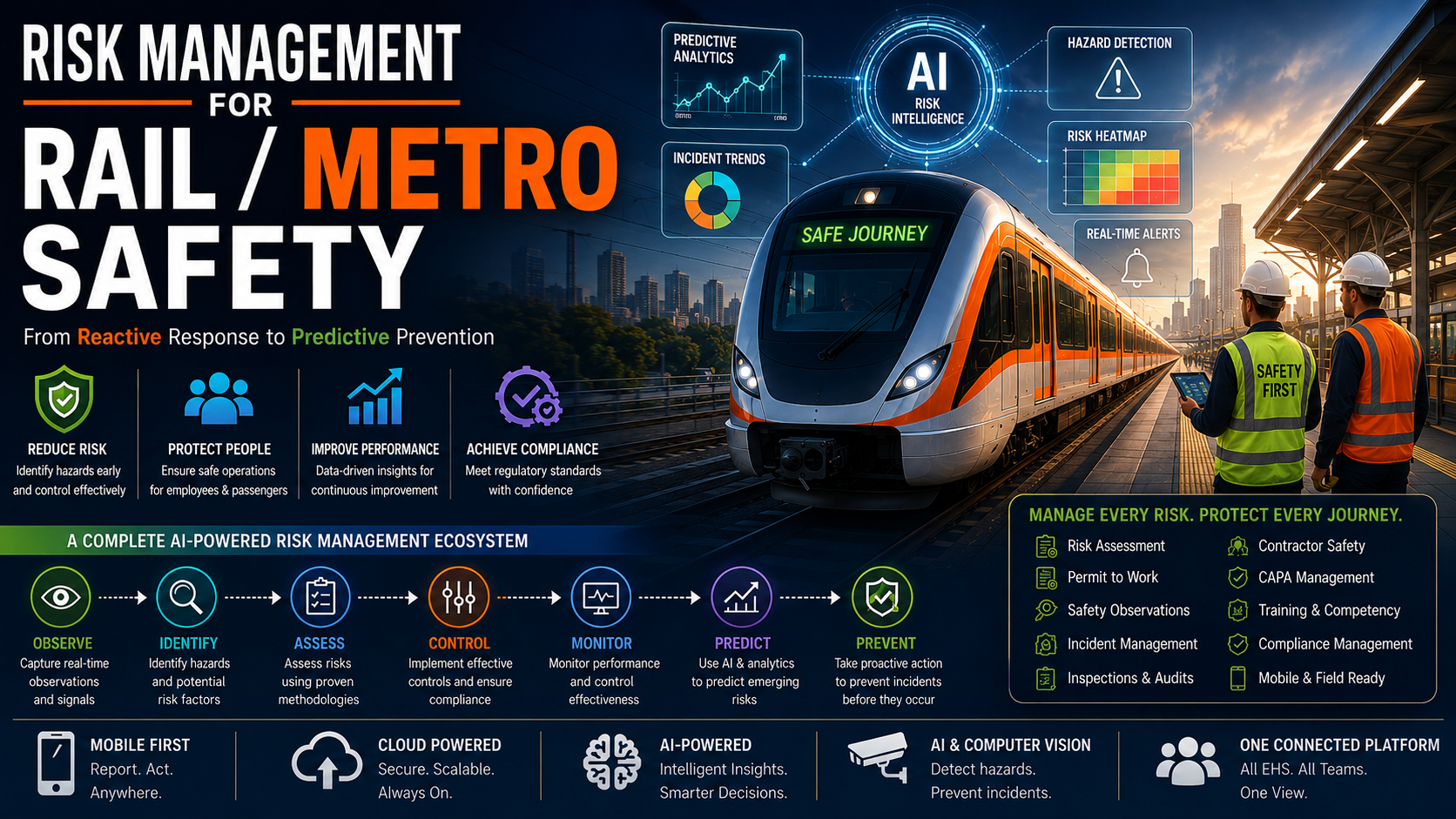
Risk Management for Rail & Metro Safety: From Reactive Response to Predictive Prevention
Rail and metro systems are built around movement, precision and safety. Every day, trains operate across tracks, tunnels, stations, depots and maintenance facilities while employees, contractors and passengers interact with complex infrastructure and operational systems.
That complexity creates a simple but important safety question:
How can railway and metro organizations identify risk early enough to prevent an incident?
Traditional safety management often answers the question after something has happened. A near miss is reported. An incident is investigated. A corrective action is assigned. A report is prepared.
All of that remains important.
But modern rail and metro safety needs to go further.
The future of railway risk management is about continuously identifying hazards, understanding changing risk levels, monitoring whether controls are effective and using connected safety data to recognize emerging patterns before they become serious events.
This is where digital EHS management, AI-powered risk intelligence, predictive analytics, mobile technology, computer vision and connected operational data can make a meaningful difference.
For organizations looking to strengthen rail and metro safety, NeoEHS Risk Management Software provides an AI-enabled approach to identifying, assessing, controlling and monitoring operational risks.
What Is Risk Management in Railways?
Railway risk management is the systematic process of identifying hazards, assessing risks, implementing controls, monitoring their effectiveness and continuously improving safety performance across railway operations.
It covers much more than train operations.
Railway risk management can involve:
- Tracks and railway infrastructure
- Rolling stock
- Stations and platforms
- Depots and maintenance workshops
- Signaling and telecommunications
- Electrical and traction systems
- Trackside activities
- Construction and infrastructure projects
- High-risk maintenance activities
- Employees and contractors
- Passenger safety
- Emergency response
- Environmental and occupational health risks
- Regulatory and compliance requirements
The most effective approach is not to treat each of these risks as a separate activity.
Instead, organizations need a connected view of risk.
An incident may be connected to an unsafe condition.
An unsafe condition may be connected to a recurring inspection finding.
That inspection finding may be related to an ineffective control.
The same control weakness may appear in another depot or project.
When these relationships are visible, safety teams can move from simply recording events to understanding the broader risk picture.
Why Risk Management Is Critical for Metro and Rail Operations
Rail and metro environments are fundamentally different from many conventional workplaces.
A railway network can contain thousands of assets, multiple operating locations, large contractor populations and activities taking place around moving trains and critical infrastructure.
A metro system may simultaneously manage:
Passengers + trains + stations + platforms + tracks + depots + electrical systems + maintenance + contractors + construction + emergency operations.
A small failure in one part of the system can potentially affect other parts.
For example, a maintenance control failure may create an electrical hazard. A contractor-related deviation may affect track access. A recurring unsafe condition at a station may indicate a weakness in an operating procedure.
This interconnected nature of railway operations is why risk management needs to be continuous rather than periodic.
The Traditional Approach to Railway Risk Management
For many years, safety management followed a familiar cycle:
Incident → Report → Investigate → Correct
This model remains necessary, particularly for serious incidents and near misses.
But it has a limitation.
The organization often learns about the weakness after the event has already occurred.
A modern approach moves the intervention further upstream:
Observe → Identify → Assess → Control → Monitor → Predict → Prevent
The objective is not to eliminate human judgment.
The objective is to give railway safety professionals better information so they can make faster and better decisions.
The Seven-Stage Railway Risk Management Lifecycle
1. Observe: See What Is Happening
Effective risk management begins with visibility.
Safety teams need to know what is happening across stations, depots, tracks, workshops, projects and other operational environments.
Safety observations, inspections, incident reports, near misses and field reports can provide valuable signals.
A mobile-first EHS platform can allow employees, supervisors and contractors to report hazards and observations directly from the field.
This is particularly important for distributed rail networks where safety teams cannot physically be everywhere at the same time.
NeoEHS Safety & Security Observation Software can be used as part of a broader observation and preventive-action strategy.
2. Identify: Understand the Hazard
Seeing a problem is not the same as understanding it.
The next step is to identify the actual hazard and determine what activity, asset, location, behavior or condition is creating the exposure.
Railway hazards may include:
- Unauthorized track access
- Electrical exposure
- Inadequate isolation
- Unsafe maintenance activities
- Defective equipment
- Work-at-height exposure
- Confined-space hazards
- Fire risks
- Poor housekeeping
- Passenger safety hazards
- Unsafe contractor activities
- Procedural deviations
Hazard identification should be specific enough to support an effective control.
3. Assess: Determine the Level of Risk
Once a hazard has been identified, the organization needs to understand its risk.
Depending on the operation, railway organizations may use methodologies such as:
- HIRA
- HIRARC
- JSA
- JHA
- FMEA
- HAZOP
- Bowtie analysis
- Risk matrix assessment
- Root Cause Analysis
The assessment should consider factors such as likelihood, severity, exposure, existing controls and residual risk.
NeoEHS AI-Enabled Risk Management Software supports configurable risk assessment workflows and methodologies including HIRA, JSA/JHA, FMEA, HAZOP, RCA and Bowtie analysis.
The important point is that risk assessment should not remain a static document.
Risk changes when operations change.
4. Control: Reduce the Exposure
Risk assessment has little value if it does not lead to effective control.
Controls may include:
- Engineering controls
- Administrative controls
- Procedures
- Isolation
- Barriers
- PPE
- Competency requirements
- Supervision
- Permit controls
- Inspection requirements
- Emergency controls
For high-risk work, the connection between risk assessment and authorization is especially important.
A digital Permit to Work system can connect:
Work Activity → Hazard → Risk Assessment → Controls → Authorization → Monitoring → Closure
NeoEHS provides configurable Permit to Work Software for high-risk activities, with workflows that can connect permits to risk assessments, contractors, approvals, isolation controls and other EHS processes.
5. Monitor: Are the Controls Actually Working?
One of the most overlooked questions in risk management is:
Are our controls effective?
A procedure may exist.
A checklist may be completed.
A corrective action may be marked as closed.
But does the risk actually decrease?
This is why risk management needs to connect with inspections, audits, observations, incidents and corrective actions.
NeoEHS Inspection Management Software connects inspection findings with risk management, incidents, permits, audits, contractor management and corrective actions.
That creates a more complete safety lifecycle instead of isolated inspection records.
6. Predict: Identify Emerging Risk Patterns
This is where AI and predictive analytics can add another layer of intelligence.
Imagine a metro organization discovers:
- Increasing safety observations at one depot
- Repeated electrical-related findings
- Several near misses
- Multiple overdue corrective actions
- Increased contractor activity
- Recurring inspection findings
Each item may appear manageable when viewed independently.
Together, they may indicate an emerging risk pattern.
AI-powered analytics can help safety teams analyze large volumes of safety data and identify recurring trends, relationships and areas requiring attention.
NeoEHS uses AI-enabled risk intelligence and predictive analytics to analyze safety information and support proactive risk management.
The objective is not to claim that AI can predict every railway accident.
It cannot.
The practical objective is to identify warning signals earlier so people can prioritize preventive action.
7. Prevent: Turn Intelligence Into Action
Prediction without action does not improve safety.
The final stage is prevention.
When an emerging risk is identified, the organization should be able to:
Alert → Assign → Control → Escalate → Verify → Learn
This creates a closed-loop safety process.
The organization does not simply identify a risk.
It does something about it.
And after the action is completed, it checks whether the control actually worked.
That is the foundation of continuous improvement.
Major Risk Areas in Railway and Metro Operations
A modern railway safety management system should consider risk across the complete operating environment.
Track and Infrastructure Risk
Track condition, infrastructure defects, track access and maintenance activities can create significant operational and worker-safety exposure.
Digital inspections, observations and corrective-action workflows can help organizations identify and manage these issues systematically.
Rolling Stock Risk
Rolling stock maintenance involves mechanical, electrical and operational hazards.
Risk management should connect maintenance activities with inspections, permits, competency requirements and incident history.
Electrical and Traction Power Risk
Electrical work can involve high-consequence hazards.
Digital risk assessment and Permit to Work workflows can help ensure that required controls, authorizations and isolation requirements are addressed before work begins.
Station and Passenger Safety
Stations introduce a different risk profile involving passengers, employees, contractors, platforms, escalators, crowd movement and emergency situations.
A connected safety platform can bring observations, incidents, inspections and operational data together to provide better visibility.
Depot and Workshop Safety
Depots combine rolling stock, machinery, maintenance work, contractors, electrical systems and high-risk activities.
Risk management needs to cover both routine operations and non-routine work.
Contractor Safety
Railway and metro projects often involve multiple contractors and subcontractors.
A modern contractor safety process should connect:
Contractor → Competency → Training → Induction → Risk → Permit → Inspection → Incident → Corrective Action → Performance
This creates a more complete view of contractor risk.
Construction and Project Risk
Metro expansion projects introduce excavation, lifting, tunneling, work at height, temporary works, traffic management, electrical activities and multiple contractor interfaces.
These risks should be managed as part of the overall safety ecosystem rather than through isolated project spreadsheets.
Why Safety Observations Matter in Railway Risk Management
Safety observations are one of the most valuable sources of early risk information.
An incident tells you that something happened.
A near miss tells you that something almost happened.
A safety observation can tell you that a potentially unsafe condition or behavior exists before an event occurs.
For rail and metro organizations, safety observations can identify:
- Unsafe acts
- Unsafe conditions
- Procedural deviations
- PPE issues
- Housekeeping problems
- Unsafe access
- Contractor concerns
- Equipment conditions
- Positive safety behaviors
The real value comes from analyzing observations collectively.
If the same observation appears repeatedly in different locations, it may indicate a systemic issue rather than an isolated problem.
The Role of Incident Management in Railway Risk Prevention
Incident management should not end when an incident report is closed.
The deeper question is:
What can this incident teach the organization?
A modern incident management process should connect:
Incident → Investigation → Root Cause → Risk → Corrective Action → Verification → Organizational Learning
NeoEHS provides AI-Powered Incident Management Software with incident reporting, investigation, root-cause analysis, corrective actions, predictive insights and mobile reporting capabilities.
This allows incident information to become part of the wider risk intelligence ecosystem rather than remaining as an isolated record.
CAPA: Closing the Loop on Railway Risk
Corrective and Preventive Action is often where risk management succeeds—or fails.
Raising an action is easy.
Ensuring that the action actually reduces risk is harder.
An effective CAPA workflow should answer:
- What was the finding?
- What caused it?
- Who owns the action?
- What is the deadline?
- What control will be implemented?
- Has the action been completed?
- Has the evidence been verified?
- Did the action reduce the risk?
- Could the same issue exist elsewhere?
This is why CAPA should be connected to incidents, inspections, audits, risk assessments and observations.
Digital Transformation of Rail Safety Management
Many organizations still rely on a combination of:
Spreadsheets + Paper Forms + Emails + Shared Drives + Disconnected Applications
These tools may work for individual processes, but they make enterprise-wide risk visibility difficult.
A digital railway EHS platform can bring together:
- Risk management
- Hazard management
- Incident management
- Safety observations
- Inspections
- Audits
- CAPA
- Permit to Work
- Contractor management
- Training and competency
- Compliance
- Environmental management
- Analytics
- AI-powered intelligence
NeoEHS's Metro & Rail platform is designed around this connected safety lifecycle, linking field-level safety activities with management-level visibility.
What Should a Modern Railway Risk Management System Include?
A modern railway safety management system should ideally provide:
Risk Assessment
HIRA, HIRARC, JSA, JHA and configurable risk matrices.
Hazard Management
Centralized hazard identification, classification and control monitoring.
Incident Management
Incident, near-miss, investigation and root-cause workflows.
Safety Observations
Mobile reporting of unsafe acts, unsafe conditions and positive observations.
Inspection Management
Digital inspections, checklists, evidence and corrective actions.
Audit Management
Internal, external, compliance and supplier audits.
Permit to Work
Digital authorization for high-risk activities.
Contractor Safety
Contractor onboarding, competency, training, permits and safety performance.
CAPA
Corrective and preventive actions with escalation and effectiveness verification.
Analytics
Dashboards, KPIs, risk trends and management reporting.
AI Risk Intelligence
AI-assisted analysis of safety data and emerging risk patterns.
Predictive Analytics
Data-driven identification of trends that may require preventive attention.
Mobile Safety
Field reporting and workflows from mobile devices.
Integration
Connectivity with enterprise systems, IoT, CCTV/computer vision and other operational technologies where appropriate.
AI in Railway Risk Management: What It Can—and Cannot—Do
AI is becoming an important part of modern EHS technology, but it should be used responsibly.
AI can help:
- Analyze large safety datasets
- Identify recurring patterns
- Classify safety information
- Support risk assessment
- Analyze incident trends
- Identify potential emerging risks
- Recommend corrective actions
- Analyze images where appropriately configured
- Support management dashboards
- Reduce manual data analysis
But AI should not replace safety leadership or professional judgment.
The right model is:
AI provides intelligence.
Safety professionals provide judgment.
Management provides accountability.
The organization takes action.
Computer Vision and Rail Safety
Rail and metro organizations already operate extensive CCTV infrastructure.
The opportunity is to move from passive video recording toward intelligent safety monitoring for defined use cases.
Depending on the infrastructure and AI models deployed, computer vision can support detection of selected conditions such as:
- PPE non-compliance
- Restricted-area access
- Unsafe proximity
- Safety-zone violations
- Crowd-related conditions
- Other organization-defined visual safety events
NeoEHS supports AI-based computer vision integration as part of its broader safety intelligence approach.
Computer vision should be viewed as another source of safety intelligence, not as a replacement for human safety observation and supervision.
Predictive Railway Safety: The Next Step
The evolution of rail safety management can be viewed in four stages.
Yesterday: Reactive
Incident → Investigation → Corrective Action
Today: Digital
Observe → Report → Analyze → Correct
Next: Predictive
Data → Pattern → Risk Signal → Preventive Action
Future: Connected Safety Intelligence
AI + IoT + Computer Vision + Mobile + EHS + Operational Data → Intelligent Prevention
The goal is simple:
Identify meaningful risk signals earlier and act before they become serious events.
How NeoEHS Supports Rail and Metro Risk Management
NeoEHS is an AI-powered Environment, Health & Safety platform designed to connect safety processes, field operations and management intelligence.
For Metro and Rail operations, the platform can support:
- AI-powered incident management
- Risk assessment
- Hazard management
- Safety observations
- UA/UC management
- Inspection management
- Audit management
- Digital Permit to Work
- Contractor safety management
- Training and competency
- Corrective and Preventive Actions
- Compliance management
- Emergency management
- Predictive safety analytics
- Computer vision integration
- IoT integration
- Mobile EHS management
- Real-time dashboards
The NeoEHS Metro & Rail Safety EHS Management Platform is positioned around connecting these processes into one safety ecosystem.
The objective is not simply to digitize existing forms.
It is to create a connected safety environment where organizations can:
See → Understand → Act → Verify → Prevent
A Practical Example: How Connected Risk Intelligence Can Help
Consider a metro depot where maintenance activity is increasing.
Over several weeks, the organization records:
- More safety observations
- Several electrical hazards
- Repeated inspection findings
- Two near misses
- Increasing contractor activity
- Several overdue corrective actions
A conventional system may show these as separate records.
A connected EHS platform can bring them together.
The safety team can then ask:
Is the depot becoming a higher-risk environment?
Are the same hazards recurring?
Are existing controls effective?
Are contractor activities contributing to the increase?
Which actions should be prioritized?
This is where risk management becomes more than compliance reporting.
It becomes risk intelligence.
The Future of Risk Management for Rail and Metro Safety
Rail and metro safety will continue to evolve as networks become more complex and organizations generate more operational data.
The next generation of railway safety management will increasingly combine:
Digital EHS + AI + Predictive Analytics + Mobile Technology + Computer Vision + IoT + Connected Operational Data
But technology alone will not create safer railways.
The real value comes when technology helps people make better decisions.
A safety professional should not have to spend hours searching through spreadsheets to discover that the same hazard has appeared at five different locations.
A manager should not have to wait for a monthly report to discover that corrective actions are repeatedly overdue.
A contractor should not have to rely on paper records to demonstrate competency and authorization.
A field supervisor should be able to report a risk immediately.
And when safety data reveals an emerging pattern, the organization should be able to act before that pattern becomes an incident.
Frequently Asked Questions
What is risk management in railways?
Railway risk management is the systematic process of identifying hazards, assessing risks, implementing controls, monitoring their effectiveness and taking preventive action across railway operations, infrastructure, people and activities.
What is railway risk management?
Railway risk management covers the identification, assessment and control of risks associated with train operations, tracks, stations, rolling stock, signaling, electrical systems, maintenance, contractors, construction and passenger safety.
How is risk managed in metro rail systems?
Metro rail risk is managed through hazard identification, risk assessment, operational controls, inspections, audits, safety observations, incident management, Permit to Work, contractor management, corrective actions and continuous monitoring.
What are the major risks in railway operations?
Major risks can include track and infrastructure failures, derailment or collision hazards, electrical risks, signaling issues, maintenance hazards, passenger safety risks, contractor activities, human factors, fire and emergency risks, and environmental or occupational health risks.
How can AI improve railway safety?
AI can analyze large volumes of incidents, observations, inspections and other safety data to identify patterns, recurring hazards and emerging risk signals. It can also support risk assessment, incident analysis, predictive analytics and selected computer-vision use cases.
What is a railway Safety Management System?
A Railway Safety Management System is a structured framework for managing railway safety risks through policies, risk assessment, operational controls, competence, monitoring, incident investigation, audits, corrective actions and continuous improvement.
How does digital EHS software improve rail safety?
Digital EHS software centralizes safety information, connects field activities with management workflows, improves corrective-action accountability, enables mobile reporting and provides real-time visibility into risks, incidents, inspections, audits and compliance.
What is predictive risk management in railways?
Predictive risk management uses historical and current safety information, analytics and AI to identify patterns and warning indicators that may signal increasing risk, allowing organizations to prioritize preventive action.
How can metro operators prevent safety incidents?
Metro operators can reduce safety risk by identifying hazards early, maintaining effective controls, encouraging safety observations and near-miss reporting, managing contractors, controlling high-risk work, investigating root causes and using data analytics to identify recurring and emerging risks.
What should a modern railway HSE management system include?
A modern railway HSE system should include risk assessment, hazard management, incident management, safety observations, inspections, audits, CAPA, Permit to Work, contractor safety, training, compliance, mobile workflows, dashboards, analytics and AI-powered risk intelligence.
Risk Management Is Moving From Records to Intelligence
The future of rail and metro safety is not simply about collecting more safety information.
It is about making that information useful.
It is about seeing a hazard before it becomes an incident.
Understanding a pattern before it becomes a trend.
Acting before a near miss becomes an accident.
And learning from every observation, inspection, incident and corrective action.
The journey can be summarized simply:
Observe → Identify → Assess → Control → Monitor → Predict → Prevent
That is the future of risk management for rail and metro safety.
And that is where AI-powered EHS technology can make a real difference.
NeoEHS — connecting safety data, intelligent risk management and preventive action for safer, smarter rail and metro operations.
Explore NeoEHS for Metro & Rail Safety | Explore AI Risk Management
READ MORE ❯
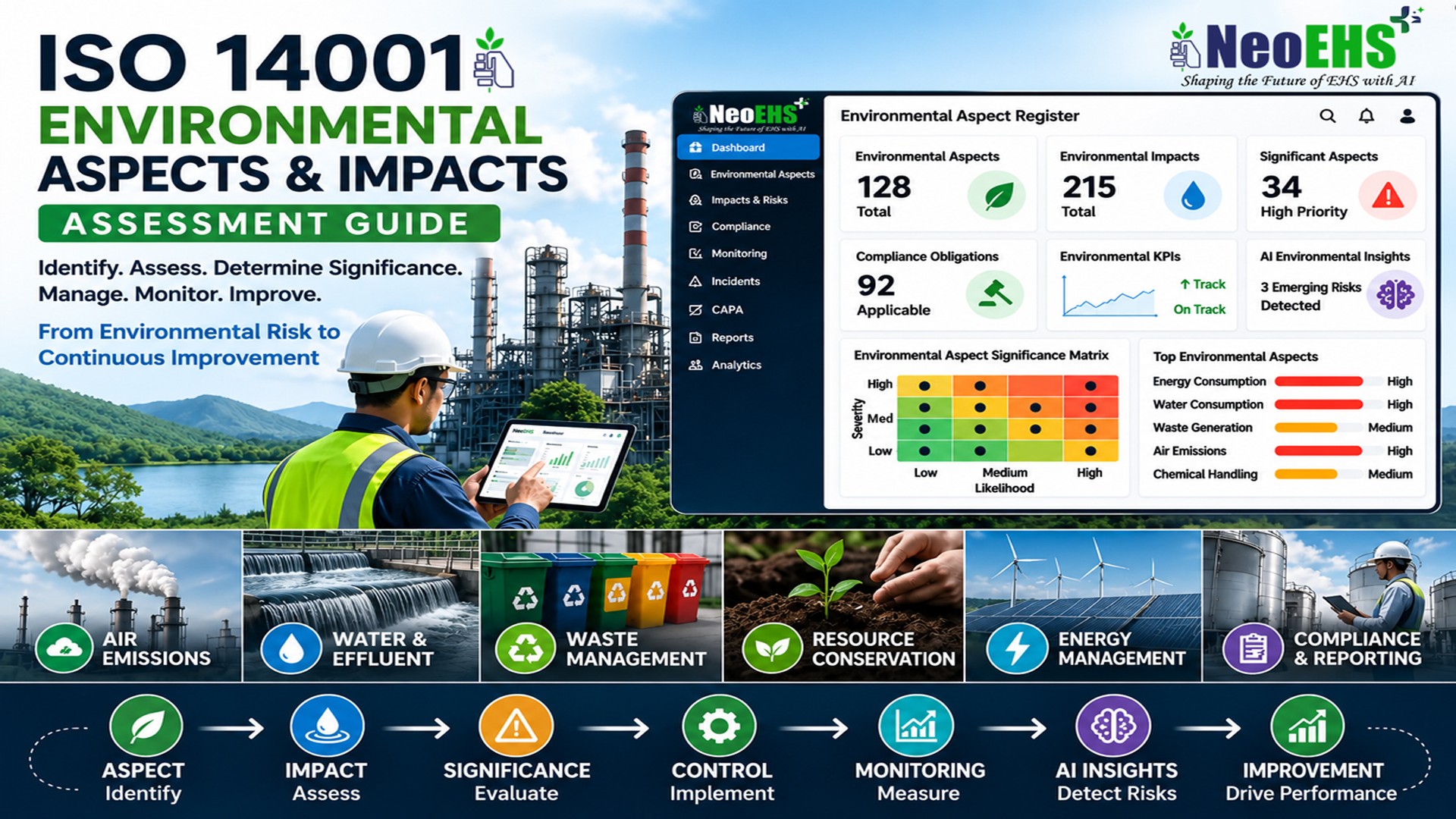
ISO 14001 Environmental Aspects and Impact Assessment Guide
A Practical Guide to Identifying Environmental Aspects, Assessing Impacts and Managing Significant Environmental Risks
Environmental aspects and impacts are at the heart of an effective ISO 14001 Environmental Management System (EMS).
But from an experienced environmental and HSE professional's perspective, an aspect-impact assessment should never become just another Excel sheet prepared before an audit.
The real purpose is much more practical:
Identify how your activities interact with the environment, understand the potential impacts, determine what is significant, establish effective controls and continuously improve environmental performance.
In a modern organization, environmental risks can change quickly.
A new chemical may be introduced. Production may increase. Equipment may change. A contractor may take over an activity. Water availability may change. Waste generation may increase. An environmental incident may reveal a weakness that was not previously understood.
If the environmental aspects register remains unchanged while the workplace changes, the organization may have documentation—but not necessarily effective environmental risk management.
This is where digital environmental management software can provide significant value.
With NeoEHS, organizations can digitize environmental aspect and impact assessments, manage significant environmental aspects, connect environmental risks with compliance and corrective actions, monitor environmental performance and use AI-powered analytics to identify emerging patterns.
Identify → Assess → Determine Significance → Control → Monitor → Improve
What Are Environmental Aspects and Environmental Impacts?
One of the first concepts every ISO 14001 professional should understand is the difference between an environmental aspect and an environmental impact.
Environmental Aspect
An environmental aspect is an element of an organization's activities, products or services that interacts or can interact with the environment.
Environmental Impact
An environmental impact is a change to the environment resulting wholly or partly from an environmental aspect.
A simple way to remember it:
Aspect = the interaction or cause
Impact = the environmental change or effect
For example:
| Activity | Environmental Aspect | Potential Environmental Impact |
|---|---|---|
| Boiler operation | Fuel consumption | Resource consumption and atmospheric emissions |
| Chemical storage | Potential leakage | Soil or water contamination |
| Manufacturing | Waste generation | Waste disposal impact |
| Vehicle operation | Fuel combustion | Air emissions |
| Cooling process | Water consumption | Resource depletion |
| Wastewater treatment | Effluent discharge | Water-quality impact |
| Generator operation | Diesel consumption | Air emissions and resource consumption |
| Packaging | Material consumption | Waste generation |
The important relationship is:
Activity → Environmental Aspect → Environmental Impact
What Is an ISO 14001 Environmental Aspects and Impacts Assessment?
An ISO 14001 environmental aspects and impacts assessment is a systematic process for identifying environmental aspects associated with an organization's activities, products and services, determining their potential environmental impacts and establishing which aspects are significant according to defined criteria.
A practical assessment should consider:
- Activities
- Products
- Services
- Normal operating conditions
- Abnormal conditions
- Emergency situations
- Environmental impacts
- Compliance obligations
- Lifecycle perspective
- Existing controls
- Significance criteria
- Environmental objectives
- Monitoring requirements
The assessment should ultimately help the organization understand:
Which environmental aspects require the greatest attention and control?
Why Environmental Aspect and Impact Assessment Matters
The aspect-impact assessment influences many parts of an Environmental Management System.
It can provide input into:
- Environmental objectives
- Environmental targets
- Operational controls
- Monitoring programs
- Compliance management
- Emergency preparedness
- Environmental improvement projects
- Internal audits
- Corrective actions
- Management review
If the assessment is weak, environmental management can become reactive.
If the assessment is meaningful and regularly reviewed, it can help the organization focus resources on the environmental issues that matter most.
The Biggest Mistake: Treating the Register as an Audit Document
One of the most common problems I have seen in environmental management is an aspect-impact register containing hundreds of entries that looks impressive—but is rarely used operationally.
A good environmental professional should ask:
Does this register reflect today's operations?
Does it cover abnormal conditions?
Does it consider emergencies?
Have relevant outsourced activities been considered?
Have relevant lifecycle stages been considered?
Does it identify the genuinely significant aspects?
Are the controls actually working?
Are incidents and environmental findings feeding back into the assessment?
If the answer is no, the register may satisfy a documentation requirement without delivering its full environmental-management value.
The objective should not simply be:
“Complete the aspect-impact register.”
It should be:
“Understand and control the environmental aspects that matter.”
How to Conduct an ISO 14001 Aspect and Impact Assessment
A practical assessment can follow this process:
1. Identify Activities, Products and Services
↓
2. Identify Environmental Aspects
↓
3. Identify Environmental Impacts
↓
4. Consider Normal, Abnormal and Emergency Conditions
↓
5. Consider the Lifecycle Perspective
↓
6. Establish Significance Criteria
↓
7. Determine Significant Environmental Aspects
↓
8. Identify Existing Controls
↓
9. Define Additional Actions
↓
10. Monitor Environmental Performance
↓
11. Review and Reassess When Conditions Change
This turns environmental aspect assessment into a continuous management process rather than a one-time exercise.
1. Identify Activities, Products and Services
Start with the organization's actual operations.
For a manufacturing facility, activities could include:
- Raw-material receipt
- Material storage
- Production
- Chemical handling
- Utilities
- Boiler operation
- Maintenance
- Packaging
- Warehousing
- Waste management
- Effluent treatment
- Transportation
- Emergency response
For a construction project:
- Excavation
- Concrete work
- Material transportation
- Equipment operation
- Fuel storage
- Waste generation
- Water consumption
- Dust generation
- Noise generation
- Site restoration
The assessment needs to reflect what the organization actually does, not simply what appears in a generic template.
2. Identify Environmental Aspects
Now ask:
How does this activity interact with the environment?
Typical environmental aspects include:
Air Emissions
- Combustion emissions
- Dust
- VOC emissions
- Process emissions
- Refrigerant releases
Water
- Water consumption
- Wastewater generation
- Effluent discharge
- Stormwater contamination
Waste
- Hazardous waste
- Non-hazardous waste
- Industrial waste
- Packaging waste
- E-waste
Resource Consumption
- Energy
- Water
- Fuel
- Raw materials
- Chemicals
Land and Soil
- Chemical storage
- Spill potential
- Contaminated land
- Material storage
Noise and Vibration
- Machinery
- Generators
- Transportation
- Construction activities
Transportation
- Fuel consumption
- Vehicle emissions
- Spill potential
Biodiversity
Where relevant to the organization's activities, location and environmental context.
3. Identify Environmental Impacts
After identifying the aspect, ask:
What environmental change could result from this aspect?
For example:
Aspect: Diesel consumption
Potential impacts: Resource consumption and atmospheric emissions.
Aspect: Chemical leakage
Potential impacts: Soil, surface-water or groundwater contamination.
Aspect: Waste generation
Potential impacts: Resource loss and disposal impacts.
Aspect: Excessive water consumption
Potential impact: Pressure on available water resources.
This gives the assessment a clear logical structure:
Activity → Aspect → Impact
4. Consider Normal, Abnormal and Emergency Conditions
Environmental assessment should not focus exclusively on routine operations.
Normal Conditions
Routine production and normal operations.
Abnormal Conditions
- Startup
- Shutdown
- Maintenance
- Equipment malfunction
- Process deviations
Emergency Conditions
- Chemical spills
- Tank failure
- Major leakage
- Fire
- Wastewater overflow
- Fuel release
- Refrigerant release
An activity that appears low-risk during normal operation may create a significant environmental impact during an emergency.
That is why emergency scenarios should be considered appropriately within the environmental assessment process.
5. Lifecycle Perspective
Lifecycle thinking is an important part of ISO 14001.
Depending on the organization's activities, relevant stages may include:
- Raw-material acquisition
- Design
- Production
- Transportation
- Delivery
- Use
- End-of-life treatment
- Disposal
Lifecycle thinking does not mean an organization has to perform a detailed Life Cycle Assessment for every product.
The practical question is:
Which lifecycle stages can the organization control or influence?
For example, a manufacturer may not control what a customer does with a product at the end of its useful life.
But it may influence:
- Product design
- Packaging
- Material selection
- Supplier selection
- Customer information
- Transportation
- End-of-life guidance
That is where lifecycle thinking becomes practical.
6. Determine Significant Environmental Aspects
Not every environmental aspect necessarily has the same level of importance.
Organizations should establish appropriate criteria for determining significance.
Criteria may include:
- Severity
- Frequency
- Scale
- Duration
- Compliance obligations
- Environmental sensitivity
- Existing controls
- Stakeholder concerns
- Pollution potential
- Resource consumption
- Emergency potential
The important point is consistency.
The organization should establish its criteria, apply them systematically and retain appropriate evidence of the assessment.
Environmental Aspect Significance Matrix
A digital environmental management system can help standardize the evaluation.
| Criterion | Example Consideration |
|---|---|
| Severity | Potential environmental consequence |
| Frequency | How often the aspect occurs |
| Scale | Geographic extent of potential impact |
| Duration | How long the impact may continue |
| Compliance | Applicable environmental obligations |
| Sensitivity | Sensitivity of the receiving environment |
| Control | Effectiveness of existing controls |
| Emergency | Potential emergency consequence |
| Stakeholder | Level of stakeholder concern |
The exact scoring method should be established by the organization and aligned with its EMS methodology.
Environmental Aspect vs Environmental Impact
This is one of the most common questions in ISO 14001 implementation.
| Environmental Aspect | Environmental Impact |
|---|---|
| Electricity consumption | Resource consumption |
| Fuel combustion | Air emissions |
| Waste generation | Waste-disposal impact |
| Chemical storage | Potential contamination |
| Water consumption | Resource depletion |
| Wastewater discharge | Potential water-quality impact |
| Noise generation | Noise disturbance |
| Land disturbance | Habitat or soil impact |
Remember:
The aspect is the interaction. The impact is the resulting environmental change.
Why a Digital Environmental Aspect Register Is Better Than a Spreadsheet
Excel can be useful for simple environmental assessments.
However, as an organization grows, managing hundreds or thousands of aspects manually can become difficult.
Typical challenges include:
- Multiple spreadsheet versions
- Manual calculations
- Poor approval tracking
- Difficult change management
- No automatic reminders
- Limited dashboards
- Weak traceability
- Difficult multi-site management
- Manual corrective-action tracking
- Limited connection to environmental incidents
- Limited analytics
A digital environmental aspect-impact assessment system can provide a controlled environment for managing the entire lifecycle.
NeoEHS Environmental Aspect & Impact Management
NeoEHS can help organizations move from a static environmental register to a connected environmental management process.
The workflow can connect:
Environmental Aspect
↓
Environmental Impact
↓
Significance
↓
Control
↓
Compliance
↓
Monitoring
↓
Inspection
↓
Environmental Incident
↓
CAPA
↓
AI Analytics
↓
Continuous Improvement
This creates a more practical environmental management cycle.
Environmental Aspects and Compliance
Environmental aspects can have direct compliance implications.
For example:
Wastewater Discharge
Potential requirements may relate to:
- Discharge limits
- Monitoring
- Sampling
- Permits
- Reporting
Hazardous Waste
Potential requirements may include:
- Storage
- Labelling
- Transportation
- Authorized disposal
- Recordkeeping
This makes it valuable to connect:
Environmental Aspect → Compliance Obligation → Control → Monitoring → Evidence
NeoEHS can help bring these environmental-management activities into a connected digital EHS environment.
Environmental Objectives Should Come From Significant Aspects
Environmental objectives should ideally have a clear relationship with significant environmental aspects and organizational priorities.
For example:
Significant Aspect
High energy consumption.
Possible Objective
Reduce energy intensity through efficiency improvements.
Significant Aspect
Waste generation.
Possible Objective
Reduce waste generation and increase recovery or recycling.
Significant Aspect
Water consumption.
Possible Objective
Reduce water intensity through reuse and process optimization.
This creates a powerful management chain:
Aspect → Significance → Objective → Target → Action → Measurement → Improvement
Environmental Monitoring
Monitoring provides evidence about environmental performance and control effectiveness.
Depending on the organization's activities, this may include:
Air
- Stack emissions
- Ambient air
- Dust
- VOCs
Water
- Effluent
- Water consumption
- Groundwater
- Stormwater
Waste
- Waste quantities
- Hazardous waste
- Recycling
- Disposal
Energy
- Electricity
- Fuel
- Energy intensity
Other Indicators
- Noise
- Soil
- Biodiversity indicators
The objective should not be simply to collect data.
The objective is to use environmental data to make better decisions.
Environmental Incidents Should Trigger Review
Consider a chemical spill.
The immediate response is important.
But an experienced environmental professional should also ask:
Was the aspect identified?
Was the potential impact correctly understood?
Was the aspect classified appropriately?
Were the controls adequate?
Why did the incident happen?
Does the assessment need to be updated?
This creates a continuous learning cycle:
Environmental Incident
→ Investigation
→ Root Cause
→ Aspect Review
→ Control Improvement
→ CAPA
→ Verification
→ Reassessment
AI-Powered Environmental Aspect Assessment
AI can add another layer of intelligence to environmental management.
But it should be used responsibly.
AI should not simply generate a significance score without context.
Instead, AI can help environmental professionals analyze patterns across available environmental and EHS data.
Potential data sources include:
- Environmental aspect assessments
- Environmental incidents
- Inspection findings
- Audit findings
- Compliance findings
- Waste data
- Energy data
- Water data
- Emissions data
- Corrective actions
- Monitoring results
The objective is to help environmental professionals see patterns earlier.
What Can AI Help Identify?
Recurring Environmental Issues
The same environmental finding repeatedly occurs.
Repeated Control Failures
The same environmental control repeatedly fails or generates findings.
Increasing Waste
Waste generation is increasing unexpectedly.
Rising Resource Consumption
Energy or water consumption is increasing relative to operational output.
Recurring Spills
Similar environmental incidents repeatedly occur.
Emerging Environmental Risk
Multiple environmental indicators suggest an area requiring closer attention.
AI should provide decision support, while qualified environmental professionals determine significance, controls and actions.
Predictive Environmental Risk Analytics
Traditional environmental reporting asks:
What happened?
A more mature environmental-management process asks:
What is changing?
AI-powered predictive analytics can help organizations investigate:
What patterns in our environmental data may indicate an emerging risk?
For example:
Increasing water consumption
Recurring leakage findings
Maintenance backlog
Repeated inspection observations
may indicate an environmental issue requiring investigation.
The technology surfaces the pattern.
The environmental professional evaluates the situation and decides what should happen next.
Digital Environmental Aspect Register
A comprehensive digital register can contain:
- Activity
- Product/service
- Environmental aspect
- Environmental impact
- Operating condition
- Lifecycle stage
- Existing controls
- Significance criteria
- Significance status
- Compliance obligation
- Responsible department
- Responsible person
- Review date
- Actions
- Evidence
- Status
This makes the register a working management tool rather than a static document.
Multi-Site Environmental Aspect Management
For organizations with multiple sites, environmental aspects can vary considerably.
A chemical plant may have:
- Chemical emissions
- Effluent
- Hazardous waste
- Process-related environmental risks
A warehouse may have:
- Energy consumption
- Packaging waste
- Vehicle movements
- Refrigeration
A construction project may have:
- Dust
- Noise
- Waste
- Fuel
- Water
- Soil disturbance
A centralized digital platform can provide common governance while allowing site-specific environmental aspects and controls.
ISO 14001 Aspect-Impact Assessment Across Industries
Manufacturing
- Energy
- Water
- Waste
- Emissions
- Chemicals
- Effluent
- Noise
Chemical Industry
- Chemical storage
- Process emissions
- Spills
- Hazardous waste
- Effluent
- Emergency releases
Oil & Gas
- Hydrocarbon releases
- Flaring
- Emissions
- Produced water
- Waste
- Energy
- Spills
Construction
- Dust
- Noise
- Waste
- Water
- Fuel
- Soil disturbance
- Biodiversity
Mining
- Land disturbance
- Water
- Dust
- Tailings
- Waste
- Energy
- Biodiversity
Logistics
- Fuel
- Vehicle emissions
- Packaging
- Waste
- Refrigeration
- Energy
Rail & Metro
- Energy
- Noise
- Waste
- Maintenance chemicals
- Water
- Construction impacts
- Rolling-stock operations
Environmental Aspects, Risks and Opportunities
An environmental aspect should not automatically be treated as the same thing as an environmental risk.
For example:
Environmental Aspect
High water consumption.
Environmental Impact
Pressure on water resources.
Potential Risk
Future water availability could affect operations.
Potential Opportunity
Water reuse or process optimization could reduce consumption.
This is where environmental management becomes connected to operational resilience and business performance.
ISO 14001 and Climate Considerations
Environmental management is increasingly connected with:
- Climate change
- Resource availability
- Pollution
- Biodiversity
- Ecosystem conditions
- Supply-chain resilience
Organizations should therefore avoid treating environmental aspects as a static list that never changes.
The environmental context evolves.
The EMS needs to evolve with it.
Practical Environmental Aspect-Impact Example
Consider a manufacturing facility.
Activity
Boiler operation.
Environmental Aspect
Natural gas consumption and combustion emissions.
Potential Impacts
- Resource consumption
- Air emissions
- Greenhouse-gas emissions
Operating Conditions
- Normal operation
- Startup
- Shutdown
- Abnormal operation
Existing Controls
- Preventive maintenance
- Combustion optimization
- Emission monitoring
- Energy monitoring
Significance
Determined according to the organization's established criteria.
Objective
Improve energy efficiency and reduce emissions intensity.
Monitoring
- Fuel consumption
- Production output
- Energy intensity
- Emission measurements
Improvement
Use performance data to identify opportunities for efficiency improvement.
This is what makes an aspect-impact assessment operationally useful.
Common Environmental Aspect-Impact Assessment Mistakes
1. Treating Every Aspect as Significant
If everything is significant, management loses the ability to prioritize.
2. Ignoring Abnormal Conditions
Startup, shutdown and maintenance can create different environmental aspects.
3. Ignoring Emergency Conditions
Spills, leaks and equipment failures can produce significant impacts.
4. Ignoring Lifecycle Perspective
Relevant environmental influences can extend beyond the organization's physical boundary.
5. Using Generic Templates
A generic register may not reflect actual operations.
6. Never Updating the Register
Process changes can create new environmental aspects.
7. Disconnecting the Register From Objectives
Significant aspects should help inform environmental priorities.
8. Ignoring Environmental Incidents
Incidents can reveal weaknesses in existing assessments and controls.
9. Treating Significance as a One-Time Exercise
Environmental conditions and organizational activities can change.
10. Using Software as Only a Digital Spreadsheet
The real benefit of digitalization comes from connecting environmental assessment with compliance, monitoring, incidents, inspections, CAPA and analytics.
ISO 14001 Environmental Aspect-Impact Checklist
Before finalizing an assessment, ask:
Activities
- Have all relevant activities been considered?
- Have products and services been considered?
- Have outsourced activities been considered where relevant?
Environmental Aspects
- Energy?
- Water?
- Waste?
- Emissions?
- Chemicals?
- Wastewater?
- Land/soil?
- Noise?
- Transportation?
- Biodiversity where relevant?
Operating Conditions
- Normal?
- Abnormal?
- Emergency?
Lifecycle
- Upstream?
- Operational?
- Downstream?
- Areas the organization can influence?
Significance
- Are criteria defined?
- Are they consistently applied?
- Is the assessment evidence-based?
Controls
- Are controls defined?
- Are responsibilities assigned?
- Are controls effective?
Monitoring
- Are significant aspects monitored?
- Are environmental KPIs established?
Improvement
- Are objectives linked to significant aspects?
- Are corrective actions tracked?
- Are incidents feeding back into the assessment?
- Is reassessment triggered by relevant changes?
How NeoEHS Digitizes Environmental Aspect and Impact Management
NeoEHS can support the complete environmental aspect-impact lifecycle through a connected digital EHS platform.
Environmental Aspect Register
Centralize environmental aspects across facilities and departments.
Impact Assessment
Document the environmental impacts associated with each aspect.
Significance Evaluation
Apply defined criteria consistently.
Lifecycle Perspective
Capture relevant lifecycle considerations.
Environmental Controls
Define and monitor operational controls.
Compliance Management
Connect environmental aspects with applicable compliance obligations.
Environmental Inspections
Capture field findings and observations.
Environmental Incidents
Record spills, releases and other environmental events.
CAPA
Assign, track and verify corrective actions.
Environmental Monitoring
Track relevant environmental performance information.
Dashboards
Provide management visibility into significant environmental aspects.
AI Analytics
Identify recurring patterns across environmental data.
Predictive Risk Analytics
Highlight emerging environmental risk signals for professional review.
From Environmental Register to Environmental Intelligence
The traditional approach is:
Activity → Aspect → Impact → Significance
A digital approach becomes:
Activity → Aspect → Impact → Significance → Control → Monitoring → CAPA
An AI-enabled approach becomes:
Activity → Aspect → Impact → Significance → Control → Monitoring → Environmental Data → AI Pattern Detection → Risk Insight → Improvement
That is the evolution of modern environmental management.
Why NeoEHS for Environmental Management?
NeoEHS can be positioned not simply as an environmental register or compliance database, but as part of an integrated AI-powered Environment, Health and Safety management ecosystem.
Environmental professionals can bring together:
- Environmental management
- EHS risk management
- Incidents
- Inspections
- Audits
- Compliance
- CAPA
- Contractor management
- Analytics
- Environmental performance
The objective is to reduce disconnected environmental processes and create a more integrated view of organizational risk and performance.
Frequently Asked Questions
What is an environmental aspect under ISO 14001?
An environmental aspect is an element of an organization's activities, products or services that interacts or can interact with the environment.
What is an environmental impact?
An environmental impact is a change to the environment resulting wholly or partly from an organization's environmental aspects.
What is an ISO 14001 aspect-impact assessment?
It is a structured process for identifying environmental aspects, determining associated environmental impacts and evaluating which aspects are significant according to established organizational criteria.
What is a significant environmental aspect?
A significant environmental aspect is an aspect that has or can have significant environmental impacts according to criteria established by the organization.
Does ISO 14001 require an environmental aspects register?
Organizations need to determine their environmental aspects and maintain the documented information required by their EMS. ISO 14001 does not prescribe one specific spreadsheet format for an aspect register.
Does ISO 14001 require a Life Cycle Assessment?
No. Considering a lifecycle perspective does not mean an organization must perform a detailed Life Cycle Assessment for every product or service.
What is the difference between an environmental aspect and impact?
The environmental aspect is the organization's interaction with the environment. The environmental impact is the resulting environmental change.
How often should environmental aspects be reviewed?
The assessment should be reviewed when relevant changes occur and as part of the organization's EMS processes. Organizations should define appropriate review arrangements based on their activities, risks and management system.
Can environmental incidents trigger an aspect-impact reassessment?
Yes. Environmental incidents can provide important information indicating that an aspect, impact, significance evaluation or control may need to be reviewed.
Can AI improve environmental aspect assessment?
AI can help environmental professionals identify patterns across environmental and EHS data and highlight potential areas for review. It should support—not replace—professional environmental judgment.
Can NeoEHS manage environmental aspects and impacts?
NeoEHS can provide a digital framework for managing environmental aspects and impacts alongside environmental compliance, inspections, incidents, CAPA, monitoring and broader EHS processes.
From Environmental Compliance to Environmental Intelligence
Environmental management is evolving.
The traditional approach was:
Paper → Excel → Static Register
The modern approach is:
Digital Register → Connected EMS → Analytics → AI-Assisted Environmental Intelligence
The objective is not to create a better-looking register.
It is to help environmental professionals understand:
What environmental aspects matter?
Where are the greatest impacts?
Which controls are effective?
Where are risks increasing?
What should we improve next?
Build a Smarter Environmental Management System With NeoEHS
Environmental aspects and impacts should not live in an isolated spreadsheet.
They should connect to the way the organization actually operates.
With NeoEHS, organizations can build a connected environmental-management workflow around:
Environmental Aspects
→ Environmental Impacts
→ Significance
→ Controls
→ Compliance
→ Monitoring
→ Inspections
→ Incidents
→ CAPA
→ AI Analytics
→ Continuous Improvement
Understand Your Environmental Impact. Control What Matters. Measure Performance. Improve Continuously.
Frequently Asked Questions: ISO 14001 Environmental Aspects & Impacts
1. What is an environmental aspect under ISO 14001?
An environmental aspect is an element of an organization's activities, products or services that interacts or can interact with the environment. Examples include energy consumption, water use, emissions, waste generation, chemical use and wastewater discharge.
2. What is an environmental impact?
An environmental impact is a change to the environment resulting wholly or partly from an organization's environmental aspects. For example, wastewater discharge is an environmental aspect, while potential deterioration of water quality is an associated environmental impact.
3. What is an ISO 14001 aspect-impact assessment?
An ISO 14001 aspect-impact assessment is a systematic process for identifying environmental aspects, determining their potential impacts and evaluating which aspects are significant according to the organization's established criteria.
4. What is a significant environmental aspect?
A significant environmental aspect is an environmental aspect that has or can have one or more significant environmental impacts based on criteria established by the organization. Significance should be evaluated consistently rather than simply assuming that every environmental aspect is significant.
5. Does ISO 14001 require an environmental aspects register?
ISO 14001 requires organizations to determine their environmental aspects and maintain the documented information required by the Environmental Management System. The standard does not prescribe one specific spreadsheet or register format. Organizations can use digital systems, databases or other appropriate documented information to manage the process.
6. Does ISO 14001 require a Life Cycle Assessment?
No. Considering a life-cycle perspective does not mean an organization must conduct a detailed Life Cycle Assessment for every product or service. The organization should consider relevant lifecycle stages where it can control or influence environmental aspects and impacts.
7. What is the difference between an environmental aspect and impact?
The simplest distinction is:
Environmental aspect = interaction with the environment.
Environmental impact = resulting environmental change.
For example:
Aspect: Fuel consumption.
Impact: Resource consumption and atmospheric emissions.
8. How often should environmental aspects be reviewed?
Environmental aspects should be reviewed when relevant changes occur and as part of the organization's established EMS processes. Reviews may be triggered by new processes, new equipment, changes in materials, incidents, regulatory changes, significant operational changes or other circumstances that could affect environmental performance.
9. Can environmental incidents trigger an aspect-impact reassessment?
Yes. An environmental incident can provide evidence that an aspect, potential impact, significance evaluation or existing control needs to be reviewed. For example, a chemical spill may lead an organization to reassess its chemical-storage aspects and emergency controls.
10. Can AI improve environmental aspect assessment?
AI can support environmental professionals by analyzing available environmental and EHS data, identifying recurring patterns and highlighting potential areas that may require review. AI should support professional judgment rather than independently determine environmental significance or replace qualified environmental decision-making.
11. Can NeoEHS manage environmental aspects and impacts?
NeoEHS can provide a digital framework for managing environmental aspects and impacts alongside environmental compliance, inspections, incidents, corrective actions, environmental monitoring and broader EHS processes. This allows organizations to move from a static environmental register toward a connected environmental-management process.
Additional High-Value FAQs
12. What are examples of environmental aspects?
Common environmental aspects include:
- Energy consumption
- Water consumption
- Fuel consumption
- Air emissions
- Waste generation
- Wastewater discharge
- Chemical use
- Chemical storage
- Noise
- Land disturbance
- Transportation
- Resource consumption
- Potential spills and leaks
The relevant aspects depend on the organization's activities, products, services and environmental context.
13. What are examples of environmental impacts?
Potential environmental impacts include:
- Air pollution
- Water pollution
- Soil contamination
- Resource depletion
- Climate-related impacts
- Waste-disposal impacts
- Noise disturbance
- Ecosystem or biodiversity impacts
- Environmental damage resulting from spills or releases
The actual impact depends on the specific aspect and operating context.
14. What is an environmental aspects register?
An environmental aspects register is documented information used to record an organization's relevant activities, environmental aspects, associated impacts and significance evaluation. Organizations may also include operating conditions, controls, responsibilities, compliance obligations, lifecycle considerations and review information.
15. What should an environmental aspects register contain?
A practical environmental aspects register may include:
- Activity
- Product or service
- Environmental aspect
- Environmental impact
- Normal/abnormal/emergency condition
- Lifecycle stage
- Significance criteria
- Significance result
- Existing controls
- Compliance obligations
- Responsible person
- Review date
- Actions
- Status
The exact structure should reflect the organization's EMS and operational requirements.
16. How do you identify environmental aspects?
Start by identifying the organization's activities, products and services. For each activity, ask:
How does this activity interact with the environment?
Consider inputs such as energy, water, raw materials and chemicals, and outputs such as emissions, wastewater, waste, noise and other environmental interactions.
17. How do you identify environmental impacts?
For each environmental aspect, ask:
What change to the environment could result from this interaction?
For example:
Activity: Chemical storage
Aspect: Potential chemical leakage
Impact: Potential soil or groundwater contamination.
18. How are significant environmental aspects determined?
Organizations establish criteria appropriate to their activities and environmental context. Criteria may consider factors such as severity, frequency, scale, duration, compliance obligations, environmental sensitivity, control effectiveness, stakeholder concerns and emergency potential.
The organization should apply its criteria consistently.
19. Does every environmental aspect have to be significant?
No. Organizations should establish criteria for determining which environmental aspects are significant. If every aspect is classified as significant, it becomes difficult to prioritize environmental management resources.
The purpose of significance evaluation is to identify where greater management attention is appropriate.
20. What is an environmental aspect significance matrix?
An environmental aspect significance matrix is a structured method for evaluating environmental aspects against defined criteria to determine their level of significance.
Depending on the organization's methodology, criteria may include:
Severity × Frequency
or additional factors such as legal requirements, environmental sensitivity, scale and control effectiveness.
There is no single universal scoring matrix that must be used by every organization.
21. Should legal requirements be considered when assessing environmental aspects?
Applicable compliance obligations are an important consideration within environmental management. For example, wastewater discharge, air emissions, hazardous waste and chemical storage may be subject to regulatory requirements.
Organizations should ensure their aspect assessment and compliance-management processes work together.
22. Should emergency situations be included in environmental aspect assessment?
Yes, where relevant. Environmental assessment should consider applicable abnormal and emergency situations.
Examples include:
- Chemical spills
- Fuel leaks
- Tank failures
- Fire
- Wastewater overflow
- Refrigerant releases
- Equipment failures
These scenarios may create environmental impacts that do not occur during normal operations.
23. What are normal, abnormal and emergency environmental conditions?
Normal conditions
Routine operations performed as intended.
Abnormal conditions
Non-routine conditions such as startup, shutdown, maintenance or equipment malfunction.
Emergency conditions
Unplanned events such as spills, leaks, fires, major releases or other situations that could cause significant environmental impacts.
Considering these conditions helps create a more realistic environmental assessment.
24. What is lifecycle perspective in ISO 14001?
A life-cycle perspective means considering relevant stages of a product, service or activity's lifecycle when determining environmental aspects and impacts, particularly where the organization can control or influence those stages.
Potential stages include:
Raw materials → Design → Production → Transportation → Use → End of life
The organization should focus on relevant stages within its ability to control or influence.
25. Is a lifecycle perspective the same as Life Cycle Assessment?
No.
A life-cycle perspective considers relevant environmental aspects and impacts across applicable lifecycle stages.
A Life Cycle Assessment is a more detailed analytical methodology for evaluating environmental impacts across a product or system's lifecycle.
ISO 14001's life-cycle perspective does not automatically require a full LCA.
26. What is the relationship between environmental aspects and environmental risks?
An environmental aspect represents an interaction with the environment. An environmental risk may arise when that interaction has the potential to create an undesirable environmental consequence or affect organizational objectives.
For example:
Aspect: High water consumption.
Impact: Pressure on water resources.
Potential risk: Water availability could affect future operations.
27. Can environmental aspects change over time?
Yes.
Environmental aspects can change when organizations:
- Introduce new equipment
- Change production processes
- Introduce new chemicals
- Increase production
- Change suppliers
- Change contractors
- Modify facilities
- Introduce new products
- Change transportation arrangements
That is why an environmental aspects register should be treated as a living management tool.
28. Should environmental incidents be linked to environmental aspects?
Yes, where practical. Linking incidents to relevant environmental aspects can help organizations understand whether the original assessment and controls were adequate.
For example:
Chemical Spill → Chemical Storage Aspect → Control Review → CAPA → Aspect Reassessment
This creates a continuous environmental-learning process.
29. Should environmental objectives be linked to significant environmental aspects?
They should be connected where relevant. Significant aspects can provide important input when an organization establishes environmental objectives and improvement priorities.
For example:
Significant Aspect: High energy consumption.
Objective: Improve energy efficiency.
Target: Establish a measurable reduction target.
Action: Implement energy-efficiency projects.
Measurement: Monitor energy intensity.
30. How can digital software improve an environmental aspects register?
Digital environmental management software can help organizations:
- Centralize aspect registers
- Standardize assessment workflows
- Automate calculations
- Track approvals
- Maintain assessment history
- Assign actions
- Set review reminders
- Connect incidents
- Connect inspections
- Monitor environmental KPIs
- Manage multiple sites
- Generate dashboards
- Analyze environmental trends
This turns the register from a static spreadsheet into a more connected management tool.
31. What is AI-powered environmental management software?
AI-powered environmental management software combines environmental management workflows with artificial intelligence and analytics to help organizations identify patterns, prioritize attention and gain insights from environmental and EHS data.
AI may analyze information from incidents, inspections, waste, energy, water, emissions, compliance findings and corrective actions, depending on the system's available data.
32. Can AI automatically determine significant environmental aspects?
AI can assist with analysis and prioritization, but organizations should not rely on AI alone to determine environmental significance.
Significance should be based on the organization's established criteria, environmental context and professional judgment.
A responsible approach is:
AI Insight → Environmental Professional Review → Decision → Control/Action
33. How can predictive analytics help environmental management?
Predictive analytics can help identify patterns in historical and current environmental information.
For example:
Increasing water consumption
Repeated leakage findings
Maintenance backlog
may indicate an emerging issue that deserves investigation.
The analytics system can highlight the pattern while environmental professionals determine its meaning and appropriate response.
34. Can environmental aspect management be integrated with EHS management?
Yes. An integrated EHS platform can connect environmental management with:
- Risk management
- Incident management
- Inspections
- Audits
- CAPA
- Compliance
- Contractor management
- Environmental monitoring
- Analytics
This reduces disconnected systems and provides a more complete view of organizational risk and performance.
35. What is the difference between an environmental aspects register and an environmental risk register?
An environmental aspects register focuses on environmental interactions, associated impacts and their significance.
An environmental risk register generally focuses on identified risks, their likelihood/consequence, controls, owners, actions and monitoring.
The two can be connected.
For example:
Environmental Aspect → Environmental Impact → Significance → Risk → Control → Action → Monitoring
36. How often should an environmental aspects register be updated?
There is no universal "update every X months" rule that should be applied blindly.
The register should be reviewed according to the organization's EMS processes and whenever relevant changes could affect environmental aspects or impacts.
Triggers may include:
- New processes
- New equipment
- New chemicals
- Production changes
- Environmental incidents
- Regulatory changes
- Significant audit findings
- New products
- Changes in environmental conditions
37. What is the role of an environmental professional in aspect-impact assessment?
The environmental professional provides essential context and judgment.
Their role may include:
- Understanding operational activities
- Identifying relevant environmental interactions
- Evaluating potential impacts
- Applying organizational significance criteria
- Reviewing compliance obligations
- Evaluating controls
- Identifying improvement opportunities
- Reviewing changes
- Interpreting environmental data
Digital tools and AI can support this work, but they should not replace professional environmental judgment.
38. How can environmental inspections support aspect-impact assessment?
Inspections provide field evidence.
For example, an inspection may identify:
- Repeated chemical leaks
- Poor waste segregation
- Water leakage
- Emission-control issues
- Poor chemical storage
- Stormwater contamination
Recurring findings may indicate that an environmental aspect or control needs to be reviewed.
39. How can environmental CAPA support ISO 14001 improvement?
Corrective and preventive actions can address environmental problems identified through:
- Incidents
- Audits
- Inspections
- Monitoring
- Compliance findings
- Environmental complaints
A useful process is:
Finding → Root Cause → Corrective Action → Verification → Effectiveness Review → EMS Improvement
40. What are the benefits of digitizing ISO 14001 environmental aspect assessment?
Digitalization can help organizations improve:
- Traceability
- Consistency
- Visibility
- Accountability
- Review management
- Corrective-action tracking
- Multi-site management
- Environmental reporting
- Data analysis
- Management decision-making
The greatest benefit comes when environmental aspect assessment is connected with the wider EMS rather than simply converted from paper to electronic format.
NeoEHS-Specific FAQs
41. How does NeoEHS support ISO 14001 environmental management?
NeoEHS can provide a connected digital EHS environment for managing environmental aspects, environmental risks, compliance activities, inspections, incidents, CAPA, monitoring and analytics.
42. Can NeoEHS replace an Excel environmental aspects register?
NeoEHS can help organizations move from spreadsheet-based aspect management to a centralized digital workflow with structured assessments, actions, reviews, dashboards and connected environmental information.
The objective is not simply to replace Excel.
It is to create a more connected environmental management process.
43. Can NeoEHS manage environmental aspects across multiple sites?
A centralized enterprise EHS platform can provide organizations with common environmental-management governance while allowing site-specific activities, aspects, impacts, controls and reporting.
This can be particularly useful for organizations managing multiple factories, projects, warehouses or facilities.
44. Can NeoEHS connect environmental aspects with incidents?
A connected environmental-management process can link environmental incidents to relevant aspects and controls, allowing organizations to investigate whether the original assessment adequately addressed the event.
45. Can NeoEHS connect environmental aspects with CAPA?
Yes. Environmental findings, incidents and assessment reviews can be connected with corrective and preventive actions so that identified issues have assigned owners, deadlines and follow-up.
46. Can NeoEHS provide environmental dashboards?
A digital environmental-management platform can provide dashboards showing information such as:
- Significant environmental aspects
- Environmental actions
- Compliance status
- Environmental incidents
- Inspection findings
- Environmental KPIs
- Monitoring trends
- Emerging risk signals
47. Can NeoEHS use AI for environmental risk intelligence?
NeoEHS's AI-powered approach can be used to analyze available EHS and environmental information to identify patterns and highlight potential areas requiring attention.
AI should be treated as a decision-support capability, with environmental professionals retaining responsibility for evaluation and action.
48. What makes NeoEHS different from an environmental aspects spreadsheet?
A spreadsheet primarily stores information.
NeoEHS can connect environmental aspect management with the broader EHS lifecycle:
Aspect → Impact → Significance → Control → Compliance → Monitoring → Inspection → Incident → CAPA → Analytics → Improvement
That connection is where digital environmental management can create significantly more value.
READ MORE ❯
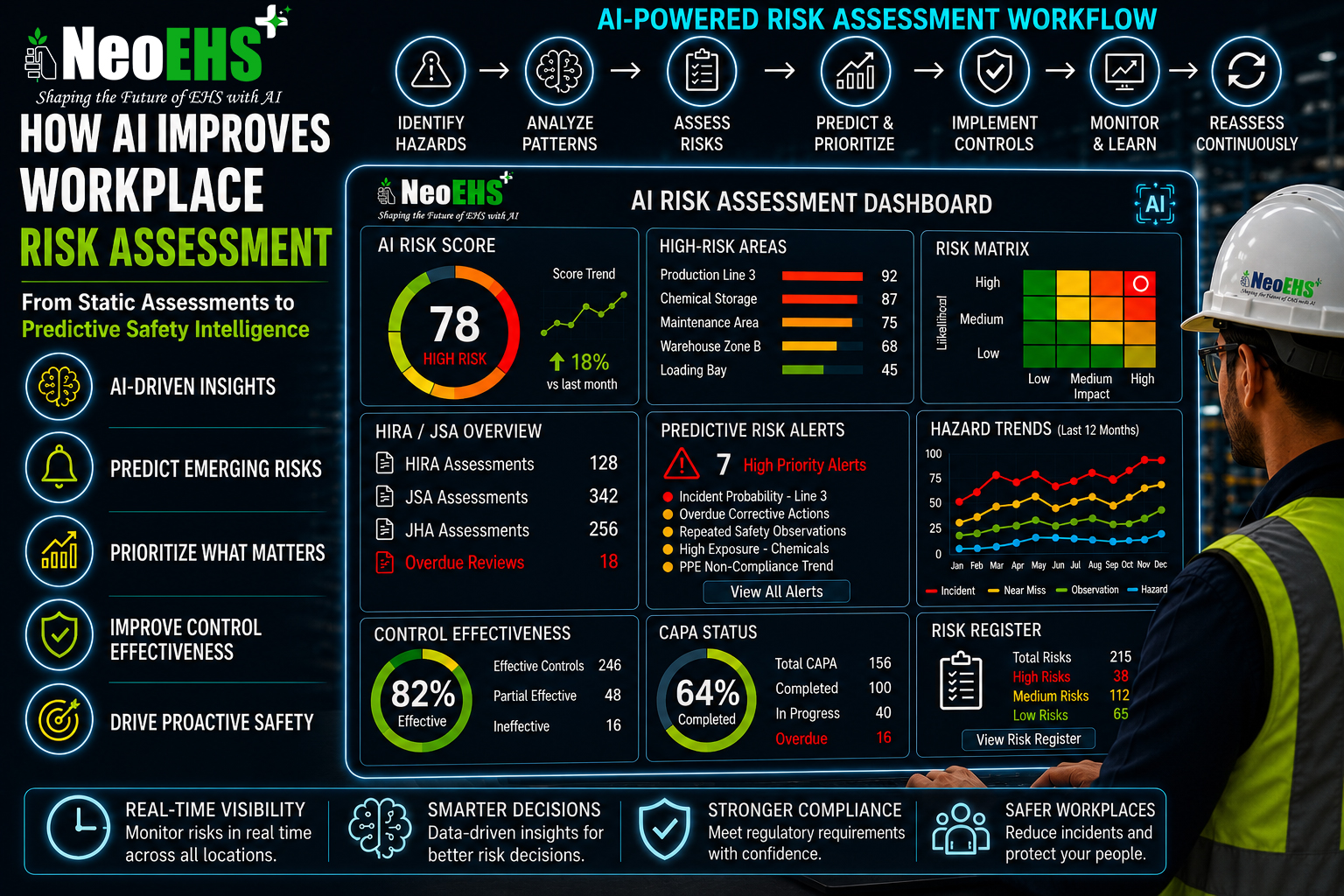
How AI Improves Workplace Risk Assessment
Workplace risk assessment has always been one of the foundations of effective health and safety management.
But the workplace has changed.
Organizations now operate across multiple sites, complex processes, contractors, equipment, chemicals, digital systems and increasingly data-rich environments. Safety teams may have thousands of incidents, inspections, observations, risk assessments and corrective actions to review.
The challenge is no longer simply collecting safety information.
The challenge is understanding it quickly enough to make better decisions.
This is where artificial intelligence is changing workplace risk assessment.
AI can help organizations identify hazards, analyze risk patterns, prioritize high-risk conditions, recommend controls and continuously monitor whether risk is changing.
NeoEHS combines AI, predictive analytics, digital risk assessment workflows and connected EHS data to help organizations move from traditional, document-based risk assessment toward dynamic and proactive risk intelligence.
The goal is not to replace safety professionals.
The goal is to give them better information, earlier warning signals and stronger decision support.
What Is AI-Powered Workplace Risk Assessment?
AI-powered workplace risk assessment is the use of artificial intelligence, machine learning, analytics and connected EHS data to identify hazards, evaluate risks, recommend controls and detect changes in workplace risk.
Traditional risk assessment often follows a periodic process:
Identify Hazard → Assess Risk → Apply Controls → Review
AI-enabled risk management can make the process more continuous:
Detect → Analyze → Assess → Predict → Control → Monitor → Learn → Reassess
This difference is important.
A risk assessment completed six months ago may no longer accurately represent today's workplace.
People change.
Equipment changes.
Processes change.
Contractors change.
Production levels change.
Environmental conditions change.
And new hazards can emerge.
AI helps organizations move toward a model where risk information can be continuously analyzed rather than treated as a static document.
Why Traditional Risk Assessment Is No Longer Enough
Traditional risk assessments remain valuable, but many organizations still manage them through spreadsheets, documents and disconnected systems.
This can create several problems.
Risk assessments may become outdated
A process may change without the corresponding risk assessment being updated.
Risk data may be fragmented
Incidents may sit in one system, inspections in another and corrective actions in spreadsheets.
High-risk areas may be difficult to identify
A safety team may have thousands of records but limited ability to identify recurring patterns.
Manual analysis takes time
EHS professionals may spend hours comparing historical incidents and inspection findings.
Risk controls may not be continuously evaluated
A control can exist on paper but may not work effectively in practice.
Emerging risks can be missed
A series of small warning signals may not appear significant individually.
AI can help connect these signals.
How AI Improves Workplace Risk Assessment
There are several important ways AI can strengthen the risk assessment lifecycle.
1. AI Helps Identify Hazards Faster
Risk assessment begins with hazard identification.
If a hazard is not identified, it cannot be properly assessed or controlled.
AI can help identify potential hazards from multiple sources, including:
- Incident reports
- Near misses
- Safety observations
- Inspection findings
- Audit findings
- Risk assessments
- Worker reports
- Equipment information
- Environmental data
- Operational information
- CCTV and computer vision
- IoT sensor data
NeoEHS supports AI-powered hazard identification through inspections, mobile reporting, AI image analysis and CCTV monitoring.
This allows organizations to move beyond relying exclusively on scheduled risk assessments.
2. AI Can Identify Patterns Humans May Miss
One incident may not tell the whole story.
Consider this example.
A manufacturing facility records:
- Three minor hand injuries
- Five observations involving machine guarding
- Two inspection findings involving the same equipment
- Four overdue corrective actions
- Several maintenance activities on the same production line
Each item may appear manageable by itself.
But together, they may indicate an emerging machine-safety risk.
AI can analyze relationships between these data points and identify recurring patterns.
This is one of the most important advantages of AI:
It can analyze large volumes of information much faster than manual review.
NeoEHS uses predictive analytics to analyze incidents, near misses, inspections and behavioral trends to identify potential future risks.
3. AI Makes Risk Assessment More Dynamic
A traditional risk register can become a static document.
An AI-enabled risk platform can turn it into a dynamic source of safety intelligence.
Instead of asking:
“What was our risk assessment last year?”
organizations can ask:
“What is our highest current risk?”
“Which risks are increasing?”
“Which controls are overdue?”
“Which locations have recurring hazards?”
“Where are workers most exposed?”
NeoEHS's current risk management solution is designed around identifying, assessing, monitoring and mitigating workplace risks through AI-driven analytics and real-time operational visibility.
4. AI Supports HIRA, HIRARC, JSA and JHA
Different industries use different risk assessment methodologies.
Common approaches include:
- HIRA — Hazard Identification and Risk Assessment
- HIRARC — Hazard Identification, Risk Assessment and Risk Control
- JSA — Job Safety Analysis
- JHA — Job Hazard Analysis
- FMEA — Failure Mode and Effects Analysis
- HAZOP — Hazard and Operability Study
- Bowtie Analysis
NeoEHS supports configurable risk assessment workflows covering HIRA, JSA, JHA, FMEA, HAZOP, risk matrices and Bowtie analysis.
AI can assist by bringing historical safety information into these workflows.
For example:
Task → Hazards → Historical Incidents → Existing Controls → Risk Score → Recommended Actions
The safety professional still makes the final judgment.
AI provides additional intelligence to support that judgment.
5. AI Can Help Prioritize High-Risk Activities
Not every risk deserves the same level of attention.
EHS teams often have limited resources.
The question becomes:
Where should we focus first?
AI can help prioritize risk using information such as:
- Severity
- Likelihood
- Frequency
- Historical incidents
- Near misses
- Exposure
- Number of workers affected
- Repeated findings
- Control effectiveness
- Location
- Operational conditions
This allows safety teams to focus attention on the risks most likely to have significant consequences.
NeoEHS provides risk scoring, predictive analytics and high-risk-area identification capabilities within its risk and hazard management workflows.
6. AI Can Detect Emerging Risks
Some risks do not appear suddenly.
They develop gradually.
For example:
More near misses → repeated observations → overdue actions → recurring equipment issues → increasing risk
A conventional reporting system may show these as separate events.
AI can potentially connect them.
This is the difference between:
Incident reporting
and
risk intelligence.
The objective is to identify a developing risk before it becomes a serious incident.
NeoEHS's hazard management platform specifically describes predictive risk analytics, behavioral safety analytics, high-risk area identification and predictive safety alerts.
7. AI Improves Risk Scoring
Risk assessment traditionally uses a risk matrix based on factors such as:
Likelihood × Severity
However, determining likelihood can be difficult when the assessment relies heavily on subjective judgment.
AI can introduce additional evidence.
For example, likelihood assessment can potentially be informed by:
- Previous incidents
- Near misses
- Frequency of exposure
- Historical inspection findings
- Safety observations
- Equipment condition
- Work activity
- Environmental conditions
- Previous corrective actions
This does not mean AI should automatically determine the final risk rating.
Rather, AI can provide evidence-based context for the person conducting the assessment.
That makes risk scoring more informed and potentially more consistent.
8. AI Can Recommend Risk Controls
Identifying a risk is only the beginning.
The real objective is to control it.
AI can analyze historical safety information and help suggest potential corrective or preventive actions.
For example:
Hazard
Worker exposure to moving machinery.
Possible controls
- Engineering guarding
- Interlocks
- Physical barriers
- LOTO
- Administrative controls
- Training
- PPE
The safety professional should determine which controls are appropriate based on the actual workplace.
AI can help accelerate the process by presenting relevant information and previous actions.
NeoEHS provides intelligent safety workflows and smart corrective recommendations as part of its AI-enabled risk management capabilities.
9. AI Connects Risk Assessment With CAPA
A risk assessment should result in action.
If a high-risk condition is identified, someone should be responsible for addressing it.
A connected workflow can be:
Risk Identified
↓
Risk Assessed
↓
Control Required
↓
CAPA Created
↓
Owner Assigned
↓
Deadline Set
↓
Action Completed
↓
Effectiveness Verified
↓
Risk Reassessed
This closes the loop between assessment and action.
NeoEHS provides automated CAPA workflows and connects risk management with corrective and preventive actions.
10. AI Can Evaluate Whether Controls Are Working
One of the biggest weaknesses in traditional risk management is assuming that a control remains effective simply because it exists.
Consider a machine guard.
The risk assessment says:
Control: Machine Guard Installed
But what if:
- The guard is damaged?
- Workers bypass it?
- Inspections repeatedly identify problems?
- Maintenance removes it?
- The control is ineffective during certain operations?
AI can help identify these signals by connecting:
Risk → Control → Inspection → Observation → Incident → CAPA
This creates a much stronger picture of control effectiveness.
11. AI Brings Incident Data Into Risk Assessment
Every incident contains information about risk.
If a workplace experiences an incident, the risk assessment should potentially be reconsidered.
For example:
Risk Assessment → Control → Incident → Investigation → Root Cause → Risk Reassessment
NeoEHS connects incident management, risk management, hazards, inspections and corrective actions within its integrated EHS ecosystem.
This means incident learning can feed back into risk management rather than remaining isolated in an incident database.
12. AI Uses Near Misses as Early Warning Signals
Near misses are valuable because they can reveal weaknesses without necessarily resulting in injury.
Suppose a warehouse reports:
- Five forklift near misses
- Three pedestrian-route observations
- Two damaged barriers
- Increasing congestion during peak hours
No serious accident has happened.
Yet the risk may be increasing.
AI can analyze these leading indicators and help identify the area as a potential high-risk zone.
This changes the safety conversation from:
“Nobody was injured.”
to:
“We are seeing signals that could lead to an injury.”
That is proactive safety management.
13. AI Can Identify High-Risk Areas
Risk is rarely distributed evenly across an organization.
One production line may have more incidents.
One warehouse zone may have more observations.
One contractor group may have more safety violations.
One maintenance activity may generate repeated hazards.
AI can identify these operational hotspots.
NeoEHS's hazard management capabilities include high-risk-area identification and analysis of unsafe behaviors, inspection history and operational data.
This allows organizations to ask:
Where is risk concentrated?
rather than simply:
How many risks do we have?
14. AI Supports Real-Time Risk Monitoring
Traditional risk assessments are often periodic.
But workplaces are dynamic.
IoT and real-time operational data can help make risk management more responsive.
NeoEHS's IoT-based safety management capabilities are designed to connect live telemetry with EHS workflows, providing visibility into where risks occur, when they occur, how frequently they occur, which workers are exposed and whether controls are working.
This creates a more dynamic model:
Real-Time Data → Risk Signal → Alert → Intervention → Risk Reduction
15. AI + Computer Vision for Risk Assessment
Computer vision can provide another source of safety intelligence.
Depending on the application, AI vision systems can help identify:
- PPE compliance
- Restricted-area access
- Unsafe activities
- Unsafe positioning
- Crowding
- Safety-zone violations
- Certain environmental or operational conditions
NeoEHS describes AI vision-based monitoring for PPE compliance, restricted-area access and unsafe activities.
When appropriate, these observations can become inputs into a broader risk management process.
For example:
Repeated PPE violations → Risk identified → Investigation → Control improvement → Monitoring
16. AI Helps Connect Contractor Risk
Contractors can introduce additional risk into an organization.
A strong risk assessment process should consider:
- Contractor competency
- Training
- Previous incidents
- Work activity
- Permit requirements
- Site conditions
- Risk assessments
- Safety performance
AI can help identify patterns across contractor activities and safety records.
This can support more informed decisions about where additional supervision or controls may be required.
NeoEHS includes contractor management within its broader HSE platform, alongside risk assessment, incidents, permits and compliance workflows.
17. AI Improves Risk Assessment Across Multiple Sites
Large organizations face another challenge:
How do we maintain consistent risk management across multiple facilities?
Imagine a company with 50 sites.
One facility discovers a serious hazard.
A traditional system may resolve the issue locally.
A connected AI platform can ask:
Do our other facilities have the same hazard?
Are they using the same equipment?
Have similar incidents occurred elsewhere?
Are the same controls being used?
This enables enterprise-wide learning.
A safety lesson from one site can become a preventive action across the organization.
18. AI Supports Dynamic Risk Registers
A risk register should not become a document that nobody opens after an assessment is completed.
A modern risk register should answer:
- What are our highest risks?
- Where are they?
- Who is exposed?
- What controls exist?
- Which controls are overdue?
- Which risks are increasing?
- Which risks are recurring?
- Which actions remain open?
- What incidents are associated with each risk?
NeoEHS provides centralized risk visibility, risk registers, scoring, controls, predictive analytics and dashboards within its risk management platform.
This transforms the risk register from a compliance document into a management tool.
AI-Powered Risk Assessment vs Traditional Risk Assessment
| Traditional Risk Assessment | AI-Powered Risk Assessment |
|---|---|
| Periodic assessment | Continuous risk intelligence |
| Spreadsheet-based | Centralized digital platform |
| Manual data review | AI-assisted analysis |
| Historical information | Historical + real-time data |
| Static risk register | Dynamic risk register |
| Manual prioritization | Intelligent prioritization |
| Isolated incidents | Connected incident intelligence |
| Manual control review | Control-effectiveness insights |
| Reactive | Proactive |
| Limited cross-site visibility | Enterprise-wide risk visibility |
| Human-only pattern recognition | AI-assisted pattern recognition |
AI does not eliminate the need for professional risk assessment.
It makes the assessment process more connected, data-driven and responsive.
What Data Can AI Use for Workplace Risk Assessment?
The quality of AI insights depends heavily on the quality and relevance of the underlying data.
Useful sources can include:
Incident Data
- Injuries
- Near misses
- Property damage
- Environmental incidents
Inspection Data
- Findings
- Repeated deficiencies
- Equipment conditions
- Workplace observations
Risk Data
- HIRA
- HIRARC
- JSA
- JHA
- HAZOP
- FMEA
- Bowtie
Behavioral Data
- Unsafe acts
- Safety observations
- PPE compliance
- High-risk behaviors
Operational Data
- Equipment
- Work activity
- Production conditions
- Maintenance
Environmental Data
- Temperature
- Gas levels
- Air quality
- Noise
- Other relevant sensor information
Compliance Data
- Audit findings
- Regulatory requirements
- Corrective actions
The more connected these data sources are, the greater the opportunity for meaningful risk intelligence.
AI Does Not Replace the Safety Professional
This point deserves emphasis.
AI should not be treated as an autonomous safety decision-maker.
Workplace risk assessment requires:
- Professional judgment
- Knowledge of the workplace
- Understanding of applicable regulations
- Engineering knowledge
- Worker consultation
- Operational context
- Validation of controls
AI should support these activities.
The ideal relationship is:
AI provides intelligence.
Safety professionals provide judgment.
Operations provide context.
Workers provide experience.
Management provides accountability.
Together, these create stronger risk decisions.
A Practical AI-Powered Risk Assessment Workflow
A modern workflow can look like this:
Step 1 — Identify
Capture hazards through inspections, observations, incidents, AI vision, mobile reporting and other sources.
Step 2 — Analyze
Use AI to identify historical patterns and similar risks.
Step 3 — Assess
Apply HIRA, HIRARC, JSA, JHA, FMEA, HAZOP, Bowtie or the organization's chosen methodology.
Step 4 — Prioritize
Identify high-risk activities, locations and exposures.
Step 5 — Control
Apply engineering, administrative and other appropriate controls.
Step 6 — Assign
Create CAPA and assign ownership and deadlines.
Step 7 — Monitor
Track risk indicators, inspections, incidents, observations and control performance.
Step 8 — Predict
Use historical and real-time data to identify emerging risk patterns.
Step 9 — Reassess
Update the risk assessment when conditions change or new information becomes available.
Step 10 — Learn
Use organizational learning to improve future risk assessments.
Industry Applications of AI-Powered Risk Assessment
Manufacturing
AI can help identify machine safety risks, ergonomic hazards, chemical exposure, maintenance risks, unsafe behaviors and recurring equipment-related incidents.
Construction
Risk assessment can be connected with work-at-height, excavation, lifting, scaffolding, temporary works, contractor activities and Permit to Work.
Oil & Gas
AI can support process safety, HAZOP, Bowtie, PTW, LOTO, contractor risk, equipment risk and operational monitoring.
Chemical Industry
AI can connect chemical hazards, SDS information, chemical inventory, exposure risks, incidents, inspections and environmental risks.
Mining
AI can help analyze risks associated with heavy equipment, haul roads, mobile machinery, ground conditions, blasting and contractor activities.
Ports & Maritime
Risk assessment can connect vessel operations, cargo handling, lifting activities, restricted areas, weather conditions and environmental risks.
Rail & Metro
AI can support risk assessment across maintenance activities, track work, electrical systems, rolling stock, stations, contractors, passenger areas and high-risk work.
How NeoEHS Improves Workplace Risk Assessment
NeoEHS combines AI-enabled risk management with the broader EHS lifecycle.
Its current Risk Management platform includes:
- AI-assisted risk assessments
- HIRA
- JSA
- JHA
- HAZOP
- FMEA
- Bowtie analysis
- Risk matrices
- Predictive analytics
- Real-time risk monitoring
- AI risk detection
- CAPA tracking
- Risk dashboards
- High-risk area identification
- AI vision-based monitoring
Explore NeoEHS AI-Enabled Risk Management Software
The value becomes even greater when risk assessment is connected with the wider NeoEHS platform, including incident management, hazard management, inspections, audits, permits and compliance.
Explore NeoEHS EHS Management System
From Risk Assessment to Risk Intelligence
The biggest change AI brings is not simply automation.
It is continuous learning.
Traditional approach:
Assess → Document → Review Later
AI-enabled approach:
Assess → Monitor → Learn → Predict → Reassess
This creates a continuous risk intelligence cycle.
For example:
Incident
↓
AI identifies similar historical events
↓
Risk assessment is reviewed
↓
Control weakness identified
↓
CAPA created
↓
Inspection verifies control
↓
AI monitors recurrence
↓
Risk score updated
↓
Organization learns
This is how risk management becomes proactive.
Frequently Asked Questions
What is AI-powered workplace risk assessment?
AI-powered workplace risk assessment uses artificial intelligence, analytics and connected EHS data to identify hazards, analyze risk patterns, prioritize risks, support control selection and monitor changing workplace conditions.
How does AI improve risk assessment?
AI can analyze large volumes of incidents, near misses, inspections, observations and operational data to identify patterns, prioritize high-risk areas and provide decision support to EHS professionals.
Can AI replace a safety professional?
No. AI should support qualified safety professionals rather than replace their judgment. Risk decisions should consider workplace conditions, applicable requirements, engineering principles, worker input and professional expertise.
Can AI predict workplace accidents?
AI cannot guarantee that an accident will be predicted or prevented. It can, however, analyze historical and real-time information to identify patterns and warning signals that may indicate increasing risk.
What risk assessment methods can NeoEHS support?
NeoEHS's current Risk Management solution supports HIRA, JSA, JHA, FMEA, HAZOP, Bowtie analysis and configurable risk matrices.
Can AI use incident data in risk assessment?
Yes. Connecting incidents and near misses with risk assessments can help organizations identify recurring hazards and reconsider whether existing controls remain effective.
Can AI identify high-risk areas?
AI-powered analytics can analyze incident trends, unsafe behaviors, inspection history and operational data to identify potential high-risk areas. NeoEHS specifically provides high-risk-area identification capabilities.
Can AI monitor risk in real time?
When connected to appropriate operational, IoT or other data sources, AI-enabled systems can provide more dynamic visibility into changing risk conditions. NeoEHS supports IoT-based dynamic risk management and real-time risk visibility.
How does AI help with corrective actions?
AI can help identify recurring problems and recommend potential corrective or preventive actions. NeoEHS includes intelligent safety recommendations and automated CAPA workflows within its risk management capabilities.
What is the difference between traditional and AI-powered risk assessment?
Traditional assessments are often periodic and document-driven. AI-powered risk assessment connects multiple sources of safety information and can provide more continuous, data-driven risk intelligence.
Is AI-powered risk assessment suitable for high-risk industries?
Yes. AI-enabled risk intelligence can be particularly valuable in industries with complex or changing risks, including manufacturing, construction, oil and gas, chemicals, mining, ports, utilities, infrastructure and transportation.
The Future of Workplace Risk Assessment
The future of workplace risk assessment is not about creating more spreadsheets.
It is about creating better safety intelligence.
Organizations need to know:
What are our highest risks?
Where are they increasing?
Which workers are exposed?
Which controls are failing?
What incidents are connected to those risks?
What should we address first?
AI can help answer these questions by connecting information that was previously scattered across different systems.
The result is a shift:
From Static Risk Registers → Dynamic Risk Intelligence
From Periodic Assessments → Continuous Monitoring
From Historical Reporting → Predictive Insights
From Reactive Controls → Proactive Prevention
From Disconnected Data → Connected Safety Intelligence
Build a Smarter Risk Management Program With NeoEHS
NeoEHS brings AI-powered risk assessment, predictive analytics, hazard management, incident management, inspections, audits, CAPA, permits and compliance into a connected EHS platform.
Discover NeoEHS AI-Powered EHS Software
The objective is not to let AI make safety decisions on its own.
The objective is to give safety professionals the information they need to make faster, better and more proactive decisions.
Because the most valuable risk assessment is not the one that simply documents yesterday's risks.
It is the one that helps an organization understand what could happen next—and what it can do today to prevent it.
AI doesn't replace risk management.
It makes risk management more intelligent.
AI-Enabled Risk Management Software
READ MORE ❯
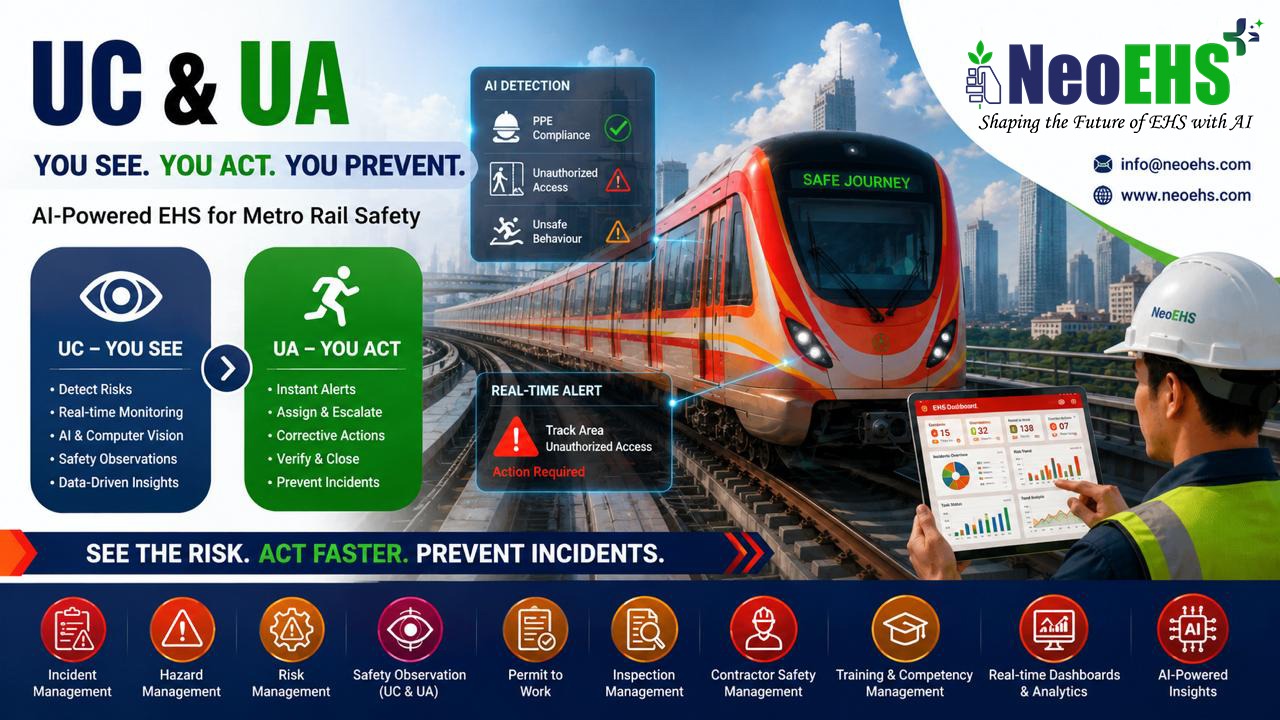
UC & UA: You See. You Act. You Prevent. The Future of AI-Powered Metro Rail Safety Solution of NeoEHS
AI-Powered Metro Rail EHS Software for Incident Management, Risk Prevention, Computer Vision, Safety Observations, Digital Permit to Work and Predictive Safety
Metro Rail systems are built around movement, precision and safety.
Every day, passengers, train operators, engineers, maintenance teams, contractors and safety professionals work within an environment where thousands of activities happen simultaneously.
A train enters a platform. Maintenance teams work near critical infrastructure. Contractors perform high-risk activities. Electrical systems remain operational. Passengers move through stations. CCTV cameras continuously monitor the environment.
In this complex ecosystem, seeing a risk is only the beginning.
The real question is:
What do you do after you see it?
This is the philosophy behind UC & UA — You See. You Act.
With NeoEHS, the vision is to help Metro Rail organisations move beyond simply recording incidents and toward a connected safety lifecycle where organisations can see risks, understand them, act on them and continuously improve.
UC & UA: A Simple Philosophy for a Complex Safety Environment
UC — You See
You See means having the visibility to identify what is happening across the Metro Rail safety ecosystem.
You see:
- Hazards
- Unsafe acts
- Unsafe conditions
- Safety observations
- Near misses
- Incidents
- High-risk activities
- Contractor activities
- Inspection findings
- Permit violations
- Compliance gaps
- Emerging risk patterns
- Operational deviations
But modern safety management requires more than human observation alone.
AI, mobile technology, computer vision, IoT and predictive analytics can extend what safety teams are able to see.
UA — You Act
You Act means converting what you see into timely and accountable action.
You act through:
- Alerts
- Notifications
- Intervention
- Risk controls
- Corrective actions
- Preventive actions
- Escalations
- Investigations
- Verification
- Closure
- Continuous improvement
Therefore:
UC — You See.
UA — You Act.
You Prevent.
This is the foundation of the NeoEHS approach to intelligent Metro Rail safety management.
Why Metro Rail Needs More Than Traditional Safety Management
Traditional EHS systems often depend on paper forms, spreadsheets, emails, disconnected applications and periodic reporting.
These approaches can make it difficult to answer critical questions quickly:
- Where are the highest safety risks today?
- Which hazards are recurring?
- Which contractors have deteriorating safety performance?
- Which corrective actions are overdue?
- Which stations or depots are becoming higher-risk areas?
- Are similar incidents occurring in different locations?
- Which high-risk permits are currently active?
- Where are safety observations increasing?
- What risks are being detected before an incident occurs?
A modern Metro Rail EHS Management System should connect these pieces.
NeoEHS brings incident management, safety observations, risk management, inspections, audits, permits, contractor safety, compliance and AI-powered safety intelligence into a connected EHS ecosystem.
UC — You See: Making Metro Rail Safety Visible
1. You See Through AI-Powered Computer Vision
Metro Rail operators already have extensive CCTV infrastructure.
The opportunity is to transform cameras from passive recording devices into intelligent safety-monitoring sources.
AI-powered computer vision can be configured to identify defined safety events such as:
- Restricted-area access
- Track intrusion
- PPE non-compliance
- Unsafe behaviour
- Unsafe proximity
- Crowd-related safety conditions
- Smoke or fire indicators
- Obstructions
- Safety-zone violations
- Other organisation-defined visual safety events
Instead of discovering an event later through manual review, an AI-enabled system can help bring potential safety events to the attention of responsible teams.
You See the Risk.
And once you see it, the next step is action.
2. You See Through Mobile Safety Observations
A Metro Rail employee, supervisor, engineer or contractor can observe a safety issue and report it directly from a mobile device.
A simple field observation can include:
Photo + Video + Voice + Location + Description + Risk Level
The observation becomes a structured digital safety record.
For example:
“Unsafe access observed inside a restricted maintenance area at Depot A.”
Instead of remaining as an informal observation, the information can enter the EHS workflow.
You See it in the field.
NeoEHS helps bring it into the safety system.
3. You See Through UAUC / Safety Observations
Unsafe Acts and Unsafe Conditions can provide valuable leading indicators of safety performance.
One observation may appear small.
Hundreds or thousands of observations can reveal something much more important: a pattern.
For example:
Observation 1: PPE non-compliance.
Observation 2: PPE non-compliance.
Observation 3: PPE non-compliance.
Observation 4: PPE non-compliance.
An AI-enabled analytics layer can help identify that these observations are recurring around a particular:
- Location
- Contractor
- Work activity
- Shift
- Equipment type
- Department
Now the organisation is no longer simply seeing individual observations.
It is seeing the pattern behind them.
4. You See Through Incident Intelligence
A traditional incident report primarily answers:
What happened?
An intelligent incident management system can help safety teams go further:
- What happened?
- Where did it happen?
- What activity was involved?
- What hazards were present?
- What controls existed?
- What controls failed?
- Has something similar happened before?
- Are similar risks present elsewhere?
- Were corrective actions previously implemented?
- Are there recurring patterns?
NeoEHS combines incident reporting, investigation, root cause analysis, corrective action tracking and predictive safety intelligence to help organisations move from incident reporting toward incident prevention.
You See the incident.
You See the causes.
You See the recurring patterns.
5. You See Through AI-Powered Risk Management
Metro Rail operations involve complex risks across stations, depots, tracks, tunnels, electrical systems, construction areas and maintenance operations.
A digital risk management system can provide visibility into:
- Hazard registers
- Risk assessments
- High-risk activities
- Risk ratings
- Existing controls
- Residual risks
- Control effectiveness
- Risk owners
- Overdue mitigation actions
- Risk trends
AI can help analyse safety information from incidents, observations, inspections and other EHS data to identify emerging patterns.
You See where risk is increasing.
You Act before it becomes an incident.
6. You See Through Digital Permit to Work
High-risk railway maintenance and infrastructure work requires controlled work authorisation.
A digital Permit to Work system can provide visibility into:
- Work location
- Work activity
- Contractor
- Risk assessment
- Required controls
- Isolation requirements
- PPE
- Approvals
- Permit validity
- Work status
- Closure requirements
For Metro Rail, digital PTW can be particularly valuable for activities such as:
- Electrical work
- Work at height
- Confined-space entry
- Hot work
- Excavation
- Lifting operations
- Isolation / LOTO
- Track-related maintenance
- Other organisation-specific high-risk activities
You See the work.
You See the risk.
You See the controls.
7. You See Through Digital Inspections
Inspections are one of the most important mechanisms for discovering hazards before incidents occur.
With mobile inspection management, safety teams can:
- Conduct inspections digitally
- Capture photographs
- Record findings
- Identify non-conformities
- Assign corrective actions
- Set deadlines
- Escalate overdue actions
- Verify closure
- Analyse recurring findings
When inspection data is connected to incidents, risks and corrective actions, organisations can gain a much broader picture of safety performance.
You See what inspections are telling you.
8. You See Through Contractor Safety Management
Metro Rail projects involve numerous contractors and subcontractors.
Managing contractor safety through disconnected spreadsheets can make it difficult to understand real-time performance.
A digital contractor safety system can provide visibility into:
- Contractor registration
- Competency
- Certifications
- Induction
- Training
- Permits
- Inspections
- Incidents
- Safety observations
- Corrective actions
- Safety performance
AI analytics can help identify changing safety patterns and highlight areas requiring management attention.
You See contractor performance before a small problem becomes a major problem.
9. You See Through Real-Time EHS Dashboards
Metro Rail executives and EHS leaders need more than monthly reports.
They need answers.
A connected NeoEHS dashboard can bring together:
Incidents
What happened?
Hazards
What could happen?
Observations
What are people seeing?
Inspections
What is being found?
Permits
What high-risk work is active?
Risks
Where is exposure increasing?
Corrective Actions
What remains unresolved?
Training
Where are competency gaps?
Contractors
Who needs attention?
AI Analytics
What patterns are emerging?
This creates a single, connected safety picture.
UA — You Act: Turning Safety Intelligence Into Action
Seeing a risk without acting on it does not create safety.
This is where UA — You Act becomes the critical second half of the philosophy.
The digital safety lifecycle becomes:
SEE → UNDERSTAND → ACT → VERIFY → PREVENT
10. You Act Through Real-Time Alerts
When a defined safety event is detected, the system can trigger an appropriate notification or workflow.
For example:
AI Detection
↓
Safety Alert
↓
Responsible Team
↓
Intervention
↓
Action Record
↓
Verification
The objective is not to generate more notifications.
The objective is to help the right people take the right action at the right time.
You See. You Act.
11. You Act Through Corrective and Preventive Actions
A safety observation should never end with:
“Reported.”
It should move through an accountable process:
Observation
↓
Risk Assessment
↓
Action Assignment
↓
Responsible Person
↓
Due Date
↓
Corrective Action
↓
Verification
↓
Closure
↓
Effectiveness Review
This transforms safety management from documentation into action.
12. You Act Through Escalation
Not every risk requires the same response.
A risk-based workflow can help determine whether an issue requires:
Supervisor Intervention
or
Departmental Action
or
Safety Manager Escalation
or
Senior Management Attention
or
Immediate Emergency Response according to the organisation's procedures
The objective is to ensure that serious risks do not remain buried inside routine workflows.
You See the risk.
You Act at the appropriate level.
13. You Act Through AI-Assisted Incident Investigation
After an incident occurs, AI can help investigators analyse available information such as:
- Incident descriptions
- Photographs
- Videos
- Previous incidents
- Safety observations
- Inspection findings
- Risk assessments
- Permit records
- Corrective actions
AI can assist in identifying potential patterns and contributing factors.
Human investigators and qualified safety professionals remain responsible for investigation conclusions, root-cause determination and safety decisions.
AI provides intelligence.
People make safety decisions.
14. You Act Through Predictive Safety
This is where UC and UA become especially powerful.
Imagine NeoEHS identifies:
- Increasing safety observations
- Repeated inspection findings
- Multiple near misses
- Increasing contractor violations
- Overdue corrective actions
- Increasing risk scores
Individually, each item may not trigger significant concern.
Together, they could represent an emerging risk pattern.
AI-powered analytics can help safety teams identify such patterns earlier.
UC — You See the warning signs.
UA — You Act before the incident.
You Prevent.
That is the transition from reactive safety to predictive safety.
The UC + UA Safety Intelligence Cycle
The NeoEHS approach can be represented through a simple continuous cycle:
UC — YOU SEE
Detect → Capture → Monitor
↓
AI — YOU UNDERSTAND
Analyse → Connect → Identify Patterns
↓
UA — YOU ACT
Alert → Assign → Correct → Escalate
↓
VERIFY
Check → Validate → Close
↓
PREVENT
Learn → Predict → Improve
SEE → UNDERSTAND → ACT → VERIFY → PREVENT
This is the foundation of intelligent Metro Rail safety management.
UC + UA Across Metro Rail Operations
| Metro Rail Area | UC — You See | UA — You Act |
|---|---|---|
| Stations | Hazards, crowd conditions, unsafe activities | Alert and intervention |
| Platforms | Passenger and operational risks | Immediate response |
| Track Areas | Restricted access and unsafe conditions | Escalation and intervention |
| Depots | Maintenance and operational hazards | Corrective action |
| Workshops | Machinery and workplace risks | Control and verification |
| Electrical Areas | Electrical safety risks | Isolation and corrective action |
| Tunnels | Worksite and environmental hazards | Alert and emergency response |
| Construction | Contractor and site risks | Corrective action and escalation |
| CCTV | Defined visual safety events | Real-time alert |
| Inspections | Findings and non-conformities | CAPA assignment |
| Incidents | Events and recurring patterns | Investigation and prevention |
| Risk Management | Increasing exposure | Additional controls |
| PTW | High-risk activities | Approval, monitoring and closure |
| Contractors | Performance trends | Intervention and improvement |
| Training | Competency gaps | Training assignment |
| Compliance | Gaps and overdue actions | Escalation and closure |
Why UC + UA Is Different
Many safety platforms focus on collecting information.
Some focus on reporting.
Others focus on analytics.
NeoEHS can bring these capabilities together around one simple operational philosophy:
You See.
The system helps capture what is happening.
You Understand.
AI and analytics help turn safety data into intelligence.
You Act.
Workflows turn intelligence into accountable action.
You Prevent.
The organisation learns from the data and takes preventive measures.
This is the difference between:
Data Collection
and
Safety Intelligence.
From Reactive Metro Rail Safety to Predictive Metro Rail Safety
Traditional approach:
Incident → Report → Investigate → Correct
Digital approach:
Observe → Report → Analyse → Correct
AI-powered approach:
See → Understand → Predict → Act → Prevent
The objective is not to eliminate human judgement.
The objective is to give EHS professionals better information so they can make faster and better safety decisions.
How NeoEHS Supports AI-Powered Metro Rail Safety
NeoEHS is an AI-powered Environmental, Health and Safety platform designed to connect EHS processes, field operations and safety intelligence.
For Metro and Rail operations, NeoEHS can support:
- AI-Powered Incident Management
- Safety Observation Management
- UAUC Management
- Hazard Management
- AI-Enabled Risk Management
- Inspection Management
- Audit Management
- Digital Permit to Work
- Contractor Safety Management
- Training & Competency Management
- Emergency Management
- Compliance Management
- Corrective & Preventive Action Management
- AI-Powered Document Intelligence
- OCR
- Computer Vision Integration
- IoT Integration
- Predictive Safety Analytics
- Real-Time EHS Dashboards
- Mobile EHS Management
The goal is to connect field-level safety with management-level intelligence.
Frequently Asked Questions
What is AI-powered Metro Rail EHS software?
AI-powered Metro Rail EHS software is a digital platform that helps metro and railway organisations manage incidents, hazards, risks, inspections, audits, permits, contractors, compliance and workforce safety while using AI and analytics to identify patterns and support proactive safety decisions.
What does UC mean in Metro Rail safety?
In the NeoEHS UC + UA philosophy, UC means “You See.” It represents the ability to identify and gain visibility into hazards, unsafe acts, unsafe conditions, incidents, observations, operational risks and emerging safety trends.
What does UA mean in Metro Rail safety?
UA means “You Act.” It represents the actions taken after a safety risk is identified, including alerts, interventions, corrective actions, escalation, verification and preventive measures.
What is the UC + UA concept?
UC + UA is a safety philosophy:
UC — You See → AI — You Understand → UA — You Act → You Prevent.
It connects safety visibility with accountable action.
How can AI improve Metro Rail safety?
AI can help analyse safety data, identify recurring patterns, support risk prediction, analyse images and videos where appropriately configured, assist incident investigations and provide intelligent recommendations for safety teams.
Can NeoEHS manage railway safety observations?
Yes. NeoEHS supports digital safety observations and UAUC workflows that allow employees, supervisors and contractors to report unsafe acts, unsafe conditions, hazards and potential risks.
Can NeoEHS support railway Permit to Work?
Yes. NeoEHS provides configurable digital Permit to Work workflows for high-risk activities and can connect PTW with risk assessments, approvals, contractors, inspections and other EHS processes.
Can NeoEHS integrate with CCTV?
NeoEHS can integrate with computer-vision and CCTV safety-monitoring capabilities to support defined safety-event detection, depending on the organisation's infrastructure, cameras, AI models and deployment requirements.
Can NeoEHS support predictive safety?
Yes. NeoEHS uses safety data, analytics and AI capabilities to identify patterns, recurring risks and emerging areas of concern, helping organisations move toward proactive and predictive safety management.
The Future of Metro Rail Safety Is Not Just About Seeing
The future of Metro Rail safety is not simply about collecting more data.
It is about turning data into decisions.
It is about seeing a hazard before it becomes an incident.
It is about recognising a pattern before it becomes a trend.
It is about acting before a near miss becomes an accident.
It is about learning from every observation, inspection and incident.
And it is about creating a continuous safety improvement loop.
UC — You See.
UA — You Act.
You Prevent.
With AI-powered EHS, computer vision, predictive analytics, digital workflows and connected safety data, Metro Rail organisations can move toward a more intelligent, proactive and prevention-focused safety ecosystem.
NeoEHS
Shaping the Future of EHS with AI
READ MORE ❯
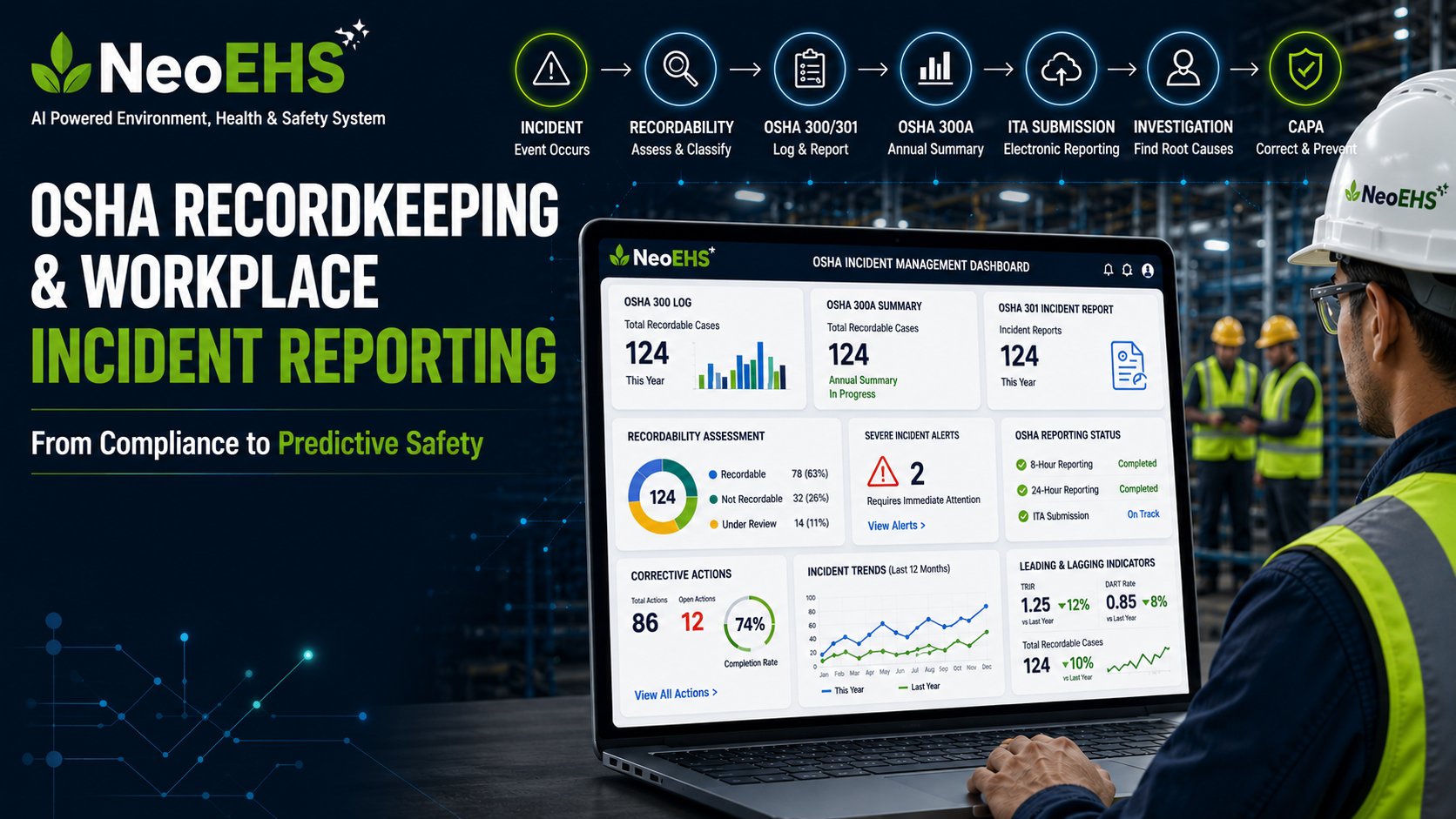
OSHA Recordkeeping and Workplace Incident Reporting Guide
OSHA Recordkeeping and Workplace Incident Reporting Guide
A workplace incident happens.
Someone gets injured. A worker develops an occupational illness. A near miss exposes a serious hazard. A machine-related event disrupts production. Or, in the most serious cases, a worker suffers a fatality, hospitalization, amputation or loss of an eye.
What happens next matters.
For organizations operating in the United States, workplace incidents can trigger several different responsibilities under the Occupational Safety and Health Administration (OSHA), including recordkeeping, reporting, electronic submission and corrective action.
But these requirements are often misunderstood.
An incident may need to be internally reported without being OSHA-recordable. An OSHA-recordable case may not necessarily require an immediate report to OSHA. And an organization may have electronic submission obligations depending on its establishment size and industry.
That is why effective workplace incident management requires more than filling out an OSHA form.
It requires a structured process for:
Report → Assess → Record → Investigate → Correct → Submit → Learn → Prevent
This guide explains the fundamentals of OSHA recordkeeping and workplace incident reporting, including OSHA Forms 300, 300A and 301, recordability criteria, severe injury reporting, electronic submission through the Injury Tracking Application (ITA), record retention and how digital EHS software can help organizations manage the process more efficiently.
Important: This article is intended as an educational guide, not legal advice. OSHA requirements can depend on establishment size, industry classification, case circumstances and applicable federal, state or other requirements. Organizations should verify their obligations using current OSHA guidance and, where appropriate, consult a qualified safety or legal professional.
What Is OSHA Recordkeeping?
OSHA recordkeeping is the process covered employers use to document qualifying work-related injuries and illnesses under 29 CFR Part 1904.
OSHA explains that many employers with more than 10 employees must maintain records of occupational injuries and illnesses, although certain low-risk industries are exempt. Covered employers generally use OSHA Forms 300, 300A and 301, or equivalent forms that meet OSHA's requirements.
The purpose is not simply paperwork.
OSHA states that recordkeeping helps employers, workers and OSHA understand workplace hazards and support efforts to prevent future injuries and illnesses.
In other words:
Good recordkeeping is not just about compliance. It is also a source of safety intelligence.
What Are OSHA Forms 300, 300A and 301?
The three primary OSHA recordkeeping forms serve different purposes.
OSHA Form 300 — Log of Work-Related Injuries and Illnesses
The OSHA 300 Log is used to record qualifying work-related injuries and illnesses.
For each recordable case, the log captures information such as:
- Case number
- Employee information
- Job title
- Date of injury or illness
- Where the event occurred
- Description of the case
- Classification of the case
- Days away from work
- Restricted work or job transfer
- Injury or illness type
OSHA requires covered employers to enter each recordable case on the OSHA 300 Log within seven calendar days of receiving information that a recordable injury or illness occurred.
OSHA Form 300A — Summary of Work-Related Injuries and Illnesses
The OSHA 300A summarizes the organization's recordable injury and illness data for the calendar year.
Covered employers must review the OSHA 300 Log for completeness and accuracy, complete and certify the 300A summary, and post it in the workplace from February 1 through April 30 of the following year, subject to the applicable requirements and exemptions.
The 300A is therefore different from the 300 Log.
Think of it this way:
OSHA 300 = individual case log
OSHA 300A = annual summary
OSHA Form 301 — Injury and Illness Incident Report
The OSHA 301 provides more detailed information about an individual recordable case.
It can include information concerning:
- The injured or ill employee
- The healthcare provider
- Medical treatment
- What the employee was doing
- How the event occurred
- The injury or illness
- The object or substance that caused the harm
OSHA requires a Form 301, or equivalent form, for each recordable injury or illness entered on the OSHA 300 Log.
What Makes a Workplace Injury or Illness OSHA Recordable?
This is one of the most important questions in workplace safety.
Under 29 CFR 1904.4, a case generally must be:
- Work-related
- A new case
- And meet OSHA's applicable recording criteria.
Under the general recording criteria in 29 CFR 1904.7, a work-related injury or illness is generally recordable if it results in:
- Death
- Days away from work
- Restricted work or job transfer
- Medical treatment beyond first aid
- Loss of consciousness
- A significant injury or illness diagnosed by a physician or other licensed healthcare professional
There are also special recording criteria for certain cases, including needlesticks and sharps injuries, medical removal, hearing loss and tuberculosis.
This is why simply asking “Was the employee injured?” is not enough.
The proper question is:
“Does this work-related case meet OSHA's recording criteria?”
Recordable Incident vs Reportable Incident
These terms are often confused.
They should not be treated as identical.
Recordable
A case meets OSHA's applicable criteria and must be entered into the required OSHA recordkeeping system.
Reportable
A case triggers an obligation to notify OSHA within a specified timeframe.
A case can therefore be recordable without requiring immediate notification to OSHA.
For example, a qualifying injury involving medical treatment beyond first aid may need to be recorded, while it may not fall within OSHA's immediate severe-injury reporting requirements.
On the other hand, a work-related fatality requires both recordkeeping and prompt reporting to OSHA.
This distinction is fundamental to a good incident management process.
OSHA Severe Injury Reporting
OSHA has separate reporting requirements for certain severe workplace incidents.
According to OSHA's current guidance, all employers must report a work-related fatality to OSHA within 8 hours.
Employers must report a work-related:
- In-patient hospitalization
- Amputation
- Loss of an eye
within 24 hours.
This is different from the normal OSHA recordkeeping timeline.
A company should therefore have a process capable of immediately escalating potentially severe incidents rather than waiting for routine recordkeeping activities.
OSHA 8-Hour and 24-Hour Reporting: A Quick Reference
| Event | OSHA reporting timeframe |
|---|---|
| Work-related fatality | Within 8 hours |
| Work-related in-patient hospitalization | Within 24 hours |
| Work-related amputation | Within 24 hours |
| Work-related loss of an eye | Within 24 hours |
| Other recordable injury/illness | Record according to Part 1904 requirements; not automatically an immediate OSHA report |
These requirements should be verified against current OSHA rules and the specific circumstances of the event.
How Quickly Must an OSHA-Recordable Case Be Recorded?
Under 29 CFR 1904.29, each recordable injury or illness must generally be entered on the OSHA 300 Log and 301 Incident Report within 7 calendar days after receiving information that a recordable injury or illness occurred.
This creates an important operational distinction:
Immediate internal incident reporting
↓
Recordability assessment
↓
OSHA recordkeeping
↓
OSHA reporting, if separately required
↓
Investigation and corrective action
A strong EHS system should support all of these steps.
Who Needs to Keep OSHA Injury and Illness Records?
OSHA states that many employers with 10 or more employees are required to keep records of occupational injuries and illnesses, although certain low-risk industries are exempt.
The important point is that employee count alone does not determine every obligation.
Industry classification also matters.
Organizations should determine whether their establishment is:
- Required to maintain OSHA records
- Partially exempt
- Required to submit data electronically
- Subject to specific reporting requirements
The OSHA rules should always be checked for the establishment's specific situation.
OSHA Electronic Recordkeeping and ITA Submission
Digital recordkeeping has become increasingly important.
Certain establishments are required to electronically submit injury and illness information to OSHA through the Injury Tracking Application (ITA).
Current OSHA requirements include different thresholds and industry criteria.
For example, certain establishments with 250 or more employees that are required to keep OSHA records must electronically submit Form 300A information.
In addition, establishments with 100 or more employees in designated high-hazard industries must electronically submit information from Forms 300 and 301 as well as the required 300A information.
OSHA states that the annual electronic submission deadline is generally March 2 of the year following the calendar year covered by the forms for covered establishments.
There are also requirements affecting certain establishments with 20–249 employees in designated industries for electronic submission of Form 300A data.
Because these requirements depend on establishment size and industry classification, companies should use OSHA's current ITA coverage guidance rather than relying on a simple employee-count rule.
OSHA Form 300A Posting Requirement
For covered employers subject to the annual summary posting requirement, OSHA requires the Form 300A to be posted in a conspicuous location from:
February 1 through April 30
The organization must also certify the summary as required.
Electronic submission to OSHA does not replace the workplace posting requirement where posting is required. OSHA's FAQ specifically addresses this distinction.
This is an example of why organizations should manage recording, posting and electronic submission as separate compliance activities.
How Long Should OSHA Records Be Kept?
Covered employers must generally retain the OSHA 300 Log, privacy case list where applicable, annual summary and OSHA 301 Incident Reports for five years following the end of the calendar year covered by the records.
During the retention period, OSHA 300 Logs must also be updated when newly discovered recordable injuries or illnesses are identified or when the classification of previously recorded cases changes.
For organizations managing multiple sites and thousands of incident records, maintaining this information accurately can become difficult with spreadsheets and disconnected files.
This is where centralized EHS software becomes valuable.
OSHA Recordkeeping Is More Than Forms
One of the biggest mistakes organizations can make is treating OSHA recordkeeping as a form-filling exercise.
The OSHA forms are the output.
The underlying process is much larger.
A mature incident management process should include:
1. Incident reporting
Capture the event quickly.
2. Initial assessment
Understand what happened and whether immediate response is required.
3. Recordability assessment
Determine whether the case meets OSHA recording criteria.
4. Severity classification
Identify actual and potential consequences.
5. OSHA reporting assessment
Determine whether a separate severe-injury reporting obligation applies.
6. Investigation
Understand immediate, contributing and root causes.
7. Corrective action
Address the underlying causes.
8. Verification
Confirm that corrective actions were effective.
9. Recordkeeping
Maintain the required OSHA information.
10. Electronic submission
Submit required information through ITA where applicable.
11. Trend analysis
Identify recurring problems.
12. Prevention
Use lessons learned to reduce future risk.
This is where EHS software can transform OSHA compliance from an administrative burden into a safety improvement process.
How NeoEHS Supports OSHA Incident Management
NeoEHS provides an AI-powered Incident Management platform designed to help organizations digitize incident reporting, investigations, root cause analysis, corrective actions, compliance workflows and safety analytics. Its current Incident Management solution specifically identifies OSHA compliance as a supported compliance area.
Explore NeoEHS Incident Management Software
NeoEHS can support the broader workflow around:
- Workplace incident reporting
- Near-miss reporting
- Incident classification
- Investigation
- Root cause analysis
- Corrective and preventive actions
- Compliance documentation
- Audit trails
- Safety trend analysis
- Management dashboards
- Multi-site reporting
The platform's broader EHS capabilities also connect incident management with risk assessment, audits, inspections, permits and other safety processes.
AI-Powered Incident Reporting
Modern employees should not have to complete complicated paperwork before reporting a workplace incident.
With mobile-first EHS workflows, workers and supervisors can report events from the field.
A digital incident report can capture:
- Date and time
- Location
- Person involved
- Incident type
- Injury or illness information
- Witnesses
- Photos
- Videos
- Immediate actions
- Equipment involved
- Hazard information
- Environmental impact
- Supporting documents
NeoEHS supports mobile incident reporting and geo-tagged incidents as part of its broader mobile EHS platform.
This can help organizations capture information while the details are still fresh.
AI-Assisted OSHA Incident Classification
One of the most valuable applications of AI is helping EHS teams organize incident information.
AI can assist with:
- Categorization
- Severity assessment support
- Similar-incident identification
- Historical pattern recognition
- Contributing-factor analysis
- Root-cause analysis support
- Corrective-action recommendations
However, AI should support—not replace—the qualified human decision-maker responsible for determining OSHA recordability and regulatory reporting obligations.
This distinction is particularly important.
An AI system can flag:
“This case may require review because medical treatment beyond first aid is indicated.”
The responsible EHS professional should then validate the facts against the applicable OSHA requirements.
OSHA Recordkeeping and Root Cause Analysis
Recording an incident answers:
What happened?
Investigation should answer:
Why did it happen?
And prevention should answer:
How do we stop it from happening again?
Consider a simple example.
A worker slips on a wet floor.
The incident may initially be classified as a slip-and-fall.
But investigation may reveal:
- A leaking pipe
- Delayed maintenance
- An inadequate inspection frequency
- Poor housekeeping
- Lack of ownership
- Repeated previous observations
If the company only records the injury, it has documented the outcome.
If it investigates the system behind the event, it can potentially prevent recurrence.
NeoEHS provides AI-assisted incident investigation and root cause analysis capabilities designed to help organizations move from incident documentation toward preventive safety intelligence.
Connect OSHA Incidents With Corrective Actions
An incident report should not disappear into an archive after it is closed.
It should create action.
For example:
Incident
Worker injured due to inadequate machine guarding.
↓
Root Cause
Machine guard design and inspection process inadequate.
↓
Corrective Action
Repair the machine guard.
↓
Preventive Action
Review guarding requirements across similar equipment.
↓
Verification
Inspect comparable machines.
↓
Learning
Update the equipment inspection checklist.
This is where digital CAPA workflows become valuable.
NeoEHS supports corrective action tracking and real-time action monitoring as part of its Incident Management capabilities.
Connect OSHA Incidents With Risk Management
An incident can be evidence that an existing risk control is not working as intended.
For example:
Risk Assessment → Control → Incident → Investigation → Risk Reassessment
This feedback loop is essential for continuous improvement.
NeoEHS supports risk assessment methodologies and connects risk management with the wider EHS platform.
This allows safety teams to move beyond:
“We completed the risk assessment.”
toward:
“The risk assessment reflects what we have actually learned from our workplace.”
OSHA Recordkeeping and Leading Indicators
OSHA records are valuable, but they are primarily historical.
They tell organizations what has already happened.
A modern EHS program should also monitor leading indicators.
Examples include:
- Near misses
- Safety observations
- Hazard reports
- Inspection findings
- Corrective-action closure
- Training completion
- Permit compliance
- Repeat findings
- Risk-control effectiveness
- Unsafe behavior observations
When leading and lagging indicators are analyzed together, EHS teams can gain a much better understanding of workplace risk.
For example:
Increasing near misses + recurring hazards + overdue corrective actions
may indicate that a risk is increasing even before a recordable injury occurs.
This is where AI-powered EHS analytics can add value.
From OSHA Compliance to Predictive Safety
Compliance is important.
But compliance should not be the finish line.
The strongest safety organizations use compliance information as a foundation for continuous improvement.
The progression looks like this:
Record
↓
Report
↓
Investigate
↓
Analyze
↓
Correct
↓
Verify
↓
Learn
↓
Predict
↓
Prevent
This is the philosophy behind modern AI-powered EHS management.
NeoEHS describes its platform as combining AI, predictive analytics, incident analytics, automated safety workflows and operational dashboards to support proactive EHS management.
OSHA Incident Reporting Workflow
A practical digital workflow can look like this:
Step 1 — Report
Worker or supervisor reports the incident.
Step 2 — Notify
Appropriate supervisors and EHS personnel receive alerts.
Step 3 — Assess
Determine severity, circumstances and immediate response requirements.
Step 4 — Determine Recordability
Evaluate whether the case meets OSHA's applicable recording criteria.
Step 5 — Determine Reporting Requirement
Check whether the event triggers OSHA's severe-injury reporting requirements.
Step 6 — Investigate
Collect evidence and identify immediate and underlying causes.
Step 7 — Record
Create or update the appropriate OSHA recordkeeping information.
Step 8 — Correct
Assign corrective and preventive actions.
Step 9 — Verify
Confirm action effectiveness.
Step 10 — Submit
Complete required electronic submission through ITA where applicable.
Step 11 — Analyze
Identify trends and recurring risks.
Step 12 — Prevent
Apply lessons learned across the organization.
OSHA Recordkeeping Checklist for EHS Teams
Use this as an operational checklist—not as a substitute for reviewing the applicable OSHA requirements.
-
Establish whether the establishment is subject to OSHA recordkeeping requirements.
-
Determine whether the incident is work-related.
-
Determine whether the case is new.
-
Evaluate OSHA recording criteria.
-
Determine whether special recording criteria apply.
-
Record qualifying cases within the applicable timeframe.
-
Complete the required incident details.
-
Determine whether severe-injury reporting applies.
-
Notify OSHA within the applicable 8-hour or 24-hour timeframe when required.
-
Investigate the incident.
-
Identify root and contributing causes.
-
Assign corrective and preventive actions.
-
Verify effectiveness.
-
Maintain required records for the applicable retention period.
-
Complete annual 300A requirements.
-
Post the 300A where required.
-
Determine whether electronic ITA submission applies.
-
Submit required data by the applicable deadline.
-
Analyze incident trends.
-
Apply lessons learned to prevent recurrence.
The exact requirements should always be checked against current OSHA regulations and guidance.
Common OSHA Recordkeeping Mistakes
1. Treating every incident as OSHA-recordable
Not every workplace event automatically meets OSHA's recording criteria.
Recordability must be evaluated under the applicable rule.
2. Assuming every recordable incident must be immediately reported to OSHA
Routine recordkeeping and severe-injury reporting are different obligations.
3. Waiting several days before internally reporting an incident
Internal reporting should happen as quickly as practical so that evidence, witnesses and critical details are not lost.
4. Treating the OSHA 300, 300A and 301 as the same document
Each form serves a different purpose.
5. Forgetting electronic submission requirements
ITA submission requirements depend on establishment size and industry classification.
6. Focusing only on the injury
The injury is the outcome.
The underlying hazard and system failure may be the more important prevention opportunity.
7. Closing corrective actions without verifying effectiveness
“Closed” does not necessarily mean “effective.”
8. Keeping OSHA information in disconnected spreadsheets
Fragmented information makes trend analysis, multi-site governance and audit preparation more difficult.
9. Ignoring near misses
Near misses can provide valuable leading indicators even when they do not result in a recordable injury.
OSHA Recordkeeping vs Incident Management Software
| OSHA Recordkeeping | Modern Incident Management |
| Records qualifying cases | Captures all relevant workplace events |
| Focuses on regulatory records | Focuses on safety improvement |
| OSHA 300 | Digital incident record |
| OSHA 300A | Management dashboards and annual summaries |
| OSHA 301 | Detailed investigation |
| Regulatory reporting | Automated escalation workflows |
| Historical information | Historical + predictive analytics |
| Compliance focused | Prevention focused |
| Periodic analysis | Real-time insights |
| Individual establishment | Multi-site enterprise visibility |
The two should not be viewed as competing systems.
OSHA recordkeeping is a regulatory requirement.
Incident management is the broader operational process that helps organizations understand and prevent workplace events.
A good EHS platform should support both.
How AI Changes Workplace Incident Reporting
AI introduces another layer of intelligence to traditional EHS workflows.
Imagine an employee reports:
“I slipped near the production line while cleaning.”
An intelligent system could potentially help identify:
- Similar previous incidents
- Related hazards
- Previous inspection findings
- Corrective actions
- Location-based trends
- Similar equipment
- Recurring root causes
- Potential risk-control gaps
The EHS professional can then investigate with more context.
Instead of looking at one incident in isolation, the organization can look at the pattern behind the incidents.
That is the real opportunity with AI.
What Should a Modern OSHA Incident Management System Provide?
Organizations evaluating EHS software should consider whether the system supports:
Incident Reporting
Mobile and web-based reporting with photographs, documents and location information.
Recordability Workflow
Structured information to help EHS professionals assess cases against applicable criteria.
Severe Incident Escalation
Immediate alerts for potentially serious events requiring urgent attention.
Investigation
Evidence collection, interviews, timelines and investigation workflows.
Root Cause Analysis
5 Why, Fishbone, Fault Tree and other investigation methodologies.
CAPA
Corrective and preventive action management with owners, deadlines and escalation.
OSHA Documentation
Support for OSHA 300, 300A and 301-related data management or equivalent records.
ITA Readiness
Structured data that can support required electronic submission processes where applicable.
Audit Trail
Clear records of changes, actions and approvals.
Analytics
Incident trends, recurring causes, severity and leading indicators.
Multi-Site Management
Centralized visibility across plants, facilities and business units.
AI Intelligence
Pattern recognition, predictive analytics and intelligent recommendations.
NeoEHS provides many of these capabilities within its broader AI-powered EHS platform.
Frequently Asked Questions About OSHA Recordkeeping
What is OSHA recordkeeping?
OSHA recordkeeping is the process of documenting qualifying work-related injuries and illnesses under 29 CFR Part 1904 using OSHA Forms 300, 300A and 301, or qualifying equivalent forms.
What is an OSHA recordable incident?
Generally, a work-related injury or illness is recordable when it is a new case and meets one or more applicable OSHA recording criteria, such as days away from work, restricted work, medical treatment beyond first aid, loss of consciousness, death or certain significant diagnosed injuries or illnesses.
What is OSHA Form 300?
OSHA Form 300 is the Log of Work-Related Injuries and Illnesses used to record qualifying cases.
What is OSHA Form 300A?
Form 300A is the annual Summary of Work-Related Injuries and Illnesses. Covered employers subject to the posting requirement generally post it from February 1 through April 30 following the calendar year covered.
What is OSHA Form 301?
Form 301 is the Injury and Illness Incident Report containing more detailed information about each recordable case, or an equivalent form meeting OSHA requirements.
How long must OSHA records be kept?
Covered employers generally must retain OSHA 300 Logs, privacy case lists where applicable, 300A summaries and 301 reports for five years following the end of the calendar year covered.
How quickly must an OSHA-recordable injury be recorded?
Under 29 CFR 1904.29, a recordable injury or illness must generally be entered on the OSHA 300 Log and 301 within seven calendar days after receiving information that the recordable event occurred.
When must a workplace fatality be reported to OSHA?
A work-related fatality must generally be reported to OSHA within eight hours.
When must a workplace hospitalization be reported?
A work-related in-patient hospitalization must generally be reported to OSHA within 24 hours. The same 24-hour reporting requirement applies to a work-related amputation or loss of an eye.
Does every recordable injury need to be immediately reported to OSHA?
No. OSHA recordkeeping and severe-injury reporting are separate requirements. A case can be recordable without necessarily triggering immediate OSHA notification. The circumstances must be evaluated against the applicable requirements.
What is OSHA's Injury Tracking Application?
The Injury Tracking Application, or ITA, is OSHA's system for electronic submission of certain injury and illness data by establishments that meet applicable size and industry requirements.
Who must submit OSHA injury data electronically?
Requirements vary by establishment size and industry. For example, certain establishments with 100 or more employees in designated high-hazard industries must submit 300 and 301 data, while other covered establishments have 300A submission requirements.
Can EHS software replace OSHA compliance responsibilities?
No. EHS software can help organizations collect, organize, track and analyze safety information, but the employer remains responsible for determining and meeting applicable regulatory obligations.
How can NeoEHS help with OSHA compliance?
NeoEHS provides incident reporting, investigation, root cause analysis, corrective action tracking, audit trails, safety analytics and OSHA compliance workflows within its AI-powered Incident Management platform.
AI-powered Incident Management Software
→ NeoEHS Incident Management Software
AI-powered EHS Software
→ NeoEHS EHS Software
HSE Management System
→ NeoEHS HSE Management System
Risk Assessment Software
→ NeoEHS Risk Management
Digital Permit to Work
→ NeoEHS Permit to Work Software
Digital Safety Inspections
→ NeoEHS Inspection Management
Audit and Compliance Management
→ NeoEHS Audit Management
AI-powered Hazard Management
→ NeoEHS Hazard Management
READ MORE ❯
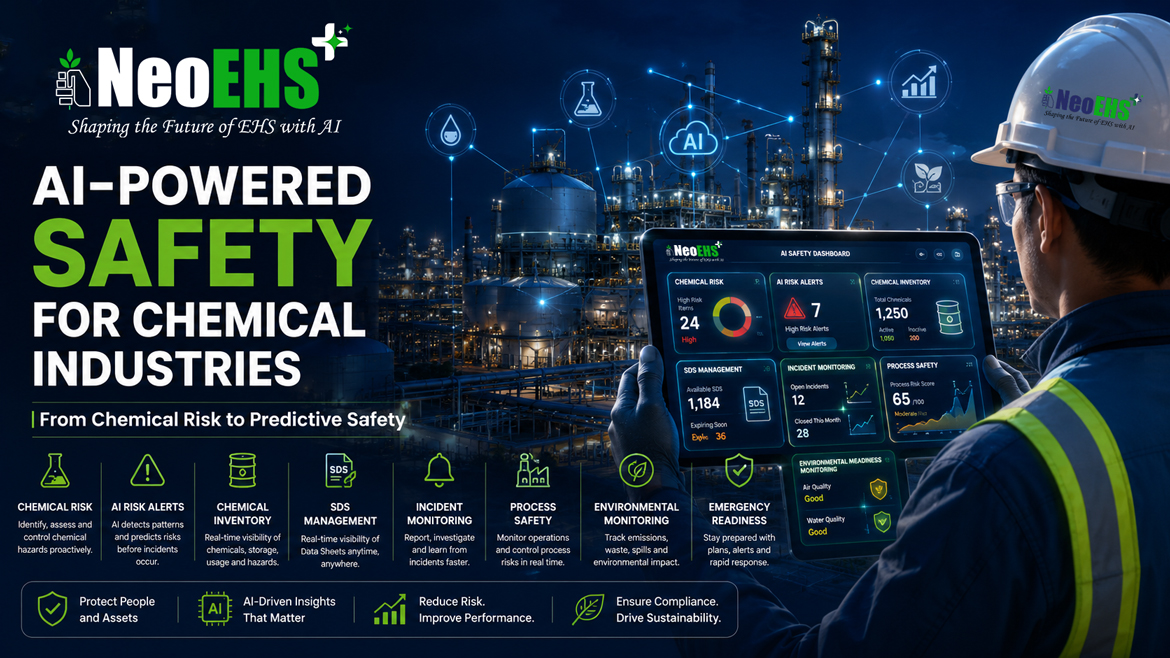
AI-Powered Safety for Chemical Industries
NeoEHS Chemical manufacturing is one of the most safety-critical industries in the world.
From hazardous substances and chemical reactions to high-pressure equipment, flammable materials, toxic exposure, process deviations, emissions, storage risks and emergency situations, chemical facilities operate in an environment where a small deviation can quickly become a serious event.
That is why chemical safety cannot depend only on periodic inspections, paper-based procedures or reacting after an incident occurs.
Modern chemical companies need to know:
Where are the risks?
Which risks are increasing?
What warning signs are we missing?
Are our controls actually working?
And can technology help us act before a serious incident occurs?
This is where AI-powered safety for chemical industries is becoming increasingly important.
NeoEHS brings artificial intelligence, predictive analytics, digital workflows, chemical management, risk management, incident management, emergency preparedness, inspections, permits and environmental compliance together within an integrated EHS platform designed for complex industrial environments.
What Is AI-Powered Safety for Chemical Industries?
AI-powered safety for chemical industries is the use of artificial intelligence, automation, predictive analytics, connected data and digital EHS workflows to identify hazards, assess risks, monitor operations, respond to incidents and prevent safety and environmental events.
Unlike traditional safety systems that primarily document what has already happened, AI-powered safety systems can analyze large volumes of EHS and operational information to identify patterns, recurring risks and potential areas of concern.
A modern chemical safety platform can connect:
- Chemical inventories
- Safety Data Sheets (SDS)
- Chemical hazards
- Risk assessments
- Process safety information
- Incidents and near misses
- Inspections
- Audits
- Permit to Work
- Chemical entry permits
- Emergency response
- Environmental monitoring
- Corrective and preventive actions
- Employee training
- Contractor activities
- IoT and sensor information
- AI-based visual monitoring
The objective is simple:
Move from reactive chemical safety to proactive and predictive safety.
Why Chemical Industries Need a Smarter Safety Approach
Chemical facilities are different from many other industrial environments because multiple risk dimensions can exist simultaneously.
A single operation may involve:
- Toxic substances
- Flammable chemicals
- Corrosive materials
- Reactive chemicals
- High temperatures
- High pressures
- Confined spaces
- Hazardous atmospheres
- Rotating machinery
- Electrical systems
- Chemical storage
- Transportation and transfer operations
- Waste streams
- Environmental emissions
A failure in one area can create consequences somewhere else.
For example:
A chemical storage issue may become a leak.
A leak may become an exposure.
An exposure may trigger an emergency response.
An emergency may lead to environmental impact.
An environmental event may create regulatory and reputational consequences.
This interconnected nature of risk makes integrated EHS management particularly valuable for chemical organizations.
From Chemical Safety Management to Chemical Safety Intelligence
Traditional chemical safety asks:
“Are we following the procedure?”
A more intelligent approach asks:
“What does our safety data tell us about where the next risk could emerge?”
That difference is significant.
Imagine a chemical plant where:
- Three minor chemical leaks have occurred in six months.
- Two inspections identified corrosion in similar equipment.
- Several maintenance activities were delayed.
- A contractor's competency certification is approaching expiry.
- A particular chemical storage area has repeated housekeeping observations.
Individually, these may appear to be unrelated events.
When connected, they may reveal an emerging operational risk.
AI can help identify relationships between these data points and bring them to the attention of EHS and operations teams.
The final decision remains with qualified professionals.
But AI can help them see the bigger picture faster.
1. AI-Powered Chemical Inventory Management
Chemical safety begins before a chemical reaches the production floor.
Knowing exactly what chemicals are present, where they are stored, how much is available and how they are being used is fundamental to effective chemical risk management.
NeoEHS Chemical Management provides centralized chemical inventory management, supplier and catalog management, risk assessment and SDS management capabilities.
A digital chemical inventory can help organizations track:
- Chemical name
- Chemical identification
- Quantity
- Storage location
- Supplier
- Hazard classification
- Storage requirements
- Expiry information
- SDS availability
- Usage
- Disposal
- Associated risks
This creates a reliable source of chemical information for EHS teams, operations and emergency responders.
2. Make Safety Data Sheets Available When They Matter
A Safety Data Sheet is not useful if employees cannot find it when they need it.
During a spill, leak or exposure event, people may need immediate access to information such as:
- Hazard identification
- Handling precautions
- Storage requirements
- PPE requirements
- First-aid measures
- Firefighting measures
- Accidental-release measures
- Exposure controls
- Disposal information
NeoEHS provides SDS management as part of its chemical management capabilities, helping organizations centralize chemical safety information.
AI can make this information even more useful by helping users search and interpret large volumes of chemical documentation.
For example:
“What PPE is required when handling this substance?”
“What are the emergency precautions for a spill?”
“Which storage requirements apply to this chemical?”
The objective is not to replace the SDS or qualified safety professionals.
It is to make critical information easier to find and use.
3. Use AI to Identify Chemical Hazards
Chemical hazard identification involves much more than knowing whether a substance is hazardous.
Organizations also need to understand:
- Where it is used
- How it is handled
- How it is stored
- What it can react with
- Who can be exposed
- How exposure could occur
- What controls are in place
- Whether those controls are effective
AI-assisted EHS workflows can help organize and analyze this information.
For example, an EHS platform can connect a chemical with:
Chemical → Hazard → Risk → Control → Inspection → Incident → Corrective Action
This creates a much stronger safety intelligence model than maintaining each record separately.
4. AI-Powered Chemical Risk Assessment
Risk assessment is central to chemical safety.
Organizations need to evaluate hazards associated with chemical handling, storage, transfer, processing and disposal.
NeoEHS Risk Management supports methodologies including HIRA, JSA/JHA, FMEA, HAZOP, RCA and Bowtie analysis, with configurable risk assessment workflows and predictive risk intelligence.
For chemical industries, this can support risk assessments around:
- Chemical exposure
- Toxic releases
- Fire
- Explosion
- Chemical incompatibility
- Storage failure
- Pressure events
- Process deviations
- Equipment failure
- Maintenance activities
- Contractor activities
- Confined spaces
- Emergency situations
AI can help identify patterns across historical assessments, incidents, inspections and observations.
5. Process Safety and AI
Process safety is one of the most important areas for chemical manufacturing.
A process safety event may involve:
- Loss of containment
- Pressure excursions
- Temperature deviations
- Equipment failure
- Chemical reactions
- Fire
- Explosion
- Toxic release
The challenge is that process safety information is often distributed across different systems.
An intelligent EHS platform can help bring relevant safety information together.
For example:
Process deviation → Risk assessment → Permit → Inspection → Incident → RCA → CAPA → Risk reassessment
This creates a continuous process safety learning cycle.
AI can then analyze historical information to identify recurring deviations and risk patterns.
6. AI-Powered Incident Management for Chemical Plants
Chemical incidents require rapid reporting and structured investigation.
Examples include:
- Chemical spills
- Leaks
- Exposure incidents
- Uncontrolled releases
- Fires
- Explosions
- Equipment failures
- Environmental incidents
- Near misses
- Unsafe chemical handling
NeoEHS Incident Management supports incident reporting, AI-powered analysis, root cause analysis, predictive insights, corrective actions and environmental incident tracking.
The goal is not simply to record the event.
It is to understand:
What happened?
Why did it happen?
Has something similar happened before?
Was the risk previously identified?
Were controls in place?
Did an inspection identify the issue?
What must change to prevent recurrence?
7. AI-Assisted Root Cause Analysis
Chemical incidents can have multiple contributing causes.
For example, a chemical leak may initially appear to be caused by equipment failure.
But deeper investigation may reveal:
- Inadequate preventive maintenance
- Corrosion
- Incorrect operating procedure
- Poor inspection frequency
- Training gaps
- Inadequate supervision
- Procurement issues
- Incompatible materials
- Management-of-change failure
This is why stopping at the immediate cause can be dangerous.
AI-assisted analytics can help investigators identify recurring relationships across historical incidents, inspections, hazards and corrective actions.
NeoEHS supports structured risk and RCA methodologies including 5 Why, Fishbone, Pareto, RCA and Bowtie analysis.
AI should support the investigator—not replace the investigator's professional judgment.
8. Predict Chemical Safety Risks Before an Incident
This is where AI can provide significant value.
Predictive safety analytics can examine historical and current information to identify patterns associated with increasing risk.
Potential data sources include:
- Incident history
- Near misses
- Chemical leaks
- Inspection findings
- Audit findings
- Risk assessments
- Equipment information
- Maintenance data
- Permit activity
- Contractor information
- Training records
- Environmental conditions
- Safety observations
NeoEHS uses predictive risk intelligence to analyze incidents, near misses, inspection history and behavioral trends to identify potential future risks.
The important point is that predictive analytics should not be presented as a guarantee that an accident will be predicted.
Rather, it helps organizations identify risk signals early enough to investigate and intervene.
9. Intelligent Chemical Entry Permits
Certain chemical operations require controlled access and authorization.
NeoEHS provides a dedicated Chemical Entry Permit workflow for environments where hazardous or toxic chemicals are stored, processed or handled. It supports digital applications, approvals, customizable checklists, notifications, safety information and real-time monitoring.
A digital Chemical Entry Permit can help control:
- Who enters the area
- Why they are entering
- What chemical is involved
- Required PPE
- Required precautions
- Permit validity
- Required training
- Emergency procedures
- Supporting documentation
This becomes particularly important during:
- Chemical sampling
- Equipment maintenance
- Calibration
- Repairs
- Chemical transfer
- Inspection activities
- Spill response
- Emergency intervention
10. Permit to Work for High-Risk Chemical Activities
Chemical facilities frequently perform maintenance and non-routine work that introduces additional hazards.
Examples include:
- Hot work
- Confined space entry
- Electrical work
- Line breaking
- Equipment isolation
- Work at height
- Excavation
- Maintenance activities
A digital Permit to Work system can help ensure that critical controls are verified before work begins.
NeoEHS provides digital permit creation, multi-level approval, LOTO validation, contractor authorization, safety verification and real-time permit monitoring.
For chemical plants, PTW can become much more powerful when connected with:
Risk Assessment + Chemical Information + LOTO + Contractor Competency + Incident Management + Inspections
This creates a connected high-risk work control system.
11. AI-Powered Hazard Detection
Chemical facilities contain many hazards that can potentially be identified through digital inspections and intelligent monitoring.
NeoEHS Hazard Management supports AI-enabled hazard detection, digital inspections, dynamic risk scoring, real-time alerts and predictive safety analytics.
Potential monitoring areas include:
- PPE compliance
- Unsafe acts
- Restricted areas
- Unsafe conditions
- Chemical handling activities
- Storage areas
- High-risk work zones
- Operational deviations
Computer vision can provide another layer of safety intelligence when integrated appropriately with site safety processes.
12. Environmental Monitoring Is Part of Chemical Safety
Chemical safety is not limited to protecting employees.
Chemical operations can also affect:
- Air quality
- Water
- Soil
- Waste streams
- Emissions
- Surrounding communities
- Ecosystems
A chemical release may therefore become both a workplace safety event and an environmental event.
That is why chemical EHS programs should connect occupational safety with environmental management.
NeoEHS's Chemical Industry solution covers chemical risk, incidents involving spills and leaks, environmental compliance and related EHS workflows.
This supports a broader concept:
People safety + process safety + environmental safety = chemical safety intelligence.
13. Emergency Preparedness for Chemical Incidents
A chemical emergency can develop rapidly.
Organizations must be prepared to respond to scenarios such as:
- Chemical spills
- Toxic releases
- Fires
- Explosions
- Gas leaks
- Exposure events
- Environmental releases
- Equipment failures
NeoEHS Emergency Management provides centralized emergency coordination, incident tracking, mapping, resource management, communications and alerts.
An intelligent emergency management approach can connect:
Incident → Location → People → Resources → Emergency Procedure → Communication → Response → Recovery
This can help teams make faster, more informed decisions during critical events.
14. Training and Competency Management
Technology cannot replace competent people.
Chemical workers need appropriate knowledge and competency for the tasks they perform.
Training may cover:
- Chemical handling
- PPE
- SDS interpretation
- Spill response
- Emergency procedures
- Process safety
- Permit requirements
- Confined space
- LOTO
- Hazard communication
- Waste handling
- Environmental procedures
An EHS platform can connect competency information with work authorization and risk.
For example:
Worker → Training → Certification → Chemical Activity → Permit → Risk Controls
This can help prevent situations where an individual performs a high-risk task without the required competency.
15. AI-Powered Safety Inspections
Inspections remain one of the most important proactive safety activities in chemical plants.
Digital inspections can identify:
- Storage problems
- Damaged containers
- Labeling issues
- Housekeeping deficiencies
- PPE gaps
- Equipment conditions
- Emergency equipment issues
- Chemical incompatibility risks
- Unsafe work practices
NeoEHS connects inspection information with incidents, permits, risk management, audits, contractor management and corrective actions.
This means an inspection finding does not have to remain an isolated observation.
It can automatically become:
Finding → Risk → Action → Owner → Deadline → Verification
16. Turn Every Incident Into Organizational Learning
One of the biggest opportunities for AI in chemical safety is learning from history.
Suppose a company operates ten plants.
One plant experiences a chemical leak caused by a specific maintenance issue.
A traditional system may close the incident after the investigation.
A connected AI-powered system can ask:
Do our other plants have the same equipment?
Have they experienced similar findings?
Do they use the same maintenance procedure?
Are the same contractors involved?
Have similar inspection findings been reported?
This is where enterprise-wide safety intelligence becomes powerful.
The lesson from one facility can become a preventive action across the entire organization.
17. From Reactive Chemical Safety to Predictive Safety
Traditional chemical safety often follows this cycle:
Incident → Investigation → Corrective Action → Closure
A predictive safety model expands the cycle:
Data → Detect → Assess → Predict → Prevent → Verify → Learn
That means organizations can use:
- Incidents as lagging indicators
- Near misses as warning signals
- Inspections as leading indicators
- Risk assessments as predictive inputs
- AI analytics as pattern recognition
- Corrective actions as prevention mechanisms
This is the direction in which modern EHS technology is moving.
NeoEHS positions its EHS platform around AI-powered risk intelligence, incident management, hazard management, inspections, permits, compliance and predictive analytics.
AI-Powered Safety for Chemical Industries: A Connected Architecture
A mature chemical safety ecosystem can look like this:
Chemical Inventory
↓
SDS & Hazard Information
↓
Risk Assessment
↓
Process Safety
↓
Permit to Work
↓
Inspection & Monitoring
↓
Incident & Near-Miss Reporting
↓
AI Investigation & Root Cause Analysis
↓
CAPA
↓
Environmental & Compliance Monitoring
↓
Predictive Safety Analytics
↓
Continuous Improvement
This creates one connected safety intelligence loop rather than a collection of independent applications.
AI-Powered Chemical Safety vs Traditional Chemical Safety
| Traditional Chemical Safety | AI-Powered Chemical Safety |
|---|---|
| Paper-based chemical records | Centralized digital chemical inventory |
| Manual SDS management | Searchable digital SDS intelligence |
| Periodic risk assessments | Continuous risk intelligence |
| Reactive incident investigation | AI-assisted investigation |
| Isolated safety records | Connected EHS data |
| Manual inspections | Mobile digital inspections |
| Manual permit approvals | Intelligent digital PTW |
| Historical reporting | Predictive analytics |
| Reactive emergency response | Connected emergency intelligence |
| Site-by-site learning | Enterprise-wide safety learning |
| Manual CAPA tracking | Automated action workflows |
| Compliance after the fact | Continuous compliance visibility |
The purpose of AI is not to remove safety professionals from the process.
It is to give them better information, earlier signals and faster decision support.
Why Chemical Companies Should Consider an Integrated EHS Platform
Chemical safety becomes difficult to manage when information is scattered across:
- Excel spreadsheets
- Paper forms
- SDS folders
- ERP systems
- Maintenance systems
- Inspection applications
- Incident databases
- Contractor systems
An integrated EHS platform creates a centralized source of safety information.
NeoEHS is designed as an integrated EHS platform covering incident management, risk assessment, hazard management, inspections, audits, permits, chemical management, emergency management, compliance and environmental/ESG capabilities.
This can help EHS leaders move from managing individual processes to managing the entire safety lifecycle.
Key Benefits of AI-Powered Safety for Chemical Industries
1. Earlier Risk Identification
Identify recurring hazards and emerging patterns before they escalate.
2. Better Chemical Visibility
Know what chemicals exist, where they are located and what hazards are associated with them.
3. Faster Incident Response
Capture and communicate incidents quickly through digital workflows.
4. Stronger Root Cause Analysis
Use structured investigation and historical data to understand why incidents occur.
5. Better High-Risk Work Control
Connect risk assessments, permits, isolation and contractor competency.
6. Improved Environmental Protection
Track chemical releases, spills, environmental events and compliance information.
7. Stronger Emergency Preparedness
Centralize emergency information, communication and response coordination.
8. Better Regulatory Readiness
Maintain structured records, workflows, evidence and audit trails.
9. Enterprise-Wide Learning
Share safety lessons from one plant across the organization.
10. More Proactive Safety Decisions
Use AI analytics to identify patterns and prioritize preventive action.
Frequently Asked Questions
What is AI-powered safety in the chemical industry?
AI-powered safety in the chemical industry combines artificial intelligence, analytics, automation and digital EHS data to identify hazards, assess risks, monitor safety performance, investigate incidents and support preventive actions.
How can AI improve chemical safety?
AI can analyze large volumes of safety data to identify recurring incidents, hazards, inspection findings, unsafe behaviors and emerging risk patterns, helping EHS teams prioritize preventive action.
Can AI prevent chemical accidents?
AI cannot guarantee that accidents will be prevented. However, AI-powered analytics can identify risk signals and recurring patterns that may help organizations intervene earlier and strengthen controls.
What is chemical safety management software?
Chemical safety management software helps organizations manage chemical inventories, SDS information, chemical hazards, risk assessments, compliance, storage information and related safety workflows. NeoEHS provides a dedicated Chemical Management solution for these activities.
How does NeoEHS manage Safety Data Sheets?
NeoEHS provides centralized SDS management as part of its Chemical Management solution, helping organizations maintain accessible chemical safety information.
Can NeoEHS manage chemical spills and leaks?
Yes. NeoEHS's Chemical Industry solution supports incident management for events such as spills, leaks and exposure incidents, with workflows for tracking incidents through resolution and corrective action.
Can NeoEHS manage chemical entry permits?
Yes. NeoEHS provides a dedicated Chemical Entry Permit solution for controlling access to areas where hazardous or toxic chemicals are stored, processed or handled.
Can NeoEHS support Permit to Work in chemical plants?
Yes. NeoEHS provides digital PTW workflows covering high-risk work authorization, approvals, LOTO validation, contractor authorization and safety verification.
Can AI be used for chemical hazard detection?
AI can support hazard identification through predictive analytics, digital inspections, image analysis and computer-vision-based safety monitoring. NeoEHS provides AI-enabled hazard management capabilities.
Why should chemical companies integrate EHS systems?
Integration creates a connected safety information environment where chemical data, risks, incidents, inspections, permits, corrective actions and emergency information can be analyzed together rather than managed in isolated systems.
The Future of Chemical Safety Is Intelligent, Connected and Proactive
Chemical safety has always required discipline.
But today's chemical industry also requires something else:
visibility.
Organizations need to understand what is happening across their facilities, where risk is increasing and whether existing controls are actually working.
AI can help make that possible.
The future is not about replacing EHS professionals with artificial intelligence.
It is about giving EHS professionals better intelligence.
A chemical safety professional should not have to search through hundreds of spreadsheets to discover that the same problem has occurred at three different facilities.
A plant manager should not have to wait for a monthly report to discover that a risk is increasing.
An emergency response team should not have to search through folders for critical chemical information.
A safety manager should not have to manually compare years of incident data to identify recurring patterns.
AI can help connect those signals.
And when those signals are connected, organizations can move from:
Reactive → Proactive
Data → Intelligence
Incident → Learning
Risk → Prevention
Compliance → Continuous Improvement
Building the Next Generation of Chemical Safety With NeoEHS
NeoEHS brings together Chemical Management, SDS Management, Risk Management, Hazard Management, Incident Management, Inspections, Permit to Work, Emergency Management, Compliance and AI-powered safety intelligence within a unified EHS ecosystem.
For chemical manufacturers, processors, distributors and other organizations handling hazardous substances, this integrated approach can provide a stronger foundation for managing safety, environmental responsibility and operational risk.
The future of chemical safety is not simply safer chemical handling.
It is a connected system that continuously learns from data, identifies emerging risks and helps people act before those risks become serious events.
That is the promise of AI-powered safety for chemical industries.
And that is where NeoEHS can help.
Explore:
- NeoEHS Chemical Industry EHS Software
- NeoEHS Chemical Management Software
- NeoEHS Risk Management Software
- NeoEHS Incident Management Software
- NeoEHS Hazard Management Software
- NeoEHS Chemical Entry Permit
- NeoEHS Permit to Work Software
- NeoEHS Emergency Management Software
- NeoEHS EHS Software
READ MORE ❯
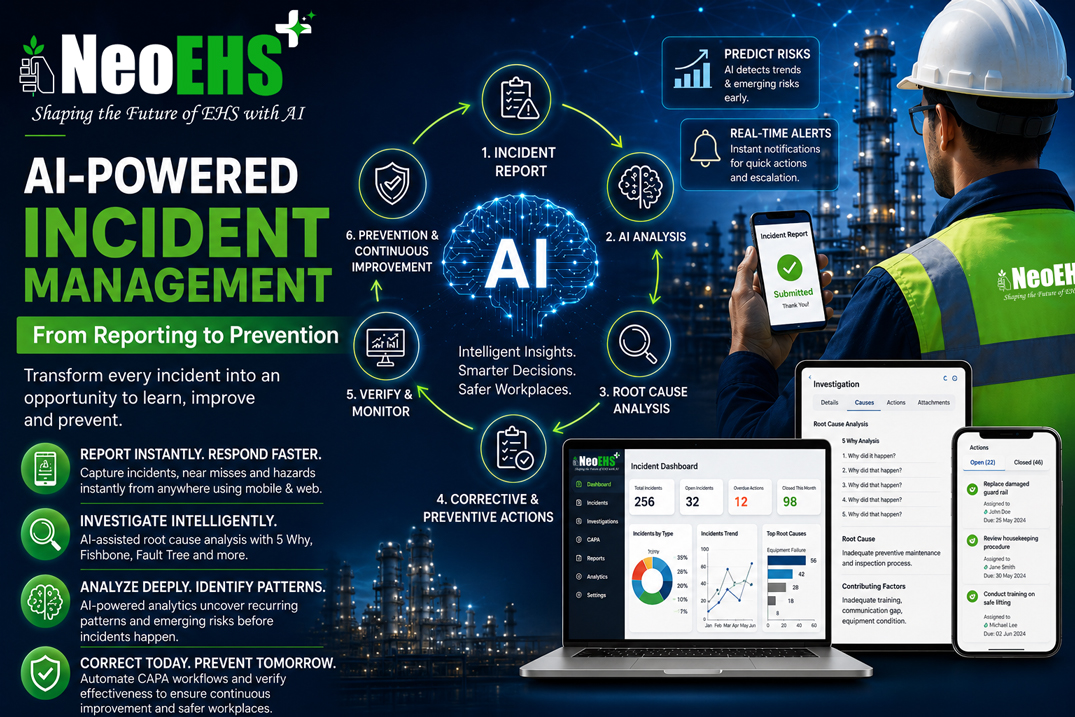
AI-Powered Incident Management: From Reporting to Prevention
A workplace incident is never just an isolated event.. A minor injury, near miss, unsafe condition, equipment failure, environmental event, or repeated safety observation can be a warning that something deeper is happening within an organization.
The real question is not simply, “What happened?”
It is:
“Why did it happen, what can we learn from it, and how can we prevent it from happening again?”
This is where AI-powered incident management is changing the way organizations approach workplace safety.
Traditional incident management often focuses on documenting an event after it happens. Modern incident management goes further. It connects reporting, investigation, root cause analysis, corrective actions, risk management, inspections, audits and predictive analytics into one continuous safety improvement process.
NeoEHS brings these capabilities together in an AI-powered Environmental, Health and Safety platform designed to help organizations move from reactive incident response toward proactive incident prevention.
What Is AI-Powered Incident Management?
AI-powered incident management is the use of artificial intelligence, automation, analytics and connected EHS data to report, investigate, analyze and prevent workplace incidents.
Instead of treating an incident report as the end of a process, AI-powered systems use incident information as a source of safety intelligence.
A modern incident management process can:
- Capture incidents and near misses immediately
- Categorize incidents automatically
- Identify severity and risk levels
- Analyze historical incidents
- Identify recurring patterns
- Support root cause analysis
- Recommend corrective and preventive actions
- Track CAPA to completion
- Identify similar incidents across locations
- Highlight emerging risks
- Connect incidents with hazards, inspections and audits
- Provide management with real-time safety intelligence
The result is a shift from “report and close” to “report, understand, learn and prevent.”
Why Traditional Incident Management Is No Longer Enough
Many organizations still depend on spreadsheets, emails, paper forms and disconnected reporting systems to manage workplace incidents.
These approaches may record what happened, but they often make it difficult to understand the bigger picture.
Consider a simple example.
A worker slips on a wet floor.
The immediate response may be:
- Record the incident.
- Provide medical assistance.
- Clean the floor.
- Close the report.
But what if the same area has experienced three previous near misses?
What if the cleaning schedule was inadequate?
What if employees had already reported the same unsafe condition?
What if an inspection had identified the problem two weeks earlier?
What if similar incidents are occurring at three other facilities?
A traditional incident system may treat these as separate records.
An intelligent EHS platform can connect the information.
That difference is critical.
The value of incident management is not only in recording incidents. Its real value is in turning incident data into prevention.
From Incident Reporting to Incident Prevention
A mature safety management process should follow a continuous cycle:
Report → Respond → Investigate → Identify Root Cause → Correct → Verify → Learn → Predict → Prevent
This lifecycle transforms incident management from an administrative activity into a strategic safety function.
NeoEHS supports this approach through incident reporting, investigation workflows, root cause analysis, corrective actions, predictive safety intelligence and real-time analytics.
1. Make Incident Reporting Simple
The first step in preventing future incidents is making it easy for people to report what they see.
If reporting requires multiple forms, lengthy emails or complicated procedures, employees may delay reporting—or not report at all.
Modern incident management should allow employees, contractors and supervisors to report incidents quickly from the field.
With NeoEHS, organizations can report incidents, near misses, unsafe conditions and hazards through mobile and web-based workflows, including image and location information.
This creates a much stronger reporting culture.
What can be captured?
A digital incident report can include:
- Incident type
- Date and time
- Location
- People involved
- Injury information
- Equipment involved
- Environmental impact
- Witness information
- Photos and videos
- Immediate actions
- Initial severity
- Potential severity
- Related hazards
- Related permits
- Related inspections
- Supporting documents
The more structured the information, the more useful the data becomes for analysis.
2. Use AI to Classify and Prioritize Incidents
Not every incident has the same level of risk.
A minor first-aid case and a high-potential near miss should not be treated identically.
AI can help analyze incident information and support classification based on factors such as:
- Incident type
- Severity
- Potential consequence
- Location
- Activity
- Equipment
- Previous history
- Frequency
- Similar incidents
- Contributing conditions
This can help EHS teams focus their attention where it matters most.
For example:
Five minor incidents involving the same machine may represent a greater emerging risk than one isolated event elsewhere.
AI-powered pattern recognition can help bring that signal to the surface.
3. Move Beyond the Immediate Cause
One of the biggest weaknesses in incident investigations is stopping at the obvious cause.
Imagine a worker falls because a walkway is wet.
The immediate cause may be:
Wet floor.
But that is not necessarily the root cause.
A deeper investigation may reveal:
- A leaking pipe
- Delayed maintenance
- Inadequate inspection
- No ownership for housekeeping
- Poor escalation
- Inadequate preventive maintenance
- Lack of management follow-up
This is why root cause analysis is such an important part of modern incident management.
NeoEHS supports structured investigation approaches including 5 Why Analysis, Fishbone/Ishikawa, Fault Tree Analysis and other RCA methodologies.
4. AI-Assisted Root Cause Analysis
Artificial intelligence does not replace experienced investigators.
Instead, it can help investigators see patterns that may otherwise be missed.
AI can analyze historical incident information and identify relationships between:
- People
- Processes
- Equipment
- Locations
- Tasks
- Environmental conditions
- Unsafe behaviors
- Previous observations
- Inspection findings
- Audit findings
- Corrective actions
For example, if similar incidents repeatedly occur during a particular maintenance activity, AI can highlight that recurrence.
The investigator can then examine the underlying process rather than treating each event independently.
This makes the investigation more data-driven.
5. Connect Incidents With Hazards and Risks
Incident management should never operate in isolation.
An incident may be the visible outcome of an existing hazard or unmanaged risk.
That is why connecting incident data with Hazard Management and Risk Management is so important.
NeoEHS provides connected workflows across incidents, hazards, risk assessments, inspections, audits and corrective actions.
For example:
Hazard identified → Risk assessed → Control implemented → Incident occurs → Investigation → Root cause identified → Risk reassessed → Control strengthened
This creates a continuous feedback loop.
Instead of maintaining separate safety databases, organizations can build a connected safety intelligence ecosystem.
6. Turn Corrective Actions Into Preventive Actions
A corrective action fixes the immediate problem.
A preventive action addresses the possibility of recurrence.
That distinction matters.
Corrective action
“Repair the damaged handrail.”
Preventive action
“Review inspection and maintenance procedures for all similar handrails across the facility.”
The first action addresses the current problem.
The second addresses the system.
NeoEHS supports automated corrective and preventive action workflows, including ownership, due dates, escalation and closure tracking.
This helps organizations move beyond simply closing actions and toward verifying whether the action actually reduced risk.
7. Verify Whether Corrective Actions Actually Worked
An action should not automatically be considered successful simply because someone marked it “Closed.”
The more important question is:
Did the action eliminate or reduce the risk?
For example:
A damaged machine guard is replaced.
The action is closed.
But if the same machine produces another safety observation two months later, the organization needs to understand why.
Effective incident management therefore requires corrective action effectiveness verification.
This can include:
- Follow-up inspections
- Repeat observations
- Risk reassessment
- Incident trend monitoring
- Evidence validation
- Management review
- Recurrence analysis
This turns CAPA from an administrative checklist into a continuous improvement mechanism.
8. Identify Recurring Incidents Before They Become Major Problems
One incident may be an isolated event.
Repeated incidents are a signal.
AI-powered analytics can analyze historical records to identify recurring patterns across:
- Sites
- Departments
- Equipment
- Contractors
- Activities
- Shifts
- Incident types
- Unsafe behaviors
- Hazards
- Root causes
NeoEHS uses AI-powered pattern and recurrence analysis to identify similar historical incidents, recurring risks and emerging safety trends.
This creates an important change in safety management.
Instead of asking:
“How many incidents did we have?”
Organizations can begin asking:
“What patterns are telling us where the next incident could occur?”
9. Bring Inspections Into the Incident Prevention Cycle
Inspections are one of the strongest sources of leading safety information.
An inspection may identify a problem before it becomes an incident.
For example:
Inspection finding → Hazard → Corrective action → Risk reduction
If that same condition later contributes to an incident, the organization should be able to connect those records.
NeoEHS connects inspection data with incidents, audits, hazards, risks, permits and corrective actions, creating a more unified EHS information environment.
This allows safety teams to ask more meaningful questions:
- Was this condition identified before the incident?
- Was an action assigned?
- Was it overdue?
- Was the action actually effective?
- Has the same problem appeared at another site?
These questions turn historical records into organizational learning.
10. Learn From Near Misses
Near misses are among the most valuable sources of preventive safety intelligence.
A near miss is a warning.
Nobody may have been injured—but under slightly different circumstances, the outcome could have been very different.
For example:
A suspended load swings unexpectedly but does not hit anyone.
A traditional system might record:
Near Miss – No Injury.
A stronger system can ask:
- Why did the load swing?
- Was the lifting plan followed?
- Was the equipment inspected?
- Was the exclusion zone adequate?
- Was the operator trained?
- Have similar events occurred?
- Is the same risk present at other sites?
This is where AI-powered incident management can help organizations extract more value from near-miss data.
11. Use Predictive Safety Intelligence
The ultimate goal of modern incident management is prevention.
Predictive safety intelligence uses historical and current information to identify patterns that may indicate increasing risk.
Potential data sources include:
- Incidents
- Near misses
- Safety observations
- Inspections
- Audits
- Risk assessments
- Hazards
- Permit data
- Training records
- Corrective actions
- Operational information
- IoT data
- Computer vision data
NeoEHS describes predictive risk intelligence as a way to analyze historical safety data, identify recurring risks and detect emerging hazards before incidents occur.
The objective is not to claim that AI can predict every accident.
It cannot.
The objective is to identify risk signals early enough for people to take preventive action.
That distinction is important.
12. Connect AI With Real-Time Safety Monitoring
Incident management becomes even more powerful when historical information is combined with real-time observations.
For example, computer vision and AI-based monitoring can help identify:
- PPE violations
- Unsafe behaviors
- Restricted-area access
- Unsafe conditions
- Potentially hazardous activities
NeoEHS provides AI-enabled hazard detection capabilities including CCTV analytics, PPE detection, behavioral analysis and real-time hazard alerts.
This creates another safety feedback loop:
Detect → Alert → Correct → Record → Analyze → Learn
The incident management platform can therefore become part of an organization's broader proactive safety architecture.
AI-Powered Incident Management Across the Complete Lifecycle
A modern incident management platform should support the complete lifecycle:
1. Report
Capture the incident, near miss or unsafe condition.
2. Classify
Determine incident type, severity, potential impact and priority.
3. Respond
Trigger notifications, escalation and immediate response workflows.
4. Investigate
Collect evidence, statements, documents, photographs and supporting information.
5. Analyze
Identify immediate, contributing and root causes.
6. Correct
Assign corrective and preventive actions.
7. Verify
Confirm that actions have been completed and are effective.
8. Learn
Identify recurring patterns and organizational lessons.
9. Predict
Use historical information and AI analytics to identify emerging risks.
10. Prevent
Strengthen controls before another incident occurs.
This is the difference between incident administration and incident intelligence.
AI Incident Management vs Traditional Incident Management
| Traditional Approach | AI-Powered Approach |
|---|---|
| Paper or spreadsheet reporting | Mobile and digital reporting |
| Manual classification | AI-assisted classification |
| Isolated incident records | Connected EHS data |
| Reactive investigation | Intelligent investigation support |
| Manual RCA | AI-assisted pattern analysis |
| Corrective actions tracked manually | Automated CAPA workflows |
| Historical reporting | Predictive safety intelligence |
| Limited cross-site visibility | Enterprise-wide visibility |
| Incident-focused | Prevention-focused |
| Report after the event | Identify risks before recurrence |
The goal is not simply to replace paperwork with software.
The goal is to change how an organization learns from safety events.
How NeoEHS Helps Turn Incidents Into Prevention
NeoEHS brings incident management into a connected AI-powered EHS ecosystem.
Its incident management capabilities include:
- AI-powered incident reporting
- Mobile incident reporting
- Near-miss management
- Intelligent investigation workflows
- Root cause analysis
- 5 Why Analysis
- Fishbone Analysis
- Fault Tree Analysis
- Pattern and recurrence analysis
- Predictive safety intelligence
- Corrective and preventive actions
- Real-time dashboards
- Compliance workflows
- Offline reporting
- Evidence management
- AI image analysis
- Cross-functional EHS integration
Organizations can also connect incident information with risk management, hazard management, inspections and audits to create a broader safety intelligence environment.
Industry Use Cases for AI-Powered Incident Management
Manufacturing
Manufacturing organizations can use AI-powered incident management to identify recurring machine-related incidents, unsafe behaviors, PPE violations, maintenance-related risks and process safety issues.
Construction
Construction companies can connect incidents and near misses with work-at-height activities, lifting operations, excavation, contractor activities, permits and site inspections.
NeoEHS supports construction safety workflows including incident reporting, risk management, observations, inspections and contractor safety.
Oil & Gas
Oil and gas organizations can use incident intelligence alongside Permit to Work, process safety, contractor management, risk management and environmental monitoring.
Mining
Mining operations can analyze incidents across equipment, mobile machinery, blasting, haul roads, contractor activities, environmental conditions and high-risk work.
Power & Energy
Power plants can connect incidents with electrical safety, isolation/LOTO, maintenance, work permits, inspections and operational risks.
Logistics & Warehousing
Organizations can identify recurring forklift incidents, loading/unloading risks, vehicle interactions, warehouse hazards and unsafe material-handling practices.
What Should EHS Leaders Measure?
Incident counts alone do not tell the whole story.
A modern incident management dashboard should provide both lagging and leading indicators.
Lagging indicators
- Recordable incidents
- Lost-time injuries
- Medical treatment cases
- Severity
- Incident frequency
- Environmental incidents
- Property damage
Leading indicators
- Near-miss reporting
- Safety observations
- Corrective action closure
- Inspection completion
- Risk control effectiveness
- Training compliance
- Repeat findings
- Hazard resolution
- Preventive action completion
The real power comes from connecting these indicators.
For example:
Increase in near misses + overdue corrective actions + repeated hazards = potential emerging risk.
That is far more useful than simply knowing the monthly incident count.
Frequently Asked Questions About AI-Powered Incident Management
What is AI-powered incident management?
AI-powered incident management uses artificial intelligence, automation and analytics to help organizations report, investigate, analyze and prevent workplace incidents, near misses, unsafe conditions and other safety events.
How does AI improve incident reporting?
AI can help classify incident information, organize submitted data, identify relevant categories, prioritize events and connect new incidents with historical safety information.
Can AI predict workplace incidents?
AI cannot guarantee that an accident will be predicted before it happens. However, predictive analytics can identify recurring patterns, risk signals and emerging trends that may help organizations take preventive action earlier.
What is the difference between incident management and incident prevention?
Incident management focuses on reporting, investigating and resolving safety events. Incident prevention goes further by using incident data, risk information and leading indicators to reduce the likelihood of recurrence.
Can AI perform root cause analysis?
AI can assist investigators by identifying patterns and suggesting areas for investigation. Human investigators should still validate causes and determine appropriate corrective and preventive actions.
Why are near misses important?
Near misses provide information about potentially dangerous conditions without necessarily resulting in injury or damage. Analyzing them can help organizations address risks before a more serious event occurs.
Can incident management software manage CAPA?
Yes. Modern incident management platforms can assign corrective and preventive actions, set deadlines, send escalation notifications, track progress and support effectiveness verification.
Can incident management connect with risk management?
Yes. Connecting incident records with risk assessments allows organizations to reassess risks when incidents or near misses reveal weaknesses in existing controls.
Can incident management software support multiple sites?
Enterprise incident management platforms can provide centralized visibility across facilities, projects, departments, contractors and geographic locations.
How does NeoEHS support AI-powered incident management?
NeoEHS combines incident reporting, intelligent investigation, root cause analysis, corrective actions, predictive safety intelligence, dashboards and connected EHS workflows in a unified platform.
The Future of Incident Management Is Prevention
The future of workplace safety is not about creating better incident reports.
It is about creating organizations that learn faster.
Every incident contains information.
Every near miss contains a warning.
Every inspection contains evidence.
Every corrective action contains an opportunity to improve.
And when these signals are connected, organizations can begin to see patterns that are difficult to identify when safety information is stored in separate systems.
AI can help make those connections.
But technology alone does not create a safer workplace.
People do.
AI provides the intelligence.
EHS professionals provide the judgment.
Management provides the accountability.
And the organization turns those insights into action.
That is the real promise of AI-powered incident management:
From reporting what happened to understanding why it happened.
From understanding why it happened to preventing recurrence.
And from reacting to incidents to building a safer, smarter and more proactive workplace.
READ MORE ❯
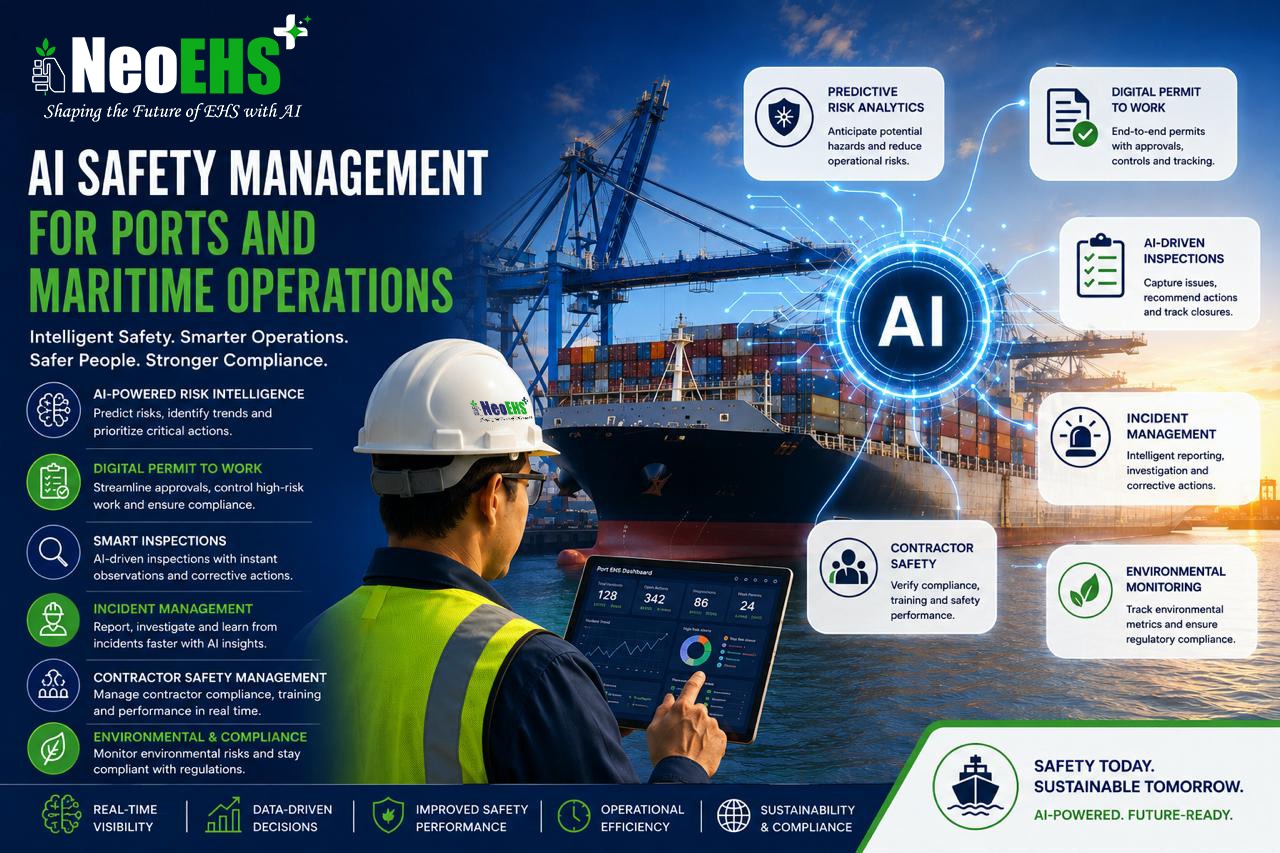
AI Safety Management for Ports and Maritime Operations
Ports and maritime facilities are among the most complex working environments in the world.
A single port can involve vessels, cranes, cargo handling equipment, trucks, warehouses, contractors, maintenance teams, marine personnel and hundreds of workers operating across multiple areas at the same time.
Safety risks can change within minutes.
A vessel arrives. Cargo operations begin. A crane starts lifting. A contractor begins maintenance. Hot work is authorized. A confined-space activity is planned. Weather conditions change. Traffic patterns shift.
For safety teams, the challenge is not simply collecting safety information.
The real challenge is understanding what is happening across the operation and identifying where risk is increasing before an incident occurs.
This is where AI safety management for ports and maritime operations can make a significant difference.
Artificial intelligence can help organizations connect information from incidents, inspections, permits, risk assessments, contractors, equipment and compliance processes to create a more proactive approach to maritime safety.
Instead of managing safety as a collection of separate activities, organizations can begin building a connected safety intelligence system.
Capture → Connect → Analyze → Predict → Act → Improve
What Is AI Safety Management for Ports and Maritime Operations?
AI safety management for ports and maritime operations is the use of artificial intelligence, predictive analytics, automation and connected safety technologies to identify risks, analyze safety information, support decision-making and improve operational safety.
In a traditional port safety environment, information may be distributed across:
- Paper forms
- Spreadsheets
- Emails
- Inspection records
- Permit documents
- Incident reports
- Contractor records
- Equipment inspections
- Audit findings
- Compliance documentation
AI-powered maritime safety management brings these sources together and helps safety teams understand relationships between them.
For example, several crane inspection findings combined with repeated maintenance observations and near misses may indicate a developing equipment-related risk.
A conventional system may store those records.
An intelligent system can help connect the signals and bring the potential risk to the attention of the responsible team.
NeoEHS provides a dedicated Port & Maritime Safety Management Software platform for ports, terminals, shipyards and marine facilities, covering digital inspections, permits, incidents, contractor safety, compliance and AI-powered risk intelligence. Explore NeoEHS Port & Maritime Safety Management Software
Why Is Safety Management Challenging in Ports?
Port and maritime operations have a unique combination of hazards.
These can include:
- Vessel movements
- Cargo handling
- Heavy lifting
- Crane operations
- Working at height
- Confined spaces
- Hot work
- Electrical work
- Ship maintenance
- Fuel and chemical handling
- Vehicle and pedestrian interaction
- Marine pollution risks
- Contractor activities
- Weather-related hazards
- Restricted-access areas
- Emergency response requirements
The complexity increases when multiple activities occur simultaneously.
A maintenance contractor may be working near cargo operations.
A crane may be operating while vehicles move through the same area.
Hot work may be taking place on a vessel while other contractors are performing maintenance nearby.
These interactions create the possibility of simultaneous operations (SIMOPS) and changing risk conditions.
This is why modern maritime safety management needs more than static checklists.
It needs continuous visibility and intelligent risk awareness.
How AI Can Transform Port Safety Management
AI can support maritime safety across the entire operational lifecycle.
1. AI-Powered Risk Management
Risk management is at the center of effective port safety.
AI can analyze information from:
- Risk assessments
- Incidents
- Near misses
- Inspections
- Safety observations
- Permit activities
- Equipment findings
- Contractor performance
- Historical trends
The objective is to identify patterns that may indicate increasing risk.
For example:
Multiple observations related to crane operations + repeated inspection findings + overdue corrective actions
may indicate that a particular operational area requires additional attention.
NeoEHS provides AI-enabled risk management capabilities including predictive analytics, risk monitoring, HIRA, JSA, JHA, FMEA and HAZOP-related workflows. NeoEHS AI Risk Management Software
2. Predictive Safety Analytics for Ports
Traditional safety reporting often focuses on what has already happened.
AI can help organizations examine what may be changing.
Imagine a port has experienced:
- Increasing near misses
- More crane-related observations
- Repeated equipment inspection findings
- Increasing contractor activity
- Several overdue corrective actions
Individually, each item may appear manageable.
Together, they could indicate an emerging risk.
Predictive analytics can help identify such patterns and prioritize areas for investigation.
The objective is not to claim that AI can predict an incident with certainty.
Rather, it can help identify risk signals and patterns that deserve human attention.
3. Digital Permit to Work for Maritime Operations
High-risk work is common in ports, terminals and shipyards.
Examples include:
- Hot work
- Confined-space entry
- Electrical work
- Lifting operations
- Work at height
- Maintenance activities
- Isolation and LOTO
- Welding and cutting
- Tank entry
- Hazardous-area work
A digital Permit to Work system can centralize authorization, approvals, risk controls and work status.
AI can add another layer by helping validate information before high-risk work begins.
For example:
Work Activity
↓
Risk Assessment
↓
Contractor Verification
↓
Worker Competency
↓
Required Controls
↓
Permit Approval
↓
Work Execution
↓
Safety Verification
↓
Permit Closure
NeoEHS's Permit to Work platform supports digital permit creation, multi-level approval, isolation and LOTO validation, contractor authorization, mobile workflows, QR verification, geotagged evidence and real-time permit monitoring. NeoEHS Intelligent Permit to Work Software
4. AI-Powered Maritime Inspections
Inspections are fundamental to port safety.
Safety teams may need to inspect:
- Cranes
- Cargo equipment
- Berths
- Vessels
- Warehouses
- Containers
- Vehicles
- Electrical systems
- Fire protection systems
- PPE
- Restricted areas
Paper-based inspections make it difficult to identify trends across thousands of findings.
Digital inspections create structured data.
AI can then help identify:
- Recurring findings
- High-risk areas
- Repeated equipment issues
- Overdue corrective actions
- Trends by location
- Trends by contractor
- Trends by asset
NeoEHS provides mobile and AI-enabled inspection management with configurable checklists, evidence capture, corrective-action tracking and trend analysis. NeoEHS Inspection Management Software
5. AI-Powered Incident Management
When an incident occurs in a port, speed and accuracy matter.
An effective digital incident process should allow teams to:
- Report the incident quickly.
- Capture evidence.
- Classify the event.
- Assess severity.
- Investigate causes.
- Identify corrective actions.
- Track closure.
- Analyze recurrence.
AI can support several of these stages.
For example, AI can help identify similar historical incidents, categorize events, highlight recurring patterns and support root-cause analysis.
NeoEHS's Incident Management platform supports digital reporting, AI-assisted risk analysis, pattern and recurrence analysis, root-cause investigation, corrective-action tracking and predictive safety intelligence. NeoEHS AI-Powered Incident Management Software
6. Contractor Safety Management
Contractors are an essential part of port and shipyard operations.
They may perform:
- Maintenance
- Welding
- Electrical work
- Cleaning
- Mechanical work
- Cargo-related activities
- Construction
- Equipment servicing
- Vessel maintenance
The challenge is ensuring that contractor safety requirements remain visible throughout the entire lifecycle.
A digital contractor safety process can track:
- Contractor approval
- Worker competency
- Training
- Induction
- Certifications
- Safety performance
- Incidents
- Observations
- Permits
- Corrective actions
- Compliance status
AI can help identify contractors or activities requiring additional safety attention based on historical performance and current operational information.
NeoEHS connects contractor compliance with Permit to Work, safety workflows and the wider EHS ecosystem. NeoEHS Port & Maritime Safety Management Platform
7. AI for Crane and Equipment Safety
Cranes and cargo-handling equipment are critical to port operations.
Equipment safety management can involve:
- Inspection schedules
- Maintenance records
- Defects
- Safety observations
- Operator competency
- Incident history
- Corrective actions
- Asset condition
AI can help identify patterns across these records.
For example:
A crane with increasing inspection findings, repeated maintenance issues and a history of safety observations may deserve additional attention.
NeoEHS's maritime platform specifically describes equipment risk analysis and AI-supported identification of assets requiring attention.
The important principle is that AI should support engineering and safety decisions, not replace qualified inspection or maintenance professionals.
8. Maritime Emergency Management
Ports need to be prepared for emergencies such as:
- Fire
- Explosion
- Chemical release
- Oil spill
- Vessel collision
- Severe weather
- Equipment failure
- Medical emergencies
- Confined-space incidents
- Security events
AI can support emergency preparedness by helping organizations maintain visibility into:
- Emergency plans
- Response teams
- Equipment
- Training
- Drills
- Inspection status
- Incident history
- Critical assets
An integrated platform can also help connect emergency information with incidents, inspections and corrective actions.
9. AI-Powered Maritime Compliance Management
Maritime organizations operate within a complex compliance environment.
Depending on the operation and jurisdiction, organizations may need to consider requirements and frameworks associated with:
- IMO
- SOLAS
- MARPOL
- ISPS
- ISO 45001
- ISO 14001
- ISO 9001
- Local port regulations
- Environmental requirements
- Internal corporate standards
NeoEHS's existing maritime platform explicitly addresses maritime compliance processes and references IMO, SOLAS, MARPOL, ISPS, ISO 45001, ISO 14001 and ISO 9001.
AI can assist by helping organizations organize obligations, monitor actions, identify gaps and maintain documentation.
It should not, however, be treated as a substitute for legal or regulatory advice.
10. AI for Environmental Safety in Ports
Port operations also have significant environmental responsibilities.
Potential environmental concerns include:
- Oil spills
- Fuel handling
- Waste
- Water pollution
- Air emissions
- Dust
- Noise
- Hazardous materials
- Wastewater
- Energy consumption
- Carbon emissions
AI-powered environmental management can help organizations identify trends across environmental data and integrate environmental performance with broader EHS management.
This is particularly important as ports increasingly pursue both operational efficiency and sustainability goals.
NeoEHS provides environmental and ESG capabilities within its wider EHS platform, including environmental compliance and sustainability management. NeoEHS AI-Powered EHS Platform
11. Computer Vision for Port Safety
CCTV cameras are already common across many ports.
The next opportunity is turning video into safety intelligence.
AI-powered computer vision can potentially support detection of conditions such as:
- PPE non-compliance
- Unauthorized access
- Unsafe zones
- Vehicle and pedestrian interactions
- Unsafe behavior
- Restricted-area entry
- Potential operational hazards
Computer vision should be implemented carefully with appropriate privacy, governance and human-review controls.
When connected to EHS workflows, visual alerts can potentially become part of a broader safety process:
Detect → Alert → Investigate → Correct → Verify
12. Connected Worker Technology
Port safety increasingly involves mobile and connected workers.
Mobile applications can allow workers and supervisors to:
- Report incidents
- Submit observations
- Conduct inspections
- View permits
- Complete checklists
- Upload photographs
- Verify work locations
- Receive safety notifications
This creates a real-time connection between the field and the safety management system.
Instead of safety information arriving at the office hours later, it can become available much closer to the point where the activity occurs.
13. AI-Powered Maritime Safety Dashboards
A modern maritime safety dashboard should provide more than a collection of charts.
Management should be able to understand:
Safety
- Incidents
- Near misses
- Observations
- High-risk activities
Operations
- Active permits
- Inspections
- Equipment status
- Contractor activities
Compliance
- Open findings
- Corrective actions
- Audit status
- Regulatory obligations
Risk
- High-risk locations
- Recurring hazards
- Emerging trends
- Predictive alerts
The real value comes when these signals are connected.
For example:
Open Permit + High-Risk Location + Previous Incident + Overdue Corrective Action
could become a much more meaningful management signal than any individual KPI.
What Does an AI-Powered Port Safety Ecosystem Look Like?
A connected maritime EHS ecosystem can be visualized as:
Workers
↓
Mobile Safety Reporting
↓
Incidents | Observations | Inspections | Permits
↓
Risk & Compliance Intelligence
↓
AI Analytics
↓
Recommendations & Alerts
↓
Corrective Actions
↓
Management Decisions
↓
Continuous Improvement
This creates a single safety intelligence loop.
AI Safety Management for Different Maritime Environments
Commercial Ports
AI can support:
- Cargo operations
- Contractor safety
- Permit management
- Inspections
- Incident reporting
- Compliance monitoring
Container Terminals
The focus may include:
- Crane safety
- Vehicle movements
- Container handling
- Equipment inspections
- Workforce safety
- Contractor management
Shipyards
AI can support:
- Hot work
- Confined-space entry
- Welding
- Lifting
- Electrical isolation
- Contractor safety
- Inspection management
Marine Terminals
Organizations can focus on:
- Vessel interface safety
- Loading and unloading
- Hazardous materials
- Permit management
- Emergency preparedness
- Environmental compliance
Offshore and Marine Facilities
The focus may include:
- High-risk work
- Permit to Work
- Isolation
- Emergency response
- Contractor management
- Environmental risks
AI Safety Management and SIMOPS
One of the most important challenges in complex maritime operations is SIMOPS — Simultaneous Operations.
Multiple activities can happen within the same area or overlapping zones.
For example:
Hot Work
Cargo Handling
Maintenance
Vehicle Movement
Electrical Work
The individual activities may each have an approved control plan.
The challenge is the interaction between activities.
Digital Permit to Work systems can provide visibility into active work.
AI can potentially help identify conflicts or combinations of activities that deserve additional review.
This creates an opportunity to move from:
Permit approval
to:
Intelligent control of work.
From Reactive Maritime Safety to Predictive Maritime Safety
Traditional safety management asks:
What happened?
Digital safety management asks:
What is happening now?
Predictive safety management asks:
What could happen next?
AI-powered safety management takes this further by helping teams understand:
What is changing, why is it changing, and where should we intervene?
This does not mean AI can guarantee that an incident will or will not occur.
It means organizations can use available data more intelligently to identify risk signals, trends and priorities.
What Should Ports Look for in AI Safety Management Software?
When evaluating maritime EHS software, organizations should look beyond the word "AI."
A strong platform should provide:
- Port and maritime-specific workflows
- Incident management
- Near-miss reporting
- Risk assessment
- Permit to Work
- Contractor management
- Inspection management
- Audit management
- Compliance management
- Environmental management
- Mobile applications
- Real-time dashboards
- Predictive analytics
- AI-assisted investigation
- Equipment risk analysis
- Corrective-action management
- Document and evidence management
- Enterprise integrations
- Role-based security
- Audit trails
Most importantly:
The platform should connect safety processes rather than creating another isolated system.
Why an Integrated Maritime EHS Platform Matters
A port may already have separate systems for:
- Operations
- Maintenance
- Asset management
- HR
- Security
- Safety
- Environmental management
- Contractor management
The goal of an EHS platform should not necessarily be to replace every enterprise system.
Instead, it should provide a connected safety layer that can integrate relevant information and give EHS teams a consistent view of risk.
NeoEHS describes integration across permits, incidents, risks, audits, inspections, contractor safety, CCTV monitoring and workforce safety within its maritime and PTW platforms.
The Future of Port and Maritime Safety
The future of maritime safety will not be defined by a single technology.
It will be shaped by the combination of:
AI + IoT + Computer Vision + Mobile Technology + Digital PTW + Predictive Analytics + Connected EHS Data
Together, these technologies can help ports move toward a more proactive operating model.
The evolution looks like this:
Yesterday
Paper forms and manual reporting.
Today
Digital workflows and centralized safety data.
Next
AI-powered analytics and predictive risk intelligence.
Future
Connected, intelligent and increasingly agentic safety operations with human oversight.
How NeoEHS Supports AI-Powered Maritime Safety
NeoEHS has a dedicated Port & Maritime Safety Management platform designed for ports, terminals, shipyards and offshore facilities.
The platform brings together:
- Maritime safety
- Incident management
- Risk management
- Digital Permit to Work
- Inspections
- Audits
- Contractor safety
- Compliance
- Environmental management
- AI risk intelligence
into a connected EHS environment. NeoEHS Port & Maritime Safety Management Platform
NeoEHS also has existing solution pages for AI-powered Incident Management, Risk Management, Inspection Management, Audit Management and Intelligent Permit to Work, allowing this article to act as a topical hub that connects maritime safety searches to the relevant commercial solution pages.
The objective is simple:
Digitize → Connect → Predict → Act → Improve
Frequently Asked Questions
What is AI safety management for ports?
AI safety management for ports uses artificial intelligence, analytics, automation and connected safety technologies to identify risks, analyze operational data, support safety decisions and improve workplace and maritime safety.
How can AI improve maritime safety?
AI can help analyze incidents, inspections, permits, risk assessments, contractor information and equipment data to identify trends, recurring hazards and emerging risk signals.
Can AI predict accidents in ports?
AI cannot guarantee that an accident will occur or prevent every incident. It can analyze historical and operational data to identify patterns and risk signals that may help safety teams prioritize preventive action.
How does AI improve Permit to Work in maritime operations?
AI can assist with checking work activities, risk controls, contractor information, competency requirements, permit conditions and potential conflicts before high-risk work proceeds.
Can AI help with port crane safety?
AI can help analyze inspection findings, equipment-related incidents, maintenance information and recurring observations to identify assets or areas that may require additional attention.
How can AI help manage maritime contractors?
AI-enabled systems can connect contractor qualifications, training, certifications, permits, incidents, observations and compliance information to provide a more complete view of contractor safety performance.
What maritime standards can EHS software support?
Depending on the operation and jurisdiction, maritime organizations may need to manage requirements associated with frameworks such as IMO, SOLAS, MARPOL, ISPS, ISO 45001 and ISO 14001. Software can help organize processes and evidence, but compliance requirements must be assessed against applicable regulations and organizational obligations.
Is AI safety management suitable for shipyards?
Yes. Shipyards can use AI-enabled EHS systems to support hot work, confined-space entry, lifting, electrical isolation, contractor safety, inspections, incident management, risk assessment and compliance processes.
What is the difference between port safety software and maritime EHS software?
Port safety software focuses primarily on safety and operational risks within port environments. Maritime EHS software can provide a broader framework covering safety, environmental management, occupational health, compliance, incidents, inspections, audits, permits and risk management.
Conclusion
Ports and maritime facilities operate in environments where people, vessels, equipment, contractors and changing conditions interact continuously.
Traditional safety systems can document what happened.
Digital systems can provide visibility into what is happening.
AI can help organizations identify patterns, prioritize risks and make better-informed decisions.
The real opportunity is to connect all of these capabilities into one intelligent safety ecosystem.
AI-powered maritime safety is not about replacing safety professionals.
It is about giving them better information, earlier risk signals and more time to focus on the decisions that protect people, assets, vessels and the environment.
The future of port safety is moving from:
Reactive → Digital → Predictive → Intelligent
And the next generation of maritime EHS will increasingly be built around connected data, AI-powered risk intelligence, digital work authorization and proactive safety management.
NeoEHS — Shaping the Future of EHS with AI.
Explore NeoEHS Port & Maritime Safety Management Software
| Port & Maritime Safety Management Software | NeoEHS Port & Maritime Safety Management | |
| AI Risk Management Software | NeoEHS Risk Management | |
| Digital Permit to Work Software | NeoEHS Permit to Work | |
| Maritime Inspection Management | NeoEHS Inspection Management | |
| AI-powered Incident Management | NeoEHS Incident Management | |
| AI-powered EHS Software | NeoEHS EHS Software | |
| EHS Audit Management Software | NeoEHS Audit Management | |
| HSE Management System | NeoEHS HSE Management System | |
| Port & Maritime Safety Management Platform | NeoEHS Port & Maritime Solution |
READ MORE ❯
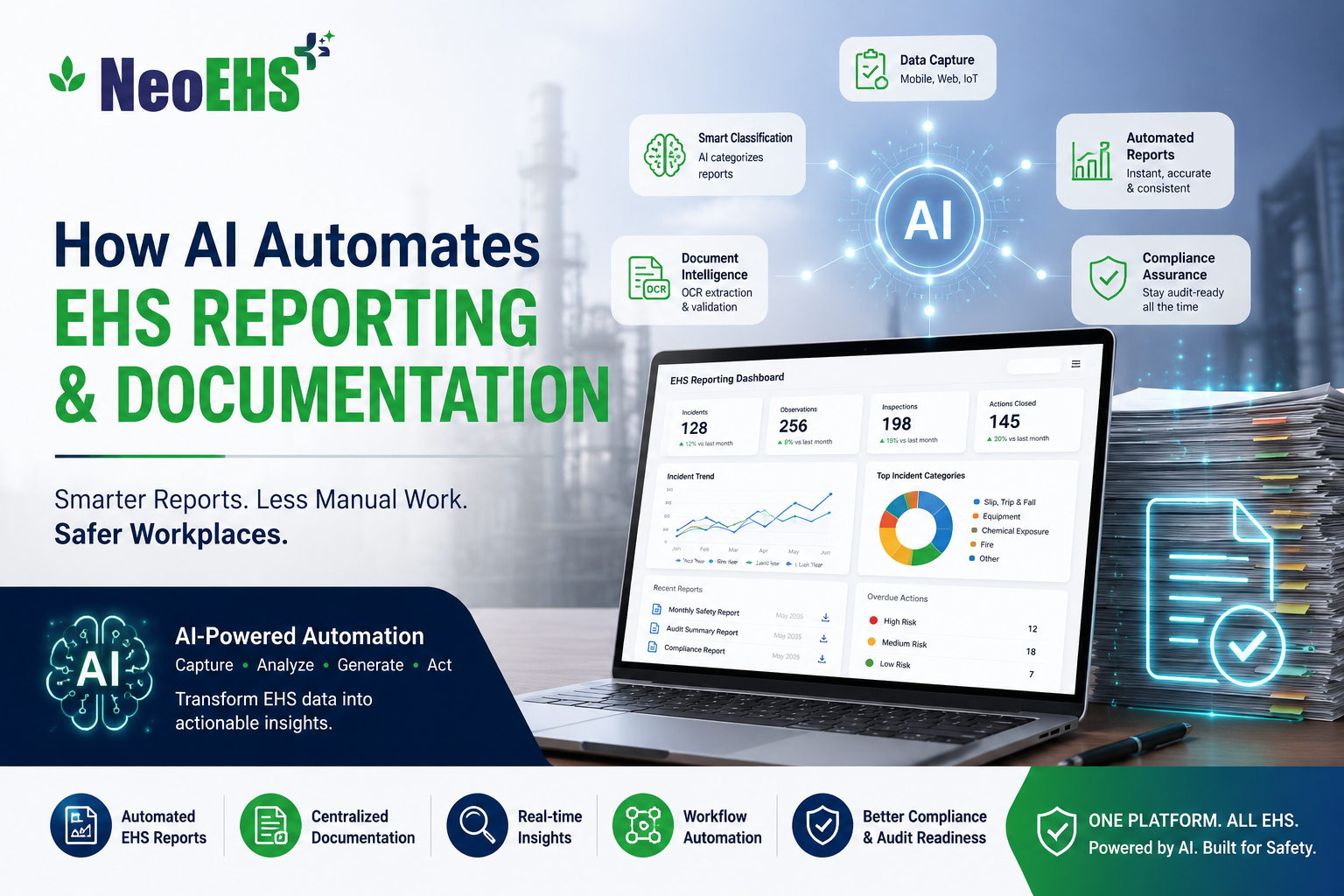
How AI Automates EHS Reporting and Documentation
Environmental, Health and Safety teams generate an enormous amount of information every day.
Incident reports. Safety observations. Inspection findings. Audit records. Risk assessments. Permit documents. Training records. Corrective actions. Environmental data. Compliance evidence.
The problem is not a lack of information.
The problem is what happens after the information is created.
In many organizations, EHS professionals still spend hours collecting data, entering information into spreadsheets, preparing reports, checking documents, formatting presentations and following up on missing records.
That administrative workload takes valuable time away from what EHS teams actually want to do: identify risks, prevent incidents and improve workplace safety.
This is where AI-powered EHS reporting and documentation can make a meaningful difference.
Instead of treating AI as simply a chatbot that answers questions, modern EHS platforms can use artificial intelligence to capture information, classify it, extract relevant data, identify patterns, generate reports, support documentation and turn large volumes of safety data into actionable insights.
The result is a shift from:
Manual reporting → Digital reporting → Automated reporting → Intelligent EHS reporting
What Is AI-Powered EHS Reporting?
AI-powered EHS reporting is the use of artificial intelligence to collect, interpret, organize, analyze and present Environmental, Health and Safety information with less manual effort.
Traditional reporting often requires an EHS professional to:
- Collect information.
- Enter data.
- Check the information.
- Categorize records.
- Prepare reports.
- Analyze trends.
- Create management summaries.
- Follow up on corrective actions.
AI can assist with several of these steps.
For example, an employee could submit an incident description and photograph from a mobile device. AI can help classify the incident, extract relevant information, identify potential contributing factors and organize the record for further investigation.
The EHS professional remains responsible for reviewing important information and making appropriate safety decisions.
That distinction matters.
AI should reduce administrative work without removing human accountability.
Why Is EHS Reporting Still So Manual?
Many organizations have modernized some parts of their operations but still depend on manual EHS processes.
Common examples include:
- Excel-based safety reports
- Paper inspection forms
- Email-based approvals
- Manually prepared monthly reports
- Scanned compliance documents
- Manually entered incident records
- Separate audit spreadsheets
- Manually maintained action trackers
- Repeated data entry across different systems
These processes create several problems.
Duplicate Data Entry
The same information may need to be entered into multiple reports or systems.
Delayed Reporting
A safety event that occurs today may not appear in a management report until days or weeks later.
Inconsistent Information
Different people may describe the same type of event using different terminology.
Reporting Errors
Manual data entry can introduce missing fields, incorrect classifications or inconsistent records.
Administrative Workload
Safety professionals spend time preparing reports instead of analyzing risk.
Limited Visibility
Management may receive historical reports without understanding what is changing in real time.
AI-powered EHS platforms can help address these challenges by automating repetitive activities and connecting information across safety processes.
NeoEHS currently positions its platform around digital EHS workflows, AI-powered analytics, automated safety processes, real-time dashboards and centralized EHS information.
How AI Automates EHS Reporting
AI can support EHS reporting at multiple stages of the reporting lifecycle.
1. Automated Data Capture
The first step in reporting is collecting information.
Modern EHS platforms can allow workers, supervisors, contractors and safety professionals to submit information through web and mobile applications.
Instead of waiting for someone to prepare a report later, information can be captured closer to the point where the event occurs.
For example:
A worker notices an unsafe condition, takes a photograph, enters a short description and submits the observation from a mobile device.
The system can then begin processing the information immediately.
This creates a faster connection between:
Workplace → EHS system → Safety team → Corrective action
2. AI-Powered Report Classification
One of the most useful applications of AI is classification.
Imagine an organization receives thousands of safety observations every month.
Manually categorizing every observation can take considerable time.
AI can assist in identifying categories such as:
- Unsafe act
- Unsafe condition
- Near miss
- PPE violation
- Fire risk
- Electrical hazard
- Chemical exposure
- Working-at-height risk
- Housekeeping issue
- Environmental incident
- Equipment-related hazard
The AI does not need to replace the safety professional.
Instead, it can provide an initial classification that the responsible person can review and confirm.
This can make reporting more consistent and reduce repetitive administrative work.
3. AI-Assisted Incident Reporting
Incident reporting is another area where automation can provide significant value.
A modern AI-enabled incident workflow can help organize:
- Incident description
- Date and time
- Location
- People involved
- Activity being performed
- Equipment involved
- Immediate actions
- Potential causes
- Supporting photographs
- Witness information
- Corrective actions
AI can help identify missing information and prompt the user to provide additional details.
For example:
"The incident description indicates that the employee was working at height. Was fall protection equipment being used?"
This type of intelligent prompting can improve the quality of information captured during the initial reporting stage.
NeoEHS currently provides digital incident management capabilities including incident reporting, investigation, corrective actions, AI-assisted analysis and audit-ready documentation.
4. AI for EHS Document Intelligence
EHS departments manage large volumes of documents.
These can include:
- Risk assessments
- Safety procedures
- SOPs
- Inspection reports
- Audit reports
- Permits
- Training certificates
- Contractor documents
- Legal documents
- Safety Data Sheets
- Incident records
- Environmental reports
Manually reading and extracting information from every document can be time-consuming.
AI-powered document intelligence can help extract relevant information from structured and unstructured documents.
For example, AI could help identify:
Document → Relevant information → Structured EHS record
Instead of asking someone to manually read a 20-page document and enter selected information into another system, AI can assist in identifying the relevant sections and preparing structured information for review.
This is particularly useful when organizations have large document repositories.
5. OCR Can Turn Documents Into Usable EHS Data
Optical Character Recognition, or OCR, allows software to extract text from documents and images.
In EHS, OCR can be useful for processing:
- Scanned inspection reports
- Certificates
- Training records
- Contractor documents
- Equipment certificates
- Permits
- Audit evidence
- Regulatory documents
AI can go beyond simply reading the text.
It can help identify:
- Document type
- Important dates
- Expiry dates
- Names
- Certificate numbers
- Required fields
- Relevant safety information
This creates an opportunity to move from:
Document storage
to:
Document intelligence.
6. Automated EHS Report Generation
Management teams often need recurring reports.
For example:
Daily
- Critical incidents
- High-risk observations
- Open permits
- Immediate corrective actions
Weekly
- Incident trends
- Inspection performance
- Action closure
- Contractor safety
Monthly
- TRIR
- LTIFR
- Near misses
- Safety observations
- Audit performance
- Training performance
- Compliance status
Quarterly
- Management review
- Safety trends
- Environmental performance
- ESG indicators
- Strategic risks
AI can help assemble information from different EHS processes and generate structured reports.
Instead of starting from a blank spreadsheet every month, the EHS team can review an automatically prepared report and focus on interpretation.
7. AI Can Turn EHS Data Into Management Insights
Reporting should not end with a PDF.
The real value of EHS reporting comes from understanding what the information means.
Suppose a company has:
- 500 safety observations
- 35 near misses
- 12 incidents
- 8 recurring hazards
- 20 overdue corrective actions
A traditional report may simply present those numbers.
AI can help identify relationships.
For example:
"Working-at-height observations increased significantly across two projects during the past quarter, while corrective-action closure declined."
That is more useful than a table containing numbers.
The goal is to move from:
Data → Information → Insight → Action
8. AI-Powered EHS Dashboards
Modern EHS dashboards can provide real-time visibility into safety performance.
Important indicators can include:
- Incident frequency
- Incident severity
- Near misses
- Safety observations
- Corrective actions
- Inspection completion
- Audit findings
- Training compliance
- Permit activity
- Contractor performance
- Environmental metrics
AI can make dashboards more useful by highlighting what deserves attention.
Instead of presenting 50 metrics equally, an intelligent system can help prioritize the information that appears most relevant or urgent.
NeoEHS provides centralized dashboards and analytics across safety and compliance processes, supporting real-time visibility and management decision-making.
9. Automated Corrective Action Reporting
Finding a problem is only the first step.
The organization must also make sure that the issue is corrected.
AI-enabled workflows can help connect:
Finding → Corrective Action → Responsible Person → Due Date → Escalation → Closure → Verification
For example, if an inspection identifies a critical electrical hazard, the system can create or recommend a corrective action, assign responsibility according to configured workflows and monitor the action until closure.
This creates greater accountability.
10. AI Can Help Identify Overdue Actions
Corrective-action backlogs are common in large organizations.
The problem is that not every overdue action has the same level of risk.
AI can help prioritize actions based on factors such as:
- Risk severity
- Age of action
- Related incidents
- Repeated findings
- Location
- Activity
- Responsible department
- Compliance significance
This helps safety teams focus first on the actions that may represent the greatest potential exposure.
11. Automating Audit Documentation
Audits generate substantial amounts of information.
An organization may need to maintain:
- Audit plans
- Checklists
- Evidence
- Findings
- Corrective actions
- Closure records
- Supporting documents
- Management responses
Digital EHS systems can centralize these records.
AI can further assist by helping organize evidence, identify missing information and summarize findings.
This can reduce the administrative effort required to prepare for internal and external audits.
NeoEHS includes digital audit and inspection management with action tracking and compliance visibility as part of its broader EHS platform.
12. AI-Powered Compliance Reporting
Compliance reporting can become particularly challenging for organizations operating across multiple locations.
Different facilities may have:
- Different regulations
- Different reporting requirements
- Different deadlines
- Different documentation requirements
- Different responsible personnel
An intelligent EHS platform can help centralize compliance information and automate recurring workflows.
AI can support:
- Compliance status summaries
- Missing evidence identification
- Upcoming deadline alerts
- Regulatory document analysis
- Corrective-action tracking
- Management reporting
However, organizations should always validate regulatory interpretations and reporting obligations with appropriately qualified legal, compliance or EHS professionals.
AI + EHS Reporting: A Practical Example
Consider a manufacturing organization with ten facilities.
Every month, the corporate EHS team receives:
- Incident reports
- Near-miss reports
- Inspection findings
- Audit findings
- Training records
- Corrective actions
- Environmental information
Historically, the corporate team spends several days collecting information from different locations and preparing management reports.
With an AI-enabled EHS platform, the workflow can become:
1. Capture
Facilities enter information digitally.
↓
2. Validate
The system checks required fields and data quality.
↓
3. Classify
AI assists with categorization.
↓
4. Analyze
The platform identifies trends and recurring issues.
↓
5. Prioritize
High-risk issues are highlighted.
↓
6. Report
Management dashboards and reports are generated.
↓
7. Act
Corrective actions are assigned and tracked.
↓
8. Learn
Historical information becomes available for future risk analysis.
The result is not simply a faster report.
It is a more connected EHS management process.
From EHS Reporting to Predictive Safety
Automated reporting creates another important opportunity.
Once an organization has consistent digital data, it can begin analyzing trends.
For example:
Observation data + Incident data + Inspection data + Risk data + Permit data
can reveal patterns that are difficult to see when each dataset exists separately.
This can support predictive safety analytics.
Instead of asking:
"How many incidents happened last month?"
the organization can begin asking:
"Which locations, activities or conditions are showing increasing risk?"
That is a fundamental shift from lagging indicators toward leading and predictive indicators.
NeoEHS positions predictive risk analytics, AI incident analysis and connected EHS information as part of its AI-powered platform.
How AI Can Improve EHS Reporting Quality
Automation is not only about speed.
It can also improve consistency.
A well-designed AI-enabled reporting system can help:
Standardize terminology
Use consistent categories and classifications.
Reduce missing information
Prompt users when important fields are incomplete.
Improve documentation
Structure information consistently across locations.
Improve traceability
Maintain records of actions and approvals.
Improve accessibility
Make information easier to search and analyze.
Improve decision-making
Turn raw data into useful insights.
What AI Should Not Do in EHS
AI should not be treated as an unquestionable decision-maker.
There are situations where human expertise is essential.
For example:
- Determining legal responsibility
- Final incident conclusions
- High-risk work authorization
- Regulatory interpretation
- Medical decisions
- Emergency decisions
- Serious incident classification
AI can provide recommendations and supporting analysis.
Qualified professionals should retain appropriate authority and accountability.
The best model is:
AI intelligence + human expertise + controlled workflows
rather than:
AI replacing the EHS professional.
What Should You Look for in AI-Powered EHS Reporting Software?
Organizations evaluating EHS reporting automation should look beyond the word "AI."
Look for capabilities such as:
- Mobile reporting
- Automated workflows
- Incident management
- Safety observations
- Risk assessment
- Audit management
- Inspection management
- Corrective-action management
- Document intelligence
- OCR
- Automated dashboards
- Predictive analytics
- Compliance management
- Role-based access
- Audit trails
- Enterprise integrations
- Human review and approval
- Configurable workflows
Most importantly, ask:
Can the system connect EHS information and turn it into actionable intelligence?
AI-Powered EHS Reporting for Different Industries
The requirements vary by industry, but the underlying principle remains the same.
Construction
AI can help automate:
- Daily safety reporting
- Contractor reporting
- Site observations
- Incident documentation
- Permit records
- Inspection reports
- Project safety dashboards
Manufacturing
AI can support:
- Machine safety reporting
- Incident documentation
- LOTO records
- Inspection reporting
- Corrective actions
- Safety trend analysis
Mining
AI can assist with:
- High-risk activity reporting
- Mobile incident reporting
- Contractor documentation
- Inspection records
- Permit workflows
- Risk intelligence
Oil & Gas
AI-powered reporting can support:
- Process safety information
- Permit records
- Incident investigation
- Environmental reporting
- Audit evidence
- Compliance documentation
Power & Energy
Organizations can use digital reporting to manage:
- Electrical safety
- Work permits
- Asset inspections
- Incident reporting
- Contractor safety
- Regulatory documentation
The same principle applies across industries:
Capture once. Connect the information. Automate the workflow. Learn from the data.
The Future of EHS Documentation Is Intelligent
For years, the objective of EHS digitization was to eliminate paper.
That was an important first step.
But digital forms alone do not create intelligent safety management.
The next stage is about making the information itself more useful.
The evolution looks like this:
Stage 1 — Paper
Information is documented manually.
Stage 2 — Digital
Information is entered into software.
Stage 3 — Automated
Workflows, notifications and reports are automated.
Stage 4 — AI-Powered
AI analyzes information and provides insights.
Stage 5 — Agentic
AI agents can coordinate defined tasks and workflows under appropriate controls and human oversight.
This is where the future of EHS is heading.
How NeoEHS Supports AI-Powered EHS Reporting
NeoEHS brings EHS processes into an integrated digital environment covering incident management, risk assessment, audits, inspections, Permit to Work, contractor safety, compliance, environmental management, ESG and analytics.
Its current platform capabilities include AI-powered incident analysis, predictive risk analytics, document intelligence, automated workflows, AI safety assistance and multi-agent AI capabilities.
The objective is not simply to generate more reports.
It is to help organizations create better safety intelligence from the information they already collect.
With a connected EHS platform, organizations can move toward:
Capture → Automate → Analyze → Predict → Act → Improve
Frequently Asked Questions
What is AI-powered EHS reporting?
AI-powered EHS reporting uses artificial intelligence to help collect, classify, analyze, summarize and present Environmental, Health and Safety information while reducing repetitive manual reporting activities.
How does AI automate EHS documentation?
AI can assist with data extraction, document classification, OCR, report generation, incident categorization, information summarization, trend analysis and workflow automation.
Can AI generate EHS reports automatically?
Yes. AI-enabled EHS platforms can assemble information from connected EHS processes and generate structured reports or management summaries. Human review remains important for significant safety, compliance and regulatory information.
Can AI automate incident reporting?
AI can assist with incident classification, information extraction, documentation, investigation support, trend analysis and corrective-action workflows. Employees and EHS professionals still need to validate important information.
Can AI help with EHS compliance reporting?
Yes. AI can assist with organizing compliance information, monitoring deadlines, identifying missing evidence, summarizing compliance status and supporting corrective-action workflows. Regulatory requirements should still be validated by qualified professionals.
Does AI replace EHS professionals?
No. The strongest use of AI in EHS is to reduce repetitive administrative work and provide better information for safety professionals. Human expertise, accountability and decision-making remain essential.
What is the difference between digital EHS reporting and AI-powered EHS reporting?
Digital reporting replaces paper with software. AI-powered reporting adds intelligent capabilities such as classification, document extraction, trend analysis, recommendations and automated reporting workflows.
Can AI improve EHS audit readiness?
AI-enabled EHS systems can help centralize records, organize evidence, track corrective actions and generate reports, making it easier for organizations to maintain consistent documentation and prepare for audits.
Conclusion
EHS reporting should not consume the time that safety professionals need to spend preventing incidents.
AI can help organizations automate repetitive documentation, improve data consistency, accelerate reporting and turn large volumes of safety information into actionable insights.
But the real opportunity goes beyond automation.
When incident reports, observations, inspections, audits, risks, permits, contractor information and compliance records are connected, organizations can begin to see the bigger picture.
They can move from:
Reporting what happened
to:
Understanding why it happened
and ultimately toward:
Identifying what could happen next and acting before it does.
That is the real promise of AI-powered EHS reporting.
NeoEHS is helping organizations move from manual EHS documentation to intelligent, connected and proactive safety management — shaping the future of EHS with AI.
Explore NeoEHS
Discover how an AI-powered EHS platform can help your organization digitize reporting, automate documentation, improve compliance visibility and turn safety data into actionable intelligence.
READ MORE ❯
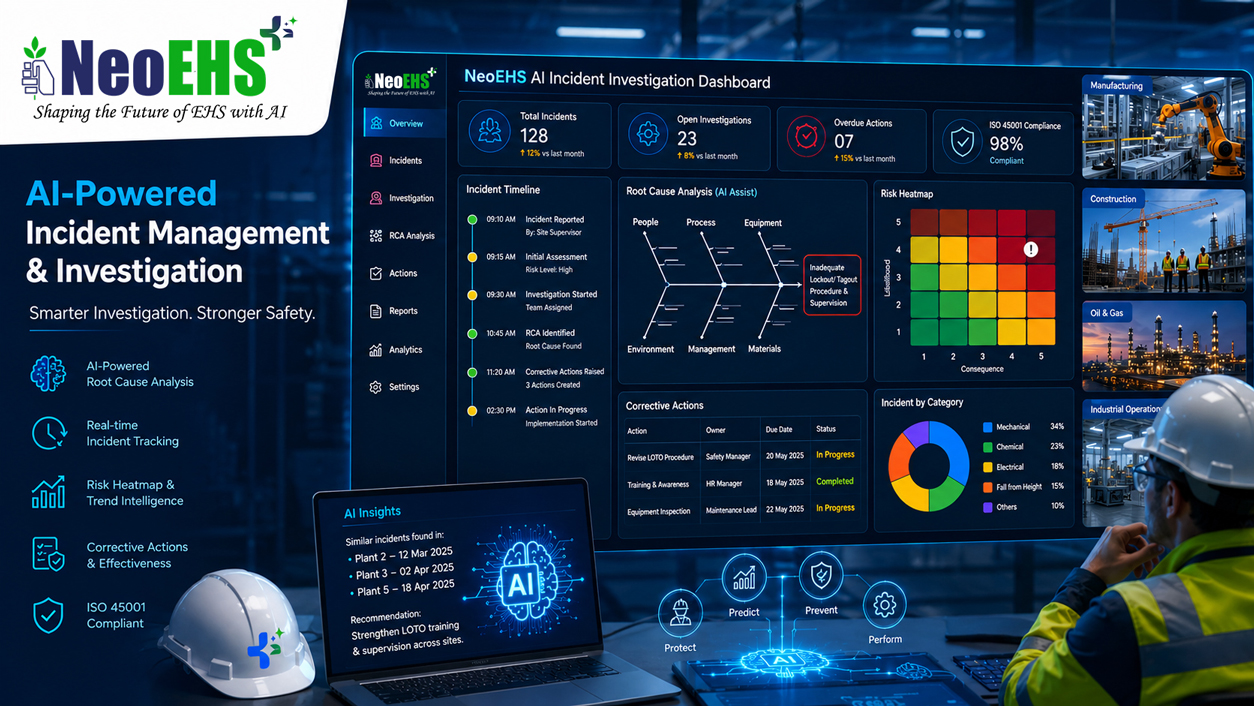
ISO 45001 Incident Management and Investigation Requirements
Workplace incidents rarely happen because of one single mistake. A serious injury, equipment failure, near miss, environmental event, or unsafe condition is often the result of several factors coming together—an ineffective control, inadequate training, a missed hazard, poor communication, equipment issues, or a weakness in the safety management system.
That is why ISO 45001 incident management and investigation is about much more than recording what happened.
ISO 45001:2018 requires organizations to establish, implement, and maintain processes for reporting, investigating, and taking action on incidents and nonconformities. The objective is to understand what happened, identify causes, prevent recurrence, and continuously improve the occupational health and safety management system.
For organizations managing hundreds or thousands of employees, contractors, projects, and operational sites, doing this consistently with spreadsheets, emails, and paper forms can become difficult. This is where an AI-powered EHS platform such as NeoEHS can help connect incident reporting, investigation, root cause analysis, corrective actions, risk management, and compliance evidence in one system.
What Is Incident Management Under ISO 45001?
Incident management under ISO 45001 is the structured process of reporting, responding to, investigating, correcting, and learning from workplace incidents and related nonconformities.
The goal is not simply to close an incident record.
The goal is to answer important questions:
- What happened?
- What were the immediate and underlying causes?
- Why did existing controls fail or become ineffective?
- Could a similar incident happen somewhere else?
- Are existing risk assessments still adequate?
- What corrective actions are required?
- Were those actions actually effective?
- Does the organization's OH&S management system need to change?
ISO 45001 connects incident investigation with continual improvement rather than treating an investigation as an isolated administrative exercise.
What Does ISO 45001 Clause 10.2 Require?
ISO 45001 Clause 10.2 — Incident, nonconformity and corrective action — is the key requirement governing incident investigation and corrective action.
The organization needs a process covering reporting, investigation, and action.
When an incident or nonconformity occurs, the organization should work through a structured cycle.
1. React in a Timely Manner
The first priority is to control the situation and protect people.
Depending on the event, this could involve:
- Stopping unsafe work
- Providing first aid or medical assistance
- Activating emergency procedures
- Isolating hazardous energy
- Evacuating affected areas
- Containing a spill
- Securing equipment or machinery
- Preventing further exposure
- Preserving relevant evidence
ISO guidance gives the example of a workplace fire: immediate response may involve raising the alarm, evacuating people, and controlling the fire, while subsequent actions may include inspecting the affected area, repairing equipment, and determining whether the area can safely return to service.
2. Deal With the Consequences
Incident management does not stop when the immediate danger is controlled.
Organizations may need to address:
- Injuries and occupational ill health
- Property or equipment damage
- Environmental consequences
- Production disruption
- Contractor impacts
- Regulatory requirements
- Emergency response costs
- Business continuity issues
- Psychological or workforce impacts
A strong incident management system therefore tracks both the event and its consequences.
3. Investigate the Incident
Investigation is one of the most important parts of the ISO 45001 process.
The investigation should go beyond asking:
"Who made the mistake?"
Instead, investigators should ask:
"What conditions and system factors allowed this event to happen?"
An effective investigation may examine:
- The sequence of events
- Workplace conditions
- People and competency
- Equipment and machinery
- Procedures and work instructions
- Supervision
- Training
- Communication
- Maintenance
- Permit-to-work controls
- Risk assessments
- Existing preventive measures
- Contractor management
- Organizational factors
- Previous similar incidents
ISO 45001 specifically links investigation with determining causes and checking whether similar incidents or nonconformities exist or could occur elsewhere.
4. Determine Root and Contributing Causes
Finding the immediate cause is not enough.
For example:
Incident:
A worker falls while accessing an elevated work area.
Immediate cause:
The worker lost balance.
Contributing causes might include:
- Inadequate access
- Poor housekeeping
- Inappropriate footwear
- Insufficient supervision
- Inadequate work-at-height controls
System-level causes might include:
- Inadequate risk assessment
- Weak inspection processes
- Insufficient training
- Poor implementation of procedures
- Inadequate management of change
This distinction is critical because correcting only the immediate cause may leave the underlying risk untouched.
Common Root Cause Analysis Methods
Organizations may use structured methodologies such as:
- 5 Why Analysis
- Fishbone / Ishikawa Analysis
- Fault Tree Analysis
- Barrier Analysis
- Bow-Tie Analysis
- TapRooT or other structured RCA methodologies
NeoEHS supports structured investigation workflows and RCA approaches including 5 Why, Fishbone, TapRooT, and Fault Tree Analysis.
5. Involve Workers in the Investigation
Incident investigations should not be conducted entirely behind a desk.
People who perform the work often understand operational realities that may not appear in procedures or risk assessments.
ISO 45001 Clause 10.2 specifically requires evaluation of corrective action needs with worker participation and involvement of relevant interested parties where appropriate.
Worker participation can help investigators understand:
- What actually happened in the field
- Whether procedures were practical
- Whether controls were available
- Whether controls were being followed
- Whether production pressures influenced decisions
- Whether similar hazards exist elsewhere
This also helps build a stronger safety culture.
6. Check Whether Similar Incidents Could Occur Elsewhere
One of the most valuable—and sometimes overlooked—parts of incident investigation is organizational learning.
Suppose a machine guard fails at Plant A.
The investigation should not end with repairing that machine.
Management should consider:
Do similar machines at Plants B, C, and D have the same vulnerability?
The ISO 45001 guidance provides a similar principle: organizations should determine whether similar incidents have occurred, whether related nonconformities exist, or whether they could potentially occur elsewhere.
This is where centralized EHS data becomes extremely valuable.
With digital incident management, organizations can compare:
- Sites
- Departments
- Equipment
- Activities
- Contractors
- Incident types
- Hazard categories
- Root causes
- Corrective actions
- Recurrence patterns
NeoEHS uses AI-powered pattern and recurrence analysis to identify similar historical incidents, recurring hazards, unsafe behaviors, and emerging operational risks.
7. Review Existing Risk Assessments
An incident can reveal that an existing risk assessment is no longer adequate.
ISO guidance specifically asks organizations to review existing OH&S risk assessments and other relevant risk assessments following an incident or nonconformity.
Investigators should therefore ask:
- Was the hazard identified?
- Was the risk assessed correctly?
- Were controls defined?
- Were the controls actually implemented?
- Were workers aware of the controls?
- Were the controls effective?
- Did conditions change after the assessment?
- Was a new hazard introduced?
This creates an important connection:
Incident → Investigation → Risk Review → Control Improvement
Rather than maintaining incident management and risk management as disconnected processes, organizations can use the incident as feedback into the broader safety management system.
8. Implement Corrective Actions Using the Hierarchy of Controls
Corrective action should address the underlying problem and be proportionate to the actual or potential effects of the incident.
ISO 45001 requires actions, including corrective actions, to be implemented in accordance with the hierarchy of controls and management of change.
Where appropriate, organizations should consider controls such as:
- Elimination
- Substitution
- Engineering controls
- Administrative controls
- Personal protective equipment
For example, if workers are repeatedly exposed to a hazardous process, simply providing additional PPE may not be the strongest solution.
The investigation should ask whether the hazard can be eliminated or engineered out before relying primarily on administrative controls.
9. Assess Risks Before Introducing New or Changed Controls
Corrective actions can sometimes create new risks.
For example, replacing equipment, changing a process, modifying a chemical, changing a work sequence, or introducing automation may introduce new hazards.
ISO 45001 therefore requires organizations to assess OH&S risks related to new or changed hazards before taking action where applicable.
A mature digital EHS process should therefore connect:
Incident → Corrective Action → Change → Risk Assessment → Approval → Implementation → Verification
10. Verify Corrective Action Effectiveness
Closing an action does not automatically mean the problem has been solved.
Consider this example:
A housekeeping inspection identifies repeated oil leakage around a machine.
A corrective action is assigned:
"Clean the affected area."
The task is completed.
But if the machine continues leaking oil, the hazard will return.
A stronger corrective action would investigate why the leakage occurs, address the source, and verify that the control remains effective.
ISO 45001 requires organizations to review the effectiveness of actions taken, including corrective actions.
This creates an important difference:
Action completed ≠ Action effective
An effective incident management system should therefore support evidence-based closure verification.
What Evidence Should Organizations Maintain?
ISO 45001 requires organizations to retain documented information as evidence of the nature of incidents or nonconformities, subsequent actions, and the results and effectiveness of corrective actions. Relevant information should also be communicated to workers and other relevant parties as appropriate.
Typical incident records may include:
- Incident report
- Date and time
- Location
- People involved
- Witness statements
- Photographs and videos
- Incident classification
- Injury or illness information
- Environmental impact
- Immediate actions
- Investigation findings
- Root cause analysis
- Risk assessment review
- Corrective actions
- Responsible persons
- Target dates
- Supporting evidence
- Verification results
- Management approvals
- Lessons learned
- Communication records
Digital records make this information easier to retrieve during internal audits, management reviews, certification audits, and organizational learning activities.
Incident vs Near Miss vs Nonconformity
A modern EHS program should distinguish between different types of events while still learning from each one.
Incident
An event arising out of or in the course of work that resulted in, or could result in, injury or ill health.
Near Miss
An event where injury, ill health, damage, or another undesirable consequence did not occur but could have occurred.
Unsafe Condition
A physical or environmental condition that can contribute to an incident.
Unsafe Act
An action or behavior that increases exposure to a hazard.
Nonconformity
A failure to meet a specified requirement of the OH&S management system or another applicable requirement.
These categories should not become isolated databases. They should feed into a common learning and corrective-action process.
How AI Can Improve ISO 45001 Incident Management
Traditional incident management systems are primarily designed to record information.
Modern AI-powered EHS platforms can go further by helping organizations understand patterns within their safety data.
For example, AI can assist with:
Intelligent Incident Classification
Automatically categorize incidents based on submitted information, helping route them to the appropriate workflow.
AI-Assisted Investigation
Help investigators organize incident information, identify missing investigation data, and surface potentially relevant patterns.
Root Cause Intelligence
Analyze incident information and support structured methodologies such as 5 Why and Fishbone analysis.
Similar Incident Detection
Compare a new event against historical incidents and identify potentially similar cases.
Predictive Risk Insights
Identify recurring patterns across incidents, hazards, locations, equipment, activities, or workforce groups.
Corrective Action Recommendations
Help safety teams identify possible corrective and preventive measures based on the incident context.
Evidence-Based Closure
Support verification of corrective actions using documents, photographs, inspection results, and other evidence.
NeoEHS combines AI-powered incident reporting, investigation workflows, root cause analysis, corrective action management, pattern intelligence, predictive safety analytics, and real-time dashboards within its incident management solution.
How NeoEHS Supports ISO 45001 Incident Management
NeoEHS is an AI-powered Environmental, Health and Safety (EHS) management platform designed to connect incident management with the wider safety management system.
Its incident management capabilities can support organizations across the complete incident lifecycle:
Report → Respond → Investigate → Analyze → Correct → Verify → Learn → Prevent
With NeoEHS, organizations can:
- Report incidents and near misses using mobile and web
- Capture photographs and supporting information
- Route incidents through configurable workflows
- Assign investigation responsibilities
- Conduct structured root cause analysis
- Identify recurring incidents and patterns
- Manage corrective and preventive actions
- Track action ownership and deadlines
- Escalate overdue actions
- Link incidents with hazards and risk assessments
- Monitor incident trends through dashboards
- Maintain investigation records
- Support audit-ready documentation
- Use AI-driven safety insights to identify emerging risks
NeoEHS also integrates incident management with other EHS processes such as risk assessment, hazard management, inspections, audits, permit-to-work, training, contractor safety, compliance, and environmental management.
This integrated approach matters because workplace incidents rarely belong to only one safety process.
A failed permit, inadequate risk assessment, expired training, poor inspection finding, or uncontrolled hazard can eventually become part of the incident story.
A Practical ISO 45001 Incident Investigation Workflow
Organizations looking to strengthen their incident investigation process can use the following practical workflow:
Step 1 — Report
Capture the incident, near miss, unsafe condition, or nonconformity as soon as possible.
Step 2 — Make Safe
Control the immediate hazard and protect workers.
Step 3 — Preserve Evidence
Capture photographs, videos, statements, equipment information, and relevant documentation.
Step 4 — Classify
Determine the event type, severity, potential severity, location, activity, and affected parties.
Step 5 — Investigate
Establish the sequence of events and collect facts.
Step 6 — Analyze Causes
Identify immediate, contributing, underlying, and systemic causes.
Step 7 — Check for Similar Risks
Search other sites, departments, equipment, activities, and historical incidents for similar conditions.
Step 8 — Review Risk Assessments
Determine whether existing hazard identification and risk controls remain adequate.
Step 9 — Define Corrective Actions
Select appropriate controls using the hierarchy of controls and consider management of change.
Step 10 — Assign and Track
Give every action an owner, priority, due date, and escalation path.
Step 11 — Verify Effectiveness
Confirm that the corrective action actually controls the problem.
Step 12 — Share the Learning
Communicate relevant lessons to workers and other interested parties.
Step 13 — Improve the System
Update procedures, training, risk assessments, controls, workflows, or other parts of the OH&S management system when necessary.
ISO 45001 Incident Investigation Checklist
Before closing an investigation, safety teams should ask:
- Was the incident reported without undue delay?
- Were immediate risks controlled?
- Were consequences addressed?
- Was sufficient evidence collected?
- Were relevant workers involved?
- Were the causes investigated?
- Were root and contributing causes considered?
- Were similar incidents checked?
- Were existing risk assessments reviewed?
- Were corrective actions based on the hierarchy of controls?
- Were new or changed hazards assessed?
- Were action owners and deadlines defined?
- Was corrective action effectiveness verified?
- Was relevant information communicated?
- Were necessary changes made to the OH&S management system?
- Is sufficient documented evidence available for future review?
This checklist can help organizations turn ISO 45001 requirements into an operational process rather than treating the standard as an audit-only requirement.
Why Digital Incident Management Is Becoming Essential
As organizations expand across multiple factories, construction sites, mining operations, oil & gas facilities, infrastructure projects, warehouses, ports, and other high-risk environments, maintaining consistent incident management becomes increasingly difficult.
A centralized EHS platform provides a single source of truth for safety events.
Instead of asking:
"Can someone find the incident report?"
Safety leaders can ask:
"What are our most common incident causes, where are they occurring, and what actions are preventing recurrence?"
That shift—from recording incidents to learning from incidents—is one of the biggest opportunities for digital EHS transformation.
NeoEHS brings incident management, risk management, inspections, audits, hazard management, permit-to-work, training, contractor management, compliance, environmental management, and ESG capabilities together within an integrated EHS platform.
Frequently Asked Questions
What is ISO 45001 incident management?
ISO 45001 incident management is the structured process of reporting, responding to, investigating, correcting, and learning from workplace incidents and nonconformities. Clause 10.2 connects incident investigation with corrective action and continual improvement.
Which ISO 45001 clause covers incident investigation?
ISO 45001 Clause 10.2 — Incident, nonconformity and corrective action covers the organization's processes for reporting, investigating, responding to incidents and nonconformities, implementing corrective action, checking effectiveness, and making necessary OH&S management system changes.
Does ISO 45001 require root cause analysis?
ISO 45001 requires organizations to investigate incidents or review nonconformities and determine their causes so that corrective action can prevent recurrence or occurrence elsewhere. Organizations can use structured root cause analysis methods to support this requirement.
Does ISO 45001 require worker participation in incident investigation?
Yes. Clause 10.2 requires evaluation of corrective action needs with worker participation and involvement of relevant interested parties where applicable.
Does ISO 45001 require corrective action?
Yes. Organizations must determine and implement appropriate actions, including corrective actions, and review their effectiveness. Corrective actions should be appropriate to the actual or potential effects of the incident or nonconformity.
Should a near miss be investigated?
Yes, near misses can provide valuable information about hazards and control weaknesses before an injury or other serious consequence occurs. Organizations should define appropriate reporting and investigation criteria within their OH&S management processes.
How can EHS software help with ISO 45001 incident management?
EHS software can digitize incident reporting, investigation workflows, root cause analysis, corrective action management, risk review, evidence collection, approvals, dashboards, notifications, and audit trails. NeoEHS adds AI-powered pattern analysis and predictive safety intelligence to help identify recurring risks.
Can NeoEHS support ISO 45001 incident management?
NeoEHS provides incident reporting, investigation, root cause analysis, corrective action tracking, risk management, dashboards, and compliance-oriented workflows that can support organizations implementing and maintaining an ISO 45001-aligned OH&S management system.
Conclusion
ISO 45001 incident management is not simply about documenting accidents.
It is about learning from what happened, understanding why it happened, identifying whether the same risk exists elsewhere, improving controls, verifying that corrective actions work, and strengthening the overall OH&S management system.
The most effective organizations are moving beyond reactive incident reporting toward proactive safety intelligence.
With an AI-powered EHS platform such as NeoEHS, organizations can connect incident reporting, investigation, root cause analysis, corrective actions, risk management, analytics, and compliance in one digital ecosystem.
The result is a more connected approach to safety:
Report faster. Investigate deeper. Correct smarter. Learn continuously. Prevent recurrence.
For organizations pursuing stronger ISO 45001 implementation and a more proactive safety culture, digital incident management can turn every incident and near miss into an opportunity to improve.
Please visit us at www.neoehs.com and write to us at info@neoehs.com
- NeoEHS Incident Management Software →
https://www.neoehs.com/solutions/incident-management-software - NeoEHS EHS Management System →
https://www.neoehs.com/ehs-management-system - NeoEHS EHS Software →
https://www.neoehs.com/ehs-software - NeoEHS HSE Management System →
https://www.neoehs.com/hse-management-system
READ MORE ❯
AI-Powered Safety Management for Power Plants | NeoEHS
Power plants are among the most complex and safety-critical industrial environments in the world.
Workers operate around high-voltage electrical systems, boilers, turbines, generators, steam, chemicals, heavy machinery, confined spaces, hazardous energy, work at height, and demanding maintenance activities.
In such an environment, safety cannot depend only on periodic inspections, paper-based checklists, or reacting after an incident occurs.
AI-powered safety management for power plants is changing the way organizations identify hazards, manage risk, monitor operations, investigate incidents, and protect workers.
NeoEHS, an AI Powered Environment, Health and Safety (EHS) System, helps power generation companies move from reactive safety management to a more connected and proactive approach—bringing together risk management, permit to work, incident management, inspections, observations, training, contractor management, emergency management, environmental monitoring, and AI-powered analytics in one platform.
The goal is simple:
Identify risks earlier. Take action faster. Make every safety decision more informed.
What Is AI-Powered Safety Management for Power Plants?
AI-powered safety management uses artificial intelligence, automation, connected data, analytics, and digital workflows to help power plants identify and manage workplace safety risks more effectively.
Instead of treating safety information as isolated records, an AI-powered EHS platform can connect information from:
- Risk assessments
- Permit to Work
- Lockout/Tagout
- Safety observations
- Inspections
- Audits
- Incidents and near misses
- Contractor activities
- Training and competency
- PPE management
- Emergency preparedness
- Equipment and operational data
- IoT sensors
- CCTV and computer vision
- Environmental monitoring
This creates a more complete picture of what is happening across the plant.
For example, a single repeated observation may not appear serious on its own. But if the same observation occurs repeatedly around a particular piece of equipment, during a specific shift, or among a particular contractor group, the combined data may reveal an emerging risk.
That is where AI can provide value: not simply storing information, but helping safety teams recognize patterns and prioritize action.
Why Power Plants Need a More Intelligent Safety Management Approach
Power generation involves multiple layers of risk operating simultaneously.
A maintenance team may be working on electrical equipment while another contractor performs hot work nearby. At the same time, operators may be managing pressure systems, rotating equipment, chemicals, and process conditions.
A safety management system therefore needs to understand more than individual activities.
It needs to connect:
People + Equipment + Work + Hazards + Permits + Competency + Environment + Historical Safety Data
This is particularly important when maintenance, shutdowns, turnarounds, construction, or contractor-intensive activities increase the number of people and tasks operating simultaneously.
OSHA's electric power generation requirements include hazard assessment and controls for hazardous energy, while its guidance emphasizes identifying current worksite conditions and potential hazards before work begins.
An intelligent EHS platform can help organizations digitize these processes and provide a more consistent view of risk.
How AI Is Transforming Power Plant Safety Management
1. AI-Powered Risk Identification
Traditional risk assessments are often performed as structured exercises around a specific job or process.
AI can add another layer by analyzing historical EHS information and identifying recurring patterns.
NeoEHS can help safety teams analyze information such as:
- Previous incidents
- Near misses
- Safety observations
- Inspection findings
- Audit findings
- Permit deviations
- Repeated corrective actions
- Contractor performance
- Training gaps
- Equipment-related observations
The objective is not to replace experienced safety professionals.
Instead, AI helps them see patterns across large amounts of information that may be difficult to identify manually.
Example
Suppose a power plant records repeated observations involving inadequate isolation during maintenance activities.
Individually, each observation may be assigned to a department and closed.
An AI-powered system can help identify the recurrence and highlight:
Repeated hazardous-energy control observations → specific equipment → specific work type → specific contractor/team → increased risk
The safety team can then investigate the underlying control weakness rather than simply closing individual observations.
2. AI-Powered Permit to Work Management
Permit to Work (PTW) is one of the most important controls for high-risk activities in power plants.
Common permits may include:
- Hot Work Permit
- Electrical Work Permit
- Confined Space Entry Permit
- Work at Height Permit
- Excavation Permit
- Lifting Permit
- Cold Work Permit
- Isolation / LOTO Permit
- Radiography Permit
- Breaking Containment Permit
- Chemical Handling Permit
An AI-powered PTW system can help validate whether the proposed work aligns with required safety controls.
NeoEHS can connect permit information with:
- Job hazard assessments
- Risk assessments
- Isolation requirements
- Worker competency
- Contractor qualifications
- Required training
- PPE requirements
- Previous observations
- Simultaneous activities
- Permit conflicts
- Approval workflows
This creates a more connected approach to work authorization.
3. Intelligent Lockout/Tagout and Energy Isolation
Energy isolation is a critical safety control during maintenance.
OSHA's power-generation requirements address hazardous-energy control, including lockout/tagout practices for servicing and maintenance where unexpected energization, startup, or release of stored energy could cause injury.
NeoEHS can digitize and connect energy isolation workflows with:
- Permit requests
- Equipment identification
- Isolation points
- Authorized personnel
- LOTO procedures
- Verification
- Permit status
- Job completion
- Restoration
The platform can provide visibility into whether required controls have been completed before work proceeds.
Important: AI should support—not replace—approved isolation procedures, competent personnel, physical verification, and site-specific safety controls.
4. AI-Powered Safety Observation Management
Safety observations are one of the most valuable sources of leading-indicator data in a power plant.
But collecting thousands of observations is not enough.
The real value comes from understanding them.
NeoEHS can help classify and analyze observations involving:
- Unsafe acts
- Unsafe conditions
- PPE non-compliance
- Electrical hazards
- Housekeeping
- Work at height
- Confined spaces
- Lifting activities
- Fire safety
- Chemical handling
- Machine guarding
- Contractor activities
- Environmental conditions
AI can assist with:
- Observation classification
- Risk prioritization
- Trend identification
- Recurring issue detection
- Suggested corrective actions
- Smart assignment
- Escalation
- Hotspot identification
This helps transform observations from a reporting exercise into a leading-indicator intelligence system.
5. Predictive Safety Analytics
One of the most promising applications of AI in EHS is predictive analytics.
Instead of asking:
"What happened?"
organizations can increasingly ask:
"What risk patterns are developing?"
NeoEHS can analyze historical and current EHS data to identify patterns associated with elevated risk.
Potential indicators include:
- Increasing safety observations
- Repeated permit violations
- Overdue corrective actions
- Contractor performance deterioration
- Increasing training gaps
- Recurring equipment-related observations
- Increased near-miss frequency
- Repeated audit findings
- Expiring certifications
- High-risk work concentration
This can help safety leaders focus their attention where it is most needed.
6. AI-Powered Incident and Near-Miss Investigation
When an incident or near miss occurs, investigation teams need to understand not just the immediate event but also the conditions surrounding it.
NeoEHS can connect incident information with:
- Previous observations
- Risk assessments
- Permits
- Training records
- Contractor records
- Equipment information
- Inspection findings
- Audit findings
- Corrective actions
AI can help investigators organize information, identify recurring themes, suggest areas for further investigation, and support structured root-cause analysis.
The final investigation should always remain under the control of qualified safety and investigation professionals.
7. Computer Vision for Power Plant Safety
Power plants increasingly use CCTV and connected visual technologies.
When integrated appropriately, AI-powered computer vision can provide additional safety monitoring capabilities.
Potential use cases include:
- PPE compliance monitoring
- Restricted-area access detection
- Unsafe-zone entry
- Worker proximity to hazardous equipment
- Vehicle and pedestrian movement
- Blocked access or emergency routes
- Safety barricade violations
- Fire or smoke detection, depending on the technology and deployment
Rather than replacing safety personnel, computer vision can act as an additional layer of observation.
Human expertise + AI monitoring = stronger situational awareness.
8. IoT-Based Safety Monitoring
Modern power plants generate large amounts of operational and environmental data.
IoT devices can provide information from connected sensors and equipment.
Depending on the plant's architecture, NeoEHS can integrate relevant data sources such as:
- Gas detection
- Temperature
- Pressure
- Air quality
- Noise
- Environmental parameters
- Worker location
- Smart PPE
- Wearable devices
- Equipment status
- Emergency alarms
Combining IoT data with EHS information can help safety teams move closer to real-time risk visibility.
9. Contractor Safety Management
Contractors play a major role in power plant maintenance, shutdowns, construction, and specialist activities.
Managing contractor safety manually becomes increasingly difficult as the contractor workforce grows.
NeoEHS can manage the contractor lifecycle from:
Registration → Prequalification → Document Verification → Competency → Training → Induction → Permit → Work → Performance → Requalification
The platform can track:
- Contractor qualifications
- Employee competency
- Certifications
- Training
- Insurance
- Work authorization
- Previous performance
- Safety observations
- Incidents
- Permit compliance
- Corrective actions
AI-driven analytics can help identify contractors with increasing risk indicators or declining performance.
10. AI-Powered Training and Competency Management
A worker may have years of experience and still require specific training for a particular task, equipment type, or site.
NeoEHS can connect competency requirements with:
- Job roles
- Permits
- Contractor assignments
- Certifications
- Training
- Equipment
- High-risk activities
The system can identify training gaps and upcoming certification or training expiries.
This helps ensure that competency is treated as an active safety control rather than simply a document stored in a database.
11. Emergency Management and Response
Power plants need robust emergency preparedness for scenarios such as:
- Fire
- Explosion
- Electrical incidents
- Chemical release
- Gas release
- Equipment failure
- Medical emergency
- Confined-space emergency
- Severe weather
- Security incidents
NeoEHS can support emergency preparedness through:
- Emergency plans
- Response procedures
- Emergency contacts
- Drills
- Training
- Equipment readiness
- Emergency observations
- Action tracking
- Incident reporting
AI and analytics can help organizations identify weaknesses from previous drills and emergency events.
12. Environmental and Occupational Health Monitoring
Power plant safety is not limited to physical injury prevention.
Organizations also need to manage environmental and occupational health risks.
NeoEHS can support monitoring and management of areas such as:
- Air quality
- Emissions
- Waste
- Chemical exposure
- Noise
- Occupational health
- Environmental incidents
- Resource consumption
- Carbon emissions
- Regulatory compliance
This creates a broader Environment, Health, Safety and Sustainability management framework.
AI-Powered Safety Dashboard for Power Plant Management
Senior management should not have to read hundreds of reports to understand plant safety.
NeoEHS provides dashboards that can bring critical information together.
Management dashboards can include:
Safety Performance
- Total incidents
- Near misses
- Safety observations
- High-risk observations
- Corrective action status
Permit Performance
- Active permits
- High-risk permits
- Permit deviations
- Expiring permits
- Permit trends
Contractor Performance
- Contractor safety score
- Training compliance
- Permit compliance
- Incident performance
- Open corrective actions
Risk Intelligence
- Top risks
- Emerging risks
- Risk hotspots
- Recurring hazards
- High-risk activities
Training & Competency
- Training completion
- Certification status
- Competency gaps
- Expiring certifications
Environmental Performance
- Emissions
- Waste
- Environmental observations
- Environmental incidents
What Are the Benefits of AI-Powered Safety Management in Power Plants?
The biggest benefit is not simply automation.
It is better decision-making.
An intelligent EHS system can help power plants:
Identify risks earlier
Use historical and real-time information to identify emerging patterns.
Reduce manual administration
Digitize inspections, permits, observations, approvals, and compliance workflows.
Improve safety visibility
Give management a real-time view of safety performance across sites and departments.
Strengthen contractor management
Monitor contractor competency, compliance, permits, training, and performance.
Improve corrective-action closure
Track ownership, deadlines, escalation, and evidence.
Strengthen compliance
Maintain structured records supporting internal controls and applicable regulatory requirements.
Improve worker engagement
Make reporting and safety participation easier through mobile and digital workflows.
Support continuous improvement
Use data from incidents, observations, inspections, audits, and risks to improve the safety management system.
AI Does Not Replace Safety Professionals
There is an important distinction between AI-assisted safety management and fully automated safety decision-making.
AI can analyze information, identify patterns, prioritize risks, and recommend actions.
But critical safety decisions should remain subject to:
- Competent safety professionals
- Qualified engineers
- Authorized personnel
- Site procedures
- Regulatory requirements
- Physical verification
- Management controls
For example, AI can identify that an isolation-related risk may exist. It should not be treated as a substitute for the authorized person's physical verification of isolation.
This principle is especially important in power generation, where hazardous energy can have severe consequences.
How NeoEHS Creates a Connected Power Plant Safety Ecosystem
The real strength of an AI-powered EHS platform comes from connecting information.
Imagine a power plant where:
Risk Management
connects to
Permit to Work
which connects to
Contractor Management
which connects to
Training & Competency
which connects to
Safety Observations
which connects to
Incident Management
which connects to
Corrective Actions
which connects to
AI Predictive Analytics
Instead of separate systems operating in isolation, NeoEHS creates a connected safety ecosystem.
This provides safety leaders with a much clearer understanding of what is happening, why it is happening, and where preventive action may be required.
AI-Powered Safety Management and ISO 45001
ISO 45001 provides a framework for organizations to establish and improve occupational health and safety management systems, including hazard identification, risk assessment, legal compliance, emergency planning, incident investigation, worker participation, auditing, and continual improvement.
NeoEHS can support organizations in digitizing many of these activities through connected workflows, records, dashboards, and analytics.
However, software itself does not make an organization ISO 45001 compliant. Compliance depends on how the organization implements its management system, controls risks, fulfills applicable requirements, and continually improves its OH&S performance.
Power Plant Safety Management: From Reactive to Predictive
Traditional safety management often follows this cycle:
Incident → Investigation → Corrective Action
A modern AI-powered approach aims to move further upstream:
Data → Pattern → Risk Signal → Preventive Action → Safer Outcome
That is the opportunity presented by AI.
The objective is not to predict every accident with certainty.
The objective is to identify meaningful risk signals earlier and help people act before those signals become serious events.
Why Choose NeoEHS for Power Plant Safety Management?
NeoEHS combines EHS management, AI, automation, analytics, IoT integration, and operational workflows into one platform.
NeoEHS brings together:
- AI Powered Risk Management
- AI Powered Permit to Work
- Incident Management
- Safety Observation Management
- Contractor Management
- Inspection Management
- Audit Management
- Training & Competency Management
- Emergency Management
- Compliance Management
- PPE Management
- Environmental Management
- Waste Management
- Air Quality Monitoring
- Carbon Emission Management
- IoT-Based Safety Monitoring
- Computer Vision Integration
- Predictive Analytics
- AI-Powered Dashboards
This connected approach helps power generation organizations move toward proactive and data-driven EHS management.
The Future of Power Plant Safety Is Intelligent, Connected and Proactive
Power plants will continue to become more digitally connected.
Sensors will generate more data. Workers will use smart devices. CCTV systems will become more intelligent. Equipment will generate operational signals. EHS teams will have access to more information than ever before.
The challenge will not be collecting data.
The challenge will be turning that data into meaningful safety decisions.
That is where AI-powered EHS platforms such as NeoEHS can make a difference.
By connecting people, processes, equipment, contractors, permits, risks, incidents, observations, training, and environmental information, organizations can create a more complete picture of operational risk.
And ultimately, better safety management is not about having more technology.
It is about using technology to help people make better decisions before something goes wrong.
Frequently Asked Questions
What is AI-powered safety management for power plants?
AI-powered safety management uses artificial intelligence, automation, analytics, connected data, and digital EHS workflows to help power plants identify hazards, assess risks, monitor safety performance, manage corrective actions, and make more informed preventive decisions.
How can AI improve power plant safety?
AI can analyze large volumes of EHS information to identify recurring observations, risk patterns, compliance gaps, training needs, contractor performance trends, and other indicators that may require preventive attention.
What are the major safety risks in power plants?
Power plants can involve risks associated with electrical systems, hazardous energy, rotating machinery, steam and pressure systems, chemicals, confined spaces, work at height, lifting operations, fire, maintenance activities, and contractor work. Specific risks depend on the plant type, equipment, processes, and work activities.
Can AI replace safety professionals in power plants?
No. AI should support safety professionals by providing data analysis, pattern recognition, prioritization, and recommendations. Critical safety decisions, physical verification, engineering controls, and authorized work procedures remain the responsibility of appropriately qualified personnel.
Can NeoEHS manage Permit to Work for power plants?
Yes. NeoEHS can support digital Permit to Work workflows for high-risk activities including hot work, electrical work, confined space entry, work at height, lifting, excavation, isolation/LOTO, and other organization-defined permits.
Can NeoEHS manage contractor safety?
Yes. NeoEHS can manage contractor registration, prequalification, documentation, competency, training, induction, permits, workforce deployment, safety performance, compliance, and contractor scorecards.
Can NeoEHS integrate IoT and CCTV?
NeoEHS can support integration with IoT devices, connected safety technologies, CCTV, and AI-powered computer vision depending on the organization's technology architecture and integration requirements.
How does predictive analytics help power plant safety?
Predictive analytics can identify patterns in historical and current safety data—such as recurring observations, increasing corrective actions, contractor performance changes, or repeated permit deviations—to help safety teams prioritize preventive action.
Does NeoEHS support ISO 45001?
NeoEHS can support the digitization and management of many processes associated with an occupational health and safety management system, including risk management, incident management, inspections, audits, training, corrective actions, compliance, and continual improvement. Organizations remain responsible for implementing and maintaining their own ISO 45001 management system.
Conclusion
AI-Powered Safety Management Is Becoming a Strategic Advantage for Power Plants
For power generation companies, safety is not just a compliance requirement. It is fundamental to business continuity, workforce protection, operational reliability, asset protection, and long-term sustainability.
AI can help EHS teams move beyond fragmented records and reactive reporting toward a connected approach where risks are identified earlier, information is easier to understand, and preventive action becomes more targeted.
NeoEHS brings AI-powered EHS management to the power generation industry—connecting risk, permits, incidents, observations, contractors, training, inspections, compliance, IoT, environmental data, and analytics in one intelligent platform.
Ready to Make Power Plant Safety Smarter?
Discover NeoEHS — AI Powered Environment, Health & Safety Software for Power Generation.
Book a Demo | Talk to a NeoEHS Expert | Explore AI-Powered EHS
#PowerPlantSafety
#AIinEHS
#AISafetyManagement
#PowerGeneration
#EHSSoftware
#PredictiveAnalytics
#PermitToWork
#ContractorSafety
#IndustrialSafety
#WorkplaceSafety
#RiskManagement
#IoTSafety
#ComputerVision
#NeoEHS
- AI Powered EHS Software
- Risk Management
- Permit to Work
- Incident Management
- Safety Observation Management
- Contractor Management
- Inspection Management
- Training Management
- Emergency Management
- Environmental Management
- Predictive Analytics
- IoT-Based Safety Management
READ MORE ❯
Agentic AI in EHS: The Next Generation of Safety Management
Agentic AI in EHS: The Next Generation of Safety Management
Workplace safety has always depended on people making the right decisions at the right time.
But today's EHS teams are dealing with more data, more regulations, more contractors, more operational complexity and more connected systems than ever before. Incidents, inspections, risk assessments, permits, audits, observations, training records and compliance obligations can generate enormous amounts of information.
The challenge is no longer simply collecting EHS data.
The challenge is understanding it, connecting it and acting on it quickly enough to prevent harm.
This is where Agentic AI in EHS is beginning to change the way organizations think about safety management.
Unlike traditional software that waits for a user to enter information and initiate an action, an agentic AI approach can use specialized AI agents to analyze information, identify priorities, recommend actions, trigger workflows and continuously support safety teams within defined rules and controls.
For EHS leaders, this represents a shift from:
Reactive safety management → Digital safety management → Predictive safety management → Intelligent safety management
What Is Agentic AI in EHS?
Agentic AI in EHS is the use of AI agents that can understand EHS information, reason about defined safety tasks, make recommendations and initiate approved actions within controlled workflows.
In simple terms, traditional EHS software primarily helps people record and manage safety activities.
AI-powered EHS software can help people analyze and predict safety risks.
Agentic AI can go a step further by helping organizations coordinate and act on those insights.
For example, instead of simply displaying that several corrective actions are overdue, an EHS AI agent could identify the highest-risk overdue actions, examine related incidents and observations, notify responsible personnel and recommend escalation according to the organization's predefined workflow.
Human oversight remains essential, particularly for high-risk decisions. Agentic AI should support qualified EHS professionals rather than replace their responsibility, judgment or accountability.
Why Is Agentic AI Important for EHS Management?
EHS teams often work across multiple systems and information sources.
Consider a construction project.
A safety manager may need to review:
- Incident reports
- Near-miss reports
- Risk assessments
- Permit to Work records
- Contractor information
- Training records
- Inspection findings
- Audit findings
- Safety observations
- Corrective actions
- Environmental data
The information may exist in different modules, applications, spreadsheets or documents.
A human safety professional can interpret this information, but doing so manually across thousands of records is difficult.
Agentic AI can help connect these signals.
Instead of asking:
"What happened?"
organizations can begin asking:
"What is likely to happen next, why might it happen, and what should we do about it?"
That is one of the most important changes in the next generation of EHS management.
Traditional EHS Software vs AI-Powered EHS vs Agentic AI
The evolution can be understood in three stages.
| Traditional EHS | AI-Powered EHS | Agentic AI EHS |
|---|---|---|
| Records information | Analyzes information | Understands and coordinates information |
| Manual workflows | Automated workflows | Intelligent workflow orchestration |
| Historical reporting | Predictive analytics | Context-aware recommendations |
| User-driven actions | AI-assisted decisions | AI-initiated approved actions |
| Reactive investigation | AI-assisted investigation | Continuous investigation support |
| Static dashboards | Intelligent dashboards | Contextual safety intelligence |
| Manual compliance tracking | Automated monitoring | Intelligent compliance response |
The objective is not to eliminate the EHS professional.
It is to give the EHS professional more intelligence, more context and more time to focus on critical decisions.
How Does Agentic AI Work in an EHS Environment?
A practical Agentic AI architecture can involve multiple specialized AI agents.
Each agent has a defined responsibility.
1. Risk Intelligence Agent
This agent can analyze:
- Risk assessments
- Hazards
- Safety observations
- Incidents
- Near misses
- Inspection findings
- Operational conditions
It can identify recurring patterns and highlight areas that deserve attention.
2. Incident Investigation Agent
An incident investigation agent can help organize incident evidence, identify contributing factors, compare similar historical incidents and support root-cause analysis.
The final investigation and conclusions should remain under appropriate human review.
3. Compliance Agent
A compliance-focused agent can help monitor:
- Regulatory obligations
- Internal requirements
- Audit findings
- Compliance actions
- Due dates
- Evidence
It can help identify potential gaps before an audit or regulatory review.
4. Permit to Work Agent
A PTW agent can support permit validation by checking information such as:
- Work type
- Risk assessment
- Required controls
- Worker competency
- Contractor status
- Isolation requirements
- Approval requirements
- Permit validity
This can help safety teams maintain better control over high-risk work.
5. Inspection Agent
An inspection agent can analyze inspection findings, identify repeated issues and help prioritize corrective actions.
For example, if the same unsafe condition is reported repeatedly in several inspections, the system can highlight the recurring pattern rather than treating each finding as an isolated event.
6. Corrective Action Agent
Corrective actions often fail not because organizations don't identify problems, but because actions remain open, become overdue or fail to address the underlying cause.
An AI agent can help prioritize actions based on risk, monitor due dates and support escalation workflows.
7. Safety Intelligence Agent
A higher-level safety intelligence agent can bring information from multiple EHS processes together.
It can help management answer questions such as:
- What are our highest emerging risks?
- Which sites are showing deteriorating safety performance?
- Which contractors have recurring safety issues?
- Which corrective actions represent the greatest exposure?
- Which incidents are repeating?
- Where should management intervene first?
Agentic AI and Predictive Safety Management
One of the biggest opportunities is connecting prediction with action.
Traditional analytics may identify that a particular facility has experienced increasing near misses.
Predictive analytics may estimate that the area has an elevated risk profile.
Agentic AI can help move the organization toward an appropriate response.
For example:
Detect → Analyze → Prioritize → Recommend → Escalate → Track → Learn
This creates a continuous safety improvement loop.
NeoEHS already positions its AI capabilities around risk prediction, safety trend analysis, intelligent recommendations, automated workflows and multi-agent AI.
A Practical Example: Preventing a Workplace Incident
Imagine a manufacturing facility where the EHS platform receives the following information over several weeks:
- Multiple housekeeping observations
- Repeated slip hazards
- Two near misses
- One minor injury
- Several overdue corrective actions
- Increased maintenance activity
- Contractor activity in the same area
A conventional system may store each record separately.
An intelligent EHS system can identify the relationship between the records.
An Agentic AI system could help safety teams recognize the developing pattern and recommend actions such as:
- Prioritize the affected area.
- Review recent incidents and observations.
- Identify recurring causes.
- Recommend an inspection.
- Escalate overdue corrective actions.
- Notify the responsible manager.
- Track completion.
- Monitor whether similar observations continue.
The goal is not simply to report the incident.
The goal is to interrupt the chain of events before the next incident occurs.
Agentic AI for Incident Management
Incident management is one of the areas where Agentic AI can provide significant value.
A modern AI-powered incident management system can support:
- Incident classification
- Severity assessment
- Evidence organization
- Similar incident identification
- Contributing-factor analysis
- Root-cause analysis support
- Corrective action recommendations
- Management notifications
- Trend analysis
- Lessons learned
NeoEHS currently describes AI-supported incident investigation, root-cause analysis and corrective-action capabilities as part of its EHS platform.
The important distinction is that AI should support investigation quality, while trained investigators remain responsible for validating findings and conclusions.
Agentic AI for Risk Management
Risk management is another natural application.
Instead of treating risk assessments as documents that are completed and then archived, organizations can connect risk information with operational data.
For example:
Risk Assessment + Incident Data + Observations + Inspections + Permit Data + Historical Trends
can provide a much richer picture of actual risk exposure.
An AI system can help identify where the documented risk profile may not match what is happening in the workplace.
This creates an opportunity to move from:
Static risk assessment
to:
Dynamic risk intelligence.
Agentic AI and Permit to Work
High-risk work requires particularly strong controls.
Digital Permit to Work systems can already improve visibility by replacing paper approvals with structured workflows.
Agentic AI can add another layer of intelligence.
Before a permit progresses, AI can assist with checking:
- Work activity
- Hazard profile
- Risk assessment
- Contractor competency
- Worker training
- Required PPE
- Isolation requirements
- Conflicting activities
- Permit conditions
- Previous incidents associated with similar work
The objective is simple:
The right person.
The right job.
The right controls.
The right authorization.
At the right time.
This is especially valuable in construction, mining, oil & gas, power, chemical processing and other high-risk environments.
Agentic AI for Contractor Safety
Contractor management is often one of the most difficult parts of enterprise EHS.
Organizations may have hundreds or thousands of contractors working across multiple locations.
Agentic AI can help safety teams monitor:
- Contractor qualifications
- Training
- Certifications
- Safety performance
- Incidents
- Observations
- Permit history
- Inspection findings
- Corrective actions
- Compliance status
Instead of simply maintaining contractor records, organizations can use connected safety data to identify contractors or activities requiring additional attention.
Agentic AI and Compliance Management
Compliance is another area where intelligent automation can reduce administrative workload.
A modern EHS platform can centralize:
- Legal requirements
- Regulatory obligations
- Internal standards
- Audit findings
- Corrective actions
- Evidence
- Compliance deadlines
Agentic AI can help identify missing evidence, prioritize upcoming obligations and support responsible teams in completing required actions.
However, regulatory interpretation should always be validated by appropriately qualified professionals. AI should not be treated as an unquestionable legal authority.
Agentic AI + Computer Vision + IoT
The next generation of EHS will not depend only on text-based information.
It will increasingly combine multiple sources of operational intelligence.
EHS Data
Incidents, inspections, audits and observations.
Computer Vision
PPE compliance, unsafe behavior and restricted-area monitoring.
IoT
Environmental conditions, equipment data and connected-worker information.
Mobile Applications
Real-time field reporting.
Enterprise Systems
HR, ERP, asset and contractor information.
Agentic AI
Connecting these signals and helping teams understand what they mean.
This is where EHS software can evolve from a system of record into a system of safety intelligence.
NeoEHS currently describes integrations across ERP, HRMS, IoT and CCTV/Computer Vision, together with AI-powered risk intelligence and connected-worker capabilities.
What Are the Benefits of Agentic AI in EHS?
When implemented responsibly, Agentic AI can help organizations:
1. Identify Emerging Risks
Connect signals across incidents, observations, inspections and operational data.
2. Reduce Manual Administrative Work
Automate repetitive classification, notifications, workflows and reporting tasks.
3. Improve Decision-Making
Give safety professionals more context when prioritizing risks.
4. Accelerate Incident Investigation
Help investigators organize evidence and identify relevant historical patterns.
5. Strengthen Compliance
Monitor obligations, actions and evidence more consistently.
6. Improve Corrective Action Management
Prioritize actions according to risk and organizational requirements.
7. Improve Contractor Safety
Connect competency, performance, incidents, permits and compliance information.
8. Create Enterprise-Wide Safety Intelligence
Turn information from multiple facilities into actionable insights.
What Should Organizations Look for in Agentic AI EHS Software?
Not every product that uses the word "AI" is truly agentic.
Organizations should evaluate whether the platform can provide:
- Context-aware AI
- Specialized AI agents
- Predictive risk analytics
- Intelligent workflow automation
- Human-in-the-loop controls
- Explainable recommendations
- Audit trails
- Role-based permissions
- Data security
- Integration capabilities
- Configurable approval workflows
- Continuous monitoring
- Enterprise scalability
Most importantly, organizations should ask:
Can the AI help us move from information to action safely and transparently?
That is more meaningful than simply asking whether a software product has an AI chatbot.
Why Human Oversight Still Matters
Safety is not an area where organizations should blindly delegate responsibility to AI.
Agentic systems should operate within clearly defined boundaries.
For high-risk decisions, organizations should maintain:
Human oversight + AI intelligence + documented controls + auditability
AI can recommend.
AI can prioritize.
AI can detect patterns.
AI can automate approved workflows.
But organizations still need accountable people making critical safety decisions.
Responsible AI governance should therefore be part of the EHS transformation strategy from the beginning.
The Future of EHS Is Not Just Automated. It Is Intelligent.
The first generation of digital EHS systems helped organizations move away from paper.
The next generation added dashboards, mobile applications, analytics and automation.
AI introduced predictive insights.
Agentic AI introduces another possibility:
Systems that can understand context, coordinate information and help initiate appropriate actions within defined boundaries.
This could fundamentally change how organizations manage workplace safety.
Instead of waiting for an EHS professional to discover a problem in a report, intelligent systems can continuously examine safety signals and bring the most important issues to the right people.
Instead of asking:
"What happened?"
organizations can increasingly ask:
"What is changing?"
"What could happen next?"
"Why is the risk increasing?"
"What action should we take?"
And ultimately:
"How can we prevent the incident before it happens?"
How NeoEHS Is Shaping the Future of EHS With AI
NeoEHS is evolving beyond traditional EHS software toward an AI-powered EHS and ESG platform that combines intelligent automation, predictive analytics, incident intelligence, risk management, compliance workflows, environmental management and operational safety data.
Its current platform positioning includes AI risk intelligence, incident analytics, automated safety workflows, predictive compliance analytics, computer vision and connected-worker capabilities. NeoEHS also describes multi-agent AI as a capability for monitoring compliance, investigating incidents, forecasting risks and supporting management decisions.
The vision is straightforward:
Digitize → Automate → Predict → Recommend → Act → Improve
That is the journey from traditional EHS management to intelligent safety management.
Frequently Asked Questions About Agentic AI in EHS
What is Agentic AI in EHS?
Agentic AI in EHS refers to AI systems that can understand EHS information, reason about defined safety tasks, provide recommendations and initiate approved workflows under organizational controls and human oversight.
What is the difference between AI and Agentic AI in EHS?
Traditional AI may analyze data or generate recommendations. Agentic AI can combine reasoning, context, planning and approved actions across connected workflows. In EHS, this can mean moving from simply identifying a risk to helping coordinate the appropriate response.
Can Agentic AI replace EHS professionals?
No. Agentic AI should support EHS professionals rather than replace them. Human oversight, professional judgment and organizational accountability remain essential, especially for high-risk decisions.
How can Agentic AI improve workplace safety?
It can help identify emerging risks, analyze incidents, prioritize corrective actions, monitor compliance, support permit workflows and connect information from multiple EHS processes.
Can Agentic AI be used for Permit to Work?
Yes. Agentic AI can support digital Permit to Work by helping validate work information, risk controls, worker competency, contractor status and approval requirements within configured workflows.
Can Agentic AI predict workplace incidents?
AI can identify patterns and estimate risk based on available historical and operational data. However, predictions are not guarantees. Organizations should use AI predictions as decision-support information alongside professional safety judgment.
Is Agentic AI useful for ISO 45001 management?
It can support processes relevant to an ISO 45001-based management system, including risk management, incident investigation, corrective actions, monitoring, audit preparation and continual improvement. AI does not itself create ISO 45001 compliance; organizations remain responsible for implementing and maintaining their management system.
What industries can use Agentic AI for EHS?
Agentic AI can support many industries, including construction, manufacturing, mining, oil & gas, chemicals, power and energy, logistics, ports and maritime, healthcare and infrastructure.
Conclusion
The future of EHS is moving beyond digital recordkeeping.
Organizations are building connected safety ecosystems where incidents, risks, inspections, permits, contractors, compliance, environmental information and operational data can work together.
Agentic AI has the potential to become the intelligence layer connecting these processes.
The goal is not to make safety management more complicated.
The goal is to make it more proactive, more intelligent and more actionable.
For organizations pursuing Zero Harm, the question is no longer simply whether they should digitize EHS.
- AI-powered EHS software → NeoEHS EHS Soffware https://www.neoehs.com/ehs-software
- EHS management system → NeoEHS EHS Management System https://www.neoehs.com/ehs-management-software
- incident management → NeoEHS Incident Management Software https://www.neoehs.com/solutions/incident-management-software
- risk management → NeoEHS Risk Management Software https://www.neoehs.com/solutions/risk-management-software
- Permit to Work → NeoEHS Permit to Work Software https://www.neoehs.com/solutions/permit-to-work-software
- contractor safety management → NeoEHS Contractor Management
- predictive risk analytics → relevant NeoEHS AI/Predictive Analytics page
- ISO 45001 compliance → relevant NeoEHS Compliance/ISO 45001 page
- AI-powered construction safety → NeoEHS Construction solution https://www.neoehs.com/industries/construction
READ MORE ❯
AI Safety Solutions for Oil & Gas Operations
AI Safety Solutions for Oil & Gas Operations: Transforming Oil & Gas Safety with Intelligent EHS Technology
The oil and gas industry operates in one of the world’s most complex and high-risk environments. From upstream exploration and drilling to refineries, petrochemical plants, pipelines, terminals, offshore platforms, and transportation, workers face hazards involving flammable materials, high pressure, toxic chemicals, heavy equipment, confined spaces, electrical systems, and extreme operating conditions.
Traditional safety management approaches can struggle to keep pace with these risks.
AI-powered safety solutions are changing how oil and gas companies identify hazards, predict risks, manage incidents, monitor workers, and improve environmental, health and safety (EHS) performance.
NeoEHS is an AI-powered Environment, Health and Safety (EHS) management software platform designed to help organizations move from reactive safety management to proactive and predictive risk management.
By combining Artificial Intelligence (AI), Predictive Analytics, IoT, Computer Vision, automation, mobile technology, and real-time safety intelligence, NeoEHS enables oil and gas organizations to build a more connected and intelligent safety management ecosystem.
What Are AI Safety Solutions for Oil & Gas Operations?
AI safety solutions for oil and gas operations are intelligent digital technologies that use artificial intelligence, data analytics, IoT, computer vision, and automation to identify hazards, predict risks, prevent incidents, and improve EHS performance.
Unlike conventional safety systems that primarily record incidents after they occur, AI-powered EHS platforms analyze safety data continuously to identify patterns and emerging risks before they result in serious incidents.
An AI-powered safety management system can help organizations:
- Identify workplace hazards
- Predict high-risk activities
- Analyze safety observations
- Automate inspections
- Digitize Permit to Work processes
- Monitor environmental conditions
- Detect unsafe behavior using computer vision
- Track worker and asset locations
- Investigate incidents using intelligent analytics
- Automate corrective and preventive actions
- Monitor regulatory and compliance requirements
- Generate real-time EHS dashboards
- Improve safety decision-making
This changes the role of EHS technology from a record-keeping system into an intelligent risk-management platform.
Why Is AI Important for Oil & Gas Safety?
Oil and gas operations generate enormous volumes of safety, operational, environmental, inspection, incident, maintenance, and compliance data.
The challenge is not simply collecting this data.
The challenge is turning data into actionable safety intelligence.
AI can analyze large volumes of structured and unstructured information much faster than manual processes. It can identify relationships between incidents, hazards, locations, activities, equipment, workers, environmental conditions, and historical safety performance.
For oil and gas companies, this can support a transition from:
Reactive Safety → Preventive Safety → Predictive Safety
Instead of asking:
"What caused the incident?"
organizations can increasingly ask:
"What conditions indicate that an incident could happen next?"
That shift can significantly improve the effectiveness of modern EHS management.
Major Safety Challenges in Oil & Gas Operations
Oil and gas organizations operate across multiple environments, each with unique risks.
1. Fire and Explosion Hazards
Hydrocarbons and other flammable substances can create significant fire and explosion risks.
AI-enabled monitoring can help organizations identify abnormal conditions, unsafe activities, and potential ignition sources earlier.
2. Gas and Toxic Exposure
Workers may be exposed to hazardous gases such as hydrogen sulfide and other toxic substances.
IoT-enabled gas detection and real-time monitoring can provide safety teams with immediate visibility into changing environmental conditions.
3. Permit to Work Risks
High-risk activities such as hot work, confined space entry, electrical work, excavation, lifting, and maintenance often require strict Permit to Work controls.
Digitizing PTW workflows can improve authorization, isolation verification, risk assessment, approval, monitoring, and closure.
4. Confined Space Entry
Confined spaces can present risks including oxygen deficiency, toxic gases, engulfment, and restricted emergency access.
Digital permit workflows, atmospheric monitoring, worker tracking, and emergency management can strengthen confined-space controls.
5. Work at Height
Falls from elevated platforms, scaffolds, ladders, and structures remain serious workplace risks.
Computer vision and connected safety technologies can help organizations identify unsafe conditions and improve compliance with work-at-height procedures.
6. Heavy Equipment and Vehicle Movement
Oil and gas facilities often contain heavy vehicles, cranes, forklifts, mobile equipment, and specialized machinery.
AI-powered monitoring can help identify unsafe proximity, restricted-zone access, and potentially dangerous interactions between people and equipment.
7. Contractor Safety
Contractors and subcontractors can represent a significant portion of the workforce in major oil and gas projects.
A centralized EHS platform can help manage contractor onboarding, competency, training, permits, inspections, observations, incidents, and compliance.
8. Environmental Risks
Oil spills, emissions, wastewater, hazardous waste, chemical releases, and other environmental events can have significant operational and regulatory consequences.
Digital environmental management can provide organizations with better visibility into environmental performance and corrective actions.
How AI Can Improve Oil & Gas Safety Management
AI can strengthen multiple stages of the EHS lifecycle.
1. Predictive Risk Analytics
Historical incidents, near misses, observations, inspections, permits, training records, and operational data can contain valuable risk signals.
NeoEHS can use AI-driven analytics to identify patterns and highlight areas requiring attention.
For example, an organization could analyze:
- High-risk locations
- Repeated hazards
- Recurring unsafe observations
- Incident frequency
- Permit trends
- Equipment-related incidents
- Contractor performance
- Training gaps
- Inspection findings
- Environmental conditions
This enables safety teams to focus resources where risk is increasing.
2. AI-Powered Incident Management
Incident management should not end when an incident is recorded.
Modern EHS systems should help organizations understand:
What happened? Why did it happen? Where did it happen? What contributing factors existed? What controls failed? How can recurrence be prevented?
AI can assist with incident classification, trend identification, root-cause analysis, corrective-action recommendations, and organizational learning.
NeoEHS can help create a structured digital incident management workflow covering:
- Incident reporting
- Near-miss reporting
- Injury management
- Investigation
- Root-cause analysis
- Corrective actions
- Preventive actions
- Approval workflows
- Evidence management
- Analytics and reporting
3. AI-Powered Permit to Work Management
Permit to Work (PTW) is one of the most important control mechanisms for high-risk oil and gas activities.
A digital and AI-enabled PTW system can help organizations manage:
- Hot Work Permits
- Cold Work Permits
- Confined Space Entry Permits
- Electrical Work Permits
- Work at Height Permits
- Excavation Permits
- Lifting Permits
- Line Breaking Permits
- Isolation and LOTO Permits
- Radiography Permits
- Chemical Handling Permits
- Pressure Testing Permits
- Vehicle Entry Permits
AI can support permit reviews by identifying missing information, inconsistent risk assessments, expired controls, conflicting activities, and potential control gaps.
The objective is not to replace competent safety professionals.
The objective is to give them better information before approving high-risk work.
4. Computer Vision for Workplace Safety
Computer Vision enables AI systems to analyze images and video to identify predefined safety conditions.
For oil and gas operations, computer vision can potentially support monitoring of:
- PPE compliance
- Restricted-area access
- Unsafe proximity to equipment
- Fall-risk situations
- Smoke or fire indicators
- Unsafe work practices
- Vehicle movement
- Worker presence in designated zones
When integrated appropriately with CCTV infrastructure, AI-powered video analytics can provide safety teams with an additional layer of continuous monitoring.
5. IoT-Based Safety Monitoring
The Internet of Things (IoT) connects sensors, devices, equipment, wearables, and environmental monitoring systems.
In oil and gas environments, IoT can support real-time monitoring of:
- Gas levels
- Temperature
- Pressure
- Air quality
- Worker location
- Equipment status
- Environmental conditions
- Emergency alarms
- Wearable safety devices
NeoEHS can serve as a centralized EHS intelligence layer, helping organizations bring safety data from connected devices into a unified platform.
6. Smart Worker Safety
Connected wearable technologies can provide additional visibility into worker safety.
Depending on the deployment environment, smart safety devices can support:
- Worker location tracking
- Geofencing
- Emergency alerts
- Man-down detection
- Lone-worker monitoring
- Restricted-zone alerts
- Environmental exposure monitoring
- Emergency response
This can be particularly valuable for remote oil fields, offshore platforms, pipelines, refineries, terminals, and large construction projects.
7. Intelligent Safety Observations
Safety observations are one of the richest sources of leading-indicator data.
However, organizations often collect thousands of observations without effectively analyzing them.
AI can categorize and analyze observations based on:
- Hazard type
- Location
- Activity
- Department
- Contractor
- Severity
- Frequency
- Root cause
- Repeated behavior
- Corrective action
NeoEHS can help safety leaders identify recurring patterns and prioritize interventions.
8. AI-Powered Inspection Management
Oil and gas facilities require frequent inspections of equipment, processes, work areas, and safety controls.
Digital inspection management can help organizations standardize inspection processes and capture findings in real time.
AI can further support inspection workflows by identifying recurring findings and highlighting areas with deteriorating safety performance.
9. Emergency Management
Oil and gas emergencies can escalate rapidly.
Examples include:
- Fire
- Explosion
- Gas release
- Chemical release
- Oil spill
- Equipment failure
- Worker injury
- Offshore emergency
- Confined-space emergency
- Natural disasters
A connected emergency management system can help organizations coordinate alerts, emergency procedures, personnel information, response teams, communication, and incident records.
10. Environmental and ESG Management
Modern oil and gas companies must manage safety alongside environmental and sustainability performance.
An integrated EHS and ESG platform can help organizations monitor:
- Carbon emissions
- Energy consumption
- Waste
- Water
- Air quality
- Environmental incidents
- Hazardous materials
- Environmental compliance
- Sustainability KPIs
This creates a more complete view of operational risk and environmental performance.
How NeoEHS Supports AI-Powered Oil & Gas Safety
NeoEHS is an AI-powered Environment, Health and Safety management platform designed to connect people, processes, data, devices, and safety intelligence in one digital ecosystem.
The platform can support oil and gas organizations across the complete EHS management lifecycle.
NeoEHS capabilities include:
AI & Predictive Analytics
- Predictive risk analytics
- Intelligent safety insights
- Safety trend analysis
- Risk prioritization
- AI-assisted decision support
Safety Management
- Incident Management
- Hazard Management
- Risk Management
- Observation Management
- Inspection Management
- Audit Management
- Corrective and Preventive Actions
High-Risk Work Management
- AI-powered Permit to Work
- LOTO
- Confined Space
- Work at Height
- Hot Work
- Excavation
- Lifting activities
Digital Workforce Safety
- Mobile safety management
- Smart wearable integration
- Worker tracking
- Emergency alerts
- Contractor management
- Training management
Connected Safety
- IoT integration
- CCTV and Computer Vision
- Smart Helmet integration
- Environmental sensors
- Real-time monitoring
Environmental & ESG
- Waste Management
- Air Quality Monitoring
- Carbon Emission Management
- Environmental Compliance
- ESG reporting
From Reactive EHS to Predictive Safety
The future of oil and gas safety will not depend solely on collecting more data.
It will depend on understanding that data and acting before risk becomes an incident.
A modern AI-powered EHS architecture can create a continuous safety intelligence cycle:
Collect → Connect → Analyze → Predict → Alert → Act → Learn
For example:
- IoT sensors collect environmental information.
- Workers report hazards through mobile applications.
- CCTV systems provide visual safety information.
- Permit systems provide high-risk work information.
- Inspection systems capture field findings.
- Incident systems record events and near misses.
- AI analyzes the combined data.
- Predictive analytics identifies emerging risk patterns.
- Safety teams receive alerts and recommendations.
- Corrective actions are assigned and tracked.
- Management dashboards measure performance.
- The organization learns from the resulting data.
This creates a continuously improving safety management ecosystem.
What Are the Benefits of AI-Powered EHS Software for Oil & Gas Companies?
Organizations implementing AI-powered EHS technology can work toward several strategic benefits:
Improved Risk Visibility
Safety leaders gain a centralized view of hazards, incidents, inspections, permits, observations, and environmental risks.
Faster Safety Response
Real-time alerts can help safety teams respond more quickly to emerging conditions.
Better Leading Indicators
AI can help organizations move beyond lagging indicators such as injury rates and analyze leading indicators such as observations, risk trends, permit activity, and control effectiveness.
Reduced Manual Administration
Automation can reduce repetitive data entry, reporting, approvals, and follow-up activities.
Stronger Compliance
Digital workflows can help organizations demonstrate that safety processes, inspections, permits, corrective actions, and training requirements are being managed systematically.
Improved Contractor Management
Organizations can establish consistent safety requirements across employees, contractors, subcontractors, and project teams.
Data-Driven Safety Decisions
Management can use real-time dashboards and analytics rather than relying exclusively on spreadsheets and periodic reports.
AI Safety Solutions Across the Oil & Gas Value Chain
AI-powered EHS technology can support multiple stages of the oil and gas lifecycle.
| Oil & Gas Operation | AI & EHS Application |
|---|---|
| Exploration | Risk assessment, field safety, environmental monitoring |
| Drilling | Permit management, hazard management, worker safety |
| Offshore Platforms | Worker tracking, IoT monitoring, emergency management |
| Refineries | Process safety support, inspections, PTW, incident management |
| Petrochemical Plants | Chemical safety, risk management, environmental monitoring |
| Pipelines | Inspection, field safety, incident and environmental management |
| Terminals | Vehicle safety, PTW, inspections, emergency response |
| Storage Facilities | Fire risk, inspections, hazardous materials management |
| Transportation | Driver safety, incident management, fleet-related risk |
| Oil & Gas Construction | Contractor safety, PTW, training, inspections |
What Should Companies Look for in an AI-Powered Oil & Gas EHS Platform?
When selecting an EHS software platform, oil and gas organizations should consider more than basic incident reporting.
A modern solution should provide:
- AI-powered analytics
- Predictive risk capabilities
- Permit to Work management
- Risk assessment
- Incident management
- Hazard management
- Inspection management
- Audit management
- Contractor management
- Training management
- Environmental management
- Mobile access
- IoT integration
- Computer Vision integration
- Real-time dashboards
- Automated alerts
- Corrective action management
- Multi-site support
- Configurable workflows
- Reporting and analytics
- Integration capabilities
- Strong security and access controls
Most importantly, the platform should be capable of evolving as the organization's safety requirements evolve.
The Future of Oil & Gas Safety Is Predictive
The oil and gas industry is entering an era where safety management is becoming increasingly connected, intelligent, and predictive.
Artificial Intelligence will not replace safety professionals.
Instead, AI can augment safety professionals by helping them identify patterns, prioritize risks, process information, and make better-informed decisions.
The future EHS ecosystem will increasingly connect:
People + AI + IoT + Data + Automation + Safety Processes
Organizations that build this connected safety infrastructure today can create a stronger foundation for tomorrow's operational resilience.
Why NeoEHS for Oil & Gas Safety Management?
NeoEHS brings together AI-powered EHS management, predictive analytics, IoT integration, computer vision, mobile safety, environmental management, and intelligent automation within one integrated platform.
Instead of managing safety information across disconnected spreadsheets, applications, emails, and manual reports, organizations can create a centralized EHS ecosystem.
With NeoEHS, oil and gas organizations can work toward:
See the Risk → Understand the Risk → Predict the Risk → Control the Risk → Prevent the Incident
The goal is simple:
Make Every Workplace Safer with Intelligent EHS Technology.
Frequently Asked Questions About AI Safety Solutions for Oil & Gas
What is AI-powered EHS software?
AI-powered EHS software uses Artificial Intelligence, analytics, automation, IoT, and other digital technologies to help organizations manage environmental, health, and safety processes and identify potential risks.
How can AI improve oil and gas safety?
AI can analyze safety data from incidents, hazards, inspections, observations, permits, sensors, and other sources to identify patterns, prioritize risks, automate workflows, and provide safety teams with actionable insights.
Can AI predict workplace accidents?
AI cannot guarantee that an accident will be predicted or prevented. However, predictive analytics can identify patterns and risk indicators associated with previous incidents and unsafe conditions, helping organizations take preventive action.
How does AI help with Permit to Work?
AI can assist with digital Permit to Work workflows by checking permit information, identifying potential gaps or inconsistencies, analyzing risk information, and helping safety teams manage high-risk work more effectively.
Can AI monitor oil and gas workers?
When integrated with appropriate CCTV, IoT devices, wearables, or location technologies, AI-enabled systems can support monitoring of predefined safety conditions, worker locations, restricted areas, environmental exposure, and emergency situations.
How does IoT improve oil and gas safety?
IoT connects sensors, equipment, wearables, and other devices to provide real-time safety and environmental information. This can help organizations detect changing conditions and respond more quickly.
What is predictive analytics in EHS?
Predictive analytics in EHS uses historical and real-time safety data to identify patterns and indicators that may suggest increasing risk, enabling organizations to prioritize preventive measures.
What is the role of Computer Vision in workplace safety?
Computer Vision uses AI to analyze images and video for predefined safety conditions, such as PPE compliance, restricted-area access, unsafe proximity, or other detectable workplace conditions.
Can NeoEHS integrate with IoT and smart safety devices?
NeoEHS is designed as a connected EHS platform and can support integration with IoT-enabled safety technologies and digital systems, depending on the specific device, protocol, API, and deployment architecture.
Is NeoEHS suitable for oil and gas companies?
Yes. NeoEHS is designed to support complex EHS environments and can be configured for oil and gas operations including drilling, offshore operations, refineries, petrochemical facilities, pipelines, terminals, construction projects, and other high-risk environments.
Conclusion
AI is transforming the way oil and gas companies approach workplace safety, risk management, environmental performance, and operational resilience.
The next generation of EHS management will be more connected, automated, data-driven, and predictive.
By combining AI, Predictive Analytics, IoT, Computer Vision, mobile technology, and intelligent EHS workflows, organizations can move beyond simply documenting incidents toward identifying risks earlier and strengthening preventive controls.
NeoEHS helps organizations take this step toward intelligent safety management.
NeoEHS — AI-Powered Environment, Health & Safety Software for a Safer Workplace and a Sustainable Future.
Explore NeoEHS: www.neoehs.com
READ MORE ❯
NeoEHS AI-Powered HSE Application: The Future of Intelligent HSE Management
How AI-Powered NeoEHS Is Transforming Workplace Safety
Workplace safety is becoming increasingly data-driven.
Every day, organizations generate large amounts of safety information through inspections, incidents, near misses, risk assessments, safety observations, permits, audits, training records, compliance activities, environmental monitoring and corrective actions.
The challenge is no longer simply collecting safety data.
The bigger challenge is understanding what that data is telling us.
Which risks are increasing? Which hazards are recurring? Where are corrective actions repeatedly delayed? Which activities are becoming higher risk? Are incidents happening for similar reasons? Which locations or processes need immediate attention?
Traditional spreadsheets, paper-based processes and disconnected safety systems can make these questions difficult to answer quickly.
This is where AI-powered EHS software can make a meaningful difference.
NeoEHS combines EHS management, artificial intelligence, predictive analytics, automation, connected technologies and ESG capabilities to help organizations move from reactive safety management toward a more proactive and intelligent approach.
The objective is not to replace EHS professionals.
It is to give them better information, better visibility and better tools to make safety decisions.
What Is an AI-Powered EHS Application?
An AI-powered EHS application is a digital Environmental, Health and Safety platform that combines traditional safety management capabilities with artificial intelligence, analytics, automation and connected data.
Traditional EHS software primarily helps organizations digitize processes such as:
- Incident reporting
- Risk assessments
- Safety inspections
- Audits
- Permit to Work
- Compliance management
- Corrective actions
- Training
- Environmental management
AI-powered EHS software can go further by helping organizations analyze information, identify patterns, prioritize risks and generate actionable insights.
For example, instead of simply storing hundreds of safety observations, an intelligent EHS platform can analyze them to identify recurring hazards or unsafe behaviors.
Instead of reviewing every incident independently, AI-assisted analytics can help identify common contributing factors across multiple incidents.
Instead of manually searching through large volumes of documents, OCR and document intelligence can help extract and organize relevant information.
This creates a progression from:
Reactive → Digital → Proactive → Predictive → Intelligent
Why Traditional HSE Management Is Becoming More Difficult
Many organizations still depend on a combination of spreadsheets, emails, paper forms and separate applications for their safety activities.
This creates information silos.
Important information may be spread across:
- Incident reports
- Near-miss reports
- Inspection findings
- Risk assessments
- Safety observations
- Audit reports
- Permit documents
- Training records
- Contractor records
- Compliance registers
- Environmental records
- Corrective actions
- Equipment information
The organization may have plenty of data but still lack a clear picture of operational risk.
A safety manager may want immediate answers to questions such as:
Which risks are increasing?
Which hazards are occurring repeatedly?
Which corrective actions are overdue?
Which locations have the highest safety concerns?
Are similar incidents happening repeatedly?
Which contractors require additional attention?
Where are compliance gaps developing?
What should the EHS team focus on today?
The real value of digital EHS management is therefore not simply storing more information.
It is turning information into safety intelligence.
How AI-Powered NeoEHS Transforms Workplace Safety
NeoEHS is designed to bring core EHS activities together within a connected digital environment while using AI and analytics to help organizations understand their safety data.
Here are some of the key ways AI can support modern EHS management.
1. AI-Powered Risk Intelligence
Risk management is at the heart of an effective safety program.
Organizations need to identify hazards, assess risk, establish controls and monitor whether those controls remain effective.
NeoEHS provides digital workflows for managing hazards, risk assessments, controls and mitigation activities.
AI-powered analytics can help identify patterns across historical and current safety information.
For example, an organization may discover that:
- Similar hazards are appearing repeatedly
- Certain activities generate more observations
- Specific locations have increasing risk indicators
- Particular controls are frequently ineffective
- Corrective actions remain overdue
- Certain work activities require additional attention
This allows EHS teams to move beyond asking:
What happened?
toward asking:
What is changing, and where should we act before the risk becomes an incident?
2. Predictive Analytics for Workplace Safety
One of the most valuable applications of AI in EHS is predictive analytics.
Historical safety information can contain signals that are difficult to identify manually.
Incident reports, near misses, inspections, observations, risk assessments and corrective actions can collectively reveal patterns.
NeoEHS can help organizations analyze these datasets to identify areas such as:
- Recurring hazards
- Increasing incident trends
- Repeated unsafe observations
- High-risk activities
- Emerging risk areas
- Recurring inspection findings
- Overdue corrective actions
- Repeated control failures
The purpose of predictive analytics is not to claim that every workplace accident can be predicted.
It cannot.
Workplace incidents are influenced by people, equipment, processes, environmental conditions and many other variables.
Instead, predictive analytics helps safety professionals identify warning signals and patterns that deserve attention.
AI supports professional judgment rather than replacing it.
3. Intelligent Incident Management
An incident management system should do more than record what happened.
A mature safety process should help organizations understand:
What happened?
Why did it happen?
What contributed to it?
What corrective actions are required?
How can recurrence be prevented?
NeoEHS supports the incident lifecycle from reporting and investigation through corrective action and closure.
AI-assisted analysis can help identify recurring themes across incident records.
For example, several incidents may appear unrelated when reviewed individually, but analysis could reveal common factors such as:
- Inadequate training
- Similar equipment
- Repeated procedural deviations
- Specific work locations
- Inadequate PPE
- Poor housekeeping
- Similar environmental conditions
This transforms incident data into organizational learning.
4. AI-Powered Safety Observation Analysis
Safety observations can provide some of the earliest warning signals of workplace risk.
A single unsafe condition may appear insignificant.
However, hundreds of observations can reveal a much larger pattern.
NeoEHS can help organizations analyze observations and identify:
- Common unsafe conditions
- Repeated unsafe behaviors
- High-risk locations
- Frequently reported hazards
- Recurring control failures
- Areas requiring additional training
- Trends by department, project or location
This helps organizations use observations not simply as records, but as a proactive source of safety intelligence.
5. Intelligent Inspection Management
Inspections are one of the most common activities performed by EHS teams.
But completing an inspection is not the same as eliminating the problem identified during the inspection.
NeoEHS helps digitize inspections, findings, corrective actions and follow-up activities.
With centralized data and analytics, organizations can identify recurring findings and determine whether corrective actions are actually resolving underlying problems.
A useful question becomes:
Are we eliminating safety problems, or are we repeatedly documenting the same problems?
That distinction is important.
AI-powered analytics can help safety teams identify recurring inspection findings and focus attention on systemic issues.
6. AI-Powered Document Intelligence and OCR
EHS teams work with large volumes of documentation.
These can include:
- Risk assessments
- Permits
- Licenses
- Certificates
- Inspection documents
- Training records
- Compliance evidence
- Contractor documentation
- Equipment records
Manually entering information from these documents can consume significant administrative time.
OCR and AI-powered document intelligence can help extract information from documents and make it easier to organize and search.
This can help organizations:
- Digitize historical records
- Extract relevant information
- Reduce repetitive data entry
- Improve document accessibility
- Organize compliance evidence
- Search safety information more efficiently
The result is a more connected digital EHS environment.
7. AI-Powered Permit to Work Management
Permit to Work is critical for organizations performing high-risk activities.
Depending on the industry and activity, permits may include:
- Hot Work Permit
- Confined Space Entry Permit
- Work at Height Permit
- Electrical Work Permit
- Excavation Permit
- Lifting Permit
- Isolation / LOTO Permit
- Breaking Containment Permit
- Radiography Permit
- Chemical Handling Permit
- Pressure Testing Permit
NeoEHS helps organizations digitize permit workflows and improve visibility into active high-risk work.
AI can support the process by helping identify missing information, highlight configured risk factors and provide recommendations based on organizational rules.
The objective is not to remove human responsibility from permit approval.
Instead, technology helps the responsible person make a better-informed decision.
8. AI-Assisted Compliance Management
Compliance management becomes increasingly complex as organizations expand across multiple sites, projects, regions and countries.
EHS teams may need to manage:
- Regulatory obligations
- Legal registers
- Compliance assessments
- Audits
- Evidence
- Corrective actions
- Licenses
- Certifications
- Renewal dates
NeoEHS provides a centralized environment for managing compliance activities.
Automation can help track deadlines, actions and responsibilities, while AI-assisted analytics can help identify potential information gaps and areas requiring attention.
This can reduce dependence on disconnected spreadsheets and manual reminders.
9. Connected Safety Through IoT
Modern workplaces increasingly generate safety data through connected devices.
Potential sources include:
- IoT sensors
- Smart helmets
- Environmental sensors
- Equipment monitoring
- Location tracking
- CCTV systems
- Air-quality monitoring
- Connected worker technologies
NeoEHS can act as a digital layer for bringing safety information from different sources into a broader EHS environment.
When operational data and EHS information are connected, organizations can gain a more complete view of workplace conditions.
For example, environmental data combined with inspection findings, incidents and workforce activities can provide additional context for understanding operational risk.
10. AI-Based Computer Vision for Workplace Safety
Computer vision can provide another layer of safety monitoring by analyzing images or video for predefined safety indicators.
Depending on the configured use case, computer vision can support the identification of:
- PPE compliance
- Restricted-area access
- Unsafe proximity
- Selected unsafe behaviors
- Site safety conditions
- Vehicle and pedestrian interactions
Computer vision should not be viewed as a replacement for safety professionals.
It is an additional layer of visibility.
The strongest safety programs combine technology with trained EHS professionals who understand the operational environment and can make informed decisions.
11. AI-Powered Environmental and ESG Management
Modern organizations increasingly manage workplace safety and sustainability together.
Environmental and ESG activities can generate significant volumes of operational data.
NeoEHS can support areas such as:
- Waste management
- Air-quality monitoring
- Carbon emissions
- Environmental controls
- Resource management
- Environmental compliance
- Sustainability data
Bringing EHS and ESG information into a connected platform can help organizations understand both how safely they operate and how their operations affect the environment.
From EHS Data to Safety Intelligence
The real value of AI-powered EHS software is not simply the ability to store more data.
It is the ability to turn data into information that people can act upon.
Imagine an EHS manager starting the day with a dashboard showing:
Emerging Risk:
Increase in working-at-height observations.
High-Risk Location:
Project Zone B.
Recurring Issue:
Fall-protection controls repeatedly identified as inadequate.
Overdue Actions:
Corrective actions approaching escalation.
Trend:
Near-miss reporting increasing over recent weeks.
Instead of asking the safety team to search through thousands of records, the system highlights where attention may be needed.
That is the difference between data management and safety intelligence.
From Reactive Safety to Predictive Safety
Traditional safety management often follows this pattern:
Incident → Investigation → Corrective Action → Closure
An intelligent EHS approach aims to create a more proactive cycle:
Data → Detection → Insight → Prediction → Prevention
AI does not eliminate workplace risk.
It does, however, provide organizations with additional tools for identifying patterns earlier and prioritizing preventive action.
The ultimate goal is to move safety teams further upstream—from reacting to incidents toward identifying and addressing risk signals before they become incidents.
One Connected EHS Management Platform
NeoEHS brings multiple EHS functions together within a connected platform.
Safety & Risk Management
- Risk Management
- Hazard Management
- Safety Observations
- Incident Management
- Emergency Management
Operational Safety
- Permit to Work
- Inspection Management
- Audit Management
- Toolbox Meetings
- Contractor Management
- Project Management
Compliance & Assurance
- Compliance Management
- Certification Management
- Regulatory Tracking
- Corrective Action Management
Environmental & ESG
- Environmental Management
- Waste Management
- Air Quality Monitoring
- Carbon Emission Management
- Resource Management
AI & Digital Intelligence
- Predictive Analytics
- AI-Assisted Insights
- OCR & Document Intelligence
- Computer Vision
- Intelligent Recommendations
- Automated Alerts
- IoT Integration
This connected approach helps reduce information silos and gives organizations a broader view of workplace safety and operational risk.
Why AI-Powered EHS Software Matters to Business Leaders
Workplace safety is not only an EHS department responsibility.
A major safety event can affect:
- Employees
- Contractors
- Production
- Project schedules
- Equipment
- Insurance
- Regulatory compliance
- Reputation
- Customer relationships
- Business continuity
For this reason, safety information should not remain isolated within the safety department.
Business leaders need visibility into operational risk.
AI-powered EHS software can help connect frontline safety activities with management-level insights, allowing leaders to understand where risks are developing and where preventive action may be required.
Key Benefits of AI-Powered NeoEHS
Organizations implementing a modern EHS platform can gain several operational benefits.
Better Safety Visibility
Bring safety information from multiple processes into one connected environment.
Proactive Risk Management
Identify recurring patterns and emerging areas of concern earlier.
Faster Decision-Making
Give EHS teams relevant information when they need it.
Reduced Administrative Work
Automate repetitive workflows, notifications and data-management activities.
Improved Accountability
Track responsibilities, corrective actions and closure status.
Stronger Compliance Management
Centralize requirements, evidence, assessments and actions.
Better Incident Learning
Use historical information to identify recurring causes and trends.
Improved Operational Visibility
Connect safety information with operational and environmental data.
Data-Driven Safety Management
Replace fragmented reports and spreadsheets with centralized dashboards and analytics.
Stronger Safety Culture
Make relevant safety information more accessible to employees, supervisors, EHS professionals and management.
Who Can Benefit From NeoEHS?
NeoEHS is designed for organizations with complex safety, compliance and operational requirements.
Manufacturing
Manage workplace hazards, machine-related risks, incidents, inspections, permits, training and compliance.
Construction
Manage project safety, contractors, permits, inspections, risk assessments and incident reporting.
Mining
Support high-risk activities, mobile equipment safety, observations, permits, incidents and environmental management.
Power & Energy
Manage electrical safety, Permit to Work, inspections, risk management, audits and compliance.
Oil & Gas
Support high-risk operations, PTW, LOTO, inspections, incident management and operational safety.
Chemical Industry
Manage chemical hazards, hazardous materials, emergency preparedness, permits and environmental controls.
Ports & Maritime
Manage operational risks, inspections, contractors, permits and safety compliance.
Infrastructure, Metro & Rail
Support project safety, contractor management, inspections, incidents and compliance across complex projects.
What Is the Difference Between Traditional EHS Software and AI-Powered EHS Software?
| Traditional EHS Software | AI-Powered EHS Software |
|---|---|
| Digitizes safety processes | Digitizes and analyzes safety processes |
| Stores safety records | Finds patterns across safety records |
| Provides standard reports | Provides intelligent insights |
| Reactive reporting | Proactive risk identification |
| Manual data analysis | AI-assisted analysis |
| Manual document review | OCR and document intelligence |
| Static dashboards | Dynamic risk and trend insights |
| Separate information sources | Connected data ecosystem |
| Human-led data interpretation | Human judgment supported by AI |
The objective is not to eliminate human expertise.
It is to augment it.
Can AI Predict Workplace Accidents?
This is an important distinction.
AI cannot guarantee that a workplace accident will be predicted or prevented.
However, AI and predictive analytics can analyze historical and current safety information to identify patterns, trends and warning indicators that may help organizations focus preventive action on higher-risk areas.
For example, repeated near misses, recurring hazards, overdue corrective actions and increasing unsafe observations may collectively indicate an area that deserves additional attention.
AI provides another layer of intelligence.
The final safety decision remains with qualified people who understand the workplace and its operational context.
The Future of Workplace Safety Is Intelligent and Connected
The future of workplace safety is not about replacing safety professionals with artificial intelligence.
It is about giving safety professionals better tools.
AI can analyze large amounts of information.
IoT can provide real-time operational data.
Computer vision can add another layer of visibility.
Predictive analytics can identify patterns.
Automation can reduce repetitive administrative work.
But people remain at the center of safety.
Technology provides intelligence. People provide judgment.
Together, they can create a stronger foundation for proactive workplace safety.
Why NeoEHS?
NeoEHS brings together:
EHS Management + AI + Predictive Analytics + Automation + IoT + Computer Vision + ESG
within a connected digital environment.
The objective is simple:
Help organizations understand risks earlier, make better decisions and build safer, more sustainable workplaces.
NeoEHS is designed to help organizations move beyond simply recording what happened.
It helps them understand:
What is happening?
Why is it happening?
Where is risk increasing?
What requires attention?
What action should happen next?
That is the transition from traditional EHS management to intelligent EHS management.
Explore NeoEHS solutions:
- HSE Application — mobile Health, Safety & Environment app for field teams
- EHS Application — mobile Environmental Health & Safety app
- HSE Software — enterprise HSE management platform
- HSE Application India — India-focused mobile HSE rollout
Frequently Asked Questions
What is an AI-powered EHS application?
An AI-powered EHS application is software that combines Environmental, Health and Safety management capabilities with artificial intelligence, analytics, automation and connected data to help organizations identify risks, manage incidents, improve compliance and make better-informed safety decisions.
What is AI-powered EHS software?
AI-powered EHS software is a digital safety management platform that uses AI and analytics to support activities such as risk management, incident analysis, inspections, observations, compliance, document processing and predictive safety analysis.
How does AI improve workplace safety?
AI can analyze large volumes of safety information, identify recurring patterns, highlight potential risk areas, automate selected processes and provide decision-support information to EHS professionals.
Can AI predict workplace accidents?
AI cannot guarantee that an accident will be predicted or prevented. However, predictive analytics can identify patterns and warning indicators in safety data that may help organizations prioritize preventive action.
How does NeoEHS help with risk management?
NeoEHS provides digital capabilities for hazard identification, risk assessment, controls, corrective actions and safety analytics. AI-assisted analysis can help identify recurring risks and emerging patterns.
Can NeoEHS manage workplace incidents?
Yes. NeoEHS supports incident reporting, investigation, corrective action management, closure and analysis of safety trends.
Does NeoEHS support Permit to Work?
Yes. NeoEHS supports digital Permit to Work processes for high-risk activities such as hot work, confined space entry, electrical work, work at height, excavation, lifting and isolation-related activities.
Can NeoEHS integrate with IoT devices?
NeoEHS can integrate with connected technologies and IoT data sources to support a broader view of operational and safety information.
Can NeoEHS use computer vision for safety monitoring?
NeoEHS can support AI-based computer vision use cases for selected safety indicators such as PPE compliance, restricted-area access, unsafe proximity and other configured workplace conditions.
Can NeoEHS support ESG management?
Yes. NeoEHS brings EHS and environmental capabilities together with sustainability-related data management, including areas such as waste, air quality, carbon emissions and environmental controls.
Is NeoEHS suitable for large organizations?
NeoEHS is designed for organizations with complex EHS requirements across multiple sites, projects, departments and operational environments.
What industries can use NeoEHS?
NeoEHS can support industries including manufacturing, construction, mining, oil and gas, power and energy, chemicals, logistics, ports and maritime, infrastructure, metro and rail and other high-risk operational environments.
Final Thought: From Safety Data to Safety Intelligence
The future of workplace safety will not be defined by how much safety data an organization collects.
It will be defined by how effectively that organization turns data into action.
AI-powered EHS software can help safety teams move from fragmented information to connected intelligence, from reactive reporting to proactive risk management and from manual processes to smarter workflows.
NeoEHS brings EHS management, artificial intelligence, predictive analytics, automation, connected technologies and ESG capabilities together to support this transformation.
Because the goal of technology in safety is not simply to report an incident faster after it happens.
The goal is to help organizations recognize warning signs earlier, understand risk better and take preventive action sooner.
NeoEHS — Shaping the Future of EHS With AI.
Ready to transform your workplace safety management?
Explore NeoEHS and discover how an AI-powered EHS platform can help your organization build a safer, more connected and more proactive safety management system.
Book a NeoEHS Demo Email is at info@neoehs.com
- AI-Powered EHS Software
- EHS Management System
- HSE Application
- Risk Management
- Incident Management
- Hazard Management
- Inspection Management
- Audit Management
- Permit to Work
- Compliance Management
- Training Management
- Environmental Management
- Carbon Emission Management
- AI-Powered Computer Vision
- Predictive Analytics
- IoT-Based Safety Management
- ESG Management
- Manufacturing EHS
- Construction EHS
- Mining EHS
- Power & Energy EHS
READ MORE ❯
AI-Powered EHS Software NeoEHS : Transforming Workplace Safety and Compliance
EHS Application: How AI-Powered NeoEHS Is Changing Workplace Safety Management
Workplace safety has changed dramatically over the past few years. Companies are no longer looking at Environmental, Health, and Safety (EHS) management simply as a compliance requirement. Today, safety has become an important part of business continuity, operational efficiency, employee wellbeing, sustainability, and long-term business performance.
Yet many organizations still manage critical safety activities through spreadsheets, paper forms, emails, disconnected applications, and manual reporting.
This is where a modern EHS application can make a significant difference.
An AI-powered EHS application can bring safety management, risk management, incident management, compliance, inspections, permits, training, environmental management, and ESG activities together in one connected platform.
NeoEHS takes this approach further by combining EHS software with Artificial Intelligence, predictive analytics, automation, IoT integration, computer vision, OCR intelligence, and real-time safety insights.
What Is an EHS Application?
An EHS application is a digital platform designed to help organizations manage their Environmental, Health, and Safety activities from a centralized system.
A traditional safety management process may involve one spreadsheet for incidents, another for inspections, emails for corrective actions, paper-based permits, separate training records, and manually prepared management reports.
An EHS management system brings these activities together.
A modern EHS software solution can help organizations manage:
- Environmental Health and Safety Management
- Workplace Safety Management
- Risk Management
- Hazard Management
- Incident Management
- Safety Observations
- Permit to Work (PTW)
- Inspection Management
- Audit Management
- Compliance Management
- Corrective and Preventive Actions (CAPA)
- Training Management
- Emergency Management
- Chemical Management
- PPE Management
- Contractor Safety
- Environmental Management
- Waste Management
- Air Quality Monitoring
- Carbon Emission Management
- ESG Management
- Certification Management
Instead of treating these activities as separate processes, organizations can connect them through a single digital EHS platform.
Why Businesses Are Moving to Digital EHS Software
Managing workplace safety manually becomes increasingly difficult as organizations grow.
A company operating multiple factories, construction projects, mines, power plants, warehouses, or offices may generate thousands of safety records every month.
Finding useful information from that data can be difficult when it is stored across different systems.
A modern EHS management software platform can provide a centralized source of information.
Safety managers can monitor incidents, hazards, inspections, audits, permits, training, corrective actions, and compliance activities without having to search through multiple files.
More importantly, digital EHS software can turn safety data into actionable information.
Instead of simply asking:
“What happened?”
organizations can begin asking:
“Why did it happen, where is the risk increasing, and what can we do before it happens again?”
That is where AI can make a meaningful difference.
How AI Is Transforming EHS Applications
Artificial Intelligence is changing the way organizations collect, analyze, and use safety information.
Traditional EHS software primarily helps organizations record information.
An AI-powered EHS application can help organizations understand that information.
AI can identify patterns, highlight unusual activity, assist with classification, analyze historical safety information, automate repetitive tasks, and support safety professionals in prioritizing risks.
1. AI-Powered Risk Management
Risk management is at the heart of an effective safety management system.
An organization may have thousands of risk assessments covering different activities, locations, equipment, and processes.
AI-powered risk analytics can help analyze information from incidents, hazards, inspections, observations, permits, and other EHS activities.
This can help safety teams identify recurring patterns and focus attention on areas that may require preventive action.
The goal is not to replace the safety professional.
The goal is to give the safety professional better information at the right time.
2. Intelligent Incident Management
Incident management is another important function of an EHS application.
A modern incident management system can help organizations report incidents, near misses, unsafe acts, unsafe conditions, investigate root causes, assign corrective actions, and monitor closure.
With AI capabilities, organizations can analyze incident data across locations and time periods.
For example, if similar incidents repeatedly occur during a particular activity, shift, location, or type of operation, AI-assisted analytics can help bring that pattern to the attention of EHS managers.
This supports a more proactive approach to workplace safety management.
3. Smart Hazard Management
Every workplace has hazards.
The challenge is not simply identifying hazards. The real challenge is ensuring that hazards are assessed, controlled, monitored, and closed effectively.
An intelligent hazard management system can connect hazard identification with risk assessment, corrective actions, inspections, observations, and incidents.
AI can help categorize information and identify recurring hazard patterns.
This can help organizations move from simply recording hazards to actively managing risk.
4. AI-Powered Permit to Work
High-risk activities require strong controls.
A digital Permit to Work (PTW) system can help organizations manage activities such as:
- Hot Work
- Cold Work
- Confined Space Entry
- Work at Height
- Electrical Work
- Excavation
- Lifting Operations
- Lockout/Tagout (LOTO)
- Radiography
- Breaking Containment
- Pressure Testing
- Chemical Handling
An AI-powered PTW application can connect permits with risk assessments, isolation requirements, approvals, inspections, and other safety controls.
This creates better visibility around high-risk work and helps organizations maintain a consistent permit workflow.
5. AI-Based Safety Inspections
Inspections are essential for identifying unsafe conditions before they result in incidents.
However, inspection data is often underused.
An intelligent EHS inspection software platform can capture inspection findings digitally and connect them to corrective actions, responsible personnel, due dates, and closure verification.
AI analytics can then help identify recurring inspection findings and locations where similar problems continue to appear.
This transforms inspection data into a source of continuous safety improvement.
6. Computer Vision for Workplace Safety
The next generation of EHS applications is not limited to information entered manually by employees.
AI-powered computer vision can analyze selected workplace conditions through connected camera systems.
Depending on the implementation, computer vision can assist with use cases such as PPE compliance, restricted-area monitoring, unsafe conditions, and other observable safety requirements.
This creates an additional layer of AI workplace safety monitoring.
Human safety professionals remain essential, but technology can help them identify situations that may otherwise be missed.
7. IoT-Connected EHS Management
Modern industrial environments increasingly use connected sensors, equipment, wearables, and smart devices.
An advanced EHS application can integrate IoT data into safety management workflows.
Examples include:
- Smart helmets
- Environmental sensors
- Gas detection devices
- Air-quality monitoring
- Wearable safety devices
- Location tracking
- Equipment monitoring
- Temperature and humidity sensors
- Connected machinery
When IoT data is combined with AI analytics, organizations can gain a more complete picture of workplace conditions.
8. AI-Powered OCR and Document Intelligence
EHS teams work with a huge amount of documentation.
Certificates, licenses, inspection reports, training records, permits, compliance documents, equipment records, and historical safety documents can all contain important information.
Manually entering this information takes time.
AI-powered OCR and document intelligence can help extract relevant information from documents and reduce repetitive data entry.
This can make an EHS document management process faster and more searchable.
NeoEHS: A Next-Generation AI-Powered EHS Application
NeoEHS is an AI-powered EHS and ESG software solution designed to help organizations manage workplace safety, environmental performance, compliance, risk, and operational safety through one connected platform.
The objective is simple:
Make safety information easier to capture, understand, act upon, and improve.
NeoEHS brings together multiple EHS processes while adding intelligent technologies that can help organizations move toward proactive and predictive safety management.
Key NeoEHS EHS Management Capabilities
NeoEHS can support organizations with:
Safety and Risk Management
Identify hazards, assess risks, monitor controls, and track corrective actions through a centralized safety management platform.
Incident Management
Capture incidents and near misses, support investigations, identify root causes, assign actions, and monitor closure.
Hazard Management
Digitally identify, assess, classify, monitor, and control workplace hazards.
Permit Management
Manage high-risk work through digital Permit to Work workflows, approvals, controls, and monitoring.
Inspection Management
Create digital inspection checklists, record findings, assign actions, and track closure.
Audit Management
Plan audits, record findings, assign corrective actions, and monitor audit performance.
Compliance Management
Centralize compliance requirements, obligations, evidence, actions, certifications, and regulatory activities.
Training Management
Manage employee training requirements, competencies, courses, attendance, certifications, and expiry dates.
Environmental Management
Monitor environmental activities including waste, emissions, air quality, resources, and other environmental performance indicators.
ESG Management
Connect environmental and sustainability information with broader ESG performance and reporting requirements.
From Reactive Safety to Predictive Safety
One of the biggest advantages of AI-powered EHS software is the opportunity to move beyond reactive safety management.
Traditional safety management often follows this pattern:
Incident → Investigation → Corrective Action → Closure
An intelligent EHS management system can support a more proactive approach:
Data → Pattern → Risk Insight → Preventive Action → Continuous Improvement
This does not mean that every incident can be predicted.
Rather, organizations can use available safety data to identify patterns and signals that deserve attention.
That distinction is important.
AI should support safety professionals—not replace their experience, judgment, or responsibility.
Who Can Benefit From an EHS Application?
An AI-powered EHS application can be valuable for organizations operating in industries where safety, compliance, and environmental performance are critical.
NeoEHS can support sectors such as:
- Manufacturing
- Construction
- Mining
- Oil and Gas
- Power and Energy
- Chemical and Process Industries
- Ports and Maritime
- Logistics and Warehousing
- Metro and Rail
- Infrastructure
- Engineering and Industrial Services
Whether an organization manages a single facility or a large network of projects and locations, a centralized EHS software platform can provide better visibility and consistency.
Key Benefits of an AI-Powered EHS Application
Better Safety Visibility
Management can gain a clearer view of incidents, risks, inspections, observations, permits, training, and corrective actions.
Reduced Administrative Work
Digital workflows reduce dependence on paper forms, spreadsheets, emails, and repetitive manual reporting.
Faster Safety Decisions
Real-time dashboards and AI-assisted analytics can help safety teams focus on important information.
Improved Compliance
Centralized compliance management makes it easier to track obligations, evidence, audits, certifications, and corrective actions.
Stronger Risk Control
Connected risk, hazard, incident, inspection, and observation data can provide a more complete understanding of workplace risks.
Better Employee Engagement
Mobile applications and digital workflows can make it easier for employees and contractors to report hazards, observations, incidents, and safety concerns.
Continuous Improvement
Organizations can use historical EHS data to identify recurring problems and improve safety processes over time.
What Makes an EHS Application Truly Intelligent?
Not every digital EHS system is an AI-powered EHS platform.
A truly intelligent EHS application should bring together several capabilities.
Digital Data Collection
Capture safety information through web and mobile applications.
Workflow Automation
Automate approvals, notifications, assignments, escalations, and follow-ups.
Data Integration
Connect EHS information with existing enterprise systems, IoT devices, sensors, and other technologies.
AI Analytics
Use Artificial Intelligence to identify patterns and provide meaningful insights.
Predictive Analytics
Analyze historical and current information to identify potential areas of increasing risk.
Real-Time Dashboards
Give decision-makers access to relevant EHS performance information.
Intelligent Alerts
Bring important safety conditions to the attention of responsible personnel.
Human Decision-Making
Keep experienced EHS professionals at the center of safety decisions.
The Future of EHS Software
The future of EHS software is not simply about replacing paper forms with digital forms.
The next generation of EHS management will increasingly connect:
People + Processes + Data + AI + IoT + Automation
This connected approach can help organizations build a stronger safety culture while improving operational efficiency and environmental performance.
AI-powered EHS applications will increasingly help organizations identify patterns, automate routine activities, improve data quality, and provide decision support.
The organizations that adopt these technologies thoughtfully will be better positioned to manage increasingly complex workplace risks.
Conclusion
An EHS application is becoming an essential part of modern workplace safety management.
But the real value of EHS technology goes beyond digitizing checklists and replacing spreadsheets.
A modern AI-powered EHS application can connect safety data, people, processes, and intelligent technologies to help organizations understand risks and take action earlier.
NeoEHS brings together EHS management, ESG management, AI, predictive analytics, IoT integration, computer vision, OCR intelligence, automation, and real-time reporting in one connected platform.
For organizations looking to move from reactive safety management toward a more proactive, data-driven approach, an intelligent EHS platform can become an important part of the journey.
NeoEHS — AI Powered EHS & ESG Software Solution for a Safer Workplace and a Sustainable Future.
EHS Application
EHS software, EHS management software, EHS management system, EHS platform, EHS software solution, AI-powered EHS software, AI-powered EHS application, workplace safety software, safety management software, environmental health and safety software, digital EHS software, EHS compliance software, EHS risk management software, EHS incident management software, EHS inspection software, EHS audit software, EHS Permit to Work software, EHS ESG software.
AI in EHS, Artificial Intelligence in workplace safety, AI workplace safety, predictive safety analytics, predictive risk analytics, safety risk management, workplace risk management, digital safety management, occupational health and safety software, environmental management software, ESG software, safety compliance software, incident reporting software, incident investigation software, hazard management software, safety observation software, corrective action management, CAPA management, Permit to Work system, PTW software, inspection management system, audit management system, compliance management system, training management software, contractor safety management, chemical management software, emergency management software, PPE management software, environmental compliance software, carbon emission management software, waste management software, air quality monitoring software, IoT safety management, computer vision safety, AI safety analytics, OCR document management, smart safety management, real-time EHS dashboard, EHS digital transformation.
- best EHS application for workplace safety
- AI-powered EHS application
- AI-powered EHS software for businesses
- EHS application for manufacturing
- EHS application for construction
- EHS software for mining
- EHS software for power plants
- EHS software for oil and gas
- EHS software for chemical industries
- EHS management software for large enterprises
- digital EHS management system
- workplace safety management software
- AI-powered workplace safety management
- predictive analytics in EHS
- AI-powered risk management software
- digital Permit to Work software
- AI-powered Permit to Work system
- EHS incident management software
- EHS hazard management software
- EHS inspection management software
- EHS compliance management software
- EHS audit management software
- AI-based safety management system
- EHS and ESG software platform
- environmental health and safety management system
- enterprise EHS software solution
- cloud-based EHS management software
- centralized EHS management platform
- smart EHS software
- intelligent EHS management system
#EHSApplication #EHSSoftware #NeoEHS #WorkplaceSafety #SafetyManagement #AIinEHS #ArtificialIntelligence #EHSManagement #RiskManagement #IncidentManagement #SafetyTechnology #PredictiveAnalytics #EHSCompliance #ESG #DigitalTransformation
EHS Software
AI in EHS
Workplace Safety
Safety Management
Risk Management
Incident Management
EHS Compliance
Predictive Analytics
Artificial Intelligence
ESG Software
Digital Transformation
NeoEHS
READ MORE ❯
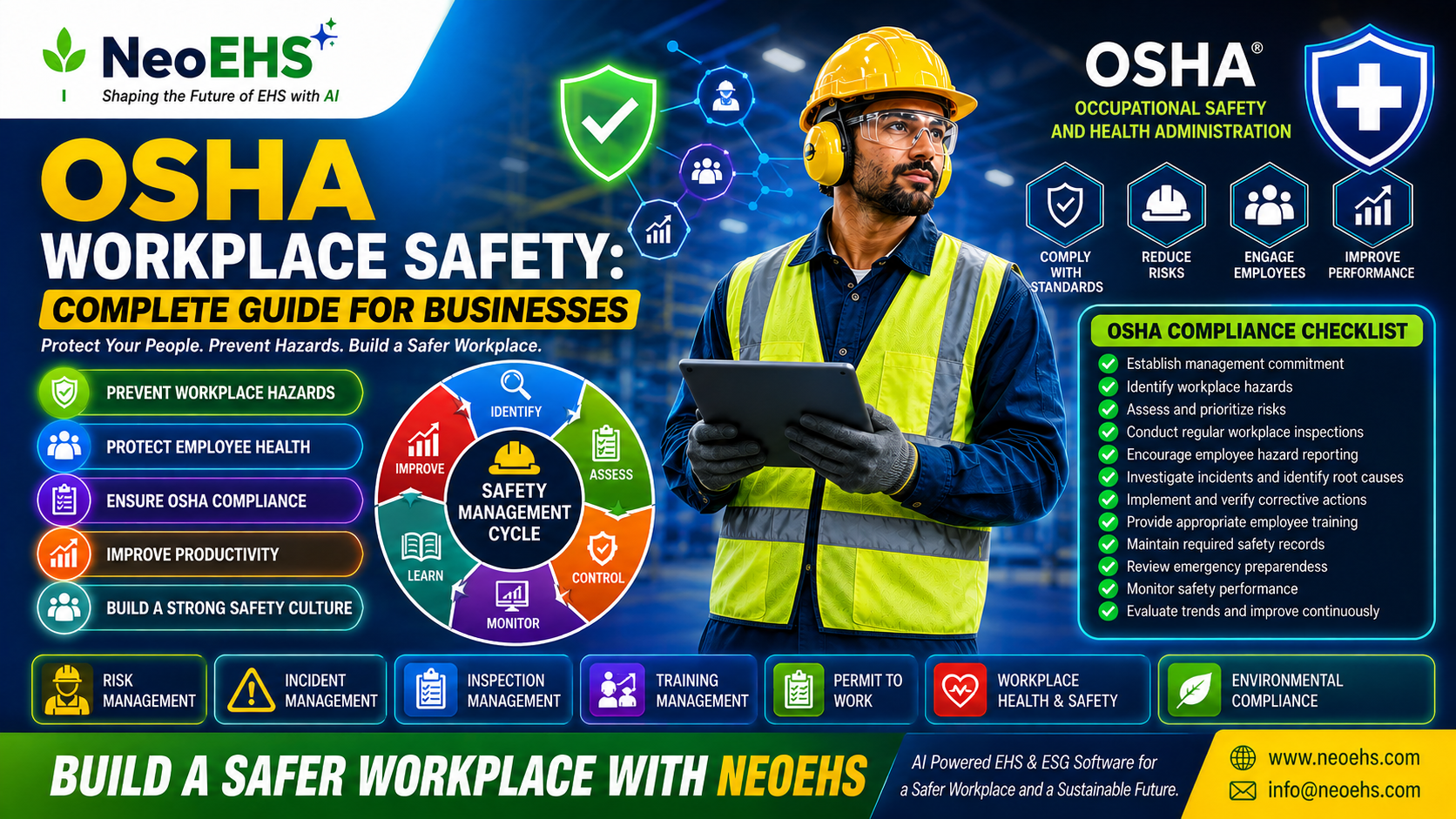
OSHA workplace safety guide for businesses with digital EHS management with NeoEHS
OSHA Workplace Safety: Complete Guide for Businesses
Workplace safety is more than wearing personal protective equipment or putting safety signs around a facility. For businesses operating in the United States, an effective occupational safety and health program requires a proactive approach to identifying hazards, controlling risks, training workers, investigating incidents, maintaining records, and continuously improving safety performance.
The Occupational Safety and Health Administration (OSHA) provides standards, guidance, and resources designed to help employers provide safe and healthful workplaces. OSHA's recommended practices emphasize that safety should be managed proactively rather than waiting for an injury, illness, or inspection to reveal a problem.
For modern organizations, digital EHS platforms such as NeoEHS can help bring safety activities, inspections, incidents, risks, corrective actions, training, permits, audits, and compliance information into one connected environment.
What Is OSHA Workplace Safety?
OSHA workplace safety refers to the systems, practices, procedures, and controls businesses use to protect employees from workplace hazards while meeting applicable occupational safety and health requirements.
OSHA covers most private-sector employers and workers in the United States through Federal OSHA or OSHA-approved state programs, although certain workplaces and hazards may fall under other federal agencies or specific jurisdictional requirements.
An effective workplace safety program should therefore combine:
- Hazard identification
- Risk assessment
- Workplace inspections
- Incident and near-miss reporting
- Corrective action management
- Safety training
- Emergency preparedness
- Personal protective equipment management
- Safety documentation and records
- Worker participation
- Management leadership
- Continuous improvement
Why OSHA Compliance Matters for Businesses
OSHA compliance is not simply a regulatory exercise. A well-managed safety program can help organizations prevent injuries and illnesses, improve operational performance, engage employees, and reduce avoidable costs.
OSHA notes that effective safety and health programs can help businesses prevent workplace injuries and illnesses, improve compliance, engage workers, enhance social responsibility, and improve productivity and operations.
For business leaders, workplace safety should therefore be viewed as part of operational excellence rather than as a separate administrative function.
Key Elements of an Effective OSHA Workplace Safety Program
1. Management Leadership
A strong safety culture starts with leadership.
Management should establish clear safety expectations, allocate appropriate resources, define responsibilities, communicate safety priorities, and demonstrate commitment through its own actions.
OSHA identifies management leadership as a fundamental component of an effective safety and health program.
With NeoEHS, management teams can use centralized dashboards and safety performance information to monitor important EHS activities and make more informed decisions.
2. Worker Participation
Employees are often closest to the hazards associated with day-to-day operations. Their knowledge can therefore be extremely valuable when identifying hazards and developing practical controls.
OSHA recommends meaningful worker participation in activities such as hazard analysis, inspections, incident investigations, training, safety procedures, and program improvement.
A modern safety management platform can make this participation easier by allowing employees to report:
- Unsafe conditions
- Hazards
- Near misses
- Safety observations
- Incidents
- Environmental concerns
- Corrective-action requirements
3. Hazard Identification and Risk Assessment
You cannot effectively control a hazard that has not been identified.
OSHA recommends an ongoing process for identifying and assessing hazards. This can include workplace inspections, reviewing previous incidents, investigating near misses, analyzing job hazards, reviewing equipment and chemical information, and involving workers in the process.
Businesses should consider hazards such as:
- Electrical hazards
- Fire hazards
- Chemical exposure
- Machinery hazards
- Falls from height
- Confined spaces
- Ergonomic risks
- Noise
- Heat exposure
- Vehicle and traffic risks
- Slips, trips, and falls
- Workplace violence
- Environmental and occupational health hazards
NeoEHS can help organizations digitize hazard identification, risk assessment, action tracking, and follow-up.
4. Workplace Inspections
Regular workplace inspections help organizations identify unsafe conditions before they result in incidents.
Inspections can cover:
- Production areas
- Warehouses
- Equipment
- Machinery
- Electrical systems
- Emergency equipment
- Fire protection
- Housekeeping
- Material storage
- Contractor activities
- PPE compliance
- Work practices
OSHA recommends documenting inspections and involving workers in identifying hazards and verifying that corrective actions are completed.
5. Incident and Near-Miss Management
An incident should not be treated simply as an event to record and close.
Organizations should investigate what happened, identify contributing factors and root causes, determine corrective actions, and use the findings to prevent recurrence.
Near misses are equally valuable because they can reveal weaknesses before someone is injured.
With digital incident management, businesses can centralize:
- Incident reporting
- Near-miss reporting
- Investigation
- Root-cause analysis
- Corrective actions
- Approvals
- Evidence and attachments
- Trend analysis
- Management reporting
6. Safety Training
Employees need appropriate information, knowledge, and skills to perform their work safely.
A workplace safety training program may include:
- New employee orientation
- Job-specific safety training
- Equipment training
- Emergency response
- PPE training
- Hazard communication
- Refresher training
- Contractor training
- Toolbox talks
- Competency assessments
Digital EHS software can help organizations track training requirements, employee participation, competency, expiry dates, and training records.
7. Hazard Prevention and Control
Identifying a hazard is only the beginning. Businesses must take appropriate steps to eliminate or control it.
Controls should be selected based on the nature and severity of the hazard and the level of worker exposure. OSHA's recommended practices emphasize identifying hazards, prioritizing them, and implementing appropriate controls.
Businesses should monitor whether corrective actions are:
- Assigned
- Prioritized
- Implemented
- Verified
- Closed
- Effective
8. Emergency Preparedness
Every organization should understand the emergencies that could affect its operations and establish appropriate response procedures.
Depending on the workplace, emergency planning may address:
- Fire
- Chemical spills
- Equipment failure
- Severe weather
- Medical emergencies
- Evacuation
- Natural disasters
- Security incidents
- Industrial emergencies
Training, drills, communication, emergency equipment, and clearly defined responsibilities are important parts of preparedness.
OSHA Recordkeeping and Safety Documentation
Safety documentation provides businesses with evidence of activities, trends, actions, and performance.
Depending on the applicable requirements, organizations may need to manage information related to injuries, illnesses, incidents, inspections, training, exposure monitoring, and other safety activities.
OSHA provides specific recordkeeping requirements and resources, so businesses should determine which requirements apply to their operations rather than relying on a generic recordkeeping process.
A centralized EHS platform can help reduce fragmented spreadsheets and disconnected records by maintaining safety information in a structured digital environment.
How Technology Can Improve OSHA Safety Management
Traditional safety management often relies on spreadsheets, paper forms, emails, disconnected systems, and manual follow-ups.
Digital EHS management can provide a more connected approach.
NeoEHS can help businesses manage:
- Risk Management
- Hazard Management
- Incident Management
- Inspection Management
- Audit Management
- Corrective Actions
- Permit to Work
- Training Management
- Emergency Management
- Chemical Management
- PPE Management
- Contractor Safety
- Safety Observations
- Compliance Management
- Environmental Management
- Safety Dashboards
- AI-powered analytics
By connecting these activities, organizations can move from reactive safety management toward more proactive risk management.
AI-Powered OSHA Safety Management
Artificial intelligence can further enhance EHS management by helping organizations identify patterns within large volumes of safety data.
For example, AI-powered EHS systems can support:
- Predictive risk analytics
- Intelligent incident analysis
- Automated document analysis
- AI-assisted safety observations
- Trend identification
- Risk prioritization
- Automated alerts
- Computer vision-based safety monitoring
- Intelligent reporting
- Data-driven safety decision-making
The objective is not to replace safety professionals. Instead, AI can help EHS teams process information faster and focus their expertise on the risks that require human judgment and action.
OSHA Compliance: A Continuous Process
OSHA compliance should not be treated as a once-a-year activity.
Workplaces change continuously. New equipment, materials, contractors, processes, employees, production targets, and environmental conditions can introduce new hazards.
A mature safety program therefore follows a continuous cycle:
Identify → Assess → Control → Monitor → Learn → Improve
This approach aligns well with OSHA's emphasis on proactive hazard identification, worker participation, management leadership, prevention and control, and continuous improvement.
How NeoEHS Supports Modern Workplace Safety
NeoEHS is an AI-powered EHS and ESG software solution designed to help organizations manage workplace safety, environmental performance, compliance, risks, incidents, inspections, audits, training, and other EHS processes from a connected digital platform.
Instead of managing safety information across multiple spreadsheets and disconnected applications, organizations can centralize EHS data and create greater visibility across operations.
NeoEHS combines EHS management capabilities with AI-powered features, analytics, automation, and digital workflows to help organizations build a more proactive safety management system.
OSHA Workplace Safety Checklist for Businesses
Businesses can use the following high-level checklist as a starting point:
-
Establish management commitment to workplace safety
-
Define safety responsibilities and objectives
-
Identify workplace hazards
-
Assess and prioritize risks
-
Conduct regular workplace inspections
-
Encourage employee hazard and near-miss reporting
-
Investigate incidents and identify root causes
-
Implement and verify corrective actions
-
Provide appropriate employee training
-
Maintain required safety records
-
Review emergency preparedness
-
Monitor safety performance
-
Evaluate trends and recurring hazards
-
Review and continuously improve the safety program
This checklist is a practical starting point and should not be treated as a substitute for reviewing the OSHA requirements applicable to a specific business, industry, workplace, or jurisdiction.
Frequently Asked Questions
What is OSHA workplace safety?
OSHA workplace safety refers to the practices, programs, controls, and processes used to protect workers from occupational hazards while meeting applicable OSHA requirements.
What are the main components of an OSHA safety program?
Important components include management leadership, worker participation, hazard identification, hazard prevention and control, workplace inspections, incident management, safety training, emergency preparedness, and continuous improvement.
How can businesses improve OSHA compliance?
Businesses can improve compliance by understanding applicable OSHA requirements, identifying workplace hazards, implementing appropriate controls, training workers, maintaining required records, investigating incidents, conducting inspections, and continuously evaluating safety performance.
Can EHS software help with OSHA compliance?
Yes. EHS software can help organizations organize safety activities such as inspections, incidents, corrective actions, training, audits, risk assessments, compliance tasks, documentation, and reporting. However, software itself does not guarantee regulatory compliance.
How does AI improve workplace safety?
AI can help organizations analyze safety data, identify trends, prioritize risks, automate workflows, identify patterns in incidents and observations, and provide decision-support insights to EHS teams.
Is NeoEHS an OSHA compliance certification?
No. NeoEHS is an EHS and ESG software platform. It can help organizations manage and document safety and compliance processes, but using software does not itself constitute OSHA certification or guarantee compliance.
Final Thoughts
Workplace safety is ultimately about people.
For businesses, OSHA compliance should not be viewed simply as a regulatory obligation. A proactive safety program can help organizations identify hazards earlier, engage workers, improve operational visibility, reduce preventable incidents, and create a stronger safety culture.
As EHS management becomes increasingly digital, AI-powered platforms such as NeoEHS can help organizations move from fragmented and reactive safety processes toward connected, data-driven, and proactive workplace safety management.
Build a safer workplace. Manage risk intelligently. Empower your EHS team with NeoEHS.
#OSHAWorkplaceSafety #OSHACompliance #WorkplaceSafety #EHSManagement #OccupationalSafety #SafetyManagementSystem #WorkplaceHazardManagement #SafetyCompliance #EHSSoftware #AIPoweredEHS #NeoEHS #WorkplaceRiskManagement
#OSHA #WorkplaceSafety #OSHACompliance #EHSSoftware #EHSManagement #SafetyManagement #OccupationalSafety #WorkplaceHealthAndSafety #RiskManagement #SafetyCulture #AIinSafety #DigitalEHS #NeoEHS #WorkplaceRisk #SafetyTechnology
READ MORE ❯
How AI Is Transforming Safety Management in Manufacturing
AI-Powered Safety Management for Manufacturing
For decades, workplace safety has largely been about learning from what has already happened.
A safety incident occurs. An investigation follows. Corrective actions are identified. Inspections are carried out. Reports are prepared. Safety teams then work to make sure the same problem does not happen again.
These activities remain essential to effective EHS management. But technology is changing what organizations can do with their safety data.
Today, organizations are asking a much more proactive question:
What if we could identify increasing workplace risk before it becomes an incident?
This is where predictive analytics in EHS is becoming increasingly important.
By combining artificial intelligence (AI), machine learning, historical EHS data, real-time safety information and operational data, modern AI powered EHS software can identify patterns and warning signals that may indicate an increasing level of workplace risk.
Instead of only asking "What happened?", organizations can begin asking:
"What could happen next, and what can we do about it now?"
For manufacturing organizations in particular, this represents an important shift from reactive safety management to proactive and predictive safety management.
What Is Predictive Analytics in EHS?
Predictive analytics in EHS is the use of historical and real-time environmental, health and safety data together with artificial intelligence and machine learning to identify patterns, trends and risk indicators that may be associated with future workplace incidents.
Traditional EHS software typically helps organizations understand:
- What incidents occurred?
- Where did they happen?
- Which hazards were reported?
- How many inspections were completed?
- Which corrective actions are overdue?
- How many safety observations were recorded?
These are important questions.
However, predictive EHS analytics takes the next step by helping organizations explore:
- Where is workplace risk increasing?
- Which activities require additional controls?
- Which departments or locations are showing unusual risk patterns?
- Which hazards are appearing repeatedly?
- Which corrective actions are associated with recurring problems?
- Which safety indicators require immediate attention?
This makes predictive safety analytics an important capability for organizations looking to build a modern, data-driven EHS management system.
Why Manufacturing Needs Predictive Safety Management
Manufacturing environments can be extremely complex.
Employees may work around heavy machinery, automated production systems, electrical equipment, chemicals, vehicles, pressure systems and high-temperature processes—all within the same facility.
A manufacturing organization may need to manage risks associated with:
- Heavy machinery
- Automated equipment
- Forklifts and mobile equipment
- Electrical systems
- Hazardous chemicals
- Confined spaces
- Work at height
- High-temperature operations
- Pressure systems
- Maintenance activities
- Contractors and temporary workers
As operations expand, the volume of safety data also increases.
EHS teams may be dealing with thousands of inspections, observations, permits, training records, incidents, audits and corrective actions.
Reviewing all of this information manually can be difficult and time-consuming.
This is why AI-powered safety management for manufacturing is becoming an important part of digital transformation.
AI can process large volumes of information, identify relationships between different data points and highlight patterns that may not be obvious during manual analysis.
The objective is not to replace EHS professionals.
It is to give them better information so they can make better decisions.
How AI Predicts Workplace Risks
An AI powered EHS software platform can bring together information from multiple safety and operational sources.
For example, an organization may have years of data covering:
- Workplace incidents
- Near misses
- Safety observations
- Hazard reports
- Risk assessments
- Inspections
- Audits
- Permit to Work activities
- Training records
- Equipment information
- Environmental conditions
- Corrective actions
- Contractor activities
When this information is connected, AI and machine learning can analyze historical patterns and identify potential risk signals.
Let's look at some practical examples.
1. AI-Powered Historical Incident Analysis
Past incidents contain valuable information.
An organization may know that an incident occurred, but the real value comes from understanding whether similar incidents are happening under similar circumstances.
AI in workplace safety can analyze incident information across multiple dimensions, including:
- Location
- Department
- Equipment
- Shift
- Job activity
- Employee role
- Incident type
- Hazard category
- Root cause
- Environmental conditions
For example, imagine that several minor incidents and near misses have occurred during maintenance activities on a particular production line.
A traditional report may simply list those incidents.
A predictive analytics system can identify the recurring relationship between the maintenance activity, equipment, shift and hazard category and highlight the area for further investigation.
This gives EHS teams an opportunity to act before the pattern develops into a serious incident.
2. AI-Based Safety Observation Analysis
Safety observations are one of the most valuable sources of leading-indicator data.
However, a large manufacturing organization can generate thousands of safety observations every month.
Manually reviewing every observation and identifying recurring patterns is difficult.
This is where AI in workplace safety can provide significant value.
AI can classify and analyze safety observations to identify trends involving:
- PPE non-compliance
- Unsafe machine operation
- Poor housekeeping
- Blocked emergency exits
- Unsafe lifting practices
- Electrical hazards
- Working-at-height risks
- Unsafe access
- Repeated procedural violations
For example, if observations relating to PPE non-compliance begin increasing in one department, the system can highlight the trend.
The EHS team can then investigate the underlying cause and take preventive action.
3. Near-Miss Pattern Analysis
A near miss is more than an event that "almost caused an accident."
It can be an early warning signal.
A modern AI safety management software platform can analyze near misses together with incidents, observations, hazards and corrective actions.
Suppose the same hazard appears repeatedly in near-miss reports before incidents occur.
AI can identify the relationship and highlight it as a potential risk pattern.
This allows organizations to investigate the underlying hazard before it results in a more serious event.
Predictive analytics therefore helps turn near-miss data into actionable safety intelligence.
4. Predictive Risk Scoring
Another important application of predictive EHS analytics is dynamic risk scoring.
Instead of relying only on a static risk assessment, AI can consider multiple data points when evaluating changing risk conditions.
For example:
Risk Score = Historical Risk + Current Observations + Incident Trends + Operational Factors + Compliance Indicators
The purpose is not simply to create another number on an EHS dashboard.
The real objective is to help safety professionals understand:
Where does the organization need to focus its attention first?
A dynamic risk score can help EHS teams prioritize high-risk locations, activities, processes and hazards.
AI-Powered Safety Management for Manufacturing
Manufacturing companies generate large volumes of operational and safety information.
A modern manufacturing EHS software platform can connect information across multiple EHS processes, including:
- Risk Management
- Hazard Management
- Incident Management
- Safety Observations
- Inspection Management
- Audit Management
- Permit Management
- Training Management
- Emergency Management
- Compliance Management
- Environmental Management
- Corrective and Preventive Actions
When these functions operate as connected systems instead of isolated applications, organizations gain a more complete picture of workplace risk.
AI can then analyze this connected information to support manufacturing risk management and proactive safety decision-making.
From Reactive Safety to Predictive Safety
Traditional safety management often follows a familiar cycle:
Incident → Investigation → Corrective Action → Monitoring
Predictive safety introduces another layer:
Data → Pattern Detection → Risk Prediction → Preventive Action → Incident Prevention
This is one of the biggest changes enabled by artificial intelligence in EHS.
The objective is not to wait for an accident before learning from the data.
The objective is to recognize warning signals early enough to take action.
That is the difference between simply managing incidents and actively managing risk.
Predictive Analytics and Risk Management
Risk assessment is a fundamental part of workplace safety.
However, risk assessments can become outdated when workplace conditions, processes, equipment or employee activities change.
This is where AI based risk assessment in manufacturing can add another layer of intelligence.
For example, if a particular hazard starts appearing more frequently across safety observations, inspections and incidents, an AI-powered EHS platform can identify the changing trend.
EHS professionals can then review:
- Existing risk assessments
- Control measures
- Training requirements
- Inspection frequency
- PPE requirements
- Work procedures
- Permit requirements
This creates a more dynamic approach to risk management in manufacturing, where risk information can continuously evolve with workplace conditions.
AI Can Identify Leading Indicators
One of the most valuable opportunities presented by predictive analytics is the ability to move beyond traditional lagging indicators.
Organizations commonly monitor metrics such as:
- Total Recordable Incident Rate
- Lost Time Injury Frequency Rate
- Number of incidents
- Lost workdays
These metrics are important, but they describe events that have already happened.
Predictive EHS analytics can also examine leading indicators such as:
- Increasing hazard reports
- Repeated safety observations
- Declining inspection performance
- Overdue corrective actions
- Training gaps
- Repeated Permit to Work violations
- Increasing equipment-related observations
- Contractor safety trends
These signals may provide an earlier indication that workplace risk is changing.
By combining leading and lagging indicators, organizations can develop a more complete understanding of their safety performance.
Predictive Analytics in NeoEHS
NeoEHS brings together modern EHS technologies to help organizations move toward intelligent, proactive and data-driven safety management.
The AI powered EHS software approach of NeoEHS is designed to connect EHS information and provide intelligent insights that can help safety teams identify patterns, prioritize risks and take preventive action.
The NeoEHS ecosystem can support areas such as:
- AI-Powered Risk Management
- Incident Management
- Hazard Management
- Safety Observations
- Predictive Analytics
- Inspection Management
- Audit Management
- Permit to Work
- Training Management
- Compliance Management
- Environmental Management
- Waste Management
- Carbon Emission Management
- IoT Integration
- Computer Vision
- OCR Intelligence
- Intelligent EHS Dashboards
By connecting these capabilities, organizations can move toward a more integrated digital EHS management system.
Computer Vision and Predictive Workplace Safety
Predictive analytics becomes even more powerful when combined with AI computer vision.
AI-enabled video analytics can analyze CCTV and other visual data to help identify potentially unsafe workplace conditions.
Depending on the application, computer vision can assist in identifying:
- Missing PPE
- Unsafe access
- Restricted-area entry
- Unsafe proximity to machinery
- Crowd or congestion risks
- Unsafe workplace conditions
This creates another stream of real-time information that can contribute to an overall AI workplace safety strategy.
Instead of relying entirely on periodic inspections, organizations can supplement human observations with continuous digital monitoring.
IoT and Real-Time EHS Data
The growth of connected devices is also changing workplace safety management.
IoT-based EHS solutions can collect real-time information from connected workplace technologies such as:
- Smart helmets
- Environmental sensors
- Gas detection systems
- Equipment sensors
- Location tracking systems
- Wearable safety devices
- Air-quality monitoring systems
When IoT data is integrated with EHS software, organizations can combine real-time workplace information with historical safety data.
This creates opportunities for:
- Real-time risk monitoring
- Automated alerts
- Predictive safety analytics
- Environmental monitoring
- Connected worker safety
- Data-driven EHS decision-making
The result is a more connected approach to digital workplace safety management.
Benefits of Predictive Analytics in EHS
Implementing predictive analytics can help organizations strengthen several areas of EHS performance.
Proactive Risk Identification
Identify emerging patterns that may indicate increasing workplace risk before they develop into serious incidents.
Better EHS Decision-Making
Use data-driven insights to support decisions instead of relying exclusively on manual reporting and individual interpretation.
Faster Risk Prioritization
Help EHS teams focus their resources on the activities, locations and hazards requiring the greatest attention.
Improved Incident Prevention
Analyze historical incidents, near misses and safety observations to identify recurring risk patterns.
Stronger Manufacturing Safety Management
Connect operational and safety information to create a more complete picture of manufacturing risk.
Reduced Manual Data Analysis
AI can process large volumes of EHS information faster than traditional manual analysis.
Improved Safety Culture
When organizations consistently identify hazards and address risks proactively, preventive safety can become part of the organizational culture.
The Future of AI in Workplace Safety
The future of workplace safety is not about replacing EHS professionals with artificial intelligence.
It is about giving EHS professionals better tools.
AI can process enormous volumes of data, identify patterns and highlight potential risks.
EHS professionals bring something equally important: human experience.
They understand the workplace, employees, processes, operational realities and practical control measures required to manage risk.
The combination of human safety expertise and artificial intelligence can therefore create a stronger approach to workplace risk management.
The best EHS technology should support people—not replace them.
Why Predictive EHS Analytics Matters for the Future
As organizations become more connected and generate more safety data, traditional manual analysis will become increasingly difficult.
The future of EHS management software will increasingly involve:
- Artificial intelligence
- Predictive analytics
- Machine learning
- Computer vision
- IoT integration
- Real-time monitoring
- Intelligent automation
- Data-driven risk management
- Connected worker technologies
Organizations that can turn their EHS data into actionable intelligence will be better positioned to identify emerging risks and improve safety performance.
Final Thoughts
Predictive analytics is changing how organizations think about workplace safety.
Instead of waiting for an incident to reveal a weakness, organizations can use historical data, real-time information and artificial intelligence to identify potential risk patterns earlier.
For manufacturing organizations, this can be particularly valuable because of the complexity of industrial operations.
With AI powered EHS software, predictive analytics, computer vision, IoT integration and intelligent risk management, organizations can build a more proactive approach to workplace safety.
The future of EHS is not simply about recording what happened.
It is about understanding what could happen next—and taking action before it does.
NeoEHS is helping organizations move toward this future with AI-powered EHS and ESG software designed for a safer workplace and a more sustainable future.
Frequently Asked Questions
What is predictive analytics in EHS?
Predictive analytics in EHS uses historical and real-time safety data, artificial intelligence and machine learning to identify patterns and indicators that may signal future workplace risks.
How does AI predict workplace risks?
AI can analyze information such as incidents, near misses, safety observations, inspections, hazards, risk assessments, training records and other EHS data to identify patterns associated with changing risk levels.
How can AI improve manufacturing safety?
AI can help manufacturing organizations identify recurring hazards, prioritize risks, analyze safety observations, monitor leading indicators and support proactive incident prevention.
What is AI powered EHS software?
AI powered EHS software combines traditional Environmental, Health and Safety management capabilities with artificial intelligence, predictive analytics, automation and intelligent data analysis.
Can predictive analytics prevent workplace accidents?
Predictive analytics cannot guarantee that an accident will be prevented. However, it can help identify potential risk patterns and warning signals earlier, giving organizations an opportunity to take preventive action.
Why is predictive safety analytics important?
Predictive safety analytics helps organizations move from reactive safety management toward proactive risk identification, continuous monitoring and data-driven EHS decision-making.
Ready to Move from Reactive Safety to Predictive EHS?
Discover how NeoEHS can help your organization use AI, predictive analytics, intelligent automation and connected EHS data to build a safer workplace.
Explore AI-Powered EHS with NeoEHS.
Website: www.neoehs.com
READ MORE ❯
Predictive Analytics in EHS: How AI Predicts Workplace Risks Before They Happen ⭐ Best overall
From Reactive to Predictive Safety: How AI Is Transforming EHS Risk Management
For many years, workplace safety has followed a familiar pattern.
An incident happens. The EHS team investigates it. The root cause is identified. Corrective actions are assigned, reports are prepared, and everyone works to make sure the same thing does not happen again.
That process is important. But there is one question that every safety professional would like to answer earlier:
What if we could identify the warning signs before the incident happens?
This is where Predictive Analytics in EHS is beginning to change the way organizations think about workplace safety.
Modern EHS platforms can bring together information from incidents, near misses, safety observations, inspections, audits, permits, training records, equipment, IoT sensors, environmental conditions and other operational systems.
AI and machine learning can then look for patterns across this information that may be difficult to identify manually.
Instead of asking only:
“What went wrong?”
EHS teams can start asking:
“Where is risk increasing, and what can we do about it now?”
That is the real opportunity behind AI-powered workplace safety.
NeoEHS brings these capabilities together to help organizations move from reactive incident management toward proactive and predictive risk management.
What Is Predictive Analytics in EHS?
Predictive analytics in EHS is the use of artificial intelligence, machine learning, historical safety data and real-time operational information to identify patterns that may indicate an increased likelihood of workplace risk.
Traditional EHS software is very good at recording what has already happened.
It can capture:
- Incidents
- Near misses
- Hazards
- Safety observations
- Inspections
- Audits
- Training records
- Permit violations
- Equipment problems
- Environmental measurements
- Corrective actions
But predictive analytics takes the next step.
Instead of simply storing the information, AI can analyze relationships between different data points and identify patterns that may otherwise remain hidden.
For example, imagine a site where:
Long working hours + high-risk activity + training gaps + maintenance delays + repeated near misses
are appearing together.
Each factor may look manageable on its own.
Together, however, they may indicate a significantly higher level of risk.
This is where AI-powered EHS software can provide valuable early insight to the safety team.
Why Traditional EHS Management Is Not Enough
Traditional safety management is not going away. Incident investigations, inspections, audits, risk assessments and corrective actions remain essential.
The challenge is that much of traditional EHS management is based on what has already happened.
The conventional cycle looks like this:
Incident → Investigation → Corrective Action → Preventive Action
A more proactive approach looks different:
Data → Risk Detection → Prediction → Intervention → Prevention
This is one of the biggest changes that AI in EHS can bring to an organization.
Rather than relying mainly on lagging indicators such as injuries and incidents, organizations can use leading indicators to understand whether safety conditions are improving or deteriorating.
The goal is not to replace traditional EHS processes.
It is to make them smarter.
How Does AI Predict Workplace Risks?
AI does not predict workplace incidents through guesswork.
It analyzes large amounts of structured and unstructured information to identify relationships, trends, anomalies and recurring risk patterns.
An AI-powered EHS system can potentially bring information together from several different sources.
1. Historical Incident Data
Past incidents contain valuable information about organizational risk.
AI can analyze factors such as:
- Incident frequency
- Incident type
- Location
- Department
- Activity
- Shift
- Equipment involved
- Root cause
- Severity
- Corrective actions
- Recurrence
Over time, these patterns can help identify areas where risk may be increasing.
For example, if similar incidents repeatedly occur during a particular activity, shift or location, that pattern deserves closer attention.
2. Near Misses and Safety Observations
Near misses are often some of the most valuable leading indicators in an EHS program.
A serious incident may be preceded by many smaller warning signs.
Consider a situation where safety observations repeatedly show:
- Unsafe work-at-height practices
- PPE non-compliance
- The same project location
- The same contractor
- Similar observations over several weeks
Individually, these observations may appear to be minor.
When AI analyzes them together, however, they may reveal an emerging risk pattern.
This is one of the practical applications of predictive safety analytics.
3. Inspection and Audit Data
Inspections and audits generate a large amount of safety information.
But simply recording findings is not enough.
AI can help identify:
- Frequently repeated findings
- Overdue corrective actions
- High-risk locations
- Recurring equipment deficiencies
- Declining compliance
- Repeated contractor issues
- Areas where corrective actions are not producing sustainable improvement
This allows EHS teams to spend more time addressing the areas that require attention instead of manually searching through thousands of records.
4. Permit-to-Work Data
Permit-to-Work systems contain some of the most important information about high-risk activities.
This includes:
- Hot Work Permits
- Confined Space Entry Permits
- Work-at-Height Permits
- Electrical Work Permits
- Excavation Permits
- LOTO activities
- Lifting Permits
- Permit deviations
- Approval patterns
When permit information is combined with incidents, observations, training and equipment data, it becomes a powerful source for EHS risk management.
For example, suppose a site begins showing:
More permit deviations + increasing near misses + overdue maintenance + competency gaps
AI can recognize that these signals are appearing together and highlight the situation for further investigation.
The system is not saying that an incident will definitely happen.
It is saying that the risk profile has changed.
That distinction is important.
5. Training and Competency Data
People are at the heart of workplace safety.
Employees working on high-risk activities need the right training, certifications and competencies.
AI can analyze whether workers involved in particular activities have:
- Completed mandatory training
- Valid certifications
- Expired qualifications
- Repeated training gaps
- Required competencies
- Relevant experience
This can help organizations identify competency-related workplace risks before work begins.
For example, if a high-risk activity is scheduled and several assigned workers have expired certifications, the EHS system can flag the situation before the task starts.
6. Equipment and IoT Data
The growth of connected equipment and IoT technology is creating new opportunities for AI workplace safety.
Modern organizations can collect real-time information such as:
- Temperature
- Gas levels
- Noise
- Air quality
- Equipment vibration
- Pressure
- Machine operating conditions
- Worker location
- Environmental conditions
AI can combine these signals with historical EHS information.
This creates a connection between operational data and safety risk management that was difficult to achieve with traditional systems.
For example, abnormal equipment vibration combined with a history of machinery-related incidents could indicate that an asset requires closer inspection.
From EHS Data to Safety Intelligence
One of the biggest advantages of predictive analytics is the ability to connect information that traditionally exists in separate systems.
Consider a construction project experiencing:
- Increasing safety observations
- Several overdue corrective actions
- High employee overtime
- Multiple recent near misses
- Increased work-at-height activity
- Expiring worker certifications
- Unfavorable weather conditions
A traditional dashboard might show these as separate numbers.
An AI-powered EHS platform can look at the bigger picture.
The combined signals may indicate:
Elevated work-at-height risk.
That gives the EHS team an opportunity to investigate and intervene before the situation becomes an incident.
This is the difference between data reporting and risk intelligence.
Leading Indicators vs. Lagging Indicators
To understand predictive EHS, it is useful to understand the difference between leading and lagging indicators.
Lagging Indicators
Lagging indicators tell us what has already happened.
Examples include:
- Lost-time injuries
- Recordable incidents
- Fatalities
- Property damage
- Environmental incidents
- Occupational illnesses
These metrics remain important.
But they provide limited warning before an event occurs.
Leading Indicators
Leading indicators provide information about conditions that may influence future safety performance.
Examples include:
- Safety observations
- Near misses
- Training completion
- Inspection findings
- Corrective-action closure
- Permit compliance
- Risk assessments
- Preventive maintenance
- Employee engagement
- Unsafe behavior trends
AI can analyze both leading and lagging indicators to understand relationships between them.
The objective is not to abandon traditional safety metrics.
It is to use them more intelligently.
How NeoEHS Uses AI-Powered Predictive Analytics
NeoEHS is designed to bring multiple EHS data sources together and turn them into actionable safety intelligence.
The platform can connect information across areas such as:
- Incident Management
- Risk Management
- Hazard Management
- Inspection Management
- Audit Management
- Permit Management
- Training Management
- Compliance Management
- Environmental Management
- Emergency Management
- PPE Management
- Machinery Management
This creates a connected EHS data environment.
Once the information is connected, AI can identify relationships between different datasets and highlight emerging patterns.
Instead of asking an EHS manager to manually review thousands of records, the system can help direct attention toward areas where the risk signals are becoming stronger.
Predictive Risk Scoring
One of the practical applications of predictive risk management is dynamic risk scoring.
Imagine a project where:
| Risk Factor | Current Signal |
|---|---|
| Near Misses | Increasing |
| Safety Observations | Increasing |
| Corrective Actions | Overdue |
| Training Compliance | Declining |
| Permit Deviations | Increasing |
| Equipment Condition | Deteriorating |
| Environmental Conditions | Unfavorable |
Looking at these factors individually may not tell the whole story.
AI can analyze the combined signals and generate a more meaningful view of the changing risk profile.
This allows EHS leaders to prioritize resources based on risk intelligence rather than simply the number of open records.
AI-Powered Early Warning for EHS Teams
The real value of predictive analytics is not another dashboard.
It is the ability to provide an early warning for workplace safety risks.
Imagine an EHS manager receiving an alert:
“Risk levels for confined-space activities have increased at Site B based on recent observations, permit deviations, equipment conditions and training gaps.”
The EHS team can then investigate.
Depending on the situation, preventive actions might include:
- Reviewing the permit
- Reassessing the risk
- Verifying worker competency
- Inspecting equipment
- Increasing supervision
- Conducting a toolbox meeting
- Strengthening control measures
- Temporarily stopping the activity
The objective is simple:
Intervene before the incident.
Predictive Analytics Across High-Risk Industries
Predictive analytics can be especially valuable in industries where multiple risk factors interact.
Construction
AI can identify patterns involving:
- Work at height
- Excavation
- Lifting operations
- Contractor safety
- Equipment usage
- Permit compliance
- Site observations
Manufacturing
Predictive safety analytics can help identify:
- Machinery-related risks
- Maintenance-related hazards
- Unsafe behaviors
- Production-related safety patterns
- Chemical exposure risks
Mining
AI can analyze:
- Equipment conditions
- Worker observations
- Environmental conditions
- Vehicle movement
- Fatigue-related indicators
- High-risk operations
Oil & Gas
Predictive analytics can support:
- Process safety
- Permit-to-work management
- Confined-space operations
- Hot work
- LOTO
- Gas monitoring
- Equipment integrity
Power & Energy
AI can help identify patterns involving:
- Electrical work
- Equipment failures
- Isolation procedures
- Permit deviations
- Maintenance activities
- Contractor safety
Ports & Maritime
Predictive models can analyze:
- Vehicle movement
- Lifting operations
- Cargo handling
- Weather conditions
- Equipment risks
- Worker observations
The underlying principle remains the same:
Connect the data, identify the pattern and act before the risk becomes an incident.
AI and Computer Vision: Continuous Safety Monitoring
Predictive analytics becomes even more powerful when combined with AI-based computer vision.
CCTV cameras and video analytics can potentially identify conditions such as:
- Missing PPE
- Unsafe access
- Restricted-area entry
- Unsafe proximity to machinery
- Unsafe work practices
- Vehicle-pedestrian interaction
- Potential fall-risk situations
Traditional inspections provide snapshots of workplace conditions.
Computer vision can support a more continuous view of critical areas.
When video analytics is combined with incidents, observations, permits and other EHS information, organizations can build a broader picture of workplace risk.
This combination of computer vision and predictive safety analytics represents an important direction for the future of EHS technology.
Predictive Analytics and Agentic AI
The next evolution of EHS technology is moving beyond analytics toward Agentic AI.
Traditional analytics may tell an EHS professional:
“Risk is increasing.”
More advanced AI systems can potentially help answer:
“Why is the risk increasing?”
“Which risk should be addressed first?”
“Who needs to know?”
“Which controls should be reviewed?”
“What preventive action should be considered?”
This creates a more intelligent EHS workflow where AI supports the safety team throughout the decision-making process.
However, there is an important principle that should never be forgotten:
AI should support EHS professionals, not replace their judgment.
Safety decisions often require practical experience, site knowledge, professional expertise and human accountability.
AI can provide the intelligence.
People remain responsible for the decision.
From Reactive Safety to Predictive Safety
The evolution of EHS technology can be viewed in four stages.
Stage 1 — Reactive Safety
Incident happens → Investigate
Stage 2 — Preventive Safety
Identify hazards → Implement controls
Stage 3 — Proactive Safety
Analyze leading indicators → Identify emerging risks
Stage 4 — Predictive Safety
AI analyzes data → Identify elevated risk → Support preventive action
This is the direction in which modern AI-powered EHS software is evolving.
The objective is no longer simply to record what happened.
It is to understand what the available data is telling us about what could happen next.
Benefits of Predictive Analytics in EHS
Organizations implementing predictive analytics can potentially achieve several important benefits.
Earlier Risk Identification
AI can help identify changing risk patterns before they develop into incidents.
Better Safety Decisions
EHS leaders can make decisions using a broader view of available data instead of relying only on historical reports.
Smarter Resource Allocation
Safety teams can focus their time and resources on higher-risk locations, activities, projects and departments.
Reduced Recurring Incidents
AI can identify repeated patterns and highlight areas where existing corrective actions may not be solving the underlying problem.
Improved Compliance Visibility
Organizations can identify emerging compliance gaps earlier and take corrective action.
Real-Time Risk Visibility
Integration with mobile applications, IoT devices, sensors and other systems can provide a more current picture of workplace conditions.
Stronger Safety Culture
When employees see that near misses and observations are not simply recorded but actually used to prevent incidents, safety reporting becomes more meaningful.
Can AI Really Predict a Workplace Accident?
This is an important question.
Predictive analytics should not be misunderstood as a crystal ball.
AI cannot reliably tell an organization:
“An accident will happen tomorrow at 3:15 PM.”
That is not what predictive EHS analytics is designed to do.
Instead, AI identifies risk patterns, probabilities and changing conditions.
For example:
“This activity currently shows a higher risk profile based on historical incidents, recent observations, training gaps, equipment conditions and permit deviations.”
That information gives EHS professionals an opportunity to investigate and take action.
The objective is not perfect prediction.
The objective is:
Earlier intervention.
The Future of AI-Powered EHS
The future of workplace safety will increasingly depend on connected data and intelligent systems.
We are moving toward an ecosystem that brings together:
AI + Machine Learning + IoT + Computer Vision + Mobile Applications + Wearables + Digital Permits + Environmental Sensors + Predictive Analytics + Agentic AI
When these technologies work together, EHS software can become more than a system for recording information.
It can become an intelligent safety layer across the organization.
Instead of simply telling management what happened, the platform can help identify patterns, highlight emerging risks and support better preventive decisions.
Building a Predictive Safety Culture
Technology alone cannot create a safer workplace.
Even the most advanced AI in EHS solution depends on strong organizational foundations.
Organizations still need:
- Strong leadership commitment
- Employee participation
- Accurate EHS data
- Consistent reporting
- Effective risk assessments
- Timely corrective actions
- Competent EHS professionals
- Continuous improvement
AI becomes more valuable when these foundations are strong.
The better the quality of the data, the more useful predictive analytics can become.
In other words:
Better data → Better insights → Better decisions → Better prevention
Conclusion: The Future of Workplace Safety Is Predictive
Workplace safety is moving beyond reactive reporting toward predictive safety intelligence.
The organizations that lead this transformation will not only ask:
“How many incidents did we have?”
They will also ask:
“Where is risk increasing?”
“Why is it increasing?”
“What signals are we seeing today?”
“What could happen next?”
And most importantly:
“What can we do now to prevent it?”
That is the real promise of Predictive Analytics in EHS.
By combining AI, machine learning, historical EHS data, real-time operational information, IoT, computer vision and connected EHS workflows, organizations can turn safety data into meaningful risk intelligence.
NeoEHS is helping organizations move toward this future — from knowing what happened to understanding what could happen next.
NeoEHS — Shaping the Future of EHS With AI
Build a safer workplace with AI-powered EHS software, predictive risk management, intelligent safety insights and connected EHS management.
Learn more about NeoEHS:
www.neoehs.com
Frequently Asked Questions
What is predictive analytics in EHS?
Predictive analytics in EHS uses AI, machine learning and safety data to identify patterns and indicators that may be associated with future workplace risks.
How does AI predict workplace risks?
AI can analyze information such as incidents, near misses, observations, inspections, permits, training, equipment conditions and environmental data to identify emerging risk patterns.
Can AI prevent workplace accidents?
AI cannot guarantee that an accident will not occur. However, predictive analytics can identify elevated risk conditions earlier, giving EHS professionals an opportunity to investigate and take preventive action.
What data is required for predictive EHS analytics?
Useful data can include incidents, near misses, safety observations, inspections, audits, risk assessments, permits, training records, corrective actions, equipment information, environmental measurements and IoT data.
What is the difference between predictive and reactive EHS?
Reactive EHS primarily responds after an event occurs. Predictive EHS uses data and AI to identify emerging risk patterns and support intervention before an incident occurs.
Is predictive analytics useful for construction and high-risk industries?
Yes. Predictive analytics can be particularly valuable in construction, mining, oil and gas, manufacturing, power and energy, logistics, ports and maritime, and other industries where multiple risk factors interact.
Does AI replace EHS professionals?
No. AI should support EHS professionals by processing large amounts of information, identifying patterns and providing actionable insights. Human expertise remains essential for risk assessment, decision-making and implementation of controls.
- Predictive Analytics in EHS
- AI in EHS
- AI-powered EHS software
- workplace risk prediction
- predictive safety analytics
- EHS risk management
- workplace safety AI
- predictive risk management
- AI workplace safety
- predictive EHS software
- AI safety management
- EHS predictive analytics
- workplace safety technology
- AI-powered safety management
- proactive safety management
- intelligent EHS software
- how predictive analytics works in EHS
- how AI predicts workplace risks
- how AI can improve workplace safety
- predictive analytics for workplace safety
- AI-powered predictive safety management
- predictive risk analytics for EHS
- AI in occupational health and safety
- predictive analytics for construction safety
- AI-powered EHS software for high-risk industries
- how AI helps prevent workplace incidents
- future of AI in EHS management
#PredictiveAnalytics #EHS #EHSManagement #AIinEHS #WorkplaceSafety #SafetyManagement #PredictiveSafety #AIWorkplaceSafety #EHSSoftware #AIpoweredEHS #RiskManagement #PredictiveRiskManagement #SafetyTechnology #OccupationalSafety #ConstructionSafety #MiningSafety #IndustrialSafety #DigitalEHS #ArtificialIntelligence #NeoEHS #AgenticAI #ComputerVision #IoT #SafetyInnovation #FutureOfEHS
READ MORE ❯
ISO 14001: The Complete Guide to Environmental Health and Safety Management Systems
ISO 14001 Explained: Environmental Management for Modern Businesses
Environmental responsibility is no longer simply a sustainability initiative.
For modern businesses, environmental management is becoming an important part of risk management, regulatory compliance, operational efficiency, customer expectations and long-term business resilience.
Organizations across manufacturing, construction, mining, energy, logistics, healthcare, technology, infrastructure and other industries are increasingly expected to understand and manage their environmental impacts.
This is where ISO 14001 becomes important.
ISO 14001 provides an internationally recognized framework for establishing, implementing, maintaining and continually improving an Environmental Management System (EMS). The current edition is ISO 14001:2026, published by ISO in April 2026.
But what exactly is ISO 14001?
Why does it matter?
What does an Environmental Management System involve?
And how can modern digital technology help organizations manage ISO 14001 more effectively?
Let's explore.
What Is ISO 14001?
ISO 14001 is an international standard for Environmental Management Systems (EMS).
It provides organizations with a structured framework to manage their environmental responsibilities, improve environmental performance, meet applicable environmental obligations and continually improve their environmental management approach.
Importantly, ISO 14001 does not prescribe a single environmental performance level that every company must achieve.
Instead, it provides a management framework that organizations can apply according to their:
- Size
- Industry
- Operations
- Environmental impacts
- Regulatory environment
- Business context
- Environmental objectives
This makes ISO 14001 applicable to organizations of different sizes and sectors.
ISO 14001:2015 vs ISO 14001:2026
This is an important update for businesses currently researching ISO 14001.
For many years, ISO 14001:2015 was the widely used edition of the standard.
However, ISO published ISO 14001:2026 in April 2026. ISO now lists ISO 14001:2015 as withdrawn and ISO 14001:2026 as the current edition.
Therefore, businesses reading older ISO 14001 content online should be careful about relying on information that only discusses the 2015 edition.
The 2026 edition builds on the established ISO 14001 framework while providing clearer structure, easier navigation and stronger alignment with current environmental priorities.
What does this mean for businesses?
Organizations already using ISO 14001:2015 should assess their transition requirements with their certification body and relevant advisors.
Organizations starting their Environmental Management System journey should work with the current ISO 14001:2026 edition.
What Is an Environmental Management System?
An Environmental Management System, commonly called an EMS, is the structured system an organization uses to identify, manage, monitor and continually improve its environmental performance.
An EMS can help an organization understand environmental issues associated with activities such as:
- Energy consumption
- Water usage
- Waste generation
- Air emissions
- Wastewater
- Chemical use
- Resource consumption
- Pollution prevention
- Carbon emissions
- Environmental incidents
- Land and soil impacts
- Supply-chain activities
ISO describes an EMS as an organization-wide framework for managing environmental issues and integrating environmental considerations into business operations.
Why Is ISO 14001 Important for Modern Businesses?
Environmental expectations have changed significantly.
Organizations increasingly face expectations from:
- Governments
- Regulators
- Customers
- Investors
- Employees
- Communities
- Supply-chain partners
- Large enterprise customers
Businesses are increasingly expected not only to say that they are environmentally responsible, but to demonstrate how they manage environmental risks and improve performance.
ISO 14001 provides a structured framework for doing this.
According to ISO, implementing an EMS can support environmental performance, regulatory compliance, risk management, resource efficiency, operational improvement and stakeholder trust.
Key Benefits of ISO 14001
1. Improved Environmental Performance
An effective Environmental Management System helps organizations systematically identify environmental impacts and establish actions to improve performance.
This can include reducing:
- Waste
- Energy consumption
- Water consumption
- Emissions
- Pollution
- Resource inefficiencies
2. Better Environmental Compliance
Environmental regulations can be complex and vary by country, state, industry and activity.
An ISO 14001-based EMS can help organizations establish processes for identifying applicable environmental obligations, monitoring compliance and addressing gaps.
However, ISO 14001 itself does not replace legal requirements.
Organizations must still understand and comply with the environmental laws and regulations applicable to their operations.
3. Environmental Risk Management
Environmental risks can create significant operational, financial and reputational consequences.
Examples include:
- Chemical spills
- Waste management failures
- Air pollution
- Water contamination
- Environmental incidents
- Excessive resource consumption
- Regulatory non-compliance
A structured EMS helps organizations identify and manage environmental risks systematically.
4. Resource Efficiency
Environmental management and operational efficiency are often closely connected.
Reducing unnecessary consumption of:
- Energy
- Water
- Raw materials
- Fuel
- Packaging
can potentially reduce environmental impact while also reducing operating costs.
ISO highlights resource efficiency and cost savings among the potential benefits of an effective EMS.
5. Better Stakeholder Confidence
Customers, investors and business partners increasingly want evidence of responsible environmental management.
ISO 14001 certification can provide independent confirmation that an organization's EMS conforms to the applicable requirements of the standard.
ISO also notes that certification can support customer, supply-chain and market expectations.
6. Support for Sustainability and ESG Goals
ISO 14001 is not an ESG reporting standard.
However, a strong Environmental Management System can provide important operational information that supports broader sustainability and ESG programs.
For example:
Environmental Data → Environmental Performance → Sustainability Objectives → ESG Reporting
This makes environmental management an important operational foundation for many sustainability strategies.
What Does ISO 14001 Cover?
ISO 14001 provides a management framework rather than a simple environmental checklist.
Important areas include:
Environmental Aspects and Impacts
Organizations need to understand the environmental aspects associated with their activities and their potential impacts.
Environmental Objectives
Organizations establish environmental objectives and performance indicators appropriate to their context.
Compliance Obligations
Organizations need processes for identifying and managing applicable legal and other environmental obligations.
Operational Controls
Environmental controls need to be established for relevant activities and processes.
Competence and Awareness
Employees need appropriate awareness and competence relating to environmental responsibilities.
Monitoring and Measurement
Organizations need to monitor relevant environmental performance.
Internal Auditing
Internal audits help evaluate whether the management system is functioning as intended.
Management Review
Management needs to periodically review the EMS and its effectiveness.
Continual Improvement
The EMS should evolve and improve over time.
These elements work together to create a structured environmental management cycle.
ISO 14001 and the Plan-Do-Check-Act Approach
One of the most useful ways to understand environmental management is through the Plan-Do-Check-Act (PDCA) improvement cycle.
PLAN
Identify environmental aspects, risks, obligations and objectives.
↓
DO
Implement environmental controls, processes and responsibilities.
↓
CHECK
Monitor performance, conduct inspections and audits, and evaluate results.
↓
ACT
Correct problems, improve processes and update objectives.
↓
CONTINUAL IMPROVEMENT
The cycle starts again.
This approach helps organizations avoid treating environmental management as a one-time certification project.
Instead, environmental management becomes part of ongoing business operations.
ISO 14001 Environmental Aspects and Impacts
One of the important concepts in environmental management is understanding environmental aspects and impacts.
An environmental aspect is an element of an organization's activities, products or services that can interact with the environment.
Examples can include:
- Fuel consumption
- Electricity consumption
- Waste generation
- Chemical usage
- Water consumption
- Air emissions
- Wastewater discharge
The resulting environmental impact may include:
- Air pollution
- Water pollution
- Resource depletion
- Climate impacts
- Waste-related impacts
- Soil contamination
Organizations need to identify relevant aspects and determine which are significant within their EMS framework.
Environmental Objectives and Targets
Organizations need measurable ways to improve environmental performance.
Examples of environmental objectives could include:
- Reduce electricity consumption
- Reduce water consumption
- Increase recycling
- Reduce waste sent to landfill
- Reduce fuel consumption
- Improve chemical management
- Reduce emissions
- Improve environmental compliance performance
Modern digital systems can make these objectives easier to monitor using dashboards and performance indicators.
ISO 14001 and Environmental Compliance
Environmental compliance is a critical part of responsible business operations.
Organizations may need to monitor requirements related to:
- Air emissions
- Water
- Waste
- Chemicals
- Hazardous materials
- Noise
- Environmental permits
- Waste transportation
- Environmental reporting
- Local environmental regulations
A digital environmental compliance system can help organizations centralize obligations, assign responsibilities, track due dates and maintain evidence.
But the technology does not replace professional environmental judgment or legal advice.
ISO 14001 Internal Audits
Internal auditing is an important part of an effective EMS.
An internal audit can help an organization determine whether its environmental management processes are:
- Implemented
- Maintained
- Effective
- Consistent with organizational requirements
- Addressing identified gaps
Digital audit management can simplify:
- Audit planning
- Checklists
- Findings
- Nonconformities
- Corrective actions
- Evidence
- Audit reports
- Follow-up
This is an area where EHS and environmental management software can significantly reduce administrative effort.
Corrective Action and Continual Improvement
Finding a problem is not enough.
Organizations need to understand:
What happened?
Why did it happen?
What action is required?
Who is responsible?
When must it be completed?
Was the action effective?
Digital corrective action management can help organizations track environmental findings from identification through closure.
AI can further help identify recurring findings and patterns across multiple locations.
How Technology Is Transforming ISO 14001 Management
Traditional environmental management may involve:
- Spreadsheets
- Paper records
- Emails
- Manual registers
- Separate systems
- Individual documents
Modern organizations can increasingly use digital environmental management systems to centralize information.
A digital EMS can connect:
Environmental Aspects
Risks
Compliance
Inspections
Audits
Incidents
Waste
Emissions
Energy
Water
↓
Environmental Intelligence
How AI Can Support Environmental Management
Artificial Intelligence is creating another opportunity for environmental management.
AI can potentially help organizations analyse large amounts of environmental data and identify patterns.
For example:
Environmental Trend Analysis
AI can identify unusual changes in environmental performance.
Waste Analytics
AI can identify recurring waste patterns and opportunities for improvement.
Energy Analytics
AI can analyse consumption trends and identify unusual usage patterns.
Environmental Incident Analysis
AI can help classify and analyse environmental incidents and recurring causes.
Compliance Monitoring
AI can help organizations identify upcoming environmental compliance activities and potential gaps.
Document Intelligence
AI-powered OCR and document analysis can help extract relevant information from environmental documents.
AI should support—not replace—qualified environmental professionals and appropriate decision-making processes.
ISO 14001 and Environmental Incident Management
Environmental incidents can include:
- Chemical spills
- Oil spills
- Wastewater releases
- Air emission events
- Environmental permit breaches
- Improper waste disposal
- Contamination events
An effective environmental incident management process should support:
Report → Investigate → Root Cause → Corrective Action → Verify → Learn
Digital incident management can help organizations maintain a centralized record and identify recurring environmental risks.
ISO 14001 and Waste Management
Waste management is an important part of environmental performance.
Organizations may need to manage:
- General waste
- Hazardous waste
- Recyclable materials
- Chemical waste
- Electronic waste
- Industrial waste
- Construction waste
Digital waste management can help organizations track:
- Waste types
- Quantities
- Sources
- Disposal methods
- Contractors
- Recycling
- Trends
- Environmental performance
This can help transform waste management from a manual reporting activity into a measurable environmental performance process.
ISO 14001 and Carbon Management
Climate-related considerations have become increasingly important in environmental management.
Organizations may monitor:
- Energy consumption
- Fuel consumption
- Electricity
- Scope 1 emissions
- Scope 2 emissions
- Relevant Scope 3 information
- Carbon intensity
- Reduction initiatives
An integrated environmental platform can connect operational data with carbon management activities.
This can help businesses move from simply reporting emissions toward actively managing them.
ISO 14001 and Climate Change
Climate change is increasingly relevant to organizational context and environmental management.
ISO introduced climate-action amendments to several management-system standards in 2024, and ISO 14001:2026 is now the current edition. The 2026 standard builds on the established framework with stronger alignment to current environmental priorities.
Organizations should therefore consider climate-related issues within their environmental management approach as appropriate to their context.
Is ISO 14001 Certification Mandatory?
No.
ISO 14001 certification is voluntary.
Organizations may implement an EMS based on ISO 14001 without necessarily pursuing certification.
Certification provides independent confirmation from an external certification body that the organization's management system conforms to the applicable requirements.
Importantly:
ISO itself does not certify organizations.
Certification is performed by independent certification bodies.
However, customers, supply chains, tenders or other stakeholders may sometimes require or prefer ISO 14001 certification.
Who Should Implement ISO 14001?
ISO 14001 can be relevant to organizations across many sectors.
Examples include:
- Manufacturing
- Mining
- Construction
- Oil & Gas
- Power and Energy
- Logistics
- Transportation
- Ports and Maritime
- Chemicals
- Healthcare
- Food and Agriculture
- Waste Management
- Technology
- Infrastructure
- Government
- Professional Services
ISO states that organizations of different sizes and sectors can use ISO 14001.
ISO 14001 for Modern Businesses
Modern environmental management should not exist separately from business management.
It should be integrated into everyday operations.
For example:
Procurement
→ Environmental criteria
Operations
→ Environmental controls
Maintenance
→ Environmental risk management
Projects
→ Environmental impact assessment
Waste
→ Waste management
Energy
→ Resource efficiency
Compliance
→ Legal obligations
Management
→ Environmental objectives
Technology
→ Data and intelligence
This is how environmental management becomes part of organizational performance rather than simply an annual compliance exercise.
ISO 14001 and Other ISO Management Systems
Organizations often implement multiple management systems.
For example:
ISO 9001
Quality Management
ISO 14001
Environmental Management
ISO 45001
Occupational Health & Safety
These systems can be integrated into a broader management-system structure.
This can help reduce duplication and create more consistent processes for:
- Audits
- Corrective actions
- Document management
- Risk management
- Management review
- Training
- Continual improvement
ISO notes that ISO 14001 can be integrated with other management-system standards.
How NeoEHS Supports Environmental Management
Modern environmental management requires more than documents.
Organizations need visibility into:
Environmental Risks + Compliance + Waste + Emissions + Resources + Incidents + Audits + Performance
This is where NeoEHS can support organizations.
NeoEHS is an AI-powered EHS and ESG software solution designed to bring safety, environmental, compliance and sustainability processes together in a connected digital platform.
Environmental capabilities can include areas such as:
- Environmental Management
- Waste Management
- Air Quality Monitoring
- Carbon Emission Management
- Resource Management
- Environmental Compliance
- Environmental Inspections
- Environmental Audits
- Environmental Incident Management
- ESG Management
AI capabilities can further help organizations analyse environmental information, identify patterns and turn environmental data into actionable insights.
Explore NeoEHS AI-Powered EHS & ESG Software
Moving from Environmental Compliance to Environmental Intelligence
Traditional environmental management often asks:
Are we compliant?
Modern environmental management should also ask:
How are we performing?
Where are our environmental risks increasing?
Where are we wasting resources?
Which environmental issues keep recurring?
What can we improve?
This is the transition from:
Compliance
↓
Management
↓
Measurement
↓
Intelligence
↓
Continual Improvement
Digital and AI-powered environmental management can help organizations make this transition.
The Future of Environmental Management
Environmental management is becoming increasingly connected to business strategy.
Organizations are expected to demonstrate measurable performance rather than simply make environmental commitments.
The future Environmental Management System will increasingly combine:
People
Processes
Environmental Data
IoT
Analytics
AI
↓
Intelligent Environmental Management
The objective is not technology for technology's sake.
The objective is to help organizations:
- Reduce environmental impact
- Improve compliance
- Reduce waste
- Optimize resources
- Manage environmental risks
- Improve environmental performance
- Strengthen stakeholder confidence
- Support sustainable business growth
Conclusion
ISO 14001 provides organizations with a structured approach to environmental management and continual improvement.
While ISO 14001:2015 was widely used for more than a decade, ISO 14001:2026 is now the current edition, published in April 2026. Organizations should therefore ensure that their environmental management information reflects the current standard and that transition considerations are addressed appropriately.
For modern businesses, ISO 14001 should not be viewed simply as a certification exercise.
It can become a framework for building stronger environmental performance, better risk management, improved resource efficiency and more disciplined environmental decision-making.
And with digital and AI-powered technologies, organizations have an opportunity to move beyond traditional environmental recordkeeping toward connected, measurable and intelligent environmental management.
ISO 14001 provides the framework.
People provide the expertise.
Technology provides the intelligence.
Continuous improvement creates the results.
NeoEHS helps organizations bring these elements together in one AI-powered EHS and ESG ecosystem.
Frequently Asked Questions
What is ISO 14001?
ISO 14001 is an internationally recognized standard for Environmental Management Systems. It provides a framework for organizations to manage environmental responsibilities, improve environmental performance and continually improve their environmental management system.
What is ISO 14001:2026?
ISO 14001:2026 is the current edition of the ISO 14001 Environmental Management Systems standard. It was published in April 2026 and replaced ISO 14001:2015.
Is ISO 14001:2015 still valid?
ISO 14001:2015 has been withdrawn and replaced by ISO 14001:2026. Organizations certified to the previous edition should discuss transition arrangements with their certification body.
What is an Environmental Management System?
An Environmental Management System is a structured framework that helps an organization identify, manage, monitor and continually improve its environmental performance.
Is ISO 14001 certification mandatory?
No. ISO 14001 certification is voluntary. However, customers, supply chains, tenders or other stakeholders may require or prefer certification.
What are the benefits of ISO 14001?
Benefits can include improved environmental performance, stronger environmental compliance processes, better risk management, improved resource efficiency, cost savings and increased stakeholder confidence.
Who can implement ISO 14001?
Organizations of different sizes and sectors can implement ISO 14001, including manufacturing, mining, construction, energy, transportation, logistics, healthcare and services.
How can software help with ISO 14001?
Environmental management software can help organizations manage environmental risks, compliance obligations, inspections, audits, waste, emissions, corrective actions, environmental incidents and performance data in a centralized system.
Can AI support ISO 14001 environmental management?
Yes. AI can support environmental management by analysing data, identifying patterns, assisting with document processing, highlighting trends and helping organizations gain better visibility into environmental performance. AI does not replace organizational responsibility, professional judgment or applicable regulatory requirements.
ISO 14001 Environmental Management
ISO 14001
- ISO 14001:2026
- ISO 14001:2015
- ISO 14001 Environmental Management System
- ISO 14001 EMS
- Environmental Management System
- Environmental Management Software
- ISO 14001 Compliance
- ISO 14001 Certification
- Environmental Compliance
- Environmental Risk Management
- Environmental Sustainability
- Environmental Performance
- Environmental Management Software
- ESG Software
- Digital Environmental Management
- What is ISO 14001
- What is ISO 14001 environmental management
- ISO 14001 explained
- ISO 14001 requirements explained
- How to implement ISO 14001
- Benefits of ISO 14001
- ISO 14001 environmental management system
- ISO 14001:2026 explained
- Difference between ISO 14001:2015 and ISO 14001:2026
- Is ISO 14001 certification mandatory
- How ISO 14001 helps businesses
- ISO 14001 compliance management
- Environmental management system for businesse
#ISO14001 #ISO140012026 #EnvironmentalManagement #EnvironmentalManagementSystem #EMS #EnvironmentalCompliance #EnvironmentalSustainability #EnvironmentalRiskManagement #EnvironmentalManagementSoftware #ESGSoftware #DigitalEHS #AIPoweredEHS #ISOCertification #SustainabilityManagement #NeoEHS
READ MORE ❯
AI in Mining Health, Safety and Environment: How Intelligent Technology Is Creating Safer Mines
AI-Powered Safety Management for Mining: Transforming Mine Safety with Artificial Intelligence
Mining is one of the world's most important industries, supplying the minerals and materials required for energy, infrastructure, manufacturing and technology.
But mining operations also involve complex and changing safety risks.
Underground mines, open-pit operations, processing facilities, haul roads, heavy machinery, blasting activities, electrical systems, dust, chemicals and remote working environments all create demanding conditions for safety teams.
The International Labour Organization describes mining as hazardous work and highlights challenges including changing underground conditions, ventilation, dust exposure and occupational diseases.
At the same time, mining companies are generating more operational and safety data than ever before.
This creates an important opportunity.
What if mining companies could use that data not only to understand what happened, but also to identify where risk is increasing?
This is where AI-powered safety management for mining is becoming increasingly important.
Artificial Intelligence, predictive analytics, computer vision, IoT and connected-worker technologies can help mining organizations move from traditional reactive safety management toward a more proactive, predictive and data-driven approach.
Why Mining Safety Needs a New Approach
Mining safety management is fundamentally different from managing safety in a simple office or low-risk environment.
Mine conditions can change continuously.
A mining operation may involve:
- Heavy mobile equipment
- Haul trucks
- Excavators
- Drilling equipment
- Conveyors
- Crushers
- Underground machinery
- Explosives
- Electrical systems
- Hazardous chemicals
- Dust
- Noise
- Ground instability
- Confined or restricted areas
- Remote workers
- Multiple contractors
- Long and changing shifts
Regulators and industry organizations continue to emphasize hazards such as mobile equipment, ground control, fall protection, ventilation, dust and other operational risks.
For example, U.S. Mine Safety and Health Administration resources identify powered haulage and mobile equipment as significant safety concerns, including risks associated with equipment condition, visibility, maintenance, operator practices and interaction with pedestrians.
This complexity makes continuous safety monitoring and effective risk management essential.
What Is AI-Powered Mining Safety Management?
AI-powered mining safety management combines Artificial Intelligence with EHS/QHSE processes, operational data, IoT devices and safety technologies to help mining organizations identify hazards, analyse risks, detect patterns and improve preventive action.
A traditional safety process may look like:
Incident → Investigation → Root Cause → Corrective Action
An AI-enabled approach can move toward:
Data → Analysis → Risk Detection → Prediction → Prevention
The objective is not to replace mining safety professionals.
Instead, AI can act as an intelligent safety assistant, helping safety teams process large amounts of information and focus their attention on the areas with the greatest potential risk.
10 Ways AI Can Transform Mining Safety Management
1. Predictive Safety Analytics for Mining
One of the most powerful applications of AI in mining safety is predictive safety analytics.
Mining organizations can generate large volumes of information from:
- Incident reports
- Near misses
- Safety observations
- Inspections
- Risk assessments
- Equipment data
- Training records
- Permit systems
- Environmental monitoring
- Maintenance records
- Worker observations
AI can analyse this information to identify recurring patterns and risk indicators.
For example, an AI system could identify:
- Increasing near misses in a particular area
- Repeated equipment-related observations
- Increasing corrective-action delays
- Recurring hazards during particular activities
- Increased risk associated with specific work locations
- Patterns involving particular equipment types
This can help mining companies prioritize preventive action.
The objective:
Identify emerging risk before it becomes a serious incident.
2. AI-Powered Hazard Identification
Hazard identification is one of the foundations of effective mining safety management.
AI can help analyse information from multiple sources, including:
- Safety observations
- Inspection reports
- Incident investigations
- Near misses
- Risk assessments
- CCTV
- Worker reports
- IoT sensors
- Equipment data
Instead of treating every observation as an isolated event, AI can identify relationships between observations.
For example:
Ten separate observations across three mine areas may reveal the same underlying hazard.
AI can help bring that pattern to the attention of the safety team.
This transforms individual safety observations into mine-wide safety intelligence.
3. AI and Mobile Equipment Safety
Mobile equipment is one of the most important areas of mining safety.
Mining operations can involve:
- Haul trucks
- Excavators
- Loaders
- Drills
- Bulldozers
- LHDs
- Service vehicles
- Water trucks
- Light vehicles
MSHA guidance highlights risks associated with powered haulage and mobile equipment, including visibility, equipment condition, operator practices, collisions and interaction between equipment and pedestrians.
AI and connected technologies can help organizations monitor and analyse:
- Vehicle movements
- Blind spots
- Pedestrian interaction
- Unsafe operating patterns
- Equipment conditions
- Speed-related events
- High-risk zones
- Repeated near misses
When combined with appropriate site controls, these technologies can help strengthen mobile equipment safety management.
4. Computer Vision for Mining Safety
Mining sites increasingly use cameras for security, operations and safety monitoring.
AI-powered computer vision can add another layer of intelligence.
Depending on the technology and implementation, computer vision can help identify predefined conditions such as:
- PPE compliance
- Restricted-area entry
- Unsafe access
- Vehicle-pedestrian interactions
- Unsafe positioning
- Certain housekeeping conditions
- Safety-zone violations
Instead of requiring safety professionals to manually watch every camera feed, AI can help highlight events that deserve attention.
AI + CCTV can become:
Camera → Detection → Alert → Investigation → Corrective Action
This creates a more proactive safety monitoring model.
5. AI for Underground Mine Safety
Underground mining presents unique safety challenges.
Workers may operate in environments with:
- Limited visibility
- Restricted communications
- Complex underground layouts
- Ventilation requirements
- Ground-control risks
- Dust
- Heavy equipment
- Restricted escape routes
The ILO's mining resources specifically address underground safety, risk assessment, ventilation and changing operational conditions.
AI can support underground mining safety through technologies such as:
- Worker tracking
- IoT sensors
- Environmental monitoring
- Equipment monitoring
- AI-powered alerts
- Predictive analytics
- Digital inspections
- Intelligent incident management
However, AI systems should be designed with the realities of underground environments in mind, including limited connectivity and challenging sensing conditions.
6. AI for Open-Pit Mining Safety
Open-pit mines present different risks.
These can include:
- Haul-road hazards
- Vehicle collisions
- Highwalls
- Slopes
- Falling material
- Heavy equipment
- Dust
- Blasting
- Pedestrian interaction
AI-powered mining safety systems can help organizations analyse information associated with these activities.
For example, AI can help identify recurring safety observations around:
- Haul roads
- Loading zones
- Dump areas
- Workshops
- Crushing plants
- Fuel stations
- Maintenance areas
This enables safety teams to prioritize high-risk locations.
7. AI-Powered Mining Incident Management
Mining incidents require structured investigation and corrective action.
AI can help make incident management more intelligent by analysing:
- Incident descriptions
- Photos
- Videos
- Witness statements
- Previous incidents
- Safety observations
- Equipment information
- Corrective actions
AI can help identify:
- Recurring incident types
- Similar historical events
- Potential contributing factors
- Repeated hazards
- Locations with increasing incident frequency
- Corrective actions that remain unresolved
The final investigation and safety decisions should remain under appropriate human oversight.
AI provides analytical support.
Mining safety professionals provide experience, judgment and accountability.
Recommended NeoEHS internal link
Use the anchor:
AI-powered incident management
and link it to your NeoEHS Incident Management Software page.
NeoEHS Incident Management Software
8. AI-Powered Mining Risk Assessment
Mining risk assessment can involve hundreds of activities and changing operational conditions.
AI can support risk assessment by analysing historical information from:
- Incidents
- Near misses
- Safety observations
- Inspections
- Previous risk assessments
- Equipment
- Work activities
- Locations
For example, if a particular maintenance activity has repeatedly generated near misses, AI can highlight that historical pattern when a similar activity is assessed.
This can help make mining risk management more data-driven.
Human expertise remains essential for evaluating risk and determining appropriate controls.
9. AI-Powered Mining Safety Inspections
Safety inspections are fundamental to mining operations.
But collecting inspection data is only the first step.
The real value comes from identifying trends.
AI-powered inspection software can help identify:
- Repeated findings
- High-risk areas
- Recurring hazards
- Overdue corrective actions
- Repeated equipment issues
- Locations with declining safety performance
Instead of asking:
"How many inspections did we complete?"
Safety leaders can also ask:
"What are our inspections telling us about emerging risk?"
That is the difference between digital inspection management and intelligent inspection management.
10. AI-Powered Permit to Work and High-Risk Activities
Mining involves many high-risk activities, including:
- Hot work
- Confined space entry
- Electrical work
- Work at height
- Excavation
- Lifting
- Isolation and LOTO
- Blasting
- Maintenance
- Breaking containment
An AI-enabled Permit to Work system can help organizations identify incomplete information, highlight risk factors and provide better visibility into active permits.
AI can also help connect permits with:
Risk Assessments + Workers + Equipment + Locations + Isolation + Incidents
This creates a more connected approach to high-risk work management.
AI + IoT: Creating a Connected Mine
AI becomes even more powerful when connected to IoT and smart mining technologies.
A connected mine could include:
Smart Helmets
Worker identification, communication and connected safety capabilities.
Environmental Sensors
Monitoring relevant environmental conditions.
Equipment Sensors
Monitoring equipment performance and operational conditions.
Smart Cameras
AI-based video analysis.
Location Tracking
Understanding worker and equipment locations where appropriate.
Wearable Devices
Supporting connected-worker safety applications.
AI Analytics
Combining information from these systems to identify patterns and potential risks.
This creates the foundation for a connected and intelligent mining safety ecosystem.
AI-Powered Worker Safety and Smart Wearables
Wearable technology can provide another layer of safety intelligence.
Depending on the device and use case, connected-worker technologies may support:
- Worker location
- Emergency alerts
- Environmental exposure monitoring
- Fatigue-related indicators
- Communication
- Man-down alerts
- Proximity awareness
Research into connected-worker technologies highlights the growing use of wearables, sensors and contextual information for occupational safety and decision support.
The important point is that wearable data becomes more valuable when it can be integrated into a broader EHS platform.
AI-Powered Environmental and Health Monitoring
Mining safety is not limited to preventing accidents.
Occupational health is equally important.
Mining workers may face exposure to:
- Dust
- Silica
- Noise
- Chemicals
- Diesel particulate matter
- Vibration
- Heat
- Other environmental conditions
The ILO identifies chemical exposure as an important occupational health risk in mining, including exposure to substances such as mercury, cyanide, sulfuric acid and solvents in different mining contexts.
AI can help organizations analyse environmental and occupational health data and identify trends that may require attention.
AI-Powered Contractor Safety Management
Mining companies often work with multiple contractors.
Managing contractor safety can therefore become complex.
AI-powered QHSE software can help organizations connect:
Contractor → Worker → Training → Competency → Permit → Risk → Inspection → Incident
This creates better visibility across the contractor lifecycle.
AI can help identify patterns such as:
- Repeated contractor findings
- Expired training
- Overdue corrective actions
- High-risk activities
- Recurring incidents
This can help mining organizations strengthen contractor safety management.
AI-Powered Mining Safety Dashboards
Mining executives and safety managers need more than large volumes of data.
They need actionable information.
An AI-powered mining safety dashboard can bring together:
- Incident trends
- Near misses
- Risk levels
- High-risk areas
- Safety observations
- Inspection performance
- Corrective actions
- Permit status
- Training compliance
- Contractor performance
- Environmental indicators
Instead of reviewing multiple spreadsheets and reports, management can gain a more centralized view of mine safety performance.
How AI Can Help Move Mining From Reactive to Predictive Safety
Traditional mining safety:
Incident
↓
Investigation
↓
Corrective Action
↓
Report
AI-enabled mining safety:
Collect
↓
Connect
↓
Analyse
↓
Identify Patterns
↓
Predict Risk
↓
Prevent
This does not eliminate the need for traditional safety processes.
It makes those processes more intelligent.
AI and ISO 45001 in Mining
ISO 45001 provides a framework for occupational health and safety management systems, including hazard identification, risk assessment, legal and regulatory requirements, emergency planning, incident investigation and continual improvement.
AI-powered EHS software can support organizations by helping them manage and connect information relevant to these activities.
For mining organizations, this can include:
- Hazard identification
- Risk assessment
- Incident management
- Inspection management
- Audit management
- Corrective actions
- Training
- Compliance documentation
- Continual improvement
AI does not replace ISO 45001 requirements or an organization's management-system responsibilities.
Instead, it can help make the processes used to manage them more connected, visible and data-driven.
Why Mining Companies Should Consider AI-Powered Safety Management
The value of AI in mining safety is not simply about adopting new technology.
The real value comes from improving the organization's ability to:
Identify risks earlier
Analyse safety data faster
Detect recurring hazards
Improve incident investigations
Strengthen inspections
Improve high-risk work management
Monitor connected operations
Improve management visibility
Support continuous improvement
Build a stronger safety culture
What Should Mining Companies Look for in AI-Powered Safety Software?
Before selecting a mining safety platform, organizations should evaluate whether it can support:
1. Incident Management
Complete incident reporting, investigation and corrective action.
2. Risk Management
Risk assessments, risk registers and risk analytics.
3. Hazard Management
Identification, classification and control of hazards.
4. Inspection Management
Digital inspections and intelligent trend analysis.
5. Permit to Work
Management of high-risk work activities.
6. Audit Management
Internal and external audit workflows.
7. Contractor Management
Contractor safety and competency visibility.
8. AI Analytics
Predictive and intelligent analysis of safety data.
9. Computer Vision
AI-enabled video and image analysis where appropriate.
10. IoT Integration
Connection with sensors, wearables and operational systems.
11. Mobile Access
Safety teams should be able to capture information from the field.
12. Compliance Management
Support for applicable regulatory and management-system requirements.
How NeoEHS Supports Mining Safety Management
NeoEHS is designed as an AI-powered EHS and ESG software solution that can help organizations manage safety, environmental and compliance processes through a connected digital platform.
For mining organizations, NeoEHS can bring together capabilities such as:
Safety Management
- Incident Management
- Risk Management
- Hazard Management
- Safety Observations
- Inspection Management
- Audit Management
- Permit Management
- Emergency Management
- Training Management
- PPE Management
- Machinery Management
AI & Intelligent Safety
- Predictive Risk Analytics
- AI-Based Image Analysis
- AI-Based Video Analysis
- Intelligent Incident Analysis
- Automated Alerts
- OCR Intelligence
- AI-Powered Documentation
Connected Safety
- IoT Integration
- Smart Helmet Integration
- Connected Worker Technologies
- Live Tracking
- Equipment and operational data integration
Environmental & ESG
- Environmental Management
- Waste Management
- Air Quality Monitoring
- Carbon Emission Management
- Resource Management
- ESG Management
Together, these capabilities can help mining organizations move toward a connected, intelligent and proactive approach to QHSE management.
Explore NeoEHS AI-Powered EHS & ESG Software
The Future of Mining Safety Is Intelligent
Mining will continue to become more connected.
Autonomous equipment, IoT sensors, computer vision, smart wearables, remote operations and digital platforms are changing the way mines operate.
AI can become the intelligence layer connecting these technologies.
The future mining safety model could look like:
Workers + Equipment + Sensors + CCTV + EHS Data + AI
↓
Intelligent Mining Safety
↓
Predictive Risk Management
↓
Proactive Prevention
The objective is not to remove people from the safety process.
It is to give safety professionals better information, earlier warnings and stronger decision support.
Conclusion
Mining safety is becoming increasingly data-driven.
As mining operations become more complex and connected, traditional safety processes alone may not provide the level of visibility organizations need.
AI-powered safety management for mining offers an opportunity to transform how organizations identify hazards, assess risk, investigate incidents, monitor operations and improve safety performance.
From predictive analytics and computer vision to IoT, smart wearables, intelligent incident management and digital inspections, AI can help mining organizations move from reactive safety management toward a more proactive and predictive model.
The goal is not simply to implement AI.
The goal is to use AI responsibly alongside experienced mining and QHSE professionals to help create safer mines, better decisions and stronger safety cultures.
The future of mining safety is not just digital.
It is connected. Intelligent. Predictive.
And the transformation has already begun.
Frequently Asked Questions
What is AI-powered safety management for mining?
AI-powered safety management for mining uses artificial intelligence, predictive analytics, computer vision, IoT and digital EHS technologies to help mining organizations identify hazards, analyse safety data, manage incidents and support proactive risk management.
How can AI improve mining safety?
AI can help analyse incidents, near misses, inspections, risk assessments, equipment information and other safety data to identify patterns and potential risk indicators.
Can AI predict mining accidents?
AI cannot guarantee that an accident will be predicted. However, predictive analytics can identify patterns and indicators associated with increased risk, helping safety teams take preventive action.
How does AI help underground mining safety?
AI can support underground mining through applications such as worker tracking, environmental monitoring, equipment monitoring, intelligent alerts, incident analysis and predictive risk analytics, subject to the limitations of connectivity and sensing conditions underground.
How can computer vision improve mining safety?
AI-powered computer vision can analyse video feeds to identify predefined safety conditions such as PPE issues, restricted-area access and certain vehicle-worker interactions, helping safety teams focus attention on events requiring review.
What is mining EHS software?
Mining EHS software is a digital platform used to manage environmental, health and safety processes such as incidents, hazards, risk assessments, inspections, audits, permits, training and compliance.
Can AI replace mining safety professionals?
No. AI should support mining safety professionals rather than replace them. Human judgment, field experience, leadership and accountability remain essential to effective mine safety management.
What should mining companies look for in AI safety software?
Mining companies should evaluate incident management, risk management, inspections, hazard management, permit management, contractor management, AI analytics, IoT integration, mobile capabilities, compliance management and reporting.
AI-Powered Safety Management for Mining
- Mining Safety Management Software
- AI Mining Safety
- AI in Mining Safety
- Mining EHS Software
- Mining Safety Software
- AI-Powered Mining Safety
- Digital Mining Safety
- Mining Risk Management
- Mining Incident Management
- Mining Hazard Management
- Predictive Safety Analytics
- Mining Safety Monitoring
- Smart Mining Safety
- AI EHS Software
- QHSE Software for Mining
- Mining Compliance Software
- How AI improves mining safety
- AI-powered mining safety software
- AI for mining risk management
- AI for underground mine safety
- AI for open-pit mine safety
- Predictive analytics in mining safety
- Computer vision for mining safety
- Mining incident management software
- Mining EHS management software
- Digital safety management for mining
READ MORE ❯
How AI Is Transforming Workplace Safety Management
AI-powered workplace safety management using predictive analytics, computer vision and EHS software
Workplace safety has always depended on people identifying hazards, investigating incidents, conducting inspections and taking corrective action. But today's workplaces are becoming more complex, connected and data-driven.
Safety teams may need to manage thousands of inspections, observations, incidents, permits, training records, risk assessments and compliance requirements across multiple locations.
The challenge is no longer simply collecting safety data.
The real challenge is understanding that data quickly enough to prevent the next incident.
This is where Artificial Intelligence (AI) is transforming workplace safety management.
AI-powered EHS technology can analyse large volumes of safety data, identify patterns, detect potential risks, automate repetitive tasks and help safety professionals make faster, more informed decisions.
Instead of relying primarily on reactive safety management, organizations can move toward a more proactive, predictive and data-driven approach to workplace safety.
What Is AI-Powered Workplace Safety Management?
AI-powered workplace safety management uses artificial intelligence technologies such as machine learning, predictive analytics, computer vision, natural language processing and intelligent automation to improve how organizations identify, assess and control workplace risks.
Traditional safety management often follows this pattern:
Incident → Investigation → Corrective Action → Reporting
AI can help organizations move toward:
Data → Risk Detection → Prediction → Prevention → Continuous Improvement
This does not mean replacing safety professionals.
Instead, AI can act as an intelligent assistant that helps EHS teams process information faster, recognize patterns and focus their expertise where it matters most.
Why Traditional Workplace Safety Management Is Changing
Many organizations still depend on spreadsheets, paper forms, emails and disconnected applications for safety management.
This can create several challenges:
- Safety data is distributed across multiple systems
- Incident reporting can be slow
- Manual inspections consume significant time
- Safety observations may not be analysed effectively
- Risk trends can remain hidden
- Corrective actions can be delayed
- Compliance documentation requires significant manual effort
- Management may not have real-time visibility into safety performance
For organizations operating across multiple projects, factories, plants or countries, these challenges become even more significant.
AI can help bring safety information together and turn large volumes of EHS data into actionable safety intelligence.
10 Ways AI Is Transforming Workplace Safety Management
1. AI Can Help Predict Workplace Safety Risks
One of the biggest opportunities for AI in workplace safety is predictive risk analytics.
Traditional safety programs often focus on analysing what has already happened.
AI can analyse historical incidents, near misses, inspections, hazards, observations, environmental conditions and other safety information to identify patterns that may indicate increased risk.
For example, AI could identify that:
- A particular location has increasing near misses
- Certain equipment is repeatedly involved in observations
- Incidents increase during specific work activities
- Particular hazards are frequently reported
- Corrective actions are repeatedly overdue
These insights can help organizations prioritize preventive action before a potential incident occurs.
Recommended NeoEHS internal link:
Link the phrase “predictive risk analytics” to the NeoEHS Risk Management solution page.
2. AI-Powered Computer Vision Can Identify Unsafe Conditions
Computer vision is another important application of AI in workplace safety.
AI-powered video analytics can analyse images and video feeds to identify certain predefined safety risks.
Depending on the implementation, computer vision can help identify situations such as:
- Missing personal protective equipment
- Restricted-zone entry
- Unsafe access areas
- Unsafe worker positioning
- Vehicle and pedestrian interaction
- Potential housekeeping issues
- Certain unsafe work practices
Instead of requiring safety professionals to manually monitor every camera feed, AI can help highlight events that require attention.
This can be particularly valuable in construction, manufacturing, mining, logistics, ports and industrial facilities.
Recommended NeoEHS internal link:
Link “computer vision” to your NeoEHS AI/computer-vision solution or relevant product page.
3. AI Makes Incident Management More Intelligent
Incident management is traditionally a highly manual process.
A worker reports an incident. A safety professional collects information, conducts interviews, reviews evidence, identifies contributing factors and prepares documentation.
AI can support several stages of this process.
AI-powered incident management can help:
- Classify incidents
- Extract information from incident reports
- Identify recurring incident patterns
- Analyse contributing factors
- Support root cause analysis
- Recommend potential corrective actions
- Identify similar historical incidents
- Generate management summaries
- Track corrective actions
The goal is not to allow AI to make safety-critical decisions without human oversight.
The goal is to help safety professionals investigate incidents faster and make better use of organizational safety data.
Recommended NeoEHS internal link
Link “AI-powered incident management” to:
NeoEHS Incident Management Software
This is particularly important because this article should help strengthen the SEO authority of your Incident Management solution page.
4. AI Can Improve Hazard Identification
Hazard identification is one of the foundations of effective workplace safety management.
AI can analyse information from:
- Safety observations
- Inspection findings
- Incident reports
- Near misses
- Risk assessments
- Worker feedback
- Images and videos
- Historical safety records
By analysing this information together, AI can help identify recurring hazards that might otherwise be overlooked.
For example, if multiple inspections across different sites report similar hazards, AI can identify the pattern and bring it to management's attention.
This transforms individual observations into organizational safety intelligence.
Recommended internal link:
Link “hazard identification” to the NeoEHS Hazard Management solution page.
5. AI-Powered Safety Inspections
Safety inspections can generate huge amounts of information.
However, collecting information is only the beginning.
The real value comes from analysing findings and taking action.
AI-powered inspection systems can help organizations:
- Identify recurring findings
- Prioritize high-risk observations
- Analyse inspection trends
- Recommend follow-up actions
- Identify locations with deteriorating safety performance
- Generate inspection summaries
- Track corrective actions
Mobile inspection applications can also allow workers and safety professionals to capture observations directly from the field.
This changes safety inspections from simple data collection exercises into continuous sources of safety intelligence.
Recommended internal link:
Link “AI-powered inspection systems” to NeoEHS Inspection Management.
6. AI Can Improve Risk Assessment
Risk assessment is another area where AI can support safety professionals.
Organizations conduct risk assessments for:
- Jobs
- Activities
- Equipment
- Processes
- Locations
- Chemicals
- Construction activities
- Maintenance work
AI can analyse previous assessments, incidents, observations and other EHS information to help identify hazards and potential control measures.
For example, if a particular activity has historically generated several near misses, AI can highlight that information when a similar risk assessment is being prepared.
This creates a more data-driven risk assessment process.
Human expertise should remain central to risk evaluation and control decisions, but AI can make relevant information easier to access.
Recommended internal link:
Link “risk assessment” to the NeoEHS Risk Management page.
7. AI Can Automate EHS Documentation
EHS professionals spend considerable time creating and reviewing documentation.
AI can assist with tasks such as:
- Incident summaries
- Inspection reports
- Safety observations
- Corrective action summaries
- Meeting minutes
- Audit findings
- Compliance documentation
- Management reports
AI-powered OCR can also extract information from documents, forms and existing records.
This can reduce repetitive administrative work and allow safety teams to spend more time on field-level risk prevention and safety leadership.
Recommended internal link:
Link “AI-powered OCR” to your NeoEHS AI/OCR or document intelligence solution page.
8. AI Can Strengthen Near-Miss Management
Near misses are valuable sources of safety intelligence.
Unfortunately, many organizations struggle to capture and analyse them effectively.
AI can analyse large numbers of near-miss reports to identify:
- Common hazards
- Recurring locations
- Repeated unsafe behaviours
- Equipment-related patterns
- High-risk activities
- Common contributing factors
This helps organizations learn from events before they become serious incidents.
A mature safety culture should not wait for an injury before learning from a risk.
Recommended internal link:
Link “near-miss reports” to your Incident Management or Safety Observation solution page.
9. AI Can Improve Corrective Action Management
Identifying a problem is only the beginning.
Organizations must also ensure that corrective actions are completed effectively.
AI can help safety teams prioritize corrective actions based on factors such as:
- Risk level
- Severity
- Frequency
- Location
- Recurrence
- Due date
- Historical performance
AI can also identify repeatedly overdue actions or recurring findings.
This can help management focus attention on issues that require immediate intervention.
10. AI Creates a More Proactive Safety Culture
Perhaps the biggest change AI can bring to workplace safety management is the transition from reactive safety to proactive safety.
Traditional Approach
Something happens → Investigate → Report → Correct
AI-Enabled Approach
Collect data → Analyse patterns → Identify emerging risks → Intervene → Prevent
This shift can fundamentally change how organizations manage workplace safety.
The objective is not simply to report more incidents.
The objective is to learn from safety data and prevent incidents from happening in the first place.
AI + IoT: Creating Connected Workplace Safety
The future of workplace safety will not rely on AI alone.
AI becomes even more powerful when connected with IoT devices and workplace systems.
Examples include:
- Smart helmets
- Wearable safety devices
- Environmental sensors
- Gas detection systems
- Location tracking
- Equipment monitoring
- Smart cameras
- Connected machinery
- Access control systems
These technologies can continuously generate information.
AI can then analyse the information and identify potential risks.
This creates a connected safety ecosystem where people, equipment, processes and environmental data work together.
For industries such as mining, construction, manufacturing, power, ports and logistics, this connected approach can provide a more comprehensive view of operational risk.
AI and the Future of EHS Software
Modern EHS software is moving beyond simple digital recordkeeping.
The next generation of EHS platforms is becoming increasingly intelligent.
An AI-powered EHS platform can bring together information from:
Incidents + Risks + Hazards + Inspections + Audits + Observations + Permits + Training + Environment + IoT
AI can then analyse these connected data sources to provide a broader understanding of organizational safety performance.
This is where NeoEHS can play an important role.
NeoEHS is an AI-powered EHS and ESG software solution designed to help organizations digitize and intelligently manage safety, environmental and compliance processes.
Explore NeoEHS AI-Powered EHS & ESG Software
How NeoEHS Supports AI-Powered Workplace Safety
NeoEHS brings together multiple areas of EHS management, including:
- Incident Management
- Risk Management
- Hazard Management
- Safety Observations
- Inspection Management
- Audit Management
- Permit Management
- Compliance Management
- Training Management
- Emergency Management
- Environmental Management
- Waste Management
- Carbon Emission Management
- PPE Management
- Machinery Management
AI capabilities can help organizations move beyond simply recording information toward analysing information, identifying patterns and generating actionable safety insights.
The result is a more connected approach to workplace safety management.
Explore NeoEHS:
NeoEHS AI-Powered EHS & ESG Software
Benefits of AI-Powered Workplace Safety Management
Organizations implementing AI-powered safety management can potentially improve several areas.
Faster Risk Identification
AI can process large amounts of information quickly and identify patterns that may require attention.
Better Safety Insights
Patterns across incidents, observations and inspections can become easier to identify.
Reduced Administrative Work
Automation can reduce repetitive documentation and reporting tasks.
Faster Incident Investigation
AI can help organize incident information and identify relevant historical patterns.
Improved Compliance Visibility
Organizations can bring safety data and compliance activities into a centralized digital environment.
Better Decision-Making
Managers can use data-driven insights to prioritize safety interventions.
More Proactive Risk Management
AI can help organizations identify emerging risk patterns instead of relying only on historical incidents.
Will AI Replace EHS Professionals?
No.
AI should not be viewed as a replacement for experienced safety professionals.
Workplace safety involves human judgment, leadership, communication, ethical considerations and an understanding of real-world working conditions.
AI is best viewed as an intelligent assistant for EHS professionals.
It can process information, identify patterns and automate repetitive work, while safety professionals remain responsible for evaluating risks, validating findings and making appropriate decisions.
The future is not:
AI instead of safety professionals.
It is:
AI + EHS professionals working together.
Challenges Organizations Should Consider Before Implementing AI
AI adoption should also be approached responsibly.
Data Quality
AI is only as useful as the information available to it.
Organizations need accurate, consistent and relevant EHS data.
Human Oversight
AI recommendations should be reviewed by qualified professionals where safety-critical decisions are involved.
Data Privacy
Organizations should establish appropriate controls for worker and organizational data.
System Integration
AI should integrate with existing EHS, HR, ERP, IoT and operational systems where appropriate.
Change Management
Employees need training and clear communication about how AI will be used and how it supports their work.
The Future of Workplace Safety Is Predictive
The traditional approach to workplace safety has largely been based on reacting to incidents.
Digital transformation changed that by making safety information easier to collect and manage.
AI is taking the next step.
Organizations can move from:
Reactive → Digital → Data-Driven → Predictive
The organizations that successfully combine experienced EHS professionals, high-quality data, AI, IoT and effective safety processes will be better positioned to build safer workplaces.
AI is not simply another software feature.
It has the potential to become an important part of how organizations identify risk, learn from safety data and prevent incidents.
Conclusion
Artificial Intelligence is transforming workplace safety management by making EHS processes more intelligent, connected and proactive.
From predictive risk analytics and computer vision to AI-powered incident management, inspections, hazard identification and automated documentation, AI can help organizations turn large amounts of safety data into meaningful insights.
The ultimate objective is not to create more technology.
It is to create safer workplaces.
As AI continues to evolve, organizations should focus on combining technology with strong safety leadership, competent professionals and effective EHS processes.
The future of workplace safety is not just digital. It is intelligent, predictive and connected.
And that is the direction in which modern EHS management is heading.
Frequently Asked Questions
What is AI in workplace safety?
AI in workplace safety refers to using artificial intelligence technologies such as machine learning, predictive analytics, computer vision and natural language processing to identify risks, analyse safety data and improve workplace safety management.
How can AI improve workplace safety?
AI can help organizations identify hazards, analyse incidents, predict potential risk patterns, improve inspections, automate EHS documentation and identify recurring safety trends.
Can AI predict workplace accidents?
AI cannot guarantee that an accident will be predicted. However, predictive analytics can identify patterns and risk indicators in historical and real-time safety data that may help organizations take preventive action.
How does AI help EHS professionals?
AI can reduce repetitive administrative work, analyse large volumes of EHS information, highlight patterns and provide insights that help safety professionals make more informed decisions.
What is AI-powered EHS software?
AI-powered EHS software combines traditional environmental, health and safety management capabilities with artificial intelligence, analytics and automation to help organizations manage and proactively improve workplace safety.
Will AI replace safety managers?
No. AI is better viewed as an intelligent tool that supports safety professionals. Human expertise, judgment, leadership and accountability remain essential to effective safety management.
AI Workplace Safety Management
- AI in workplace safety
- AI safety management
- AI-powered workplace safety
- AI-powered EHS
- AI EHS software
- Artificial intelligence in workplace safety
- Predictive safety analytics
- AI risk assessment
- AI incident management
- AI hazard identification
- AI safety inspections
- Workplace safety technology
- EHS software
- Digital safety management
#AI
#ArtificialIntelligence
#AIWorkplaceSafety
#AISafetyManagement
#WorkplaceSafety
#SafetyManagement
#EHS
#EHSSoftware
#AIpoweredEHS
#EHSManagement
#EnvironmentalHealthAndSafety
#OccupationalSafety
#SafetyTechnology
#PredictiveAnalytics
#PredictiveSafety
#DigitalEHS
#DigitalTransformation
#RiskManagement
#IncidentManagement
#HazardManagement
#SafetyInnovation
#WorkplaceHealthAndSafety
#SmartSafety
#IndustrialSafety
#NeoEHS
READ MORE ❯
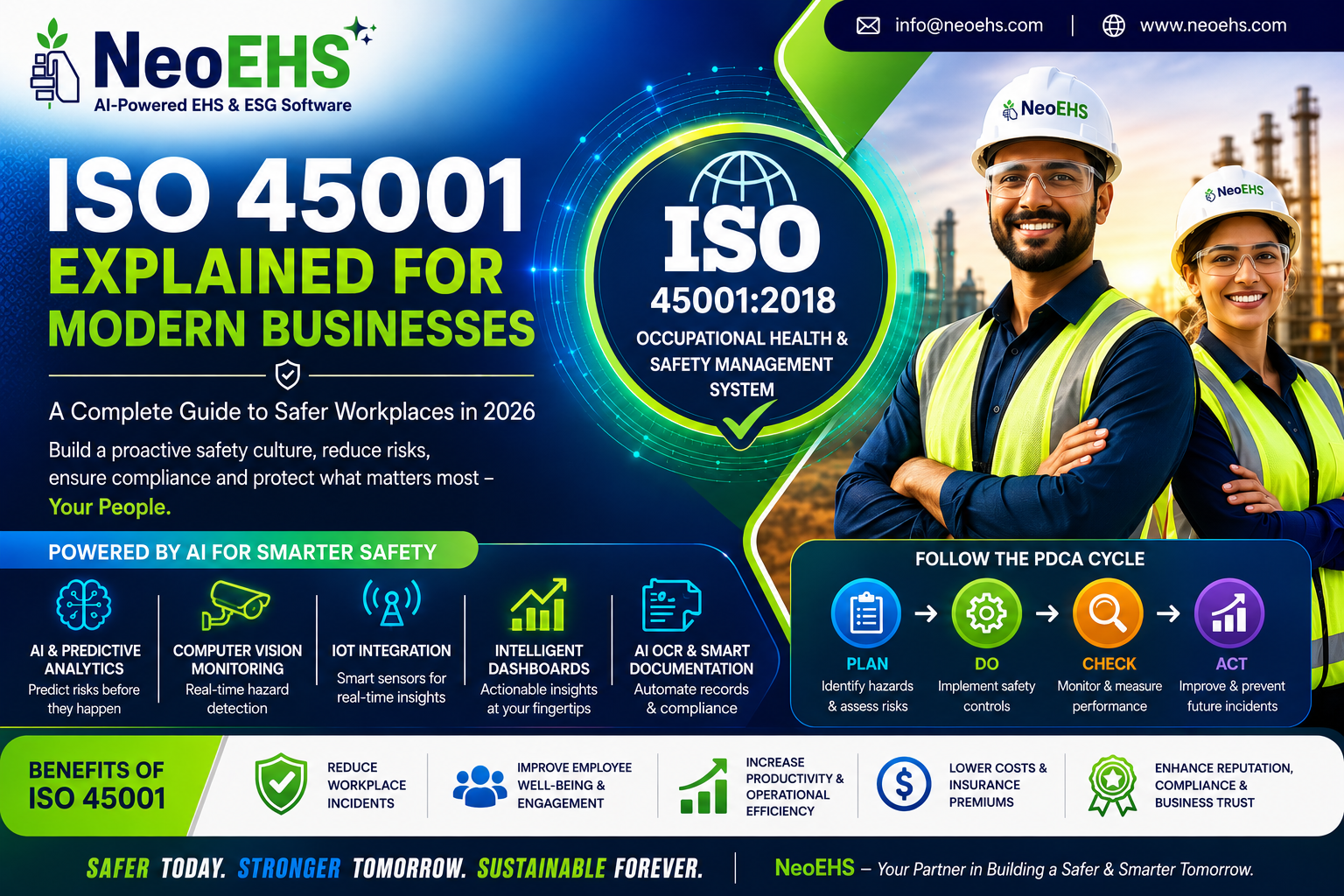
ISO 45001 Explained for Modern Businesses
ISO 45001 Explained for Modern Businesses
In today's highly regulated and safety-conscious business environment, protecting employees is no longer just a legal obligation—it's a strategic business priority. Organizations that prioritize occupational health and safety experience fewer workplace incidents, higher employee engagement, improved productivity, and stronger customer trust.
This is where ISO 45001 plays a vital role.
ISO 45001 is the world's leading international standard for Occupational Health and Safety Management Systems (OHSMS). It provides organizations with a structured framework to identify workplace hazards, reduce risks, prevent injuries, and continually improve safety performance.
With the rise of Artificial Intelligence (AI), Computer Vision, IoT, Predictive Analytics, and digital safety management platforms like NeoEHS, achieving ISO 45001 compliance has become faster, smarter, and more effective than ever before.
In this comprehensive guide, we'll explain everything modern businesses need to know about ISO 45001 and how AI is transforming workplace safety.
What is ISO 45001?
ISO 45001:2018 is an internationally recognized Occupational Health and Safety Management System (OHSMS) standard published by the International Organization for Standardization (ISO).
Its objective is to:
- Prevent workplace injuries
- Reduce occupational illnesses
- Improve employee well-being
- Eliminate workplace hazards
- Ensure continual improvement
- Build a proactive safety culture
Unlike traditional safety management systems that focus only on compliance, ISO 45001 promotes risk-based thinking and continuous improvement.
Why ISO 45001 Matters in Today's Workplace
Modern businesses face increasing safety challenges, including:
- Construction accidents
- Industrial machinery hazards
- Chemical exposure
- Electrical risks
- Working at heights
- Confined space entry
- Fatigue management
- Environmental risks
- Human error
- Contractor safety
Without a structured safety management system, organizations face:
- Legal penalties
- Increased insurance costs
- Lost productivity
- Reputational damage
- Employee turnover
- Operational downtime
ISO 45001 helps organizations systematically address these risks before incidents occur.
Key Principles of ISO 45001
The ISO 45001 framework is based on several fundamental principles.
1. Leadership Commitment
Top management must actively demonstrate commitment to workplace safety through policies, resources, accountability, and continual improvement.
2. Worker Participation
Employees play a crucial role by:
- Reporting hazards
- Participating in risk assessments
- Providing safety observations
- Suggesting improvements
3. Risk-Based Thinking
Organizations should proactively identify:
- Hazards
- Unsafe behaviors
- Near misses
- Emerging risks
- Environmental conditions
before they result in incidents.
4. Continuous Improvement
ISO 45001 follows the Plan-Do-Check-Act (PDCA) cycle to continuously improve occupational health and safety performance.
Main Requirements of ISO 45001
The standard includes several important clauses.
Context of the Organization
Understand internal and external issues affecting occupational health and safety.
Leadership
Establish clear responsibilities and safety objectives.
Planning
Identify hazards, evaluate risks, and define control measures.
Support
Ensure:
- Competency
- Awareness
- Communication
- Documentation
- Resources
Operation
Manage operational risks including:
- Permit to Work
- Contractor Management
- Emergency Preparedness
- PPE Management
- Hazard Controls
Performance Evaluation
Monitor:
- Safety KPIs
- Internal Audits
- Compliance
- Incident Trends
- Corrective Actions
Improvement
Implement:
- Root Cause Analysis
- Preventive Actions
- Corrective Actions
- Lessons Learned
Benefits of ISO 45001 Certification
Organizations implementing ISO 45001 enjoy numerous advantages.
Improved Workplace Safety
Systematic hazard identification significantly reduces accidents.
Lower Incident Rates
Proactive risk management prevents injuries before they occur.
Better Legal Compliance
Helps organizations comply with OSHA and local occupational safety regulations.
Higher Employee Engagement
Workers become active participants in creating a safer workplace.
Reduced Insurance Costs
Lower incident rates often result in reduced insurance premiums.
Increased Productivity
Safe workplaces experience:
- Less downtime
- Improved morale
- Higher efficiency
Stronger Brand Reputation
ISO-certified organizations gain greater trust from customers, investors, and regulators.
Industries That Benefit from ISO 45001
ISO 45001 is suitable for organizations of every size.
Industries include:
- Construction
- Manufacturing
- Oil & Gas
- Mining
- Logistics
- Warehousing
- Healthcare
- Utilities
- Power Plants
- Chemicals
- Transportation
- Ports & Maritime
- Infrastructure Projects
Common Challenges During ISO 45001 Implementation
Many organizations struggle with:
- Paper-based inspections
- Manual incident reporting
- Poor hazard visibility
- Inconsistent audits
- Delayed corrective actions
- Lack of employee engagement
- Inefficient compliance tracking
These challenges often delay certification and increase operational risks.
How AI is Transforming ISO 45001 Compliance
Artificial Intelligence is changing occupational safety management by making compliance proactive instead of reactive.
AI helps organizations:
- Detect unsafe behaviors automatically
- Identify PPE violations
- Monitor high-risk work areas
- Predict future incidents
- Analyze safety trends
- Automate inspections
- Improve hazard reporting
- Reduce human error
Instead of relying only on manual inspections, AI continuously monitors workplace safety 24/7.
How NeoEHS Simplifies ISO 45001 Compliance
NeoEHS is an AI-powered Environment, Health, Safety, and ESG platform designed to simplify ISO 45001 implementation and ongoing compliance.
Key capabilities include:
AI-Powered Hazard Detection
Computer Vision continuously detects:
- Missing PPE
- Unsafe acts
- Restricted area violations
- Unsafe lifting
- Vehicle movement risks
- Worker proximity hazards
Digital Risk Assessments
Conduct standardized risk assessments with automated scoring, approvals, and action tracking.
Smart Incident Management
Digitally manage:
- Incidents
- Near misses
- Unsafe observations
- Investigations
- Root cause analysis
- Corrective actions
AI Safety Analytics
Interactive dashboards provide insights into:
- Leading indicators
- Lagging indicators
- High-risk locations
- Incident trends
- Compliance scores
- Predictive risk analysis
Digital Permit-to-Work
Manage permits for:
- Hot Work
- Confined Space Entry
- Electrical Work
- Excavation
- Work at Height
- Lifting Operations
- Lockout/Tagout (LOTO)
with automated approvals and audit trails.
Inspection & Audit Management
Schedule and perform inspections using mobile devices, generate findings, assign corrective actions, and monitor closure.
Compliance Management
Track:
- Legal registers
- ISO requirements
- Internal audits
- External audits
- Corrective actions
- Evidence documentation
AI-Powered Document Management
Maintain centralized records for:
- SOPs
- Policies
- Risk assessments
- Training records
- Audit reports
- Compliance evidence
Mobile Safety App
Employees can instantly:
- Report hazards
- Upload photos
- Submit observations
- Receive alerts
- Complete inspections
- Track corrective actions
from anywhere.
ISO 45001 Implementation Roadmap
Organizations typically follow these steps:
- Conduct a gap assessment.
- Define Occupational Health & Safety policies.
- Identify workplace hazards.
- Perform risk assessments.
- Establish operational controls.
- Train employees.
- Implement digital safety processes.
- Conduct internal audits.
- Review management performance.
- Complete certification audits.
Using an AI-powered platform like NeoEHS accelerates each stage by automating documentation, tracking actions, and providing real-time visibility into compliance.
Best Practices for Maintaining ISO 45001 Certification
To sustain certification and continually improve safety performance:
- Review risks regularly.
- Encourage employee participation.
- Conduct frequent inspections.
- Track leading safety indicators.
- Investigate all incidents and near misses.
- Use predictive analytics to identify emerging risks.
- Automate compliance workflows.
- Continuously train employees.
- Monitor contractor performance.
- Review management objectives periodically.
The Future of Occupational Health & Safety
The future of workplace safety lies in intelligent, connected systems that combine AI, IoT, computer vision, and predictive analytics. Organizations adopting these technologies can move beyond reactive compliance to prevent incidents before they happen, while strengthening operational resilience and employee trust.
Why Choose NeoEHS?
NeoEHS empowers organizations to:
- Simplify ISO 45001 compliance
- Reduce workplace incidents
- Automate inspections and audits
- Monitor safety in real time with AI
- Improve contractor and permit management
- Gain predictive safety insights
- Enhance employee engagement
- Centralize compliance documentation
- Support ESG and sustainability initiatives
- Build a safer, smarter workplace
Whether you're in construction, manufacturing, energy, logistics, healthcare, or mining, NeoEHS helps transform occupational health and safety into a strategic business advantage.
Conclusion
ISO 45001 is more than a certification—it is a framework for building a resilient, proactive safety culture that protects people and strengthens business performance. By integrating AI-driven technologies, organizations can simplify compliance, improve decision-making, and reduce workplace risks.
NeoEHS combines AI, Computer Vision, IoT, predictive analytics, and digital workflows into one comprehensive platform, making it easier for modern businesses to achieve and maintain ISO 45001 compliance while creating safer workplaces.
Frequently Asked Questions (FAQs)
1. What is ISO 45001?
ISO 45001 is the international standard for Occupational Health and Safety Management Systems (OHSMS), helping organizations manage workplace health and safety risks.
2. Who should implement ISO 45001?
Any organization—regardless of size or industry—can implement ISO 45001 to improve occupational health and safety performance.
3. Is ISO 45001 certification mandatory?
Certification is generally voluntary, but many customers, regulators, and procurement processes require or strongly prefer it.
4. How does AI help with ISO 45001 compliance?
AI automates hazard detection, PPE monitoring, incident analysis, inspections, and predictive risk assessment, making safety management more proactive.
5. How does NeoEHS support ISO 45001?
NeoEHS provides AI-powered hazard detection, digital inspections, incident management, permit-to-work, compliance tracking, audit management, predictive analytics, and real-time dashboards to streamline ISO 45001 implementation and ongoing compliance.
#ISO45001 #OccupationalHealth #WorkplaceSafety #HealthAndSafety #SafetyManagement #OHSMS #EHSSoftware #AISafety #AIPoweredEHS #RiskAssessment #IncidentManagement #DigitalTransformation #ComplianceManagement #ESG #ConstructionSafety #IndustrialSafety #ManufacturingSafety #ComputerVision #PredictiveAnalytics #NeoEHS
READ MORE ❯
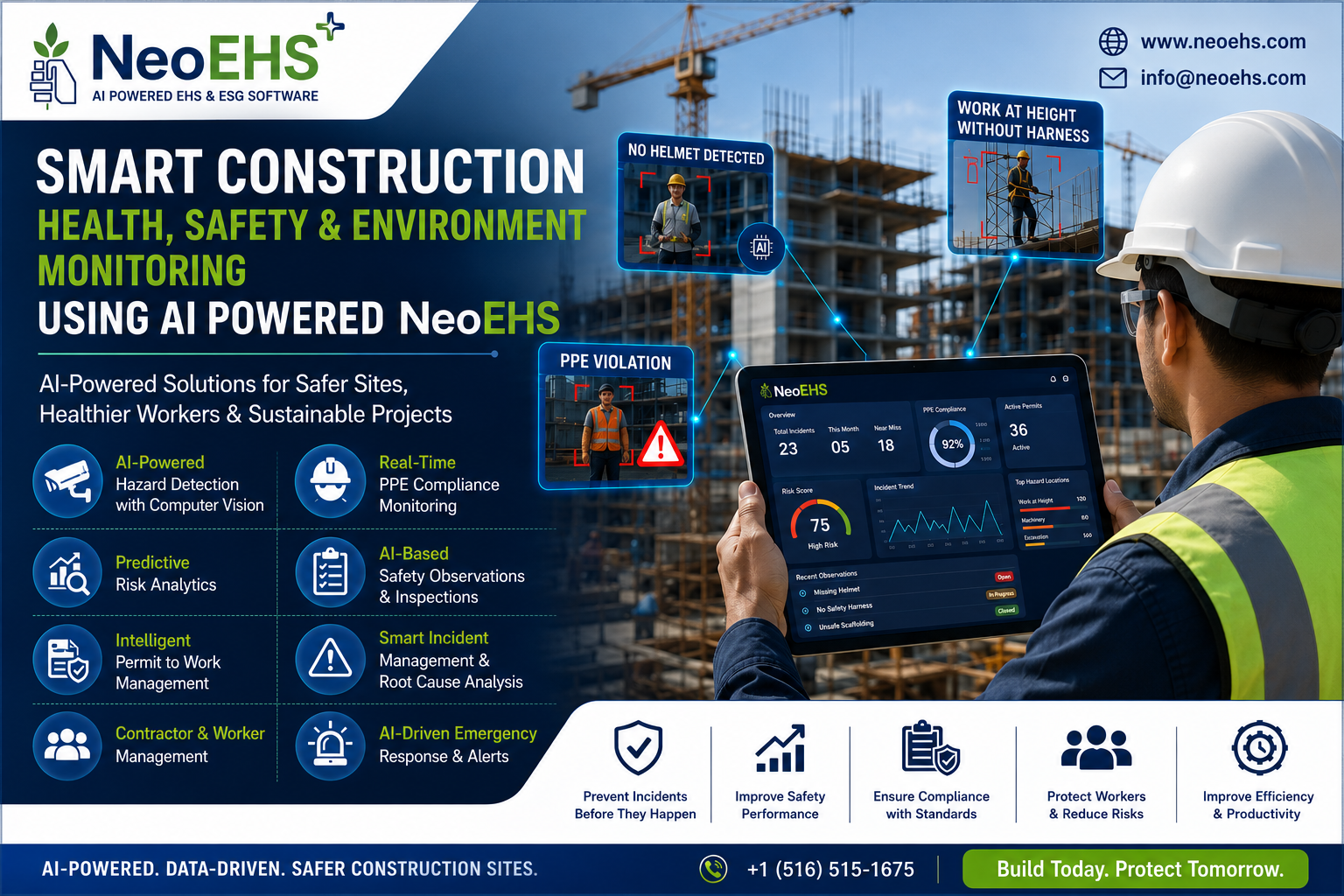
how-ai-improves-construction-site-safety
How AI Improves Construction Site Safety: The Future of Smart Construction with NeoEHS AI
Construction remains one of the world's most hazardous industries. Every day, workers face risks such as falls from height, equipment accidents, electrical hazards, confined spaces, crane operations, and exposure to hazardous materials.
Traditional safety management relies heavily on manual inspections, paper-based checklists, and reactive incident reporting. While these methods are essential, they often identify problems only after they occur.
Artificial Intelligence (AI) is changing this reality.
By combining AI, Computer Vision, IoT, predictive analytics, and automation, organizations can proactively identify hazards, prevent accidents, improve compliance, and create safer construction sites.
NeoEHS AI Powered Construction Safety Software brings these technologies together into one intelligent platform that helps organizations transform construction safety management.
Why Construction Needs AI-Powered Safety Management
Construction projects involve:
- Thousands of workers
- Multiple contractors
- Heavy machinery
- Hazardous work environments
- Constantly changing job sites
- Tight deadlines
- Strict compliance requirements
Managing safety manually across such dynamic environments becomes increasingly difficult.
AI enables organizations to monitor construction activities continuously while providing instant insights that help prevent incidents before they happen.
Common Construction Site Hazards


6
Some of the most common risks include:
- Falls from height
- Unsafe scaffolding
- PPE violations
- Crane lifting accidents
- Vehicle collisions
- Excavation collapses
- Electrical hazards
- Confined space incidents
- Unsafe worker behavior
- Fire and explosion risks
- Material handling accidents
- Heat stress and worker fatigue
Traditional inspections cannot monitor every activity continuously.
This is where AI becomes a game changer.
How AI Improves Construction Site Safety
1. AI-Powered Computer Vision for Hazard Detection
NeoEHS integrates AI-powered Computer Vision with CCTV cameras installed across construction sites.
The system automatically detects:
- Workers without helmets
- Missing safety vests
- No safety harness
- Unsafe work at height
- Restricted area violations
- Unsafe machinery operation
- Workers inside crane danger zones
- Fire and smoke
- Unsafe behavior
Instead of waiting for supervisors to identify violations, AI detects them instantly.
Benefits
- 24/7 monitoring
- Immediate alerts
- Reduced human error
- Faster corrective actions
2. Real-Time PPE Compliance Monitoring
Personal Protective Equipment (PPE) is the first line of defense for construction workers.
NeoEHS AI continuously verifies whether workers are wearing:
- Helmet
- Safety Vest
- Gloves
- Goggles
- Face Shield
- Respirator
- Safety Shoes
- Fall Protection Harness
Whenever PPE violations occur, supervisors receive immediate notifications.
3. Predictive Risk Analytics
Rather than reacting to incidents, AI predicts where accidents are most likely to occur.
NeoEHS analyzes:
- Previous incidents
- Near misses
- Hazard observations
- Weather conditions
- Worker exposure
- Equipment usage
- Project progress
- Safety inspection history
The system identifies high-risk work zones before accidents happen.
This allows safety teams to take preventive actions.
4. AI-Based Safety Observation Management
Construction workers can easily submit:
- Unsafe acts
- Unsafe conditions
- Near misses
- Good safety practices
NeoEHS AI automatically:
- Categorizes observations
- Identifies recurring trends
- Assigns corrective actions
- Prioritizes critical risks
- Tracks closure status
The result is a proactive safety culture.
5. Intelligent Incident Management
When an incident occurs, NeoEHS AI accelerates investigations by automatically:
- Recording incident details
- Collecting witness information
- Identifying root causes
- Suggesting corrective actions
- Tracking CAPA implementation
- Generating investigation reports
Organizations reduce investigation time while improving learning from incidents.
6. AI-Powered Permit to Work (PTW)
Construction projects involve many high-risk permits:
- Hot Work Permit
- Work at Height Permit
- Excavation Permit
- Electrical Permit
- Lifting Permit
- Confined Space Permit
- Isolation (LOTO) Permit
NeoEHS AI ensures:
- Permit validation
- Risk assessment verification
- Mandatory checklist completion
- Competency verification
- PPE confirmation
- Approval workflow automation
AI significantly reduces permit-related safety failures.
7. Smart Inspection Automation
Routine inspections become smarter using AI.
NeoEHS enables digital inspections for:
- Scaffolding
- Excavation
- Heavy Equipment
- Fire Protection
- Electrical Safety
- Housekeeping
- PPE Compliance
- Site Conditions
AI identifies inspection trends and highlights recurring deficiencies.
8. AI-Driven Contractor Safety Management
Construction projects often involve multiple subcontractors.
NeoEHS helps manage:
- Contractor competency
- Safety training
- Permit approvals
- Compliance records
- Incident history
- Performance scoring
Organizations can identify high-risk contractors before work begins.
9. AI-Based Worker Fatigue Detection
Worker fatigue contributes significantly to accidents.
Using AI and smart wearables, NeoEHS helps detect:
- Fatigue
- Heat stress
- Worker inactivity
- Abnormal movement
- Emergency situations
Supervisors receive alerts before serious incidents occur.
10. Intelligent Emergency Management
During emergencies, every second matters.
NeoEHS AI supports:
- Emergency alerts
- Worker evacuation
- Muster point attendance
- Incident tracking
- Rescue coordination
- Emergency reporting
The platform improves emergency response efficiency across large construction sites.
NeoEHS AI Construction Safety Dashboard


6
The NeoEHS dashboard provides real-time visibility into:
- Safety KPIs
- Incident trends
- PPE compliance
- High-risk locations
- Active permits
- Safety observations
- Audit status
- Training completion
- Environmental monitoring
- Contractor performance
Executives gain instant insights into overall project safety performance.
Benefits of AI-Powered Construction Safety
Organizations implementing AI-powered safety solutions typically achieve:
- Improved worker safety
- Faster hazard identification
- Reduced workplace incidents
- Better compliance
- Lower insurance costs
- Increased operational efficiency
- Higher productivity
- Improved contractor accountability
- Faster investigations
- Better decision-making through predictive analytics
Industries That Benefit from NeoEHS AI
NeoEHS supports safety management across:
- Commercial Construction
- Infrastructure Projects
- Roads and Highways
- Metro Rail Projects
- Airports
- Bridges
- Industrial Construction
- Oil & Gas Construction
- Power Plants
- Manufacturing Facilities
- Smart Cities
- Renewable Energy Projects
Why Choose NeoEHS AI Powered Construction Safety Software?
NeoEHS combines advanced AI technologies into a single integrated platform designed specifically for modern construction projects.
Key Features
- AI Computer Vision
- Predictive Analytics
- Smart PPE Monitoring
- Digital Permit to Work
- Incident Management
- Risk Assessment
- Inspection Management
- Audit Management
- Hazard Management
- Contractor Management
- Training Management
- Emergency Management
- Environmental Monitoring
- IoT Device Integration
- Mobile Safety Inspections
- Executive Dashboards
- Automated Compliance Reporting
The Future of Construction Safety Is AI
Construction companies can no longer rely solely on manual safety inspections and reactive incident management.
Artificial Intelligence empowers organizations to predict risks, automate safety processes, improve compliance, and protect workers before accidents occur.
With NeoEHS AI Powered Construction Safety Software, businesses can build safer workplaces, improve operational excellence, and achieve world-class safety performance.
As construction projects become larger and more complex, AI will play an increasingly critical role in ensuring every worker returns home safely.
Frequently Asked Questions (FAQs)
1. How does AI improve construction site safety?
AI improves construction safety by detecting hazards in real time, monitoring PPE compliance, predicting risks, automating inspections, and enabling faster incident response.
2. What is AI-powered construction safety software?
AI-powered construction safety software uses technologies such as computer vision, machine learning, predictive analytics, and IoT to proactively identify and manage workplace risks.
3. Can AI monitor PPE compliance?
Yes. NeoEHS AI uses computer vision to automatically detect whether workers are wearing required PPE such as helmets, safety vests, harnesses, goggles, gloves, and safety shoes.
4. What construction activities can AI monitor?
AI can monitor work at height, crane operations, excavations, confined spaces, heavy equipment movement, PPE compliance, restricted areas, fire hazards, and unsafe worker behavior.
5. Why should construction companies use NeoEHS?
NeoEHS provides an integrated AI-powered EHS platform that combines hazard detection, predictive analytics, permit-to-work management, inspections, incident management, compliance tracking, and executive dashboards to help reduce risks and improve safety performance
READ MORE ❯
What Is AI-Powered EHS Software? Complete Guide for 2026
What Is AI-Powered EHS Software? A Complete Guide
Introduction
Workplace safety is no longer just about compliance checklists and incident reporting. Modern organizations face increasing regulatory requirements, growing operational complexity, and higher expectations for employee wellbeing and environmental responsibility.
Traditional Environmental, Health, and Safety (EHS) systems often rely on manual inspections, spreadsheets, paper-based permits, and reactive decision-making. While these methods have served organizations for years, they struggle to keep pace with today's dynamic workplaces.
This is where AI-Powered EHS Software is transforming the industry.
Artificial Intelligence enables organizations to identify hazards before incidents occur, automate repetitive compliance tasks, analyze thousands of safety records instantly, and provide real-time recommendations for safer operations.
Solutions like NeoEHS combine Artificial Intelligence, Machine Learning, Computer Vision, IoT, Predictive Analytics, and intelligent automation into a unified platform that helps organizations move from reactive safety management to proactive risk prevention.
What Is AI-Powered EHS Software?
AI-Powered EHS Software is an intelligent digital platform that uses Artificial Intelligence to automate and enhance Environmental, Health, Safety, and ESG management processes.
Unlike traditional EHS systems that depend heavily on manual data entry and human intervention, AI continuously analyzes operational data, detects anomalies, predicts potential risks, and recommends corrective actions before incidents occur.
Think of it as having an intelligent safety advisor monitoring your workplace 24/7.
Instead of simply recording incidents after they happen, AI helps prevent them.
Why Traditional EHS Software Is No Longer Enough
Many organizations still experience challenges such as:
- Manual safety inspections
- Paper-based permit systems
- Delayed incident reporting
- Compliance gaps
- Human errors
- Limited visibility into risks
- Slow investigations
- Reactive safety culture
These limitations can lead to:
- Increased workplace accidents
- Higher insurance costs
- Regulatory penalties
- Environmental incidents
- Productivity losses
- Reputational damage
AI addresses these challenges by introducing intelligence into every stage of safety management.
How AI Is Transforming EHS
Artificial Intelligence enhances every aspect of EHS management.
1. Predictive Risk Analytics
Instead of waiting for accidents, AI analyzes historical incidents, inspections, weather conditions, equipment performance, employee behavior, and operational trends.
It predicts:
- High-risk locations
- Unsafe activities
- Equipment failures
- Near-miss probability
- Environmental risks
Organizations can take preventive action before incidents occur.
2. Intelligent Incident Management
AI automatically:
- Categorizes incidents
- Identifies root causes
- Detects recurring patterns
- Suggests corrective actions
- Prioritizes investigations
This dramatically reduces investigation time while improving accuracy.
3. Computer Vision Safety Monitoring
AI-powered cameras can detect:
- Missing PPE
- Unsafe worker behavior
- Restricted area access
- Vehicle violations
- Fire and smoke
- Slip and fall hazards
- Unsafe lifting practices
Real-time alerts allow supervisors to intervene immediately.
4. AI-Powered Safety Inspections
Instead of lengthy manual inspections, AI can:
- Recommend inspection schedules
- Identify recurring defects
- Generate inspection checklists
- Analyze inspection findings
- Prioritize corrective actions
Inspectors spend less time on paperwork and more time improving safety.
5. Intelligent Compliance Management
Regulatory requirements change frequently.
AI helps organizations:
- Monitor regulatory updates
- Track compliance obligations
- Automate reminders
- Generate compliance reports
- Identify missing documentation
This reduces compliance risks while saving significant administrative effort.
6. Smart Permit-to-Work (PTW)
AI simplifies permit management by:
- Validating permits automatically
- Checking worker competency
- Identifying permit conflicts
- Detecting isolation errors
- Monitoring permit expiry
- Sending approval reminders
This ensures safer high-risk work activities.
7. AI-Driven Hazard Identification
AI analyzes multiple data sources including:
- Near misses
- Safety observations
- Audit findings
- Equipment failures
- Environmental monitoring
- Worker feedback
Potential hazards are identified long before they become incidents.
8. ESG Intelligence
Modern EHS platforms also support sustainability.
AI helps organizations monitor:
- Carbon emissions
- Energy consumption
- Water usage
- Waste generation
- Environmental compliance
- ESG reporting
This improves transparency while supporting sustainability goals.
Key Features of AI-Powered EHS Software
An intelligent EHS platform typically includes:
- AI Incident Management
- Risk Assessment
- Hazard Management
- Safety Observations
- Safety Inspections
- Digital Checklists
- AI Permit-to-Work
- Audit Management
- Compliance Management
- Environmental Monitoring
- Carbon Emission Tracking
- Waste Management
- PPE Management
- Training Management
- Contractor Safety
- Machine Safety
- Emergency Response
- Predictive Analytics
- Computer Vision
- IoT Integration
- Mobile Applications
- Executive Dashboards
Benefits of AI-Powered EHS Software
Organizations adopting AI-powered EHS solutions can experience:
Improved Safety
AI detects hazards earlier, helping prevent incidents before they occur.
Better Compliance
Automated workflows reduce missed deadlines and regulatory violations.
Faster Decision-Making
Real-time dashboards provide instant insights into safety performance.
Lower Costs
Reducing incidents lowers medical expenses, insurance premiums, downtime, and legal costs.
Increased Productivity
Automation reduces manual paperwork, allowing teams to focus on high-value safety activities.
Stronger ESG Performance
Integrated environmental and sustainability management supports corporate ESG objectives.
Industries That Benefit from AI-Powered EHS Software
AI-powered EHS solutions are valuable across many sectors, including:
- Construction
- Manufacturing
- Oil & Gas
- Mining
- Utilities & Power
- Chemical Processing
- Pharmaceuticals
- Logistics
- Transportation
- Maritime
- Aviation
- Healthcare
- Food Manufacturing
- Infrastructure Projects
- Government Organizations
How NeoEHS Is Transforming Workplace Safety
NeoEHS is an AI-powered EHS and ESG platform designed to help organizations build safer, smarter, and more sustainable workplaces.
Its intelligent capabilities include:
- AI-driven risk prediction
- Computer vision for PPE and unsafe behavior detection
- Smart Permit-to-Work automation
- Intelligent incident investigation
- Digital inspections and audits
- IoT-enabled monitoring
- Predictive safety analytics
- Carbon emission management
- Environmental monitoring
- ESG reporting
- AI-powered document management with OCR
- Executive dashboards with real-time insights
- Mobile-first safety applications
- Multi-site enterprise management
By combining Artificial Intelligence, automation, and predictive analytics, NeoEHS helps organizations transition from reactive compliance to proactive risk prevention.
Future Trends in AI-Powered EHS
The next generation of EHS software will increasingly leverage advanced AI capabilities, including:
- Agentic AI safety assistants
- Autonomous workplace inspections
- AI-powered digital twins
- Drone-based safety monitoring
- Wearable safety devices
- Voice-enabled safety reporting
- Generative AI for safety documentation
- Autonomous ESG reporting
- Real-time regulatory intelligence
- AI-powered sustainability forecasting
Organizations that embrace these technologies today will be better prepared for the evolving demands of workplace safety and sustainability.
Conclusion
Artificial Intelligence is fundamentally changing how organizations manage safety, compliance, and sustainability. Rather than reacting to incidents after they happen, AI-powered EHS software enables businesses to anticipate risks, automate routine tasks, and make informed decisions in real time.
By adopting an intelligent platform such as NeoEHS, organizations can strengthen workplace safety, streamline regulatory compliance, reduce operational costs, and advance their ESG objectives. As industries continue to evolve, AI-powered EHS solutions will play an increasingly central role in creating safer, more resilient, and more sustainable workplaces.
Frequently Asked Questions (FAQ)
What is AI-powered EHS software?
AI-powered EHS software uses Artificial Intelligence to automate workplace safety, environmental management, compliance, incident investigations, and risk assessments.
How does AI improve workplace safety?
AI continuously analyzes safety data, detects hazards, predicts risks, and provides real-time recommendations to prevent accidents before they occur.
Which industries use AI-powered EHS software?
Industries including construction, manufacturing, oil and gas, mining, utilities, healthcare, logistics, chemicals, pharmaceuticals, and transportation benefit from AI-powered EHS solutions.
Can AI replace safety professionals?
No. AI enhances the capabilities of safety professionals by automating repetitive tasks, analyzing large datasets, and providing decision support. Human expertise remains essential for leadership, judgment, and fostering a strong safety culture.
What makes NeoEHS different?
NeoEHS combines Artificial Intelligence, Computer Vision, IoT, Predictive Analytics, ESG management, intelligent automation, and enterprise dashboards into one integrated platform.
Call to Action
Transform Workplace Safety with AI
Discover how NeoEHS can help your organization reduce risks, automate compliance, improve ESG performance, and create a safer workplace through AI-driven intelligence.
Request a personalized demo today and experience the future of EHS management. Please visit us at www.neoehs.com and contact us info@neoehs.com
#AIPoweredEHSSoftware #AISafetyManagement #WorkplaceSafety #EnvironmentalHealthAndSafety #EHSSoftware #ESGSoftware #ComplianceManagement #RiskAssessment #IncidentManagement #AICompliance #PredictiveAnalytics #ComputerVision #IndustrialSafety #DigitalSafetyTransformation #NeoEHS #ArtificialIntelligence #AI #SafetyManagementSystem #OccupationalHealthAndSafety #WorkplaceCompliance #SafetyTechnology #DigitalTransformation #EnterpriseSoftware #Sustainability #ESG #CarbonManagement #EnvironmentalCompliance #SmartSafety #ConnectedWorker #IoT #MachineLearning #Automation #SmartManufacturing #ConstructionSafety #MiningSafety #OilAndGasSafety #ManufacturingSafety #BehaviorBasedSafety #SafetyCulture #OperationalExcellence #IncidentPrevention #RiskManagementSoftware #ComplianceSoftware #SafetyInspection #PermitToWork #ContractorSafety #SafetyAnalytics #PredictiveSafety #ESGReporting #AIForSafety #AIDrivenEHS #SmartWorkplace #FutureOfSafety #HealthSafetyEnvironment #NeoEHS
READ MORE ❯
AI for ESG Risk Assessment | Predictive Sustainability Risk Management | NeoEHS
How AI Can Help Organizations Make Better ESG and Sustainability Risk Decisions
For many years, risk assessments have been an essential part of Environmental, Health & Safety (EHS) programs. They help organizations identify hazards, reduce incidents, and maintain compliance. But today's business environment is changing rapidly.
Climate change, evolving regulations, supply chain disruptions, rising stakeholder expectations, and sustainability commitments have made risk management far more complex than it was just a few years ago.
The question many organizations are now asking is not "Should we perform risk assessments?" but rather "How can we make them smarter and more proactive?"
This is where Artificial Intelligence (AI) is beginning to make a real difference.
Moving Beyond Traditional Risk Assessments
Most organizations still conduct risk assessments using spreadsheets, paper forms, or periodic inspections. These methods have served businesses well for decades, but they also have limitations.
A risk assessment completed six months ago may no longer reflect today's reality. Equipment conditions change, work practices evolve, weather patterns shift, and new regulations are introduced. By the time an issue is identified, the opportunity to prevent it may already have passed.
AI doesn't replace experienced safety professionals—it helps them make better decisions by bringing together information that would otherwise be difficult to analyze manually.
Seeing Risks Before They Become Problems
One of AI's greatest strengths is its ability to recognize patterns.
Imagine an organization with years of incident reports, audit findings, inspection records, maintenance history, and environmental monitoring data. Individually, each record tells only part of the story. Together, they contain valuable insights.
AI can analyze these large volumes of information and highlight trends that people might easily overlook.
For example, it may identify that a particular site experiences an increase in near misses during specific weather conditions, or that recurring equipment failures are linked to delayed maintenance. These insights allow organizations to act earlier rather than simply reacting after an incident occurs.
Supporting Sustainability Goals
Sustainability is no longer just an annual report prepared for investors. It has become part of everyday business decisions.
Organizations today need visibility into energy consumption, waste generation, emissions, water usage, and environmental performance across multiple facilities.
AI can help by continuously analyzing operational data and highlighting unusual trends or areas that require attention. Instead of waiting for monthly reports, sustainability teams can receive timely insights that support faster decision-making and continuous improvement.
Helping Safety Teams Focus on What Matters
Safety professionals often spend significant time collecting information, reviewing documents, preparing reports, and following up on compliance activities.
AI can automate many of these routine tasks, allowing EHS teams to focus more on improving workplace safety and engaging with employees.
Whether it's identifying overdue inspections, highlighting recurring hazards, or supporting incident investigations, AI acts as an intelligent assistant rather than replacing human expertise.
Improving ESG Decision-Making
Environmental, Social, and Governance (ESG) risks are interconnected.
A supplier's environmental performance may affect business continuity. Poor safety performance can influence employee wellbeing and organizational reputation. Compliance failures can impact investor confidence.
AI helps organizations connect these different pieces of information, giving leaders a clearer understanding of their overall risk landscape.
Rather than relying solely on historical data, organizations can make decisions based on current conditions and emerging trends.
Technology Should Support People
One of the biggest misconceptions about AI is that it replaces human judgment.
In reality, the best AI solutions are designed to support experienced professionals—not replace them.
Risk assessments will always require knowledge, experience, site inspections, and professional judgment. AI simply provides additional insights, helping organizations prioritize actions, identify emerging risks, and make more informed decisions.
The final decisions remain in the hands of people.
Looking Ahead
As ESG expectations continue to grow, organizations will need faster, smarter, and more connected ways to manage risk.
Artificial Intelligence is becoming an important part of that journey—not because it has all the answers, but because it enables organizations to ask better questions, identify opportunities earlier, and respond more effectively.
Companies that embrace AI thoughtfully today will be better positioned to build safer workplaces, strengthen compliance, improve sustainability performance, and create long-term business resilience.
How NeoEHS Can Help
At NeoEHS, we believe technology should empower people—not replace them.
Our AI-powered EHS and ESG platform is designed to help organizations identify risks earlier, streamline compliance, improve incident management, monitor environmental performance, and support smarter decision-making across the enterprise.
Whether you're managing a manufacturing facility, construction project, mining operation, power plant, or port, NeoEHS provides the tools needed to move from reactive safety management to proactive risk intelligence.
The future of EHS and ESG isn't about collecting more data—it's about turning that data into meaningful actions that protect people, strengthen businesses, and contribute to a more sustainable future.
#AIESG #ESGRiskAssessment #SustainabilityRiskAssessment #AIRiskManagement #AIPoweredEHS #ESGSoftware #SustainabilitySoftware #EnterpriseRiskManagement #PredictiveRiskAnalytics #AISafetySoftware #CarbonEmissions #ClimateRisk #EnvironmentalRisk #SocialRisk #GovernanceRisk #AICompliance #ISO14001 #ESGReporting #RiskRegister #DigitalRiskAssessment
READ MORE ❯
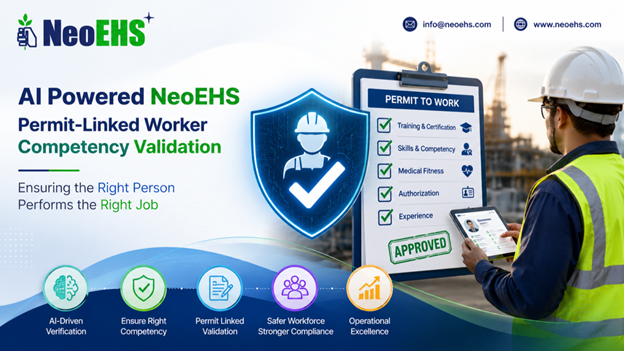
Empowering Safer Permit-to-Work Through Intelligent Worker Competency Validation with AI-Powered NeoEHS
Strengthening Permit-to-Work (PTW) Safety with AI-Driven Competency Verification
High-risk industries such as mining, construction, oil & gas, manufacturing, power generation, utilities, and infrastructure rely heavily on Permit-to-Work (PTW) systems to control hazardous activities. However, issuing a permit alone does not guarantee workplace safety. The critical question remains:
Is the person performing the task truly qualified, trained, medically fit, and authorized to execute the work?
A permit approved without validating worker competency can expose organizations to serious workplace accidents, equipment damage, environmental incidents, regulatory penalties, and even loss of life.
NeoEHS transforms traditional Permit-to-Work management with Artificial Intelligence (AI), Agentic AI, Predictive Analytics, Intelligent Automation, and Real-Time Competency Validation, ensuring every permit is linked to the right worker with the right qualifications before work begins.
Why Worker Competency Validation Matters
Many workplace incidents occur not because of equipment failure, but because workers are assigned tasks beyond their competency or without valid qualifications.
Common issues include:
- Expired training certifications
- Missing job-specific competency
- Invalid operator licenses
- Incomplete site induction
- Expired medical fitness certificates
- Contractor compliance gaps
- Unauthorized work assignments
- Lack of rescue or emergency response training
By validating these requirements automatically, organizations significantly reduce operational risk and improve compliance.
Challenges with Traditional Permit-to-Work Systems
In many organizations, competency verification remains a manual process.
Safety officers often spend valuable time checking:
- Training records
- Competency certificates
- Medical fitness reports
- Contractor documentation
- Equipment operator licenses
- Authorization approvals
- Trade qualifications
- Site induction records
This manual approach is:
- Time-consuming
- Error-prone
- Difficult to audit
- Inefficient across multiple project sites
- Vulnerable to expired or missing certifications
As projects grow in complexity, manual verification becomes increasingly difficult to manage.
How AI-Powered NeoEHS Solves the Problem
NeoEHS integrates Worker Competency Management directly with the Permit-to-Work workflow.
Before a permit is approved, the AI engine automatically validates every assigned worker against predefined competency requirements.
Automatic Competency Validation Includes
- Mandatory safety training completion
- Job-specific competency certification
- Equipment operator license validity
- Trade qualification verification
- Medical fitness status
- Site induction completion
- Contractor compliance
- PPE competency requirements
- Regulatory certifications
- Supervisor authorization
If any requirement is missing, expired, or invalid, NeoEHS immediately blocks permit approval until corrective actions are completed.
AI-Powered Competency Intelligence
NeoEHS goes beyond document verification by continuously analyzing workforce competency data.
The AI engine evaluates:
- Worker skills and qualifications
- Historical permit assignments
- Training completion records
- Incident and near-miss history
- Competency expiry dates
- Job risk levels
- Supervisor approvals
- Regulatory compliance requirements
This intelligent analysis enables organizations to proactively identify competency gaps before they become safety risks.
Intelligent Permit Validation for High-Risk Activities
Imagine issuing a Confined Space Entry Permit.
Before approval, NeoEHS automatically verifies whether every assigned worker:
- Holds valid confined space certification
- Is medically fit for confined space work
- Has completed rescue training
- Possesses valid gas testing certification
- Has breathing apparatus training
- Has completed site induction
- Is authorized by management
If even one requirement is missing, NeoEHS immediately alerts the permit issuer and prevents approval until compliance is achieved.
The same intelligent validation can be applied to:
- Hot Work Permits
- Work at Height Permits
- Electrical Isolation (LOTO)
- Excavation Permits
- Crane Operations
- Heavy Equipment Operations
- Blasting Activities
- Radiography Work
- Chemical Handling
- High Voltage Switching
- Confined Space Entry
Advanced AI Features for Permit-to-Work
NeoEHS combines Artificial Intelligence with intelligent automation to strengthen PTW safety.
Key capabilities include:
- AI-driven competency verification
- Automatic detection of expired certifications
- Intelligent worker-to-job matching
- Real-time training compliance monitoring
- Contractor competency validation
- Risk-based competency recommendations
- Automated approval workflows
- QR Code verification
- Biometric worker authentication
- Integration with HRMS and Learning Management Systems (LMS)
- Complete audit trails for regulatory compliance
Business Benefits
Organizations implementing AI-powered competency validation experience measurable improvements in safety and operational efficiency.
Benefits include:
- Reduced human error during permit approval
- Faster Permit-to-Work processing
- Improved regulatory compliance
- Better contractor management
- Increased workforce readiness
- Reduced operational risk
- Enhanced audit preparedness
- Higher productivity
- Stronger workplace safety culture
- Greater confidence in executing high-risk work
Why Organizations Choose NeoEHS
NeoEHS provides an intelligent digital platform that integrates:
- Permit-to-Work Management
- Worker Competency Management
- Contractor Safety
- Training Management
- Risk Assessment
- Incident Management
- Inspection Management
- Audit Management
- Corrective Action Tracking
- ESG Reporting
- AI Safety Assistant
Together, these capabilities create a connected safety ecosystem that improves decision-making while reducing workplace risks.
The Future of Intelligent Permit-to-Work
The future of Permit-to-Work is no longer just digital—it is intelligent.
With AI continuously validating worker competency, monitoring compliance, and recommending corrective actions, organizations can ensure that every permit is issued to the right person, with the right qualifications, at the right time.
This transforms Permit-to-Work from a documentation process into a proactive risk prevention system that safeguards people, assets, and operations.
Conclusion
A Permit-to-Work is only as effective as the competency of the people carrying it out.
NeoEHS empowers organizations with AI-driven competency validation, ensuring that every worker assigned to a high-risk task is trained, certified, medically fit, and fully authorized before work begins.By combining intelligent automation, predictive analytics, and real-time workforce validation, NeoEHS helps organizations eliminate preventable risks, improve compliance, and build a stronger culture of workplace safety.
The future of Permit-to-Work is intelligent, proactive, and AI-driven—and with NeoEHS, that future starts today.
#NeoEHS #PermitToWork #PTW #AI #ArtificialIntelligence #WorkerCompetency #CompetencyManagement #AIWorkplaceSafety #EHSSoftware #EHS #IndustrialSafety #OccupationalSafety #WorkplaceSafety #ContractorSafety #SafetyManagement #RiskManagement #SafetyCompliance #PredictiveSafety #SmartSafety #DigitalTransformation #SafetyCulture #LOTO #ConfinedSpace #HotWork #WorkAtHeight #MiningSafety #ConstructionSafety #ManufacturingSafety #OilAndGas #Utilities #ESG #FutureOfSafety #AgenticAI #SafetyInnovation #PermitManagement #DigitalSafety
READ MORE ❯
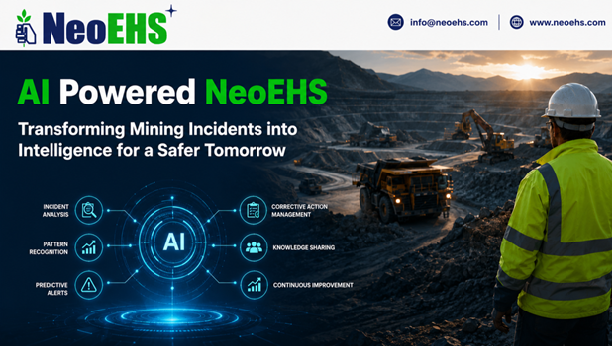
Transforming Mining Incidents into Intelligence for a Safer Tomorrow with AI-Powered NeoEHS
Turning Every Incident into Actionable Intelligence for Smarter Mining Operations
Mining remains one of the world's most hazardous industries. From underground operations and open-pit mines to mineral processing plants, workers face constantly changing risks involving heavy machinery, blasting operations, confined spaces, vehicle movement, hazardous materials, and environmental conditions.
Every incident—whether it's a near miss, equipment failure, unsafe act, or workplace injury—contains valuable insights that can strengthen an organization's safety management system. However, traditional incident investigations often focus on documenting what happened rather than predicting and preventing future occurrences.
NeoEHS transforms incident management through Artificial Intelligence (AI), Predictive Analytics, Machine Learning, Computer Vision, and Intelligent Automation, enabling mining organizations to learn from every event and proactively prevent future accidents.
Why Incident Learning Matters in Mining
Leading mining organizations understand that every incident presents an opportunity to improve workplace safety.
Instead of asking:
Who made the mistake?
Modern safety leaders ask:
- Why did the incident occur?
- Which hazards were overlooked?
- Have similar incidents happened before?
- Could the incident have been predicted?
- What preventive measures should become standard practice?
This shift from reactive investigations to predictive intelligence creates a stronger safety culture and improves operational resilience.
Common Causes Behind Mining Incidents
AI analysis across mining operations frequently identifies recurring safety issues, including:
- Incomplete hazard identification
- Failure to follow Permit-to-Work (PTW) procedures
- Delayed equipment maintenance
- Poor shift handover communication
- Contractor safety gaps
- Vehicle and mobile equipment collisions
- Worker fatigue
- Inadequate risk reassessment
- Unsafe lifting operations
- Delayed reporting of hazards and near misses
Although these challenges are common across the mining industry, they are highly preventable when organizations leverage real-time safety intelligence.
How AI Revolutionizes Mining Incident Management
Unlike traditional incident management systems that only record events, NeoEHS continuously learns from every incident.
AI-Assisted Root Cause Analysis
NeoEHS automatically analyzes incidents to identify recurring contributing factors and probable root causes.
Instead of manually reviewing hundreds of reports, safety professionals receive AI-generated insights that accelerate investigations and improve decision-making.
Benefits
- Faster investigations
- Consistent root cause identification
- Improved corrective actions
- Better regulatory compliance
Pattern Recognition Across Operations
Artificial Intelligence identifies hidden trends that may otherwise go unnoticed.
NeoEHS analyzes incidents across:
- Mine locations
- Work shifts
- Contractors
- Departments
- Equipment
- Job activities
- Seasonal conditions
This helps organizations identify systemic safety issues before they lead to major accidents.
Near Miss Intelligence
Near misses are valuable leading indicators of future incidents.
NeoEHS captures and analyzes every reported near miss to:
- Detect recurring hazards
- Identify unsafe behaviours
- Highlight high-risk work areas
- Recommend preventive actions
Learning from near misses significantly reduces serious workplace incidents.
Predictive Risk Alerts
One of NeoEHS's most powerful capabilities is Predictive Safety Intelligence.
The platform continuously analyzes:
- Incident reports
- Hazard observations
- Safety inspections
- Equipment maintenance history
- Permit-to-Work records
- Environmental monitoring
- IoT sensor data
- CCTV safety observations
When AI detects conditions similar to previous incidents, supervisors receive real-time alerts before accidents occur.
Intelligent Corrective Action Management
Completing corrective actions is just as important as identifying hazards.
NeoEHS automatically:
- Assigns corrective actions
- Tracks due dates
- Sends reminders
- Escalates overdue actions
- Monitors effectiveness
- Generates compliance reports
Organizations gain complete visibility into safety improvement activities.
Enterprise-Wide Safety Knowledge Sharing
Every incident should benefit the entire organization—not just one site.
NeoEHS automatically distributes lessons learned across multiple mining locations, enabling every operation to improve from shared experiences.
Knowledge sharing includes:
- Root cause summaries
- Best practices
- Corrective actions
- Safety alerts
- Toolbox Talks
- Training recommendations
This builds a consistent and proactive safety culture across the enterprise.
Building a Learning Organization
The safest mining organizations are not those that report zero incidents.
They are organizations that learn the fastest.
NeoEHS encourages employees to report:
- Near misses
- Unsafe acts
- Unsafe conditions
- Equipment abnormalities
- Process deviations
- Environmental concerns
without fear of blame.
Every report becomes valuable organizational knowledge that strengthens workplace safety.
AI Technologies Behind NeoEHS
NeoEHS combines multiple AI technologies into one intelligent mining safety platform.
Artificial Intelligence
Continuously learns from historical safety data to improve decision-making.
Machine Learning
Predicts emerging workplace risks based on historical patterns.
Computer Vision
Detects PPE violations, unsafe behaviours, and restricted area access using existing CCTV cameras.
Predictive Analytics
Forecasts high-risk work activities before incidents occur.
IoT Integration
Monitors environmental conditions, gas exposure, worker fatigue, equipment health, and real-time safety data.
Intelligent Automation
Automates investigations, corrective actions, notifications, workflows, and compliance reporting.
Why Mining Organizations Choose NeoEHS
Mining companies implementing NeoEHS experience significant improvements in safety performance.
Key benefits include:
- Faster incident investigations
- Reduced workplace accidents
- Improved near-miss reporting
- Predictive hazard identification
- Better regulatory compliance
- Automated corrective action tracking
- Enterprise-wide knowledge sharing
- Improved operational efficiency
- Data-driven safety decisions
- Stronger safety culture
NeoEHS transforms incident management from a compliance requirement into a strategic business capability.
The Future of AI-Powered Mining Safety
Mining safety continues to evolve through advanced digital technologies.
NeoEHS is expanding with innovations including:
- Agentic AI
- Generative AI
- Digital Twins
- Autonomous Drone Inspections
- Smart Wearables
- ESG Intelligence
- Robotics Integration
- Enterprise Business Intelligence Dashboards
- Predictive Risk Modelling
- Computer Vision Safety Monitoring
Together, these technologies help mining organizations create safer, smarter, and more sustainable operations.
Conclusion
Every mining incident tells a story.
The question is whether organizations simply document it—or use it to prevent the next accident.
NeoEHS transforms traditional incident management into an intelligent, AI-driven safety ecosystem that continuously learns, predicts risks, automates investigations, and empowers organizations to make smarter safety decisions.
By turning every incident, near miss, and hazard observation into actionable intelligence, NeoEHS helps mining companies protect lives, improve compliance, strengthen operational resilience, and build a culture of continuous safety improvement.
The future of mining safety is not reactive—it is predictive. And with NeoEHS, that future starts today.
#MiningSafety #MiningIndustry #ArtificialIntelligence #AI #AISafety #AIForMining #EHSSoftware #EHS #SafetyManagement #IncidentManagement #MiningIncidentManagement #NearMissManagement #PredictiveSafety #PredictiveAnalytics #RiskManagement #HazardIdentification #RootCauseAnalysis #WorkplaceSafety #OccupationalSafety #IndustrialSafety #MiningTechnology #DigitalMining #SmartMining #ComputerVision #MachineLearning #IoT #PermitToWork #SafetyCulture #Compliance #ESG #EnvironmentalHealthSafety #MiningOperations #CorrectiveAction #SafetyAnalytics #WorkerSafety #OperationalExcellence #IndustrialAutomation #DigitalTransformation #FutureOfSafety #MiningCompliance
READ MORE ❯
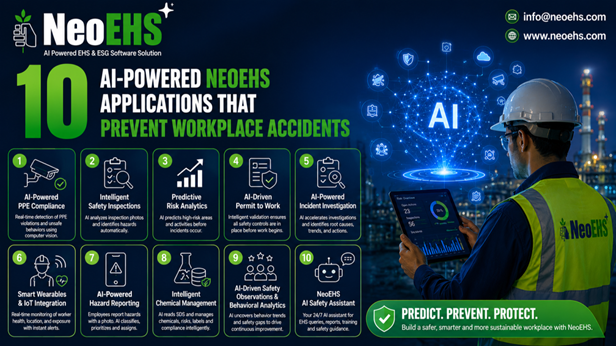
How AI is Revolutionizing Hazard Identification: 10 Real-World EHS Applications That Prevent Workplace Accidents
How NeoEHS is Transforming Workplace Safety with Artificial Intelligence
"Every workplace accident leaves behind warning signs—but without the right technology, those signs often go unnoticed. NeoEHS leverages Artificial Intelligence to identify hazards, predict risks, and empower organizations to prevent incidents before they happen."
Introduction
Across industries such as manufacturing, construction, mining, oil & gas, ports, logistics, power plants, and healthcare, organizations are under increasing pressure to improve workplace safety while maintaining operational efficiency and regulatory compliance.
Traditional EHS management relies on manual inspections, paper-based reports, and reactive investigations after incidents occur. While these practices remain essential, they often fail to identify hidden risks early enough to prevent accidents.
NeoEHS is redefining workplace safety through Agentic AI, Computer Vision, Predictive Analytics, IoT integration, Intelligent Automation, and Real-Time Risk Intelligence.
Rather than simply recording safety data, NeoEHS continuously analyzes workplace activities, detects unsafe conditions, predicts future risks, and recommends preventive actions—helping organizations move from reactive safety management to predictive accident prevention.
Here are 10 powerful AI capabilities within NeoEHS that help organizations create safer workplaces.
1. AI-Powered Computer Vision for PPE Compliance
One of NeoEHS's most powerful capabilities is AI-powered Computer Vision, which transforms ordinary CCTV cameras into intelligent safety monitoring systems.
NeoEHS continuously detects:
- Missing safety helmets
- Missing safety shoes
- Missing gloves
- Missing safety harnesses
- Improper reflective jackets
- Unauthorized access to restricted areas
- Unsafe worker behavior
Whenever a violation is detected, NeoEHS instantly alerts supervisors through dashboards, mobile notifications, email, or SMS, enabling immediate intervention.
Business Benefits
✅ Reduce PPE violations
✅ Improve compliance with safety policies
✅ Minimize supervisor dependency
✅ Prevent accidents before they occur
2. Intelligent Safety Inspections
NeoEHS simplifies inspections using AI-powered image analysis.
Safety officers can upload inspection photographs directly from their mobile devices.
NeoEHS automatically identifies hazards such as:
- Oil spills
- Blocked emergency exits
- Damaged scaffolding
- Missing machine guards
- Unsafe electrical panels
- Fire hazards
- Poor housekeeping
The system prioritizes findings based on risk severity, allowing teams to address critical issues first.
3. Predictive Risk Analytics
NeoEHS continuously learns from organizational safety data, including:
- Incident reports
- Near misses
- Safety observations
- Inspection findings
- Equipment maintenance
- Environmental monitoring
- Employee behavior
Using AI algorithms, NeoEHS predicts high-risk areas and activities before accidents occur, enabling proactive risk mitigation.
Instead of asking "What happened?", organizations can answer "What is likely to happen next?"
4. AI-Driven Permit to Work (PTW)
NeoEHS transforms the Permit to Work process through intelligent validation.
Before approving a permit, NeoEHS automatically verifies:
- Lockout/Tagout (LOTO) requirements
- Gas test validity
- Competency certifications
- PPE requirements
- Isolation procedures
- Weather conditions
- Conflicting work permits
If any safety control is missing, the system alerts the permit issuer immediately, significantly reducing human error.
5. AI-Powered Incident Investigation
Incident investigations often require reviewing multiple reports, photographs, witness statements, and historical records.
NeoEHS uses AI to:
- Analyze incident trends
- Recommend probable root causes
- Identify recurring risk patterns
- Suggest corrective and preventive actions
- Generate investigation reports
This accelerates investigations while improving the quality of corrective actions.
6. Smart Wearables & IoT Integration
NeoEHS integrates with IoT sensors and wearable devices to monitor worker health and environmental conditions in real time.
The platform tracks:
- Heat stress
- Heart rate
- Worker fatigue
- Gas exposure
- Falls
- Lone worker safety
- Environmental monitoring
When abnormal conditions are detected, NeoEHS immediately notifies supervisors, enabling rapid emergency response.
7. AI-Powered Hazard Reporting
NeoEHS makes hazard reporting simple and intelligent.
Employees only need to:
📸 Capture a photo
📝 Add a brief description
NeoEHS automatically:
- Identifies the hazard
- Assigns a risk level
- Recommends corrective actions
- Allocates responsibility
- Tracks issue closure
This improves reporting accuracy while encouraging greater workforce participation.
8. Intelligent Chemical Management
NeoEHS simplifies hazardous chemical management through AI.
The platform automatically:
- Reads Safety Data Sheets (SDS)
- Classifies hazardous substances
- Recommends PPE
- Identifies incompatible chemical storage
- Generates GHS labels
- Suggests emergency response procedures
Organizations improve compliance while reducing manual administrative effort.
9. AI-Driven Safety Observation & Behavioral Analytics
Thousands of safety observations are generated every year.
NeoEHS analyzes these observations to identify:
- Repeated unsafe behaviors
- High-risk departments
- Frequently occurring hazards
- Compliance gaps
- Emerging safety trends
The platform converts raw observations into actionable intelligence for management.
10. NeoEHS AI Safety Assistant
The NeoEHS AI Safety Assistant serves as a 24/7 digital EHS advisor.
Users can ask questions such as:
- "What PPE is required for confined space entry?"
- "Generate a Job Safety Analysis."
- "Summarize today's incidents."
- "Create a Toolbox Talk on Working at Height."
- "Explain ISO 45001 requirements."
- "Recommend corrective actions for this hazard."
Within seconds, NeoEHS generates accurate, context-aware responses, significantly improving productivity for EHS professionals.
Why Organizations Choose NeoEHS
Organizations implementing NeoEHS benefit from:
- Reduced workplace incidents
- Faster hazard identification
- Higher PPE compliance
- Improved operational efficiency
- Better regulatory compliance
- Intelligent decision-making
- Predictive risk management
- Reduced administrative workload
- Enhanced workforce engagement
- Stronger safety culture
NeoEHS transforms EHS from a compliance function into a strategic business advantage.
The Future of AI-Powered Workplace Safety
NeoEHS is continuously evolving with next-generation technologies, including:
- Agentic AI
- Computer Vision
- Generative AI
- Digital Twins
- IoT & Smart Sensors
- Autonomous Drone Inspections
- Robotics Integration
- Predictive Analytics
- ESG Intelligence
- Enterprise Business Intelligence Dashboards
Together, these innovations empower organizations to build safer, smarter, and more sustainable workplaces.
Conclusion
Artificial Intelligence is no longer a future concept—it is already transforming how organizations manage workplace safety.
With NeoEHS, organizations gain more than an EHS management system. They gain an intelligent safety partner that continuously monitors operations, predicts risks, automates compliance, and helps prevent workplace accidents before they happen.
Whether you're operating a manufacturing plant, construction site, mining operation, logistics hub, port, healthcare facility, or power plant, NeoEHS empowers your teams to protect people, improve compliance, and drive operational excellence through AI-powered innovation.
The future of workplace safety isn't reactive—it's predictive. And with NeoEHS, that future starts today.
#NeoEHS #AgenticAI #ArtificialIntelligence #EHS #WorkplaceSafety #OccupationalSafety #HazardIdentification #RiskManagement #ComputerVision #PredictiveAnalytics #DigitalTransformation #ISO45001 #ESG #IndustrialSafety #SafetyCulture #SmartSafety #Innovation #HealthAndSafety #FutureOfWork #SustainableWorkplaces
READ MORE ❯
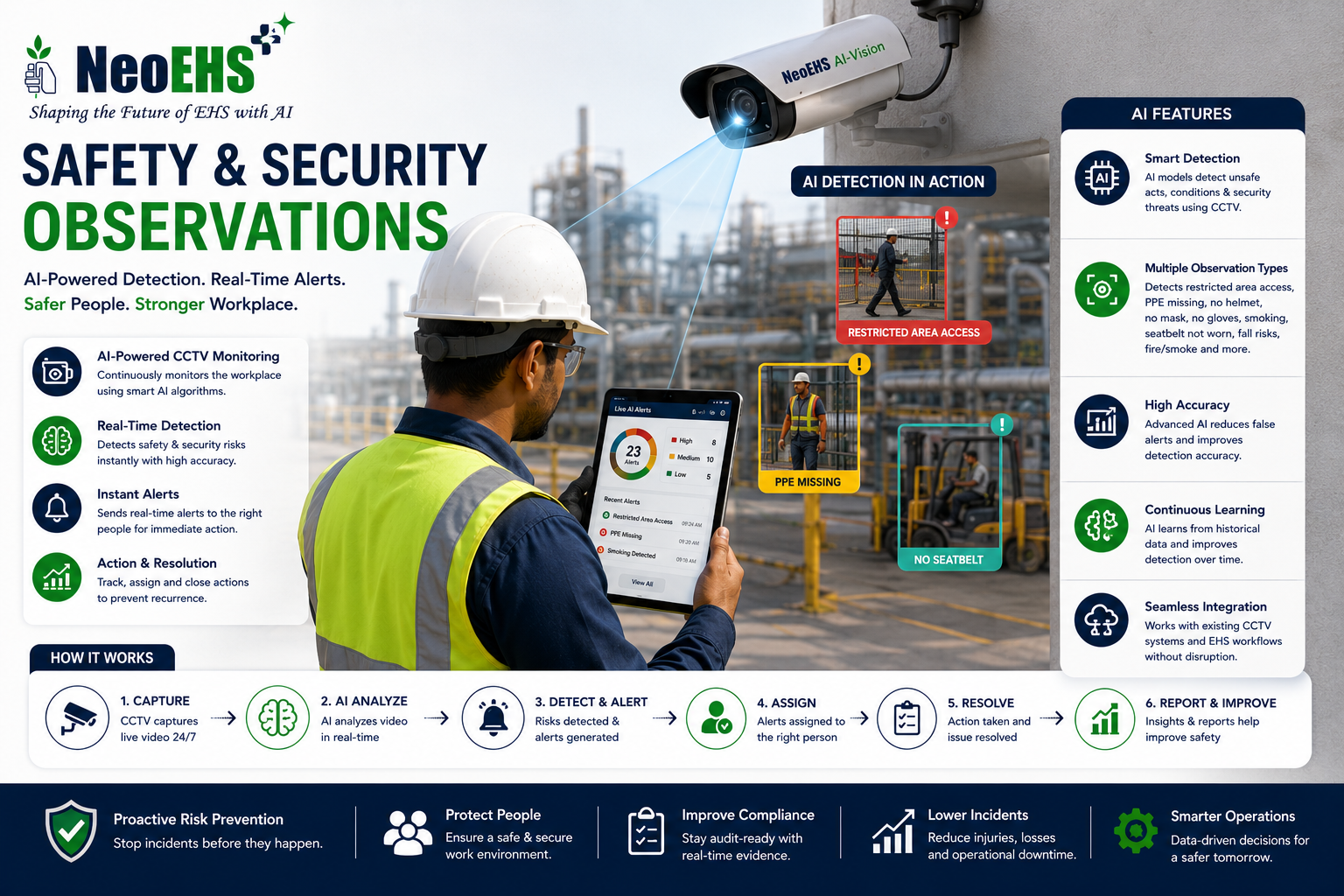
AI-Powered Safety & Security Observation Software for Proactive Risk Prevention
From Observation to Prevention: How AI-Powered Safety & Security Observation Software Reduces Workplace Risk
Every workplace produces warning signals before a major safety incident or security breach occurs. An unsafe act, missing PPE, damaged barricade, unauthorized access, suspicious activity, blocked emergency exit, or repeated procedural violation may appear minor when viewed individually. However, when these observations are captured, connected, and analyzed, they can reveal emerging risks before they cause serious consequences.
Modern organizations need more than a system for recording observations. They need an intelligent platform that helps employees report concerns quickly, prioritizes critical risks, ensures corrective actions are completed, and converts observation data into actionable insights.
This is where AI-powered Safety & Security Observation Software can help organizations move from reactive incident management toward proactive risk prevention.
Why Safety & Security Observations Matter
Traditional safety and security performance management often depends on lagging indicators such as injuries, security breaches, equipment damage, lost-time incidents, and operational disruptions.
These indicators explain what has already happened.
Observations provide visibility into what could happen next.
Employees, contractors, supervisors, security personnel, and HSE teams interact with workplace risks every day. Giving them an easy way to report unsafe conditions, unsafe behaviors, security concerns, near misses, access-control issues, and procedural violations creates an important source of leading-indicator data.
The challenge begins when organizations receive hundreds or thousands of observations.
Which observation requires immediate attention?
Which location is repeatedly reporting the same issue?
Which corrective actions are overdue?
Are similar risks occurring across multiple facilities?
Which observations could develop into serious incidents?
Without a centralized and intelligent observation management system, answering these questions becomes difficult.
From Traditional Reporting to Intelligent Risk Prevention
Many organizations still use paper forms, emails, spreadsheets, messaging applications, and disconnected software systems to manage observations.
The following graphic illustrates how an intelligent observation management approach changes the process.
GRAPHIC: Traditional Observation Management vs AI-Powered Observation Intelligence
|
TRADITIONAL OBSERVATION MANAGEMENT |
AI-POWERED OBSERVATION INTELLIGENCE |
|
Manual or paper-based reporting |
Mobile and digital observation reporting |
|
Delayed communication of risks |
Real-time reporting and notifications |
|
Safety and security data stored separately |
Unified Safety & Security Observation Platform |
|
Manual observation categorization |
AI-assisted classification and categorization |
|
Every observation reviewed manually |
Intelligent risk prioritization |
|
Corrective actions tracked through emails and spreadsheets |
Automated CAPA workflows and escalation |
|
Limited visibility of recurring risks |
AI-powered pattern and trend detection |
|
Periodic management reports |
Real-time dashboards and analytics |
|
Reactive response after incidents |
Predictive and proactive risk prevention |
Key Transformation:
OBSERVE → REPORT → ANALYZE → PRIORITIZE → ACT → VERIFY → LEARN → PREVENT
One Platform for Safety and Security Observations
Safety and security risks are often managed by separate departments, even though many workplace risks are interconnected.
Consider an unauthorized person entering a restricted operational area.
It is a security concern because access-control measures have failed. At the same time, it creates a serious safety risk because the individual may be exposed to moving machinery, electrical equipment, hazardous materials, or operational vehicles.
Similarly, blocked emergency exits, inadequate lighting, damaged perimeter fencing, disabled CCTV cameras, unsafe contractor behavior, and unauthorized material movement may create both safety and security consequences.
A unified Safety & Security Observation Management System enables organizations to capture and manage these risks through one centralized platform.
Management teams gain better visibility across plants, offices, projects, warehouses, infrastructure facilities, departments, contractors, and business units.
Capture Observations Directly from the Workplace
An effective observation management program depends on workforce participation.
Reporting must therefore be fast and simple.
Mobile-enabled Safety & Security Observation Software allows employees, supervisors, contractors, HSE professionals, and security personnel to report concerns directly from the workplace.
Users can record the observation, identify the location, select the risk category, upload photographs or supporting evidence, describe immediate actions, and submit the report for evaluation.
Real-time reporting reduces communication delays and enables responsible teams to respond faster to critical risks.
How AI Makes Observation Management Smarter
As reporting participation increases, organizations generate large volumes of observation data.
Reviewing every observation manually can become difficult for safety and security teams.
Artificial Intelligence can help transform this growing volume of information into actionable risk intelligence.
AI-assisted classification can automatically organize observations into categories such as unsafe acts, unsafe conditions, PPE violations, access-control concerns, housekeeping issues, equipment risks, fire hazards, and security threats.
AI-powered risk prioritization can help identify observations that require immediate management attention.
Pattern recognition can highlight repeated observations occurring at the same location, involving similar activities, contractors, equipment, or departments.
Instead of treating every observation as an isolated event, organizations can identify systemic weaknesses and implement preventive actions.
Connecting Observations with Corrective Actions
Reporting an observation is only the beginning of the risk management process.
The real value comes from ensuring that identified risks are properly addressed.
An effective observation management system should connect significant observations with structured Corrective and Preventive Action workflows.
Responsible personnel can be assigned actions with clear deadlines. Automated notifications can remind action owners about approaching due dates, while escalation workflows can bring overdue or high-risk issues to management attention.
Supporting photographs, documents, and completion evidence can be uploaded before actions are closed.
Supervisors and HSE teams can then verify whether the corrective measures have effectively controlled the identified risk.
This creates a clear accountability cycle:
Observation Identified → Risk Evaluated → Action Assigned → Corrective Action Completed → Evidence Submitted → Effectiveness Verified → Observation Closed
Real-Time Dashboards for Better Decision-Making
Observation data becomes more valuable when organizations can understand the story behind the numbers.
Real-time dashboards can provide management teams with visibility into total observations, open observations, high-risk issues, overdue corrective actions, recurring concerns, location-wise trends, department performance, and closure rates.
Heat maps and trend analytics can help organizations identify facilities and operational areas with increasing risk exposure.
Management teams can use these insights to prioritize inspections, improve training programs, strengthen security controls, allocate resources, and implement targeted preventive measures.
Moving Toward Predictive Safety and Security Management
The future of workplace safety and security management is increasingly proactive.
Organizations are moving beyond simply recording what happened toward understanding what could happen next.
By combining workforce observations, historical incidents, corrective action performance, recurring risk patterns, and operational data, AI-powered platforms can help organizations identify emerging risks.
When repeated observations appear at the same facility or activity, the system can highlight potential weaknesses before a serious incident occurs.
This enables organizations to focus their resources on prevention rather than waiting for incidents to reveal weaknesses in existing controls.
How NeoEHS Supports Intelligent Observation Management
NeoEHS Safety & Security Observation Software provides organizations with a centralized digital platform for capturing, managing, analyzing, and responding to workplace safety and security observations.
The solution supports mobile observation reporting, AI-assisted observation classification, risk prioritization, corrective and preventive action management, automated notifications and escalations, real-time dashboards, trend analytics, and centralized observation tracking.
By converting everyday workplace observations into actionable intelligence, NeoEHS helps organizations strengthen accountability, accelerate corrective actions, identify recurring risks, and improve safety and security performance.
Conclusion
Every observation is an opportunity to prevent an incident.
Organizations that simply collect observations may improve reporting numbers. Organizations that analyze observations, prioritize risks, complete corrective actions, and learn from recurring patterns can create meaningful improvements in workplace safety and security.
AI-powered Safety & Security Observation Software enables organizations to transform scattered reports into connected risk intelligence.
The result is faster reporting, better risk visibility, stronger accountability, smarter decision-making, and a proactive approach to protecting people, assets, facilities, and operations.
NeoEHS helps organizations move beyond observation reporting—turning everyday safety and security signals into actionable insights for proactive risk prevention.
Safety and Security Observation Software, AI Safety Observation Software, Security Observation Management System, Workplace Safety Reporting Software, AI EHS Software, Corrective Action Management Software, Safety Observation App, Proactive Risk Prevention, Predictive Safety Analytics, Security Risk Management Software
READ MORE ❯
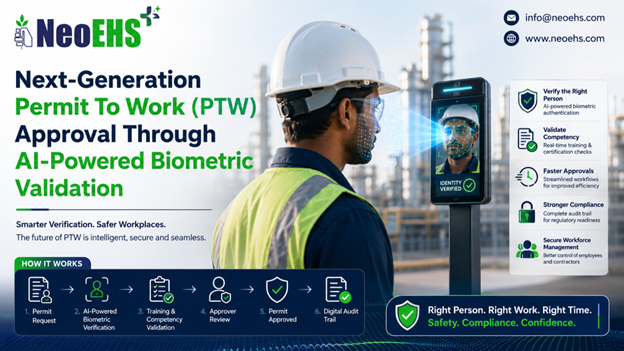
AI-Powered Biometric Worker Authentication for Permit To Work Approval in NeoEHS
Next-Generation PTW Approval Through AI-Powered Biometric Validation. Transforming Safety Compliance with Intelligent Worker Authentication
Transforming Safety Compliance with Intelligent Worker Authentication
In today's high-risk industrial environments, ensuring that only authorized, trained, and certified personnel perform critical tasks is no longer optional—it is essential. Traditional Permit To Work (PTW) processes often rely on manual verification methods that can be time-consuming, prone to human error, and vulnerable to identity fraud.
At NeoEHS, we are redefining workplace safety with AI-Powered Biometric Worker Authentication integrated directly into the PTW approval process.
The Challenge
Organizations across manufacturing, oil & gas, chemicals, construction, and utilities face common challenges:
- Unauthorized personnel accessing hazardous work areas
- Manual identity verification delays
- Compliance risks due to incomplete worker validation
- Contractor workforce management complexities
- Audit and regulatory reporting requirements
A permit is only as secure as the verification process behind it.
The NeoEHS Solution
Our next-generation PTW platform leverages Artificial Intelligence and Biometric Validation to authenticate workers before permit issuance and approval.
The system verifies worker identity in real time using biometric technologies such as facial recognition, fingerprint authentication, or mobile-based biometric verification, ensuring that the person requesting or receiving the permit is the authorized individual.
The NeoEHS 5-Step Intelligent PTW Authentication Process
As illustrated in our solution framework, NeoEHS follows a unique 5-card AI-powered workflow that seamlessly integrates worker verification with PTW approval:
Card 1: Permit Request Initiation
The worker or contractor initiates a Permit To Work request through the NeoEHS platform. The system captures job details, work location, permit type, and worker information.
Card 2: AI-Powered Biometric Authentication
The worker's identity is verified using facial recognition, fingerprint authentication, or mobile biometric validation. AI ensures that the individual requesting the permit is the authorized worker.
Card 3: Competency & Compliance Validation
The platform automatically validates:
- Training records
- Certifications
- Medical fitness requirements
- Skill competency
- Contractor compliance status
Only qualified personnel proceed to the next stage.
Card 4: Intelligent PTW Review & Approval
Authorized supervisors and permit approvers receive authenticated worker information along with compliance status. This enables faster, more informed, and risk-based permit approval decisions.
Card 5: Digital Authorization & Audit Trail
Once approved, the permit is digitally issued and linked to the authenticated worker. Every action is securely recorded, creating a complete audit trail for compliance, inspections, and reporting.
How It Works
- Worker requests a permit through the NeoEHS platform.
- AI-powered biometric verification confirms the worker's identity.
- The system validates training records, certifications, and competency requirements.
- PTW approvers receive authenticated worker details.
- Permit approval is granted only after successful verification and compliance checks.
- Every action is digitally logged, creating a complete audit trail.
Key Benefits
✅ Enhanced worker safety and accountability
✅ Elimination of identity fraud and proxy attendance
✅ Faster PTW approval workflows
✅ Improved contractor workforce compliance
✅ Real-time validation of certifications and training records
✅ Digital audit readiness for regulatory inspections
✅ Reduced administrative effort and manual verification
✅ Stronger governance through authenticated permit ownership
✅ Improved operational efficiency with automated compliance checks
The Future of Safe Work Management
The convergence of AI, biometrics, and digital safety management is creating a new standard for operational excellence. Organizations can now move beyond paper-based controls and fragmented verification processes to establish a truly secure and intelligent Permit To Work ecosystem.
The NeoEHS 5-step authentication and approval framework ensures that every permit is backed by verified worker identity, validated competency, and documented compliance. This not only strengthens workplace safety but also enhances operational transparency and regulatory readiness.
By integrating biometric worker authentication into PTW approvals, businesses can significantly reduce risk, strengthen compliance, and ensure that every permit is issued to the right person, at the right time, for the right job.
Driving the Next Generation of Workplace Safety
At NeoEHS, we believe safety innovation should be proactive, intelligent, and scalable. AI-powered biometric validation is more than a technology enhancement—it is a strategic step toward building safer, smarter, and more compliant workplaces.
With our unique 5-card intelligent PTW workflow, organizations can confidently verify worker identity, validate competency, streamline approvals, and maintain complete auditability throughout the permit lifecycle.
READ MORE ❯
.png)
Smarter Mines. Safer Futures: How AI-Powered EHS Software is Transforming the Mining Industry
Smarter Mines. Safer Futures: How AI-Powered EHS Software is Transforming the Mining Industry
Mining remains one of the world's most challenging and high-risk industries. From managing hazardous operations and ensuring worker safety to maintaining environmental compliance, mining organizations face constant pressure to operate efficiently while protecting people and the planet.
This is where AI-powered Environment, Health, and Safety (EHS) solutions are changing the game.
The Need for Smarter Mining Operations
Traditional safety management systems often rely on manual processes, paper-based records, and reactive incident management. These approaches can lead to:
- Delayed hazard identification
- Compliance gaps
- Inefficient permit approvals
- Limited visibility into operational risks
- Increased administrative workload
As mining operations become more complex, companies need a centralized, intelligent platform that provides real-time visibility and proactive risk management.
Introducing NeoEHS: AI-Powered EHS Software for Mining
NeoEHS is designed specifically to help mining organizations strengthen safety, improve compliance, and enhance operational performance through a single integrated platform.
With real-time monitoring, intelligent workflows, and AI-driven insights, NeoEHS enables mining companies to move from reactive safety management to proactive risk prevention.
Key Modules
NeoEHS provides complete control over mining EHS operations through:
- Permit to Work Management
- Risk Assessments
- Inspections
- Incident Management
- LOTO (Lockout/Tagout) Management
- Compliance Tracking
- Reports & Analytics
- Audit Management
- Training Management
All modules are connected through a centralized dashboard, providing instant access to critical safety and compliance information.
AI Features Driving Safer Operations
1. Risk Detection
NeoEHS continuously identifies:
- Unsafe acts
- Workplace hazards
- Compliance violations
- Emerging operational risks
This enables organizations to address issues before incidents occur.
2. Risk Prediction
Using historical data and operational trends, the platform predicts potential risks and highlights areas requiring immediate attention.
Benefits include:
- Reduced incident rates
- Improved preventive actions
- Better resource planning
3. Smart Recommendations
The AI engine recommends corrective and preventive actions, helping teams implement effective controls faster and more consistently.
Built for Every Mining Operation
NeoEHS supports a wide range of mining activities, including:
- Drilling & Blasting
- Equipment Maintenance
- Material Handling
- Underground Operations
- Contractor Management
- Environmental Monitoring
- Incident Management
- Emergency Response
Whether managing a single site or multiple mining locations, NeoEHS scales to meet operational requirements.
Benefits for Mining Organizations
Improve Safety Outcomes
- Reduce workplace incidents
- Strengthen safety culture
- Protect employees and contractors
Streamline Permit Processes
- Faster approvals
- Automated workflows
- Improved accountability
Enhance Contractor Management
- Track competencies and certifications
- Monitor contractor performance
- Ensure compliance requirements are met
Reduce Paperwork
- Digitize forms and records
- Eliminate manual tracking
- Improve data accuracy
Increase Operational Efficiency
- Real-time dashboards
- Data-driven decision making
- Improved collaboration across teams
Driving Sustainable Mining
Modern mining organizations are expected to deliver both operational excellence and environmental responsibility. NeoEHS helps organizations monitor environmental impacts, track compliance requirements, and support sustainability initiatives while maintaining productivity.
The Future of Mining Safety
The future of mining belongs to organizations that leverage technology to create safer, smarter, and more sustainable operations. AI-powered EHS platforms like NeoEHS provide the intelligence, automation, and visibility needed to reduce risks, improve compliance, and drive continuous improvement.
Conclusion
Mining companies can no longer afford fragmented safety systems and reactive risk management approaches. By combining AI-driven risk detection, prediction, and recommendations within a single platform, NeoEHS empowers organizations to protect people, optimize operations, and build a safer future for the mining industry.
Smarter Mines. Safer Futures. One Intelligent Platform for Mining EHS Excellence.
READ MORE ❯
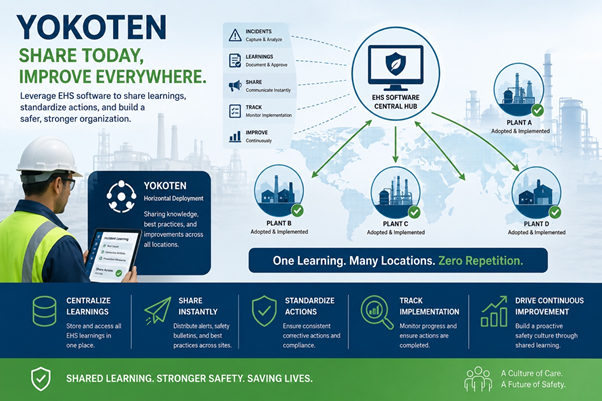
Why Yokoten Matters More Than Ever in Modern EHS Management
Introduction
In today’s industrial environment, organizations are under constant pressure to improve safety performance, reduce operational risks, and maintain compliance across multiple locations.
But one challenge still remains:
How can a lesson learned at one site become a preventive action across every site?
This is where Yokoten becomes a game changer.
What is Yokoten?
Yokoten is a Japanese concept that means “horizontal deployment” — the practice of sharing knowledge, best practices, corrective actions, and improvements across teams, plants, and business units.
Originally rooted in Lean manufacturing and Toyota Production Systems, Yokoten is no longer limited to operational excellence. It has become a critical strategy for Environment, Health & Safety (EHS) leaders.
Instead of solving the same safety problem repeatedly at different sites, Yokoten enables organizations to:
- Replicate successful safety initiatives
- Share incident learnings enterprise-wide
- Standardize corrective actions
- Accelerate compliance improvements
- Build a proactive safety culture
The Gap in Traditional EHS Processes
Many companies still rely on emails, spreadsheets, disconnected reports, or manual meetings to distribute safety learnings.
The result?
- Delayed communication
- Inconsistent implementation
- Repeated incidents
- Limited visibility across locations
When critical learnings remain siloed, organizations lose the opportunity to prevent future risks.
How Modern EHS Software Enables Yokoten
Modern EHS software platforms are changing this dynamic by making Yokoten scalable, measurable, and actionable.
With integrated EHS systems, organizations can:
Centralize Incident Learnings
Capture root causes, corrective actions, and preventive measures in one shared platform.
Automate Knowledge Sharing
Push alerts, safety bulletins, and best practices across facilities instantly.
Standardize Corrective Actions
Ensure every plant follows the same approved procedures and compliance workflows.
Track Implementation
Monitor which sites have reviewed, adopted, and completed required actions.
Build Continuous Improvement
Create a culture where safety learning becomes part of daily operations—not just post-incident reporting.
From Reactive Safety to Preventive Intelligence
The future of EHS is not only about compliance.
It’s about creating an organization that learns continuously.
Companies that successfully embed Yokoten into their EHS strategy move from:
- Reactive → Predictive
- Isolated fixes → Enterprise-wide improvement
- Compliance tracking → Safety intelligence
Technology alone does not create a safety culture.
But the right EHS software can ensure that every lesson learned becomes a lesson shared.
And in safety, shared learning saves lives.
Conclusion
The power and energy industry requires a modern and integrated approach to safety management.
AI-powered EHS platforms enable organizations to:
- Detect risks instantly
- Predict incidents before they occur
- Automate safety processes
- Improve operational efficiency
- Build a stronger safety culture
By adopting intelligent EHS solutions, organizations can move toward a future of zero incidents, improved compliance, and smarter operational excellence.
Call to Action
Transform your safety management with intelligent technology.
Explore how NeoEHS can help your organization build a safer, smarter, and more efficient power & energy operation.
READ MORE ❯
.webp)
AI-Powered EHS Platform for Power & Energy: Driving Predictive Safety and Operational Excellence
Introduction
The power and energy industry operates in one of the most high-risk, complex, and regulated environments. Managing safety, compliance, and operational efficiency across plants, grids, and field operations is a constant challenge.
Traditional EHS systems often rely on manual reporting, delayed insights, and reactive safety approaches—making it difficult to prevent incidents before they occur.
The NeoEHS platform transforms this landscape by introducing an AI-powered, predictive, and fully digital EHS ecosystem designed specifically for modern industrial environments.
Moving Beyond Reactive Safety
Most organizations still operate in a reactive safety model:
- Incidents are reported after they happen
- Investigations focus on past events
- Insights are delayed
- Actions are not always tracked effectively
This approach increases the risk of:
- Repeated incidents
- Operational disruptions
- Compliance failures
NeoEHS enables a shift toward predictive and proactive safety management, where risks are identified and addressed before they escalate.
AI That Sees. Thinks. Acts.
The NeoEHS platform is built on a powerful AI foundation that transforms safety management into an intelligent system.
Vision AI & Image Analysis
NeoEHS uses advanced image and video analysis to monitor workplace environments in real time.
Capabilities include:
- Detecting unsafe behaviors
- Identifying PPE violations
- Monitoring hazardous conditions
- Capturing near-miss events
This ensures instant risk detection without manual intervention.
Predictive Risk Intelligence
Using advanced analytics, NeoEHS can:
- Identify risk patterns
- Predict potential failures
- Highlight high-risk zones
- Provide early warnings
This allows organizations to act before incidents occur, reducing operational risks significantly.
AI Safety Narratives
NeoEHS converts complex safety data into intelligent summaries and narratives, helping decision-makers quickly understand:
- What happened
- Why it happened
- What needs to be done
This improves decision-making speed and clarity.
Behavior & Trend Intelligence
The platform analyzes safety behavior trends over time to:
- Identify unsafe patterns
- Measure safety culture maturity
- Improve workforce engagement
Organizations can move toward a data-driven safety culture.
Complete EHS Digital Ecosystem
NeoEHS provides a unified platform that covers the entire safety lifecycle.
Core Modules
-
Proactive Safety Activity
Track observations, near misses, and preventive actions. -
Incident Management
Manage incidents with structured workflows and root cause analysis. -
Audit Management
Conduct inspections and audits with digital checklists. -
Behaviour-Based Safety (BBS)
- Monitor and improve workforce safety behavior.
-
Action Tracking
Ensure corrective and preventive actions are completed on time. -
Change Management (MOC)
Manage operational changes safely with structured approvals. -
Training Management
Track workforce training and competency. -
Risk Assessment
Identify, evaluate, and mitigate risks proactively. -
Zone Register & Follow-ups
Monitor high-risk zones and ensure compliance. -
Automated Reports
Generate real-time reports for management and compliance.
Real-Time Safety Visibility
NeoEHS provides a centralized dashboard that gives:
- Live incident data
- Leading and lagging indicators
- Safety performance metrics
- Action status tracking
This enables leadership teams to make informed, real-time decisions.
Business Impact
Implementing NeoEHS delivers measurable business outcomes.
-
Reduce Operational Risks
Identify and mitigate risks before they lead to incidents. -
Improve Workforce Safety
Ensure safer working conditions across all operations. -
Eliminate Manual Reporting
Automate data capture, reporting, and analysis. -
Increase Compliance Efficiency
Maintain audit-ready records with full traceability. -
Enable Predictive Safety Culture
Shift from reactive to proactive safety management.
Why Power & Energy Industry Needs AI in EHS
The power and energy sector involves:
- High-risk equipment
- Complex operations
- Distributed assets
- Strict regulatory requirements
AI-powered platforms like NeoEHS help organizations:
- Improve operational reliability
- Reduce downtime
- Enhance safety compliance
- Optimize resource utilization
The Future of EHS is Intelligent
EHS is no longer just about compliance—it is about intelligence, prediction, and prevention.
With NeoEHS, organizations can:
- Detect risks instantly
- Predict incidents before they occur
- Automate safety processes
- Build a strong safety culture
Conclusion
The power and energy industry requires a modern, intelligent, and integrated approach to safety management.
The NeoEHS AI-powered EHS platform delivers:
- Real-time visibility
- Predictive risk intelligence
- Complete digital safety ecosystem
- Measurable business impact
By adopting NeoEHS, organizations can move toward a future of zero incidents, higher efficiency, and smarter safety management.
Call to Action
Transform your safety management with intelligent technology.
👉 Explore how NeoEHS can help you build a safer, smarter, and more efficient power & energy operation.
READ MORE ❯
.jpg)
5 Why Analysis: A Simple Yet Powerful Method to Identify Root Causes
Introduction
When a workplace incident occurs, the most common mistake organizations make is addressing only the surface-level issue.
Fixing symptoms may solve the immediate problem—but it does not prevent recurrence.
To truly eliminate incidents, organizations need to uncover the root cause.
This is where 5 Why Analysis (Why-Why Analysis) becomes highly effective.
The NeoEHS platform integrates this method into its investigation workflow, enabling teams to systematically identify root causes and implement lasting solutions.
What is 5 Why Analysis?
5 Why Analysis is a simple yet powerful root cause analysis technique that involves asking “Why?” repeatedly—typically five times—until the underlying cause of a problem is identified.
Instead of jumping to conclusions, this method encourages teams to:
- Think deeper
- Explore cause-effect relationships
- Identify process gaps
- Avoid assumptions
Why 5 Why Analysis is Important in EHS
In safety management, many incidents repeat because the actual root cause is never addressed.
5 Why Analysis helps organizations:
- Identify true root causes
- Avoid superficial fixes
- Improve investigation quality
- Strengthen safety culture
- Reduce recurring incidents
It is especially effective for quick, structured investigations.
How 5 Why Analysis Works
The method follows a simple sequence:
Step 1: Define the Problem
Clearly state the incident.
Step 2: Ask “Why?”
Identify the immediate cause.
Step 3: Ask “Why?” Again
Dig deeper into the underlying cause.
Step 4: Repeat the Process
Continue until the root cause is identified (usually 5 levels).
Step 5: Take Corrective Action
Address the root cause—not just the symptom.
Example of 5 Why Analysis
Problem
Worker slipped and got injured.
Why 1: Why did the worker slip?
→ Floor was wet
Why 2: Why was the floor wet?
→ Water leakage
Why 3: Why was there leakage?
→ Pipe was damaged
Why 4: Why was the pipe damaged?
→ No maintenance
Why 5: Why was there no maintenance?
→ No inspection schedule
Root Cause
Lack of preventive maintenance and inspection system
Solution
- Implement regular inspection schedules
- Assign maintenance responsibility
- Track actions digitally
How NeoEHS Enables 5 Why Analysis
The NeoEHS platform digitizes and structures the 5 Why process.
Structured Workflow
Guided step-by-step questioning approach
Standardized Investigation
Ensures consistency across sites and teams
Root Cause Mapping
Clearly captures cause-effect relationships
Action Integration
Links root causes directly to corrective actions
Real-Time Tracking
Monitors action completion and effectiveness
Benefits of 5 Why Analysis in NeoEHS
Simplicity
Easy to understand and implement
Speed
Quick analysis for immediate insights
Clarity
Clear identification of root causes
Prevention
Eliminates recurring issues
Integration
Seamless connection with CAPA workflows
Common Mistakes to Avoid
Even though 5 Why Analysis is simple, it can fail if not done correctly.
Jumping to Conclusions
Assuming causes without evidence
Stopping Too Early
Not reaching the real root cause
Blaming Individuals
Focusing on people instead of processes
Lack of Data
Not supporting answers with facts
No Action Taken
Identifying causes but not fixing them
When to Use 5 Why Analysis
- Minor to moderate incidents
- Near misses
- Repetitive issues
- Operational inefficiencies
- Quick investigations
For complex incidents, it can be combined with other methods like:
- Fishbone Analysis
- Fault Tree Analysis
Role in Continuous Improvement
5 Why Analysis is not just an investigation tool—it supports continuous improvement.
Organizations can use it to:
- Improve processes
- Strengthen safety systems
- Enhance accountability
- Build a proactive safety culture
With NeoEHS, this becomes part of a centralized safety ecosystem.
Conclusion
Workplace incidents cannot be prevented by quick fixes alone.
Organizations must understand why problems occur and address them at the source.
5 Why Analysis provides a simple, structured, and effective way to uncover root causes and prevent recurrence.
With NeoEHS, this process becomes digital, standardized, and fully integrated—ensuring better investigations and safer workplaces.
Call to Action
Start identifying real causes—not just symptoms.
👉 Discover how NeoEHS enables structured 5 Why Analysis and smarter incident investigations.
READ MORE ❯
.webp)
Fault Tree Analysis (FTA): A Structured Approach to Incident Root Cause Identification
Introduction
In complex industrial environments, workplace incidents are rarely caused by a single failure. Instead, they result from a combination of multiple contributing factors.
Traditional investigation methods often fail to capture these interdependencies, leading to incomplete analysis and recurring incidents.
This is where Fault Tree Analysis (FTA) becomes essential.
The NeoEHS platform integrates Fault Tree Analysis into its incident investigation framework, enabling organizations to visually map failures, identify root causes, and implement effective preventive measures.
What is Fault Tree Analysis (FTA)?
Fault Tree Analysis is a top-down, deductive analysis method used to determine the root causes of an incident or system failure.
The process begins with a top event (incident) and works backward to identify all possible causes that contributed to it.
FTA uses a tree-like structure with:
- Top Event → The incident being analyzed
- Intermediate Events → Contributing failures
- Basic Events → Root causes
- Logic Gates (AND / OR) → Relationships between causes
This structured approach helps teams understand how multiple failures interact to produce a single incident.
Why Fault Tree Analysis is Important in EHS
In industries such as construction, manufacturing, and energy, risks are interconnected.
Fault Tree Analysis helps organizations:
- Identify multiple failure pathways
- Understand cause-effect relationships
- Analyze complex systems
- Improve risk assessment
- Prevent high-impact incidents
Unlike simple investigation methods, FTA provides a comprehensive view of how incidents occur.
Key Components of Fault Tree Analysis
1. Top Event
The top event represents the incident or failure being analyzed.
Example:
- Worker injury
- Equipment failure
- Fire incident
2. Intermediate Events
These are events that occur due to one or more contributing causes.
They connect the top event with root causes.
3. Basic Events
Basic events are the root-level causes that cannot be broken down further.
Examples:
- Equipment malfunction
- Human error
- Process failure
4. Logic Gates
FTA uses logical relationships to connect events.
AND Gate
All conditions must occur for the event to happen.
OR Gate
Any one condition can cause the event.
These gates help visualize how different factors combine to create incidents.
How Fault Tree Analysis Works in NeoEHS
The NeoEHS platform simplifies Fault Tree Analysis through a digital, structured workflow.
Step 1: Define the Incident (Top Event)
Clearly identify the incident being investigated.
Step 2: Break Down Contributing Events
Identify intermediate events leading to the incident.
Step 3: Map Root Causes
Break down events into basic root causes.
Step 4: Apply Logical Relationships
Use AND/OR logic to define how causes are connected.
Step 5: Analyze Failure Paths
Identify the most critical combinations of failures.
Step 6: Assign Corrective Actions
Link each root cause to corrective and preventive actions.
Step 7: Track and Verify
Ensure all actions are completed and validated within the system.
Benefits of Fault Tree Analysis in NeoEHS
Comprehensive Investigation
Captures all possible contributing factors.
Visual Clarity
Provides a clear graphical representation of incident causes.
Better Risk Understanding
Helps identify critical failure points.
Preventive Approach
Enables organizations to eliminate root causes proactively.
Integrated CAPA Management
Direct linkage between root causes and corrective actions.
Fault Tree Analysis vs Traditional Investigation
|
Traditional Investigation |
Fault Tree Analysis with NeoEHS |
|
Focus on single cause |
Identifies multiple causes |
|
Linear thinking |
System-based thinking |
|
Limited visibility |
Visual cause mapping |
|
Manual documentation |
Digital structured workflow |
|
Weak prevention |
Strong predictive insights |
Role of Fault Tree Analysis in Risk Management
FTA is not just an investigation tool—it is also a risk assessment tool.
Organizations can use it to:
- Predict potential failures
- Evaluate system reliability
- Strengthen safety controls
- Improve operational efficiency
When integrated with NeoEHS, FTA becomes part of a continuous safety improvement cycle.
Building Safer Workplaces with Structured Analysis
By combining Fault Tree Analysis with:
- Incident reporting
- Root cause analysis
- Corrective action tracking
- Real-time dashboards
NeoEHS enables organizations to move toward data-driven and proactive safety management.
Conclusion
Workplace incidents are complex and often involve multiple interconnected causes. Traditional investigation methods may overlook these relationships.
Fault Tree Analysis provides a structured, visual, and systematic approach to identifying root causes and understanding failure pathways.
With NeoEHS, organizations can digitize this process, integrate it with corrective actions, and ensure complete visibility from incident to prevention.
Call to Action
Strengthen your incident investigations with advanced analysis tools.
👉 Discover how NeoEHS enables Fault Tree Analysis and proactive safety management across your organization.
READ MORE ❯
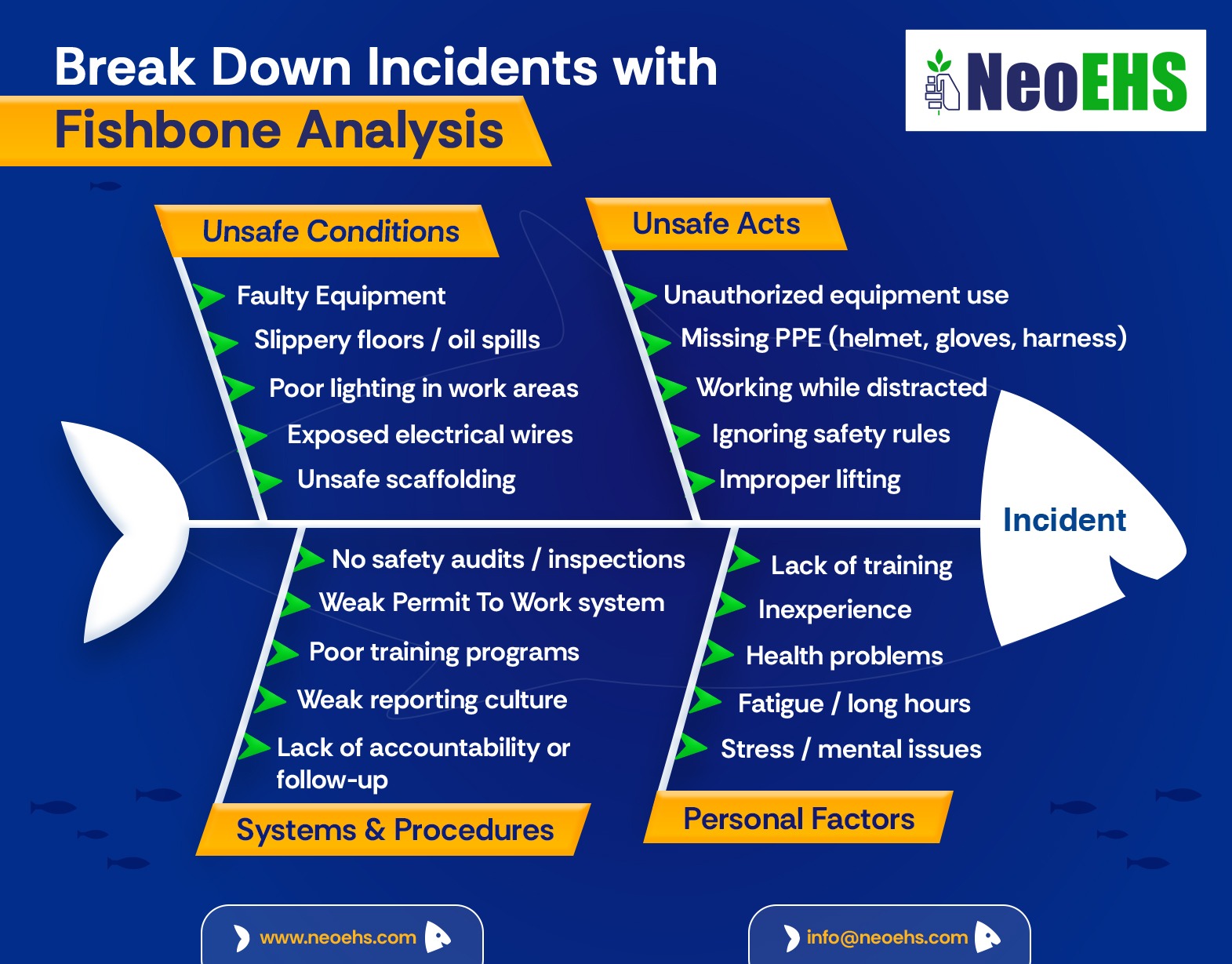
Fishbone (Ishikawa) Analysis: Identifying Root Causes of Workplace Incidents
Introduction
In safety-critical industries such as construction, manufacturing, and oil & gas, identifying the true root cause of incidents is essential to prevent recurrence.
However, many organizations stop at identifying surface-level causes, leading to repeated incidents and ineffective corrective actions.
This is where Fishbone (Ishikawa) Analysis becomes a powerful tool.
Integrated within the NeoEHS platform, Fishbone Analysis enables safety teams to systematically investigate incidents, identify contributing factors, and implement effective corrective and preventive actions.
What is Fishbone (Ishikawa) Analysis?
Fishbone Analysis, also known as the Cause-and-Effect Diagram, is a structured method used to identify potential causes of a problem.
It was developed by Kaoru Ishikawa, a pioneer in quality management.
The diagram resembles a fish skeleton:
- The head represents the problem (incident)
- The bones represent categories of causes
- The branches represent contributing factors
This approach helps teams move beyond assumptions and uncover systemic and root-level issues.
Why Fishbone Analysis is Important in EHS
In Environmental, Health & Safety (EHS), incidents are rarely caused by a single factor.
They are often the result of:
- Human errors
- Unsafe conditions
- System failures
- Process gaps
Fishbone Analysis helps organizations:
- Identify multiple contributing factors
- Categorize causes systematically
- Improve investigation quality
- Prevent recurring incidents
- Strengthen safety culture
Fishbone Categories Used in NeoEHS
The NeoEHS platform structures Fishbone Analysis into key categories to ensure comprehensive investigation.
1. Unsafe Acts
These are human behaviors that directly contribute to incidents.
Examples:
- Not wearing PPE
- Improper equipment handling
- Bypassing safety procedures
2. Unsafe Conditions
These refer to hazardous physical environments.
Examples:
- Defective equipment
- Poor lighting
- Slippery surfaces
- Unsafe site conditions
3. Personal Factors
These are individual-related causes affecting performance.
Examples:
- Lack of training
- Fatigue or stress
- Inexperience
- Health issues
4. Systems and Procedures
These represent organizational or process failures.
Examples:
- Lack of standard operating procedures (SOPs)
- Poor maintenance systems
- Inadequate supervision
- Missing safety controls
How Fishbone Analysis Works in NeoEHS
The NeoEHS platform digitizes and simplifies the Fishbone analysis process.
Step 1: Define the Problem
Identify the incident clearly (e.g., “Worker slipped on wet surface”).
Step 2: Categorize Causes
Use predefined categories like Unsafe Acts, Conditions, Personal Factors, and Systems.
Step 3: Identify Contributing Factors
Add all possible causes under each category.
Step 4: Analyze Root Causes
Evaluate which factors contributed most to the incident.
Step 5: Link Corrective Actions
Assign corrective and preventive actions directly within the system.
Step 6: Track and Verify
Monitor action completion and verify effectiveness through evidence.
Benefits of Using Fishbone Analysis in NeoEHS
Structured Investigation
Ensures all possible causes are considered systematically.
Improved Root Cause Identification
Helps uncover deeper systemic issues beyond surface-level causes.
Better Decision Making
Provides clear insights for implementing effective corrective actions.
Prevention of Recurring Incidents
Addresses root causes, not just symptoms.
Integrated CAPA Management
Links analysis directly with corrective and preventive actions.
Fishbone Analysis vs Traditional Investigation
|
Traditional Approach |
Fishbone Analysis with NeoEHS |
|
Focus on immediate cause |
Focus on multiple contributing factors |
|
Unstructured investigation |
Structured, categorized analysis |
|
Manual documentation |
Digital, centralized workflow |
|
Limited insights |
Deep root cause visibility |
|
Weak action tracking |
Integrated CAPA tracking |
Real-World Example
Incident
Worker slipped and fell at a construction site.
Fishbone Analysis
Unsafe Acts
- Worker not wearing anti-slip footwear
Unsafe Conditions
- Wet floor due to leakage
Personal Factors
- Worker unaware of hazard
Systems & Procedures
- Maintenance issue not reported
- No hazard signage
Outcome
- Leak fixed
- PPE enforcement improved
- Hazard communication implemented
This ensures long-term prevention instead of temporary fixes.
Building a Proactive Safety Culture
Fishbone Analysis is not just a tool—it is a mindset shift.
By using structured investigation methods within NeoEHS, organizations can:
- Encourage deeper analysis
- Promote accountability
- Share learnings across teams
- Build a proactive safety culture
Conclusion
Workplace incidents are often the result of multiple interconnected factors. Identifying only the immediate cause is not enough to prevent recurrence.
Fishbone (Ishikawa) Analysis provides a systematic and visual approach to uncover root causes and improve safety outcomes.
With NeoEHS, organizations can digitize this process, integrate it with corrective actions, and ensure complete traceability from incident to prevention.
Call to Action
Transform your incident investigations with structured root cause analysis.
👉 Explore how NeoEHS enables Fishbone Analysis and complete incident management across your organization.
READ MORE ❯
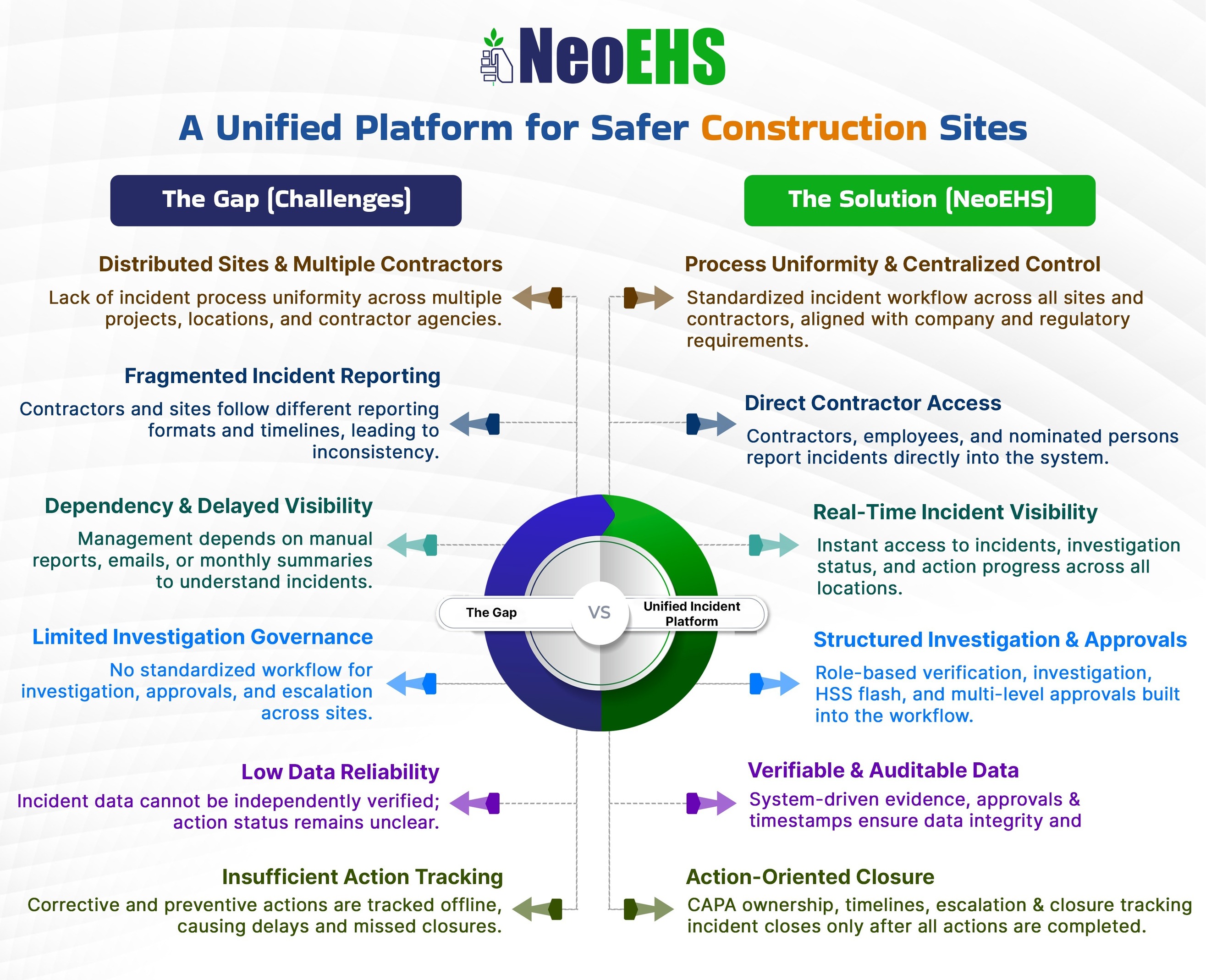
A Unified Platform for Safer Construction Sites
Introduction
Construction projects involve multiple contractors, distributed worksites, complex operations, and high-risk environments. Managing safety incidents across such environments is a major challenge for organizations.
Many construction companies still rely on fragmented reporting systems, emails, spreadsheets, or manual documentation to track safety incidents and corrective actions. This often leads to delayed responses, inconsistent investigations, and poor visibility for management.
The NeoEHS unified incident management platform addresses these challenges by providing a centralized system for incident reporting, investigation, corrective actions, and compliance management across all sites and contractors.
The Safety Management Challenges in Construction Projects
Construction companies face several operational challenges when managing incidents across multiple sites and contractors.
1. Distributed Sites and Multiple Contractors
Large construction organizations often operate across:
-
Multiple project sites
-
Different contractors and subcontractors
-
Various geographic locations
Each site or contractor may follow different reporting formats and safety procedures, resulting in inconsistent incident management practices.
Impact
-
Lack of standardized safety processes
-
Difficulties in monitoring incidents across sites
-
Inconsistent compliance with company policies
2. Fragmented Incident Reporting
Many contractors still use separate reporting systems or manual formats.
Some incidents may be reported through:
-
Email
-
Paper forms
-
WhatsApp messages
-
Excel sheets
This fragmentation results in incomplete records and delayed incident investigations.
Impact
-
Poor data consolidation
-
Delayed response to incidents
-
Difficulty analyzing incident trends
3. Dependency on Manual Reports
In traditional systems, management often relies on:
-
Monthly safety reports
-
Email summaries
-
Manual dashboards
This creates delayed visibility into incidents happening at project sites.
Impact
-
Management cannot respond quickly to critical safety risks
-
Delayed corrective actions
-
Increased accident exposure
4. Limited Investigation Governance
Incident investigations require structured workflows and accountability.
However, many organizations lack:
-
Standardized investigation processes
-
Defined approval workflows
-
Escalation mechanisms
Impact
-
Incomplete investigations
-
Lack of accountability
-
Poor incident learning
5. Low Data Reliability
Without centralized systems, incident data becomes difficult to verify.
Challenges include:
-
Missing evidence
-
Unverified action status
-
Inconsistent reporting
Impact
-
Reduced trust in safety data
-
Difficulty during compliance audits
6. Insufficient Action Tracking
Corrective and preventive actions are often tracked outside the incident system.
Organizations frequently use:
-
Spreadsheets
-
Emails
-
Manual tracking
Impact
-
Missed action deadlines
-
Poor closure tracking
-
Recurring safety incidents
The NeoEHS Unified Incident Management Solution
The NeoEHS platform provides a centralized system that connects incident reporting, investigation, approvals, and action tracking across all construction sites and contractors.
This creates process uniformity and real-time safety intelligence across the organization.
1. Process Uniformity and Centralized Control
NeoEHS standardizes incident reporting and investigation workflows across the organization.
All sites and contractors follow the same structured process aligned with company policies and regulatory requirements.
Key Benefits
-
Consistent incident management procedures
-
Compliance with safety regulations
-
Standardized reporting across projects
2. Direct Contractor Access
Contractors, employees, and nominated personnel can report incidents directly into the system.
This ensures faster reporting and more accurate information capture from the field.
Key Benefits
-
Faster incident reporting
-
Improved participation from contractors
-
Reduced reporting delays
3. Real-Time Incident Visibility
The NeoEHS platform provides management with instant access to incident information across all sites.
Safety teams can monitor:
-
Incident status
-
Investigation progress
-
Corrective action completion
Key Benefits
-
Immediate safety insights
-
Faster decision-making
-
Improved risk management
4. Structured Investigation and Approvals
NeoEHS provides structured workflows for incident investigations with role-based access and approval processes.
Features include:
-
Role-based verification
-
Investigation assignment
-
Multi-level approvals
-
HSS flash alerts
Key Benefits
-
Improved investigation quality
-
Clear accountability
-
Better compliance documentation
5. Verifiable and Auditable Data
NeoEHS ensures data integrity through system-driven evidence and approvals.
All actions and updates are recorded with:
-
Evidence attachments
-
Approval records
-
System timestamps
Key Benefits
-
Reliable safety data
-
Transparent audit trail
-
Improved regulatory compliance
6. Action-Oriented Incident Closure
NeoEHS integrates Corrective and Preventive Action (CAPA) management directly within the incident workflow.
Incidents can only be closed once all actions are completed and verified.
Key Benefits
-
Strong accountability for corrective actions
-
Prevent recurrence of incidents
-
Complete safety lifecycle management
Building Safer Construction Projects with Digital Safety Platforms
A unified digital platform like NeoEHS helps construction companies move beyond traditional incident reporting systems and build proactive safety management environments.
By integrating:
-
Incident reporting
-
Investigation workflows
-
Contractor participation
-
Action tracking
-
Real-time dashboards
organizations gain complete visibility and control over safety performance across all projects.
Conclusion
Managing safety incidents across distributed construction projects requires standardization, visibility, and accountability.
The NeoEHS unified incident management platform enables organizations to:
-
Standardize safety processes across sites
-
Enable direct contractor reporting
-
Improve incident investigation governance
-
Ensure reliable and auditable safety data
-
Track corrective actions effectively
With a centralized digital platform, organizations can significantly improve safety performance and reduce incident recurrence across construction projects.
READ MORE ❯
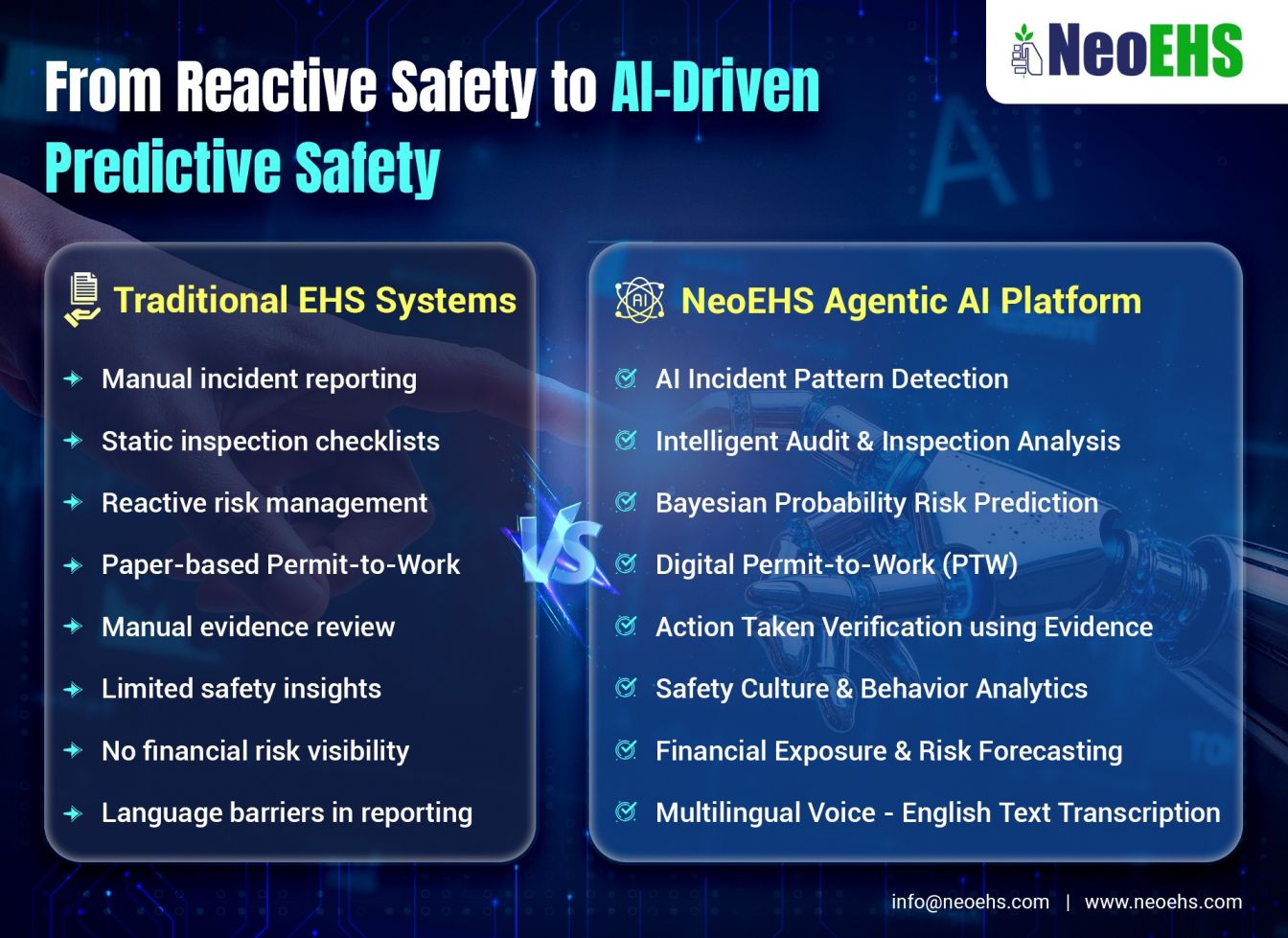
From Reactive Safety to AI-Driven Predictive Safety: The Future of EHS Management
For decades, Environmental, Health & Safety (EHS) systems across industries have primarily been reactive.
An incident happens.
A report is created.
An investigation follows.
While these steps are important, they occur after the risk has already materialized.
Today, with the emergence of Agentic AI and predictive analytics, organizations can move beyond reactive processes and build AI-driven predictive safety ecosystems.
This transformation is exactly what the NeoEHS Agentic AI Platform is designed to achieve.
The Limitations of Traditional EHS Systems
Many organizations still rely on conventional safety management systems that struggle to deliver proactive insights.
Common challenges include:
1. Manual Incident Reporting
Most safety incidents are reported manually, leading to delays, incomplete information, and underreporting.
2. Static Inspection Checklists
Traditional inspection checklists are static and fail to adapt to changing risk environments.
3. Reactive Risk Management
Risk assessments are often performed after incidents, rather than predicting potential hazards.
4. Paper-Based Permit-to-Work
Manual PTW systems create inefficiencies, approval delays, and poor traceability.
5. Manual Evidence Review
Safety teams spend significant time reviewing images, documents, and reports manually.
6. Limited Safety Insights
Data is often fragmented across multiple systems, making it difficult to generate meaningful insights.
7. Lack of Financial Risk Visibility
Most safety platforms do not quantify the financial impact of safety risks.
8. Language Barriers
Workforces in industries like construction, manufacturing, and oil & gas often speak multiple languages, which creates challenges in reporting incidents.
The Rise of AI-Driven Predictive Safety
Modern organizations are shifting toward predictive safety intelligence powered by artificial intelligence.
Instead of asking:
“What went wrong?”
They can now ask:
“What could go wrong — and how do we prevent it?”
This is where NeoEHS Agentic AI transforms traditional safety management.
How the NeoEHS Agentic AI Platform Transforms Safety
The NeoEHS platform integrates advanced AI capabilities to help organizations move from incident reporting systems to predictive safety intelligence platforms.
AI Incident Pattern Detection
AI continuously analyzes historical incident data to identify patterns and recurring safety risks across sites, departments, and activities.
Intelligent Audit & Inspection Analysis
Audit and inspection findings are automatically analyzed to detect systemic safety weaknesses.
Bayesian Risk Prediction
Using probabilistic models, the platform predicts future safety risks based on historical data and operational patterns.
Digital Permit-to-Work (PTW)
The platform replaces paper-based PTW systems with fully digital workflows, ensuring faster approvals and better compliance tracking.
Evidence-Based Action Verification
AI helps validate whether corrective actions have truly resolved the safety issue by analyzing submitted evidence.
Safety Culture & Behaviour Analytics
The system evaluates:
-
Near-miss reporting trends
-
Safety observation frequency
-
Reporting delays
-
Management response times
This generates an Organizational Safety Maturity Index.
Financial Exposure & Risk Forecasting
Safety risks are translated into potential financial exposure, enabling leadership teams to make risk-informed decisions.
Multilingual Voice Reporting
Field workers can report incidents using voice in any language, which is automatically converted into English text for centralized analysis.
Industries That Benefit from Predictive Safety
AI-driven EHS platforms are particularly valuable in high-risk industries such as:
-
Construction
-
Oil & Gas
-
Manufacturing
-
Infrastructure
-
Energy & Utilities
-
Mining
-
Logistics
These sectors generate large volumes of safety data that AI can analyze to predict risk and prevent incidents.
The Future of EHS is Predictive
Organizations that adopt AI-driven safety intelligence will gain major advantages:
✅ Reduced incidents and injuries
✅ Improved compliance
✅ Faster decision making
✅ Stronger safety culture
✅ Better financial risk control
The future of EHS is not just about reporting what happened.
It is about predicting what could happen — and preventing it before it occurs.
Transform Your Safety Program with NeoEHS
The NeoEHS Agentic AI Platform enables organizations to transition from reactive safety management to predictive safety intelligence.
By combining AI, probabilistic risk modeling, and intelligent automation, NeoEHS helps businesses create safer workplaces and smarter safety decisions.
📩 Contact us to learn more about implementing AI-powered EHS management in your organization.
READ MORE ❯

The Role of EHS Software in Power and Energy Industries
In the power and energy industries, ensuring the safety of workers and compliance with regulations is critical. Here is where Environmental, Health, and Safety (EHS) software comes into play. It plays a significant role in helping organizations manage the complex web of safety protocols, regulatory requirements, and environmental responsibilities. These industries face significant challenges, from keeping accurate records and handling incident reports to conducting regular audits and maintaining continuous safety training. Relying on traditional methods often falls short, leading to inefficiencies and increased risk. EHS software provides a comprehensive solution to these challenges, helping organizations protect their workers and the environment.
Benefits
Improve Safety Performance and Reduce Incidents
EHS software equips organizations with tools for detailed incident management, risk assessments, and proactive hazard identification. This leads to a safer work environment and fewer accidents.
Streamline Compliance Management and Reporting
Automated tracking and reporting features ensure that organizations stay compliant with regulations efficiently, reducing the risk of violations and associated penalties.
Enhance Operational Efficiency and Productivity
By automating routine EHS tasks and integrating them into daily operations, organizations can improve productivity and allocate resources more effectively.
Mitigate Risks and Minimize Environmental Impact
EHS software helps identify and mitigate risks early, leading to reduced environmental impact and better sustainability practices.
Key Features of EHS Software for Power and Energy Companies
Incident Management and Reporting
Allows real-time reporting and tracking of incidents, near-misses, and corrective actions, making it easier to respond swiftly.
Risk Assessment and Hazard Identification
Offers tools for comprehensive risk assessments and identifying potential hazards before they become issues.
Safety Training and Certification Tracking
Manages and tracks safety training programs and employee certifications, ensuring everyone is up-to-date and prepared.
Audit and Inspection Management
Simplifies the scheduling, execution, and documentation of audits and inspections, ensuring nothing is overlooked.
Environmental Compliance Monitoring
Keeps track of environmental metrics and ensures compliance with environmental regulations, helping companies stay green.
Emergency Response Planning
Develops and manages emergency response plans, ensuring readiness in case of emergencies.
Implementing EHS Software in Power and Energy Industries
Conduct a Thorough Needs Assessment
Understand the specific needs and challenges of your organization to find an EHS software solution that fits perfectly.
Involve Key Stakeholders in the Decision-Making Process
Engage safety officers, IT staff, and management in selecting the software to ensure it meets everyone’s needs.
Select a User-Friendly and Customizable Software Solution
Choose software that is intuitive and can be customized to fit your organization’s unique processes.
Ensure Seamless Integration with Existing Systems
Integrate the EHS software with current operational systems to ensure smooth data flow and consistency.
Provide Comprehensive Training and Ongoing Support
Offer thorough training for all users and ensure ongoing support to address any issues and updates.
Successful Implementation of EHS Software in Power and Energy Companies
Several organizations in the power and energy sectors have reaped significant benefits from implementing EHS software. For example, a major utility company saw a 30% reduction in incident rates and improved regulatory compliance through automated reporting. Another energy firm achieved substantial cost savings by streamlining safety training and audit processes, leading to a more efficient allocation of resources and improved safety records.
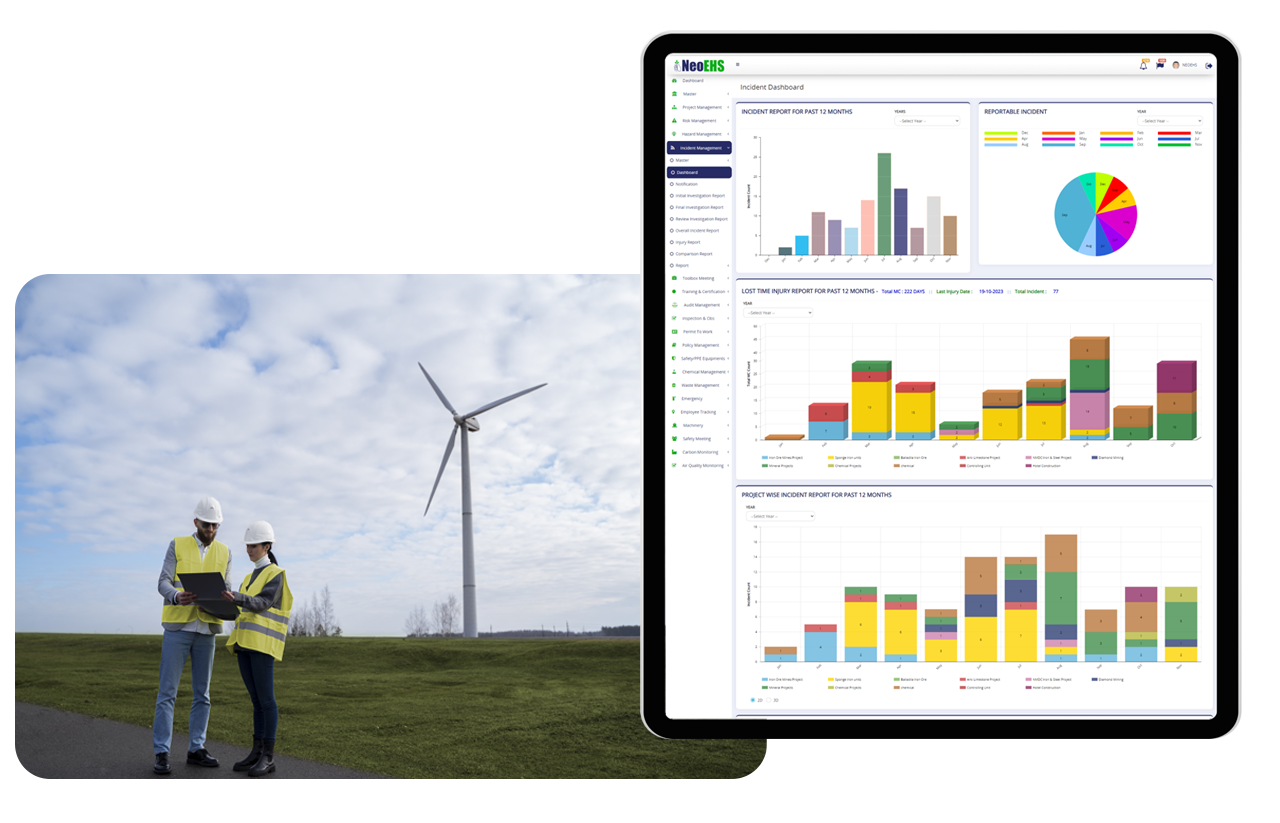
Future Trends and Innovations in EHS Software for Power and Energy Industries
New technologies like the Internet of Things (IoT), Artificial Intelligence (AI), and predictive analytics are transforming EHS management. IoT enables real-time monitoring of environmental and safety parameters, while AI and predictive analytics provide insights for proactive risk management. Additionally, integrating EHS software with other operational systems creates a unified platform for holistic risk management, enhancing overall organizational resilience.
Bottom Line
EHS software is indispensable for ensuring a safe and compliant working environment in the power and energy industries. It offers significant benefits, including improved safety performance, streamlined compliance management, enhanced operational efficiency, and effective risk mitigation. By adopting best practices and leveraging emerging technologies, organizations can achieve substantial improvements in safety, compliance, and sustainability, ultimately protecting their workforce and the environment.
READ MORE ❯
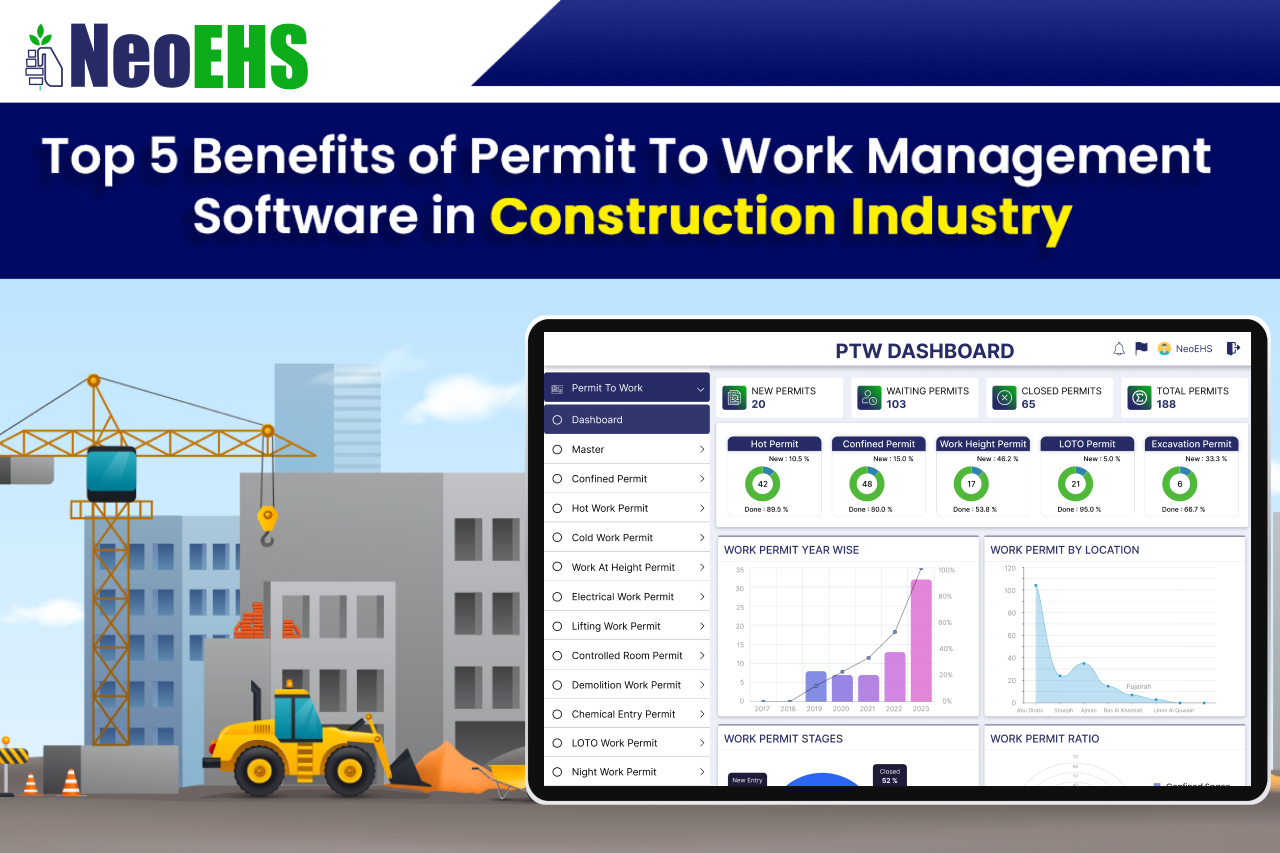
Top 5 Benefits of Permit To Work Management Software in the Construction Industry
Permit To Work management software is a specialized tool designed to streamline the permit-issuing process for various tasks, particularly in high-risk industries like construction. This HSE software ensures that all necessary safety protocols and compliance requirements are met before any work begins. By leveraging PTW software, construction companies can significantly enhance their safety standards, streamline workflows, and improve overall project efficiency.
In the construction industry, safety and efficiency are paramount. Managing permits manually can be a complex, time-consuming process prone to errors and compliance risks. PTW management software addresses these challenges by providing a structured, automated solution that enhances safety and boosts operational efficiency.
1. Enhanced Safety and Risk Mitigation
Identifying and Assessing Risks
EHS management software for permits helps identify and mitigate potential risks through a comprehensive risk assessment framework. It requires detailed information about the work, including potential hazards and control measures. This structured approach ensures all risks are systematically identified and addressed before work begins.
Compliance with Safety Regulations
Digital permits play a crucial role in ensuring compliance with safety regulations. The HSE software ensures that all necessary approvals and safety checks are completed according to regulatory requirements, preventing accidents and ensuring the construction site meets all legal safety standards.
Real-time Monitoring and Alerts
Real-time monitoring and alerts are critical features of PTW management software. With EHS software continuously track permit status and work progress, providing instant alerts. This proactive approach allows for immediate corrective actions, enhancing overall safety on the construction site.
2. Streamlined Workflow and Efficiency
Simplified Permit Approval Process
PTW management software simplifies the permit approval process by automating many of the steps involved. Digital forms and workflows replace manual paperwork, reducing the time and effort required to obtain necessary approvals. This streamlined process ensures permits are issued more quickly and efficiently.
Task Automation and Paperwork Reduction
Automation of tasks and reduction of paperwork are significant advantages of using PTW software. Routine tasks such as permit issuance, tracking, and renewal are automated, freeing up valuable time for construction managers and workers. This reduction in administrative workload enhances overall productivity.
Improved Communication and Collaboration
The HSE software facilitates improved communication and collaboration among all stakeholders involved in the permit process. Digital platforms allow for easy sharing of information, updates, and approvals, ensuring that everyone is on the same page and that the workflow proceeds smoothly.
3. Centralized Data Management and Reporting
Centralized Permit Data Storage
Permit To Work software provides a centralized repository for all permit-related data. This centralized storage ensures that all relevant information is easily accessible and well-organized, reducing the risk of data loss or mismanagement.
Comprehensive Reporting and Analytics
The software enables the generation of comprehensive reports and analytics. Detailed insights into permit usage, safety incidents, and compliance can be easily obtained, helping construction companies make informed decisions based on accurate data.
Data-Driven Decision-Making
With centralized data and powerful analytics, PTW software supports data-driven decision-making. Managers can analyze trends, identify areas for improvement, and make strategic decisions that enhance safety and efficiency.
4. Improved Communication and Accountability
Seamless Communication Among Stakeholders
EHS software enhances communication among all stakeholders, including workers, managers, and regulatory bodies. Digital platforms ensure that everyone has access to the latest information, facilitating seamless coordination and collaboration.
Enhanced Accountability and Audit Trail
Digital permits ensure enhanced accountability by maintaining a detailed audit trail of all actions taken. This transparency helps in tracking responsibilities and ensuring that all safety protocols are followed rigorously.
Real-time Updates and Notifications
Real-time updates and notifications keep all stakeholders informed about the status of permits and any changes that occur. This timely information flow helps maintain high levels of safety and compliance.
5. Cost and Time Savings
Cost Reduction through Automation
Automation of permit processes leads to significant cost savings. By reducing the need for manual paperwork and administrative tasks, PTW software lowers operational costs and increases efficiency.
Time Savings and Increased Productivity
The time-saving benefits of automation and streamlined workflows are substantial. Faster permit approvals and reduced administrative burdens allow construction projects to proceed without unnecessary delays, boosting overall productivity.
Return on Investment (ROI) Analysis
The cost and time savings provided by PTW management software result in a high return on investment. By improving safety, efficiency, and compliance, the software delivers significant value to construction companies.
Final Thoughts
In summary, Permit Work Management Software offers numerous benefits, including enhanced safety and risk mitigation, streamlined workflow and efficiency, centralized data management, improved communication and accountability, and cost and time savings. EHS software is crucial for construction companies aiming to improve their operational standards, ensure regulatory compliance, and enhance overall project performance. Leveraging PTW management software is a strategic move that can lead to safer, more efficient, and more successful construction projects.
READ MORE ❯
How To Mitigate Occupational Hazards and Enhance Safety Measures in the Oil and Gas Industry?
Due to the high-risk nature of operations, safety measures in the oil and gas industry are essential. These measures protect workers, the environment, and assets while safeguarding companies' reputations and financial stability. Mitigating occupational hazards is crucial for preventing accidents, injuries, and fatalities and fostering a safe working environment.
Understanding Occupational Hazards in the Oil and Gas Industry
Occupational hazards in the oil and gas industry encompass a range of risks, including falls, chemical exposure, fires, explosions, and equipment failures. Each hazard presents unique dangers, such as respiratory issues from exposure to toxic gases, burns from fires, or injuries from machinery accidents. Proper risk assessment and hazard identification are essential for effectively anticipating and addressing these dangers.
Essential Safety Measures in the Oil and Gas Industry
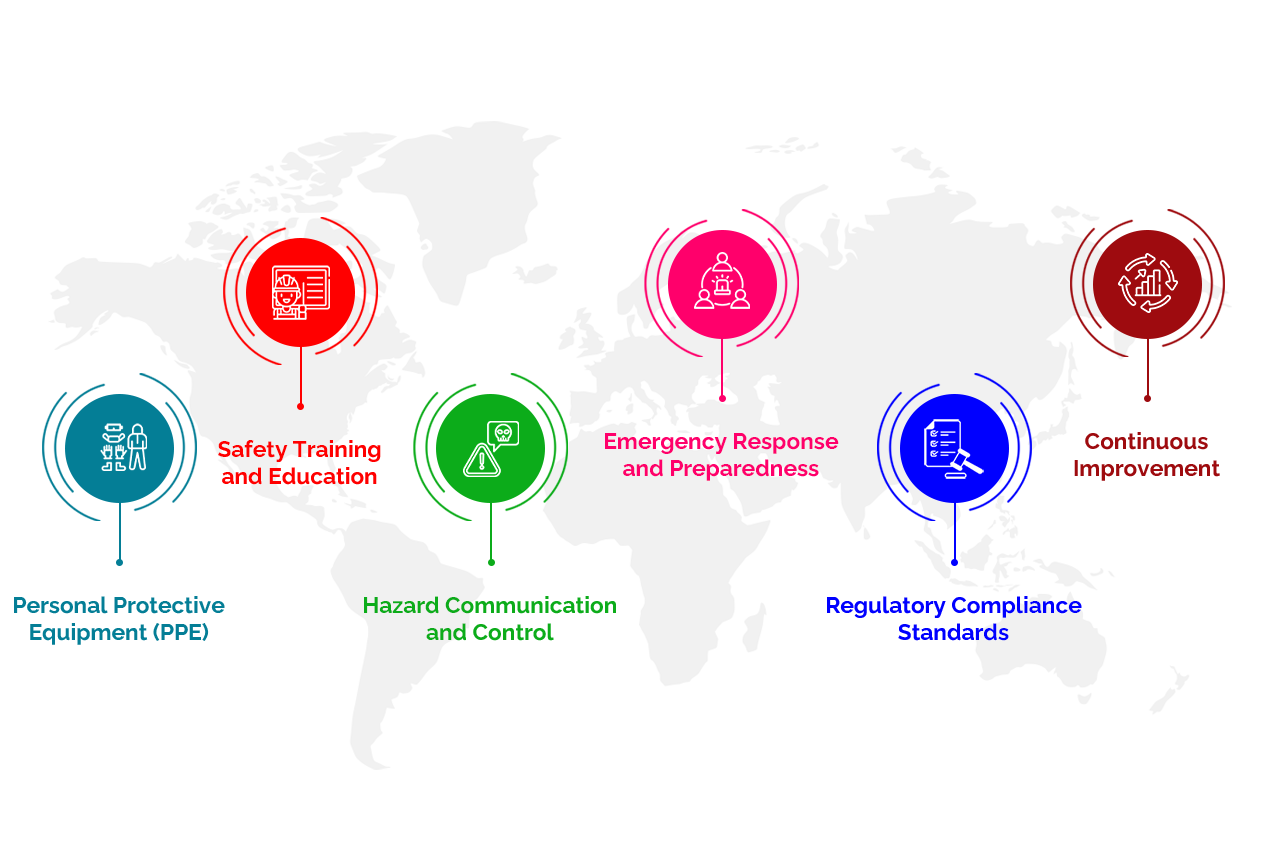
1. Personal Protective Equipment (PPE)
PPE protects workers from various hazards by providing a physical barrier. It includes helmets, gloves, goggles, and respiratory protection. Proper selection, use, and maintenance of PPE are vital to ensure its effectiveness in safeguarding workers.
2. Safety Training and Education
Comprehensive safety training programs equip workers with the knowledge and skills to identify hazards, respond to emergencies, and adhere to safety protocols. Training should cover topics such as hazard recognition, proper use of equipment, and emergency procedures and be conducted through interactive and engaging sessions.
3. Hazard Communication and Control
Effective communication about hazards ensures that workers know potential risks and understand how to mitigate them. Strategies for hazard control may include engineering controls, administrative controls, and personal protective measures. Implementing robust hazard communication programs facilitates the dissemination of crucial safety information throughout the organization.
4. Emergency Response and Preparedness
An emergency response plan outlines procedures for addressing various scenarios, including fires, spills, and medical emergencies. Regular drills and exercises help ensure workers are prepared to respond effectively in real-life situations. Creating a culture of preparedness encourages proactive measures and instant action during emergencies.
5. Regulatory Compliance Standards
Regulatory authorities establish guidelines and standards to maintain safety in the oil and gas industry. Compliance with these regulations is mandatory to prevent accidents and maintain operational integrity. Adhering to industry standards ensures best practices are followed, promoting a culture of safety and accountability.
6. Continuous Improvement
A strong safety culture is built on continuous improvement, prioritizing safety at all organizational levels. Fostering such a culture requires leadership commitment, employee involvement, and ongoing evaluation of safety processes. Embracing a continuous improvement mindset leads to enhanced safety practices and reduced incidents.
Why NeoEHS Risk Management Software?
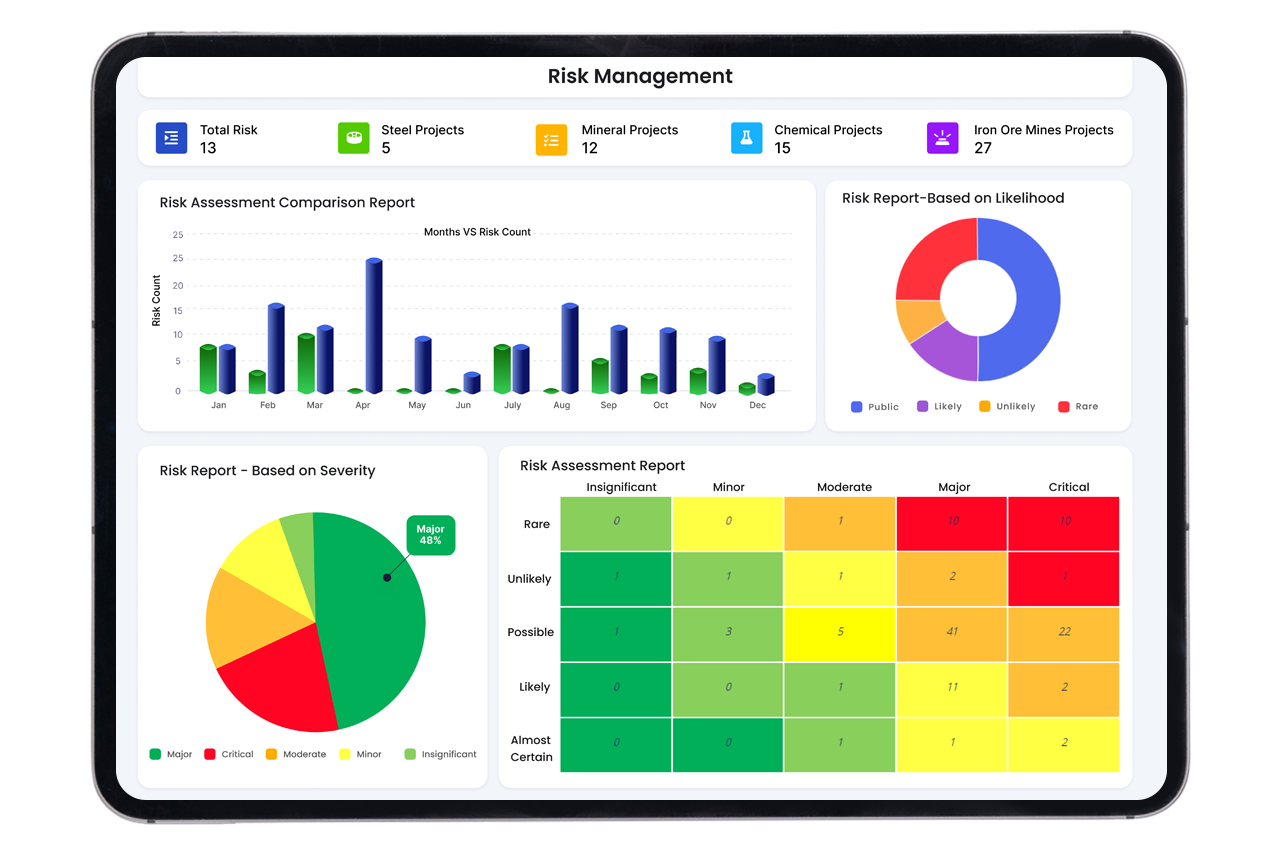
Transform your approach to occupational hazard management effortlessly with NeoEHS risk management software. Build a culture of safety in your workplace with our comprehensive HSE solution, featuring customizable dashboards, user-friendly accessibility, live reporting, and insightful analytics. Seamlessly integrate our HSE software with your existing technology platform. Don't hesitate any longer – book a free demo now and unlock the full potential of our platform.
Final Thoughts
Prioritizing safety measures in the oil and gas industry is paramount for protecting workers, the environment, and company assets. Organizations can mitigate occupational hazards by implementing essential safety measures, adhering to regulations, and building a safety culture. Industry stakeholders must embrace safety as a core value and commit to continuous improvement to safeguard lives and promote sustainable operations.
READ MORE ❯
How Technology is Revolutionizing EHS Management in the Construction Industry?
Effective management of EHS is crucial for businesses to ensure compliance with regulations, safeguard their workforce, and reduce environmental impact. In recent years, technological advancements have advanced EHS management, offering solutions that enhance safety monitoring, reconceptualize site inspections, safeguard accidents, and provide immersive training experiences. In this blog article, you will explore diverse ways advanced technology is essential in enhancing EHS safety management within the construction industry.
Let's get started!
What Is EHS Management?
EHS management is crucial for organizations to safeguard their employees, communities, and environment, comply with legal requirements, and maximize overall sustainability. Many organizations have dedicated EHS departments or personnel overseeing and implementing environmental health and safety management systems.
Role of Technology in EHS Management
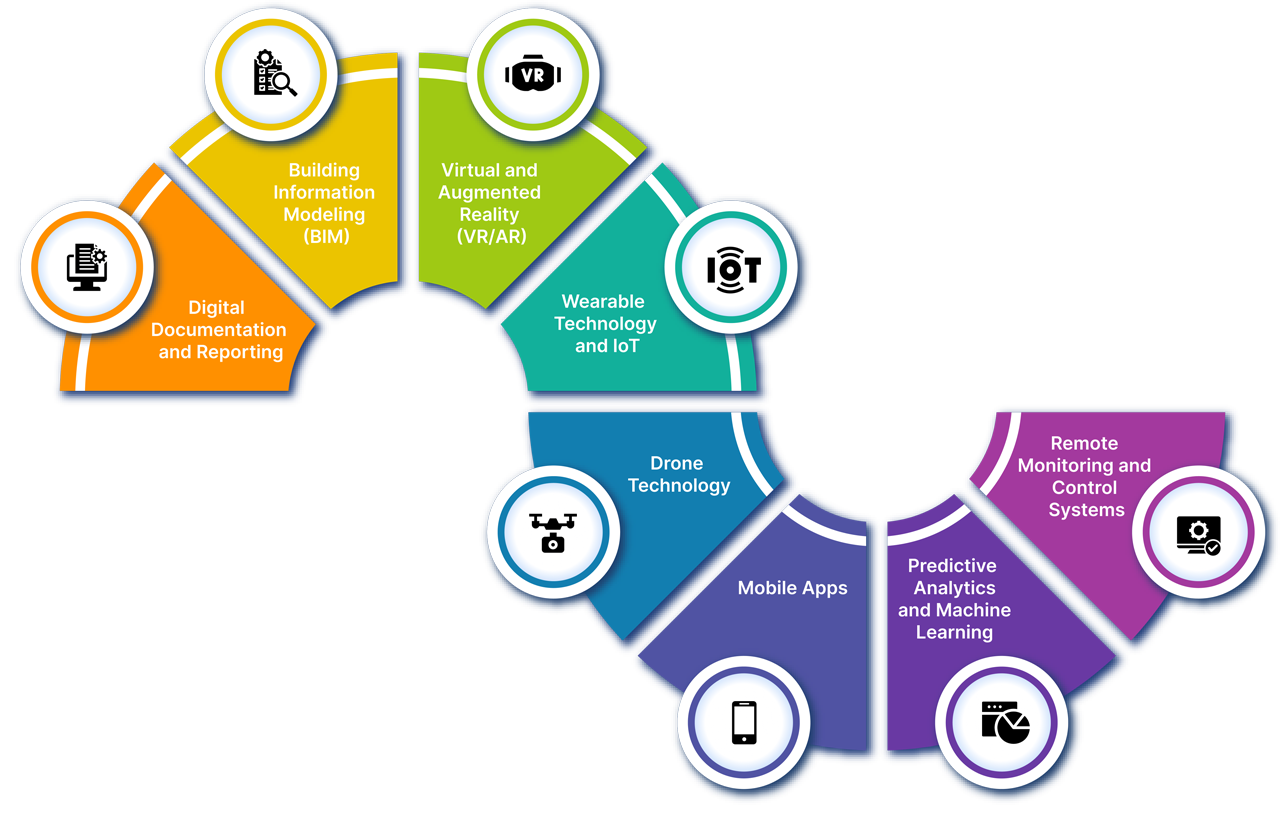
Digital Documentation and Reporting
It's high time to say goodbye to paperwork and manual reporting processes. With the advent of technology, construction industries now have access to digital platforms and software solutions that streamline EHS documentation and reporting. Permits, inspections, incident reports, and safety manuals can be digitized, ensuring easy access to critical information and facilitating real-time reporting of incidents or hazards.
Building Information Modeling (BIM)
Building Information Modeling (BIM) technology has emerged as a game-changer in construction safety. By creating comprehensive 3D models that encompass design, construction, and maintenance data, BIM enables EHS professionals to identify potential safety risks, simulate construction processes to assess safety implications, and develop effective emergency response strategies.
Wearable Technology and IoT
The integration of wearable technology and Internet of Things (IoT) devices is transforming safety practices on construction sites. Smart helmets, vests, and glasses with sensors can monitor workers' vital signs, detect environmental hazards, and provide real-time alerts for potential safety risks. IoT devices installed on construction sites collect data on air quality, noise levels, and temperature, ensuring compliance with safety regulations and promoting a safer working environment.
Drone Technology
Drones equipped with cameras and sensors are revolutionizing safety inspections and monitoring on construction sites. They provide valuable aerial data for assessing site conditions, identifying safety hazards, and conducting inspections in hard-to-reach areas. Drones enhance safety by reducing the need for manual inspections, minimizing worker exposure to risks, and improving overall situational awareness.
Virtual and Augmented Reality (VR/AR)
Virtual and Augmented Reality technologies are increasingly utilized for safety training and simulation in the construction industry. VR and AR simulations allow workers to undergo realistic training exercises, learn how to respond to emergencies, and operate machinery safely in a virtual environment. These immersive training solutions enhance safety awareness, improve preparedness, and reduce the risk of accidents on construction sites.
Mobile Applications
Mobile applications tailored for environmental health and safety management empower construction professionals to access safety guidelines, conduct inspections, report incidents, and communicate safety information anywhere on the construction site. These apps facilitate real-time collaboration among team members, streamline communication channels, and enhance overall safety awareness among workers.
Predictive Analytics and Machine Learning
Advanced analytics tools, powered by predictive analytics and machine learning algorithms, enable construction companies to analyze historical EHS data, identify patterns, predict potential safety issues, and recommend preventive measures. These technologies continuously improve risk assessments and safety protocols based on evolving construction site conditions and historical incident data, ultimately enhancing safety standards.
Remote Monitoring and Control Systems
Remote monitoring systems enable EHS professionals to remotely monitor construction sites in real time, allowing them to identify safety hazards, track progress, and intervene quickly in emergencies. These systems enhance situational awareness, enable proactive risk management, and contribute to creating safer working environments for construction workers.
Final Thoughts
Technology is transformative in EHS safety management within the construction industry. From digital documentation and wearable technology to drones and predictive analytics, technological innovations are revolutionizing safety practices, reducing accidents, and creating safer working environments for construction workers. Embracing these advancements is essential for construction companies looking to stay ahead in an increasingly competitive and safety-conscious industry.
READ MORE ❯
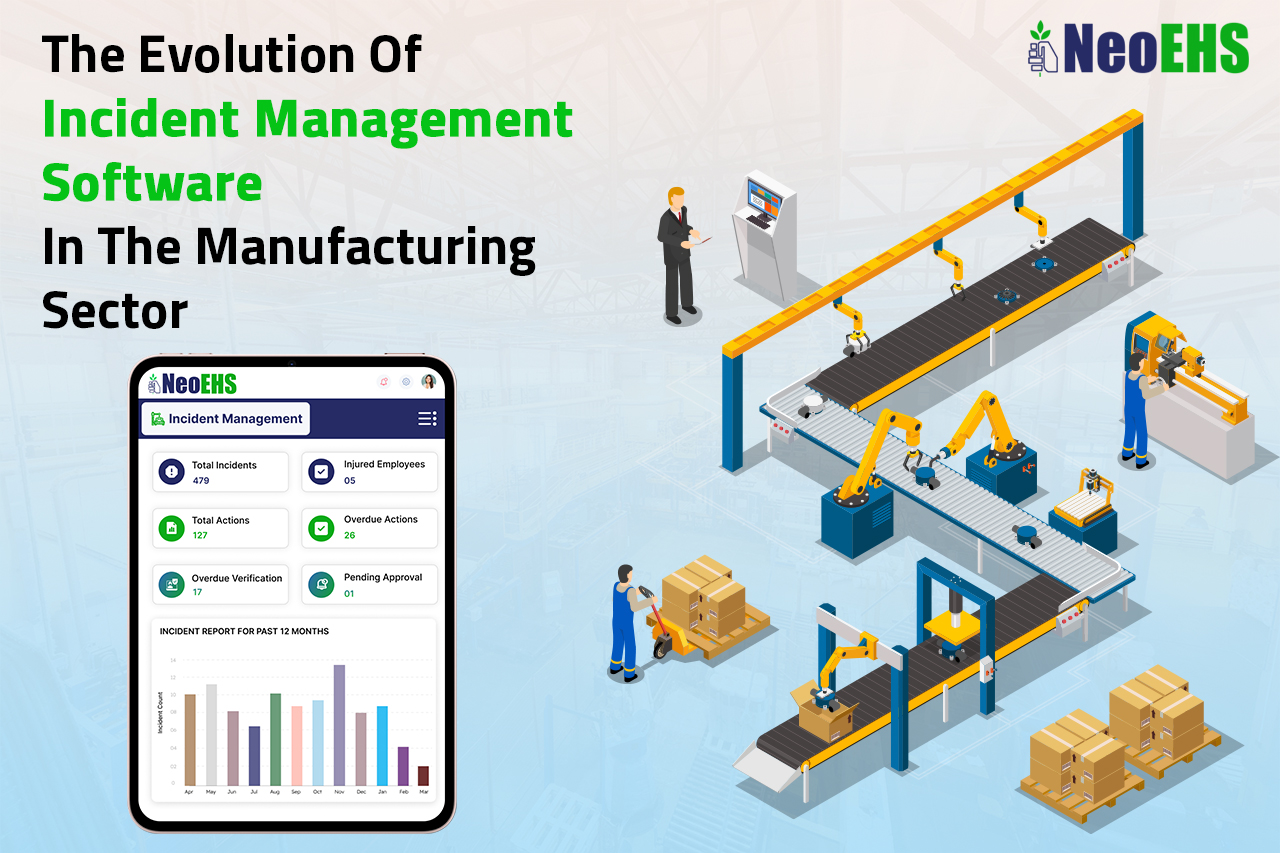
The Evolution Of Incident Management Software In The Manufacturing Sector
Nowadays, most manufacturing industries face a rise in the number of incidents across their workplace. According to a survey, the industry experiences more than thousands of incidents yearly. If your industry isn't focusing on these facts, you neglect the opportunities to enhance workplace safety. These incidents not only impact your employees' lives but also minimize your overall productivity and efficiency.
Is your manufacturing industry equipped to handle incidents? Workplace safety must be every industry's priority; hence, it is essential to implement incident management software to prevent incidents and minimize potential hazards.
What Is Incident Management Software?
Incident management software is a comprehensive solution designed to manage and respond to incidents, emergencies, or disruptions and ensure compliance with regulatory standards. By streamlining the incident management process, you can identify potential risks before they turn critical and reduce future incidents.
In this blog article, let's discuss the evolution of incident management software in the manufacturing sector and explore its transformative impact.
Overview of Incident Management in the Manufacturing Sector
During the early stages of manufacturing, incident management heavily relied on manual procedures and paper-based documentation. Workers were tasked with completing incident reports manually, resulting in inefficiencies, delays, and inaccuracies. Retrieving historical data for analysis or compliance requirements was laborious and time-intensive.
Challenges of Traditional Incident Management Approaches
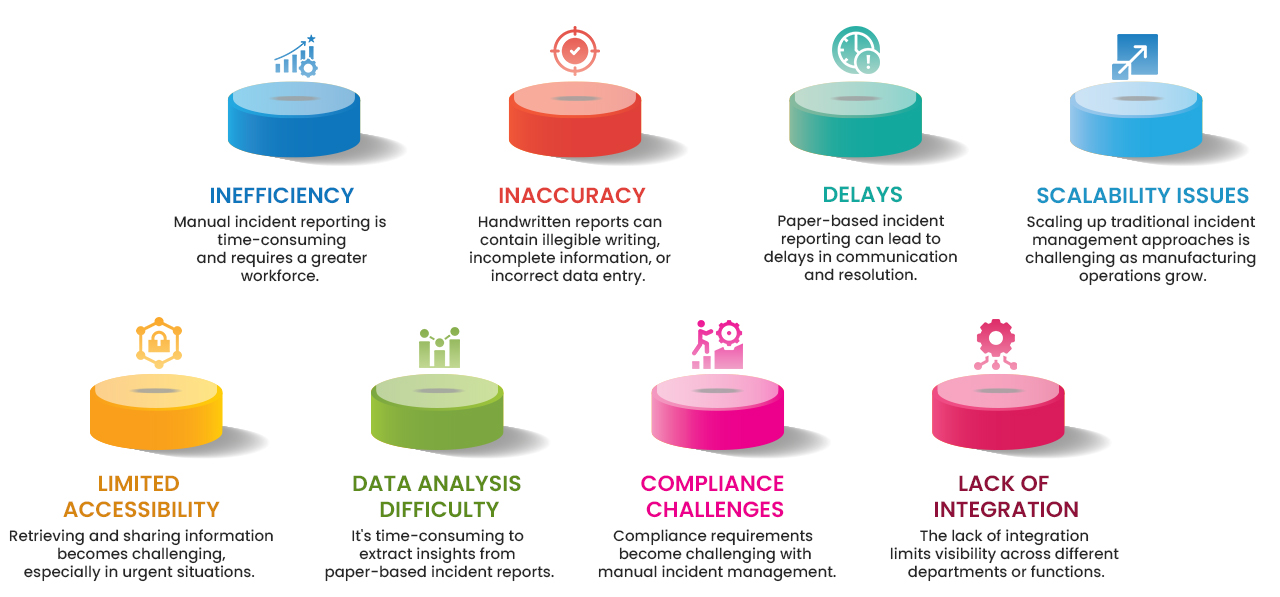
Transition to Digital Incident Management Solutions
As technology advanced, manufacturing industries began transitioning to digital incident management solutions. Many industries have started leveraging HSE software for instant incident reporting and tracking, streamlining processes, and improving data accuracy. These solutions have a significant impact on minimizing incidents before they occur.
Key Features and Functionalities of Incident Management Software
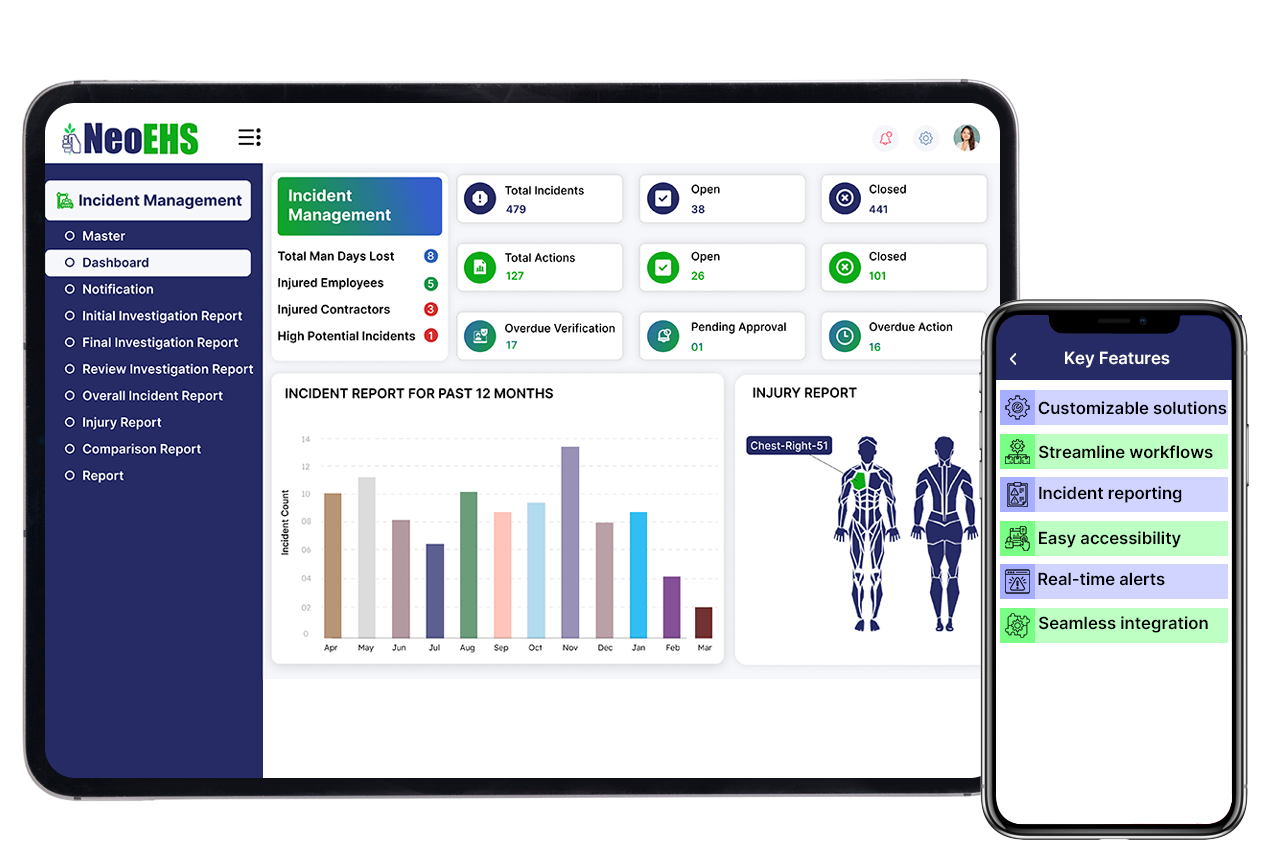
Customizable Solutions
Incident management software can be customized based on the organization's requirements.
Streamline Workflows
Automating incident management processes has revolutionized incident response, enabling predictive analytics and proactive risk mitigation.
Incident Reporting and Tracking
Advanced incident reporting provides comprehensive dashboards and customizable metrics, empowering decision-makers with actionable insights.
Easy Accessibility
The incident reporting software can be accessed anytime, anywhere, allowing frontline workers to report incidents directly from the field using any device.
Real-Time Notifications
When an incident occurs, this software sends instant notifications to employees, enabling them to perform quick and effective CAPA.
Integration with Other Systems
Integration with other enterprise systems, such as ERP, CRM and much more, enables seamless data flow and real-time collaboration across departments.
Benefits
- Improved incident response
- Advanced visibility and transparency in incident management processes
- Reduction in operational costs and productivity losses
- Compliance with regulatory requirements and standards
- Enhanced risk management
Future Trends and Advancements in Incident Management Software
The evolution of incident management software in the manufacturing sector shows no signs of slowing down. AI-powered predictive analytics will continue to enhance risk assessment and identify potential incidents before they occur. In addition to that, virtual reality (VR) simulations will enable workers to have immersive training experiences, enhancing safety awareness and preparedness. Likewise, the advancements in HSE software, including wearable devices, integration with IoT and machine learning technologies, and much more, can significantly reduce workplace incidents.
Final Thoughts
The transformation of incident management software in the manufacturing industry has evolved companies to identify, respond to, and mitigate risks. From manual processes and paper-based systems to AI-driven predictive analytics and cloud-based platforms, the evolution has been marked by innovation and progress. Leveraging these advancements empowers manufacturing organizations to prioritize safety, optimize operations, and achieve sustainable growth in an increasingly complex and competitive landscape.
READ MORE ❯
The Impact of Implementing Digital Permit to Work Systems in the Oil & Gas Sector
The oil and gas sector is under growing pressure to boost safety measures and operational efficiency in today's rapidly evolving digital age. A significant stride in this direction comes from embracing digital permit to work systems. These systems represent a game-changer in managing work permits, using technology to simplify processes and reduce risks.
Safety and efficiency are top priorities in industries like oil and gas, with high risks and fierce competition. Safety is critical due to the inherently hazardous nature of operations, while efficiency is essential for staying competitive.
In this blog, we highlight that digital permit to work systems can significantly enhance safety measures and operational efficiency within oil and gas companies. By embracing digitalization, these companies can elevate safety standards, streamline workflow processes, and improve operational performance. Nowadays, many organizations use HSE software to automate permit approval processes effortlessly.
Challenges in the Oil and Gas Industry
Oil and gas operations are rife with hazards and risks, including accidents, spills, and environmental damage, posing significant challenges to companies in the sector. Traditional paper-based permit to work systems exacerbate these challenges with inefficiencies like delays, errors, and a lack of real-time information.
Implementation Steps
Implementing digital permit systems requires careful planning, thorough training, and active stakeholder engagement. Planning involves assessing current processes, setting clear objectives, and allocating resources effectively. Training ensures all employees understand and can effectively use the new system, while stakeholder engagement fosters collaboration and accountability. Continuous monitoring and evaluation are crucial for ongoing success, allowing companies to make necessary adjustments and optimizations.
Future of Digital Permit Systems
The future of digital permit systems in the oil and gas industry looks promising. Advancements in technology, such as predictive analytics and artificial intelligence, are expected to enhance these systems further. With a continued focus on safety and innovation, the industry is poised to overcome challenges and shape a safer, more sustainable future.
Why EHS Software?
Digitalizing the Permit To Work system through HSE software offers numerous advantages. Firstly, it automates the entire workflow, simplifying the process from request initiation to authorization and closure. It saves time and effort compared to traditional paper-based systems. In addition, EHS software ensures compliance with regulatory requirements and organizational policies, reducing the risk of non-compliance. With real-time visibility into permit status, authorized personnel can track progress, identify bottlenecks, and take timely actions.
Final Thoughts
In conclusion, digital permit to work systems offer a transformative solution for enhancing safety and efficiency in the oil and gas industry. By leveraging technology, companies can improve safety outcomes, increase productivity, and maintain a competitive edge. Oil and gas companies must consider adopting digital permit systems to safeguard their workforce, protect the environment, and stay ahead in a rapidly changing industry.
READ MORE ❯
6 Benefits Of Leveraging AI To Improve Workplace Safety
Have you come across the recent AI technology? AI refers to the simulation of human intelligence processes by machines, including learning, reasoning, and self-correction. Workplace safety includes measures and protocols designed to protect employees from hazards and ensure a safe working environment.
Importance Of Workplace Safety In Today's Organizations
Workplace safety is essential for safeguarding human lives, preventing injuries, and enhancing productivity. It also helps organizations comply with regulations, minimize potential risks, and improve employee morale and retention.
AI technology offers various benefits for advancing workplace safety, including improved hazard detection, predictive analysis, increased incident response, employee safety training, real-time monitoring, and data-driven decision-making.
Here, in this article, let's check out a few benefits of leveraging AI technology to enhance workplace safety.
1. Enhanced Hazard Detection
Are you still relying on traditional methods to identify potential risks? Artificial Intelligence (AI) offers advanced capabilities to analyze data from various sources like sensors and cameras, enabling more accurate and efficient hazard detection. For example, computer vision systems can spot safety violations, machine learning algorithms can detect anomalies in sensor data, and natural language processing can extract safety insights from textual information.
2. Real-time Monitoring and Alerts
AI can continuously monitor data streams in real time, swiftly detecting anomalies or safety breaches that demand immediate attention. By setting predefined safety thresholds or spotting unusual patterns, AI algorithms can generate alerts or notifications, facilitating prompt response and intervention. It includes AI-powered surveillance systems, wearable devices equipped with AI for health monitoring, and software platforms analyzing operational data for safety risks.
3. Predictive Analytics for Risk Assessment
AI leverages historical data to forecast patterns and trends, enabling organizations to predict and mitigate potential safety risks proactively. Predictive maintenance systems anticipate equipment failures; predictive models identify high-risk areas, and risk-scoring algorithms prioritize safety interventions. AI-driven predictive analytics aids in addressing safety risks beforehand, reducing accidents, minimizing downtime, and optimizing resource allocation for safety measures.
4. Improved Incident Response
AI facilitates quicker and more efficient incident response by providing real-time insights, automating decision-making, and guiding emergency efforts. Currently, AI-based emergency response platforms coordinate rescue operations, AI-driven chatbots offer real-time guidance during crises, and predictive models optimize evacuation routes.
5. Employee Safety Training and Simulation
AI-driven virtual reality (VR) simulations offer immersive training experiences, allowing employees to practice safety protocols in realistic scenarios. VR simulations cover emergency procedures, hazard recognition, and high-risk work environments, enhancing knowledge retention, skill development, and confidence in applying safety measures.
6. Data-driven Decision Making
AI analyzes extensive data to offer actionable insights and recommendations, empowering organizations to make informed decisions regarding safety protocols, resource allocation, and risk mitigation strategies. AI-driven dashboards visualize safety metrics; machine learning models predict safety performance, and decision support systems identify areas for improvement.
By harnessing AI-enabled data analysis, organizations can identify trends, anticipate safety risks, and optimize safety strategies, leading to more effective safety management and improved outcomes.
We hope you got an idea of the benefits of leveraging Artificial Intelligence to enhance your workplace safety. Due to the growing benefits of AI, many organizations are integrating AI into their HSE software to advance their safety and also minimize incident rates.
READ MORE ❯
Enhancing Safety Measures: 5 Benefits of Implementing EHS Software in Construction
Safety is essential in the construction sector owing to its inherently risky environment. Accidents and injuries endanger workers' lives and lead to project delays, increased costs, and damage to reputation. Therefore, implementing potential measures is crucial to ensure the well-being of workers and the success of construction projects.
EHS software is a digital solution designed to manage EHS processes within an organization. It helps firms streamline their safety management systems, track incidents, conduct risk assessments, ensure compliance with regulations, and promote a safety culture among employees.
How Can EHS Software Be Customized For The Construction Industry?
EHS software can be tailored to meet the specific needs of the construction industry. Some features include job site safety inspections, toolbox talks, equipment maintenance tracking, and subcontractor management. The software can also be integrated with other construction management tools to provide a comprehensive solution for safety management.
In this blog, let's check out the benefits of implementing EHS software in the construction industry.
Benefits of Implementing EHS Software in Construction
1. Improved Incident Reporting and Management
With the EHS management software, you can streamline reporting incidents and near misses. This workplace safety software enables workers to report incidents and near-misses instantly through digital forms or mobile apps. It plays a vital role in ensuring time response and initial investigation. Additionally, the software allows for real-time tracking of incidents, facilitating proactive identification of trends and patterns to prevent future accidents.
2. Enhanced Risk Assessment and Mitigation
EHS management system provides tools for conducting comprehensive risk assessments, identifying hazards, and prioritizing mitigation measures to minimize the likelihood of accidents. This software helps construction companies implement proactive safety measures, such as safety inspections and employee training programs, by centralizing safety data and increasing stakeholder communication.
3. Streamlined Compliance and Regulatory Reporting
If you are trying to streamline your EHS processes, then EHS software is the right choice! It automates documenting safety procedures and regulatory requirements, ensuring compliance with local, state, and federal regulations. In addition to that, it also maintains a centralized repository of safety records. Thus, the safety software makes it easy for construction companies to access historical data for audits, inspections, and regulatory reporting.
4. Centralized Safety Data Management
The EHS management solution consolidates all safety-related data, including incident reports, risk assessments, and training records, into a centralized platform, improving data visibility. By eliminating manual data entry and paper-based processes, EHS software minimizes errors and ensures that safety data is accurate and up-to-date.
5. Increased Employee Engagement and Training
Using EHS software, employees can access interactive training modules and resources, which promote continuous learning on safety best practices. The software allows employees to share safety information, report hazards, and discuss safety concerns.
Final Thoughts
Construction companies benefit from EHS software in many ways, including enhanced incident reporting, risk assessment, streamlined compliance, centralized data management, and increased employee engagement.
In conclusion, prioritizing safety is essential for the success and sustainability of construction projects. In addition to managing safety risks, ensuring compliance with regulations, and creating a safer workplace, construction companies can benefit from investing in environmental, health, and safety software.
READ MORE ❯
Enhancing Safety: The Core Components of an Effective Safety Management System
Effective safety management systems are essential for maintaining the health and welfare of employees, as well as protecting the assets and reputation of organizations. These systems offer a systematic framework for recognizing, evaluating, and addressing risks in the workplace.
Employing robust safety management systems ensures a company's dedication to employee well-being, adherence to regulations, and operational excellence. Such systems enhance employee, customer, and stakeholder confidence by showcasing a holistic approach to safety.
This article delves into the vital elements of safety management systems, highlighting their importance and providing practical insights for implementation.
Benefits of implementing an effective safety management system include:
- Reduced accident rates and associated costs.
- Improved employee morale and productivity.
- Enhanced regulatory compliance and decreased legal liability.
- Strengthened reputation and trust among stakeholders.
- Increased operational efficiency and sustainability.
Components of an Effective Safety Management System
1. Legal and Regulatory Requirements
Organizations must adhere to many laws, regulations, and standards concerning workplace safety, contingent upon their industry and geographical location. These encompass Occupational Safety and Health Administration (OSHA) regulations in the United States, Health and Safety Executive (HSE) guidelines in the UK, and International Organization for Standardization (ISO) standards like ISO 45001.
Compliance with these stipulations is imperative to evade penalties, litigation, and reputational harm. Safety management systems are indispensable tools for organizations to navigate and fulfil these obligations proficiently.
2. Leadership Commitment
Leadership is pivotal in moulding organizational culture and values, encompassing attitudes towards safety. When leaders prioritize safety and set an example, they motivate employees to prioritize safety in their behaviours and choices.
Competent leadership cultivates a culture of accountability, empowering employees to voice safety concerns and engage actively in safety endeavours.
Clear and concise safety policies convey the organization's dedication to safety and outline employee expectations. These policies must adhere to regulatory requirements and industry best practices while reflecting the organization's distinctive risk profile and values.
Establishing measurable safety objectives furnishes a structure for ongoing enhancement and facilitates tracking progress. Objectives should be SMART (Specific, Measurable, Achievable, Relevant, Time-bound) and subject to regular review to maintain relevance and efficacy.
Ensuring adequate allocation of resources, including financial resources, time, personnel, and technology, is crucial for implementing and sustaining effective safety management systems.
Organizations must prioritize safety investments based on thorough risk assessments, regulatory requirements, and strategic objectives. Investments in training, equipment, infrastructure, and safety incentives can yield significant returns in terms of accident prevention and overall organizational performance.
3. Risk Assessment and Hazard Identification
Risk assessments involve systematically identifying, evaluating, and prioritizing hazards within the workplace. This process helps organizations comprehensively understand their risk profile and implement appropriate controls to mitigate risks.
Regular risk assessments are vital, particularly when introducing new processes, equipment, or organizational changes. Engaging employees in the risk assessment ensures a thorough understanding of potential hazards and promotes ownership of safety outcomes.
Hazard identification entails identifying potential sources of harm, including physical, chemical, biological, ergonomic, and psychosocial hazards. Organizations can utilize workplace inspections, job hazard analyses, and incident investigations to identify hazards proactively.
Once hazards are identified, they should undergo analysis to assess their severity, likelihood, and potential consequences. This analysis informs the selection of appropriate control measures to eliminate or mitigate the risks posed by these hazards.
Controls are measures to eliminate or reduce the likelihood of hazards causing harm. These controls can be administrative (e.g., policies, procedures), engineering (e.g., physical barriers, ventilation systems), or personal protective equipment (PPE).
Following the hierarchy of controls provides a framework for selecting the most effective control measures. It prioritizes controls that eliminate hazards at the source over those that rely on worker behaviour or protective equipment.
4. Employee Involvement and Training
Engaging employees in safety initiatives empowers them to take ownership of their safety and that of their colleagues. This involvement can manifest through participation in safety committees, hazard reporting programs, and safety improvement projects.
Creating an open communication and trust culture encourages employees to share their insights, experiences, and concerns regarding safety issues. This feedback is invaluable for identifying potential hazards and implementing effective solutions.
Safety training equips employees with the knowledge, skills, and attitudes necessary to perform their jobs safely and effectively. Training topics may encompass hazard recognition, emergency response procedures, ergonomics, chemical safety, and equipment operation.
Tailoring training to the specific needs of each job role and delivering it using engaging, interactive methods is essential. Regular refresher training ensures employees remain current on safety protocols and best practices.
Encouraging employees to report near-miss incidents and hazards provides valuable opportunities for identifying and addressing potential risks before they result in serious accidents or injuries.
Establishing a non-punitive reporting culture where employees feel safe to report incidents without fear of reprisal encourages open communication and continuous improvement. Near-miss reporting should be followed by thorough investigation and corrective action to prevent recurrence.
5. Incident Reporting and Investigation
An effective incident reporting system allows employees to report accidents, injuries, near misses, and unsafe conditions promptly and accurately. This system should be accessible, user-friendly, and confidential to encourage reporting.
Incident reports should capture essential information, including the date, time, location, individuals involved, nature of the incident, and contributing factors. Prompt reporting enables timely investigation and intervention to prevent further harm.
Incident investigations aim to uncover the underlying causes and contributing factors of accidents or near misses. This process involves collecting and analyzing evidence, interviewing witnesses, and identifying systemic deficiencies.
Root cause analysis techniques such as the "5 Whys" or fault tree analysis help investigators delve beyond immediate causes to identify underlying systemic issues or failures in safety management systems.
Based on the incident investigation findings, corrective actions should be implemented to address root causes and prevent similar incidents from occurring in the future. These actions may include process improvements, additional training, equipment modifications, or policy changes.
It's essential to prioritize corrective actions based on their potential to prevent recurrence and mitigate risk. Assigning responsibility for implementing and tracking disciplinary actions ensures accountability and follow-through.
6. Safety Performance Measurement and Monitoring
Key performance indicators (KPIs) are quantifiable measures used to evaluate the effectiveness of safety management systems and track progress towards safety goals. Safety KPIs include:
- Injury rates
- Near-miss reporting frequency
- Compliance with safety procedures
- Safety culture surveys
KPIs should be aligned with organizational objectives, relevant to the specific context and risks of the organization, and measurable over time. Regular review of KPI data allows organizations to identify trends, benchmark performance, and make data-driven decisions.
Continuous monitoring of safety performance involves collecting, analyzing, and interpreting safety data to identify areas of strength and opportunities for improvement. This process may include reviewing incident reports, conducting safety inspections, and analyzing leading and lagging indicators.
Real-time monitoring of safety performance enables organizations to detect and proactively address emerging risks before they escalate into incidents or accidents.
Data analysis is crucial in identifying patterns, trends, and correlations within safety performance data. By analyzing leading indicators (predictive measures) and lagging indicators (historical measures), organizations can identify root causes, prioritize interventions, and allocate resources effectively.
Data visualization techniques such as charts, graphs, and dashboards facilitate the interpretation and communication of safety data to stakeholders at all levels of the organization.
7. Continuous Improvement and Review
Safety audits and inspections provide systematic evaluations of safety management systems, processes, and practices to identify areas for improvement and ensure compliance with regulatory requirements.
Audits may be conducted internally by trained personnel or externally by third-party auditors, depending on the organization's size, complexity, and resources. Regular audits help organizations maintain accountability, transparency, and continuous improvement in safety performance.
Safety policies and procedures should be reviewed regularly to remain current, relevant, and aligned with organizational objectives and regulatory requirements. Changes in technology, processes, or industry standards may necessitate updates to existing policies or the development of new ones.
Stakeholder feedback, incident investigations, regulatory updates, and industry best practices should inform the review and revision process. Communication and training are essential to ensure that employees are aware of and understand any safety policy and procedure changes.
8. Communication and Engagement
Effective communication is essential for conveying safety-related information, expectations, and updates to employees at all levels of the organization. Establishing clear communication channels ensures that safety messages are disseminated promptly and accurately.
Encouraging employees to provide feedback, suggestions, and concerns regarding safety issues promotes a culture of continuous improvement and open communication. Employees are often the first to identify potential hazards or opportunities for improvement in their work environment.
Final Thoughts
An effective safety management system encompasses leadership commitment, risk assessment, employee involvement, incident reporting, performance measurement, continuous improvement, communication, and engagement. These components work together to create a safety culture and drive sustainable improvements in safety performance.
Implementing these components is essential for fostering a safe work environment, preventing accidents and injuries, and ensuring compliance with regulatory requirements. By prioritizing safety and investing in proactive risk management, organizations can protect the well-being of their employees and enhance their overall performance and reputation.
READ MORE ❯
10 Essential Construction Safety Rules For A Secure Workplace
Construction safety is essential in ensuring the well-being of workers and preventing accidents on construction sites. It adds to the effectiveness and success of building projects and safeguarding the lives of individuals engaged.
The construction sector's risk of accidents and injuries can decrease by adhering to the top 10 standards for a secure workplace. From training to equipment usage, these regulations address many facets of safety.
1. Conduct Regular Safety Training
Regular safety training keeps construction workers updated on the newest safety procedures, equipment usage, and industry regulations. It aids in fostering a safety-conscious mindset in employees.
Safety Training Sessions
- Emergency procedures
- Proper use of personal protective equipment (PPE)
- Hazard identification and reporting
- Equipment operation and maintenance
- Communication protocols
2. Implement Personal Protective Equipment (PPE)
Personal protective equipment (PPE) includes gear designed to protect workers from hazards on construction sites. It could include high-visibility apparel, safety eyewear, hard hats, gloves, and ear protection.
Types of PPE Required on Construction Sites
- Head protection: Hard hats
- Eye protection: Safety glasses or goggles
- Hand protection: Gloves
- Hearing protection: Earplugs or earmuffs
- High-visibility clothing: Vests or jackets
3. Establish Clear Communication Channels
Clear communication is crucial to prevent miscommunications that can result in future accidents. Everyone on the building site will be aware of potential hazards and able to respond if there is effective communication.
Strategies for Improving Communication on Construction Sites
- Periodic safety meetings
- Implementing signage
- Encouraging effective communication for reporting concerns
4. Conduct Regular Equipment Inspections
Periodic inspections help identify potential equipment problems before they become safety hazards. This holistic approach enhances overall construction site safety.
Key Areas to Inspect and Maintain
- Machinery and tools
- Electrical equipment
- Fall protection systems
- Ladders and scaffolding
- Emergency response equipment
5. Enforce Proper Use of Tools and Equipment
When tools are misused, mishaps, injuries, and equipment damage can occur. Understanding prevalent errors is pivotal for promoting safe handling.
Steps to Promote Safe Handling of Tools and Equipment
- Providing proper training on tool usage
- Ensuring tools are well-maintained
- Encouraging workers to report damaged or malfunctioning tools
- Enforcing consequences for unsafe tool use
6. Create and Enforce Safety Policies
The standards for conduct and procedures on the construction site are established by establishing thorough and explicit safety policies. Policies should follow regulations and industry standards.
Strategies for Enforcing Safety Policies Effectively
- Communicating policies to all workers
- Regularly reviewing and updating policies as needed
- Implementing consequences for policy violations
- Encouraging a positive safety culture
7. Promote Hazard Identification and Reporting
Hazards must be quickly identified and reported to reduce the risk of accidents and build a safer workplace. Employees ought to be able to disclose risks without worrying about negative consequences.
Techniques for Promoting a Culture of Hazard Awareness
- Regularly carrying out training in hazard identification
- putting in place a procedure for reporting hazards
- Proactive reporting of hazards
8. Encourage Proper Lifting Techniques
Injuries to the skeletal system can result from improper lifting techniques. Preventing these injuries requires appropriate training in safe lifting techniques.
Safe Lifting Practices
- Proper body mechanics and posture
- Using lifting aids when necessary
- Team lifting and communication
- Recognizing and avoiding overexertion
9. Implement Fall Protection Measures
One of the leading causes of injuries and deaths in the construction industry is falls. Fall prevention measures must be implemented to protect employees in elevated workspaces.
Fall Protection Systems and Equipment to Consider
- Guardrails and toe boards
- Safety nets
- Personal fall arrest systems
- Elevated work platforms
10. Regularly Evaluate and Improve Safety Practices
Construction sites are dynamic environments, and continuous evaluation and improvement of safety practices are necessary to adapt to changing conditions and emerging risks.
Strategies for Evaluating and Enhancing Safety Practices
- Regular safety audits and inspections
- Soliciting feedback from workers
- Reviewing incident reports and near misses
- Incorporating new technologies and best practices
Final Thoughts
Developing a safety culture in the construction sector is essential to guaranteeing a safe working environment for all. Organizations can lower the risk of accidents and injuries by following this blog's ten crucial construction safety guidelines. Using personal protection equipment, having regular training, and maintaining effective communication helps build an environment where employees feel safe. By prioritizing it, we can protect employee health and safety while increasing productivity and project success.
READ MORE ❯
Unlocking the Potential of Advanced EHS Software in a Tech-Driven Era
Unlocking the potential of advanced EHS software is a commitment to creating a safer, healthier, and more sustainable future. Environmental, Health, and Safety (EHS) software has become essential for organizations establishing a sustainable and secure workplace. It includes a variety of instruments intended to oversee and track an entity's adherence to safety, occupational health, and environmental rules.
Technology is essential to increasing productivity and performance in today's business world. The software uses technology innovations to improve operational efficiency, expedite compliance procedures, and improve safety measures.
The Evolution of EHS Software
Earlier, EHS management relied on a lot of paperwork and laborious documentation. This method's efficacy in handling changing workplace difficulties was constrained by its length and error-prone nature.
Advanced EHS software
Advanced EHS software introduced automated solutions that completely changed safety management, shifting the paradigm. These systems combine cutting-edge technologies to provide predictive analytics, streamlined compliance procedures, and real-time insights.
Benefits And Features
The perks of advanced workplace safety software extend beyond compliance. This software provides many benefits, including enhanced safety monitoring, efficient incident response, and predictive analytics for proactive risk management. Here, in this section, let's explore the multifaceted advantages of embracing modern EHS solutions.
Key Features of Advanced EHS Software
Instantaneous Monitoring and Analysis of Data
Health and safety software streamlines collecting and analyzing data in real-time, enabling organizations to track safety metrics promptly. This functionality increases rapid responses to potential hazards, improving workplace safety.
Enhanced Safety and Risk Management through IoT Device Integration
Integrating Environmental, Health, and Safety software with Internet of Things (IoT) devices boosts safety monitoring by providing real-time updates on safety conditions. Through sensors and devices, inconsistency can be detected, allowing for an instant response to potential risks and preventing escalation.
Mobile Accessibility For On-The-Go EHS Management
The mobility of advanced health and safety software ensures that safety and risk management can be done anytime, anywhere. Users can access critical data and respond to incidents instantly. This feature can foster a culture of safety on the go.
Automation Of Compliance And Reporting Processes
A key highlight of workplace safety software is its ability to automate compliance and reporting tasks. It simplifies adhering to regulations and minimizes human errors, ensuring that organizations consistently comply with evolving standards.
Predictive Analytics For Proactive Risk Management
Predictive analytics tools leverage historical data analysis to identify root cause patterns and potential risks. This proactive approach empowers organizations to implement preventive measures, minimizing the likelihood of accidents and incidents.
Unlocking the Potential of Advanced EHS Software
Improved Workplace Safety
- Incident Reporting and Response in Real Time
Advanced EHS software facilitates immediate incident reporting and response, ensuring prompt action to minimize the impact of accidents or hazards.
- Proactive Hazard Identification and Mitigation
Organizations can proactively identify potential hazards before they escalate by utilizing predictive analytics and real-time monitoring, contributing to a safer work environment.
Streamlined Compliance Management
- Automation of Regulatory Reporting
Compliance management is enhanced through automation, ensuring accurate and timely regulatory reporting and reducing the risk of non-compliance penalties.
- Simplification of Audit Processes
EHS software simplifies audit processes by centralizing documentation and providing easy access to compliance records, resulting in smoother audits.
Enhanced Operational Efficiency
- Centralized Data Management and Accessibility
This software centralizes data management, making information easily accessible to stakeholders and streamlining decision-making processes.
- Integration with Other Business Systems for Seamless Operations
Integration capabilities enable software to collaborate with other business systems, fostering a seamless operational environment.
Best Practices for Successful Implementation
Comprehensive Assessment
Conducting a thorough needs assessment is crucial for understanding organizational requirements and selecting the right EHS software tailored to meet specific needs.
Selection of a Reputable Software Vendor
Choosing a reputable vendor with a proven track record is essential to ensure the reliability and effectiveness of the selected workplace safety software.
Implementation Plan
A well-thought-out implementation plan should cover all aspects, from data migration to training, ensuring a smooth transition to the new safety software.
Provision of Adequate Training and Support for Users
Comprehensive training programs and ongoing support are vital for maximizing user adoption and leveraging the full potential of workplace safety software.
Final Thoughts
In the ever-evolving landscape of EHS management, unlocking the full potential of advanced EHS software becomes paramount. The advancement in technology and EHS solutions ensures regulatory compliance and creates a proactive approach to risk mitigation and sustainability.
By enhancing innovation, organizations can streamline their EHS processes, improve data accuracy, and empower decision-makers with real-time insights. Integrating artificial intelligence, machine learning, IoT technologies, and predictive analytics enables businesses to prevent incidents before they occur. This holistic approach safeguards the well-being of employees and the environment and enhances operational efficiency and overall business resilience.
READ MORE ❯
The Future of EHS Software: Predictions and Innovations
EHS software is designed to simplify and manage a number of workplace safety, legal, and sustainability-related issues. This software includes modules for risk assessment, compliance tracking, incident management, and other features aimed at creating a safer and more sustainable work environment.
Importance Of EHS Software In The Modern Workplace
Environmental, Health and Safety software plays a crucial role in helping organizations proactively manage and monitor their EHS practices. It facilitates regulatory compliance, lowers risks, improves incident response, and fosters a sustainable and safe culture.
Current State of EHS Software
Challenges Faced By Organizations During Implementation
When implementing health and safety software, organizations encounter challenges such as reluctance to change, problems integrating it with current systems, and the requirement for intensive training. It is essential to overcome these obstacles to implement safety management software successfully.
Benefits
Adopting safety management software has several advantages, including increased operational efficiency, expanded data visibility, simpler reporting procedures, improved safety assessment, and improved regulatory compliance.
Predictions for the Future of EHS Software
Integration of Artificial Intelligence (AI) and Machine Learning (ML) in HSE Software
Artificial Intelligence will be used for predictive analytics and risk assessment. It can play a crucial role in analyzing historical data and risk monitoring, enabling organizations to take proactive measures to prevent incidents.
On the other hand, Machine Learning algorithms can be used to automate data analysis and decision-making. Machine learning algorithms will automate the analysis of large datasets, aiding in quicker and more accurate decision-making processes related to safety and compliance.
Mobile and Cloud-based Safety Software
With real-time data collecting, incident reporting, and access to vital information from anywhere in the workplace made possible by mobile accessibility, its significance is only going to grow. Cloud-based Safety Software solutions will offer scalability, flexibility, and improved collaboration, allowing organizations to store and access data securely while facilitating seamless collaboration among stakeholders.
Internet of Things (IoT) in HSE Software
The integration of IoT devices into work environments will enable real-time safety assessment and provide instantaneous data for analysis and decision-making. The workplace safety software solutions will incorporate data provided by IoT devices, providing enterprises with actionable insights to process safety management.
Innovations in EHS Software
Virtual Reality (VR) and Augmented Reality (AR) Applications in EHS training
By producing realistic and engaging simulations, virtual reality and augmented reality technologies will transform safety training and improve employee engagement and knowledge retention. VR and AR will be used in hazardous environment training so that employees may practice safety control protocols in a controlled and risk-free environment.
Blockchain Technology For Secure And Transparent Data Management
Blockchain technology will be essential for protecting EHS data, guaranteeing transparency, and offering an impenetrable audit trail in order to comply with regulations. This technology can be integrated with health and safety software to enable secure incident reporting, transparent supply chain management, and unchangeable record-keeping of safety-related data.
Final Thoughts
The future of EHS Software will see the integration of AI, ML, IoT, VR, AR, and blockchain technologies, enhancing the capabilities of these platforms for better safety management and compliance.
Organizations need to stay informed about emerging technologies and innovations in safety management software to adapt and implement solutions that address evolving safety and compliance requirements.
The advancements in health and safety software outlined above have the potential to significantly impact workplace safety and compliance, leading to safer work environments, reduced incidents, and enhanced sustainability practices. Staying abreast of these developments will be crucial for organizations striving for continuous improvement in their EHS practices.
READ MORE ❯
10 Key Elements of EHS Management System
In today's world, businesses recognize the importance of Environmental, Health, and Safety (EHS) management systems. Implementing a robust EHS management system ensures compliance with regulations and promotes sustainable practices. This contributes to a positive impact on the environment and society. To maximize benefits and streamline operations, organizations should encompass the following 10 key elements in their EHS management system.
1. Environmental Policy
At the core of every successful EHS system lies a comprehensive health and safety policy. This policy should reflect the organization's commitment to environmental protection. It should outline its stance on pollution prevention, compliance with regulations, and engagement with stakeholders. It serves as a guiding document that identifies environmental impacts, setting the tone for responsible action.
NeoEHS - a leading provider of EHS solutions - emphasizes the significance of aligning the environmental policy with the organization's values and objectives, creating a unified approach towards sustainability.
2. Environmental Requirements and Voluntary Initiatives
Understanding and meeting environmental requirements is essential. Employees need clarity on their compliance roles, and identifying management practices affecting compliance helps refine processes. Proactive participation in voluntary initiatives that promote pollution prevention demonstrates commitment beyond regulatory obligations.
3. Objectives
Establishing clear and achievable environmental objectives is essential. These objectives should align with regulatory compliance, continuous improvement, and pollution prevention. Regularly updating objectives in line with evolving environmental requirements ensures adaptability and progress.
4. Structure, Responsibility, and Resources
A well-defined organizational structure allocating responsibilities for environmental performance ensures accountability. Providing adequate resources - both human and material - is crucial for meeting objectives and strengthening a workplace health and safety culture at every level.
5. Operational Control
Efficient waste management protocols and procedures for monitoring the environmental impacts of processes are fundamental. Adhering to waste management hierarchies and measuring impacts helps in implementing corrective actions and reducing environmental footprints.
6. Corrective and Preventive Action, Emergency Procedures
Documented procedures for identifying, rectifying, and preventing mistakes or hazards are essential. Emergency procedures mitigate adverse impacts from accidents, emphasizing the organization's preparedness and commitment to environmental safety.
7. Training, Awareness, and Competence
Training programs to increase staff meeting capability are extremely important. NeoEHS focuses the importance of detailed pollution prevention training and raising awareness among employees regarding their roles in environmental stewardship.
8. Organizational Decision-making and Planning
Integrating life-cycle analysis into decision-making processes helps identify environmental impacts. Empowering employees to suggest and implement pollution prevention improvements leads to a culture of innovation and sustainability.
9. Document Control
Document control within an EHS (Environmental, Health, and Safety) management system is a critical element that ensures the systematic organization, maintenance, and accessibility of documents related to environmental objectives, compliance, and operational processes. This aspect focuses on managing information to support decision-making, evaluation, and regulatory requirements.
10. Continuous Evaluation and Improvement
Regular and objective audits assess environmental performance. Using these audits to evaluate pollution prevention efforts allows for continuous improvement and adaptation to changing environmental landscapes.
Incorporating these 10 elements into an EHS management system lays the foundation for a sustainable and responsible business model. By addressing environmental concerns, ensuring compliance, and fostering a culture of continuous improvement, organizations can contribute positively to both the environment and their bottom line.
NeoEHS provides comprehensive solutions aligned with these elements, aiding organizations in their journey towards effective EHS management.
Remember, implementing an EHS management system is not just about compliance; it's a commitment to a more sustainable and safer future for all.
READ MORE ❯
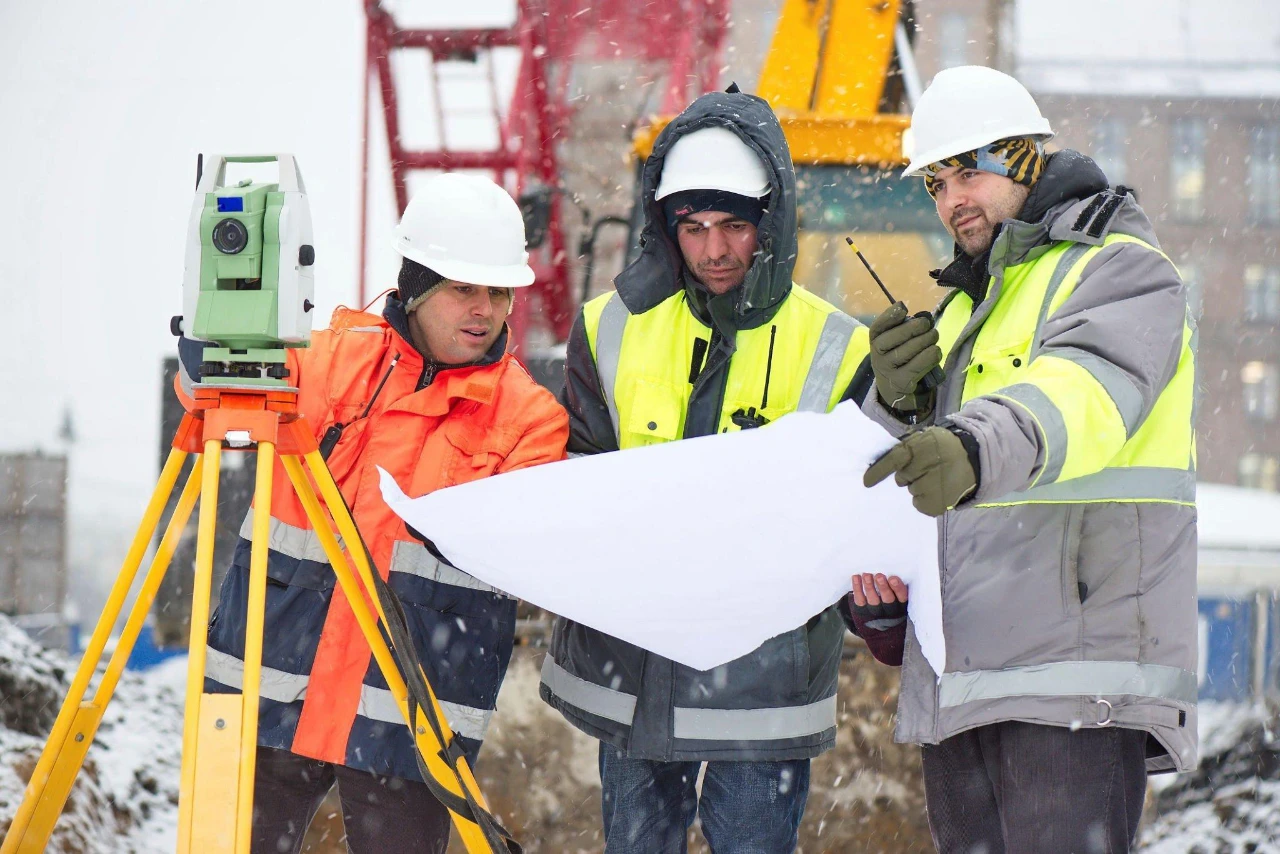
A Step-By-Step Guide to Creating a Cold Work Permit Checklist
Cold work activities, which involve tasks in non-operational or non-energized equipment, pose significant safety risks. It is essential to have a cold work permit checklist to safeguard workers and company assets. This checklist adopts a systematic approach to evaluate and minimize risks, thereby preventing accidents, injuries, and harm to equipment and facilities.
This article aims to guide you through the process of creating a comprehensive cold work permit checklist, emphasizing safety and compliance. By following this step-by-step guide, you'll be able to establish a standardized procedure for obtaining cold work permits, ensuring that all safety measures and precautions are in place before any cold work activities commence.
Understanding Cold Work Permits
A permit for cold work is official documentation that grants permission for specific non-routine tasks, such as repairs or maintenance, in areas where equipment is inactive or de-energized. This document serves as an authorized means to carry out work safely and contains information regarding the work scope, hazards, safety precautions, and personnel responsible.
Checklists simplify the permit process, ensuring that all necessary safety precautions and measures are addressed prior to commencing work, thereby reducing the possibility of accidents. By utilizing a checklist, critical safety steps can be ensured, offering a systematic approach to risk management and adherence to regulations.
Cold work may encompass confined space safety, toxic substances, electrical equipment, and other hazards, underscoring the importance of a checklist for risk evaluation and mitigation. The checklist aids in identifying potential risks and prompts responsible personnel to implement safety measures and controls, thus safeguarding both workers and the work environment. It functions as a proactive tool to manage the distinct challenges posed by cold work environments effectively.
Step 1: Identify the Responsible Parties
Managing cold work permits requires establishing a clear chain of responsibility. It entails designating key individuals, such as a cold work permit coordinator, safety officers, and supervisors, who will each be accountable for various aspects of the permit process. These individuals will be responsible for tasks such as creating, reviewing, approving, and overseeing the implementation of cold work permits.
Step 2: Understanding Cold Weather Hazards
Understanding the hazards associated with cold weather is of paramount importance. It is essential to have a comprehensive awareness of the potential risks and dangers that your workers may encounter when working in cold conditions. This knowledge serves as the fundamental basis for developing effective safety measures.
Step 3: Develop a Template
Develop a standardized template for your cold work permit checklist. A well-structured template ensures consistency and completeness in the documentation process. This template should include clear sections, headings, and designated spaces for filling in required information.
Step 4: Gathering Information
This step involves the collection of essential information that will be incorporated into the cold work permit. The details to be gathered include:
- Project Details: This section should encompass the project's name, location, and the planned work date in cold weather conditions.
- Work Description: Clearly outline the tasks that will be performed in the cold environment, which may include construction activities, maintenance tasks, or any job exposing workers to cold weather.
- Team Members: List the names and roles of all workers who will participate in the cold work.
- Weather Conditions: Document the prevailing weather conditions, including temperature, wind speed, and any precipitation. This information is vital for assessing the severity of the cold and determining safety measures.
- Emergency Contacts: Include contact numbers for medical services, first-aid responders, and safety officers who can be reached in case of emergencies.
Step 5: Detailed Risk Assessment for Cold Weather Work
Conduct a comprehensive risk assessment for tasks performed in cold conditions, taking into account various factors such as low temperatures, wind chill, and the duration of exposure. This step is crucial in identifying potential risks to both personnel and equipment. Key considerations include:
- Temperature Extremes: Assess the range of temperatures workers will be exposed to, considering extremes of cold that can lead to frostbite, hypothermia, or other cold-related health issues.
- Duration of Exposure: Determine how long workers will be exposed to cold conditions, as prolonged exposure increases the risk of cold stress.
- Environmental Conditions: Consider additional factors such as precipitation, humidity, and the specific location of the work, as they can impact safety.
- Physical Demands: Evaluate the physical demands of the tasks being performed in cold weather, as these demands can affect a worker's ability to stay warm and safe.
Step 6: Safety Measures
List safety measures and precautions that must be implemented to mitigate the identified risks in cold weather conditions. These measures may include:
- Proper Clothing and PPE: Specify the types of clothing, including insulated gloves, jackets, and appropriate footwear, that workers should wear to stay warm and protect against cold-related injuries.
- Break Schedules: Establish regular break schedules to allow workers to warm up, rehydrate, and rest. Adequate rest is essential in preventing cold-related health issues.
- First Aid and Emergency Supplies: Ensure that first aid kits and emergency supplies are readily available on-site. All workers should be trained on basic first aid procedures to address cold-related injuries.
- Communication: Establish a communication system for workers to signal for help if needed, such as radios, mobile phones, or other means of contact.
- Equipment Checks: Verify that all equipment and machinery used in cold weather conditions are suitable for the operation. Ensure that they are functioning correctly and have undergone necessary maintenance to prevent equipment-related incidents.
Step 7: Emergency Procedures
Outline detailed emergency procedures for different scenarios that might arise in cold weather conditions. These procedures should cover responses to situations like frostbite, hypothermia, equipment failure, and accidents. Ensure that all workers are familiar with these procedures, have access to the necessary resources, and have received appropriate training to respond effectively in cold weather emergencies.
Step 8: Review and Approval
Before any work commences in cold conditions, ensure that the cold work permit checklist undergoes a thorough review and approval process. Safety officers, project managers, and other relevant personnel should review and approve the checklist to confirm that all safety measures are in place and that the cold work can proceed safely.
Step 9: Communication
After obtaining approval, it is crucial to effectively communicate the cold work permit checklist and safety measures to all personnel involved in the cold work. Conduct training sessions or safety briefings to ensure that all workers have a clear understanding of the procedures, potential risks, and safety measures. Effective communication is vital for ensuring worker safety and awareness.
Step 10: Implementation
With the checklist and safety measures effectively communicated, it is essential to implement them rigorously. All workers must strictly adhere to the safety protocols and procedures outlined in the checklist. Supervisors and safety officers should actively monitor the work to ensure that safety measures are consistently followed.
Step 11: Periodic Review
Safety is an ongoing process, and both weather conditions and work requirements can change over time. Therefore, it's crucial to establish a system for regular review and updates to the cold work permit checklist. This periodic review ensures that safety measures remain relevant and effective in light of evolving conditions and requirements.
Step 12: Documentation
Proper documentation is essential for accountability, record-keeping, and compliance. Maintain detailed records of cold work permits, including information such as the results of inspections, safety measures taken, and any incidents that occur during cold-weather work. This documentation serves as a valuable resource for incident investigations, safety audits, and regulatory compliance.
Wrapping Up
Developing a cold work permit checklist requires a systematic and comprehensive approach to evaluate and mitigate the risks associated with working in cold conditions. Effective communication, periodic updates, and commitment to safety are fundamental elements of a successful cold work permit system. By following these steps, you can significantly enhance the safety and overall well-being of workers operating in cold environments.
READ MORE ❯
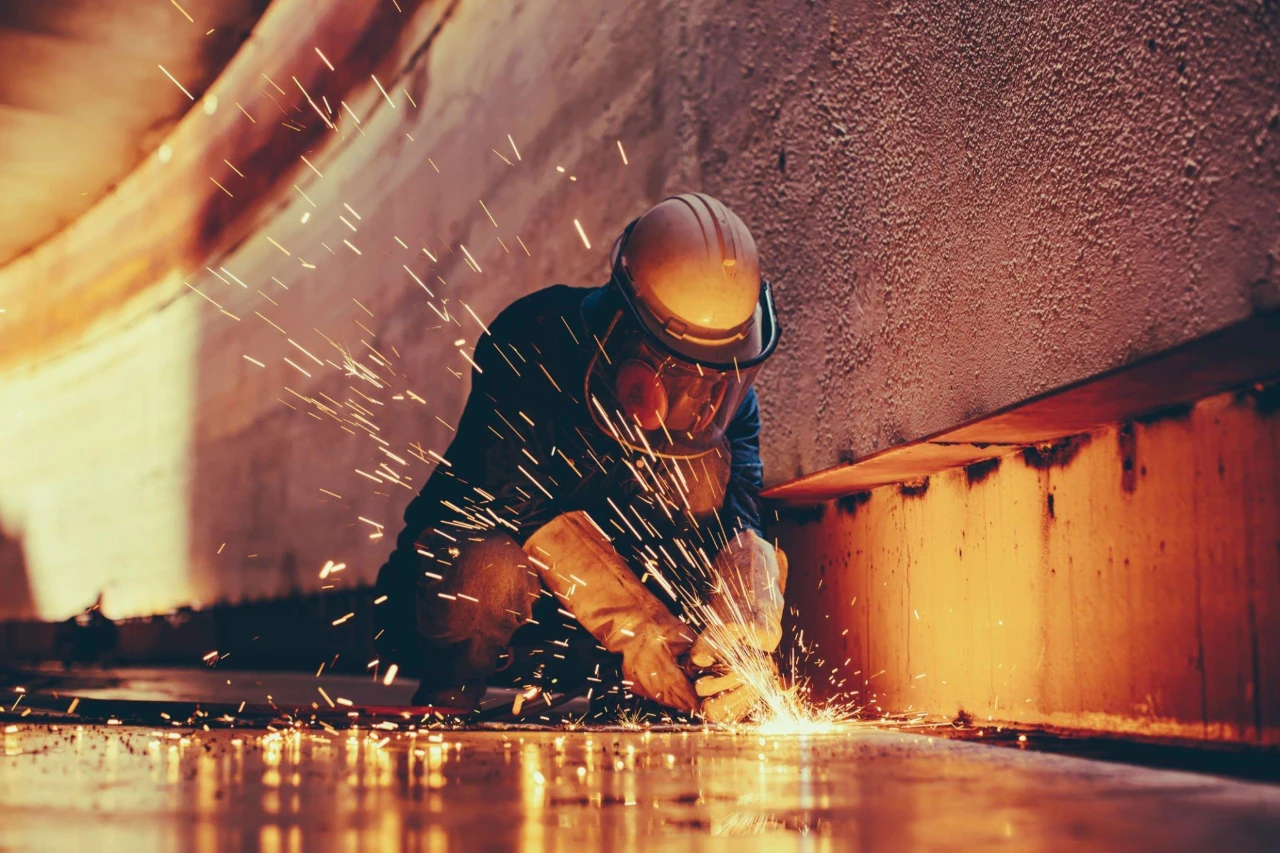
Enhancing Safety in Confined Spaces through Permit to Work Software
In today's fast-growing industrial and infrastructural landscape, workplace safety has taken center stage. Workplace safety faces distinctive challenges when it comes to confined spaces. Typically, these areas are found in construction, manufacturing, and petrochemical industries, with limited entry and exit points, poor ventilation, and potentially hazardous atmospheres. To counteract the hazards tied to confined space work, various organizations are adopting advanced technological solutions, notably Permit to Work software. In this article, we will delve into how PTW software elevates safety standards within confined spaces.
Confined Spaces
Confined spaces are not designed for continuous occupancy and have limited entry and exit points. Spaces like these can be found in many locations, such as industrial plants, construction sites, and storage tanks.
The Importance Of Safety In Confined Spaces
Due to their inherent risks, confined spaces require the utmost attention to safety. These risks include the potential for hazardous atmospheres, engulfment, entrapment, and other life-threatening situations. Safety measures are essential to prevent serious consequences.
Challenges of Confined Spaces
Confined spaces bring many hazards that can impose significant risks on individuals employed within or near them. These spaces offer limited entry and exit options and are not intended for continuous habitation. They are prevalent across diverse sectors, such as construction, manufacturing, agriculture, and beyond. Recognizing the potential dangers linked to confined spaces is essential for safeguarding the well-being of workers.
1. Limited Entry and Exit Points
One of the primary dangers of confined spaces is their limited access. In case of any emergency, such as a fire, toxic gas release, or equipment malfunction, the ability to enter or exit the space quickly is severely restricted. Workers can be trapped, which makes rescue operations challenging and time-sensitive.
2. Poor Ventilation
Confined spaces often need proper ventilation. It can lead to the accumulation of hazardous gases, such as carbon monoxide, methane, or hydrogen sulfide. Poor air quality increases the risk of respiratory problems, making it vital to monitor and maintain air quality in confined spaces.
3. Hazardous Atmospheres
These spaces may contain a range of hazardous atmospheres, including toxic gases, flammable materials, and dust. Exposure to these substances can result in acute or chronic health issues, such as chemical burns, lung damage, or explosions. The risks associated with such atmospheres make it essential to assess and control them before workers enter.
4. Engulfment and Entrapment
Some confined spaces, such as silos, tanks, or sewers, may contain liquids, grains, or other materials that can suddenly engulf or trap workers. These incidents can lead to drowning, suffocation, or crushing injuries. Proper safety measures, including fall protection and lockout/tagout procedures, are necessary to prevent these accidents.
5. Physical Hazards
Confined spaces can contain obstructions or moving machinery. Workers may be at risk of physical injuries, such as cuts, bruises, or fractures, while navigating these tight spaces. Adequate training and protective equipment are essential to minimizing these risks.
6. Lack of Communication
Communication can be challenging, as workers may need more radio or visual contact with colleagues outside. In emergencies, this can hinder coordination and response efforts, making it crucial to establish effective communication protocols.
Permit to Work Software
Permit to Work Software is a digital system designed to manage and streamline the process of issuing permits to perform various tasks in a controlled and safe manner. It is a critical component of safety management systems in industries where hazardous work activities are common, such as construction, manufacturing, and petrochemicals. This software ensures that work is carried out safely, with proper authorization and adherence to safety protocols.
How does it work?
1. Request and Submission
Users initiate the permit process by submitting a work request, specifying the type of work, location, and required safety measures. This request is then routed to the appropriate authorities for review.
2. Review and Approval
Safety professionals or supervisors review the request to ensure it complies with safety regulations and standards. They may request additional information or revisions before approval.
3. Permit Generation
Once approved, the system generates an electronic permit with all necessary details, including safety instructions, equipment requirements, and work schedules.
4. Communication
The permit is communicated to the relevant individual involved in the task, ensuring everyone knows the safety requirements.
5. Work Execution
Work can commence after all safety protocols are in place and the permit is in effect.
6. Real-time Monitoring
The software provides real-time work monitoring, allowing supervisors to ensure safety measures are followed.
7. Closure
After the work is completed, the permit is closed in the system, and any necessary reports or documentation are archived.
Key features and benefits
Key Features
- User-friendly interface for requesting and managing permits.
- Integration with safety regulations and standards.
- Real-time access to permit status and safety instructions.
- Reporting and auditing capabilities.
- Automatic notifications and reminders for permit expiration.
- Customizable templates for various types of permits
- Document storage and retrieval
Benefits
1. Improved Safety
Ensures that work is carried out in compliance with safety regulations, reducing the risk of accidents and incidents.
2. Real-time Monitoring
Enables supervisors to monitor work progress and intervene if safety standards are unmet.
3. Data Management
Facilitates the documentation of work activities for future reference and audits.
4. Efficiency
Streamlines the permit issuing process, reducing paperwork and administrative overhead.
5. Transparency
Provides a transparent record of who issued the permit, who is responsible for the work, and when it was completed.
6. Compliance
It helps organizations maintain compliance with safety regulations, avoiding fines and legal liabilities.
The Role of Permit to Work Software in Enhancing Safety
Streamlining the permit-issuing process
Permit to Work Software enhances safety by streamlining the permit-issuing process. It eliminates manual paperwork, making it faster and more efficient. It not only reduces the administrative burden but also ensures that permits are issued promptly. It helps reduce the time between the request and the actual work. Automating the prolonged permit approval process reduces the potential for unauthorized work and ensures that safety measures are in place before the work commences.
Ensuring compliance with safety regulations
The software is designed to integrate safety regulations and standards into the permit approval process. It ensures that every permit issued is compliant with the latest safety requirements. By automating the permit approval process with safety regulations, organizations can be confident that their operations consistently meet legal and industry safety standards, minimizing the risk of accidents, injuries, and regulatory violations.
Real-time monitoring and control
One of the most significant benefits of Permit to Work Software is its ability to offer real-time monitoring and control over ongoing work. Supervisors can track work progress and monitor whether safety measures and procedures are being followed. The real-time visibility allows monitoring of any safety violations, helping to prevent accidents and ensure that the work environment remains safe throughout the task.
Implementing Permit to Work Software
Assessment and Planning
Before leveraging the PTW software, it is essential to assess your organization's needs, current permit processes, and safety requirements. Develop a plan that outlines the goals, timeline, and budget for implementing software.
Vendor Selection
Choose a reputable software vendor that aligns with your organization's requirements. Ensure the software can be customized based on your company’s requirements. Based on your needs, you can configure user roles, permit types, and workflows.
Data Migration
If you have existing permit data, plan for data migration to the new system, ensuring a smooth transition.
Pilot Testing
Conduct a pilot test with a small group of users to identify any issues, fine-tune the system, and make necessary adjustments.
Training and Onboarding
Provide training for users to ensure they understand how to use the software effectively and in compliance with safety standards.
Rollout and Communication:
Deploy the software to all relevant personnel and communicate the change, emphasizing its importance for safety.
Monitoring and Evaluation
Continuously monitor system performance and gather user feedback to make improvements as needed.
Software Training
Train employees on how to use the Permit to Work Software effectively. It includes navigating the system, requesting permits, and complying with safety measures.
Safety Protocols
Provide comprehensive safety training to ensure employees understand the importance of adhering to safety protocols, a critical aspect of using the software.
Regular Updates
Keep employees informed about software updates and changes to safety regulations through regular training and educational sessions.
Best Practices for Using Permit to Work Software
Creating a Safer Work Culture
Leadership Commitment: Leaders should set an example by prioritizing safety and visibly supporting the use of the software.
Clear Policies: Establish and communicate safety policies and expectations to all employees.
Employee Involvement: Encourage employees to participate in safety initiatives and report safety concerns actively.
Regular Audits And Inspections
Scheduled Audits: Conduct routine safety audits and inspections to ensure permits are used correctly and safety measures are in place.
Documentation: Maintain detailed records of audits and inspections for reference and compliance purposes.
Continuous Improvement And Feedback
Feedback Mechanisms: Create a system for employees to provide feedback on the software and safety processes, and use this feedback for continuous improvement.
Periodic Reviews: Regularly review the permit processes and software to identify areas where efficiency and safety can be enhanced.
Legal and Regulatory Aspects
How Does Permit To Work Software Help With Compliance?
Automated Compliance Checks: Permit to Work Software can include automated checks to ensure that permits align with legal requirements, reducing the risk of non-compliance.
Documentation and Reporting: The software helps organizations maintain detailed records of permits, inspections, and safety measures, which can be crucial for demonstrating compliance during audits.
Real-time Updates: Keeping the software up-to-date with the latest regulations ensures that permits are always aligned with legal requirements.
Choosing the Right Permit to Work Software
Factors To Consider When Selecting A Software Solution
Selecting the right Permit to Work Software is essential for ensuring safety and efficiency in your organization. Consider the following factors:
Industry-Specific Needs: Ensure the software is tailored to your industry's requirements and specific permit types, such as confined spaces, hot work, or electrical work.
Customization: The ability to customize the software to your organization's unique processes and safety protocols is crucial for a seamless fit.
Compliance with Regulations: Ensure that the software aligns with relevant safety regulations and standards in your region.
Support and Training: Assess the level of support and training provided by the software vendor to ensure a smooth implementation process.
Scalability: Consider whether the software can grow with your organization and handle an increasing volume of permits.
User-Friendly Interface: The software should be intuitive and user-friendly to encourage employee adoption.
Integration: Check if the software can integrate with your existing systems, such as asset management, ERP, or safety databases.
Mobile Accessibility: A mobile-friendly solution allows on-site permit creation, monitoring, and compliance checks.
Reporting and Analytics: Look for software that offers robust reporting and analytics features to track safety performance and identify areas for improvement.
Evolving Technology In Confined Space Safety
IoT and Sensors
The application of Internet of Things (IoT) devices and sensors for continuous, real-time monitoring of confined spaces offers essential data on factors like air quality, temperature, and other critical safety parameters.
Augmented Reality (AR)
AR technology can provide remote assistance and training in confined space areas, augmenting safety measures and operational efficiency.
Artificial Intelligence (AI)
AI can be leveraged to analyze data from permits, incident reports, and safety records, allowing for the detection of patterns and recommendations for safety protocol enhancements.
Drones
Drones equipped with cameras and sensors can serve the purpose of inspecting and overseeing confined spaces. By doing so, the workers don't need to enter the potentially hazardous areas.
Predictions For The Future Of Permit To Work Software
Greater Integration
Permit to Work Software will see deeper integration with other environmental, Health, and Safety (EHS) and operational systems, resulting in a seamless exchange of data and information.
Enhanced Mobility
Mobile applications will advance in sophistication, allowing users to generate and oversee permits from virtually anywhere, with real-time updates and alerts.
AI-driven Safety Recommendations
The software will offer safety recommendations driven by Artificial Intelligence (AI) and predictive analytics to avert incidents proactively.
Blockchain for Verification
Blockchain technology might be harnessed for verifying the authenticity and compliance of permits, heightening trust and security in the process.
Global Standardization
Permit to Work Software could move toward global standardization, simplifying safety management for multinational organizations operating across international boundaries.
Conclusion
In conclusion, this article has highlighted the importance of safety in confined spaces and introduced Permit to Work Software as a revolutionary tool for ensuring the well-being of workers. By fostering a proactive safety culture and leveraging innovative solutions, organizations can transform how they approach safety in confined spaces.
READ MORE ❯
5 Ways Technology is Transforming Manufacturing Safety with EHS Software
Manufacturing safety is a critical aspect of any industrial operation. It ensures worker safety, protects assets, and maintains operational efficiency. Ensuring the safety of employees, protecting valuable equipment, and preventing workplace accidents are top priorities for any manufacturing operation. With the ever-advancing technology, there are now new and innovative ways to enhance safety in manufacturing.
This blog post will cover the following five ways technology revolutionizes manufacturing safety.
Impact of Technology on Manufacturing Safety
1. Automation and Robotics
Automation refers to using control systems, machinery, and technology to reduce human intervention in manufacturing processes. It encompasses many technologies, from robotic arms to conveyor belts, designed to improve efficiency and safety.
Reducing Human Error
Automation and robotics play a crucial role in mitigating human error. These technologies are increasingly taking on tasks that pose significant safety risks to workers. For instance, robots can handle dangerous materials or repetitive tasks with utmost precision, eliminating the chance of accidents caused by fatigue or distraction.
Precision and Accident Reduction
Automation brings precision that human labour can't match, reducing the margin of error in manufacturing processes. Fewer errors translate to fewer workplace accidents, making it a win-win for workers and businesses.
Examples in Action
In the automotive industry, robots tirelessly weld and assemble car parts with incredible accuracy. Food processing plants use automated sorting and packaging machinery to prevent injuries caused by manual handling. By automating these tasks, manufacturers improve safety and enhance the quality and efficiency of their operations.
2. IoT and Sensor Technology
The Power of IoT
The Internet of Things (IoT) transforms manufacturing by connecting machines and equipment. This interconnected network provides real-time data that can be used to monitor equipment conditions and worker safety.
Sensing Danger
Sensors can detect changes in temperature, pressure, or other factors that may indicate a potential safety hazard. When these sensors detect an anomaly, they can trigger alerts or automatic safety protocols, helping to prevent workplace accidents. For instance, IoT sensors in a chemical manufacturing plant can detect gas leaks and initiate immediate shutdown procedures, preventing catastrophic accidents.
3. Artificial Intelligence and Predictive Analytics
Harnessing AI
Artificial Intelligence (AI) and predictive analytics are revolutionizing manufacturing safety by forecasting potential risks. AI algorithms analyze large volumes of data to identify patterns and trends, which can then be used to predict safety issues.
Predictive Insights
By monitoring equipment performance, employee behaviour, and environmental conditions, AI can predict when equipment maintenance is needed or when an employee may be at risk of an accident, allowing for timely intervention. Major manufacturing companies already implement AI for predictive maintenance, reducing downtime and accidents while saving operational costs.
4. Virtual Reality (VR) and Augmented Reality (AR)
Immersive Safety Training
Virtual Reality (VR) and Augmented Reality (AR) are transforming safety training and on-site support. VR immerses workers in realistic scenarios to simulate potentially dangerous situations, ensuring they are well-prepared to handle them safely.
Benefits of Immersion
According to a survey, leading manufacturers use VR and AR to train their employees to deal with complex machinery, chemical reactions, and high-risk environments.
5. Big Data and Analytics
Analyzing Historical Data
Big data and analytics are being harnessed to analyze historical safety data. By examining past incidents and near-misses, manufacturers can uncover patterns and trends that may have previously gone unnoticed.
Data-Driven Improvements
This data-driven approach allows manufacturers to proactively improve safety protocols, machinery design, and worker behaviour. Companies that harness the power of big data are seeing a significant reduction in accidents and near-misses, saving lives and resources.
Challenges and Concerns
Cybersecurity
Cybersecurity is a significant concern, as interconnected systems can be vulnerable to cyberattacks. Manufacturers must prioritize robust cybersecurity measures to protect their data and workers.
Proper Training
Introducing new technologies necessitates proper training for employees. Without it, technology can become a liability rather than an asset. Manufacturers should invest in comprehensive training programs to ensure their workforce can safely operate and maintain new equipment.
Emerging Technologies
The future of manufacturing safety holds exciting prospects. Emerging technologies like 3D printing, drones, and advanced wearable devices are set to enhance safety measures further.
Final Thoughts
Incorporating technology into manufacturing safety is a game-changer. Manufacturers can proactively reduce accidents, protect workers, and enhance operational efficiency by leveraging automation, IoT, AI, VR, and big data. The future of manufacturing safety is bright, as we can anticipate even more innovative solutions to keep workers and businesses safe.
READ MORE ❯
NeoEHS at the Forefront of Conference APOSHO 2023
As the workplace safety and health landscape continues to evolve, organizations must stay updated on the latest trends, technologies, and regulations. The Malaysian Society for Occupational Safety and Health (MSOSH) recently hosted its Annual General Meeting and Conference APOSHO 2023, and NeoEHS was right at the center of this exceptional event.
It was a three-day conference themed 'Moving Forward Beyond Compliance,' aimed at discussing issues and trends for policymakers, occupational safety practitioners, and employees' well-being.
APOSHO 2023: Making Workplaces Safer Together
The Asia-Pacific Occupational Safety and Health Organization (APOSHO) is a renowned annual event that brings together EHS professionals, HSE experts, and organizations from the Asia-Pacific region to discuss the latest developments in occupational safety and health (OSH). This year, APOSHO 2023 was hosted by MSOSH in Malaysia. It offered an excellent opportunity to discuss the diverse challenges faced by organizations in ensuring workforce well-being.
NeoEHS: A Leader in EHS Solutions
NeoEHS, a leading provider of Environmental, Health, and Safety (EHS) solutions, participated actively in APOSHO 2023. With its commitment to delivering top-notch EHS solutions, delegates of NeoEHS team Dr.Mohd Rosmadi, Mr.M.C.Balamurugan and Mr.M.Ch.Ramaiah showcased its EHS management software designed to help organizations improve workplace safety and promote a culture of well-being. Notably, the organizations that participated in the event expressed a keen interest in embracing digital transformation within their Health, Safety, and Environment (HSE) operations.
Key Takeaways from NeoEHS' Participation
Innovative EHS Solutions: NeoEHS showcased its EHS software that helps companies manage risks, compliance, incidents, and more. Our innovative solutions ensure organizations have a proactive approach to OSH, preventing workplace accidents and promoting a safer environment.
Knowledge Sharing: NeoEHS professionals actively engaged in knowledge-sharing sessions during the conference. They discussed best practices, emerging trends, and effective strategies for improving OSH within organizations. Our contributions helped attendees gain valuable insights.
Keynote Presentation: The honorable keynote address was delivered by the renowned Dato' Sri Dr.Mohammed Azman bin Dato' Aziz Mohammed, Lawrence Webb, and the Director General of the Department of Occupational Safety and Health (DOSH) Malaysia.
Networking Opportunities: APOSHO 2023 provided an exceptional platform for networking and collaboration. NeoEHS leveraged this opportunity to connect with like-minded professionals, HSE experts, and organizations that share our commitment to employee safety and health.
Global Perspectives: APOSHO 2023 was a melting pot of OSH ideas and experiences from various countries in the Asia-Pacific region. NeoEHS' participation allowed them to gain a global perspective on workplace safety challenges and solutions.
Towards a Safer and Healthier Future
Amidst an era where employee well-being is essential, NeoEHS' participation in APOSHO 2023 underscores our dedication to promoting safer and healthier workplaces. With our intuitive EHS solutions and active engagement in industry events like APOSHO, NeoEHS contributes immensely to the global mission of occupational safety and health.
As the workplace safety landscape evolves, NeoEHS remains committed to helping organizations meet and exceed our EHS goals. This is done by encouraging a culture of employee well-being and safety. Our active involvement in events like APOSHO 2023 is a testimony to our ongoing efforts to lead the way in EHS management.
READ MORE ❯
.jpg)
How Wearable Technology is Transforming Workplace Safety?
In today's rapidly evolving workplace landscape, the integration of technology is reshaping how we ensure the safety of employees. Wearable technology is now playing a pivotal role in enhancing workplace safety. In this blog, we will explore the profound impact of wearable technology on workplace safety, providing insights into its applications, benefits, and the future it holds.
The Role of Wearable Technology in Workplace Safety
Accidents and injuries not only have personal and financial consequences but also affect overall productivity. In recent years, wearable technology has emerged as a promising tool to enhance workplace safety. These innovative devices, ranging from smart helmets to safety vests, are designed to monitor and improve various aspects of safety in work environments.
Real-time Monitoring and Data Collection
Wearable technology can provide real-time monitoring of a worker's vital signs and environmental conditions. For instance, smart helmets equipped with sensors can detect excessive heat, toxic gases, or harmful radiation levels. These devices send alerts to workers and supervisors, allowing them to take immediate action, such as evacuating a hazardous area or donning appropriate safety gear.
Fall Detection and Prevention
Falls are a leading cause of workplace accidents. Wearable technology can include sensors that detect sudden movements or changes in altitude, signaling potential falls. These devices can automatically alert supervisors or emergency services, ensuring prompt assistance to injured workers. Additionally, some wearables can be equipped with fall-prevention features, such as vibrating alerts or audio warnings, to remind workers to maintain safe footing.
Training and Skill Enhancement
Wearable technology can also serve as a valuable tool for training and skill enhancement. Augmented reality (AR) glasses or smart helmets can provide real-time guidance to workers, displaying instructions, schematics, or safety protocols directly in their field of vision. It can help inexperienced workers perform complex tasks safely and efficiently.
Incident Documentation
In the event of an accident or near miss, wearables equipped with cameras can capture valuable video footage and images. This documentation can be invaluable for incident investigations, enabling employers to identify the root causes and implement preventive measures more effectively.
Compliance Monitoring
In regulated industries, such as healthcare or food production, wearables can help ensure compliance with safety protocols and regulations. For example, smart badges can track hand hygiene compliance in hospitals, reducing the risk of infections.
Benefits of Wearable Technology
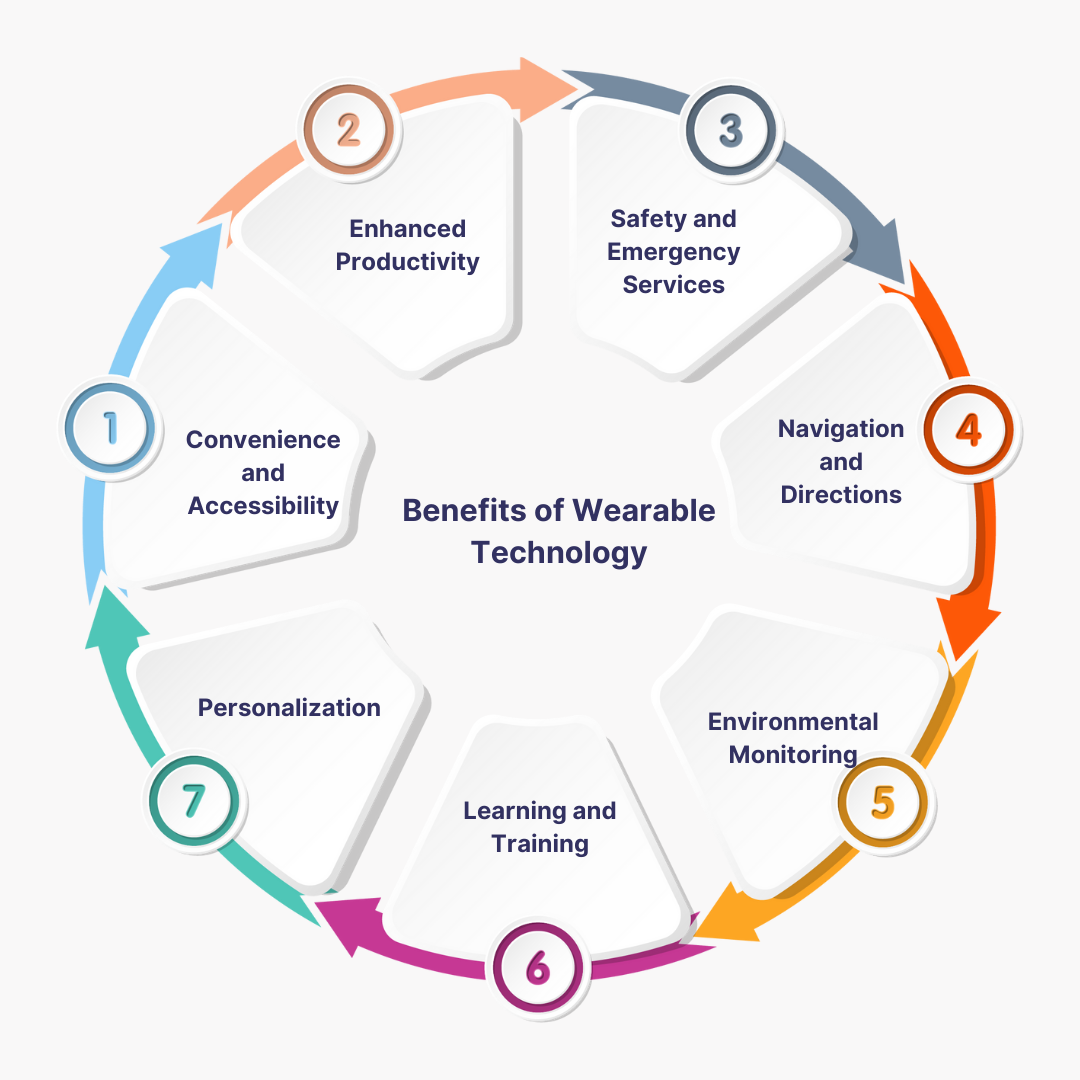
In recent years, wearable technology has seen significant advancements, transforming how we interact with and perceive our surroundings. Here are some of the key advantages of wearable technology:
Convenience and Accessibility
Wearable technology, such as smart glasses and smartwatches, empowers users to effortlessly access information, receive notifications, and even make calls without the hassle of reaching for their smartphone tucked away in their pocket or bag. This seamless convenience not only simplifies daily routines but also ensures users stay constantly connected.
Enhanced Productivity
In professional environments, wearables have the potential to enhance productivity significantly by offering swift access to emails, calendars, and task lists. Smartwatches and augmented reality (AR) glasses enable hands-free communication and instant information retrieval, ultimately streamlining work processes and increasing efficiency.
Safety and Emergency Services
Wearables are equipped with emergency features like fall detection or SOS buttons. In crucial situations, these devices can send alerts to designated emergency contacts or summon assistance, potentially playing a vital role in saving lives.
Navigation and Directions
Wearable devices incorporating GPS functionality, such as smart glasses or navigation bracelets, offer turn-by-turn directions, simplifying the task of navigating unfamiliar locations.
Environmental Monitoring
Wearable sensors are capable of measuring environmental parameters such as air quality, UV exposure, and temperature. This data empowers users to make informed choices concerning their comfort and overall well-being.
Learning and Training
Wearable devices, such as AR headsets, find application in training across industries like manufacturing, healthcare, and aviation. They offer immersive, hands-on training experiences, which, in turn, lower the chances of errors and accidents.
Personalization
Wearable technology frequently adjusts to individual preferences and behaviors. Machine learning algorithms can analyze user data to provide tailored suggestions for fitness regimens, shopping choices, entertainment options, and various other aspects of life
Industries Benefiting from Wearable Technology
Wearable technology has found applications in various industries, providing numerous benefits. Here are some industries that have benefited from wearable technology:
Construction and Manufacturing
- Smart Helmets: Construction workers can wear smart helmets with augmented reality (AR) displays for enhanced safety and productivity, providing real-time data and instructions.
- Exoskeletons: Wearable exoskeletons can assist manufacturing workers by reducing physical strain and fatigue, increasing efficiency and safety.
Healthcare and Medical
- Fitness Trackers: Wearable fitness trackers monitor patients' activity levels, heart rate, and sleep patterns, aiding in preventive healthcare.
- Remote Monitoring: Medical professionals can remotely monitor patients' vital signs and health conditions through wearables, improving patient care.
- Smart Glasses: Surgeons use smart glasses for augmented reality-assisted procedures, displaying critical information during surgery.
Logistics and Warehousing
- Wearable Scanners: Warehouse workers wear barcode scanners, improving inventory management and order fulfillment accuracy.
- Smart Glasses: Logistics personnel can use smart glasses for hands-free navigation and order picking, enhancing efficiency.
Oil and Gas
- Smart Helmets: Workers in the oil and gas industry wear smart helmets for safety and to access real-time information about equipment and processes.
- Wearable Gas Sensors: These devices detect harmful gases, protecting workers from potential hazards.
Agriculture
- Smart Farming Sensors: Farmers use wearable sensors to monitor crop conditions, soil quality, and livestock health, optimizing agricultural practices.
- GPS Wearables: Precision agriculture relies on wearable GPS devices for accurate mapping and crop management.
Mining
- Safety Helmets: Miners wear smart helmets equipped with communication and monitoring systems to enhance safety underground.
- Wearable Gas Detectors: Miners use wearable gas detectors to detect harmful gases in real time, reducing health risks.
The Future of Wearable Technology in Workplace Safety
The future of wearable technology in workplace safety holds great promise as these innovative devices continue to evolve and play a pivotal role in enhancing employee well-being and operational efficiency. With the integration of advanced sensors, augmented reality displays, and real-time data analytics, wearables are poised to provide workers with proactive hazard detection, personalized safety guidance, and instant access to critical information. By fostering a safer work environment and minimizing accidents, these technologies not only protect employees but also contribute to increased productivity and reduced operational costs, making them an indispensable component of the modern workplace safety landscape.
Wrapping Up
In conclusion, wearable technology has rolled out in a new era of workplace safety. These innovative devices not only monitor the health and well-being of employees but also provide real-time data that can be used to enhance safety and prevent accidents. From smart helmets that detect potential hazards to fitness trackers that promote healthier lifestyles, the impact of wearables on workplace safety is undeniable. As technology continues to advance, we can expect even more effective wearable solutions to emerge, further improving the safety and well-being of workers. Embracing these advancements is not just a choice but a necessity for employers looking to create safer and more productive workplaces.
READ MORE ❯
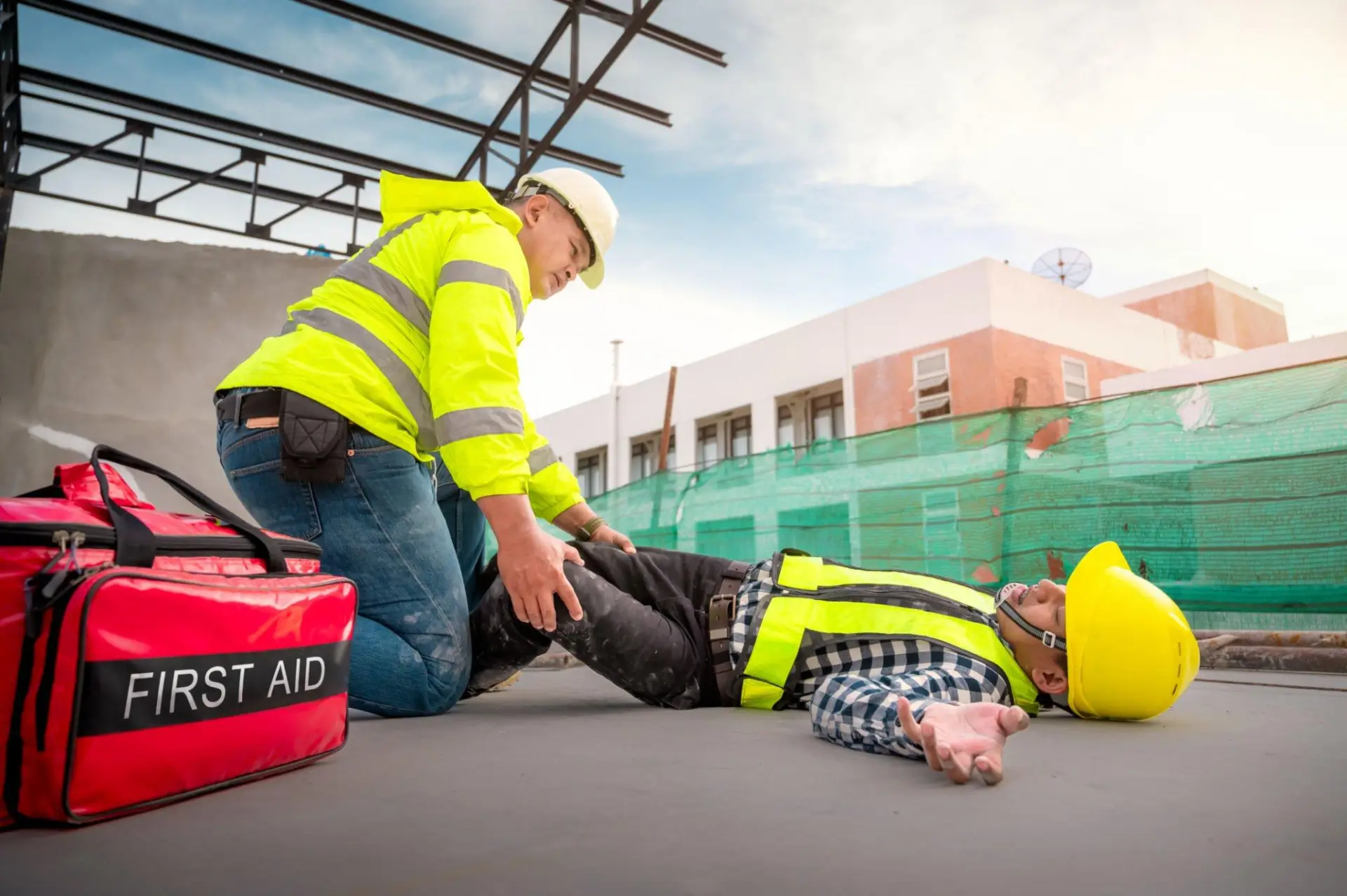
Importance of Technological Advancements to Eliminate Workplace Fatalities
In today's landscape, prioritizing workplace safety remains a paramount concern. Despite significant advancements in safety regulations and practices, the unfortunate reality is that workplace fatalities and accidents continue to persist. However, with the integration of cutting-edge technology, a promising path toward reducing and ultimately eradicating these tragedies has emerged.
In this blog post, we'll delve into a range of innovative technologies that are actively contributing to making workplaces safer and more secure.
1. The Art of Predictive Analytics
Machine learning algorithms have proven their worth by analyzing extensive datasets to predict potential safety risks. By analyzing historical data on workplace incidents, these tools pinpoint patterns and trends that may predict accidents. This safety-focused approach empowers organizations to take preventive measures before accidents occur.
2. Robotic Assistants
Increasingly, robots are finding roles in hazardous work environments where human workers cannot safely perform their tasks. With remote control or autonomous operation, these robots minimize the risks associated with human presence, especially in high-temperature, radiation-exposed, or toxic environments.
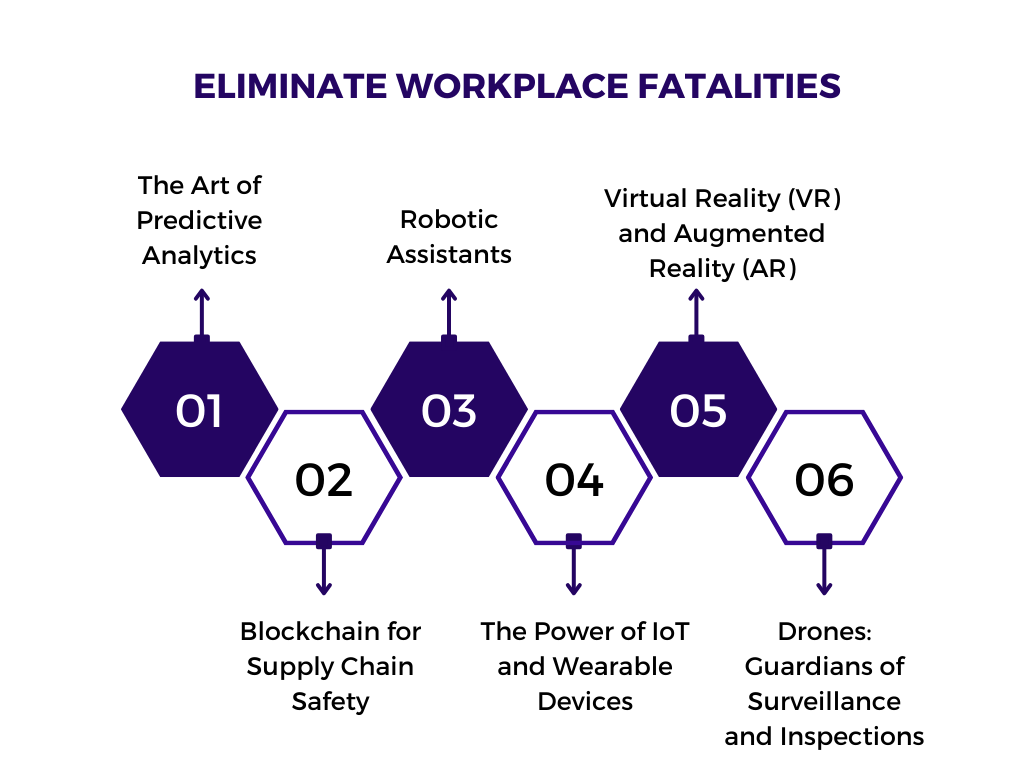
3. Virtual Reality (VR) and Augmented Reality (AR)
VR and AR technologies have redefined safety training through immersive simulations. With virtual reality, employees can practice safety protocols and emergency responses without being exposed to any real risks. Additionally, AR provides real-time guidance and information to workers on the ground, significantly improving situational awareness.
4. Blockchain for Supply Chain Safety
Blockchain technology has introduced transparency and traceability into supply chains. It acts as a vital aspect in industries where material source and quality directly impact worker safety. By utilizing blockchain technology, you can track the origin and handling of materials. Companies can secure compliance with safety standards and substantially decrease the likelihood of accidents resulting from inadequate materials.
5. The Power of IoT and Wearable Devices
The development of the Internet of Things (IoT) has brought about a significant shift in workplace safety. Nowadays, employees have the opportunity to use smart devices that provide real-time health and safety monitoring. For instance, smart helmets equipped with advanced sensors capable of detecting hazardous conditions, such as elevated levels of toxic gases or potential head injuries. These devices not only alert the employee but also transmit crucial information to a central control room, ensuring instant responses in emergencies.
6. Drones: Guardians of Surveillance and Inspections
Drones have emerged as indispensable tools for inspecting challenging-to-reach areas across various industries, from construction to mining. With high-resolution cameras and specialized sensors, these aerial tools continually monitor workplace conditions and identify potential hazards. In addition to that, drones offer a safer alternative instead of sending human workers into dangerous or inaccessible locations
Final Thoughts
Incorporating cutting-edge technology into the workplace represents a flawless approach to reducing workplace fatalities. These advanced technological solutions empower organizations to oversee and improve safety protocols proactively. As technology advances, our ability to create safer work environments grows. By investing in these technologies and cultivating a culture of safety, organizations can pursue the vision of building a zero-harm environment.
READ MORE ❯
Preventing Hearing Loss in the Workplace
Hearing loss is a significant and often underestimated workplace hazard. It can affect employees across various industries, from construction and manufacturing to office settings. The good news is that hearing loss can be preventable with the right measures in place. The prevention of hearing loss at work is essential for both employee health and safety. Employers can take several measures to minimize the risk of hearing loss among their workers after exposure to loud noise.
In this blog article, we will discuss the importance of preventing hearing loss in the workplace and provide practical tips for both employers and employees to protect their hearing.
Assessment and Monitoring
Firstly, you will have to identify the workplace areas where the noise levels exceed permissible exposure limits. Conduct regular noise assessments to determine the extent of noise exposure. Hearing protection equipment should be worn by all employees in noisy work environments, and hearing tests should be conducted regularly to assess hearing health. Employers should also provide employees with training on the risks of noise exposure and proper hearing protection.
Administrative Controls
To manage workplace noise effectively, consider implementing job rotation to minimize individual exposure to noisy environments, schedule noisy tasks during off-peak hours when fewer employees are present, and strive to limit the duration of exposure to loud noise whenever feasible.
Engineering Controls
To mitigate workplace noise, invest in noise-reducing technologies and equipment like quieter machinery and tools, isolate noisy machinery or processes within soundproof enclosures or barriers, and ensure regular maintenance and repairs to minimize noise emissions.
Personal Protective Equipment (PPE)
To safeguard employee hearing, provide hearing protection devices (HPDs) like earplugs or earmuffs, offer comprehensive training on their proper usage and maintenance, and consistently perform checks to confirm employees are correctly utilizing their hearing protection measures. Monitor noise levels in the workplace, provide regular hearing tests, and provide access to audiometric testing.
Education and Training
Prioritize employee awareness regarding noise exposure risks and the significance of hearing protection, offering comprehensive training on correct hearing protection use and early detection of signs of hearing damage. Provide access to hearing protection at no cost to employees. Monitor the use of hearing protection regularly. Provide regular hearing tests.
Regulatory Compliance
Ensure compliance with occupational safety and health regulations concerning noise exposure, and stay informed and up-to-date regarding any revisions or alterations in workplace noise regulations. Employers must remain vigilant and well-informed about any potential changes or updates to workplace noise regulations. Regulations can vary by region and may evolve, making it essential for organizations to maintain a proactive approach to compliance.
Hearing Conservation Programs
Establish a comprehensive hearing conservation program encompassing policies, procedures, and guidelines, incorporating regular audiometric testing to monitor employees' hearing health over time and diligently maintaining records of noise exposure assessments and audiometric test results.
Regular Audits and Inspections
Regularly perform audits and inspections to evaluate the effectiveness of noise control measures and make necessary adjustments based on the findings to improve noise management in the workplace continually. Provide proper hearing protection. Ensure employee use of hearing protection. Educate employees on the importance of hearing conservation.
Employee Involvement
Build an environment where employees can report workplace noise concerns or issues and actively engage in the development and enhancement of hearing conservation programs. By doing so, you can ensure that their input and experiences are considered. Monitor noise levels in the workplace. Provide regular hearing tests and wear ear protection if necessary.
Continuous Improvement
Consistently review and update hearing conservation policies and practices in light of new research and technological advancements while actively seeking opportunities to reduce noise levels and enhance workplace safety through ongoing improvements.
Final Thoughts
Through the implementation of these strategies, employers can effectively mitigate the risk of hearing loss in the workplace, fostering a safer and healthier environment for their employees. Prioritizing hearing protection and awareness within a comprehensive occupational health and safety program is essential for long-term employee well-being and productivity
READ MORE ❯
 (1).png)
Essential Strategies for Workplace Fall Protection
Today, ensuring workplace safety is critical for all organizations. This undeniable truth underscores the significance of workplace fall protection. Falls are the prominent cause of injuries and fatalities across various industries. The implementation of effective fall protection measures is vital to safeguard their employees and meet regulatory requirements.
Employers should regularly assess their workplace to identify potential fall hazards and take appropriate action to mitigate them. They should also provide appropriate fall protection and safety equipment to their employees and ensure that they are adequately trained in its use. Additionally, organizations should ensure that their employees have access to appropriate first-aid equipment and trained personnel in case of an accident. They should provide regular safety inspections and risk assessments to identify and address any potential hazards. Companies must develop a comprehensive fall protection plan that includes risk assessment, hazard identification, and safety training.
In this blog article, we will explore essential strategies for fall prevention workplace.
Let's get started!
Hierarchy of Fall Protection
Employers should adhere to the hierarchy of fall protection, prioritizing methods to prevent falls in the following order:
Elimination: The most potential way to prevent falls is to eliminate the need for employees to work at heights. It may involve task redesign or the use of equipment that allows access without exposing workers to fall hazards.
Passive Fall Protection: As we know, elimination isn't feasible in all cases, so employ passive fall protection measures like guardrails, safety nets, and covers to establish physical barriers preventing falls.
Fall Restraint: Fall restraint systems prevent workers from reaching fall hazards using equipment such as restraint lanyards and anchor points.
Fall Arrest: If falls can't be prevented by other means, use fall arrest systems like personal fall arrest harnesses and lifelines to minimize the impact of a fall.
Risk Assessment
A fundamental step in fall protection measures is conducting a thorough risk assessment. Identify potential fall hazards in your workplace, including elevated surfaces, open edges, holes, and roofs. Ensure to investigate these potential hazards and assign respective employees to perform in these areas and assess the associated risks. This method will guide the prioritization of fall protection measures. Encourage employees to speak up if they identify potential hazards. Inspect the work environment regularly to detect and correct any hazards. Make sure employees wear appropriate protective gear.
Equipment Inspection and Maintenance
It is essential to conduct inspections before each use and regular maintenance to guarantee the functionality of fall protection equipment. In addition to that, it is crucial to replace damaged or worn-out equipment promptly. Implement a tracking system for equipment inspections and maintenance to build a safer work environment. Conduct frequent workplace inspections and safety audits to identify potential fall hazards or areas in need of improvement. Address any issues promptly to prevent accidents and maintain a safe working environment.
Fall Protection Plans
Develop a workplace-specific fall protection work plan outlining procedures, equipment requirements, and emergency response protocols. Ensure all employees get training on these plans and comprehend their roles in executing them. Provide appropriate PPE for employees working at heights, including safety harnesses, helmets, non-slip footwear, and other gear that can mitigate injury in the event of a fall. Enforce safe work practices such as discouraging rushing or shortcuts, maintaining a clean workspace, and ensuring ergonomic conditions. Foster open communication among workers to facilitate the prompt reporting of hazards and near misses.
Training and Education
Proper training and education about workplace falls are pivotal in fall prevention. Ensure that all employees understand the risks associated with their tasks. Every employee must be proficient in using fall protection equipment. Conduct training programs and incorporate periodic updates to prevent workplace falls. Provide adequate supervision to ensure that employees follow safety protocols. Establish a system of accountability to ensure that employees comply with safety requirements.
Final Thoughts
Workplace fall protection is essential to employee safety and well-being. By conducting thorough risk assessments, adhering to the hierarchy of fall protection, providing proper training, maintaining equipment, and cultivating a safety-oriented culture, organizations can significantly reduce the risk of falls and create a safer work environment. Make use of the below insights to build a safer environment.
READ MORE ❯

Why Do Businesses Need EHS Software?
In today’s fast-paced business landscape, ensuring the safety of employees and complying with ever-changing regulations have become critical priorities of organizations. Hence, many organizations started leveraging the EHS software to streamline these efforts.
This article lists a few reasons businesses need to use EHS software to enhance safety, work culture, and operational efficiency.
1. Ensure Regulatory Compliance
EHS regulations are ever-evolving and complex. Using EHS software, organizations can stay up-to-date with the latest regulations and track compliance requirements. By using the software, you can handle documents anytime, anywhere. This centralized platform ensures that necessary documentation never gets lost. Hence, businesses must choose the right EHS software to meet the regulation standards and avoid legal penalties and reputational damage.
2. Mitigate Accidents and Injuries
If you are looking for a solution to reduce accidents and incidents in your workplace, then EHS software is the right one for you. Using our software, you can mitigate risks and reduce future incidents. Many organizations use environmental, health, and safety software to improve workplace safety. According to the survey, more than 60% of accidents are reduced with the help of safety software. So, why are you still hesitating? Make use of the EHS software to advance safety in your organization.
3. Advanced Productivity
Based on a study, EHS software helps organizations to increase 50% of productivity. By leveraging the EHS software, businesses can automate their workflows and check documentation processes effortlessly. With EHS reports, organizations can focus on areas to reduce costs to improve operational efficiency. It also helps the professionals to assign audit-related tasks to other on-site employees. Thus, EHS software is vital in advancing productivity in your organization.
4. Increased Operational Performance
With EHS software, you can easily streamline administration tasks and highlight unsafe areas in your organization. The software plays a crucial role in improving your operational performance by lowering the time to carry out the tasks. In addition to that, it can maximize safety awareness and also employee participation. Doing so can help organizations reduce lost time due to injuries.
5. Effortless Report Generation
Reporting events and workplace dangers is a big part of what health and safety professionals do daily. EHS software aids in streamlining this process by automating some report components and enabling speedier form-filling. Using app-based checklists and similar techniques, workers may become more involved in the process and develop a greater awareness of health and safety.
Final Thoughts
Using EHS software is now essential in a connected world where EHS issues significantly impact corporate success. The advantages of stakeholder involvement, regulatory compliance, risk mitigation, incident management, operational efficiency, and data-driven decision-making should be considered. EHS software is vital for ensuring a secure, sustainable, and lucrative future as businesses navigate an ever-changing environment.
READ MORE ❯
Revolutionizing Safety: The Power of Automating EHS Processes in Workplace
Due to the increasing industrial landscape, workplace safety has become a significant concern for organizations across the globe. Organizations are continuously looking for methods to improve efficiency, streamline operations, and safeguard the security and well-being of their employees. One of the potent solutions that has gained massive traction is the automation of EHS processes in the workplace.
In this blog, let's check out how automating EHS processes can improve workplace safety!
The Need for Automation
EHS management includes manual record-keeping, data entry, and reporting, which could be error-prone and time-consuming. These procedures can be streamlined by automation, which also allows for data-driven decision-making and reduces human error and saves time.
Perks of Automating EHS Processes
Data-Driven Insights
Automation collects and organizes data, giving detailed analyses of EHS performance. This information can support strategic choices, assisting businesses in proactively improving their EHS procedures.
Cost Savings
Automation eventually lowers expenses associated with human labour, compliance fines, and workplace accidents, even though initial deployment may require an investment.
Advanced Compliance
Automated EHS processes can aid businesses in adhering to various laws and requirements. Companies can ensure that they regularly comply with regulatory obligations by automating data collection, reporting, and audits.
Risk Reduction
Workplace dangers must be identified and mitigated to ensure employee safety. Real-time monitoring and notifications made possible by automation help businesses quickly address potential hazards and avoid mishaps.
Efficient Incident Management
Automated EHS systems provide quick reporting and action in accidents or incidents. Due to the automation of EHS processes, you will reap faster resolution, less downtime, and speedier recovery.
Employee Empowerment
Automated systems frequently contain tools and modules for employee training, enabling staff to participate actively in EHS procedures and fostering a safety culture.
Sustainability Efforts
Automation makes tracking and lowering resource use, waste production, and emissions effortless. It helps businesses accomplish their sustainability objectives and make an environmental difference.
Streamlined Reporting
Regular EHS reporting might take a lot of time. This process is streamlined through automation, which enables businesses to quickly and accurately produce reports.
Final Thoughts
Automating EHS operations becomes a potent tool in a world where worker safety, compliance, and sustainability are crucial. It improves risk management, empowers staff, and fosters a culture of continuous improvement. It also streamlines operations. Organizations that adopt EHS automation safeguard their workers and present themselves as trustworthy, progressive industry leaders. Businesses can make the workplace for everyone safer, more effective, and more sustainable by leveraging the power of technology.
READ MORE ❯

How EHS Software Drives Safety, Compliance, And Sustainability?
In today's rapidly increasingly regulated business landscape, companies face various challenges to ensure workplace safety, adhere to environmental regulations, and maintain sustainable practices. Many organizations use modern solutions such as EHS software to tackle these challenges effectively.
This blog article explores how EHS software is pivotal in driving safety, compliance, and sustainability within companies.
Let's get started!
Centralized Data Management
EHS software acts as a thorough repository for all EHS data. It allows organizations to store data in one centralized location. This functionality makes real-time access to critical information possible, simplifying data administration and improving decision-making. Through the EHS software platform, businesses can efficiently monitor occurrences, conduct risk analyses, and keep tabs on compliance-related operations.
Advanced Safety Management
Enhancing worker safety is the main objective of EHS software. It helps organizations identify possible risks, carry out safety measures, and take proactive corrective actions. Companies can use the EHS software to train their staff to handle potentially dangerous situations and manage employee certifications and training. As a result, workplace accidents and injuries will be minimized, improving employee well-being and workers' compensation expenses.
Streamlined Incident Reporting and Investigation
EHS software simplifies the reporting and investigation process in case of any accidents or incidents. Employees can quickly log incidents, and the system prompts immediate notifications to the respective individual. The software aids in root cause analysis, allowing organizations to understand the underlying issues and implement preventive measures to prevent future incidents.
Risk Mitigation and Financial Perks
By adequately managing safety and environmental risks, companies can reduce the possibility of potential accidents and the following financial repercussions. EHS software makes identifying potential risks easier and evaluating how they might affect the organization. Businesses may decide how to limit risk exposure and preserve their bottom line using data-driven insights.
Sustainability Initiatives and Environmental Management
Companies increasingly focus on sustainability as part of their corporate social responsibility efforts. EHS software is critical in supporting these initiatives by enabling efficient environmental management. The software helps track energy consumption, waste generation, and greenhouse gas emissions. It aids in setting sustainability goals, monitoring progress, and generating sustainability reports, which is essential for transparent communication with stakeholders and investors.
Enhanced Compliance Tracking
Compliance with ever-evolving EHS regulations is crucial for businesses to maintain a positive reputation and avoid costly penalties. The software has features that track compliance requirements, automate reporting processes, and notify stakeholders about upcoming deadlines. With real-time compliance insights, companies can address compliance gaps promptly and ensure adherence to the latest regulations.
Final Thoughts
Leveraging EHS software safeguards employees' well-being and ensures that businesses operate responsibly and sustainably. By providing centralized data management, advanced safety management, increased compliance tracking, automated incident reporting, and support for sustainability initiatives, EHS software empowers companies to drive positive change.
READ MORE ❯

A Historical Overview of Workplace Health and Safety
In today's world, workplace safety has become the top priority of all organizations. But, earlier, it wasn't the case. Workplace health and safety was entirely a new concept.
Preceding 1970, workplace safety was under the Department of Labour and had no central focus. Because of it, workers were the ones to suffer the consequences. It had taken more than 200 years to evolve into the law we follow today. Due to the increasing number of fatalities and injuries, health and safety continue to evolve daily.
Over the ages, workplace health and safety have advanced significantly, moving from a time of dangerous working conditions to the current emphasis on employee well-being and accident prevention. In this article, we'll learn about the major turning points that have helped make the workplace safer and healthier for workers, from the Industrial Revolution to modern procedures.
The Early Days: Pre-Industrial Revolution Era
Earlier, limited technological development created some inherent risks in the workplace. However, companies might frequently control possible hazards more efficiently with smaller labour sizes and better oversight. While most safety precautions were informal in ancient Mesopotamia other early communities already had the idea of protecting employees' welfare.
The Industrial Revolution
In the late 18th century, there was a revolution in industries. As industries boomed, factories emerged, introducing mass production and a higher demand for labour. Unfortunately, this time was marked by terrible conditions at work, lengthy hours, child labour, and minimal consideration for employee safety. Accidents and fatal injuries became too regular. During this period, the organizations did not focus on improving workplace safety.
The Emergence of Labor Movements
Labour movements started to take off in the late 19th and early 20th centuries due to the harsh realities of the Industrial Revolution. Workers began requesting more pay, lenient working hours, and safer working environments. These joint efforts resulted in the creation of labour laws that intended to safeguard workers' rights and welfare, such as the Factory Act of 1833 in the United Kingdom and the Fair Labor Standards Act in the United States.
Early Safety Regulations and Standards
Governments and businesses realized the necessity for explicit safety rules as industries became more complicated and mechanized. The first safety committees and departments were established to address workplace dangers methodically in response. Organizations like the National Safety Council (NSC) in the United States and the British Safety Council, formed in the 20th century, were crucial in raising public awareness of safety issues and establishing safety standards.
Governments worldwide took worker and workplace health and safety far more seriously in the 1970s. The Occupational Health and Safety (OHS) Act was passed in the US in 1970, establishing the Occupational Health and Safety Administration (OSHA) to establish, enforce, and maintain health and safety standards and laws.
The main objective of this act was to advance safety and guarantee a safer work culture for all employees across the globe. The law addressed risks to people's health and safety, such as toxic environments, uncomfortable working conditions, and cold and heat stress.
The Ongoing Evolution
Research and technological developments in the second half of the 20th century further altered occupational health and safety procedures. Organizations prioritized risk analyses, safety training, and accident investigations in adopting comprehensive safety management systems. National authorities implemented stricter rules, while international organizations like the International Labour Organization (ILO) attempted to establish worldwide safety standards.
In recent decades, the focus has shifted beyond mere safety compliance to encompass employee well-being and overall health. The ergonomics concept gained prominence, aiming to design work environments that prevent physical strain and promote productivity. Technology and the Future of Workplace Health and Safety.
Technology has become increasingly important in developing workplace health and safety practices since the dawn of the digital age. Innovative solutions have improved risk assessment, incident prevention, and employee engagement. Predictive analytics may further revolutionize workplace safety.
Final Thoughts
From the challenges of the Industrial Revolution to the current emphasis on employee well-being, every era has influenced today's workplace safety landscape. The road to a safer workplace has advanced significantly, but more work still needs to be done. Technology and our combined efforts are moving us toward a safer and healthier future.
READ MORE ❯
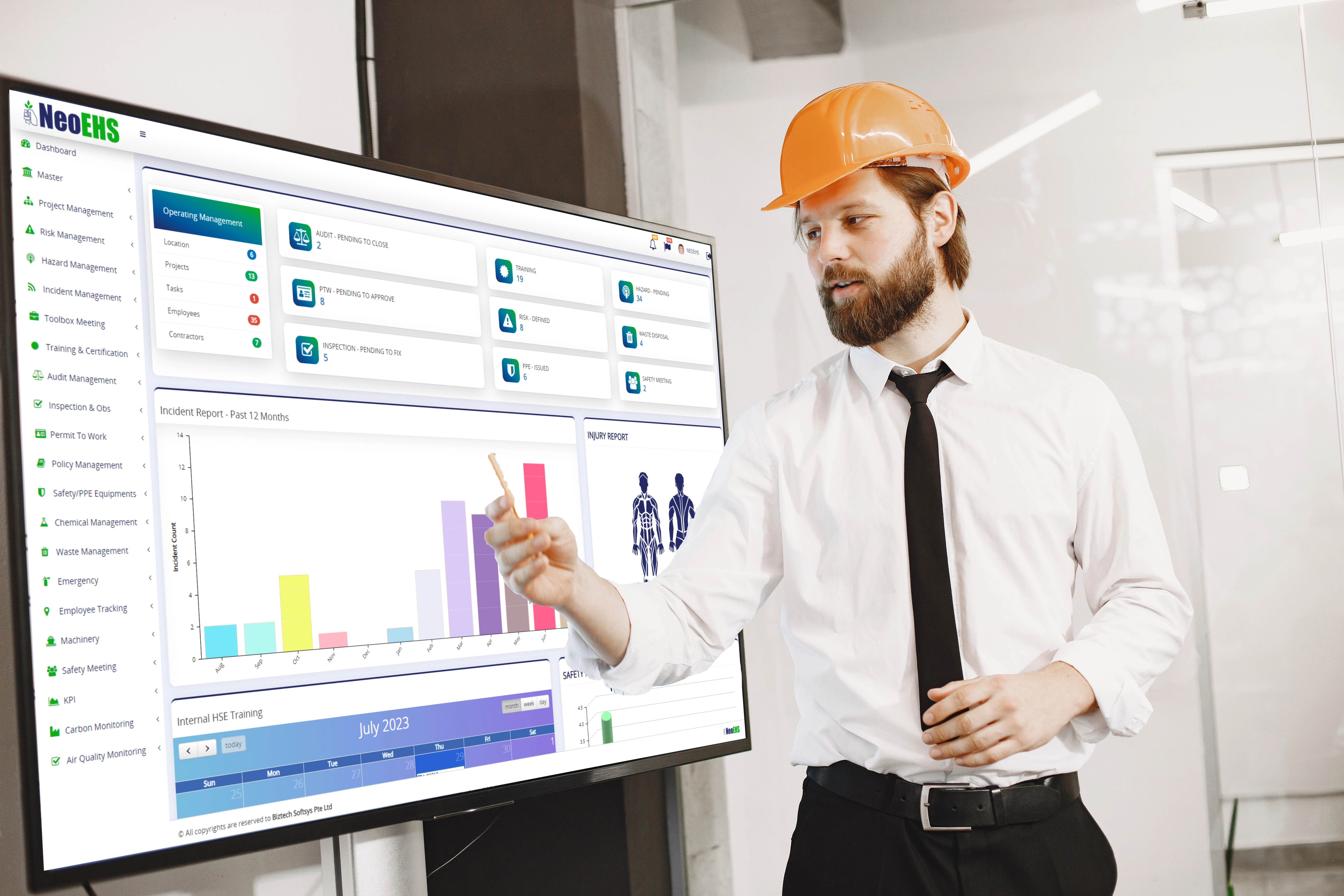
Core Features of an EHS Management System
Organizations need help to build a safer environment for their employees. An effective EHS management system is pivotal for organizations to ensure compliance with regulations, protect employees and the environment, and improve overall operational efficiency.
In this article, we have highlighted the core functions of an EHS management system and their significance in achieving a safe and sustainable work environment.
Functions of EHS Management System
Risk Assessment and Management
One of the fundamental functions of an EHS management system is conducting comprehensive risk assessments. It involves identifying potential hazards, evaluating likelihood and potential impact, and implementing control measures to mitigate risks. Risk management processes should be proactive, including hazard identification, analysis, evaluation, and treatment strategies.
Incident Reporting and Investigation
Accurate reporting of incidents and near-misses is critical for effective EHS management. An EHS management system should include structured incident reporting that allows employees to report hazards and incidents effortlessly. It should also facilitate thorough investigation procedures to determine the root causes of incidents and implement corrective measures.
Compliance Monitoring and Reporting
It has become a legal requirement for organizations to maintain compliance with EHS regulations. An EHS management system should include processes for monitoring compliance, such as periodic inspections, audits, and documentation reviews. It is also essential to enable the generation of compliance reports to meet regulatory requirements.
Performance Monitoring and Reporting
Monitoring key performance indicators (KPIs) is essential for assessing an EHS management system's efficacy and fostering continual development. The system should provide tools for tracking and analyzing EHS metrics, such as incident rates, near-miss statistics, training completion rates, and compliance status. Regular performance reports make it easier to analyze current trends, set goals, and make wise decisions.
Training and Competence Management
Providing adequate training to employees is essential for building a safety culture. An EHS management system should conduct training programs tailored to various job roles and responsibilities. It should also support the tracking and managing of employee competencies, ensuring that individuals possess the necessary skills and knowledge to perform their tasks safely.
Document Management
A document control module that supports version control, document approval protocols, and centralized document repositories should be part of the system. It ensures employees quickly access the most recent policies, procedures, and job instructions. Maintaining accurate records and guaranteeing access to up-to-date information is essential for effectively managing EHS-related documents.
Final Thoughts
To achieve compliance, reduce risks, and promote a secure and sustainable workplace, organizations need to implement an EHS management system with these fundamental features. Businesses can use an effective management system to improve their EHS performance, safeguard their personnel, lower incident rates, and perform responsible operations. Adopting such a system promotes better operational effectiveness and long-term corporate success in addition to safeguarding people and the environment.
READ MORE ❯
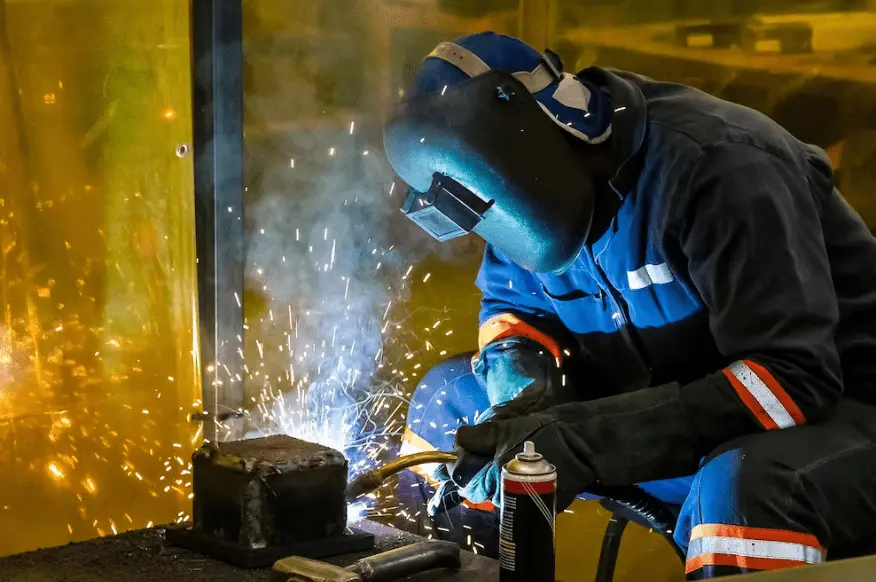
Hot Work Permits: Mitigating Fire Hazards through Proactive Safety Measures
Many sectors are concerned about fire risks, especially regarding hot work activities. If not adequately controlled, hot work, which includes welding, cutting, soldering, and similar procedures using open flames or heat sources, could result in deadly fires. Proactive safety measures are essential to create a secure workplace and avoid incidents. Implementing hot work permits is one of the measures which is essential in reducing the risk of fire.
In this article, we have highlighted the significance of hot work permits and preventative safety measures.
Come, let’s get started!
Understanding Hot Work Permits
Do you know what hot work permits are? Hot work permits authorizing and regulating hot work activities in a specific area. These permits are designed to ensure proper safety protocols are followed before, during, and after any hot work operations. By implementing a hot work permit system, organizations can identify potential risks, enforce safety standards, and minimize the chances of fire incidents.
Risk Assessment and Hazard Identification
A detailed risk assessment and hazard identification are essential for a hot work permit. Before issuing a permit, a designated safety professional must inspect the work site for fire dangers. The inspection includes looking for combustible gases, explosive compounds, and other ignition sources. By doing so, proper safety measures can be carried out to reduce the identified risks
Preparing the Work Area
After the risk assessment and hazard identification process, you will know the hazards that can harm your work area. The work environment might be prepared for hot work activities as part of proactive safety precautions. It includes removing combustible materials from the area, including chemicals, oils, and fuels. For adequate ventilation, avoiding the buildup of flammable vapours or gases is essential. In some circumstances, it is necessary to use fire-resistant shielding or barriers to safeguard nearby objects or machinery. These safety measures limit the possibility of fire events occurring when performing hot work.
Regular Inspections and Audits
Inspections and audits must be conducted periodically to maintain safety. By doing so, you will know if the safety procedures are carried out properly. Organizations may maintain a safe working environment and continuously improve their fire prevention methods by performing periodic inspections and fixing identified risks.
Final Thoughts
Hot work permits are essential for reducing fire risk by implementing preventative safety measures. Organizations can greatly lower the incidence of fire incidents during hot work activities by conducting extensive risk assessments, being well-prepared, implementing fire protection measures, effectively communicating, and conducting routine inspections. Hence, carry out the necessary proactive safety measures to mitigate high risks in your organization.
READ MORE ❯

The Permit to Work Management System: Effectively Managing and Controlling Risky Tasks
Nowadays, industries strive hard to build a safer work culture for their employees. Keeping workers safe and minimizing accidents are of the highest importance for industries that involve hazardous tasks. One of the potential methods for monitoring and controlling these tasks is implementing a Permit to Work management system. A PTW system provides an organized and systematic method for risk assessment, work activity planning, and high-risk task authorization.
In this article, let's check out the essential elements and advantages of a PTW system for controlling potentially hazardous tasks.
Key Components of Permit to Work Management System
Permit to work management system is a formal process that governs hazardous work activities inside an organization. Before starting any hazardous work, the workers must get permission from the designated officer. Workers in hazardous positions must first get permission from a recognized party before starting. The PTW system typically has three phases: request, appraisal, and permission.
Let's check out the main phases of the PTW system!
The Request Stage
First comes the request stage. In this stage, individuals and work teams must submit a permit request form to initiate the process. The form includes various details. The form provides details such as the task, nature of the work, location, resources required, and estimated duration. This stage helps you conduct a thorough risk assessment by ensuring all pertinent information is provided.
The Assessment Stage
During the assessment stage, an authorized competent person will review the permit request form and evaluates the hazards involved during the evaluation phase. This assessment involves taking potential risks into account, assessing the effectiveness of control systems, and identifying the necessary safety precautions. The competent person may conduct site inspections, consult safety laws, and work with pertinent stakeholders to acquire the essential data.
The Authorization Stage
When the risk evaluation is finished, the competent person approves the task. The permit is issued if the risks are tolerable and the necessary control measures are in place. The consent is given to the workers in the form of a physical permit document. This permit provides formal authorization to perform the task and specifies any particular requirements or safety measures that must be observed.
Benefits of the Permit to Work Management System
By implementing a PTW system in your organization, you can reap various benefits in managing potentially hazardous tasks:
Risk Identification and Mitigation
A complete risk assessment is necessary for the PTW system to ensure any possible dangers are found, examined, and resolved. The system helps reduce hazards and improve overall safety by carrying out possible control measures.
Enhanced Communication
The PTW system offers effective communication between workers, supervisors, and safety personnel. With proper communication, everyone will understand their duties and responsibilities, leading to increased coordination and cooperation.
Standardization of Processes
With the PTW system, you can build a streamlined framework for managing hazardous tasks. It aids organizations in optimizing workflows, minimizing errors, and maintaining compliance with safety laws.
Continuous Improvement
The PTW system enables periodic assessments and evaluations of tasks that have been done, allowing organizations to apply lessons from the past and enhance safety procedures. Lessons learned can be used to risk assessments in the future, resulting in continuous improvement of safety procedures.
Final Thoughts
The PTW system is an effective tool for monitoring hazardous tasks. By implementing the PTW system, organizations can analyze risks, reduce them, increase communication, streamline workflows, and progress ongoing safety practice improvement. A vital first step in reducing accidents and upholding a secure workplace is to put workers' safety first through a thorough PTW system.
READ MORE ❯

5 Factors To Consider: How To Choose The Best Permit to Work Software?
Implementing permit to work software has become highly crucial when it comes to maintaining safety and compliance in high-risk workplaces. Permit to work software allows organizations a streamlined system for managing permits, minimizing manual paperwork, and advancing communication among stakeholders. However, with numerous available options, choosing the right PTW software solutions requires considering various factors.
In this article, we have listed ten key factors to consider while choosing an ideal permit to work software for your workplace.
Top 5 Factors To Consider While Choosing The Best Permit To Work Software
1. Analyzing Organization's Needs
Before choosing PTW software, it is necessary to understand your organization's needs and consider various vital factors. Make sure to choose a solution that suits their requirements.
Key Factors to Analyze:
- Permit volume
- Work complexity
- Multiple site operations
- Key stakeholders
2. Features of Permit to Work Software
While choosing the permit to work software, it is crucial to consider its key features. You can finalize if the software meets your specific needs by checking into the features. If you choose the right software, you can amplify overall efficiency.
Features of PTW Software:
- Permit creation and real-time monitoring of permits
- Integration with existing systems
- Customized solutions
- Mobile Accessibility
- Instant alerts and notifications
3. Compliance and Regulatory Requirements
Ensure to choose software that complies with the industry's regulations and standards. By adhering to the requirements, you can not only create a safer environment but also ensure to build a legally compliant workspace.
Key Points to Consider:
- Making sure the software complies with compliance standards.
- Analyzing pertinent industry norms and regulations.
- Being able to produce reports and supporting documents for audits.
4. Seamless User Experience
If you want a permit to work software for your organization, you must find software that offers a seamless user experience. It plays a pivotal role in successful implementation in your organization.
Evaluate the User Experience:
- User-friendly design
- Flawless implementation in various roles
- Software vendors provide support and training
5. Scalability
For PTW software, it is essential to check its scalability. By doing so, you will know if the software can meet your organization's evolving requirements. Hence, ensure to check if the software is scalable while selecting it.
Points to Consider:
- Able to handle all types of permits
- Flexible based on the organization's needs.
Bottom Line
By considering all of these factors, you may choose PTW software that best suits your organization's needs and contributes to increased safety and efficiency in permit management.
READ MORE ❯
Future Trends in EHS: What to Expect?
Today, the field of environmental, health, and safety is constantly evolving. It is because many organizations are striving hard to build a safer and more sustainable workplace. Therefore, it is significant to predict the future trends in EHS. Organizations can get ahead of the competitive curve by understanding these trends and staying updated.
If you aren’t updated with the trends in EHS, you are missing out on a seamless opportunity to create a safer workplace in your organization. In this article, let’s see some future trends in EHS!
Trends in EHS
- Technology Integration
- Sustainability and Circular Economy
- Compliance and Regulatory Changes
- Transparency in Supply Chain
- Stakeholder Engagement and Reporting
- EHS Culture and Leadership
Technology Integration
In the upcoming days, artificial intelligence (AI), machine learning, and the Internet of Things (IoT) will all be used more and more in EHS practices. These advanced technologies will be leveraged for real-time monitoring, data analysis, predictive modeling, and automation of EHS procedures. It can help organizations increase risk assessment and incident prevention.
Sustainability and Circular Economy
Environmental sustainability will keep receiving a lot of attention from EHS. Organizations will implement the circular economy concepts, emphasizing resource conservation, waste reduction, and product lifetime management. It will entail adopting eco-friendly procedures, supporting renewable energy sources, and reducing carbon footprints throughout businesses and supply networks.
Compliance and Regulatory Changes
In the subsequent days, it is anticipated that EHS regulations will be advanced, covering new dangers. Organizations must adjust to shifting compliance standards and proactively address environmental and health issues.
Transparency in Supply Chain
As businesses work to identify and reduce EHS risks to vendors and suppliers, transparency in the supply chain will become more pivotal. Demands for ethical sourcing, responsible production methods, and supplier audits will increase to verify adherence to EHS requirements.
Stakeholder Engagement and Reporting
Organizations must actively engage with all relevant parties, including employees, communities, investors, and customers, to maximize transparency and engagement. EHS reporting and disclosure processes will be necessary to meet the requirements of many stakeholders and show commitment to sustainability.
EHS Culture and Leadership
For organizations, developing a strong EHS culture will be essential. Leadership commitment, employee engagement, and ongoing training and education will be required to promote a proactive safety mentality and guarantee that EHS practices are ingrained throughout the organization.
Wrapping Up
In conclusion, considerable changes are predicted to occur in the environment, health, and safety (EHS) field in the future. The EHS environment is anticipated to experience several changes and developments due to technological breakthroughs, shifting laws, and shifting cultural expectations.
READ MORE ❯
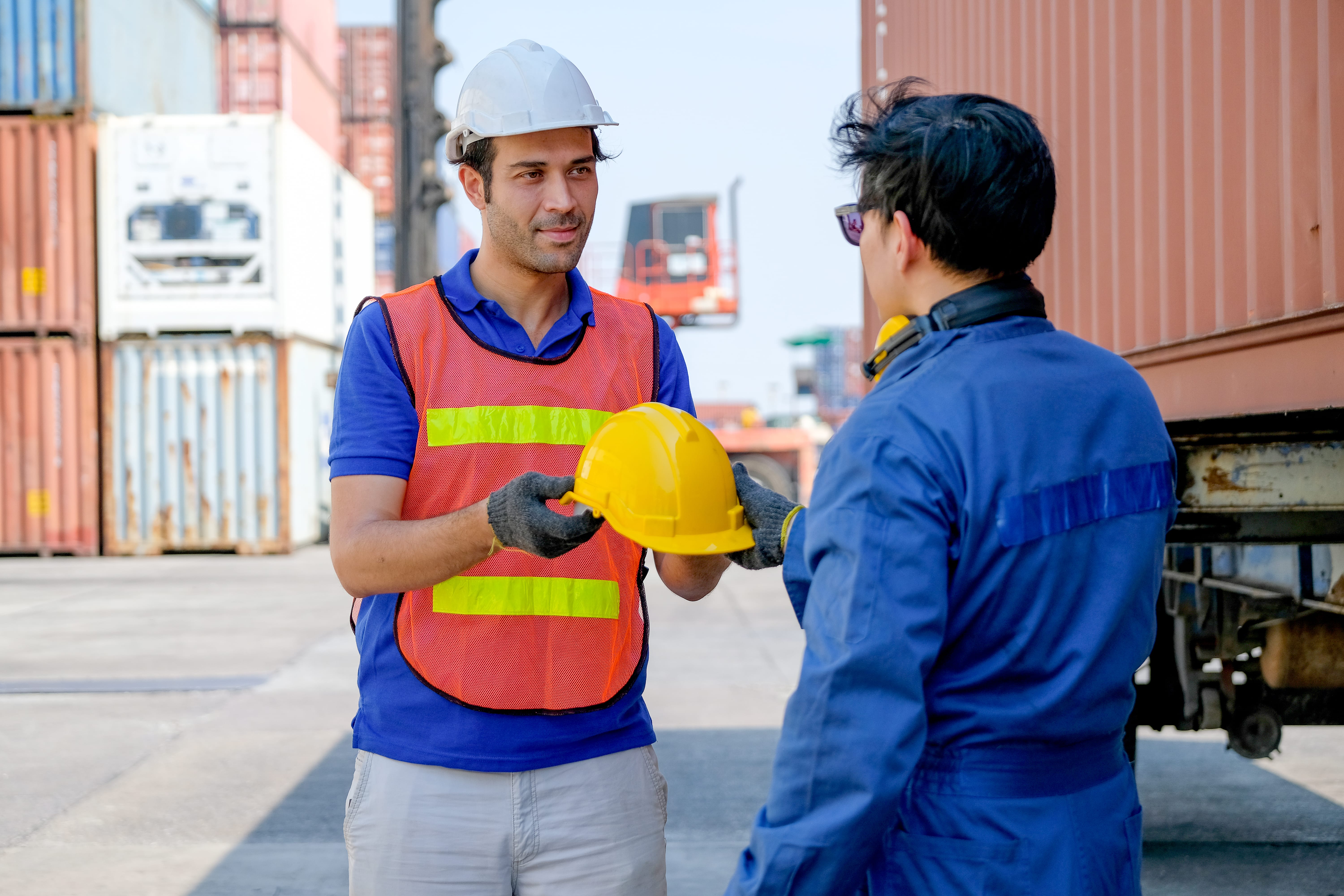
Top 5 Ways To Strengthen Your Workplace Health and Safety Culture
Maintaining a zero-harm environment requires a strong health and safety culture. Nowadays, organizations face difficulties in offering their employees a safer culture. By providing your employees with a safer and healthier workplace, you can lessen absenteeism, mitigate workplace accidents and injuries, and maximize productivity. In addition to that, you can also enhance your business ROI in no time.
This article highlights the top five methods to amplify your workplace health and safety culture.
Let's get started!
Tactics To Advance Your Workplace Health and Safety Culture
Establish a Communication Culture
Firstly, it is essential to build a safer culture across the organization. Effective communication is significant for a workplace to continue to have a strong culture of health and safety. Employees who face any concerns or safety threats should be immediately reported to the safety officers or managers. It must be done in a timely and efficient manner. In addition to promoting communication, regular safety meetings may ensure that everyone is informed of potential hazards and how to avoid them.
Provide Thorough Training
All staff members should receive thorough instruction on workplace health and safety policies and practices to mitigate future incidents. In this safety training program, everything from safe lifting practices to emergency evacuation protocols should be included. To stay current with any procedure changes, it's also crucial to ensure that training continues and that personnel takes regular courses.
Periodic Examination
It's crucial to examine and enhance workplace health and safety protocols routinely. This strategy can entail reviewing event reports to find potential hazards and building new protocols to reduce those risks. By doing so, you can minimize incidents from occurring. Reviewing training programs is vital to make sure they are current and efficient. You can uphold a strong safety culture by regularly assessing and updating safety practices.
Encourage a Sense of Responsibility
In an organization, it is pivotal for every employee to take ownership of keeping the workplace safe and healthy. Hence, you must encourage workers to take responsibility for their workstations and report any hazards or problems. Additionally, managers should set a good example by continuously adhering to safety protocols. Following this strategy can safeguard your workplace from future risks and incidents.
Implement Safety Incentives
Lastly, rewarding safe behavior is one effective strategy for maintaining a good workplace health and safety culture. Rewards can encourage staff members to take safety seriously and foster a culture that values safety. It may involve awards for achieving safety objectives, praising good conduct, and even offering monetary incentives for extended accident-free periods.
Final Thoughts
In conclusion, everyone in the organization must continuously work towards and commit to developing a good workplace health and safety culture. You can foster a culture of safety that aids in preventing mishaps and injuries and builds a healthy, productive workplace. You can create a risk-free workplace by encouraging open communication, offering thorough training, encouraging a sense of responsibility, implementing safety incentives, and routinely reviewing and improving procedures.
READ MORE ❯

Significant Cost Implications of Delayed Incident Reporting
Delayed incident reporting can have pivotal cost implications for organizations. It is important to report incidents promptly to ensure appropriate action can be taken to prevent future incidents. This type of reporting can enhance costs, reputational damage, and legal liabilities.
Here, in this article, let’s see a few significant cost implications of delayed incident reporting.
Let’s get started!
Impact of Delayed Incident Reporting
Cost Implications of Delayed Incident Reporting
Delayed incident reporting can result in advanced costs related to remediation and investigation. It turns out to be time-consuming and costly. A delay in reporting can also make it more difficult to investigate the incident, leading to additional costs.
Reputational Damage
This type of delayed incident reporting can also cause reputational damage. Incidents that are not reported promptly can cause harm to an organization's reputation, especially if they become public knowledge. It can lead to losing customers, business opportunities, and negative media coverage.
Legal Liabilities
Delayed incident reporting can also cause legal liabilities. Organizations have a duty of care to their employees, customers, and stakeholders, and delayed reporting of incidents can lead to legal action. It can result in expensive legal fees, fines, and compensation payments.
Effective Incident Reporting Procedures
Organizations should create efficient incident reporting procedures to reduce the expense of delayed event reporting. It includes ensuring staff members are trained to identify events and immediately comprehend the value of reporting them. Also, organizations should have well-defined reporting routes and procedures in place with assigned personnel responsible for receiving and looking into incident reports.
Prioritize Incident Prevention
In addition to implementing effective incident reporting procedures, organizations should prioritize incident prevention. It includes implementing risk management strategies and conducting regular risk assessments to identify potential hazards and vulnerabilities. By addressing these issues proactively, organizations can reduce the likelihood of incidents occurring in the first place.
Final Thoughts
In conclusion, delayed incident reporting can have significant cost implications for organizations, including advanced remediation and investigation costs, reputational damage, and legal liabilities. Organizations should implement effective incident reporting procedures to minimize these costs, prioritize incident prevention, and consider using incident reporting software. By taking these steps, organizations can mitigate the risk of incidents occurring and ensure that any incidents are reported promptly and effectively addressed.
READ MORE ❯
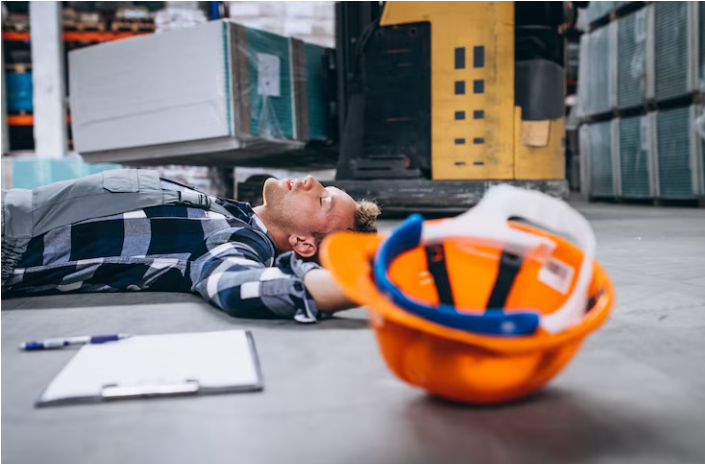
7 Potential Strategies To Advance Incident Management
All organizations must use incident management since it helps to reduce the effects of unforeseen incidents and maintain business continuity. However, effective incident management can be difficult, especially if an organization has a well-established procedure.
Here, in this article, we have highlighted seven effective practices to enhance the incident management process.
Tips To Advance Incident Management
1. Standardize Your Incident Management Process
Establishing a consistent incident management procedure is the first step in enhancing incident management. The procedures to be followed when an event is discovered should be outlined in this process and properly conveyed to all team members. Identification, categorization, priority, assignment, escalation, and resolution of incidents should all be part of the process. All team members will understand their roles and duties and be able to collaborate more effectively if there is a defined process in place.
2. Build A Proper Culture
Developing an organizational incident management culture is crucial for improving incident management procedures. It entails enforcing the need for incident management to be a crucial component of operations and encouraging all team members to be watchful and proactive in spotting and reporting events. Team members will be more likely to report issues immediately, and the business will be able to respond more quickly and effectively by promoting an incident management culture.
3. Leverage Incident Management Tools
There are many platforms and specialized technologies that can help to advance incident management procedures. They include communication tools, monitoring systems, and incident-tracking software. These technologies make it possible to track incidents more accurately and to streamline team member communication. By doing so, incident response times can be sped up, and incidents' effects on the organization can be lessened.
4. Perform Periodic Incident Reviews
Doing regular incident reviews is crucial for enhancing incident management procedures continuously. It entails investigating occurrences to find their underlying causes and patterns and then creating plans to stop them from happening again. Organizations can learn from past incidents and enhance their incident management procedures by performing routine incident reviews.
5. Develop Effective Communication
For incident management to be successful, effective communication is essential. Organizations should develop clear communication channels and protocols for incident management and ensure that all team members are aware of these protocols to ensure successful communication. By doing so, confusion can be reduced, and everyone will respond to occurrences similarly.
6. Train Your Employees
Giving team members ongoing training and education is crucial to strengthen incident management procedures. It may involve regular drills and simulations and training on best practices, tools, and processes for incident management. Team members will be more prepared to handle situations when they arise by receiving frequent training and education.
7. Analyze The Process
Last but not least, it's critical to continually analyze and enhance incident management procedures to guarantee that they get better over time. It includes conducting routine audits, implementing new tools and technologies as they become available, and incorporating input from stakeholders and team members.
Final Thoughts
To sum up, incident management is an important activity for any firm, and enhancing incident management procedures can assist in lessening the effects of unforeseen incidents and guaranteeing business continuity. By implementing these best practices, organizations can create a standardized incident management procedure, use specialized incident management tools, promote an incident management culture, carry out routine incident reviews, ensure effective communication, train and educate team members, and gradually improve incident management procedures.
All organizations must use incident management since it helps to reduce the effects of unforeseen incidents and maintain business continuity. However, effective incident management can be difficult, especially if an organization has a well-established procedure.
READ MORE ❯
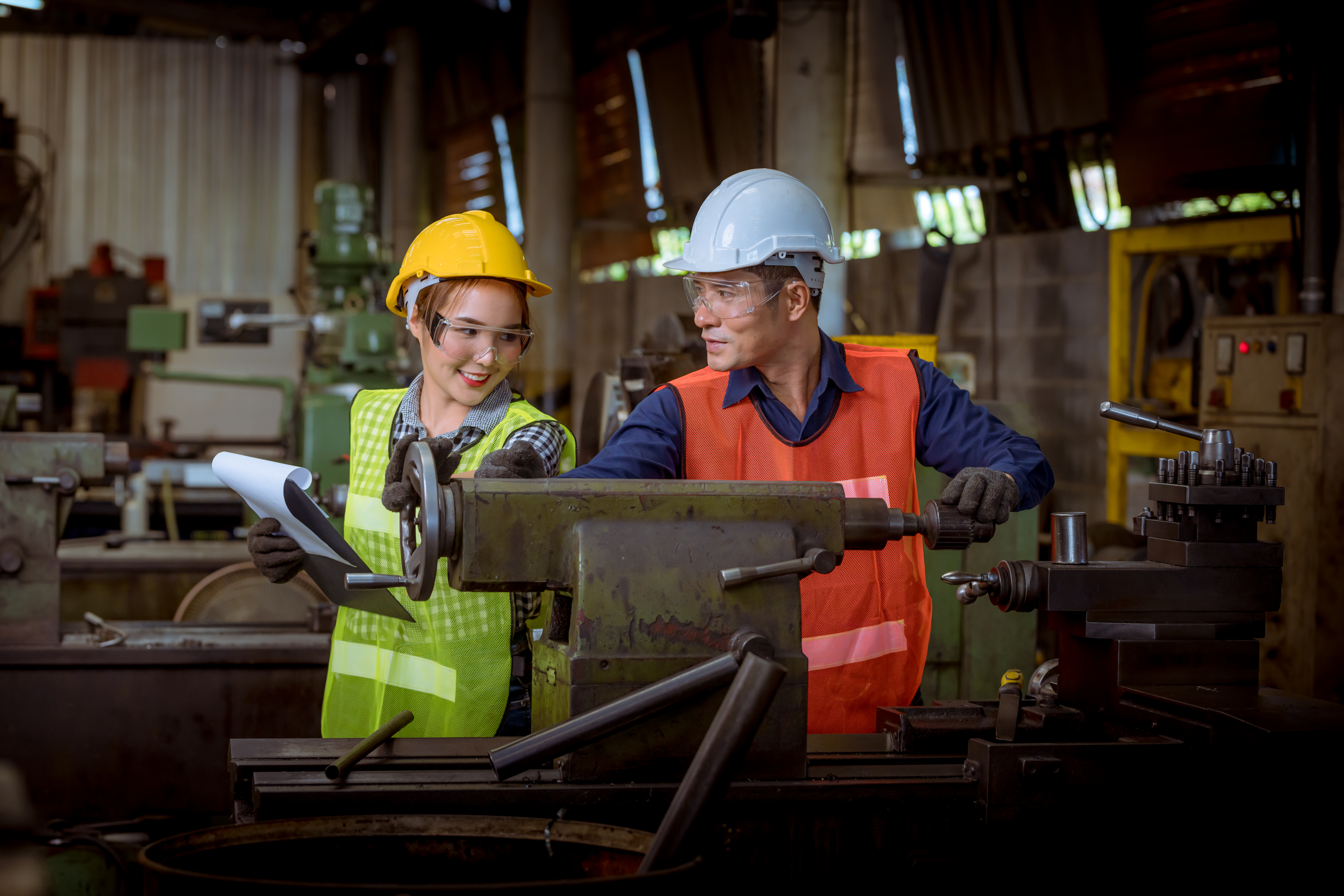
Top Measures to Control Workplace Hazards
Organizations are focusing on building a safer and healthier workplace for their employees. But, it has become a daunting task. Occupational hazards have the potential to result in fatalities, severe illnesses, and injuries. Employers are tasked with taking action to limit these risks and establish a zero-harm working environment.
In this article, we have listed some of the best controls for workplace hazards.
Let’s get started!
5 Effective Measures to Control Workplace Hazards
Perform Risk Assessments
Routine risk assessment is one of the most critical steps in identifying workplace hazards. It includes locating potential risks and assessing the severity of those risks. To acquire their opinions and insights, workers must involve employees in risk assessment. The risk assessment results should be used to create appropriate controls for the hazards found.
Establish Safety Policies
Controlling workplace hazards includes developing and implementing safety rules and procedures. All staff should be informed about the policies and procedures. These policies should also be updated often. All facets of workplace safety, such as first aid, handling hazardous materials, and personal protection equipment, should be implemented to create a zero-harm environment.
Leverage Personal Protective Equipment
The use of personal protective equipment (PPE) is crucial for reducing occupational hazards. It consists of tools like gloves, goggles, hearing protection, and breathing protection. Employees must have access to the proper PPE, and employers must guarantee it is used properly.
Effective Training For Employees
Businesses are required to give their staff the necessary training on workplace safety procedures. All elements of workplace safety, such as PPE, danger identification, and emergency procedures, should be covered in training. It should be customized to meet every worker's requirements while considering their duties at work.
Periodic Monitoring
To ensure safety rules and procedures are successful, employers must periodically monitor and assess safety performance. It includes compiling information on safety-related accidents, performing safety audits, and reviewing safety guidelines. The results should be applied to control occupational hazards by making the required adjustments.
Final Thoughts
On the whole, managing workplace risks is crucial to provide workers with a secure working environment. Businesses are taking necessary steps to recognize and manage workplace hazards. These measures consist of regular risk assessments, the application of safety rules and procedures, sufficient training, the use of personal protective equipment, enticing employee participation, and regular monitoring and evaluation of safety performance. Employers may foster a culture of safety where workers are aware of the risks and responsible for their safety by putting these steps in place.
READ MORE ❯
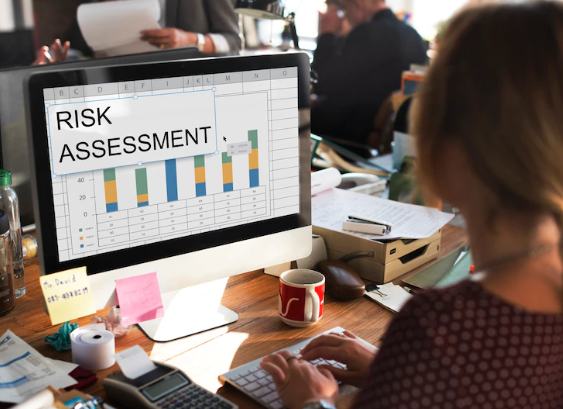
Top 9 Operational Risks That Organizations Should Consider
Many organizations are striving hard to mitigate operational risks across their workplace. Operational risk is the possibility of harm or loss to a company's operations, processes, or assets as a result of internal factors, such as insufficient or ineffective internal processes, systems, or human errors, as well as external occurrences, like natural disasters, cyberattacks, or regulatory changes. Here, in this article, let's check out some instances of operational risks that businesses may experience:
Top 9 Operational Risks
Human Error
- One of the top operational risks is human errors. It includes employees' mistakes that can result in regulatory penalties, financial losses, or reputational damage.
Cybersecurity Threats
- Due to the growing competitive digital world, one of the errors that organizations need to consider is cyber security threats. Mostly cyber attacks, data breaches, and other online security risks occur. These threats can expose sensitive data and harm reputation, resulting in financial losses.
Vendor and Third-party Risk
- Vendor and third-party risks comprise risks raised by suppliers and vendors. It also includes risks from other third-party relationships, such as financial instability, data breaches, and reputational harm.
Technology Failure
- Technology failure can harm your productivity in no time. Software errors, system breakdowns, or hardware malfunctions can affect business operations. These failures will lead to lost productivity or revenue.
Business Interruption
- Unforeseen events, such as power outages, natural disasters, or public health emergencies, can impact operations. At times, various crises might interrupt the business and affect its performance. These instances will result in revenue loss.
Supply Chain Disruption
- Natural disasters, political unrest, or other external causes can cause supply chain disruptions, which can cause production delays and financial losses.
Regulatory Compliance
- As an organization, it is crucial to follow legal requirements. Fines, legal penalties, and social harm may result from breaking laws and rules. Organizations must prioritize regulatory compliance to ensure their company's long-term success because it is crucial to managing operational risk.
Fraud
- Financial loss and reputational harm can come from internal and external fraud, such as embezzlement and phishing scams.
Environmental Risks
- Events related to the environment, such as pollution or natural catastrophes, can affect business operations and cause financial damage.
Final Thoughts
Organizations should have a complete risk management framework for efficiently identifying, evaluating, and managing operational risks. Organizations can reduce the possibility of potential losses and guarantee business continuity by proactively addressing these risks. We hope you got to know some of the operational risks. Use the information above to increase your company's return on investment.
READ MORE ❯
Permit To Work For Construction Industries
Compared to all other fields, construction industries strive hard to build a safer workplace for their employees. Commitment to safety has become a daunting task for construction sectors. Employees are frequently forced to perform jobs that could endanger them if proper induction and safety procedures haven't been addressed. In the construction industry, workplaces are often high-risk environments.
The significance of safety in the construction sector cannot be overstated. A Permit to Work (PTW) system is essential to ensure that work is done safely and controlled.
A PTW is a written system used to regulate specific kinds of labor that may be hazardous. It promotes the security of personnel, machinery, and the environment. This formal document guarantees that all necessary safety measures have been taken before work starts and that all risks have been identified.
How Do Permits Work For the Construction Industry?
Before beginning construction, check your local laws because building codes are subject to change. Organizations must acquire a building permit for most construction projects and many home improvement jobs. Trade workers like house painters and carpet installers are unlikely to require building permits, even though significant residential or business construction projects probably do.
Obtaining a building permit typically involves the following steps, though the procedure varies by location:
- Filling out an application.
- Creating and filing a building blueprint and construction site plan.
- Scheduling a meeting to obtain approval for a building design.
- Perform periodic inspections during construction.
- Final approval from local building officials
Why Is A PTW System Essential?
The PTW system has become a crucial part of any company's control of the work system. A PTW system is intended to manage and reduce the daily risks employees encounter. These dangers include welding sparks, confined space labor, loose valve connections, and more. Although it is impossible to eliminate these risks in these situations, there are methods to manage them and protect workers.
PTW Process
The following steps are usually included in the PTW process:
Analyzing The Activity
Identifying the activity entails determining the kind of work to do, where it will be done, and any possible hazards.
Risk Assessment
A risk assessment is performed to identify potential risks and choose the appropriate safety precautions and measures.
Permit Issuance
A PTW is issued after the risks have been evaluated, and the required safety measures have been determined, approving the activity.
Review And Monitoring
The activity is viewed to ensure all necessary safety measures are taken, and risks are effectively managed. It is periodically reviewed to make sure the PTW system is still valuable and successful.
Using a PTW system in the construction sector can help lower the likelihood of accidents and guarantee employee safety. Additionally, it shows a dedication to safety and can improve the company's standing with customers, staff, and the general public.
Final Thoughts
In conclusion, any safety program in the building industry must include a PTW system. By putting this approach in place, companies may show their dedication to safety, safeguard their employees, and reduce the likelihood of accidents and injuries.
READ MORE ❯

14 Types of Permit to Work That You Need To Know
Permit to work plays a pivotal role in ensuring the safety and well-being of workers across various industries. It is an indispensable tool to mitigate potential risks and hazards associated with specific tasks. Without these permits, accidents and incidents occur. It puts employees' lives at stake and exposes organizations to legal and financial repercussions.
This blog explores the significance of the permit to work, their types, and their critical considerations.
Definition and Purpose of Permit to Work
What is a Permit to Work?
A permit to work is a formal document that authorizes and details the specific conditions under which a high-risk work activity can be performed. It is a risk assessment tool, and a record of precautions to mitigate potential hazards.
Why is a Permit to Work Necessary?
Permit to work is necessary because of the following reasons:
Mitigate Risks: By identifying potential hazards and providing safety measures, permits help reduce the risk of accidents and injuries.
Ensure Accountability: They specify roles and responsibilities for individuals involved in the activity, making it clear who is responsible for safety.
Enhance Communication: Permits provide a standardized method for communicating safety requirements to everyone involved.
Legal Requirements and Regulations
For specific high-risk activities, many countries mandate the use of permits. Failing to comply with legal requirements and regulations can result in legal consequences and penalties. Understanding and adhering to local and industry-specific regulations is crucial.
Considerations Before Obtaining Work Permits
Identifying Potential Hazards and Risks
Before obtaining a permit to work conducting a comprehensive hazard analysis is essential. Identifying potential risks associated with a specific task is the first step in ensuring a safe work environment. This analysis helps in determining the appropriate permit required.
Assessing the Need for Permit to Work
Not all tasks require a work permit. Assessing whether a task involves significant risks and warrants a permit is crucial. Overusing permits can lead to unnecessary paperwork while failing to use them when needed can compromise safety.
Roles and Responsibilities of Individuals Involved
Clearly defining the roles and responsibilities of everyone involved in the task is vital. It ensures that each person understands their responsibilities in maintaining safety and compliance during the work process.
Types of Permit to Work
A work permit is classified depending on the nature of the job and the hazard involved. Here, let's see some of the work permits.
1. General Work Permit
2. Lifting Permit to Work
3. Confined Space Permit
4. Excavation Permit to Work
5. Hot Work Permit and Cold Work Permit
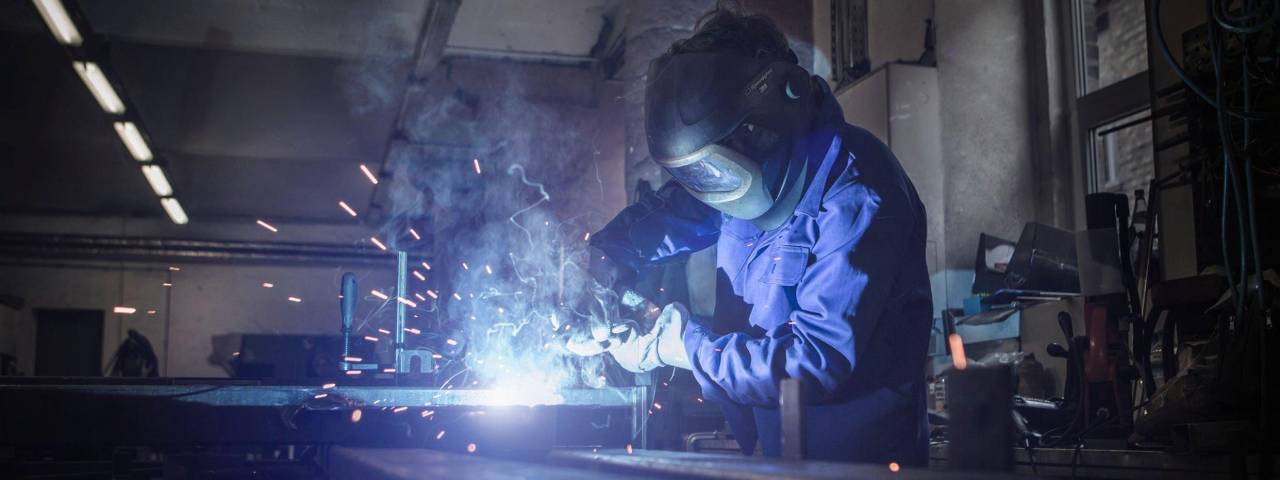
6. Controlled Room Permit
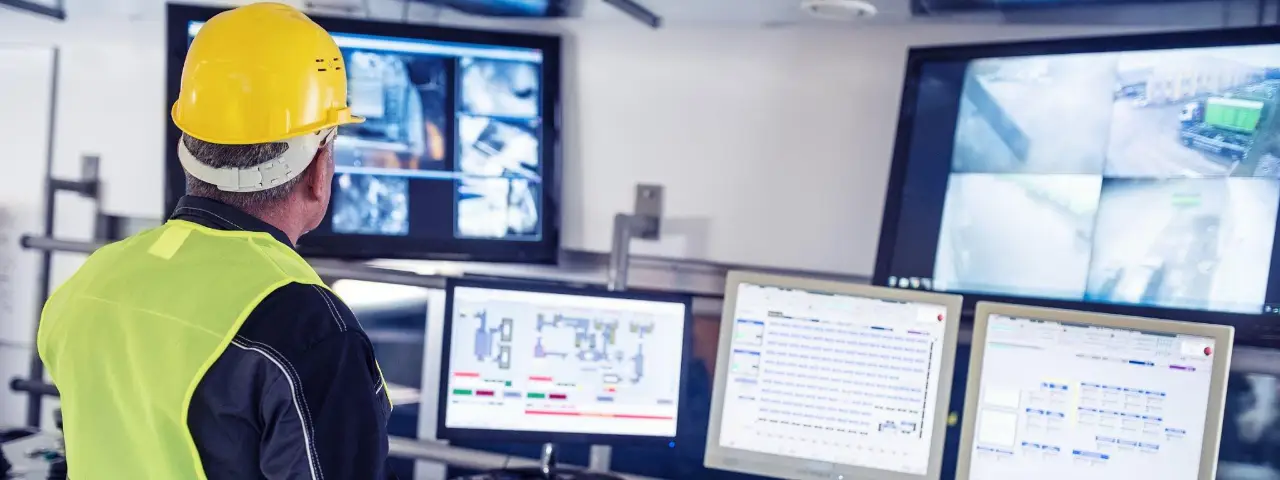
7. PTW MEWP (Mobile Elevated Working Platform)
8. PTW EEW (Energized Electrical Work)
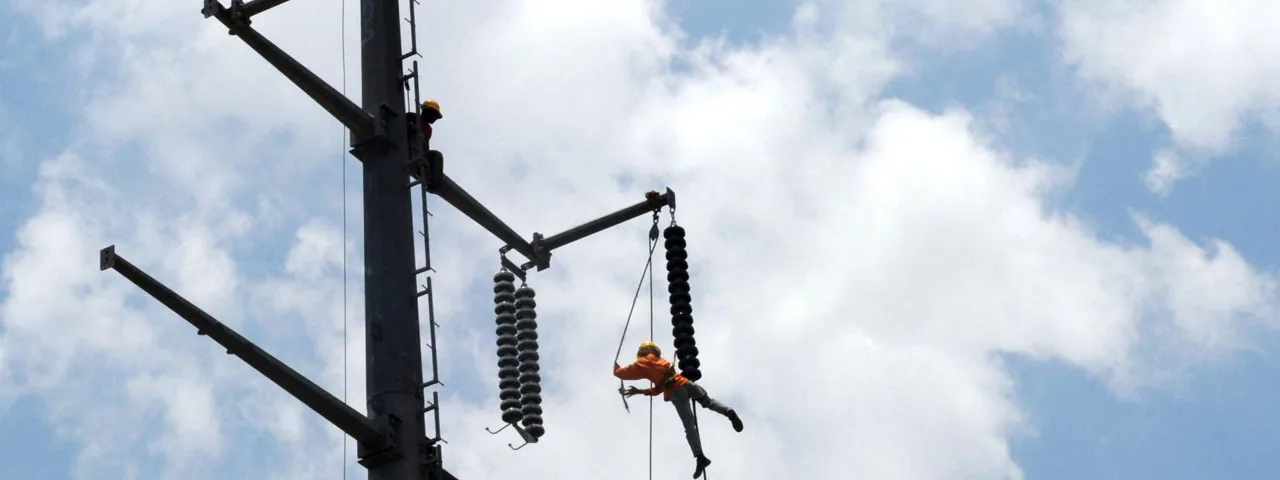
9. Road Blocking Work Permit
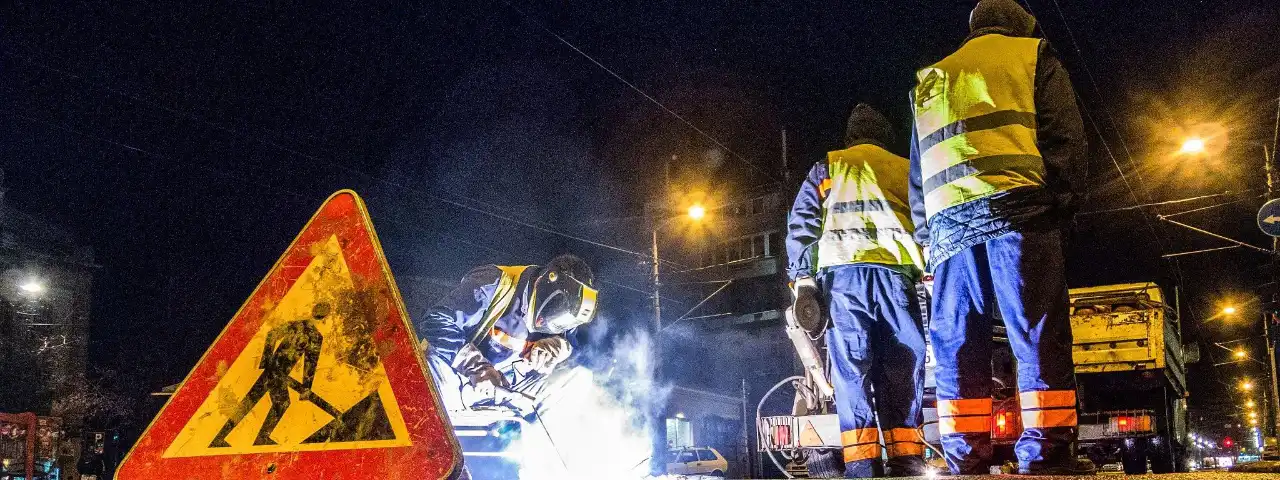
10. Demolition Work Permit
11. Chemical Entry Permit
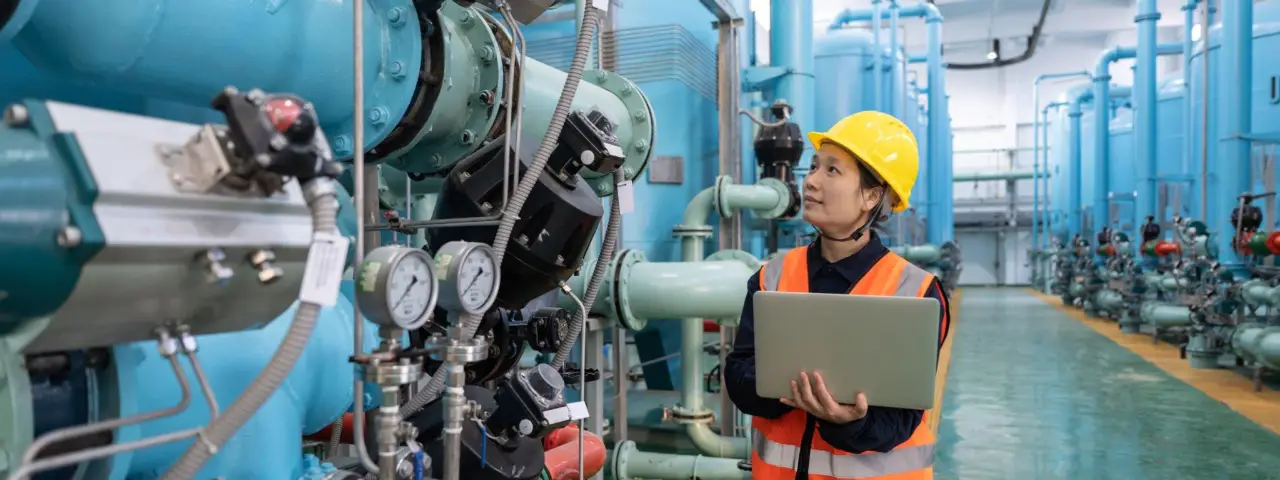
12. Night Work Permit
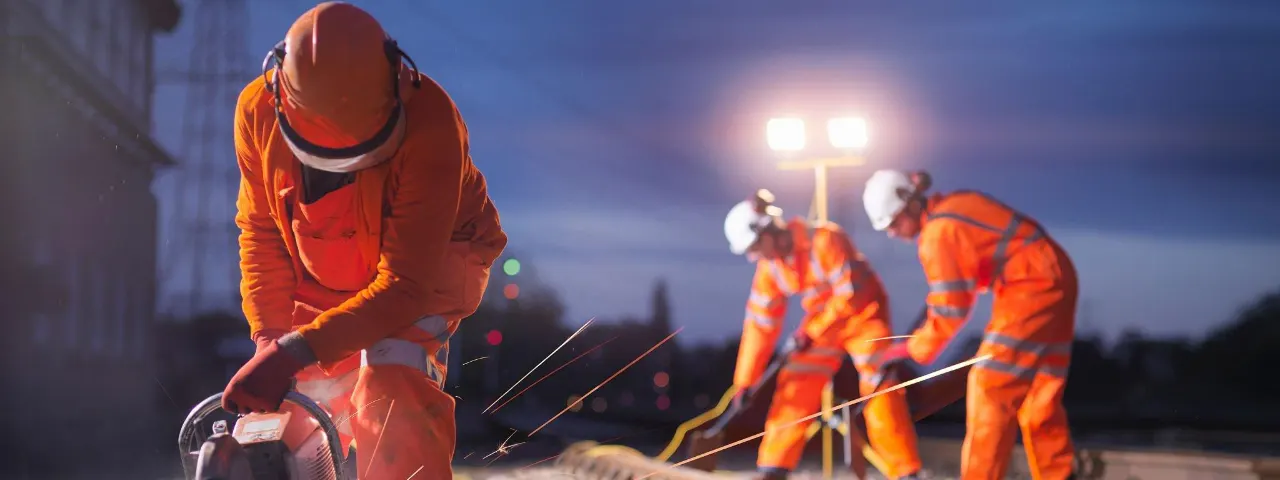
13. Work At Height Permit

14. LOTO Permit (Lockout-Tagout)
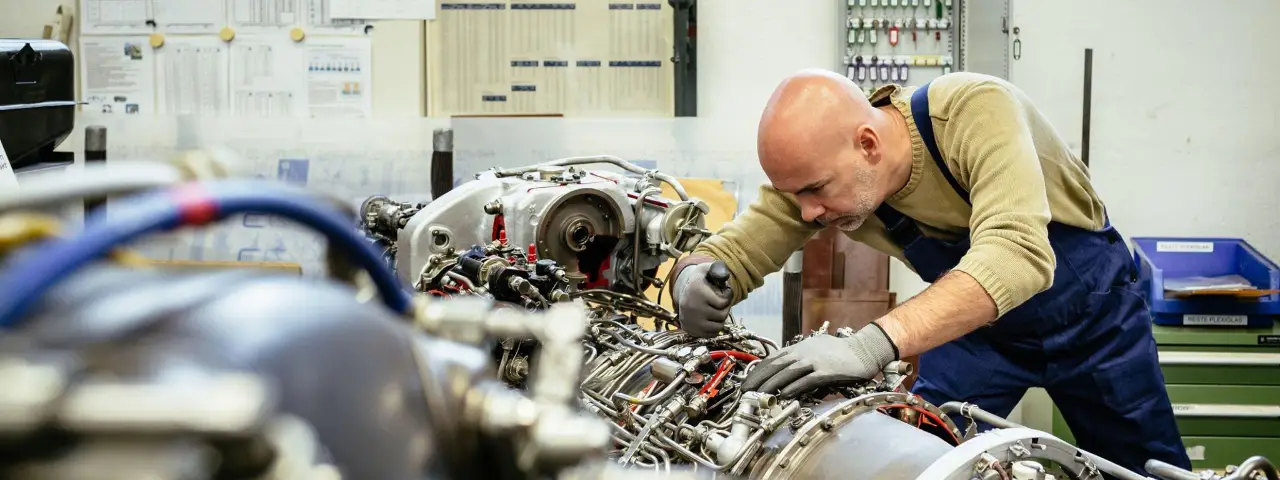
Conclusion
READ MORE ❯

5 Top Practices For Businesses To Maintain Effective Chemical Management
Chemical management has become crucial for businesses that monitor, transport and store hazardous elements. Compared to other materials, chemicals require close monitoring to lower the possibility of safety hazards connected to compatibility or accidental leakage. Hence, businesses need to implement and design systems that help them build a safer and risk-free environment.
In this article, we have listed a few practices that will help businesses to maintain effective chemical management. These suggestions help see future upgrades and think of potential approaches to scheduling resource utilization, supplier management, and safety routines.
Come, let's check the top practices!
1. Mitigate Hazardous Waste
If businesses need to guarantee cost savings in the garbage disposal, they must first mitigate trash. Waste disposal is one of the most expensive costs associated with chemical management. According to surveys, the costs of waste disposal are more than purchasing chemicals. A proper understanding of the costs associated with hazardous waste disposal is required to identify cost-saving options and ensure potential chemical management in the organization.
2. Build Flawless Relationship With Vendors
Managing vendors can be difficult when working with chemicals because each substance may have specific purity needs. Once acceptable vendors are found, establishing a closed relationship with your most essential suppliers is crucial. In addition to facilitating price negotiations and forecasting demand, it can streamline the procurement process. You can handle orders more rapidly using a supplier with advanced technologies for their major clients.
3. Clearly Define The Procedures For Storing Chemicals
Most chemical containers in a facility must move to various workplaces. Educating staff members on the proper ways to store chemicals is crucial to prevent any materials from being left in a dangerous position. It would help if you informed your employees about keeping chemical storage containers close to passageways, in the sun, or in unsuitable storage cabinets. To remind individuals where to put hazardous containers during and after use, reinforce your storage practices with prominent signage.
4. Update Safety Data Sheets
Safety data sheets (SDS) are essential for managing chemicals and should be updated regularly. The demand for these reference materials increases during chemical leaks, exposures, or other safety-related situations, and the EHS team should know accurate information on chemical handling. Using a centralized platform, you can designate an owner for each document and set up systematic reviews.
5. Implement EHS Software For Chemical Management
Chemical information and EHS data are typically dispersed over multiple locations at organizations. The data you require for compliance and reporting can be challenging to find. The data include chemical and regulatory data, hazard data, environmental data, SDS, training records, and permits. Many businesses are now employing advanced technology to mitigate these issues. By implementing EHS software for chemical management, companies streamline their workflows and store the data in a centralized platform. It's a productive technique for handling chemicals and dangerous materials.
Final Thoughts
Chemical management is a complex process involving numerous corporate divisions' involvement and assistance. An effective chemical management strategy is crucial for the success of an organization. Many businesses use EHS software for chemical management to save costs, reduce hazards, and maintain compliance. We hope you got to know how to sustain potential chemical management. Make use of the above insights to improve your chemical management.
READ MORE ❯
.png)
Tips To Find The Right EHS Software For Your Organization
Why do businesses need EHS software?
-
Compliance Management: Ensure adherence to regulatory requirements and standards.
-
Risk Mitigation: Identifying, assessing, and minimizing workplace safety and environmental risks.
-
Incident Reporting and Management: Tracking, documenting, and analyzing incidents to enhance safety measures and prevent future occurrences.
-
Training and Education: Providing resources and tools for employee training on safety protocols and best practices.
-
Data Analysis and Reporting: Gathering and analyzing data to spot trends, make informed decisions, and enhance safety performance.
How to Choose the Right EHS Software?
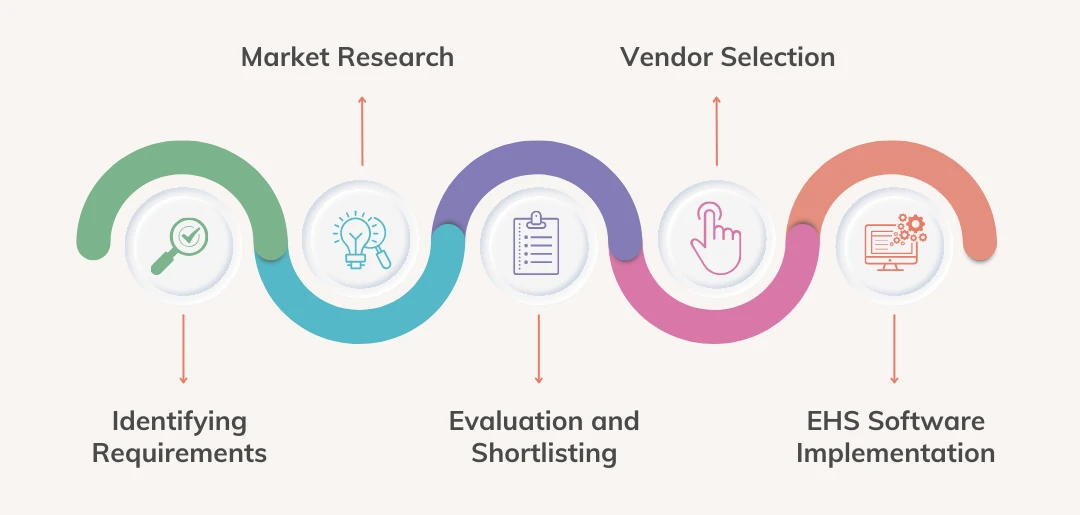
1. Analyze Business Needs
2. Evaluate Your EHS Cost Savings
3. Scalability
4. Seamless User Experience
5. Customizable Solutions
In Summary
READ MORE ❯

The Benefits Of Using Workplace Health And Safety Software For Incident Reporting And Management
Every firm focuses on providing a safer and healthier environment for its employees. Organizations must ensure that their employers are secure and safe from workplace dangers. Due to the increasing safety need for employers, incident management and reporting are essential elements of a business's overall health and safety program. Organizations can boost productivity, streamline incident reporting and ensure all legal requirements by implementing workplace health and safety software.
Using the EHS software, you can maximize reporting efficiency and accuracy, which is one of the key advantages. This software gives employees a straightforward, user-friendly platform to report incidents, which can be done promptly and effectively.
Benefits of Workplace Health And Safety Software
EHS software is a technology solution used to manage and monitor workplace health and safety, environmental compliance, and sustainability. In this article, let's see some of the perks of leveraging workplace health and safety software for incident reporting and management.
Let's get started!
Get Up-To-Date Information
Organizations can acquire accurate and up-to-date information about incidents by automating the reporting process. It enables them to act immediately to stop future occurrences of the same problems. It reduces the need for labour-intensive, error-prone manual reporting systems.
Improved Incident Management And Tracking
Another advantage of employing workplace health and safety software is improved incident management and tracking. Organizations can use this software to store all pertinent information regarding occurrences in a single, easily accessible area. It includes specifics like the incident's date and time, location, nature, and other pertinent information. They can easily and rapidly track the status of each incident by having all this information in one location, ensuring that all essential steps are taken to address the issue.
Compliance With Legal Standards
One of the highest benefits of adopting workplace health and safety software is better compliance with legal standards. Organizations must adhere to severe health and safety laws in many nations, and failing can result in penalties and fines. Workplace health and safety software give organizations a thorough record of all occurrences and the steps taken to rectify them, assisting them in making sure they comply with all applicable legislation. This information can be quickly recovered and utilized to show compliance with regulatory organizations.
Gain Real-Time Insights
Another significant advantage of employing workplace health and safety software is improved stakeholder coordination and communication. This program makes real-time information sharing and collaboration in the incident resolution process possible by ensuring everyone is on the same page and working toward the same objectives. Stakeholders, including employees, supervisors, safety personnel, and even outside contractors, may be included in this. Organizations may handle crises more quickly and effectively, minimizing downtime and boosting overall productivity through enhancing communication and collaboration.
Maximize Safety Culture
Organizations can advance their safety culture and lower incident rates by deploying workplace health and safety software. This program gives staff members a convenient way to report events, encouraging them to be proactive in spotting and alerting possible threats. It, in turn, results in a more concerned safety workforce, which can drastically lower the number of workplace mishaps.
Spot Patterns And Areas Of Development
Finally, workplace health and safety software enables businesses to spot patterns and potential areas for development. Organizations can pinpoint areas where their safety procedures and practices need to be improved by examining data and information regarding occurrences. It can involve determining the areas that need training and instruction, implementing new processes and procedures, or even upgrading tools and infrastructure to ensure that they adhere to the most recent safety regulations.
Final Thoughts
In conclusion, there are several advantages to employing workplace health and safety software for incident management. Organizations of all sizes and types can gain a lot from this technology, from increased efficiency and accuracy in reporting incidents to better tracking and managing incidents and related data, better compliance with regulatory requirements, amplified communication and collaboration among stakeholders, advanced safety culture, and decreased incident rates, to the ability to spot trends and areas for development and cost savings in terms of time and resources.
READ MORE ❯
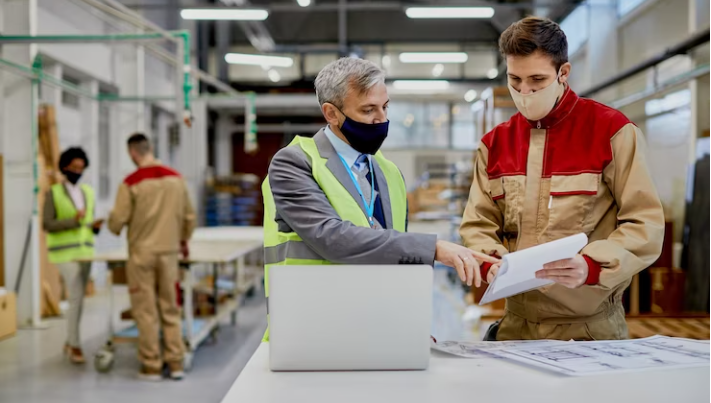
EHS Software Vs. Manual Systems: Which One Is Best For Your Organization?
Are you thinking of choosing between EHS software and manual systems? One must consider the specific requirements of their business when deciding between an environmental health and safety software system and a Manual System for managing EHS operations and paperwork. Systems handled manually frequently lack the sophisticated features and automated capabilities offered by environmental health software systems. However, while comparing these two solutions, it is important to consider the total cost, which includes the purchase price, customization expenses, maintenance costs, training costs, and the total cost of ownership for the entire system. To choose the finest alternative that fulfills their unique organizational goals while delivering the most returns on investment, organizations must ultimately compare the advantages of each option to the financial cost.
EHS Software Vs. Manual Systems
Are you trying to build a safer environment for your employees? Then it would be best if you tried out the EHS software. With this software, you can increase employee performance productivity, mitigate risks and minimize future incidents.
Nowadays, many organizations started using EHS management software to advance a safer workplace and also improve employee performance with ease. If you are still using manual systems for your company, you are missing out on a chance to amplify your productivity. Let's see some of the drawbacks of manual systems for the health and safety industry.
Drawbacks Of Manual Management System
- In manual management, the paperwork system, which includes drafting and tracking incident reports, safety observations, work permits, tools and equipment inspection checklists, etc., is challenging for the HSE team to follow.
- It is challenging for the team to monitor the effectiveness of the EHS management system within the company.
- Data and files are prone to be lost or missing from building sites, and handling and storing them there is challenging.
- The process of manually managing a system is very difficult and time-consuming. It isn't easy to handle each document and preserve them safely at the work site.
- It might be difficult for new hires, department workers, and teams to follow and understand the organization's EHS system and current safety policy.
- In the EHS sector, a paper document is less secure than an electronic system.
- Paper document systems present challenges when an organization conducts internal and external audits.
- It requires physical effort to handle and carry the documents. However, if you use an IT solution, you can travel with years' worth of data, which we can examine for ongoing improvement.
- Data analysis and predictive analytics are tough with paper document systems. In the EHS sector, predictive analytics have already been discussed.
Why Should You Use EHS Management software When Compared To Manual System?
As listed above, there are various drawbacks to a manual management system. Now, let's see why organizations must try the EHS software.
Centralized System
The complete database of the organization can be maintained in a centralized platform. With the EHS management software, you can maintain a detailed report of risks, incidents, and other details in your organization.
Automate Reporting
In terms of reporting, outdated systems and labor-intensive manual procedures are insufficient. On the other hand, when preparing complex reports, EHS software is significantly faster, more accurate, and more efficient. Users can quickly record data in real time by streamlining reporting. They can also precisely record observations, events, and other EHS actions.
Completely Safe
The data is completely safe and secure. Workplace safety software is end-to-end encrypted; hence, it is completely secure for storing organizational-related data. In the manual management system, there are higher chances of you losing your data. But, when it comes to EHS software, your data is highly safe and secured.
Advanced Health And Safety
Companies can be significantly more proactive regarding health and safety thanks to the ability to record real-time data and focus on important issues. Users of EHS software can spot concerns fast, come to informed conclusions, and provide solutions to problems immediately. Users can also identify repeating patterns to avoid near-misses or future problems. It enables businesses to take preventative actions to avert accidents at work.
Meet Compliance
When done using spreadsheets and paper files, ensuring compliance and handling audits may be time- and money-consuming. On the other hand, workplace health and safety software enables organizations to stay current with industry rules and guarantee adherence to EHS standards.
Additionally, automating audit management lowers the likelihood of unplanned regulatory fines as well as redundant data, inaccurate information, and inaccurate records.
Final Thoughts
EHS software can mitigate risks, minimize incidents, improve productivity, and build a safer workplace. With effective workplace health and safety software, you can create a zero-harm environment for your employees, which in turn helps you increase your productivity. At the same time, the manual management system requires more manpower and time. Thus, use the right EHS software and sky-high your business ROI in no time.
READ MORE ❯

Top 5 Key Strategies of EHS Software To Improve Workplace Safety and Compliance
Organizations strive to provide a safer workspace for their employees in the competitive digital world. Now, that's where EHS software comes in! Using EHS software, you can minimize workplace risks and improve your safety. EHS software can help organizations advance their safety and lower compliance-related risks. With the right software, you can reduce risks, streamline workflows, and sky-high the productivity of your business in no time.
Though the EHS software has various benefits, yet only a few are using it in an effective way. Some organizations started implementing the software to enhance overall safety. Are you still hesitant to use EHS software for your business? In this article, we have listed a few benefits of EHS software.
Let's begin!
1. Track Incidents
You may easily track incidents with good EHS software. No matter how secure your operations are, workplace accidents can happen in every firm. With an integrated system, you can keep track of every issue at every stage, even if you don't personally manage the incident specifics. This aids you in making sure you adhere to corporate policy, OSHA compliance, and other industry standards. Additionally, you can always be aware of the status of each occurrence. You can reduce future risks using data from previous incidents.
2. Streamline Workflows
In unstable and dangerous circumstances, it is vital to centralise EHS procedures. EHS teams can unify their entire business to follow a disciplined approach by streamlining operations. Instead of having to manage workflow across various sources, EHS software allow you to concentrate tasks and sources. It allow for the centralization and monitoring of data, providing health and safety experts with the knowledge they need to optimise their processes. It also makes it simple for each team member to log their duties and incident data against a predetermined criterion. Additionally, for quicker assessment, it enables you to assign compliance activities and track every aspect of its environmental effects on a single platform.
3. Advanced Productivity
Management team's productivity can be increased by 50% with the aid of environmental health & safety software. They can rapidly verify the documentation and automate workflows thanks to it. One can quickly monitor the status of audits and other essential papers.
Reminders can be configured to be sent automatically, eliminating the requirement for the management staff to carry out this and other administrative chores. The management team can rapidly determine from EHS data which areas need their attention in order to cut expenses and boost operational effectiveness.
4. Minimize Costs
Nobody wants to see a coworker suffer an injury. Unfortunately, accidents often happen after a near-miss or series of near-misses. Accidents do happen. EHS software can help businesses identify issues and swiftly address risky behaviours, equipment malfunctions, and other issues. By removing these risks, companies can lower their incident and accident rates. What will happen in the end? You'll be able to avoid expensive OSHA fines while saving time, gaining a competitive edge, and ensuring the safety of your personnel on the job.
5. Boosts Employee's Morality
When workers are confident that a company has a solid safety management system, they feel safer. Since they are aware of the most efficient ways to manage risks and report dangers, their confidence increases productivity. An online safety management system resembles a wise digital guardian who is always on the lookout for safety concerns and seeking out effective solutions. A safety system that generates data and sends automated notifications simplifies administration. Also, it shows that the business is committed to maintaining a safe workplace.
Final Thoughts
As a brand, it is crucial to build a safer work environment. Using the EHS software, you can create a safer workplace for your employees. No matter how hard an organization works, there can never be complete workplace compliance and safety without the workers' active engagement. Because of this, it is essential that they have access to the company's EHS solution so they can determine for themselves what has to be done and what will happen if they don't. The cost of EHS software is also reasonable. Therefore, investing in one would not be too tough for firms. So, why wait? Try out an EHS software for your organization and reap its incredible benefits.
READ MORE ❯
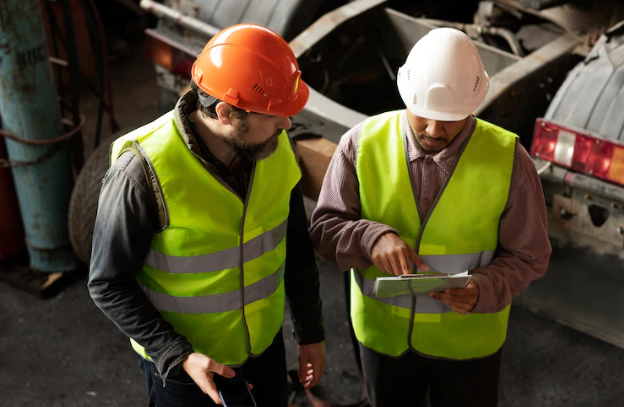
Top 5 Challenges In Manual Incident Management
Effective incident management is of utmost importance. Incident management involves a structured approach to addressing and resolving unforeseen events. These incidents could be anything from IT outages and security breaches to operational disruptions or safety concerns.
According to a survey, 77% of firms still need an incident management plan to use consistently throughout their enterprises despite its apparent advantages. The ultimate objective of incident management is to refine procedures based on prior incidents and introduce successful strategies. Organizations can use that to preserve service quality, boost productivity, and guarantee a better user experience.
This blog post will delve into the top five challenges encountered in manual incident management.
What is Manual Incident Management?
Manual incident management refers to the traditional, hands-on approach of dealing with incidents without the use of automated tools or systems. It relies on human intervention for detection, response, and resolution. While technology plays a vital role in modern incident management, manual incident management remains crucial in situations that require immediate and context-driven responses.
In manual incident management, common practices include incident detection, manual notification, manual data collection, and the use of spreadsheets or rudimentary tracking systems to log incidents. Teams typically communicate through emails or phone calls, and incident prioritization is often subjective.
Importance of Effective Incident Management
Effective incident management is essential for minimizing downtime, ensuring security, and maintaining the trust of customers and stakeholders. It helps organizations identify problems instantly and resolve them efficiently, ultimately improving their overall safety and productivity.
Top 5 Challenges in Manual Incident Management
1. Lack of Real-time Incident Visibility
Real-time visibility into incidents is limited, making it challenging to track the current status and location of incidents and resources. Without real-time visibility, response times are delayed, and incidents may take longer to resolve, resulting in increased downtime and potential customer dissatisfaction.
2. Misprioritization of Incidents
Manual incident management lacks prioritization and a clear framework. It can lead to confusion about which incidents to address first. Misprioritization can result in critical issues being overlooked while less important ones receive excessive attention, causing inefficiency and increased risks.
3. Inefficient Communication and Collaboration
Manual communication methods like emails and phone calls are error-prone and may lead to miscommunication. Inefficient communication can slow down the incident resolution, causing misunderstandings and potentially jeopardizing the overall response effort.
4. Limited Automation Capabilities
Manual incident management needs more automation for routine tasks, which can lead to repetitive, time-consuming processes. Manual handling of incidents consumes more time and resources, reducing overall efficiency and preventing teams from focusing on higher-value tasks.
5. Lack of Comprehensive Incident Data Analysis
Manual systems often need the ability to collect, analyze, and visualize incident data comprehensively. With proper data analysis, organizations can gain insights from past incidents, making it easier to identify patterns, trends, and areas for improvement.
Best Practices
Automated incident management tools utilize technology to streamline incident detection, notification, and resolution, enhancing overall efficiency and effectiveness.
Benefits of Using Automation in Incident Management
The benefits of automated incident management include real-time visibility, accurate incident prioritization, efficient communication, and collaboration, reduced manual work, and in-depth data analysis. Here are some of the key benefits of using automation in incident management:
Faster Incident Resolution: Automation allows for rapid detection and response to incidents, reducing the time it takes to identify and address issues.
Improved Accuracy: The systems minimize the risk of human error, ensuring that incident management processes are consistently executed following predefined rules and best practices.
Reduced Downtime: Automation aids in resolving incidents more rapidly, resulting in minimal impact on operations.
Cost Efficiency: By reducing the need for manual intervention, automation can lower operational costs, as it requires fewer human resources to manage incidents.
Data Analysis and Reporting: Automation can collect and analyze incident data, providing valuable insights that can be used for continuous improvement and incident prevention.
Compliance: Many industries have regulatory requirements for incident management and reporting. Automation can help ensure that incidents are managed in compliance with these regulations.
Streamlined Workflows: Automation can streamline incident management workflows by automatically assigning tasks, updating incident statuses, and tracking resolution progress.
Proactive Problem Resolution: Automation can be used to detect and respond to incidents before they escalate, reducing the potential impact and preventing the recurrence of similar incidents in the future.
Enhanced Customer Satisfaction: Faster incident resolution and reduced downtime can lead to improved customer satisfaction and loyalty.
Resource Optimization: Automation can allocate resources more efficiently, ensuring that the right people with the right skills are involved in resolving specific incidents.
Integration with Other Systems: Automated incident management systems can easily integrate with other IT and business systems, facilitating information sharing and reducing manual data entry.
Real-time Monitoring: Automation can continuously monitor an organization's systems and infrastructure, allowing for the immediate detection of anomalies or incidents.
Conclusion
In conclusion, manual incident management poses significant challenges for organizations. Limited visibility, inefficient communication, human error, scalability issues, and the absence of data insights all hinder effective incident response. To address these challenges
READ MORE ❯

How Can Effective Workflow Benefit Your Audit Management Process?
Audit management has become essential to ensuring compliance, minimizing risk, and maintaining organizational integrity. Traditional audit methods are often time-consuming and error-prone. Here is where the concept of an effective workflow comes into play. This blog post explores how effective workflow can enhance audit management.
Understanding Audit Management
What is Audit Management?
The audit management process includes planning, executing, documenting, and reporting on organizational audits. Audits may involve financial records, internal operations, compliance with regulations, or other aspects of the company.
Challenges in Traditional Audit Management
Traditionally, audit management involves manual tasks, spreadsheets, and extensive paperwork. In addition to being resource-intensive and error-prone, this approach isn't as adaptable as other approaches to compliance.
Stages Of Audit Process
The four steps of an audit program, divided into stages, make up the internal audit process. Every stage needs communication between the auditor, top management, the technology department, and other pertinent stakeholders. The stages of the audit process include:
- Planning
- Document review
- Fieldwork
- Examine
- Reporting
- Monitoring issues
1. Planning
Before developing an audit strategy, the internal auditor must identify the scope and objectives before developing an audit strategy. The preparation step of audit planning can involve acquiring paperwork or setting up an initial meeting with your audit team.
2. Document Review
After planning, the internal auditor will review established controls, policies, and procedures. Document review's primary focus is verifying that your written plans comply with rules and regulations. Role-based access privileges are required if OSHA compliance is required as a security measure. It is only compliant if you have included these in the written program.
3. Fieldwork
Your organization must adhere to your written policies to continue with the access rights illustration. You must adequately modify the access rights if an employee switches responsibilities within your company.
To ensure proper compliance with standards, rules, and organizational documentation, fieldwork also includes interacting with staff and participating in day-to-day business activities.
4. Examine
Before completing a report, your auditor frequently needs to find documentation or has more inquiries. The auditor must examine the report before finalizing it. After comparing an employee's response to internal policies, if the auditor does not understand the report, he may ask for clarification. Before reporting their findings, most auditors will resolve any misunderstandings. Doing so will give them a clear vision of the report before submission.
5. Reporting
Next comes the reporting process! Your auditor will release a draft report after reviewing all the information provided and finishing the testing. The results of the audit are included in the draft report. It will contain their impartial assessment of your program's strengths, a thorough list of faults, and suggestions for a corrective action plan.
The draft report will be sent to you by the internal auditor so that you can study it and give management time to comment on any findings. Before the auditor issues the final report, you could send extra material at this stage to dispute conclusions. Following all this back and forth, the auditor finally generates the report.
6. Monitoring Issues
If your audit report has findings, you must keep track of them. Put the necessary internal controls in place to address the problem, and demonstrate your corrective action with a written response.
For instance, you would need to demonstrate that you had a plan of action to ensure timely and correct evaluations. To ensure that corrective action is still being taken for any flaws discovered in earlier audits, you must also pay close attention to them.
The Role of Workflow in Audit Management
Standardization of Processes
Workflow defines a set of standardized procedures and tasks that auditors must follow during an audit. This standardization promotes consistency and reduces the chances of errors. Moreover, it assists auditors in complying with industry regulations and adopting best practices.
Assignment of Tasks
Audit managers can assign tasks to team members based on their expertise and skills. It ensures that each audit facet is handled by the most qualified individuals, optimizing resource utilization.
Task Monitoring
The workflow tools often include task monitoring features, enabling audit managers to track the progress of audit tasks in real-time. This transparency ensures that audits stay on schedule and allows for timely resolution of potential bottlenecks or delays.
Management of Documentation
Audits generate a substantial volume of documentation and reports. Using these workflow systems, you can organize and manage audit-related data.
Risk Assessment
With an effective workflow tool, you can incorporate risk assessment criteria and assist audit teams in prioritizing their efforts. By addressing high-risk areas first, auditors can offer timely risk mitigation and control enhancement recommendations.
Reporting and Analytics
Auditors can utilize reporting and analytics features to create comprehensive reports summarizing audit findings, recommendations, and key metrics. These reports are crucial for presenting results to management and stakeholders.
Continuous Improvement
Workflow systems enable audit managers to analyze past audits and pinpoint areas for enhancement. Organizations can refine their processes over time by monitoring performance metrics and feedback, resulting in more effective and efficient audits.
Benefits Of Effective Audit Management
Improved Efficiency
By automating manual tasks involved in audit planning, execution, and reporting, audit management software allows auditors to allocate more time and effort to critical responsibilities, significantly enhancing overall efficiency.
Enhanced Accuracy
Automating data entry and calculations reduces the potential for human errors, resulting in more accurate audit findings and reports.
Streamlined Workflow
Many audit management software solutions incorporate workflow management features that simplify task assignment progress tracking and adhere to predefined audit schedules.
Centralized Data Repository
The audit management software provides a centralized location for storing audit-related documents and historical data. You can gain easy access to all information, promoting organization and accessibility.
Real-time Monitoring
Auditors and management can monitor audit progress in real-time, allowing for prompt identification and resolution of any issues or delays.
Compliance Assurance
Audit management software often includes compliance modules designed to help organizations conform to regulatory requirements and industry standards, reducing the risk of non-compliance and associated penalties.
Customization
Organizations can tailor audit management software to align with their specific audit processes and requirements. This flexibility ensures that the software meets the unique needs of the organization.
Reporting and Documentation
Audit software simplifies the process of generating comprehensive audit reports, often providing templates and tools for creating professional, standardized reports that can be easily shared with stakeholders.
Cost Savings
Although there is an initial investment in implementing audit management software, the long-term benefits, including time savings, reduced errors, and improved compliance, can result in significant cost savings for organizations.
Bottom Line
In conclusion, effective workflow is a game-changer for audit management. It improves efficiency, accuracy, and compliance while reducing the burden of manual tasks. As organizations leverage workflow automation, they position themselves for success in an ever-evolving business landscape. Use the above insights to make your audit management process more efficient and effective.
READ MORE ❯
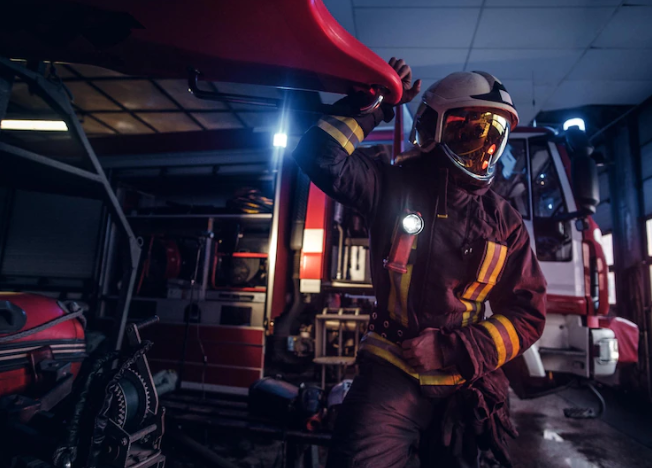
How To Prevent Workplace Accidents?
The National Safety Council (NSC) and the American Society of Safety Professionals (ASSP), the leading safety organizations in the country, have responded to a recent report from the Bureau of Labor Statistics (BLS). The report highlighted a concerning rise in fatal workplace injuries in the United States. Shockingly, the number of fatally injured workers increased from 4,764 in 2020 to 5,190 in 2021, marking an 8.9% surge. Furthermore, the serious injury rate of 3.6 per 100,000 full-time equivalent (FTE) employees is the highest since 2016. A staggering 104 million production days were lost due to work-related injuries, as indicated by a survey.
Not only high-risk sectors are susceptible to workplace accidents. Actually, accidents can happen even when someone sits idle in the office. A workplace accident can be detrimental to a business. Here, in this article, you will learn the effective strategies to prevent workplace accidents by using Workplace Health and Safety Software.
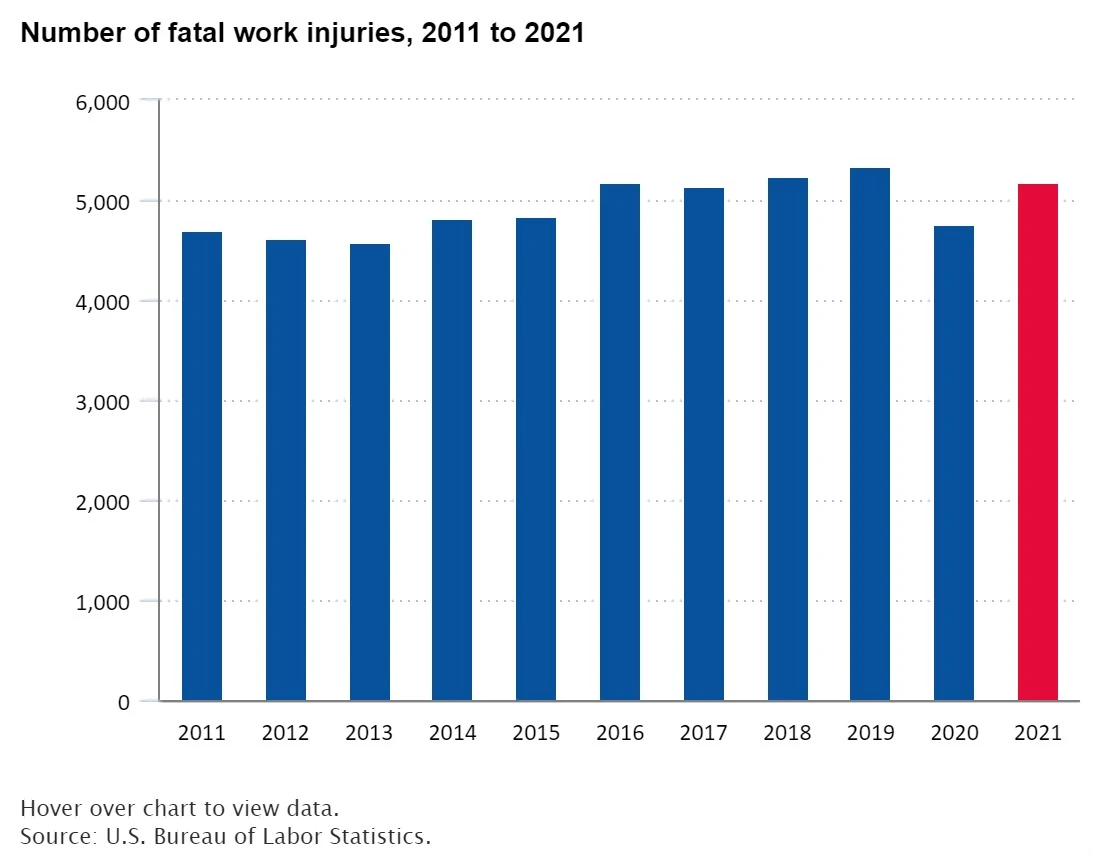
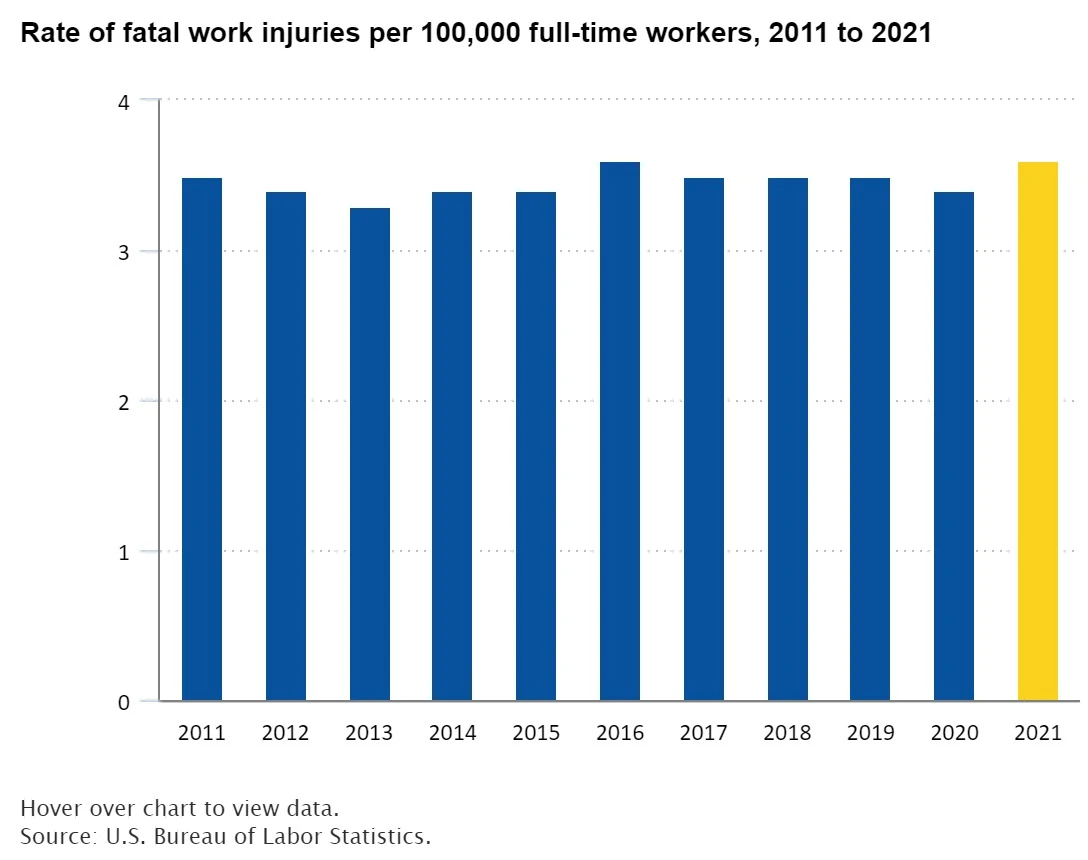
Tips To Prevent Workplace Accidents
1. Build a Wellness Plan
Without the appropriate training, an individual may unintentionally hurt himself and his coworkers. Comprehensive wellness and accident prevention at work initiatives set the stage for a safe workplace. The program must include all aspects of employee health and safety, and encourage reporting of risky behaviors or practices. Hence, organizations will have to build a safety training program to prevent workplace accidents.
2. Carry out Pre-Employment Tests
Many businesses demand that individuals for certain roles pass through physical and psychological testing before hiring. It is because they look for fit individuals physically and mentally. For instance, as part of the hiring process, pilots must successfully pass extensive eye and hearing examinations, and truck drivers must continue to receive ongoing health exams to work.
3. Identify Safety-Related Issues
Complete a safety assessment of your company to find trends and potential hazards.
-
Examine the area on foot for hazards.
-
Read through the accident reports from the previous year.
-
To analyze your workplace, consult a safety officer.
-
You can tailor your safety and wellness plan to include rules that apply to both your company and its employees. This is done by focusing on the relevant organizational areas.
4. Leverage PPE
To keep employees safe, you might need personal protective equipment (PPE) depending on your workplace. PPE can consist of:
-
Helmets
-
Goggles
-
High-visibility apparel, such as reflective vests
-
Gloves
-
Covers for the ears
-
Hip belts
-
Harnesses
-
Footwear safety
To ensure that personnel are properly using their protective equipment, consider conducting arbitrary safety audits. You might need to give team members additional safety gear, such as traffic cones, signs, and first aid kits for their work zones.
5. Perform Regular Inspections
Make sure employees adhere to all safety procedures and conduct routine inspections to identify and measure any potential hazards. Keep track of any safety breaches or issues so that you may adjust your business's safety and wellness strategy. It's crucial to discuss safety concerns with staff members and explain the policies. Keeping track of incidents might help you identify recurring problems with employees that may prompt disciplinary action.
Nowadays, workplace accidents are increasing rapidly across various organizations. Hence, it is crucial to take accident prevention measures. Your own safety program can be improved based on workplace fatality causes. By adapting accident prevention needs to the particular difficulties in your workplace, you may use the tips above to create the framework for your program.
What's left to say
By implementing a comprehensive safety strategy or environmental health and safety software, workplace accidents can be prevented significantly. You and your staff may establish a safety culture and a focused accident prevention program with preventative measures.
READ MORE ❯

How is EHS Software Beneficial for Ports?
Nowadays, ports are striving hard to build a safer environment. It affects performance and productivity also.
The port industry is changing due to new laws from the Bureau of Safety and Environmental Enforcement (BSEE). Based on these laws, many processes are updated for offshore energy companies and ports. Due to recent important improvements mandated by the BSEE, environmental, health, and safety programs must now be even more effective and efficient in ensuring the safety of employees, suppliers, and clients.
In this article, let’s see a few benefits of using EHS software for ports.
1. Build Zero-Harm Environment
Ports are known for higher risks. There are various risks such as oil spilling, injuries, environmental damage, cargo theft/missing, equipment shortage, lack of port security, and much more. By using workplace health and safety software ports can mitigate incidents and also grow a safer environment with ease. With software, you can track, manage, and report risks with ease. By doing so, you can minimize future incidents and create a zero-harm environment.
To achieve zero incidents at ports, at NeoEHS, we offer various safety modules such as:
- ATAR
- HIRARC
- Incident management
- Inspection management
- Permit to work
- Guard tour system
- Port security access
2. Manage Confined Safety Hazards
A thorough awareness of the health and safety risks associated with permit-required confined space entry is necessary due to port conditions. With EHS software designed specifically for the port industry, keep track of data about ventilation standards, atmospheric risks, and training.
3. Advanced Port Security
The entry of ships into ports affects national security. The professionals will make sure to dock safely and also stay compliant. Having cutting-edge EHS software helps you on top of everything, from tracking incident reactions when handling goods to maintaining regulatory compliance with OSHA, OSHAD, NEOSH, DOSH, MOM, and much more.
4. Ensures Safety
With NeoEHS software, you can track, analyze, and report operational risks with ease. Our safety practices will help you in building a safer work culture for your employees. Many port industries opt to use the EHS software to keep track of their employees and also notify them about the risks. We plan to build safety procedures that abide by OSHA regulations. Hence, make use of our environmental, health, and safety software to create a safer environment.
Final Thoughts
EHS software can play a vital role in advancing your performance, minimizing risks, reducing incidents, and growing productivity seamlessly. From this article, we hope you have got to know some benefits of using EHS software. There are still many other benefits too. By using the right software, you can create a safer, healthier, and more compliant organization.
READ MORE ❯

What Are The Various Health And Safety Hazards In Ports
Working in ports can be hard. You might work with a variety of employees, and deal with a diverse range of commodities. Port operations go place day and night, in all weather conditions. To catch a tide or free up a wharf, there is often pressure to quickly load or unload a ship's cargo. The goal of visiting truckers is to rapidly pick up or deliver their cargo, so they can continue driving.
Due to these factors, it is both an interesting and perhaps dangerous sector to work in ports. Risks change over time because of constantly shifting conditions. To mitigate these risks, businesses must carry out the necessary health and safety procedures.
Here, in this article, let’s see some health and safety hazards in ports.
Moving Vehicles
In ports, vehicles are often used in congested areas close to pedestrian employees. As a result, there is a higher chance of causing property damage, getting run over, being crushed, or falling from a moving vehicle. Loading and unloading cargo in trucks, reversing cars on decks, and driving through tight corners are hazards linked with moving vehicles and equipment.
Lifting Operations
The core of port logistics operations is the loading and unloading of cargo. Workers use a variety of lifting tools, including cranes and forklifts, for heavy containers and objects. Poorly planned lifting operations can put workers in great danger of incurring fatal injuries or being struck by things that are falling or moving. Falling loads from incorrectly piled goods and malfunctioning lifting equipment are two risks associated with lifting activities on ports.
Mishandling Injuries
At ports, many workers carry out various manual handling activities. Some injuries from manual handling involve twisting, frequent bending, repetitive movements, and physical work. Such activities include;
- Carrying mooring ropes.
- Moving, hauling, and lifting weights.
- Operating straddle carriers, cranes, and heavy equipment.
- Storage activities.
Slips And Trips
One of the most frequent types of workplace accidents is slipping and falling. Water is not the only thing that increases the risk of a slip or trip hazard; improperly stored cables and ropes, dim lighting, and uneven ground are also factors. The risk of a slipping danger is constantly there because docks and ports are invariably covered with water. Ports are still striving hard to fix these incidents.
Final Thoughts
Both HSE and the port sector have published recommendations that will help you better understand the key risks and the suitable management actions you may take. Using NeoEHS software, you can track, monitor, analyze, and report risks with ease. It helps you in minimizing future risks and also build a safer environment.
Here, in this article, we have listed some hazards in the port industry. But still, there are various other hazards too. However, EHS software can help you in managing all hazards seamlessly. From automating workflows, tracking employees, monitoring risks, minimizing hazards to eliminating incidents, our EHS software can help ports and various other industries in sorting out these complications.
READ MORE ❯

Top 7 Workplace Safety Tips
“Prepare and prevent, don’t repair and repent.” Have you ever come across this popular saying? Accidents do happen, especially in the workplace. But it is our utmost responsibility to take potential measures to prevent them. As an organization, it is essential to ensure that your employees are safe at work. You can build a work culture that emphasizes safety in your organization.
Workplace safety is crucial for every organization, no matter how small or big. In addition to that, it is everyone’s responsibility to keep their workplace safe. Here, in this article, we have highlighted some of the tips that will play a vital role in maintaining a safer workplace.
Come, let’s get started!
1. Identify Operational Risks
Every work environment varies, and it is critical for employees to spot risks in their workplace. Firstly, it is essential to identify the risks in your organization. For that, you can try out using EHS software to find out the risks and hazards in your workplace. By doing so, you can take corrective steps to mitigate the hazards in your workplace and provide a safer organization for your employees.
2. Create An Action Plan
Once, you have identified risks in your workplace, then comes the preventive measures. You can map out the risks faced by your organization and create action plans to eliminate those risks. Start by creating plans for the areas that are more impacted by the risks. Ensure to leverage the right preventive measure to mitigate the issues in your organization.
3. Conduct Regular Inspections
Performing regular inspections play a vital role in enhancing the safety of your organization. By carrying out regular audits and inspections, you will get to see what part of your company seems to be unsafe. Starting from chemical spills to electrical breakdowns, you will have to check for all types of risks. Based on the recorded data, you can take the necessary steps and ensure to provide a safer work culture for your employees. So, it is crucial to check out for hazards by conducting periodic inspections.
4. Encourage Regular Breaks
As per OSHA, it is necessary for employees to take regular breaks. Not only based on OSHA but also the break is required for all employees. By taking periodic breaks, employees will feel fresh and also will stay alert. For instance, if a person is very tired, he is more prone to incidents. It is because their awareness will be hindered by exhaustion. So, encourage your employees to take regular breaks and stay fresh all day.
5. Wear Protective Equipment
Though every employee knows this step, it is crucial to remind workers to wear personal protective equipment. Wearing non-safe equipment may lead to injuries and illness. Some safety equipment includes googles, gloves, face masks, and much more., Make sure to wear these types of equipment to stay safe and healthy. Ensure not to forget to wear PPE and be safe in your workplace.
6. Enforce Safety Rules
To avoid risks and hazards, employers must enforce safety rules to provide a safe and healthy work culture. Employers must impose safety rules for their employees to skyrocket workplace safety. By doing so, employees are more likely to obey the rules and get motivated to stay safe in their workplace.
7. Train Your Employees
Training is one of the best ways to keep your workplace safe. Make sure to train your employees on safety procedures. Starting from the usage of PPE, reporting in case of emergencies to keeping their places clean, everything should be taught. By doing so, you can advance safety and also increase productivity in your organization.
Final Thoughts
Safety plays a vital role in making your organization more successful. When it comes to workplace safety, both employers and employees need to follow the set of protocols made by the organization. But, employers have a much bigger role. Employers need to educate the employees on the safety rules and also ensure that they are following the right rules properly. In this article, we have listed some safety tips. Make sure to follow them to provide a safer and healthier work culture for your workers. If you have any other ideas, share them in the comments below.
READ MORE ❯

Why Should Healthcare Sectors Consider Occupational Health And Safety?
Occupational health and safety are essential for safeguarding employees from exposure to harmful substances, injuries, and accidents in the workplace. Though we all know that accidents can occur at any time, we must take preventive measures to protect ourselves from such accidents. Every employee needs to take necessary steps to mitigate such risks of incidents. Due to the increasing rate of incidents, many organizations are using occupational health and safety software to build a safer workplace for employees.
In this article, let’s see why healthcare sectors must consider occupational health and safety in their workplace.
Perks Of Prioritizing Occupational Health And Safety
Healthcare sectors face a lot of occupational hazards that are distinctive to their environment. Occupational safety is crucial because employee safety should always come first in any firm. Every organization is responsible for providing a safer workplace for its employees.
Let’s check out the benefits of prioritizing occupational health and safety!
- By monitoring hazards, you can mitigate risks and accidents.
- Due to reduced illness of workers, there will be a rise in productivity.
- Increased employee morale.
- Reduced workplace incidents.
- Minimized operational and legal costs.
Tips To Maintain Occupational Health And Safety In the Workplace
Every industry must consider occupational health and safety. A strong safety policy should focus on identifying these risks and ensuring that workers have the training, tools, and other resources to do their work safely. Effective regulations must be implemented to prevent accidents, restrict output owing to a lack of competent employees, compensation claims, and avoid fines from the Occupational Safety and Health Administration (OSHA).
Here are some of the strategies to maintain occupational health and safety in the workplace:
- Ensure your OHS policy meets all applicable federal, state, and local rules and regulations.
- Make sure that your personnel has received the necessary training and certification to operate any machinery or equipment they may utilize.
- Check if only staff can quickly obtain all Safety Data Sheets for chemical goods used at your business.
- Ensure each employee has access to all appropriate Personal Protection Equipment (PPE), including sturdy hats, eye protection, and respirators.
- Use tools and other equipment properly, only for what they were designed for.
- Use mechanical aid such as carts, handling equipment, or pallets to lift or move heavy things.
- Maintain proper posture while sitting, standing, or lifting items, especially for an extended period.
Final Thoughts
Organizations must consider occupational health and safety to build a safer environment for their employees. As a firm, you will have to give priority to employee safety. In this article, we have highlighted why you must consider health and safety regulations in your organization. Use the above insights and create a zero-harm environment for your employees.
READ MORE ❯
.png)
Excelling the art of communicating risk
With successful estimates taken, (for example, home isolate) in COVID-19 pandemic, individuals have gotten more mindful of the side effects and its fix. One can say to a degree, that the endeavors and the equivalent collaboration from individuals has smoothed the bend of dread in individuals. Wearing covers, social removing and accentuation on cleanliness has taken roots – one is figuring out how to ingest the unexpected stuns and proceeding onward.
In any case, given the mercy and opportunity to the individuals, the contamination can wait and the bend can turn up once more.
Basically on the grounds that the dangers are genuine, the information is befuddling and the science is clashed. Until the immunization is created and made accessible to the majority, the flare-ups will proceed.
For an industry, imparting about vulnerability – what is normally known as ‘hazard correspondence’ at a working environment gets trying for any individual who needs to pass on or devour such data.
In the midst of unanticipated and frightening occasions like these, enterprises stay uncertain of the essential realities at start – any ill-advised data spread from their side can have urgent ramifications in close to home and cultural choices. Like for this situation – they have to think, how irresistible is this new infection? Would it be able to murder individuals? What will be the drawn out social and financial repercussions?
READ MORE ❯

Deriving benefits from a BBS software
Managing environmental health and safety (EHS) is always concerned with mitigating risk, preventing potential hazards and incidents, and improving the safety culture of the organization. All of these goals can be achieved through behavior-based safety (BBS), which is an effective tool.
Through the observation and analysis of employees’ behavior while they work, BBS is a method for avoiding human error and improving workplace safety. Let's take a look at some of the key concepts of BBS, along with some actions EHS managers and professionals can take to implement the concepts in their organizations.
To dispel a common misconception about behavior-based safety, let us first emphasize one point: Behavior-based safety isn't about blaming employees for safety incidents. It is about positively reinforcing safe behaviors and providing feedback when risky behaviors occur.
The basics of BBS
As a result of a series of safe behaviors, behavioral safety is the guiding principle that helps employees perform their jobs safely. The term "behavior" refers to any actions you are able to observe someone performing, and it includes actions that are visible only (i.e., things that cannot be seen, such as attitudes or thoughts). Through BBS, at-risk behavior on the job is determined and steps taken to change at-risk behavior into safe behavior are determined.
The BBS method uses materials and activities. In a behavioral safety framework, all of these tools can be effectively utilized, such as safety signs, training, safety rules and policies, and safety meetings. In addition to observing behavior to determine whether it is appropriate or unsafe, it also reinforces safe behavior and changes unsafe behavior by providing positive or corrective feedback on performance.
BBS Starts with Selecting and Observing Desired Safe Behaviors
When putting BBS into action within the workplace, it’s imperative that EHS managers properly select and observe employee behavior. Behaviors to be observed include:
Observable
Reliable
Something over which an employee has control, and
Describe positively (i.e., what should be done, not what shouldn’t be done).
A behavior-based safety observation must be objective, that is, based on what you actually observe the employee doing, rather than on opinions or interpretations.
Consider this activity as an example of putting observations into action. It is recommended that employees select a few safe behaviors (no more than five at one time) and compile them into a checklist they carry with them during the workday to spot-check for the selected safe behaviors. The employee places a check in the “safe” column if he observes that a coworker is performing a behavior on the checklist safely. When a coworker is observed acting unsafely, the employee places a check in the “unsafe” column. EHS professionals can use this tool to determine the prevalence of safe versus unsafe behavior on the job, and then provide positive feedback to employees exhibiting safe behavior, or take corrective and preventive measures against employees who exhibit riskier behaviors.
Positive Feedback Is Essential to BBS
When you provide employees with feedback about safe behavior, be specific about what you observed. Verbal feedback is an effective tool for promoting safe behavior.
It would be appropriate to say, for example, "Thank you for driving slowly around that corner and blaring the horn to warn others." Do not use generalizations such as, "Thank you for driving the forklift carefully." Provide feedback on performance immediately following or as soon as possible following the behavior.
Also, be sure to identify the person or group to whom you’re giving feedback by name. For example, “John, thanks for mopping up that spilled water. You just prevented someone from slipping and falling and getting injured.” Avoid saying things like, “Thanks, everyone, for keeping the floor clean.”
One thing to avoid in your communication: Don’t use the words “but” or “however” when giving positive feedback, since these qualifiers diminish the effect of the positive message. For example, if you say, “Good to see you wearing safety glasses, Sally, but…” Sally may only hear the part after the “but”—not the positive reinforcement that preceded it.
Correct observed risky behaviors with feedback
The BBS is emphatically not about blaming employees, but you must never ignore unsafe behavior--it might lead to an accident, injury, or possibly death. When you observe an employee engaging in unsafe behavior, you must provide appropriate feedback.
Corrective feedback is provided to employees to provide information on their errors as well as to provide suggestions for improvement. In contrast to simply scolding employees (which may result in retaliation), this method emphasizes a specific behavior and promotes safer habits in the future.
When giving corrective feedback, remember:
Be specific and focus on the correct behavior only—don’t discuss other behaviors.
Be objective and talk about the behavior, not the person.
Describe safe behavior, and make sure employees understand why this behavior is imperative to their safety.
Positive behaviors, Positive Culture
A BBS can help identify both safe and unsafe behaviors so that incidents can be prevented. It also contributes to improving the overall safety culture of a company. In addition to making safety a core part of a company's values, organizations should ensure that communication is frequent, consistent, and clear about safety issues such as behavior. This is an integral part of their overall culture as well.
By adopting a more mindful approach to behavior, EHS managers, employees and upper management can contribute to creating a culture where safety is a top priority. By using behavior-based safety in conjunction with effective tracking and analytical tools, you can ensure that employees are not only performing their tasks, but are also actively promoting health and safety while doing so.
READ MORE ❯
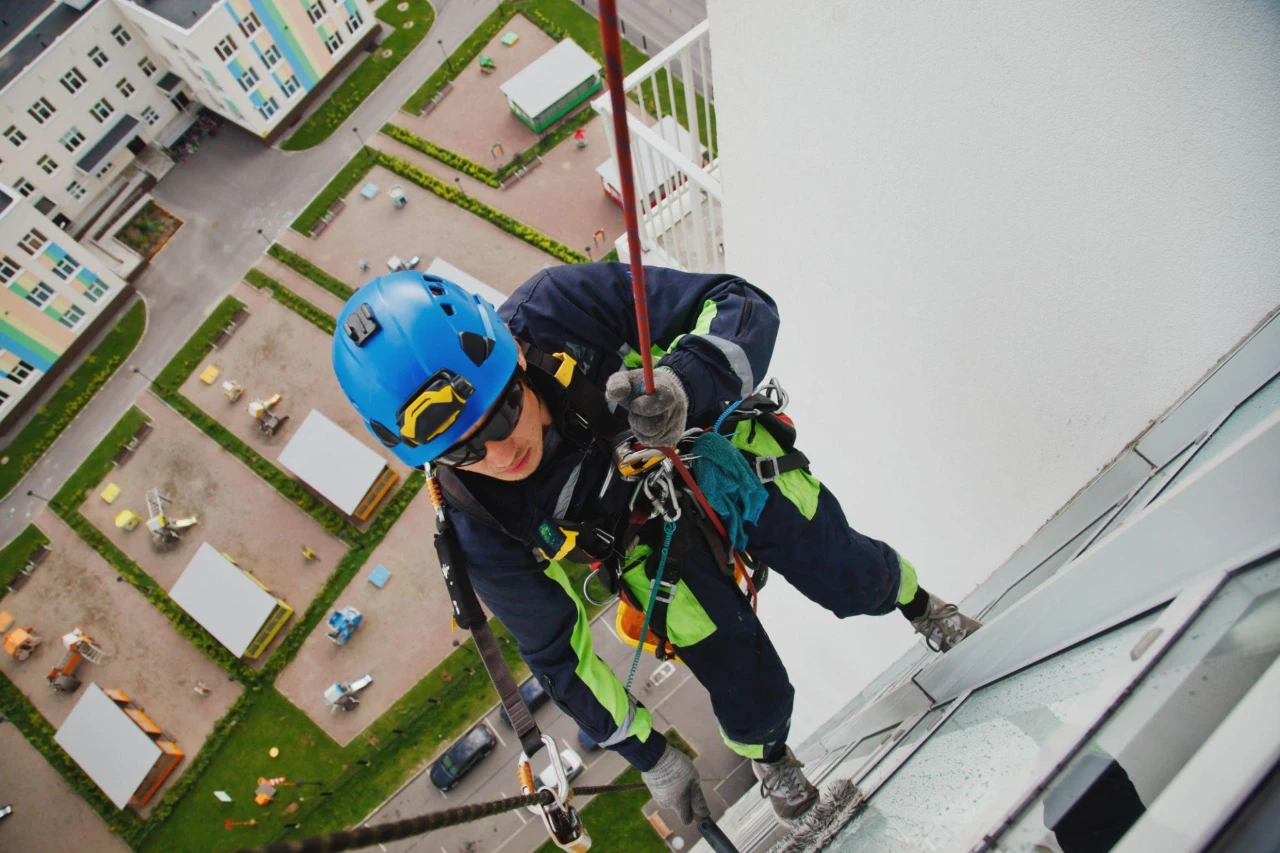
10 Essential Safety Tips for Working at Heights
Working at height includes tasks where individuals are exposed to potential fall hazards. Such work requires the utmost caution and safety procedures to prevent accidents. Prioritizing safety in work at height operations not only safeguards the physical health of workers but also ensures that projects are completed efficiently, without costly delays caused by accidents. Moreover, maintaining a strong safety culture builds a positive work environment and reduces financial and legal liabilities associated with workplace accidents.
Let's look at ten essential safety tips to keep workers safe.
What Is Work At Heights?
Work at height operations encompass a wide range of tasks that require individuals to operate at elevated levels above the ground or other surfaces. It can include construction work on scaffolds, maintenance of tall structures, painting, window cleaning, tree trimming, and more. Any task requiring employees to work in elevated positions is considered a work at height operation.
It is essential to note that working at height operations involve inherent risks due to the potential for falls or accidents, making safety measures an absolute necessity. These operations demand a thorough understanding of the associated hazards and the implementation of safety protocols to mitigate risks and protect workers' well-being.
Safety Tips for Working at Height
1. Utilize Proper Safety Equipment
One of the fundamental aspects of work at height safety is the utilization of appropriate Personal Protective Equipment (PPE). It includes harnesses, helmets, gloves, and other gear that protects workers from falls. Regular inspections and maintenance of safety equipment are essential to ensure their effectiveness.
2. Perform a Thorough Risk Assessment
A comprehensive risk assessment is vital before commencing any work at height operation. Identify potential hazards and assess risks involved in each task. It enables workers to take the necessary precautions and implement safety measures.
3. Select the Right Ladder or Scaffolding
Choosing the right equipment is crucial. Ladders and scaffolding should be carefully selected based on task requirements. Ensure that these structures can support weight and are stable. Additionally, workers should be trained on proper ladder and scaffold usage.
4. Secure the Work Area
It is essential to secure the work area to prevent accidents and falls. It creates a protective barrier using guardrails, toe boards, and safety nets. During conditions of strong winds, extra precautions are recommended to ensure worker safety.
5. Maintain an Organized Workspace
Maintaining a clean and organized workspace is integral to safety. Clutter or debris can cause tripping hazards. Regular cleaning and maintenance routines should be established to prevent hazards in the workplace.
6. Follow Safe Climbing Practices
Proper climbing techniques are essential for work at height safety. Workers should ascend and descend carefully, making sure they have three points of contact. Recognizing and avoiding common mistakes during climbing is crucial.
7. Training and Educating Workers
Worker training and education are central to work at height safety. Provide specialized training based on job roles and responsibilities. Continuous safety education and refresher courses inform workers about safety best practices.
8. Communicate Effectively
Clear communication is vital in preventing accidents during work at height operations. Implement communication tools like signals or radios. Educate your employees about the consequences of poor communication to reinforce the importance of effective communication.
9. Monitor Weather Conditions
Weather can have a significant impact on work at height operations. Use tools and resources for real-time weather monitoring and make informed decisions about adverse conditions.
10. Develop a Rescue Plan
In the unfortunate event of an accident, having a well-defined rescue plan is really important. Ensure rescue procedures are established and practiced. Share case studies of successful rescue operations to illustrate readiness.
The bottom line
Workers' safety at heights is a top priority in any industry. Observing and adhering to these safety tips can help reduce the risk of accidents and injuries. Encouraging a safety-first culture in all work at height scenarios is not just a responsibility but a moral obligation. Always remember that safety is everyone's responsibility and should never be compromised for any reason. Prioritizing safety ensures that workers return home safely after every workday, which is the ultimate goal in any work at height operation.
READ MORE ❯

Underlining information for in general working environment well being and security
As operational efficiencies increment, it gets crucial to coordinate with the taking off desires for the two organizations and buyers. With COVID-19 in picture, putting resources into advancements that permit safe return of representatives to their homes turns out to be considerably more critical.
Especially in greetings tech stockrooms and dispersions focuses, the utilization of wellbeing insights have demonstrated to be helpful with regards to laborer security and injury avoidance.
Helping them are the serious hardware and controls that are skilled at storing up information, an initial move towards network availability – for example for improved wellbeing at the stacking dock, interlocking dock controls can be modified to work in safe succession of tasks that can incorporate movement sensor actuated sound and visual correspondence frameworks.
As we probably am aware, there are shrewd watches that screen laborers’ effort levels and internal heat levels and personal when both of them goes high. Comparative is in the event of hard-caps at building destinations – progressed ones can even accumulate information on working conditions, for example, gear temperatures, dust, harmful substances and so on.
READ MORE ❯