How AI Is Transforming Safety Management in Manufacturing
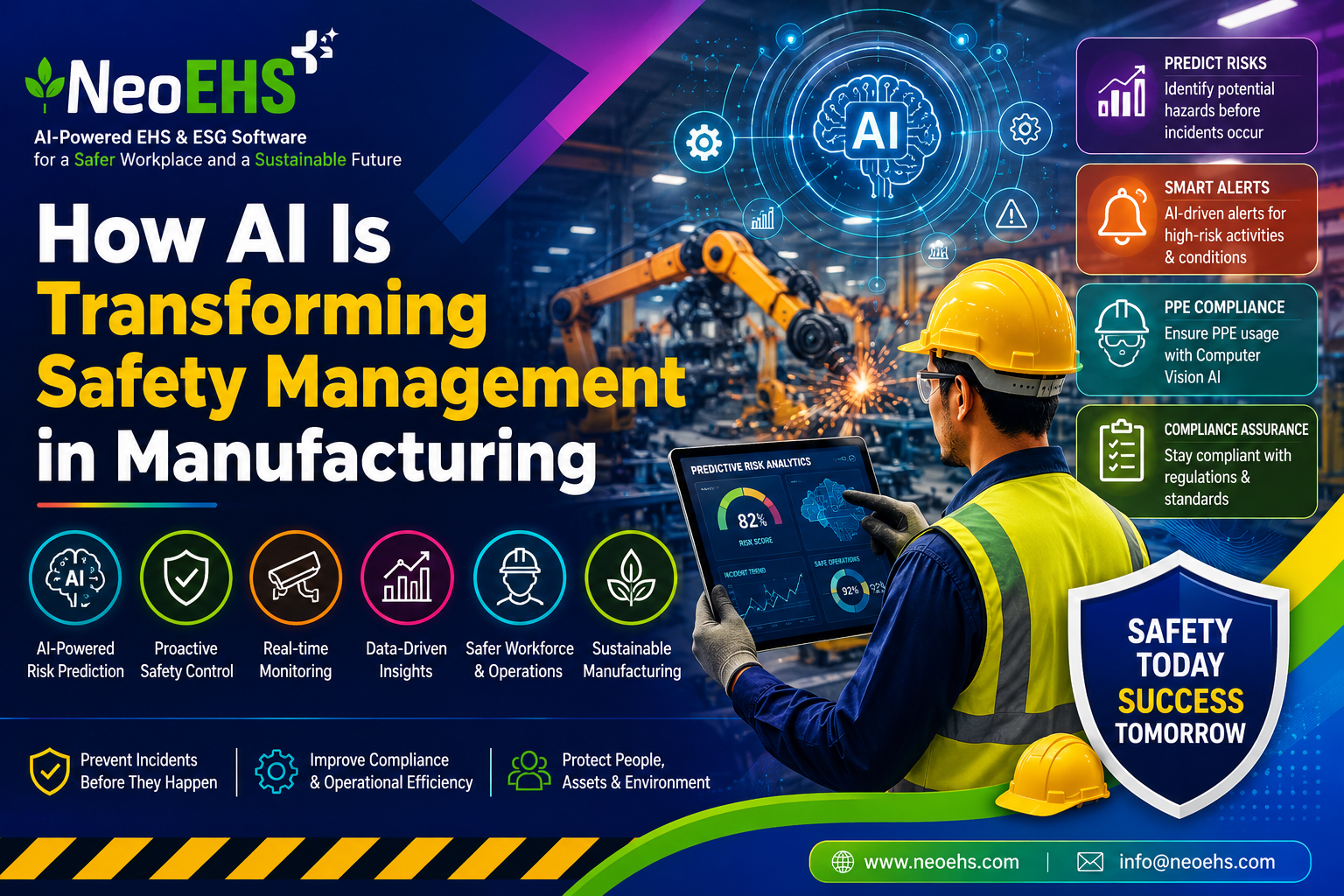
AI-Powered Safety Management for Manufacturing
For decades, workplace safety has largely been about learning from what has already happened.
A safety incident occurs. An investigation follows. Corrective actions are identified. Inspections are carried out. Reports are prepared. Safety teams then work to make sure the same problem does not happen again.
These activities remain essential to effective EHS management. But technology is changing what organizations can do with their safety data.
Today, organizations are asking a much more proactive question:
What if we could identify increasing workplace risk before it becomes an incident?
This is where predictive analytics in EHS is becoming increasingly important.
By combining artificial intelligence (AI), machine learning, historical EHS data, real-time safety information and operational data, modern AI powered EHS software can identify patterns and warning signals that may indicate an increasing level of workplace risk.
Instead of only asking "What happened?", organizations can begin asking:
"What could happen next, and what can we do about it now?"
For manufacturing organizations in particular, this represents an important shift from reactive safety management to proactive and predictive safety management.
What Is Predictive Analytics in EHS?
Predictive analytics in EHS is the use of historical and real-time environmental, health and safety data together with artificial intelligence and machine learning to identify patterns, trends and risk indicators that may be associated with future workplace incidents.
Traditional EHS software typically helps organizations understand:
- What incidents occurred?
- Where did they happen?
- Which hazards were reported?
- How many inspections were completed?
- Which corrective actions are overdue?
- How many safety observations were recorded?
These are important questions.
However, predictive EHS analytics takes the next step by helping organizations explore:
- Where is workplace risk increasing?
- Which activities require additional controls?
- Which departments or locations are showing unusual risk patterns?
- Which hazards are appearing repeatedly?
- Which corrective actions are associated with recurring problems?
- Which safety indicators require immediate attention?
This makes predictive safety analytics an important capability for organizations looking to build a modern, data-driven EHS management system.
Why Manufacturing Needs Predictive Safety Management
Manufacturing environments can be extremely complex.
Employees may work around heavy machinery, automated production systems, electrical equipment, chemicals, vehicles, pressure systems and high-temperature processes—all within the same facility.
A manufacturing organization may need to manage risks associated with:
- Heavy machinery
- Automated equipment
- Forklifts and mobile equipment
- Electrical systems
- Hazardous chemicals
- Confined spaces
- Work at height
- High-temperature operations
- Pressure systems
- Maintenance activities
- Contractors and temporary workers
As operations expand, the volume of safety data also increases.
EHS teams may be dealing with thousands of inspections, observations, permits, training records, incidents, audits and corrective actions.
Reviewing all of this information manually can be difficult and time-consuming.
This is why AI-powered safety management for manufacturing is becoming an important part of digital transformation.
AI can process large volumes of information, identify relationships between different data points and highlight patterns that may not be obvious during manual analysis.
The objective is not to replace EHS professionals.
It is to give them better information so they can make better decisions.
How AI Predicts Workplace Risks
An AI powered EHS software platform can bring together information from multiple safety and operational sources.
For example, an organization may have years of data covering:
- Workplace incidents
- Near misses
- Safety observations
- Hazard reports
- Risk assessments
- Inspections
- Audits
- Permit to Work activities
- Training records
- Equipment information
- Environmental conditions
- Corrective actions
- Contractor activities
When this information is connected, AI and machine learning can analyze historical patterns and identify potential risk signals.
Let's look at some practical examples.
1. AI-Powered Historical Incident Analysis
Past incidents contain valuable information.
An organization may know that an incident occurred, but the real value comes from understanding whether similar incidents are happening under similar circumstances.
AI in workplace safety can analyze incident information across multiple dimensions, including:
- Location
- Department
- Equipment
- Shift
- Job activity
- Employee role
- Incident type
- Hazard category
- Root cause
- Environmental conditions
For example, imagine that several minor incidents and near misses have occurred during maintenance activities on a particular production line.
A traditional report may simply list those incidents.
A predictive analytics system can identify the recurring relationship between the maintenance activity, equipment, shift and hazard category and highlight the area for further investigation.
This gives EHS teams an opportunity to act before the pattern develops into a serious incident.
2. AI-Based Safety Observation Analysis
Safety observations are one of the most valuable sources of leading-indicator data.
However, a large manufacturing organization can generate thousands of safety observations every month.
Manually reviewing every observation and identifying recurring patterns is difficult.
This is where AI in workplace safety can provide significant value.
AI can classify and analyze safety observations to identify trends involving:
- PPE non-compliance
- Unsafe machine operation
- Poor housekeeping
- Blocked emergency exits
- Unsafe lifting practices
- Electrical hazards
- Working-at-height risks
- Unsafe access
- Repeated procedural violations
For example, if observations relating to PPE non-compliance begin increasing in one department, the system can highlight the trend.
The EHS team can then investigate the underlying cause and take preventive action.
3. Near-Miss Pattern Analysis
A near miss is more than an event that "almost caused an accident."
It can be an early warning signal.
A modern AI safety management software platform can analyze near misses together with incidents, observations, hazards and corrective actions.
Suppose the same hazard appears repeatedly in near-miss reports before incidents occur.
AI can identify the relationship and highlight it as a potential risk pattern.
This allows organizations to investigate the underlying hazard before it results in a more serious event.
Predictive analytics therefore helps turn near-miss data into actionable safety intelligence.
4. Predictive Risk Scoring
Another important application of predictive EHS analytics is dynamic risk scoring.
Instead of relying only on a static risk assessment, AI can consider multiple data points when evaluating changing risk conditions.
For example:
Risk Score = Historical Risk + Current Observations + Incident Trends + Operational Factors + Compliance Indicators
The purpose is not simply to create another number on an EHS dashboard.
The real objective is to help safety professionals understand:
Where does the organization need to focus its attention first?
A dynamic risk score can help EHS teams prioritize high-risk locations, activities, processes and hazards.
AI-Powered Safety Management for Manufacturing
Manufacturing companies generate large volumes of operational and safety information.
A modern manufacturing EHS software platform can connect information across multiple EHS processes, including:
- Risk Management
- Hazard Management
- Incident Management
- Safety Observations
- Inspection Management
- Audit Management
- Permit Management
- Training Management
- Emergency Management
- Compliance Management
- Environmental Management
- Corrective and Preventive Actions
When these functions operate as connected systems instead of isolated applications, organizations gain a more complete picture of workplace risk.
AI can then analyze this connected information to support manufacturing risk management and proactive safety decision-making.
From Reactive Safety to Predictive Safety
Traditional safety management often follows a familiar cycle:
Incident → Investigation → Corrective Action → Monitoring
Predictive safety introduces another layer:
Data → Pattern Detection → Risk Prediction → Preventive Action → Incident Prevention
This is one of the biggest changes enabled by artificial intelligence in EHS.
The objective is not to wait for an accident before learning from the data.
The objective is to recognize warning signals early enough to take action.
That is the difference between simply managing incidents and actively managing risk.
Predictive Analytics and Risk Management
Risk assessment is a fundamental part of workplace safety.
However, risk assessments can become outdated when workplace conditions, processes, equipment or employee activities change.
This is where AI based risk assessment in manufacturing can add another layer of intelligence.
For example, if a particular hazard starts appearing more frequently across safety observations, inspections and incidents, an AI-powered EHS platform can identify the changing trend.
EHS professionals can then review:
- Existing risk assessments
- Control measures
- Training requirements
- Inspection frequency
- PPE requirements
- Work procedures
- Permit requirements
This creates a more dynamic approach to risk management in manufacturing, where risk information can continuously evolve with workplace conditions.
AI Can Identify Leading Indicators
One of the most valuable opportunities presented by predictive analytics is the ability to move beyond traditional lagging indicators.
Organizations commonly monitor metrics such as:
- Total Recordable Incident Rate
- Lost Time Injury Frequency Rate
- Number of incidents
- Lost workdays
These metrics are important, but they describe events that have already happened.
Predictive EHS analytics can also examine leading indicators such as:
- Increasing hazard reports
- Repeated safety observations
- Declining inspection performance
- Overdue corrective actions
- Training gaps
- Repeated Permit to Work violations
- Increasing equipment-related observations
- Contractor safety trends
These signals may provide an earlier indication that workplace risk is changing.
By combining leading and lagging indicators, organizations can develop a more complete understanding of their safety performance.
Predictive Analytics in NeoEHS
NeoEHS brings together modern EHS technologies to help organizations move toward intelligent, proactive and data-driven safety management.
The AI powered EHS software approach of NeoEHS is designed to connect EHS information and provide intelligent insights that can help safety teams identify patterns, prioritize risks and take preventive action.
The NeoEHS ecosystem can support areas such as:
- AI-Powered Risk Management
- Incident Management
- Hazard Management
- Safety Observations
- Predictive Analytics
- Inspection Management
- Audit Management
- Permit to Work
- Training Management
- Compliance Management
- Environmental Management
- Waste Management
- Carbon Emission Management
- IoT Integration
- Computer Vision
- OCR Intelligence
- Intelligent EHS Dashboards
By connecting these capabilities, organizations can move toward a more integrated digital EHS management system.
Computer Vision and Predictive Workplace Safety
Predictive analytics becomes even more powerful when combined with AI computer vision.
AI-enabled video analytics can analyze CCTV and other visual data to help identify potentially unsafe workplace conditions.
Depending on the application, computer vision can assist in identifying:
- Missing PPE
- Unsafe access
- Restricted-area entry
- Unsafe proximity to machinery
- Crowd or congestion risks
- Unsafe workplace conditions
This creates another stream of real-time information that can contribute to an overall AI workplace safety strategy.
Instead of relying entirely on periodic inspections, organizations can supplement human observations with continuous digital monitoring.
IoT and Real-Time EHS Data
The growth of connected devices is also changing workplace safety management.
IoT-based EHS solutions can collect real-time information from connected workplace technologies such as:
- Smart helmets
- Environmental sensors
- Gas detection systems
- Equipment sensors
- Location tracking systems
- Wearable safety devices
- Air-quality monitoring systems
When IoT data is integrated with EHS software, organizations can combine real-time workplace information with historical safety data.
This creates opportunities for:
- Real-time risk monitoring
- Automated alerts
- Predictive safety analytics
- Environmental monitoring
- Connected worker safety
- Data-driven EHS decision-making
The result is a more connected approach to digital workplace safety management.
Benefits of Predictive Analytics in EHS
Implementing predictive analytics can help organizations strengthen several areas of EHS performance.
Proactive Risk Identification
Identify emerging patterns that may indicate increasing workplace risk before they develop into serious incidents.
Better EHS Decision-Making
Use data-driven insights to support decisions instead of relying exclusively on manual reporting and individual interpretation.
Faster Risk Prioritization
Help EHS teams focus their resources on the activities, locations and hazards requiring the greatest attention.
Improved Incident Prevention
Analyze historical incidents, near misses and safety observations to identify recurring risk patterns.
Stronger Manufacturing Safety Management
Connect operational and safety information to create a more complete picture of manufacturing risk.
Reduced Manual Data Analysis
AI can process large volumes of EHS information faster than traditional manual analysis.
Improved Safety Culture
When organizations consistently identify hazards and address risks proactively, preventive safety can become part of the organizational culture.
The Future of AI in Workplace Safety
The future of workplace safety is not about replacing EHS professionals with artificial intelligence.
It is about giving EHS professionals better tools.
AI can process enormous volumes of data, identify patterns and highlight potential risks.
EHS professionals bring something equally important: human experience.
They understand the workplace, employees, processes, operational realities and practical control measures required to manage risk.
The combination of human safety expertise and artificial intelligence can therefore create a stronger approach to workplace risk management.
The best EHS technology should support people—not replace them.
Why Predictive EHS Analytics Matters for the Future
As organizations become more connected and generate more safety data, traditional manual analysis will become increasingly difficult.
The future of EHS management software will increasingly involve:
- Artificial intelligence
- Predictive analytics
- Machine learning
- Computer vision
- IoT integration
- Real-time monitoring
- Intelligent automation
- Data-driven risk management
- Connected worker technologies
Organizations that can turn their EHS data into actionable intelligence will be better positioned to identify emerging risks and improve safety performance.
Final Thoughts
Predictive analytics is changing how organizations think about workplace safety.
Instead of waiting for an incident to reveal a weakness, organizations can use historical data, real-time information and artificial intelligence to identify potential risk patterns earlier.
For manufacturing organizations, this can be particularly valuable because of the complexity of industrial operations.
With AI powered EHS software, predictive analytics, computer vision, IoT integration and intelligent risk management, organizations can build a more proactive approach to workplace safety.
The future of EHS is not simply about recording what happened.
It is about understanding what could happen next—and taking action before it does.
NeoEHS is helping organizations move toward this future with AI-powered EHS and ESG software designed for a safer workplace and a more sustainable future.
Frequently Asked Questions
What is predictive analytics in EHS?
Predictive analytics in EHS uses historical and real-time safety data, artificial intelligence and machine learning to identify patterns and indicators that may signal future workplace risks.
How does AI predict workplace risks?
AI can analyze information such as incidents, near misses, safety observations, inspections, hazards, risk assessments, training records and other EHS data to identify patterns associated with changing risk levels.
How can AI improve manufacturing safety?
AI can help manufacturing organizations identify recurring hazards, prioritize risks, analyze safety observations, monitor leading indicators and support proactive incident prevention.
What is AI powered EHS software?
AI powered EHS software combines traditional Environmental, Health and Safety management capabilities with artificial intelligence, predictive analytics, automation and intelligent data analysis.
Can predictive analytics prevent workplace accidents?
Predictive analytics cannot guarantee that an accident will be prevented. However, it can help identify potential risk patterns and warning signals earlier, giving organizations an opportunity to take preventive action.
Why is predictive safety analytics important?
Predictive safety analytics helps organizations move from reactive safety management toward proactive risk identification, continuous monitoring and data-driven EHS decision-making.
Ready to Move from Reactive Safety to Predictive EHS?
Discover how NeoEHS can help your organization use AI, predictive analytics, intelligent automation and connected EHS data to build a safer workplace.
Explore AI-Powered EHS with NeoEHS.
Website: www.neoehs.com
.jpg "Wearable Technology is Transforming Workplace Safety")