Risk Management for Rail & Metro Safety: From Reactive Response to Predictive Prevention
Rail and metro systems are built around movement, precision and safety. Every day, trains operate across tracks, tunnels, stations, depots and maintenance facilities while employees, contractors and passengers interact with complex infrastructure and operational systems.
That complexity creates a simple but important safety question:
How can railway and metro organizations identify risk early enough to prevent an incident?
Traditional safety management often answers the question after something has happened. A near miss is reported. An incident is investigated. A corrective action is assigned. A report is prepared.
All of that remains important.
But modern rail and metro safety needs to go further.
The future of railway risk management is about continuously identifying hazards, understanding changing risk levels, monitoring whether controls are effective and using connected safety data to recognize emerging patterns before they become serious events.
This is where digital EHS management, AI-powered risk intelligence, predictive analytics, mobile technology, computer vision and connected operational data can make a meaningful difference.
For organizations looking to strengthen rail and metro safety, NeoEHS Risk Management Software provides an AI-enabled approach to identifying, assessing, controlling and monitoring operational risks.
What Is Risk Management in Railways?
Railway risk management is the systematic process of identifying hazards, assessing risks, implementing controls, monitoring their effectiveness and continuously improving safety performance across railway operations.
It covers much more than train operations.
Railway risk management can involve:
- Tracks and railway infrastructure
- Rolling stock
- Stations and platforms
- Depots and maintenance workshops
- Signaling and telecommunications
- Electrical and traction systems
- Trackside activities
- Construction and infrastructure projects
- High-risk maintenance activities
- Employees and contractors
- Passenger safety
- Emergency response
- Environmental and occupational health risks
- Regulatory and compliance requirements
The most effective approach is not to treat each of these risks as a separate activity.
Instead, organizations need a connected view of risk.
An incident may be connected to an unsafe condition.
An unsafe condition may be connected to a recurring inspection finding.
That inspection finding may be related to an ineffective control.
The same control weakness may appear in another depot or project.
When these relationships are visible, safety teams can move from simply recording events to understanding the broader risk picture.
Why Risk Management Is Critical for Metro and Rail Operations
Rail and metro environments are fundamentally different from many conventional workplaces.
A railway network can contain thousands of assets, multiple operating locations, large contractor populations and activities taking place around moving trains and critical infrastructure.
A metro system may simultaneously manage:
Passengers + trains + stations + platforms + tracks + depots + electrical systems + maintenance + contractors + construction + emergency operations.
A small failure in one part of the system can potentially affect other parts.
For example, a maintenance control failure may create an electrical hazard. A contractor-related deviation may affect track access. A recurring unsafe condition at a station may indicate a weakness in an operating procedure.
This interconnected nature of railway operations is why risk management needs to be continuous rather than periodic.
The Traditional Approach to Railway Risk Management
For many years, safety management followed a familiar cycle:
Incident → Report → Investigate → Correct
This model remains necessary, particularly for serious incidents and near misses.
But it has a limitation.
The organization often learns about the weakness after the event has already occurred.
A modern approach moves the intervention further upstream:
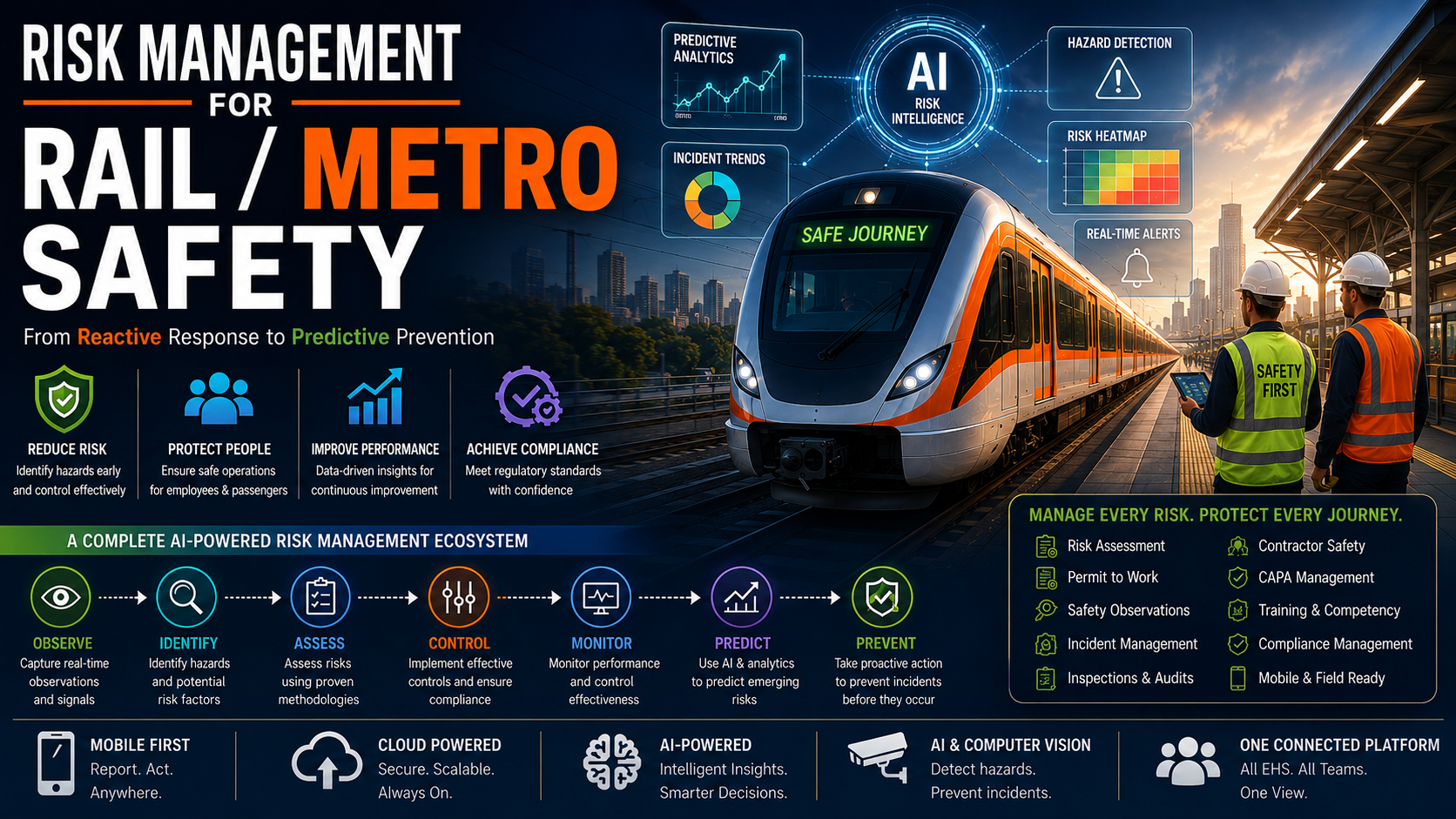
Observe → Identify → Assess → Control → Monitor → Predict → Prevent
The objective is not to eliminate human judgment.
The objective is to give railway safety professionals better information so they can make faster and better decisions.
The Seven-Stage Railway Risk Management Lifecycle
1. Observe: See What Is Happening
Effective risk management begins with visibility.
Safety teams need to know what is happening across stations, depots, tracks, workshops, projects and other operational environments.
Safety observations, inspections, incident reports, near misses and field reports can provide valuable signals.
A mobile-first EHS platform can allow employees, supervisors and contractors to report hazards and observations directly from the field.
This is particularly important for distributed rail networks where safety teams cannot physically be everywhere at the same time.
NeoEHS Safety & Security Observation Software can be used as part of a broader observation and preventive-action strategy.
2. Identify: Understand the Hazard
Seeing a problem is not the same as understanding it.
The next step is to identify the actual hazard and determine what activity, asset, location, behavior or condition is creating the exposure.
Railway hazards may include:
- Unauthorized track access
- Electrical exposure
- Inadequate isolation
- Unsafe maintenance activities
- Defective equipment
- Work-at-height exposure
- Confined-space hazards
- Fire risks
- Poor housekeeping
- Passenger safety hazards
- Unsafe contractor activities
- Procedural deviations
Hazard identification should be specific enough to support an effective control.
3. Assess: Determine the Level of Risk
Once a hazard has been identified, the organization needs to understand its risk.
Depending on the operation, railway organizations may use methodologies such as:
- HIRA
- HIRARC
- JSA
- JHA
- FMEA
- HAZOP
- Bowtie analysis
- Risk matrix assessment
- Root Cause Analysis
The assessment should consider factors such as likelihood, severity, exposure, existing controls and residual risk.
NeoEHS AI-Enabled Risk Management Software supports configurable risk assessment workflows and methodologies including HIRA, JSA/JHA, FMEA, HAZOP, RCA and Bowtie analysis.
The important point is that risk assessment should not remain a static document.
Risk changes when operations change.
4. Control: Reduce the Exposure
Risk assessment has little value if it does not lead to effective control.
Controls may include:
- Engineering controls
- Administrative controls
- Procedures
- Isolation
- Barriers
- PPE
- Competency requirements
- Supervision
- Permit controls
- Inspection requirements
- Emergency controls
For high-risk work, the connection between risk assessment and authorization is especially important.
A digital Permit to Work system can connect:
Work Activity → Hazard → Risk Assessment → Controls → Authorization → Monitoring → Closure
NeoEHS provides configurable Permit to Work Software for high-risk activities, with workflows that can connect permits to risk assessments, contractors, approvals, isolation controls and other EHS processes.
5. Monitor: Are the Controls Actually Working?
One of the most overlooked questions in risk management is:
Are our controls effective?
A procedure may exist.
A checklist may be completed.
A corrective action may be marked as closed.
But does the risk actually decrease?
This is why risk management needs to connect with inspections, audits, observations, incidents and corrective actions.
NeoEHS Inspection Management Software connects inspection findings with risk management, incidents, permits, audits, contractor management and corrective actions.
That creates a more complete safety lifecycle instead of isolated inspection records.
6. Predict: Identify Emerging Risk Patterns
This is where AI and predictive analytics can add another layer of intelligence.
Imagine a metro organization discovers:
- Increasing safety observations at one depot
- Repeated electrical-related findings
- Several near misses
- Multiple overdue corrective actions
- Increased contractor activity
- Recurring inspection findings
Each item may appear manageable when viewed independently.
Together, they may indicate an emerging risk pattern.
AI-powered analytics can help safety teams analyze large volumes of safety data and identify recurring trends, relationships and areas requiring attention.
NeoEHS uses AI-enabled risk intelligence and predictive analytics to analyze safety information and support proactive risk management.
The objective is not to claim that AI can predict every railway accident.
It cannot.
The practical objective is to identify warning signals earlier so people can prioritize preventive action.
7. Prevent: Turn Intelligence Into Action
Prediction without action does not improve safety.
The final stage is prevention.
When an emerging risk is identified, the organization should be able to:
Alert → Assign → Control → Escalate → Verify → Learn
This creates a closed-loop safety process.
The organization does not simply identify a risk.
It does something about it.
And after the action is completed, it checks whether the control actually worked.
That is the foundation of continuous improvement.
Major Risk Areas in Railway and Metro Operations
A modern railway safety management system should consider risk across the complete operating environment.
Track and Infrastructure Risk
Track condition, infrastructure defects, track access and maintenance activities can create significant operational and worker-safety exposure.
Digital inspections, observations and corrective-action workflows can help organizations identify and manage these issues systematically.
Rolling Stock Risk
Rolling stock maintenance involves mechanical, electrical and operational hazards.
Risk management should connect maintenance activities with inspections, permits, competency requirements and incident history.
Electrical and Traction Power Risk
Electrical work can involve high-consequence hazards.
Digital risk assessment and Permit to Work workflows can help ensure that required controls, authorizations and isolation requirements are addressed before work begins.
Station and Passenger Safety
Stations introduce a different risk profile involving passengers, employees, contractors, platforms, escalators, crowd movement and emergency situations.
A connected safety platform can bring observations, incidents, inspections and operational data together to provide better visibility.
Depot and Workshop Safety
Depots combine rolling stock, machinery, maintenance work, contractors, electrical systems and high-risk activities.
Risk management needs to cover both routine operations and non-routine work.
Contractor Safety
Railway and metro projects often involve multiple contractors and subcontractors.
A modern contractor safety process should connect:
Contractor → Competency → Training → Induction → Risk → Permit → Inspection → Incident → Corrective Action → Performance
This creates a more complete view of contractor risk.
Construction and Project Risk
Metro expansion projects introduce excavation, lifting, tunneling, work at height, temporary works, traffic management, electrical activities and multiple contractor interfaces.
These risks should be managed as part of the overall safety ecosystem rather than through isolated project spreadsheets.
Why Safety Observations Matter in Railway Risk Management
Safety observations are one of the most valuable sources of early risk information.
An incident tells you that something happened.
A near miss tells you that something almost happened.
A safety observation can tell you that a potentially unsafe condition or behavior exists before an event occurs.
For rail and metro organizations, safety observations can identify:
- Unsafe acts
- Unsafe conditions
- Procedural deviations
- PPE issues
- Housekeeping problems
- Unsafe access
- Contractor concerns
- Equipment conditions
- Positive safety behaviors
The real value comes from analyzing observations collectively.
If the same observation appears repeatedly in different locations, it may indicate a systemic issue rather than an isolated problem.
The Role of Incident Management in Railway Risk Prevention
Incident management should not end when an incident report is closed.
The deeper question is:
What can this incident teach the organization?
A modern incident management process should connect:
Incident → Investigation → Root Cause → Risk → Corrective Action → Verification → Organizational Learning
NeoEHS provides AI-Powered Incident Management Software with incident reporting, investigation, root-cause analysis, corrective actions, predictive insights and mobile reporting capabilities.
This allows incident information to become part of the wider risk intelligence ecosystem rather than remaining as an isolated record.
CAPA: Closing the Loop on Railway Risk
Corrective and Preventive Action is often where risk management succeeds—or fails.
Raising an action is easy.
Ensuring that the action actually reduces risk is harder.
An effective CAPA workflow should answer:
- What was the finding?
- What caused it?
- Who owns the action?
- What is the deadline?
- What control will be implemented?
- Has the action been completed?
- Has the evidence been verified?
- Did the action reduce the risk?
- Could the same issue exist elsewhere?
This is why CAPA should be connected to incidents, inspections, audits, risk assessments and observations.
Digital Transformation of Rail Safety Management
Many organizations still rely on a combination of:
Spreadsheets + Paper Forms + Emails + Shared Drives + Disconnected Applications
These tools may work for individual processes, but they make enterprise-wide risk visibility difficult.
A digital railway EHS platform can bring together:
- Risk management
- Hazard management
- Incident management
- Safety observations
- Inspections
- Audits
- CAPA
- Permit to Work
- Contractor management
- Training and competency
- Compliance
- Environmental management
- Analytics
- AI-powered intelligence
NeoEHS's Metro & Rail platform is designed around this connected safety lifecycle, linking field-level safety activities with management-level visibility.
What Should a Modern Railway Risk Management System Include?
A modern railway safety management system should ideally provide:
Risk Assessment
HIRA, HIRARC, JSA, JHA and configurable risk matrices.
Hazard Management
Centralized hazard identification, classification and control monitoring.
Incident Management
Incident, near-miss, investigation and root-cause workflows.
Safety Observations
Mobile reporting of unsafe acts, unsafe conditions and positive observations.
Inspection Management
Digital inspections, checklists, evidence and corrective actions.
Audit Management
Internal, external, compliance and supplier audits.
Permit to Work
Digital authorization for high-risk activities.
Contractor Safety
Contractor onboarding, competency, training, permits and safety performance.
CAPA
Corrective and preventive actions with escalation and effectiveness verification.
Analytics
Dashboards, KPIs, risk trends and management reporting.
AI Risk Intelligence
AI-assisted analysis of safety data and emerging risk patterns.
Predictive Analytics
Data-driven identification of trends that may require preventive attention.
Mobile Safety
Field reporting and workflows from mobile devices.
Integration
Connectivity with enterprise systems, IoT, CCTV/computer vision and other operational technologies where appropriate.
AI in Railway Risk Management: What It Can—and Cannot—Do
AI is becoming an important part of modern EHS technology, but it should be used responsibly.
AI can help:
- Analyze large safety datasets
- Identify recurring patterns
- Classify safety information
- Support risk assessment
- Analyze incident trends
- Identify potential emerging risks
- Recommend corrective actions
- Analyze images where appropriately configured
- Support management dashboards
- Reduce manual data analysis
But AI should not replace safety leadership or professional judgment.
The right model is:
AI provides intelligence.
Safety professionals provide judgment.
Management provides accountability.
The organization takes action.
Computer Vision and Rail Safety
Rail and metro organizations already operate extensive CCTV infrastructure.
The opportunity is to move from passive video recording toward intelligent safety monitoring for defined use cases.
Depending on the infrastructure and AI models deployed, computer vision can support detection of selected conditions such as:
- PPE non-compliance
- Restricted-area access
- Unsafe proximity
- Safety-zone violations
- Crowd-related conditions
- Other organization-defined visual safety events
NeoEHS supports AI-based computer vision integration as part of its broader safety intelligence approach.
Computer vision should be viewed as another source of safety intelligence, not as a replacement for human safety observation and supervision.
Predictive Railway Safety: The Next Step
The evolution of rail safety management can be viewed in four stages.
Yesterday: Reactive
Incident → Investigation → Corrective Action
Today: Digital
Observe → Report → Analyze → Correct
Next: Predictive
Data → Pattern → Risk Signal → Preventive Action
Future: Connected Safety Intelligence
AI + IoT + Computer Vision + Mobile + EHS + Operational Data → Intelligent Prevention
The goal is simple:
Identify meaningful risk signals earlier and act before they become serious events.
How NeoEHS Supports Rail and Metro Risk Management
NeoEHS is an AI-powered Environment, Health & Safety platform designed to connect safety processes, field operations and management intelligence.
For Metro and Rail operations, the platform can support:
- AI-powered incident management
- Risk assessment
- Hazard management
- Safety observations
- UA/UC management
- Inspection management
- Audit management
- Digital Permit to Work
- Contractor safety management
- Training and competency
- Corrective and Preventive Actions
- Compliance management
- Emergency management
- Predictive safety analytics
- Computer vision integration
- IoT integration
- Mobile EHS management
- Real-time dashboards
The NeoEHS Metro & Rail Safety EHS Management Platform is positioned around connecting these processes into one safety ecosystem.
The objective is not simply to digitize existing forms.
It is to create a connected safety environment where organizations can:
See → Understand → Act → Verify → Prevent
A Practical Example: How Connected Risk Intelligence Can Help
Consider a metro depot where maintenance activity is increasing.
Over several weeks, the organization records:
- More safety observations
- Several electrical hazards
- Repeated inspection findings
- Two near misses
- Increasing contractor activity
- Several overdue corrective actions
A conventional system may show these as separate records.
A connected EHS platform can bring them together.
The safety team can then ask:
Is the depot becoming a higher-risk environment?
Are the same hazards recurring?
Are existing controls effective?
Are contractor activities contributing to the increase?
Which actions should be prioritized?
This is where risk management becomes more than compliance reporting.
It becomes risk intelligence.
The Future of Risk Management for Rail and Metro Safety
Rail and metro safety will continue to evolve as networks become more complex and organizations generate more operational data.
The next generation of railway safety management will increasingly combine:
Digital EHS + AI + Predictive Analytics + Mobile Technology + Computer Vision + IoT + Connected Operational Data
But technology alone will not create safer railways.
The real value comes when technology helps people make better decisions.
A safety professional should not have to spend hours searching through spreadsheets to discover that the same hazard has appeared at five different locations.
A manager should not have to wait for a monthly report to discover that corrective actions are repeatedly overdue.
A contractor should not have to rely on paper records to demonstrate competency and authorization.
A field supervisor should be able to report a risk immediately.
And when safety data reveals an emerging pattern, the organization should be able to act before that pattern becomes an incident.
Frequently Asked Questions
What is risk management in railways?
Railway risk management is the systematic process of identifying hazards, assessing risks, implementing controls, monitoring their effectiveness and taking preventive action across railway operations, infrastructure, people and activities.
What is railway risk management?
Railway risk management covers the identification, assessment and control of risks associated with train operations, tracks, stations, rolling stock, signaling, electrical systems, maintenance, contractors, construction and passenger safety.
How is risk managed in metro rail systems?
Metro rail risk is managed through hazard identification, risk assessment, operational controls, inspections, audits, safety observations, incident management, Permit to Work, contractor management, corrective actions and continuous monitoring.
What are the major risks in railway operations?
Major risks can include track and infrastructure failures, derailment or collision hazards, electrical risks, signaling issues, maintenance hazards, passenger safety risks, contractor activities, human factors, fire and emergency risks, and environmental or occupational health risks.
How can AI improve railway safety?
AI can analyze large volumes of incidents, observations, inspections and other safety data to identify patterns, recurring hazards and emerging risk signals. It can also support risk assessment, incident analysis, predictive analytics and selected computer-vision use cases.
What is a railway Safety Management System?
A Railway Safety Management System is a structured framework for managing railway safety risks through policies, risk assessment, operational controls, competence, monitoring, incident investigation, audits, corrective actions and continuous improvement.
How does digital EHS software improve rail safety?
Digital EHS software centralizes safety information, connects field activities with management workflows, improves corrective-action accountability, enables mobile reporting and provides real-time visibility into risks, incidents, inspections, audits and compliance.
What is predictive risk management in railways?
Predictive risk management uses historical and current safety information, analytics and AI to identify patterns and warning indicators that may signal increasing risk, allowing organizations to prioritize preventive action.
How can metro operators prevent safety incidents?
Metro operators can reduce safety risk by identifying hazards early, maintaining effective controls, encouraging safety observations and near-miss reporting, managing contractors, controlling high-risk work, investigating root causes and using data analytics to identify recurring and emerging risks.
What should a modern railway HSE management system include?
A modern railway HSE system should include risk assessment, hazard management, incident management, safety observations, inspections, audits, CAPA, Permit to Work, contractor safety, training, compliance, mobile workflows, dashboards, analytics and AI-powered risk intelligence.
Risk Management Is Moving From Records to Intelligence
The future of rail and metro safety is not simply about collecting more safety information.
It is about making that information useful.
It is about seeing a hazard before it becomes an incident.
Understanding a pattern before it becomes a trend.
Acting before a near miss becomes an accident.
And learning from every observation, inspection, incident and corrective action.
The journey can be summarized simply:
Observe → Identify → Assess → Control → Monitor → Predict → Prevent
That is the future of risk management for rail and metro safety.
And that is where AI-powered EHS technology can make a real difference.
NeoEHS — connecting safety data, intelligent risk management and preventive action for safer, smarter rail and metro operations.
Explore NeoEHS for Metro & Rail Safety | Explore AI Risk Management
.png "Two workers in a conversation about safety compliance at the workplace")