ISO 45001 Incident Management and Investigation Requirements
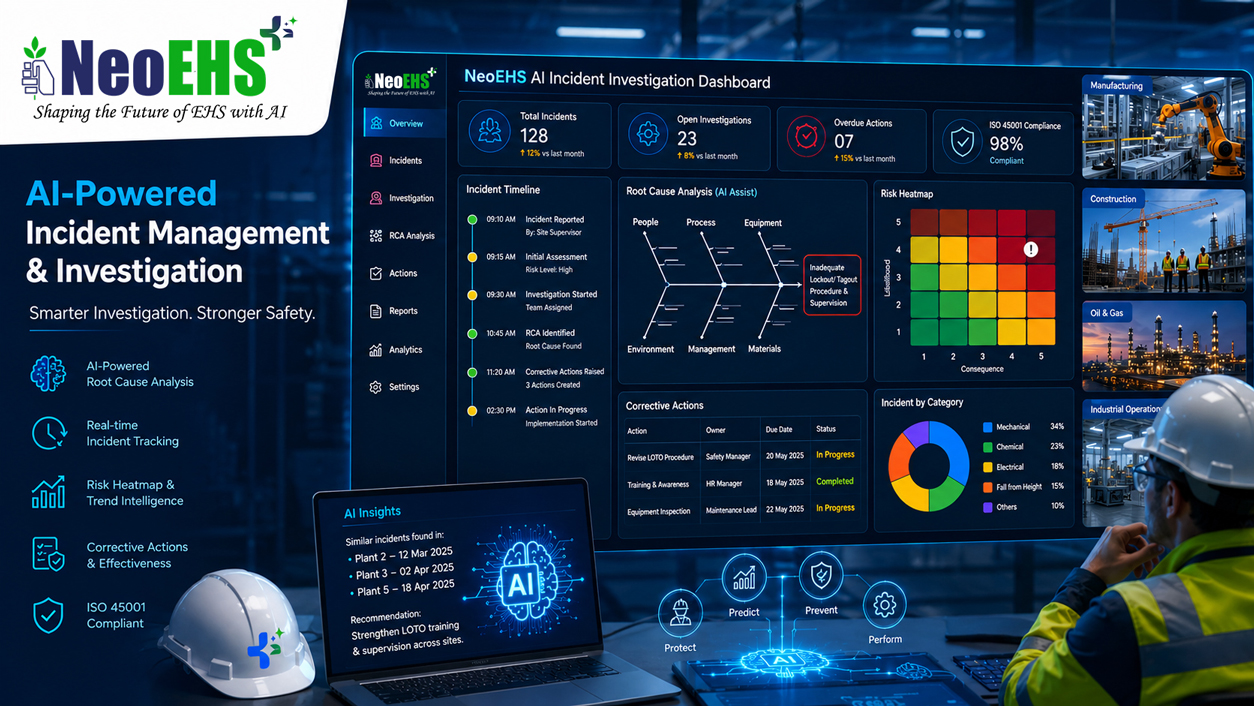
Workplace incidents rarely happen because of one single mistake. A serious injury, equipment failure, near miss, environmental event, or unsafe condition is often the result of several factors coming together—an ineffective control, inadequate training, a missed hazard, poor communication, equipment issues, or a weakness in the safety management system.
That is why ISO 45001 incident management and investigation is about much more than recording what happened.
ISO 45001:2018 requires organizations to establish, implement, and maintain processes for reporting, investigating, and taking action on incidents and nonconformities. The objective is to understand what happened, identify causes, prevent recurrence, and continuously improve the occupational health and safety management system.
For organizations managing hundreds or thousands of employees, contractors, projects, and operational sites, doing this consistently with spreadsheets, emails, and paper forms can become difficult. This is where an AI-powered EHS platform such as NeoEHS can help connect incident reporting, investigation, root cause analysis, corrective actions, risk management, and compliance evidence in one system.
What Is Incident Management Under ISO 45001?
Incident management under ISO 45001 is the structured process of reporting, responding to, investigating, correcting, and learning from workplace incidents and related nonconformities.
The goal is not simply to close an incident record.
The goal is to answer important questions:
- What happened?
- What were the immediate and underlying causes?
- Why did existing controls fail or become ineffective?
- Could a similar incident happen somewhere else?
- Are existing risk assessments still adequate?
- What corrective actions are required?
- Were those actions actually effective?
- Does the organization's OH&S management system need to change?
ISO 45001 connects incident investigation with continual improvement rather than treating an investigation as an isolated administrative exercise.
What Does ISO 45001 Clause 10.2 Require?
ISO 45001 Clause 10.2 — Incident, nonconformity and corrective action — is the key requirement governing incident investigation and corrective action.
The organization needs a process covering reporting, investigation, and action.
When an incident or nonconformity occurs, the organization should work through a structured cycle.
1. React in a Timely Manner
The first priority is to control the situation and protect people.
Depending on the event, this could involve:
- Stopping unsafe work
- Providing first aid or medical assistance
- Activating emergency procedures
- Isolating hazardous energy
- Evacuating affected areas
- Containing a spill
- Securing equipment or machinery
- Preventing further exposure
- Preserving relevant evidence
ISO guidance gives the example of a workplace fire: immediate response may involve raising the alarm, evacuating people, and controlling the fire, while subsequent actions may include inspecting the affected area, repairing equipment, and determining whether the area can safely return to service.
2. Deal With the Consequences
Incident management does not stop when the immediate danger is controlled.
Organizations may need to address:
- Injuries and occupational ill health
- Property or equipment damage
- Environmental consequences
- Production disruption
- Contractor impacts
- Regulatory requirements
- Emergency response costs
- Business continuity issues
- Psychological or workforce impacts
A strong incident management system therefore tracks both the event and its consequences.
3. Investigate the Incident
Investigation is one of the most important parts of the ISO 45001 process.
The investigation should go beyond asking:
"Who made the mistake?"
Instead, investigators should ask:
"What conditions and system factors allowed this event to happen?"
An effective investigation may examine:
- The sequence of events
- Workplace conditions
- People and competency
- Equipment and machinery
- Procedures and work instructions
- Supervision
- Training
- Communication
- Maintenance
- Permit-to-work controls
- Risk assessments
- Existing preventive measures
- Contractor management
- Organizational factors
- Previous similar incidents
ISO 45001 specifically links investigation with determining causes and checking whether similar incidents or nonconformities exist or could occur elsewhere.
4. Determine Root and Contributing Causes
Finding the immediate cause is not enough.
For example:
Incident:
A worker falls while accessing an elevated work area.
Immediate cause:
The worker lost balance.
Contributing causes might include:
- Inadequate access
- Poor housekeeping
- Inappropriate footwear
- Insufficient supervision
- Inadequate work-at-height controls
System-level causes might include:
- Inadequate risk assessment
- Weak inspection processes
- Insufficient training
- Poor implementation of procedures
- Inadequate management of change
This distinction is critical because correcting only the immediate cause may leave the underlying risk untouched.
Common Root Cause Analysis Methods
Organizations may use structured methodologies such as:
- 5 Why Analysis
- Fishbone / Ishikawa Analysis
- Fault Tree Analysis
- Barrier Analysis
- Bow-Tie Analysis
- TapRooT or other structured RCA methodologies
NeoEHS supports structured investigation workflows and RCA approaches including 5 Why, Fishbone, TapRooT, and Fault Tree Analysis.
5. Involve Workers in the Investigation
Incident investigations should not be conducted entirely behind a desk.
People who perform the work often understand operational realities that may not appear in procedures or risk assessments.
ISO 45001 Clause 10.2 specifically requires evaluation of corrective action needs with worker participation and involvement of relevant interested parties where appropriate.
Worker participation can help investigators understand:
- What actually happened in the field
- Whether procedures were practical
- Whether controls were available
- Whether controls were being followed
- Whether production pressures influenced decisions
- Whether similar hazards exist elsewhere
This also helps build a stronger safety culture.
6. Check Whether Similar Incidents Could Occur Elsewhere
One of the most valuable—and sometimes overlooked—parts of incident investigation is organizational learning.
Suppose a machine guard fails at Plant A.
The investigation should not end with repairing that machine.
Management should consider:
Do similar machines at Plants B, C, and D have the same vulnerability?
The ISO 45001 guidance provides a similar principle: organizations should determine whether similar incidents have occurred, whether related nonconformities exist, or whether they could potentially occur elsewhere.
This is where centralized EHS data becomes extremely valuable.
With digital incident management, organizations can compare:
- Sites
- Departments
- Equipment
- Activities
- Contractors
- Incident types
- Hazard categories
- Root causes
- Corrective actions
- Recurrence patterns
NeoEHS uses AI-powered pattern and recurrence analysis to identify similar historical incidents, recurring hazards, unsafe behaviors, and emerging operational risks.
7. Review Existing Risk Assessments
An incident can reveal that an existing risk assessment is no longer adequate.
ISO guidance specifically asks organizations to review existing OH&S risk assessments and other relevant risk assessments following an incident or nonconformity.
Investigators should therefore ask:
- Was the hazard identified?
- Was the risk assessed correctly?
- Were controls defined?
- Were the controls actually implemented?
- Were workers aware of the controls?
- Were the controls effective?
- Did conditions change after the assessment?
- Was a new hazard introduced?
This creates an important connection:
Incident → Investigation → Risk Review → Control Improvement
Rather than maintaining incident management and risk management as disconnected processes, organizations can use the incident as feedback into the broader safety management system.
8. Implement Corrective Actions Using the Hierarchy of Controls
Corrective action should address the underlying problem and be proportionate to the actual or potential effects of the incident.
ISO 45001 requires actions, including corrective actions, to be implemented in accordance with the hierarchy of controls and management of change.
Where appropriate, organizations should consider controls such as:
- Elimination
- Substitution
- Engineering controls
- Administrative controls
- Personal protective equipment
For example, if workers are repeatedly exposed to a hazardous process, simply providing additional PPE may not be the strongest solution.
The investigation should ask whether the hazard can be eliminated or engineered out before relying primarily on administrative controls.
9. Assess Risks Before Introducing New or Changed Controls
Corrective actions can sometimes create new risks.
For example, replacing equipment, changing a process, modifying a chemical, changing a work sequence, or introducing automation may introduce new hazards.
ISO 45001 therefore requires organizations to assess OH&S risks related to new or changed hazards before taking action where applicable.
A mature digital EHS process should therefore connect:
Incident → Corrective Action → Change → Risk Assessment → Approval → Implementation → Verification
10. Verify Corrective Action Effectiveness
Closing an action does not automatically mean the problem has been solved.
Consider this example:
A housekeeping inspection identifies repeated oil leakage around a machine.
A corrective action is assigned:
"Clean the affected area."
The task is completed.
But if the machine continues leaking oil, the hazard will return.
A stronger corrective action would investigate why the leakage occurs, address the source, and verify that the control remains effective.
ISO 45001 requires organizations to review the effectiveness of actions taken, including corrective actions.
This creates an important difference:
Action completed ≠ Action effective
An effective incident management system should therefore support evidence-based closure verification.
What Evidence Should Organizations Maintain?
ISO 45001 requires organizations to retain documented information as evidence of the nature of incidents or nonconformities, subsequent actions, and the results and effectiveness of corrective actions. Relevant information should also be communicated to workers and other relevant parties as appropriate.
Typical incident records may include:
- Incident report
- Date and time
- Location
- People involved
- Witness statements
- Photographs and videos
- Incident classification
- Injury or illness information
- Environmental impact
- Immediate actions
- Investigation findings
- Root cause analysis
- Risk assessment review
- Corrective actions
- Responsible persons
- Target dates
- Supporting evidence
- Verification results
- Management approvals
- Lessons learned
- Communication records
Digital records make this information easier to retrieve during internal audits, management reviews, certification audits, and organizational learning activities.
Incident vs Near Miss vs Nonconformity
A modern EHS program should distinguish between different types of events while still learning from each one.
Incident
An event arising out of or in the course of work that resulted in, or could result in, injury or ill health.
Near Miss
An event where injury, ill health, damage, or another undesirable consequence did not occur but could have occurred.
Unsafe Condition
A physical or environmental condition that can contribute to an incident.
Unsafe Act
An action or behavior that increases exposure to a hazard.
Nonconformity
A failure to meet a specified requirement of the OH&S management system or another applicable requirement.
These categories should not become isolated databases. They should feed into a common learning and corrective-action process.
How AI Can Improve ISO 45001 Incident Management
Traditional incident management systems are primarily designed to record information.
Modern AI-powered EHS platforms can go further by helping organizations understand patterns within their safety data.
For example, AI can assist with:
Intelligent Incident Classification
Automatically categorize incidents based on submitted information, helping route them to the appropriate workflow.
AI-Assisted Investigation
Help investigators organize incident information, identify missing investigation data, and surface potentially relevant patterns.
Root Cause Intelligence
Analyze incident information and support structured methodologies such as 5 Why and Fishbone analysis.
Similar Incident Detection
Compare a new event against historical incidents and identify potentially similar cases.
Predictive Risk Insights
Identify recurring patterns across incidents, hazards, locations, equipment, activities, or workforce groups.
Corrective Action Recommendations
Help safety teams identify possible corrective and preventive measures based on the incident context.
Evidence-Based Closure
Support verification of corrective actions using documents, photographs, inspection results, and other evidence.
NeoEHS combines AI-powered incident reporting, investigation workflows, root cause analysis, corrective action management, pattern intelligence, predictive safety analytics, and real-time dashboards within its incident management solution.
How NeoEHS Supports ISO 45001 Incident Management
NeoEHS is an AI-powered Environmental, Health and Safety (EHS) management platform designed to connect incident management with the wider safety management system.
Its incident management capabilities can support organizations across the complete incident lifecycle:
Report → Respond → Investigate → Analyze → Correct → Verify → Learn → Prevent
With NeoEHS, organizations can:
- Report incidents and near misses using mobile and web
- Capture photographs and supporting information
- Route incidents through configurable workflows
- Assign investigation responsibilities
- Conduct structured root cause analysis
- Identify recurring incidents and patterns
- Manage corrective and preventive actions
- Track action ownership and deadlines
- Escalate overdue actions
- Link incidents with hazards and risk assessments
- Monitor incident trends through dashboards
- Maintain investigation records
- Support audit-ready documentation
- Use AI-driven safety insights to identify emerging risks
NeoEHS also integrates incident management with other EHS processes such as risk assessment, hazard management, inspections, audits, permit-to-work, training, contractor safety, compliance, and environmental management.
This integrated approach matters because workplace incidents rarely belong to only one safety process.
A failed permit, inadequate risk assessment, expired training, poor inspection finding, or uncontrolled hazard can eventually become part of the incident story.
A Practical ISO 45001 Incident Investigation Workflow
Organizations looking to strengthen their incident investigation process can use the following practical workflow:
Step 1 — Report
Capture the incident, near miss, unsafe condition, or nonconformity as soon as possible.
Step 2 — Make Safe
Control the immediate hazard and protect workers.
Step 3 — Preserve Evidence
Capture photographs, videos, statements, equipment information, and relevant documentation.
Step 4 — Classify
Determine the event type, severity, potential severity, location, activity, and affected parties.
Step 5 — Investigate
Establish the sequence of events and collect facts.
Step 6 — Analyze Causes
Identify immediate, contributing, underlying, and systemic causes.
Step 7 — Check for Similar Risks
Search other sites, departments, equipment, activities, and historical incidents for similar conditions.
Step 8 — Review Risk Assessments
Determine whether existing hazard identification and risk controls remain adequate.
Step 9 — Define Corrective Actions
Select appropriate controls using the hierarchy of controls and consider management of change.
Step 10 — Assign and Track
Give every action an owner, priority, due date, and escalation path.
Step 11 — Verify Effectiveness
Confirm that the corrective action actually controls the problem.
Step 12 — Share the Learning
Communicate relevant lessons to workers and other interested parties.
Step 13 — Improve the System
Update procedures, training, risk assessments, controls, workflows, or other parts of the OH&S management system when necessary.
ISO 45001 Incident Investigation Checklist
Before closing an investigation, safety teams should ask:
- Was the incident reported without undue delay?
- Were immediate risks controlled?
- Were consequences addressed?
- Was sufficient evidence collected?
- Were relevant workers involved?
- Were the causes investigated?
- Were root and contributing causes considered?
- Were similar incidents checked?
- Were existing risk assessments reviewed?
- Were corrective actions based on the hierarchy of controls?
- Were new or changed hazards assessed?
- Were action owners and deadlines defined?
- Was corrective action effectiveness verified?
- Was relevant information communicated?
- Were necessary changes made to the OH&S management system?
- Is sufficient documented evidence available for future review?
This checklist can help organizations turn ISO 45001 requirements into an operational process rather than treating the standard as an audit-only requirement.
Why Digital Incident Management Is Becoming Essential
As organizations expand across multiple factories, construction sites, mining operations, oil & gas facilities, infrastructure projects, warehouses, ports, and other high-risk environments, maintaining consistent incident management becomes increasingly difficult.
A centralized EHS platform provides a single source of truth for safety events.
Instead of asking:
"Can someone find the incident report?"
Safety leaders can ask:
"What are our most common incident causes, where are they occurring, and what actions are preventing recurrence?"
That shift—from recording incidents to learning from incidents—is one of the biggest opportunities for digital EHS transformation.
NeoEHS brings incident management, risk management, inspections, audits, hazard management, permit-to-work, training, contractor management, compliance, environmental management, and ESG capabilities together within an integrated EHS platform.
Frequently Asked Questions
What is ISO 45001 incident management?
ISO 45001 incident management is the structured process of reporting, responding to, investigating, correcting, and learning from workplace incidents and nonconformities. Clause 10.2 connects incident investigation with corrective action and continual improvement.
Which ISO 45001 clause covers incident investigation?
ISO 45001 Clause 10.2 — Incident, nonconformity and corrective action covers the organization's processes for reporting, investigating, responding to incidents and nonconformities, implementing corrective action, checking effectiveness, and making necessary OH&S management system changes.
Does ISO 45001 require root cause analysis?
ISO 45001 requires organizations to investigate incidents or review nonconformities and determine their causes so that corrective action can prevent recurrence or occurrence elsewhere. Organizations can use structured root cause analysis methods to support this requirement.
Does ISO 45001 require worker participation in incident investigation?
Yes. Clause 10.2 requires evaluation of corrective action needs with worker participation and involvement of relevant interested parties where applicable.
Does ISO 45001 require corrective action?
Yes. Organizations must determine and implement appropriate actions, including corrective actions, and review their effectiveness. Corrective actions should be appropriate to the actual or potential effects of the incident or nonconformity.
Should a near miss be investigated?
Yes, near misses can provide valuable information about hazards and control weaknesses before an injury or other serious consequence occurs. Organizations should define appropriate reporting and investigation criteria within their OH&S management processes.
How can EHS software help with ISO 45001 incident management?
EHS software can digitize incident reporting, investigation workflows, root cause analysis, corrective action management, risk review, evidence collection, approvals, dashboards, notifications, and audit trails. NeoEHS adds AI-powered pattern analysis and predictive safety intelligence to help identify recurring risks.
Can NeoEHS support ISO 45001 incident management?
NeoEHS provides incident reporting, investigation, root cause analysis, corrective action tracking, risk management, dashboards, and compliance-oriented workflows that can support organizations implementing and maintaining an ISO 45001-aligned OH&S management system.
Conclusion
ISO 45001 incident management is not simply about documenting accidents.
It is about learning from what happened, understanding why it happened, identifying whether the same risk exists elsewhere, improving controls, verifying that corrective actions work, and strengthening the overall OH&S management system.
The most effective organizations are moving beyond reactive incident reporting toward proactive safety intelligence.
With an AI-powered EHS platform such as NeoEHS, organizations can connect incident reporting, investigation, root cause analysis, corrective actions, risk management, analytics, and compliance in one digital ecosystem.
The result is a more connected approach to safety:
Report faster. Investigate deeper. Correct smarter. Learn continuously. Prevent recurrence.
For organizations pursuing stronger ISO 45001 implementation and a more proactive safety culture, digital incident management can turn every incident and near miss into an opportunity to improve.
Please visit us at www.neoehs.com and write to us at info@neoehs.com
- NeoEHS Incident Management Software →
https://www.neoehs.com/solutions/incident-management-software - NeoEHS EHS Management System →
https://www.neoehs.com/ehs-management-system - NeoEHS EHS Software →
https://www.neoehs.com/ehs-software - NeoEHS HSE Management System →
https://www.neoehs.com/hse-management-system

 (1).png "fall protection in workplace")
.jpg "5 Why analysis diagram showing step-by-step questioning to identify root cause of workplace incidents using NeoEHS")