How AI Is Transforming Metro and Railway Safety Management
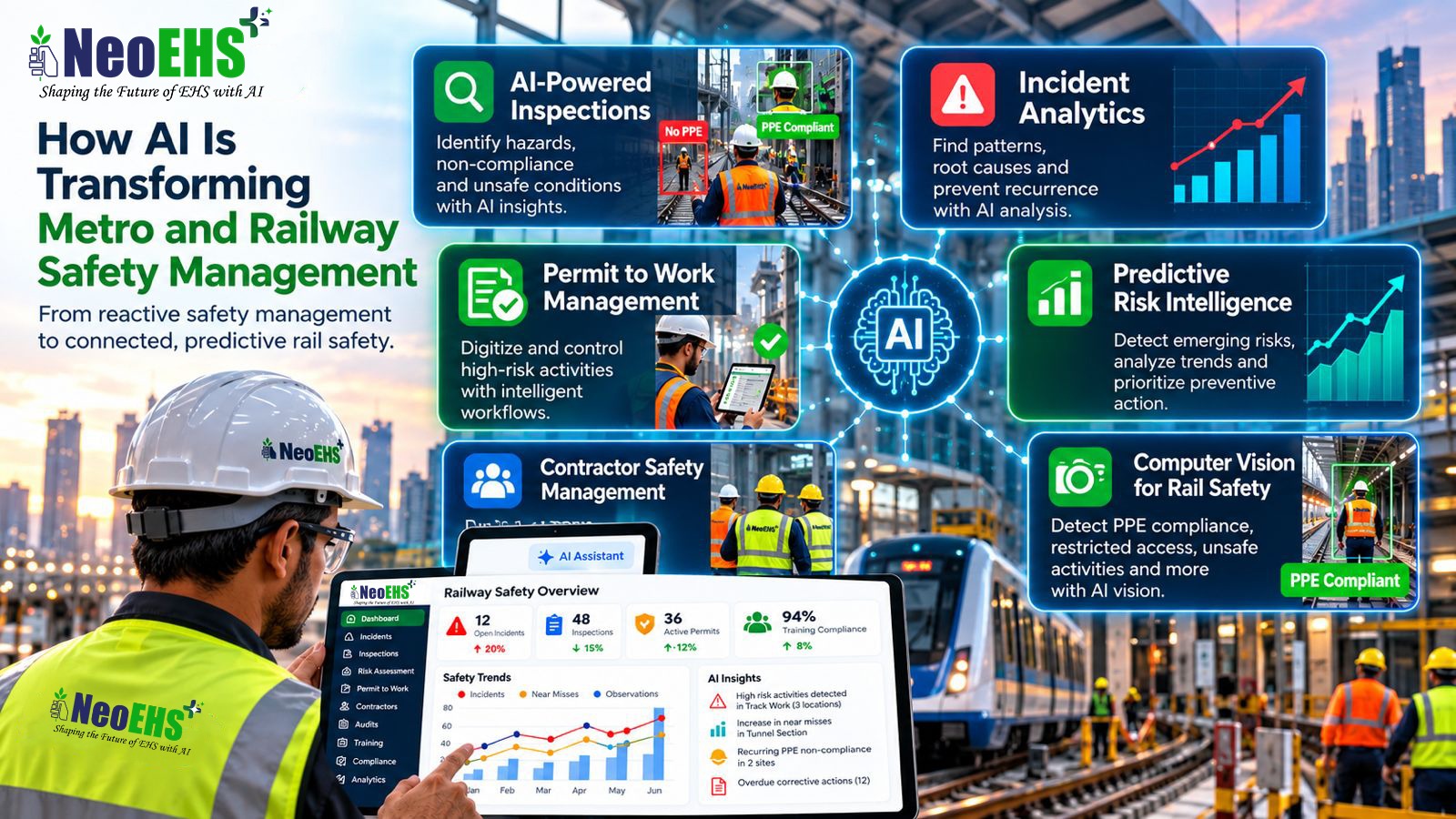
Reactive safety management to connected, predictive rail safety
Metro and railway systems are among the most complex operating environments in the world. A single network can involve trains, tracks, stations, tunnels, depots, electrical systems, signaling infrastructure, maintenance activities, contractors and large numbers of workers operating around the clock.
In such an environment, safety cannot depend only on periodic inspections and incident reporting.
Rail and metro organizations need to understand where risks are emerging, whether controls are working, and how different safety events are connected.
This is where Artificial Intelligence is beginning to change the way railway and metro safety is managed.
AI can help EHS teams analyze large volumes of safety information, identify recurring patterns, support risk assessment, improve inspections and incident investigations, and provide earlier visibility into conditions that may require attention.
The goal is not to replace railway safety professionals.
The goal is to give them better information, faster analysis and stronger decision support.
What Is AI-Powered Metro and Railway Safety Management?
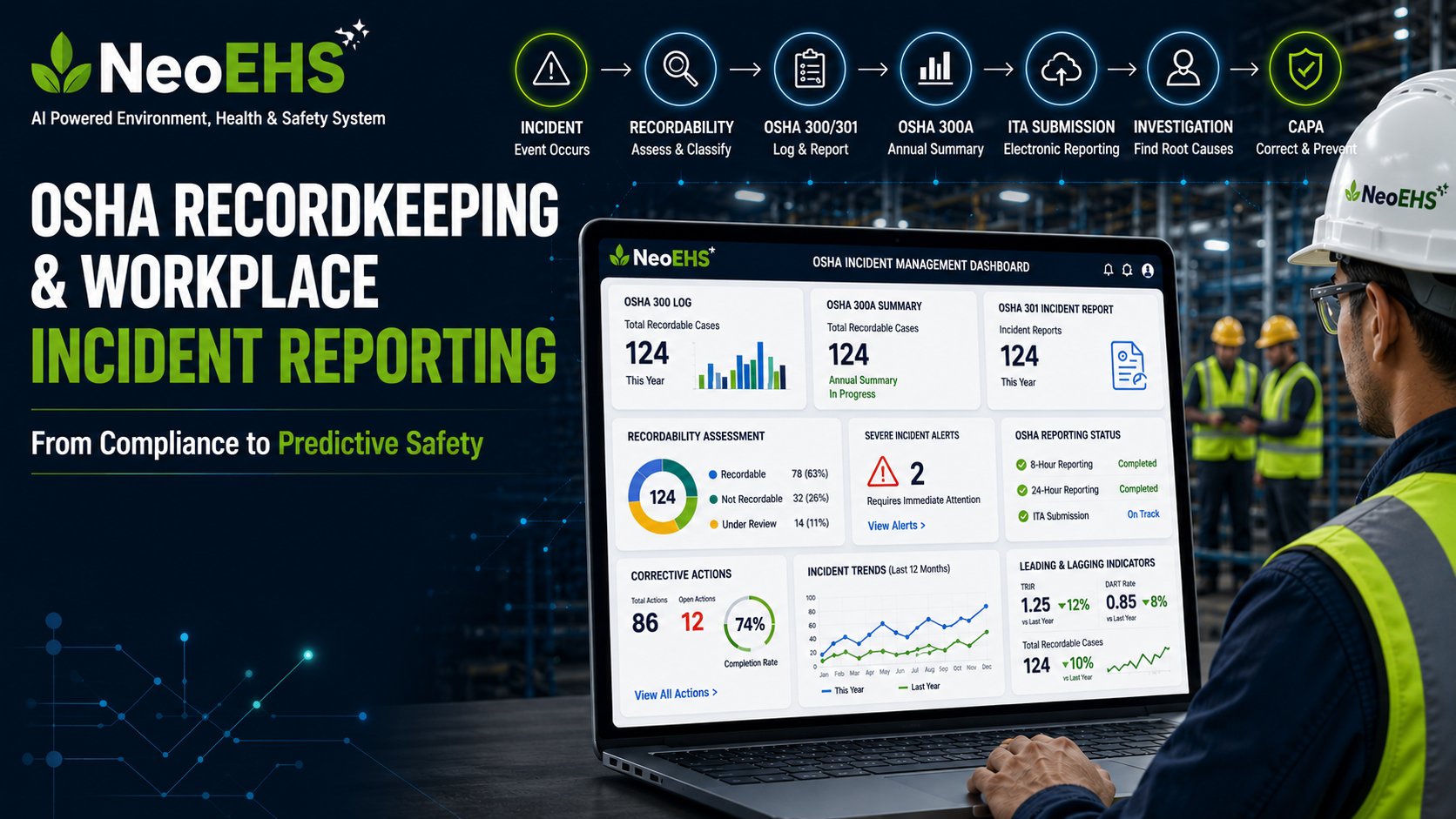
AI-powered metro and railway safety management is the use of artificial intelligence, analytics, connected data and digital EHS workflows to help rail organizations identify hazards, assess risks, manage incidents, monitor safety performance and strengthen preventive controls.
A modern AI-enabled rail safety system can bring together information from:
- Safety inspections
- Incidents and near misses
- Risk assessments
- HIRA and HIRARC
- JSA and JHA
- Permit to Work
- Safety observations
- Audits
- Contractor activities
- Training and competency
- Asset and equipment inspections
- Corrective actions
- CCTV and computer vision
- IoT and connected devices
The value comes from connecting these sources rather than treating every safety activity as a separate process.
NeoEHS follows this integrated approach by combining incident management, hazard identification, risk assessment, audits, inspections, Permit to Work, contractor management, analytics and other EHS workflows within one platform.
Why Metro and Railway Safety Needs a Different Approach
Railway safety is not simply about preventing one type of accident.
A metro or railway project may involve:
- Track construction
- Tunnel construction
- Station construction
- Electrical installation
- Signaling and communication
- Rolling stock maintenance
- Depot operations
- Work at height
- Excavation
- Lifting operations
- Confined spaces
- Hot work
- Energized electrical systems
- Contractor activities
- Passenger interfaces
- Emergency response
The risks also change as the project or operation changes.
A construction site today may become an operational railway tomorrow. A maintenance activity may introduce risks that were not present during normal train operations.
This means safety management needs to be continuous, connected and context-aware.
1. AI Can Strengthen Railway Risk Assessment
Risk assessment is at the heart of railway safety.
EHS teams may use HIRA, HIRARC, JSA, JHA, task risk assessments, Bowtie analysis and other methodologies depending on the organization and activity.
AI can support this process by analyzing information from:
- Previous incidents
- Near misses
- Safety observations
- Inspection findings
- Existing risk assessments
- Work activities
- Equipment
- Locations
- Contractor performance
- Historical trends
For example, if several inspections identify recurring risks around track maintenance, the organization can review whether the existing risk assessment adequately addresses those conditions.
NeoEHS supports HIRA, HIRARC, JSA and configurable risk assessment workflows, together with AI-enabled risk intelligence and analytics.
The important principle is:
AI can identify patterns in risk data; competent safety professionals determine what those patterns mean operationally.
2. Predictive Safety Analytics for Rail Operations
Traditional safety reporting often focuses on what has already happened.
For example:
- Number of incidents
- Lost-time injuries
- Near misses
- Audit findings
- Inspection findings
These metrics remain important.
But AI allows organizations to examine the relationships between different datasets.
For example:
Inspection findings + near misses + incidents + corrective actions + risk assessments
may reveal a pattern that is difficult to identify by looking at individual reports.
Predictive safety analytics can help identify:
- Recurring hazards
- Repeated unsafe conditions
- High-risk locations
- Repeated corrective actions
- Changing risk patterns
- Areas requiring additional investigation
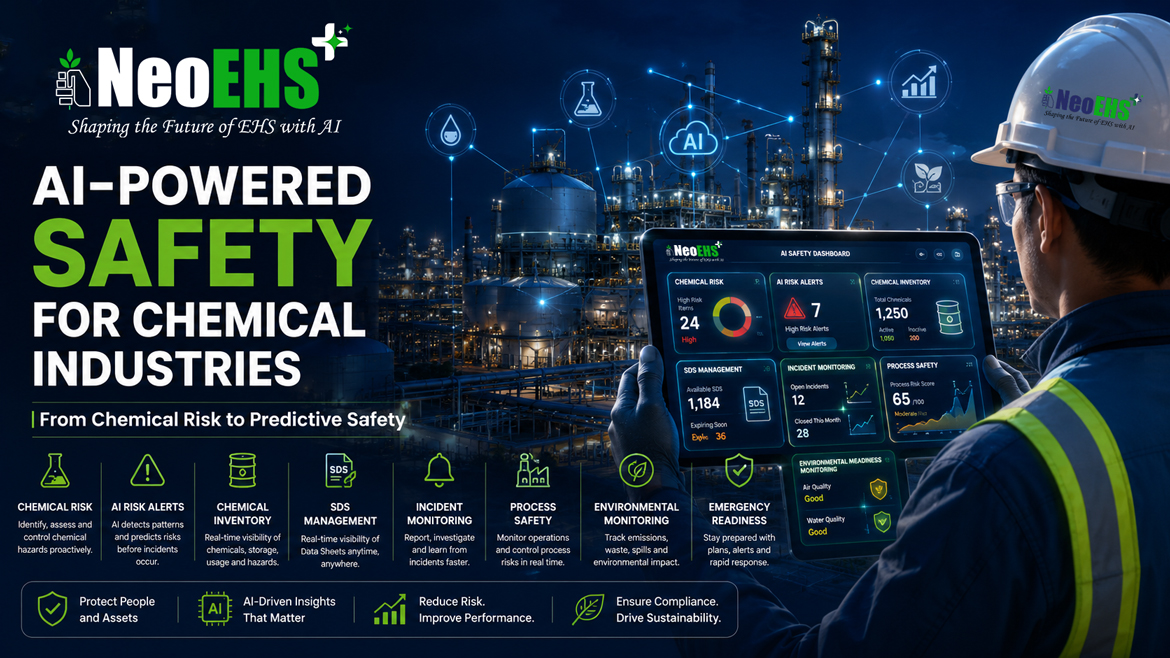
NeoEHS describes predictive risk analytics as a capability that can analyze incidents, near misses, inspections and behavioral trends to support identification of future risk patterns.
This should be understood as risk intelligence, not a guarantee that AI can predict a specific accident.
3. AI-Powered Railway Safety Inspections
Inspections generate some of the most valuable frontline safety data in a railway organization.
A digital inspection can capture:
- Findings
- Photographs
- Location
- Equipment
- Hazard category
- Risk level
- Corrective actions
- Responsible person
- Due date
AI can take this information further by identifying recurring findings and relationships across inspections.
For example:
Missing guard → repeated at three locations → similar previous finding → corrective action previously closed → issue reappeared.
That pattern deserves more attention than a single isolated observation.
NeoEHS supports digital inspections with mobile checklists, findings, corrective actions and analytics.
4. AI Can Improve Railway Incident Management
When an incident occurs, the investigation should not stop at identifying what happened.
Investigators need to understand:
Why did it happen?
Which controls failed?
Was the hazard previously identified?
Were similar events reported elsewhere?
Were previous corrective actions effective?
AI can help investigators analyze historical records and identify similar incidents, recurring hazards and related risk assessments.
NeoEHS's incident-management capability includes AI-assisted incident analysis, investigation workflows, root cause analysis, pattern detection and corrective-action tracking.
This creates a stronger connection:
Incident → Investigation → Root Cause → Corrective Action → Learning → Prevention
5. AI Can Support Root Cause Analysis
Rail incidents can have multiple contributing factors.
For example, an incident involving maintenance equipment could involve:
People
Training, competency or communication
Equipment
Condition, maintenance or guarding
Process
Procedure, permit or isolation
Environment
Lighting, weather, access or housekeeping
Management
Supervision, planning, risk assessment or change management
AI can help organize evidence and identify relationships that investigators should examine.
NeoEHS supports structured root cause methodologies including 5 Why, Fishbone/Ishikawa, Fault Tree Analysis and TapRooT, according to its incident-management documentation.
AI should support the investigation—not automatically determine blame or replace professional judgment.
6. AI and Railway Computer Vision
Computer vision is another important area of AI for rail safety.
Depending on the implementation and available data, computer vision can support detection of visually identifiable conditions such as:
- PPE compliance
- Restricted-area access
- Unsafe activities
- Certain unsafe conditions
- Worker proximity
- Site conditions
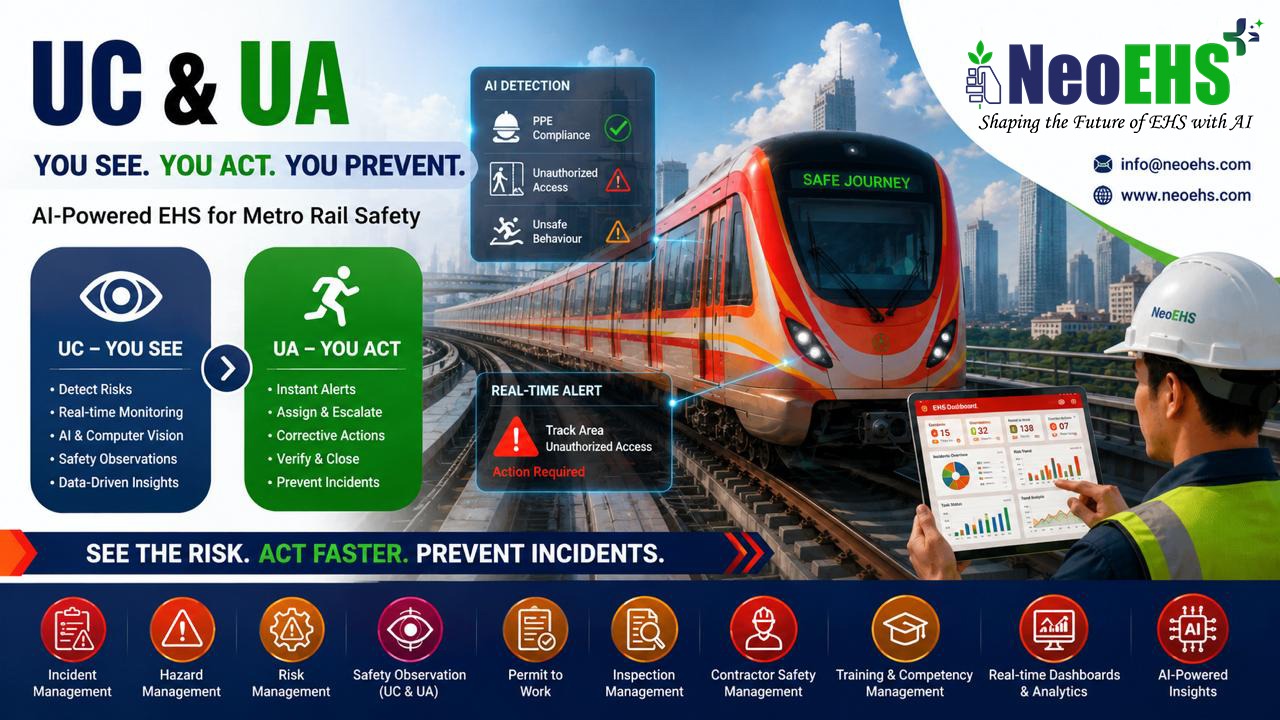
For example, a camera-based system could identify a worker entering a restricted area and generate an alert for review.
NeoEHS describes AI vision-based monitoring for areas such as PPE compliance, restricted-area access, crowd density and unsafe activities.
The purpose is not to replace physical inspections.
Instead, computer vision can provide additional continuous visibility between inspections.
7. AI Can Improve Contractor Safety
Metro and railway projects frequently involve multiple contractors and subcontractors.
This can make contractor safety management challenging.
Organizations may need to monitor:
- Contractor onboarding
- Competency
- Training
- Certifications
- Site access
- Safety observations
- Incidents
- Inspections
- Permit compliance
- Corrective actions
- Contractor performance
AI can help analyze contractor safety data and identify recurring patterns.
For example, if several contractors working on similar activities repeatedly generate the same findings, the organization can investigate whether the problem relates to:
- Training
- Supervision
- Work planning
- Procedures
- Competency
- Contractor selection
- Site controls
This is more useful than simply counting contractor incidents.
8. AI-Powered Permit to Work for Railway Projects
Metro construction and railway maintenance involve many high-risk activities.
Examples include:
- Hot work
- Electrical work
- Confined-space entry
- Excavation
- Work at height
- Lifting
- Isolation and LOTO
- Breaking containment
A digital Permit to Work system can connect permit information with risk assessments, workers, contractors and operational controls.
AI can potentially help identify inconsistencies between:
Work activity → Risk assessment → Permit → Required controls
For example, if a particular type of maintenance work repeatedly generates safety findings, the organization can review whether the permit process adequately controls the associated risk.
NeoEHS includes digital Permit to Work capabilities covering high-risk activities such as hot work, confined space, excavation and isolation.
9. AI Can Connect Safety Data Across the Railway Organization
This is where an integrated EHS platform becomes particularly valuable.
Imagine a railway organization has:
- 25 stations
- 5 depots
- Multiple construction packages
- Hundreds of contractors
- Thousands of workers
- Thousands of inspections
If every safety function operates separately, management may see fragmented information.
An integrated platform can connect:
Hazards
↓
Risk Assessments
↓
Inspections
↓
Incidents
↓
Audits
↓
Corrective Actions
↓
Training
↓
Permit to Work
This provides a more complete view of safety performance.
NeoEHS is designed around this integrated EHS model, bringing incident management, hazard management, risk assessment, audits, inspections, PTW, contractor management and other workflows into a centralized platform.
10. AI Can Help Railway EHS Teams Identify Recurring Problems
One of the strongest applications of AI is pattern recognition.
Suppose a railway organization records:
- 15 housekeeping findings
- 9 similar inspection findings
- 4 near misses
- 2 incidents
across different locations.
A traditional reporting system may show these as separate events.
AI can help identify whether they share common characteristics.
The EHS team can then investigate whether the underlying issue relates to:
- Work planning
- Maintenance
- Supervision
- Contractor management
- Training
- Procedures
- Equipment
- Site conditions
This moves the organization from closing individual findings to learning from recurring patterns.
11. AI Can Strengthen Emergency Management
Metro systems require robust emergency preparedness because incidents can involve large numbers of people and complex infrastructure.
Digital emergency management can support:
- Emergency response plans
- Evacuation procedures
- Emergency contacts
- Drill management
- Incident communication
- Emergency equipment
- Response responsibilities
- Corrective actions after drills
AI can help analyze historical emergency drills, findings and incident information to identify recurring weaknesses.
The objective is to make emergency preparedness a continuous management process rather than something reviewed only during an annual drill.
12. AI Can Improve Railway Safety Audits
Audits provide another valuable source of organizational intelligence.
An AI-enabled audit system can help identify recurring findings across:
- Stations
- Depots
- Projects
- Contractors
- Maintenance teams
- Operational units
For example:
Finding repeated at Station A → Station B → Station C
may indicate a system-level issue rather than three independent problems.
AI can help management recognize these patterns and investigate whether a corporate-level control needs improvement.
13. AI Can Help EHS Leaders Prioritize Attention
A railway EHS manager may have hundreds of open findings.
The challenge is not simply knowing how many findings exist.
The challenge is understanding:
Which issues deserve immediate attention?
AI-supported analytics can help organize information using factors such as:
- Potential severity
- Recurrence
- Location
- Exposure
- Historical incidents
- Control effectiveness
- Overdue corrective actions
This allows safety professionals to focus their time where the available evidence indicates greater concern.
14. Connected Worker Technology
The connected worker is becoming an important part of modern railway safety.
Workers can use mobile devices to:
- Report hazards
- Report near misses
- Complete inspections
- Access procedures
- Receive alerts
- Review permits
- Submit observations
- Record photographs
- Track corrective actions
This brings safety management closer to the people actually performing the work.
For rail maintenance and construction environments, where workers may spend most of their time away from offices, mobile-first EHS technology is particularly useful.
NeoEHS supports mobile reporting and field-oriented EHS workflows, including offline incident reporting and GPS-enabled reporting capabilities.
15. From Reactive Railway Safety to Predictive Prevention
The evolution of railway safety technology can be viewed in five stages:
Stage 1 — Paper-Based Safety
Forms, registers and manual reports.
Stage 2 — Digital Safety
Electronic inspections, incidents and audits.
Stage 3 — Connected EHS
Incidents, inspections, risks, audits and corrective actions become connected.
Stage 4 — Intelligent EHS
AI identifies patterns and provides decision support.
Stage 5 — Predictive Safety Intelligence
Organizations use connected historical and operational data to identify emerging risk signals and strengthen preventive controls.
The objective is not to remove humans from safety management.
It is to help safety professionals see more, understand faster and act earlier.
What Should an AI-Powered Railway Safety System Include?
A mature platform should go beyond an AI chatbot or a dashboard.
For Metro and Rail organizations, the technology architecture should ideally include:
Risk Management
- HIRA
- HIRARC
- JSA/JHA
- Dynamic risk assessment
- Bowtie analysis
Incident Management
- Incident reporting
- Near misses
- Investigation
- Root cause analysis
- CAPA
Inspection & Audit
- Digital inspections
- Mobile checklists
- Audit management
- Findings
- Corrective actions
Operational Safety
- Permit to Work
- LOTO
- Contractor management
- Training
- Emergency management
AI & Analytics
- Pattern detection
- Predictive risk analytics
- AI recommendations
- Computer vision
- Safety dashboards
- Trend analysis
The important point is that these capabilities should work together.
What AI Cannot Replace in Railway Safety
There is a temptation to describe AI as if it can independently manage safety.
That is not how responsible EHS technology should be implemented.
AI cannot replace:
- Competent railway safety professionals
- Field inspections
- Worker consultation
- Engineering judgment
- Investigation interviews
- Operational knowledge
- Emergency leadership
- Management accountability
AI can process information and identify patterns.
People provide context, verification and judgment.
That human-AI partnership is particularly important in safety-critical railway environments.
How NeoEHS Supports AI-Powered Metro & Railway Safety
NeoEHS is an AI-powered Environment, Health and Safety system designed to connect safety processes across organizations.
For Metro and Rail organizations, relevant capabilities include:
- Incident management
- Hazard management
- Risk assessment
- HIRA/HIRARC
- JSA/JHA
- Inspection management
- Audit management
- Permit to Work
- Contractor safety
- Training management
- Emergency management
- Corrective actions
- AI-powered analytics
- AI vision-based monitoring
- Predictive risk intelligence
NeoEHS's platform documentation describes these capabilities as connected EHS workflows rather than isolated modules.
For example, a safety observation identified during a railway inspection can become part of the organization's hazard and risk-management process. An incident can be investigated against previous inspections and risk assessments. Corrective actions can then be tracked and verified.
That connected approach is the foundation of rail safety intelligence.
Frequently Asked Questions
What is AI-powered railway safety management?
AI-powered railway safety management combines artificial intelligence, analytics, digital EHS workflows and operational safety data to help rail organizations identify hazards, assess risks, investigate incidents, monitor safety performance and strengthen preventive controls.
How can AI improve metro safety?
AI can analyze information from incidents, inspections, risk assessments, audits and other EHS processes to identify patterns, recurring hazards and emerging risk signals.
Can AI predict railway accidents?
AI can identify patterns and risk indicators in historical and operational data, but it should not be represented as being able to guarantee that a specific railway accident will or will not occur.
How does AI help railway risk assessment?
AI can analyze previous incidents, near misses, inspections, hazards and other safety data to help EHS teams identify relevant patterns and review whether existing risk controls remain appropriate.
How is computer vision used in railway safety?
Computer vision can support detection of certain visually identifiable conditions, such as PPE compliance, restricted-area access and selected unsafe activities, depending on the technology and deployment.
Can AI improve railway incident investigation?
Yes. AI can help investigators organize information, identify similar historical incidents, analyze recurring patterns and support root cause analysis. Qualified investigators should validate the evidence and conclusions.
What is digital EHS for railway projects?
Digital EHS uses software to manage railway safety activities such as incidents, inspections, audits, risk assessments, permits, contractors, training and corrective actions through connected digital workflows.
What should a railway EHS software system include?
A comprehensive system should support risk assessment, incident management, inspections, audits, Permit to Work, contractor management, training, emergency management, corrective actions, compliance and analytics.
Can NeoEHS be used for Metro and Rail safety?
NeoEHS provides integrated EHS capabilities relevant to infrastructure and high-risk operations, including incident management, risk assessment, inspections, audits, PTW, contractor safety, AI analytics and hazard management.
Conclusion
The future of Metro and Railway safety will not be defined by one technology.
It will come from connecting people, processes, operational data and intelligent technology.
AI can help railway organizations move beyond simply recording incidents and completing inspections.
It can help them recognize patterns.
It can connect information that previously existed in separate systems.
It can help EHS professionals understand where risks are recurring.
And, when combined with sound safety management practices, it can support earlier and more informed preventive action.
The journey is:
Digitize → Connect → Analyze → Learn → Predict → Prevent
For NeoEHS, the vision is to help organizations move from traditional EHS management toward AI-powered safety intelligence—where every incident, inspection, hazard, audit and observation contributes to a better understanding of risk.
Because the real goal of digital railway safety is not simply to produce more data.
It is to use safety data to make the railway safer.