How AI Helps Organizations Investigate Workplace Incidents
What Is a Workplace Incident Investigation?
A workplace incident investigation is a structured process used to understand the circumstances, causes and contributing factors behind an incident, near miss, injury, environmental event or other safety-related occurrence.
A good investigation normally asks:
- What happened?
- Where and when did it happen?
- Who and what were involved?
- What conditions existed at the time?
- What immediate causes contributed to the event?
- Which underlying or systemic factors were involved?
- Which controls were missing, ineffective or bypassed?
- What corrective actions are required?
- How will we verify that those actions actually worked?
Traditional investigations often depend on paper forms, spreadsheets, emails, photographs, interview notes and separate documents. That can make it difficult to connect information across an organization.
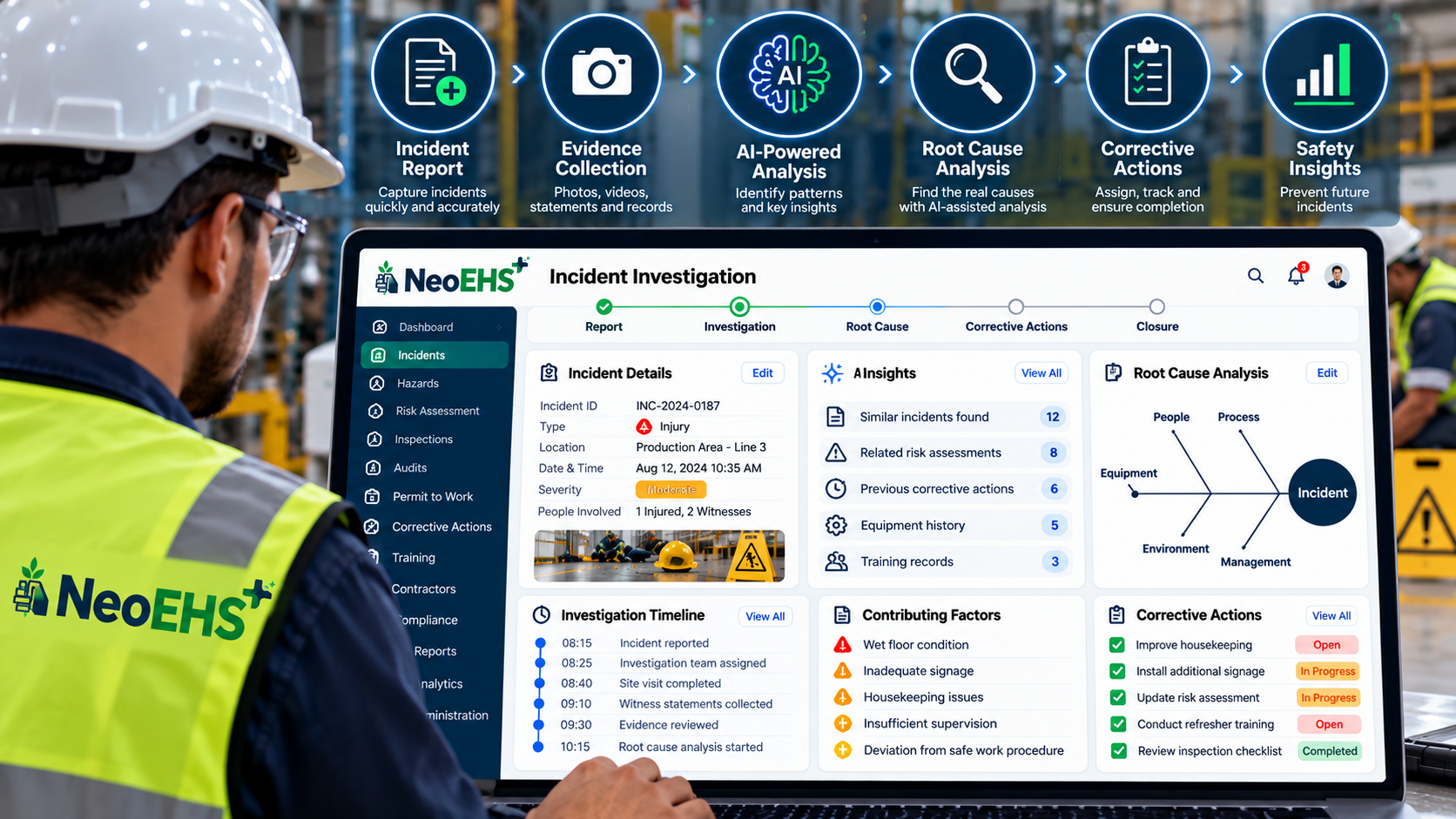
Digital incident management changes this by bringing the investigation process into one structured workflow. NeoEHS, for example, provides digital incident reporting, investigation workflows, root cause analysis and corrective-action tracking.
Why Traditional Incident Investigations Can Be Difficult
Experienced safety professionals know that the difficult part of an investigation is rarely completing the incident form.
The difficult part is finding the story hidden inside the information.
An investigation may contain:
- Incident descriptions
- Witness statements
- Photographs and videos
- Inspection records
- Previous incident reports
- Risk assessments
- JSA/JHA documents
- HIRA records
- Permit-to-work information
- Training and competency records
- Equipment inspection history
- Maintenance information
- Safety observations
- Corrective actions
- Environmental conditions
- Contractor information
When this information is stored across different systems, investigators may have to manually search through records before they can see the complete picture.
This is where AI can provide practical assistance.
How AI Helps Investigate Workplace Incidents
AI can support incident investigation at several stages of the process.
1. Faster Incident Reporting and Classification
The quality of an investigation begins with the quality of the initial information.
AI can assist employees and supervisors by analyzing incident descriptions and helping classify events according to factors such as:
- Incident type
- Injury type
- Potential severity
- Location
- Activity involved
- Equipment involved
- Hazard category
- Environmental impact
- Unsafe act
- Unsafe condition
- Near miss
For example, an employee might enter:
"Worker slipped while carrying material near the loading area. Floor was wet and no warning sign was visible."
AI can identify potentially relevant factors such as slip hazard, wet surface, material handling and inadequate warning controls, while the responsible EHS professional validates the classification.
This reduces the amount of manual sorting required at the beginning of the investigation.
2. AI Can Help Organize Investigation Evidence
An incident investigation can generate a significant amount of information.
AI can help organize and summarize:
- Witness statements
- Investigation notes
- Photographs
- Incident descriptions
- Inspection findings
- Previous incidents
- Corrective actions
- Risk assessments
- Permit records
- Training records
Instead of an investigator manually reviewing every related record, AI can help surface potentially relevant information.
For example:
Current incident: Worker injured during maintenance activity.
AI-assisted analysis could identify:
- Previous incidents involving the same equipment
- Previous inspection findings
- Similar near misses
- Existing risk assessments
- Previous corrective actions
- Training records
- Permit-to-work history
The investigator can then decide which information is actually relevant.
That distinction is important: AI can identify relationships; the investigator validates their significance.
3. AI-Assisted Root Cause Analysis
Finding the immediate cause of an incident is often relatively easy.
Finding the underlying cause is much harder.
Consider a simple example:
Incident: Worker suffered a hand injury while operating machinery.
A superficial investigation might conclude:
"Worker did not follow the procedure."
But that may not be the end of the investigation.
An effective investigation should ask:
- Was the procedure available?
- Was the worker trained?
- Was the procedure practical?
- Was the machine properly guarded?
- Was there pressure to maintain production?
- Had similar problems been reported?
- Was maintenance completed?
- Was the risk assessment current?
- Were supervisors aware of the unsafe condition?
- Was the equipment modified?
- Were previous corrective actions completed?
AI can help investigators examine these relationships and identify potential contributing factors.
This makes AI-assisted root cause analysis particularly useful when incidents involve multiple interacting conditions.
NeoEHS positions its incident-management capability around intelligent investigations, root cause analysis, corrective actions and predictive insights.
4. AI Can Identify Repeated Patterns
One incident by itself may not reveal a significant trend.
Ten apparently unrelated incidents might.
For example:
| Incident | Location | Activity | Contributing Factor |
|---|---|---|---|
| 1 | Plant A | Material handling | Poor housekeeping |
| 2 | Plant B | Material handling | Poor housekeeping |
| 3 | Plant A | Maintenance | Inadequate access |
| 4 | Plant C | Material handling | Poor housekeeping |
| 5 | Plant B | Maintenance | Inadequate access |
A human investigator looking at one incident may see an isolated event.
AI analyzing thousands of records may identify recurring relationships across:
- Sites
- Departments
- Equipment
- Activities
- Contractors
- Shifts
- Incident types
- Hazards
- Root causes
- Corrective actions
This moves the organization from incident-by-incident investigation toward organizational learning.
5. AI Can Connect Incidents With Near Misses
Near misses are particularly valuable because they can provide early warning signals.
Suppose an organization records:
- 2 injuries
- 15 near misses
- 42 unsafe-condition observations
If all of them involve similar equipment or activities, the organization may have a broader control problem.
AI can analyze these records together and identify relationships that may not be obvious when each event is reviewed independently.
This is one reason a modern EHS platform should connect incident management, safety observations, hazard management and risk assessment rather than treating them as isolated applications.
NeoEHS provides these capabilities as part of its broader EHS platform.
6. AI Can Compare an Incident With Existing Risk Assessments
A valuable investigation question is:
"Did we already know this risk existed?"
This question can reveal important weaknesses in the organization's risk-management process.
AI can help compare incident information with:
- HIRA
- HIRARC
- JSA
- JHA
- Risk registers
- Job procedures
- Safety observations
- Permit-to-work controls
For example, an incident may occur during confined-space maintenance.
The investigation could examine whether:
- The hazard was identified in the HIRA.
- The risk rating was appropriate.
- Required controls were defined.
- The permit reflected those controls.
- Workers were trained.
- The controls were actually implemented.
This creates an important connection between risk assessment and incident investigation.
7. AI Can Analyze Previous Corrective Actions
Corrective actions are only useful if they address the underlying problem.
One common EHS challenge is repeatedly creating corrective actions that look different on paper but address the same symptom.
AI can help identify:
- Similar corrective actions from previous incidents
- Repeated recommendations
- Overdue actions
- Recurring findings
- Actions that have been closed repeatedly without eliminating recurrence
- Similar incidents after corrective actions were completed
This supports a more important question:
Did the corrective action actually prevent recurrence?
That is the difference between simply closing an action and demonstrating corrective-action effectiveness.
8. AI Can Help Investigators Prioritize Evidence
Not every piece of information in an investigation has equal importance.
AI can help investigators prioritize potentially relevant evidence based on the incident context.
For example, following a machinery incident, the system might surface:
High relevance
- Machine inspection records
- Maintenance history
- Previous machine incidents
- Operator training
- Machine guarding findings
Potentially relevant
- Similar incidents at other facilities
- Previous safety observations
- Related risk assessments
The investigator can then review the evidence and determine what belongs in the final investigation.
This can reduce investigation time without removing professional judgment.
9. AI Can Support Investigation Timelines
Understanding what happened before, during and after an incident is often critical.
AI can help organize available information into a chronological timeline.
For example:
08:05 – Maintenance permit issued
08:15 – Equipment isolation recorded
08:42 – Worker entered work area
08:48 – Equipment inspection completed
08:55 – Incident reported
09:02 – Emergency response initiated
09:20 – Investigation started
A structured timeline helps investigators identify gaps between the documented procedure and what actually occurred.
10. AI Can Analyze Large Incident Databases
Large organizations may have thousands of historical records.
Manually reviewing that information is difficult.
AI can help analyze historical data to identify patterns involving:
- Incident frequency
- Severity
- Equipment
- Locations
- Work activities
- Departments
- Contractors
- Shifts
- Root causes
- Unsafe acts
- Unsafe conditions
- Corrective actions
- Recurrence
This is particularly valuable for organizations operating multiple plants, projects or countries.
NeoEHS is designed as a multi-site EHS platform with centralized incident, risk, audit, inspection and compliance capabilities.
11. AI Can Help Identify Potential Recurrence Risk
AI should not be presented as a machine that can guarantee which accident will happen next.
Workplace safety is influenced by human behavior, equipment condition, work environment, management systems and changing operational conditions.
However, AI can identify patterns associated with previous incidents and emerging risk signals.
For example, an organization may discover that incidents are more frequently associated with:
- Specific equipment
- Certain activities
- Particular locations
- Repeated housekeeping findings
- Expired training
- Contractor activities
- High-risk permits
- Repeated inspection findings
This allows EHS teams to investigate and address the underlying conditions before another event occurs.
12. AI Can Generate Investigation Summaries
Investigators often spend considerable time preparing reports for management.
AI can assist by summarizing:
- What happened
- Immediate causes
- Contributing factors
- Root causes identified by the investigation
- Evidence reviewed
- Corrective actions
- Responsible persons
- Due dates
- Recurrence concerns
The investigator should review and approve the final report rather than automatically accepting AI-generated conclusions.
This provides a useful principle for AI-powered EHS:
AI assists with analysis and documentation; qualified EHS professionals remain responsible for decisions.
AI-Powered Incident Investigation: A Practical Workflow
A modern AI-supported investigation can follow this process:
Incident Report → Evidence Collection → AI-Assisted Analysis → Investigation → Root Cause Analysis → Corrective Actions → Effectiveness Verification → Trend Analysis → Preventive Learning
Step 1 — Report
Capture the incident immediately through web or mobile reporting.
Step 2 — Collect Evidence
Bring together photographs, videos, statements, inspection records and relevant EHS information.
Step 3 — Analyze
Use AI to classify information and identify potentially relevant patterns.
Step 4 — Investigate
The investigator validates evidence, interviews personnel and establishes what actually happened.
Step 5 — Determine Causes
Use structured root cause methodologies supported by relevant evidence.
Step 6 — Correct
Assign corrective and preventive actions with responsibilities and deadlines.
Step 7 — Verify
Check whether the actions were implemented and whether they were effective.
Step 8 — Learn
Analyze the incident alongside previous incidents, near misses and safety observations.
Step 9 — Prevent
Update risk assessments, procedures, training, controls or other parts of the EHS management system where necessary.
AI Incident Investigation Should Not Become "AI Blame"
There is an important distinction between AI-assisted investigation and automated blame assignment.
An incident may involve several contributing factors.
For example:
Worker factor
Training or competency
Equipment factor
Guarding or maintenance
Work environment
Lighting, housekeeping or access
Process factor
Procedure or permit
Management-system factor
Risk assessment, supervision or change management
A mature EHS investigation should look at the entire system rather than automatically attributing the event to an individual worker.
AI should therefore help investigators expand the investigation, not prematurely narrow it.
The Role of Human Expertise in AI-Powered Investigations
Artificial Intelligence is powerful at processing information and identifying patterns.
Experienced EHS professionals remain essential for:
- Understanding operational context
- Interviewing workers and witnesses
- Validating evidence
- Determining causal relationships
- Understanding organizational conditions
- Evaluating control effectiveness
- Making safety decisions
- Communicating lessons learned
The strongest model is therefore not Human versus AI.
It is:
Human Expertise + AI Intelligence
AI can process large volumes of information quickly.
The EHS professional brings experience, judgment and knowledge of the workplace.
Together, they can create a stronger investigation process.
How NeoEHS Supports AI-Powered Incident Investigation
NeoEHS AI-Powered Incident Management Software brings incident reporting, investigation, root cause analysis, corrective actions and safety analytics into a structured digital workflow.
For organizations looking beyond incident reporting, the wider NeoEHS EHS Management Software platform connects incident management with risk assessment, audits, inspections, permit-to-work, compliance, environmental management and AI-powered analytics.
Relevant NeoEHS capabilities include:
- Incident and near-miss reporting
- Digital investigation workflows
- Root cause analysis
- Corrective and preventive action management
- Safety trend analysis
- Risk assessment
- Hazard management
- Audit and inspection management
- Permit-to-work management
- Contractor safety
- Mobile EHS reporting
- AI-powered safety intelligence
- Enterprise dashboards and analytics
This integrated approach is important because an incident should not end when the investigation report is approved. The lessons learned should flow back into the organization's risk assessments, controls, inspections, training and preventive actions.
AI Incident Investigation Across Different Industries
The investigation process varies by industry, but AI-assisted analysis can be applied across many operational environments.
Manufacturing
Analyze machinery incidents, machine guarding, maintenance history, operator training and recurring unsafe conditions.
Construction
Connect incidents with permits, contractor activities, site inspections, JSA/JHA records and changing site conditions.
Mining
Analyze incidents involving mobile equipment, ground conditions, blasting, heavy machinery and contractor activities.
NeoEHS has also addressed AI-powered incident management specifically for mining operations, including the use of incident data to support predictive safety intelligence.
Power & Energy
Connect incidents with electrical safety, LOTO, maintenance activities, permits and equipment conditions.
Oil & Gas
Analyze incidents in relation to process safety, permit-to-work, isolation, contractor activities and operational changes.
Ports & Maritime
Investigate incidents involving cargo handling, vehicle movement, lifting operations, marine activities and contractor safety.
From Incident Investigation to Safety Intelligence
The real opportunity with AI is not simply making an investigation report faster.
It is turning every incident into organizational knowledge.
A mature EHS system should allow an organization to move through four stages:
Incident → Investigation → Learning → Prevention
When the information from thousands of investigations is connected, the organization can begin to understand:
- Which hazards repeatedly appear
- Which controls frequently fail
- Which activities generate recurring incidents
- Where corrective actions are ineffective
- Which sites have similar risk patterns
- Which near misses deserve greater attention
- Where preventive controls should be strengthened
That is where an EHS platform begins to evolve from a recordkeeping system into a safety intelligence system.
Frequently Asked Questions
What is AI-powered incident investigation?
AI-powered incident investigation uses artificial intelligence to assist EHS teams in organizing incident information, analyzing evidence, identifying patterns, supporting root cause analysis, tracking corrective actions and generating safety insights.
Can AI investigate a workplace accident?
AI can assist with parts of an investigation, including information analysis, classification, pattern identification and documentation. A qualified investigator should validate evidence, establish causation and make the final investigation decisions.
How does AI help with root cause analysis?
AI can analyze incident information alongside historical incidents, risk assessments, inspections, observations and corrective actions to identify potential contributing factors and recurring patterns. The investigator should validate the findings.
Can AI identify recurring workplace incidents?
Yes. AI can analyze large historical datasets to identify recurring relationships involving equipment, activities, locations, hazards, root causes, contractors and other factors.
Can AI analyze near misses?
Yes. Near-miss information can be analyzed alongside incidents and safety observations to identify recurring hazards and early warning signals.
Can AI help prevent workplace incidents?
AI can support prevention by identifying recurring patterns, emerging risk signals and weaknesses in existing controls. It cannot guarantee that a particular accident will or will not occur.
Does AI replace EHS investigators?
No. AI should support EHS professionals rather than replace their operational knowledge, investigation skills and professional judgment.
What should an AI-powered incident management system include?
A comprehensive system should ideally include incident reporting, near-miss management, investigation workflows, evidence management, root cause analysis, corrective actions, effectiveness verification, analytics and integration with risk, audit, inspection and compliance processes.
How does NeoEHS help with incident investigation?
NeoEHS provides digital incident reporting, investigation workflows, root cause analysis, corrective-action management and safety analytics, while connecting incident management with broader EHS processes.
Conclusion
The purpose of an incident investigation is not simply to explain yesterday's event.
It is to improve tomorrow's workplace.
AI can help EHS teams process more information, identify relationships across incidents, connect events with risk assessments and previous findings, support root cause analysis and turn historical safety data into practical intelligence.
But technology alone does not create a safer workplace.
The strongest approach combines quality data, sound investigation methodology, experienced EHS professionals and responsible use of AI.
For organizations moving from reactive safety management toward proactive and predictive EHS, AI-powered incident investigation can become an important part of that journey.
Report → Investigate → Understand → Learn → Prevent.
And that is the real value of bringing AI into workplace incident management.