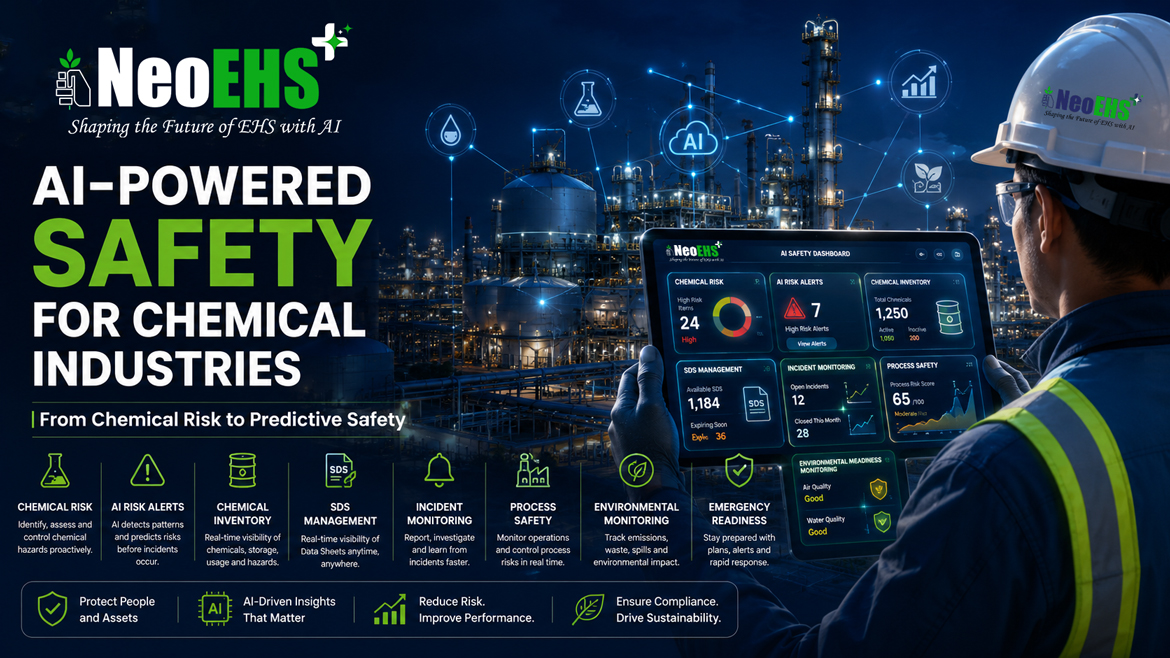
AI-Powered Safety for Chemical Industries
NeoEHS Chemical manufacturing is one of the most safety-critical industries in the world.
From hazardous substances and chemical reactions to high-pressure equipment, flammable materials, toxic exposure, process deviations, emissions, storage risks and emergency situations, chemical facilities operate in an environment where a small deviation can quickly become a serious event.
That is why chemical safety cannot depend only on periodic inspections, paper-based procedures or reacting after an incident occurs.
Modern chemical companies need to know:
Where are the risks?
Which risks are increasing?
What warning signs are we missing?
Are our controls actually working?
And can technology help us act before a serious incident occurs?
This is where AI-powered safety for chemical industries is becoming increasingly important.
NeoEHS brings artificial intelligence, predictive analytics, digital workflows, chemical management, risk management, incident management, emergency preparedness, inspections, permits and environmental compliance together within an integrated EHS platform designed for complex industrial environments.
What Is AI-Powered Safety for Chemical Industries?
AI-powered safety for chemical industries is the use of artificial intelligence, automation, predictive analytics, connected data and digital EHS workflows to identify hazards, assess risks, monitor operations, respond to incidents and prevent safety and environmental events.
Unlike traditional safety systems that primarily document what has already happened, AI-powered safety systems can analyze large volumes of EHS and operational information to identify patterns, recurring risks and potential areas of concern.
A modern chemical safety platform can connect:
- Chemical inventories
- Safety Data Sheets (SDS)
- Chemical hazards
- Risk assessments
- Process safety information
- Incidents and near misses
- Inspections
- Audits
- Permit to Work
- Chemical entry permits
- Emergency response
- Environmental monitoring
- Corrective and preventive actions
- Employee training
- Contractor activities
- IoT and sensor information
- AI-based visual monitoring
The objective is simple:
Move from reactive chemical safety to proactive and predictive safety.
Why Chemical Industries Need a Smarter Safety Approach
Chemical facilities are different from many other industrial environments because multiple risk dimensions can exist simultaneously.
A single operation may involve:
- Toxic substances
- Flammable chemicals
- Corrosive materials
- Reactive chemicals
- High temperatures
- High pressures
- Confined spaces
- Hazardous atmospheres
- Rotating machinery
- Electrical systems
- Chemical storage
- Transportation and transfer operations
- Waste streams
- Environmental emissions
A failure in one area can create consequences somewhere else.
For example:
A chemical storage issue may become a leak.
A leak may become an exposure.
An exposure may trigger an emergency response.
An emergency may lead to environmental impact.
An environmental event may create regulatory and reputational consequences.
This interconnected nature of risk makes integrated EHS management particularly valuable for chemical organizations.
From Chemical Safety Management to Chemical Safety Intelligence
Traditional chemical safety asks:
“Are we following the procedure?”
A more intelligent approach asks:
“What does our safety data tell us about where the next risk could emerge?”
That difference is significant.
Imagine a chemical plant where:
- Three minor chemical leaks have occurred in six months.
- Two inspections identified corrosion in similar equipment.
- Several maintenance activities were delayed.
- A contractor's competency certification is approaching expiry.
- A particular chemical storage area has repeated housekeeping observations.
Individually, these may appear to be unrelated events.
When connected, they may reveal an emerging operational risk.
AI can help identify relationships between these data points and bring them to the attention of EHS and operations teams.
The final decision remains with qualified professionals.
But AI can help them see the bigger picture faster.
1. AI-Powered Chemical Inventory Management
Chemical safety begins before a chemical reaches the production floor.
Knowing exactly what chemicals are present, where they are stored, how much is available and how they are being used is fundamental to effective chemical risk management.
NeoEHS Chemical Management provides centralized chemical inventory management, supplier and catalog management, risk assessment and SDS management capabilities.
A digital chemical inventory can help organizations track:
- Chemical name
- Chemical identification
- Quantity
- Storage location
- Supplier
- Hazard classification
- Storage requirements
- Expiry information
- SDS availability
- Usage
- Disposal
- Associated risks
This creates a reliable source of chemical information for EHS teams, operations and emergency responders.
2. Make Safety Data Sheets Available When They Matter
A Safety Data Sheet is not useful if employees cannot find it when they need it.
During a spill, leak or exposure event, people may need immediate access to information such as:
- Hazard identification
- Handling precautions
- Storage requirements
- PPE requirements
- First-aid measures
- Firefighting measures
- Accidental-release measures
- Exposure controls
- Disposal information
NeoEHS provides SDS management as part of its chemical management capabilities, helping organizations centralize chemical safety information.
AI can make this information even more useful by helping users search and interpret large volumes of chemical documentation.
For example:
“What PPE is required when handling this substance?”
“What are the emergency precautions for a spill?”
“Which storage requirements apply to this chemical?”
The objective is not to replace the SDS or qualified safety professionals.
It is to make critical information easier to find and use.
3. Use AI to Identify Chemical Hazards
Chemical hazard identification involves much more than knowing whether a substance is hazardous.
Organizations also need to understand:
- Where it is used
- How it is handled
- How it is stored
- What it can react with
- Who can be exposed
- How exposure could occur
- What controls are in place
- Whether those controls are effective
AI-assisted EHS workflows can help organize and analyze this information.
For example, an EHS platform can connect a chemical with:
Chemical → Hazard → Risk → Control → Inspection → Incident → Corrective Action
This creates a much stronger safety intelligence model than maintaining each record separately.
4. AI-Powered Chemical Risk Assessment
Risk assessment is central to chemical safety.
Organizations need to evaluate hazards associated with chemical handling, storage, transfer, processing and disposal.
NeoEHS Risk Management supports methodologies including HIRA, JSA/JHA, FMEA, HAZOP, RCA and Bowtie analysis, with configurable risk assessment workflows and predictive risk intelligence.
For chemical industries, this can support risk assessments around:
- Chemical exposure
- Toxic releases
- Fire
- Explosion
- Chemical incompatibility
- Storage failure
- Pressure events
- Process deviations
- Equipment failure
- Maintenance activities
- Contractor activities
- Confined spaces
- Emergency situations
AI can help identify patterns across historical assessments, incidents, inspections and observations.
5. Process Safety and AI
Process safety is one of the most important areas for chemical manufacturing.
A process safety event may involve:
- Loss of containment
- Pressure excursions
- Temperature deviations
- Equipment failure
- Chemical reactions
- Fire
- Explosion
- Toxic release
The challenge is that process safety information is often distributed across different systems.
An intelligent EHS platform can help bring relevant safety information together.
For example:
Process deviation → Risk assessment → Permit → Inspection → Incident → RCA → CAPA → Risk reassessment
This creates a continuous process safety learning cycle.
AI can then analyze historical information to identify recurring deviations and risk patterns.
6. AI-Powered Incident Management for Chemical Plants
Chemical incidents require rapid reporting and structured investigation.
Examples include:
- Chemical spills
- Leaks
- Exposure incidents
- Uncontrolled releases
- Fires
- Explosions
- Equipment failures
- Environmental incidents
- Near misses
- Unsafe chemical handling
NeoEHS Incident Management supports incident reporting, AI-powered analysis, root cause analysis, predictive insights, corrective actions and environmental incident tracking.
The goal is not simply to record the event.
It is to understand:
What happened?
Why did it happen?
Has something similar happened before?
Was the risk previously identified?
Were controls in place?
Did an inspection identify the issue?
What must change to prevent recurrence?
7. AI-Assisted Root Cause Analysis
Chemical incidents can have multiple contributing causes.
For example, a chemical leak may initially appear to be caused by equipment failure.
But deeper investigation may reveal:
- Inadequate preventive maintenance
- Corrosion
- Incorrect operating procedure
- Poor inspection frequency
- Training gaps
- Inadequate supervision
- Procurement issues
- Incompatible materials
- Management-of-change failure
This is why stopping at the immediate cause can be dangerous.
AI-assisted analytics can help investigators identify recurring relationships across historical incidents, inspections, hazards and corrective actions.
NeoEHS supports structured risk and RCA methodologies including 5 Why, Fishbone, Pareto, RCA and Bowtie analysis.
AI should support the investigator—not replace the investigator's professional judgment.
8. Predict Chemical Safety Risks Before an Incident
This is where AI can provide significant value.
Predictive safety analytics can examine historical and current information to identify patterns associated with increasing risk.
Potential data sources include:
- Incident history
- Near misses
- Chemical leaks
- Inspection findings
- Audit findings
- Risk assessments
- Equipment information
- Maintenance data
- Permit activity
- Contractor information
- Training records
- Environmental conditions
- Safety observations
NeoEHS uses predictive risk intelligence to analyze incidents, near misses, inspection history and behavioral trends to identify potential future risks.
The important point is that predictive analytics should not be presented as a guarantee that an accident will be predicted.
Rather, it helps organizations identify risk signals early enough to investigate and intervene.
9. Intelligent Chemical Entry Permits
Certain chemical operations require controlled access and authorization.
NeoEHS provides a dedicated Chemical Entry Permit workflow for environments where hazardous or toxic chemicals are stored, processed or handled. It supports digital applications, approvals, customizable checklists, notifications, safety information and real-time monitoring.
A digital Chemical Entry Permit can help control:
- Who enters the area
- Why they are entering
- What chemical is involved
- Required PPE
- Required precautions
- Permit validity
- Required training
- Emergency procedures
- Supporting documentation
This becomes particularly important during:
- Chemical sampling
- Equipment maintenance
- Calibration
- Repairs
- Chemical transfer
- Inspection activities
- Spill response
- Emergency intervention
10. Permit to Work for High-Risk Chemical Activities
Chemical facilities frequently perform maintenance and non-routine work that introduces additional hazards.
Examples include:
- Hot work
- Confined space entry
- Electrical work
- Line breaking
- Equipment isolation
- Work at height
- Excavation
- Maintenance activities
A digital Permit to Work system can help ensure that critical controls are verified before work begins.
NeoEHS provides digital permit creation, multi-level approval, LOTO validation, contractor authorization, safety verification and real-time permit monitoring.
For chemical plants, PTW can become much more powerful when connected with:
Risk Assessment + Chemical Information + LOTO + Contractor Competency + Incident Management + Inspections
This creates a connected high-risk work control system.
11. AI-Powered Hazard Detection
Chemical facilities contain many hazards that can potentially be identified through digital inspections and intelligent monitoring.
NeoEHS Hazard Management supports AI-enabled hazard detection, digital inspections, dynamic risk scoring, real-time alerts and predictive safety analytics.
Potential monitoring areas include:
- PPE compliance
- Unsafe acts
- Restricted areas
- Unsafe conditions
- Chemical handling activities
- Storage areas
- High-risk work zones
- Operational deviations
Computer vision can provide another layer of safety intelligence when integrated appropriately with site safety processes.
12. Environmental Monitoring Is Part of Chemical Safety
Chemical safety is not limited to protecting employees.
Chemical operations can also affect:
- Air quality
- Water
- Soil
- Waste streams
- Emissions
- Surrounding communities
- Ecosystems
A chemical release may therefore become both a workplace safety event and an environmental event.
That is why chemical EHS programs should connect occupational safety with environmental management.
NeoEHS's Chemical Industry solution covers chemical risk, incidents involving spills and leaks, environmental compliance and related EHS workflows.
This supports a broader concept:
People safety + process safety + environmental safety = chemical safety intelligence.
13. Emergency Preparedness for Chemical Incidents
A chemical emergency can develop rapidly.
Organizations must be prepared to respond to scenarios such as:
- Chemical spills
- Toxic releases
- Fires
- Explosions
- Gas leaks
- Exposure events
- Environmental releases
- Equipment failures
NeoEHS Emergency Management provides centralized emergency coordination, incident tracking, mapping, resource management, communications and alerts.
An intelligent emergency management approach can connect:
Incident → Location → People → Resources → Emergency Procedure → Communication → Response → Recovery
This can help teams make faster, more informed decisions during critical events.
14. Training and Competency Management
Technology cannot replace competent people.
Chemical workers need appropriate knowledge and competency for the tasks they perform.
Training may cover:
- Chemical handling
- PPE
- SDS interpretation
- Spill response
- Emergency procedures
- Process safety
- Permit requirements
- Confined space
- LOTO
- Hazard communication
- Waste handling
- Environmental procedures
An EHS platform can connect competency information with work authorization and risk.
For example:
Worker → Training → Certification → Chemical Activity → Permit → Risk Controls
This can help prevent situations where an individual performs a high-risk task without the required competency.
15. AI-Powered Safety Inspections
Inspections remain one of the most important proactive safety activities in chemical plants.
Digital inspections can identify:
- Storage problems
- Damaged containers
- Labeling issues
- Housekeeping deficiencies
- PPE gaps
- Equipment conditions
- Emergency equipment issues
- Chemical incompatibility risks
- Unsafe work practices
NeoEHS connects inspection information with incidents, permits, risk management, audits, contractor management and corrective actions.
This means an inspection finding does not have to remain an isolated observation.
It can automatically become:
Finding → Risk → Action → Owner → Deadline → Verification
16. Turn Every Incident Into Organizational Learning
One of the biggest opportunities for AI in chemical safety is learning from history.
Suppose a company operates ten plants.
One plant experiences a chemical leak caused by a specific maintenance issue.
A traditional system may close the incident after the investigation.
A connected AI-powered system can ask:
Do our other plants have the same equipment?
Have they experienced similar findings?
Do they use the same maintenance procedure?
Are the same contractors involved?
Have similar inspection findings been reported?
This is where enterprise-wide safety intelligence becomes powerful.
The lesson from one facility can become a preventive action across the entire organization.
17. From Reactive Chemical Safety to Predictive Safety
Traditional chemical safety often follows this cycle:
Incident → Investigation → Corrective Action → Closure
A predictive safety model expands the cycle:
Data → Detect → Assess → Predict → Prevent → Verify → Learn
That means organizations can use:
- Incidents as lagging indicators
- Near misses as warning signals
- Inspections as leading indicators
- Risk assessments as predictive inputs
- AI analytics as pattern recognition
- Corrective actions as prevention mechanisms
This is the direction in which modern EHS technology is moving.
NeoEHS positions its EHS platform around AI-powered risk intelligence, incident management, hazard management, inspections, permits, compliance and predictive analytics.
AI-Powered Safety for Chemical Industries: A Connected Architecture
A mature chemical safety ecosystem can look like this:
Chemical Inventory
↓
SDS & Hazard Information
↓
Risk Assessment
↓
Process Safety
↓
Permit to Work
↓
Inspection & Monitoring
↓
Incident & Near-Miss Reporting
↓
AI Investigation & Root Cause Analysis
↓
CAPA
↓
Environmental & Compliance Monitoring
↓
Predictive Safety Analytics
↓
Continuous Improvement
This creates one connected safety intelligence loop rather than a collection of independent applications.
AI-Powered Chemical Safety vs Traditional Chemical Safety
| Traditional Chemical Safety | AI-Powered Chemical Safety |
|---|---|
| Paper-based chemical records | Centralized digital chemical inventory |
| Manual SDS management | Searchable digital SDS intelligence |
| Periodic risk assessments | Continuous risk intelligence |
| Reactive incident investigation | AI-assisted investigation |
| Isolated safety records | Connected EHS data |
| Manual inspections | Mobile digital inspections |
| Manual permit approvals | Intelligent digital PTW |
| Historical reporting | Predictive analytics |
| Reactive emergency response | Connected emergency intelligence |
| Site-by-site learning | Enterprise-wide safety learning |
| Manual CAPA tracking | Automated action workflows |
| Compliance after the fact | Continuous compliance visibility |
The purpose of AI is not to remove safety professionals from the process.
It is to give them better information, earlier signals and faster decision support.
Why Chemical Companies Should Consider an Integrated EHS Platform
Chemical safety becomes difficult to manage when information is scattered across:
- Excel spreadsheets
- Paper forms
- SDS folders
- ERP systems
- Maintenance systems
- Inspection applications
- Incident databases
- Contractor systems
An integrated EHS platform creates a centralized source of safety information.
NeoEHS is designed as an integrated EHS platform covering incident management, risk assessment, hazard management, inspections, audits, permits, chemical management, emergency management, compliance and environmental/ESG capabilities.
This can help EHS leaders move from managing individual processes to managing the entire safety lifecycle.
Key Benefits of AI-Powered Safety for Chemical Industries
1. Earlier Risk Identification
Identify recurring hazards and emerging patterns before they escalate.
2. Better Chemical Visibility
Know what chemicals exist, where they are located and what hazards are associated with them.
3. Faster Incident Response
Capture and communicate incidents quickly through digital workflows.
4. Stronger Root Cause Analysis
Use structured investigation and historical data to understand why incidents occur.
5. Better High-Risk Work Control
Connect risk assessments, permits, isolation and contractor competency.
6. Improved Environmental Protection
Track chemical releases, spills, environmental events and compliance information.
7. Stronger Emergency Preparedness
Centralize emergency information, communication and response coordination.
8. Better Regulatory Readiness
Maintain structured records, workflows, evidence and audit trails.
9. Enterprise-Wide Learning
Share safety lessons from one plant across the organization.
10. More Proactive Safety Decisions
Use AI analytics to identify patterns and prioritize preventive action.
Frequently Asked Questions
What is AI-powered safety in the chemical industry?
AI-powered safety in the chemical industry combines artificial intelligence, analytics, automation and digital EHS data to identify hazards, assess risks, monitor safety performance, investigate incidents and support preventive actions.
How can AI improve chemical safety?
AI can analyze large volumes of safety data to identify recurring incidents, hazards, inspection findings, unsafe behaviors and emerging risk patterns, helping EHS teams prioritize preventive action.
Can AI prevent chemical accidents?
AI cannot guarantee that accidents will be prevented. However, AI-powered analytics can identify risk signals and recurring patterns that may help organizations intervene earlier and strengthen controls.
What is chemical safety management software?
Chemical safety management software helps organizations manage chemical inventories, SDS information, chemical hazards, risk assessments, compliance, storage information and related safety workflows. NeoEHS provides a dedicated Chemical Management solution for these activities.
How does NeoEHS manage Safety Data Sheets?
NeoEHS provides centralized SDS management as part of its Chemical Management solution, helping organizations maintain accessible chemical safety information.
Can NeoEHS manage chemical spills and leaks?
Yes. NeoEHS's Chemical Industry solution supports incident management for events such as spills, leaks and exposure incidents, with workflows for tracking incidents through resolution and corrective action.
Can NeoEHS manage chemical entry permits?
Yes. NeoEHS provides a dedicated Chemical Entry Permit solution for controlling access to areas where hazardous or toxic chemicals are stored, processed or handled.
Can NeoEHS support Permit to Work in chemical plants?
Yes. NeoEHS provides digital PTW workflows covering high-risk work authorization, approvals, LOTO validation, contractor authorization and safety verification.
Can AI be used for chemical hazard detection?
AI can support hazard identification through predictive analytics, digital inspections, image analysis and computer-vision-based safety monitoring. NeoEHS provides AI-enabled hazard management capabilities.
Why should chemical companies integrate EHS systems?
Integration creates a connected safety information environment where chemical data, risks, incidents, inspections, permits, corrective actions and emergency information can be analyzed together rather than managed in isolated systems.
The Future of Chemical Safety Is Intelligent, Connected and Proactive
Chemical safety has always required discipline.
But today's chemical industry also requires something else:
visibility.
Organizations need to understand what is happening across their facilities, where risk is increasing and whether existing controls are actually working.
AI can help make that possible.
The future is not about replacing EHS professionals with artificial intelligence.
It is about giving EHS professionals better intelligence.
A chemical safety professional should not have to search through hundreds of spreadsheets to discover that the same problem has occurred at three different facilities.
A plant manager should not have to wait for a monthly report to discover that a risk is increasing.
An emergency response team should not have to search through folders for critical chemical information.
A safety manager should not have to manually compare years of incident data to identify recurring patterns.
AI can help connect those signals.
And when those signals are connected, organizations can move from:
Reactive → Proactive
Data → Intelligence
Incident → Learning
Risk → Prevention
Compliance → Continuous Improvement
Building the Next Generation of Chemical Safety With NeoEHS
NeoEHS brings together Chemical Management, SDS Management, Risk Management, Hazard Management, Incident Management, Inspections, Permit to Work, Emergency Management, Compliance and AI-powered safety intelligence within a unified EHS ecosystem.
For chemical manufacturers, processors, distributors and other organizations handling hazardous substances, this integrated approach can provide a stronger foundation for managing safety, environmental responsibility and operational risk.
The future of chemical safety is not simply safer chemical handling.
It is a connected system that continuously learns from data, identifies emerging risks and helps people act before those risks become serious events.
That is the promise of AI-powered safety for chemical industries.
And that is where NeoEHS can help.
Explore:
- NeoEHS Chemical Industry EHS Software
- NeoEHS Chemical Management Software
- NeoEHS Risk Management Software
- NeoEHS Incident Management Software
- NeoEHS Hazard Management Software
- NeoEHS Chemical Entry Permit
- NeoEHS Permit to Work Software
- NeoEHS Emergency Management Software
- NeoEHS EHS Software