AI Safety Management for Ports and Maritime Operations
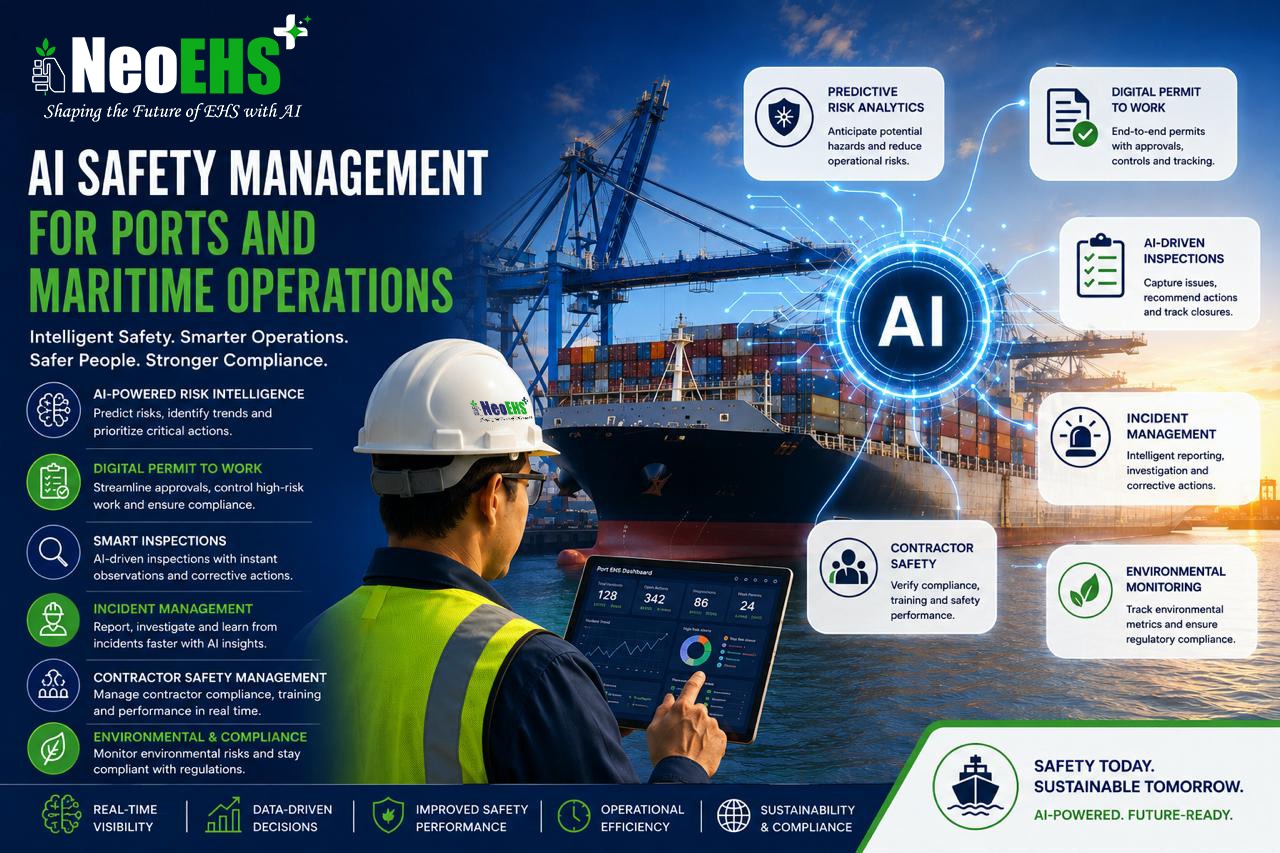
Ports and maritime facilities are among the most complex working environments in the world.
A single port can involve vessels, cranes, cargo handling equipment, trucks, warehouses, contractors, maintenance teams, marine personnel and hundreds of workers operating across multiple areas at the same time.
Safety risks can change within minutes.
A vessel arrives. Cargo operations begin. A crane starts lifting. A contractor begins maintenance. Hot work is authorized. A confined-space activity is planned. Weather conditions change. Traffic patterns shift.
For safety teams, the challenge is not simply collecting safety information.
The real challenge is understanding what is happening across the operation and identifying where risk is increasing before an incident occurs.
This is where AI safety management for ports and maritime operations can make a significant difference.
Artificial intelligence can help organizations connect information from incidents, inspections, permits, risk assessments, contractors, equipment and compliance processes to create a more proactive approach to maritime safety.
Instead of managing safety as a collection of separate activities, organizations can begin building a connected safety intelligence system.
Capture → Connect → Analyze → Predict → Act → Improve
What Is AI Safety Management for Ports and Maritime Operations?
AI safety management for ports and maritime operations is the use of artificial intelligence, predictive analytics, automation and connected safety technologies to identify risks, analyze safety information, support decision-making and improve operational safety.
In a traditional port safety environment, information may be distributed across:
- Paper forms
- Spreadsheets
- Emails
- Inspection records
- Permit documents
- Incident reports
- Contractor records
- Equipment inspections
- Audit findings
- Compliance documentation
AI-powered maritime safety management brings these sources together and helps safety teams understand relationships between them.
For example, several crane inspection findings combined with repeated maintenance observations and near misses may indicate a developing equipment-related risk.
A conventional system may store those records.
An intelligent system can help connect the signals and bring the potential risk to the attention of the responsible team.
NeoEHS provides a dedicated Port & Maritime Safety Management Software platform for ports, terminals, shipyards and marine facilities, covering digital inspections, permits, incidents, contractor safety, compliance and AI-powered risk intelligence. Explore NeoEHS Port & Maritime Safety Management Software
Why Is Safety Management Challenging in Ports?
Port and maritime operations have a unique combination of hazards.
These can include:
- Vessel movements
- Cargo handling
- Heavy lifting
- Crane operations
- Working at height
- Confined spaces
- Hot work
- Electrical work
- Ship maintenance
- Fuel and chemical handling
- Vehicle and pedestrian interaction
- Marine pollution risks
- Contractor activities
- Weather-related hazards
- Restricted-access areas
- Emergency response requirements
The complexity increases when multiple activities occur simultaneously.
A maintenance contractor may be working near cargo operations.
A crane may be operating while vehicles move through the same area.
Hot work may be taking place on a vessel while other contractors are performing maintenance nearby.
These interactions create the possibility of simultaneous operations (SIMOPS) and changing risk conditions.
This is why modern maritime safety management needs more than static checklists.
It needs continuous visibility and intelligent risk awareness.
How AI Can Transform Port Safety Management
AI can support maritime safety across the entire operational lifecycle.
1. AI-Powered Risk Management
Risk management is at the center of effective port safety.
AI can analyze information from:
- Risk assessments
- Incidents
- Near misses
- Inspections
- Safety observations
- Permit activities
- Equipment findings
- Contractor performance
- Historical trends
The objective is to identify patterns that may indicate increasing risk.
For example:
Multiple observations related to crane operations + repeated inspection findings + overdue corrective actions
may indicate that a particular operational area requires additional attention.
NeoEHS provides AI-enabled risk management capabilities including predictive analytics, risk monitoring, HIRA, JSA, JHA, FMEA and HAZOP-related workflows. NeoEHS AI Risk Management Software
2. Predictive Safety Analytics for Ports
Traditional safety reporting often focuses on what has already happened.
AI can help organizations examine what may be changing.
Imagine a port has experienced:
- Increasing near misses
- More crane-related observations
- Repeated equipment inspection findings
- Increasing contractor activity
- Several overdue corrective actions
Individually, each item may appear manageable.
Together, they could indicate an emerging risk.
Predictive analytics can help identify such patterns and prioritize areas for investigation.
The objective is not to claim that AI can predict an incident with certainty.
Rather, it can help identify risk signals and patterns that deserve human attention.
3. Digital Permit to Work for Maritime Operations
High-risk work is common in ports, terminals and shipyards.
Examples include:
- Hot work
- Confined-space entry
- Electrical work
- Lifting operations
- Work at height
- Maintenance activities
- Isolation and LOTO
- Welding and cutting
- Tank entry
- Hazardous-area work
A digital Permit to Work system can centralize authorization, approvals, risk controls and work status.
AI can add another layer by helping validate information before high-risk work begins.
For example:
Work Activity
↓
Risk Assessment
↓
Contractor Verification
↓
Worker Competency
↓
Required Controls
↓
Permit Approval
↓
Work Execution
↓
Safety Verification
↓
Permit Closure
NeoEHS's Permit to Work platform supports digital permit creation, multi-level approval, isolation and LOTO validation, contractor authorization, mobile workflows, QR verification, geotagged evidence and real-time permit monitoring. NeoEHS Intelligent Permit to Work Software
4. AI-Powered Maritime Inspections
Inspections are fundamental to port safety.
Safety teams may need to inspect:
- Cranes
- Cargo equipment
- Berths
- Vessels
- Warehouses
- Containers
- Vehicles
- Electrical systems
- Fire protection systems
- PPE
- Restricted areas
Paper-based inspections make it difficult to identify trends across thousands of findings.
Digital inspections create structured data.
AI can then help identify:
- Recurring findings
- High-risk areas
- Repeated equipment issues
- Overdue corrective actions
- Trends by location
- Trends by contractor
- Trends by asset
NeoEHS provides mobile and AI-enabled inspection management with configurable checklists, evidence capture, corrective-action tracking and trend analysis. NeoEHS Inspection Management Software
5. AI-Powered Incident Management
When an incident occurs in a port, speed and accuracy matter.
An effective digital incident process should allow teams to:
- Report the incident quickly.
- Capture evidence.
- Classify the event.
- Assess severity.
- Investigate causes.
- Identify corrective actions.
- Track closure.
- Analyze recurrence.
AI can support several of these stages.
For example, AI can help identify similar historical incidents, categorize events, highlight recurring patterns and support root-cause analysis.
NeoEHS's Incident Management platform supports digital reporting, AI-assisted risk analysis, pattern and recurrence analysis, root-cause investigation, corrective-action tracking and predictive safety intelligence. NeoEHS AI-Powered Incident Management Software
6. Contractor Safety Management
Contractors are an essential part of port and shipyard operations.
They may perform:
- Maintenance
- Welding
- Electrical work
- Cleaning
- Mechanical work
- Cargo-related activities
- Construction
- Equipment servicing
- Vessel maintenance
The challenge is ensuring that contractor safety requirements remain visible throughout the entire lifecycle.
A digital contractor safety process can track:
- Contractor approval
- Worker competency
- Training
- Induction
- Certifications
- Safety performance
- Incidents
- Observations
- Permits
- Corrective actions
- Compliance status
AI can help identify contractors or activities requiring additional safety attention based on historical performance and current operational information.
NeoEHS connects contractor compliance with Permit to Work, safety workflows and the wider EHS ecosystem. NeoEHS Port & Maritime Safety Management Platform
7. AI for Crane and Equipment Safety
Cranes and cargo-handling equipment are critical to port operations.
Equipment safety management can involve:
- Inspection schedules
- Maintenance records
- Defects
- Safety observations
- Operator competency
- Incident history
- Corrective actions
- Asset condition
AI can help identify patterns across these records.
For example:
A crane with increasing inspection findings, repeated maintenance issues and a history of safety observations may deserve additional attention.
NeoEHS's maritime platform specifically describes equipment risk analysis and AI-supported identification of assets requiring attention.
The important principle is that AI should support engineering and safety decisions, not replace qualified inspection or maintenance professionals.
8. Maritime Emergency Management
Ports need to be prepared for emergencies such as:
- Fire
- Explosion
- Chemical release
- Oil spill
- Vessel collision
- Severe weather
- Equipment failure
- Medical emergencies
- Confined-space incidents
- Security events
AI can support emergency preparedness by helping organizations maintain visibility into:
- Emergency plans
- Response teams
- Equipment
- Training
- Drills
- Inspection status
- Incident history
- Critical assets
An integrated platform can also help connect emergency information with incidents, inspections and corrective actions.
9. AI-Powered Maritime Compliance Management
Maritime organizations operate within a complex compliance environment.
Depending on the operation and jurisdiction, organizations may need to consider requirements and frameworks associated with:
- IMO
- SOLAS
- MARPOL
- ISPS
- ISO 45001
- ISO 14001
- ISO 9001
- Local port regulations
- Environmental requirements
- Internal corporate standards
NeoEHS's existing maritime platform explicitly addresses maritime compliance processes and references IMO, SOLAS, MARPOL, ISPS, ISO 45001, ISO 14001 and ISO 9001.
AI can assist by helping organizations organize obligations, monitor actions, identify gaps and maintain documentation.
It should not, however, be treated as a substitute for legal or regulatory advice.
10. AI for Environmental Safety in Ports
Port operations also have significant environmental responsibilities.
Potential environmental concerns include:
- Oil spills
- Fuel handling
- Waste
- Water pollution
- Air emissions
- Dust
- Noise
- Hazardous materials
- Wastewater
- Energy consumption
- Carbon emissions
AI-powered environmental management can help organizations identify trends across environmental data and integrate environmental performance with broader EHS management.
This is particularly important as ports increasingly pursue both operational efficiency and sustainability goals.
NeoEHS provides environmental and ESG capabilities within its wider EHS platform, including environmental compliance and sustainability management. NeoEHS AI-Powered EHS Platform
11. Computer Vision for Port Safety
CCTV cameras are already common across many ports.
The next opportunity is turning video into safety intelligence.
AI-powered computer vision can potentially support detection of conditions such as:
- PPE non-compliance
- Unauthorized access
- Unsafe zones
- Vehicle and pedestrian interactions
- Unsafe behavior
- Restricted-area entry
- Potential operational hazards
Computer vision should be implemented carefully with appropriate privacy, governance and human-review controls.
When connected to EHS workflows, visual alerts can potentially become part of a broader safety process:
Detect → Alert → Investigate → Correct → Verify
12. Connected Worker Technology
Port safety increasingly involves mobile and connected workers.
Mobile applications can allow workers and supervisors to:
- Report incidents
- Submit observations
- Conduct inspections
- View permits
- Complete checklists
- Upload photographs
- Verify work locations
- Receive safety notifications
This creates a real-time connection between the field and the safety management system.
Instead of safety information arriving at the office hours later, it can become available much closer to the point where the activity occurs.
13. AI-Powered Maritime Safety Dashboards
A modern maritime safety dashboard should provide more than a collection of charts.
Management should be able to understand:
Safety
- Incidents
- Near misses
- Observations
- High-risk activities
Operations
- Active permits
- Inspections
- Equipment status
- Contractor activities
Compliance
- Open findings
- Corrective actions
- Audit status
- Regulatory obligations
Risk
- High-risk locations
- Recurring hazards
- Emerging trends
- Predictive alerts
The real value comes when these signals are connected.
For example:
Open Permit + High-Risk Location + Previous Incident + Overdue Corrective Action
could become a much more meaningful management signal than any individual KPI.
What Does an AI-Powered Port Safety Ecosystem Look Like?
A connected maritime EHS ecosystem can be visualized as:
Workers
↓
Mobile Safety Reporting
↓
Incidents | Observations | Inspections | Permits
↓
Risk & Compliance Intelligence
↓
AI Analytics
↓
Recommendations & Alerts
↓
Corrective Actions
↓
Management Decisions
↓
Continuous Improvement
This creates a single safety intelligence loop.
AI Safety Management for Different Maritime Environments
Commercial Ports
AI can support:
- Cargo operations
- Contractor safety
- Permit management
- Inspections
- Incident reporting
- Compliance monitoring
Container Terminals
The focus may include:
- Crane safety
- Vehicle movements
- Container handling
- Equipment inspections
- Workforce safety
- Contractor management
Shipyards
AI can support:
- Hot work
- Confined-space entry
- Welding
- Lifting
- Electrical isolation
- Contractor safety
- Inspection management
Marine Terminals
Organizations can focus on:
- Vessel interface safety
- Loading and unloading
- Hazardous materials
- Permit management
- Emergency preparedness
- Environmental compliance
Offshore and Marine Facilities
The focus may include:
- High-risk work
- Permit to Work
- Isolation
- Emergency response
- Contractor management
- Environmental risks
AI Safety Management and SIMOPS
One of the most important challenges in complex maritime operations is SIMOPS — Simultaneous Operations.
Multiple activities can happen within the same area or overlapping zones.
For example:
Hot Work
Cargo Handling
Maintenance
Vehicle Movement
Electrical Work
The individual activities may each have an approved control plan.
The challenge is the interaction between activities.
Digital Permit to Work systems can provide visibility into active work.
AI can potentially help identify conflicts or combinations of activities that deserve additional review.
This creates an opportunity to move from:
Permit approval
to:
Intelligent control of work.
From Reactive Maritime Safety to Predictive Maritime Safety
Traditional safety management asks:
What happened?
Digital safety management asks:
What is happening now?
Predictive safety management asks:
What could happen next?
AI-powered safety management takes this further by helping teams understand:
What is changing, why is it changing, and where should we intervene?
This does not mean AI can guarantee that an incident will or will not occur.
It means organizations can use available data more intelligently to identify risk signals, trends and priorities.
What Should Ports Look for in AI Safety Management Software?
When evaluating maritime EHS software, organizations should look beyond the word "AI."
A strong platform should provide:
- Port and maritime-specific workflows
- Incident management
- Near-miss reporting
- Risk assessment
- Permit to Work
- Contractor management
- Inspection management
- Audit management
- Compliance management
- Environmental management
- Mobile applications
- Real-time dashboards
- Predictive analytics
- AI-assisted investigation
- Equipment risk analysis
- Corrective-action management
- Document and evidence management
- Enterprise integrations
- Role-based security
- Audit trails
Most importantly:
The platform should connect safety processes rather than creating another isolated system.
Why an Integrated Maritime EHS Platform Matters
A port may already have separate systems for:
- Operations
- Maintenance
- Asset management
- HR
- Security
- Safety
- Environmental management
- Contractor management
The goal of an EHS platform should not necessarily be to replace every enterprise system.
Instead, it should provide a connected safety layer that can integrate relevant information and give EHS teams a consistent view of risk.
NeoEHS describes integration across permits, incidents, risks, audits, inspections, contractor safety, CCTV monitoring and workforce safety within its maritime and PTW platforms.
The Future of Port and Maritime Safety
The future of maritime safety will not be defined by a single technology.
It will be shaped by the combination of:
AI + IoT + Computer Vision + Mobile Technology + Digital PTW + Predictive Analytics + Connected EHS Data
Together, these technologies can help ports move toward a more proactive operating model.
The evolution looks like this:
Yesterday
Paper forms and manual reporting.
Today
Digital workflows and centralized safety data.
Next
AI-powered analytics and predictive risk intelligence.
Future
Connected, intelligent and increasingly agentic safety operations with human oversight.
How NeoEHS Supports AI-Powered Maritime Safety
NeoEHS has a dedicated Port & Maritime Safety Management platform designed for ports, terminals, shipyards and offshore facilities.
The platform brings together:
- Maritime safety
- Incident management
- Risk management
- Digital Permit to Work
- Inspections
- Audits
- Contractor safety
- Compliance
- Environmental management
- AI risk intelligence
into a connected EHS environment. NeoEHS Port & Maritime Safety Management Platform
NeoEHS also has existing solution pages for AI-powered Incident Management, Risk Management, Inspection Management, Audit Management and Intelligent Permit to Work, allowing this article to act as a topical hub that connects maritime safety searches to the relevant commercial solution pages.
The objective is simple:
Digitize → Connect → Predict → Act → Improve
Frequently Asked Questions
What is AI safety management for ports?
AI safety management for ports uses artificial intelligence, analytics, automation and connected safety technologies to identify risks, analyze operational data, support safety decisions and improve workplace and maritime safety.
How can AI improve maritime safety?
AI can help analyze incidents, inspections, permits, risk assessments, contractor information and equipment data to identify trends, recurring hazards and emerging risk signals.
Can AI predict accidents in ports?
AI cannot guarantee that an accident will occur or prevent every incident. It can analyze historical and operational data to identify patterns and risk signals that may help safety teams prioritize preventive action.
How does AI improve Permit to Work in maritime operations?
AI can assist with checking work activities, risk controls, contractor information, competency requirements, permit conditions and potential conflicts before high-risk work proceeds.
Can AI help with port crane safety?
AI can help analyze inspection findings, equipment-related incidents, maintenance information and recurring observations to identify assets or areas that may require additional attention.
How can AI help manage maritime contractors?
AI-enabled systems can connect contractor qualifications, training, certifications, permits, incidents, observations and compliance information to provide a more complete view of contractor safety performance.
What maritime standards can EHS software support?
Depending on the operation and jurisdiction, maritime organizations may need to manage requirements associated with frameworks such as IMO, SOLAS, MARPOL, ISPS, ISO 45001 and ISO 14001. Software can help organize processes and evidence, but compliance requirements must be assessed against applicable regulations and organizational obligations.
Is AI safety management suitable for shipyards?
Yes. Shipyards can use AI-enabled EHS systems to support hot work, confined-space entry, lifting, electrical isolation, contractor safety, inspections, incident management, risk assessment and compliance processes.
What is the difference between port safety software and maritime EHS software?
Port safety software focuses primarily on safety and operational risks within port environments. Maritime EHS software can provide a broader framework covering safety, environmental management, occupational health, compliance, incidents, inspections, audits, permits and risk management.
Conclusion
Ports and maritime facilities operate in environments where people, vessels, equipment, contractors and changing conditions interact continuously.
Traditional safety systems can document what happened.
Digital systems can provide visibility into what is happening.
AI can help organizations identify patterns, prioritize risks and make better-informed decisions.
The real opportunity is to connect all of these capabilities into one intelligent safety ecosystem.
AI-powered maritime safety is not about replacing safety professionals.
It is about giving them better information, earlier risk signals and more time to focus on the decisions that protect people, assets, vessels and the environment.
The future of port safety is moving from:
Reactive → Digital → Predictive → Intelligent
And the next generation of maritime EHS will increasingly be built around connected data, AI-powered risk intelligence, digital work authorization and proactive safety management.
NeoEHS — Shaping the Future of EHS with AI.
Explore NeoEHS Port & Maritime Safety Management Software
| Port & Maritime Safety Management Software | NeoEHS Port & Maritime Safety Management | |
| AI Risk Management Software | NeoEHS Risk Management | |
| Digital Permit to Work Software | NeoEHS Permit to Work | |
| Maritime Inspection Management | NeoEHS Inspection Management | |
| AI-powered Incident Management | NeoEHS Incident Management | |
| AI-powered EHS Software | NeoEHS EHS Software | |
| EHS Audit Management Software | NeoEHS Audit Management | |
| HSE Management System | NeoEHS HSE Management System | |
| Port & Maritime Safety Management Platform | NeoEHS Port & Maritime Solution |