ISO 45001 Explained for Modern Businesses
ISO 45001 Explained for Modern Businesses
In today's highly regulated and safety-conscious business environment, protecting employees is no longer just a legal obligation—it's a strategic business priority. Organizations that prioritize occupational health and safety experience fewer workplace incidents, higher employee engagement, improved productivity, and stronger customer trust.
This is where ISO 45001 plays a vital role.
ISO 45001 is the world's leading international standard for Occupational Health and Safety Management Systems (OHSMS). It provides organizations with a structured framework to identify workplace hazards, reduce risks, prevent injuries, and continually improve safety performance.
With the rise of Artificial Intelligence (AI), Computer Vision, IoT, Predictive Analytics, and digital safety management platforms like NeoEHS, achieving ISO 45001 compliance has become faster, smarter, and more effective than ever before.
In this comprehensive guide, we'll explain everything modern businesses need to know about ISO 45001 and how AI is transforming workplace safety.
What is ISO 45001?
ISO 45001:2018 is an internationally recognized Occupational Health and Safety Management System (OHSMS) standard published by the International Organization for Standardization (ISO).
Its objective is to:
- Prevent workplace injuries
- Reduce occupational illnesses
- Improve employee well-being
- Eliminate workplace hazards
- Ensure continual improvement
- Build a proactive safety culture
Unlike traditional safety management systems that focus only on compliance, ISO 45001 promotes risk-based thinking and continuous improvement.
Why ISO 45001 Matters in Today's Workplace
Modern businesses face increasing safety challenges, including:
- Construction accidents
- Industrial machinery hazards
- Chemical exposure
- Electrical risks
- Working at heights
- Confined space entry
- Fatigue management
- Environmental risks
- Human error
- Contractor safety
Without a structured safety management system, organizations face:
- Legal penalties
- Increased insurance costs
- Lost productivity
- Reputational damage
- Employee turnover
- Operational downtime
ISO 45001 helps organizations systematically address these risks before incidents occur.
Key Principles of ISO 45001
The ISO 45001 framework is based on several fundamental principles.
1. Leadership Commitment
Top management must actively demonstrate commitment to workplace safety through policies, resources, accountability, and continual improvement.
2. Worker Participation
Employees play a crucial role by:
- Reporting hazards
- Participating in risk assessments
- Providing safety observations
- Suggesting improvements
3. Risk-Based Thinking
Organizations should proactively identify:
- Hazards
- Unsafe behaviors
- Near misses
- Emerging risks
- Environmental conditions
before they result in incidents.
4. Continuous Improvement
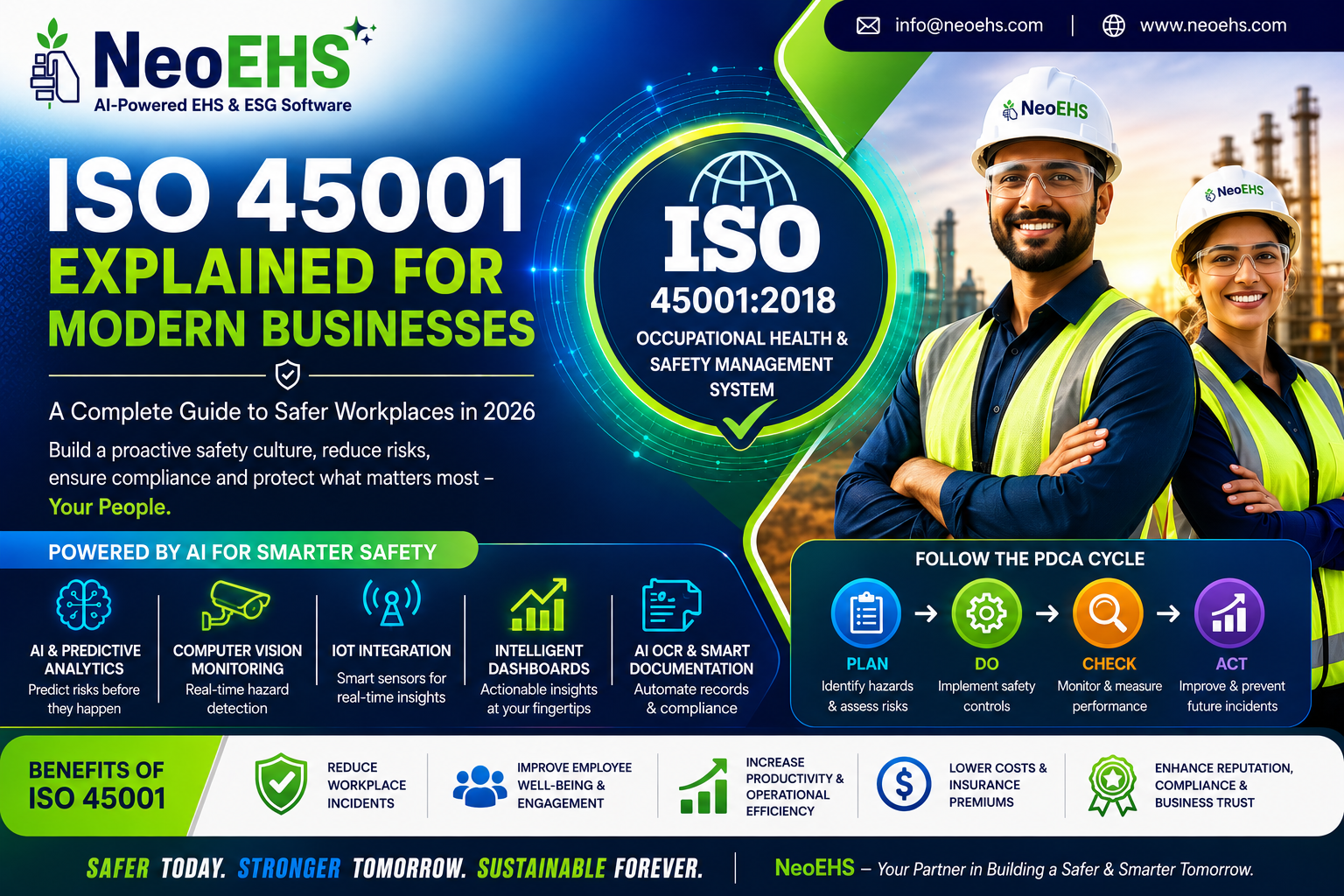
ISO 45001 follows the Plan-Do-Check-Act (PDCA) cycle to continuously improve occupational health and safety performance.
Main Requirements of ISO 45001
The standard includes several important clauses.
Context of the Organization
Understand internal and external issues affecting occupational health and safety.
Leadership
Establish clear responsibilities and safety objectives.
Planning
Identify hazards, evaluate risks, and define control measures.
Support
Ensure:
- Competency
- Awareness
- Communication
- Documentation
- Resources
Operation
Manage operational risks including:
- Permit to Work
- Contractor Management
- Emergency Preparedness
- PPE Management
- Hazard Controls
Performance Evaluation
Monitor:
- Safety KPIs
- Internal Audits
- Compliance
- Incident Trends
- Corrective Actions
Improvement
Implement:
- Root Cause Analysis
- Preventive Actions
- Corrective Actions
- Lessons Learned
Benefits of ISO 45001 Certification
Organizations implementing ISO 45001 enjoy numerous advantages.
Improved Workplace Safety
Systematic hazard identification significantly reduces accidents.
Lower Incident Rates
Proactive risk management prevents injuries before they occur.
Better Legal Compliance
Helps organizations comply with OSHA and local occupational safety regulations.
Higher Employee Engagement
Workers become active participants in creating a safer workplace.
Reduced Insurance Costs
Lower incident rates often result in reduced insurance premiums.
Increased Productivity
Safe workplaces experience:
- Less downtime
- Improved morale
- Higher efficiency
Stronger Brand Reputation
ISO-certified organizations gain greater trust from customers, investors, and regulators.
Industries That Benefit from ISO 45001
ISO 45001 is suitable for organizations of every size.
Industries include:
- Construction
- Manufacturing
- Oil & Gas
- Mining
- Logistics
- Warehousing
- Healthcare
- Utilities
- Power Plants
- Chemicals
- Transportation
- Ports & Maritime
- Infrastructure Projects
Common Challenges During ISO 45001 Implementation
Many organizations struggle with:
- Paper-based inspections
- Manual incident reporting
- Poor hazard visibility
- Inconsistent audits
- Delayed corrective actions
- Lack of employee engagement
- Inefficient compliance tracking
These challenges often delay certification and increase operational risks.
How AI is Transforming ISO 45001 Compliance
Artificial Intelligence is changing occupational safety management by making compliance proactive instead of reactive.
AI helps organizations:
- Detect unsafe behaviors automatically
- Identify PPE violations
- Monitor high-risk work areas
- Predict future incidents
- Analyze safety trends
- Automate inspections
- Improve hazard reporting
- Reduce human error
Instead of relying only on manual inspections, AI continuously monitors workplace safety 24/7.
How NeoEHS Simplifies ISO 45001 Compliance
NeoEHS is an AI-powered Environment, Health, Safety, and ESG platform designed to simplify ISO 45001 implementation and ongoing compliance.
Key capabilities include:
AI-Powered Hazard Detection
Computer Vision continuously detects:
- Missing PPE
- Unsafe acts
- Restricted area violations
- Unsafe lifting
- Vehicle movement risks
- Worker proximity hazards
Digital Risk Assessments
Conduct standardized risk assessments with automated scoring, approvals, and action tracking.
Smart Incident Management
Digitally manage:
- Incidents
- Near misses
- Unsafe observations
- Investigations
- Root cause analysis
- Corrective actions
AI Safety Analytics
Interactive dashboards provide insights into:
- Leading indicators
- Lagging indicators
- High-risk locations
- Incident trends
- Compliance scores
- Predictive risk analysis
Digital Permit-to-Work
Manage permits for:
- Hot Work
- Confined Space Entry
- Electrical Work
- Excavation
- Work at Height
- Lifting Operations
- Lockout/Tagout (LOTO)
with automated approvals and audit trails.
Inspection & Audit Management
Schedule and perform inspections using mobile devices, generate findings, assign corrective actions, and monitor closure.
Compliance Management
Track:
- Legal registers
- ISO requirements
- Internal audits
- External audits
- Corrective actions
- Evidence documentation
AI-Powered Document Management
Maintain centralized records for:
- SOPs
- Policies
- Risk assessments
- Training records
- Audit reports
- Compliance evidence
Mobile Safety App
Employees can instantly:
- Report hazards
- Upload photos
- Submit observations
- Receive alerts
- Complete inspections
- Track corrective actions
from anywhere.
ISO 45001 Implementation Roadmap
Organizations typically follow these steps:
- Conduct a gap assessment.
- Define Occupational Health & Safety policies.
- Identify workplace hazards.
- Perform risk assessments.
- Establish operational controls.
- Train employees.
- Implement digital safety processes.
- Conduct internal audits.
- Review management performance.
- Complete certification audits.
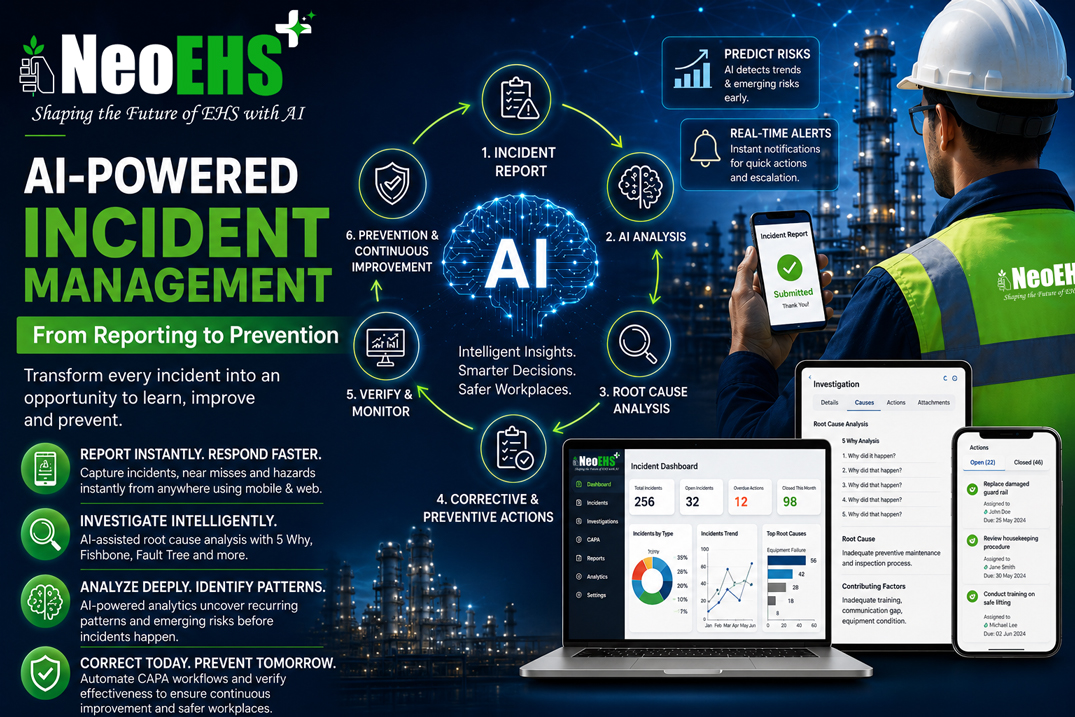
Using an AI-powered platform like NeoEHS accelerates each stage by automating documentation, tracking actions, and providing real-time visibility into compliance.
Best Practices for Maintaining ISO 45001 Certification
To sustain certification and continually improve safety performance:
- Review risks regularly.
- Encourage employee participation.
- Conduct frequent inspections.
- Track leading safety indicators.
- Investigate all incidents and near misses.
- Use predictive analytics to identify emerging risks.
- Automate compliance workflows.
- Continuously train employees.
- Monitor contractor performance.
- Review management objectives periodically.
The Future of Occupational Health & Safety
The future of workplace safety lies in intelligent, connected systems that combine AI, IoT, computer vision, and predictive analytics. Organizations adopting these technologies can move beyond reactive compliance to prevent incidents before they happen, while strengthening operational resilience and employee trust.
Why Choose NeoEHS?
NeoEHS empowers organizations to:
- Simplify ISO 45001 compliance
- Reduce workplace incidents
- Automate inspections and audits
- Monitor safety in real time with AI
- Improve contractor and permit management
- Gain predictive safety insights
- Enhance employee engagement
- Centralize compliance documentation
- Support ESG and sustainability initiatives
- Build a safer, smarter workplace
Whether you're in construction, manufacturing, energy, logistics, healthcare, or mining, NeoEHS helps transform occupational health and safety into a strategic business advantage.
Conclusion
ISO 45001 is more than a certification—it is a framework for building a resilient, proactive safety culture that protects people and strengthens business performance. By integrating AI-driven technologies, organizations can simplify compliance, improve decision-making, and reduce workplace risks.
NeoEHS combines AI, Computer Vision, IoT, predictive analytics, and digital workflows into one comprehensive platform, making it easier for modern businesses to achieve and maintain ISO 45001 compliance while creating safer workplaces.
Frequently Asked Questions (FAQs)
1. What is ISO 45001?
ISO 45001 is the international standard for Occupational Health and Safety Management Systems (OHSMS), helping organizations manage workplace health and safety risks.
2. Who should implement ISO 45001?
Any organization—regardless of size or industry—can implement ISO 45001 to improve occupational health and safety performance.
3. Is ISO 45001 certification mandatory?
Certification is generally voluntary, but many customers, regulators, and procurement processes require or strongly prefer it.
4. How does AI help with ISO 45001 compliance?
AI automates hazard detection, PPE monitoring, incident analysis, inspections, and predictive risk assessment, making safety management more proactive.
5. How does NeoEHS support ISO 45001?
NeoEHS provides AI-powered hazard detection, digital inspections, incident management, permit-to-work, compliance tracking, audit management, predictive analytics, and real-time dashboards to streamline ISO 45001 implementation and ongoing compliance.
#ISO45001 #OccupationalHealth #WorkplaceSafety #HealthAndSafety #SafetyManagement #OHSMS #EHSSoftware #AISafety #AIPoweredEHS #RiskAssessment #IncidentManagement #DigitalTransformation #ComplianceManagement #ESG #ConstructionSafety #IndustrialSafety #ManufacturingSafety #ComputerVision #PredictiveAnalytics #NeoEHS