OSHA Recordkeeping and Workplace Incident Reporting Guide
OSHA Recordkeeping and Workplace Incident Reporting Guide
A workplace incident happens.
Someone gets injured. A worker develops an occupational illness. A near miss exposes a serious hazard. A machine-related event disrupts production. Or, in the most serious cases, a worker suffers a fatality, hospitalization, amputation or loss of an eye.
What happens next matters.
For organizations operating in the United States, workplace incidents can trigger several different responsibilities under the Occupational Safety and Health Administration (OSHA), including recordkeeping, reporting, electronic submission and corrective action.
But these requirements are often misunderstood.
An incident may need to be internally reported without being OSHA-recordable. An OSHA-recordable case may not necessarily require an immediate report to OSHA. And an organization may have electronic submission obligations depending on its establishment size and industry.
That is why effective workplace incident management requires more than filling out an OSHA form.
It requires a structured process for:
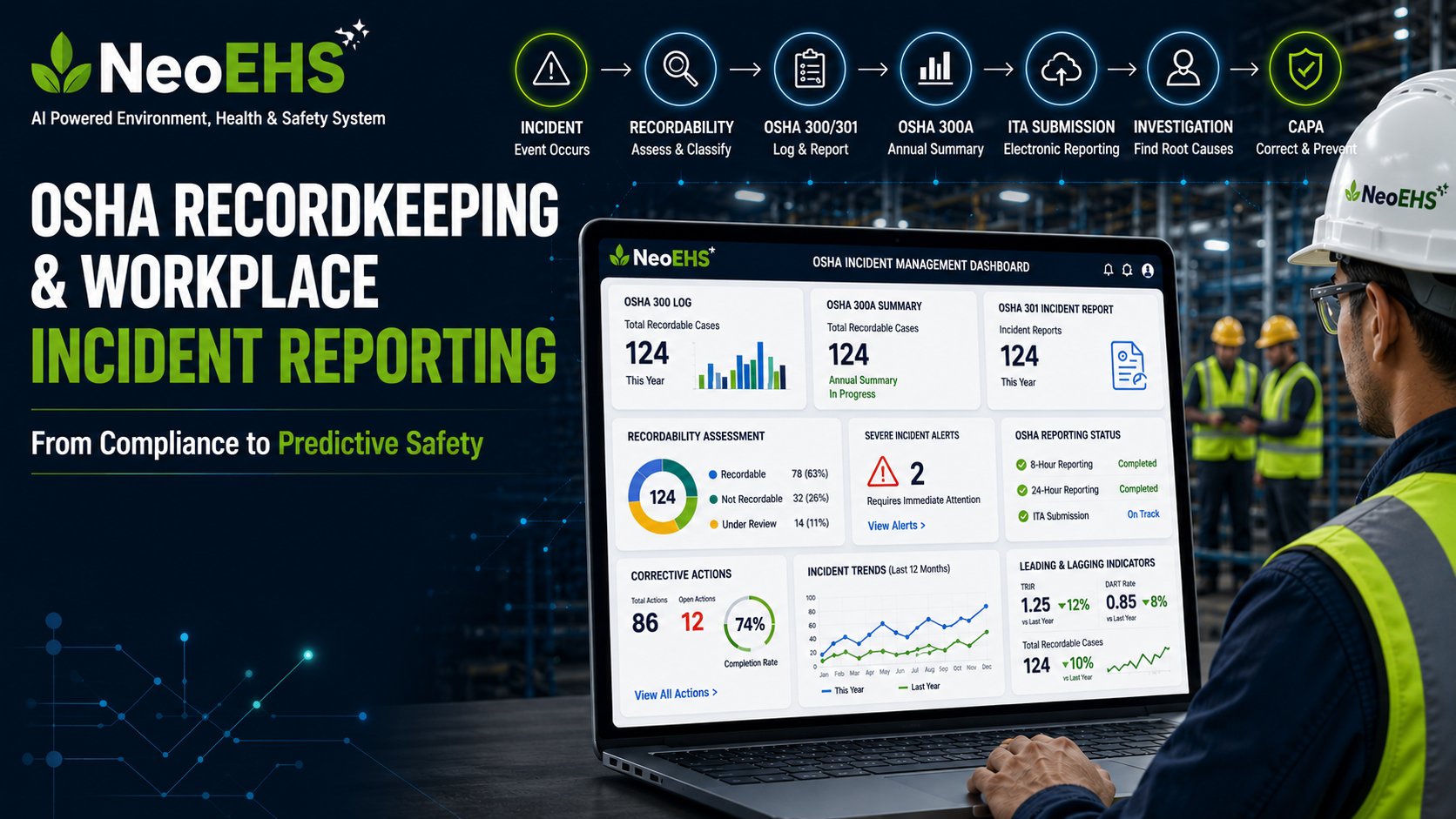
Report → Assess → Record → Investigate → Correct → Submit → Learn → Prevent
This guide explains the fundamentals of OSHA recordkeeping and workplace incident reporting, including OSHA Forms 300, 300A and 301, recordability criteria, severe injury reporting, electronic submission through the Injury Tracking Application (ITA), record retention and how digital EHS software can help organizations manage the process more efficiently.
Important: This article is intended as an educational guide, not legal advice. OSHA requirements can depend on establishment size, industry classification, case circumstances and applicable federal, state or other requirements. Organizations should verify their obligations using current OSHA guidance and, where appropriate, consult a qualified safety or legal professional.
What Is OSHA Recordkeeping?
OSHA recordkeeping is the process covered employers use to document qualifying work-related injuries and illnesses under 29 CFR Part 1904.
OSHA explains that many employers with more than 10 employees must maintain records of occupational injuries and illnesses, although certain low-risk industries are exempt. Covered employers generally use OSHA Forms 300, 300A and 301, or equivalent forms that meet OSHA's requirements.
The purpose is not simply paperwork.
OSHA states that recordkeeping helps employers, workers and OSHA understand workplace hazards and support efforts to prevent future injuries and illnesses.
In other words:
Good recordkeeping is not just about compliance. It is also a source of safety intelligence.
What Are OSHA Forms 300, 300A and 301?
The three primary OSHA recordkeeping forms serve different purposes.
OSHA Form 300 — Log of Work-Related Injuries and Illnesses
The OSHA 300 Log is used to record qualifying work-related injuries and illnesses.
For each recordable case, the log captures information such as:
- Case number
- Employee information
- Job title
- Date of injury or illness
- Where the event occurred
- Description of the case
- Classification of the case
- Days away from work
- Restricted work or job transfer
- Injury or illness type
OSHA requires covered employers to enter each recordable case on the OSHA 300 Log within seven calendar days of receiving information that a recordable injury or illness occurred.
OSHA Form 300A — Summary of Work-Related Injuries and Illnesses
The OSHA 300A summarizes the organization's recordable injury and illness data for the calendar year.
Covered employers must review the OSHA 300 Log for completeness and accuracy, complete and certify the 300A summary, and post it in the workplace from February 1 through April 30 of the following year, subject to the applicable requirements and exemptions.
The 300A is therefore different from the 300 Log.
Think of it this way:
OSHA 300 = individual case log
OSHA 300A = annual summary
OSHA Form 301 — Injury and Illness Incident Report
The OSHA 301 provides more detailed information about an individual recordable case.
It can include information concerning:
- The injured or ill employee
- The healthcare provider
- Medical treatment
- What the employee was doing
- How the event occurred
- The injury or illness
- The object or substance that caused the harm
OSHA requires a Form 301, or equivalent form, for each recordable injury or illness entered on the OSHA 300 Log.
What Makes a Workplace Injury or Illness OSHA Recordable?
This is one of the most important questions in workplace safety.
Under 29 CFR 1904.4, a case generally must be:
- Work-related
- A new case
- And meet OSHA's applicable recording criteria.
Under the general recording criteria in 29 CFR 1904.7, a work-related injury or illness is generally recordable if it results in:
- Death
- Days away from work
- Restricted work or job transfer
- Medical treatment beyond first aid
- Loss of consciousness
- A significant injury or illness diagnosed by a physician or other licensed healthcare professional
There are also special recording criteria for certain cases, including needlesticks and sharps injuries, medical removal, hearing loss and tuberculosis.
This is why simply asking “Was the employee injured?” is not enough.
The proper question is:
“Does this work-related case meet OSHA's recording criteria?”
Recordable Incident vs Reportable Incident
These terms are often confused.
They should not be treated as identical.
Recordable
A case meets OSHA's applicable criteria and must be entered into the required OSHA recordkeeping system.
Reportable
A case triggers an obligation to notify OSHA within a specified timeframe.
A case can therefore be recordable without requiring immediate notification to OSHA.
For example, a qualifying injury involving medical treatment beyond first aid may need to be recorded, while it may not fall within OSHA's immediate severe-injury reporting requirements.
On the other hand, a work-related fatality requires both recordkeeping and prompt reporting to OSHA.
This distinction is fundamental to a good incident management process.
OSHA Severe Injury Reporting
OSHA has separate reporting requirements for certain severe workplace incidents.
According to OSHA's current guidance, all employers must report a work-related fatality to OSHA within 8 hours.
Employers must report a work-related:
- In-patient hospitalization
- Amputation
- Loss of an eye
within 24 hours.
This is different from the normal OSHA recordkeeping timeline.
A company should therefore have a process capable of immediately escalating potentially severe incidents rather than waiting for routine recordkeeping activities.
OSHA 8-Hour and 24-Hour Reporting: A Quick Reference
| Event | OSHA reporting timeframe |
|---|---|
| Work-related fatality | Within 8 hours |
| Work-related in-patient hospitalization | Within 24 hours |
| Work-related amputation | Within 24 hours |
| Work-related loss of an eye | Within 24 hours |
| Other recordable injury/illness | Record according to Part 1904 requirements; not automatically an immediate OSHA report |
These requirements should be verified against current OSHA rules and the specific circumstances of the event.
How Quickly Must an OSHA-Recordable Case Be Recorded?
Under 29 CFR 1904.29, each recordable injury or illness must generally be entered on the OSHA 300 Log and 301 Incident Report within 7 calendar days after receiving information that a recordable injury or illness occurred.
This creates an important operational distinction:
Immediate internal incident reporting
↓
Recordability assessment
↓
OSHA recordkeeping
↓
OSHA reporting, if separately required
↓
Investigation and corrective action
A strong EHS system should support all of these steps.
Who Needs to Keep OSHA Injury and Illness Records?
OSHA states that many employers with 10 or more employees are required to keep records of occupational injuries and illnesses, although certain low-risk industries are exempt.
The important point is that employee count alone does not determine every obligation.
Industry classification also matters.
Organizations should determine whether their establishment is:
- Required to maintain OSHA records
- Partially exempt
- Required to submit data electronically
- Subject to specific reporting requirements
The OSHA rules should always be checked for the establishment's specific situation.
OSHA Electronic Recordkeeping and ITA Submission
Digital recordkeeping has become increasingly important.
Certain establishments are required to electronically submit injury and illness information to OSHA through the Injury Tracking Application (ITA).
Current OSHA requirements include different thresholds and industry criteria.
For example, certain establishments with 250 or more employees that are required to keep OSHA records must electronically submit Form 300A information.
In addition, establishments with 100 or more employees in designated high-hazard industries must electronically submit information from Forms 300 and 301 as well as the required 300A information.
OSHA states that the annual electronic submission deadline is generally March 2 of the year following the calendar year covered by the forms for covered establishments.
There are also requirements affecting certain establishments with 20–249 employees in designated industries for electronic submission of Form 300A data.
Because these requirements depend on establishment size and industry classification, companies should use OSHA's current ITA coverage guidance rather than relying on a simple employee-count rule.
OSHA Form 300A Posting Requirement
For covered employers subject to the annual summary posting requirement, OSHA requires the Form 300A to be posted in a conspicuous location from:
February 1 through April 30
The organization must also certify the summary as required.
Electronic submission to OSHA does not replace the workplace posting requirement where posting is required. OSHA's FAQ specifically addresses this distinction.
This is an example of why organizations should manage recording, posting and electronic submission as separate compliance activities.
How Long Should OSHA Records Be Kept?
Covered employers must generally retain the OSHA 300 Log, privacy case list where applicable, annual summary and OSHA 301 Incident Reports for five years following the end of the calendar year covered by the records.
During the retention period, OSHA 300 Logs must also be updated when newly discovered recordable injuries or illnesses are identified or when the classification of previously recorded cases changes.
For organizations managing multiple sites and thousands of incident records, maintaining this information accurately can become difficult with spreadsheets and disconnected files.
This is where centralized EHS software becomes valuable.
OSHA Recordkeeping Is More Than Forms
One of the biggest mistakes organizations can make is treating OSHA recordkeeping as a form-filling exercise.
The OSHA forms are the output.
The underlying process is much larger.
A mature incident management process should include:
1. Incident reporting
Capture the event quickly.
2. Initial assessment
Understand what happened and whether immediate response is required.
3. Recordability assessment
Determine whether the case meets OSHA recording criteria.
4. Severity classification
Identify actual and potential consequences.
5. OSHA reporting assessment
Determine whether a separate severe-injury reporting obligation applies.
6. Investigation
Understand immediate, contributing and root causes.
7. Corrective action
Address the underlying causes.
8. Verification
Confirm that corrective actions were effective.
9. Recordkeeping
Maintain the required OSHA information.
10. Electronic submission
Submit required information through ITA where applicable.
11. Trend analysis
Identify recurring problems.
12. Prevention
Use lessons learned to reduce future risk.
This is where EHS software can transform OSHA compliance from an administrative burden into a safety improvement process.
How NeoEHS Supports OSHA Incident Management
NeoEHS provides an AI-powered Incident Management platform designed to help organizations digitize incident reporting, investigations, root cause analysis, corrective actions, compliance workflows and safety analytics. Its current Incident Management solution specifically identifies OSHA compliance as a supported compliance area.
Explore NeoEHS Incident Management Software
NeoEHS can support the broader workflow around:
- Workplace incident reporting
- Near-miss reporting
- Incident classification
- Investigation
- Root cause analysis
- Corrective and preventive actions
- Compliance documentation
- Audit trails
- Safety trend analysis
- Management dashboards
- Multi-site reporting
The platform's broader EHS capabilities also connect incident management with risk assessment, audits, inspections, permits and other safety processes.
AI-Powered Incident Reporting
Modern employees should not have to complete complicated paperwork before reporting a workplace incident.
With mobile-first EHS workflows, workers and supervisors can report events from the field.
A digital incident report can capture:
- Date and time
- Location
- Person involved
- Incident type
- Injury or illness information
- Witnesses
- Photos
- Videos
- Immediate actions
- Equipment involved
- Hazard information
- Environmental impact
- Supporting documents
NeoEHS supports mobile incident reporting and geo-tagged incidents as part of its broader mobile EHS platform.
This can help organizations capture information while the details are still fresh.
AI-Assisted OSHA Incident Classification
One of the most valuable applications of AI is helping EHS teams organize incident information.
AI can assist with:
- Categorization
- Severity assessment support
- Similar-incident identification
- Historical pattern recognition
- Contributing-factor analysis
- Root-cause analysis support
- Corrective-action recommendations
However, AI should support—not replace—the qualified human decision-maker responsible for determining OSHA recordability and regulatory reporting obligations.
This distinction is particularly important.
An AI system can flag:
“This case may require review because medical treatment beyond first aid is indicated.”
The responsible EHS professional should then validate the facts against the applicable OSHA requirements.
OSHA Recordkeeping and Root Cause Analysis
Recording an incident answers:
What happened?
Investigation should answer:
Why did it happen?
And prevention should answer:
How do we stop it from happening again?
Consider a simple example.
A worker slips on a wet floor.
The incident may initially be classified as a slip-and-fall.
But investigation may reveal:
- A leaking pipe
- Delayed maintenance
- An inadequate inspection frequency
- Poor housekeeping
- Lack of ownership
- Repeated previous observations
If the company only records the injury, it has documented the outcome.
If it investigates the system behind the event, it can potentially prevent recurrence.
NeoEHS provides AI-assisted incident investigation and root cause analysis capabilities designed to help organizations move from incident documentation toward preventive safety intelligence.
Connect OSHA Incidents With Corrective Actions
An incident report should not disappear into an archive after it is closed.
It should create action.
For example:
Incident
Worker injured due to inadequate machine guarding.
↓
Root Cause
Machine guard design and inspection process inadequate.
↓
Corrective Action
Repair the machine guard.
↓
Preventive Action
Review guarding requirements across similar equipment.
↓
Verification
Inspect comparable machines.
↓
Learning
Update the equipment inspection checklist.
This is where digital CAPA workflows become valuable.
NeoEHS supports corrective action tracking and real-time action monitoring as part of its Incident Management capabilities.
Connect OSHA Incidents With Risk Management
An incident can be evidence that an existing risk control is not working as intended.
For example:
Risk Assessment → Control → Incident → Investigation → Risk Reassessment
This feedback loop is essential for continuous improvement.
NeoEHS supports risk assessment methodologies and connects risk management with the wider EHS platform.
This allows safety teams to move beyond:
“We completed the risk assessment.”
toward:
“The risk assessment reflects what we have actually learned from our workplace.”
OSHA Recordkeeping and Leading Indicators
OSHA records are valuable, but they are primarily historical.
They tell organizations what has already happened.
A modern EHS program should also monitor leading indicators.
Examples include:
- Near misses
- Safety observations
- Hazard reports
- Inspection findings
- Corrective-action closure
- Training completion
- Permit compliance
- Repeat findings
- Risk-control effectiveness
- Unsafe behavior observations
When leading and lagging indicators are analyzed together, EHS teams can gain a much better understanding of workplace risk.
For example:
Increasing near misses + recurring hazards + overdue corrective actions
may indicate that a risk is increasing even before a recordable injury occurs.
This is where AI-powered EHS analytics can add value.
From OSHA Compliance to Predictive Safety
Compliance is important.
But compliance should not be the finish line.
The strongest safety organizations use compliance information as a foundation for continuous improvement.
The progression looks like this:
Record
↓
Report
↓
Investigate
↓
Analyze
↓
Correct
↓
Verify
↓
Learn
↓
Predict
↓
Prevent
This is the philosophy behind modern AI-powered EHS management.
NeoEHS describes its platform as combining AI, predictive analytics, incident analytics, automated safety workflows and operational dashboards to support proactive EHS management.
OSHA Incident Reporting Workflow
A practical digital workflow can look like this:
Step 1 — Report
Worker or supervisor reports the incident.
Step 2 — Notify
Appropriate supervisors and EHS personnel receive alerts.
Step 3 — Assess
Determine severity, circumstances and immediate response requirements.
Step 4 — Determine Recordability
Evaluate whether the case meets OSHA's applicable recording criteria.
Step 5 — Determine Reporting Requirement
Check whether the event triggers OSHA's severe-injury reporting requirements.
Step 6 — Investigate
Collect evidence and identify immediate and underlying causes.
Step 7 — Record
Create or update the appropriate OSHA recordkeeping information.
Step 8 — Correct
Assign corrective and preventive actions.
Step 9 — Verify
Confirm action effectiveness.
Step 10 — Submit
Complete required electronic submission through ITA where applicable.
Step 11 — Analyze
Identify trends and recurring risks.
Step 12 — Prevent
Apply lessons learned across the organization.
OSHA Recordkeeping Checklist for EHS Teams
Use this as an operational checklist—not as a substitute for reviewing the applicable OSHA requirements.
-
Establish whether the establishment is subject to OSHA recordkeeping requirements.
-
Determine whether the incident is work-related.
-
Determine whether the case is new.
-
Evaluate OSHA recording criteria.
-
Determine whether special recording criteria apply.
-
Record qualifying cases within the applicable timeframe.
-
Complete the required incident details.
-
Determine whether severe-injury reporting applies.
-
Notify OSHA within the applicable 8-hour or 24-hour timeframe when required.
-
Investigate the incident.
-
Identify root and contributing causes.
-
Assign corrective and preventive actions.
-
Verify effectiveness.
-
Maintain required records for the applicable retention period.
-
Complete annual 300A requirements.
-
Post the 300A where required.
-
Determine whether electronic ITA submission applies.
-
Submit required data by the applicable deadline.
-
Analyze incident trends.
-
Apply lessons learned to prevent recurrence.
The exact requirements should always be checked against current OSHA regulations and guidance.
Common OSHA Recordkeeping Mistakes
1. Treating every incident as OSHA-recordable
Not every workplace event automatically meets OSHA's recording criteria.
Recordability must be evaluated under the applicable rule.
2. Assuming every recordable incident must be immediately reported to OSHA
Routine recordkeeping and severe-injury reporting are different obligations.
3. Waiting several days before internally reporting an incident
Internal reporting should happen as quickly as practical so that evidence, witnesses and critical details are not lost.
4. Treating the OSHA 300, 300A and 301 as the same document
Each form serves a different purpose.
5. Forgetting electronic submission requirements
ITA submission requirements depend on establishment size and industry classification.
6. Focusing only on the injury
The injury is the outcome.
The underlying hazard and system failure may be the more important prevention opportunity.
7. Closing corrective actions without verifying effectiveness
“Closed” does not necessarily mean “effective.”
8. Keeping OSHA information in disconnected spreadsheets
Fragmented information makes trend analysis, multi-site governance and audit preparation more difficult.
9. Ignoring near misses
Near misses can provide valuable leading indicators even when they do not result in a recordable injury.
OSHA Recordkeeping vs Incident Management Software
| OSHA Recordkeeping | Modern Incident Management |
| Records qualifying cases | Captures all relevant workplace events |
| Focuses on regulatory records | Focuses on safety improvement |
| OSHA 300 | Digital incident record |
| OSHA 300A | Management dashboards and annual summaries |
| OSHA 301 | Detailed investigation |
| Regulatory reporting | Automated escalation workflows |
| Historical information | Historical + predictive analytics |
| Compliance focused | Prevention focused |
| Periodic analysis | Real-time insights |
| Individual establishment | Multi-site enterprise visibility |
The two should not be viewed as competing systems.
OSHA recordkeeping is a regulatory requirement.
Incident management is the broader operational process that helps organizations understand and prevent workplace events.
A good EHS platform should support both.
How AI Changes Workplace Incident Reporting
AI introduces another layer of intelligence to traditional EHS workflows.
Imagine an employee reports:
“I slipped near the production line while cleaning.”
An intelligent system could potentially help identify:
- Similar previous incidents
- Related hazards
- Previous inspection findings
- Corrective actions
- Location-based trends
- Similar equipment
- Recurring root causes
- Potential risk-control gaps
The EHS professional can then investigate with more context.
Instead of looking at one incident in isolation, the organization can look at the pattern behind the incidents.
That is the real opportunity with AI.
What Should a Modern OSHA Incident Management System Provide?
Organizations evaluating EHS software should consider whether the system supports:
Incident Reporting
Mobile and web-based reporting with photographs, documents and location information.
Recordability Workflow
Structured information to help EHS professionals assess cases against applicable criteria.
Severe Incident Escalation
Immediate alerts for potentially serious events requiring urgent attention.
Investigation
Evidence collection, interviews, timelines and investigation workflows.
Root Cause Analysis
5 Why, Fishbone, Fault Tree and other investigation methodologies.
CAPA
Corrective and preventive action management with owners, deadlines and escalation.
OSHA Documentation
Support for OSHA 300, 300A and 301-related data management or equivalent records.
ITA Readiness
Structured data that can support required electronic submission processes where applicable.
Audit Trail
Clear records of changes, actions and approvals.
Analytics
Incident trends, recurring causes, severity and leading indicators.
Multi-Site Management
Centralized visibility across plants, facilities and business units.
AI Intelligence
Pattern recognition, predictive analytics and intelligent recommendations.
NeoEHS provides many of these capabilities within its broader AI-powered EHS platform.
Frequently Asked Questions About OSHA Recordkeeping
What is OSHA recordkeeping?
OSHA recordkeeping is the process of documenting qualifying work-related injuries and illnesses under 29 CFR Part 1904 using OSHA Forms 300, 300A and 301, or qualifying equivalent forms.
What is an OSHA recordable incident?
Generally, a work-related injury or illness is recordable when it is a new case and meets one or more applicable OSHA recording criteria, such as days away from work, restricted work, medical treatment beyond first aid, loss of consciousness, death or certain significant diagnosed injuries or illnesses.
What is OSHA Form 300?
OSHA Form 300 is the Log of Work-Related Injuries and Illnesses used to record qualifying cases.
What is OSHA Form 300A?
Form 300A is the annual Summary of Work-Related Injuries and Illnesses. Covered employers subject to the posting requirement generally post it from February 1 through April 30 following the calendar year covered.
What is OSHA Form 301?
Form 301 is the Injury and Illness Incident Report containing more detailed information about each recordable case, or an equivalent form meeting OSHA requirements.
How long must OSHA records be kept?
Covered employers generally must retain OSHA 300 Logs, privacy case lists where applicable, 300A summaries and 301 reports for five years following the end of the calendar year covered.
How quickly must an OSHA-recordable injury be recorded?
Under 29 CFR 1904.29, a recordable injury or illness must generally be entered on the OSHA 300 Log and 301 within seven calendar days after receiving information that the recordable event occurred.
When must a workplace fatality be reported to OSHA?
A work-related fatality must generally be reported to OSHA within eight hours.
When must a workplace hospitalization be reported?
A work-related in-patient hospitalization must generally be reported to OSHA within 24 hours. The same 24-hour reporting requirement applies to a work-related amputation or loss of an eye.
Does every recordable injury need to be immediately reported to OSHA?
No. OSHA recordkeeping and severe-injury reporting are separate requirements. A case can be recordable without necessarily triggering immediate OSHA notification. The circumstances must be evaluated against the applicable requirements.
What is OSHA's Injury Tracking Application?
The Injury Tracking Application, or ITA, is OSHA's system for electronic submission of certain injury and illness data by establishments that meet applicable size and industry requirements.
Who must submit OSHA injury data electronically?
Requirements vary by establishment size and industry. For example, certain establishments with 100 or more employees in designated high-hazard industries must submit 300 and 301 data, while other covered establishments have 300A submission requirements.
Can EHS software replace OSHA compliance responsibilities?
No. EHS software can help organizations collect, organize, track and analyze safety information, but the employer remains responsible for determining and meeting applicable regulatory obligations.
How can NeoEHS help with OSHA compliance?
NeoEHS provides incident reporting, investigation, root cause analysis, corrective action tracking, audit trails, safety analytics and OSHA compliance workflows within its AI-powered Incident Management platform.
AI-powered Incident Management Software
→ NeoEHS Incident Management Software
AI-powered EHS Software
→ NeoEHS EHS Software
HSE Management System
→ NeoEHS HSE Management System
Risk Assessment Software
→ NeoEHS Risk Management
Digital Permit to Work
→ NeoEHS Permit to Work Software
Digital Safety Inspections
→ NeoEHS Inspection Management
Audit and Compliance Management
→ NeoEHS Audit Management
AI-powered Hazard Management
→ NeoEHS Hazard Management