NeoEHS AI-Powered HSE Application: The Future of Intelligent HSE Management
How AI-Powered NeoEHS Is Transforming Workplace Safety
Workplace safety is becoming increasingly data-driven.
Every day, organizations generate large amounts of safety information through inspections, incidents, near misses, risk assessments, safety observations, permits, audits, training records, compliance activities, environmental monitoring and corrective actions.
The challenge is no longer simply collecting safety data.
The bigger challenge is understanding what that data is telling us.
Which risks are increasing? Which hazards are recurring? Where are corrective actions repeatedly delayed? Which activities are becoming higher risk? Are incidents happening for similar reasons? Which locations or processes need immediate attention?
Traditional spreadsheets, paper-based processes and disconnected safety systems can make these questions difficult to answer quickly.
This is where AI-powered EHS software can make a meaningful difference.
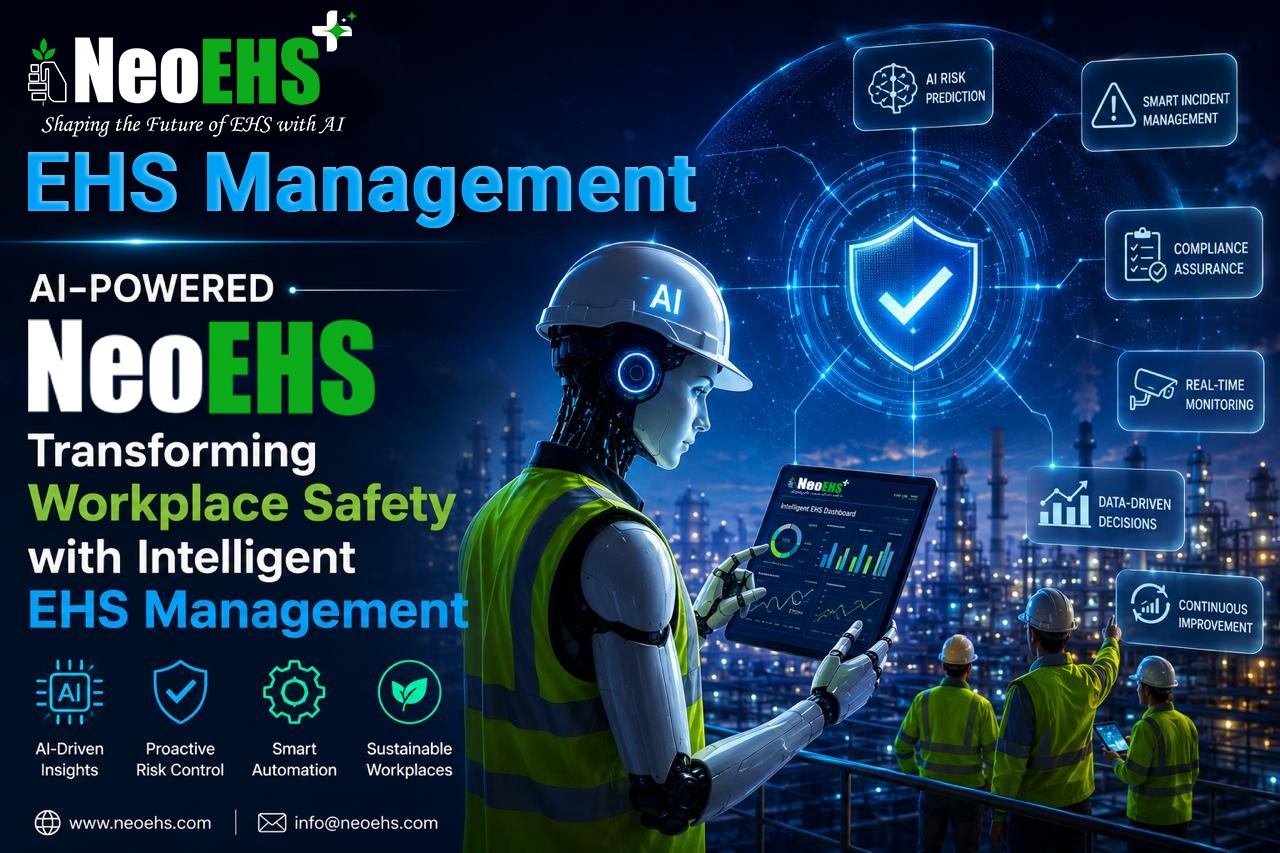
NeoEHS combines EHS management, artificial intelligence, predictive analytics, automation, connected technologies and ESG capabilities to help organizations move from reactive safety management toward a more proactive and intelligent approach.
The objective is not to replace EHS professionals.
It is to give them better information, better visibility and better tools to make safety decisions.
What Is an AI-Powered EHS Application?
An AI-powered EHS application is a digital Environmental, Health and Safety platform that combines traditional safety management capabilities with artificial intelligence, analytics, automation and connected data.
Traditional EHS software primarily helps organizations digitize processes such as:
- Incident reporting
- Risk assessments
- Safety inspections
- Audits
- Permit to Work
- Compliance management
- Corrective actions
- Training
- Environmental management
AI-powered EHS software can go further by helping organizations analyze information, identify patterns, prioritize risks and generate actionable insights.
For example, instead of simply storing hundreds of safety observations, an intelligent EHS platform can analyze them to identify recurring hazards or unsafe behaviors.
Instead of reviewing every incident independently, AI-assisted analytics can help identify common contributing factors across multiple incidents.
Instead of manually searching through large volumes of documents, OCR and document intelligence can help extract and organize relevant information.
This creates a progression from:
Reactive → Digital → Proactive → Predictive → Intelligent
Why Traditional HSE Management Is Becoming More Difficult
Many organizations still depend on a combination of spreadsheets, emails, paper forms and separate applications for their safety activities.
This creates information silos.
Important information may be spread across:
- Incident reports
- Near-miss reports
- Inspection findings
- Risk assessments
- Safety observations
- Audit reports
- Permit documents
- Training records
- Contractor records
- Compliance registers
- Environmental records
- Corrective actions
- Equipment information
The organization may have plenty of data but still lack a clear picture of operational risk.
A safety manager may want immediate answers to questions such as:
Which risks are increasing?
Which hazards are occurring repeatedly?
Which corrective actions are overdue?
Which locations have the highest safety concerns?
Are similar incidents happening repeatedly?
Which contractors require additional attention?
Where are compliance gaps developing?
What should the EHS team focus on today?
The real value of digital EHS management is therefore not simply storing more information.
It is turning information into safety intelligence.
How AI-Powered NeoEHS Transforms Workplace Safety
NeoEHS is designed to bring core EHS activities together within a connected digital environment while using AI and analytics to help organizations understand their safety data.
Here are some of the key ways AI can support modern EHS management.
1. AI-Powered Risk Intelligence
Risk management is at the heart of an effective safety program.
Organizations need to identify hazards, assess risk, establish controls and monitor whether those controls remain effective.
NeoEHS provides digital workflows for managing hazards, risk assessments, controls and mitigation activities.
AI-powered analytics can help identify patterns across historical and current safety information.
For example, an organization may discover that:
- Similar hazards are appearing repeatedly
- Certain activities generate more observations
- Specific locations have increasing risk indicators
- Particular controls are frequently ineffective
- Corrective actions remain overdue
- Certain work activities require additional attention
This allows EHS teams to move beyond asking:
What happened?
toward asking:
What is changing, and where should we act before the risk becomes an incident?
2. Predictive Analytics for Workplace Safety
One of the most valuable applications of AI in EHS is predictive analytics.
Historical safety information can contain signals that are difficult to identify manually.
Incident reports, near misses, inspections, observations, risk assessments and corrective actions can collectively reveal patterns.
NeoEHS can help organizations analyze these datasets to identify areas such as:
- Recurring hazards
- Increasing incident trends
- Repeated unsafe observations
- High-risk activities
- Emerging risk areas
- Recurring inspection findings
- Overdue corrective actions
- Repeated control failures
The purpose of predictive analytics is not to claim that every workplace accident can be predicted.
It cannot.
Workplace incidents are influenced by people, equipment, processes, environmental conditions and many other variables.
Instead, predictive analytics helps safety professionals identify warning signals and patterns that deserve attention.
AI supports professional judgment rather than replacing it.
3. Intelligent Incident Management
An incident management system should do more than record what happened.
A mature safety process should help organizations understand:
What happened?
Why did it happen?
What contributed to it?
What corrective actions are required?
How can recurrence be prevented?
NeoEHS supports the incident lifecycle from reporting and investigation through corrective action and closure.
AI-assisted analysis can help identify recurring themes across incident records.
For example, several incidents may appear unrelated when reviewed individually, but analysis could reveal common factors such as:
- Inadequate training
- Similar equipment
- Repeated procedural deviations
- Specific work locations
- Inadequate PPE
- Poor housekeeping
- Similar environmental conditions
This transforms incident data into organizational learning.
4. AI-Powered Safety Observation Analysis
Safety observations can provide some of the earliest warning signals of workplace risk.
A single unsafe condition may appear insignificant.
However, hundreds of observations can reveal a much larger pattern.
NeoEHS can help organizations analyze observations and identify:
- Common unsafe conditions
- Repeated unsafe behaviors
- High-risk locations
- Frequently reported hazards
- Recurring control failures
- Areas requiring additional training
- Trends by department, project or location
This helps organizations use observations not simply as records, but as a proactive source of safety intelligence.
5. Intelligent Inspection Management
Inspections are one of the most common activities performed by EHS teams.
But completing an inspection is not the same as eliminating the problem identified during the inspection.
NeoEHS helps digitize inspections, findings, corrective actions and follow-up activities.
With centralized data and analytics, organizations can identify recurring findings and determine whether corrective actions are actually resolving underlying problems.
A useful question becomes:
Are we eliminating safety problems, or are we repeatedly documenting the same problems?
That distinction is important.
AI-powered analytics can help safety teams identify recurring inspection findings and focus attention on systemic issues.
6. AI-Powered Document Intelligence and OCR
EHS teams work with large volumes of documentation.
These can include:
- Risk assessments
- Permits
- Licenses
- Certificates
- Inspection documents
- Training records
- Compliance evidence
- Contractor documentation
- Equipment records
Manually entering information from these documents can consume significant administrative time.
OCR and AI-powered document intelligence can help extract information from documents and make it easier to organize and search.
This can help organizations:
- Digitize historical records
- Extract relevant information
- Reduce repetitive data entry
- Improve document accessibility
- Organize compliance evidence
- Search safety information more efficiently
The result is a more connected digital EHS environment.
7. AI-Powered Permit to Work Management
Permit to Work is critical for organizations performing high-risk activities.
Depending on the industry and activity, permits may include:
- Hot Work Permit
- Confined Space Entry Permit
- Work at Height Permit
- Electrical Work Permit
- Excavation Permit
- Lifting Permit
- Isolation / LOTO Permit
- Breaking Containment Permit
- Radiography Permit
- Chemical Handling Permit
- Pressure Testing Permit
NeoEHS helps organizations digitize permit workflows and improve visibility into active high-risk work.
AI can support the process by helping identify missing information, highlight configured risk factors and provide recommendations based on organizational rules.
The objective is not to remove human responsibility from permit approval.
Instead, technology helps the responsible person make a better-informed decision.
8. AI-Assisted Compliance Management
Compliance management becomes increasingly complex as organizations expand across multiple sites, projects, regions and countries.
EHS teams may need to manage:
- Regulatory obligations
- Legal registers
- Compliance assessments
- Audits
- Evidence
- Corrective actions
- Licenses
- Certifications
- Renewal dates
NeoEHS provides a centralized environment for managing compliance activities.
Automation can help track deadlines, actions and responsibilities, while AI-assisted analytics can help identify potential information gaps and areas requiring attention.
This can reduce dependence on disconnected spreadsheets and manual reminders.
9. Connected Safety Through IoT
Modern workplaces increasingly generate safety data through connected devices.
Potential sources include:
- IoT sensors
- Smart helmets
- Environmental sensors
- Equipment monitoring
- Location tracking
- CCTV systems
- Air-quality monitoring
- Connected worker technologies
NeoEHS can act as a digital layer for bringing safety information from different sources into a broader EHS environment.
When operational data and EHS information are connected, organizations can gain a more complete view of workplace conditions.
For example, environmental data combined with inspection findings, incidents and workforce activities can provide additional context for understanding operational risk.
10. AI-Based Computer Vision for Workplace Safety
Computer vision can provide another layer of safety monitoring by analyzing images or video for predefined safety indicators.
Depending on the configured use case, computer vision can support the identification of:
- PPE compliance
- Restricted-area access
- Unsafe proximity
- Selected unsafe behaviors
- Site safety conditions
- Vehicle and pedestrian interactions
Computer vision should not be viewed as a replacement for safety professionals.
It is an additional layer of visibility.
The strongest safety programs combine technology with trained EHS professionals who understand the operational environment and can make informed decisions.
11. AI-Powered Environmental and ESG Management
Modern organizations increasingly manage workplace safety and sustainability together.
Environmental and ESG activities can generate significant volumes of operational data.
NeoEHS can support areas such as:
- Waste management
- Air-quality monitoring
- Carbon emissions
- Environmental controls
- Resource management
- Environmental compliance
- Sustainability data
Bringing EHS and ESG information into a connected platform can help organizations understand both how safely they operate and how their operations affect the environment.
From EHS Data to Safety Intelligence
The real value of AI-powered EHS software is not simply the ability to store more data.
It is the ability to turn data into information that people can act upon.
Imagine an EHS manager starting the day with a dashboard showing:
Emerging Risk:
Increase in working-at-height observations.
High-Risk Location:
Project Zone B.
Recurring Issue:
Fall-protection controls repeatedly identified as inadequate.
Overdue Actions:
Corrective actions approaching escalation.
Trend:
Near-miss reporting increasing over recent weeks.
Instead of asking the safety team to search through thousands of records, the system highlights where attention may be needed.
That is the difference between data management and safety intelligence.
From Reactive Safety to Predictive Safety
Traditional safety management often follows this pattern:
Incident → Investigation → Corrective Action → Closure
An intelligent EHS approach aims to create a more proactive cycle:
Data → Detection → Insight → Prediction → Prevention
AI does not eliminate workplace risk.
It does, however, provide organizations with additional tools for identifying patterns earlier and prioritizing preventive action.
The ultimate goal is to move safety teams further upstream—from reacting to incidents toward identifying and addressing risk signals before they become incidents.
One Connected EHS Management Platform
NeoEHS brings multiple EHS functions together within a connected platform.
Safety & Risk Management
- Risk Management
- Hazard Management
- Safety Observations
- Incident Management
- Emergency Management
Operational Safety
- Permit to Work
- Inspection Management
- Audit Management
- Toolbox Meetings
- Contractor Management
- Project Management
Compliance & Assurance
- Compliance Management
- Certification Management
- Regulatory Tracking
- Corrective Action Management
Environmental & ESG
- Environmental Management
- Waste Management
- Air Quality Monitoring
- Carbon Emission Management
- Resource Management
AI & Digital Intelligence
- Predictive Analytics
- AI-Assisted Insights
- OCR & Document Intelligence
- Computer Vision
- Intelligent Recommendations
- Automated Alerts
- IoT Integration
This connected approach helps reduce information silos and gives organizations a broader view of workplace safety and operational risk.
Why AI-Powered EHS Software Matters to Business Leaders
Workplace safety is not only an EHS department responsibility.
A major safety event can affect:
- Employees
- Contractors
- Production
- Project schedules
- Equipment
- Insurance
- Regulatory compliance
- Reputation
- Customer relationships
- Business continuity
For this reason, safety information should not remain isolated within the safety department.
Business leaders need visibility into operational risk.
AI-powered EHS software can help connect frontline safety activities with management-level insights, allowing leaders to understand where risks are developing and where preventive action may be required.
Key Benefits of AI-Powered NeoEHS
Organizations implementing a modern EHS platform can gain several operational benefits.
Better Safety Visibility
Bring safety information from multiple processes into one connected environment.
Proactive Risk Management
Identify recurring patterns and emerging areas of concern earlier.
Faster Decision-Making
Give EHS teams relevant information when they need it.
Reduced Administrative Work
Automate repetitive workflows, notifications and data-management activities.
Improved Accountability
Track responsibilities, corrective actions and closure status.
Stronger Compliance Management
Centralize requirements, evidence, assessments and actions.
Better Incident Learning
Use historical information to identify recurring causes and trends.
Improved Operational Visibility
Connect safety information with operational and environmental data.
Data-Driven Safety Management
Replace fragmented reports and spreadsheets with centralized dashboards and analytics.
Stronger Safety Culture
Make relevant safety information more accessible to employees, supervisors, EHS professionals and management.
Who Can Benefit From NeoEHS?
NeoEHS is designed for organizations with complex safety, compliance and operational requirements.
Manufacturing
Manage workplace hazards, machine-related risks, incidents, inspections, permits, training and compliance.
Construction
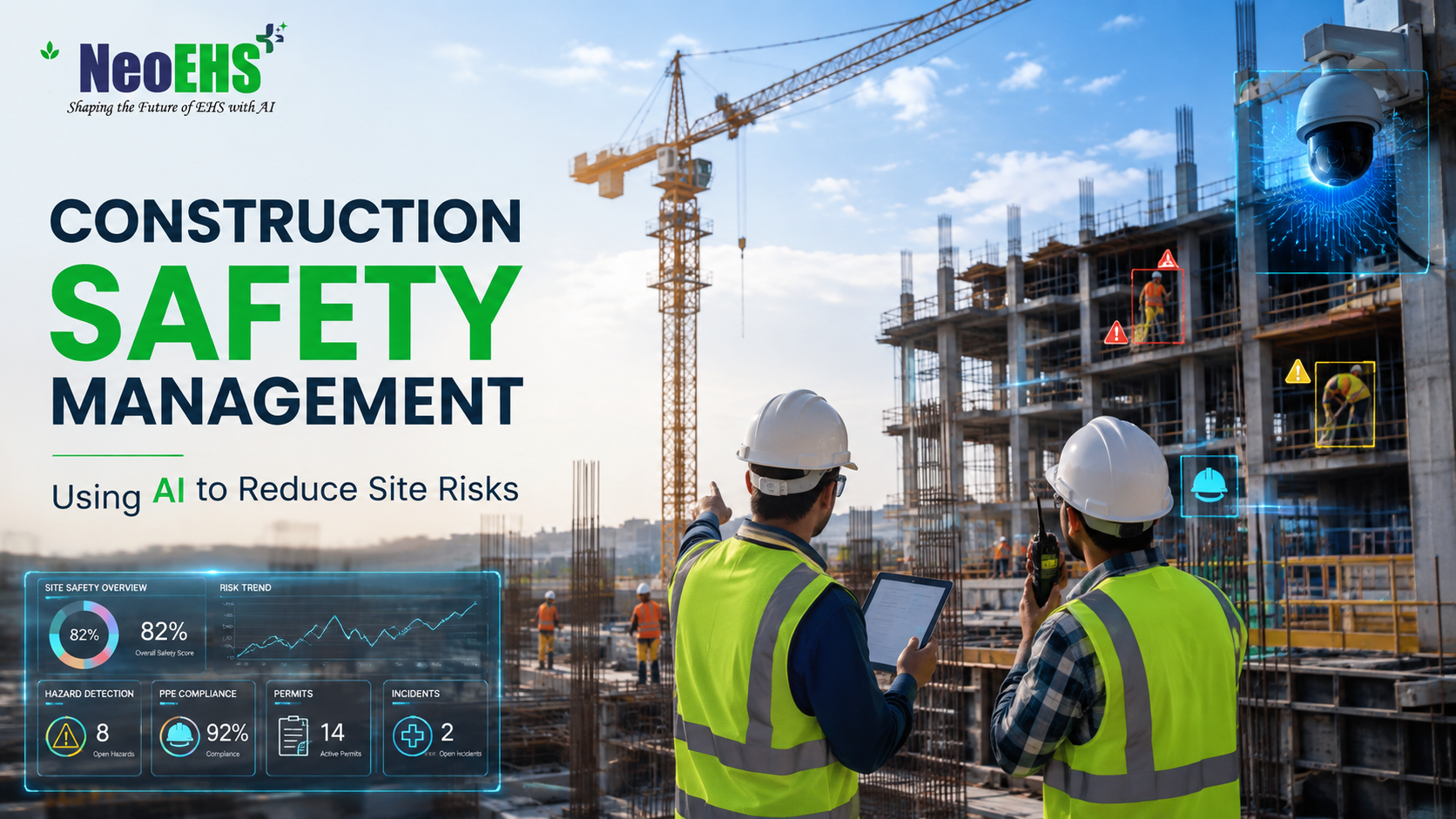
Manage project safety, contractors, permits, inspections, risk assessments and incident reporting.
Mining
Support high-risk activities, mobile equipment safety, observations, permits, incidents and environmental management.
Power & Energy
Manage electrical safety, Permit to Work, inspections, risk management, audits and compliance.
Oil & Gas
Support high-risk operations, PTW, LOTO, inspections, incident management and operational safety.
Chemical Industry
Manage chemical hazards, hazardous materials, emergency preparedness, permits and environmental controls.
Ports & Maritime
Manage operational risks, inspections, contractors, permits and safety compliance.
Infrastructure, Metro & Rail
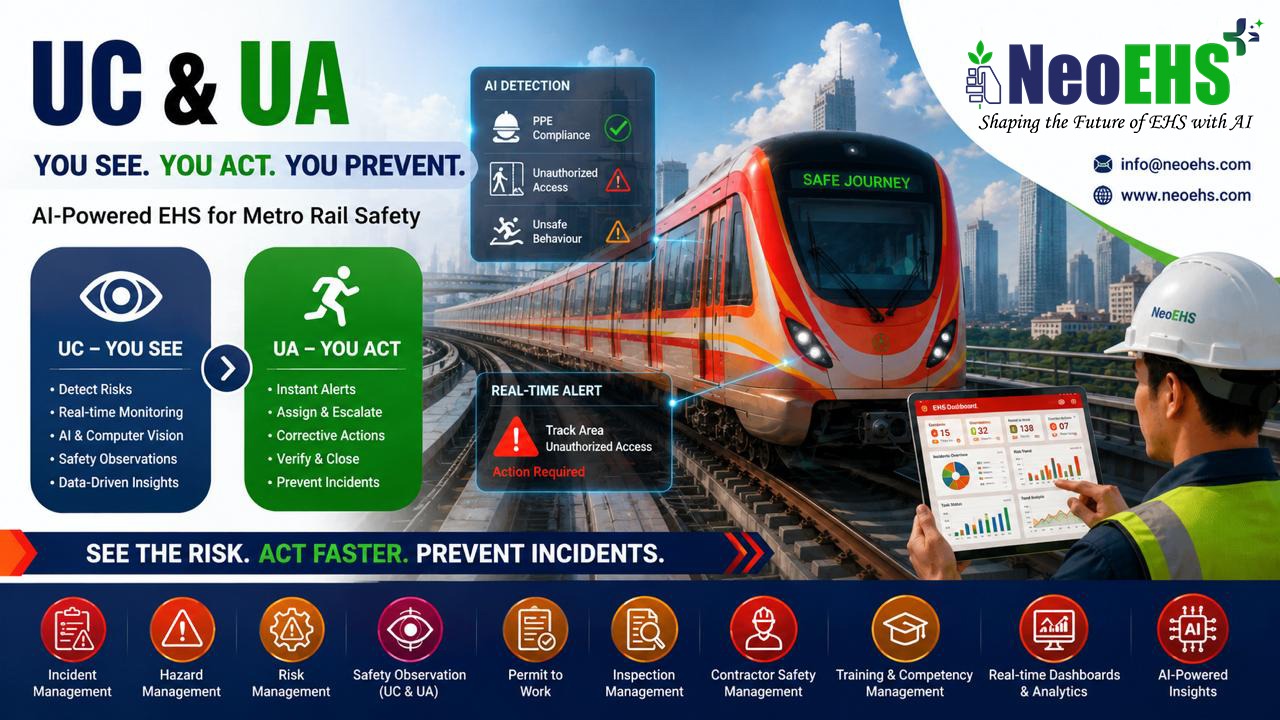
Support project safety, contractor management, inspections, incidents and compliance across complex projects.
What Is the Difference Between Traditional EHS Software and AI-Powered EHS Software?
| Traditional EHS Software | AI-Powered EHS Software |
|---|---|
| Digitizes safety processes | Digitizes and analyzes safety processes |
| Stores safety records | Finds patterns across safety records |
| Provides standard reports | Provides intelligent insights |
| Reactive reporting | Proactive risk identification |
| Manual data analysis | AI-assisted analysis |
| Manual document review | OCR and document intelligence |
| Static dashboards | Dynamic risk and trend insights |
| Separate information sources | Connected data ecosystem |
| Human-led data interpretation | Human judgment supported by AI |
The objective is not to eliminate human expertise.
It is to augment it.
Can AI Predict Workplace Accidents?
This is an important distinction.
AI cannot guarantee that a workplace accident will be predicted or prevented.
However, AI and predictive analytics can analyze historical and current safety information to identify patterns, trends and warning indicators that may help organizations focus preventive action on higher-risk areas.
For example, repeated near misses, recurring hazards, overdue corrective actions and increasing unsafe observations may collectively indicate an area that deserves additional attention.
AI provides another layer of intelligence.
The final safety decision remains with qualified people who understand the workplace and its operational context.
The Future of Workplace Safety Is Intelligent and Connected
The future of workplace safety is not about replacing safety professionals with artificial intelligence.
It is about giving safety professionals better tools.
AI can analyze large amounts of information.
IoT can provide real-time operational data.
Computer vision can add another layer of visibility.
Predictive analytics can identify patterns.
Automation can reduce repetitive administrative work.
But people remain at the center of safety.
Technology provides intelligence. People provide judgment.
Together, they can create a stronger foundation for proactive workplace safety.
Why NeoEHS?
NeoEHS brings together:
EHS Management + AI + Predictive Analytics + Automation + IoT + Computer Vision + ESG
within a connected digital environment.
The objective is simple:
Help organizations understand risks earlier, make better decisions and build safer, more sustainable workplaces.
NeoEHS is designed to help organizations move beyond simply recording what happened.
It helps them understand:
What is happening?
Why is it happening?
Where is risk increasing?
What requires attention?
What action should happen next?
That is the transition from traditional EHS management to intelligent EHS management.
Explore NeoEHS solutions:
- HSE Application — mobile Health, Safety & Environment app for field teams
- EHS Application — mobile Environmental Health & Safety app
- HSE Software — enterprise HSE management platform
- HSE Application India — India-focused mobile HSE rollout
Frequently Asked Questions
What is an AI-powered EHS application?
An AI-powered EHS application is software that combines Environmental, Health and Safety management capabilities with artificial intelligence, analytics, automation and connected data to help organizations identify risks, manage incidents, improve compliance and make better-informed safety decisions.
What is AI-powered EHS software?
AI-powered EHS software is a digital safety management platform that uses AI and analytics to support activities such as risk management, incident analysis, inspections, observations, compliance, document processing and predictive safety analysis.
How does AI improve workplace safety?
AI can analyze large volumes of safety information, identify recurring patterns, highlight potential risk areas, automate selected processes and provide decision-support information to EHS professionals.
Can AI predict workplace accidents?
AI cannot guarantee that an accident will be predicted or prevented. However, predictive analytics can identify patterns and warning indicators in safety data that may help organizations prioritize preventive action.
How does NeoEHS help with risk management?
NeoEHS provides digital capabilities for hazard identification, risk assessment, controls, corrective actions and safety analytics. AI-assisted analysis can help identify recurring risks and emerging patterns.
Can NeoEHS manage workplace incidents?
Yes. NeoEHS supports incident reporting, investigation, corrective action management, closure and analysis of safety trends.
Does NeoEHS support Permit to Work?
Yes. NeoEHS supports digital Permit to Work processes for high-risk activities such as hot work, confined space entry, electrical work, work at height, excavation, lifting and isolation-related activities.
Can NeoEHS integrate with IoT devices?
NeoEHS can integrate with connected technologies and IoT data sources to support a broader view of operational and safety information.
Can NeoEHS use computer vision for safety monitoring?
NeoEHS can support AI-based computer vision use cases for selected safety indicators such as PPE compliance, restricted-area access, unsafe proximity and other configured workplace conditions.
Can NeoEHS support ESG management?
Yes. NeoEHS brings EHS and environmental capabilities together with sustainability-related data management, including areas such as waste, air quality, carbon emissions and environmental controls.
Is NeoEHS suitable for large organizations?
NeoEHS is designed for organizations with complex EHS requirements across multiple sites, projects, departments and operational environments.
What industries can use NeoEHS?
NeoEHS can support industries including manufacturing, construction, mining, oil and gas, power and energy, chemicals, logistics, ports and maritime, infrastructure, metro and rail and other high-risk operational environments.
Final Thought: From Safety Data to Safety Intelligence
The future of workplace safety will not be defined by how much safety data an organization collects.
It will be defined by how effectively that organization turns data into action.
AI-powered EHS software can help safety teams move from fragmented information to connected intelligence, from reactive reporting to proactive risk management and from manual processes to smarter workflows.
NeoEHS brings EHS management, artificial intelligence, predictive analytics, automation, connected technologies and ESG capabilities together to support this transformation.
Because the goal of technology in safety is not simply to report an incident faster after it happens.
The goal is to help organizations recognize warning signs earlier, understand risk better and take preventive action sooner.
NeoEHS — Shaping the Future of EHS With AI.
Ready to transform your workplace safety management?
Explore NeoEHS and discover how an AI-powered EHS platform can help your organization build a safer, more connected and more proactive safety management system.
Book a NeoEHS Demo Email is at info@neoehs.com
- AI-Powered EHS Software
- EHS Management System
- HSE Application
- Risk Management
- Incident Management
- Hazard Management
- Inspection Management
- Audit Management
- Permit to Work
- Compliance Management
- Training Management
- Environmental Management
- Carbon Emission Management
- AI-Powered Computer Vision
- Predictive Analytics
- IoT-Based Safety Management
- ESG Management
- Manufacturing EHS
- Construction EHS
- Mining EHS
- Power & Energy EHS