How AI Improves Workplace Risk Assessment
Workplace risk assessment has always been one of the foundations of effective health and safety management.
But the workplace has changed.
Organizations now operate across multiple sites, complex processes, contractors, equipment, chemicals, digital systems and increasingly data-rich environments. Safety teams may have thousands of incidents, inspections, observations, risk assessments and corrective actions to review.
The challenge is no longer simply collecting safety information.
The challenge is understanding it quickly enough to make better decisions.
This is where artificial intelligence is changing workplace risk assessment.
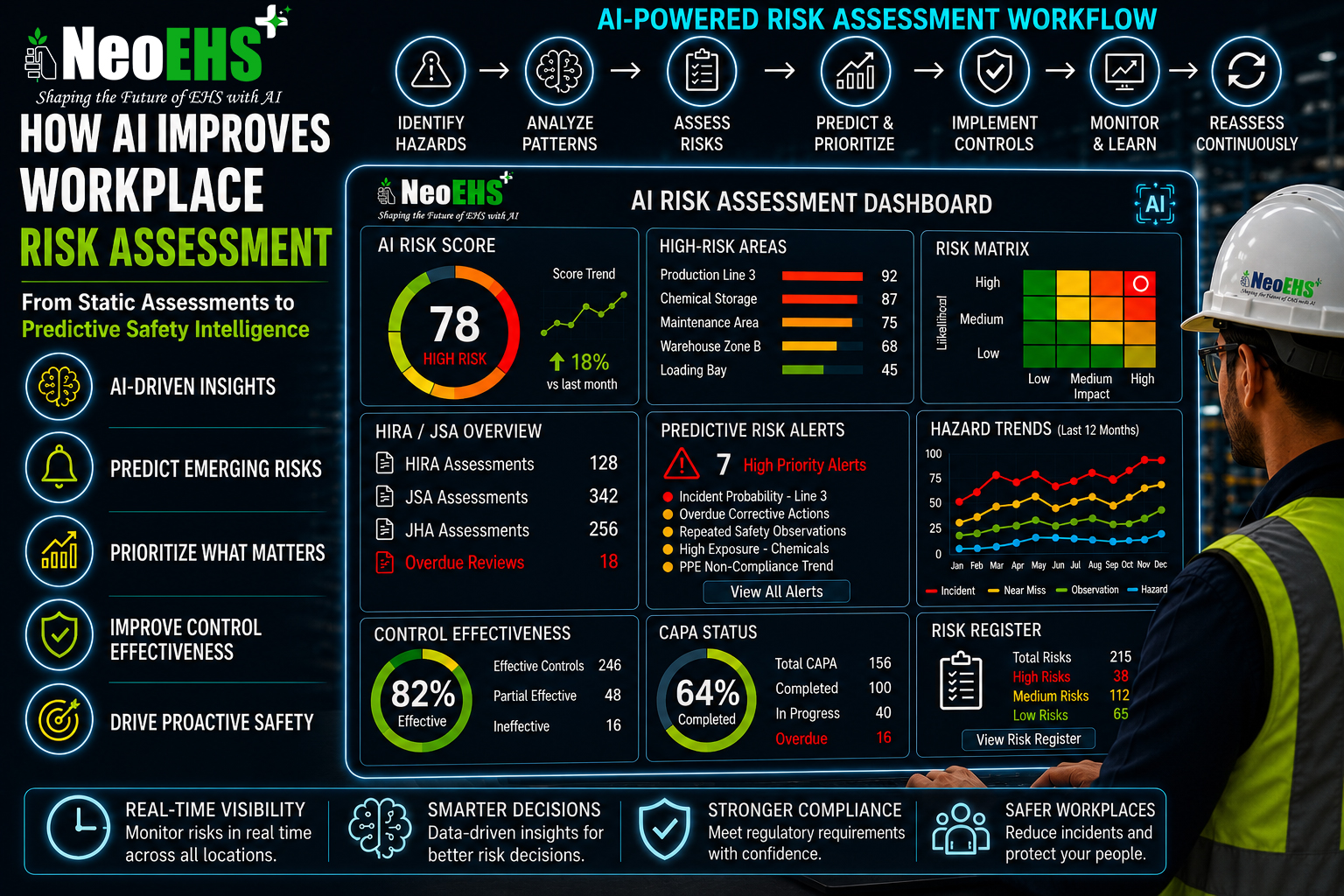
AI can help organizations identify hazards, analyze risk patterns, prioritize high-risk conditions, recommend controls and continuously monitor whether risk is changing.
NeoEHS combines AI, predictive analytics, digital risk assessment workflows and connected EHS data to help organizations move from traditional, document-based risk assessment toward dynamic and proactive risk intelligence.
The goal is not to replace safety professionals.
The goal is to give them better information, earlier warning signals and stronger decision support.
What Is AI-Powered Workplace Risk Assessment?
AI-powered workplace risk assessment is the use of artificial intelligence, machine learning, analytics and connected EHS data to identify hazards, evaluate risks, recommend controls and detect changes in workplace risk.
Traditional risk assessment often follows a periodic process:
Identify Hazard → Assess Risk → Apply Controls → Review
AI-enabled risk management can make the process more continuous:
Detect → Analyze → Assess → Predict → Control → Monitor → Learn → Reassess
This difference is important.
A risk assessment completed six months ago may no longer accurately represent today's workplace.
People change.
Equipment changes.
Processes change.
Contractors change.
Production levels change.
Environmental conditions change.
And new hazards can emerge.
AI helps organizations move toward a model where risk information can be continuously analyzed rather than treated as a static document.
Why Traditional Risk Assessment Is No Longer Enough
Traditional risk assessments remain valuable, but many organizations still manage them through spreadsheets, documents and disconnected systems.
This can create several problems.
Risk assessments may become outdated
A process may change without the corresponding risk assessment being updated.
Risk data may be fragmented
Incidents may sit in one system, inspections in another and corrective actions in spreadsheets.
High-risk areas may be difficult to identify
A safety team may have thousands of records but limited ability to identify recurring patterns.
Manual analysis takes time
EHS professionals may spend hours comparing historical incidents and inspection findings.
Risk controls may not be continuously evaluated
A control can exist on paper but may not work effectively in practice.
Emerging risks can be missed
A series of small warning signals may not appear significant individually.
AI can help connect these signals.
How AI Improves Workplace Risk Assessment
There are several important ways AI can strengthen the risk assessment lifecycle.
1. AI Helps Identify Hazards Faster
Risk assessment begins with hazard identification.
If a hazard is not identified, it cannot be properly assessed or controlled.
AI can help identify potential hazards from multiple sources, including:
- Incident reports
- Near misses
- Safety observations
- Inspection findings
- Audit findings
- Risk assessments
- Worker reports
- Equipment information
- Environmental data
- Operational information
- CCTV and computer vision
- IoT sensor data
NeoEHS supports AI-powered hazard identification through inspections, mobile reporting, AI image analysis and CCTV monitoring.
This allows organizations to move beyond relying exclusively on scheduled risk assessments.
2. AI Can Identify Patterns Humans May Miss
One incident may not tell the whole story.
Consider this example.
A manufacturing facility records:
- Three minor hand injuries
- Five observations involving machine guarding
- Two inspection findings involving the same equipment
- Four overdue corrective actions
- Several maintenance activities on the same production line
Each item may appear manageable by itself.
But together, they may indicate an emerging machine-safety risk.
AI can analyze relationships between these data points and identify recurring patterns.
This is one of the most important advantages of AI:
It can analyze large volumes of information much faster than manual review.
NeoEHS uses predictive analytics to analyze incidents, near misses, inspections and behavioral trends to identify potential future risks.
3. AI Makes Risk Assessment More Dynamic
A traditional risk register can become a static document.
An AI-enabled risk platform can turn it into a dynamic source of safety intelligence.
Instead of asking:
“What was our risk assessment last year?”
organizations can ask:
“What is our highest current risk?”
“Which risks are increasing?”
“Which controls are overdue?”
“Which locations have recurring hazards?”
“Where are workers most exposed?”
NeoEHS's current risk management solution is designed around identifying, assessing, monitoring and mitigating workplace risks through AI-driven analytics and real-time operational visibility.
4. AI Supports HIRA, HIRARC, JSA and JHA
Different industries use different risk assessment methodologies.
Common approaches include:
- HIRA — Hazard Identification and Risk Assessment
- HIRARC — Hazard Identification, Risk Assessment and Risk Control
- JSA — Job Safety Analysis
- JHA — Job Hazard Analysis
- FMEA — Failure Mode and Effects Analysis
- HAZOP — Hazard and Operability Study
- Bowtie Analysis
NeoEHS supports configurable risk assessment workflows covering HIRA, JSA, JHA, FMEA, HAZOP, risk matrices and Bowtie analysis.
AI can assist by bringing historical safety information into these workflows.
For example:
Task → Hazards → Historical Incidents → Existing Controls → Risk Score → Recommended Actions
The safety professional still makes the final judgment.
AI provides additional intelligence to support that judgment.
5. AI Can Help Prioritize High-Risk Activities
Not every risk deserves the same level of attention.
EHS teams often have limited resources.
The question becomes:
Where should we focus first?
AI can help prioritize risk using information such as:
- Severity
- Likelihood
- Frequency
- Historical incidents
- Near misses
- Exposure
- Number of workers affected
- Repeated findings
- Control effectiveness
- Location
- Operational conditions
This allows safety teams to focus attention on the risks most likely to have significant consequences.
NeoEHS provides risk scoring, predictive analytics and high-risk-area identification capabilities within its risk and hazard management workflows.
6. AI Can Detect Emerging Risks
Some risks do not appear suddenly.
They develop gradually.
For example:
More near misses → repeated observations → overdue actions → recurring equipment issues → increasing risk
A conventional reporting system may show these as separate events.
AI can potentially connect them.
This is the difference between:
Incident reporting
and
risk intelligence.
The objective is to identify a developing risk before it becomes a serious incident.
NeoEHS's hazard management platform specifically describes predictive risk analytics, behavioral safety analytics, high-risk area identification and predictive safety alerts.
7. AI Improves Risk Scoring
Risk assessment traditionally uses a risk matrix based on factors such as:
Likelihood × Severity
However, determining likelihood can be difficult when the assessment relies heavily on subjective judgment.
AI can introduce additional evidence.
For example, likelihood assessment can potentially be informed by:
- Previous incidents
- Near misses
- Frequency of exposure
- Historical inspection findings
- Safety observations
- Equipment condition
- Work activity
- Environmental conditions
- Previous corrective actions
This does not mean AI should automatically determine the final risk rating.
Rather, AI can provide evidence-based context for the person conducting the assessment.
That makes risk scoring more informed and potentially more consistent.
8. AI Can Recommend Risk Controls
Identifying a risk is only the beginning.
The real objective is to control it.
AI can analyze historical safety information and help suggest potential corrective or preventive actions.
For example:
Hazard
Worker exposure to moving machinery.
Possible controls
- Engineering guarding
- Interlocks
- Physical barriers
- LOTO
- Administrative controls
- Training
- PPE
The safety professional should determine which controls are appropriate based on the actual workplace.
AI can help accelerate the process by presenting relevant information and previous actions.
NeoEHS provides intelligent safety workflows and smart corrective recommendations as part of its AI-enabled risk management capabilities.
9. AI Connects Risk Assessment With CAPA
A risk assessment should result in action.
If a high-risk condition is identified, someone should be responsible for addressing it.
A connected workflow can be:
Risk Identified
↓
Risk Assessed
↓
Control Required
↓
CAPA Created
↓
Owner Assigned
↓
Deadline Set
↓
Action Completed
↓
Effectiveness Verified
↓
Risk Reassessed
This closes the loop between assessment and action.
NeoEHS provides automated CAPA workflows and connects risk management with corrective and preventive actions.
10. AI Can Evaluate Whether Controls Are Working
One of the biggest weaknesses in traditional risk management is assuming that a control remains effective simply because it exists.
Consider a machine guard.
The risk assessment says:
Control: Machine Guard Installed
But what if:
- The guard is damaged?
- Workers bypass it?
- Inspections repeatedly identify problems?
- Maintenance removes it?
- The control is ineffective during certain operations?
AI can help identify these signals by connecting:
Risk → Control → Inspection → Observation → Incident → CAPA
This creates a much stronger picture of control effectiveness.
11. AI Brings Incident Data Into Risk Assessment
Every incident contains information about risk.
If a workplace experiences an incident, the risk assessment should potentially be reconsidered.
For example:
Risk Assessment → Control → Incident → Investigation → Root Cause → Risk Reassessment
NeoEHS connects incident management, risk management, hazards, inspections and corrective actions within its integrated EHS ecosystem.
This means incident learning can feed back into risk management rather than remaining isolated in an incident database.
12. AI Uses Near Misses as Early Warning Signals
Near misses are valuable because they can reveal weaknesses without necessarily resulting in injury.
Suppose a warehouse reports:
- Five forklift near misses
- Three pedestrian-route observations
- Two damaged barriers
- Increasing congestion during peak hours
No serious accident has happened.
Yet the risk may be increasing.
AI can analyze these leading indicators and help identify the area as a potential high-risk zone.
This changes the safety conversation from:
“Nobody was injured.”
to:
“We are seeing signals that could lead to an injury.”
That is proactive safety management.
13. AI Can Identify High-Risk Areas
Risk is rarely distributed evenly across an organization.
One production line may have more incidents.
One warehouse zone may have more observations.
One contractor group may have more safety violations.
One maintenance activity may generate repeated hazards.
AI can identify these operational hotspots.
NeoEHS's hazard management capabilities include high-risk-area identification and analysis of unsafe behaviors, inspection history and operational data.
This allows organizations to ask:
Where is risk concentrated?
rather than simply:
How many risks do we have?
14. AI Supports Real-Time Risk Monitoring
Traditional risk assessments are often periodic.
But workplaces are dynamic.
IoT and real-time operational data can help make risk management more responsive.
NeoEHS's IoT-based safety management capabilities are designed to connect live telemetry with EHS workflows, providing visibility into where risks occur, when they occur, how frequently they occur, which workers are exposed and whether controls are working.
This creates a more dynamic model:
Real-Time Data → Risk Signal → Alert → Intervention → Risk Reduction
15. AI + Computer Vision for Risk Assessment
Computer vision can provide another source of safety intelligence.
Depending on the application, AI vision systems can help identify:
- PPE compliance
- Restricted-area access
- Unsafe activities
- Unsafe positioning
- Crowding
- Safety-zone violations
- Certain environmental or operational conditions
NeoEHS describes AI vision-based monitoring for PPE compliance, restricted-area access and unsafe activities.
When appropriate, these observations can become inputs into a broader risk management process.
For example:
Repeated PPE violations → Risk identified → Investigation → Control improvement → Monitoring
16. AI Helps Connect Contractor Risk
Contractors can introduce additional risk into an organization.
A strong risk assessment process should consider:
- Contractor competency
- Training
- Previous incidents
- Work activity
- Permit requirements
- Site conditions
- Risk assessments
- Safety performance
AI can help identify patterns across contractor activities and safety records.
This can support more informed decisions about where additional supervision or controls may be required.
NeoEHS includes contractor management within its broader HSE platform, alongside risk assessment, incidents, permits and compliance workflows.
17. AI Improves Risk Assessment Across Multiple Sites
Large organizations face another challenge:
How do we maintain consistent risk management across multiple facilities?
Imagine a company with 50 sites.
One facility discovers a serious hazard.
A traditional system may resolve the issue locally.
A connected AI platform can ask:
Do our other facilities have the same hazard?
Are they using the same equipment?
Have similar incidents occurred elsewhere?
Are the same controls being used?
This enables enterprise-wide learning.
A safety lesson from one site can become a preventive action across the organization.
18. AI Supports Dynamic Risk Registers
A risk register should not become a document that nobody opens after an assessment is completed.
A modern risk register should answer:
- What are our highest risks?
- Where are they?
- Who is exposed?
- What controls exist?
- Which controls are overdue?
- Which risks are increasing?
- Which risks are recurring?
- Which actions remain open?
- What incidents are associated with each risk?
NeoEHS provides centralized risk visibility, risk registers, scoring, controls, predictive analytics and dashboards within its risk management platform.
This transforms the risk register from a compliance document into a management tool.
AI-Powered Risk Assessment vs Traditional Risk Assessment
| Traditional Risk Assessment | AI-Powered Risk Assessment |
|---|---|
| Periodic assessment | Continuous risk intelligence |
| Spreadsheet-based | Centralized digital platform |
| Manual data review | AI-assisted analysis |
| Historical information | Historical + real-time data |
| Static risk register | Dynamic risk register |
| Manual prioritization | Intelligent prioritization |
| Isolated incidents | Connected incident intelligence |
| Manual control review | Control-effectiveness insights |
| Reactive | Proactive |
| Limited cross-site visibility | Enterprise-wide risk visibility |
| Human-only pattern recognition | AI-assisted pattern recognition |
AI does not eliminate the need for professional risk assessment.
It makes the assessment process more connected, data-driven and responsive.
What Data Can AI Use for Workplace Risk Assessment?
The quality of AI insights depends heavily on the quality and relevance of the underlying data.
Useful sources can include:
Incident Data
- Injuries
- Near misses
- Property damage
- Environmental incidents
Inspection Data
- Findings
- Repeated deficiencies
- Equipment conditions
- Workplace observations
Risk Data
- HIRA
- HIRARC
- JSA
- JHA
- HAZOP
- FMEA
- Bowtie
Behavioral Data
- Unsafe acts
- Safety observations
- PPE compliance
- High-risk behaviors
Operational Data
- Equipment
- Work activity
- Production conditions
- Maintenance
Environmental Data
- Temperature
- Gas levels
- Air quality
- Noise
- Other relevant sensor information
Compliance Data
- Audit findings
- Regulatory requirements
- Corrective actions
The more connected these data sources are, the greater the opportunity for meaningful risk intelligence.
AI Does Not Replace the Safety Professional
This point deserves emphasis.
AI should not be treated as an autonomous safety decision-maker.
Workplace risk assessment requires:
- Professional judgment
- Knowledge of the workplace
- Understanding of applicable regulations
- Engineering knowledge
- Worker consultation
- Operational context
- Validation of controls
AI should support these activities.
The ideal relationship is:
AI provides intelligence.
Safety professionals provide judgment.
Operations provide context.
Workers provide experience.
Management provides accountability.
Together, these create stronger risk decisions.
A Practical AI-Powered Risk Assessment Workflow
A modern workflow can look like this:
Step 1 — Identify
Capture hazards through inspections, observations, incidents, AI vision, mobile reporting and other sources.
Step 2 — Analyze
Use AI to identify historical patterns and similar risks.
Step 3 — Assess
Apply HIRA, HIRARC, JSA, JHA, FMEA, HAZOP, Bowtie or the organization's chosen methodology.
Step 4 — Prioritize
Identify high-risk activities, locations and exposures.
Step 5 — Control
Apply engineering, administrative and other appropriate controls.
Step 6 — Assign
Create CAPA and assign ownership and deadlines.
Step 7 — Monitor
Track risk indicators, inspections, incidents, observations and control performance.
Step 8 — Predict
Use historical and real-time data to identify emerging risk patterns.
Step 9 — Reassess
Update the risk assessment when conditions change or new information becomes available.
Step 10 — Learn
Use organizational learning to improve future risk assessments.
Industry Applications of AI-Powered Risk Assessment
Manufacturing
AI can help identify machine safety risks, ergonomic hazards, chemical exposure, maintenance risks, unsafe behaviors and recurring equipment-related incidents.
Construction
Risk assessment can be connected with work-at-height, excavation, lifting, scaffolding, temporary works, contractor activities and Permit to Work.
Oil & Gas
AI can support process safety, HAZOP, Bowtie, PTW, LOTO, contractor risk, equipment risk and operational monitoring.
Chemical Industry
AI can connect chemical hazards, SDS information, chemical inventory, exposure risks, incidents, inspections and environmental risks.
Mining
AI can help analyze risks associated with heavy equipment, haul roads, mobile machinery, ground conditions, blasting and contractor activities.
Ports & Maritime
Risk assessment can connect vessel operations, cargo handling, lifting activities, restricted areas, weather conditions and environmental risks.
Rail & Metro
AI can support risk assessment across maintenance activities, track work, electrical systems, rolling stock, stations, contractors, passenger areas and high-risk work.
How NeoEHS Improves Workplace Risk Assessment
NeoEHS combines AI-enabled risk management with the broader EHS lifecycle.
Its current Risk Management platform includes:
- AI-assisted risk assessments
- HIRA
- JSA
- JHA
- HAZOP
- FMEA
- Bowtie analysis
- Risk matrices
- Predictive analytics
- Real-time risk monitoring
- AI risk detection
- CAPA tracking
- Risk dashboards
- High-risk area identification
- AI vision-based monitoring
Explore NeoEHS AI-Enabled Risk Management Software
The value becomes even greater when risk assessment is connected with the wider NeoEHS platform, including incident management, hazard management, inspections, audits, permits and compliance.
Explore NeoEHS EHS Management System
From Risk Assessment to Risk Intelligence
The biggest change AI brings is not simply automation.
It is continuous learning.
Traditional approach:
Assess → Document → Review Later
AI-enabled approach:
Assess → Monitor → Learn → Predict → Reassess
This creates a continuous risk intelligence cycle.
For example:
Incident
↓
AI identifies similar historical events
↓
Risk assessment is reviewed
↓
Control weakness identified
↓
CAPA created
↓
Inspection verifies control
↓
AI monitors recurrence
↓
Risk score updated
↓
Organization learns
This is how risk management becomes proactive.
Frequently Asked Questions
What is AI-powered workplace risk assessment?
AI-powered workplace risk assessment uses artificial intelligence, analytics and connected EHS data to identify hazards, analyze risk patterns, prioritize risks, support control selection and monitor changing workplace conditions.
How does AI improve risk assessment?
AI can analyze large volumes of incidents, near misses, inspections, observations and operational data to identify patterns, prioritize high-risk areas and provide decision support to EHS professionals.
Can AI replace a safety professional?
No. AI should support qualified safety professionals rather than replace their judgment. Risk decisions should consider workplace conditions, applicable requirements, engineering principles, worker input and professional expertise.
Can AI predict workplace accidents?
AI cannot guarantee that an accident will be predicted or prevented. It can, however, analyze historical and real-time information to identify patterns and warning signals that may indicate increasing risk.
What risk assessment methods can NeoEHS support?
NeoEHS's current Risk Management solution supports HIRA, JSA, JHA, FMEA, HAZOP, Bowtie analysis and configurable risk matrices.
Can AI use incident data in risk assessment?
Yes. Connecting incidents and near misses with risk assessments can help organizations identify recurring hazards and reconsider whether existing controls remain effective.
Can AI identify high-risk areas?
AI-powered analytics can analyze incident trends, unsafe behaviors, inspection history and operational data to identify potential high-risk areas. NeoEHS specifically provides high-risk-area identification capabilities.
Can AI monitor risk in real time?
When connected to appropriate operational, IoT or other data sources, AI-enabled systems can provide more dynamic visibility into changing risk conditions. NeoEHS supports IoT-based dynamic risk management and real-time risk visibility.
How does AI help with corrective actions?
AI can help identify recurring problems and recommend potential corrective or preventive actions. NeoEHS includes intelligent safety recommendations and automated CAPA workflows within its risk management capabilities.
What is the difference between traditional and AI-powered risk assessment?
Traditional assessments are often periodic and document-driven. AI-powered risk assessment connects multiple sources of safety information and can provide more continuous, data-driven risk intelligence.
Is AI-powered risk assessment suitable for high-risk industries?
Yes. AI-enabled risk intelligence can be particularly valuable in industries with complex or changing risks, including manufacturing, construction, oil and gas, chemicals, mining, ports, utilities, infrastructure and transportation.
The Future of Workplace Risk Assessment
The future of workplace risk assessment is not about creating more spreadsheets.
It is about creating better safety intelligence.
Organizations need to know:
What are our highest risks?
Where are they increasing?
Which workers are exposed?
Which controls are failing?
What incidents are connected to those risks?
What should we address first?
AI can help answer these questions by connecting information that was previously scattered across different systems.
The result is a shift:
From Static Risk Registers → Dynamic Risk Intelligence
From Periodic Assessments → Continuous Monitoring
From Historical Reporting → Predictive Insights
From Reactive Controls → Proactive Prevention
From Disconnected Data → Connected Safety Intelligence
Build a Smarter Risk Management Program With NeoEHS
NeoEHS brings AI-powered risk assessment, predictive analytics, hazard management, incident management, inspections, audits, CAPA, permits and compliance into a connected EHS platform.
Discover NeoEHS AI-Powered EHS Software
The objective is not to let AI make safety decisions on its own.
The objective is to give safety professionals the information they need to make faster, better and more proactive decisions.
Because the most valuable risk assessment is not the one that simply documents yesterday's risks.
It is the one that helps an organization understand what could happen next—and what it can do today to prevent it.
AI doesn't replace risk management.
It makes risk management more intelligent.
AI-Enabled Risk Management Software
.jpg "5 Why analysis diagram showing step-by-step questioning to identify root cause of workplace incidents using NeoEHS")