ISO 14001 Environmental Aspects and Impact Assessment Guide
A Practical Guide to Identifying Environmental Aspects, Assessing Impacts and Managing Significant Environmental Risks
Environmental aspects and impacts are at the heart of an effective ISO 14001 Environmental Management System (EMS).
But from an experienced environmental and HSE professional's perspective, an aspect-impact assessment should never become just another Excel sheet prepared before an audit.
The real purpose is much more practical:
Identify how your activities interact with the environment, understand the potential impacts, determine what is significant, establish effective controls and continuously improve environmental performance.
In a modern organization, environmental risks can change quickly.
A new chemical may be introduced. Production may increase. Equipment may change. A contractor may take over an activity. Water availability may change. Waste generation may increase. An environmental incident may reveal a weakness that was not previously understood.
If the environmental aspects register remains unchanged while the workplace changes, the organization may have documentation—but not necessarily effective environmental risk management.
This is where digital environmental management software can provide significant value.
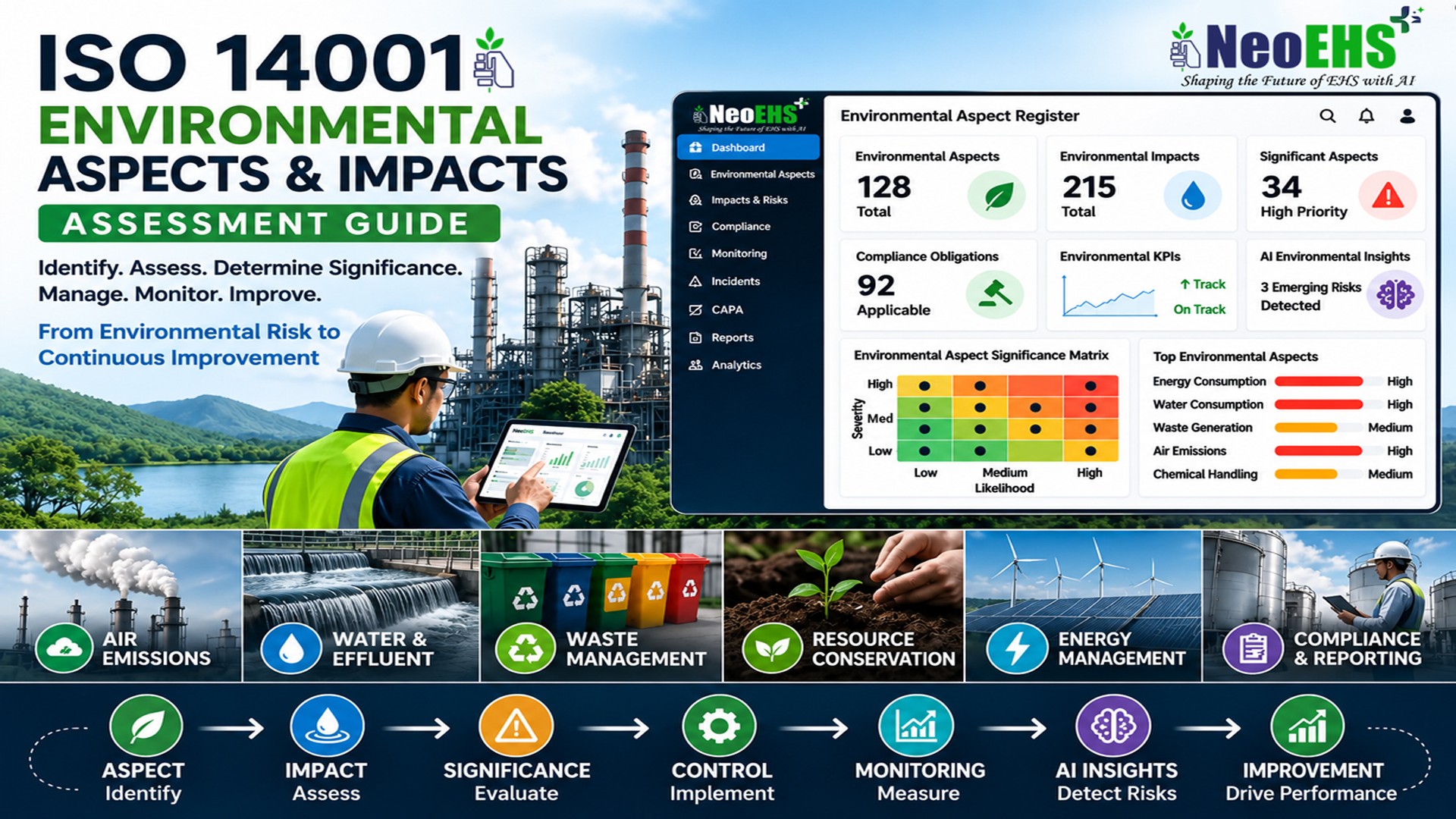
With NeoEHS, organizations can digitize environmental aspect and impact assessments, manage significant environmental aspects, connect environmental risks with compliance and corrective actions, monitor environmental performance and use AI-powered analytics to identify emerging patterns.
Identify → Assess → Determine Significance → Control → Monitor → Improve
What Are Environmental Aspects and Environmental Impacts?
One of the first concepts every ISO 14001 professional should understand is the difference between an environmental aspect and an environmental impact.
Environmental Aspect
An environmental aspect is an element of an organization's activities, products or services that interacts or can interact with the environment.
Environmental Impact
An environmental impact is a change to the environment resulting wholly or partly from an environmental aspect.
A simple way to remember it:
Aspect = the interaction or cause
Impact = the environmental change or effect
For example:
| Activity | Environmental Aspect | Potential Environmental Impact |
|---|---|---|
| Boiler operation | Fuel consumption | Resource consumption and atmospheric emissions |
| Chemical storage | Potential leakage | Soil or water contamination |
| Manufacturing | Waste generation | Waste disposal impact |
| Vehicle operation | Fuel combustion | Air emissions |
| Cooling process | Water consumption | Resource depletion |
| Wastewater treatment | Effluent discharge | Water-quality impact |
| Generator operation | Diesel consumption | Air emissions and resource consumption |
| Packaging | Material consumption | Waste generation |
The important relationship is:
Activity → Environmental Aspect → Environmental Impact
What Is an ISO 14001 Environmental Aspects and Impacts Assessment?
An ISO 14001 environmental aspects and impacts assessment is a systematic process for identifying environmental aspects associated with an organization's activities, products and services, determining their potential environmental impacts and establishing which aspects are significant according to defined criteria.
A practical assessment should consider:
- Activities
- Products
- Services
- Normal operating conditions
- Abnormal conditions
- Emergency situations
- Environmental impacts
- Compliance obligations
- Lifecycle perspective
- Existing controls
- Significance criteria
- Environmental objectives
- Monitoring requirements
The assessment should ultimately help the organization understand:
Which environmental aspects require the greatest attention and control?
Why Environmental Aspect and Impact Assessment Matters
The aspect-impact assessment influences many parts of an Environmental Management System.
It can provide input into:
- Environmental objectives
- Environmental targets
- Operational controls
- Monitoring programs
- Compliance management
- Emergency preparedness
- Environmental improvement projects
- Internal audits
- Corrective actions
- Management review
If the assessment is weak, environmental management can become reactive.
If the assessment is meaningful and regularly reviewed, it can help the organization focus resources on the environmental issues that matter most.
The Biggest Mistake: Treating the Register as an Audit Document
One of the most common problems I have seen in environmental management is an aspect-impact register containing hundreds of entries that looks impressive—but is rarely used operationally.
A good environmental professional should ask:
Does this register reflect today's operations?
Does it cover abnormal conditions?
Does it consider emergencies?
Have relevant outsourced activities been considered?
Have relevant lifecycle stages been considered?
Does it identify the genuinely significant aspects?
Are the controls actually working?
Are incidents and environmental findings feeding back into the assessment?
If the answer is no, the register may satisfy a documentation requirement without delivering its full environmental-management value.
The objective should not simply be:
“Complete the aspect-impact register.”
It should be:
“Understand and control the environmental aspects that matter.”
How to Conduct an ISO 14001 Aspect and Impact Assessment
A practical assessment can follow this process:
1. Identify Activities, Products and Services
↓
2. Identify Environmental Aspects
↓
3. Identify Environmental Impacts
↓
4. Consider Normal, Abnormal and Emergency Conditions
↓
5. Consider the Lifecycle Perspective
↓
6. Establish Significance Criteria
↓
7. Determine Significant Environmental Aspects
↓
8. Identify Existing Controls
↓
9. Define Additional Actions
↓
10. Monitor Environmental Performance
↓
11. Review and Reassess When Conditions Change
This turns environmental aspect assessment into a continuous management process rather than a one-time exercise.
1. Identify Activities, Products and Services
Start with the organization's actual operations.
For a manufacturing facility, activities could include:
- Raw-material receipt
- Material storage
- Production
- Chemical handling
- Utilities
- Boiler operation
- Maintenance
- Packaging
- Warehousing
- Waste management
- Effluent treatment
- Transportation
- Emergency response
For a construction project:
- Excavation
- Concrete work
- Material transportation
- Equipment operation
- Fuel storage
- Waste generation
- Water consumption
- Dust generation
- Noise generation
- Site restoration
The assessment needs to reflect what the organization actually does, not simply what appears in a generic template.
2. Identify Environmental Aspects
Now ask:
How does this activity interact with the environment?
Typical environmental aspects include:
Air Emissions
- Combustion emissions
- Dust
- VOC emissions
- Process emissions
- Refrigerant releases
Water
- Water consumption
- Wastewater generation
- Effluent discharge
- Stormwater contamination
Waste
- Hazardous waste
- Non-hazardous waste
- Industrial waste
- Packaging waste
- E-waste
Resource Consumption
- Energy
- Water
- Fuel
- Raw materials
- Chemicals
Land and Soil
- Chemical storage
- Spill potential
- Contaminated land
- Material storage
Noise and Vibration
- Machinery
- Generators
- Transportation
- Construction activities
Transportation
- Fuel consumption
- Vehicle emissions
- Spill potential
Biodiversity
Where relevant to the organization's activities, location and environmental context.
3. Identify Environmental Impacts
After identifying the aspect, ask:
What environmental change could result from this aspect?
For example:
Aspect: Diesel consumption
Potential impacts: Resource consumption and atmospheric emissions.
Aspect: Chemical leakage
Potential impacts: Soil, surface-water or groundwater contamination.
Aspect: Waste generation
Potential impacts: Resource loss and disposal impacts.
Aspect: Excessive water consumption
Potential impact: Pressure on available water resources.
This gives the assessment a clear logical structure:
Activity → Aspect → Impact
4. Consider Normal, Abnormal and Emergency Conditions
Environmental assessment should not focus exclusively on routine operations.
Normal Conditions
Routine production and normal operations.
Abnormal Conditions
- Startup
- Shutdown
- Maintenance
- Equipment malfunction
- Process deviations
Emergency Conditions
- Chemical spills
- Tank failure
- Major leakage
- Fire
- Wastewater overflow
- Fuel release
- Refrigerant release
An activity that appears low-risk during normal operation may create a significant environmental impact during an emergency.
That is why emergency scenarios should be considered appropriately within the environmental assessment process.
5. Lifecycle Perspective
Lifecycle thinking is an important part of ISO 14001.
Depending on the organization's activities, relevant stages may include:
- Raw-material acquisition
- Design
- Production
- Transportation
- Delivery
- Use
- End-of-life treatment
- Disposal
Lifecycle thinking does not mean an organization has to perform a detailed Life Cycle Assessment for every product.
The practical question is:
Which lifecycle stages can the organization control or influence?
For example, a manufacturer may not control what a customer does with a product at the end of its useful life.
But it may influence:
- Product design
- Packaging
- Material selection
- Supplier selection
- Customer information
- Transportation
- End-of-life guidance
That is where lifecycle thinking becomes practical.
6. Determine Significant Environmental Aspects
Not every environmental aspect necessarily has the same level of importance.
Organizations should establish appropriate criteria for determining significance.
Criteria may include:
- Severity
- Frequency
- Scale
- Duration
- Compliance obligations
- Environmental sensitivity
- Existing controls
- Stakeholder concerns
- Pollution potential
- Resource consumption
- Emergency potential
The important point is consistency.
The organization should establish its criteria, apply them systematically and retain appropriate evidence of the assessment.
Environmental Aspect Significance Matrix
A digital environmental management system can help standardize the evaluation.
| Criterion | Example Consideration |
|---|---|
| Severity | Potential environmental consequence |
| Frequency | How often the aspect occurs |
| Scale | Geographic extent of potential impact |
| Duration | How long the impact may continue |
| Compliance | Applicable environmental obligations |
| Sensitivity | Sensitivity of the receiving environment |
| Control | Effectiveness of existing controls |
| Emergency | Potential emergency consequence |
| Stakeholder | Level of stakeholder concern |
The exact scoring method should be established by the organization and aligned with its EMS methodology.
Environmental Aspect vs Environmental Impact
This is one of the most common questions in ISO 14001 implementation.
| Environmental Aspect | Environmental Impact |
|---|---|
| Electricity consumption | Resource consumption |
| Fuel combustion | Air emissions |
| Waste generation | Waste-disposal impact |
| Chemical storage | Potential contamination |
| Water consumption | Resource depletion |
| Wastewater discharge | Potential water-quality impact |
| Noise generation | Noise disturbance |
| Land disturbance | Habitat or soil impact |
Remember:
The aspect is the interaction. The impact is the resulting environmental change.
Why a Digital Environmental Aspect Register Is Better Than a Spreadsheet
Excel can be useful for simple environmental assessments.
However, as an organization grows, managing hundreds or thousands of aspects manually can become difficult.
Typical challenges include:
- Multiple spreadsheet versions
- Manual calculations
- Poor approval tracking
- Difficult change management
- No automatic reminders
- Limited dashboards
- Weak traceability
- Difficult multi-site management
- Manual corrective-action tracking
- Limited connection to environmental incidents
- Limited analytics
A digital environmental aspect-impact assessment system can provide a controlled environment for managing the entire lifecycle.
NeoEHS Environmental Aspect & Impact Management
NeoEHS can help organizations move from a static environmental register to a connected environmental management process.
The workflow can connect:
Environmental Aspect
↓
Environmental Impact
↓
Significance
↓
Control
↓
Compliance
↓
Monitoring
↓
Inspection
↓
Environmental Incident
↓
CAPA
↓
AI Analytics
↓
Continuous Improvement
This creates a more practical environmental management cycle.
Environmental Aspects and Compliance
Environmental aspects can have direct compliance implications.
For example:
Wastewater Discharge
Potential requirements may relate to:
- Discharge limits
- Monitoring
- Sampling
- Permits
- Reporting
Hazardous Waste
Potential requirements may include:
- Storage
- Labelling
- Transportation
- Authorized disposal
- Recordkeeping
This makes it valuable to connect:
Environmental Aspect → Compliance Obligation → Control → Monitoring → Evidence
NeoEHS can help bring these environmental-management activities into a connected digital EHS environment.
Environmental Objectives Should Come From Significant Aspects
Environmental objectives should ideally have a clear relationship with significant environmental aspects and organizational priorities.
For example:
Significant Aspect
High energy consumption.
Possible Objective
Reduce energy intensity through efficiency improvements.
Significant Aspect
Waste generation.
Possible Objective
Reduce waste generation and increase recovery or recycling.
Significant Aspect
Water consumption.
Possible Objective
Reduce water intensity through reuse and process optimization.
This creates a powerful management chain:
Aspect → Significance → Objective → Target → Action → Measurement → Improvement
Environmental Monitoring
Monitoring provides evidence about environmental performance and control effectiveness.
Depending on the organization's activities, this may include:
Air
- Stack emissions
- Ambient air
- Dust
- VOCs
Water
- Effluent
- Water consumption
- Groundwater
- Stormwater
Waste
- Waste quantities
- Hazardous waste
- Recycling
- Disposal
Energy
- Electricity
- Fuel
- Energy intensity
Other Indicators
- Noise
- Soil
- Biodiversity indicators
The objective should not be simply to collect data.
The objective is to use environmental data to make better decisions.
Environmental Incidents Should Trigger Review
Consider a chemical spill.
The immediate response is important.
But an experienced environmental professional should also ask:
Was the aspect identified?
Was the potential impact correctly understood?
Was the aspect classified appropriately?
Were the controls adequate?
Why did the incident happen?
Does the assessment need to be updated?
This creates a continuous learning cycle:
Environmental Incident
→ Investigation
→ Root Cause
→ Aspect Review
→ Control Improvement
→ CAPA
→ Verification
→ Reassessment
AI-Powered Environmental Aspect Assessment
AI can add another layer of intelligence to environmental management.
But it should be used responsibly.
AI should not simply generate a significance score without context.
Instead, AI can help environmental professionals analyze patterns across available environmental and EHS data.
Potential data sources include:
- Environmental aspect assessments
- Environmental incidents
- Inspection findings
- Audit findings
- Compliance findings
- Waste data
- Energy data
- Water data
- Emissions data
- Corrective actions
- Monitoring results
The objective is to help environmental professionals see patterns earlier.
What Can AI Help Identify?
Recurring Environmental Issues
The same environmental finding repeatedly occurs.
Repeated Control Failures
The same environmental control repeatedly fails or generates findings.
Increasing Waste
Waste generation is increasing unexpectedly.
Rising Resource Consumption
Energy or water consumption is increasing relative to operational output.
Recurring Spills
Similar environmental incidents repeatedly occur.
Emerging Environmental Risk
Multiple environmental indicators suggest an area requiring closer attention.
AI should provide decision support, while qualified environmental professionals determine significance, controls and actions.
Predictive Environmental Risk Analytics
Traditional environmental reporting asks:
What happened?
A more mature environmental-management process asks:
What is changing?
AI-powered predictive analytics can help organizations investigate:
What patterns in our environmental data may indicate an emerging risk?
For example:
Increasing water consumption
Recurring leakage findings
Maintenance backlog
Repeated inspection observations
may indicate an environmental issue requiring investigation.
The technology surfaces the pattern.
The environmental professional evaluates the situation and decides what should happen next.
Digital Environmental Aspect Register
A comprehensive digital register can contain:
- Activity
- Product/service
- Environmental aspect
- Environmental impact
- Operating condition
- Lifecycle stage
- Existing controls
- Significance criteria
- Significance status
- Compliance obligation
- Responsible department
- Responsible person
- Review date
- Actions
- Evidence
- Status
This makes the register a working management tool rather than a static document.
Multi-Site Environmental Aspect Management
For organizations with multiple sites, environmental aspects can vary considerably.
A chemical plant may have:
- Chemical emissions
- Effluent
- Hazardous waste
- Process-related environmental risks
A warehouse may have:
- Energy consumption
- Packaging waste
- Vehicle movements
- Refrigeration
A construction project may have:
- Dust
- Noise
- Waste
- Fuel
- Water
- Soil disturbance
A centralized digital platform can provide common governance while allowing site-specific environmental aspects and controls.
ISO 14001 Aspect-Impact Assessment Across Industries
Manufacturing
- Energy
- Water
- Waste
- Emissions
- Chemicals
- Effluent
- Noise
Chemical Industry
- Chemical storage
- Process emissions
- Spills
- Hazardous waste
- Effluent
- Emergency releases
Oil & Gas
- Hydrocarbon releases
- Flaring
- Emissions
- Produced water
- Waste
- Energy
- Spills
Construction
- Dust
- Noise
- Waste
- Water
- Fuel
- Soil disturbance
- Biodiversity
Mining
- Land disturbance
- Water
- Dust
- Tailings
- Waste
- Energy
- Biodiversity
Logistics
- Fuel
- Vehicle emissions
- Packaging
- Waste
- Refrigeration
- Energy
Rail & Metro
- Energy
- Noise
- Waste
- Maintenance chemicals
- Water
- Construction impacts
- Rolling-stock operations
Environmental Aspects, Risks and Opportunities
An environmental aspect should not automatically be treated as the same thing as an environmental risk.
For example:
Environmental Aspect
High water consumption.
Environmental Impact
Pressure on water resources.
Potential Risk
Future water availability could affect operations.
Potential Opportunity
Water reuse or process optimization could reduce consumption.
This is where environmental management becomes connected to operational resilience and business performance.
ISO 14001 and Climate Considerations
Environmental management is increasingly connected with:
- Climate change
- Resource availability
- Pollution
- Biodiversity
- Ecosystem conditions
- Supply-chain resilience
Organizations should therefore avoid treating environmental aspects as a static list that never changes.
The environmental context evolves.
The EMS needs to evolve with it.
Practical Environmental Aspect-Impact Example
Consider a manufacturing facility.
Activity
Boiler operation.
Environmental Aspect
Natural gas consumption and combustion emissions.
Potential Impacts
- Resource consumption
- Air emissions
- Greenhouse-gas emissions
Operating Conditions
- Normal operation
- Startup
- Shutdown
- Abnormal operation
Existing Controls
- Preventive maintenance
- Combustion optimization
- Emission monitoring
- Energy monitoring
Significance
Determined according to the organization's established criteria.
Objective
Improve energy efficiency and reduce emissions intensity.
Monitoring
- Fuel consumption
- Production output
- Energy intensity
- Emission measurements
Improvement
Use performance data to identify opportunities for efficiency improvement.
This is what makes an aspect-impact assessment operationally useful.
Common Environmental Aspect-Impact Assessment Mistakes
1. Treating Every Aspect as Significant
If everything is significant, management loses the ability to prioritize.
2. Ignoring Abnormal Conditions
Startup, shutdown and maintenance can create different environmental aspects.
3. Ignoring Emergency Conditions
Spills, leaks and equipment failures can produce significant impacts.
4. Ignoring Lifecycle Perspective
Relevant environmental influences can extend beyond the organization's physical boundary.
5. Using Generic Templates
A generic register may not reflect actual operations.
6. Never Updating the Register
Process changes can create new environmental aspects.
7. Disconnecting the Register From Objectives
Significant aspects should help inform environmental priorities.
8. Ignoring Environmental Incidents
Incidents can reveal weaknesses in existing assessments and controls.
9. Treating Significance as a One-Time Exercise
Environmental conditions and organizational activities can change.
10. Using Software as Only a Digital Spreadsheet
The real benefit of digitalization comes from connecting environmental assessment with compliance, monitoring, incidents, inspections, CAPA and analytics.
ISO 14001 Environmental Aspect-Impact Checklist
Before finalizing an assessment, ask:
Activities
- Have all relevant activities been considered?
- Have products and services been considered?
- Have outsourced activities been considered where relevant?
Environmental Aspects
- Energy?
- Water?
- Waste?
- Emissions?
- Chemicals?
- Wastewater?
- Land/soil?
- Noise?
- Transportation?
- Biodiversity where relevant?
Operating Conditions
- Normal?
- Abnormal?
- Emergency?
Lifecycle
- Upstream?
- Operational?
- Downstream?
- Areas the organization can influence?
Significance
- Are criteria defined?
- Are they consistently applied?
- Is the assessment evidence-based?
Controls
- Are controls defined?
- Are responsibilities assigned?
- Are controls effective?
Monitoring
- Are significant aspects monitored?
- Are environmental KPIs established?
Improvement
- Are objectives linked to significant aspects?
- Are corrective actions tracked?
- Are incidents feeding back into the assessment?
- Is reassessment triggered by relevant changes?
How NeoEHS Digitizes Environmental Aspect and Impact Management
NeoEHS can support the complete environmental aspect-impact lifecycle through a connected digital EHS platform.
Environmental Aspect Register
Centralize environmental aspects across facilities and departments.
Impact Assessment
Document the environmental impacts associated with each aspect.
Significance Evaluation
Apply defined criteria consistently.
Lifecycle Perspective
Capture relevant lifecycle considerations.
Environmental Controls
Define and monitor operational controls.
Compliance Management
Connect environmental aspects with applicable compliance obligations.
Environmental Inspections
Capture field findings and observations.
Environmental Incidents
Record spills, releases and other environmental events.
CAPA
Assign, track and verify corrective actions.
Environmental Monitoring
Track relevant environmental performance information.
Dashboards
Provide management visibility into significant environmental aspects.
AI Analytics
Identify recurring patterns across environmental data.
Predictive Risk Analytics
Highlight emerging environmental risk signals for professional review.
From Environmental Register to Environmental Intelligence
The traditional approach is:
Activity → Aspect → Impact → Significance
A digital approach becomes:
Activity → Aspect → Impact → Significance → Control → Monitoring → CAPA
An AI-enabled approach becomes:
Activity → Aspect → Impact → Significance → Control → Monitoring → Environmental Data → AI Pattern Detection → Risk Insight → Improvement
That is the evolution of modern environmental management.
Why NeoEHS for Environmental Management?
NeoEHS can be positioned not simply as an environmental register or compliance database, but as part of an integrated AI-powered Environment, Health and Safety management ecosystem.
Environmental professionals can bring together:
- Environmental management
- EHS risk management
- Incidents
- Inspections
- Audits
- Compliance
- CAPA
- Contractor management
- Analytics
- Environmental performance
The objective is to reduce disconnected environmental processes and create a more integrated view of organizational risk and performance.
Frequently Asked Questions
What is an environmental aspect under ISO 14001?
An environmental aspect is an element of an organization's activities, products or services that interacts or can interact with the environment.
What is an environmental impact?
An environmental impact is a change to the environment resulting wholly or partly from an organization's environmental aspects.
What is an ISO 14001 aspect-impact assessment?
It is a structured process for identifying environmental aspects, determining associated environmental impacts and evaluating which aspects are significant according to established organizational criteria.
What is a significant environmental aspect?
A significant environmental aspect is an aspect that has or can have significant environmental impacts according to criteria established by the organization.
Does ISO 14001 require an environmental aspects register?
Organizations need to determine their environmental aspects and maintain the documented information required by their EMS. ISO 14001 does not prescribe one specific spreadsheet format for an aspect register.
Does ISO 14001 require a Life Cycle Assessment?
No. Considering a lifecycle perspective does not mean an organization must perform a detailed Life Cycle Assessment for every product or service.
What is the difference between an environmental aspect and impact?
The environmental aspect is the organization's interaction with the environment. The environmental impact is the resulting environmental change.
How often should environmental aspects be reviewed?
The assessment should be reviewed when relevant changes occur and as part of the organization's EMS processes. Organizations should define appropriate review arrangements based on their activities, risks and management system.
Can environmental incidents trigger an aspect-impact reassessment?
Yes. Environmental incidents can provide important information indicating that an aspect, impact, significance evaluation or control may need to be reviewed.
Can AI improve environmental aspect assessment?
AI can help environmental professionals identify patterns across environmental and EHS data and highlight potential areas for review. It should support—not replace—professional environmental judgment.
Can NeoEHS manage environmental aspects and impacts?
NeoEHS can provide a digital framework for managing environmental aspects and impacts alongside environmental compliance, inspections, incidents, CAPA, monitoring and broader EHS processes.
From Environmental Compliance to Environmental Intelligence
Environmental management is evolving.
The traditional approach was:
Paper → Excel → Static Register
The modern approach is:
Digital Register → Connected EMS → Analytics → AI-Assisted Environmental Intelligence
The objective is not to create a better-looking register.
It is to help environmental professionals understand:
What environmental aspects matter?
Where are the greatest impacts?
Which controls are effective?
Where are risks increasing?
What should we improve next?
Build a Smarter Environmental Management System With NeoEHS
Environmental aspects and impacts should not live in an isolated spreadsheet.
They should connect to the way the organization actually operates.
With NeoEHS, organizations can build a connected environmental-management workflow around:
Environmental Aspects
→ Environmental Impacts
→ Significance
→ Controls
→ Compliance
→ Monitoring
→ Inspections
→ Incidents
→ CAPA
→ AI Analytics
→ Continuous Improvement
Understand Your Environmental Impact. Control What Matters. Measure Performance. Improve Continuously.
Frequently Asked Questions: ISO 14001 Environmental Aspects & Impacts
1. What is an environmental aspect under ISO 14001?
An environmental aspect is an element of an organization's activities, products or services that interacts or can interact with the environment. Examples include energy consumption, water use, emissions, waste generation, chemical use and wastewater discharge.
2. What is an environmental impact?
An environmental impact is a change to the environment resulting wholly or partly from an organization's environmental aspects. For example, wastewater discharge is an environmental aspect, while potential deterioration of water quality is an associated environmental impact.
3. What is an ISO 14001 aspect-impact assessment?
An ISO 14001 aspect-impact assessment is a systematic process for identifying environmental aspects, determining their potential impacts and evaluating which aspects are significant according to the organization's established criteria.
4. What is a significant environmental aspect?
A significant environmental aspect is an environmental aspect that has or can have one or more significant environmental impacts based on criteria established by the organization. Significance should be evaluated consistently rather than simply assuming that every environmental aspect is significant.
5. Does ISO 14001 require an environmental aspects register?
ISO 14001 requires organizations to determine their environmental aspects and maintain the documented information required by the Environmental Management System. The standard does not prescribe one specific spreadsheet or register format. Organizations can use digital systems, databases or other appropriate documented information to manage the process.
6. Does ISO 14001 require a Life Cycle Assessment?
No. Considering a life-cycle perspective does not mean an organization must conduct a detailed Life Cycle Assessment for every product or service. The organization should consider relevant lifecycle stages where it can control or influence environmental aspects and impacts.
7. What is the difference between an environmental aspect and impact?
The simplest distinction is:
Environmental aspect = interaction with the environment.
Environmental impact = resulting environmental change.
For example:
Aspect: Fuel consumption.
Impact: Resource consumption and atmospheric emissions.
8. How often should environmental aspects be reviewed?
Environmental aspects should be reviewed when relevant changes occur and as part of the organization's established EMS processes. Reviews may be triggered by new processes, new equipment, changes in materials, incidents, regulatory changes, significant operational changes or other circumstances that could affect environmental performance.
9. Can environmental incidents trigger an aspect-impact reassessment?
Yes. An environmental incident can provide evidence that an aspect, potential impact, significance evaluation or existing control needs to be reviewed. For example, a chemical spill may lead an organization to reassess its chemical-storage aspects and emergency controls.
10. Can AI improve environmental aspect assessment?
AI can support environmental professionals by analyzing available environmental and EHS data, identifying recurring patterns and highlighting potential areas that may require review. AI should support professional judgment rather than independently determine environmental significance or replace qualified environmental decision-making.
11. Can NeoEHS manage environmental aspects and impacts?
NeoEHS can provide a digital framework for managing environmental aspects and impacts alongside environmental compliance, inspections, incidents, corrective actions, environmental monitoring and broader EHS processes. This allows organizations to move from a static environmental register toward a connected environmental-management process.
Additional High-Value FAQs
12. What are examples of environmental aspects?
Common environmental aspects include:
- Energy consumption
- Water consumption
- Fuel consumption
- Air emissions
- Waste generation
- Wastewater discharge
- Chemical use
- Chemical storage
- Noise
- Land disturbance
- Transportation
- Resource consumption
- Potential spills and leaks
The relevant aspects depend on the organization's activities, products, services and environmental context.
13. What are examples of environmental impacts?
Potential environmental impacts include:
- Air pollution
- Water pollution
- Soil contamination
- Resource depletion
- Climate-related impacts
- Waste-disposal impacts
- Noise disturbance
- Ecosystem or biodiversity impacts
- Environmental damage resulting from spills or releases
The actual impact depends on the specific aspect and operating context.
14. What is an environmental aspects register?
An environmental aspects register is documented information used to record an organization's relevant activities, environmental aspects, associated impacts and significance evaluation. Organizations may also include operating conditions, controls, responsibilities, compliance obligations, lifecycle considerations and review information.
15. What should an environmental aspects register contain?
A practical environmental aspects register may include:
- Activity
- Product or service
- Environmental aspect
- Environmental impact
- Normal/abnormal/emergency condition
- Lifecycle stage
- Significance criteria
- Significance result
- Existing controls
- Compliance obligations
- Responsible person
- Review date
- Actions
- Status
The exact structure should reflect the organization's EMS and operational requirements.
16. How do you identify environmental aspects?
Start by identifying the organization's activities, products and services. For each activity, ask:
How does this activity interact with the environment?
Consider inputs such as energy, water, raw materials and chemicals, and outputs such as emissions, wastewater, waste, noise and other environmental interactions.
17. How do you identify environmental impacts?
For each environmental aspect, ask:
What change to the environment could result from this interaction?
For example:
Activity: Chemical storage
Aspect: Potential chemical leakage
Impact: Potential soil or groundwater contamination.
18. How are significant environmental aspects determined?
Organizations establish criteria appropriate to their activities and environmental context. Criteria may consider factors such as severity, frequency, scale, duration, compliance obligations, environmental sensitivity, control effectiveness, stakeholder concerns and emergency potential.
The organization should apply its criteria consistently.
19. Does every environmental aspect have to be significant?
No. Organizations should establish criteria for determining which environmental aspects are significant. If every aspect is classified as significant, it becomes difficult to prioritize environmental management resources.
The purpose of significance evaluation is to identify where greater management attention is appropriate.
20. What is an environmental aspect significance matrix?
An environmental aspect significance matrix is a structured method for evaluating environmental aspects against defined criteria to determine their level of significance.
Depending on the organization's methodology, criteria may include:
Severity × Frequency
or additional factors such as legal requirements, environmental sensitivity, scale and control effectiveness.
There is no single universal scoring matrix that must be used by every organization.
21. Should legal requirements be considered when assessing environmental aspects?
Applicable compliance obligations are an important consideration within environmental management. For example, wastewater discharge, air emissions, hazardous waste and chemical storage may be subject to regulatory requirements.
Organizations should ensure their aspect assessment and compliance-management processes work together.
22. Should emergency situations be included in environmental aspect assessment?
Yes, where relevant. Environmental assessment should consider applicable abnormal and emergency situations.
Examples include:
- Chemical spills
- Fuel leaks
- Tank failures
- Fire
- Wastewater overflow
- Refrigerant releases
- Equipment failures
These scenarios may create environmental impacts that do not occur during normal operations.
23. What are normal, abnormal and emergency environmental conditions?
Normal conditions
Routine operations performed as intended.
Abnormal conditions
Non-routine conditions such as startup, shutdown, maintenance or equipment malfunction.
Emergency conditions
Unplanned events such as spills, leaks, fires, major releases or other situations that could cause significant environmental impacts.
Considering these conditions helps create a more realistic environmental assessment.
24. What is lifecycle perspective in ISO 14001?
A life-cycle perspective means considering relevant stages of a product, service or activity's lifecycle when determining environmental aspects and impacts, particularly where the organization can control or influence those stages.
Potential stages include:
Raw materials → Design → Production → Transportation → Use → End of life
The organization should focus on relevant stages within its ability to control or influence.
25. Is a lifecycle perspective the same as Life Cycle Assessment?
No.
A life-cycle perspective considers relevant environmental aspects and impacts across applicable lifecycle stages.
A Life Cycle Assessment is a more detailed analytical methodology for evaluating environmental impacts across a product or system's lifecycle.
ISO 14001's life-cycle perspective does not automatically require a full LCA.
26. What is the relationship between environmental aspects and environmental risks?
An environmental aspect represents an interaction with the environment. An environmental risk may arise when that interaction has the potential to create an undesirable environmental consequence or affect organizational objectives.
For example:
Aspect: High water consumption.
Impact: Pressure on water resources.
Potential risk: Water availability could affect future operations.
27. Can environmental aspects change over time?
Yes.
Environmental aspects can change when organizations:
- Introduce new equipment
- Change production processes
- Introduce new chemicals
- Increase production
- Change suppliers
- Change contractors
- Modify facilities
- Introduce new products
- Change transportation arrangements
That is why an environmental aspects register should be treated as a living management tool.
28. Should environmental incidents be linked to environmental aspects?
Yes, where practical. Linking incidents to relevant environmental aspects can help organizations understand whether the original assessment and controls were adequate.
For example:
Chemical Spill → Chemical Storage Aspect → Control Review → CAPA → Aspect Reassessment
This creates a continuous environmental-learning process.
29. Should environmental objectives be linked to significant environmental aspects?
They should be connected where relevant. Significant aspects can provide important input when an organization establishes environmental objectives and improvement priorities.
For example:
Significant Aspect: High energy consumption.
Objective: Improve energy efficiency.
Target: Establish a measurable reduction target.
Action: Implement energy-efficiency projects.
Measurement: Monitor energy intensity.
30. How can digital software improve an environmental aspects register?
Digital environmental management software can help organizations:
- Centralize aspect registers
- Standardize assessment workflows
- Automate calculations
- Track approvals
- Maintain assessment history
- Assign actions
- Set review reminders
- Connect incidents
- Connect inspections
- Monitor environmental KPIs
- Manage multiple sites
- Generate dashboards
- Analyze environmental trends
This turns the register from a static spreadsheet into a more connected management tool.
31. What is AI-powered environmental management software?
AI-powered environmental management software combines environmental management workflows with artificial intelligence and analytics to help organizations identify patterns, prioritize attention and gain insights from environmental and EHS data.
AI may analyze information from incidents, inspections, waste, energy, water, emissions, compliance findings and corrective actions, depending on the system's available data.
32. Can AI automatically determine significant environmental aspects?
AI can assist with analysis and prioritization, but organizations should not rely on AI alone to determine environmental significance.
Significance should be based on the organization's established criteria, environmental context and professional judgment.
A responsible approach is:
AI Insight → Environmental Professional Review → Decision → Control/Action
33. How can predictive analytics help environmental management?
Predictive analytics can help identify patterns in historical and current environmental information.
For example:
Increasing water consumption
Repeated leakage findings
Maintenance backlog
may indicate an emerging issue that deserves investigation.
The analytics system can highlight the pattern while environmental professionals determine its meaning and appropriate response.
34. Can environmental aspect management be integrated with EHS management?
Yes. An integrated EHS platform can connect environmental management with:
- Risk management
- Incident management
- Inspections
- Audits
- CAPA
- Compliance
- Contractor management
- Environmental monitoring
- Analytics
This reduces disconnected systems and provides a more complete view of organizational risk and performance.
35. What is the difference between an environmental aspects register and an environmental risk register?
An environmental aspects register focuses on environmental interactions, associated impacts and their significance.
An environmental risk register generally focuses on identified risks, their likelihood/consequence, controls, owners, actions and monitoring.
The two can be connected.
For example:
Environmental Aspect → Environmental Impact → Significance → Risk → Control → Action → Monitoring
36. How often should an environmental aspects register be updated?
There is no universal "update every X months" rule that should be applied blindly.
The register should be reviewed according to the organization's EMS processes and whenever relevant changes could affect environmental aspects or impacts.
Triggers may include:
- New processes
- New equipment
- New chemicals
- Production changes
- Environmental incidents
- Regulatory changes
- Significant audit findings
- New products
- Changes in environmental conditions
37. What is the role of an environmental professional in aspect-impact assessment?
The environmental professional provides essential context and judgment.
Their role may include:
- Understanding operational activities
- Identifying relevant environmental interactions
- Evaluating potential impacts
- Applying organizational significance criteria
- Reviewing compliance obligations
- Evaluating controls
- Identifying improvement opportunities
- Reviewing changes
- Interpreting environmental data
Digital tools and AI can support this work, but they should not replace professional environmental judgment.
38. How can environmental inspections support aspect-impact assessment?
Inspections provide field evidence.
For example, an inspection may identify:
- Repeated chemical leaks
- Poor waste segregation
- Water leakage
- Emission-control issues
- Poor chemical storage
- Stormwater contamination
Recurring findings may indicate that an environmental aspect or control needs to be reviewed.
39. How can environmental CAPA support ISO 14001 improvement?
Corrective and preventive actions can address environmental problems identified through:
- Incidents
- Audits
- Inspections
- Monitoring
- Compliance findings
- Environmental complaints
A useful process is:
Finding → Root Cause → Corrective Action → Verification → Effectiveness Review → EMS Improvement
40. What are the benefits of digitizing ISO 14001 environmental aspect assessment?
Digitalization can help organizations improve:
- Traceability
- Consistency
- Visibility
- Accountability
- Review management
- Corrective-action tracking
- Multi-site management
- Environmental reporting
- Data analysis
- Management decision-making
The greatest benefit comes when environmental aspect assessment is connected with the wider EMS rather than simply converted from paper to electronic format.
NeoEHS-Specific FAQs
41. How does NeoEHS support ISO 14001 environmental management?
NeoEHS can provide a connected digital EHS environment for managing environmental aspects, environmental risks, compliance activities, inspections, incidents, CAPA, monitoring and analytics.
42. Can NeoEHS replace an Excel environmental aspects register?
NeoEHS can help organizations move from spreadsheet-based aspect management to a centralized digital workflow with structured assessments, actions, reviews, dashboards and connected environmental information.
The objective is not simply to replace Excel.
It is to create a more connected environmental management process.
43. Can NeoEHS manage environmental aspects across multiple sites?
A centralized enterprise EHS platform can provide organizations with common environmental-management governance while allowing site-specific activities, aspects, impacts, controls and reporting.
This can be particularly useful for organizations managing multiple factories, projects, warehouses or facilities.
44. Can NeoEHS connect environmental aspects with incidents?
A connected environmental-management process can link environmental incidents to relevant aspects and controls, allowing organizations to investigate whether the original assessment adequately addressed the event.
45. Can NeoEHS connect environmental aspects with CAPA?
Yes. Environmental findings, incidents and assessment reviews can be connected with corrective and preventive actions so that identified issues have assigned owners, deadlines and follow-up.
46. Can NeoEHS provide environmental dashboards?
A digital environmental-management platform can provide dashboards showing information such as:
- Significant environmental aspects
- Environmental actions
- Compliance status
- Environmental incidents
- Inspection findings
- Environmental KPIs
- Monitoring trends
- Emerging risk signals
47. Can NeoEHS use AI for environmental risk intelligence?
NeoEHS's AI-powered approach can be used to analyze available EHS and environmental information to identify patterns and highlight potential areas requiring attention.
AI should be treated as a decision-support capability, with environmental professionals retaining responsibility for evaluation and action.
48. What makes NeoEHS different from an environmental aspects spreadsheet?
A spreadsheet primarily stores information.
NeoEHS can connect environmental aspect management with the broader EHS lifecycle:
Aspect → Impact → Significance → Control → Compliance → Monitoring → Inspection → Incident → CAPA → Analytics → Improvement
That connection is where digital environmental management can create significantly more value.