ISO 14001: The Complete Guide to Environmental Health and Safety Management Systems
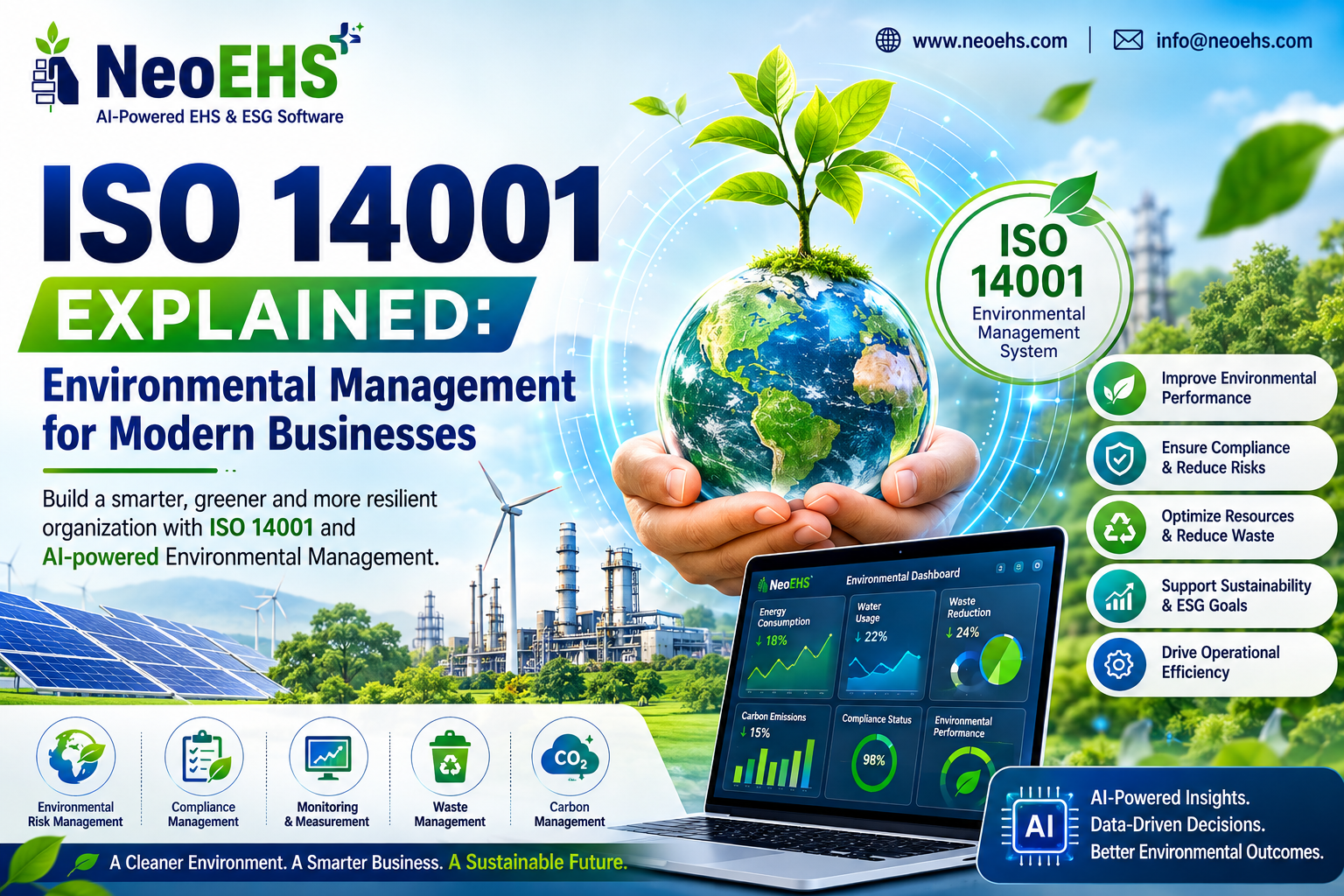
ISO 14001 Explained: Environmental Management for Modern Businesses
Environmental responsibility is no longer simply a sustainability initiative.
For modern businesses, environmental management is becoming an important part of risk management, regulatory compliance, operational efficiency, customer expectations and long-term business resilience.
Organizations across manufacturing, construction, mining, energy, logistics, healthcare, technology, infrastructure and other industries are increasingly expected to understand and manage their environmental impacts.
This is where ISO 14001 becomes important.
ISO 14001 provides an internationally recognized framework for establishing, implementing, maintaining and continually improving an Environmental Management System (EMS). The current edition is ISO 14001:2026, published by ISO in April 2026.
But what exactly is ISO 14001?
Why does it matter?
What does an Environmental Management System involve?
And how can modern digital technology help organizations manage ISO 14001 more effectively?
Let's explore.
What Is ISO 14001?
ISO 14001 is an international standard for Environmental Management Systems (EMS).
It provides organizations with a structured framework to manage their environmental responsibilities, improve environmental performance, meet applicable environmental obligations and continually improve their environmental management approach.
Importantly, ISO 14001 does not prescribe a single environmental performance level that every company must achieve.
Instead, it provides a management framework that organizations can apply according to their:
- Size
- Industry
- Operations
- Environmental impacts
- Regulatory environment
- Business context
- Environmental objectives
This makes ISO 14001 applicable to organizations of different sizes and sectors.
ISO 14001:2015 vs ISO 14001:2026
This is an important update for businesses currently researching ISO 14001.
For many years, ISO 14001:2015 was the widely used edition of the standard.
However, ISO published ISO 14001:2026 in April 2026. ISO now lists ISO 14001:2015 as withdrawn and ISO 14001:2026 as the current edition.
Therefore, businesses reading older ISO 14001 content online should be careful about relying on information that only discusses the 2015 edition.
The 2026 edition builds on the established ISO 14001 framework while providing clearer structure, easier navigation and stronger alignment with current environmental priorities.
What does this mean for businesses?
Organizations already using ISO 14001:2015 should assess their transition requirements with their certification body and relevant advisors.
Organizations starting their Environmental Management System journey should work with the current ISO 14001:2026 edition.
What Is an Environmental Management System?
An Environmental Management System, commonly called an EMS, is the structured system an organization uses to identify, manage, monitor and continually improve its environmental performance.
An EMS can help an organization understand environmental issues associated with activities such as:
- Energy consumption
- Water usage
- Waste generation
- Air emissions
- Wastewater
- Chemical use
- Resource consumption
- Pollution prevention
- Carbon emissions
- Environmental incidents
- Land and soil impacts
- Supply-chain activities
ISO describes an EMS as an organization-wide framework for managing environmental issues and integrating environmental considerations into business operations.
Why Is ISO 14001 Important for Modern Businesses?
Environmental expectations have changed significantly.
Organizations increasingly face expectations from:
- Governments
- Regulators
- Customers
- Investors
- Employees
- Communities
- Supply-chain partners
- Large enterprise customers
Businesses are increasingly expected not only to say that they are environmentally responsible, but to demonstrate how they manage environmental risks and improve performance.
ISO 14001 provides a structured framework for doing this.
According to ISO, implementing an EMS can support environmental performance, regulatory compliance, risk management, resource efficiency, operational improvement and stakeholder trust.
Key Benefits of ISO 14001
1. Improved Environmental Performance
An effective Environmental Management System helps organizations systematically identify environmental impacts and establish actions to improve performance.
This can include reducing:
- Waste
- Energy consumption
- Water consumption
- Emissions
- Pollution
- Resource inefficiencies
2. Better Environmental Compliance
Environmental regulations can be complex and vary by country, state, industry and activity.
An ISO 14001-based EMS can help organizations establish processes for identifying applicable environmental obligations, monitoring compliance and addressing gaps.
However, ISO 14001 itself does not replace legal requirements.
Organizations must still understand and comply with the environmental laws and regulations applicable to their operations.
3. Environmental Risk Management
Environmental risks can create significant operational, financial and reputational consequences.
Examples include:
- Chemical spills
- Waste management failures
- Air pollution
- Water contamination
- Environmental incidents
- Excessive resource consumption
- Regulatory non-compliance
A structured EMS helps organizations identify and manage environmental risks systematically.
4. Resource Efficiency
Environmental management and operational efficiency are often closely connected.
Reducing unnecessary consumption of:
- Energy
- Water
- Raw materials
- Fuel
- Packaging
can potentially reduce environmental impact while also reducing operating costs.
ISO highlights resource efficiency and cost savings among the potential benefits of an effective EMS.
5. Better Stakeholder Confidence
Customers, investors and business partners increasingly want evidence of responsible environmental management.
ISO 14001 certification can provide independent confirmation that an organization's EMS conforms to the applicable requirements of the standard.
ISO also notes that certification can support customer, supply-chain and market expectations.
6. Support for Sustainability and ESG Goals
ISO 14001 is not an ESG reporting standard.
However, a strong Environmental Management System can provide important operational information that supports broader sustainability and ESG programs.
For example:
Environmental Data → Environmental Performance → Sustainability Objectives → ESG Reporting
This makes environmental management an important operational foundation for many sustainability strategies.
What Does ISO 14001 Cover?
ISO 14001 provides a management framework rather than a simple environmental checklist.
Important areas include:
Environmental Aspects and Impacts
Organizations need to understand the environmental aspects associated with their activities and their potential impacts.
Environmental Objectives
Organizations establish environmental objectives and performance indicators appropriate to their context.
Compliance Obligations
Organizations need processes for identifying and managing applicable legal and other environmental obligations.
Operational Controls
Environmental controls need to be established for relevant activities and processes.
Competence and Awareness
Employees need appropriate awareness and competence relating to environmental responsibilities.
Monitoring and Measurement
Organizations need to monitor relevant environmental performance.
Internal Auditing
Internal audits help evaluate whether the management system is functioning as intended.
Management Review
Management needs to periodically review the EMS and its effectiveness.
Continual Improvement
The EMS should evolve and improve over time.
These elements work together to create a structured environmental management cycle.
ISO 14001 and the Plan-Do-Check-Act Approach
One of the most useful ways to understand environmental management is through the Plan-Do-Check-Act (PDCA) improvement cycle.
PLAN
Identify environmental aspects, risks, obligations and objectives.
↓
DO
Implement environmental controls, processes and responsibilities.
↓
CHECK
Monitor performance, conduct inspections and audits, and evaluate results.
↓
ACT
Correct problems, improve processes and update objectives.
↓
CONTINUAL IMPROVEMENT
The cycle starts again.
This approach helps organizations avoid treating environmental management as a one-time certification project.
Instead, environmental management becomes part of ongoing business operations.
ISO 14001 Environmental Aspects and Impacts
One of the important concepts in environmental management is understanding environmental aspects and impacts.
An environmental aspect is an element of an organization's activities, products or services that can interact with the environment.
Examples can include:
- Fuel consumption
- Electricity consumption
- Waste generation
- Chemical usage
- Water consumption
- Air emissions
- Wastewater discharge
The resulting environmental impact may include:
- Air pollution
- Water pollution
- Resource depletion
- Climate impacts
- Waste-related impacts
- Soil contamination
Organizations need to identify relevant aspects and determine which are significant within their EMS framework.
Environmental Objectives and Targets
Organizations need measurable ways to improve environmental performance.
Examples of environmental objectives could include:
- Reduce electricity consumption
- Reduce water consumption
- Increase recycling
- Reduce waste sent to landfill
- Reduce fuel consumption
- Improve chemical management
- Reduce emissions
- Improve environmental compliance performance
Modern digital systems can make these objectives easier to monitor using dashboards and performance indicators.
ISO 14001 and Environmental Compliance
Environmental compliance is a critical part of responsible business operations.
Organizations may need to monitor requirements related to:
- Air emissions
- Water
- Waste
- Chemicals
- Hazardous materials
- Noise
- Environmental permits
- Waste transportation
- Environmental reporting
- Local environmental regulations
A digital environmental compliance system can help organizations centralize obligations, assign responsibilities, track due dates and maintain evidence.
But the technology does not replace professional environmental judgment or legal advice.
ISO 14001 Internal Audits
Internal auditing is an important part of an effective EMS.
An internal audit can help an organization determine whether its environmental management processes are:
- Implemented
- Maintained
- Effective
- Consistent with organizational requirements
- Addressing identified gaps
Digital audit management can simplify:
- Audit planning
- Checklists
- Findings
- Nonconformities
- Corrective actions
- Evidence
- Audit reports
- Follow-up
This is an area where EHS and environmental management software can significantly reduce administrative effort.
Corrective Action and Continual Improvement
Finding a problem is not enough.
Organizations need to understand:
What happened?
Why did it happen?
What action is required?
Who is responsible?
When must it be completed?
Was the action effective?
Digital corrective action management can help organizations track environmental findings from identification through closure.
AI can further help identify recurring findings and patterns across multiple locations.
How Technology Is Transforming ISO 14001 Management
Traditional environmental management may involve:
- Spreadsheets
- Paper records
- Emails
- Manual registers
- Separate systems
- Individual documents
Modern organizations can increasingly use digital environmental management systems to centralize information.
A digital EMS can connect:
Environmental Aspects
Risks
Compliance
Inspections
Audits
Incidents
Waste
Emissions
Energy
Water
↓
Environmental Intelligence
How AI Can Support Environmental Management
Artificial Intelligence is creating another opportunity for environmental management.
AI can potentially help organizations analyse large amounts of environmental data and identify patterns.
For example:
Environmental Trend Analysis
AI can identify unusual changes in environmental performance.
Waste Analytics
AI can identify recurring waste patterns and opportunities for improvement.
Energy Analytics
AI can analyse consumption trends and identify unusual usage patterns.
Environmental Incident Analysis
AI can help classify and analyse environmental incidents and recurring causes.
Compliance Monitoring
AI can help organizations identify upcoming environmental compliance activities and potential gaps.
Document Intelligence
AI-powered OCR and document analysis can help extract relevant information from environmental documents.
AI should support—not replace—qualified environmental professionals and appropriate decision-making processes.
ISO 14001 and Environmental Incident Management
Environmental incidents can include:
- Chemical spills
- Oil spills
- Wastewater releases
- Air emission events
- Environmental permit breaches
- Improper waste disposal
- Contamination events
An effective environmental incident management process should support:
Report → Investigate → Root Cause → Corrective Action → Verify → Learn
Digital incident management can help organizations maintain a centralized record and identify recurring environmental risks.
ISO 14001 and Waste Management
Waste management is an important part of environmental performance.
Organizations may need to manage:
- General waste
- Hazardous waste
- Recyclable materials
- Chemical waste
- Electronic waste
- Industrial waste
- Construction waste
Digital waste management can help organizations track:
- Waste types
- Quantities
- Sources
- Disposal methods
- Contractors
- Recycling
- Trends
- Environmental performance
This can help transform waste management from a manual reporting activity into a measurable environmental performance process.
ISO 14001 and Carbon Management
Climate-related considerations have become increasingly important in environmental management.
Organizations may monitor:
- Energy consumption
- Fuel consumption
- Electricity
- Scope 1 emissions
- Scope 2 emissions
- Relevant Scope 3 information
- Carbon intensity
- Reduction initiatives
An integrated environmental platform can connect operational data with carbon management activities.
This can help businesses move from simply reporting emissions toward actively managing them.
ISO 14001 and Climate Change
Climate change is increasingly relevant to organizational context and environmental management.
ISO introduced climate-action amendments to several management-system standards in 2024, and ISO 14001:2026 is now the current edition. The 2026 standard builds on the established framework with stronger alignment to current environmental priorities.
Organizations should therefore consider climate-related issues within their environmental management approach as appropriate to their context.
Is ISO 14001 Certification Mandatory?
No.
ISO 14001 certification is voluntary.
Organizations may implement an EMS based on ISO 14001 without necessarily pursuing certification.
Certification provides independent confirmation from an external certification body that the organization's management system conforms to the applicable requirements.
Importantly:
ISO itself does not certify organizations.
Certification is performed by independent certification bodies.
However, customers, supply chains, tenders or other stakeholders may sometimes require or prefer ISO 14001 certification.
Who Should Implement ISO 14001?
ISO 14001 can be relevant to organizations across many sectors.
Examples include:
- Manufacturing
- Mining
- Construction
- Oil & Gas
- Power and Energy
- Logistics
- Transportation
- Ports and Maritime
- Chemicals
- Healthcare
- Food and Agriculture
- Waste Management
- Technology
- Infrastructure
- Government
- Professional Services
ISO states that organizations of different sizes and sectors can use ISO 14001.
ISO 14001 for Modern Businesses
Modern environmental management should not exist separately from business management.
It should be integrated into everyday operations.
For example:
Procurement
→ Environmental criteria
Operations
→ Environmental controls
Maintenance
→ Environmental risk management
Projects
→ Environmental impact assessment
Waste
→ Waste management
Energy
→ Resource efficiency
Compliance
→ Legal obligations
Management
→ Environmental objectives
Technology
→ Data and intelligence
This is how environmental management becomes part of organizational performance rather than simply an annual compliance exercise.
ISO 14001 and Other ISO Management Systems
Organizations often implement multiple management systems.
For example:
ISO 9001
Quality Management
ISO 14001
Environmental Management
ISO 45001
Occupational Health & Safety
These systems can be integrated into a broader management-system structure.
This can help reduce duplication and create more consistent processes for:
- Audits
- Corrective actions
- Document management
- Risk management
- Management review
- Training
- Continual improvement
ISO notes that ISO 14001 can be integrated with other management-system standards.
How NeoEHS Supports Environmental Management
Modern environmental management requires more than documents.
Organizations need visibility into:
Environmental Risks + Compliance + Waste + Emissions + Resources + Incidents + Audits + Performance
This is where NeoEHS can support organizations.
NeoEHS is an AI-powered EHS and ESG software solution designed to bring safety, environmental, compliance and sustainability processes together in a connected digital platform.
Environmental capabilities can include areas such as:
- Environmental Management
- Waste Management
- Air Quality Monitoring
- Carbon Emission Management
- Resource Management
- Environmental Compliance
- Environmental Inspections
- Environmental Audits
- Environmental Incident Management
- ESG Management
AI capabilities can further help organizations analyse environmental information, identify patterns and turn environmental data into actionable insights.
Explore NeoEHS AI-Powered EHS & ESG Software
Moving from Environmental Compliance to Environmental Intelligence
Traditional environmental management often asks:
Are we compliant?
Modern environmental management should also ask:
How are we performing?
Where are our environmental risks increasing?
Where are we wasting resources?
Which environmental issues keep recurring?
What can we improve?
This is the transition from:
Compliance
↓
Management
↓
Measurement
↓
Intelligence
↓
Continual Improvement
Digital and AI-powered environmental management can help organizations make this transition.
The Future of Environmental Management
Environmental management is becoming increasingly connected to business strategy.
Organizations are expected to demonstrate measurable performance rather than simply make environmental commitments.
The future Environmental Management System will increasingly combine:
People
Processes
Environmental Data
IoT
Analytics
AI
↓
Intelligent Environmental Management
The objective is not technology for technology's sake.
The objective is to help organizations:
- Reduce environmental impact
- Improve compliance
- Reduce waste
- Optimize resources
- Manage environmental risks
- Improve environmental performance
- Strengthen stakeholder confidence
- Support sustainable business growth
Conclusion
ISO 14001 provides organizations with a structured approach to environmental management and continual improvement.
While ISO 14001:2015 was widely used for more than a decade, ISO 14001:2026 is now the current edition, published in April 2026. Organizations should therefore ensure that their environmental management information reflects the current standard and that transition considerations are addressed appropriately.
For modern businesses, ISO 14001 should not be viewed simply as a certification exercise.
It can become a framework for building stronger environmental performance, better risk management, improved resource efficiency and more disciplined environmental decision-making.
And with digital and AI-powered technologies, organizations have an opportunity to move beyond traditional environmental recordkeeping toward connected, measurable and intelligent environmental management.
ISO 14001 provides the framework.
People provide the expertise.
Technology provides the intelligence.
Continuous improvement creates the results.
NeoEHS helps organizations bring these elements together in one AI-powered EHS and ESG ecosystem.
Frequently Asked Questions
What is ISO 14001?
ISO 14001 is an internationally recognized standard for Environmental Management Systems. It provides a framework for organizations to manage environmental responsibilities, improve environmental performance and continually improve their environmental management system.
What is ISO 14001:2026?
ISO 14001:2026 is the current edition of the ISO 14001 Environmental Management Systems standard. It was published in April 2026 and replaced ISO 14001:2015.
Is ISO 14001:2015 still valid?
ISO 14001:2015 has been withdrawn and replaced by ISO 14001:2026. Organizations certified to the previous edition should discuss transition arrangements with their certification body.
What is an Environmental Management System?
An Environmental Management System is a structured framework that helps an organization identify, manage, monitor and continually improve its environmental performance.
Is ISO 14001 certification mandatory?
No. ISO 14001 certification is voluntary. However, customers, supply chains, tenders or other stakeholders may require or prefer certification.
What are the benefits of ISO 14001?
Benefits can include improved environmental performance, stronger environmental compliance processes, better risk management, improved resource efficiency, cost savings and increased stakeholder confidence.
Who can implement ISO 14001?
Organizations of different sizes and sectors can implement ISO 14001, including manufacturing, mining, construction, energy, transportation, logistics, healthcare and services.
How can software help with ISO 14001?
Environmental management software can help organizations manage environmental risks, compliance obligations, inspections, audits, waste, emissions, corrective actions, environmental incidents and performance data in a centralized system.
Can AI support ISO 14001 environmental management?
Yes. AI can support environmental management by analysing data, identifying patterns, assisting with document processing, highlighting trends and helping organizations gain better visibility into environmental performance. AI does not replace organizational responsibility, professional judgment or applicable regulatory requirements.
ISO 14001 Environmental Management
ISO 14001
- ISO 14001:2026
- ISO 14001:2015
- ISO 14001 Environmental Management System
- ISO 14001 EMS
- Environmental Management System
- Environmental Management Software
- ISO 14001 Compliance
- ISO 14001 Certification
- Environmental Compliance
- Environmental Risk Management
- Environmental Sustainability
- Environmental Performance
- Environmental Management Software
- ESG Software
- Digital Environmental Management
- What is ISO 14001
- What is ISO 14001 environmental management
- ISO 14001 explained
- ISO 14001 requirements explained
- How to implement ISO 14001
- Benefits of ISO 14001
- ISO 14001 environmental management system
- ISO 14001:2026 explained
- Difference between ISO 14001:2015 and ISO 14001:2026
- Is ISO 14001 certification mandatory
- How ISO 14001 helps businesses
- ISO 14001 compliance management
- Environmental management system for businesse
#ISO14001 #ISO140012026 #EnvironmentalManagement #EnvironmentalManagementSystem #EMS #EnvironmentalCompliance #EnvironmentalSustainability #EnvironmentalRiskManagement #EnvironmentalManagementSoftware #ESGSoftware #DigitalEHS #AIPoweredEHS #ISOCertification #SustainabilityManagement #NeoEHS