AI-Powered Incident Management: From Reporting to Prevention
A workplace incident is never just an isolated event.. A minor injury, near miss, unsafe condition, equipment failure, environmental event, or repeated safety observation can be a warning that something deeper is happening within an organization.
The real question is not simply, “What happened?”
It is:
“Why did it happen, what can we learn from it, and how can we prevent it from happening again?”
This is where AI-powered incident management is changing the way organizations approach workplace safety.
Traditional incident management often focuses on documenting an event after it happens. Modern incident management goes further. It connects reporting, investigation, root cause analysis, corrective actions, risk management, inspections, audits and predictive analytics into one continuous safety improvement process.
NeoEHS brings these capabilities together in an AI-powered Environmental, Health and Safety platform designed to help organizations move from reactive incident response toward proactive incident prevention.
What Is AI-Powered Incident Management?
AI-powered incident management is the use of artificial intelligence, automation, analytics and connected EHS data to report, investigate, analyze and prevent workplace incidents.
Instead of treating an incident report as the end of a process, AI-powered systems use incident information as a source of safety intelligence.
A modern incident management process can:
- Capture incidents and near misses immediately
- Categorize incidents automatically
- Identify severity and risk levels
- Analyze historical incidents
- Identify recurring patterns
- Support root cause analysis
- Recommend corrective and preventive actions
- Track CAPA to completion
- Identify similar incidents across locations
- Highlight emerging risks
- Connect incidents with hazards, inspections and audits
- Provide management with real-time safety intelligence
The result is a shift from “report and close” to “report, understand, learn and prevent.”
Why Traditional Incident Management Is No Longer Enough
Many organizations still depend on spreadsheets, emails, paper forms and disconnected reporting systems to manage workplace incidents.
These approaches may record what happened, but they often make it difficult to understand the bigger picture.
Consider a simple example.
A worker slips on a wet floor.
The immediate response may be:
- Record the incident.
- Provide medical assistance.
- Clean the floor.
- Close the report.
But what if the same area has experienced three previous near misses?
What if the cleaning schedule was inadequate?
What if employees had already reported the same unsafe condition?
What if an inspection had identified the problem two weeks earlier?
What if similar incidents are occurring at three other facilities?
A traditional incident system may treat these as separate records.
An intelligent EHS platform can connect the information.
That difference is critical.
The value of incident management is not only in recording incidents. Its real value is in turning incident data into prevention.
From Incident Reporting to Incident Prevention
A mature safety management process should follow a continuous cycle:
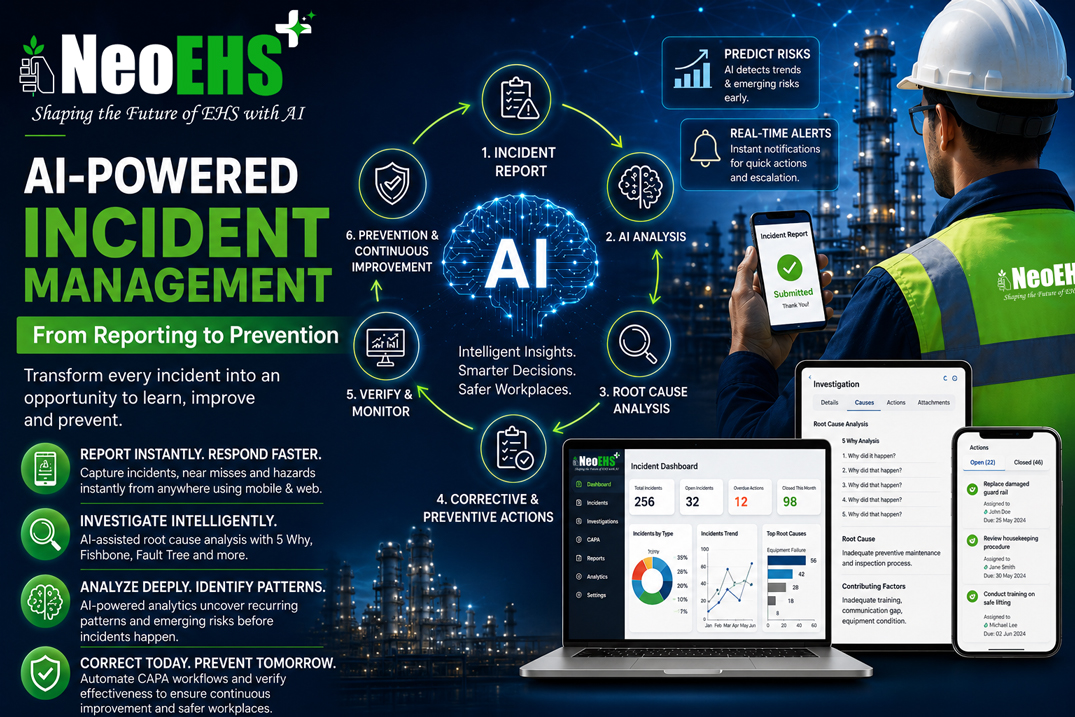
Report → Respond → Investigate → Identify Root Cause → Correct → Verify → Learn → Predict → Prevent
This lifecycle transforms incident management from an administrative activity into a strategic safety function.
NeoEHS supports this approach through incident reporting, investigation workflows, root cause analysis, corrective actions, predictive safety intelligence and real-time analytics.
1. Make Incident Reporting Simple
The first step in preventing future incidents is making it easy for people to report what they see.
If reporting requires multiple forms, lengthy emails or complicated procedures, employees may delay reporting—or not report at all.
Modern incident management should allow employees, contractors and supervisors to report incidents quickly from the field.
With NeoEHS, organizations can report incidents, near misses, unsafe conditions and hazards through mobile and web-based workflows, including image and location information.
This creates a much stronger reporting culture.
What can be captured?
A digital incident report can include:
- Incident type
- Date and time
- Location
- People involved
- Injury information
- Equipment involved
- Environmental impact
- Witness information
- Photos and videos
- Immediate actions
- Initial severity
- Potential severity
- Related hazards
- Related permits
- Related inspections
- Supporting documents
The more structured the information, the more useful the data becomes for analysis.
2. Use AI to Classify and Prioritize Incidents
Not every incident has the same level of risk.
A minor first-aid case and a high-potential near miss should not be treated identically.
AI can help analyze incident information and support classification based on factors such as:
- Incident type
- Severity
- Potential consequence
- Location
- Activity
- Equipment
- Previous history
- Frequency
- Similar incidents
- Contributing conditions
This can help EHS teams focus their attention where it matters most.
For example:
Five minor incidents involving the same machine may represent a greater emerging risk than one isolated event elsewhere.
AI-powered pattern recognition can help bring that signal to the surface.
3. Move Beyond the Immediate Cause
One of the biggest weaknesses in incident investigations is stopping at the obvious cause.
Imagine a worker falls because a walkway is wet.
The immediate cause may be:
Wet floor.
But that is not necessarily the root cause.
A deeper investigation may reveal:
- A leaking pipe
- Delayed maintenance
- Inadequate inspection
- No ownership for housekeeping
- Poor escalation
- Inadequate preventive maintenance
- Lack of management follow-up
This is why root cause analysis is such an important part of modern incident management.
NeoEHS supports structured investigation approaches including 5 Why Analysis, Fishbone/Ishikawa, Fault Tree Analysis and other RCA methodologies.
4. AI-Assisted Root Cause Analysis
Artificial intelligence does not replace experienced investigators.
Instead, it can help investigators see patterns that may otherwise be missed.
AI can analyze historical incident information and identify relationships between:
- People
- Processes
- Equipment
- Locations
- Tasks
- Environmental conditions
- Unsafe behaviors
- Previous observations
- Inspection findings
- Audit findings
- Corrective actions
For example, if similar incidents repeatedly occur during a particular maintenance activity, AI can highlight that recurrence.
The investigator can then examine the underlying process rather than treating each event independently.
This makes the investigation more data-driven.
5. Connect Incidents With Hazards and Risks
Incident management should never operate in isolation.
An incident may be the visible outcome of an existing hazard or unmanaged risk.
That is why connecting incident data with Hazard Management and Risk Management is so important.
NeoEHS provides connected workflows across incidents, hazards, risk assessments, inspections, audits and corrective actions.
For example:
Hazard identified → Risk assessed → Control implemented → Incident occurs → Investigation → Root cause identified → Risk reassessed → Control strengthened
This creates a continuous feedback loop.
Instead of maintaining separate safety databases, organizations can build a connected safety intelligence ecosystem.
6. Turn Corrective Actions Into Preventive Actions
A corrective action fixes the immediate problem.
A preventive action addresses the possibility of recurrence.
That distinction matters.
Corrective action
“Repair the damaged handrail.”
Preventive action
“Review inspection and maintenance procedures for all similar handrails across the facility.”
The first action addresses the current problem.
The second addresses the system.
NeoEHS supports automated corrective and preventive action workflows, including ownership, due dates, escalation and closure tracking.
This helps organizations move beyond simply closing actions and toward verifying whether the action actually reduced risk.
7. Verify Whether Corrective Actions Actually Worked
An action should not automatically be considered successful simply because someone marked it “Closed.”
The more important question is:
Did the action eliminate or reduce the risk?
For example:
A damaged machine guard is replaced.
The action is closed.
But if the same machine produces another safety observation two months later, the organization needs to understand why.
Effective incident management therefore requires corrective action effectiveness verification.
This can include:
- Follow-up inspections
- Repeat observations
- Risk reassessment
- Incident trend monitoring
- Evidence validation
- Management review
- Recurrence analysis
This turns CAPA from an administrative checklist into a continuous improvement mechanism.
8. Identify Recurring Incidents Before They Become Major Problems
One incident may be an isolated event.
Repeated incidents are a signal.
AI-powered analytics can analyze historical records to identify recurring patterns across:
- Sites
- Departments
- Equipment
- Contractors
- Activities
- Shifts
- Incident types
- Unsafe behaviors
- Hazards
- Root causes
NeoEHS uses AI-powered pattern and recurrence analysis to identify similar historical incidents, recurring risks and emerging safety trends.
This creates an important change in safety management.
Instead of asking:
“How many incidents did we have?”
Organizations can begin asking:
“What patterns are telling us where the next incident could occur?”
9. Bring Inspections Into the Incident Prevention Cycle
Inspections are one of the strongest sources of leading safety information.
An inspection may identify a problem before it becomes an incident.
For example:
Inspection finding → Hazard → Corrective action → Risk reduction
If that same condition later contributes to an incident, the organization should be able to connect those records.
NeoEHS connects inspection data with incidents, audits, hazards, risks, permits and corrective actions, creating a more unified EHS information environment.
This allows safety teams to ask more meaningful questions:
- Was this condition identified before the incident?
- Was an action assigned?
- Was it overdue?
- Was the action actually effective?
- Has the same problem appeared at another site?
These questions turn historical records into organizational learning.
10. Learn From Near Misses
Near misses are among the most valuable sources of preventive safety intelligence.
A near miss is a warning.
Nobody may have been injured—but under slightly different circumstances, the outcome could have been very different.
For example:
A suspended load swings unexpectedly but does not hit anyone.
A traditional system might record:
Near Miss – No Injury.
A stronger system can ask:
- Why did the load swing?
- Was the lifting plan followed?
- Was the equipment inspected?
- Was the exclusion zone adequate?
- Was the operator trained?
- Have similar events occurred?
- Is the same risk present at other sites?
This is where AI-powered incident management can help organizations extract more value from near-miss data.
11. Use Predictive Safety Intelligence
The ultimate goal of modern incident management is prevention.
Predictive safety intelligence uses historical and current information to identify patterns that may indicate increasing risk.
Potential data sources include:
- Incidents
- Near misses
- Safety observations
- Inspections
- Audits
- Risk assessments
- Hazards
- Permit data
- Training records
- Corrective actions
- Operational information
- IoT data
- Computer vision data
NeoEHS describes predictive risk intelligence as a way to analyze historical safety data, identify recurring risks and detect emerging hazards before incidents occur.
The objective is not to claim that AI can predict every accident.
It cannot.
The objective is to identify risk signals early enough for people to take preventive action.
That distinction is important.
12. Connect AI With Real-Time Safety Monitoring
Incident management becomes even more powerful when historical information is combined with real-time observations.
For example, computer vision and AI-based monitoring can help identify:
- PPE violations
- Unsafe behaviors
- Restricted-area access
- Unsafe conditions
- Potentially hazardous activities
NeoEHS provides AI-enabled hazard detection capabilities including CCTV analytics, PPE detection, behavioral analysis and real-time hazard alerts.
This creates another safety feedback loop:
Detect → Alert → Correct → Record → Analyze → Learn
The incident management platform can therefore become part of an organization's broader proactive safety architecture.
AI-Powered Incident Management Across the Complete Lifecycle
A modern incident management platform should support the complete lifecycle:
1. Report
Capture the incident, near miss or unsafe condition.
2. Classify
Determine incident type, severity, potential impact and priority.
3. Respond
Trigger notifications, escalation and immediate response workflows.
4. Investigate
Collect evidence, statements, documents, photographs and supporting information.
5. Analyze
Identify immediate, contributing and root causes.
6. Correct
Assign corrective and preventive actions.
7. Verify
Confirm that actions have been completed and are effective.
8. Learn
Identify recurring patterns and organizational lessons.
9. Predict
Use historical information and AI analytics to identify emerging risks.
10. Prevent
Strengthen controls before another incident occurs.
This is the difference between incident administration and incident intelligence.
AI Incident Management vs Traditional Incident Management
| Traditional Approach | AI-Powered Approach |
|---|---|
| Paper or spreadsheet reporting | Mobile and digital reporting |
| Manual classification | AI-assisted classification |
| Isolated incident records | Connected EHS data |
| Reactive investigation | Intelligent investigation support |
| Manual RCA | AI-assisted pattern analysis |
| Corrective actions tracked manually | Automated CAPA workflows |
| Historical reporting | Predictive safety intelligence |
| Limited cross-site visibility | Enterprise-wide visibility |
| Incident-focused | Prevention-focused |
| Report after the event | Identify risks before recurrence |
The goal is not simply to replace paperwork with software.
The goal is to change how an organization learns from safety events.
How NeoEHS Helps Turn Incidents Into Prevention
NeoEHS brings incident management into a connected AI-powered EHS ecosystem.
Its incident management capabilities include:
- AI-powered incident reporting
- Mobile incident reporting
- Near-miss management
- Intelligent investigation workflows
- Root cause analysis
- 5 Why Analysis
- Fishbone Analysis
- Fault Tree Analysis
- Pattern and recurrence analysis
- Predictive safety intelligence
- Corrective and preventive actions
- Real-time dashboards
- Compliance workflows
- Offline reporting
- Evidence management
- AI image analysis
- Cross-functional EHS integration
Organizations can also connect incident information with risk management, hazard management, inspections and audits to create a broader safety intelligence environment.
Industry Use Cases for AI-Powered Incident Management
Manufacturing
Manufacturing organizations can use AI-powered incident management to identify recurring machine-related incidents, unsafe behaviors, PPE violations, maintenance-related risks and process safety issues.
Construction
Construction companies can connect incidents and near misses with work-at-height activities, lifting operations, excavation, contractor activities, permits and site inspections.
NeoEHS supports construction safety workflows including incident reporting, risk management, observations, inspections and contractor safety.
Oil & Gas
Oil and gas organizations can use incident intelligence alongside Permit to Work, process safety, contractor management, risk management and environmental monitoring.
Mining
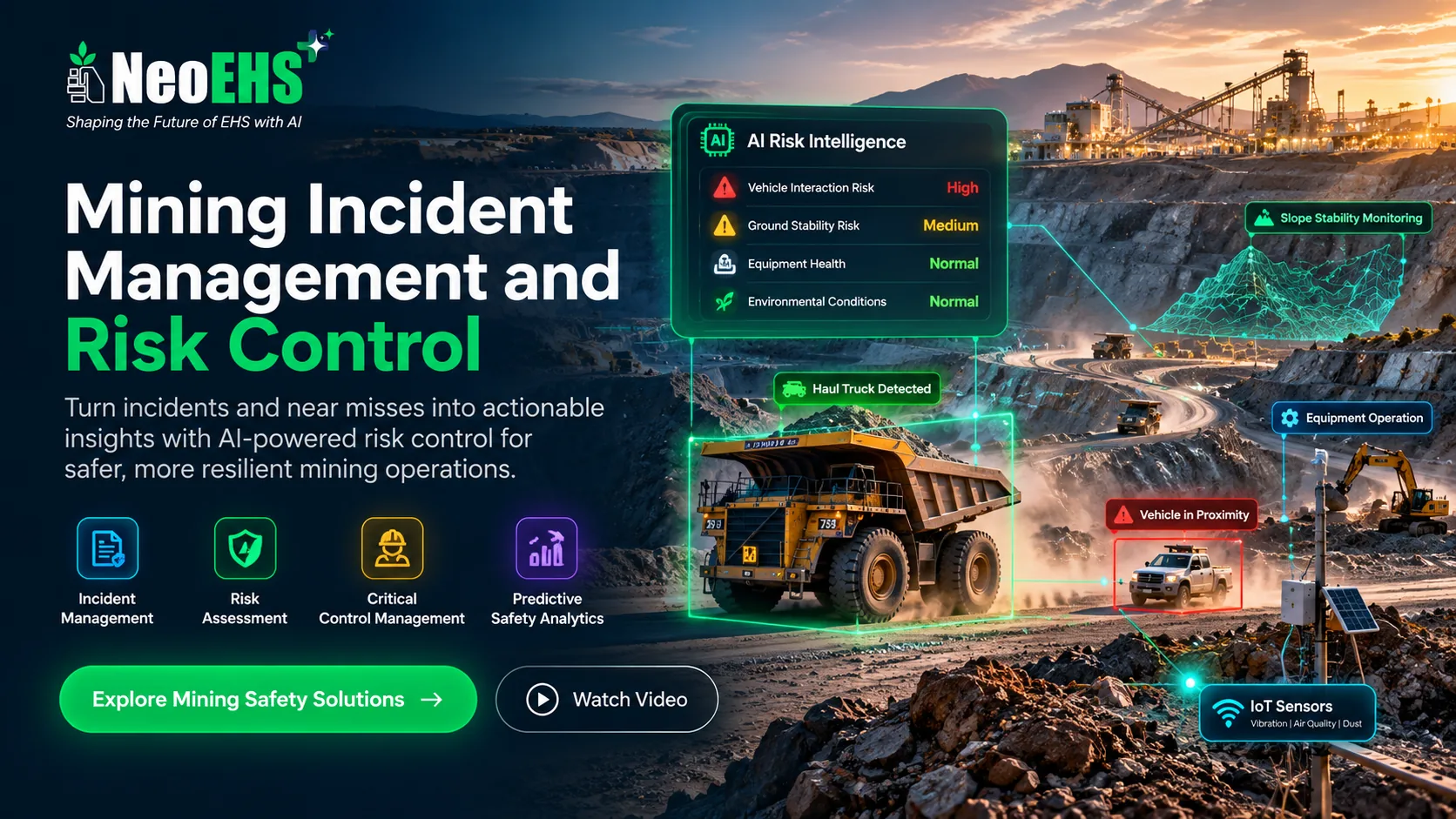
Mining operations can analyze incidents across equipment, mobile machinery, blasting, haul roads, contractor activities, environmental conditions and high-risk work.
Power & Energy
Power plants can connect incidents with electrical safety, isolation/LOTO, maintenance, work permits, inspections and operational risks.
Logistics & Warehousing
Organizations can identify recurring forklift incidents, loading/unloading risks, vehicle interactions, warehouse hazards and unsafe material-handling practices.
What Should EHS Leaders Measure?
Incident counts alone do not tell the whole story.
A modern incident management dashboard should provide both lagging and leading indicators.
Lagging indicators
- Recordable incidents
- Lost-time injuries
- Medical treatment cases
- Severity
- Incident frequency
- Environmental incidents
- Property damage
Leading indicators
- Near-miss reporting
- Safety observations
- Corrective action closure
- Inspection completion
- Risk control effectiveness
- Training compliance
- Repeat findings
- Hazard resolution
- Preventive action completion
The real power comes from connecting these indicators.
For example:
Increase in near misses + overdue corrective actions + repeated hazards = potential emerging risk.
That is far more useful than simply knowing the monthly incident count.
Frequently Asked Questions About AI-Powered Incident Management
What is AI-powered incident management?
AI-powered incident management uses artificial intelligence, automation and analytics to help organizations report, investigate, analyze and prevent workplace incidents, near misses, unsafe conditions and other safety events.
How does AI improve incident reporting?
AI can help classify incident information, organize submitted data, identify relevant categories, prioritize events and connect new incidents with historical safety information.
Can AI predict workplace incidents?
AI cannot guarantee that an accident will be predicted before it happens. However, predictive analytics can identify recurring patterns, risk signals and emerging trends that may help organizations take preventive action earlier.
What is the difference between incident management and incident prevention?
Incident management focuses on reporting, investigating and resolving safety events. Incident prevention goes further by using incident data, risk information and leading indicators to reduce the likelihood of recurrence.
Can AI perform root cause analysis?
AI can assist investigators by identifying patterns and suggesting areas for investigation. Human investigators should still validate causes and determine appropriate corrective and preventive actions.
Why are near misses important?
Near misses provide information about potentially dangerous conditions without necessarily resulting in injury or damage. Analyzing them can help organizations address risks before a more serious event occurs.
Can incident management software manage CAPA?
Yes. Modern incident management platforms can assign corrective and preventive actions, set deadlines, send escalation notifications, track progress and support effectiveness verification.
Can incident management connect with risk management?
Yes. Connecting incident records with risk assessments allows organizations to reassess risks when incidents or near misses reveal weaknesses in existing controls.
Can incident management software support multiple sites?
Enterprise incident management platforms can provide centralized visibility across facilities, projects, departments, contractors and geographic locations.
How does NeoEHS support AI-powered incident management?
NeoEHS combines incident reporting, intelligent investigation, root cause analysis, corrective actions, predictive safety intelligence, dashboards and connected EHS workflows in a unified platform.
The Future of Incident Management Is Prevention
The future of workplace safety is not about creating better incident reports.
It is about creating organizations that learn faster.
Every incident contains information.
Every near miss contains a warning.
Every inspection contains evidence.
Every corrective action contains an opportunity to improve.
And when these signals are connected, organizations can begin to see patterns that are difficult to identify when safety information is stored in separate systems.
AI can help make those connections.
But technology alone does not create a safer workplace.
People do.
AI provides the intelligence.
EHS professionals provide the judgment.
Management provides the accountability.
And the organization turns those insights into action.
That is the real promise of AI-powered incident management:
From reporting what happened to understanding why it happened.
From understanding why it happened to preventing recurrence.
And from reacting to incidents to building a safer, smarter and more proactive workplace.