Ship-to-Shore Crane Lifting Risk Assessments: A Practical EHS Guide for Port and Maritime Industries
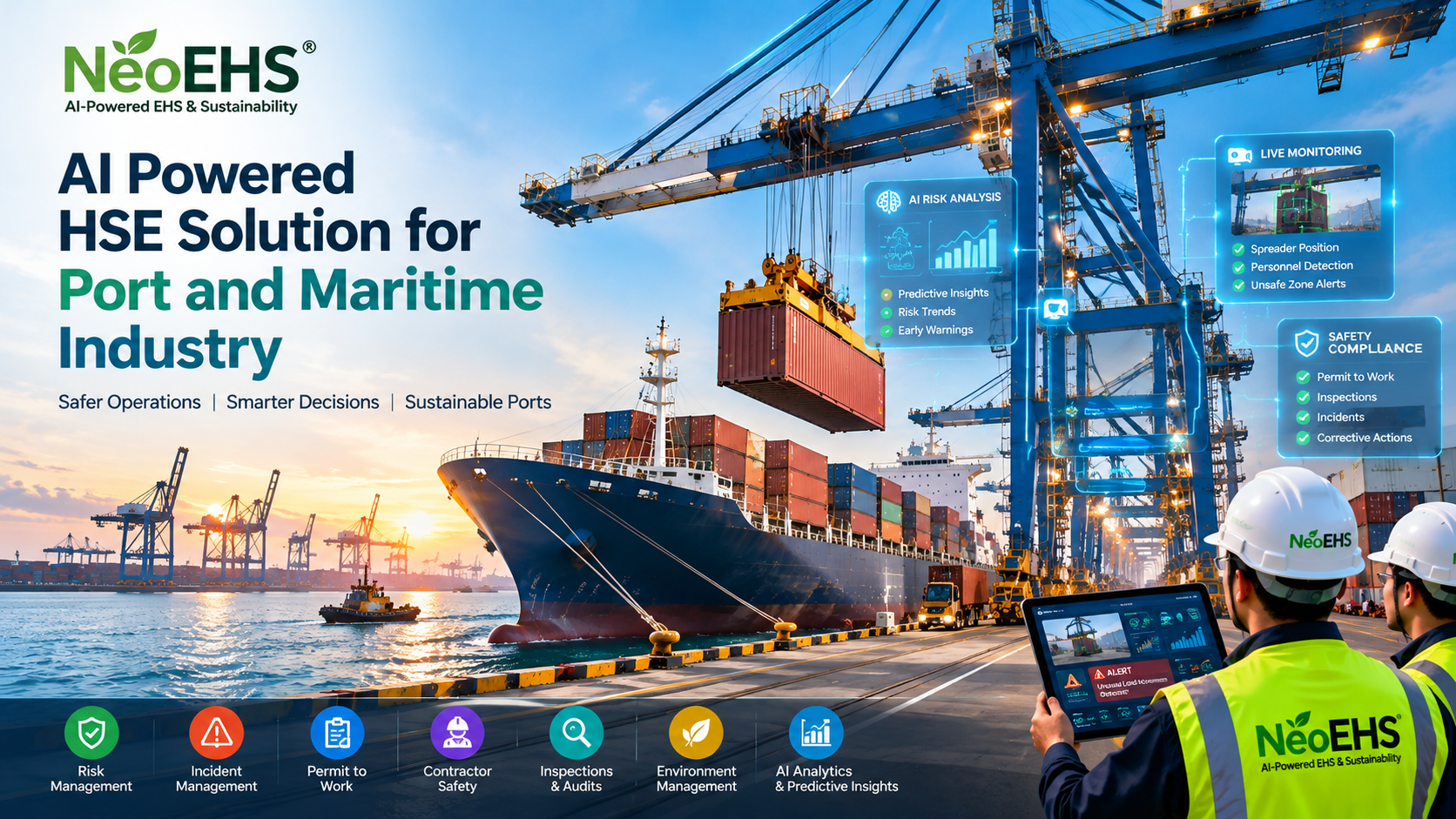
Crane lifting hazards, assessing operational risks, implementing critical safety controls, and strengthening EHS performance across container terminals and maritime operations.
Ship-to-shore (STS) container cranes are essential to modern port operations. They move containers between vessels and terminals, often under demanding schedules, changing weather conditions, and complex coordination between crane operators, vessel crews, lashers, terminal equipment operators, and maintenance personnel.
The scale of these operations creates significant safety challenges. A single uncontrolled lift can expose workers to suspended loads, moving machinery, falling objects, equipment collisions, and serious injuries. In addition to human consequences, crane incidents can disrupt terminal operations, damage vessels or infrastructure, and create substantial commercial losses.
For port and terminal operators, ship-to-shore crane lifting risk assessment is not simply a compliance exercise. It is a fundamental operational safety process.
This guide explains how to identify STS crane hazards, assess lifting risks, select appropriate controls, investigate incidents, and use digital EHS systems to strengthen safety assurance.
What Is a Ship-to-Shore Crane Lifting Risk Assessment?
A ship-to-shore crane lifting risk assessment is a structured process used to identify hazards associated with loading and unloading containers between vessels and terminals, evaluate the likelihood and potential severity of harm, and establish controls to reduce the risk.
The assessment should consider the crane, lifting accessories, container, vessel, quay, personnel, traffic movements, weather conditions, and operational interfaces.
A practical STS crane assessment typically covers:
-
Crane structural and mechanical integrity
-
Hoisting, trolley, gantry, and spreader operations
-
Container weight, condition, and securing arrangements
-
Suspended-load and dropped-object exposure
-
Crane-to-crane and crane-to-vessel clearances
-
Vessel movement and operational coordination
-
Wind, lightning, visibility, and other weather conditions
-
Personnel access and exclusion zones
-
Maintenance, inspection, and emergency arrangements
The assessment must be appropriate to the specific crane, terminal, task, operating conditions, and applicable legal requirements.
Why STS Crane Lifting Operations Are High Risk
Unlike many conventional lifting operations, STS crane activities involve repeated container movements between two operating environments: a moving or potentially moving vessel and a fixed shore-based terminal.
The working environment may change throughout a shift.
A vessel's position, container stack configuration, operational visibility, weather conditions, and the movement of personnel or terminal vehicles can all influence lifting safety.
Consider a typical container discharge operation.
The crane operator positions the spreader over a container, engages the twistlocks, lifts the load, moves it across the vessel-to-shore interface, and lowers it onto a waiting terminal vehicle or designated transfer location.
At every stage, an unexpected event can introduce risk.
A twistlock may fail to release correctly. A container may be damaged or incorrectly declared. A person may enter an exclusion zone. The crane may experience an equipment fault. Wind conditions may deteriorate.
A robust risk assessment must anticipate these scenarios before an incident occurs.
1. Identify the Major Hazards in Ship-to-Shore Crane Operations
Suspended Loads and Dropped Containers
One of the most serious hazards is the uncontrolled release or fall of a container or lifting component.
Potential contributing factors include:
-
Incorrect spreader engagement
-
Twistlock malfunction or incomplete engagement
-
Damaged container corner castings
-
Incorrect container weight information
-
Lifting equipment defects
-
Improper handling of snagged or obstructed containers
-
Unexpected load movement
Recommended controls: Verify spreader engagement and equipment condition, use appropriate lifting procedures, enforce exclusion zones, and establish clear stop-work arrangements for abnormal lifts.
Personnel should never be permitted beneath suspended containers.
Crane Structural and Mechanical Failure
STS cranes are complex structures containing hoisting systems, wire ropes, sheaves, brakes, drives, trolley mechanisms, gantry systems, and structural members.
Failures involving these components may result in uncontrolled movement, dropped loads, or crane instability.
Risk assessments should consider inspection findings, maintenance history, manufacturer requirements, structural condition, operational limits, and any outstanding defects.
Crane-to-Crane and Crane-to-Vessel Collisions
Container terminals may operate multiple cranes along the same quay.
Potential collision scenarios include adjacent cranes operating too close together, gantry movements near obstructions, and crane components contacting vessel structures.
Controls may include approved operating clearances, anti-collision systems, communication protocols, travel restrictions, and effective coordination between crane operators and terminal control personnel.
High Winds and Adverse Weather
Wind can affect suspended-container stability and crane operation. Lightning, poor visibility, heavy rainfall, and other adverse conditions may introduce additional hazards.
The applicable operating and shutdown limits must come from the crane manufacturer's instructions, terminal procedures, engineering assessments, and relevant regulations.
A single generic wind-speed threshold should not be assumed suitable for every crane or terminal.
Personnel and Vehicle Interaction
Crane operations frequently involve workers and mobile equipment within or near operational areas.
Risks include personnel entering lifting zones, terminal vehicles moving beneath loads, and workers being exposed to crane travel or container movement.
Traffic separation, access control, communication, designated operating zones, and supervision are essential.
Maintenance and Unexpected Energization
Maintenance work introduces different hazards from routine container handling.
Electrical systems, stored mechanical energy, elevated work locations, hydraulic systems, and moving machinery can create serious exposure.
Maintenance risk assessments should address isolation, lockout/tagout, verification of zero-energy state where applicable, working at height, rescue arrangements, and controlled return to service.
2. Conduct a Step-by-Step STS Crane Lifting Risk Assessment
A useful assessment should follow the actual lifting operation rather than rely on a generic checklist.
Step 1: Define the Task and Operating Conditions
Identify the crane, vessel, berth, container-handling activity, personnel involved, and operating environment.
Confirm the planned lifting sequence and any non-routine circumstances, such as abnormal cargo, maintenance restrictions, reduced visibility, or unusual vessel arrangements.
Step 2: Break the Operation Into Activities
Typical activities include:
-
Pre-operational crane inspection
-
Vessel and terminal coordination
-
Crane and spreader positioning
-
Spreader engagement
-
Container lifting and clearance
-
Trolley travel and load transfer
-
Container landing
-
Spreader disengagement
-
Crane repositioning
-
Shutdown or handover
Each activity may require different safety controls.
Step 3: Identify Hazards and Exposed Persons
Identify what could go wrong, who may be harmed, and how the event could occur.
Include crane operators, maintenance technicians, lashers, vessel crew, terminal vehicle operators, contractors, and other personnel who may enter the affected area.
Step 4: Evaluate Risk
Use the organization's approved risk assessment methodology.
A risk matrix may consider likelihood and consequence, but numerical scores should not replace engineering judgment or the assessment of potentially catastrophic events.
For high-consequence lifting scenarios, particular attention should be given to the reliability of critical controls.
Step 5: Apply the Hierarchy of Controls
Controls should be selected using the hierarchy of controls:
-
Elimination: Remove unnecessary exposure or avoid an unsafe lift.
-
Substitution: Use a safer handling method where feasible.
-
Engineering controls: Use suitable interlocks, overload protection, anti-collision systems, and physical segregation.
-
Administrative controls: Establish approved procedures, lift plans, competency requirements, inspections, communication, and supervision.
-
Personal protective equipment: Provide appropriate PPE for residual exposure.
PPE should not be treated as the primary safeguard against falling containers or major crane failures.
Step 6: Verify Controls Before Lifting
Before the operation begins, confirm that the required controls are in place and functioning.
Critical checks may include crane fitness for service, spreader condition, weather suitability, communication arrangements, exclusion zones, and the availability of competent personnel.
Step 7: Monitor and Reassess
Risk assessment is not completed when the form is signed.
The assessment should be reviewed when conditions change, defects are discovered, abnormal loads are encountered, or the operation deviates from the approved method.
Workers must have a clear means of stopping work when conditions become unsafe.
3. Example STS Crane Lifting Risk Assessment
The following example illustrates how a port safety team might structure an assessment. It is not a substitute for a site-specific assessment by competent personnel.
| Activity | Hazard | Potential Consequence | Example Control |
|---|---|---|---|
| Container lifting | Incorrect spreader engagement | Dropped container, fatal injury | Engagement verification, equipment checks, exclusion zones |
| Trolley movement | Suspended-load movement | Collision or struck-by injury | Operating procedures, clear travel path, access restrictions |
| Gantry movement | Adjacent crane or obstruction | Structural damage, serious injury | Clearance verification, anti-collision safeguards |
| Vessel interface | Unexpected vessel movement | Contact or unstable lifting conditions | Vessel–terminal coordination and operational monitoring |
| Adverse weather | High wind or lightning | Loss of control, crane damage | Site-specific weather limits and shutdown procedures |
| Maintenance | Unexpected energization | Electric shock or crush injury | Energy isolation, verification and controlled handback |
For every significant hazard, the assessment should also identify the responsible person, control verification method, residual risk, and required authorization.
4. Critical Safety Controls for STS Crane Operations
A critical control is a safeguard whose failure could materially increase the likelihood or consequences of a major unwanted event.
In STS crane operations, critical controls may include:
-
Functional lifting and overload protection
-
Effective spreader engagement verification
-
Suitable crane inspection and maintenance
-
Controlled exclusion zones
-
Crane movement and collision safeguards
-
Weather-related operating restrictions
-
Competent operators and clear communications
-
Effective maintenance isolation
-
Emergency stop and response arrangements
The important question is not simply whether a control is documented.
Can the terminal demonstrate that the control is effective when it is needed?
For example, recording that an anti-collision system exists is different from confirming that it has been inspected, tested, and maintained according to the applicable requirements.
Critical-control verification should be based on the site's engineering and safety management arrangements.
5. Common STS Crane Incidents and Near Misses
Port safety teams should learn from both actual incidents and events that could have resulted in serious harm.
Dropped Container Incidents
Investigations should consider equipment condition, spreader engagement, container integrity, operating methods, and supervision.
Crane Collision Near Misses
These may involve inadequate clearance, communication failures, equipment faults, or poor coordination between simultaneous operations.
Unexpected Load Movement
Possible contributing factors include snagged containers, unexpected restraint, handling conditions, and procedural deviations.
Maintenance Injuries
Maintenance investigations should examine isolation effectiveness, access arrangements, task planning, competency, and handover procedures.
Unauthorized Entry Into Lifting Zones
Investigations should examine traffic management, physical barriers, signage, operational communication, and whether the exclusion zone was practical and consistently enforced.
A strong investigation looks beyond individual mistakes to identify system weaknesses and recurring patterns.
6. Why Traditional Paper-Based Risk Assessments Often Fall Short
Paper-based risk assessments can support safe operations when they are properly prepared, communicated, reviewed, and implemented.
However, large terminals may face practical difficulties when assessments are managed across multiple shifts, cranes, berths, contractors, and departments.
Common challenges include outdated forms, inconsistent hazard classifications, delayed corrective actions, fragmented inspection records, and limited visibility of repeated incidents.
A digital EHS system can help standardize information and improve traceability.
For example, a crane inspection finding can be linked to a corrective action, assigned to a responsible person, and reviewed alongside maintenance and incident records.
The benefit comes from better control of information and follow-through, not simply replacing paper with a screen.
7. How AI-Powered EHS Software Can Support Port Crane Safety
AI-assisted EHS technologies can help safety teams identify patterns and prioritize attention, provided that their outputs are validated and used with appropriate human oversight.
Potential applications include:
Incident Pattern Analysis
AI-assisted analysis may help identify recurring incident categories, contributing factors, or trends across cranes, shifts, and operational locations.
Risk Assessment Assistance
Digital tools can help teams reuse approved hazard libraries, review historical findings, and identify potentially missing considerations.
Any AI-generated recommendation should be checked by competent personnel before being used in a safety-critical decision.
Inspection and Corrective Action Tracking
Digital workflows can help connect inspection findings to responsible personnel, corrective actions, deadlines, and verification records.
Predictive Risk Intelligence
Where reliable operational and historical data are available, analytics may help identify patterns associated with increased exposure or recurring failures.
Such systems require validation and should not be treated as capable of predicting every accident.
Computer Vision and Connected Systems
Where appropriately designed and authorized, camera-based and connected systems may support monitoring of defined operational conditions.
Their effectiveness depends on camera coverage, environmental conditions, data quality, integration, and site-specific testing.
They should not replace engineered crane safety systems, approved operating procedures, or direct operational supervision.
8. Supporting Port and Maritime Safety With NeoEHS
NeoEHS is an AI-powered Environment, Health and Safety management platform designed to support organizations in managing operational risks, incidents, inspections, corrective actions, compliance information, and EHS performance.
For port and maritime organizations, a unified EHS approach can help connect activities that are often managed separately:
-
Crane and lifting risk assessments
-
Hazard and near-miss reporting
-
Safety inspections and observations
-
Incident investigation and corrective actions
-
Contractor and workforce safety
-
Permit-to-work processes
-
EHS reporting and management dashboards
By bringing related safety information into a consistent management process, port operators can strengthen accountability, improve visibility, and support more timely follow-up.
The suitability and availability of individual NeoEHS features, integrations, and AI capabilities should be confirmed during solution evaluation.
Explore NeoEHS to discuss how digital EHS workflows can support your port and maritime safety operations.
9. Practical STS Crane Safety Checklist
Before commencing crane operations, supervisors and responsible personnel should confirm the following, as applicable:
-
The crane is authorized and fit for the intended operation.
-
Required pre-operational inspections have been completed.
-
Reported defects and operating restrictions have been reviewed.
-
Lifting accessories and spreader arrangements are suitable.
-
The vessel and terminal teams understand the operating plan.
-
Container handling arrangements are appropriate for the task.
-
Personnel exclusion zones are established.
-
Terminal vehicle movements are controlled.
-
Communication systems and responsibilities are clear.
-
Weather conditions remain within approved operating limits.
-
Emergency and stop-work arrangements are understood.
-
Any non-routine lift has received the necessary additional assessment and authorization.
This checklist is illustrative and must be adapted to the crane manufacturer's instructions, terminal procedures, and applicable regulations.
10. Frequently Asked Questions
What are the main hazards of ship-to-shore crane lifting?
The principal hazards include dropped containers, suspended loads, crane mechanical failure, crane collisions, unexpected load movement, adverse weather, personnel entering lifting zones, and hazardous maintenance activities.
How often should an STS crane lifting risk assessment be reviewed?
It should be reviewed according to applicable requirements and the organization's risk management procedures, and whenever relevant conditions change. Changes in equipment condition, lifting methods, operating environment, or incident findings may require reassessment.
What is the difference between a lifting risk assessment and a lifting plan?
A risk assessment identifies hazards, evaluates risk, and determines controls. A lifting plan describes how a lifting operation will be performed safely, including the equipment, personnel, sequence, responsibilities, and controls. The documents should support one another.
Can AI prevent ship-to-shore crane accidents?
AI may help identify trends, improve reporting, and support risk analysis. It cannot guarantee accident prevention and should not replace engineered safeguards, competent supervision, inspections, or approved operational controls.
Why are exclusion zones important during container lifting?
Exclusion zones reduce the likelihood of people being exposed to suspended loads, falling objects, crane movement, and other hazardous operating conditions.
What records should a terminal retain for crane lifting safety?
Relevant records may include risk assessments, lifting plans, crane inspections, maintenance history, operator competency, incident investigations, corrective actions, equipment defects, and critical-control verification.
How can EHS software improve crane lifting risk management?
EHS software can help organize risk assessments, inspection findings, incident records, action tracking, and management reporting. Its value depends on the quality of the underlying processes, data, and implementation.
11. Final Thoughts: Safer Lifting Starts Before the Container Moves
Ship-to-shore crane safety depends on much more than the crane operator's skill.
It requires suitable equipment, effective engineering safeguards, competent personnel, coordinated terminal operations, reliable communication, and continuous verification of critical controls.
The strongest risk assessments are not the longest documents. They are the assessments that identify credible hazards, establish practical controls, and influence how work is actually performed.
For ports and container terminals looking to strengthen their EHS management processes, digital systems can help connect risk assessment, inspections, incident learning, and corrective actions into a more consistent approach.
NeoEHS — Safer People. Greener Operations. A Sustainable Tomorrow.
Editorial note: This article provides general EHS guidance. It does not replace a site-specific lifting assessment, manufacturer instructions, competent engineering advice, or applicable port and maritime regulations.