AI-Powered Hazard Identification: Detecting Risks Before Incidents
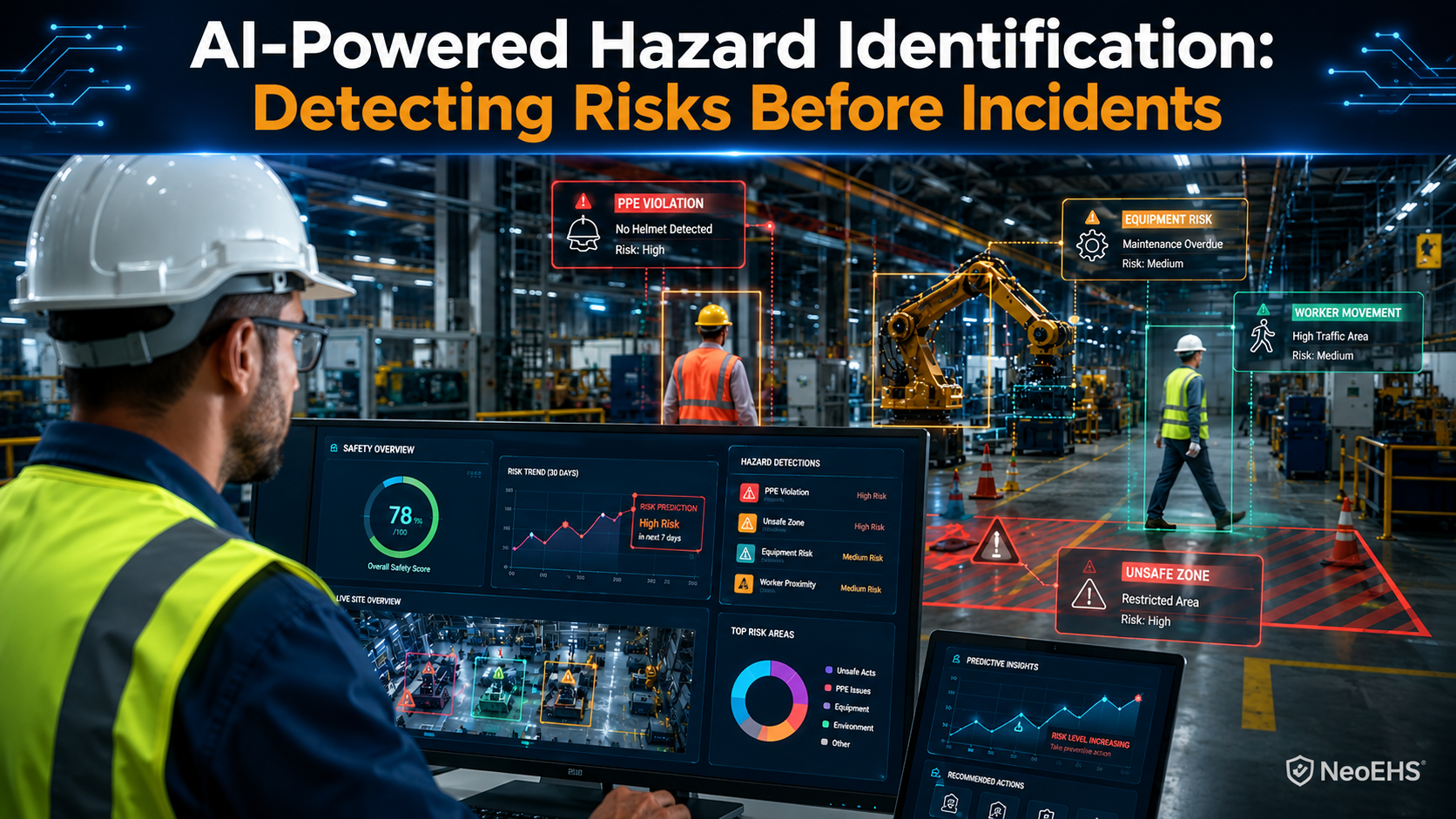
AI-Powered Hazard Identification: Detecting Risks Before Incidents
A workplace incident rarely happens without warning.
Before an accident, there is often a sequence of smaller signals: an unsafe condition, a missed control, a repeated unsafe behavior, an overdue corrective action, a near miss, or a work activity that gradually becomes higher risk.
The challenge is that traditional safety management systems are often designed to record what has already happened. Safety teams may identify hazards during inspections, document them in spreadsheets, assign corrective actions and review them later.
That approach is necessary—but it is no longer enough.
Modern organizations are moving toward AI-powered hazard identification, where safety data, inspections, observations, incidents, operational information, images, CCTV feeds and connected devices can be brought together to identify emerging risks earlier.
This is where an intelligent EHS platform such as NeoEHS can change the way organizations approach workplace risk.
Instead of asking only:
“What went wrong?”
organizations can begin asking:
“What risk is developing right now, and what can we do before it becomes an incident?”
NeoEHS AI-Powered Hazard Management Software
What Is AI-Powered Hazard Identification?
AI-powered hazard identification is the use of artificial intelligence, machine learning, computer vision, predictive analytics and operational data to identify potential workplace hazards and emerging risks before they result in incidents.
Traditional hazard identification usually depends on inspections, employee observations, safety walks, checklists and incident investigations.
AI can extend this process by continuously analyzing large volumes of information and identifying patterns that may be difficult to detect manually.
For example, an AI-enabled EHS system may help identify:
- Repeated unsafe acts in a particular work area
- PPE compliance issues
- Frequently occurring hazards
- High-risk activities
- Recurring near-miss patterns
- Unsafe conditions captured through images
- Risks associated with specific equipment or processes
- High-risk locations
- Overdue corrective actions
- Changes in risk patterns over time
The objective is not to replace safety professionals.
It is to give them better information, earlier signals and greater visibility into developing risks.
Why Traditional Hazard Identification Is No Longer Enough
Many organizations still rely heavily on spreadsheets, paper-based inspections, manual reporting and periodic safety reviews.
These methods can work, but they create a significant limitation: safety information is often reviewed after the event or at fixed intervals.
Consider a simple example.
A manufacturing facility records five similar unsafe observations around a particular machine over three months.
Individually, each observation may appear manageable.
But when those observations are analyzed together, they may reveal a recurring hazard.
That is where AI can add value.
Instead of treating every observation as an isolated record, an intelligent EHS platform can connect information across:
Hazards → Observations → Inspections → Near Misses → Incidents → Corrective Actions → Risk Assessments
The result is a more connected view of risk.
NeoEHS is designed around this broader EHS lifecycle, combining hazard management with risk assessment, incident management, inspections, audits, permits and corrective action workflows.
How AI Changes Hazard Identification
AI does not make hazard identification a single automated activity.
Its real value comes from creating a continuous safety intelligence cycle.
1. Detect
The system collects information from multiple sources.
This may include:
- Mobile hazard reports
- Safety observations
- Inspection findings
- Incident and near-miss records
- CCTV and computer vision
- IoT sensors
- Permit-to-Work information
- Risk assessments
- Contractor activities
- Environmental conditions
This creates a broader safety information base than a conventional spreadsheet or standalone inspection system.
2. Understand
AI can classify and organize safety information.
A reported observation, for example, can be categorized according to hazard type, location, activity, severity or risk level.
Images and documents can also provide additional evidence for safety teams.
3. Identify Patterns
This is where AI becomes particularly useful.
Suppose a facility experiences repeated observations involving:
- Forklift movement
- Pedestrian interaction
- Poor segregation
- Similar locations
- Similar shifts
Individually, these records may not appear critical.
Together, they may indicate an emerging operational risk.
4. Predict
Historical and real-time information can be analyzed to identify areas where risk is increasing.
Predictive analytics can help safety teams prioritize attention toward:
- High-risk activities
- Recurring hazards
- High-risk locations
- Repeated unsafe behaviors
- Poorly performing controls
- Outstanding corrective actions
5. Prevent
The final step is action.
An intelligent system should not simply produce another dashboard.
It should help organizations act on the risk.
That can include creating corrective actions, escalating overdue actions, notifying responsible personnel, initiating inspections or triggering additional risk assessments.
AI + HIRA: Moving from Static Risk Assessment to Living Risk Intelligence
Hazard Identification and Risk Assessment—commonly known as HIRA—is one of the foundations of workplace safety.
Traditionally, a HIRA may be prepared for an activity, approved and then reviewed periodically.
The problem is that operational conditions change.
People change. Equipment changes. Processes change. Contractors change. Production pressures change. Environmental conditions change.
The risk assessment therefore needs to evolve as well.
An AI-enabled approach can connect HIRA with real operational information.
For example:
Hazard Identified → Risk Assessed → Controls Defined → Work Begins → Safety Data Collected → Risk Pattern Detected → Risk Reassessed → Controls Improved
This transforms HIRA from a static document into a living risk management process.
NeoEHS supports digital risk assessment approaches including HIRA, HIRARC, JSA and JHA, alongside broader hazard and risk management workflows.
Explore NeoEHS Risk Assessment & Hazard Management
Computer Vision: Seeing Hazards That Humans May Miss
One of the most visible applications of AI in workplace safety is computer vision.
CCTV cameras are already present in many industrial facilities, construction sites, warehouses, plants and infrastructure projects.
AI can add an additional layer of safety intelligence to those existing video feeds.
Depending on the configured use case, computer vision can help detect:
- Missing PPE
- Unsafe acts
- Restricted-area access
- Unsafe movement
- Fire or smoke indicators
- Unsafe workplace conditions
- Safety-zone violations
This allows safety teams to move from relying exclusively on periodic physical observations toward continuous digital monitoring of selected risk conditions.
NeoEHS integrates AI-powered CCTV and computer vision capabilities into its broader hazard management approach.
NeoEHS AI-Powered EHS Platform
AI-Powered Mobile Hazard Reporting
Technology is only useful when people can actually use it.
Frontline workers are often the first people to notice a hazard.
A damaged guard, oil spill, unsafe stacking condition, exposed cable or unusual equipment behavior may be visible to a worker long before it appears in an inspection report.
AI-powered mobile hazard reporting can make it easier to capture this information immediately.
Workers can potentially submit:
- Photos
- Videos
- Voice reports
- Location information
- Hazard descriptions
- Safety observations
- Near misses
AI can then assist with categorization and prioritization.
NeoEHS supports mobile hazard reporting, image and video evidence, QR-based reporting and AI-assisted hazard categorization.
The result is an important shift:
From “report it later” to “capture it when you see it.”
Predictive Risk Analytics: Finding the Warning Signs
The greatest opportunity for AI in EHS may not be detecting an obvious hazard.
It may be identifying the relationship between multiple smaller warning signs.
Imagine a construction project where the system identifies:
- Increasing near misses
- More observations involving work at height
- Repeated permit deviations
- Several overdue corrective actions
- Increased contractor activity
- Similar findings during inspections
Each data point matters.
But together, they may represent a growing risk pattern.
Predictive risk analytics can help safety professionals recognize these connections earlier and focus their resources where they matter most.
NeoEHS describes this approach as predictive safety intelligence—using incident trends, unsafe behaviors, inspection history and operational information to identify emerging workplace risks.
From Hazard Detection to Corrective Action
Identifying a hazard is only the beginning.
A safety system creates real value when it helps ensure that the hazard is controlled and does not simply remain open in a database.
An effective digital workflow should connect:
Hazard → Risk → Control → Action → Owner → Due Date → Verification → Closure
For example:
A hazard is identified during a mobile inspection.
The system records the evidence and assigns a risk level.
A corrective action is automatically created.
The responsible person receives the task.
If the action becomes overdue, an escalation can be triggered.
Once completed, the safety team verifies the control.
The hazard record is updated.
The information then becomes part of the organization's historical safety intelligence.
This creates a continuous improvement loop rather than a collection of disconnected safety records.
AI-Powered Hazard Identification Across Industries
Different industries have different risk profiles, but the underlying principle remains the same: identify risk early and control it before it becomes an incident.
Manufacturing
AI can help identify machine safety risks, PPE violations, unsafe behaviors, material-handling hazards and recurring shop-floor risks.
Construction
Construction organizations can use AI-enabled hazard management to monitor high-risk activities, work-at-height risks, site conditions, contractor activities and PPE compliance.
Oil & Gas
In high-risk oil and gas environments, AI can support hazard identification, permit-related risk management, operational risk monitoring and predictive safety analysis.
Warehousing & Logistics
AI can help identify forklift risks, pedestrian movement issues, unsafe material handling, loading-area hazards and recurring operational risks.
Energy & Utilities
Safety teams can use connected data, inspections and predictive analytics to improve visibility into electrical, equipment and field-operation risks.
Pharmaceuticals & Chemicals
AI-enabled risk management can support chemical safety, laboratory hazards, process safety, inspections and compliance workflows.
NeoEHS provides hazard management capabilities across manufacturing, construction, oil & gas, warehousing, logistics, pharmaceuticals, utilities and infrastructure environments.
AI Does Not Replace the Safety Professional
There is an important point that should not be overlooked.
AI should support safety professionals—not replace them.
Safety decisions often require context.
A computer model may identify a pattern, but an experienced EHS professional understands the operational environment, workforce behavior, engineering controls and practical constraints behind that pattern.
The strongest approach combines both.
AI provides:
- Data analysis
- Pattern recognition
- Risk signals
- Automated classification
- Real-time alerts
- Predictive insights
- Prioritization
Safety professionals provide:
- Context
- Experience
- Professional judgment
- Control selection
- Verification
- Leadership
- Continuous improvement
The future of EHS is therefore not AI versus people.
It is AI + people.
What Should Organizations Look for in AI Hazard Identification Software?
Organizations evaluating AI-powered hazard identification software should look beyond the words “AI” and “machine learning.”
A useful platform should connect AI with actual EHS workflows.
Look for capabilities such as:
- Digital Hazard Reporting
- AI-Assisted Hazard Categorization
- HIRA and Risk Assessment
- Dynamic Risk Scoring
- AI-Powered Computer Vision
- Mobile Inspections
- Near-Miss Management
- Predictive Risk Analytics
- CAPA Management
- Real-Time Alerts
- Risk Dashboards
- Integration with IoT and enterprise systems
- Audit trails and evidence management
- Multi-site safety management
- Action tracking and verification
Most importantly, these capabilities should work together rather than operate as isolated modules.
NeoEHS brings hazard management, risk assessment, incidents, inspections, audits, permits, corrective actions and AI-powered analytics into one connected EHS environment.
The Future of Hazard Identification Is Predictive
The evolution of workplace safety can be viewed in four stages:
Reactive Safety
Something happens → investigate it.
↓
Preventive Safety
Identify hazards → implement controls.
↓
Data-Driven Safety
Analyze incidents, observations and trends → improve decisions.
↓
Predictive Safety
Continuously analyze data → identify emerging risks → intervene before the incident.
AI-powered hazard identification is an important step toward this fourth stage.
It does not mean that every accident can be predicted.
It means organizations can use more information, more consistently, to recognize risk signals earlier and make better-informed preventive decisions.
How NeoEHS Helps Organizations Detect Risks Before Incidents
NeoEHS brings together AI-powered hazard management, risk assessment, predictive analytics, computer vision, mobile reporting, inspections, incident management and CAPA workflows to create a connected safety intelligence ecosystem.
Instead of managing hazards as isolated records, organizations can connect them with the wider EHS lifecycle.
Identify → Assess → Control → Monitor → Analyze → Predict → Act → Verify → Improve
That is the shift from traditional hazard management to AI-powered risk intelligence.
NeoEHS is designed to help organizations move from reactive incident management toward proactive and predictive safety management through AI, automation and real-time operational visibility.
Discover NeoEHS AI-Powered Hazard Management
Frequently Asked Questions
What is AI-powered hazard identification?
AI-powered hazard identification uses artificial intelligence, computer vision, predictive analytics and operational safety data to identify potential hazards, unsafe conditions and emerging risks before they result in incidents.
How does AI help identify workplace hazards?
AI can analyze safety observations, inspection findings, incident records, images, CCTV data, operational information and other EHS data to identify patterns, classify hazards, prioritize risks and provide early warnings.
Can AI predict workplace accidents?
AI cannot guarantee that an accident will be predicted or prevented. However, AI-powered predictive analytics can identify patterns and risk indicators that may help organizations intervene earlier and strengthen preventive controls.
What is the difference between traditional and AI-powered hazard identification?
Traditional hazard identification generally depends on inspections, observations and manual analysis. AI-powered approaches add continuous data analysis, pattern recognition, computer vision, predictive analytics and automated workflows to improve early risk detection.
Can AI be used for HIRA?
Yes. AI can support HIRA by helping analyze hazards, risk information, historical safety data and operational conditions. The strongest approach connects HIRA with inspections, incidents, observations, corrective actions and ongoing risk monitoring.
Does NeoEHS support AI-powered hazard identification?
Yes. NeoEHS provides AI-enabled hazard management capabilities including AI hazard detection, computer vision monitoring, predictive risk analytics, mobile hazard reporting, digital inspections, risk assessment and automated corrective action workflows.
Can NeoEHS integrate hazard management with other EHS processes?
Yes. NeoEHS connects hazard management with risk assessment, incident management, inspections, audits, Permit to Work, CAPA, contractor safety and other EHS processes within its broader platform.
Final Thought
The safest organizations are not necessarily the ones that have the most safety reports.
They are the ones that can recognize the warning signs early and act on them quickly.
AI-powered hazard identification provides a new way to achieve that.
By combining human safety expertise with AI, computer vision, predictive analytics, mobile reporting and connected EHS workflows, organizations can build a safety management system that does more than document yesterday's problems.
It can help them see today's risks, understand tomorrow's risks and act before those risks become incidents.
That is the future of intelligent EHS management.