From Reactive Safety to AI-Driven Predictive Safety: The Future of EHS Management
For decades, Environmental, Health & Safety (EHS) systems across industries have primarily been reactive.
An incident happens.
A report is created.
An investigation follows.
While these steps are important, they occur after the risk has already materialized.
Today, with the emergence of Agentic AI and predictive analytics, organizations can move beyond reactive processes and build AI-driven predictive safety ecosystems.
This transformation is exactly what the NeoEHS Agentic AI Platform is designed to achieve.
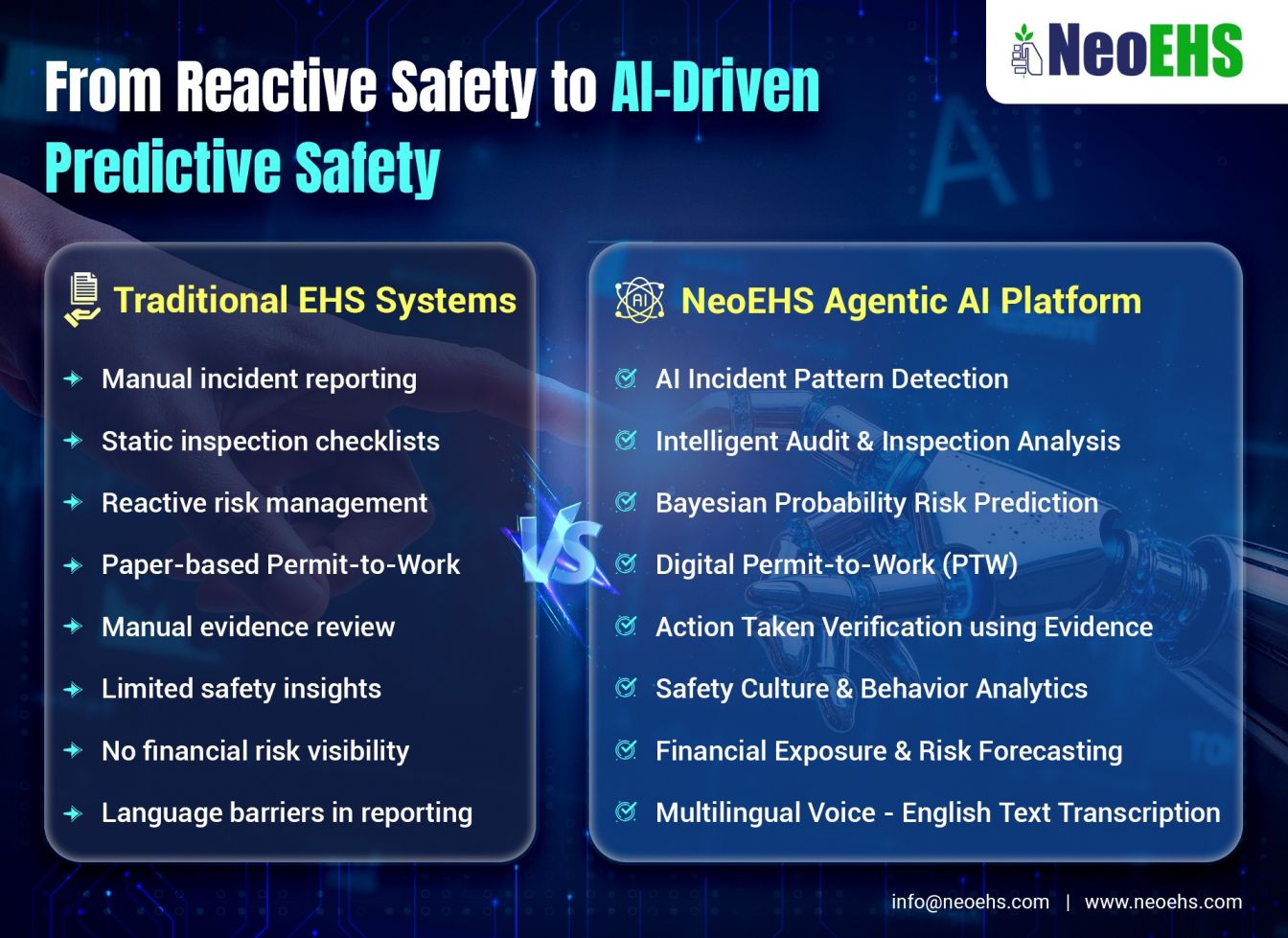
The Limitations of Traditional EHS Systems
Many organizations still rely on conventional safety management systems that struggle to deliver proactive insights.
Common challenges include:
1. Manual Incident Reporting
Most safety incidents are reported manually, leading to delays, incomplete information, and underreporting.
2. Static Inspection Checklists
Traditional inspection checklists are static and fail to adapt to changing risk environments.
3. Reactive Risk Management
Risk assessments are often performed after incidents, rather than predicting potential hazards.
4. Paper-Based Permit-to-Work
Manual PTW systems create inefficiencies, approval delays, and poor traceability.
5. Manual Evidence Review
Safety teams spend significant time reviewing images, documents, and reports manually.
6. Limited Safety Insights
Data is often fragmented across multiple systems, making it difficult to generate meaningful insights.
7. Lack of Financial Risk Visibility
Most safety platforms do not quantify the financial impact of safety risks.
8. Language Barriers
Workforces in industries like construction, manufacturing, and oil & gas often speak multiple languages, which creates challenges in reporting incidents.
The Rise of AI-Driven Predictive Safety
Modern organizations are shifting toward predictive safety intelligence powered by artificial intelligence.
Instead of asking:
“What went wrong?”
They can now ask:
“What could go wrong — and how do we prevent it?”
This is where NeoEHS Agentic AI transforms traditional safety management.
How the NeoEHS Agentic AI Platform Transforms Safety
The NeoEHS platform integrates advanced AI capabilities to help organizations move from incident reporting systems to predictive safety intelligence platforms.
AI Incident Pattern Detection
AI continuously analyzes historical incident data to identify patterns and recurring safety risks across sites, departments, and activities.
Intelligent Audit & Inspection Analysis
Audit and inspection findings are automatically analyzed to detect systemic safety weaknesses.
Bayesian Risk Prediction
Using probabilistic models, the platform predicts future safety risks based on historical data and operational patterns.
Digital Permit-to-Work (PTW)
The platform replaces paper-based PTW systems with fully digital workflows, ensuring faster approvals and better compliance tracking.
Evidence-Based Action Verification
AI helps validate whether corrective actions have truly resolved the safety issue by analyzing submitted evidence.
Safety Culture & Behaviour Analytics
The system evaluates:
-
Near-miss reporting trends
-
Safety observation frequency
-
Reporting delays
-
Management response times
This generates an Organizational Safety Maturity Index.
Financial Exposure & Risk Forecasting
Safety risks are translated into potential financial exposure, enabling leadership teams to make risk-informed decisions.
Multilingual Voice Reporting
Field workers can report incidents using voice in any language, which is automatically converted into English text for centralized analysis.
Industries That Benefit from Predictive Safety
AI-driven EHS platforms are particularly valuable in high-risk industries such as:
-
Construction
-
Oil & Gas
-
Manufacturing
-
Infrastructure
-
Energy & Utilities
-
Mining
-
Logistics
These sectors generate large volumes of safety data that AI can analyze to predict risk and prevent incidents.
The Future of EHS is Predictive
Organizations that adopt AI-driven safety intelligence will gain major advantages:
✅ Reduced incidents and injuries
✅ Improved compliance
✅ Faster decision making
✅ Stronger safety culture
✅ Better financial risk control
The future of EHS is not just about reporting what happened.
It is about predicting what could happen — and preventing it before it occurs.
Transform Your Safety Program with NeoEHS
The NeoEHS Agentic AI Platform enables organizations to transition from reactive safety management to predictive safety intelligence.
By combining AI, probabilistic risk modeling, and intelligent automation, NeoEHS helps businesses create safer workplaces and smarter safety decisions.
📩 Contact us to learn more about implementing AI-powered EHS management in your organization.