OSHA workplace safety guide for businesses with digital EHS management with NeoEHS
OSHA Workplace Safety: Complete Guide for Businesses
Workplace safety is more than wearing personal protective equipment or putting safety signs around a facility. For businesses operating in the United States, an effective occupational safety and health program requires a proactive approach to identifying hazards, controlling risks, training workers, investigating incidents, maintaining records, and continuously improving safety performance.
The Occupational Safety and Health Administration (OSHA) provides standards, guidance, and resources designed to help employers provide safe and healthful workplaces. OSHA's recommended practices emphasize that safety should be managed proactively rather than waiting for an injury, illness, or inspection to reveal a problem.
For modern organizations, digital EHS platforms such as NeoEHS can help bring safety activities, inspections, incidents, risks, corrective actions, training, permits, audits, and compliance information into one connected environment.
What Is OSHA Workplace Safety?
OSHA workplace safety refers to the systems, practices, procedures, and controls businesses use to protect employees from workplace hazards while meeting applicable occupational safety and health requirements.
OSHA covers most private-sector employers and workers in the United States through Federal OSHA or OSHA-approved state programs, although certain workplaces and hazards may fall under other federal agencies or specific jurisdictional requirements.
An effective workplace safety program should therefore combine:
- Hazard identification
- Risk assessment
- Workplace inspections
- Incident and near-miss reporting
- Corrective action management
- Safety training
- Emergency preparedness
- Personal protective equipment management
- Safety documentation and records
- Worker participation
- Management leadership
- Continuous improvement
Why OSHA Compliance Matters for Businesses
OSHA compliance is not simply a regulatory exercise. A well-managed safety program can help organizations prevent injuries and illnesses, improve operational performance, engage employees, and reduce avoidable costs.
OSHA notes that effective safety and health programs can help businesses prevent workplace injuries and illnesses, improve compliance, engage workers, enhance social responsibility, and improve productivity and operations.
For business leaders, workplace safety should therefore be viewed as part of operational excellence rather than as a separate administrative function.
Key Elements of an Effective OSHA Workplace Safety Program
1. Management Leadership
A strong safety culture starts with leadership.
Management should establish clear safety expectations, allocate appropriate resources, define responsibilities, communicate safety priorities, and demonstrate commitment through its own actions.
OSHA identifies management leadership as a fundamental component of an effective safety and health program.
With NeoEHS, management teams can use centralized dashboards and safety performance information to monitor important EHS activities and make more informed decisions.
2. Worker Participation
Employees are often closest to the hazards associated with day-to-day operations. Their knowledge can therefore be extremely valuable when identifying hazards and developing practical controls.
OSHA recommends meaningful worker participation in activities such as hazard analysis, inspections, incident investigations, training, safety procedures, and program improvement.
A modern safety management platform can make this participation easier by allowing employees to report:
- Unsafe conditions
- Hazards
- Near misses
- Safety observations
- Incidents
- Environmental concerns
- Corrective-action requirements
3. Hazard Identification and Risk Assessment
You cannot effectively control a hazard that has not been identified.
OSHA recommends an ongoing process for identifying and assessing hazards. This can include workplace inspections, reviewing previous incidents, investigating near misses, analyzing job hazards, reviewing equipment and chemical information, and involving workers in the process.
Businesses should consider hazards such as:
- Electrical hazards
- Fire hazards
- Chemical exposure
- Machinery hazards
- Falls from height
- Confined spaces
- Ergonomic risks
- Noise
- Heat exposure
- Vehicle and traffic risks
- Slips, trips, and falls
- Workplace violence
- Environmental and occupational health hazards
NeoEHS can help organizations digitize hazard identification, risk assessment, action tracking, and follow-up.
4. Workplace Inspections
Regular workplace inspections help organizations identify unsafe conditions before they result in incidents.
Inspections can cover:
- Production areas
- Warehouses
- Equipment
- Machinery
- Electrical systems
- Emergency equipment
- Fire protection
- Housekeeping
- Material storage
- Contractor activities
- PPE compliance
- Work practices
OSHA recommends documenting inspections and involving workers in identifying hazards and verifying that corrective actions are completed.
5. Incident and Near-Miss Management
An incident should not be treated simply as an event to record and close.
Organizations should investigate what happened, identify contributing factors and root causes, determine corrective actions, and use the findings to prevent recurrence.
Near misses are equally valuable because they can reveal weaknesses before someone is injured.
With digital incident management, businesses can centralize:
- Incident reporting
- Near-miss reporting
- Investigation
- Root-cause analysis
- Corrective actions
- Approvals
- Evidence and attachments
- Trend analysis
- Management reporting
6. Safety Training
Employees need appropriate information, knowledge, and skills to perform their work safely.
A workplace safety training program may include:
- New employee orientation
- Job-specific safety training
- Equipment training
- Emergency response
- PPE training
- Hazard communication
- Refresher training
- Contractor training
- Toolbox talks
- Competency assessments
Digital EHS software can help organizations track training requirements, employee participation, competency, expiry dates, and training records.
7. Hazard Prevention and Control
Identifying a hazard is only the beginning. Businesses must take appropriate steps to eliminate or control it.
Controls should be selected based on the nature and severity of the hazard and the level of worker exposure. OSHA's recommended practices emphasize identifying hazards, prioritizing them, and implementing appropriate controls.
Businesses should monitor whether corrective actions are:
- Assigned
- Prioritized
- Implemented
- Verified
- Closed
- Effective
8. Emergency Preparedness
Every organization should understand the emergencies that could affect its operations and establish appropriate response procedures.
Depending on the workplace, emergency planning may address:
- Fire
- Chemical spills
- Equipment failure
- Severe weather
- Medical emergencies
- Evacuation
- Natural disasters
- Security incidents
- Industrial emergencies
Training, drills, communication, emergency equipment, and clearly defined responsibilities are important parts of preparedness.
OSHA Recordkeeping and Safety Documentation
Safety documentation provides businesses with evidence of activities, trends, actions, and performance.
Depending on the applicable requirements, organizations may need to manage information related to injuries, illnesses, incidents, inspections, training, exposure monitoring, and other safety activities.
OSHA provides specific recordkeeping requirements and resources, so businesses should determine which requirements apply to their operations rather than relying on a generic recordkeeping process.
A centralized EHS platform can help reduce fragmented spreadsheets and disconnected records by maintaining safety information in a structured digital environment.
How Technology Can Improve OSHA Safety Management
Traditional safety management often relies on spreadsheets, paper forms, emails, disconnected systems, and manual follow-ups.
Digital EHS management can provide a more connected approach.
NeoEHS can help businesses manage:
- Risk Management
- Hazard Management
- Incident Management
- Inspection Management
- Audit Management
- Corrective Actions
- Permit to Work
- Training Management
- Emergency Management
- Chemical Management
- PPE Management
- Contractor Safety
- Safety Observations
- Compliance Management
- Environmental Management
- Safety Dashboards
- AI-powered analytics
By connecting these activities, organizations can move from reactive safety management toward more proactive risk management.
AI-Powered OSHA Safety Management
Artificial intelligence can further enhance EHS management by helping organizations identify patterns within large volumes of safety data.
For example, AI-powered EHS systems can support:
- Predictive risk analytics
- Intelligent incident analysis
- Automated document analysis
- AI-assisted safety observations
- Trend identification
- Risk prioritization
- Automated alerts
- Computer vision-based safety monitoring
- Intelligent reporting
- Data-driven safety decision-making
The objective is not to replace safety professionals. Instead, AI can help EHS teams process information faster and focus their expertise on the risks that require human judgment and action.
OSHA Compliance: A Continuous Process
OSHA compliance should not be treated as a once-a-year activity.
Workplaces change continuously. New equipment, materials, contractors, processes, employees, production targets, and environmental conditions can introduce new hazards.
A mature safety program therefore follows a continuous cycle:
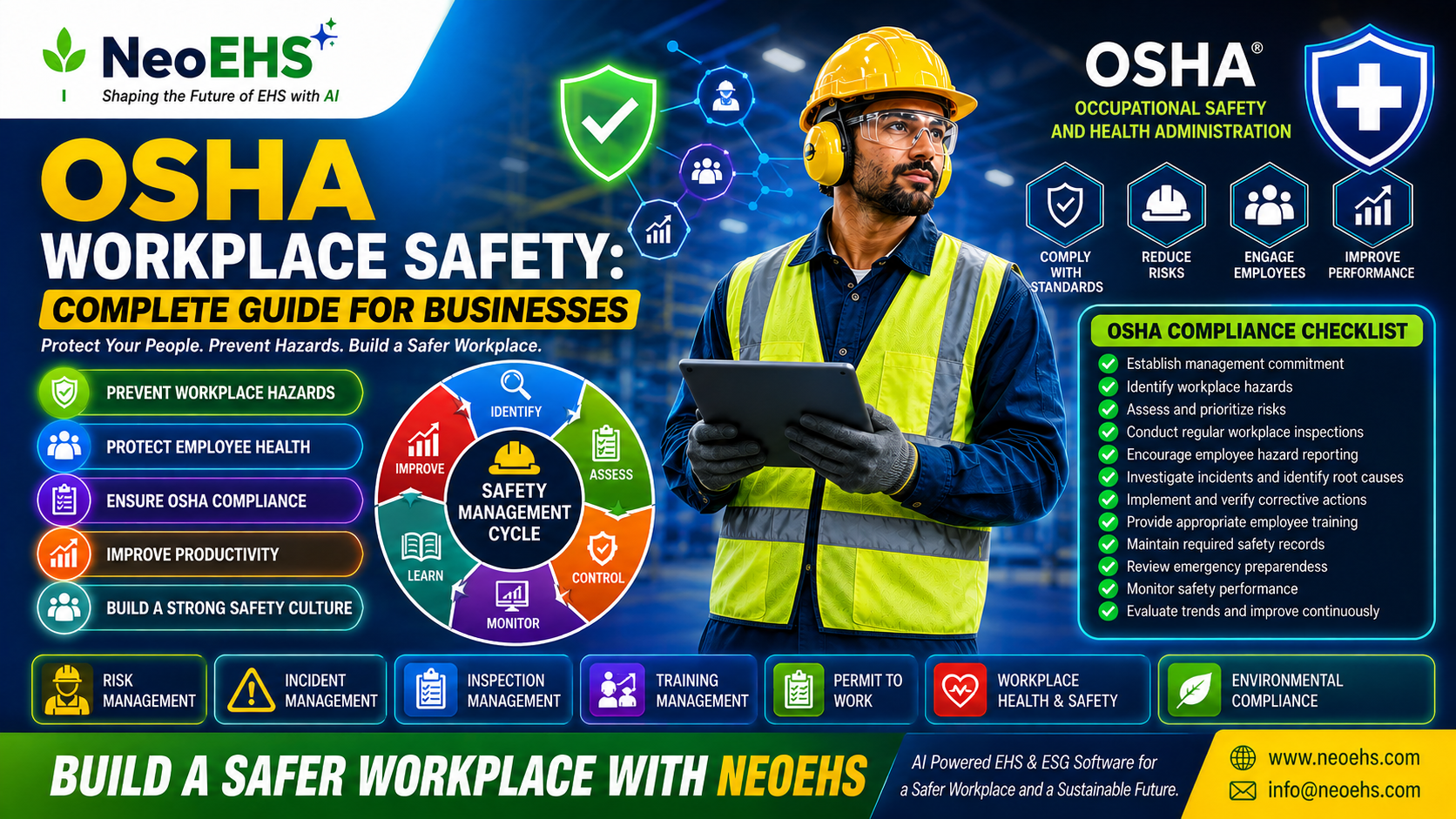
Identify → Assess → Control → Monitor → Learn → Improve
This approach aligns well with OSHA's emphasis on proactive hazard identification, worker participation, management leadership, prevention and control, and continuous improvement.
How NeoEHS Supports Modern Workplace Safety
NeoEHS is an AI-powered EHS and ESG software solution designed to help organizations manage workplace safety, environmental performance, compliance, risks, incidents, inspections, audits, training, and other EHS processes from a connected digital platform.
Instead of managing safety information across multiple spreadsheets and disconnected applications, organizations can centralize EHS data and create greater visibility across operations.
NeoEHS combines EHS management capabilities with AI-powered features, analytics, automation, and digital workflows to help organizations build a more proactive safety management system.
OSHA Workplace Safety Checklist for Businesses
Businesses can use the following high-level checklist as a starting point:
-
Establish management commitment to workplace safety
-
Define safety responsibilities and objectives
-
Identify workplace hazards
-
Assess and prioritize risks
-
Conduct regular workplace inspections
-
Encourage employee hazard and near-miss reporting
-
Investigate incidents and identify root causes
-
Implement and verify corrective actions
-
Provide appropriate employee training
-
Maintain required safety records
-
Review emergency preparedness
-
Monitor safety performance
-
Evaluate trends and recurring hazards
-
Review and continuously improve the safety program
This checklist is a practical starting point and should not be treated as a substitute for reviewing the OSHA requirements applicable to a specific business, industry, workplace, or jurisdiction.
Frequently Asked Questions
What is OSHA workplace safety?
OSHA workplace safety refers to the practices, programs, controls, and processes used to protect workers from occupational hazards while meeting applicable OSHA requirements.
What are the main components of an OSHA safety program?
Important components include management leadership, worker participation, hazard identification, hazard prevention and control, workplace inspections, incident management, safety training, emergency preparedness, and continuous improvement.
How can businesses improve OSHA compliance?
Businesses can improve compliance by understanding applicable OSHA requirements, identifying workplace hazards, implementing appropriate controls, training workers, maintaining required records, investigating incidents, conducting inspections, and continuously evaluating safety performance.
Can EHS software help with OSHA compliance?
Yes. EHS software can help organizations organize safety activities such as inspections, incidents, corrective actions, training, audits, risk assessments, compliance tasks, documentation, and reporting. However, software itself does not guarantee regulatory compliance.
How does AI improve workplace safety?
AI can help organizations analyze safety data, identify trends, prioritize risks, automate workflows, identify patterns in incidents and observations, and provide decision-support insights to EHS teams.
Is NeoEHS an OSHA compliance certification?
No. NeoEHS is an EHS and ESG software platform. It can help organizations manage and document safety and compliance processes, but using software does not itself constitute OSHA certification or guarantee compliance.
Final Thoughts
Workplace safety is ultimately about people.
For businesses, OSHA compliance should not be viewed simply as a regulatory obligation. A proactive safety program can help organizations identify hazards earlier, engage workers, improve operational visibility, reduce preventable incidents, and create a stronger safety culture.
As EHS management becomes increasingly digital, AI-powered platforms such as NeoEHS can help organizations move from fragmented and reactive safety processes toward connected, data-driven, and proactive workplace safety management.
Build a safer workplace. Manage risk intelligently. Empower your EHS team with NeoEHS.
#OSHAWorkplaceSafety #OSHACompliance #WorkplaceSafety #EHSManagement #OccupationalSafety #SafetyManagementSystem #WorkplaceHazardManagement #SafetyCompliance #EHSSoftware #AIPoweredEHS #NeoEHS #WorkplaceRiskManagement
#OSHA #WorkplaceSafety #OSHACompliance #EHSSoftware #EHSManagement #SafetyManagement #OccupationalSafety #WorkplaceHealthAndSafety #RiskManagement #SafetyCulture #AIinSafety #DigitalEHS #NeoEHS #WorkplaceRisk #SafetyTechnology