AI-Powered Safety & Security Observation Software for Proactive Risk Prevention
From Observation to Prevention: How AI-Powered Safety & Security Observation Software Reduces Workplace Risk
Every workplace produces warning signals before a major safety incident or security breach occurs. An unsafe act, missing PPE, damaged barricade, unauthorized access, suspicious activity, blocked emergency exit, or repeated procedural violation may appear minor when viewed individually. However, when these observations are captured, connected, and analyzed, they can reveal emerging risks before they cause serious consequences.
Modern organizations need more than a system for recording observations. They need an intelligent platform that helps employees report concerns quickly, prioritizes critical risks, ensures corrective actions are completed, and converts observation data into actionable insights.
This is where AI-powered Safety & Security Observation Software can help organizations move from reactive incident management toward proactive risk prevention.
Why Safety & Security Observations Matter
Traditional safety and security performance management often depends on lagging indicators such as injuries, security breaches, equipment damage, lost-time incidents, and operational disruptions.
These indicators explain what has already happened.
Observations provide visibility into what could happen next.
Employees, contractors, supervisors, security personnel, and HSE teams interact with workplace risks every day. Giving them an easy way to report unsafe conditions, unsafe behaviors, security concerns, near misses, access-control issues, and procedural violations creates an important source of leading-indicator data.
The challenge begins when organizations receive hundreds or thousands of observations.
Which observation requires immediate attention?
Which location is repeatedly reporting the same issue?
Which corrective actions are overdue?
Are similar risks occurring across multiple facilities?
Which observations could develop into serious incidents?
Without a centralized and intelligent observation management system, answering these questions becomes difficult.
From Traditional Reporting to Intelligent Risk Prevention
Many organizations still use paper forms, emails, spreadsheets, messaging applications, and disconnected software systems to manage observations.
The following graphic illustrates how an intelligent observation management approach changes the process.
GRAPHIC: Traditional Observation Management vs AI-Powered Observation Intelligence
|
TRADITIONAL OBSERVATION MANAGEMENT |
AI-POWERED OBSERVATION INTELLIGENCE |
|
Manual or paper-based reporting |
Mobile and digital observation reporting |
|
Delayed communication of risks |
Real-time reporting and notifications |
|
Safety and security data stored separately |
Unified Safety & Security Observation Platform |
|
Manual observation categorization |
AI-assisted classification and categorization |
|
Every observation reviewed manually |
Intelligent risk prioritization |
|
Corrective actions tracked through emails and spreadsheets |
Automated CAPA workflows and escalation |
|
Limited visibility of recurring risks |
AI-powered pattern and trend detection |
|
Periodic management reports |
Real-time dashboards and analytics |
|
Reactive response after incidents |
Predictive and proactive risk prevention |
Key Transformation:
OBSERVE → REPORT → ANALYZE → PRIORITIZE → ACT → VERIFY → LEARN → PREVENT
One Platform for Safety and Security Observations
Safety and security risks are often managed by separate departments, even though many workplace risks are interconnected.
Consider an unauthorized person entering a restricted operational area.
It is a security concern because access-control measures have failed. At the same time, it creates a serious safety risk because the individual may be exposed to moving machinery, electrical equipment, hazardous materials, or operational vehicles.
Similarly, blocked emergency exits, inadequate lighting, damaged perimeter fencing, disabled CCTV cameras, unsafe contractor behavior, and unauthorized material movement may create both safety and security consequences.
A unified Safety & Security Observation Management System enables organizations to capture and manage these risks through one centralized platform.
Management teams gain better visibility across plants, offices, projects, warehouses, infrastructure facilities, departments, contractors, and business units.
Capture Observations Directly from the Workplace
An effective observation management program depends on workforce participation.
Reporting must therefore be fast and simple.
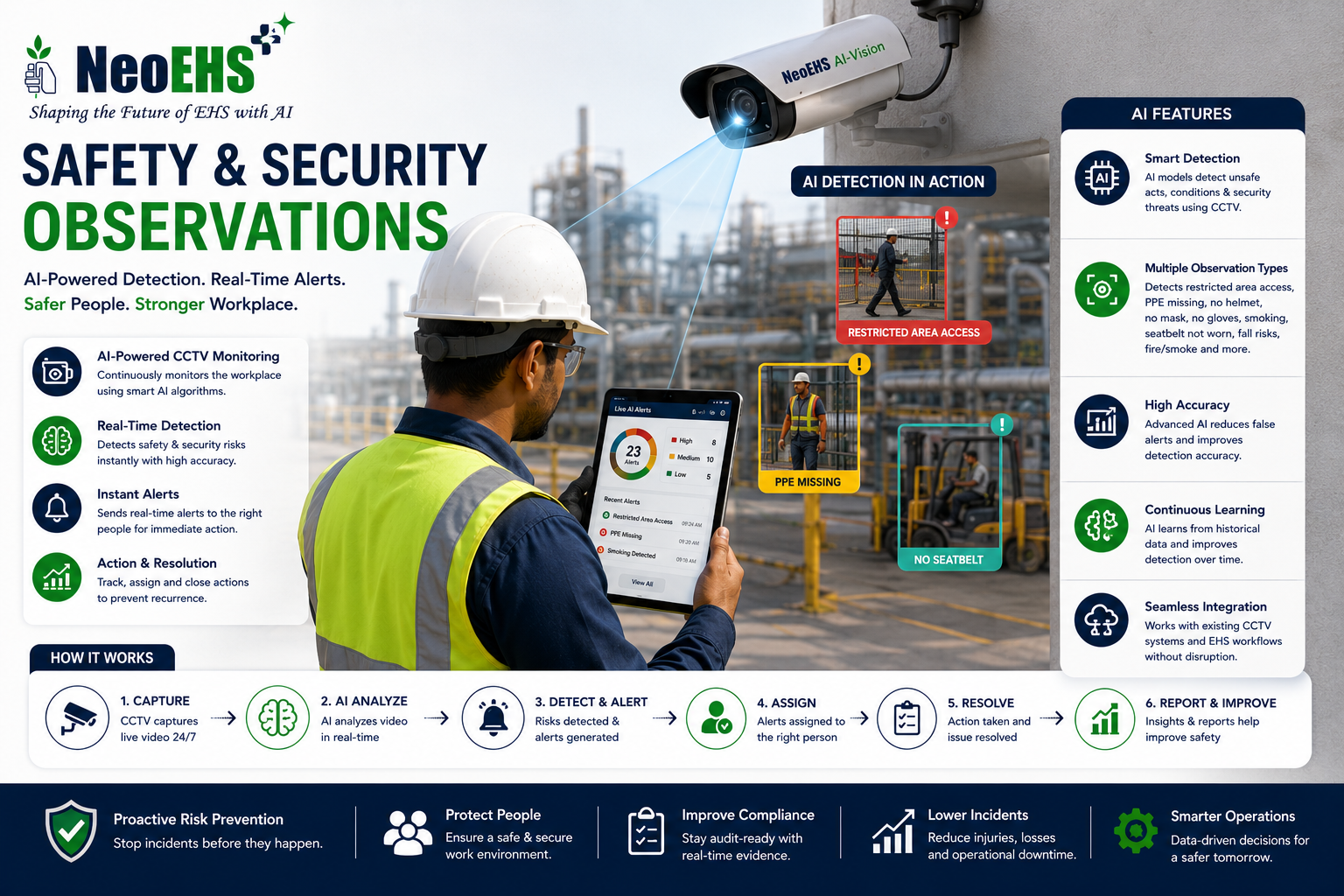
Mobile-enabled Safety & Security Observation Software allows employees, supervisors, contractors, HSE professionals, and security personnel to report concerns directly from the workplace.
Users can record the observation, identify the location, select the risk category, upload photographs or supporting evidence, describe immediate actions, and submit the report for evaluation.
Real-time reporting reduces communication delays and enables responsible teams to respond faster to critical risks.
How AI Makes Observation Management Smarter
As reporting participation increases, organizations generate large volumes of observation data.
Reviewing every observation manually can become difficult for safety and security teams.
Artificial Intelligence can help transform this growing volume of information into actionable risk intelligence.
AI-assisted classification can automatically organize observations into categories such as unsafe acts, unsafe conditions, PPE violations, access-control concerns, housekeeping issues, equipment risks, fire hazards, and security threats.
AI-powered risk prioritization can help identify observations that require immediate management attention.
Pattern recognition can highlight repeated observations occurring at the same location, involving similar activities, contractors, equipment, or departments.
Instead of treating every observation as an isolated event, organizations can identify systemic weaknesses and implement preventive actions.
Connecting Observations with Corrective Actions
Reporting an observation is only the beginning of the risk management process.
The real value comes from ensuring that identified risks are properly addressed.
An effective observation management system should connect significant observations with structured Corrective and Preventive Action workflows.
Responsible personnel can be assigned actions with clear deadlines. Automated notifications can remind action owners about approaching due dates, while escalation workflows can bring overdue or high-risk issues to management attention.
Supporting photographs, documents, and completion evidence can be uploaded before actions are closed.
Supervisors and HSE teams can then verify whether the corrective measures have effectively controlled the identified risk.
This creates a clear accountability cycle:
Observation Identified → Risk Evaluated → Action Assigned → Corrective Action Completed → Evidence Submitted → Effectiveness Verified → Observation Closed
Real-Time Dashboards for Better Decision-Making
Observation data becomes more valuable when organizations can understand the story behind the numbers.
Real-time dashboards can provide management teams with visibility into total observations, open observations, high-risk issues, overdue corrective actions, recurring concerns, location-wise trends, department performance, and closure rates.
Heat maps and trend analytics can help organizations identify facilities and operational areas with increasing risk exposure.
Management teams can use these insights to prioritize inspections, improve training programs, strengthen security controls, allocate resources, and implement targeted preventive measures.
Moving Toward Predictive Safety and Security Management
The future of workplace safety and security management is increasingly proactive.
Organizations are moving beyond simply recording what happened toward understanding what could happen next.
By combining workforce observations, historical incidents, corrective action performance, recurring risk patterns, and operational data, AI-powered platforms can help organizations identify emerging risks.
When repeated observations appear at the same facility or activity, the system can highlight potential weaknesses before a serious incident occurs.
This enables organizations to focus their resources on prevention rather than waiting for incidents to reveal weaknesses in existing controls.
How NeoEHS Supports Intelligent Observation Management
NeoEHS Safety & Security Observation Software provides organizations with a centralized digital platform for capturing, managing, analyzing, and responding to workplace safety and security observations.
The solution supports mobile observation reporting, AI-assisted observation classification, risk prioritization, corrective and preventive action management, automated notifications and escalations, real-time dashboards, trend analytics, and centralized observation tracking.
By converting everyday workplace observations into actionable intelligence, NeoEHS helps organizations strengthen accountability, accelerate corrective actions, identify recurring risks, and improve safety and security performance.
Conclusion
Every observation is an opportunity to prevent an incident.
Organizations that simply collect observations may improve reporting numbers. Organizations that analyze observations, prioritize risks, complete corrective actions, and learn from recurring patterns can create meaningful improvements in workplace safety and security.
AI-powered Safety & Security Observation Software enables organizations to transform scattered reports into connected risk intelligence.
The result is faster reporting, better risk visibility, stronger accountability, smarter decision-making, and a proactive approach to protecting people, assets, facilities, and operations.
NeoEHS helps organizations move beyond observation reporting—turning everyday safety and security signals into actionable insights for proactive risk prevention.
Safety and Security Observation Software, AI Safety Observation Software, Security Observation Management System, Workplace Safety Reporting Software, AI EHS Software, Corrective Action Management Software, Safety Observation App, Proactive Risk Prevention, Predictive Safety Analytics, Security Risk Management Software
.png "NeoEHS AI-powered Mining solution for modern EHS management, enabling safer operations, compliance excellence, risk detection, and sustainable mining performance")