UC & UA: You See. You Act. You Prevent. The Future of AI-Powered Metro Rail Safety Solution of NeoEHS
AI-Powered Metro Rail EHS Software for Incident Management, Risk Prevention, Computer Vision, Safety Observations, Digital Permit to Work and Predictive Safety
Metro Rail systems are built around movement, precision and safety.
Every day, passengers, train operators, engineers, maintenance teams, contractors and safety professionals work within an environment where thousands of activities happen simultaneously.
A train enters a platform. Maintenance teams work near critical infrastructure. Contractors perform high-risk activities. Electrical systems remain operational. Passengers move through stations. CCTV cameras continuously monitor the environment.
In this complex ecosystem, seeing a risk is only the beginning.
The real question is:
What do you do after you see it?
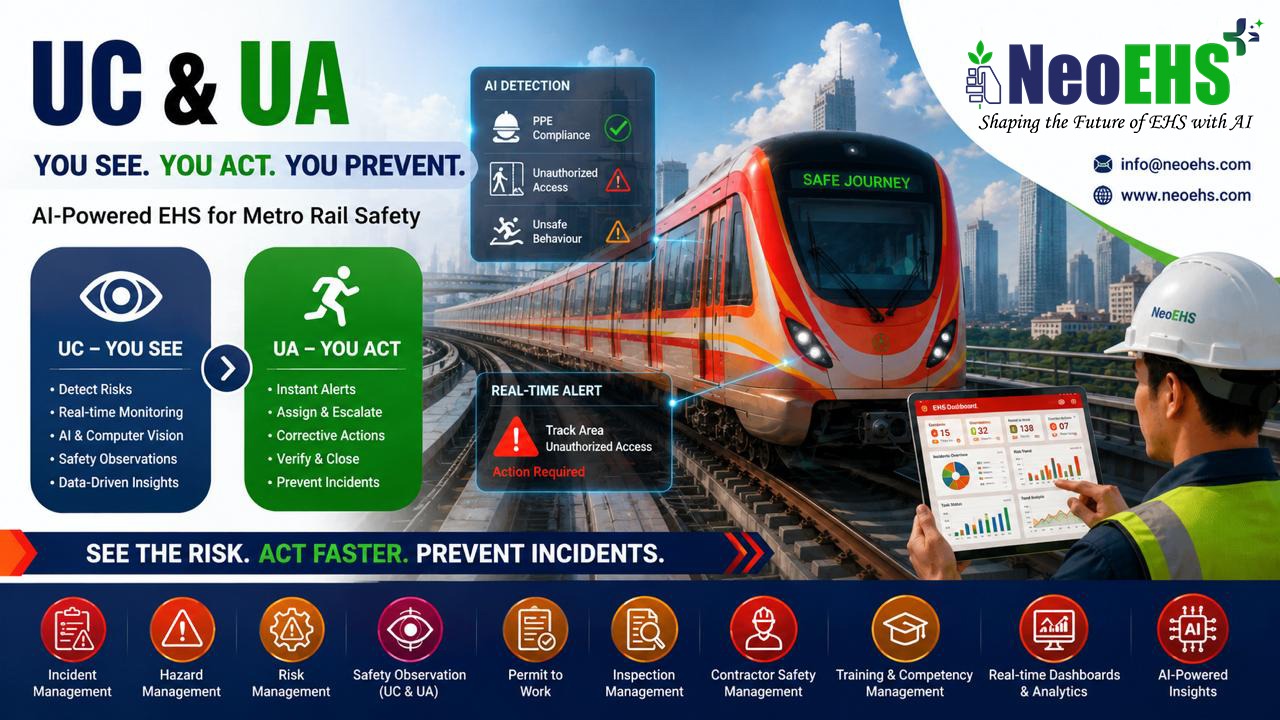
This is the philosophy behind UC & UA — You See. You Act.
With NeoEHS, the vision is to help Metro Rail organisations move beyond simply recording incidents and toward a connected safety lifecycle where organisations can see risks, understand them, act on them and continuously improve.
UC & UA: A Simple Philosophy for a Complex Safety Environment
UC — You See
You See means having the visibility to identify what is happening across the Metro Rail safety ecosystem.
You see:
- Hazards
- Unsafe acts
- Unsafe conditions
- Safety observations
- Near misses
- Incidents
- High-risk activities
- Contractor activities
- Inspection findings
- Permit violations
- Compliance gaps
- Emerging risk patterns
- Operational deviations
But modern safety management requires more than human observation alone.
AI, mobile technology, computer vision, IoT and predictive analytics can extend what safety teams are able to see.
UA — You Act
You Act means converting what you see into timely and accountable action.
You act through:
- Alerts
- Notifications
- Intervention
- Risk controls
- Corrective actions
- Preventive actions
- Escalations
- Investigations
- Verification
- Closure
- Continuous improvement
Therefore:
UC — You See.
UA — You Act.
You Prevent.
This is the foundation of the NeoEHS approach to intelligent Metro Rail safety management.
Why Metro Rail Needs More Than Traditional Safety Management
Traditional EHS systems often depend on paper forms, spreadsheets, emails, disconnected applications and periodic reporting.
These approaches can make it difficult to answer critical questions quickly:
- Where are the highest safety risks today?
- Which hazards are recurring?
- Which contractors have deteriorating safety performance?
- Which corrective actions are overdue?
- Which stations or depots are becoming higher-risk areas?
- Are similar incidents occurring in different locations?
- Which high-risk permits are currently active?
- Where are safety observations increasing?
- What risks are being detected before an incident occurs?
A modern Metro Rail EHS Management System should connect these pieces.
NeoEHS brings incident management, safety observations, risk management, inspections, audits, permits, contractor safety, compliance and AI-powered safety intelligence into a connected EHS ecosystem.
UC — You See: Making Metro Rail Safety Visible
1. You See Through AI-Powered Computer Vision
Metro Rail operators already have extensive CCTV infrastructure.
The opportunity is to transform cameras from passive recording devices into intelligent safety-monitoring sources.
AI-powered computer vision can be configured to identify defined safety events such as:
- Restricted-area access
- Track intrusion
- PPE non-compliance
- Unsafe behaviour
- Unsafe proximity
- Crowd-related safety conditions
- Smoke or fire indicators
- Obstructions
- Safety-zone violations
- Other organisation-defined visual safety events
Instead of discovering an event later through manual review, an AI-enabled system can help bring potential safety events to the attention of responsible teams.
You See the Risk.
And once you see it, the next step is action.
2. You See Through Mobile Safety Observations
A Metro Rail employee, supervisor, engineer or contractor can observe a safety issue and report it directly from a mobile device.
A simple field observation can include:
Photo + Video + Voice + Location + Description + Risk Level
The observation becomes a structured digital safety record.
For example:
“Unsafe access observed inside a restricted maintenance area at Depot A.”
Instead of remaining as an informal observation, the information can enter the EHS workflow.
You See it in the field.
NeoEHS helps bring it into the safety system.
3. You See Through UAUC / Safety Observations
Unsafe Acts and Unsafe Conditions can provide valuable leading indicators of safety performance.
One observation may appear small.
Hundreds or thousands of observations can reveal something much more important: a pattern.
For example:
Observation 1: PPE non-compliance.
Observation 2: PPE non-compliance.
Observation 3: PPE non-compliance.
Observation 4: PPE non-compliance.
An AI-enabled analytics layer can help identify that these observations are recurring around a particular:
- Location
- Contractor
- Work activity
- Shift
- Equipment type
- Department
Now the organisation is no longer simply seeing individual observations.
It is seeing the pattern behind them.
4. You See Through Incident Intelligence
A traditional incident report primarily answers:
What happened?
An intelligent incident management system can help safety teams go further:
- What happened?
- Where did it happen?
- What activity was involved?
- What hazards were present?
- What controls existed?
- What controls failed?
- Has something similar happened before?
- Are similar risks present elsewhere?
- Were corrective actions previously implemented?
- Are there recurring patterns?
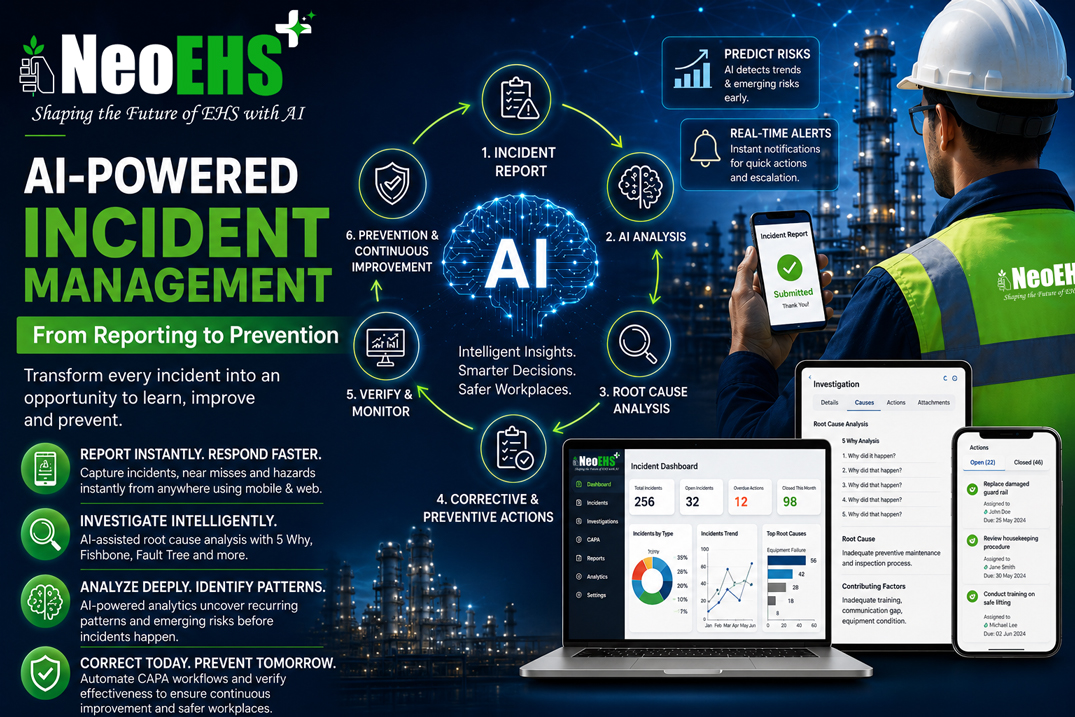
NeoEHS combines incident reporting, investigation, root cause analysis, corrective action tracking and predictive safety intelligence to help organisations move from incident reporting toward incident prevention.
You See the incident.
You See the causes.
You See the recurring patterns.
5. You See Through AI-Powered Risk Management
Metro Rail operations involve complex risks across stations, depots, tracks, tunnels, electrical systems, construction areas and maintenance operations.
A digital risk management system can provide visibility into:
- Hazard registers
- Risk assessments
- High-risk activities
- Risk ratings
- Existing controls
- Residual risks
- Control effectiveness
- Risk owners
- Overdue mitigation actions
- Risk trends
AI can help analyse safety information from incidents, observations, inspections and other EHS data to identify emerging patterns.
You See where risk is increasing.
You Act before it becomes an incident.
6. You See Through Digital Permit to Work
High-risk railway maintenance and infrastructure work requires controlled work authorisation.
A digital Permit to Work system can provide visibility into:
- Work location
- Work activity
- Contractor
- Risk assessment
- Required controls
- Isolation requirements
- PPE
- Approvals
- Permit validity
- Work status
- Closure requirements
For Metro Rail, digital PTW can be particularly valuable for activities such as:
- Electrical work
- Work at height
- Confined-space entry
- Hot work
- Excavation
- Lifting operations
- Isolation / LOTO
- Track-related maintenance
- Other organisation-specific high-risk activities
You See the work.
You See the risk.
You See the controls.
7. You See Through Digital Inspections
Inspections are one of the most important mechanisms for discovering hazards before incidents occur.
With mobile inspection management, safety teams can:
- Conduct inspections digitally
- Capture photographs
- Record findings
- Identify non-conformities
- Assign corrective actions
- Set deadlines
- Escalate overdue actions
- Verify closure
- Analyse recurring findings
When inspection data is connected to incidents, risks and corrective actions, organisations can gain a much broader picture of safety performance.
You See what inspections are telling you.
8. You See Through Contractor Safety Management
Metro Rail projects involve numerous contractors and subcontractors.
Managing contractor safety through disconnected spreadsheets can make it difficult to understand real-time performance.
A digital contractor safety system can provide visibility into:
- Contractor registration
- Competency
- Certifications
- Induction
- Training
- Permits
- Inspections
- Incidents
- Safety observations
- Corrective actions
- Safety performance
AI analytics can help identify changing safety patterns and highlight areas requiring management attention.
You See contractor performance before a small problem becomes a major problem.
9. You See Through Real-Time EHS Dashboards
Metro Rail executives and EHS leaders need more than monthly reports.
They need answers.
A connected NeoEHS dashboard can bring together:
Incidents
What happened?
Hazards
What could happen?
Observations
What are people seeing?
Inspections
What is being found?
Permits
What high-risk work is active?
Risks
Where is exposure increasing?
Corrective Actions
What remains unresolved?
Training
Where are competency gaps?
Contractors
Who needs attention?
AI Analytics
What patterns are emerging?
This creates a single, connected safety picture.
UA — You Act: Turning Safety Intelligence Into Action
Seeing a risk without acting on it does not create safety.
This is where UA — You Act becomes the critical second half of the philosophy.
The digital safety lifecycle becomes:
SEE → UNDERSTAND → ACT → VERIFY → PREVENT
10. You Act Through Real-Time Alerts
When a defined safety event is detected, the system can trigger an appropriate notification or workflow.
For example:
AI Detection
↓
Safety Alert
↓
Responsible Team
↓
Intervention
↓
Action Record
↓
Verification
The objective is not to generate more notifications.
The objective is to help the right people take the right action at the right time.
You See. You Act.
11. You Act Through Corrective and Preventive Actions
A safety observation should never end with:
“Reported.”
It should move through an accountable process:
Observation
↓
Risk Assessment
↓
Action Assignment
↓
Responsible Person
↓
Due Date
↓
Corrective Action
↓
Verification
↓
Closure
↓
Effectiveness Review
This transforms safety management from documentation into action.
12. You Act Through Escalation
Not every risk requires the same response.
A risk-based workflow can help determine whether an issue requires:
Supervisor Intervention
or
Departmental Action
or
Safety Manager Escalation
or
Senior Management Attention
or
Immediate Emergency Response according to the organisation's procedures
The objective is to ensure that serious risks do not remain buried inside routine workflows.
You See the risk.
You Act at the appropriate level.
13. You Act Through AI-Assisted Incident Investigation
After an incident occurs, AI can help investigators analyse available information such as:
- Incident descriptions
- Photographs
- Videos
- Previous incidents
- Safety observations
- Inspection findings
- Risk assessments
- Permit records
- Corrective actions
AI can assist in identifying potential patterns and contributing factors.
Human investigators and qualified safety professionals remain responsible for investigation conclusions, root-cause determination and safety decisions.
AI provides intelligence.
People make safety decisions.
14. You Act Through Predictive Safety
This is where UC and UA become especially powerful.
Imagine NeoEHS identifies:
- Increasing safety observations
- Repeated inspection findings
- Multiple near misses
- Increasing contractor violations
- Overdue corrective actions
- Increasing risk scores
Individually, each item may not trigger significant concern.
Together, they could represent an emerging risk pattern.
AI-powered analytics can help safety teams identify such patterns earlier.
UC — You See the warning signs.
UA — You Act before the incident.
You Prevent.
That is the transition from reactive safety to predictive safety.
The UC + UA Safety Intelligence Cycle
The NeoEHS approach can be represented through a simple continuous cycle:
UC — YOU SEE
Detect → Capture → Monitor
↓
AI — YOU UNDERSTAND
Analyse → Connect → Identify Patterns
↓
UA — YOU ACT
Alert → Assign → Correct → Escalate
↓
VERIFY
Check → Validate → Close
↓
PREVENT
Learn → Predict → Improve
SEE → UNDERSTAND → ACT → VERIFY → PREVENT
This is the foundation of intelligent Metro Rail safety management.
UC + UA Across Metro Rail Operations
| Metro Rail Area | UC — You See | UA — You Act |
|---|---|---|
| Stations | Hazards, crowd conditions, unsafe activities | Alert and intervention |
| Platforms | Passenger and operational risks | Immediate response |
| Track Areas | Restricted access and unsafe conditions | Escalation and intervention |
| Depots | Maintenance and operational hazards | Corrective action |
| Workshops | Machinery and workplace risks | Control and verification |
| Electrical Areas | Electrical safety risks | Isolation and corrective action |
| Tunnels | Worksite and environmental hazards | Alert and emergency response |
| Construction | Contractor and site risks | Corrective action and escalation |
| CCTV | Defined visual safety events | Real-time alert |
| Inspections | Findings and non-conformities | CAPA assignment |
| Incidents | Events and recurring patterns | Investigation and prevention |
| Risk Management | Increasing exposure | Additional controls |
| PTW | High-risk activities | Approval, monitoring and closure |
| Contractors | Performance trends | Intervention and improvement |
| Training | Competency gaps | Training assignment |
| Compliance | Gaps and overdue actions | Escalation and closure |
Why UC + UA Is Different
Many safety platforms focus on collecting information.
Some focus on reporting.
Others focus on analytics.
NeoEHS can bring these capabilities together around one simple operational philosophy:
You See.
The system helps capture what is happening.
You Understand.
AI and analytics help turn safety data into intelligence.
You Act.
Workflows turn intelligence into accountable action.
You Prevent.
The organisation learns from the data and takes preventive measures.
This is the difference between:
Data Collection
and
Safety Intelligence.
From Reactive Metro Rail Safety to Predictive Metro Rail Safety
Traditional approach:
Incident → Report → Investigate → Correct
Digital approach:
Observe → Report → Analyse → Correct
AI-powered approach:
See → Understand → Predict → Act → Prevent
The objective is not to eliminate human judgement.
The objective is to give EHS professionals better information so they can make faster and better safety decisions.
How NeoEHS Supports AI-Powered Metro Rail Safety
NeoEHS is an AI-powered Environmental, Health and Safety platform designed to connect EHS processes, field operations and safety intelligence.
For Metro and Rail operations, NeoEHS can support:
- AI-Powered Incident Management
- Safety Observation Management
- UAUC Management
- Hazard Management
- AI-Enabled Risk Management
- Inspection Management
- Audit Management
- Digital Permit to Work
- Contractor Safety Management
- Training & Competency Management
- Emergency Management
- Compliance Management
- Corrective & Preventive Action Management
- AI-Powered Document Intelligence
- OCR
- Computer Vision Integration
- IoT Integration
- Predictive Safety Analytics
- Real-Time EHS Dashboards
- Mobile EHS Management
The goal is to connect field-level safety with management-level intelligence.
Frequently Asked Questions
What is AI-powered Metro Rail EHS software?
AI-powered Metro Rail EHS software is a digital platform that helps metro and railway organisations manage incidents, hazards, risks, inspections, audits, permits, contractors, compliance and workforce safety while using AI and analytics to identify patterns and support proactive safety decisions.
What does UC mean in Metro Rail safety?
In the NeoEHS UC + UA philosophy, UC means “You See.” It represents the ability to identify and gain visibility into hazards, unsafe acts, unsafe conditions, incidents, observations, operational risks and emerging safety trends.
What does UA mean in Metro Rail safety?
UA means “You Act.” It represents the actions taken after a safety risk is identified, including alerts, interventions, corrective actions, escalation, verification and preventive measures.
What is the UC + UA concept?
UC + UA is a safety philosophy:
UC — You See → AI — You Understand → UA — You Act → You Prevent.
It connects safety visibility with accountable action.
How can AI improve Metro Rail safety?
AI can help analyse safety data, identify recurring patterns, support risk prediction, analyse images and videos where appropriately configured, assist incident investigations and provide intelligent recommendations for safety teams.
Can NeoEHS manage railway safety observations?
Yes. NeoEHS supports digital safety observations and UAUC workflows that allow employees, supervisors and contractors to report unsafe acts, unsafe conditions, hazards and potential risks.
Can NeoEHS support railway Permit to Work?
Yes. NeoEHS provides configurable digital Permit to Work workflows for high-risk activities and can connect PTW with risk assessments, approvals, contractors, inspections and other EHS processes.
Can NeoEHS integrate with CCTV?
NeoEHS can integrate with computer-vision and CCTV safety-monitoring capabilities to support defined safety-event detection, depending on the organisation's infrastructure, cameras, AI models and deployment requirements.
Can NeoEHS support predictive safety?
Yes. NeoEHS uses safety data, analytics and AI capabilities to identify patterns, recurring risks and emerging areas of concern, helping organisations move toward proactive and predictive safety management.
The Future of Metro Rail Safety Is Not Just About Seeing
The future of Metro Rail safety is not simply about collecting more data.
It is about turning data into decisions.
It is about seeing a hazard before it becomes an incident.
It is about recognising a pattern before it becomes a trend.
It is about acting before a near miss becomes an accident.
It is about learning from every observation, inspection and incident.
And it is about creating a continuous safety improvement loop.
UC — You See.
UA — You Act.
You Prevent.
With AI-powered EHS, computer vision, predictive analytics, digital workflows and connected safety data, Metro Rail organisations can move toward a more intelligent, proactive and prevention-focused safety ecosystem.