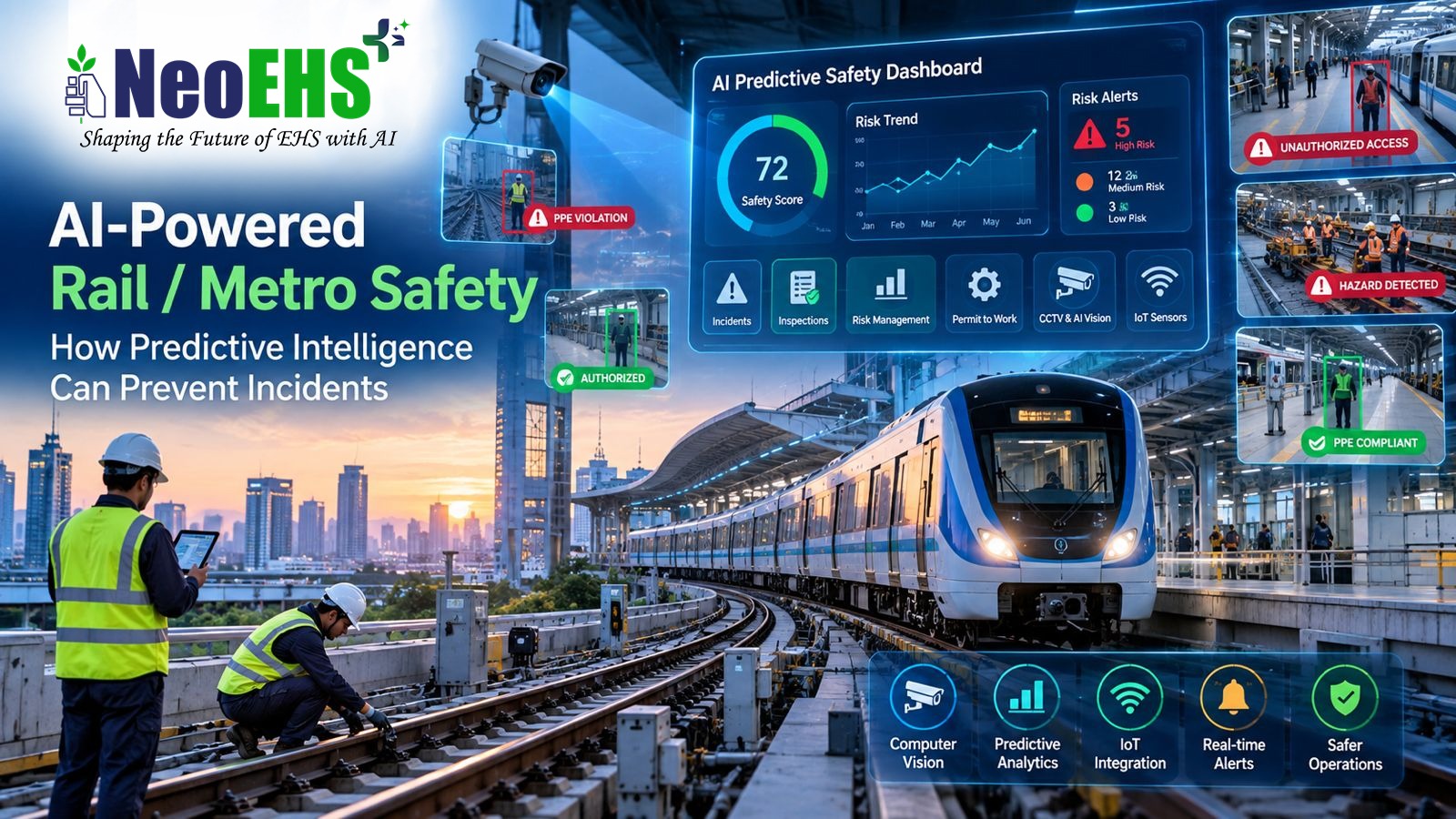
AI-Powered Rail / Metro Safety: How Predictive Intelligence Can Prevent Incident
Metro/ Rail Health, Safety, and Environment System
Railways and metro systems are designed around precision. Trains must move safely, passengers must be protected, infrastructure must remain reliable, and thousands of employees and contractors may work across stations, depots, workshops, tunnels and trackside environments every day.
But modern rail safety is becoming more complex.
A single transportation network may involve rolling stock, tracks, signalling systems, electrical infrastructure, stations, depots, maintenance activities, contractors, passenger areas, CCTV systems, environmental sensors and thousands of safety records.
The question is no longer simply:
“What happened?”
The more important question is:
“What is changing, where is the risk increasing, and what can we do before an incident occurs?”
This is where AI-powered rail safety and predictive intelligence can make a meaningful difference.
By connecting incidents, near misses, safety observations, inspections, risk assessments, permits, audits, workforce information, CCTV and IoT data, modern EHS platforms can help safety teams identify patterns that may otherwise remain hidden.
NeoEHS brings these capabilities together through an integrated EHS platform designed for complex and high-risk operations, including Metro & Rail environments.
What Is AI-Powered Rail Safety?
AI-powered rail safety refers to the use of artificial intelligence, predictive analytics, computer vision, connected data and workflow automation to help railway and metro organizations identify hazards, understand changing risk conditions and take preventive action.
Traditional safety systems are often focused on recording events after they happen.
A digital safety system goes further by connecting:
- Incidents
- Near misses
- Safety observations
- Unsafe acts and unsafe conditions
- Risk assessments
- Inspections
- Audits
- Permit to Work activities
- Corrective and preventive actions
- Contractor activities
- Training and competency
- CCTV and computer vision
- IoT and environmental sensors
- Workforce and operational data
When these information sources are connected, organizations can begin to see relationships and recurring patterns rather than isolated events.
NeoEHS is designed around this connected approach, combining AI-powered risk intelligence, incident analytics, computer vision, mobile safety and EHS workflows within one platform.
Why Traditional Rail Safety Management Is Not Enough
Rail and metro organizations already conduct inspections, audits, risk assessments and incident investigations.
The challenge is that safety information can become fragmented.
For example, imagine that:
- A depot records repeated housekeeping observations.
- A maintenance team reports several near misses.
- An inspection identifies deteriorating equipment.
- A contractor receives repeated corrective actions.
- CCTV identifies recurring unsafe behaviour in a particular work zone.
- A particular maintenance activity generates several permit deviations.
Individually, each event may appear manageable.
Together, they may indicate an emerging risk pattern.
A conventional reporting system may store these records separately.
Predictive safety intelligence aims to connect them.
This creates a fundamental shift:
Reactive Safety
Incident → Investigation → Corrective Action
Digital Safety
Observe → Report → Analyse → Correct
Predictive Safety
Data → Pattern → Risk Signal → Preventive Action
The objective is not to replace experienced safety professionals.
It is to give them better information earlier.
How Predictive Intelligence Can Help Prevent Rail Incidents
Predictive intelligence does not mean that an AI system can guarantee that an accident will never happen.
Instead, it can help organizations identify risk indicators and patterns early enough to support preventive decisions.
Here are some of the most important applications.
1. Predictive Risk Identification
One of the most valuable applications of AI in railway safety is identifying areas where risk may be increasing.
Historical incidents, near misses, inspections, observations and operational information can be analysed to identify:
- Recurring hazards
- High-risk locations
- Repeated unsafe acts
- Increasing observation frequency
- Recurring equipment-related issues
- High-risk activities
- Corrective-action delays
- Areas with declining compliance
For example, if several maintenance-related observations are repeatedly recorded at the same depot, the organization may want to investigate whether the issue is related to equipment condition, procedures, competency, workload or environmental conditions.
A predictive safety system can help bring that pattern to attention.
NeoEHS uses AI-powered risk intelligence and predictive analytics to identify emerging safety trends and support proactive risk management.
2. AI-Powered Incident and Near-Miss Analysis
Incident reporting remains essential in rail safety.
However, the real value of incident management comes from learning from events and near misses.
AI can assist safety teams by analysing large volumes of records and identifying common characteristics.
For example:
Incident A
Electrical maintenance + contractor + night shift
Incident B
Electrical maintenance + contractor + night shift
Near Miss C
Electrical maintenance + contractor + night shift
A human reviewer may notice the pattern immediately when reviewing the records together.
But in a large railway organization with thousands of records, finding such relationships manually can become difficult.
AI-assisted incident analysis can help identify:
- Recurring root causes
- Similar incident types
- Common locations
- Repeated contractor-related issues
- Frequently involved activities
- Recurring corrective actions
- Emerging trends
NeoEHS Incident Management supports digital incident reporting, investigation, root-cause analysis, corrective actions and safety analytics.
3. Computer Vision for Rail and Metro Safety
Rail and metro organizations increasingly use CCTV across stations, depots, workshops and other operational areas.
The next step is making those video systems more intelligent.
AI-powered computer vision can potentially assist with detecting predefined safety conditions such as:
- PPE violations
- Unauthorized access
- Unsafe behaviour
- Restricted-area entry
- Fire or smoke indicators
- Unsafe activities within designated zones
For example, in a maintenance depot, an AI-enabled camera system could identify a predefined PPE non-compliance condition and generate an alert for review.
This can complement—not replace—existing safety supervision.
NeoEHS includes AI-powered computer vision capabilities designed to detect selected workplace safety conditions and connect those signals with the broader EHS ecosystem.
4. Predictive Safety Analytics From Inspections
Inspections generate enormous amounts of safety information.
But collecting inspection data is only the beginning.
The real opportunity comes from understanding what the data is telling the organization.
Consider a railway network with:
- 50 stations
- Multiple depots
- Hundreds of maintenance activities
- Thousands of inspection findings
A traditional system may produce inspection reports.
A predictive platform can help answer more useful questions:
Which locations have recurring findings?
Which hazards are increasing?
Which corrective actions remain overdue?
Which assets or activities repeatedly appear in observations?
Which sites are showing declining safety performance?
NeoEHS Inspection Management enables organizations to digitize inspections, capture findings, assign corrective actions and analyse inspection trends across locations.
5. Intelligent Permit to Work for High-Risk Rail Activities
Railway maintenance often involves high-risk work.
Examples include:
- Electrical work
- Isolation and LOTO
- Confined-space entry
- Hot work
- Work at height
- Excavation
- Lifting operations
- Trackside maintenance
- Equipment maintenance
A digital Permit to Work system can connect authorization with risk controls.
Instead of simply asking:
“Was the permit approved?”
a connected safety platform can help teams ask:
“Were the required controls verified?”
“Was isolation completed?”
“Are contractor competencies valid?”
“Are there conflicting activities in the same area?”
“Has the permit expired?”
NeoEHS provides digital Permit to Work workflows including approval, isolation verification, contractor coordination, safety validation and real-time permit monitoring.
6. Connecting IoT Data With Safety Intelligence
Rail and metro infrastructure can generate data from many sources.
These may include:
- Environmental sensors
- Equipment sensors
- Wearable devices
- Gas detection systems
- Vibration monitoring
- Worker location systems
- Smart helmets
- Machinery monitoring
- Other industrial IoT systems
The challenge is turning these individual data streams into useful safety information.
An integrated EHS platform can connect relevant IoT signals with safety workflows.
For example:
Sensor → Abnormal condition → Risk alert → Safety review → Corrective action
This is particularly useful where a condition can change quickly and waiting for the next scheduled inspection may not be sufficient.
NeoEHS provides an IoT-based safety architecture designed to connect workers, machines, equipment, sensors and safety systems and use AI analytics to identify emerging patterns.
7. From Safety Observations to Predictive Intelligence
Safety observations are one of the most valuable sources of leading-indicator data.
An observation may appear minor:
- Missing PPE
- Poor housekeeping
- Unsafe access
- Improper storage
- Inadequate barricading
- Unsafe behaviour
- Defective equipment
- Procedure deviation
But repeated observations can reveal something more important.
For example:
One observation = local issue
Ten similar observations = recurring issue
Repeated observations across several sites = potential systemic issue
AI can help classify, prioritize and analyse observations so safety teams can focus on patterns rather than treating every record as an isolated event.
NeoEHS supports AI-powered observation management, including classification, risk detection, severity scoring, routing and preventive-action workflows.
8. Identifying High-Risk Locations
Not every location in a railway network carries the same risk profile.
A predictive safety platform can help organizations analyse safety information by:
- Station
- Depot
- Workshop
- Track section
- Maintenance area
- Project
- Contractor
- Activity
- Equipment
- Shift
- Department
This can help create a dynamic view of safety performance.
Instead of relying only on an annual or monthly report, safety leaders can investigate where risk signals are becoming more frequent.
For example:
Station A: Stable
Station B: Increasing observations
Depot C: Repeated maintenance findings
Workshop D: Increasing permit deviations
The purpose is not simply to produce another dashboard.
The purpose is to help safety teams decide where attention may be required first.
9. Contractor Safety Intelligence
Contractors play an important role in railway construction, maintenance and infrastructure projects.
However, contractor safety information is often distributed across different systems.
A connected platform can bring together:
- Contractor onboarding
- Safety induction
- Competency
- Certifications
- Training
- Permit activity
- Safety observations
- Inspection findings
- Incidents
- Corrective actions
This creates a more complete view of contractor safety performance.
For rail organizations managing multiple contractors across stations, depots and infrastructure projects, this connected approach can significantly improve visibility and accountability.
NeoEHS's Metro & Rail platform includes contractor safety, training, competency, compliance and mobile field workflows as part of its transportation safety architecture.
10. Predictive Corrective Action Management
Finding a hazard is only the first step.
The real question is whether the organization actually controls it.
A predictive safety system can analyse:
- Open corrective actions
- Overdue actions
- Repeat findings
- Action severity
- Responsible departments
- Closure times
- Verification results
This helps identify where corrective-action processes themselves may be becoming a risk.
For example, if the same type of corrective action repeatedly remains overdue across several sites, the organization may need to address the underlying management process rather than simply sending another reminder.
This is where connected CAPA management becomes an important part of predictive safety.
The Rail Safety Data Loop
A modern AI-powered rail safety ecosystem can be viewed as a continuous cycle:
1. Identify
Capture hazards, observations and unsafe conditions.
↓
2. Assess
Evaluate risk and existing controls.
↓
3. Control
Apply preventive and corrective measures.
↓
4. Monitor
Track inspections, permits, incidents and operational conditions.
↓
5. Report
Capture incidents and near misses.
↓
6. Investigate
Understand contributing factors and root causes.
↓
7. Correct
Assign and execute CAPA.
↓
8. Verify
Confirm that controls are effective.
↓
9. Analyse
Use AI and analytics to identify patterns.
↓
10. Improve
Strengthen processes based on the intelligence generated.
This creates a continuous feedback loop rather than a collection of disconnected safety activities.
What Data Does AI Need to Predict Safety Risks?
AI is only as useful as the quality and relevance of the information available to it.
For rail and metro safety, useful data sources may include:
| Data Source | Potential Safety Intelligence |
|---|---|
| Incidents | Recurring causes and event patterns |
| Near Misses | Leading indicators |
| Safety Observations | Unsafe acts and conditions |
| Inspections | Recurring physical and procedural issues |
| Audits | Compliance gaps |
| Risk Assessments | Existing risk exposure |
| PTW | High-risk work activities |
| CAPA | Control effectiveness |
| Training | Competency gaps |
| Contractor Data | Contractor performance patterns |
| CCTV | Selected visual safety conditions |
| IoT | Real-time operational signals |
| Environmental Data | Changing workplace conditions |
The goal is not to collect data simply because it is available.
The goal is to connect relevant safety data to meaningful decisions.
AI + Human Expertise: The Right Model for Rail Safety
Rail safety is too important to be delegated blindly to an algorithm.
AI should support safety professionals—not replace them.
Experienced railway engineers, HSE professionals, supervisors and operational leaders understand context that may not be visible in historical datasets.
The most effective model is therefore:
Human Expertise + Connected Data + AI Intelligence + Strong Safety Governance
AI can identify patterns.
People investigate the context.
AI can highlight a potential risk.
Safety professionals determine the appropriate control.
AI can prioritize information.
Management makes the operational decision.
This combination allows technology to strengthen—not weaken—the human side of safety management.
How NeoEHS Supports AI-Powered Rail & Metro Safety
NeoEHS is designed to connect the different components of enterprise EHS management into a unified safety ecosystem.
For rail and metro organizations, this can include:
- AI-powered Incident Management
- Risk Management
- Hazard Management
- Safety Observation Management
- Inspection Management
- Audit Management
- Permit to Work
- Contractor Safety
- Training & Competency
- Emergency Management
- Compliance Management
- Environmental Management
- Mobile Field Safety
- AI Predictive Analytics
- Computer Vision
- IoT Safety Integration
- Executive Safety Dashboards
The NeoEHS Metro & Rail solution specifically addresses distributed transportation environments including stations, depots, workshops, trackside activities, rolling stock operations and corporate functions.
Its underlying approach is to connect field-level safety information with automated workflows, corrective actions, analytics and management oversight.
What Does the Future of Railway Safety Look Like?
The future of rail safety is unlikely to be defined by one technology.
It will be defined by how different technologies work together.
Imagine a connected railway safety ecosystem where:
CCTV identifies a predefined safety condition.
↓
AI classifies the event.
↓
EHS platform creates a safety observation.
↓
Risk engine evaluates its significance.
↓
Workflow automation alerts the responsible team.
↓
Supervisor investigates the condition.
↓
CAPA is assigned.
↓
Inspection verifies the corrective action.
↓
Analytics learns from the outcome.
↓
Management dashboard identifies whether the issue is recurring.
That is the difference between simply digitizing safety and creating connected safety intelligence.
Key Benefits of AI-Powered Rail Safety
When implemented appropriately, AI-powered EHS technology can help railway and metro organizations:
Improve Early Risk Visibility
Identify recurring hazards and emerging risk indicators earlier.
Strengthen Incident Prevention
Use leading indicators and connected safety information to support preventive action.
Improve Field Reporting
Enable workers and supervisors to report observations, incidents and inspections from the field.
Strengthen Corrective Actions
Track actions from identification through closure and verification.
Improve Contractor Oversight
Connect contractor competency, permits, observations, incidents and compliance information.
Increase Management Visibility
Provide consolidated safety information across stations, depots, projects and business units.
Support Data-Driven Decisions
Transform large volumes of safety information into actionable intelligence.
Build a Proactive Safety Culture
Move the organizational mindset from “investigate what happened” toward “understand what could happen and act early.”
Frequently Asked Questions
What is AI-powered rail safety?
AI-powered rail safety uses artificial intelligence, predictive analytics, computer vision, connected data and digital workflows to help railway and metro organizations identify safety risks, analyse patterns and support preventive actions.
How can AI prevent railway accidents?
AI cannot guarantee that an accident will not occur. However, it can analyse relevant safety data to identify recurring hazards, unusual patterns, high-risk activities and other indicators that may warrant preventive intervention.
What is predictive safety analytics in railways?
Predictive safety analytics uses historical and current safety information to identify patterns and leading indicators that may signal increasing risk, helping safety teams prioritize preventive action.
Can AI analyse railway incident data?
Yes. AI can assist in analysing incident, near-miss and observation data to identify recurring patterns, contributing factors, locations, activities and other characteristics.
Can AI CCTV be used for railway safety?
AI-enabled computer vision can be used for selected safety-monitoring applications, such as detecting predefined PPE violations, restricted-area access or other visual conditions, depending on the camera infrastructure and configured AI models.
What is a Railway EHS Management System?
A Railway EHS Management System is a digital platform used to manage health, safety, environmental, risk, compliance and operational safety processes across railway and metro operations.
What should a rail safety software platform include?
A modern rail safety platform may include incident management, risk assessment, hazard management, inspections, audits, Permit to Work, contractor safety, training, compliance, corrective actions, mobile field reporting, analytics and integration with relevant operational technologies.
How does NeoEHS support metro and railway safety?
NeoEHS connects incidents, observations, risks, inspections, audits, permits, contractor safety, compliance and other EHS processes through an integrated platform, with AI-powered predictive analytics, computer vision and connected safety capabilities.
Conclusion: From Reactive Rail Safety to Predictive Safety Intelligence
Rail and metro safety is entering a new phase.
The objective is no longer simply to record incidents faster or produce reports more efficiently.
The larger opportunity is to use connected safety data to understand why risks emerge, where they are increasing and what preventive action can be taken earlier.
AI-powered predictive intelligence can help make that possible.
By connecting incidents, near misses, observations, inspections, risk assessments, permits, contractor activities, CCTV, IoT and operational information, rail organizations can create a more complete picture of safety performance.
The future is not AI instead of safety professionals.
It is AI working with safety professionals.
And the ultimate goal remains simple:
Identify risk earlier. Act sooner. Protect people. Keep rail operations moving safely.
NeoEHS is helping organizations move from reactive EHS management toward connected, predictive and intelligent safety management.
- Metro & Rail Safety Management Software — use in the introduction and "How NeoEHS Supports..." section. NeoEHS Metro & Rail Safety Management Software
- AI-Powered Incident Management Software — link from "Incident and Near-Miss Analysis." NeoEHS Incident Management Software
- AI-Enabled Risk Management Software — link from "Predictive Risk Identification." NeoEHS Risk Management Software
- AI-Powered Hazard Management Software — link from "Predictive Hazard Detection" and "Safety Observations." NeoEHS Hazard Management Software
- Inspection Management Software — link from "Predictive Safety Analytics From Inspections." NeoEHS Inspection Management Software
- Permit to Work Software — link from "Intelligent Permit to Work." NeoEHS Permit to Work Software
- AI-Powered Safety & Security Observation Software — link from "Safety Observations to Predictive Intelligence." NeoEHS Safety & Security Observation Software
- IoT-Based Safety Management — link from "Connecting IoT Data With Safety Intelligence." NeoEHS IoT-Based Safety Management