How AI Automates EHS Reporting and Documentation
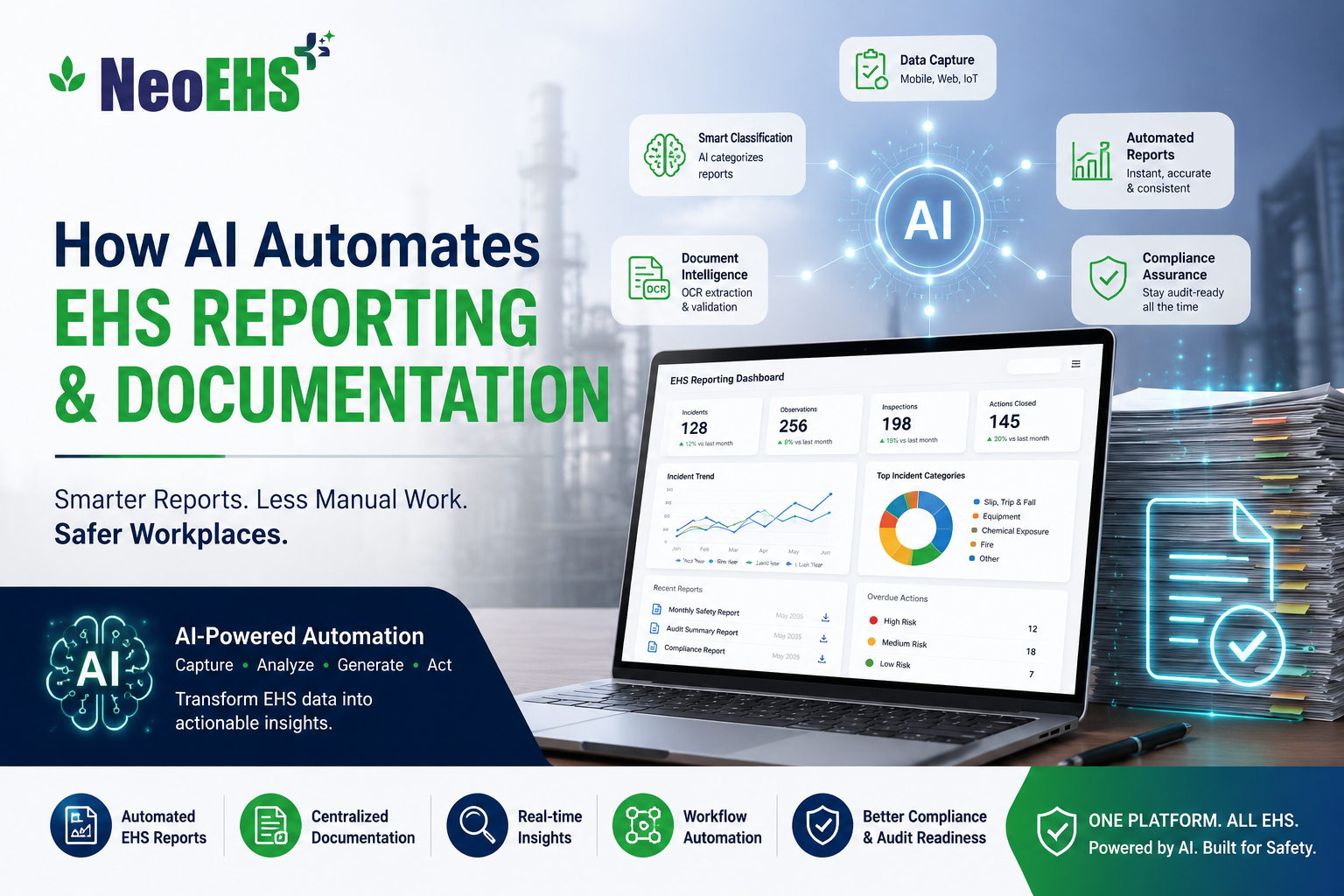
Environmental, Health and Safety teams generate an enormous amount of information every day.
Incident reports. Safety observations. Inspection findings. Audit records. Risk assessments. Permit documents. Training records. Corrective actions. Environmental data. Compliance evidence.
The problem is not a lack of information.
The problem is what happens after the information is created.
In many organizations, EHS professionals still spend hours collecting data, entering information into spreadsheets, preparing reports, checking documents, formatting presentations and following up on missing records.
That administrative workload takes valuable time away from what EHS teams actually want to do: identify risks, prevent incidents and improve workplace safety.
This is where AI-powered EHS reporting and documentation can make a meaningful difference.
Instead of treating AI as simply a chatbot that answers questions, modern EHS platforms can use artificial intelligence to capture information, classify it, extract relevant data, identify patterns, generate reports, support documentation and turn large volumes of safety data into actionable insights.
The result is a shift from:
Manual reporting → Digital reporting → Automated reporting → Intelligent EHS reporting
What Is AI-Powered EHS Reporting?
AI-powered EHS reporting is the use of artificial intelligence to collect, interpret, organize, analyze and present Environmental, Health and Safety information with less manual effort.
Traditional reporting often requires an EHS professional to:
- Collect information.
- Enter data.
- Check the information.
- Categorize records.
- Prepare reports.
- Analyze trends.
- Create management summaries.
- Follow up on corrective actions.
AI can assist with several of these steps.
For example, an employee could submit an incident description and photograph from a mobile device. AI can help classify the incident, extract relevant information, identify potential contributing factors and organize the record for further investigation.
The EHS professional remains responsible for reviewing important information and making appropriate safety decisions.
That distinction matters.
AI should reduce administrative work without removing human accountability.
Why Is EHS Reporting Still So Manual?
Many organizations have modernized some parts of their operations but still depend on manual EHS processes.
Common examples include:
- Excel-based safety reports
- Paper inspection forms
- Email-based approvals
- Manually prepared monthly reports
- Scanned compliance documents
- Manually entered incident records
- Separate audit spreadsheets
- Manually maintained action trackers
- Repeated data entry across different systems
These processes create several problems.
Duplicate Data Entry
The same information may need to be entered into multiple reports or systems.
Delayed Reporting
A safety event that occurs today may not appear in a management report until days or weeks later.
Inconsistent Information
Different people may describe the same type of event using different terminology.
Reporting Errors
Manual data entry can introduce missing fields, incorrect classifications or inconsistent records.
Administrative Workload
Safety professionals spend time preparing reports instead of analyzing risk.
Limited Visibility
Management may receive historical reports without understanding what is changing in real time.
AI-powered EHS platforms can help address these challenges by automating repetitive activities and connecting information across safety processes.
NeoEHS currently positions its platform around digital EHS workflows, AI-powered analytics, automated safety processes, real-time dashboards and centralized EHS information.
How AI Automates EHS Reporting
AI can support EHS reporting at multiple stages of the reporting lifecycle.
1. Automated Data Capture
The first step in reporting is collecting information.
Modern EHS platforms can allow workers, supervisors, contractors and safety professionals to submit information through web and mobile applications.
Instead of waiting for someone to prepare a report later, information can be captured closer to the point where the event occurs.
For example:
A worker notices an unsafe condition, takes a photograph, enters a short description and submits the observation from a mobile device.
The system can then begin processing the information immediately.
This creates a faster connection between:
Workplace → EHS system → Safety team → Corrective action
2. AI-Powered Report Classification
One of the most useful applications of AI is classification.
Imagine an organization receives thousands of safety observations every month.
Manually categorizing every observation can take considerable time.
AI can assist in identifying categories such as:
- Unsafe act
- Unsafe condition
- Near miss
- PPE violation
- Fire risk
- Electrical hazard
- Chemical exposure
- Working-at-height risk
- Housekeeping issue
- Environmental incident
- Equipment-related hazard
The AI does not need to replace the safety professional.
Instead, it can provide an initial classification that the responsible person can review and confirm.
This can make reporting more consistent and reduce repetitive administrative work.
3. AI-Assisted Incident Reporting
Incident reporting is another area where automation can provide significant value.
A modern AI-enabled incident workflow can help organize:
- Incident description
- Date and time
- Location
- People involved
- Activity being performed
- Equipment involved
- Immediate actions
- Potential causes
- Supporting photographs
- Witness information
- Corrective actions
AI can help identify missing information and prompt the user to provide additional details.
For example:
"The incident description indicates that the employee was working at height. Was fall protection equipment being used?"
This type of intelligent prompting can improve the quality of information captured during the initial reporting stage.
NeoEHS currently provides digital incident management capabilities including incident reporting, investigation, corrective actions, AI-assisted analysis and audit-ready documentation.
4. AI for EHS Document Intelligence
EHS departments manage large volumes of documents.
These can include:
- Risk assessments
- Safety procedures
- SOPs
- Inspection reports
- Audit reports
- Permits
- Training certificates
- Contractor documents
- Legal documents
- Safety Data Sheets
- Incident records
- Environmental reports
Manually reading and extracting information from every document can be time-consuming.
AI-powered document intelligence can help extract relevant information from structured and unstructured documents.
For example, AI could help identify:
Document → Relevant information → Structured EHS record
Instead of asking someone to manually read a 20-page document and enter selected information into another system, AI can assist in identifying the relevant sections and preparing structured information for review.
This is particularly useful when organizations have large document repositories.
5. OCR Can Turn Documents Into Usable EHS Data
Optical Character Recognition, or OCR, allows software to extract text from documents and images.
In EHS, OCR can be useful for processing:
- Scanned inspection reports
- Certificates
- Training records
- Contractor documents
- Equipment certificates
- Permits
- Audit evidence
- Regulatory documents
AI can go beyond simply reading the text.
It can help identify:
- Document type
- Important dates
- Expiry dates
- Names
- Certificate numbers
- Required fields
- Relevant safety information
This creates an opportunity to move from:
Document storage
to:
Document intelligence.
6. Automated EHS Report Generation
Management teams often need recurring reports.
For example:
Daily
- Critical incidents
- High-risk observations
- Open permits
- Immediate corrective actions
Weekly
- Incident trends
- Inspection performance
- Action closure
- Contractor safety
Monthly
- TRIR
- LTIFR
- Near misses
- Safety observations
- Audit performance
- Training performance
- Compliance status
Quarterly
- Management review
- Safety trends
- Environmental performance
- ESG indicators
- Strategic risks
AI can help assemble information from different EHS processes and generate structured reports.
Instead of starting from a blank spreadsheet every month, the EHS team can review an automatically prepared report and focus on interpretation.
7. AI Can Turn EHS Data Into Management Insights
Reporting should not end with a PDF.
The real value of EHS reporting comes from understanding what the information means.
Suppose a company has:
- 500 safety observations
- 35 near misses
- 12 incidents
- 8 recurring hazards
- 20 overdue corrective actions
A traditional report may simply present those numbers.
AI can help identify relationships.
For example:
"Working-at-height observations increased significantly across two projects during the past quarter, while corrective-action closure declined."
That is more useful than a table containing numbers.
The goal is to move from:
Data → Information → Insight → Action
8. AI-Powered EHS Dashboards
Modern EHS dashboards can provide real-time visibility into safety performance.
Important indicators can include:
- Incident frequency
- Incident severity
- Near misses
- Safety observations
- Corrective actions
- Inspection completion
- Audit findings
- Training compliance
- Permit activity
- Contractor performance
- Environmental metrics
AI can make dashboards more useful by highlighting what deserves attention.
Instead of presenting 50 metrics equally, an intelligent system can help prioritize the information that appears most relevant or urgent.
NeoEHS provides centralized dashboards and analytics across safety and compliance processes, supporting real-time visibility and management decision-making.
9. Automated Corrective Action Reporting
Finding a problem is only the first step.
The organization must also make sure that the issue is corrected.
AI-enabled workflows can help connect:
Finding → Corrective Action → Responsible Person → Due Date → Escalation → Closure → Verification
For example, if an inspection identifies a critical electrical hazard, the system can create or recommend a corrective action, assign responsibility according to configured workflows and monitor the action until closure.
This creates greater accountability.
10. AI Can Help Identify Overdue Actions
Corrective-action backlogs are common in large organizations.
The problem is that not every overdue action has the same level of risk.
AI can help prioritize actions based on factors such as:
- Risk severity
- Age of action
- Related incidents
- Repeated findings
- Location
- Activity
- Responsible department
- Compliance significance
This helps safety teams focus first on the actions that may represent the greatest potential exposure.
11. Automating Audit Documentation
Audits generate substantial amounts of information.
An organization may need to maintain:
- Audit plans
- Checklists
- Evidence
- Findings
- Corrective actions
- Closure records
- Supporting documents
- Management responses
Digital EHS systems can centralize these records.
AI can further assist by helping organize evidence, identify missing information and summarize findings.
This can reduce the administrative effort required to prepare for internal and external audits.
NeoEHS includes digital audit and inspection management with action tracking and compliance visibility as part of its broader EHS platform.
12. AI-Powered Compliance Reporting
Compliance reporting can become particularly challenging for organizations operating across multiple locations.
Different facilities may have:
- Different regulations
- Different reporting requirements
- Different deadlines
- Different documentation requirements
- Different responsible personnel
An intelligent EHS platform can help centralize compliance information and automate recurring workflows.
AI can support:
- Compliance status summaries
- Missing evidence identification
- Upcoming deadline alerts
- Regulatory document analysis
- Corrective-action tracking
- Management reporting
However, organizations should always validate regulatory interpretations and reporting obligations with appropriately qualified legal, compliance or EHS professionals.
AI + EHS Reporting: A Practical Example
Consider a manufacturing organization with ten facilities.
Every month, the corporate EHS team receives:
- Incident reports
- Near-miss reports
- Inspection findings
- Audit findings
- Training records
- Corrective actions
- Environmental information
Historically, the corporate team spends several days collecting information from different locations and preparing management reports.
With an AI-enabled EHS platform, the workflow can become:
1. Capture
Facilities enter information digitally.
↓
2. Validate
The system checks required fields and data quality.
↓
3. Classify
AI assists with categorization.
↓
4. Analyze
The platform identifies trends and recurring issues.
↓
5. Prioritize
High-risk issues are highlighted.
↓
6. Report
Management dashboards and reports are generated.
↓
7. Act
Corrective actions are assigned and tracked.
↓
8. Learn
Historical information becomes available for future risk analysis.
The result is not simply a faster report.
It is a more connected EHS management process.
From EHS Reporting to Predictive Safety
Automated reporting creates another important opportunity.
Once an organization has consistent digital data, it can begin analyzing trends.
For example:
Observation data + Incident data + Inspection data + Risk data + Permit data
can reveal patterns that are difficult to see when each dataset exists separately.
This can support predictive safety analytics.
Instead of asking:
"How many incidents happened last month?"
the organization can begin asking:
"Which locations, activities or conditions are showing increasing risk?"
That is a fundamental shift from lagging indicators toward leading and predictive indicators.
NeoEHS positions predictive risk analytics, AI incident analysis and connected EHS information as part of its AI-powered platform.
How AI Can Improve EHS Reporting Quality
Automation is not only about speed.
It can also improve consistency.
A well-designed AI-enabled reporting system can help:
Standardize terminology
Use consistent categories and classifications.
Reduce missing information
Prompt users when important fields are incomplete.
Improve documentation
Structure information consistently across locations.
Improve traceability
Maintain records of actions and approvals.
Improve accessibility
Make information easier to search and analyze.
Improve decision-making
Turn raw data into useful insights.
What AI Should Not Do in EHS
AI should not be treated as an unquestionable decision-maker.
There are situations where human expertise is essential.
For example:
- Determining legal responsibility
- Final incident conclusions
- High-risk work authorization
- Regulatory interpretation
- Medical decisions
- Emergency decisions
- Serious incident classification
AI can provide recommendations and supporting analysis.
Qualified professionals should retain appropriate authority and accountability.
The best model is:
AI intelligence + human expertise + controlled workflows
rather than:
AI replacing the EHS professional.
What Should You Look for in AI-Powered EHS Reporting Software?
Organizations evaluating EHS reporting automation should look beyond the word "AI."
Look for capabilities such as:
- Mobile reporting
- Automated workflows
- Incident management
- Safety observations
- Risk assessment
- Audit management
- Inspection management
- Corrective-action management
- Document intelligence
- OCR
- Automated dashboards
- Predictive analytics
- Compliance management
- Role-based access
- Audit trails
- Enterprise integrations
- Human review and approval
- Configurable workflows
Most importantly, ask:
Can the system connect EHS information and turn it into actionable intelligence?
AI-Powered EHS Reporting for Different Industries
The requirements vary by industry, but the underlying principle remains the same.
Construction
AI can help automate:
- Daily safety reporting
- Contractor reporting
- Site observations
- Incident documentation
- Permit records
- Inspection reports
- Project safety dashboards
Manufacturing
AI can support:
- Machine safety reporting
- Incident documentation
- LOTO records
- Inspection reporting
- Corrective actions
- Safety trend analysis
Mining
AI can assist with:
- High-risk activity reporting
- Mobile incident reporting
- Contractor documentation
- Inspection records
- Permit workflows
- Risk intelligence
Oil & Gas
AI-powered reporting can support:
- Process safety information
- Permit records
- Incident investigation
- Environmental reporting
- Audit evidence
- Compliance documentation
Power & Energy
Organizations can use digital reporting to manage:
- Electrical safety
- Work permits
- Asset inspections
- Incident reporting
- Contractor safety
- Regulatory documentation
The same principle applies across industries:
Capture once. Connect the information. Automate the workflow. Learn from the data.
The Future of EHS Documentation Is Intelligent
For years, the objective of EHS digitization was to eliminate paper.
That was an important first step.
But digital forms alone do not create intelligent safety management.
The next stage is about making the information itself more useful.
The evolution looks like this:
Stage 1 — Paper
Information is documented manually.
Stage 2 — Digital
Information is entered into software.
Stage 3 — Automated
Workflows, notifications and reports are automated.
Stage 4 — AI-Powered
AI analyzes information and provides insights.
Stage 5 — Agentic
AI agents can coordinate defined tasks and workflows under appropriate controls and human oversight.
This is where the future of EHS is heading.
How NeoEHS Supports AI-Powered EHS Reporting
NeoEHS brings EHS processes into an integrated digital environment covering incident management, risk assessment, audits, inspections, Permit to Work, contractor safety, compliance, environmental management, ESG and analytics.
Its current platform capabilities include AI-powered incident analysis, predictive risk analytics, document intelligence, automated workflows, AI safety assistance and multi-agent AI capabilities.
The objective is not simply to generate more reports.
It is to help organizations create better safety intelligence from the information they already collect.
With a connected EHS platform, organizations can move toward:
Capture → Automate → Analyze → Predict → Act → Improve
Frequently Asked Questions
What is AI-powered EHS reporting?
AI-powered EHS reporting uses artificial intelligence to help collect, classify, analyze, summarize and present Environmental, Health and Safety information while reducing repetitive manual reporting activities.
How does AI automate EHS documentation?
AI can assist with data extraction, document classification, OCR, report generation, incident categorization, information summarization, trend analysis and workflow automation.
Can AI generate EHS reports automatically?
Yes. AI-enabled EHS platforms can assemble information from connected EHS processes and generate structured reports or management summaries. Human review remains important for significant safety, compliance and regulatory information.
Can AI automate incident reporting?
AI can assist with incident classification, information extraction, documentation, investigation support, trend analysis and corrective-action workflows. Employees and EHS professionals still need to validate important information.
Can AI help with EHS compliance reporting?
Yes. AI can assist with organizing compliance information, monitoring deadlines, identifying missing evidence, summarizing compliance status and supporting corrective-action workflows. Regulatory requirements should still be validated by qualified professionals.
Does AI replace EHS professionals?
No. The strongest use of AI in EHS is to reduce repetitive administrative work and provide better information for safety professionals. Human expertise, accountability and decision-making remain essential.
What is the difference between digital EHS reporting and AI-powered EHS reporting?
Digital reporting replaces paper with software. AI-powered reporting adds intelligent capabilities such as classification, document extraction, trend analysis, recommendations and automated reporting workflows.
Can AI improve EHS audit readiness?
AI-enabled EHS systems can help centralize records, organize evidence, track corrective actions and generate reports, making it easier for organizations to maintain consistent documentation and prepare for audits.
Conclusion
EHS reporting should not consume the time that safety professionals need to spend preventing incidents.
AI can help organizations automate repetitive documentation, improve data consistency, accelerate reporting and turn large volumes of safety information into actionable insights.
But the real opportunity goes beyond automation.
When incident reports, observations, inspections, audits, risks, permits, contractor information and compliance records are connected, organizations can begin to see the bigger picture.
They can move from:
Reporting what happened
to:
Understanding why it happened
and ultimately toward:
Identifying what could happen next and acting before it does.
That is the real promise of AI-powered EHS reporting.
NeoEHS is helping organizations move from manual EHS documentation to intelligent, connected and proactive safety management — shaping the future of EHS with AI.
Explore NeoEHS
Discover how an AI-powered EHS platform can help your organization digitize reporting, automate documentation, improve compliance visibility and turn safety data into actionable intelligence.