Fishbone (Ishikawa) Analysis: Identifying Root Causes of Workplace Incidents
Introduction
In safety-critical industries such as construction, manufacturing, and oil & gas, identifying the true root cause of incidents is essential to prevent recurrence.
However, many organizations stop at identifying surface-level causes, leading to repeated incidents and ineffective corrective actions.
This is where Fishbone (Ishikawa) Analysis becomes a powerful tool.
Integrated within the NeoEHS platform, Fishbone Analysis enables safety teams to systematically investigate incidents, identify contributing factors, and implement effective corrective and preventive actions.
What is Fishbone (Ishikawa) Analysis?
Fishbone Analysis, also known as the Cause-and-Effect Diagram, is a structured method used to identify potential causes of a problem.
It was developed by Kaoru Ishikawa, a pioneer in quality management.
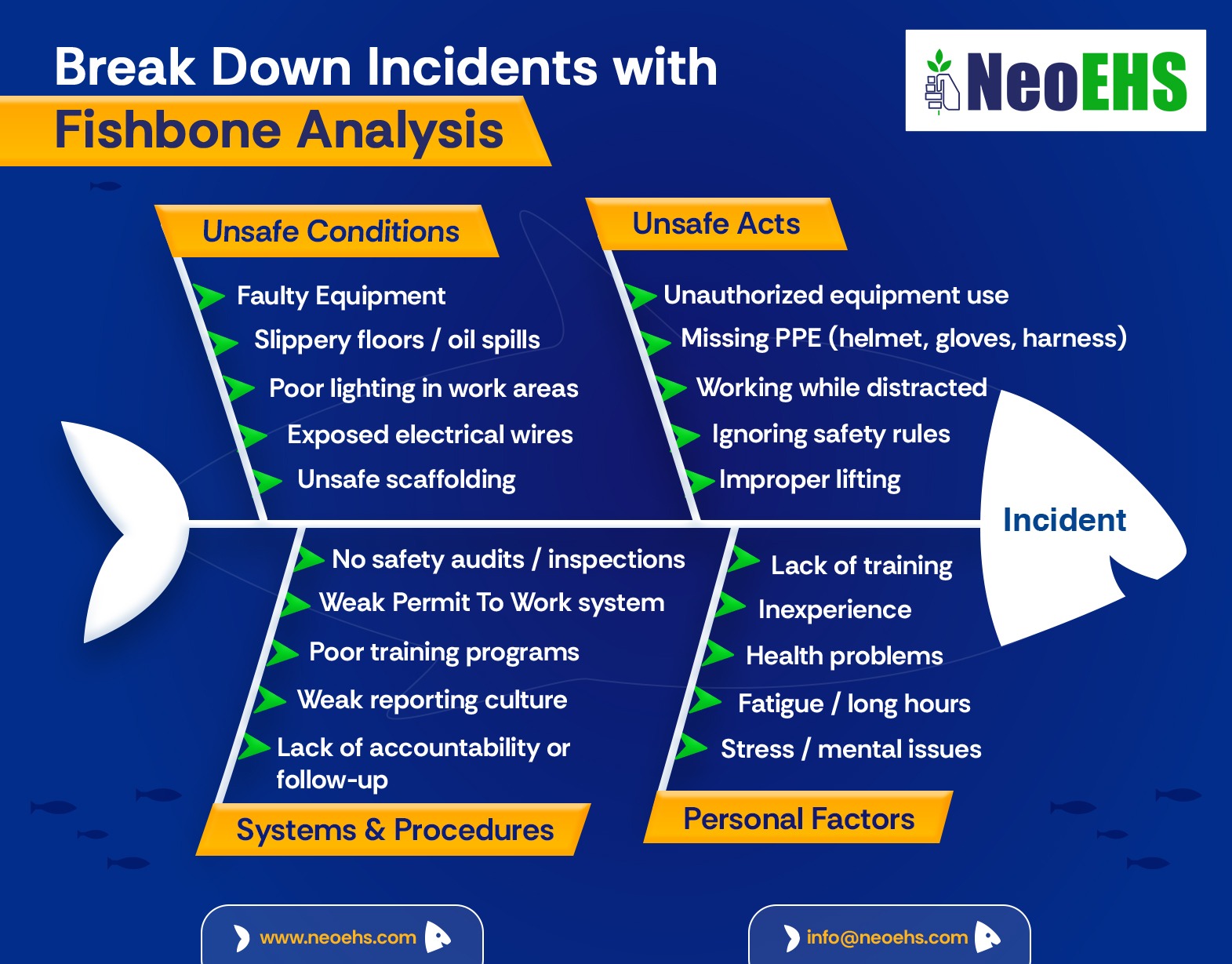
The diagram resembles a fish skeleton:
- The head represents the problem (incident)
- The bones represent categories of causes
- The branches represent contributing factors
This approach helps teams move beyond assumptions and uncover systemic and root-level issues.
Why Fishbone Analysis is Important in EHS
In Environmental, Health & Safety (EHS), incidents are rarely caused by a single factor.
They are often the result of:
- Human errors
- Unsafe conditions
- System failures
- Process gaps
Fishbone Analysis helps organizations:
- Identify multiple contributing factors
- Categorize causes systematically
- Improve investigation quality
- Prevent recurring incidents
- Strengthen safety culture
Fishbone Categories Used in NeoEHS
The NeoEHS platform structures Fishbone Analysis into key categories to ensure comprehensive investigation.
1. Unsafe Acts
These are human behaviors that directly contribute to incidents.
Examples:
- Not wearing PPE
- Improper equipment handling
- Bypassing safety procedures
2. Unsafe Conditions
These refer to hazardous physical environments.
Examples:
- Defective equipment
- Poor lighting
- Slippery surfaces
- Unsafe site conditions
3. Personal Factors
These are individual-related causes affecting performance.
Examples:
- Lack of training
- Fatigue or stress
- Inexperience
- Health issues
4. Systems and Procedures
These represent organizational or process failures.
Examples:
- Lack of standard operating procedures (SOPs)
- Poor maintenance systems
- Inadequate supervision
- Missing safety controls
How Fishbone Analysis Works in NeoEHS
The NeoEHS platform digitizes and simplifies the Fishbone analysis process.
Step 1: Define the Problem
Identify the incident clearly (e.g., “Worker slipped on wet surface”).
Step 2: Categorize Causes
Use predefined categories like Unsafe Acts, Conditions, Personal Factors, and Systems.
Step 3: Identify Contributing Factors
Add all possible causes under each category.
Step 4: Analyze Root Causes
Evaluate which factors contributed most to the incident.
Step 5: Link Corrective Actions
Assign corrective and preventive actions directly within the system.
Step 6: Track and Verify
Monitor action completion and verify effectiveness through evidence.
Benefits of Using Fishbone Analysis in NeoEHS
Structured Investigation
Ensures all possible causes are considered systematically.
Improved Root Cause Identification
Helps uncover deeper systemic issues beyond surface-level causes.
Better Decision Making
Provides clear insights for implementing effective corrective actions.
Prevention of Recurring Incidents
Addresses root causes, not just symptoms.
Integrated CAPA Management
Links analysis directly with corrective and preventive actions.
Fishbone Analysis vs Traditional Investigation
|
Traditional Approach |
Fishbone Analysis with NeoEHS |
|
Focus on immediate cause |
Focus on multiple contributing factors |
|
Unstructured investigation |
Structured, categorized analysis |
|
Manual documentation |
Digital, centralized workflow |
|
Limited insights |
Deep root cause visibility |
|
Weak action tracking |
Integrated CAPA tracking |
Real-World Example
Incident
Worker slipped and fell at a construction site.
Fishbone Analysis
Unsafe Acts
- Worker not wearing anti-slip footwear
Unsafe Conditions
- Wet floor due to leakage
Personal Factors
- Worker unaware of hazard
Systems & Procedures
- Maintenance issue not reported
- No hazard signage
Outcome
- Leak fixed
- PPE enforcement improved
- Hazard communication implemented
This ensures long-term prevention instead of temporary fixes.
Building a Proactive Safety Culture
Fishbone Analysis is not just a tool—it is a mindset shift.
By using structured investigation methods within NeoEHS, organizations can:
- Encourage deeper analysis
- Promote accountability
- Share learnings across teams
- Build a proactive safety culture
Conclusion
Workplace incidents are often the result of multiple interconnected factors. Identifying only the immediate cause is not enough to prevent recurrence.
Fishbone (Ishikawa) Analysis provides a systematic and visual approach to uncover root causes and improve safety outcomes.
With NeoEHS, organizations can digitize this process, integrate it with corrective actions, and ensure complete traceability from incident to prevention.
Call to Action
Transform your incident investigations with structured root cause analysis.
👉 Explore how NeoEHS enables Fishbone Analysis and complete incident management across your organization.
.jpg "5 Why analysis diagram showing step-by-step questioning to identify root cause of workplace incidents using NeoEHS")