How AI Is Transforming Workplace Safety Management
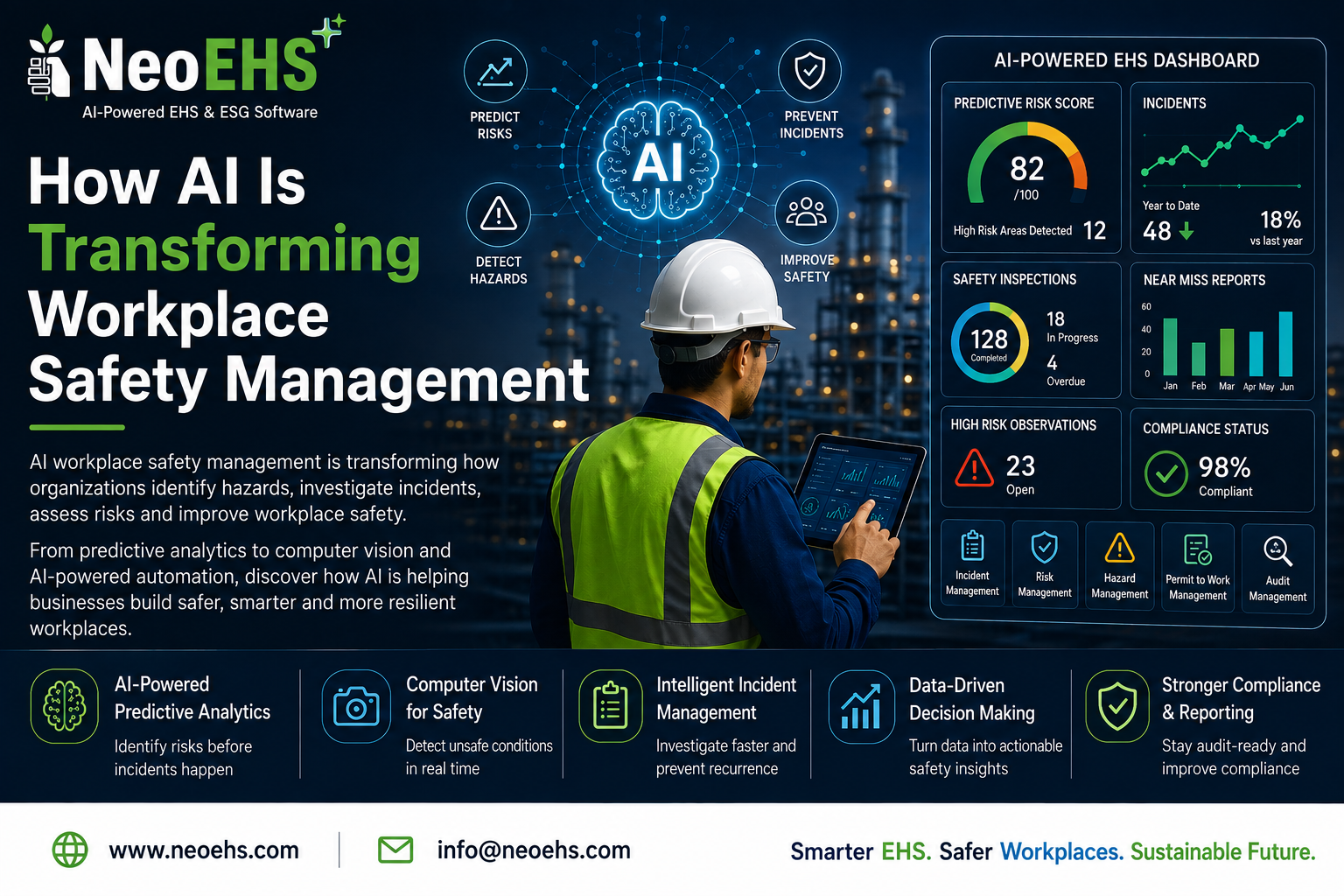
AI-powered workplace safety management using predictive analytics, computer vision and EHS software
Workplace safety has always depended on people identifying hazards, investigating incidents, conducting inspections and taking corrective action. But today's workplaces are becoming more complex, connected and data-driven.
Safety teams may need to manage thousands of inspections, observations, incidents, permits, training records, risk assessments and compliance requirements across multiple locations.
The challenge is no longer simply collecting safety data.
The real challenge is understanding that data quickly enough to prevent the next incident.
This is where Artificial Intelligence (AI) is transforming workplace safety management.
AI-powered EHS technology can analyse large volumes of safety data, identify patterns, detect potential risks, automate repetitive tasks and help safety professionals make faster, more informed decisions.
Instead of relying primarily on reactive safety management, organizations can move toward a more proactive, predictive and data-driven approach to workplace safety.
What Is AI-Powered Workplace Safety Management?
AI-powered workplace safety management uses artificial intelligence technologies such as machine learning, predictive analytics, computer vision, natural language processing and intelligent automation to improve how organizations identify, assess and control workplace risks.
Traditional safety management often follows this pattern:
Incident → Investigation → Corrective Action → Reporting
AI can help organizations move toward:
Data → Risk Detection → Prediction → Prevention → Continuous Improvement
This does not mean replacing safety professionals.
Instead, AI can act as an intelligent assistant that helps EHS teams process information faster, recognize patterns and focus their expertise where it matters most.
Why Traditional Workplace Safety Management Is Changing
Many organizations still depend on spreadsheets, paper forms, emails and disconnected applications for safety management.
This can create several challenges:
- Safety data is distributed across multiple systems
- Incident reporting can be slow
- Manual inspections consume significant time
- Safety observations may not be analysed effectively
- Risk trends can remain hidden
- Corrective actions can be delayed
- Compliance documentation requires significant manual effort
- Management may not have real-time visibility into safety performance
For organizations operating across multiple projects, factories, plants or countries, these challenges become even more significant.
AI can help bring safety information together and turn large volumes of EHS data into actionable safety intelligence.
10 Ways AI Is Transforming Workplace Safety Management
1. AI Can Help Predict Workplace Safety Risks
One of the biggest opportunities for AI in workplace safety is predictive risk analytics.
Traditional safety programs often focus on analysing what has already happened.
AI can analyse historical incidents, near misses, inspections, hazards, observations, environmental conditions and other safety information to identify patterns that may indicate increased risk.
For example, AI could identify that:
- A particular location has increasing near misses
- Certain equipment is repeatedly involved in observations
- Incidents increase during specific work activities
- Particular hazards are frequently reported
- Corrective actions are repeatedly overdue
These insights can help organizations prioritize preventive action before a potential incident occurs.
Recommended NeoEHS internal link:
Link the phrase “predictive risk analytics” to the NeoEHS Risk Management solution page.
2. AI-Powered Computer Vision Can Identify Unsafe Conditions
Computer vision is another important application of AI in workplace safety.
AI-powered video analytics can analyse images and video feeds to identify certain predefined safety risks.
Depending on the implementation, computer vision can help identify situations such as:
- Missing personal protective equipment
- Restricted-zone entry
- Unsafe access areas
- Unsafe worker positioning
- Vehicle and pedestrian interaction
- Potential housekeeping issues
- Certain unsafe work practices
Instead of requiring safety professionals to manually monitor every camera feed, AI can help highlight events that require attention.
This can be particularly valuable in construction, manufacturing, mining, logistics, ports and industrial facilities.
Recommended NeoEHS internal link:
Link “computer vision” to your NeoEHS AI/computer-vision solution or relevant product page.
3. AI Makes Incident Management More Intelligent
Incident management is traditionally a highly manual process.
A worker reports an incident. A safety professional collects information, conducts interviews, reviews evidence, identifies contributing factors and prepares documentation.
AI can support several stages of this process.
AI-powered incident management can help:
- Classify incidents
- Extract information from incident reports
- Identify recurring incident patterns
- Analyse contributing factors
- Support root cause analysis
- Recommend potential corrective actions
- Identify similar historical incidents
- Generate management summaries
- Track corrective actions
The goal is not to allow AI to make safety-critical decisions without human oversight.
The goal is to help safety professionals investigate incidents faster and make better use of organizational safety data.
Recommended NeoEHS internal link
Link “AI-powered incident management” to:
NeoEHS Incident Management Software
This is particularly important because this article should help strengthen the SEO authority of your Incident Management solution page.
4. AI Can Improve Hazard Identification
Hazard identification is one of the foundations of effective workplace safety management.
AI can analyse information from:
- Safety observations
- Inspection findings
- Incident reports
- Near misses
- Risk assessments
- Worker feedback
- Images and videos
- Historical safety records
By analysing this information together, AI can help identify recurring hazards that might otherwise be overlooked.
For example, if multiple inspections across different sites report similar hazards, AI can identify the pattern and bring it to management's attention.
This transforms individual observations into organizational safety intelligence.
Recommended internal link:
Link “hazard identification” to the NeoEHS Hazard Management solution page.
5. AI-Powered Safety Inspections
Safety inspections can generate huge amounts of information.
However, collecting information is only the beginning.
The real value comes from analysing findings and taking action.
AI-powered inspection systems can help organizations:
- Identify recurring findings
- Prioritize high-risk observations
- Analyse inspection trends
- Recommend follow-up actions
- Identify locations with deteriorating safety performance
- Generate inspection summaries
- Track corrective actions
Mobile inspection applications can also allow workers and safety professionals to capture observations directly from the field.
This changes safety inspections from simple data collection exercises into continuous sources of safety intelligence.
Recommended internal link:
Link “AI-powered inspection systems” to NeoEHS Inspection Management.
6. AI Can Improve Risk Assessment
Risk assessment is another area where AI can support safety professionals.
Organizations conduct risk assessments for:
- Jobs
- Activities
- Equipment
- Processes
- Locations
- Chemicals
- Construction activities
- Maintenance work
AI can analyse previous assessments, incidents, observations and other EHS information to help identify hazards and potential control measures.
For example, if a particular activity has historically generated several near misses, AI can highlight that information when a similar risk assessment is being prepared.
This creates a more data-driven risk assessment process.
Human expertise should remain central to risk evaluation and control decisions, but AI can make relevant information easier to access.
Recommended internal link:
Link “risk assessment” to the NeoEHS Risk Management page.
7. AI Can Automate EHS Documentation
EHS professionals spend considerable time creating and reviewing documentation.
AI can assist with tasks such as:
- Incident summaries
- Inspection reports
- Safety observations
- Corrective action summaries
- Meeting minutes
- Audit findings
- Compliance documentation
- Management reports
AI-powered OCR can also extract information from documents, forms and existing records.
This can reduce repetitive administrative work and allow safety teams to spend more time on field-level risk prevention and safety leadership.
Recommended internal link:
Link “AI-powered OCR” to your NeoEHS AI/OCR or document intelligence solution page.
8. AI Can Strengthen Near-Miss Management
Near misses are valuable sources of safety intelligence.
Unfortunately, many organizations struggle to capture and analyse them effectively.
AI can analyse large numbers of near-miss reports to identify:
- Common hazards
- Recurring locations
- Repeated unsafe behaviours
- Equipment-related patterns
- High-risk activities
- Common contributing factors
This helps organizations learn from events before they become serious incidents.
A mature safety culture should not wait for an injury before learning from a risk.
Recommended internal link:
Link “near-miss reports” to your Incident Management or Safety Observation solution page.
9. AI Can Improve Corrective Action Management
Identifying a problem is only the beginning.
Organizations must also ensure that corrective actions are completed effectively.
AI can help safety teams prioritize corrective actions based on factors such as:
- Risk level
- Severity
- Frequency
- Location
- Recurrence
- Due date
- Historical performance
AI can also identify repeatedly overdue actions or recurring findings.
This can help management focus attention on issues that require immediate intervention.
10. AI Creates a More Proactive Safety Culture
Perhaps the biggest change AI can bring to workplace safety management is the transition from reactive safety to proactive safety.
Traditional Approach
Something happens → Investigate → Report → Correct
AI-Enabled Approach
Collect data → Analyse patterns → Identify emerging risks → Intervene → Prevent
This shift can fundamentally change how organizations manage workplace safety.
The objective is not simply to report more incidents.
The objective is to learn from safety data and prevent incidents from happening in the first place.
AI + IoT: Creating Connected Workplace Safety
The future of workplace safety will not rely on AI alone.
AI becomes even more powerful when connected with IoT devices and workplace systems.
Examples include:
- Smart helmets
- Wearable safety devices
- Environmental sensors
- Gas detection systems
- Location tracking
- Equipment monitoring
- Smart cameras
- Connected machinery
- Access control systems
These technologies can continuously generate information.
AI can then analyse the information and identify potential risks.
This creates a connected safety ecosystem where people, equipment, processes and environmental data work together.
For industries such as mining, construction, manufacturing, power, ports and logistics, this connected approach can provide a more comprehensive view of operational risk.
AI and the Future of EHS Software
Modern EHS software is moving beyond simple digital recordkeeping.
The next generation of EHS platforms is becoming increasingly intelligent.
An AI-powered EHS platform can bring together information from:
Incidents + Risks + Hazards + Inspections + Audits + Observations + Permits + Training + Environment + IoT
AI can then analyse these connected data sources to provide a broader understanding of organizational safety performance.
This is where NeoEHS can play an important role.
NeoEHS is an AI-powered EHS and ESG software solution designed to help organizations digitize and intelligently manage safety, environmental and compliance processes.
Explore NeoEHS AI-Powered EHS & ESG Software
How NeoEHS Supports AI-Powered Workplace Safety
NeoEHS brings together multiple areas of EHS management, including:
- Incident Management
- Risk Management
- Hazard Management
- Safety Observations
- Inspection Management
- Audit Management
- Permit Management
- Compliance Management
- Training Management
- Emergency Management
- Environmental Management
- Waste Management
- Carbon Emission Management
- PPE Management
- Machinery Management
AI capabilities can help organizations move beyond simply recording information toward analysing information, identifying patterns and generating actionable safety insights.
The result is a more connected approach to workplace safety management.
Explore NeoEHS:
NeoEHS AI-Powered EHS & ESG Software
Benefits of AI-Powered Workplace Safety Management
Organizations implementing AI-powered safety management can potentially improve several areas.
Faster Risk Identification
AI can process large amounts of information quickly and identify patterns that may require attention.
Better Safety Insights
Patterns across incidents, observations and inspections can become easier to identify.
Reduced Administrative Work
Automation can reduce repetitive documentation and reporting tasks.
Faster Incident Investigation
AI can help organize incident information and identify relevant historical patterns.
Improved Compliance Visibility
Organizations can bring safety data and compliance activities into a centralized digital environment.
Better Decision-Making
Managers can use data-driven insights to prioritize safety interventions.
More Proactive Risk Management
AI can help organizations identify emerging risk patterns instead of relying only on historical incidents.
Will AI Replace EHS Professionals?
No.
AI should not be viewed as a replacement for experienced safety professionals.
Workplace safety involves human judgment, leadership, communication, ethical considerations and an understanding of real-world working conditions.
AI is best viewed as an intelligent assistant for EHS professionals.
It can process information, identify patterns and automate repetitive work, while safety professionals remain responsible for evaluating risks, validating findings and making appropriate decisions.
The future is not:
AI instead of safety professionals.
It is:
AI + EHS professionals working together.
Challenges Organizations Should Consider Before Implementing AI
AI adoption should also be approached responsibly.
Data Quality
AI is only as useful as the information available to it.
Organizations need accurate, consistent and relevant EHS data.
Human Oversight
AI recommendations should be reviewed by qualified professionals where safety-critical decisions are involved.
Data Privacy
Organizations should establish appropriate controls for worker and organizational data.
System Integration
AI should integrate with existing EHS, HR, ERP, IoT and operational systems where appropriate.
Change Management
Employees need training and clear communication about how AI will be used and how it supports their work.
The Future of Workplace Safety Is Predictive
The traditional approach to workplace safety has largely been based on reacting to incidents.
Digital transformation changed that by making safety information easier to collect and manage.
AI is taking the next step.
Organizations can move from:
Reactive → Digital → Data-Driven → Predictive
The organizations that successfully combine experienced EHS professionals, high-quality data, AI, IoT and effective safety processes will be better positioned to build safer workplaces.
AI is not simply another software feature.
It has the potential to become an important part of how organizations identify risk, learn from safety data and prevent incidents.
Conclusion
Artificial Intelligence is transforming workplace safety management by making EHS processes more intelligent, connected and proactive.
From predictive risk analytics and computer vision to AI-powered incident management, inspections, hazard identification and automated documentation, AI can help organizations turn large amounts of safety data into meaningful insights.
The ultimate objective is not to create more technology.
It is to create safer workplaces.
As AI continues to evolve, organizations should focus on combining technology with strong safety leadership, competent professionals and effective EHS processes.
The future of workplace safety is not just digital. It is intelligent, predictive and connected.
And that is the direction in which modern EHS management is heading.
Frequently Asked Questions
What is AI in workplace safety?
AI in workplace safety refers to using artificial intelligence technologies such as machine learning, predictive analytics, computer vision and natural language processing to identify risks, analyse safety data and improve workplace safety management.
How can AI improve workplace safety?
AI can help organizations identify hazards, analyse incidents, predict potential risk patterns, improve inspections, automate EHS documentation and identify recurring safety trends.
Can AI predict workplace accidents?
AI cannot guarantee that an accident will be predicted. However, predictive analytics can identify patterns and risk indicators in historical and real-time safety data that may help organizations take preventive action.
How does AI help EHS professionals?
AI can reduce repetitive administrative work, analyse large volumes of EHS information, highlight patterns and provide insights that help safety professionals make more informed decisions.
What is AI-powered EHS software?
AI-powered EHS software combines traditional environmental, health and safety management capabilities with artificial intelligence, analytics and automation to help organizations manage and proactively improve workplace safety.
Will AI replace safety managers?
No. AI is better viewed as an intelligent tool that supports safety professionals. Human expertise, judgment, leadership and accountability remain essential to effective safety management.
AI Workplace Safety Management
- AI in workplace safety
- AI safety management
- AI-powered workplace safety
- AI-powered EHS
- AI EHS software
- Artificial intelligence in workplace safety
- Predictive safety analytics
- AI risk assessment
- AI incident management
- AI hazard identification
- AI safety inspections
- Workplace safety technology
- EHS software
- Digital safety management
#AI
#ArtificialIntelligence
#AIWorkplaceSafety
#AISafetyManagement
#WorkplaceSafety
#SafetyManagement
#EHS
#EHSSoftware
#AIpoweredEHS
#EHSManagement
#EnvironmentalHealthAndSafety
#OccupationalSafety
#SafetyTechnology
#PredictiveAnalytics
#PredictiveSafety
#DigitalEHS
#DigitalTransformation
#RiskManagement
#IncidentManagement
#HazardManagement
#SafetyInnovation
#WorkplaceHealthAndSafety
#SmartSafety
#IndustrialSafety
#NeoEHS