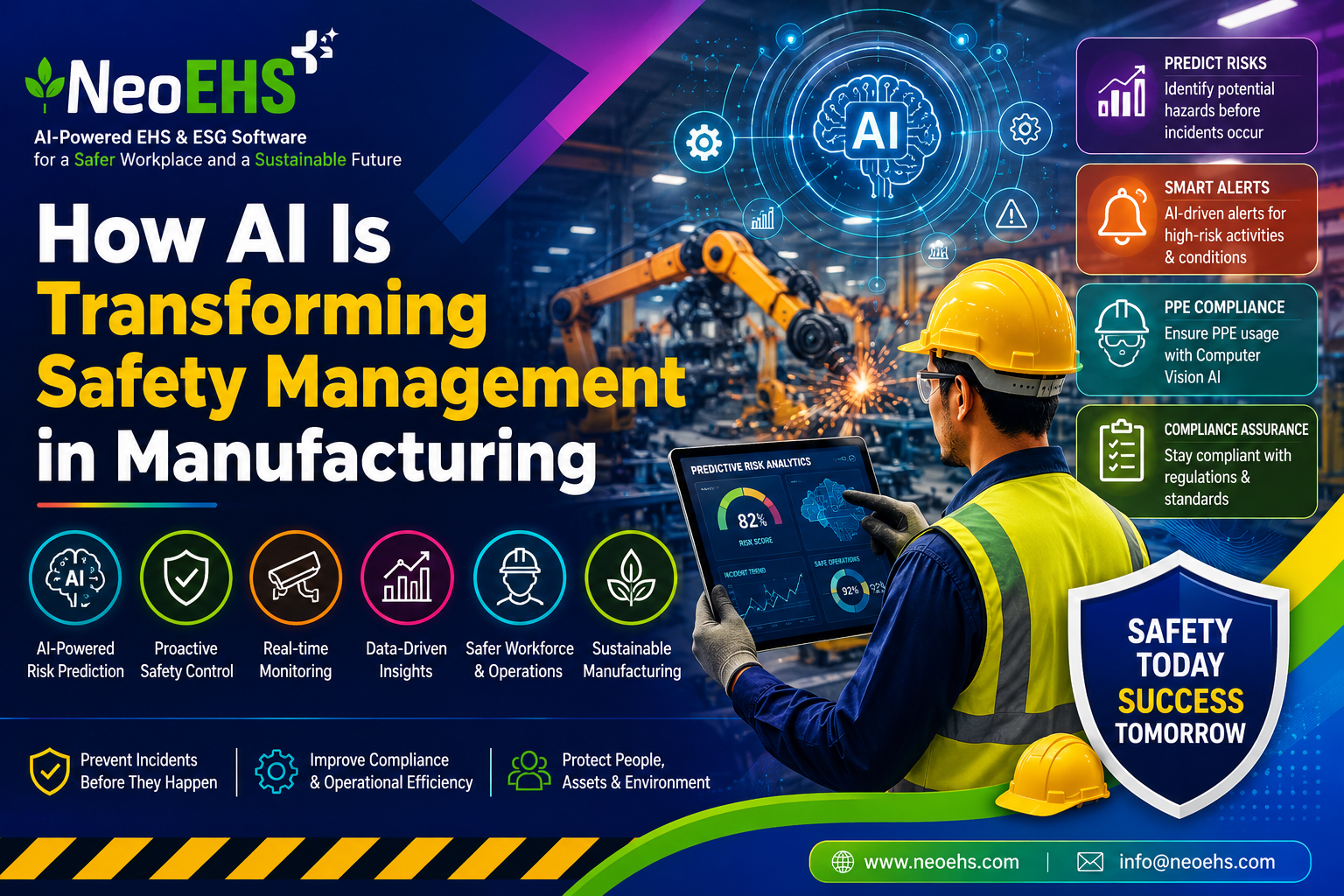
AI-Powered EHS Software NeoEHS : Transforming Workplace Safety and Compliance
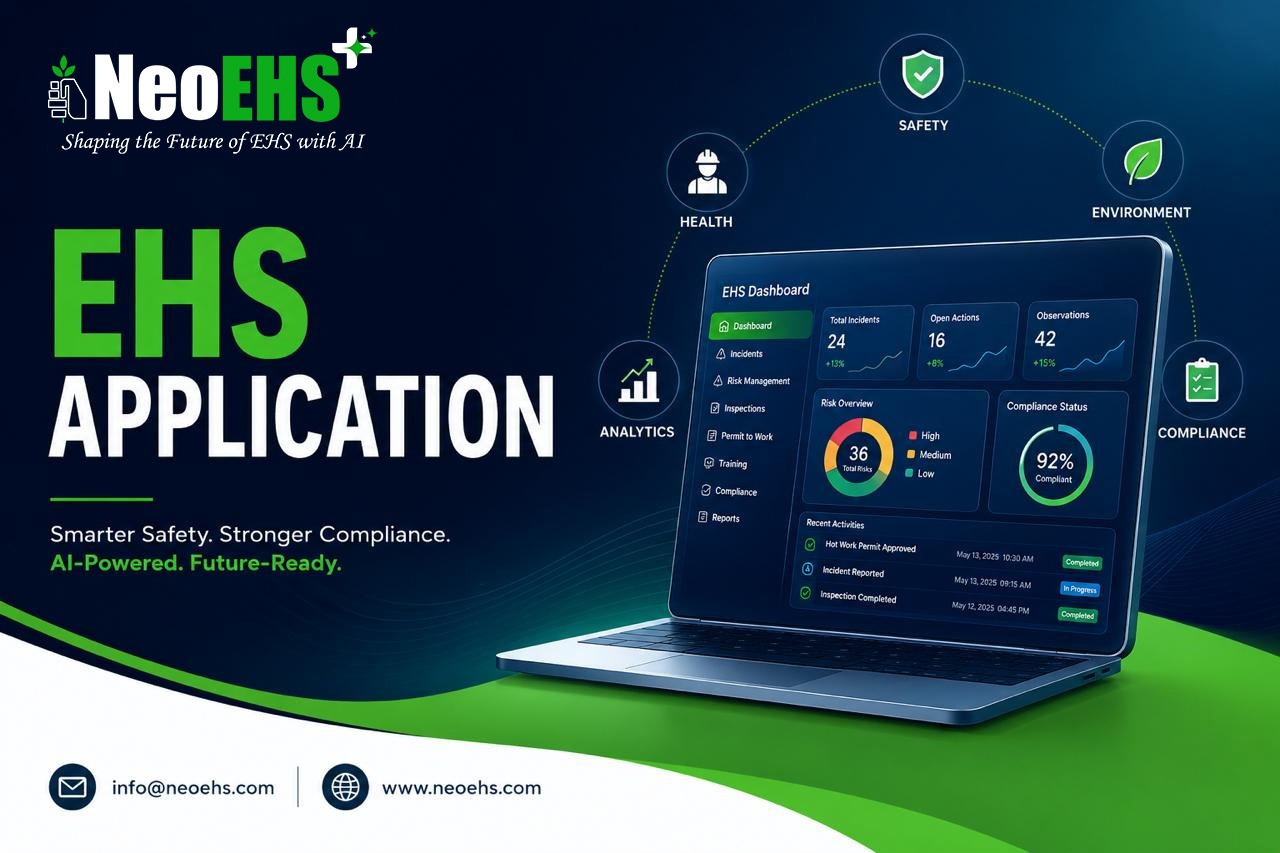
EHS Application: How AI-Powered NeoEHS Is Changing Workplace Safety Management
Workplace safety has changed dramatically over the past few years. Companies are no longer looking at Environmental, Health, and Safety (EHS) management simply as a compliance requirement. Today, safety has become an important part of business continuity, operational efficiency, employee wellbeing, sustainability, and long-term business performance.
Yet many organizations still manage critical safety activities through spreadsheets, paper forms, emails, disconnected applications, and manual reporting.
This is where a modern EHS application can make a significant difference.
An AI-powered EHS application can bring safety management, risk management, incident management, compliance, inspections, permits, training, environmental management, and ESG activities together in one connected platform.
NeoEHS takes this approach further by combining EHS software with Artificial Intelligence, predictive analytics, automation, IoT integration, computer vision, OCR intelligence, and real-time safety insights.
What Is an EHS Application?
An EHS application is a digital platform designed to help organizations manage their Environmental, Health, and Safety activities from a centralized system.
A traditional safety management process may involve one spreadsheet for incidents, another for inspections, emails for corrective actions, paper-based permits, separate training records, and manually prepared management reports.
An EHS management system brings these activities together.
A modern EHS software solution can help organizations manage:
- Environmental Health and Safety Management
- Workplace Safety Management
- Risk Management
- Hazard Management
- Incident Management
- Safety Observations
- Permit to Work (PTW)
- Inspection Management
- Audit Management
- Compliance Management
- Corrective and Preventive Actions (CAPA)
- Training Management
- Emergency Management
- Chemical Management
- PPE Management
- Contractor Safety
- Environmental Management
- Waste Management
- Air Quality Monitoring
- Carbon Emission Management
- ESG Management
- Certification Management
Instead of treating these activities as separate processes, organizations can connect them through a single digital EHS platform.
Why Businesses Are Moving to Digital EHS Software
Managing workplace safety manually becomes increasingly difficult as organizations grow.
A company operating multiple factories, construction projects, mines, power plants, warehouses, or offices may generate thousands of safety records every month.
Finding useful information from that data can be difficult when it is stored across different systems.
A modern EHS management software platform can provide a centralized source of information.
Safety managers can monitor incidents, hazards, inspections, audits, permits, training, corrective actions, and compliance activities without having to search through multiple files.
More importantly, digital EHS software can turn safety data into actionable information.
Instead of simply asking:
“What happened?”
organizations can begin asking:
“Why did it happen, where is the risk increasing, and what can we do before it happens again?”
That is where AI can make a meaningful difference.
How AI Is Transforming EHS Applications
Artificial Intelligence is changing the way organizations collect, analyze, and use safety information.
Traditional EHS software primarily helps organizations record information.
An AI-powered EHS application can help organizations understand that information.
AI can identify patterns, highlight unusual activity, assist with classification, analyze historical safety information, automate repetitive tasks, and support safety professionals in prioritizing risks.
1. AI-Powered Risk Management
Risk management is at the heart of an effective safety management system.
An organization may have thousands of risk assessments covering different activities, locations, equipment, and processes.
AI-powered risk analytics can help analyze information from incidents, hazards, inspections, observations, permits, and other EHS activities.
This can help safety teams identify recurring patterns and focus attention on areas that may require preventive action.
The goal is not to replace the safety professional.
The goal is to give the safety professional better information at the right time.
2. Intelligent Incident Management
Incident management is another important function of an EHS application.
A modern incident management system can help organizations report incidents, near misses, unsafe acts, unsafe conditions, investigate root causes, assign corrective actions, and monitor closure.
With AI capabilities, organizations can analyze incident data across locations and time periods.
For example, if similar incidents repeatedly occur during a particular activity, shift, location, or type of operation, AI-assisted analytics can help bring that pattern to the attention of EHS managers.
This supports a more proactive approach to workplace safety management.
3. Smart Hazard Management
Every workplace has hazards.
The challenge is not simply identifying hazards. The real challenge is ensuring that hazards are assessed, controlled, monitored, and closed effectively.
An intelligent hazard management system can connect hazard identification with risk assessment, corrective actions, inspections, observations, and incidents.
AI can help categorize information and identify recurring hazard patterns.
This can help organizations move from simply recording hazards to actively managing risk.
4. AI-Powered Permit to Work
High-risk activities require strong controls.
A digital Permit to Work (PTW) system can help organizations manage activities such as:
- Hot Work
- Cold Work
- Confined Space Entry
- Work at Height
- Electrical Work
- Excavation
- Lifting Operations
- Lockout/Tagout (LOTO)
- Radiography
- Breaking Containment
- Pressure Testing
- Chemical Handling
An AI-powered PTW application can connect permits with risk assessments, isolation requirements, approvals, inspections, and other safety controls.
This creates better visibility around high-risk work and helps organizations maintain a consistent permit workflow.
5. AI-Based Safety Inspections
Inspections are essential for identifying unsafe conditions before they result in incidents.
However, inspection data is often underused.
An intelligent EHS inspection software platform can capture inspection findings digitally and connect them to corrective actions, responsible personnel, due dates, and closure verification.
AI analytics can then help identify recurring inspection findings and locations where similar problems continue to appear.
This transforms inspection data into a source of continuous safety improvement.
6. Computer Vision for Workplace Safety
The next generation of EHS applications is not limited to information entered manually by employees.
AI-powered computer vision can analyze selected workplace conditions through connected camera systems.
Depending on the implementation, computer vision can assist with use cases such as PPE compliance, restricted-area monitoring, unsafe conditions, and other observable safety requirements.
This creates an additional layer of AI workplace safety monitoring.
Human safety professionals remain essential, but technology can help them identify situations that may otherwise be missed.
7. IoT-Connected EHS Management
Modern industrial environments increasingly use connected sensors, equipment, wearables, and smart devices.
An advanced EHS application can integrate IoT data into safety management workflows.
Examples include:
- Smart helmets
- Environmental sensors
- Gas detection devices
- Air-quality monitoring
- Wearable safety devices
- Location tracking
- Equipment monitoring
- Temperature and humidity sensors
- Connected machinery
When IoT data is combined with AI analytics, organizations can gain a more complete picture of workplace conditions.
8. AI-Powered OCR and Document Intelligence
EHS teams work with a huge amount of documentation.
Certificates, licenses, inspection reports, training records, permits, compliance documents, equipment records, and historical safety documents can all contain important information.
Manually entering this information takes time.
AI-powered OCR and document intelligence can help extract relevant information from documents and reduce repetitive data entry.
This can make an EHS document management process faster and more searchable.
NeoEHS: A Next-Generation AI-Powered EHS Application
NeoEHS is an AI-powered EHS and ESG software solution designed to help organizations manage workplace safety, environmental performance, compliance, risk, and operational safety through one connected platform.
The objective is simple:
Make safety information easier to capture, understand, act upon, and improve.
NeoEHS brings together multiple EHS processes while adding intelligent technologies that can help organizations move toward proactive and predictive safety management.
Key NeoEHS EHS Management Capabilities
NeoEHS can support organizations with:
Safety and Risk Management
Identify hazards, assess risks, monitor controls, and track corrective actions through a centralized safety management platform.
Incident Management
Capture incidents and near misses, support investigations, identify root causes, assign actions, and monitor closure.
Hazard Management
Digitally identify, assess, classify, monitor, and control workplace hazards.
Permit Management
Manage high-risk work through digital Permit to Work workflows, approvals, controls, and monitoring.
Inspection Management
Create digital inspection checklists, record findings, assign actions, and track closure.
Audit Management
Plan audits, record findings, assign corrective actions, and monitor audit performance.
Compliance Management
Centralize compliance requirements, obligations, evidence, actions, certifications, and regulatory activities.
Training Management
Manage employee training requirements, competencies, courses, attendance, certifications, and expiry dates.
Environmental Management
Monitor environmental activities including waste, emissions, air quality, resources, and other environmental performance indicators.
ESG Management
Connect environmental and sustainability information with broader ESG performance and reporting requirements.
From Reactive Safety to Predictive Safety
One of the biggest advantages of AI-powered EHS software is the opportunity to move beyond reactive safety management.
Traditional safety management often follows this pattern:
Incident → Investigation → Corrective Action → Closure
An intelligent EHS management system can support a more proactive approach:
Data → Pattern → Risk Insight → Preventive Action → Continuous Improvement
This does not mean that every incident can be predicted.
Rather, organizations can use available safety data to identify patterns and signals that deserve attention.
That distinction is important.
AI should support safety professionals—not replace their experience, judgment, or responsibility.
Who Can Benefit From an EHS Application?
An AI-powered EHS application can be valuable for organizations operating in industries where safety, compliance, and environmental performance are critical.
NeoEHS can support sectors such as:
- Manufacturing
- Construction
- Mining
- Oil and Gas
- Power and Energy
- Chemical and Process Industries
- Ports and Maritime
- Logistics and Warehousing
- Metro and Rail
- Infrastructure
- Engineering and Industrial Services
Whether an organization manages a single facility or a large network of projects and locations, a centralized EHS software platform can provide better visibility and consistency.
Key Benefits of an AI-Powered EHS Application
Better Safety Visibility
Management can gain a clearer view of incidents, risks, inspections, observations, permits, training, and corrective actions.
Reduced Administrative Work
Digital workflows reduce dependence on paper forms, spreadsheets, emails, and repetitive manual reporting.
Faster Safety Decisions
Real-time dashboards and AI-assisted analytics can help safety teams focus on important information.
Improved Compliance
Centralized compliance management makes it easier to track obligations, evidence, audits, certifications, and corrective actions.
Stronger Risk Control
Connected risk, hazard, incident, inspection, and observation data can provide a more complete understanding of workplace risks.
Better Employee Engagement
Mobile applications and digital workflows can make it easier for employees and contractors to report hazards, observations, incidents, and safety concerns.
Continuous Improvement
Organizations can use historical EHS data to identify recurring problems and improve safety processes over time.
What Makes an EHS Application Truly Intelligent?
Not every digital EHS system is an AI-powered EHS platform.
A truly intelligent EHS application should bring together several capabilities.
Digital Data Collection
Capture safety information through web and mobile applications.
Workflow Automation
Automate approvals, notifications, assignments, escalations, and follow-ups.
Data Integration
Connect EHS information with existing enterprise systems, IoT devices, sensors, and other technologies.
AI Analytics
Use Artificial Intelligence to identify patterns and provide meaningful insights.
Predictive Analytics
Analyze historical and current information to identify potential areas of increasing risk.
Real-Time Dashboards
Give decision-makers access to relevant EHS performance information.
Intelligent Alerts
Bring important safety conditions to the attention of responsible personnel.
Human Decision-Making
Keep experienced EHS professionals at the center of safety decisions.
The Future of EHS Software
The future of EHS software is not simply about replacing paper forms with digital forms.
The next generation of EHS management will increasingly connect:
People + Processes + Data + AI + IoT + Automation
This connected approach can help organizations build a stronger safety culture while improving operational efficiency and environmental performance.
AI-powered EHS applications will increasingly help organizations identify patterns, automate routine activities, improve data quality, and provide decision support.
The organizations that adopt these technologies thoughtfully will be better positioned to manage increasingly complex workplace risks.
Conclusion
An EHS application is becoming an essential part of modern workplace safety management.
But the real value of EHS technology goes beyond digitizing checklists and replacing spreadsheets.
A modern AI-powered EHS application can connect safety data, people, processes, and intelligent technologies to help organizations understand risks and take action earlier.
NeoEHS brings together EHS management, ESG management, AI, predictive analytics, IoT integration, computer vision, OCR intelligence, automation, and real-time reporting in one connected platform.
For organizations looking to move from reactive safety management toward a more proactive, data-driven approach, an intelligent EHS platform can become an important part of the journey.
NeoEHS — AI Powered EHS & ESG Software Solution for a Safer Workplace and a Sustainable Future.
EHS Application
EHS software, EHS management software, EHS management system, EHS platform, EHS software solution, AI-powered EHS software, AI-powered EHS application, workplace safety software, safety management software, environmental health and safety software, digital EHS software, EHS compliance software, EHS risk management software, EHS incident management software, EHS inspection software, EHS audit software, EHS Permit to Work software, EHS ESG software.
AI in EHS, Artificial Intelligence in workplace safety, AI workplace safety, predictive safety analytics, predictive risk analytics, safety risk management, workplace risk management, digital safety management, occupational health and safety software, environmental management software, ESG software, safety compliance software, incident reporting software, incident investigation software, hazard management software, safety observation software, corrective action management, CAPA management, Permit to Work system, PTW software, inspection management system, audit management system, compliance management system, training management software, contractor safety management, chemical management software, emergency management software, PPE management software, environmental compliance software, carbon emission management software, waste management software, air quality monitoring software, IoT safety management, computer vision safety, AI safety analytics, OCR document management, smart safety management, real-time EHS dashboard, EHS digital transformation.
- best EHS application for workplace safety
- AI-powered EHS application
- AI-powered EHS software for businesses
- EHS application for manufacturing
- EHS application for construction
- EHS software for mining
- EHS software for power plants
- EHS software for oil and gas
- EHS software for chemical industries
- EHS management software for large enterprises
- digital EHS management system
- workplace safety management software
- AI-powered workplace safety management
- predictive analytics in EHS
- AI-powered risk management software
- digital Permit to Work software
- AI-powered Permit to Work system
- EHS incident management software
- EHS hazard management software
- EHS inspection management software
- EHS compliance management software
- EHS audit management software
- AI-based safety management system
- EHS and ESG software platform
- environmental health and safety management system
- enterprise EHS software solution
- cloud-based EHS management software
- centralized EHS management platform
- smart EHS software
- intelligent EHS management system
#EHSApplication #EHSSoftware #NeoEHS #WorkplaceSafety #SafetyManagement #AIinEHS #ArtificialIntelligence #EHSManagement #RiskManagement #IncidentManagement #SafetyTechnology #PredictiveAnalytics #EHSCompliance #ESG #DigitalTransformation
EHS Software
AI in EHS
Workplace Safety
Safety Management
Risk Management
Incident Management
EHS Compliance
Predictive Analytics
Artificial Intelligence
ESG Software
Digital Transformation
NeoEHS