AI in Mining Health, Safety and Environment: How Intelligent Technology Is Creating Safer Mines
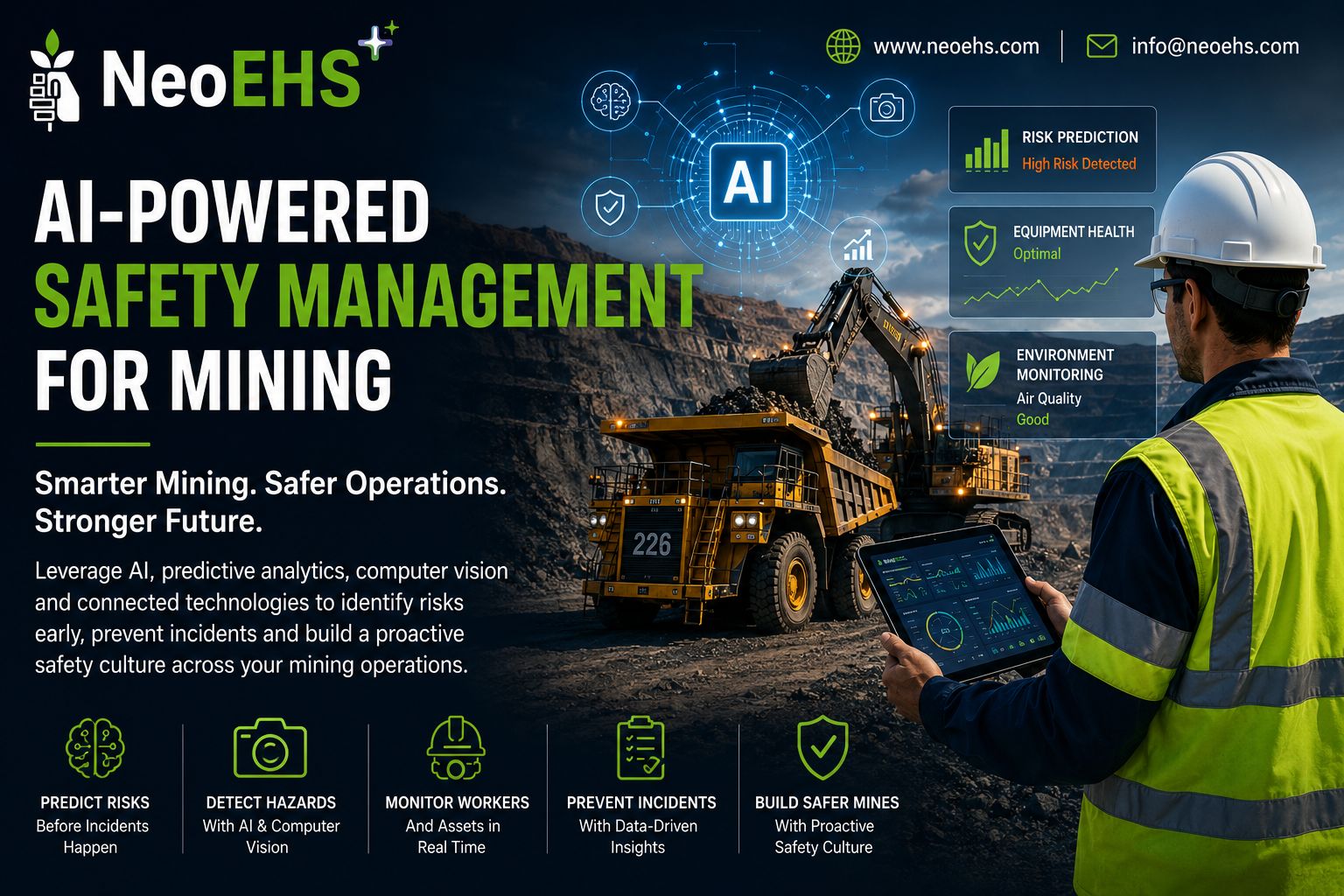
AI-Powered Safety Management for Mining: Transforming Mine Safety with Artificial Intelligence
Mining is one of the world's most important industries, supplying the minerals and materials required for energy, infrastructure, manufacturing and technology.
But mining operations also involve complex and changing safety risks.
Underground mines, open-pit operations, processing facilities, haul roads, heavy machinery, blasting activities, electrical systems, dust, chemicals and remote working environments all create demanding conditions for safety teams.
The International Labour Organization describes mining as hazardous work and highlights challenges including changing underground conditions, ventilation, dust exposure and occupational diseases.
At the same time, mining companies are generating more operational and safety data than ever before.
This creates an important opportunity.
What if mining companies could use that data not only to understand what happened, but also to identify where risk is increasing?
This is where AI-powered safety management for mining is becoming increasingly important.
Artificial Intelligence, predictive analytics, computer vision, IoT and connected-worker technologies can help mining organizations move from traditional reactive safety management toward a more proactive, predictive and data-driven approach.
Why Mining Safety Needs a New Approach
Mining safety management is fundamentally different from managing safety in a simple office or low-risk environment.
Mine conditions can change continuously.
A mining operation may involve:
- Heavy mobile equipment
- Haul trucks
- Excavators
- Drilling equipment
- Conveyors
- Crushers
- Underground machinery
- Explosives
- Electrical systems
- Hazardous chemicals
- Dust
- Noise
- Ground instability
- Confined or restricted areas
- Remote workers
- Multiple contractors
- Long and changing shifts
Regulators and industry organizations continue to emphasize hazards such as mobile equipment, ground control, fall protection, ventilation, dust and other operational risks.
For example, U.S. Mine Safety and Health Administration resources identify powered haulage and mobile equipment as significant safety concerns, including risks associated with equipment condition, visibility, maintenance, operator practices and interaction with pedestrians.
This complexity makes continuous safety monitoring and effective risk management essential.
What Is AI-Powered Mining Safety Management?
AI-powered mining safety management combines Artificial Intelligence with EHS/QHSE processes, operational data, IoT devices and safety technologies to help mining organizations identify hazards, analyse risks, detect patterns and improve preventive action.
A traditional safety process may look like:
Incident → Investigation → Root Cause → Corrective Action
An AI-enabled approach can move toward:
Data → Analysis → Risk Detection → Prediction → Prevention
The objective is not to replace mining safety professionals.
Instead, AI can act as an intelligent safety assistant, helping safety teams process large amounts of information and focus their attention on the areas with the greatest potential risk.
10 Ways AI Can Transform Mining Safety Management
1. Predictive Safety Analytics for Mining
One of the most powerful applications of AI in mining safety is predictive safety analytics.
Mining organizations can generate large volumes of information from:
- Incident reports
- Near misses
- Safety observations
- Inspections
- Risk assessments
- Equipment data
- Training records
- Permit systems
- Environmental monitoring
- Maintenance records
- Worker observations
AI can analyse this information to identify recurring patterns and risk indicators.
For example, an AI system could identify:
- Increasing near misses in a particular area
- Repeated equipment-related observations
- Increasing corrective-action delays
- Recurring hazards during particular activities
- Increased risk associated with specific work locations
- Patterns involving particular equipment types
This can help mining companies prioritize preventive action.
The objective:
Identify emerging risk before it becomes a serious incident.
2. AI-Powered Hazard Identification
Hazard identification is one of the foundations of effective mining safety management.
AI can help analyse information from multiple sources, including:
- Safety observations
- Inspection reports
- Incident investigations
- Near misses
- Risk assessments
- CCTV
- Worker reports
- IoT sensors
- Equipment data
Instead of treating every observation as an isolated event, AI can identify relationships between observations.
For example:
Ten separate observations across three mine areas may reveal the same underlying hazard.
AI can help bring that pattern to the attention of the safety team.
This transforms individual safety observations into mine-wide safety intelligence.
3. AI and Mobile Equipment Safety
Mobile equipment is one of the most important areas of mining safety.
Mining operations can involve:
- Haul trucks
- Excavators
- Loaders
- Drills
- Bulldozers
- LHDs
- Service vehicles
- Water trucks
- Light vehicles
MSHA guidance highlights risks associated with powered haulage and mobile equipment, including visibility, equipment condition, operator practices, collisions and interaction between equipment and pedestrians.
AI and connected technologies can help organizations monitor and analyse:
- Vehicle movements
- Blind spots
- Pedestrian interaction
- Unsafe operating patterns
- Equipment conditions
- Speed-related events
- High-risk zones
- Repeated near misses
When combined with appropriate site controls, these technologies can help strengthen mobile equipment safety management.
4. Computer Vision for Mining Safety
Mining sites increasingly use cameras for security, operations and safety monitoring.
AI-powered computer vision can add another layer of intelligence.
Depending on the technology and implementation, computer vision can help identify predefined conditions such as:
- PPE compliance
- Restricted-area entry
- Unsafe access
- Vehicle-pedestrian interactions
- Unsafe positioning
- Certain housekeeping conditions
- Safety-zone violations
Instead of requiring safety professionals to manually watch every camera feed, AI can help highlight events that deserve attention.
AI + CCTV can become:
Camera → Detection → Alert → Investigation → Corrective Action
This creates a more proactive safety monitoring model.
5. AI for Underground Mine Safety
Underground mining presents unique safety challenges.
Workers may operate in environments with:
- Limited visibility
- Restricted communications
- Complex underground layouts
- Ventilation requirements
- Ground-control risks
- Dust
- Heavy equipment
- Restricted escape routes
The ILO's mining resources specifically address underground safety, risk assessment, ventilation and changing operational conditions.
AI can support underground mining safety through technologies such as:
- Worker tracking
- IoT sensors
- Environmental monitoring
- Equipment monitoring
- AI-powered alerts
- Predictive analytics
- Digital inspections
- Intelligent incident management
However, AI systems should be designed with the realities of underground environments in mind, including limited connectivity and challenging sensing conditions.
6. AI for Open-Pit Mining Safety
Open-pit mines present different risks.
These can include:
- Haul-road hazards
- Vehicle collisions
- Highwalls
- Slopes
- Falling material
- Heavy equipment
- Dust
- Blasting
- Pedestrian interaction
AI-powered mining safety systems can help organizations analyse information associated with these activities.
For example, AI can help identify recurring safety observations around:
- Haul roads
- Loading zones
- Dump areas
- Workshops
- Crushing plants
- Fuel stations
- Maintenance areas
This enables safety teams to prioritize high-risk locations.
7. AI-Powered Mining Incident Management
Mining incidents require structured investigation and corrective action.
AI can help make incident management more intelligent by analysing:
- Incident descriptions
- Photos
- Videos
- Witness statements
- Previous incidents
- Safety observations
- Equipment information
- Corrective actions
AI can help identify:
- Recurring incident types
- Similar historical events
- Potential contributing factors
- Repeated hazards
- Locations with increasing incident frequency
- Corrective actions that remain unresolved
The final investigation and safety decisions should remain under appropriate human oversight.
AI provides analytical support.
Mining safety professionals provide experience, judgment and accountability.
Recommended NeoEHS internal link
Use the anchor:
AI-powered incident management
and link it to your NeoEHS Incident Management Software page.
NeoEHS Incident Management Software
8. AI-Powered Mining Risk Assessment
Mining risk assessment can involve hundreds of activities and changing operational conditions.
AI can support risk assessment by analysing historical information from:
- Incidents
- Near misses
- Safety observations
- Inspections
- Previous risk assessments
- Equipment
- Work activities
- Locations
For example, if a particular maintenance activity has repeatedly generated near misses, AI can highlight that historical pattern when a similar activity is assessed.
This can help make mining risk management more data-driven.
Human expertise remains essential for evaluating risk and determining appropriate controls.
9. AI-Powered Mining Safety Inspections
Safety inspections are fundamental to mining operations.
But collecting inspection data is only the first step.
The real value comes from identifying trends.
AI-powered inspection software can help identify:
- Repeated findings
- High-risk areas
- Recurring hazards
- Overdue corrective actions
- Repeated equipment issues
- Locations with declining safety performance
Instead of asking:
"How many inspections did we complete?"
Safety leaders can also ask:
"What are our inspections telling us about emerging risk?"
That is the difference between digital inspection management and intelligent inspection management.
10. AI-Powered Permit to Work and High-Risk Activities
Mining involves many high-risk activities, including:
- Hot work
- Confined space entry
- Electrical work
- Work at height
- Excavation
- Lifting
- Isolation and LOTO
- Blasting
- Maintenance
- Breaking containment
An AI-enabled Permit to Work system can help organizations identify incomplete information, highlight risk factors and provide better visibility into active permits.
AI can also help connect permits with:
Risk Assessments + Workers + Equipment + Locations + Isolation + Incidents
This creates a more connected approach to high-risk work management.
AI + IoT: Creating a Connected Mine
AI becomes even more powerful when connected to IoT and smart mining technologies.
A connected mine could include:
Smart Helmets
Worker identification, communication and connected safety capabilities.
Environmental Sensors
Monitoring relevant environmental conditions.
Equipment Sensors
Monitoring equipment performance and operational conditions.
Smart Cameras
AI-based video analysis.
Location Tracking
Understanding worker and equipment locations where appropriate.
Wearable Devices
Supporting connected-worker safety applications.
AI Analytics
Combining information from these systems to identify patterns and potential risks.
This creates the foundation for a connected and intelligent mining safety ecosystem.
AI-Powered Worker Safety and Smart Wearables
Wearable technology can provide another layer of safety intelligence.
Depending on the device and use case, connected-worker technologies may support:
- Worker location
- Emergency alerts
- Environmental exposure monitoring
- Fatigue-related indicators
- Communication
- Man-down alerts
- Proximity awareness
Research into connected-worker technologies highlights the growing use of wearables, sensors and contextual information for occupational safety and decision support.
The important point is that wearable data becomes more valuable when it can be integrated into a broader EHS platform.
AI-Powered Environmental and Health Monitoring
Mining safety is not limited to preventing accidents.
Occupational health is equally important.
Mining workers may face exposure to:
- Dust
- Silica
- Noise
- Chemicals
- Diesel particulate matter
- Vibration
- Heat
- Other environmental conditions
The ILO identifies chemical exposure as an important occupational health risk in mining, including exposure to substances such as mercury, cyanide, sulfuric acid and solvents in different mining contexts.
AI can help organizations analyse environmental and occupational health data and identify trends that may require attention.
AI-Powered Contractor Safety Management
Mining companies often work with multiple contractors.
Managing contractor safety can therefore become complex.
AI-powered QHSE software can help organizations connect:
Contractor → Worker → Training → Competency → Permit → Risk → Inspection → Incident
This creates better visibility across the contractor lifecycle.
AI can help identify patterns such as:
- Repeated contractor findings
- Expired training
- Overdue corrective actions
- High-risk activities
- Recurring incidents
This can help mining organizations strengthen contractor safety management.
AI-Powered Mining Safety Dashboards
Mining executives and safety managers need more than large volumes of data.
They need actionable information.
An AI-powered mining safety dashboard can bring together:
- Incident trends
- Near misses
- Risk levels
- High-risk areas
- Safety observations
- Inspection performance
- Corrective actions
- Permit status
- Training compliance
- Contractor performance
- Environmental indicators
Instead of reviewing multiple spreadsheets and reports, management can gain a more centralized view of mine safety performance.
How AI Can Help Move Mining From Reactive to Predictive Safety
Traditional mining safety:
Incident
↓
Investigation
↓
Corrective Action
↓
Report
AI-enabled mining safety:
Collect
↓
Connect
↓
Analyse
↓
Identify Patterns
↓
Predict Risk
↓
Prevent
This does not eliminate the need for traditional safety processes.
It makes those processes more intelligent.
AI and ISO 45001 in Mining
ISO 45001 provides a framework for occupational health and safety management systems, including hazard identification, risk assessment, legal and regulatory requirements, emergency planning, incident investigation and continual improvement.
AI-powered EHS software can support organizations by helping them manage and connect information relevant to these activities.
For mining organizations, this can include:
- Hazard identification
- Risk assessment
- Incident management
- Inspection management
- Audit management
- Corrective actions
- Training
- Compliance documentation
- Continual improvement
AI does not replace ISO 45001 requirements or an organization's management-system responsibilities.
Instead, it can help make the processes used to manage them more connected, visible and data-driven.
Why Mining Companies Should Consider AI-Powered Safety Management
The value of AI in mining safety is not simply about adopting new technology.
The real value comes from improving the organization's ability to:
Identify risks earlier
Analyse safety data faster
Detect recurring hazards
Improve incident investigations
Strengthen inspections
Improve high-risk work management
Monitor connected operations
Improve management visibility
Support continuous improvement
Build a stronger safety culture
What Should Mining Companies Look for in AI-Powered Safety Software?
Before selecting a mining safety platform, organizations should evaluate whether it can support:
1. Incident Management
Complete incident reporting, investigation and corrective action.
2. Risk Management
Risk assessments, risk registers and risk analytics.
3. Hazard Management
Identification, classification and control of hazards.
4. Inspection Management
Digital inspections and intelligent trend analysis.
5. Permit to Work
Management of high-risk work activities.
6. Audit Management
Internal and external audit workflows.
7. Contractor Management
Contractor safety and competency visibility.
8. AI Analytics
Predictive and intelligent analysis of safety data.
9. Computer Vision
AI-enabled video and image analysis where appropriate.
10. IoT Integration
Connection with sensors, wearables and operational systems.
11. Mobile Access
Safety teams should be able to capture information from the field.
12. Compliance Management
Support for applicable regulatory and management-system requirements.
How NeoEHS Supports Mining Safety Management
NeoEHS is designed as an AI-powered EHS and ESG software solution that can help organizations manage safety, environmental and compliance processes through a connected digital platform.
For mining organizations, NeoEHS can bring together capabilities such as:
Safety Management
- Incident Management
- Risk Management
- Hazard Management
- Safety Observations
- Inspection Management
- Audit Management
- Permit Management
- Emergency Management
- Training Management
- PPE Management
- Machinery Management
AI & Intelligent Safety
- Predictive Risk Analytics
- AI-Based Image Analysis
- AI-Based Video Analysis
- Intelligent Incident Analysis
- Automated Alerts
- OCR Intelligence
- AI-Powered Documentation
Connected Safety
- IoT Integration
- Smart Helmet Integration
- Connected Worker Technologies
- Live Tracking
- Equipment and operational data integration
Environmental & ESG
- Environmental Management
- Waste Management
- Air Quality Monitoring
- Carbon Emission Management
- Resource Management
- ESG Management
Together, these capabilities can help mining organizations move toward a connected, intelligent and proactive approach to QHSE management.
Explore NeoEHS AI-Powered EHS & ESG Software
The Future of Mining Safety Is Intelligent
Mining will continue to become more connected.
Autonomous equipment, IoT sensors, computer vision, smart wearables, remote operations and digital platforms are changing the way mines operate.
AI can become the intelligence layer connecting these technologies.
The future mining safety model could look like:
Workers + Equipment + Sensors + CCTV + EHS Data + AI
↓
Intelligent Mining Safety
↓
Predictive Risk Management
↓
Proactive Prevention
The objective is not to remove people from the safety process.
It is to give safety professionals better information, earlier warnings and stronger decision support.
Conclusion
Mining safety is becoming increasingly data-driven.
As mining operations become more complex and connected, traditional safety processes alone may not provide the level of visibility organizations need.
AI-powered safety management for mining offers an opportunity to transform how organizations identify hazards, assess risk, investigate incidents, monitor operations and improve safety performance.
From predictive analytics and computer vision to IoT, smart wearables, intelligent incident management and digital inspections, AI can help mining organizations move from reactive safety management toward a more proactive and predictive model.
The goal is not simply to implement AI.
The goal is to use AI responsibly alongside experienced mining and QHSE professionals to help create safer mines, better decisions and stronger safety cultures.
The future of mining safety is not just digital.
It is connected. Intelligent. Predictive.
And the transformation has already begun.
Frequently Asked Questions
What is AI-powered safety management for mining?
AI-powered safety management for mining uses artificial intelligence, predictive analytics, computer vision, IoT and digital EHS technologies to help mining organizations identify hazards, analyse safety data, manage incidents and support proactive risk management.
How can AI improve mining safety?
AI can help analyse incidents, near misses, inspections, risk assessments, equipment information and other safety data to identify patterns and potential risk indicators.
Can AI predict mining accidents?
AI cannot guarantee that an accident will be predicted. However, predictive analytics can identify patterns and indicators associated with increased risk, helping safety teams take preventive action.
How does AI help underground mining safety?
AI can support underground mining through applications such as worker tracking, environmental monitoring, equipment monitoring, intelligent alerts, incident analysis and predictive risk analytics, subject to the limitations of connectivity and sensing conditions underground.
How can computer vision improve mining safety?
AI-powered computer vision can analyse video feeds to identify predefined safety conditions such as PPE issues, restricted-area access and certain vehicle-worker interactions, helping safety teams focus attention on events requiring review.
What is mining EHS software?
Mining EHS software is a digital platform used to manage environmental, health and safety processes such as incidents, hazards, risk assessments, inspections, audits, permits, training and compliance.
Can AI replace mining safety professionals?
No. AI should support mining safety professionals rather than replace them. Human judgment, field experience, leadership and accountability remain essential to effective mine safety management.
What should mining companies look for in AI safety software?
Mining companies should evaluate incident management, risk management, inspections, hazard management, permit management, contractor management, AI analytics, IoT integration, mobile capabilities, compliance management and reporting.
AI-Powered Safety Management for Mining
- Mining Safety Management Software
- AI Mining Safety
- AI in Mining Safety
- Mining EHS Software
- Mining Safety Software
- AI-Powered Mining Safety
- Digital Mining Safety
- Mining Risk Management
- Mining Incident Management
- Mining Hazard Management
- Predictive Safety Analytics
- Mining Safety Monitoring
- Smart Mining Safety
- AI EHS Software
- QHSE Software for Mining
- Mining Compliance Software
- How AI improves mining safety
- AI-powered mining safety software
- AI for mining risk management
- AI for underground mine safety
- AI for open-pit mine safety
- Predictive analytics in mining safety
- Computer vision for mining safety
- Mining incident management software
- Mining EHS management software
- Digital safety management for mining