Agentic AI in EHS: The Next Generation of Safety Management
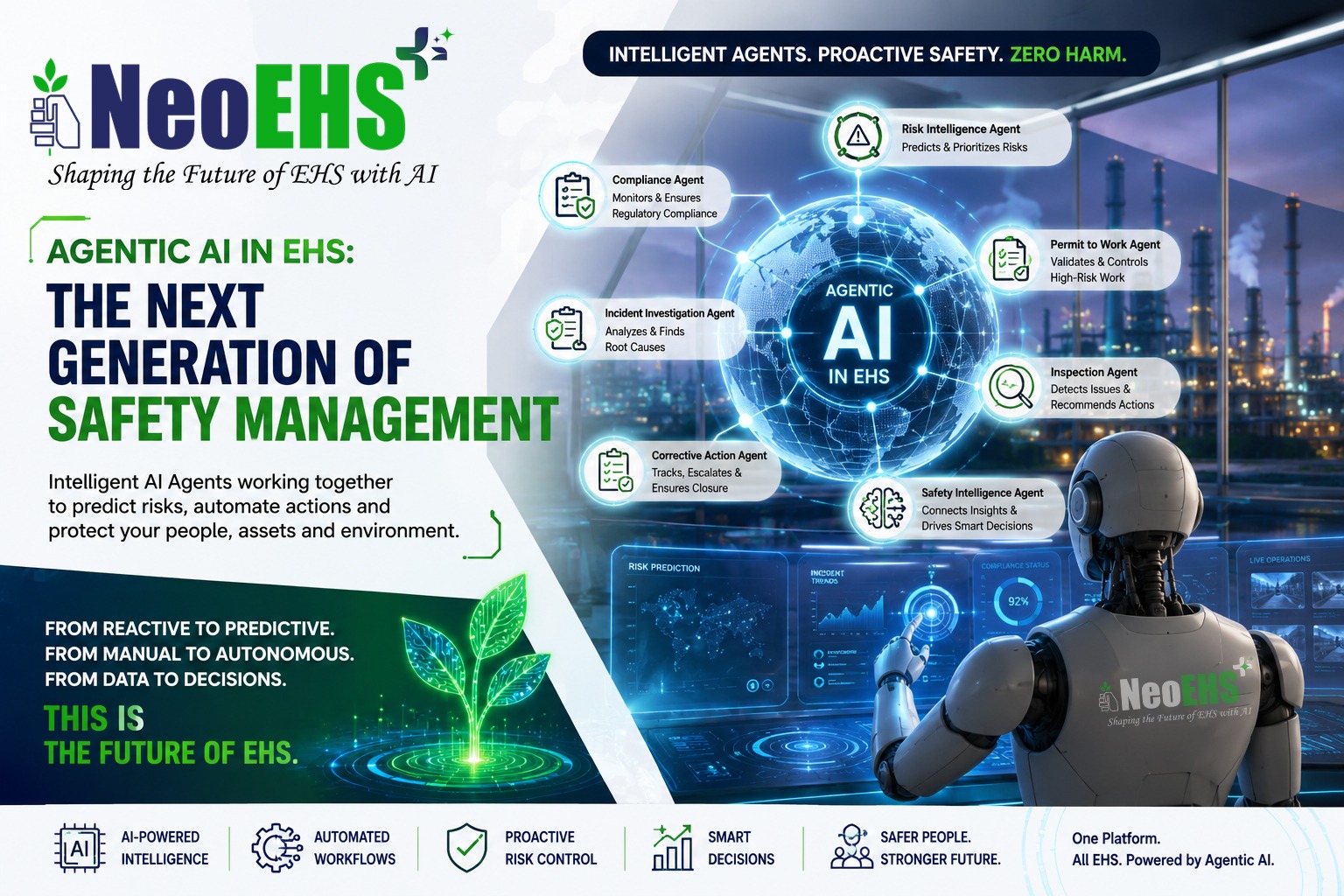
Agentic AI in EHS: The Next Generation of Safety Management
Workplace safety has always depended on people making the right decisions at the right time.
But today's EHS teams are dealing with more data, more regulations, more contractors, more operational complexity and more connected systems than ever before. Incidents, inspections, risk assessments, permits, audits, observations, training records and compliance obligations can generate enormous amounts of information.
The challenge is no longer simply collecting EHS data.
The challenge is understanding it, connecting it and acting on it quickly enough to prevent harm.
This is where Agentic AI in EHS is beginning to change the way organizations think about safety management.
Unlike traditional software that waits for a user to enter information and initiate an action, an agentic AI approach can use specialized AI agents to analyze information, identify priorities, recommend actions, trigger workflows and continuously support safety teams within defined rules and controls.
For EHS leaders, this represents a shift from:
Reactive safety management → Digital safety management → Predictive safety management → Intelligent safety management
What Is Agentic AI in EHS?
Agentic AI in EHS is the use of AI agents that can understand EHS information, reason about defined safety tasks, make recommendations and initiate approved actions within controlled workflows.
In simple terms, traditional EHS software primarily helps people record and manage safety activities.
AI-powered EHS software can help people analyze and predict safety risks.
Agentic AI can go a step further by helping organizations coordinate and act on those insights.
For example, instead of simply displaying that several corrective actions are overdue, an EHS AI agent could identify the highest-risk overdue actions, examine related incidents and observations, notify responsible personnel and recommend escalation according to the organization's predefined workflow.
Human oversight remains essential, particularly for high-risk decisions. Agentic AI should support qualified EHS professionals rather than replace their responsibility, judgment or accountability.
Why Is Agentic AI Important for EHS Management?
EHS teams often work across multiple systems and information sources.
Consider a construction project.
A safety manager may need to review:
- Incident reports
- Near-miss reports
- Risk assessments
- Permit to Work records
- Contractor information
- Training records
- Inspection findings
- Audit findings
- Safety observations
- Corrective actions
- Environmental data
The information may exist in different modules, applications, spreadsheets or documents.
A human safety professional can interpret this information, but doing so manually across thousands of records is difficult.
Agentic AI can help connect these signals.
Instead of asking:
"What happened?"
organizations can begin asking:
"What is likely to happen next, why might it happen, and what should we do about it?"
That is one of the most important changes in the next generation of EHS management.
Traditional EHS Software vs AI-Powered EHS vs Agentic AI
The evolution can be understood in three stages.
| Traditional EHS | AI-Powered EHS | Agentic AI EHS |
|---|---|---|
| Records information | Analyzes information | Understands and coordinates information |
| Manual workflows | Automated workflows | Intelligent workflow orchestration |
| Historical reporting | Predictive analytics | Context-aware recommendations |
| User-driven actions | AI-assisted decisions | AI-initiated approved actions |
| Reactive investigation | AI-assisted investigation | Continuous investigation support |
| Static dashboards | Intelligent dashboards | Contextual safety intelligence |
| Manual compliance tracking | Automated monitoring | Intelligent compliance response |
The objective is not to eliminate the EHS professional.
It is to give the EHS professional more intelligence, more context and more time to focus on critical decisions.
How Does Agentic AI Work in an EHS Environment?
A practical Agentic AI architecture can involve multiple specialized AI agents.
Each agent has a defined responsibility.
1. Risk Intelligence Agent
This agent can analyze:
- Risk assessments
- Hazards
- Safety observations
- Incidents
- Near misses
- Inspection findings
- Operational conditions
It can identify recurring patterns and highlight areas that deserve attention.
2. Incident Investigation Agent
An incident investigation agent can help organize incident evidence, identify contributing factors, compare similar historical incidents and support root-cause analysis.
The final investigation and conclusions should remain under appropriate human review.
3. Compliance Agent
A compliance-focused agent can help monitor:
- Regulatory obligations
- Internal requirements
- Audit findings
- Compliance actions
- Due dates
- Evidence
It can help identify potential gaps before an audit or regulatory review.
4. Permit to Work Agent
A PTW agent can support permit validation by checking information such as:
- Work type
- Risk assessment
- Required controls
- Worker competency
- Contractor status
- Isolation requirements
- Approval requirements
- Permit validity
This can help safety teams maintain better control over high-risk work.
5. Inspection Agent
An inspection agent can analyze inspection findings, identify repeated issues and help prioritize corrective actions.
For example, if the same unsafe condition is reported repeatedly in several inspections, the system can highlight the recurring pattern rather than treating each finding as an isolated event.
6. Corrective Action Agent
Corrective actions often fail not because organizations don't identify problems, but because actions remain open, become overdue or fail to address the underlying cause.
An AI agent can help prioritize actions based on risk, monitor due dates and support escalation workflows.
7. Safety Intelligence Agent
A higher-level safety intelligence agent can bring information from multiple EHS processes together.
It can help management answer questions such as:
- What are our highest emerging risks?
- Which sites are showing deteriorating safety performance?
- Which contractors have recurring safety issues?
- Which corrective actions represent the greatest exposure?
- Which incidents are repeating?
- Where should management intervene first?
Agentic AI and Predictive Safety Management
One of the biggest opportunities is connecting prediction with action.
Traditional analytics may identify that a particular facility has experienced increasing near misses.
Predictive analytics may estimate that the area has an elevated risk profile.
Agentic AI can help move the organization toward an appropriate response.
For example:
Detect → Analyze → Prioritize → Recommend → Escalate → Track → Learn
This creates a continuous safety improvement loop.
NeoEHS already positions its AI capabilities around risk prediction, safety trend analysis, intelligent recommendations, automated workflows and multi-agent AI.
A Practical Example: Preventing a Workplace Incident
Imagine a manufacturing facility where the EHS platform receives the following information over several weeks:
- Multiple housekeeping observations
- Repeated slip hazards
- Two near misses
- One minor injury
- Several overdue corrective actions
- Increased maintenance activity
- Contractor activity in the same area
A conventional system may store each record separately.
An intelligent EHS system can identify the relationship between the records.
An Agentic AI system could help safety teams recognize the developing pattern and recommend actions such as:
- Prioritize the affected area.
- Review recent incidents and observations.
- Identify recurring causes.
- Recommend an inspection.
- Escalate overdue corrective actions.
- Notify the responsible manager.
- Track completion.
- Monitor whether similar observations continue.
The goal is not simply to report the incident.
The goal is to interrupt the chain of events before the next incident occurs.
Agentic AI for Incident Management
Incident management is one of the areas where Agentic AI can provide significant value.
A modern AI-powered incident management system can support:
- Incident classification
- Severity assessment
- Evidence organization
- Similar incident identification
- Contributing-factor analysis
- Root-cause analysis support
- Corrective action recommendations
- Management notifications
- Trend analysis
- Lessons learned
NeoEHS currently describes AI-supported incident investigation, root-cause analysis and corrective-action capabilities as part of its EHS platform.
The important distinction is that AI should support investigation quality, while trained investigators remain responsible for validating findings and conclusions.
Agentic AI for Risk Management
Risk management is another natural application.
Instead of treating risk assessments as documents that are completed and then archived, organizations can connect risk information with operational data.
For example:
Risk Assessment + Incident Data + Observations + Inspections + Permit Data + Historical Trends
can provide a much richer picture of actual risk exposure.
An AI system can help identify where the documented risk profile may not match what is happening in the workplace.
This creates an opportunity to move from:
Static risk assessment
to:
Dynamic risk intelligence.
Agentic AI and Permit to Work
High-risk work requires particularly strong controls.
Digital Permit to Work systems can already improve visibility by replacing paper approvals with structured workflows.
Agentic AI can add another layer of intelligence.
Before a permit progresses, AI can assist with checking:
- Work activity
- Hazard profile
- Risk assessment
- Contractor competency
- Worker training
- Required PPE
- Isolation requirements
- Conflicting activities
- Permit conditions
- Previous incidents associated with similar work
The objective is simple:
The right person.
The right job.
The right controls.
The right authorization.
At the right time.
This is especially valuable in construction, mining, oil & gas, power, chemical processing and other high-risk environments.
Agentic AI for Contractor Safety
Contractor management is often one of the most difficult parts of enterprise EHS.
Organizations may have hundreds or thousands of contractors working across multiple locations.
Agentic AI can help safety teams monitor:
- Contractor qualifications
- Training
- Certifications
- Safety performance
- Incidents
- Observations
- Permit history
- Inspection findings
- Corrective actions
- Compliance status
Instead of simply maintaining contractor records, organizations can use connected safety data to identify contractors or activities requiring additional attention.
Agentic AI and Compliance Management
Compliance is another area where intelligent automation can reduce administrative workload.
A modern EHS platform can centralize:
- Legal requirements
- Regulatory obligations
- Internal standards
- Audit findings
- Corrective actions
- Evidence
- Compliance deadlines
Agentic AI can help identify missing evidence, prioritize upcoming obligations and support responsible teams in completing required actions.
However, regulatory interpretation should always be validated by appropriately qualified professionals. AI should not be treated as an unquestionable legal authority.
Agentic AI + Computer Vision + IoT
The next generation of EHS will not depend only on text-based information.
It will increasingly combine multiple sources of operational intelligence.
EHS Data
Incidents, inspections, audits and observations.
Computer Vision
PPE compliance, unsafe behavior and restricted-area monitoring.
IoT
Environmental conditions, equipment data and connected-worker information.
Mobile Applications
Real-time field reporting.
Enterprise Systems
HR, ERP, asset and contractor information.
Agentic AI
Connecting these signals and helping teams understand what they mean.
This is where EHS software can evolve from a system of record into a system of safety intelligence.
NeoEHS currently describes integrations across ERP, HRMS, IoT and CCTV/Computer Vision, together with AI-powered risk intelligence and connected-worker capabilities.
What Are the Benefits of Agentic AI in EHS?
When implemented responsibly, Agentic AI can help organizations:
1. Identify Emerging Risks
Connect signals across incidents, observations, inspections and operational data.
2. Reduce Manual Administrative Work
Automate repetitive classification, notifications, workflows and reporting tasks.
3. Improve Decision-Making
Give safety professionals more context when prioritizing risks.
4. Accelerate Incident Investigation
Help investigators organize evidence and identify relevant historical patterns.
5. Strengthen Compliance
Monitor obligations, actions and evidence more consistently.
6. Improve Corrective Action Management
Prioritize actions according to risk and organizational requirements.
7. Improve Contractor Safety
Connect competency, performance, incidents, permits and compliance information.
8. Create Enterprise-Wide Safety Intelligence
Turn information from multiple facilities into actionable insights.
What Should Organizations Look for in Agentic AI EHS Software?
Not every product that uses the word "AI" is truly agentic.
Organizations should evaluate whether the platform can provide:
- Context-aware AI
- Specialized AI agents
- Predictive risk analytics
- Intelligent workflow automation
- Human-in-the-loop controls
- Explainable recommendations
- Audit trails
- Role-based permissions
- Data security
- Integration capabilities
- Configurable approval workflows
- Continuous monitoring
- Enterprise scalability
Most importantly, organizations should ask:
Can the AI help us move from information to action safely and transparently?
That is more meaningful than simply asking whether a software product has an AI chatbot.
Why Human Oversight Still Matters
Safety is not an area where organizations should blindly delegate responsibility to AI.
Agentic systems should operate within clearly defined boundaries.
For high-risk decisions, organizations should maintain:
Human oversight + AI intelligence + documented controls + auditability
AI can recommend.
AI can prioritize.
AI can detect patterns.
AI can automate approved workflows.
But organizations still need accountable people making critical safety decisions.
Responsible AI governance should therefore be part of the EHS transformation strategy from the beginning.
The Future of EHS Is Not Just Automated. It Is Intelligent.
The first generation of digital EHS systems helped organizations move away from paper.
The next generation added dashboards, mobile applications, analytics and automation.
AI introduced predictive insights.
Agentic AI introduces another possibility:
Systems that can understand context, coordinate information and help initiate appropriate actions within defined boundaries.
This could fundamentally change how organizations manage workplace safety.
Instead of waiting for an EHS professional to discover a problem in a report, intelligent systems can continuously examine safety signals and bring the most important issues to the right people.
Instead of asking:
"What happened?"
organizations can increasingly ask:
"What is changing?"
"What could happen next?"
"Why is the risk increasing?"
"What action should we take?"
And ultimately:
"How can we prevent the incident before it happens?"
How NeoEHS Is Shaping the Future of EHS With AI
NeoEHS is evolving beyond traditional EHS software toward an AI-powered EHS and ESG platform that combines intelligent automation, predictive analytics, incident intelligence, risk management, compliance workflows, environmental management and operational safety data.
Its current platform positioning includes AI risk intelligence, incident analytics, automated safety workflows, predictive compliance analytics, computer vision and connected-worker capabilities. NeoEHS also describes multi-agent AI as a capability for monitoring compliance, investigating incidents, forecasting risks and supporting management decisions.
The vision is straightforward:
Digitize → Automate → Predict → Recommend → Act → Improve
That is the journey from traditional EHS management to intelligent safety management.
Frequently Asked Questions About Agentic AI in EHS
What is Agentic AI in EHS?
Agentic AI in EHS refers to AI systems that can understand EHS information, reason about defined safety tasks, provide recommendations and initiate approved workflows under organizational controls and human oversight.
What is the difference between AI and Agentic AI in EHS?
Traditional AI may analyze data or generate recommendations. Agentic AI can combine reasoning, context, planning and approved actions across connected workflows. In EHS, this can mean moving from simply identifying a risk to helping coordinate the appropriate response.
Can Agentic AI replace EHS professionals?
No. Agentic AI should support EHS professionals rather than replace them. Human oversight, professional judgment and organizational accountability remain essential, especially for high-risk decisions.
How can Agentic AI improve workplace safety?
It can help identify emerging risks, analyze incidents, prioritize corrective actions, monitor compliance, support permit workflows and connect information from multiple EHS processes.
Can Agentic AI be used for Permit to Work?
Yes. Agentic AI can support digital Permit to Work by helping validate work information, risk controls, worker competency, contractor status and approval requirements within configured workflows.
Can Agentic AI predict workplace incidents?
AI can identify patterns and estimate risk based on available historical and operational data. However, predictions are not guarantees. Organizations should use AI predictions as decision-support information alongside professional safety judgment.
Is Agentic AI useful for ISO 45001 management?
It can support processes relevant to an ISO 45001-based management system, including risk management, incident investigation, corrective actions, monitoring, audit preparation and continual improvement. AI does not itself create ISO 45001 compliance; organizations remain responsible for implementing and maintaining their management system.
What industries can use Agentic AI for EHS?
Agentic AI can support many industries, including construction, manufacturing, mining, oil & gas, chemicals, power and energy, logistics, ports and maritime, healthcare and infrastructure.
Conclusion
The future of EHS is moving beyond digital recordkeeping.
Organizations are building connected safety ecosystems where incidents, risks, inspections, permits, contractors, compliance, environmental information and operational data can work together.
Agentic AI has the potential to become the intelligence layer connecting these processes.
The goal is not to make safety management more complicated.
The goal is to make it more proactive, more intelligent and more actionable.
For organizations pursuing Zero Harm, the question is no longer simply whether they should digitize EHS.
- AI-powered EHS software → NeoEHS EHS Soffware https://www.neoehs.com/ehs-software
- EHS management system → NeoEHS EHS Management System https://www.neoehs.com/ehs-management-software
- incident management → NeoEHS Incident Management Software https://www.neoehs.com/solutions/incident-management-software
- risk management → NeoEHS Risk Management Software https://www.neoehs.com/solutions/risk-management-software
- Permit to Work → NeoEHS Permit to Work Software https://www.neoehs.com/solutions/permit-to-work-software
- contractor safety management → NeoEHS Contractor Management
- predictive risk analytics → relevant NeoEHS AI/Predictive Analytics page
- ISO 45001 compliance → relevant NeoEHS Compliance/ISO 45001 page
- AI-powered construction safety → NeoEHS Construction solution https://www.neoehs.com/industries/construction
 (1).png "fall protection in workplace")