AI Safety Solutions for Oil & Gas Operations
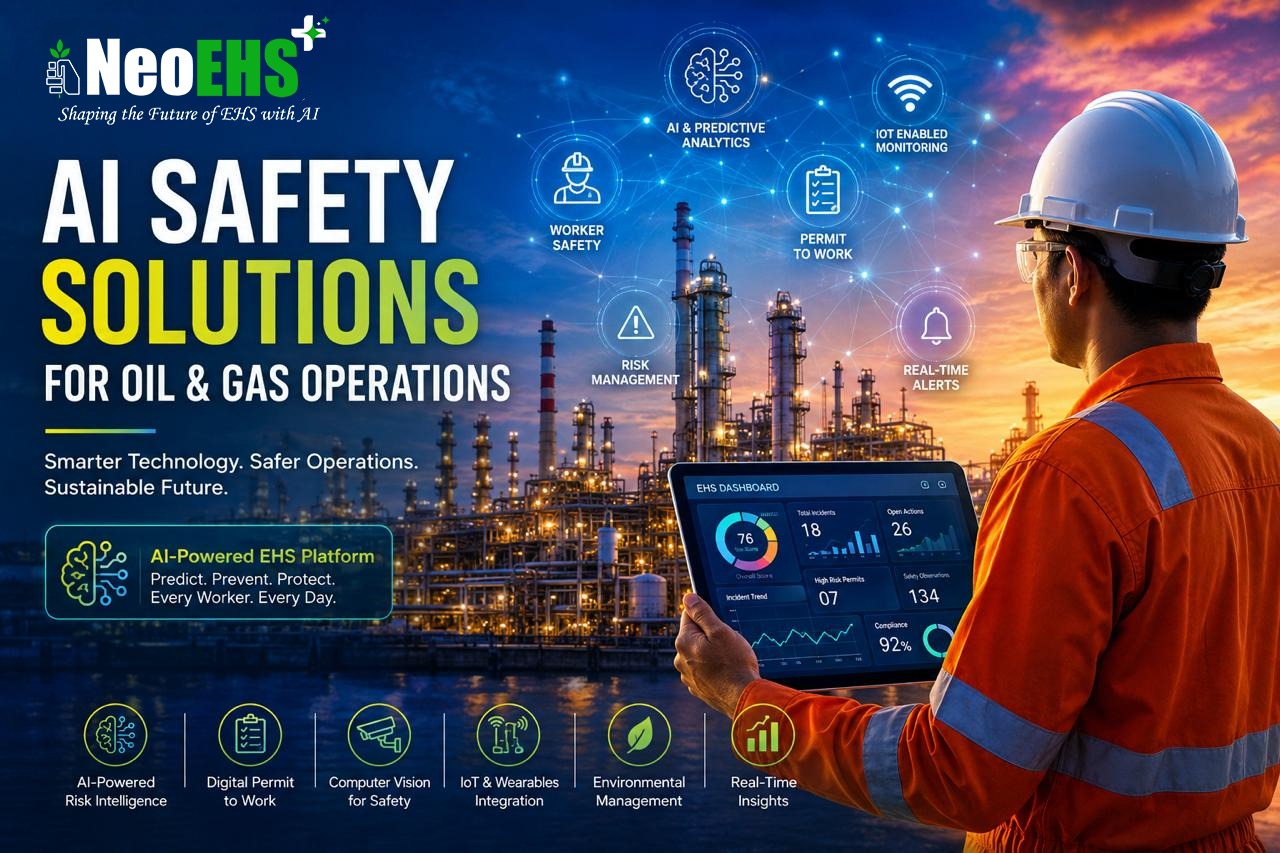
AI Safety Solutions for Oil & Gas Operations: Transforming Oil & Gas Safety with Intelligent EHS Technology
The oil and gas industry operates in one of the world’s most complex and high-risk environments. From upstream exploration and drilling to refineries, petrochemical plants, pipelines, terminals, offshore platforms, and transportation, workers face hazards involving flammable materials, high pressure, toxic chemicals, heavy equipment, confined spaces, electrical systems, and extreme operating conditions.
Traditional safety management approaches can struggle to keep pace with these risks.
AI-powered safety solutions are changing how oil and gas companies identify hazards, predict risks, manage incidents, monitor workers, and improve environmental, health and safety (EHS) performance.
NeoEHS is an AI-powered Environment, Health and Safety (EHS) management software platform designed to help organizations move from reactive safety management to proactive and predictive risk management.
By combining Artificial Intelligence (AI), Predictive Analytics, IoT, Computer Vision, automation, mobile technology, and real-time safety intelligence, NeoEHS enables oil and gas organizations to build a more connected and intelligent safety management ecosystem.
What Are AI Safety Solutions for Oil & Gas Operations?
AI safety solutions for oil and gas operations are intelligent digital technologies that use artificial intelligence, data analytics, IoT, computer vision, and automation to identify hazards, predict risks, prevent incidents, and improve EHS performance.
Unlike conventional safety systems that primarily record incidents after they occur, AI-powered EHS platforms analyze safety data continuously to identify patterns and emerging risks before they result in serious incidents.
An AI-powered safety management system can help organizations:
- Identify workplace hazards
- Predict high-risk activities
- Analyze safety observations
- Automate inspections
- Digitize Permit to Work processes
- Monitor environmental conditions
- Detect unsafe behavior using computer vision
- Track worker and asset locations
- Investigate incidents using intelligent analytics
- Automate corrective and preventive actions
- Monitor regulatory and compliance requirements
- Generate real-time EHS dashboards
- Improve safety decision-making
This changes the role of EHS technology from a record-keeping system into an intelligent risk-management platform.
Why Is AI Important for Oil & Gas Safety?
Oil and gas operations generate enormous volumes of safety, operational, environmental, inspection, incident, maintenance, and compliance data.
The challenge is not simply collecting this data.
The challenge is turning data into actionable safety intelligence.
AI can analyze large volumes of structured and unstructured information much faster than manual processes. It can identify relationships between incidents, hazards, locations, activities, equipment, workers, environmental conditions, and historical safety performance.
For oil and gas companies, this can support a transition from:
Reactive Safety → Preventive Safety → Predictive Safety
Instead of asking:
"What caused the incident?"
organizations can increasingly ask:
"What conditions indicate that an incident could happen next?"
That shift can significantly improve the effectiveness of modern EHS management.
Major Safety Challenges in Oil & Gas Operations
Oil and gas organizations operate across multiple environments, each with unique risks.
1. Fire and Explosion Hazards
Hydrocarbons and other flammable substances can create significant fire and explosion risks.
AI-enabled monitoring can help organizations identify abnormal conditions, unsafe activities, and potential ignition sources earlier.
2. Gas and Toxic Exposure
Workers may be exposed to hazardous gases such as hydrogen sulfide and other toxic substances.
IoT-enabled gas detection and real-time monitoring can provide safety teams with immediate visibility into changing environmental conditions.
3. Permit to Work Risks
High-risk activities such as hot work, confined space entry, electrical work, excavation, lifting, and maintenance often require strict Permit to Work controls.
Digitizing PTW workflows can improve authorization, isolation verification, risk assessment, approval, monitoring, and closure.
4. Confined Space Entry
Confined spaces can present risks including oxygen deficiency, toxic gases, engulfment, and restricted emergency access.
Digital permit workflows, atmospheric monitoring, worker tracking, and emergency management can strengthen confined-space controls.
5. Work at Height
Falls from elevated platforms, scaffolds, ladders, and structures remain serious workplace risks.
Computer vision and connected safety technologies can help organizations identify unsafe conditions and improve compliance with work-at-height procedures.
6. Heavy Equipment and Vehicle Movement
Oil and gas facilities often contain heavy vehicles, cranes, forklifts, mobile equipment, and specialized machinery.
AI-powered monitoring can help identify unsafe proximity, restricted-zone access, and potentially dangerous interactions between people and equipment.
7. Contractor Safety
Contractors and subcontractors can represent a significant portion of the workforce in major oil and gas projects.
A centralized EHS platform can help manage contractor onboarding, competency, training, permits, inspections, observations, incidents, and compliance.
8. Environmental Risks
Oil spills, emissions, wastewater, hazardous waste, chemical releases, and other environmental events can have significant operational and regulatory consequences.
Digital environmental management can provide organizations with better visibility into environmental performance and corrective actions.
How AI Can Improve Oil & Gas Safety Management
AI can strengthen multiple stages of the EHS lifecycle.
1. Predictive Risk Analytics
Historical incidents, near misses, observations, inspections, permits, training records, and operational data can contain valuable risk signals.
NeoEHS can use AI-driven analytics to identify patterns and highlight areas requiring attention.
For example, an organization could analyze:
- High-risk locations
- Repeated hazards
- Recurring unsafe observations
- Incident frequency
- Permit trends
- Equipment-related incidents
- Contractor performance
- Training gaps
- Inspection findings
- Environmental conditions
This enables safety teams to focus resources where risk is increasing.
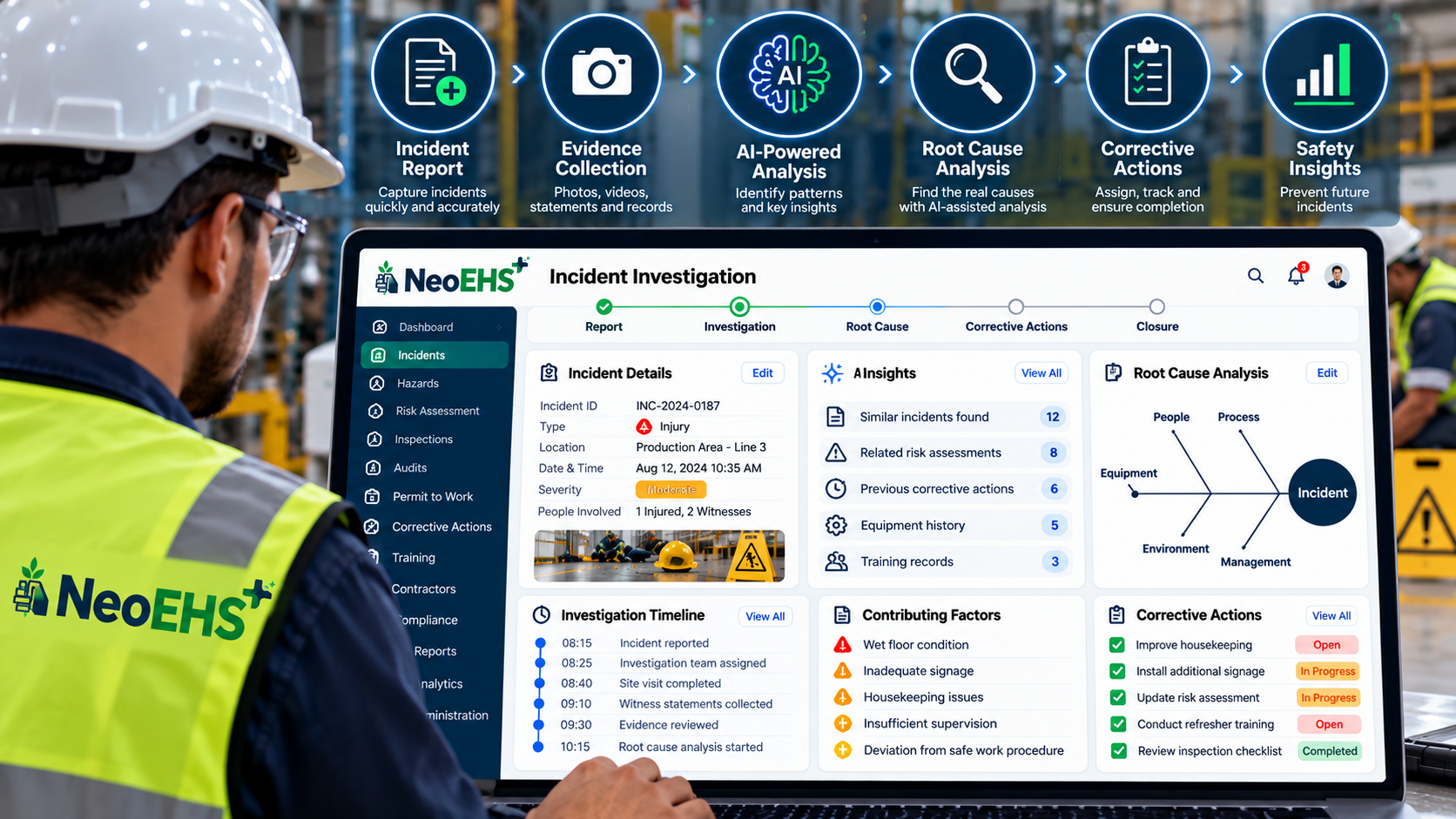
2. AI-Powered Incident Management
Incident management should not end when an incident is recorded.
Modern EHS systems should help organizations understand:
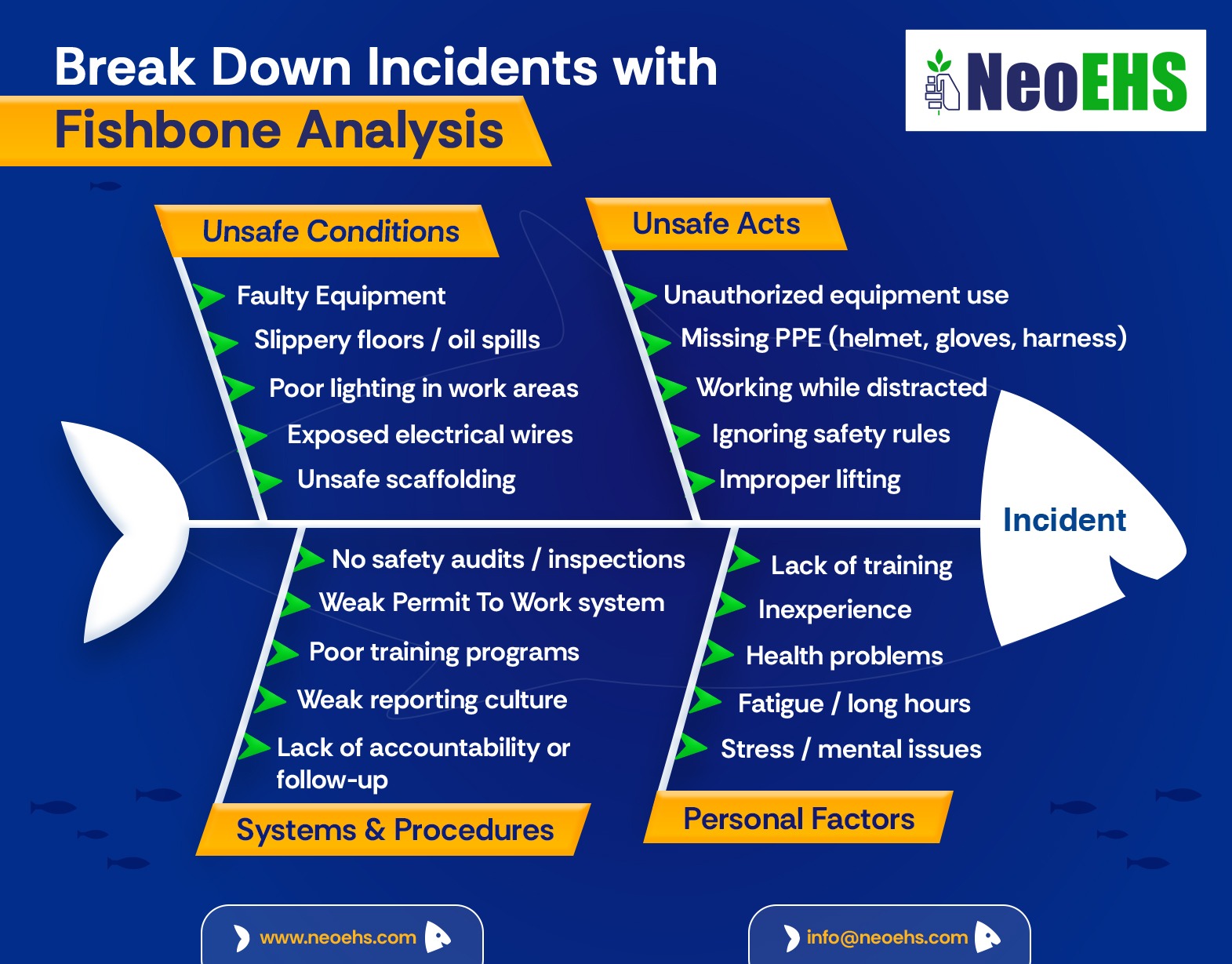
What happened? Why did it happen? Where did it happen? What contributing factors existed? What controls failed? How can recurrence be prevented?
AI can assist with incident classification, trend identification, root-cause analysis, corrective-action recommendations, and organizational learning.
NeoEHS can help create a structured digital incident management workflow covering:
- Incident reporting
- Near-miss reporting
- Injury management
- Investigation
- Root-cause analysis
- Corrective actions
- Preventive actions
- Approval workflows
- Evidence management
- Analytics and reporting
3. AI-Powered Permit to Work Management
Permit to Work (PTW) is one of the most important control mechanisms for high-risk oil and gas activities.
A digital and AI-enabled PTW system can help organizations manage:
- Hot Work Permits
- Cold Work Permits
- Confined Space Entry Permits
- Electrical Work Permits
- Work at Height Permits
- Excavation Permits
- Lifting Permits
- Line Breaking Permits
- Isolation and LOTO Permits
- Radiography Permits
- Chemical Handling Permits
- Pressure Testing Permits
- Vehicle Entry Permits
AI can support permit reviews by identifying missing information, inconsistent risk assessments, expired controls, conflicting activities, and potential control gaps.
The objective is not to replace competent safety professionals.
The objective is to give them better information before approving high-risk work.
4. Computer Vision for Workplace Safety
Computer Vision enables AI systems to analyze images and video to identify predefined safety conditions.
For oil and gas operations, computer vision can potentially support monitoring of:
- PPE compliance
- Restricted-area access
- Unsafe proximity to equipment
- Fall-risk situations
- Smoke or fire indicators
- Unsafe work practices
- Vehicle movement
- Worker presence in designated zones
When integrated appropriately with CCTV infrastructure, AI-powered video analytics can provide safety teams with an additional layer of continuous monitoring.
5. IoT-Based Safety Monitoring
The Internet of Things (IoT) connects sensors, devices, equipment, wearables, and environmental monitoring systems.
In oil and gas environments, IoT can support real-time monitoring of:
- Gas levels
- Temperature
- Pressure
- Air quality
- Worker location
- Equipment status
- Environmental conditions
- Emergency alarms
- Wearable safety devices
NeoEHS can serve as a centralized EHS intelligence layer, helping organizations bring safety data from connected devices into a unified platform.
6. Smart Worker Safety
Connected wearable technologies can provide additional visibility into worker safety.
Depending on the deployment environment, smart safety devices can support:
- Worker location tracking
- Geofencing
- Emergency alerts
- Man-down detection
- Lone-worker monitoring
- Restricted-zone alerts
- Environmental exposure monitoring
- Emergency response
This can be particularly valuable for remote oil fields, offshore platforms, pipelines, refineries, terminals, and large construction projects.
7. Intelligent Safety Observations
Safety observations are one of the richest sources of leading-indicator data.
However, organizations often collect thousands of observations without effectively analyzing them.
AI can categorize and analyze observations based on:
- Hazard type
- Location
- Activity
- Department
- Contractor
- Severity
- Frequency
- Root cause
- Repeated behavior
- Corrective action
NeoEHS can help safety leaders identify recurring patterns and prioritize interventions.
8. AI-Powered Inspection Management
Oil and gas facilities require frequent inspections of equipment, processes, work areas, and safety controls.
Digital inspection management can help organizations standardize inspection processes and capture findings in real time.
AI can further support inspection workflows by identifying recurring findings and highlighting areas with deteriorating safety performance.
9. Emergency Management
Oil and gas emergencies can escalate rapidly.
Examples include:
- Fire
- Explosion
- Gas release
- Chemical release
- Oil spill
- Equipment failure
- Worker injury
- Offshore emergency
- Confined-space emergency
- Natural disasters
A connected emergency management system can help organizations coordinate alerts, emergency procedures, personnel information, response teams, communication, and incident records.
10. Environmental and ESG Management
Modern oil and gas companies must manage safety alongside environmental and sustainability performance.
An integrated EHS and ESG platform can help organizations monitor:
- Carbon emissions
- Energy consumption
- Waste
- Water
- Air quality
- Environmental incidents
- Hazardous materials
- Environmental compliance
- Sustainability KPIs
This creates a more complete view of operational risk and environmental performance.
How NeoEHS Supports AI-Powered Oil & Gas Safety
NeoEHS is an AI-powered Environment, Health and Safety management platform designed to connect people, processes, data, devices, and safety intelligence in one digital ecosystem.
The platform can support oil and gas organizations across the complete EHS management lifecycle.
NeoEHS capabilities include:
AI & Predictive Analytics
- Predictive risk analytics
- Intelligent safety insights
- Safety trend analysis
- Risk prioritization
- AI-assisted decision support
Safety Management
- Incident Management
- Hazard Management
- Risk Management
- Observation Management
- Inspection Management
- Audit Management
- Corrective and Preventive Actions
High-Risk Work Management
- AI-powered Permit to Work
- LOTO
- Confined Space
- Work at Height
- Hot Work
- Excavation
- Lifting activities
Digital Workforce Safety
- Mobile safety management
- Smart wearable integration
- Worker tracking
- Emergency alerts
- Contractor management
- Training management
Connected Safety
- IoT integration
- CCTV and Computer Vision
- Smart Helmet integration
- Environmental sensors
- Real-time monitoring
Environmental & ESG
- Waste Management
- Air Quality Monitoring
- Carbon Emission Management
- Environmental Compliance
- ESG reporting
From Reactive EHS to Predictive Safety
The future of oil and gas safety will not depend solely on collecting more data.
It will depend on understanding that data and acting before risk becomes an incident.
A modern AI-powered EHS architecture can create a continuous safety intelligence cycle:
Collect → Connect → Analyze → Predict → Alert → Act → Learn
For example:
- IoT sensors collect environmental information.
- Workers report hazards through mobile applications.
- CCTV systems provide visual safety information.
- Permit systems provide high-risk work information.
- Inspection systems capture field findings.
- Incident systems record events and near misses.
- AI analyzes the combined data.
- Predictive analytics identifies emerging risk patterns.
- Safety teams receive alerts and recommendations.
- Corrective actions are assigned and tracked.
- Management dashboards measure performance.
- The organization learns from the resulting data.
This creates a continuously improving safety management ecosystem.
What Are the Benefits of AI-Powered EHS Software for Oil & Gas Companies?
Organizations implementing AI-powered EHS technology can work toward several strategic benefits:
Improved Risk Visibility
Safety leaders gain a centralized view of hazards, incidents, inspections, permits, observations, and environmental risks.
Faster Safety Response
Real-time alerts can help safety teams respond more quickly to emerging conditions.
Better Leading Indicators
AI can help organizations move beyond lagging indicators such as injury rates and analyze leading indicators such as observations, risk trends, permit activity, and control effectiveness.
Reduced Manual Administration
Automation can reduce repetitive data entry, reporting, approvals, and follow-up activities.
Stronger Compliance
Digital workflows can help organizations demonstrate that safety processes, inspections, permits, corrective actions, and training requirements are being managed systematically.
Improved Contractor Management
Organizations can establish consistent safety requirements across employees, contractors, subcontractors, and project teams.
Data-Driven Safety Decisions
Management can use real-time dashboards and analytics rather than relying exclusively on spreadsheets and periodic reports.
AI Safety Solutions Across the Oil & Gas Value Chain
AI-powered EHS technology can support multiple stages of the oil and gas lifecycle.
| Oil & Gas Operation | AI & EHS Application |
|---|---|
| Exploration | Risk assessment, field safety, environmental monitoring |
| Drilling | Permit management, hazard management, worker safety |
| Offshore Platforms | Worker tracking, IoT monitoring, emergency management |
| Refineries | Process safety support, inspections, PTW, incident management |
| Petrochemical Plants | Chemical safety, risk management, environmental monitoring |
| Pipelines | Inspection, field safety, incident and environmental management |
| Terminals | Vehicle safety, PTW, inspections, emergency response |
| Storage Facilities | Fire risk, inspections, hazardous materials management |
| Transportation | Driver safety, incident management, fleet-related risk |
| Oil & Gas Construction | Contractor safety, PTW, training, inspections |
What Should Companies Look for in an AI-Powered Oil & Gas EHS Platform?
When selecting an EHS software platform, oil and gas organizations should consider more than basic incident reporting.
A modern solution should provide:
- AI-powered analytics
- Predictive risk capabilities
- Permit to Work management
- Risk assessment
- Incident management
- Hazard management
- Inspection management
- Audit management
- Contractor management
- Training management
- Environmental management
- Mobile access
- IoT integration
- Computer Vision integration
- Real-time dashboards
- Automated alerts
- Corrective action management
- Multi-site support
- Configurable workflows
- Reporting and analytics
- Integration capabilities
- Strong security and access controls
Most importantly, the platform should be capable of evolving as the organization's safety requirements evolve.
The Future of Oil & Gas Safety Is Predictive
The oil and gas industry is entering an era where safety management is becoming increasingly connected, intelligent, and predictive.
Artificial Intelligence will not replace safety professionals.
Instead, AI can augment safety professionals by helping them identify patterns, prioritize risks, process information, and make better-informed decisions.
The future EHS ecosystem will increasingly connect:
People + AI + IoT + Data + Automation + Safety Processes
Organizations that build this connected safety infrastructure today can create a stronger foundation for tomorrow's operational resilience.
Why NeoEHS for Oil & Gas Safety Management?
NeoEHS brings together AI-powered EHS management, predictive analytics, IoT integration, computer vision, mobile safety, environmental management, and intelligent automation within one integrated platform.
Instead of managing safety information across disconnected spreadsheets, applications, emails, and manual reports, organizations can create a centralized EHS ecosystem.
With NeoEHS, oil and gas organizations can work toward:
See the Risk → Understand the Risk → Predict the Risk → Control the Risk → Prevent the Incident
The goal is simple:
Make Every Workplace Safer with Intelligent EHS Technology.
Frequently Asked Questions About AI Safety Solutions for Oil & Gas
What is AI-powered EHS software?
AI-powered EHS software uses Artificial Intelligence, analytics, automation, IoT, and other digital technologies to help organizations manage environmental, health, and safety processes and identify potential risks.
How can AI improve oil and gas safety?
AI can analyze safety data from incidents, hazards, inspections, observations, permits, sensors, and other sources to identify patterns, prioritize risks, automate workflows, and provide safety teams with actionable insights.
Can AI predict workplace accidents?
AI cannot guarantee that an accident will be predicted or prevented. However, predictive analytics can identify patterns and risk indicators associated with previous incidents and unsafe conditions, helping organizations take preventive action.
How does AI help with Permit to Work?
AI can assist with digital Permit to Work workflows by checking permit information, identifying potential gaps or inconsistencies, analyzing risk information, and helping safety teams manage high-risk work more effectively.
Can AI monitor oil and gas workers?
When integrated with appropriate CCTV, IoT devices, wearables, or location technologies, AI-enabled systems can support monitoring of predefined safety conditions, worker locations, restricted areas, environmental exposure, and emergency situations.
How does IoT improve oil and gas safety?
IoT connects sensors, equipment, wearables, and other devices to provide real-time safety and environmental information. This can help organizations detect changing conditions and respond more quickly.
What is predictive analytics in EHS?
Predictive analytics in EHS uses historical and real-time safety data to identify patterns and indicators that may suggest increasing risk, enabling organizations to prioritize preventive measures.
What is the role of Computer Vision in workplace safety?
Computer Vision uses AI to analyze images and video for predefined safety conditions, such as PPE compliance, restricted-area access, unsafe proximity, or other detectable workplace conditions.
Can NeoEHS integrate with IoT and smart safety devices?
NeoEHS is designed as a connected EHS platform and can support integration with IoT-enabled safety technologies and digital systems, depending on the specific device, protocol, API, and deployment architecture.
Is NeoEHS suitable for oil and gas companies?
Yes. NeoEHS is designed to support complex EHS environments and can be configured for oil and gas operations including drilling, offshore operations, refineries, petrochemical facilities, pipelines, terminals, construction projects, and other high-risk environments.
Conclusion
AI is transforming the way oil and gas companies approach workplace safety, risk management, environmental performance, and operational resilience.
The next generation of EHS management will be more connected, automated, data-driven, and predictive.
By combining AI, Predictive Analytics, IoT, Computer Vision, mobile technology, and intelligent EHS workflows, organizations can move beyond simply documenting incidents toward identifying risks earlier and strengthening preventive controls.
NeoEHS helps organizations take this step toward intelligent safety management.
NeoEHS — AI-Powered Environment, Health & Safety Software for a Safer Workplace and a Sustainable Future.
Explore NeoEHS: www.neoehs.com