A Unified Platform for Safer Construction Sites
Introduction
Construction projects involve multiple contractors, distributed worksites, complex operations, and high-risk environments. Managing safety incidents across such environments is a major challenge for organizations.
Many construction companies still rely on fragmented reporting systems, emails, spreadsheets, or manual documentation to track safety incidents and corrective actions. This often leads to delayed responses, inconsistent investigations, and poor visibility for management.
The NeoEHS unified incident management platform addresses these challenges by providing a centralized system for incident reporting, investigation, corrective actions, and compliance management across all sites and contractors.
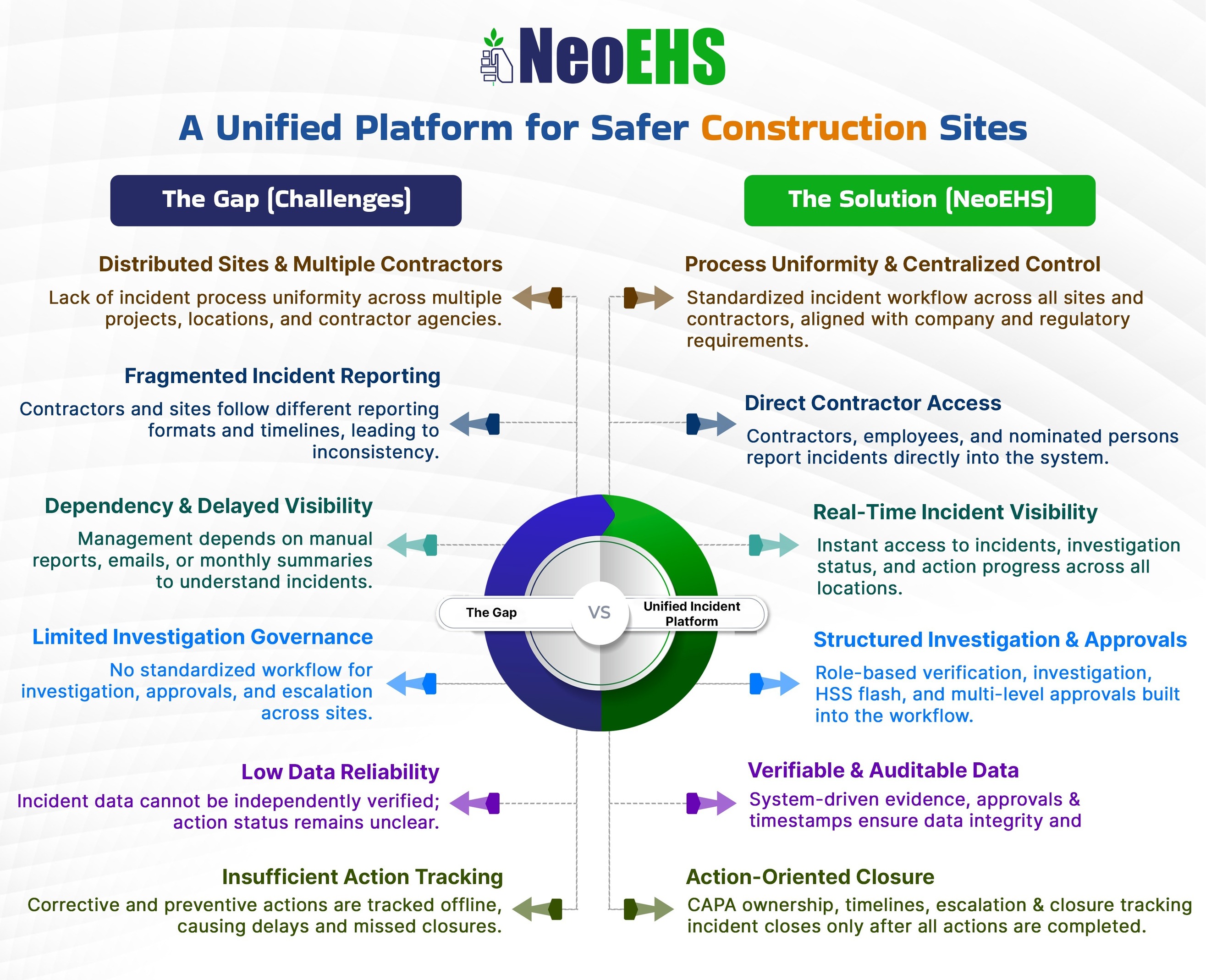
The Safety Management Challenges in Construction Projects
Construction companies face several operational challenges when managing incidents across multiple sites and contractors.
1. Distributed Sites and Multiple Contractors
Large construction organizations often operate across:
-
Multiple project sites
-
Different contractors and subcontractors
-
Various geographic locations
Each site or contractor may follow different reporting formats and safety procedures, resulting in inconsistent incident management practices.
Impact
-
Lack of standardized safety processes
-
Difficulties in monitoring incidents across sites
-
Inconsistent compliance with company policies
2. Fragmented Incident Reporting
Many contractors still use separate reporting systems or manual formats.
Some incidents may be reported through:
-
Email
-
Paper forms
-
WhatsApp messages
-
Excel sheets
This fragmentation results in incomplete records and delayed incident investigations.
Impact
-
Poor data consolidation
-
Delayed response to incidents
-
Difficulty analyzing incident trends
3. Dependency on Manual Reports
In traditional systems, management often relies on:
-
Monthly safety reports
-
Email summaries
-
Manual dashboards
This creates delayed visibility into incidents happening at project sites.
Impact
-
Management cannot respond quickly to critical safety risks
-
Delayed corrective actions
-
Increased accident exposure
4. Limited Investigation Governance
Incident investigations require structured workflows and accountability.
However, many organizations lack:
-
Standardized investigation processes
-
Defined approval workflows
-
Escalation mechanisms
Impact
-
Incomplete investigations
-
Lack of accountability
-
Poor incident learning
5. Low Data Reliability
Without centralized systems, incident data becomes difficult to verify.
Challenges include:
-
Missing evidence
-
Unverified action status
-
Inconsistent reporting
Impact
-
Reduced trust in safety data
-
Difficulty during compliance audits
6. Insufficient Action Tracking
Corrective and preventive actions are often tracked outside the incident system.
Organizations frequently use:
-
Spreadsheets
-
Emails
-
Manual tracking
Impact
-
Missed action deadlines
-
Poor closure tracking
-
Recurring safety incidents
The NeoEHS Unified Incident Management Solution
The NeoEHS platform provides a centralized system that connects incident reporting, investigation, approvals, and action tracking across all construction sites and contractors.
This creates process uniformity and real-time safety intelligence across the organization.
1. Process Uniformity and Centralized Control
NeoEHS standardizes incident reporting and investigation workflows across the organization.
All sites and contractors follow the same structured process aligned with company policies and regulatory requirements.
Key Benefits
-
Consistent incident management procedures
-
Compliance with safety regulations
-
Standardized reporting across projects
2. Direct Contractor Access
Contractors, employees, and nominated personnel can report incidents directly into the system.
This ensures faster reporting and more accurate information capture from the field.
Key Benefits
-
Faster incident reporting
-
Improved participation from contractors
-
Reduced reporting delays
3. Real-Time Incident Visibility
The NeoEHS platform provides management with instant access to incident information across all sites.
Safety teams can monitor:
-
Incident status
-
Investigation progress
-
Corrective action completion
Key Benefits
-
Immediate safety insights
-
Faster decision-making
-
Improved risk management
4. Structured Investigation and Approvals
NeoEHS provides structured workflows for incident investigations with role-based access and approval processes.
Features include:
-
Role-based verification
-
Investigation assignment
-
Multi-level approvals
-
HSS flash alerts
Key Benefits
-
Improved investigation quality
-
Clear accountability
-
Better compliance documentation
5. Verifiable and Auditable Data
NeoEHS ensures data integrity through system-driven evidence and approvals.
All actions and updates are recorded with:
-
Evidence attachments
-
Approval records
-
System timestamps
Key Benefits
-
Reliable safety data
-
Transparent audit trail
-
Improved regulatory compliance
6. Action-Oriented Incident Closure
NeoEHS integrates Corrective and Preventive Action (CAPA) management directly within the incident workflow.
Incidents can only be closed once all actions are completed and verified.
Key Benefits
-
Strong accountability for corrective actions
-
Prevent recurrence of incidents
-
Complete safety lifecycle management
Building Safer Construction Projects with Digital Safety Platforms
A unified digital platform like NeoEHS helps construction companies move beyond traditional incident reporting systems and build proactive safety management environments.
By integrating:
-
Incident reporting
-
Investigation workflows
-
Contractor participation
-
Action tracking
-
Real-time dashboards
organizations gain complete visibility and control over safety performance across all projects.
Conclusion
Managing safety incidents across distributed construction projects requires standardization, visibility, and accountability.
The NeoEHS unified incident management platform enables organizations to:
-
Standardize safety processes across sites
-
Enable direct contractor reporting
-
Improve incident investigation governance
-
Ensure reliable and auditable safety data
-
Track corrective actions effectively
With a centralized digital platform, organizations can significantly improve safety performance and reduce incident recurrence across construction projects.