ISO 45001 Safety Objectives and Performance Indicators
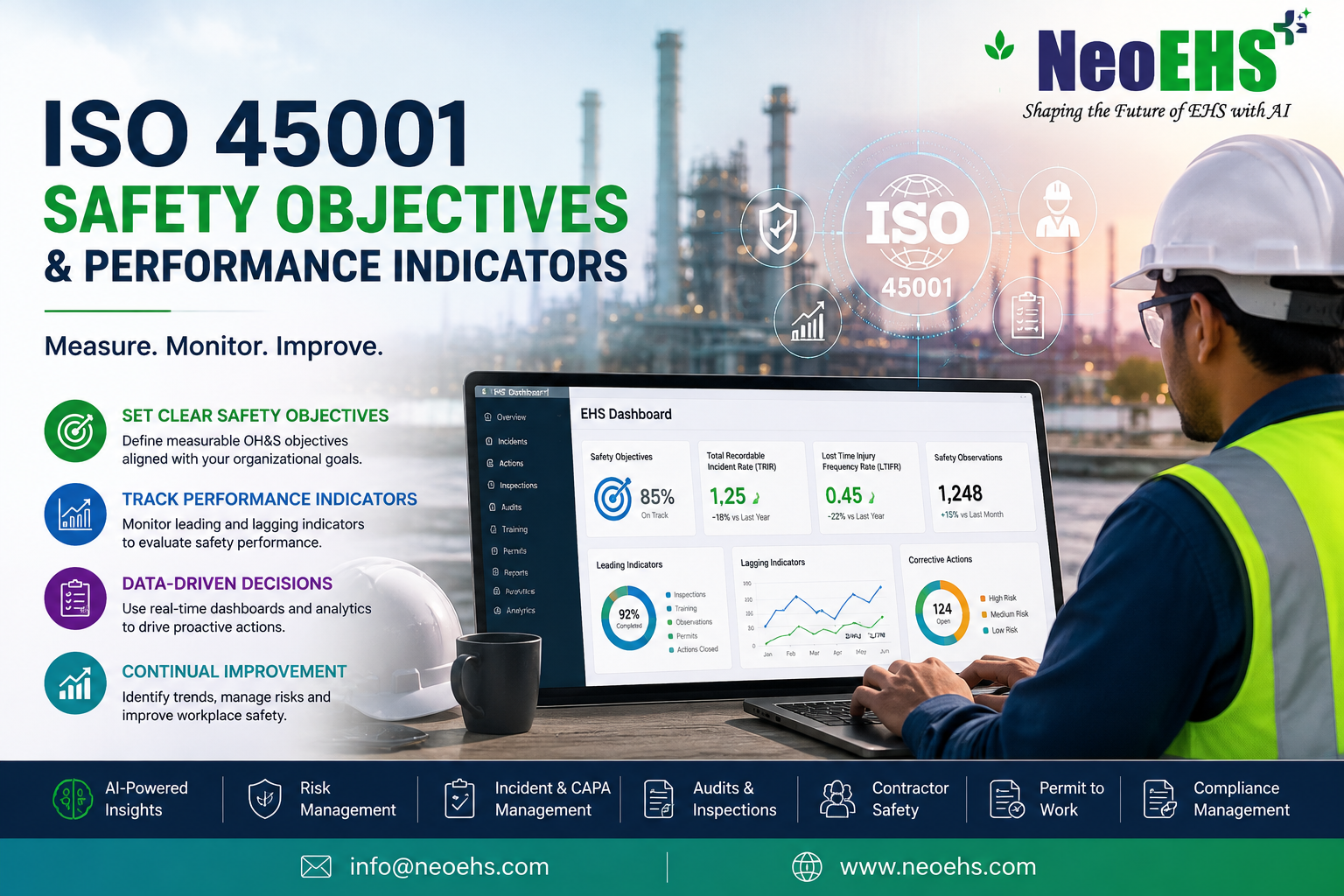
An effective occupational health and safety management system should do more than document policies and procedures. It should help an organization understand whether its safety efforts are actually working.
That is why ISO 45001 safety objectives and performance indicators are so important.
Safety objectives define what an organization wants to achieve. Performance indicators provide the evidence needed to understand whether it is moving in the right direction.
For example, an organization may set an objective to reduce high-risk workplace exposures. Its performance indicators could then measure the percentage of high-risk activities assessed, corrective actions completed on time, repeat hazards identified, safety observations closed and exposure-related incidents.
The important point is that a safety objective should not exist in isolation.
It needs a measurable target, clear ownership, defined actions and regular performance review.
ISO 45001 provides a framework for organizations to establish, implement and continually improve an occupational health and safety management system. The standard covers areas including OH&S policy, objectives, planning, implementation, monitoring, performance evaluation and continual improvement.
For organizations managing these activities digitally, NeoEHS EHS Management Software brings together risk management, incidents, inspections, audits, corrective actions, compliance and AI-powered safety intelligence in one platform.
What Are ISO 45001 Safety Objectives?
ISO 45001 safety objectives are defined OH&S goals that an organization establishes to improve occupational health and safety performance and achieve the intended outcomes of its OH&S management system.
A good safety objective should be:
- Relevant to the organization's OH&S risks and opportunities
- Consistent with its OH&S policy
- Measurable where practicable
- Monitored
- Communicated to relevant people
- Reviewed periodically
- Supported by defined actions and responsibilities
The objective should answer a simple question:
What safety improvement are we trying to achieve?
For example:
Objective: Reduce high-risk unsafe conditions across operational sites.
This is a useful starting point, but it becomes much stronger when converted into a measurable target:
Target: Reduce repeat high-risk findings by 25% within 12 months.
The organization can then establish indicators that show whether the target is being achieved.
Safety Objective vs KPI vs Performance Indicator
These terms are often used interchangeably, but they are not exactly the same.
| Term | What it means | Example |
|---|---|---|
| Safety Objective | What the organization wants to achieve | Reduce workplace injuries |
| Target | The desired measurable result | Reduce recordable injuries by 15% |
| KPI | A key measure used to track important performance | TRIR |
| Performance Indicator | A measure used to evaluate performance | Inspection completion rate |
| Action | What will be done to achieve the objective | Implement monthly high-risk inspections |
A simple way to remember the relationship is:
Objective → Target → Action → Indicator → Measurement → Review → Improvement
This connection is critical.
If an organization establishes objectives but does not measure them, it cannot confidently determine whether its safety management system is improving.
Why Safety Performance Indicators Matter in ISO 45001
Safety performance indicators turn EHS activities into measurable information.
They help management answer questions such as:
- Are workplace injuries increasing or decreasing?
- Are high-risk hazards being identified early?
- Are corrective actions being closed on time?
- Are safety inspections being completed?
- Are workers reporting near misses?
- Are contractors meeting safety requirements?
- Are high-risk permits being properly controlled?
- Are repeated hazards occurring?
- Are training and competency requirements being met?
- Are emergency preparedness activities effective?
ISO 45004:2024 specifically provides guidance on establishing monitoring, measurement, analysis and evaluation processes and developing relevant OH&S indicators to assess performance and support continual improvement.
That makes performance measurement more than a reporting exercise.
It becomes part of the organization's improvement cycle.
Leading and Lagging Safety Indicators
One of the most important concepts in safety performance management is the difference between leading indicators and lagging indicators.
What Are Lagging Safety Indicators?
Lagging indicators measure events or outcomes that have already happened.
Common examples include:
- Lost Time Injury Frequency Rate
- Total Recordable Incident Rate
- Number of lost-time injuries
- Occupational illness cases
- Fatalities
- Restricted work cases
- Days away from work
- Workers' compensation cases
- Property damage incidents
Lagging indicators are important because they show the results of past performance.
However, there is an obvious limitation:
By the time a serious incident appears in a lagging indicator, the incident has already happened.
That is why organizations should not rely on lagging indicators alone.
What Are Leading Safety Indicators?
Leading indicators focus more on activities, conditions and controls that can influence future safety performance.
Examples include:
- Safety inspections completed
- Hazard reports submitted
- Near misses reported
- Corrective actions closed on time
- Safety observations completed
- High-risk activities reviewed
- Permit compliance
- Toolbox talks completed
- Safety training completion
- Competency verification
- Emergency drills conducted
- Critical controls verified
- Preventive maintenance completed
- Contractor safety assessments completed
Leading indicators help organizations understand whether preventive activities are actually taking place.
For example:
A company may have zero lost-time injuries during a quarter.
That sounds positive.
But suppose the same organization has:
- 40 overdue corrective actions
- Falling near-miss reporting
- Reduced safety inspections
- Several repeat hazards
- Low training completion
- Poor permit compliance
The lagging indicator looks good.
The leading indicators suggest that the risk environment may not be improving.
This is why a balanced safety dashboard needs both.
Leading vs Lagging Indicators: A Simple Example
| Safety Area | Leading Indicator | Lagging Indicator |
|---|---|---|
| Hazard Management | High-risk hazards closed on time | Incidents caused by hazards |
| Training | Training completion rate | Training-related incident |
| Inspections | Planned inspections completed | Findings resulting in incidents |
| Corrective Actions | Actions closed within target | Repeat incidents |
| Permit to Work | Permit compliance rate | PTW-related incident |
| Contractor Safety | Contractor assessments completed | Contractor incidents |
| Emergency Preparedness | Drills completed | Emergency-related consequences |
| PPE | PPE compliance observations | PPE-related injury |
The strongest ISO 45001 performance system does not ask only:
"How many incidents did we have?"
It also asks:
"What are we doing today to prevent the next incident?"
10 Practical ISO 45001 Safety Objectives
There is no universal list of safety objectives that every organization must use.
ISO 45001 does not prescribe a fixed set of numerical OH&S performance criteria. Organizations need to establish objectives appropriate to their context, risks, opportunities and intended outcomes.
However, the following objectives can provide a useful starting point.
1. Reduce Workplace Injuries
Objective: Reduce the frequency and severity of occupational injuries.
Possible indicators:
- Total recordable injuries
- Lost-time injuries
- Injury frequency rate
- Injury severity rate
- Days lost due to injury
2. Improve Hazard Identification
Objective: Identify and control hazards before they result in incidents.
Possible indicators:
- Number of hazard reports
- High-risk hazards identified
- Percentage of hazards risk assessed
- Percentage of high-risk hazards controlled
- Repeat hazard rate
3. Improve Corrective Action Closure
Objective: Close safety corrective actions within defined timeframes.
Possible indicators:
- Corrective actions closed on time
- Overdue actions
- Average closure time
- Repeat findings
- High-risk actions outstanding
4. Improve Safety Inspection Performance
Objective: Improve the effectiveness and consistency of workplace safety inspections.
Possible indicators:
- Planned inspections completed
- Inspection completion rate
- High-risk findings
- Repeat findings
- Inspection action closure rate
5. Strengthen Worker Participation
Objective: Increase meaningful worker participation in safety activities.
Possible indicators:
- Safety observations submitted
- Near misses reported
- Toolbox talks completed
- Safety committee participation
- Worker safety suggestions implemented
6. Improve Contractor Safety
Objective: Improve the safety performance and compliance of contractors.
Possible indicators:
- Contractor safety assessments completed
- Contractor training compliance
- Contractor incidents
- Contractor inspection findings
- Contractor corrective-action closure
- Permit compliance
7. Improve Permit to Work Compliance
Objective: Ensure high-risk activities are properly authorized and controlled.
Possible indicators:
- Permit compliance rate
- Expired permits
- Permit deviations
- High-risk permits reviewed
- Isolation verification rate
8. Strengthen Emergency Preparedness
Objective: Improve readiness to respond to workplace emergencies.
Possible indicators:
- Emergency drills completed
- Drill response time
- Emergency equipment inspection completion
- Emergency action closure rate
- Personnel participation
9. Improve Safety Training and Competency
Objective: Ensure workers have the knowledge and competence required for their roles.
Possible indicators:
- Mandatory training completion
- Competency assessment completion
- Expired certifications
- Refresher training completion
- High-risk role competency compliance
10. Reduce Repeat Safety Findings
Objective: Reduce recurring safety deficiencies.
Possible indicators:
- Repeat findings
- Repeat hazards
- Recurrence rate
- Corrective action effectiveness
- Root-cause closure rate
This last objective is particularly valuable because simply closing an action does not necessarily mean that the underlying problem has been solved.
How to Set Effective ISO 45001 Safety Objectives
A practical objective-setting process can follow these steps.
Step 1: Understand the Organization's Context
Start by considering:
- Business activities
- Workplace conditions
- Workforce
- Contractors
- Interested parties
- Legal requirements
- Operational risks
- Significant hazards
- Previous incidents
- Safety performance trends
The objective should reflect the organization's actual risk profile.
Step 2: Review the Significant OH&S Risks
Not every risk deserves the same management priority.
A manufacturing organization may focus heavily on machinery and energy isolation.
A construction company may prioritize:
- Work at height
- Lifting operations
- Excavation
- Mobile equipment
- Electrical work
- Temporary structures
An oil and gas organization may focus on:
- Process safety
- Permit to Work
- Energy isolation
- Confined spaces
- Fire and explosion risks
The objective should be connected to the organization's real operational risks.
Step 3: Convert Risks Into Objectives
Suppose an organization identifies repeated work-at-height findings.
Instead of creating a vague objective:
"Improve work-at-height safety."
Create a measurable objective:
"Reduce repeat work-at-height safety findings by 30% within 12 months."
Now the organization has something that can be measured.
Step 4: Define Indicators
The objective needs indicators.
For the work-at-height example:
Leading indicators
- Work-at-height inspections completed
- Harness inspection compliance
- Edge-protection inspection completion
- Training completion
- Corrective actions closed
Lagging indicators
- Falls
- Work-at-height incidents
- Lost-time injuries associated with falls
This creates a much more complete picture.
Step 5: Assign Responsibility
Every objective should have an accountable owner.
For example:
| Objective | Owner | Review |
|---|---|---|
| Reduce high-risk findings | Site HSE Manager | Monthly |
| Improve training compliance | Training Manager | Monthly |
| Improve contractor safety | Project Manager | Monthly |
| Improve PTW compliance | Operations Manager | Weekly |
| Reduce repeat incidents | Corporate HSE Manager | Monthly |
Without ownership, objectives can easily become passive targets sitting inside a management system.
Step 6: Establish Baselines and Targets
A target should be based on meaningful information.
For example:
Baseline: 78% corrective actions closed on time
Target: 95% closure within agreed timeframe
Measurement frequency: Monthly
Owner: HSE Manager
Escalation: Actions below 90% trigger management review
This makes the objective operational rather than theoretical.
Step 7: Monitor Trends Instead of Single Numbers
A single KPI value can be misleading.
Suppose safety inspection completion is:
- January: 86%
- February: 89%
- March: 91%
- April: 94%
The trend indicates improvement.
But if the number is:
- January: 96%
- February: 95%
- March: 92%
- April: 87%
the organization should investigate why performance is declining.
This is where dashboards and analytics become particularly valuable.
ISO 45001 Safety KPI Dashboard
A useful management dashboard should allow executives and EHS teams to see the safety picture quickly.
A practical dashboard could include:
Safety Outcomes
- Recordable incidents
- Lost-time injuries
- Injury frequency
- Severity
- Occupational illness
Preventive Performance
- Safety observations
- Near misses
- Inspections
- Hazard reports
- Training completion
Corrective Actions
- Open actions
- Overdue actions
- High-risk actions
- Closure rate
- Repeat findings
Risk
- High-risk activities
- High-risk hazards
- Critical control status
- Risk trends
Compliance
- Audit findings
- Compliance percentage
- Permit compliance
- Certification status
- Legal obligations
Contractor Safety
- Contractor incidents
- Contractor assessments
- Training compliance
- Contractor findings
This turns the safety management system into a management decision tool rather than simply a compliance database.
How AI Can Improve ISO 45001 Performance Monitoring
Traditional EHS systems are good at storing information.
The next opportunity is making that information more intelligent.
AI-powered EHS technology can help organizations analyze large amounts of safety information and identify patterns that may otherwise be difficult to see.
For example, AI can help identify:
- Recurring hazards
- Repeated incidents
- High-risk locations
- Contractor performance patterns
- Overdue corrective actions
- Declining leading indicators
- Relationships between different safety events
- Emerging risk patterns
The value of AI is not simply producing another dashboard.
The value is helping safety teams answer:
Where should we focus our attention next?
NeoEHS positions its platform around AI-powered safety intelligence, predictive risk analytics, incident and CAPA management, risk assessment, audits, inspections and real-time HSE visibility.
From KPI Reporting to Predictive Safety Intelligence
There is an important difference between reporting a KPI and understanding what it means.
Consider this example.
A company records a decrease in safety observations.
At first glance, this could appear positive.
But there are two possible explanations:
Scenario A:
Unsafe conditions have genuinely decreased.
Scenario B:
Workers are reporting fewer hazards.
Those two situations have completely different safety implications.
AI-powered analytics can help organizations compare multiple data sources rather than interpreting one KPI in isolation.
For example:
Safety observations ↓
Near-miss reporting ↓
Inspection findings ↑
Repeat hazards ↑
Corrective actions overdue ↑
Taken together, these indicators may tell a very different story from any single metric.
That is the direction in which modern EHS management is moving—from isolated KPIs toward connected safety intelligence.
How NeoEHS Supports ISO 45001 Performance Management
NeoEHS EHS Management Software is designed to connect core EHS processes such as incident management, risk assessment, inspections, audits, corrective actions, Permit to Work and contractor management with analytics and safety intelligence.
For organizations working toward ISO 45001 requirements, this connected approach can help bring safety objectives and performance data into a centralized environment.
For example:
Safety Objective
↓
KPI / Indicator
↓
Data Collection
↓
Dashboard
↓
Trend Analysis
↓
Corrective Action
↓
Management Review
↓
Continual Improvement
This is much more effective than maintaining separate spreadsheets for incidents, inspections, corrective actions and KPI reporting.
NeoEHS also specifically positions its HSE platform as ISO 45001 ready, with capabilities covering risk management, audits, inspections, incident investigations and corrective-action tracking.
Using Mobile Technology for Safety Performance Data
Performance indicators are only as useful as the data behind them.
If safety teams have to return to an office to enter every inspection, hazard or observation, there can be delays between what happens on the site and what management sees.
Mobile EHS systems can allow workers and safety professionals to capture information closer to the point of work.
For example:
Site → Mobile Inspection → Finding → Risk Classification → Action → Verification → Dashboard
This shortens the distance between an unsafe condition and management visibility.
NeoEHS supports cloud and mobile-based EHS management as part of its broader platform.
Common Mistakes When Setting ISO 45001 Safety Objectives
1. Choosing Too Many KPIs
More KPIs do not automatically mean better safety management.
A dashboard containing 100 indicators can become difficult to understand.
Focus on indicators that actually help decision-making.
2. Measuring Only Incidents
Incident rates are important, but they are lagging indicators.
Organizations should also monitor preventive activities and critical controls.
3. Setting Unmeasurable Objectives
"Improve safety culture" is a useful aspiration, but it needs supporting measures.
For example:
- Increase worker safety observations by 20%
- Achieve 95% participation in safety meetings
- Complete safety culture assessments annually
4. Focusing on Numbers Instead of Risk
A high number of hazard reports does not necessarily mean safety performance is getting worse.
It could mean workers are becoming more engaged in identifying hazards.
Context matters.
5. Ignoring Repeat Findings
A corrective action marked "closed" does not necessarily mean the risk has been permanently controlled.
Repeat findings should be monitored carefully.
6. Treating KPIs as a Reporting Exercise
The purpose of a KPI is not to make a dashboard look good.
The purpose is to identify where action is required.
How Often Should ISO 45001 Safety KPIs Be Reviewed?
There is no single review frequency suitable for every indicator.
The frequency should reflect the organization's risks and operational conditions.
A practical model might be:
| Indicator | Suggested Review |
|---|---|
| High-risk incidents | Immediate |
| Critical safety alerts | Daily |
| Permit compliance | Daily/Weekly |
| High-risk corrective actions | Weekly |
| Safety inspections | Weekly/Monthly |
| Training compliance | Monthly |
| Contractor performance | Monthly |
| Safety objectives | Monthly/Quarterly |
| Strategic OH&S performance | Quarterly |
| Management system performance | Management review cycle |
The important principle is that high-risk information should reach decision-makers quickly.
ISO 45001 Objectives and the PDCA Cycle
ISO 45001 follows the Plan-Do-Check-Act approach for systematic OH&S management.
Safety objectives fit naturally into this cycle.
PLAN
Identify risks, opportunities and priorities.
Set objectives and targets.
DO
Implement controls, programs, training and operational processes.
CHECK
Measure KPIs, conduct inspections, audits and performance reviews.
ACT
Correct problems, address root causes and improve the system.
This creates a continuous improvement loop:
Plan → Do → Check → Act → Improve
Frequently Asked Questions
What are ISO 45001 safety objectives?
ISO 45001 safety objectives are defined occupational health and safety goals established by an organization to improve OH&S performance and achieve the intended outcomes of its management system.
What are examples of ISO 45001 objectives?
Examples include reducing workplace injuries, improving hazard identification, increasing corrective-action closure, improving training compliance, strengthening contractor safety, improving Permit to Work compliance and reducing repeat safety findings.
What are ISO 45001 performance indicators?
Performance indicators are measurable values used to monitor and evaluate OH&S performance. They can include both leading indicators, such as inspections and corrective-action closure, and lagging indicators, such as injuries and lost-time incidents.
What is the difference between a safety objective and a KPI?
A safety objective describes what the organization wants to achieve. A KPI or performance indicator measures how performance is progressing toward that objective.
What are leading safety indicators?
Leading safety indicators measure preventive activities and conditions that can influence future safety performance. Examples include safety inspections, hazard reports, training completion, critical-control verification and corrective-action closure.
What are lagging safety indicators?
Lagging indicators measure safety outcomes that have already occurred, such as injuries, illnesses, lost-time incidents and recordable incidents.
Does ISO 45001 prescribe specific safety KPIs?
No. ISO 45001 does not prescribe a universal list of numerical OH&S performance criteria. Organizations should establish appropriate objectives and indicators based on their context, risks, opportunities and intended outcomes.
How can technology help manage ISO 45001 objectives?
EHS software can centralize safety data, automate workflows, track objectives and corrective actions, monitor KPIs, generate dashboards and provide trend analysis. AI-powered platforms can additionally help identify patterns and emerging risks.
Can NeoEHS support ISO 45001 management?
NeoEHS positions its EHS platform as ISO 45001 ready and provides capabilities including risk management, incident management, audits, inspections and corrective-action tracking.
What is ISO 45004 and how does it relate to ISO 45001 KPIs?
ISO 45004:2024 provides guidance on monitoring, measurement, analysis and evaluation of OH&S performance, including the development of relevant indicators. It can be used alongside an OH&S management system based on ISO 45001.
Conclusion
A safety objective is more than a statement of intent.
A KPI is more than a number on a dashboard.
Together, well-designed ISO 45001 safety objectives and performance indicators create a mechanism for understanding whether an organization's occupational health and safety management system is actually improving.
The strongest approach combines:
Clear objectives
- Measurable targets
- Leading indicators
- Lagging indicators
- Reliable data
- Clear accountability
- Regular review
- Continual improvement
And increasingly, organizations can add another layer:
AI-powered safety intelligence.
Instead of waiting for an incident to tell the organization that something went wrong, AI can help safety teams identify patterns, prioritize risks and focus preventive action where it can have the greatest impact.
That is the opportunity for modern EHS management.
With an integrated platform such as NeoEHS, organizations can bring safety objectives, performance indicators, risk management, inspections, incidents, audits, corrective actions and analytics into a connected EHS environment.
Measure what matters. Understand what the data is telling you. Act before risks become incidents.
That is how safety performance becomes continual improvement.
AI-Powered EHS Management Software NeoEHS EHS Management Software
HSE Management Software. NeoEHS HSE Management Software
ISO 45001 compliance. NeoEHS EHS Compliance
AI-powered EHS software in India. NeoEHS EHS Software India