Predictive Analytics in EHS: How AI Predicts Workplace Risks Before They Happen ⭐ Best overall
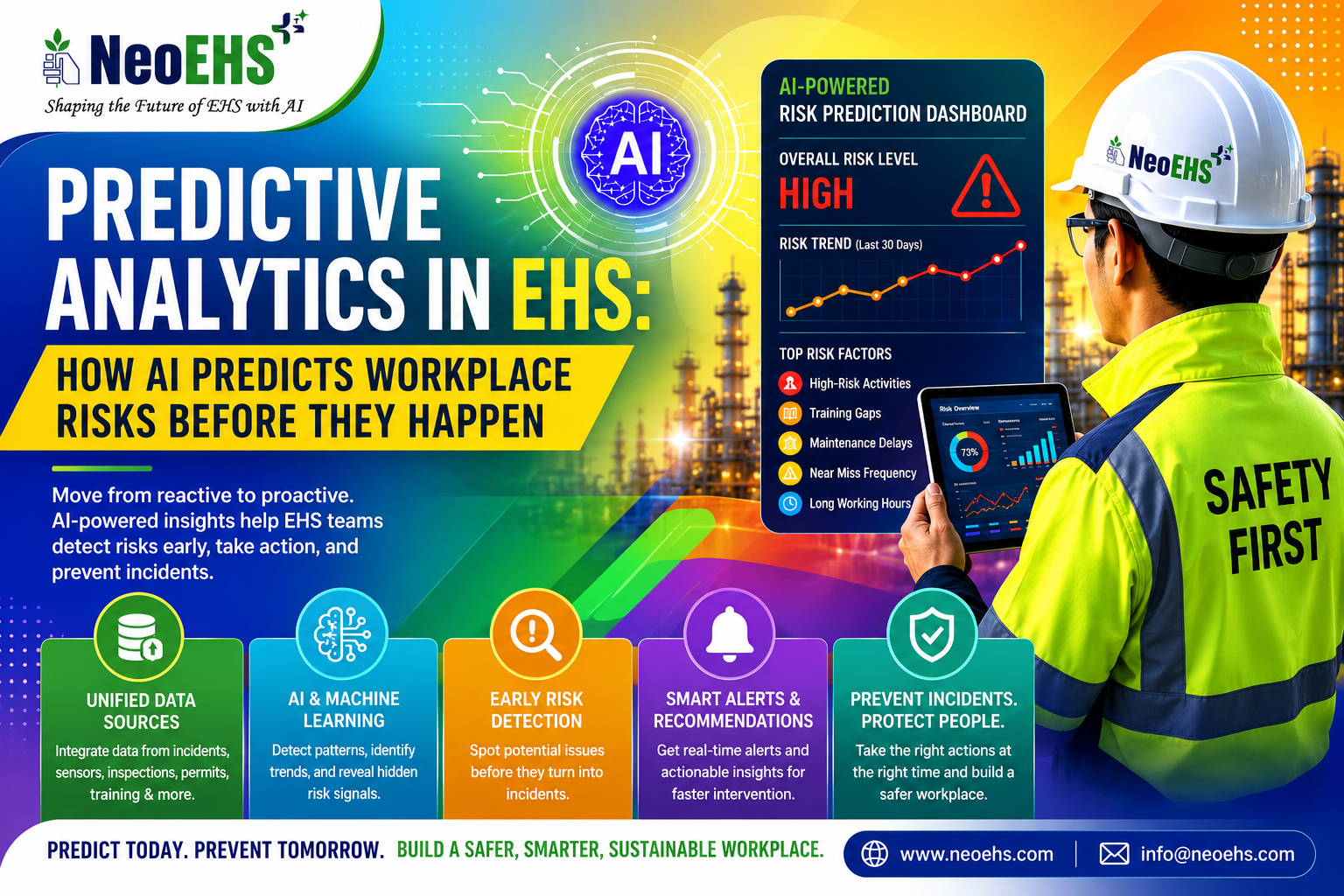
From Reactive to Predictive Safety: How AI Is Transforming EHS Risk Management
For many years, workplace safety has followed a familiar pattern.
An incident happens. The EHS team investigates it. The root cause is identified. Corrective actions are assigned, reports are prepared, and everyone works to make sure the same thing does not happen again.
That process is important. But there is one question that every safety professional would like to answer earlier:
What if we could identify the warning signs before the incident happens?
This is where Predictive Analytics in EHS is beginning to change the way organizations think about workplace safety.
Modern EHS platforms can bring together information from incidents, near misses, safety observations, inspections, audits, permits, training records, equipment, IoT sensors, environmental conditions and other operational systems.
AI and machine learning can then look for patterns across this information that may be difficult to identify manually.
Instead of asking only:
“What went wrong?”
EHS teams can start asking:
“Where is risk increasing, and what can we do about it now?”
That is the real opportunity behind AI-powered workplace safety.
NeoEHS brings these capabilities together to help organizations move from reactive incident management toward proactive and predictive risk management.
What Is Predictive Analytics in EHS?
Predictive analytics in EHS is the use of artificial intelligence, machine learning, historical safety data and real-time operational information to identify patterns that may indicate an increased likelihood of workplace risk.
Traditional EHS software is very good at recording what has already happened.
It can capture:
- Incidents
- Near misses
- Hazards
- Safety observations
- Inspections
- Audits
- Training records
- Permit violations
- Equipment problems
- Environmental measurements
- Corrective actions
But predictive analytics takes the next step.
Instead of simply storing the information, AI can analyze relationships between different data points and identify patterns that may otherwise remain hidden.
For example, imagine a site where:
Long working hours + high-risk activity + training gaps + maintenance delays + repeated near misses
are appearing together.
Each factor may look manageable on its own.
Together, however, they may indicate a significantly higher level of risk.
This is where AI-powered EHS software can provide valuable early insight to the safety team.
Why Traditional EHS Management Is Not Enough
Traditional safety management is not going away. Incident investigations, inspections, audits, risk assessments and corrective actions remain essential.
The challenge is that much of traditional EHS management is based on what has already happened.
The conventional cycle looks like this:
Incident → Investigation → Corrective Action → Preventive Action
A more proactive approach looks different:
Data → Risk Detection → Prediction → Intervention → Prevention
This is one of the biggest changes that AI in EHS can bring to an organization.
Rather than relying mainly on lagging indicators such as injuries and incidents, organizations can use leading indicators to understand whether safety conditions are improving or deteriorating.
The goal is not to replace traditional EHS processes.
It is to make them smarter.
How Does AI Predict Workplace Risks?
AI does not predict workplace incidents through guesswork.
It analyzes large amounts of structured and unstructured information to identify relationships, trends, anomalies and recurring risk patterns.
An AI-powered EHS system can potentially bring information together from several different sources.
1. Historical Incident Data
Past incidents contain valuable information about organizational risk.
AI can analyze factors such as:
- Incident frequency
- Incident type
- Location
- Department
- Activity
- Shift
- Equipment involved
- Root cause
- Severity
- Corrective actions
- Recurrence
Over time, these patterns can help identify areas where risk may be increasing.
For example, if similar incidents repeatedly occur during a particular activity, shift or location, that pattern deserves closer attention.
2. Near Misses and Safety Observations
Near misses are often some of the most valuable leading indicators in an EHS program.
A serious incident may be preceded by many smaller warning signs.
Consider a situation where safety observations repeatedly show:
- Unsafe work-at-height practices
- PPE non-compliance
- The same project location
- The same contractor
- Similar observations over several weeks
Individually, these observations may appear to be minor.
When AI analyzes them together, however, they may reveal an emerging risk pattern.
This is one of the practical applications of predictive safety analytics.
3. Inspection and Audit Data
Inspections and audits generate a large amount of safety information.
But simply recording findings is not enough.
AI can help identify:
- Frequently repeated findings
- Overdue corrective actions
- High-risk locations
- Recurring equipment deficiencies
- Declining compliance
- Repeated contractor issues
- Areas where corrective actions are not producing sustainable improvement
This allows EHS teams to spend more time addressing the areas that require attention instead of manually searching through thousands of records.
4. Permit-to-Work Data
Permit-to-Work systems contain some of the most important information about high-risk activities.
This includes:
- Hot Work Permits
- Confined Space Entry Permits
- Work-at-Height Permits
- Electrical Work Permits
- Excavation Permits
- LOTO activities
- Lifting Permits
- Permit deviations
- Approval patterns
When permit information is combined with incidents, observations, training and equipment data, it becomes a powerful source for EHS risk management.
For example, suppose a site begins showing:
More permit deviations + increasing near misses + overdue maintenance + competency gaps
AI can recognize that these signals are appearing together and highlight the situation for further investigation.
The system is not saying that an incident will definitely happen.
It is saying that the risk profile has changed.
That distinction is important.
5. Training and Competency Data
People are at the heart of workplace safety.
Employees working on high-risk activities need the right training, certifications and competencies.
AI can analyze whether workers involved in particular activities have:
- Completed mandatory training
- Valid certifications
- Expired qualifications
- Repeated training gaps
- Required competencies
- Relevant experience
This can help organizations identify competency-related workplace risks before work begins.
For example, if a high-risk activity is scheduled and several assigned workers have expired certifications, the EHS system can flag the situation before the task starts.
6. Equipment and IoT Data
The growth of connected equipment and IoT technology is creating new opportunities for AI workplace safety.
Modern organizations can collect real-time information such as:
- Temperature
- Gas levels
- Noise
- Air quality
- Equipment vibration
- Pressure
- Machine operating conditions
- Worker location
- Environmental conditions
AI can combine these signals with historical EHS information.
This creates a connection between operational data and safety risk management that was difficult to achieve with traditional systems.
For example, abnormal equipment vibration combined with a history of machinery-related incidents could indicate that an asset requires closer inspection.
From EHS Data to Safety Intelligence
One of the biggest advantages of predictive analytics is the ability to connect information that traditionally exists in separate systems.
Consider a construction project experiencing:
- Increasing safety observations
- Several overdue corrective actions
- High employee overtime
- Multiple recent near misses
- Increased work-at-height activity
- Expiring worker certifications
- Unfavorable weather conditions
A traditional dashboard might show these as separate numbers.
An AI-powered EHS platform can look at the bigger picture.
The combined signals may indicate:
Elevated work-at-height risk.
That gives the EHS team an opportunity to investigate and intervene before the situation becomes an incident.
This is the difference between data reporting and risk intelligence.
Leading Indicators vs. Lagging Indicators
To understand predictive EHS, it is useful to understand the difference between leading and lagging indicators.
Lagging Indicators
Lagging indicators tell us what has already happened.
Examples include:
- Lost-time injuries
- Recordable incidents
- Fatalities
- Property damage
- Environmental incidents
- Occupational illnesses
These metrics remain important.
But they provide limited warning before an event occurs.
Leading Indicators
Leading indicators provide information about conditions that may influence future safety performance.
Examples include:
- Safety observations
- Near misses
- Training completion
- Inspection findings
- Corrective-action closure
- Permit compliance
- Risk assessments
- Preventive maintenance
- Employee engagement
- Unsafe behavior trends
AI can analyze both leading and lagging indicators to understand relationships between them.
The objective is not to abandon traditional safety metrics.
It is to use them more intelligently.
How NeoEHS Uses AI-Powered Predictive Analytics
NeoEHS is designed to bring multiple EHS data sources together and turn them into actionable safety intelligence.
The platform can connect information across areas such as:
- Incident Management
- Risk Management
- Hazard Management
- Inspection Management
- Audit Management
- Permit Management
- Training Management
- Compliance Management
- Environmental Management
- Emergency Management
- PPE Management
- Machinery Management
This creates a connected EHS data environment.
Once the information is connected, AI can identify relationships between different datasets and highlight emerging patterns.
Instead of asking an EHS manager to manually review thousands of records, the system can help direct attention toward areas where the risk signals are becoming stronger.
Predictive Risk Scoring
One of the practical applications of predictive risk management is dynamic risk scoring.
Imagine a project where:
| Risk Factor | Current Signal |
|---|---|
| Near Misses | Increasing |
| Safety Observations | Increasing |
| Corrective Actions | Overdue |
| Training Compliance | Declining |
| Permit Deviations | Increasing |
| Equipment Condition | Deteriorating |
| Environmental Conditions | Unfavorable |
Looking at these factors individually may not tell the whole story.
AI can analyze the combined signals and generate a more meaningful view of the changing risk profile.
This allows EHS leaders to prioritize resources based on risk intelligence rather than simply the number of open records.
AI-Powered Early Warning for EHS Teams
The real value of predictive analytics is not another dashboard.
It is the ability to provide an early warning for workplace safety risks.
Imagine an EHS manager receiving an alert:
“Risk levels for confined-space activities have increased at Site B based on recent observations, permit deviations, equipment conditions and training gaps.”
The EHS team can then investigate.
Depending on the situation, preventive actions might include:
- Reviewing the permit
- Reassessing the risk
- Verifying worker competency
- Inspecting equipment
- Increasing supervision
- Conducting a toolbox meeting
- Strengthening control measures
- Temporarily stopping the activity
The objective is simple:
Intervene before the incident.
Predictive Analytics Across High-Risk Industries
Predictive analytics can be especially valuable in industries where multiple risk factors interact.
Construction
AI can identify patterns involving:
- Work at height
- Excavation
- Lifting operations
- Contractor safety
- Equipment usage
- Permit compliance
- Site observations
Manufacturing
Predictive safety analytics can help identify:
- Machinery-related risks
- Maintenance-related hazards
- Unsafe behaviors
- Production-related safety patterns
- Chemical exposure risks
Mining
AI can analyze:
- Equipment conditions
- Worker observations
- Environmental conditions
- Vehicle movement
- Fatigue-related indicators
- High-risk operations
Oil & Gas
Predictive analytics can support:
- Process safety
- Permit-to-work management
- Confined-space operations
- Hot work
- LOTO
- Gas monitoring
- Equipment integrity
Power & Energy
AI can help identify patterns involving:
- Electrical work
- Equipment failures
- Isolation procedures
- Permit deviations
- Maintenance activities
- Contractor safety
Ports & Maritime
Predictive models can analyze:
- Vehicle movement
- Lifting operations
- Cargo handling
- Weather conditions
- Equipment risks
- Worker observations
The underlying principle remains the same:
Connect the data, identify the pattern and act before the risk becomes an incident.
AI and Computer Vision: Continuous Safety Monitoring
Predictive analytics becomes even more powerful when combined with AI-based computer vision.
CCTV cameras and video analytics can potentially identify conditions such as:
- Missing PPE
- Unsafe access
- Restricted-area entry
- Unsafe proximity to machinery
- Unsafe work practices
- Vehicle-pedestrian interaction
- Potential fall-risk situations
Traditional inspections provide snapshots of workplace conditions.
Computer vision can support a more continuous view of critical areas.
When video analytics is combined with incidents, observations, permits and other EHS information, organizations can build a broader picture of workplace risk.
This combination of computer vision and predictive safety analytics represents an important direction for the future of EHS technology.
Predictive Analytics and Agentic AI
The next evolution of EHS technology is moving beyond analytics toward Agentic AI.
Traditional analytics may tell an EHS professional:
“Risk is increasing.”
More advanced AI systems can potentially help answer:
“Why is the risk increasing?”
“Which risk should be addressed first?”
“Who needs to know?”
“Which controls should be reviewed?”
“What preventive action should be considered?”
This creates a more intelligent EHS workflow where AI supports the safety team throughout the decision-making process.
However, there is an important principle that should never be forgotten:
AI should support EHS professionals, not replace their judgment.
Safety decisions often require practical experience, site knowledge, professional expertise and human accountability.
AI can provide the intelligence.
People remain responsible for the decision.
From Reactive Safety to Predictive Safety
The evolution of EHS technology can be viewed in four stages.
Stage 1 — Reactive Safety
Incident happens → Investigate
Stage 2 — Preventive Safety
Identify hazards → Implement controls
Stage 3 — Proactive Safety
Analyze leading indicators → Identify emerging risks
Stage 4 — Predictive Safety
AI analyzes data → Identify elevated risk → Support preventive action
This is the direction in which modern AI-powered EHS software is evolving.
The objective is no longer simply to record what happened.
It is to understand what the available data is telling us about what could happen next.
Benefits of Predictive Analytics in EHS
Organizations implementing predictive analytics can potentially achieve several important benefits.
Earlier Risk Identification
AI can help identify changing risk patterns before they develop into incidents.
Better Safety Decisions
EHS leaders can make decisions using a broader view of available data instead of relying only on historical reports.
Smarter Resource Allocation
Safety teams can focus their time and resources on higher-risk locations, activities, projects and departments.
Reduced Recurring Incidents
AI can identify repeated patterns and highlight areas where existing corrective actions may not be solving the underlying problem.
Improved Compliance Visibility
Organizations can identify emerging compliance gaps earlier and take corrective action.
Real-Time Risk Visibility
Integration with mobile applications, IoT devices, sensors and other systems can provide a more current picture of workplace conditions.
Stronger Safety Culture
When employees see that near misses and observations are not simply recorded but actually used to prevent incidents, safety reporting becomes more meaningful.
Can AI Really Predict a Workplace Accident?
This is an important question.
Predictive analytics should not be misunderstood as a crystal ball.
AI cannot reliably tell an organization:
“An accident will happen tomorrow at 3:15 PM.”
That is not what predictive EHS analytics is designed to do.
Instead, AI identifies risk patterns, probabilities and changing conditions.
For example:
“This activity currently shows a higher risk profile based on historical incidents, recent observations, training gaps, equipment conditions and permit deviations.”
That information gives EHS professionals an opportunity to investigate and take action.
The objective is not perfect prediction.
The objective is:
Earlier intervention.
The Future of AI-Powered EHS
The future of workplace safety will increasingly depend on connected data and intelligent systems.
We are moving toward an ecosystem that brings together:
AI + Machine Learning + IoT + Computer Vision + Mobile Applications + Wearables + Digital Permits + Environmental Sensors + Predictive Analytics + Agentic AI
When these technologies work together, EHS software can become more than a system for recording information.
It can become an intelligent safety layer across the organization.
Instead of simply telling management what happened, the platform can help identify patterns, highlight emerging risks and support better preventive decisions.
Building a Predictive Safety Culture
Technology alone cannot create a safer workplace.
Even the most advanced AI in EHS solution depends on strong organizational foundations.
Organizations still need:
- Strong leadership commitment
- Employee participation
- Accurate EHS data
- Consistent reporting
- Effective risk assessments
- Timely corrective actions
- Competent EHS professionals
- Continuous improvement
AI becomes more valuable when these foundations are strong.
The better the quality of the data, the more useful predictive analytics can become.
In other words:
Better data → Better insights → Better decisions → Better prevention
Conclusion: The Future of Workplace Safety Is Predictive
Workplace safety is moving beyond reactive reporting toward predictive safety intelligence.
The organizations that lead this transformation will not only ask:
“How many incidents did we have?”
They will also ask:
“Where is risk increasing?”
“Why is it increasing?”
“What signals are we seeing today?”
“What could happen next?”
And most importantly:
“What can we do now to prevent it?”
That is the real promise of Predictive Analytics in EHS.
By combining AI, machine learning, historical EHS data, real-time operational information, IoT, computer vision and connected EHS workflows, organizations can turn safety data into meaningful risk intelligence.
NeoEHS is helping organizations move toward this future — from knowing what happened to understanding what could happen next.
NeoEHS — Shaping the Future of EHS With AI
Build a safer workplace with AI-powered EHS software, predictive risk management, intelligent safety insights and connected EHS management.
Learn more about NeoEHS:
www.neoehs.com
Frequently Asked Questions
What is predictive analytics in EHS?
Predictive analytics in EHS uses AI, machine learning and safety data to identify patterns and indicators that may be associated with future workplace risks.
How does AI predict workplace risks?
AI can analyze information such as incidents, near misses, observations, inspections, permits, training, equipment conditions and environmental data to identify emerging risk patterns.
Can AI prevent workplace accidents?
AI cannot guarantee that an accident will not occur. However, predictive analytics can identify elevated risk conditions earlier, giving EHS professionals an opportunity to investigate and take preventive action.
What data is required for predictive EHS analytics?
Useful data can include incidents, near misses, safety observations, inspections, audits, risk assessments, permits, training records, corrective actions, equipment information, environmental measurements and IoT data.
What is the difference between predictive and reactive EHS?
Reactive EHS primarily responds after an event occurs. Predictive EHS uses data and AI to identify emerging risk patterns and support intervention before an incident occurs.
Is predictive analytics useful for construction and high-risk industries?
Yes. Predictive analytics can be particularly valuable in construction, mining, oil and gas, manufacturing, power and energy, logistics, ports and maritime, and other industries where multiple risk factors interact.
Does AI replace EHS professionals?
No. AI should support EHS professionals by processing large amounts of information, identifying patterns and providing actionable insights. Human expertise remains essential for risk assessment, decision-making and implementation of controls.
- Predictive Analytics in EHS
- AI in EHS
- AI-powered EHS software
- workplace risk prediction
- predictive safety analytics
- EHS risk management
- workplace safety AI
- predictive risk management
- AI workplace safety
- predictive EHS software
- AI safety management
- EHS predictive analytics
- workplace safety technology
- AI-powered safety management
- proactive safety management
- intelligent EHS software
- how predictive analytics works in EHS
- how AI predicts workplace risks
- how AI can improve workplace safety
- predictive analytics for workplace safety
- AI-powered predictive safety management
- predictive risk analytics for EHS
- AI in occupational health and safety
- predictive analytics for construction safety
- AI-powered EHS software for high-risk industries
- how AI helps prevent workplace incidents
- future of AI in EHS management
#PredictiveAnalytics #EHS #EHSManagement #AIinEHS #WorkplaceSafety #SafetyManagement #PredictiveSafety #AIWorkplaceSafety #EHSSoftware #AIpoweredEHS #RiskManagement #PredictiveRiskManagement #SafetyTechnology #OccupationalSafety #ConstructionSafety #MiningSafety #IndustrialSafety #DigitalEHS #ArtificialIntelligence #NeoEHS #AgenticAI #ComputerVision #IoT #SafetyInnovation #FutureOfEHS