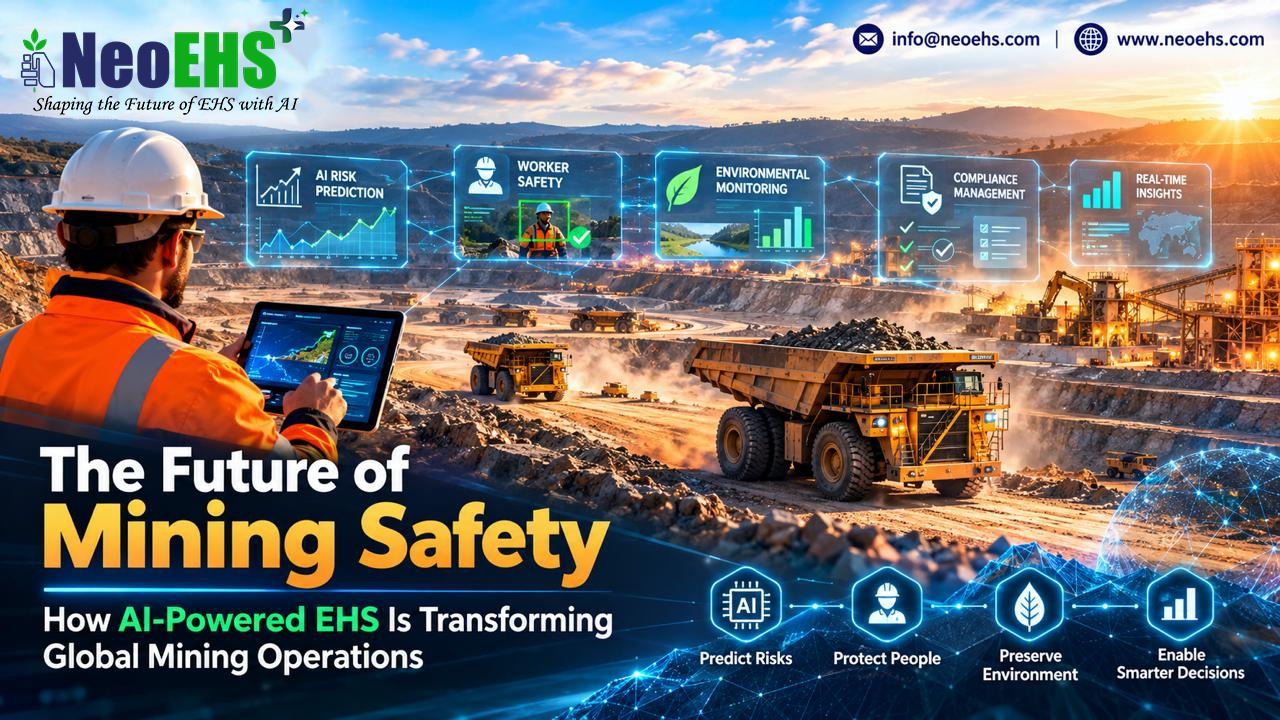
The Future of Mining Safety with NeoEHS: How AI-Powered EHS Is Transforming Global Mining Operations
Mining Safety Is Changing Faster Than Ever, How NeoEHS will help
A mine can invest millions in advanced equipment, automation and monitoring systems, yet a single overlooked hazard can still put workers, production and the environment at risk.
Across the mining industry, safety teams face a familiar challenge: operations are becoming more sophisticated, but essential safety information often remains scattered across inspection records, incident reports, spreadsheets, permit registers and contractor systems.
This gap matters.
A warning identified during an equipment inspection may not reach the maintenance team quickly enough. A recurring near miss may be investigated without revealing a wider operational pattern. A high-risk task may be approved without everyone having a complete picture of nearby activities.
The next generation of mining safety management aims to address these problems by connecting people, processes and operational information.
AI-powered Environment, Health and Safety (EHS) software is helping mining organizations move from reactive incident management toward more proactive, risk-based safety management.
For open-pit mines, underground operations, mineral processing facilities and remote mining sites, this represents an important opportunity to improve how risks are identified, communicated and controlled.
What Is AI-Powered EHS Software for Mining?
AI-powered EHS software for mining is a digital safety management platform that combines established EHS workflows with artificial intelligence, analytics and connected data to support hazard identification, risk assessment, incident investigation, inspections, compliance management and preventive action.
Unlike traditional systems that primarily store records, AI-enabled platforms can help safety professionals identify patterns, prioritize emerging risks and make better-informed decisions.
For example, when multiple inspections identify similar equipment defects, an AI-supported system may help highlight the recurring issue before it develops into a more serious failure.
The purpose is not to replace experienced mining engineers, supervisors or safety officers. It is to give them more useful information and reduce the administrative effort involved in managing complex safety processes.
Why Traditional Mining Safety Systems Are No Longer Enough
Mining operations rarely face one isolated safety challenge. Risks develop through interactions between equipment, workers, contractors, environmental conditions and operational decisions.
Some common limitations of conventional safety management include:
-
Delayed reporting from remote or underground locations.
-
Disconnected inspection, incident and corrective-action records.
-
Limited visibility across multiple mines and contractor teams.
-
Manual monitoring of permits and high-risk activities.
-
Difficulty identifying recurring hazards across departments.
-
Significant time spent preparing compliance reports.
-
Inconsistent follow-up on preventive and corrective actions.
These challenges do not necessarily mean an organization has poor safety practices. They often indicate that its information systems have not kept pace with operational complexity.
A connected EHS platform can make important safety information easier to capture, share, analyze and act upon.
Seven Ways AI-Powered EHS Is Transforming Mining Safety
1. Predictive Safety Analytics: Recognizing Risk Patterns Earlier
Traditional safety reporting often focuses on events that have already occurred.
Predictive analytics takes a different approach by examining historical incidents, inspection findings, near misses, equipment observations and other relevant information to identify patterns associated with elevated risk.
Consider a large open-pit mine where haul-truck near misses repeatedly occur around a particular intersection.
Rather than reviewing each event independently, analytics may reveal relationships involving shift changes, traffic volume, visibility, road conditions or operational schedules.
Safety managers can then investigate the pattern and strengthen controls before a serious collision occurs.
Predictive models are decision-support tools, not guarantees. Their effectiveness depends on data quality, validation and appropriate human review.
2. Computer Vision: Supporting Safer Mining Environments
Computer vision uses AI to interpret visual information from cameras and other imaging systems.
In suitable mining environments, computer vision can support monitoring for:
-
Missing or incorrectly worn personal protective equipment.
-
Unauthorized entry into restricted areas.
-
Unsafe proximity between people and mobile equipment.
-
Potentially unsafe activities near machinery.
-
Selected operational hazards visible within camera coverage.
For example, an appropriately configured system may detect a person entering a designated exclusion zone around operating equipment and notify authorized personnel.
However, camera placement, lighting, dust, occlusion and model performance can affect detection reliability.
Computer vision should complement physical barriers, traffic management, supervision and other established critical controls—not replace them.
3. Digital Permit-to-Work: Improving Control of High-Risk Activities
Mining maintenance and construction activities often involve hot work, confined spaces, electrical isolation, working at heights, excavation and simultaneous operations.
A digital Permit-to-Work (PTW) process helps organizations manage these activities through structured workflows.
With a connected EHS system, authorized personnel can review hazard assessments, verify required approvals, document isolations and track permit status.
For instance, when maintenance is scheduled on a conveyor system, the permit workflow can help ensure that relevant safety checks and authorizations are completed before work begins.
Integration with competency records, risk assessments and action tracking can provide further visibility.
Explore the NeoEHS platform at www.neoehs.com.
4. Intelligent Incident and Near-Miss Management
Every incident and near miss contains information that can help prevent future harm.
The challenge is turning individual reports into organizational learning.
AI-assisted incident management can support classification, identify recurring themes and help investigators review similar historical events.
Imagine three separate mines reporting incidents involving mobile-equipment blind spots.
Individually, these may appear unrelated. When reviewed together, they may reveal a common weakness in traffic separation, equipment configuration or worker awareness.
A connected incident management process can help safety teams investigate the underlying causes, assign corrective actions and verify their effectiveness.
AI can assist analysis, but investigation findings and causal conclusions should remain subject to competent human review.
5. Digital Safety Inspections Across Remote Mining Sites
Mining inspections cover an extensive range of activities, from heavy equipment and electrical installations to underground ventilation, emergency equipment and processing facilities.
Paper-based inspections can delay the reporting and resolution of hazards.
Mobile inspection workflows allow workers to record findings, attach photographs, document deficiencies and assign follow-up actions.
Where offline functionality is supported, field teams can capture information in areas with limited connectivity and synchronize records when a connection becomes available.
This is particularly valuable for geographically dispersed mining operations.
Digital inspections also create more consistent records for management reviews and regulatory audits.
6. Connected Worker Safety Through IoT and Wearables
Connected-worker technologies can provide additional information about worker location, environmental conditions and selected exposure risks.
Depending on the equipment and infrastructure deployed, mining organizations may use connected technologies for gas monitoring, environmental measurements, emergency alerts and worker-related safety indicators.
For example, a hazardous-gas reading from a connected monitoring device may initiate an alert to designated personnel.
Such technologies require appropriate device certification, reliable communications, calibration, maintenance and emergency response procedures.
When integrated responsibly with EHS workflows, connected-worker data can help teams respond more consistently to hazardous conditions.
7. Environmental Monitoring and Sustainable Mining
Modern mining safety extends beyond occupational injuries.
Dust exposure, water quality, hazardous substances, waste management, energy consumption and tailings-related risks are also important management responsibilities.
Digital EHS systems can help organize environmental inspections, monitoring records, nonconformities, corrective actions and reporting activities.
Where suitable integrations exist, monitoring data can also support earlier identification of abnormal environmental conditions.
For mining companies pursuing stronger sustainability performance, connecting environmental and occupational safety information can improve governance and accountability.
How NeoEHS Supports Modern Mining Operations
NeoEHS — AI-Powered Environment, Health and Safety Management Software
NeoEHS is designed to support organizations managing complex EHS responsibilities across high-risk industries, including mining.
Its digital EHS approach brings together important safety management processes and supports the transition from disconnected records toward more integrated operational oversight.
Relevant solution areas include incident and near-miss management, risk and hazard management, digital safety inspections, permit-to-work, contractor safety, corrective and preventive actions, audits, environmental management and EHS dashboards.
AI and analytics can extend these capabilities through pattern recognition, risk prioritization and intelligent workflow assistance, subject to the features and integrations enabled for each deployment.
For a mining organization operating multiple sites, the value of a unified approach is particularly clear: consistent processes, consolidated safety information and better visibility into unresolved risks.
The goal is to help mining professionals spend less time managing fragmented information and more time improving safety performance.
Practical Mining Scenario: Preventing a Haul-Truck Collision
Consider an illustrative open-pit mining operation with heavy haul trucks, light vehicles and maintenance personnel moving between work areas.
Over several weeks, the safety team receives multiple observations about poor visibility at a busy intersection.
A conventional reporting process might treat these as separate findings.
In a connected digital EHS environment, the observations can be grouped, reviewed alongside inspection findings and escalated for risk assessment.
The resulting actions may include traffic-flow changes, improved road signage, additional physical separation, revised operating procedures and targeted worker briefings.
Management can then track completion and verify whether the controls are effective.
AI-supported analytics may help identify the recurring pattern sooner, but the preventive measures still depend on competent assessment, engineering decisions and operational accountability.
This is the practical meaning of proactive mining safety: using available information to strengthen controls before a serious event occurs.
Measuring the Success of Digital Mining Safety
Mining organizations should evaluate digital EHS initiatives through meaningful performance indicators rather than software adoption alone.
Useful measures include:
|
Performance indicator |
What it helps evaluate |
|---|---|
|
Critical-control verification completion |
Whether important risk controls are being checked |
|
Overdue corrective actions |
Effectiveness of action ownership and follow-up |
|
High-potential near-miss trends |
Emerging serious-risk patterns |
|
Inspection completion and finding closure |
Inspection discipline and resolution |
|
Permit compliance and exceptions |
Control of high-risk work |
|
Contractor competency verification |
Workforce authorization and readiness |
|
Environmental exceedances and response time |
Environmental management performance |
|
Repeat incident causes |
Effectiveness of organizational learning |
These indicators should be interpreted together. A rise in reported near misses, for example, may reflect improved reporting culture rather than deteriorating safety performance.
What Mining Leaders Should Consider Before Adopting AI-Powered EHS
Successful implementation requires more than selecting software.
Mining companies should begin by identifying their highest-consequence risks and the operational processes that need improvement.
Data quality is equally important. Inconsistent classifications, incomplete investigations and poorly maintained records can reduce the value of analytics.
Organizations should also consider system integration, cybersecurity, worker privacy, multilingual support, connectivity limitations and the competence of personnel responsible for reviewing AI-assisted recommendations.
For underground or remote operations, availability during communication outages can be especially important.
A phased approach—starting with a clearly defined operational challenge, validating results and expanding gradually—can help organizations achieve sustainable improvements.
The Future: From Digital Records to Connected Safety Intelligence
The next stage of mining safety transformation will involve closer integration between EHS workflows, operational technology, environmental monitoring and AI-supported analysis.
Over time, organizations may be able to combine information from inspections, equipment systems, permits, incidents and connected devices to develop a more comprehensive picture of operational risk.
Agentic AI may also support selected administrative activities, such as preparing investigation summaries, identifying overdue actions and suggesting follow-up tasks.
For safety-critical decisions, however, appropriate authorization, verification and human accountability must remain central.
The future of mining safety is not about removing people from the decision-making process. It is about giving them the information and tools needed to make better decisions.
Conclusion: A Safer Mine Starts with Better Decisions
Mining will always involve complex operational hazards. Technology cannot eliminate every risk, but it can help organizations recognize problems earlier, coordinate preventive actions and learn more effectively from experience.
AI-powered EHS software represents an important step toward connected, risk-based safety management.
For mining companies seeking to strengthen incident prevention, contractor oversight, inspections, high-risk work controls and environmental performance, the opportunity is to build a more responsive and accountable safety system.
NeoEHS supports this journey by bringing critical EHS processes together and helping organizations turn safety information into meaningful action.
Explore how NeoEHS can support your mining safety digital transformation.
Website: www.neoehs.com Email: info@neoehs.com
Frequently Asked Questions
What is AI-powered EHS software in mining?
AI-powered EHS software combines digital safety management workflows with artificial intelligence and analytics to help mining organizations manage hazards, incidents, inspections, risk assessments and preventive actions.
How can AI improve mining safety?
AI can help identify recurring risk patterns, analyze incident data, support visual hazard detection and prioritize corrective actions. Its recommendations require appropriate validation and human oversight.
Can AI predict mining accidents?
AI models may estimate elevated risk based on available data, but they cannot reliably predict every accident or guarantee prevention.
What are the benefits of digital EHS software for mining companies?
Potential benefits include more consistent inspections, improved action tracking, better visibility across sites, faster access to safety information and stronger documentation of risk controls.
Can digital EHS systems support underground mines?
Yes. Underground mining can benefit from digital inspections, incident management, risk assessments and connected monitoring, provided the solution is suitable for the site's connectivity, equipment and operational requirements.
Does AI replace mining safety officers?
No. AI is best used to assist qualified safety professionals. Responsibility for risk assessments, critical controls and safety decisions remains with authorized personnel.
How does NeoEHS support mining operations?
NeoEHS brings together EHS management workflows such as incident reporting, risk management, inspections, permits, audits and corrective actions, with AI-supported capabilities available according to the deployment.