AI-Powered Safety Inspections for Metro and Railway Operations
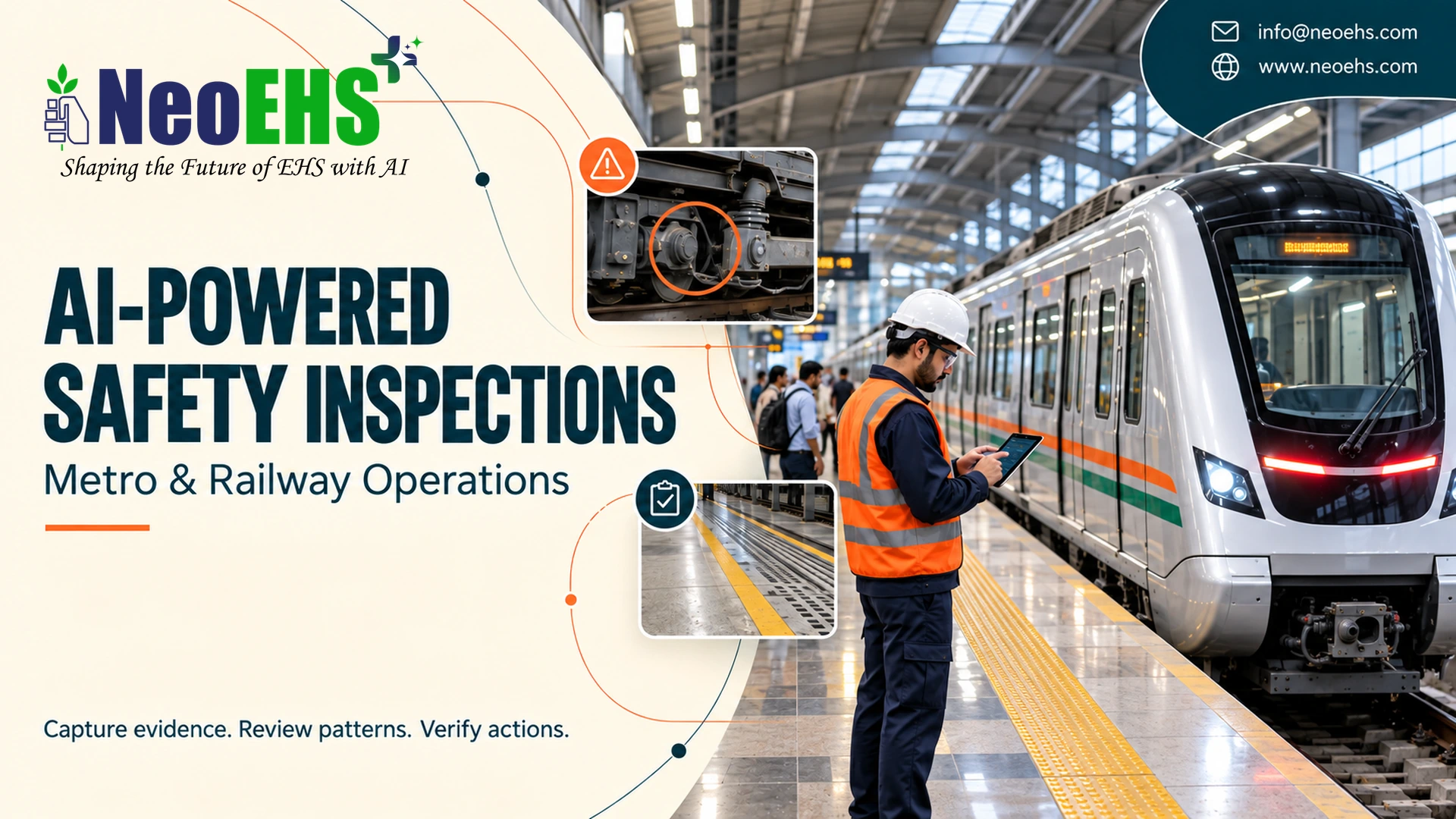
What are AI-powered safety inspections?
AI-powered safety inspections combine digital field checks with AI-assisted analysis of inspection findings, observations and action history. For metro and railway operations, they can help teams review recurring hazards and target follow-up. Inspectors verify conditions, and authorised personnel retain responsibility for safety decisions and corrective-action approval.
The scope of this article is operational EHS inspections: the work environment, activities, controls, evidence and follow-up. It does not describe automated certification of track, signalling, rolling stock or electrical systems.
Three capabilities that should not be confused
| Capability | What it contributes | What it does not establish |
|---|---|---|
| Digital inspection workflow | Consistent questions, field evidence, owners and action records | That a completed form proves a safe condition |
| AI-assisted record analysis | Patterns and suggestions that help people focus their review | That a suggested link is a confirmed cause |
| Configured computer vision | Flags for selected visible conditions within camera coverage | That every hazard is detectable or that no alert means no risk |
This distinction is useful during software evaluation. Ask which capability is included, what information it uses and who must respond to its output.
Why a digital checklist is only the beginning
Rail operations change through the day. A station may have temporary maintenance barriers in the morning and a different pedestrian route later. A depot can receive deliveries after an inspection. Contractors may hand over unfinished work between shifts.
A checklist captures a moment. To remain useful, the inspection process needs to recognise changes and connect them with earlier findings.
Consider three records: “access restricted”, “materials near walkway” and “temporary storage beside workshop”. The wording is different. If all three concern the same place and activity, they deserve a combined review. If they concern different circumstances, grouping them together could mislead the team.
Consistent locations, activity descriptions and control information make analysis more meaningful. AI cannot recover context that nobody recorded.
How NeoEHS supports inspection management
NeoEHS is an AI-powered Environment, Health and Safety system. Its Inspection Management software describes configurable checklists, photo and video evidence, mobile and offline capture, action assignment, verification workflows and analysis of recurring findings.
These capabilities provide a foundation for organising field information. The workflow below shows how a rail team can use that foundation; the exact configuration and available AI functions should be confirmed for the deployment.
1. Define the inspection around the work
Start with the activity, location and controls that need checking. A workshop inspection should reflect its current tasks. A station inspection should account for temporary arrangements as well as routine conditions.
Give inspectors a way to record unexpected concerns. Review templates when the work changes rather than allowing yesterday’s questions to become a permanent substitute for observation.
2. Capture evidence that another person can understand
A helpful finding tells the reviewer what was observed, where it occurred, who may be exposed and which control needs attention. It also records the activity underway and any immediate response.
“Area unsafe” is difficult to act on. “Delivery materials narrowing the marked pedestrian route beside Workshop B during unloading” gives the next person something specific to investigate. A suitable photograph and location reference add context.
Offline capture can help teams record findings in low-connectivity areas. Urgent concerns still need the operator’s immediate communication and escalation route. An unsynchronised record is not evidence that the responsible person has been notified.
3. Review patterns without losing the detail
NeoEHS describes AI-supported analysis of inspection records, observations and action history. The practical opportunity is to bring recurring themes to a reviewer’s attention.
The reviewer should inspect the source records, check whether the circumstances are comparable and decide what further investigation is needed. An AI suggestion should remain distinguishable from a confirmed finding.
A location with many reports may have more activity or a stronger reporting culture. Compare the context before labelling it the least safe site.
4. Give every action a clear owner
Once a finding is reviewed, specify the required response, responsible person and due time appropriate to the risk. Keep temporary controls and unresolved concerns visible during handover.
Where an inspection reveals an incident or near miss, use the organisation’s investigation process. NeoEHS Incident Management provides a related workflow for reporting and investigation; inspection closure should not replace that process.
5. Verify what changed
Action completion and action effectiveness answer different questions. Completion asks whether the agreed task was done. Effectiveness asks whether it addressed the problem.
For a recurring condition, check again during the relevant activity. If materials obstructed a route during deliveries, a quiet-period photograph may offer little evidence that the revised arrangement works.
The UK Health and Safety Executive’s guidance on managing risk emphasises reviewing controls, including when work changes or problems are reported. This is a useful management reference; local rail rules and jurisdiction-specific duties still govern the operation.
Practical use cases across metro and railway operations
| Use case | Inspection focus | Useful follow-up |
|---|---|---|
| Station maintenance | Temporary barriers, pedestrian routes and access to designated emergency facilities | Check revised arrangements during the relevant operating conditions |
| Depot deliveries | Materials placed near pedestrian routes and shared work areas | Review receiving arrangements when repeat findings appear |
| Workshop activities | Housekeeping, work-area boundaries and evidence of required task controls | Assign actions to the team able to change the underlying arrangement |
| Contractor handover | Outstanding findings, temporary controls and responsibility | Confirm the incoming team understands unresolved conditions |
| Low-connectivity work areas | Evidence capture and reliable urgent communication | Check synchronisation separately from immediate notification |
These are example EHS applications, not customer outcomes or substitutes for specialist inspection schedules. Work authorisation must remain with authorised personnel. NeoEHS Permit to Work software is a related capability to evaluate where work-control records need coordination.
What computer vision can add
Scheduled inspections cannot observe every activity continuously. NeoEHS AI Computer Vision describes monitoring for configured visual conditions, including missing PPE and entry into restricted zones, with alerts for review.
Before deployment, define the particular condition, camera coverage and response owner. Test the setup under the lighting, weather, obstructions and working practices it will encounter. Record missed detections as well as false alerts, and agree how the team will recognise a loss of coverage.
Visual monitoring cannot confirm an electrical isolation, assess every hidden defect or authorise train movement. It should complement established controls within a clearly defined scope.
An illustrative example: a finding that returns every week
A depot team repeatedly finds materials beside a marked access route. Each report is closed after the materials are moved. The next delivery creates the same condition.
A combined review of the records prompts the team to observe the receiving process. They identify an unsuitable temporary storage arrangement and consider a revised unloading plan with the people doing the work.
The team assigns the agreed changes, records implementation and checks subsequent deliveries. If the obstruction returns, the action is reopened and the arrangement is reviewed again.
This is an illustrative scenario, not a NeoEHS customer case study. It demonstrates a review approach without claiming a measured outcome.
How to evaluate an AI inspection pilot
Choose a manageable area and one problem that matters to the operational team. Avoid beginning with a network-wide rollout or an assumption that every finding needs AI analysis.
- Agree the question. For example: can reviewers identify repeated access-route findings more consistently?
- Define the evidence. Specify mandatory locations, activity details and finding categories.
- Set responsibilities. Name who reviews suggestions, responds to urgent issues and verifies closure.
- Establish a baseline. Record the existing review process, workload and known gaps.
- Compare with competent review. Check a representative sample, including records the AI did not flag.
- Review usefulness and limitations. Examine incorrect groupings, missed patterns and the effort needed to resolve them.
- Decide the next step. Refine the setup, expand a validated use case or stop an unhelpful application.
The NIST AI Risk Management Framework provides a voluntary reference for evaluating AI trustworthiness and managing risk. It is not a certification of NeoEHS or a replacement for a rail operator’s own assurance process.
Measure inspection effectiveness, not just volume
Useful measures include high-priority findings awaiting action, reporting-to-acknowledgement time, repeat findings by activity, reopened actions and closure records with the required evidence.
Define the period and denominator for each measure. For example, a reopening rate needs an agreed cohort of closed actions and a consistent follow-up window. Without those definitions, comparisons can be misleading.
Use inspection counts as an activity measure. Assess control effectiveness through evidence and competent review. A lower number of reports alone does not demonstrate safer work.
Questions to bring to a NeoEHS demonstration
- Which inspection and AI functions are available in the proposed configuration?
- Can reviewers trace a suggestion back to its source records?
- How are offline records, notification failures and overdue actions handled?
- Who can approve, verify, reopen or change a finding?
- What access controls and retention arrangements apply to photos and video?
- How will local validation and ongoing performance review be documented?
Bring a real, appropriately anonymised inspection example. A demonstration based on your workflow is more informative than a screen filled with sample performance figures.
Frequently asked questions
Can AI replace a qualified railway safety inspector?
No. AI can support record analysis and selected visual monitoring. Competent people still inspect conditions, assess the evidence and make authorised safety decisions.
Can NeoEHS support inspections without an internet connection?
NeoEHS describes offline inspection capture with synchronisation when connectivity returns. Confirm the supported devices and workflow during implementation. Urgent hazards require a separate immediate communication route.
Does every AI-powered inspection require CCTV?
No. Analysis of inspection records and corrective-action history is distinct from camera-based monitoring. Computer vision is a separate use case that requires suitable coverage, configuration and validation.
Can this software certify track, signalling or rolling-stock safety?
This article concerns EHS inspection management. Do not treat its workflows or AI outputs as substitutes for prescribed technical testing, certification or authorised rail engineering decisions.
What makes inspection data useful for AI analysis?
Consistent location and activity information, clear finding descriptions, suitable evidence and reliable action history make records easier to compare. Missing context and inconsistent labels can weaken the analysis.
Where should a metro or railway operator start?
Select one operational area and a recurring inspection problem. Agree the evidence, response owners and evaluation criteria, then test usefulness before expanding the scope.
Make inspection findings easier to act on
The purpose of an inspection is to help people understand conditions and improve controls. A useful system makes the evidence accessible, the responsibility clear and the response reviewable.
Explore NeoEHS for Metro and Rail and request an Inspection Management demonstration using a scenario from your operation. For the wider project context, read Digital EHS Management for Metro and Railway Projects.