Digital EHS Management for Metro and Railway Projects
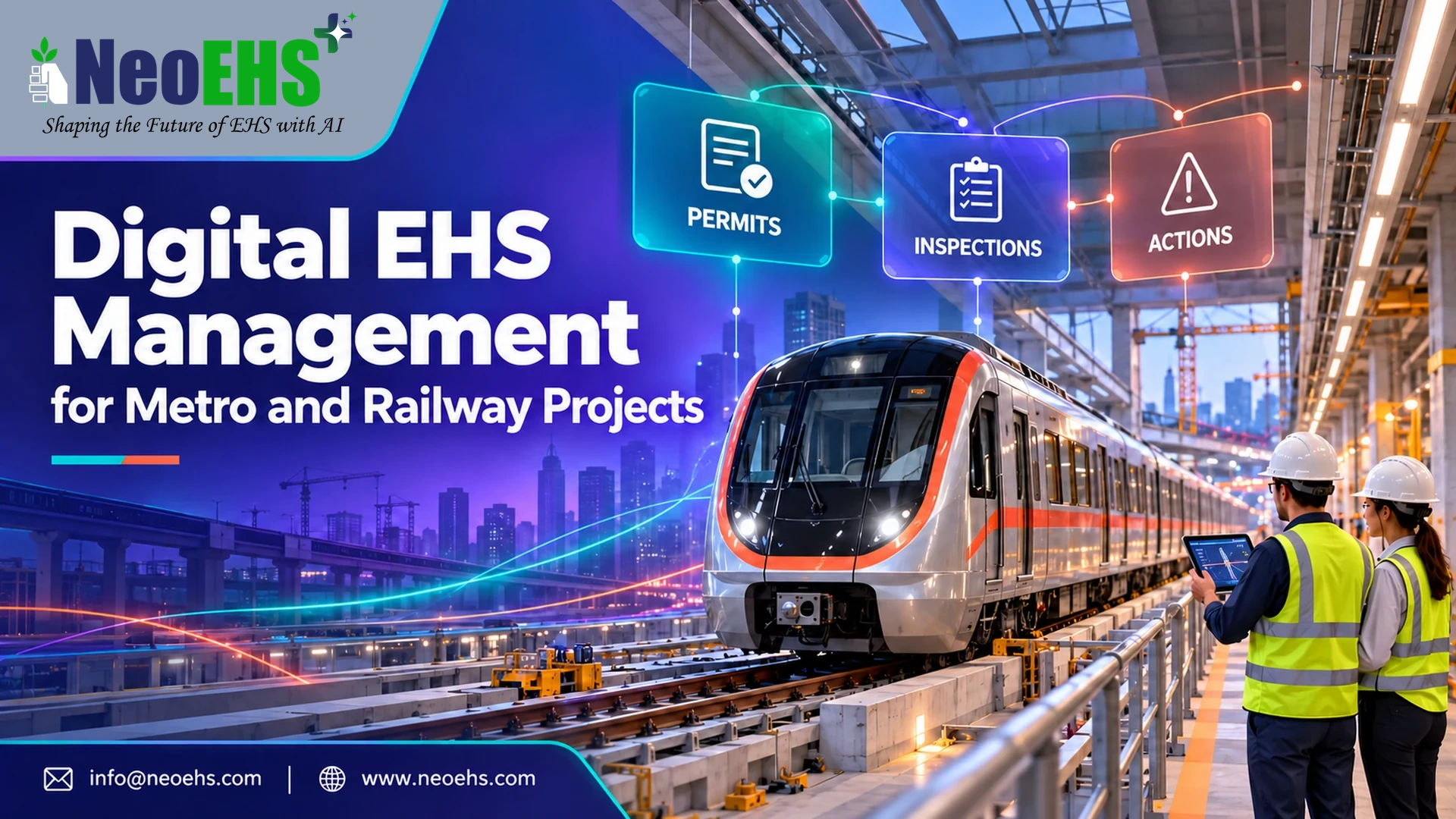
What is digital EHS management for metro and railway projects?
Digital EHS management is the use of connected software to manage environmental, health and safety activities across a rail project's lifecycle. It brings risk assessments, permits, inspections, incident reports, contractor records and corrective actions into structured workflows with clear ownership and traceable evidence.
For metro and railway projects, this means organising information by station, depot, work package, contractor, asset and project phase. Teams can see where an issue belongs, who needs to act and whether the response has been verified.
An EHS platform supports the project safety-management arrangements. It does not replace signalling, train protection, engineering assurance or the authorised processes that control track access and electrical isolation.
Why project interfaces deserve special attention
A contractor may finish a task while leaving a restriction that affects another team. A work area may move from civil construction into systems installation. Testing may introduce energised equipment into a location that workers previously treated as a construction zone.
These transitions create questions that a shared EHS workflow should help answer:
- What has changed since the work was planned?
- Which other activities or teams could be affected?
- Who must review the change before work continues?
- What restrictions and open actions must carry into the next shift?
A useful digital record connects the answers to the actual work package. A document stored in a folder is only helpful if people can find and apply it when conditions change.
Connect EHS across the project lifecycle
| Project phase | EHS priorities | Information to carry forward |
|---|---|---|
| Planning and mobilisation | Responsibilities, risk reviews, contractor onboarding and reporting arrangements | Named owners, accepted requirements and outstanding prerequisites |
| Civil construction and installation | Inspections, work permits, changing site conditions and overlapping activities | Location-specific findings, work restrictions and action evidence |
| Testing and commissioning | Changes in equipment status, access arrangements and interfaces between teams | Current status, authorised approvals and unresolved issues |
| Handover and operations | Residual risks, accepted responsibilities and continuing inspections | Traceable records, open-action ownership and maintenance obligations |
Six workflows that make digital EHS useful on site
1. Risk assessments that remain connected to the work
Risk reviews should be easy to locate against the relevant task, work area and revision. When the method, equipment or conditions change, the workflow should identify who needs to reassess the work and communicate the outcome.
For example, changing an access route during station fit-out may affect several trades. Recording the revised route is only one step; affected supervisors also need to receive and understand the change.
2. Permits with visible dependencies and responsibilities
A digital permit workflow can organise requests, review steps, supporting evidence, approvals and closure. For railway projects, it should fit the operator's approved arrangements for work access and interfaces with other activities.
Digital approval alone does not prove that equipment is isolated or an area is safe. Required checks still need competent people, field verification and the applicable railway procedures. Explore NeoEHS Permit to Work software for connected permit workflows.
3. Inspections that lead to verified closure
An inspection finding needs a clear location, a description of the issue, an accountable owner and a response appropriate to its significance. A photograph can support the record, but it should not replace a meaningful explanation.
Closure should include checking the result. If a missing barrier is reported, uploading a photograph of a replacement may show completion. A reviewer still needs to establish whether it protects the intended area and remains suitable for the work.
NeoEHS Inspection Management provides a relevant starting point for digitising field inspections and follow-up.
4. Contractor records linked to assigned work
Project teams need to understand which contractor is responsible for each activity and which workers have the required induction, competence and authorisation. These are related checks, but they are not interchangeable.
For example, completing a general site induction does not establish competence for a specialist task. Digital records should help reviewers make that distinction and identify records requiring renewal or further review.
5. Incident and near-miss reporting that supports learning
A near miss at one station can reveal a problem relevant to another. Structured reporting makes it easier to compare locations, understand contributing factors and track the resulting actions.
The purpose is not simply to collect more reports. It is to make reporting useful to the people doing the work. A worker who reports a problem should be able to learn what happened next. NeoEHS Incident Management connects reporting with investigation and corrective-action workflows.
6. Environmental and occupational-health follow-up
EHS records should cover environmental and health concerns alongside immediate safety hazards. Depending on the work, this may include dust, noise, vibration, heat exposure, chemicals, waste handling and drainage.
Monitoring results need context: where a measurement was taken, when, under what conditions and what response followed. Applicable limits and obligations depend on the project and jurisdiction. Sensitive personal health information also needs appropriately restricted access.
Where AI adds practical value
AI is most useful when it helps reviewers understand information they already struggle to process. Potential applications include grouping similar observations, identifying repeated findings across work packages and highlighting records that need further attention.
For example, several reports describing blocked access routes may use different wording. AI-assisted analysis can help a reviewer identify the common theme and investigate whether it reflects a wider planning issue.
Computer vision can provide an additional monitoring input for selected use cases. Its performance depends on factors such as camera coverage, lighting, visibility and validation in the actual environment. See NeoEHS AI-Powered Computer Vision.
AI outputs require review. A risk score is not proof that a task is safe, and an alert is not a substitute for an effective response. Project teams should establish who reviews alerts, how false alarms are handled and what happens when an important condition is missed.
A practical example: one finding, several affected teams
The following is an illustrative workflow, not a reported customer result.
During a depot inspection, a supervisor finds materials obstructing a designated access route. Mechanical and electrical contractors both use the area, and another shift is due to start shortly.
- The supervisor records the exact location, photographs and affected work area.
- The responsible team reviews the issue and puts the necessary immediate controls in place.
- An action is assigned to a named owner, with affected supervisors notified.
- The owner records completion and supporting evidence.
- An authorised reviewer checks that the route is suitable before closing the action.
- The incoming shift receives any remaining restrictions, and management reviews repeated access-route findings across the project.
The benefit is a visible chain of responsibility. Everyone can distinguish a reported issue, an action underway and a verified resolution.
Which EHS indicators should project leaders review?
A useful dashboard connects numbers to decisions. The following measures can help teams identify where follow-up is needed:
| Indicator | What to examine |
|---|---|
| Overdue high-priority actions | Severity, age, location, owner and escalation status |
| Inspection completion | Completed versus scheduled inspections, with risk-based coverage |
| Verified closure rate | Actions verified as effective divided by actions submitted for closure during the reporting period |
| Repeated findings | Similar issues recurring after earlier action, using a consistent classification |
| Competency gaps | Missing or expired requirements relevant to the people and work assigned |
| Handover completeness | Whether open issues, restrictions and responsible owners are recorded and acknowledged |
Agree definitions and reporting periods before comparing results. A higher near-miss reporting count can reflect greater willingness to report; it should not automatically be treated as worsening safety. Differences in work exposure and project phase also affect comparisons.
How to introduce digital EHS without overwhelming the workforce
Start with a workflow that has a clear operational problem, such as inspection findings that remain open across shifts. Map how the process works today, who makes decisions and where information is lost.
Configure a consistent location and contractor structure, a short set of essential fields and clear responsibilities. Pilot the workflow on a representative work package, including the field conditions in which people will actually use it.
Check mobile usability, permissions, evidence quality and behaviour during poor connectivity. Where offline functionality is required, test exactly which activities are supported and how synchronisation conflicts are handled.
Expand once the pilot demonstrates that people can report an issue, act on it and verify the outcome. Add further workflows and AI use cases as the underlying information becomes reliable.
How NeoEHS supports metro and railway projects
NeoEHS is an AI-powered Environment, Health and Safety software platform. Its Metro & Rail EHS solution brings together workflows including observations, incidents, inspections, permits, contractor safety and corrective actions.
For a project team, the starting point is the operating model: the locations being managed, the contractors involved, the approval responsibilities and the information required at handover. The configuration and integrations should follow those needs.
Discuss your metro or railway project with NeoEHS. Explore how connected EHS workflows can support clearer responsibilities, timely follow-up and better visibility across your project.
Visit www.neoehs.com | info@neoehs.com
Frequently asked questions
What is the difference between digital EHS and a railway signalling system?
Digital EHS manages workflows such as inspections, reporting, permits and corrective actions. Signalling and train-protection systems manage railway movement and operational protection. Their purposes are distinct; EHS software does not replace those safety-critical systems.
Can one EHS platform cover construction and railway operations?
It can support both when workflows, permissions and records are configured for each phase. Handover needs particular attention so that residual risks, restrictions and open actions retain clear ownership.
Can AI predict every railway incident?
No. AI can help identify patterns and prioritise review, but its output depends on available data and validation. It cannot guarantee incident prevention or replace competent safety decisions.
Does digital EHS software automatically ensure compliance?
No. Software can organise obligations, evidence, responsibilities and review dates. Compliance depends on applicable requirements, competent interpretation and effective controls in practice.
What should a project digitise first?
Choose a recurring problem with a clear owner and measurable outcome. Inspection-to-action closure is often a practical pilot because teams can follow a finding from capture through verification.