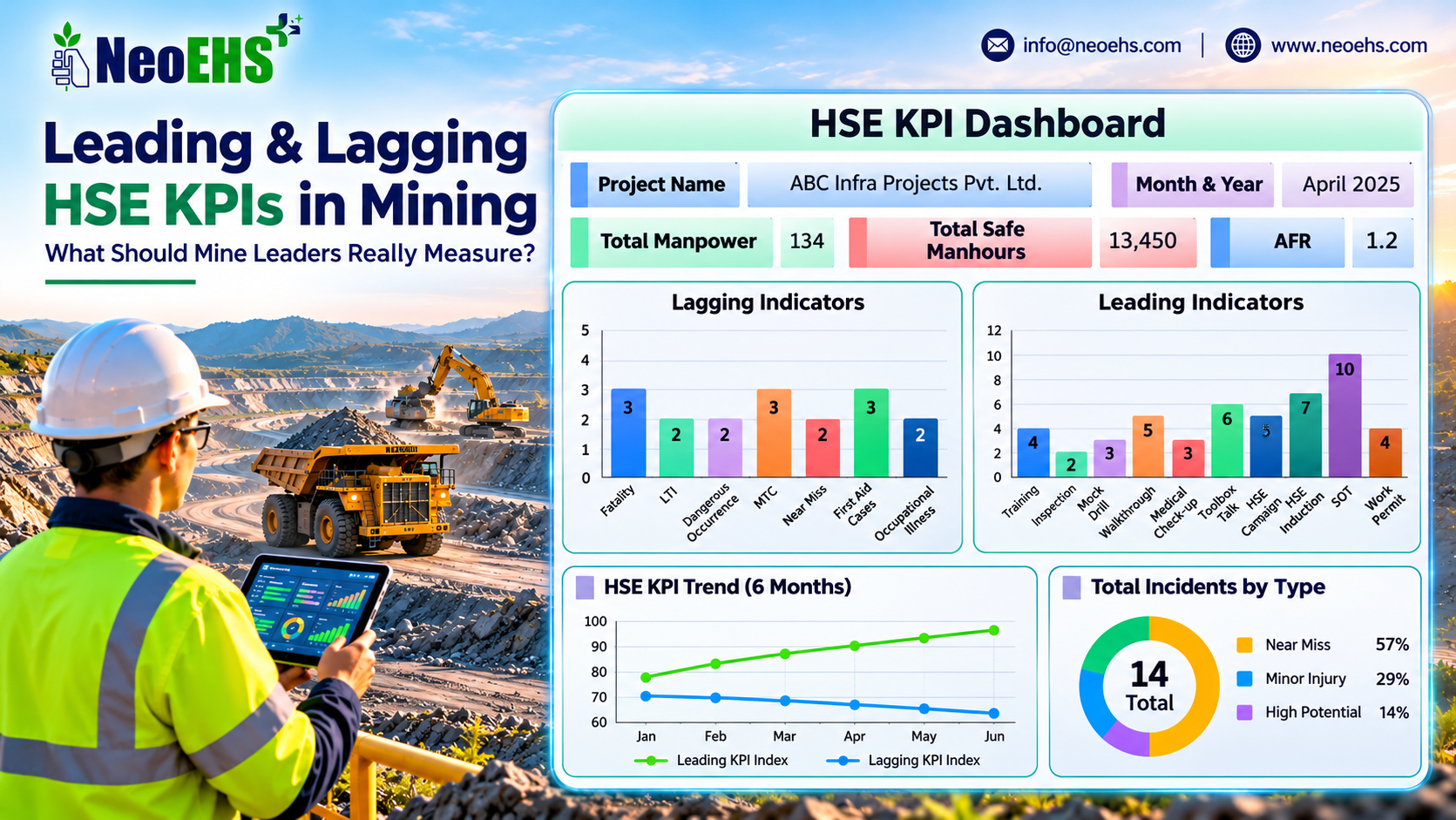
Mining Safety KPI | Leading and Lagging HSE KPIs in Mining: What Should Mine Leaders Really Measure?
A Mine Can Report Zero Lost-Time Injuries and Still Be Exposed to a Major Accident
Imagine two mining operations presenting their monthly Health, Safety and Environment (HSE) performance reports.
Mine A proudly reports 365 days without a lost-time injury. Its dashboard is green, training completion is high, and management celebrates another successful month.
Mine B reports several near misses, identifies weaknesses in mobile-equipment segregation and discovers overdue corrective actions associated with high-risk maintenance work.
At first glance, Mine A appears safer.
But which operation actually understands its risks better?
The answer depends on what lies behind those numbers.
Mine A may have effective controls and genuinely strong performance. Alternatively, important hazards may remain unreported or unrecognized. Mine B may have more visible problems because its workforce actively reports concerns and its management team investigates them.
This illustrates one of the most important challenges in mining safety leadership:
The absence of reported injuries does not necessarily demonstrate the presence of effective risk controls.
Mining operations face hazards that can lead to catastrophic consequences, including mobile-equipment collisions, ground instability, fires, explosions, hazardous energy releases, confined-space incidents and failures involving high-risk infrastructure.
These events may be relatively infrequent, but their consequences can be severe.
Mine leaders therefore need more than a monthly injury-rate report.
They need indicators that explain what has happened, what could happen next and whether the controls intended to prevent serious harm are working.
That is the purpose of combining leading and lagging HSE key performance indicators (KPIs).
What Are Leading and Lagging HSE KPIs in Mining?
Leading HSE KPIs are measures that help mining organizations evaluate preventive activities, operational conditions and the effectiveness of risk controls before an unwanted event occurs.
Examples include critical-control verification, high-risk corrective-action completion, equipment safety checks, competency verification and the timely resolution of serious hazards.
Lagging HSE KPIs measure events and consequences that have already occurred.
Examples include fatalities, lost-time injuries, recordable injuries, occupational illnesses, high-potential incidents and significant environmental events.
Both are necessary.
Leading indicators help leaders understand whether preventive systems are functioning. Lagging indicators reveal actual outcomes and provide evidence of where protection has failed.
The most effective mining HSE scorecard combines outcome measures with evidence that critical controls are operating as intended.
Why Traditional Mining Safety KPIs Are Not Enough
For many years, mining safety performance has been communicated primarily through measures such as Lost Time Injury Frequency Rate (LTIFR), Total Recordable Injury Frequency Rate (TRIFR) and injury-free days.
These indicators remain important. They support performance tracking, regulatory reporting and, when definitions are aligned, comparison across operations.
However, they have limitations.
1. Serious accidents are relatively rare
A mine may operate for an extended period without a fatality or serious injury even when significant hazards remain uncontrolled.
Low-frequency events cannot be reliably predicted from injury counts alone.
2. Not all incidents have the same potential consequences
A minor hand injury and a near collision involving a fully loaded haul truck are fundamentally different risk situations.
Counting events without considering their potential severity can conceal important operational threats.
3. Reporting practices influence results
A reduction in reported incidents may reflect safer operations, but it may also reflect weaker reporting practices.
Leaders should examine reporting quality, worker confidence and investigation completeness before interpreting a downward trend.
4. Company-wide averages can hide local problems
An improving corporate injury rate may conceal deteriorating conditions in a particular pit, underground section, maintenance workshop or contractor workgroup.
5. Activity does not always equal effectiveness
Completing 1,000 inspections is not necessarily better than completing 300 focused inspections that identify critical deficiencies and result in verified corrective actions.
The real question is whether the activities reduce exposure to serious hazards.
Which Leading HSE KPIs Should Mine Leaders Measure?
The following indicators provide a practical foundation for a risk-focused mining safety dashboard.
1. Critical-Control Verification Effectiveness
Mining operations rely on controls designed to prevent or mitigate serious and potentially fatal incidents.
Examples include vehicle collision-avoidance arrangements, ground-support systems, isolation procedures, machine guarding, ventilation safeguards and emergency protection systems.
A meaningful KPI measures whether the required controls are verified as effective—not simply whether a checklist was completed.
Suggested formula:
Effective Critical-Control Verification (%) = (Critical controls verified as effective ÷ Critical controls due for verification) × 100
A failed verification should trigger appropriate action, including stopping or restricting work when required by the site's risk-control procedures.
For mine leaders, this is one of the most valuable indicators because it connects safety performance directly with high-consequence risks.
2. High-Risk Corrective-Action Closure
Not all corrective actions deserve equal attention.
An overdue administrative observation should not automatically receive the same priority as a failed braking safeguard or an unresolved ground-control deficiency.
Track high-risk corrective actions separately from routine findings.
Suggested formula:
On-Time High-Risk CAPA Closure (%) = (High-risk actions closed and verified by their due dates ÷ High-risk actions due in the reporting period) × 100
Closure should require evidence that the corrective measure is implemented and effective.
Reopening an ineffective action is better than recording a misleading completion.
3. High-Potential Incident Reporting and Investigation Quality
High-potential incidents are events that could credibly have caused serious injury or fatality under slightly different circumstances.
Examples include a haul truck passing dangerously close to a light vehicle, an unexpected release of stored energy or a rockfall in an occupied work area.
The number of reports is useful, but it is not a simple performance target.
An increase may reflect greater exposure, improved reporting or both.
More useful measures include:
-
Percentage of high-potential incidents investigated within the required timeframe.
-
Percentage with documented critical-control analysis.
-
Percentage of resulting high-risk actions verified as effective.
-
Recurrence of similar high-potential events.
The objective is organizational learning, not maximizing or minimizing report counts.
4. Mobile-Equipment Safety Control Compliance
Mobile equipment is a major source of high-consequence exposure in mining.
A mine-specific scorecard should assess controls such as pre-start inspections, traffic segregation, reversing controls, visibility arrangements, equipment defect management and operator authorization.
One useful KPI is the percentage of sampled high-risk equipment movements or operating conditions meeting all applicable critical requirements.
Another is the number of unresolved safety-critical equipment defects.
For safety-critical defects, leaders should monitor immediate equipment withdrawal and authorization to return to service—not merely average repair time.
5. Permit-to-Work and Energy Isolation Verification
Maintenance, shutdowns, electrical work, confined-space entry and other high-risk activities depend on effective work authorization.
Counting permits issued provides little assurance that controls are effective.
Instead, measure:
-
Percentage of sampled high-risk permits with required field verification.
-
Percentage of isolations verified before work begins.
-
Number of serious permit deviations.
-
Percentage of identified deviations corrected before work resumes.
A digitally approved permit is not evidence that a hazardous-energy source has actually been isolated.
6. Competency and Authorization for High-Risk Work
Training completion is useful, but attendance alone does not establish competence.
Mine leaders should distinguish between completing a course and demonstrating the ability to perform a safety-critical task.
Measure the proportion of personnel assigned to high-risk work who have current, verified competency and authorization.
This should include relevant contractors, not only permanent employees.
7. Worker-Identified Hazard Resolution
Frontline workers often recognize changes in operating conditions before management dashboards reveal them.
Hazard reporting should therefore be encouraged.
However, the stronger indicator is what happens after a hazard is identified.
Measure the time taken to assess serious hazards, implement interim controls, assign responsibility and verify permanent corrective actions.
A strong reporting culture without a strong response system is incomplete.
Which Lagging HSE KPIs Should Mining Companies Track?
Leading indicators provide preventive visibility. Lagging indicators remain essential for understanding actual harm and operational failures.
1. Fatalities and Serious Injuries
Every fatality and serious injury requires appropriate reporting, investigation and management attention.
These outcomes should be visible separately rather than hidden within an aggregate injury rate.
2. Lost Time Injury Frequency Rate (LTIFR)
LTIFR measures lost-time injuries relative to hours worked.
Common formula:
LTIFR = (Number of lost-time injuries × 1,000,000) ÷ Total hours worked
Some organizations and jurisdictions use different reporting bases and definitions. Always identify the applicable methodology.
3. Total Recordable Injury Frequency Rate (TRIFR)
TRIFR measures recordable injuries relative to work hours.
Common million-hour formula:
TRIFR = (Total recordable injuries × 1,000,000) ÷ Total hours worked
In the United States, MSHA uses an incidence-rate basis of 200,000 employee-hours for its injury statistics. These rates must not be compared directly with million-hour frequency rates without conversion and alignment of case definitions.
4. High-Potential Incidents
Although often classified as lagging because the event has already occurred, high-potential incidents can provide valuable information about serious future exposure.
Mine leaders should evaluate their potential consequences and associated control failures rather than relying solely on incident counts.
5. Occupational Health Outcomes
Mining-related occupational health risks can include exposure to respirable dust, silica, diesel particulate matter, noise and hazardous substances.
Relevant lagging indicators may include confirmed occupational illness cases and work-related hearing loss.
These outcomes can develop over long periods, so they must be complemented by exposure-monitoring and health-surveillance indicators.
6. Significant Environmental Incidents
Mining HSE performance also includes environmental consequences.
Examples include significant spills, uncontrolled releases, permit exceedances and other reportable environmental events.
Environmental indicators should reflect site-specific obligations and material risks.
Leading vs. Lagging KPIs: A Practical Comparison
| Leading KPI | Related Lagging KPI | Leadership Question |
|---|---|---|
| Critical-control effectiveness | Serious injuries and fatalities | Are our major-hazard barriers working? |
| High-risk CAPA closure | Repeat incidents | Are known weaknesses being corrected? |
| Mobile-equipment control compliance | Vehicle collisions | Are traffic risks adequately controlled? |
| Isolation verification | Energy-release incidents | Is hazardous energy controlled before work? |
| Competency verification | Task-related injuries | Are workers capable and authorized? |
| Exposure-control effectiveness | Occupational illness | Are harmful exposures being controlled? |
| Environmental-control inspections | Significant environmental events | Are environmental safeguards effective? |
These relationships are useful for management analysis, but a change in one indicator does not automatically prove a causal change in another.
What Should a Mining HSE Dashboard Actually Show?
A useful dashboard should help mine leaders answer five questions:
-
Where are our most serious risks?
-
Which critical controls are failing or have not been verified?
-
Which high-risk corrective actions remain unresolved?
-
What serious incidents and near misses are revealing emerging problems?
-
Who is accountable for restoring control?
The dashboard should not simply display more charts.
It should direct attention toward decisions that matter.
A Recommended Executive Mining HSE Scorecard
| KPI | Indicator Type | Suggested Review |
|---|---|---|
| Critical-control verification effectiveness | Leading | Daily / Weekly |
| Failed or overdue critical controls | Leading | Daily |
| High-risk CAPA closure and overdue exposure | Leading | Weekly |
| High-potential incident investigation quality | Leading / Learning | Weekly |
| Mobile-equipment critical-control compliance | Leading | Daily / Weekly |
| High-risk PTW and isolation verification | Leading | Daily / Weekly |
| High-risk worker competency compliance | Leading | Monthly |
| Fatalities and serious injuries | Lagging | Immediate / Monthly |
| LTIFR / TRIFR | Lagging | Monthly |
| Significant environmental incidents | Lagging | Immediate / Monthly |
Review frequency should match risk severity, operational conditions and reporting obligations.
Safety-critical control failures require immediate operational response rather than waiting for a scheduled dashboard review.
How AI Can Improve Mining HSE KPI Monitoring
Traditional reporting often requires HSE teams to manually consolidate data from inspections, incidents, permits, training records and corrective-action registers.
By the time the monthly report is ready, important operating conditions may already have changed.
AI-enabled analytics can support a more connected approach.
For example, an analytics system may identify that a particular mine area has experienced:
-
Increasing mobile-equipment safety observations.
-
Repeated overdue high-risk corrective actions.
-
More frequent equipment defects.
-
Incomplete control verifications.
Examined together, these patterns may justify additional management attention.
AI may assist with trend detection, prioritization and the identification of unusual combinations of risk signals.
However, predictive outputs depend on data quality, model validation and operational context.
AI should support competent human judgment—not automatically declare an operation safe or unsafe.
How NeoEHS Helps Mining Organizations Measure What Matters
NeoEHS is an AI-powered Environment, Health and Safety management platform that brings together risk assessments, incident management, inspections, audits, permits, corrective actions and safety analytics.
For mining organizations, the value of connected HSE information lies in understanding how preventive controls, field observations and incident outcomes relate to one another.
Connecting Critical Risks with Corrective Actions
Through NeoEHS Risk Management, mining teams can document hazards, assess risks, maintain control information and monitor corrective actions.
This supports risk-based KPI reporting rather than relying only on activity counts.
Learning from Incidents and Near Misses
Digital incident workflows can help connect initial reports, investigations, root-cause analysis and corrective-action verification.
High-potential events can be reviewed alongside operational hazards to identify recurring control weaknesses.
Improving Inspection and Audit Visibility
Digital inspections and audits can help management distinguish between completed activities, failed checks and outstanding corrective actions.
This makes it easier to focus on the effectiveness of field controls.
Monitoring High-Risk Work
Permit-to-work and contractor management workflows can provide structured records of approvals, verification requirements and work-related responsibilities.
For safety-critical activities, physical field verification remains essential.
Supporting Executive HSE Dashboards
NeoEHS dashboards and analytics can bring relevant safety information into a centralized management view.
Depending on site configuration, data availability and integration requirements, organizations can define indicators for critical-control performance, incident trends, corrective actions, inspections, compliance and other operational priorities.
AI-assisted analytics can further support risk prioritization and trend analysis.
The objective is not to create the largest possible dashboard.
It is to give mine leaders reliable information that helps them act before serious harm occurs.
Five Practical Steps to Build a Better Mining HSE KPI Framework
Step 1: Start with Material Risks
Identify the hazards capable of causing fatalities, serious injuries, occupational disease or major environmental harm.
Do not begin by selecting every metric available in the software.
Step 2: Define the Critical Controls
For each material risk, identify the preventive and mitigating controls that must remain effective.
Define how those controls will be verified and what constitutes failure.
Step 3: Select a Balanced Set of KPIs
Choose a manageable combination of leading and lagging indicators.
Include both control-effectiveness measures and actual outcomes.
Step 4: Assign Ownership and Response Requirements
Every important KPI should have a defined owner, data source, calculation method, review frequency and escalation requirement.
A red indicator without an accountable response is simply a warning that has not been acted upon.
Step 5: Review, Learn and Improve
Evaluate whether the indicators are revealing meaningful risks and prompting useful action.
Retire measures that encourage unnecessary administration or create misleading incentives.
The best KPI framework evolves with operational conditions.
Final Thought: Measure the Conditions That Prevent Harm
A mining operation should be proud when people return home safely.
But safety performance cannot be judged solely by the number of days since the last injury.
Mine leaders must also understand the conditions that could lead to the next serious event.
Are critical controls effective?
Are workers raising concerns?
Are dangerous defects being addressed promptly?
Are high-risk corrective actions verified?
Are environmental and occupational health exposures being controlled?
These are the questions that make HSE performance measurement meaningful.
The future of mining safety is not about measuring more. It is about measuring what matters—and acting on what the evidence reveals.
With connected digital workflows and AI-assisted analytics, NeoEHS helps organizations move toward more informed, proactive and accountable HSE management.
Explore AI-Powered Mining HSE Management
Discover how NeoEHS can support connected risk management, inspections, incident investigation, corrective-action tracking and safety performance visibility.
Website: https://www.neoehs.com/
Email: info@neoehs.com
Related reading: Mining Environmental Management: How Digital EHS Can Strengthen Compliance and Sustainability
Practical mining industry use cases
These are illustrative scenarios for article enrichment, not verified NeoEHS customer case studies.
Sanvi Hydraulics | Heavy Equipment Rental, Hydraulic Pumps & Excavator Spare Parts in Cuttack
Use case 1: Haul-truck collision prevention
A mine records repeated vehicle proximity events but no injuries. Leaders track segregation-control verification, vehicle defect resolution and high-potential incident investigations instead of relying on injury-free days.
Use case 2: Underground ground-control safety
Ground-support inspection failures and overdue remedial actions become leading indicators. Rockfall events and related injuries remain lagging outcomes.
Use case 3: Maintenance and hazardous energy
Isolation verification and permit field checks are monitored before maintenance begins. Unexpected energy-release incidents are investigated as lagging evidence of control failure.
Use case 4: Dust exposure management
Exposure monitoring, dust-suppression verification and respiratory-protection compliance provide earlier visibility than waiting for occupational disease outcomes.
Q1. What is the difference between leading and lagging HSE KPIs in mining?
Leading indicators measure preventive activities, conditions and control effectiveness. Lagging indicators measure incidents and consequences that have already occurred. Mining companies need both to evaluate safety performance.
Q2. What are the most important leading safety indicators in mining?
Critical-control effectiveness, high-risk corrective-action closure, mobile-equipment safety verification, hazardous-energy isolation, competency assurance and high-potential incident investigation quality are especially valuable.
Q3. Is LTIFR enough to measure mining safety performance?
No. LTIFR measures lost-time injuries relative to hours worked, but it cannot independently establish whether major-hazard controls are effective or whether serious incidents may occur.
Q4. How should mining companies measure critical-control effectiveness?
Identify the controls associated with material risks, define performance standards, verify their effectiveness in the field and track failed or overdue verifications. Escalate safety-critical failures immediately.
Q5. Should near-miss reporting be considered a leading or lagging indicator?
A near miss is an event that has already occurred, so its count is generally lagging. However, reporting quality, investigation timeliness and verified preventive actions can serve as leading or learning indicators.
Q6. How is LTIFR calculated in mining?
A common method multiplies the number of lost-time injuries by 1,000,000 and divides the result by total hours worked. Organizations must confirm the applicable reporting definition and rate base.
Q7. How can AI improve mining safety dashboards?
AI can assist with identifying unusual patterns, recurring deficiencies and emerging risk combinations across safety records. Its effectiveness depends on reliable data, validation and human oversight.
Q8. Can NeoEHS support leading and lagging HSE KPI reporting?
NeoEHS provides connected incident, risk, inspection, audit, corrective-action and analytics capabilities. Mining-specific KPI definitions, calculations and dashboard configurations should be validated against the customer's requirements.
AI-powered EHS software
mining risk management
integrated EHS management system
HSE performance management
digital mining safety inspections
Mining Environmental Management Blog
environmental performance in mining