Construction Risk | Why Construction Risk Assessments Fail When Work Conditions Change
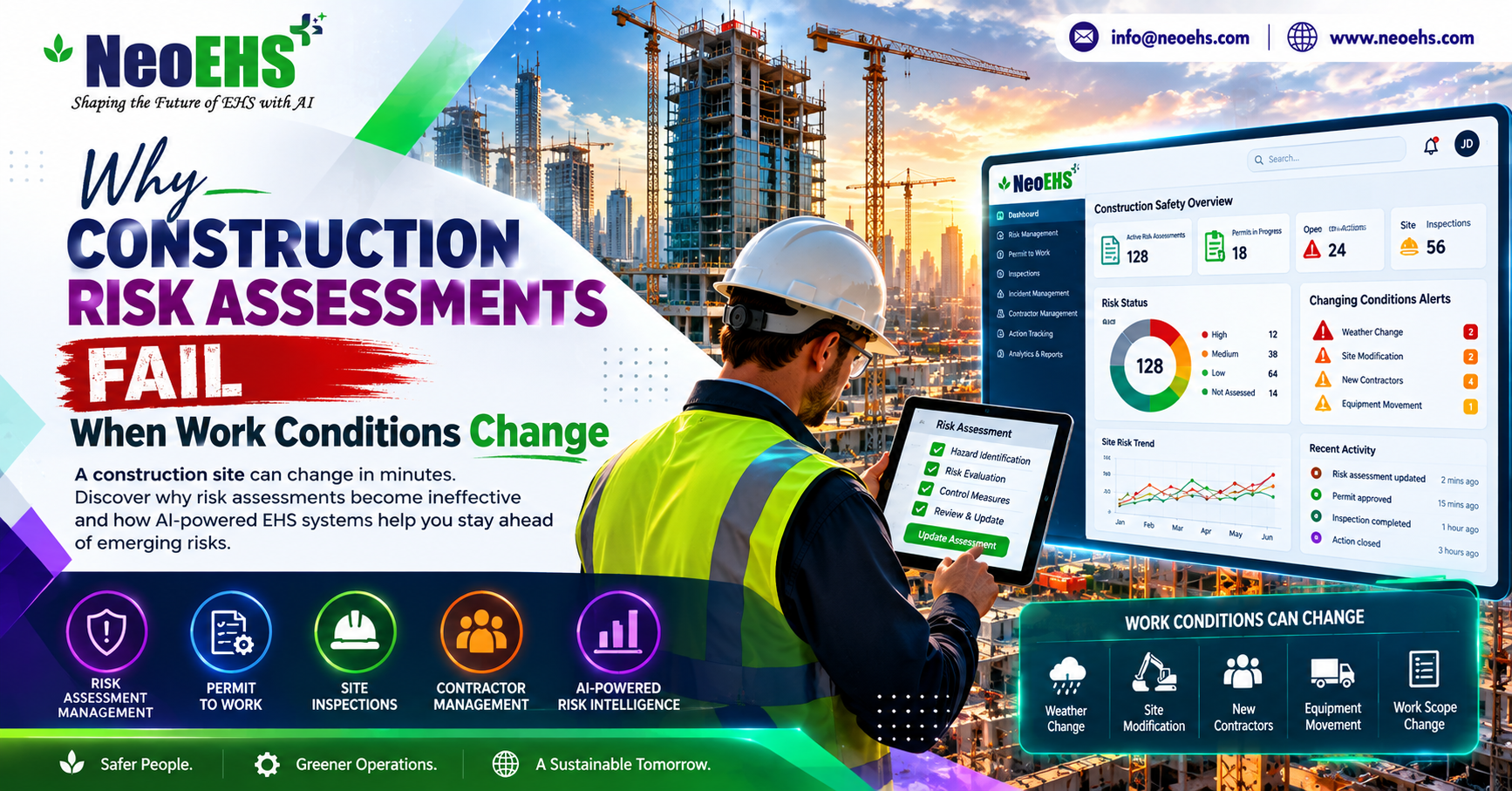
Why Do Construction Risk Assessments Fail?
Construction risk assessments can become ineffective when the work environment changes faster than the organisation's risk-management process.
A Job Safety Analysis (JSA), Job Hazard Analysis (JHA), Task Risk Assessment (TRA) or Risk Assessment and Method Statement (RAMS) identifies foreseeable hazards and establishes controls for a particular activity.
However, no assessment can anticipate every change in site conditions.
Five recurring problems deserve attention.
1. Risk Assessments Are Treated as One-Time Approvals
On some projects, risk assessments are completed before work begins and reviewed mainly during scheduled audits.
The problem is that construction hazards are not static.
An excavation that was stable in the morning may become hazardous after rainfall. A lifting operation may require reassessment when the crane position or load configuration changes.
Approval establishes the initial basis for work. It does not guarantee that those conditions will remain unchanged.
2. Contractor Activities Create Unexpected Interfaces
Large construction projects involve multiple contractors working in overlapping areas.
One contractor may relocate a barrier, modify access arrangements or introduce mobile equipment without communicating the change to adjacent teams.
This creates risks that may not appear in the original assessment.
The underlying weakness is often inadequate coordination between contractors, supervisors and work-authorisation processes.
3. Critical Controls Are Not Verified in the Field
A risk assessment may require edge protection, excavation support, electrical isolation or a lifting exclusion zone.
But documenting a requirement is different from confirming that the control is installed, suitable and effective.
For activities with serious injury potential, field verification is essential.
4. Production Pressure Discourages Reassessment
Construction schedules are demanding. Work interruptions affect equipment utilisation, subcontractor coordination and delivery milestones.
When conditions change, teams may be reluctant to suspend an activity for reassessment.
A strong safety culture treats a necessary stop-work decision as part of effective operational management—not as an administrative failure.
5. Near Misses and Inspection Findings Remain Disconnected
Near-miss reports, unsafe-condition observations and inspection records often contain useful information about changing hazards.
If these records are not connected to risk assessments and work planning, the same problems can recur.
The organisation collects safety information but fails to translate it into improved controls.
What Is Dynamic Risk Assessment in Construction?
Dynamic risk assessment is the ongoing process of recognising changing hazards, evaluating their significance and adapting safety controls while work is being performed.
It complements formal risk assessment and does not replace documented planning, competent supervision or legally required permits.
Dynamic reassessment becomes particularly important when:
-
Weather or ground conditions deteriorate.
-
Equipment or machinery is relocated.
-
Temporary structures or access arrangements change.
-
New subcontractors enter an active work area.
-
The work sequence or method is modified.
-
Simultaneous operations introduce additional hazards.
-
Unexpected underground services are discovered.
-
An inspection identifies a serious deficiency.
-
A near miss reveals an unrecognised exposure.
Not every minor variation requires a completely new assessment.
The important question is whether the change affects the assumptions, hazards or controls on which the original assessment was based.
If a significant change creates uncontrolled risk, affected work should be stopped or secured until competent personnel reassess the situation and implement appropriate measures.
Management of Change: The Missing Link in Construction Safety
Management of Change (MOC) is often associated with industrial facilities and process safety.
Its underlying principles are equally valuable in construction.
A practical construction MOC process follows five stages.
Identify the change. Recognise alterations to equipment, materials, methods, people, site conditions or nearby activities.
Evaluate the impact. Determine which hazards, workers, contractors and surrounding operations may be affected.
Review the controls. Decide whether existing precautions remain suitable or additional controls are necessary.
Communicate and authorise. Update relevant assessments, permits and work instructions, and inform affected personnel.
Verify implementation. Confirm that revised controls are effective before affected work resumes.
This process helps prevent a common failure: approving revised documentation without checking whether the corresponding physical controls have actually been implemented.
Critical-Control Verification: Are the Controls Still Working?
For construction activities with the potential for fatal or life-changing injuries, identifying critical controls is particularly important.
Examples include:
Excavation and Trenching
Critical controls may include suitable excavation support or safe battering, safe access and egress, control of equipment near excavation edges, and identification of underground services.
Working at Height
Controls may include suitable edge protection, safe access, properly selected equipment, inspection arrangements and fall-prevention measures.
Crane and Lifting Operations
Controls may include verified crane configuration, adequate ground support, appropriate rigging, competent personnel and effective exclusion zones.
Electrical Work
Controls may include appropriate isolation, verification of de-energisation, protection from nearby live equipment and controlled access.
Confined-Space Entry
Controls may include atmospheric testing where required, isolation, ventilation, communication, standby arrangements and suitable emergency rescue provisions.
For each activity, supervisors should ask:
Is the critical control present, suitable and effective under the conditions that exist right now?
A previously completed checklist cannot answer that question on its own.
How AI-Powered EHS Software Can Support Dynamic Risk Assessment
Digital systems can improve the flow of information between work planning, field supervision, incident learning and management oversight.
AI may provide additional decision support when suitable data and validated applications are available.
Digital Risk Assessment Management
Digital risk assessment workflows can help organisations maintain structured hazard records, assign responsibilities and manage assessment revisions.
Version histories make it easier to establish what changed, who reviewed it and which controls were approved.
For multi-contractor projects, this can improve the traceability of safety decisions.
Connected Permit-to-Work Systems
Digital Permit-to-Work software can link work authorisation with risk assessments, inspections and supporting documentation.
Depending on system configuration, significant changes may be routed for review, permit suspension or reauthorisation.
For example, unexpected ground movement during excavation may require the work area to be secured and the activity reassessed before permission to continue is granted.
Digital authorisation supports control of work. It does not replace physical verification.
Mobile Safety Inspections
Mobile inspection systems can help supervisors record changed conditions, attach photographs and assign corrective actions.
Examples include damaged edge protection, water accumulation, unstable access routes and unauthorised equipment movement.
Immediate hazards must still be addressed immediately. Recording an observation should never delay necessary protective action.
AI-Assisted Incident and Near-Miss Intelligence
AI-assisted analysis may help safety teams identify recurring themes across incidents, near misses and inspection reports.
Repeated findings involving excavation barriers, temporary access arrangements or contractor coordination may indicate broader management weaknesses.
These insights can support targeted reviews and preventive actions.
Predictive Safety Analytics
Predictive analytics may help prioritise areas for investigation by analysing historical deficiencies, overdue actions and incident patterns.
However, results depend on data quality, validation and the context in which models are used.
Predictive systems cannot guarantee that an incident will occur or that a particular activity is safe.
Computer Vision and Connected Monitoring
Where appropriately deployed, computer vision may help identify certain visible conditions, such as unauthorised entry into restricted areas.
It cannot independently determine every hidden ground hazard, structural weakness or engineering requirement.
AI should support competent human decision-making—not replace it.
Practical Construction Example: When a Safe Work Plan Becomes Outdated
Consider a high-rise building project where façade installation is underway.
The approved risk assessment identifies requirements for edge protection, controlled material handling, access equipment and coordination between subcontractors.
During the afternoon, another contractor temporarily modifies a protected access area to accommodate a delivery.
The façade team has not yet received the updated information.
The original assessment may still show the work as adequately controlled, even though the actual conditions have changed.
A stronger process would involve:
-
Identifying the change and securing the affected work area.
-
Informing the responsible supervisors and affected contractors.
-
Reassessing fall exposure, access arrangements and material movement.
-
Updating the relevant risk assessment or work authorisation where required.
-
Implementing and physically verifying revised controls.
-
Communicating the revised arrangements before restarting work.
-
Recording the event and reviewing the underlying coordination weakness.
This is an illustrative construction scenario, not a claimed NeoEHS customer result.
The operational lesson is straightforward: the safety process must respond to changes in the work, not wait for the next scheduled document review.
How NeoEHS Supports Construction Risk Management
NeoEHS is an AI-powered Environment, Health and Safety management software platform designed to connect important EHS processes.
For construction organisations, relevant solution areas include:
Risk and Hazard Management: Structured hazard identification, assessment records and control tracking.
Permit-to-Work Management: Controlled authorisation workflows and supporting documentation for higher-risk work.
Digital Safety Inspections: Field observations, inspection evidence and corrective-action tracking.
Contractor Safety Management: Coordination of contractor-related safety information and responsibilities.
Incident and Near-Miss Management: Reporting, investigation and identification of recurring safety issues.
Corrective and Preventive Actions: Assignment, follow-up and verification of actions arising from inspections and investigations.
EHS Dashboards and Analytics: Management visibility of overdue actions, recurring findings and safety performance trends.
Explore NeoEHS Construction Safety Management and Digital Permit-to-Work Software.
Advanced AI capabilities, automated change triggers and external system integrations should be evaluated against the actual product configuration and implementation requirements.
The business value of connected EHS processes lies in improving visibility, coordination, traceability and accountability across projects.
ISO 45001, ISO 14001 and International Construction Safety Guidance
ISO 45001 — Occupational Health and Safety Management
ISO 45001 provides an international framework for hazard identification, assessment of OH&S risks, operational control, management of change, worker participation and continual improvement.
These principles are directly relevant to reviewing construction risk assessments when work conditions change.
ISO 14001 — Environmental Management
ISO 14001 addresses the management of environmental aspects and impacts.
Changes in drainage, excavation methods, fuel storage, waste handling or material movement can introduce environmental risks requiring reassessment.
ILO Construction Safety Guidance
The International Labour Organization's construction safety guidance addresses preventive planning, safe work organisation, coordination and protection of workers.
Country-Specific Legal Requirements
Construction safety legislation differs across jurisdictions.
Organisations must comply with applicable national laws, regulations, technical standards and project-specific requirements.
International management-system standards support systematic safety management but do not automatically establish legal compliance.
Construction Risk Assessment Review Checklist
Before continuing work after a change, ask:
-
Has the work scope or sequence changed?
-
Have weather, ground or environmental conditions changed?
-
Has equipment been moved or substituted?
-
Have temporary works, access arrangements or barriers changed?
-
Are new workers or contractors entering the area?
-
Have simultaneous operations introduced additional hazards?
-
Have inspections or near misses identified new risks?
-
Are the original assessment assumptions still valid?
-
Are safety-critical controls present and effective?
-
Have affected workers and supervisors been informed?
-
Do permits or method statements require revision?
-
Has a competent person verified the controls before work continues?
Where a significant change creates uncontrolled risk, the affected activity should be stopped or secured until suitable controls are established.
Frequently Asked Questions
Why do construction risk assessments become outdated?
They become outdated when site conditions, equipment, work methods, personnel or contractor interfaces change without corresponding review of hazards and controls.
What is the difference between a JSA and a dynamic risk assessment?
A JSA generally documents task steps, hazards and controls. Dynamic risk assessment is the ongoing process of identifying and responding to changing risks during work. The two processes complement each other.
When should a construction risk assessment be reviewed?
An assessment should be reviewed at required intervals and whenever significant changes, incidents, new information or other relevant triggers suggest that existing controls may be inadequate.
Can AI automatically assess construction site risks?
AI may help identify patterns, analyse reports or support review workflows. Safety-critical decisions still require appropriate human assessment, validation and authorisation.
How does digital Permit-to-Work software help?
It can help connect work authorisations with risk assessments, supporting documents, approvals and revision records, improving traceability when conditions change.
How does dynamic risk assessment support sustainability?
It can help teams recognise changing environmental risks, such as drainage problems, spills, dust and waste-management issues, and adjust controls accordingly.
Conclusion: Risk Assessments Must Evolve with Construction Work
A signed risk assessment is an important starting point.
It is not proof that a construction activity will remain safe throughout the day.
Effective risk management requires continuous awareness, clear communication, critical-control verification and the willingness to reassess when conditions change.
Connected digital EHS systems and responsible AI can help organisations manage these processes more consistently.
But the decisive responsibility remains with competent people making informed decisions at the worksite.
The right question is not only, “Was the risk assessment approved?”
It is, “Does the assessment still reflect the work being performed right now?”
Strengthen Construction Risk Management with NeoEHS
Discover how NeoEHS can support risk and hazard management, digital inspections, Permit-to-Work workflows, incident reporting and connected EHS intelligence.
Website: https://www.neoehs.com
Email: info@neoehs.com
NeoEHS — Safer People. Greener Operations. A Sustainable Tomorrow.
|
NeoEHS AI-Powered EHS Software |
|
|
Construction Safety Management Software |
|
|
Digital Permit-to-Work Software |
.jpg "5 Why analysis diagram showing step-by-step questioning to identify root cause of workplace incidents using NeoEHS")