Contractor Management in Construction : Who Is Really Responsible for Subcontractor Safety on a Construction Project?
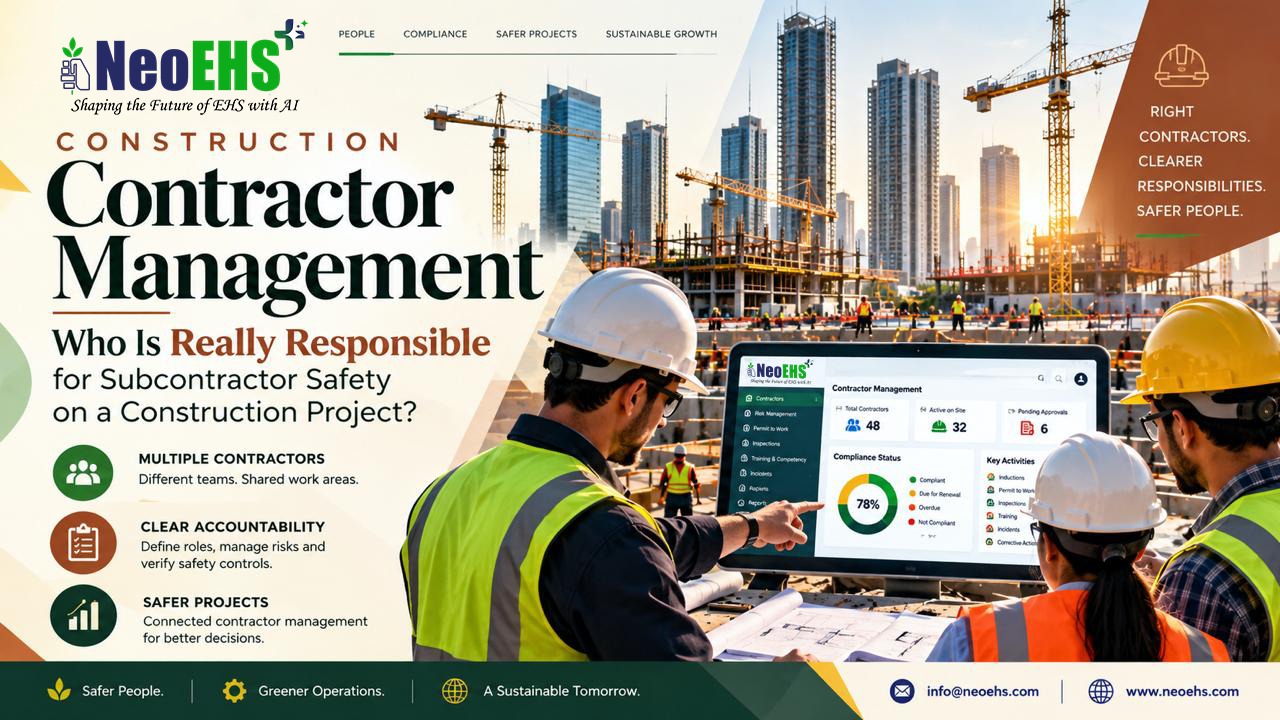
Understanding Shared Safety Responsibilities, Contractor Accountability and AI-Powered EHS Management
A subcontractor is carrying out electrical installation on the twelfth floor of a high-rise construction project.
Nearby, another contractor is installing façade panels. A third team is moving materials using a temporary hoist.
The electrical subcontractor has completed its safety induction. Its workers have attended toolbox talks. The required permits have been approved.
Then a temporary access barrier is removed to accommodate a delivery.
Nobody informs the electrical team.
An employee enters the affected area and is exposed to a serious fall hazard.
If an incident occurs, who is responsible?
The subcontractor employing the worker? The main contractor managing the site? The contractor that removed the barrier? Or the client who appointed the organisations?
The answer may involve more than one party.
Construction safety responsibilities cannot always be transferred simply by awarding a subcontract or inserting a clause into a contract.
On complex projects, effective contractor safety management depends on clearly defined responsibilities, competent supervision, coordinated activities and verification of safety controls.
Who Is Responsible for Subcontractor Safety on a Construction Project?
Subcontractor safety is a shared responsibility, with specific legal duties determined by the jurisdiction, contractual arrangements, control of the workplace and activities undertaken.
The subcontractor generally has responsibilities toward its own workers, including competent supervision, safe work methods, training and suitable equipment.
The main or principal contractor commonly has important responsibilities for coordinating site activities, managing shared hazards and controlling interfaces between contractors.
Clients, developers, designers and specialist contractors may also have duties under applicable legislation.
These responsibilities can overlap.
A contractual provision assigning safety obligations to a subcontractor does not necessarily remove statutory duties imposed on another organisation.
The practical objective is to ensure that every significant risk has a clearly identified owner and that the necessary controls are implemented and maintained.
Why Does Subcontractor Safety Management Fail?
Construction projects often involve multiple organisations operating within a single, constantly changing work environment.
The most serious weaknesses frequently occur between contractual boundaries.
1. Responsibilities Are Defined on Paper but Not Understood on Site
A subcontract may contain extensive health and safety clauses.
However, workers and supervisors may remain unclear about who controls shared access routes, temporary barriers, lifting zones or emergency arrangements.
When responsibilities are ambiguous, hazards can remain unresolved.
A responsibility matrix should identify who establishes, maintains, verifies and authorises changes to critical controls.
2. Contractor Prequalification Becomes a Documentation Exercise
Before appointment, contractors may submit safety policies, certifications, training records, incident information and equipment documentation.
These records can support due diligence, but they do not independently demonstrate how safely the contractor will operate on a particular project.
Prequalification should be proportionate to the work and consider practical capability, relevant experience, supervisory arrangements and the contractor's ability to manage foreseeable risks.
3. Induction Is Mistaken for Competency
Site induction introduces project rules, hazards and emergency arrangements.
It does not replace task-specific competence.
A worker attending induction is not automatically qualified to operate lifting equipment, undertake electrical isolation or supervise confined-space entry.
Competency requirements must be established for the actual work.
4. Contractors Work in Isolation
One subcontractor may be carrying out excavation while another operates heavy vehicles nearby.
A façade contractor may work above an area occupied by mechanical installers.
Each organisation may have an acceptable task risk assessment, yet the combined activities introduce additional hazards.
These simultaneous operations, often called SIMOPS, require active coordination.
5. Corrective Actions Are Not Closed Effectively
A site inspection identifies a missing barrier.
The finding is assigned to a subcontractor, but the action remains open while work continues.
Closing an action in a system is also insufficient unless the required control has actually been implemented and, where appropriate, verified.
6. Contractor Performance Is Measured Too Narrowly
Many projects focus on incident counts and lost-time injury indicators.
These are useful but incomplete.
Leading indicators such as critical-control verification, overdue corrective actions, repeated inspection deficiencies and permit deviations can reveal weaknesses before a serious event occurs.
Understanding the Responsibilities of Each Project Participant
Client or Project Owner
Depending on the jurisdiction, clients and project owners may have duties relating to project arrangements, contractor selection, provision of information, allocation of adequate resources and coordination.
They should establish appropriate governance and avoid creating contractual or scheduling pressures that undermine safe execution.
Main Contractor or Principal Contractor
The main contractor typically plays a central role in coordinating construction activities and managing shared site arrangements.
Responsibilities may include site access, work sequencing, contractor interfaces, emergency coordination, common safety rules and monitoring of agreed controls.
The exact legal duties of a designated principal contractor vary between jurisdictions.
Subcontractor Employer
Subcontractors must manage the hazards associated with their own activities and meet applicable duties toward workers and others affected by their work.
This includes appropriate planning, supervision, training, equipment, communication and compliance with relevant site arrangements.
Site Supervisors and Safety Professionals
Supervisors are responsible for implementing assigned operational controls and escalating unsafe conditions.
HSE professionals support risk assessment, inspection, assurance, training and management review.
However, employing an HSE manager does not transfer all operational responsibility away from line management.
Workers
Workers contribute by following safe systems of work, using required protective measures, reporting hazards and exercising applicable stop-work rights.
Worker participation is an important element of effective safety management.
Five Critical Stages of Construction Contractor Safety Management
A robust contractor safety programme should extend across the entire contractor lifecycle.
Stage 1: Contractor Selection and Prequalification
Before mobilisation, assess whether the contractor has the resources and competence needed for the intended work.
Relevant checks may include:
-
Appropriate registrations and licences.
-
Relevant project and task experience.
-
Competent supervisory personnel.
-
Worker qualifications and training.
-
Suitable equipment and inspection arrangements.
-
Safety management procedures.
-
Relevant incident history and improvement actions.
-
Capacity to manage subcontractors engaged by the contractor.
Documentation should be verified as appropriate, particularly for safety-critical activities.
Stage 2: Mobilisation and Site Readiness
Before work begins, establish site-specific requirements.
These may include induction, access authorisation, emergency arrangements, welfare provisions, equipment approval and coordination meetings.
Site-specific risk assessments should consider both the subcontractor's activities and the hazards created by neighbouring operations.
Stage 3: Work Planning and Authorisation
High-risk activities require suitable planning and control.
Depending on the task and jurisdiction, this may involve method statements, Job Safety Analyses, lifting plans, isolation procedures and Permit-to-Work arrangements.
A permit should identify relevant hazards, controls, responsible persons and authorisation requirements.
An approved permit is not evidence that site conditions will remain safe throughout the activity.
Stage 4: Field Monitoring and Critical-Control Verification
Contractor performance must be assessed during execution.
Inspections, supervisor observations, coordination meetings and critical-control checks can help determine whether agreed measures remain effective.
Particular attention is needed when work conditions, equipment or contractor interfaces change.
Stage 5: Performance Review and Demobilisation
At completion, review significant findings, outstanding actions, lessons learned and contractor performance.
This information should inform future contractor selection and project planning.
The Greatest Contractor Safety Risks Often Exist Between Work Packages
Consider a project where three contractors operate in the same area.
One installs scaffolding. Another carries out structural steel lifting. A third installs mechanical services.
Each has its own risk assessment.
But the scaffolding contractor changes access arrangements while the lifting contractor modifies its load path.
The mechanical team continues working under the original site arrangements.
The hazard is not confined to any one contractor's activity.
It emerges from the interaction between them.
A coordinated control-of-work process should therefore address:
-
Shared work areas and access routes.
-
Lifting and material movement.
-
Work at height above occupied areas.
-
Excavation and underground services.
-
Electrical and mechanical isolations.
-
Temporary works and structural stability.
-
Emergency access and evacuation.
-
Changes in sequencing, equipment and personnel.
Effective SIMOPS management requires competent planning, communication and authority to suspend conflicting activities when necessary.
How Can AI-Powered EHS Software Support Contractor Safety?
Connected EHS systems can help organisations manage contractor information, field observations, work authorisations and corrective actions more consistently.
AI may provide additional analytical support, but its role must be clearly understood.
Digital Contractor Safety Management
A contractor management system can support structured records for prequalification, mobilisation, competency information, site authorisation and performance review.
This improves traceability and reduces reliance on disconnected spreadsheets and email exchanges.
Digital Permit-to-Work
Connected permit workflows can help identify authorised work activities, responsible supervisors, supporting assessments and potential work-area conflicts.
Where suitably configured, permit reviews can support coordination between contractors undertaking simultaneous activities.
Mobile Safety Inspections
Digital inspections enable supervisors to record site findings, attach evidence and assign corrective actions.
Recurring deficiencies can be reviewed across contractors and projects.
Incident and Near-Miss Intelligence
AI-assisted analysis may help identify patterns in reported events, such as repeated access-control failures, lifting-zone breaches or deficiencies in contractor supervision.
These insights can support investigation and targeted improvement.
They do not establish the legal responsibility of a party or prove the root cause of an incident.
Predictive Analytics
Historical inspection findings, overdue actions and incident trends may help safety teams prioritise contractor reviews.
However, predictive models require appropriate data, validation and human oversight.
They cannot guarantee that an incident will occur or that a contractor is safe.
Computer Vision and Connected Monitoring
Where technically suitable and validated, computer vision may assist with monitoring certain visible conditions, including access to restricted areas.
Its limitations include visibility, camera coverage, context and detection accuracy.
Computer vision should not replace physical segregation, supervision or competent verification.
Practical Example: Managing Subcontractor Interfaces on a High-Rise Project
Imagine a major high-rise project with separate contractors responsible for structural works, façade installation, electrical services and material handling.
The façade contractor requests temporary access to an area used by the electrical team.
The proposed change affects edge protection and material movement.
Without effective coordination, each contractor may continue under its existing work instructions.
A stronger process would involve:
-
Identifying the proposed change and the affected work area.
-
Consulting the relevant contractor supervisors.
-
Reviewing the shared hazards and existing controls.
-
Revising risk assessments and permits where necessary.
-
Implementing and verifying the revised controls.
-
Communicating the new arrangements to affected workers.
-
Recording the change and monitoring the area during execution.
A connected EHS platform can support documentation, communication, action ownership and management visibility.
This is an illustrative scenario, not a claimed customer implementation or measured NeoEHS outcome.
How NeoEHS Supports Construction Contractor Management
NeoEHS is an AI-powered Environment, Health and Safety management software platform designed to connect essential safety-management processes.
Relevant solution areas for construction contractor safety include:
Contractor Safety Management: Organisation of contractor information, safety requirements and performance records.
Risk and Hazard Management: Documentation of task hazards, risk assessments and control responsibilities.
Permit-to-Work Management: Structured authorisation workflows for activities requiring formal work control.
Digital Inspections: Field inspection records, observations and supporting evidence.
Incident and Near-Miss Management: Reporting, investigation and identification of recurring weaknesses.
Corrective and Preventive Action Management: Assignment, tracking and verification of corrective measures.
EHS Dashboards and Analytics: Visibility of outstanding actions, recurring findings and contractor-related safety trends.
For enterprises managing multiple projects and subcontractors, connected EHS processes can help strengthen consistency, accountability and management oversight.
Advanced AI functionality, automated eligibility checks and integrations should be assessed against the product capabilities actually available in the intended implementation.
Explore NeoEHS Construction Safety Solutions and Digital Permit-to-Work Management.
What Do International Standards Say About Contractor Safety?
ISO 45001
ISO 45001 provides an occupational health and safety management-system framework that addresses procurement, contractors, outsourced activities, operational control, worker participation and continual improvement.
It supports systematic management of risks arising from contractors and their activities.
ISO 14001
ISO 14001 addresses environmental management, including environmental aspects associated with activities that organisations control or influence.
For construction contractors, this may involve waste handling, dust, spills, noise and other environmental impacts.
ILO Construction Safety Guidance
The International Labour Organization's construction safety guidance emphasises coordination, preventive measures and responsibilities among parties involved in construction work.
National Legal Requirements
Legal duties differ by country.
For example, the United Kingdom's Construction (Design and Management) Regulations 2015 establish defined duties for clients, principal contractors, contractors and other dutyholders.
In the United States, OSHA requirements and the multi-employer citation policy can be relevant when several employers operate at one worksite.
Other countries have their own frameworks.
Contractual allocation of duties must always be considered alongside applicable statutory requirements.
Construction Contractor Safety Management Checklist
Use this checklist during contractor mobilisation and periodic project reviews.
-
Are contractor roles and responsibilities clearly documented?
-
Has contractor competence been evaluated for the intended work?
-
Are required licences, training and qualifications verified?
-
Have site-specific risks been communicated?
-
Are contractor supervisors clearly identified?
-
Are shared hazards and SIMOPS interfaces assessed?
-
Are high-risk activities subject to appropriate work controls?
-
Are critical controls physically verified?
-
Are changes communicated across affected contractors?
-
Are incidents and near misses reported and investigated?
-
Are corrective actions assigned and verified before closure?
-
Are emergency arrangements understood by all contractors?
-
Is contractor performance reviewed using meaningful indicators?
-
Are environmental responsibilities included where relevant?
Frequently Asked Questions
Is the main contractor responsible for subcontractor safety?
Main contractors commonly have significant responsibilities for site coordination and shared hazards. However, their precise duties depend on applicable law and their role and control. Subcontractors also retain their own legal obligations.
Can a subcontractor take full responsibility for safety through a contract?
A contract can allocate responsibilities between parties, but it does not necessarily remove statutory duties imposed on other organisations.
What is construction contractor safety management software?
It is software used to organise and track contractor safety information, onboarding requirements, work authorisations, inspections, incidents, corrective actions and performance reviews.
How can AI improve subcontractor safety management?
AI may assist with analysing incident narratives, identifying recurring deficiencies and prioritising safety reviews. It should not replace competent supervision, field verification or legal assessment.
What is SIMOPS in construction?
SIMOPS means simultaneous operations. It refers to activities occurring at the same time that may affect one another, requiring coordination to manage shared or interacting hazards.
How does ISO 45001 apply to subcontractors?
ISO 45001 includes requirements relevant to contractor procurement, coordination and control of OH&S risks associated with contractors and outsourced activities.
Conclusion: Safety Accountability Must Extend Beyond Contract Boundaries
Subcontractor safety is not simply a matter of deciding who should be blamed after an incident.
It is about establishing clear responsibilities before work begins and ensuring that critical controls remain effective as multiple contractors operate together.
Clients, main contractors, subcontractors, supervisors and workers all have roles to play, although their legal duties differ.
Connected EHS systems and responsible AI can help organisations improve coordination, information visibility and accountability.
But no digital system can substitute for competent supervision, effective controls and a culture where people act when conditions become unsafe.
The question every construction leader should ask is not only, “Who is responsible for subcontractor safety?”
It is, “Have we made every responsibility clear—and verified that the controls are actually working?”
Strengthen Contractor Safety Management with NeoEHS
Discover how NeoEHS supports connected contractor safety processes, risk assessments, Permit-to-Work management, inspections, incident reporting and EHS intelligence.
Website: https://www.neoehs.com
Email: info@neoehs.com
NeoEHS — Safer People. Greener Operations. A Sustainable Tomorrow
|
Construction Safety Management Software |
|
|
Digital Permit-to-Work Software |
|
|
AI-Powered EHS Management System |
|
|
Construction HSE Software in India |