The Role of AI in Power Plant Safety | Reactive Reporting to Proactive Risk Management
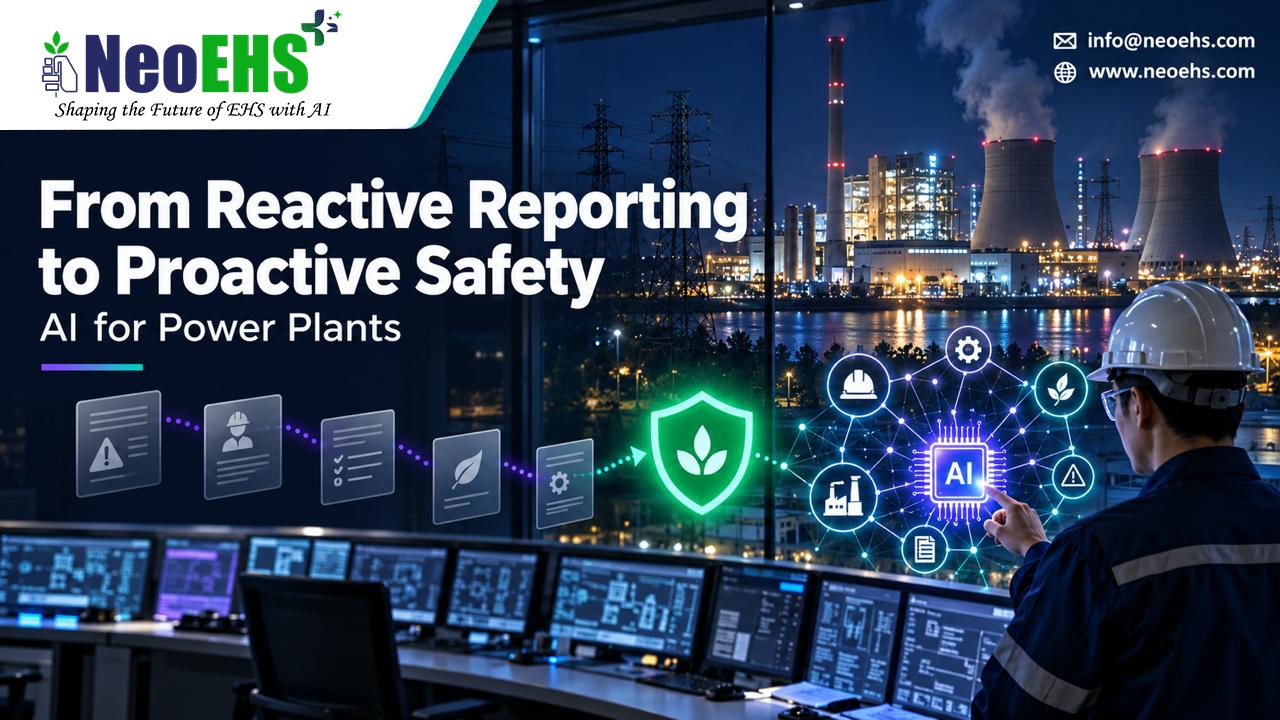
What is proactive risk management in power plants?
Proactive risk management means identifying hazards, assessing changing conditions and verifying controls before an incident occurs. It combines planned assessments with ongoing learning from inspections, near misses, maintenance activities and worker observations.
AI can support this process by analysing information across records and highlighting patterns that deserve attention. It does not replace competent people, physical safeguards or established work procedures.
The goal is practical: give the right person useful information early enough to make a difference.
Reactive reporting and proactive management work together
Incident reporting remains essential. A thorough investigation can explain what happened, identify contributing factors and guide corrective action.
The opportunity is to apply that learning more widely.
If an investigation identifies a recurring access problem around one turbine, could similar conditions exist around another? If a control failed during a maintenance activity, should comparable work be reviewed before it begins?
A proactive approach carries those questions into daily planning.
| Area | Reactive reporting focus | Proactive risk management focus |
|---|---|---|
| Incident information | Understanding an event after it occurs | Applying the learning to similar activities |
| Inspection findings | Recording individual deficiencies | Reviewing recurrence and unresolved concerns |
| Corrective actions | Tracking completion | Verifying effectiveness and checking for recurrence |
| Work planning | Reviewing the record of a completed task | Considering relevant findings before authorisation |
| Management review | Looking at historical outcomes | Examining current conditions alongside past performance |
The strongest approach connects both perspectives. It learns from events while continually checking whether existing controls remain effective.
Where AI can add practical value
1. Connect reports that describe the same concern differently
One employee reports “poor access.” Another writes “materials blocking the route.” A third records “difficulty reaching the inspection point.”
A keyword search may treat these as separate issues. AI-assisted text analysis can help identify a shared theme and group the records for review.
The reviewer then checks the location, equipment, timing and circumstances. Similar wording does not automatically mean the same cause—but it can provide a useful starting point.
NeoEHS Incident Management supports the reporting, investigation and action-tracking processes that make this information available for learning.
2. Help teams prioritise the review queue
An EHS team may have many open observations, but they do not all require the same response.
Useful context includes the potential consequence, the condition of relevant controls, repeated findings, affected activities and how long an action has remained unresolved.
AI can help organise this information and surface records for attention. Any prioritisation method should remain understandable to the people using it.
A frequently reported minor concern must not automatically outrank a rare concern with potentially severe consequences. Frequency is one input, not a complete measure of risk.
NeoEHS Risk Management software provides workflows for assessing risks, recording controls and managing corrective and preventive actions.
3. Bring previous learning into work preparation
Before a maintenance activity starts, supervisors need more than the current permit form. Relevant past findings may help them ask better questions about the planned work.
For example:
-
Has a similar task generated repeated observations?
-
Are related corrective actions still outstanding?
-
Have working conditions changed since the assessment?
-
Are nearby activities creating additional coordination needs?
A connected implementation can make these records easier to find during preparation.
NeoEHS Permit to Work software supports digital work-authorisation workflows. AI-assisted analysis can complement that process where configured, while authorised personnel retain responsibility for site checks and approval.
4. Identify recurrence after an action is closed
An action marked “completed” is not always evidence that the underlying concern has been resolved.
Suppose a recurring housekeeping issue is closed after materials are removed. If similar reports return every week, the team may need to examine storage arrangements, delivery timing or work-area planning.
AI-assisted comparison can help bring those repeated observations together. People must then investigate the reasons and determine whether the control needs to change.
This is an important shift: from asking whether an action was completed to asking whether it worked.
5. Make safety information easier to review
Plant leaders need a clear view of what requires attention, supported by the underlying evidence.
A useful AI-assisted summary might identify recurring findings in a particular area, highlight unresolved actions and link back to the original records. It should distinguish recorded facts from suggested interpretations.
NeoEHS predictive analytics is relevant to this broader use of EHS data for identifying patterns and supporting prioritisation.
Predictions should be treated as estimates with limitations—not as certainty about when or where an incident will happen.
Not every automated workflow is AI
This distinction matters when evaluating EHS software.
An overdue-action reminder follows a predefined rule. A permit approval follows an agreed workflow. Both can be valuable without using AI.
AI adds a different capability when it interprets varied descriptions, identifies relationships across records or produces model-based estimates from data.
A useful demonstration should show:
-
What information the system uses.
-
Which steps follow fixed rules.
-
Where AI contributes.
-
How users review and challenge the output.
-
What happens when information is incomplete.
Clear answers help a plant choose capabilities that match its actual needs.
A practical power plant example
The following scenario is illustrative, not a customer case study.
During a maintenance period, workers submit several observations about congestion near a turbine access route. The descriptions differ, and each report is assigned separately.
AI-assisted analysis groups the observations by theme and location. A supervisor reviews the original records and finds that temporary material storage is affecting access during overlapping activities.
The team reviews the work arrangements, assigns a response and communicates the changes through the established site process. A follow-up inspection checks whether access has improved.
Later reports are reviewed for recurrence.
The value comes from the complete sequence: connecting the evidence, reviewing it, acting on it and verifying the result. An alert alone does not resolve the concern.
What makes AI-supported risk management trustworthy?
Reliable records
Consistent location names, equipment references and timestamps help teams compare information accurately. Missing or outdated records can weaken both human review and AI analysis.
Operational context
A rise in observations might reflect changing conditions—or simply better reporting participation. Teams need to understand the circumstances before interpreting a trend.
Human accountability
Someone must own each significant review and response. AI can assist with analysis, but responsibility cannot be delegated to a score or dashboard.
Appropriate access
Worker information and sensitive records should be available only to authorised users. Monitoring arrangements should have a defined purpose and clear governance.
Ongoing evaluation
Teams should check whether alerts are useful, whether important concerns are being missed and whether the system remains suitable as operations change.
How to begin without overcomplicating the rollout
Start with a specific problem: recurring inspection findings, slow review of observations or weak verification of corrective actions.
Choose one area or workflow and establish a baseline. Then track a small set of meaningful measures:
-
Time from reporting to review.
-
Age of unresolved priority actions.
-
Repeat findings after closure.
-
Actions closed with verified evidence.
-
Alerts judged useful by reviewers.
Interpret the measures together. Fewer reports alone do not prove that a workplace has become safer.
NeoEHS’s power and energy EHS solutions provide a starting point for discussing the workflows, responsibilities and implementation scope relevant to your plant.
Frequently asked questions
How does AI support power plant safety?
AI can help analyse incident reports, near misses and inspection findings, identify recurring themes and prioritise records for human review. Its usefulness depends on data quality, configuration and follow-through.
Can AI predict every power plant incident?
No. Unrecorded conditions, changing work and incomplete information limit prediction. AI supports risk management; it does not guarantee incident prevention.
What data is needed to get started?
A focused implementation can begin with well-structured observations, inspection findings and corrective-action records. Additional data sources should be introduced when they serve a defined purpose and can be integrated reliably.
Does a low AI risk score mean work is safe?
No. A score reflects a model and its available inputs. Required assessments, physical controls, checks and authorisations still apply.
Make reporting the start of action
Power plant teams already hold valuable knowledge in their observations, inspections and investigations.
AI can help them connect that knowledge and identify where to look more closely. The improvement happens when those insights lead to accountable decisions and verified action.
Request a NeoEHS demonstration to explore how connected EHS workflows and AI-assisted analysis can support proactive risk management at your power plant.
Email: info@neoehs.com
Website: www.neoehs.com