Lifting in Construction — One Wrong Lift Can Be Fatal: Are Your Crane Safety Controls Really Working?
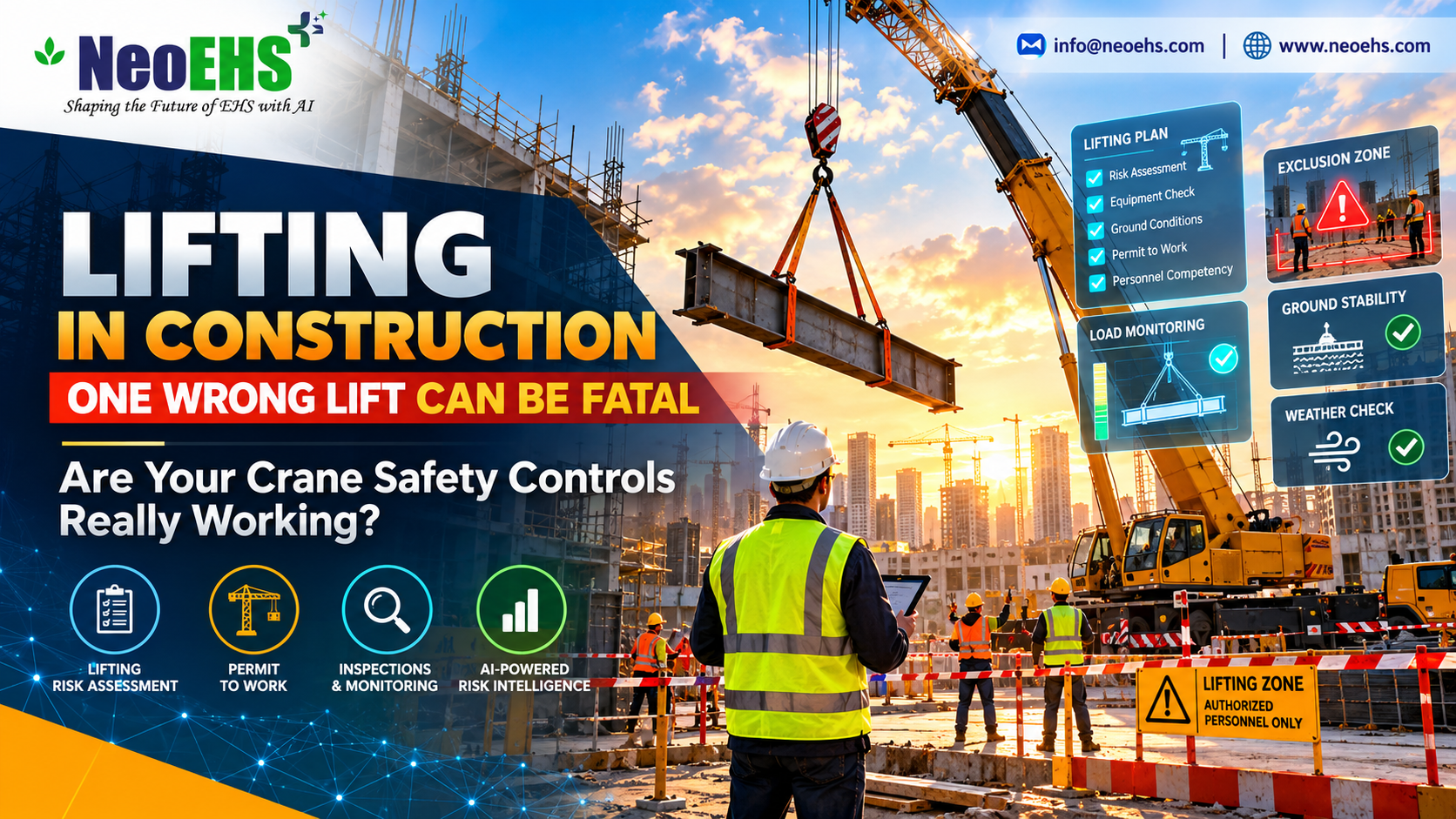
Crane Lifting Safety, Critical-Control Verification and AI-Powered EHS Management
A crane operator is preparing to lift a heavy steel structure onto the upper level of a construction project.
The lifting plan has been approved. The operator is competent. The equipment inspection records are available. The rigging team has completed its checks.
Everything appears ready.
But what happens if the ground conditions have changed after heavy rain? What if another contractor enters the lifting zone? What if the actual lifting radius differs from the approved plan?
A single overlooked change can turn a routine lifting operation into a serious incident.
Crane lifting safety is not simply about having the right documents. It is about ensuring that critical safety controls are effective before and throughout every lift.
Across high-rise construction, infrastructure development, power plants, industrial facilities and large EPC projects, lifting operations remain among the activities requiring the most rigorous planning and supervision.
Digital EHS management systems and AI-assisted safety intelligence can help organisations strengthen these processes by connecting risk assessments, lifting permits, inspections, contractor coordination and incident learning.
However, technology must support—not replace—competent people, engineering controls and physical verification.
Why Are Crane Lifting Operations High-Risk in Construction?
Crane lifting operations combine heavy suspended loads, complex equipment, changing site conditions and multiple work teams.
An incident may result from one major failure or several smaller control failures occurring together.
Common crane lifting hazards include:
Crane Overturning and Structural Failure
Inadequate ground bearing capacity, incorrect outrigger arrangements, unsuitable crane configuration or exceeding rated capacity can contribute to crane instability or failure.
Ground conditions must be assessed for the actual loads imposed by the crane. Particular attention is required near excavations, underground services, backfilled ground and temporary structures.
Falling or Uncontrolled Loads
Incorrect rigging, unsuitable lifting accessories, poorly assessed centres of gravity and uncontrolled load movement can cause dropped loads or serious struck-by incidents.
Rigging arrangements must be suitable for the load geometry, attachment points and planned lifting method.
Workers Entering Lifting Zones
Workers, visitors or other contractors may enter hazardous areas during lifting operations.
Effective exclusion zones require physical segregation, clear communication and active supervision. Warning signs alone may be insufficient.
Contact with Overhead Power Lines
Crane booms, suspended loads and lifting accessories can create serious electrical hazards when operating near energised overhead lines.
Applicable legal clearance requirements, isolation arrangements and other necessary protective measures must be established before work begins.
Simultaneous Operations and Contractor Conflicts
Multiple contractors may perform lifting, scaffolding, excavation, vehicle movement and structural installation activities in the same work area.
Without effective coordination, one activity can introduce hazards into another.
Weather and Environmental Conditions
Wind, lightning, rain and reduced visibility can affect lifting safety.
Wind limits must reflect the equipment manufacturer's instructions, the lifting plan and the characteristics of the load. Large surface-area loads can be particularly sensitive to wind.
What Are the Critical Safety Controls for Crane Lifting?
Critical controls are measures that prevent a serious incident or reduce its consequences.
For lifting operations, these controls must be selected through an appropriate risk assessment and verified at the worksite.
Seven essential control areas deserve particular attention.
1. Lifting Planning and Engineering Assessment
Every lifting operation should be planned by competent personnel, with a level of detail appropriate to its complexity and risk.
The lifting plan should address the load weight, centre of gravity, lifting radius, crane configuration, rigging arrangement, load path, landing location and foreseeable hazards.
Complex or unusual lifts may require additional engineering assessment.
2. Crane Suitability and Ground Stability
The selected crane must be suitable for the intended lifting operation.
Teams must verify rated capacity for the planned configuration, ground support arrangements, outriggers, mats and proximity to excavations or underground structures.
3. Lifting Equipment and Rigging Integrity
Slings, shackles, hooks, lifting beams and attachment points must be suitable and inspected as required.
The rigging arrangement should account for sling angles, load distribution, sharp edges and potential movement.
4. Competency and Supervision
Crane operators, riggers, signal persons and lifting supervisors must have the competencies appropriate to their duties.
Responsibilities, communication protocols and stop-work authority should be understood before the lift begins.
5. Exclusion Zones and Load-Path Management
The lifting zone must be controlled to prevent unauthorised exposure to suspended loads and moving equipment.
The load path should minimise risks to workers and surrounding operations.
6. Permit-to-Work and Risk Assessment
Where a lifting permit is required, it should connect the approved lifting plan with relevant risk assessments, supporting documents, worksite conditions and authorisation responsibilities.
Permit approval is not a substitute for verifying actual conditions.
7. Emergency Preparedness and Stop-Work Authority
Emergency arrangements should reflect the risks of the operation.
Personnel must be empowered to stop work when unsafe conditions arise or when the operation deviates materially from the approved plan.
Why Can a Completed Lifting Checklist Still Leave Workers Exposed?
A completed checklist confirms that information has been recorded. It does not automatically prove that every safety control remains effective.
Consider a lifting operation where the exclusion zone was verified at 8:00 AM.
At 10:30 AM, another contractor temporarily removes part of the barrier to move materials.
The original inspection record may still show the exclusion zone as satisfactory.
The actual condition has changed.
This is why effective lifting safety requires ongoing verification, communication and reassessment when circumstances change.
Digital EHS workflows can support this process by recording observations, assigning responsibilities, escalating corrective actions and maintaining traceability.
How Can AI Improve Crane Lifting Safety?
AI-powered EHS technologies can support crane lifting safety through better information analysis, faster identification of recurring issues and improved management visibility.
Their usefulness depends on appropriate configuration, reliable data and human oversight.
AI-Assisted Hazard Identification
AI-assisted analysis can help identify recurring hazards across inspection reports, near misses and risk assessments.
For example, repeated observations involving rigging defects, exclusion-zone breaches or inadequate lifting-area segregation may indicate systemic weaknesses requiring management attention.
Predictive Safety Analytics
Predictive analytics can examine historical patterns involving inspection deficiencies, contractor performance, permit deviations and incident trends.
These patterns may help safety teams prioritise reviews and preventive interventions.
Predictive analytics cannot guarantee that a crane incident will occur or that an individual lift is safe.
Computer Vision for Construction Safety
Where appropriately deployed and validated, computer vision may assist with detecting certain visible conditions, such as people entering restricted lifting areas.
However, computer vision cannot independently verify load calculations, ground bearing capacity or rigging suitability.
Detection performance can also be affected by camera positioning, visibility, lighting and obstruction.
Connected EHS Data and Management Dashboards
Connecting permits, risk assessments, inspections, incidents and corrective actions can help organisations identify overdue controls and recurring deficiencies across multiple projects.
The value comes from making safety information accessible to the right people at the right time.
How Does Digital Permit-to-Work Software Support Lifting Operations?
Digital Permit-to-Work software can support lifting authorisation through structured workflows and traceable approvals.
A lifting-permit process may include:
-
Submission of the lifting plan and task risk assessment.
-
Verification of required supporting equipment and competency records.
-
Review of site conditions and simultaneous operations.
-
Approval by authorised personnel.
-
Confirmation of field-level safety prerequisites.
-
Recording of changes, suspension, reassessment and closure.
Digital systems can reduce fragmented records and make approval responsibilities more visible.
However, a digitally approved permit does not replace a competent lifting supervisor or physical site verification.
Practical Example: Crane Lifting on a Multi-Contractor Construction Project
Consider a major industrial construction project where structural steel, mechanical equipment and building materials are being lifted across several work areas.
Different contractors share access roads, laydown areas and lifting zones.
Without effective coordination, lifting plans may conflict with vehicle movements, scaffolding activities or other site operations.
A connected safety-management approach can help by linking:
Planning: Lifting plans, risk assessments and supporting documentation.
Authorisation: Permit review, contractor coordination and approval responsibilities.
Execution: Field inspections, exclusion-zone verification and communication.
Corrective action: Hazard reporting, action assignment and closure verification.
Management review: Trends in lifting deficiencies, overdue actions and recurring contractor issues.
This is an illustrative operational scenario, not a claim about a particular NeoEHS customer implementation.
The objective is to strengthen the connection between planned controls and actual field conditions.
How NeoEHS Supports Construction Lifting Safety Management
NeoEHS is an AI-powered Environment, Health and Safety management software platform designed to connect essential EHS processes.
Relevant NeoEHS modules can support lifting-related safety management in the following ways.
| NeoEHS module | Practical value for lifting safety |
|---|---|
| Permit-to-Work Management | Structured lifting-permit workflows, approvals and supporting documentation |
| Risk and Hazard Management | Hazard identification, risk assessments and control tracking |
| Digital Safety Inspections | Field inspections, observations and evidence records |
| Contractor Safety Management | Contractor coordination and competency information |
| Incident and Near-Miss Management | Investigation records, lessons learned and recurring incident analysis |
| Corrective Action Management | Action assignment, escalation and closure verification |
| EHS Dashboards and Analytics | Visibility of safety performance, overdue actions and emerging patterns |
Advanced AI, computer vision and external equipment integrations should be assessed against the capabilities and deployment configuration actually available.
For construction companies operating multiple projects, connected EHS management can support more consistent safety processes and stronger management oversight.
Crane Safety Standards and Regulatory Considerations
ISO 45001 — Occupational Health and Safety Management
ISO 45001 provides an international management-system framework for hazard identification, risk assessment, operational control, worker participation and continual improvement.
It is relevant to construction lifting safety but does not replace crane-specific technical requirements.
ISO 14001 — Environmental Management
ISO 14001 supports the management of environmental aspects such as fuel spills, hydraulic leaks, waste and other environmental impacts associated with construction activities.
It is not a lifting-equipment safety standard.
ILO Construction Safety Guidance
International Labour Organization guidance addresses broader construction safety principles, including safe equipment use, worker protection and effective supervision.
National Regulations
Specific legal requirements depend on the country and project location.
Examples include OSHA's construction crane regulations in the United States and LOLER requirements in Great Britain.
Organisations must identify and comply with applicable local legal requirements, equipment standards and project specifications.
Crane Lifting Safety Checklist for Construction Projects
Before starting a lifting operation, verify the following:
-
The lifting plan has been prepared and reviewed by competent personnel.
-
The load weight, centre of gravity and lifting radius are established.
-
The crane configuration is suitable for the planned operation.
-
Ground conditions and supporting arrangements are verified.
-
Required crane and lifting-accessory inspections are current.
-
Rigging arrangements and attachment points are suitable.
-
Operators, riggers and signal persons are competent.
-
Exclusion zones and load paths are controlled.
-
Overhead electrical hazards have been addressed.
-
Weather conditions are within established operating limits.
-
SIMOPS conflicts have been resolved.
-
Emergency arrangements and stop-work authority are clear.
-
Required lifting permits and risk assessments are approved.
-
Critical controls have been physically verified at the worksite.
Any significant change in conditions should trigger appropriate reassessment before work continues.
Frequently Asked Questions About Crane Lifting Safety
What is crane lifting safety management software?
Crane lifting safety management software helps organisations organise and track lifting-related risk assessments, permits, inspections, safety observations and corrective actions. It supports administrative control and oversight but does not replace technical lifting planning or physical safety measures.
What are the most common crane lifting hazards?
Major hazards include crane overturning, falling loads, rigging failures, struck-by incidents, power-line contact, inadequate ground support and uncontrolled access to lifting zones.
Can AI prevent crane accidents?
AI can support hazard analysis, trend identification and certain monitoring applications. It cannot guarantee accident prevention or replace competent operators, engineering assessments and critical safety controls.
Why is Permit-to-Work important for crane lifting?
Where required, a lifting permit provides a controlled authorisation process that connects the lifting plan, risk assessment, responsibilities and operating conditions.
How does ISO 45001 apply to crane safety?
ISO 45001 supports systematic identification and management of occupational safety risks, including lifting operations. Specific crane requirements must still be addressed through applicable legislation, technical standards and competent planning.
Conclusion: The Safest Lift Is the One Where Critical Controls Actually Work
Crane lifting safety is not measured by the number of completed permits or inspection forms.
It is measured by whether hazards are understood, critical controls are effective and workers are protected throughout the operation.
AI-powered EHS management, digital permits, inspections and incident intelligence can help construction organisations improve coordination and visibility.
But the final responsibility remains with competent people making informed decisions at the worksite.
One wrong lift can be fatal. Every critical control matters.
Explore AI-Powered Construction Safety with NeoEHS
Discover how NeoEHS can support digital risk assessments, Permit-to-Work management, safety inspections, contractor coordination and connected EHS management.
Website: https://www.neoehs.com
Email: info@neoehs.com
NeoEHS — Safer People. Greener Operations. A Sustainable Tomorrow.