Construction Safety Management: Using AI to Reduce Site Risks
Construction sites are changing faster than ever. Projects are becoming larger, schedules are getting tighter, workforces are more distributed, and multiple contractors may be working simultaneously across the same site.
But one thing has not changed: construction remains an industry where a small unsafe condition can quickly become a serious incident.
A worker may enter a restricted area. A permit may not be properly verified. Personal protective equipment may be missing. A temporary structure may become unstable. A high-risk activity may continue even though the conditions around it have changed.
Traditionally, construction safety management has depended heavily on inspections, checklists, toolbox talks, safety observations and the experience of site safety teams. These remain essential. The challenge is that many of these processes are reactive or periodic.
Artificial Intelligence is changing that model.
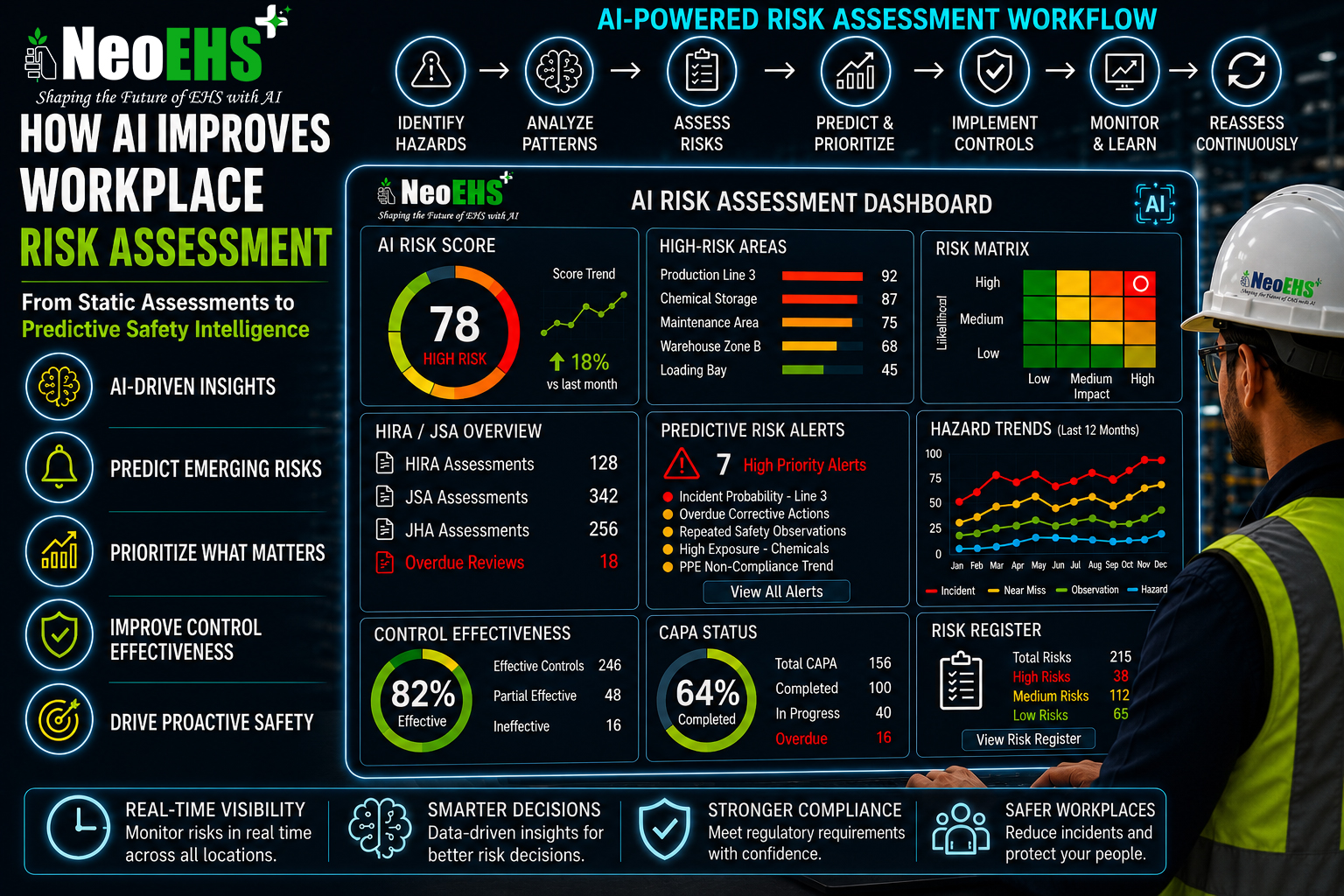
Instead of using technology simply to record what happened, construction companies can increasingly use AI to identify patterns, detect unsafe conditions, prioritize risks and support safety teams before an incident occurs.
That is where AI-powered EHS platforms such as NeoEHS can make a practical difference.
What Is Construction Safety Management?
Construction safety management is the systematic process of identifying hazards, assessing risks, implementing controls, monitoring work activities and continuously improving safety performance throughout a construction project.
It covers activities such as:
- Hazard identification and risk assessment
- Job Safety Analysis (JSA) and Job Hazard Analysis (JHA)
- Safety inspections
- Incident and near-miss reporting
- Permit to Work management
- Work-at-height safety
- Excavation and trench safety
- Electrical safety
- Lifting and rigging safety
- Equipment and machinery inspections
- Contractor safety management
- Toolbox talks and safety observations
- Corrective and preventive actions
- Emergency preparedness
- Regulatory and compliance management
The objective is not simply to produce more safety reports.
The real objective is to identify risks early, control them effectively and prevent people from being harmed.
For organizations looking to digitize these processes, NeoEHS Construction Safety Management Software provides a centralized platform for construction safety activities, including hazards, inspections, permits, incidents, contractor activities and compliance.
Why Construction Sites Need a More Proactive Approach to Safety
A construction project is a constantly changing environment.
The risk profile of a site can change from one hour to the next because of:
- New work activities
- Changing weather conditions
- Different contractors entering the site
- Equipment movement
- Changes in site layout
- Temporary structures
- Work at height
- Excavation activities
- Simultaneous operations
- Changes in workforce competency
- Expired permits or certifications
A safety inspection performed in the morning cannot necessarily tell you what will happen later in the afternoon.
This is one of the biggest opportunities for digital construction safety management.
Instead of relying only on periodic checks, organizations can bring together information from inspections, observations, incidents, permits, contractors and other operational activities.
AI can then help safety teams identify relationships and patterns that may be difficult to see manually.
How AI Is Changing Construction Safety Management
AI does not replace safety professionals.
It gives them better information to make faster and more informed decisions.
An AI-powered construction safety system can support safety teams in several important ways.
1. Predicting Emerging Safety Risks
One of the most valuable applications of AI in construction safety is risk prediction.
Traditional safety management often asks:
"What went wrong?"
A proactive safety program asks:
"Where are we likely to have a problem next?"
AI can analyze historical and current safety information such as incidents, near misses, safety observations, inspection findings, permit activities and corrective actions.
Patterns can then be used to identify areas that deserve additional attention.
For example, if a particular project repeatedly reports unsafe work-at-height observations, overdue corrective actions and repeated inspection findings, the system can highlight that activity as a higher-priority risk.
NeoEHS uses AI-powered risk intelligence to identify emerging risks and high-risk activities from EHS data.
2. AI-Powered Hazard Identification
Hazard identification is the foundation of construction safety.
However, hazards are not always obvious.
A hazard may be hidden in a combination of conditions rather than a single event.
For example:
Work at height + incomplete edge protection + unsuitable access + changing work conditions = elevated risk.
AI can help safety teams analyze large volumes of safety observations and inspection information to identify recurring patterns.
This can help answer questions such as:
- Which hazards are appearing repeatedly?
- Which locations have the highest number of findings?
- Which contractors have recurring safety issues?
- Which corrective actions remain open?
- Which activities generate the most observations?
- Are similar hazards appearing across different projects?
The value is not simply collecting more observations.
The value is converting observations into actionable safety intelligence.
3. Computer Vision for Construction Site Safety
Construction sites are highly visual environments.
Cameras can see conditions that humans may not continuously monitor.
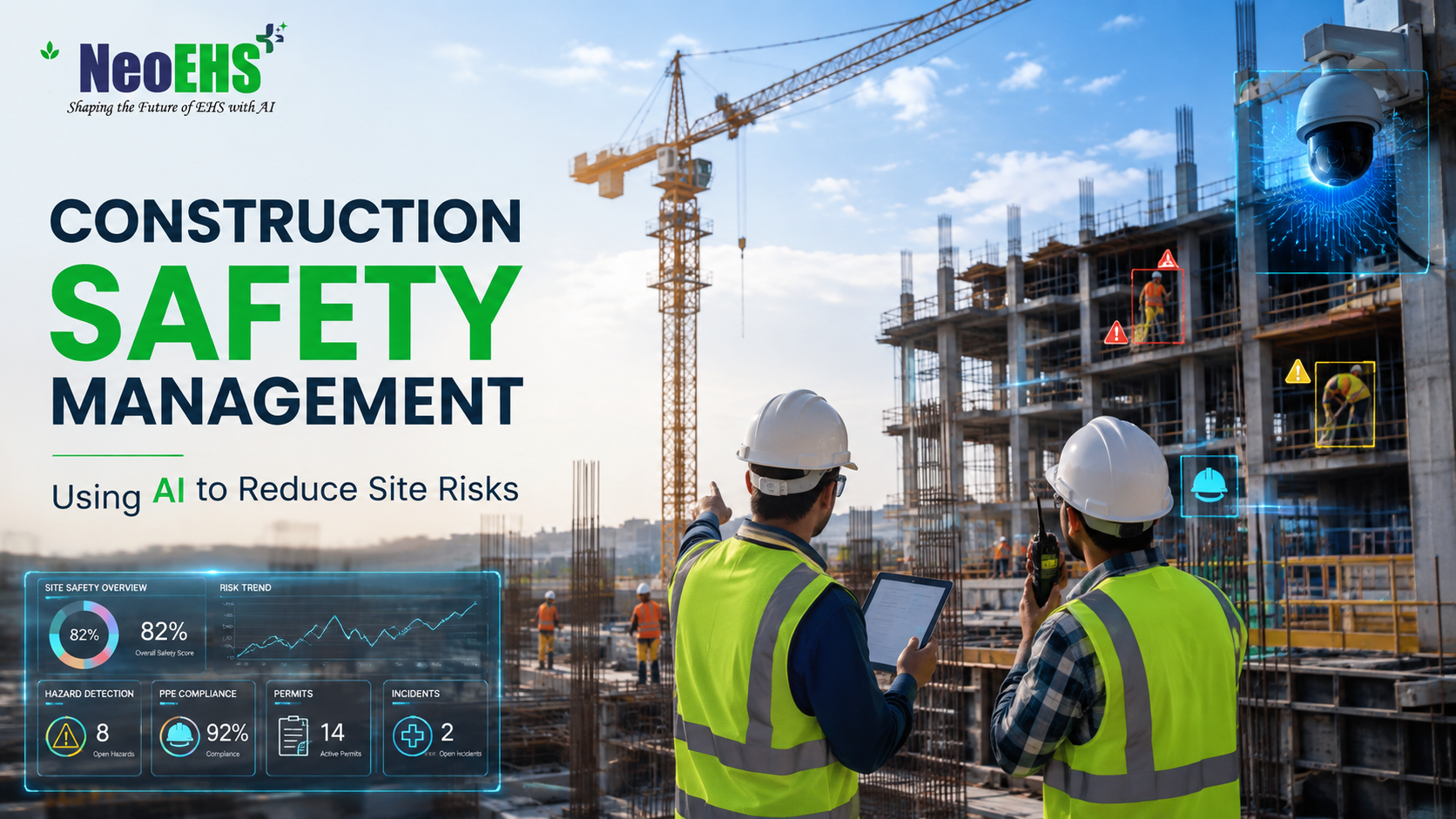
Computer vision and AI-powered CCTV analytics can assist with detecting specific safety conditions, depending on the cameras, configuration and AI models being used.
Examples can include:
- PPE compliance
- Restricted-area access
- Unsafe behavior
- Safety-zone violations
- Fire and smoke indicators
- Movement in designated areas
- Other predefined visual safety conditions
NeoEHS supports AI-powered computer vision capabilities designed to help organizations detect safety conditions such as PPE violations, unsafe behavior and restricted-area access.
The important point is that computer vision should complement—not replace—site safety professionals.
AI can identify a potential issue.
A competent safety professional still needs to understand the context, verify the condition and determine the appropriate control.
4. Smarter Permit to Work Management
High-risk construction activities often require formal authorization before work begins.
Examples include:
- Hot work
- Confined space entry
- Electrical work
- Excavation
- Work at height
- Lifting operations
- Energy isolation
- Other hazardous activities
A Permit to Work system creates a structured process for verifying that required controls are in place.
Digital PTW can make this process easier to monitor by providing visibility into:
- Pending permits
- Approved permits
- Expired permits
- Permit conditions
- Required approvals
- Isolation requirements
- Contractor information
- High-risk activities
NeoEHS provides digital Permit to Work capabilities for high-risk activities, including approval workflows, hazard verification and isolation controls.
The next step is using intelligence around that data.
For example, a safety team could prioritize monitoring when multiple high-risk permits are active in the same area at the same time.
5. Contractor Safety Management
Large construction projects rarely involve only one organization.
There may be dozens—or hundreds—of contractors and subcontractors working across different packages.
Managing contractor safety manually can become difficult.
A construction safety management platform can centralize information such as:
- Contractor profiles
- Safety performance
- Training status
- Competency records
- Certifications
- Incident history
- Safety observations
- Inspection results
- Corrective actions
- Permit activities
AI can add another layer by identifying contractor performance trends.
For example, if a contractor shows an increasing number of safety observations, overdue actions and permit violations, the system can help EHS managers identify that trend earlier.
This makes contractor management more proactive.
6. Turning Incident Data Into Prevention
Incident management should not end when an incident report is submitted.
The more important question is:
What can we learn from the incident so that it does not happen again?
A modern EHS system can connect:
Incident → Investigation → Root Cause → Corrective Action → Verification → Learning
AI can assist safety teams by analyzing incident information and identifying recurring contributing factors.
NeoEHS includes digital incident management, investigation, root-cause analysis and corrective-action workflows, with AI-assisted capabilities designed to support proactive safety management.
This creates a shift from simply recording incidents to building organizational learning.
7. Predictive Safety Analytics for Project Managers
Construction project managers need more than a list of open safety actions.
They need to understand the overall risk picture.
A digital construction safety platform can bring together information from:
- Incidents
- Near misses
- Hazards
- Safety observations
- Inspections
- Audits
- Permits
- Contractor performance
- Corrective actions
- Training
- Equipment inspections
AI-powered analytics can then help identify trends and prioritize attention.
For example:
"Which project currently has the highest concentration of unresolved high-risk findings?"
Or:
"Which safety category has deteriorated over the last three months?"
Or:
"Which corrective actions are repeatedly overdue?"
These are the kinds of questions that turn safety data into management intelligence.
8. AI Can Help Safety Teams Prioritize, Not Just Report
One of the biggest problems with traditional safety reporting is information overload.
A project may generate hundreds or thousands of observations, inspection findings and corrective actions.
Not every item has the same level of risk.
AI can help prioritize information based on factors such as:
- Risk severity
- Recurrence
- Location
- Activity
- Historical incidents
- Corrective-action status
- Contractor performance
- Frequency of observations
This allows safety professionals to focus their time where it matters most.
The goal is not more data. The goal is better decisions.
9. A Practical AI-Powered Construction Safety Workflow
A useful AI-enabled construction safety workflow can look like this:
Step 1: Capture
Collect information from mobile inspections, safety observations, incidents, permits, audits and other site activities.
Step 2: Connect
Bring the information together in a centralized EHS platform.
Step 3: Analyze
Use analytics and AI to identify trends, recurring hazards and emerging risk patterns.
Step 4: Prioritize
Highlight activities, locations, contractors or findings that require greater attention.
Step 5: Act
Assign corrective and preventive actions to responsible people.
Step 6: Verify
Confirm that controls have been implemented and findings have been closed effectively.
Step 7: Learn
Use historical information to improve future risk assessments, inspections and preventive controls.
This creates a continuous safety improvement loop rather than a collection of disconnected safety processes.
10. Construction Safety Use Cases for AI
AI can support different stages of a construction project.
| Construction Safety Area | How AI Can Help |
|---|---|
| Hazard Identification | Identify recurring and emerging hazard patterns |
| Risk Assessment | Support risk prioritization using historical data |
| PPE Monitoring | Detect predefined PPE compliance conditions using computer vision |
| Permit to Work | Improve visibility of high-risk work and permit status |
| Contractor Safety | Identify performance trends and recurring issues |
| Incident Management | Analyze incidents and contributing factors |
| Inspections | Highlight recurring inspection findings |
| Corrective Actions | Identify overdue or repeatedly recurring actions |
| Safety Observations | Analyze large volumes of observations |
| Project Dashboards | Provide management-level risk intelligence |
| Compliance | Identify potential gaps and overdue requirements |
11. AI + Human Expertise: The Right Safety Model
There is a common misconception that AI will replace safety professionals.
That is not the right way to look at it.
Construction safety involves judgment, communication, leadership and understanding of real-world conditions.
AI cannot walk onto a site and understand every operational nuance.
A safety professional can.
The strongest model is therefore:
AI + Safety Professional + Operational Data = Better Safety Decisions
AI can monitor patterns.
AI can prioritize information.
AI can identify potential risks.
AI can support investigations.
But people remain responsible for interpreting the situation, implementing controls and leading the safety culture.
12. What Should Construction Companies Look for in an AI-Powered EHS Platform?
Not every system described as "AI-powered" provides the same practical value.
Construction companies should evaluate whether the platform can actually connect AI with day-to-day EHS processes.
Important capabilities include:
Integrated Risk Management
The system should connect hazard identification, risk assessment and corrective actions.
Mobile Safety Management
Site teams should be able to report hazards, incidents and inspections from mobile devices.
Digital Permit to Work
High-risk activities should be managed through structured digital workflows.
Contractor Management
The platform should provide visibility into contractor competency, compliance and performance.
AI Risk Intelligence
AI should help identify patterns and emerging risks rather than simply display historical statistics.
Computer Vision
Where appropriate, computer vision can provide an additional layer of site monitoring.
Incident & Near-Miss Management
The platform should support investigation, root-cause analysis and corrective actions.
Dashboards & Analytics
Project managers and EHS leaders need clear, actionable information—not just large volumes of data.
Multi-Project Management
Large organizations should be able to compare safety performance across projects, contractors and locations.
NeoEHS combines these capabilities within an integrated EHS platform designed for construction and other high-risk industries.
13. How NeoEHS Supports Construction Safety Management
NeoEHS is an AI-powered Environmental, Health and Safety platform designed to connect safety processes, operational data and intelligent insights.
For construction organizations, the platform can support:
- Incident and near-miss management
- Hazard identification
- Risk assessment
- Safety observations
- Inspections
- Audits
- Permit to Work
- Contractor management
- Corrective and preventive actions
- Training and competency management
- AI-powered risk intelligence
- Computer vision safety monitoring
- Mobile workforce safety
- Dashboards and analytics
The construction-specific NeoEHS solution brings these capabilities together to help project teams improve visibility across hazards, permits, incidents, inspections, contractors and compliance activities.
For organizations looking for a broader enterprise platform, the NeoEHS EHS Software Platform provides an integrated approach to EHS, risk management, compliance and ESG.
14. The Future of Construction Safety Is Predictive
Construction safety is moving from a reactive model toward a more connected and predictive model.
The progression looks something like this:
Paper-based safety
↓
Digital safety reporting
↓
Connected EHS management
↓
Real-time safety intelligence
↓
AI-assisted risk prediction
The purpose is not to remove human involvement.
It is to give safety teams earlier visibility into the conditions that could lead to harm.
A near miss should become a learning opportunity.
A recurring hazard should become a signal.
An overdue corrective action should become a priority.
A high-risk activity should receive greater attention before something goes wrong.
That is the real promise of AI in construction safety management.
Frequently Asked Questions
What is construction safety management?
Construction safety management is the structured process of identifying hazards, assessing risks, implementing controls, monitoring work activities and improving safety performance throughout a construction project.
How can AI improve construction safety?
AI can analyze safety data, identify recurring patterns, support risk prediction, prioritize hazards, assist incident analysis and provide intelligent insights that help safety teams make more proactive decisions.
Can AI detect hazards on construction sites?
AI can assist with detecting certain predefined hazards or unsafe conditions, particularly when combined with computer vision, CCTV and connected data sources. However, AI should complement qualified safety professionals rather than replace human judgment.
How does AI help with contractor safety?
AI can analyze contractor-related safety data such as incidents, observations, inspection findings, training status and corrective actions to identify performance trends and areas requiring additional attention.
Can AI be used with Permit to Work systems?
Yes. AI can add intelligence to digital Permit to Work processes by analyzing permit activity, high-risk work patterns and operational data. Digital PTW platforms can also provide real-time visibility of active, pending and expired permits.
Is AI-powered EHS software suitable for large construction projects?
Yes. An enterprise EHS platform can help standardize safety processes across multiple projects, contractors and locations while providing centralized dashboards and analytics.
Does AI replace construction safety officers?
No. AI should support safety professionals by reducing manual analysis, identifying patterns and prioritizing risks. Safety professionals remain essential for site verification, decision-making, leadership and implementing effective controls.
What is the difference between traditional EHS software and AI-powered EHS software?
Traditional EHS software primarily digitizes and manages safety processes. AI-powered EHS software can additionally analyze large volumes of data, identify patterns, support predictions and provide intelligent recommendations to help organizations move toward proactive risk management.
From Safety Reporting to Safety Intelligence
Construction safety management is no longer just about collecting inspection forms and closing corrective actions.
The next generation of safety management is about understanding what the data is telling us—and acting before risks become incidents.
AI can help construction organizations connect information from hazards, inspections, incidents, permits, contractors and site activities to create a clearer picture of operational risk.
But technology alone does not create a safe construction site.
People, leadership, effective controls and a strong safety culture remain at the heart of construction safety.
AI simply gives those people better information, earlier visibility and a stronger foundation for making safety decisions.
With an integrated AI-powered EHS platform such as NeoEHS, construction companies can move from fragmented safety processes toward connected, proactive and intelligence-driven safety management.
The future of construction safety is not simply digital. It is predictive, connected and human-led.
eadcrumbListFAQPage— only if the visible FAQ content remains on the page and complies with Google's current structured-data requirements.ImageObject
This gives search engines and AI systems clearer relationships between NeoEHS → Construction Safety → AI → EHS Software → specific capabilities.
1. Construction Solution
Anchor text: NeoEHS Construction Safety Management Software. NeoEHS Construction Safety Management Software
2. EHS Software
Anchor text: AI-powered EHS software. AI-Powered EHS Software
3. HSE Software.
Anchor text: HSE Management Software. NeoEHS HSE Software
4. AI-Powered EHS Application
Anchor text: AI-powered EHS application. NeoEHS AI-Powered EHS Application