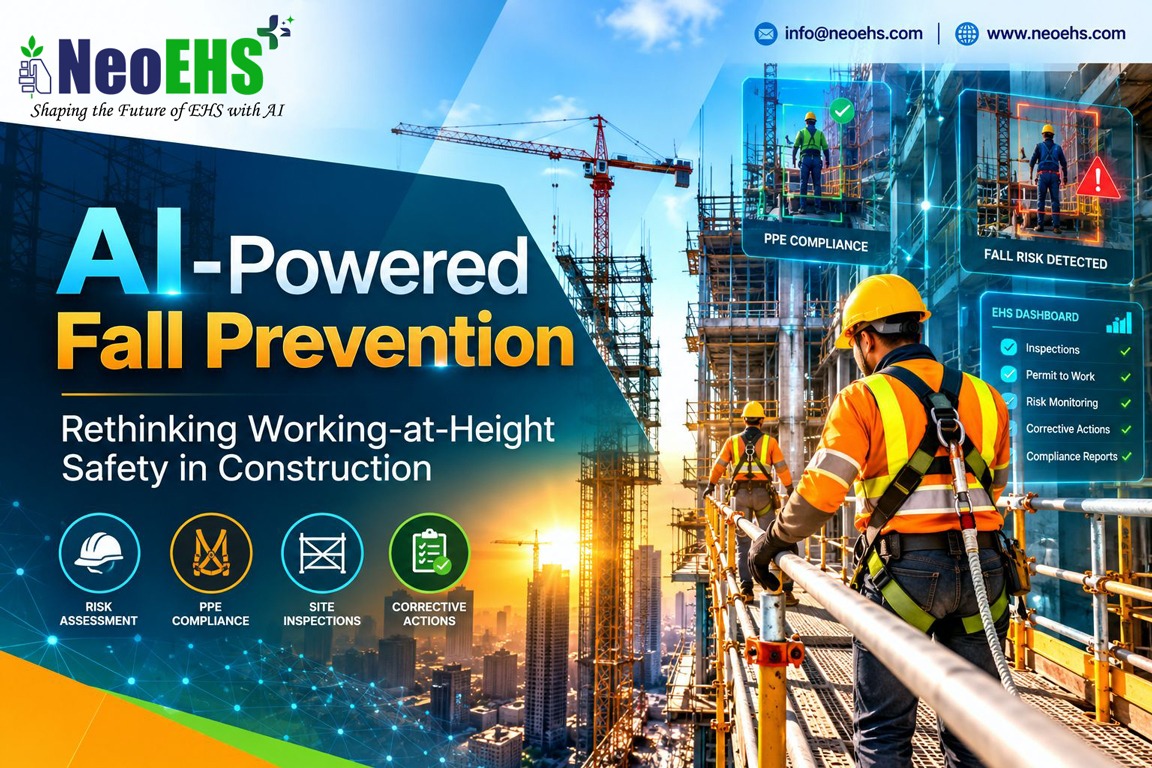
AI-Powered Fall Prevention: Rethinking Working-at-Height Safety in Construction
The Most Dangerous Step on a Construction Site May Be the One Nobody Questions
A construction worker climbs a scaffold to complete a routine installation. The team has performed the same activity dozens of times. The work permit is approved, the supervisor has completed the morning briefing, and everyone believes the risks are understood.
But something has changed.
An edge protection barrier was temporarily removed to allow material movement. A scaffold platform was modified during the previous shift. A worker's fall-arrest connection is not properly secured.
Each issue may appear small in isolation. Together, they can create the conditions for a serious fall.
This is one of the biggest challenges in construction safety: working-at-height risks are dynamic, while many safety management processes remain periodic and document-driven.
As construction projects become larger, more complex and increasingly dependent on multiple contractors, safety teams need better ways to identify changing conditions before someone gets hurt.
AI-powered safety technologies, combined with structured digital EHS management, offer an opportunity to strengthen that process.
What Is AI-Powered Fall Prevention in Construction?
AI-powered fall prevention uses technologies such as computer vision, predictive analytics, digital risk assessments and intelligent safety monitoring to help identify working-at-height hazards, prioritise interventions and support safer construction activities.
Depending on the system and deployment, these technologies may help safety teams recognise missing protective equipment, detect unsafe access conditions, identify recurring high-risk activities and monitor whether corrective actions have been completed.
However, AI does not physically prevent a fall.
Effective fall prevention still depends on engineering controls, properly designed access systems, competent workers, reliable equipment, supervision and emergency preparedness.
AI adds value by helping organisations recognise and respond to hazards earlier.
Why Working-at-Height Safety Remains a Major Construction Challenge
Construction sites rarely remain unchanged for long.
Scaffolding is assembled, modified and dismantled. Temporary platforms are installed. Floor openings appear as work progresses. Cranes move materials between levels, and multiple subcontractors operate in overlapping work zones.
A control that was adequate yesterday may no longer be adequate today.
Common working-at-height hazards include:
-
Unprotected roof edges and floor openings.
-
Incomplete or improperly modified scaffolding.
-
Unsafe ladders and temporary access arrangements.
-
Incorrectly selected or connected fall-arrest equipment.
-
Poorly controlled work near fragile surfaces.
-
Falling tools and materials that endanger workers below.
-
Inadequate rescue arrangements following a fall-arrest event.
These risks are not solved by increasing paperwork alone.
They require a reliable process for recognising hazards, assigning responsibility, implementing controls and verifying that the work environment remains safe.
From Reactive Safety Management to Proactive Risk Prevention
Traditional construction safety programmes often depend on scheduled inspections, toolbox meetings, manual permit approvals and incident investigations.
These practices remain essential, but their effectiveness can be limited when information moves slowly between workers, supervisors, contractors and corporate safety teams.
Consider a typical construction project.
A safety officer identifies missing edge protection on Level 12 and records the observation. The responsible contractor receives the instruction later. Meanwhile, another crew arrives to begin installation work in the same area.
The problem is not necessarily that the hazard was missed.
The problem is that the information did not reach the right people quickly enough.
Digital EHS systems can help close this communication gap by supporting faster reporting, responsibility assignment, corrective-action tracking and management visibility.
Where suitable AI capabilities are available, they can also assist with hazard classification, trend identification and prioritisation.
The objective is straightforward: move safety information closer to the moment when a decision must be made.
Five Ways AI Can Strengthen Working-at-Height Safety
1. Identifying unsafe conditions before work begins
Working-at-height activities should begin with a suitable risk assessment that considers the task, location, access arrangements, weather, equipment and potential consequences of a fall.
AI-assisted assessment tools may help safety professionals identify overlooked hazards or recommend additional considerations based on approved safety procedures and previous observations.
For example, a planned roofing activity might require reviewing fragile surfaces, weather exposure, edge protection, safe access and rescue arrangements.
The final assessment and approval must remain with competent personnel.
2. Supporting smarter permit-to-work decisions
High-risk work often requires formal authorisation, particularly where site procedures mandate permits for working at height.
A digital permit-to-work process can connect task descriptions, risk assessments, equipment checks, contractor information and approval responsibilities.
Intelligent rules may flag missing prerequisites, expired training records or incomplete safety inspections before authorisation.
For a large EPC project, this can provide better consistency across multiple work fronts.
Importantly, permit approval must reflect actual site conditions. A digitally approved permit is not evidence that a work area is physically safe.
3. Improving visibility through computer vision
AI-enabled cameras and image-analysis systems may be used to detect certain observable safety conditions, such as the presence of helmets, visible harnesses or workers approaching designated restricted areas.
Such systems require careful configuration and validation.
A camera may recognise that a worker is wearing a harness, but it may not reliably determine whether the harness is correctly fitted, connected to a suitable anchor or appropriate for the task.
Computer vision should therefore supplement competent inspection and supervision rather than replace them.
4. Learning from near misses and recurring hazards
A single near miss can reveal a problem. Hundreds of observations can reveal a pattern.
AI-assisted analysis may help identify recurring issues across construction projects, including repeated scaffold defects, incomplete barricading, poor housekeeping around access routes or recurring permit deviations.
These findings can help HSE leaders direct inspections, training and preventive interventions toward higher-priority activities.
The quality of these insights depends on accurate reporting, consistent hazard classifications and representative data.
5. Accelerating corrective-action closure
Identifying a hazard is only the beginning.
A working-at-height observation should have a clear owner, an appropriate control, a target completion date and evidence of verification.
Digital workflows can support reminders, escalation, photographic evidence and closure tracking.
For critical hazards, the priority is immediate risk control, including stopping affected work when necessary. A software notification should never substitute for urgent on-site intervention.
Why the Hierarchy of Controls Must Come Before AI
Technology is most effective when it supports sound safety engineering.
For working at height, organisations should first consider whether the activity can be eliminated or performed from ground level.
Where work at height cannot be avoided, suitable collective protection measures—such as properly designed guardrails, protected platforms and other engineered solutions—should generally take priority over reliance on personal protective equipment alone, subject to applicable regulations and task-specific risk assessment.
Personal fall protection, including restraint and fall-arrest systems, requires appropriate selection, anchorage, inspection, training and rescue planning.
Illustrative hierarchy for working-at-height risk control
1
Eliminate work at height
Prefabrication, ground-level assembly or alternative methods
2
Provide collective protection
Guardrails, protected platforms and engineered access
3
Use suitable personal protection
Restraint or fall-arrest systems with rescue arrangements
4
Strengthen administrative controls
Risk assessments, permits, inspections and supervision
5
Add digital and AI-enabled assurance
Monitoring, reporting, analytics and corrective-action visibility
AI is an additional assurance layer, not a substitute for higher-order controls. The sequence is illustrative and must be adapted to the applicable regulatory hierarchy.
A company can deploy advanced analytics and still have an unsafe site if physical fall protection is missing.
The goal is to combine reliable engineering controls with better operational information.
Connecting Working-at-Height Safety with a Digital EHS Platform
Fall prevention does not operate independently from the rest of construction safety management.
It connects with contractor competency, training, inspections, risk assessments, permit approvals, incident investigations and corrective-action management.
When these processes operate through disconnected spreadsheets, messaging applications and paper records, management visibility can become fragmented.
An integrated EHS approach helps organisations build a more consistent safety management process across sites and contractors.
This is the context in which NeoEHS—an AI-powered Environment, Health and Safety software platform—can be positioned as part of construction safety digitalisation.
For working-at-height management, organisations should evaluate how their EHS platform supports:
-
Hazard and near-miss reporting.
-
Task-specific risk assessments.
-
Working-at-height permit workflows.
-
Scaffold and access-equipment inspection records.
-
Contractor safety responsibilities.
-
Corrective and preventive action management.
-
Incident investigation and lessons learned.
-
Safety performance dashboards and management reporting.
The exact functionality, available AI features and integration options should be confirmed against the deployed NeoEHS configuration.
A Practical Construction Scenario: Managing Work at Height Across Multiple Contractors
Imagine a large commercial development where civil, mechanical, electrical and façade contractors operate simultaneously.
The project safety team needs to coordinate rooftop activities, temporary scaffolds, elevated work platforms and open-floor penetrations.
A digitally connected process could work as follows.
Before work: The contractor submits a task-specific risk assessment and the required permit documentation. The supervisor checks access arrangements, collective protection, worker competency and rescue preparedness.
During work: Safety officers record inspections and observations against the relevant location, activity and contractor. Critical hazards are communicated immediately, and affected work is suspended where required.
After a hazard is identified: The responsible team implements the necessary controls, attaches supporting evidence and requests verification.
At management level: Project leaders review overdue critical actions, repeated hazard categories and contractor performance trends.
Where AI-based analytical capabilities are implemented and validated, historical data may also help identify patterns that deserve additional management attention.
This scenario illustrates a potential operating model, not a claim that every function is currently available in NeoEHS.
What Construction Leaders Should Measure
A successful fall-prevention programme should not be evaluated solely by the number of incidents reported.
Construction leaders should also monitor the effectiveness of preventive controls.
|
Performance indicator |
Why it matters |
|---|---|
|
Critical fall hazards identified and controlled |
Measures hazard-control responsiveness |
|
Overdue high-risk corrective actions |
Highlights unresolved exposure |
|
Scaffold inspection compliance |
Tracks inspection completion against requirements |
|
Permit and risk assessment quality |
Assesses the adequacy of pre-work controls |
|
Worker competency and training validity |
Supports appropriate task authorisation |
|
Repeat working-at-height observations |
Reveals recurring weaknesses |
|
Verified corrective-action effectiveness |
Measures whether controls remain effective |
These indicators should be interpreted alongside workforce exposure, project activities and the quality of reporting. More hazard observations do not automatically mean a site is becoming less safe.
Responsible AI Adoption in Construction Safety
Before deploying AI-assisted fall-prevention technologies, construction companies should ask several important questions.
How accurately does the system detect the hazards it claims to recognise? How are false alerts managed? Can supervisors explain and challenge the system's recommendations? Who is responsible for final safety decisions?
For camera-based systems, organisations must also address worker privacy, data retention, access controls and applicable employment and data-protection requirements.
Any AI system used in a safety-critical process should undergo appropriate testing, site-specific validation and ongoing performance review.
Human accountability must remain central to every safety-critical decision.
The Future of Working-at-Height Safety Is Connected, Not Just Automated
Construction safety is moving toward a more connected operating model in which risk assessments, field inspections, permit approvals, contractor records and management information can work together.
AI may help identify patterns that are difficult to recognise manually. Digital workflows can improve coordination and accountability. Engineering controls and competent supervision remain the foundation of protection.
For construction and EPC organisations, the opportunity is not simply to collect more safety data.
It is to turn reliable information into timely preventive action.
Build a Stronger Construction Safety Management Process with NeoEHS
Working-at-height safety demands more than completed checklists and periodic reporting.
Construction companies need clear responsibilities, effective physical controls, consistent risk assessment, responsive corrective-action management and meaningful visibility across projects.
NeoEHS supports the broader vision of digital, AI-powered EHS transformation for organisations seeking to strengthen their safety management approach.
Explore NeoEHS to learn more about the platform and discuss how digital EHS processes can support your construction safety programme.
Contact: info@neoehs.com Website: www.neoehs.com
Frequently Asked Questions
What is AI-powered fall prevention in construction?
AI-powered fall prevention uses tools such as intelligent analytics, computer vision and digital safety workflows to help identify working-at-height hazards and support earlier preventive action. It supplements, rather than replaces, physical fall protection and human supervision.
Can AI detect whether construction workers are wearing safety harnesses?
Some computer-vision systems can identify visible harnesses under suitable conditions. However, recognising a harness does not prove that it is properly fitted, correctly anchored or safe for the task.
How can EHS software improve working-at-height safety?
EHS software can support hazard reporting, risk assessments, inspection records, permit management, corrective-action tracking and safety performance monitoring. These processes help improve coordination and accountability.
What is the difference between fall prevention and fall arrest?
Fall prevention aims to stop a fall from occurring, while fall-arrest systems are designed to stop a fall after it begins and limit its consequences. Suitable rescue arrangements are essential when fall-arrest equipment is used.
Can AI replace construction safety officers?
No. AI can assist with information analysis, monitoring and workflow support, but competent safety professionals remain responsible for assessing hazards, verifying controls and making safety-critical decisions.
What should construction companies prioritise when digitalising working-at-height safety?
Start with clearly defined safety procedures, effective physical controls, reliable inspections, contractor competency and corrective-action accountability. Digital tools should strengthen these established foundations.
Verified industry evidence and internal hyperlinks
To strengthen credibility and AI-search visibility, I recommend inserting this evidence paragraph after the opening section:
The scale of the challenge is significant. According to the U.S. Occupational Safety and Health Administration (OSHA), 389 of the 1,034 construction fatalities recorded in the United States in 2024 involved falls to a lower level. This reinforces why construction companies must combine physical fall protection, worker training, effective supervision and timely hazard identification.
Occupational Safety and Health Administration
+1
The following NeoEHS pages have been identified as relevant existing destinations:
|
Suggested anchor text |
Verified destination |
|---|---|
|
NeoEHS Construction Safety Management Software |
|
|
Digital Permit-to-Work Software |
|
|
AI-Powered EHS Software |
|
|
Integrated HSE Management System |
|
|
General Work Permit Management |
The construction page specifically describes working-at-height permits, inspections, hazard management and contractor safety, making it the strongest commercial landing page for this article.
.jpg "Wearable Technology is Transforming Workplace Safety")