Mining Environmental Management: How Digital EHS Can Strengthen Compliance and Sustainability
Responsible Mining Begins with Better Environmental Control
A mining operation can meet its production targets, maintain strong equipment availability and operate efficiently—yet still face serious consequences from an overlooked environmental risk.
A small change in water quality, an uncontrolled dust emission, an improperly stored chemical or a delayed corrective action can create consequences extending far beyond the mine boundary.
For mining companies, environmental management is no longer a responsibility handled only during regulatory inspections or annual sustainability reporting. It has become an essential part of everyday operational decision-making.
Modern mining operations must manage land disturbance, water resources, air quality, hazardous substances, waste, energy consumption and environmental rehabilitation while maintaining productivity.
The challenge is that much of this information remains fragmented.
Environmental monitoring results may be maintained in spreadsheets. Inspection findings may be recorded on paper. Corrective actions may be followed up through emails. Compliance obligations may be managed separately from operational activities.
When these processes are disconnected, identifying emerging environmental risks becomes more difficult.
Digital Environment, Health and Safety (EHS) management systems are changing how mining organizations monitor environmental performance, manage compliance obligations and support sustainable operations.
With AI-powered analytics, centralized information and automated workflows, mining companies can move beyond reactive reporting toward more preventive, transparent and accountable environmental management.
What Is Mining Environmental Management?
Mining environmental management is the systematic process of identifying, monitoring, controlling and reducing the environmental impacts associated with mineral exploration, extraction, processing, transportation and mine closure.
It includes activities such as water management, air-quality monitoring, waste and tailings management, hazardous chemical control, land rehabilitation, biodiversity protection, emissions management and environmental compliance.
The objective is to minimize environmental harm while meeting applicable legal obligations and supporting responsible resource development.
What Is Digital EHS for Mining Environmental Management?
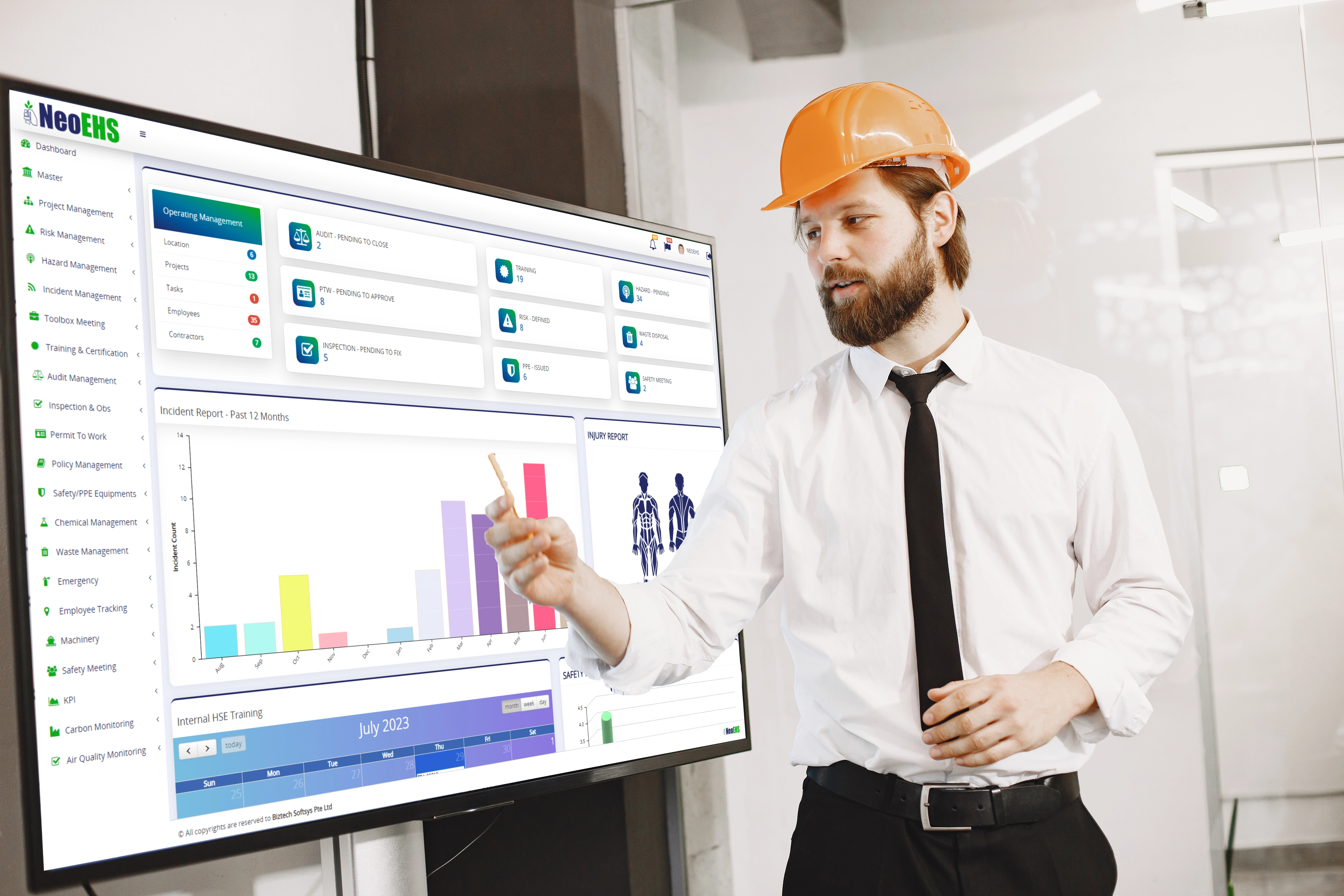
Digital EHS is the use of integrated software to manage environmental, occupational health and safety processes through centralized records, monitoring data, inspections, alerts, corrective actions and performance dashboards.
For mining organizations, it can help connect environmental observations with compliance requirements, responsible personnel and documented corrective measures.
AI can further support these activities by identifying unusual trends, highlighting recurring issues and assisting with risk prioritization.
However, digital EHS does not replace calibrated monitoring equipment, qualified environmental professionals or site-specific engineering controls.
Why Environmental Management Is Particularly Challenging in Mining
Unlike many industrial facilities, mining operations can extend across vast geographical areas and continue through multiple phases over many years.
Environmental conditions may change as excavation progresses, processing capacity expands, new waste facilities are developed or rehabilitation activities begin.
Six challenges deserve particular attention.
1. Water Consumption and Water Quality
Mining operations may require significant water resources for mineral processing, dust suppression and other activities.
Potential concerns include contaminated runoff, sediment discharge, changes in groundwater conditions and impacts on surrounding water resources.
Environmental teams must monitor relevant parameters, investigate deviations and maintain reliable compliance records.
2. Dust and Air Emissions
Drilling, blasting, excavation, crushing, material handling and haul-road traffic can generate airborne dust.
Depending on the operation, monitoring may need to address particulate matter, respirable crystalline silica, diesel emissions and other relevant pollutants.
Effective management requires more than collecting measurements. It requires linking monitoring results to operational controls and follow-up actions.
3. Waste and Tailings Management
Mining generates different waste streams, including waste rock, processing residues, hazardous waste and tailings.
These materials may present long-term environmental and safety risks.
Tailings facilities, in particular, require specialized engineering, monitoring, governance and emergency preparedness.
Digital EHS software can support related inspections, documentation, findings and action tracking, but it cannot substitute for a dedicated tailings management system or qualified engineering oversight.
4. Hazardous Chemicals and Materials
Fuel, lubricants, reagents and other chemicals must be stored, handled and disposed of appropriately.
Poor chemical inventory control or delayed reporting of spills can increase environmental exposure and compliance risk.
5. Regulatory Requirements Across Multiple Locations
Mining companies operating in different countries or jurisdictions may face different environmental permit conditions, reporting obligations, monitoring requirements and enforcement frameworks.
Managing these obligations through disconnected systems creates unnecessary administrative complexity.
6. Mine Closure and Rehabilitation
Environmental responsibilities continue beyond active extraction.
Mine closure planning, rehabilitation activities, post-closure monitoring and long-term environmental commitments require reliable records and sustained accountability.
A digital approach can help preserve institutional knowledge throughout the mining lifecycle.
Seven Ways Digital EHS Can Strengthen Mining Environmental Management
1. Centralized Environmental Monitoring and Reporting
One of the greatest challenges for environmental teams is obtaining a reliable view of environmental performance across the entire operation.
Information may come from laboratory reports, field inspections, monitoring instruments, contractors and regulatory submissions.
A digital EHS platform can organize these records within a consistent management structure.
For example, a mining company operating three geographically separated sites can use standardized environmental reporting processes while maintaining site-specific monitoring requirements.
Management can review trends, outstanding issues and reporting obligations without relying entirely on manual consolidation.
The benefit is not simply having more data. It is having dependable information available when decisions need to be made.
2. Water Quality Monitoring and Early Environmental Alerts
Consider an open-pit mine where surface-water samples are collected at designated monitoring locations.
A laboratory result identifies an unexpected increase in a monitored parameter.
In a traditional workflow, the finding may require several manual steps before reaching the responsible environmental manager.
In a connected system, the result can be recorded against the appropriate location, compared with configured thresholds and escalated for review.
The environmental team can investigate possible causes, initiate corrective actions and document follow-up sampling.
Where compatible monitoring equipment and integrations are available, automated data collection can reduce manual entry.
AI-supported analysis may also help identify recurring patterns or unusual changes that warrant investigation.
Importantly, an unusual reading is not automatically evidence of a regulatory violation. Monitoring quality, permit conditions and technical context must be assessed.
3. Dust and Air-Quality Management
Dust control is essential for protecting workers, nearby communities and the surrounding environment.
Mining companies may use monitoring stations, mobile inspections and operational observations to evaluate dust-related risks.
A digital EHS system can help connect these records with corrective-action workflows.
For example, repeated dust observations along a haul road may indicate that existing suppression measures are insufficient.
Environmental and operational teams can review the findings, assess conditions and introduce appropriate controls, such as adjusting watering schedules, improving road surfaces or modifying traffic arrangements.
AI analytics may help identify recurring patterns involving weather, operating activity and recorded dust levels.
This provides a stronger foundation for targeted preventive action.
4. Environmental Incident and Spill Management
An environmental incident can begin with something as simple as a leaking fuel hose or damaged chemical container.
The seriousness of the event depends on the material involved, the quantity released, the surrounding environment and the effectiveness of the response.
Digital incident management can help teams record the event, document the location, attach evidence, initiate an investigation and track corrective actions.
Consider a diesel spill near a maintenance workshop.
The immediate priority is safe containment and response by trained personnel.
The digital workflow can then support documentation of the incident, affected areas, investigation findings, cleanup verification and preventive measures.
If similar incidents occur at multiple locations, trend analysis may reveal weaknesses in equipment maintenance or chemical handling procedures.
The objective is to prevent recurrence, not merely close the incident report.
5. Environmental Compliance and Audit Readiness
Mining environmental compliance involves more than maintaining a list of regulations.
Organizations must understand which obligations apply to each facility, activity, permit and reporting period.
A digital compliance management process can help maintain obligation registers, assign responsible personnel, track deadlines and retain supporting evidence.
Environmental audits can also be managed through structured checklists, findings, corrective actions and verification records.
For example, an internal audit may identify missing evidence of a required monitoring activity.
Rather than leaving the finding in an isolated audit report, the system can assign an action, establish a deadline and monitor closure.
Digital workflows support compliance management, but actual compliance depends on the organization's controls, conduct and adherence to applicable requirements.
6. Carbon Emissions, Energy and ESG Performance
Environmental performance is increasingly connected with energy management, greenhouse gas emissions and sustainability reporting.
Mining organizations may need to track fuel consumption, purchased electricity, emissions sources, waste quantities and water usage.
A digital EHS platform can help organize relevant environmental data and support management dashboards.
Where suitable data sources and calculation methodologies are available, organizations can analyze trends and identify opportunities for resource efficiency.
For example, changes in diesel consumption across mining fleets may prompt further investigation into equipment utilization, operating practices or maintenance conditions.
Environmental and sustainability reporting should use recognized calculation methods, documented assumptions and appropriate data-quality controls.
AI-assisted insights can support the analysis, but reported figures must remain traceable and verifiable.
7. Environmental Risk Assessment and Corrective Action
Environmental risks are rarely static.
Changes in mining activity, seasonal rainfall, material storage, equipment condition or surrounding land use may introduce new exposure pathways.
A structured digital risk management process helps organizations review environmental hazards, assess consequences and maintain control measures.
Potential scenarios include contaminated runoff, uncontrolled emissions, chemical releases and inadequate waste containment.
Where risks are identified, corrective and preventive actions can be assigned and monitored.
Connecting risk assessments with incidents, inspections and audits helps ensure that lessons from one activity are considered elsewhere in the operation.
How AI Can Support More Proactive Environmental Decisions
Artificial intelligence becomes useful when it helps environmental professionals recognize information that might otherwise be overlooked.
Three applications are especially relevant to mining.
Pattern recognition: AI-supported analytics may identify recurring environmental deviations across locations, operating periods or equipment categories.
Anomaly detection: Statistical and machine-learning techniques can flag unusual changes in monitoring data for technical review.
Decision support: AI can assist with organizing environmental observations, summarizing incident information and prioritizing follow-up activities.
These applications require suitable data, validation and governance. They should not be represented as autonomous regulatory decisions or guaranteed environmental protection.
The strongest approach combines digital intelligence with environmental expertise and established operational controls.
How AI-Powered NeoEHS Supports Mining Environmental Management
NeoEHS — AI-Powered Environment, Health and Safety Management Software
Mining organizations require an integrated approach that connects environmental responsibilities with operational safety, risk management and compliance activities.
NeoEHS provides a digital EHS platform covering important environmental and safety management workflows.
Relevant capabilities described within the NeoEHS mining solution include:
|
NeoEHS solution area |
Application in mining environmental management |
|---|---|
|
Environmental Management |
Organize environmental activities and monitoring records |
|
Air-Quality Monitoring |
Manage air-quality observations and related actions |
|
Carbon Emission Management |
Support emissions data collection and performance visibility |
|
Waste Management |
Maintain waste-related records and follow-up activities |
|
Chemical Management |
Manage chemical information and associated controls |
|
Incident Management |
Report and investigate spills and environmental incidents |
|
Risk Management |
Assess environmental hazards and control measures |
|
Inspection & Audit Management |
Document findings, evidence and corrective actions |
|
CAPA Management |
Assign, escalate and verify preventive and corrective actions |
|
EHS Dashboards |
Provide consolidated visibility into performance and outstanding issues |
NeoEHS also supports AI-assisted analytics and workflow automation. The precise monitoring integrations, predictive models and reporting functions should be confirmed for each implementation.
For mining companies managing multiple locations, an integrated EHS approach can strengthen consistency, accountability and access to environmental information.
Learn more about NeoEHS AI-Powered EHS Software.
Practical Use Case: Managing Environmental Risk at an Open-Pit Mine
Consider an illustrative open-pit mine experiencing increased rainfall during the wet season.
Environmental inspections identify sediment accumulation near a drainage channel. Monitoring results also show a change in downstream water-quality conditions.
The environmental team needs to establish whether the observations are related, determine the cause and take appropriate action.
A connected digital EHS workflow could operate as follows:
-
Detection: Record the inspection finding and relevant water-quality measurements.
-
Assessment: Review the monitoring data, site conditions and applicable permit requirements.
-
Investigation: Identify potential causes, including drainage conditions and sediment-control effectiveness.
-
Corrective action: Assign appropriate operational and engineering measures to responsible personnel.
-
Verification: Complete follow-up inspections and sampling to evaluate the effectiveness of controls.
-
Management review: Examine recurring findings and update the environmental risk assessment where necessary.
The value of the system lies in connecting observations, responsibilities and evidence of completion.
It does not determine the technical cause automatically, nor does it replace environmental sampling or professional assessment.
Measuring Environmental Performance: KPIs That Matter
Mining organizations should measure the effectiveness of environmental management using indicators relevant to their activities and permit conditions.
|
Environmental KPI |
Management purpose |
|---|---|
|
Water-quality threshold exceedances |
Identify and investigate abnormal results |
|
Dust-monitoring trends |
Evaluate dust-control effectiveness |
|
Environmental incident frequency |
Monitor reportable and non-reportable events |
|
Overdue environmental corrective actions |
Assess follow-up accountability |
|
Waste generation and disposal records |
Improve waste oversight |
|
Energy consumption per unit of production |
Evaluate operational efficiency |
|
Greenhouse gas emissions |
Support emissions management |
|
Environmental inspection completion |
Monitor inspection execution |
|
Rehabilitation milestone completion |
Track closure and restoration commitments |
These indicators are most useful when interpreted alongside operational context, monitoring quality and relevant legal requirements.
Environmental Standards and Global Mining Expectations
Mining companies operate under a combination of national regulations, environmental permits, industry standards and stakeholder expectations.
Several international frameworks can help guide environmental management practices.
ISO 14001 – Environmental Management Systems: Provides a framework for establishing, implementing, maintaining and improving an environmental management system.
ISO 45001 – Occupational Health and Safety Management Systems: Supports systematic management of workplace health and safety risks.
Global Industry Standard on Tailings Management (GISTM): Establishes expectations for responsible tailings facility management, including governance, affected communities and risk management.
GHG Protocol: Provides widely used standards and guidance for greenhouse gas accounting and reporting.
International Council on Mining and Metals (ICMM): Publishes industry principles and resources relating to responsible mining practices.
Digital EHS software can help organize information and workflows associated with these frameworks, but using software does not itself establish certification or conformity.
The Future of Sustainable Mining Is Connected
Mining companies are under increasing pressure to improve operational efficiency while managing environmental responsibilities.
The next phase of environmental management will involve better connections between monitoring equipment, operational data, environmental teams and management systems.
Digital platforms can help make these connections more effective.
AI may contribute through anomaly detection, trend analysis and workflow assistance, while environmental specialists remain responsible for technical interpretation and decisions.
Successful organizations will not be defined simply by how much environmental data they collect.
They will be distinguished by how effectively they use that information to prevent harm, strengthen controls and demonstrate responsible performance.
Conclusion: Better Environmental Decisions Build More Sustainable Mining Operations
Environmental responsibility cannot be achieved through reporting alone.
It requires consistent monitoring, competent assessment, timely action and continuous improvement across the mining lifecycle.
Digital EHS provides a practical foundation for connecting these activities.
By bringing environmental monitoring, inspections, incidents, risk assessments, corrective actions and performance information together, mining companies can improve visibility and accountability.
NeoEHS supports this transition by helping organizations manage environmental and safety responsibilities through connected digital workflows and AI-assisted intelligence.
The future of sustainable mining depends on turning environmental information into meaningful action.
Explore NeoEHS
Website: www.neoehs.com
Email: info@neoehs.com
Frequently Asked Questions
What is mining environmental management software?
Mining environmental management software is a digital platform used to organize environmental monitoring, compliance obligations, inspections, incidents, risk assessments and corrective actions associated with mining operations.
How does digital EHS improve environmental compliance in mining?
Digital EHS can improve the management of compliance obligations through centralized records, assigned responsibilities, scheduled activities, documented evidence and corrective-action tracking. It does not guarantee regulatory compliance.
Can AI help prevent environmental incidents in mines?
AI can help identify unusual trends and recurring environmental risks, supporting earlier investigation and preventive action. Its effectiveness depends on reliable data and appropriate human review.
Can NeoEHS support water and air-quality management?
NeoEHS includes environmental and air-quality management capabilities. Water-monitoring workflows and specific equipment integrations should be confirmed against the proposed deployment scope.
How does EHS software support sustainable mining?
It helps organizations manage environmental information, identify recurring issues, coordinate corrective actions and track selected sustainability indicators.
Can mining companies use one EHS platform across multiple sites?
Yes. A centralized EHS platform can support standardized workflows across locations while allowing configuration for site-specific environmental requirements.
Does digital EHS replace ISO 14001?
No. ISO 14001 is an environmental management system standard. Digital EHS software can support implementation and record management, but it does not replace the standard or independent certification processes.