Metro / Rail Projects Risk Assessment : HIRA, HIRARC, JSA and JHA Explained
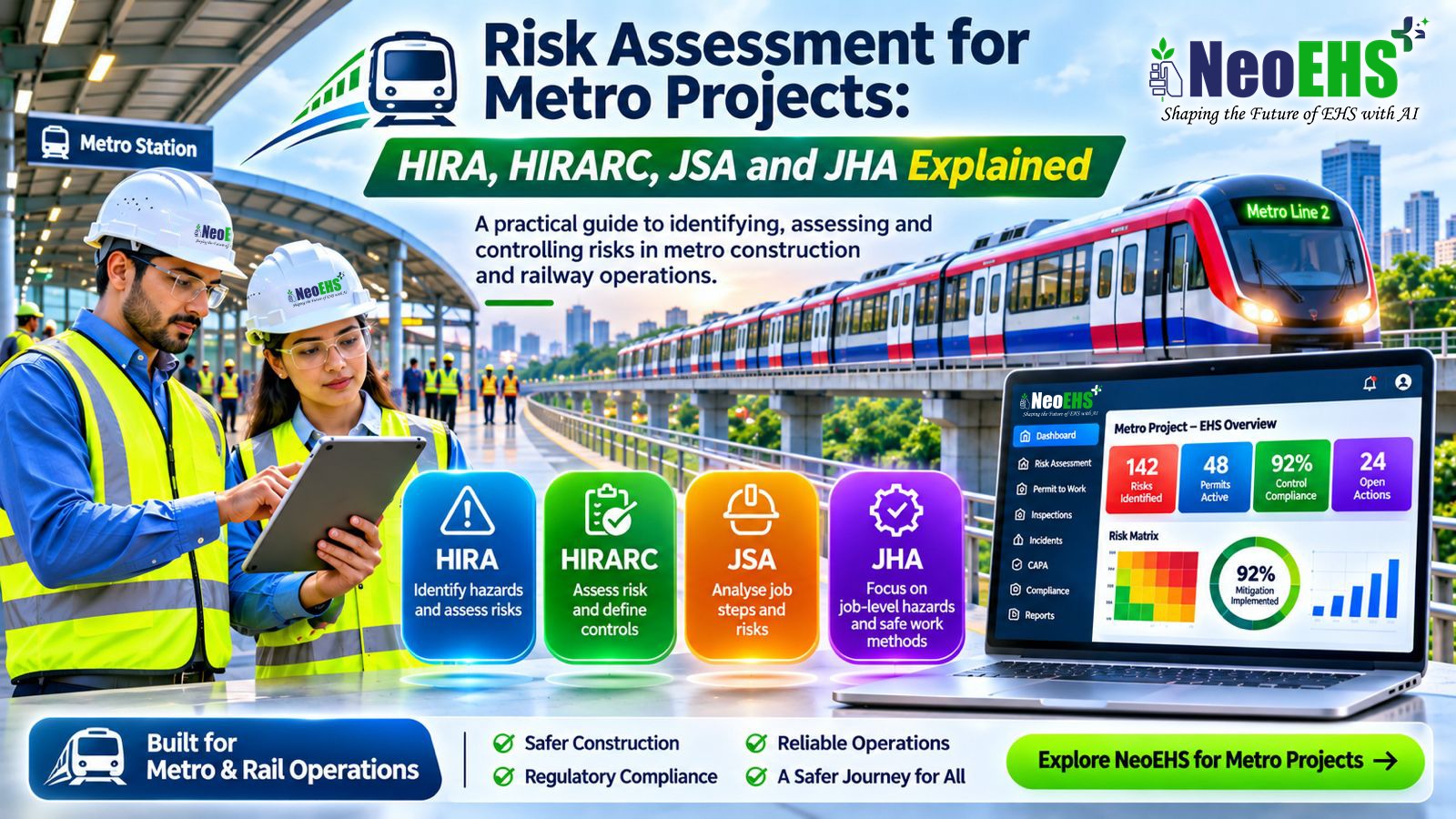
How to identify hazards, evaluate risks and control high-risk activities throughout metro construction and railway infrastructure projects.
What are HIRA, HIRARC, JSA and JHA?
HIRA (Hazard Identification and Risk Assessment) is a structured process for identifying workplace hazards and evaluating the risks they present.
HIRARC (Hazard Identification, Risk Assessment and Risk Control) explicitly includes the selection and implementation of risk controls. It is particularly familiar in Malaysian occupational safety practice.
JSA (Job Safety Analysis) examines a particular job by breaking it into steps, identifying hazards at each step and defining precautions.
JHA (Job Hazard Analysis) is closely related to JSA. Many organizations use the terms interchangeably, although individual company procedures may distinguish them.
For metro projects, these methods work best as connected parts of one risk management process rather than separate paperwork exercises.
HIRA: Understanding the wider risks of metro construction
HIRA helps project teams recognize hazards associated with construction areas, work packages, equipment and operational interfaces.
For example, consider an elevated metro viaduct construction project.
The project HIRA may identify hazards associated with:
-
Working at height on piers and launching girders.
-
Heavy lifting and suspended loads.
-
Temporary works and structural stability.
-
Mobile cranes and construction vehicles.
-
Electrical installations and temporary power.
-
Working above public roads and pedestrian areas.
-
Falling objects and material handling.
-
Adverse weather affecting lifting and elevated work.
-
Simultaneous activities involving several contractors.
Each identified hazard is assessed according to the project's approved risk methodology.
Many organizations use a likelihood-and-severity matrix, but there is no single universal scoring scale. Risk criteria, acceptance thresholds and approval requirements must follow the applicable project procedures.
A well-prepared HIRA should identify the people exposed, credible consequences, existing safeguards, additional controls, responsible persons and review triggers.
Example: Elevated station construction
During station construction, workers may operate near unprotected edges while lifting formwork.
The assessment should consider falls, dropped objects, equipment movement, structural stability and the exposure of people below.
Controls may include engineered edge protection, approved lifting arrangements, exclusion zones, inspected temporary works, suitable access systems and competent supervision.
The assessment must also consider whether the controls can actually be implemented under current site conditions.
HIRARC: Moving from risk identification to effective control
HIRARC makes the risk control stage explicit.
The process is commonly presented as three connected activities:
-
Identify hazards.
-
Assess the associated risks.
-
Determine and implement suitable controls.
For metro projects, this approach is useful because hazards often change as construction progresses.
Consider excavation work for an underground metro station.
Potential hazards include ground collapse, groundwater ingress, buried utilities, moving plant, restricted access, poor ventilation and interaction with adjacent structures.
A HIRARC process should evaluate these hazards and establish appropriate controls.
Possible controls include engineered excavation support, utility identification and protection, groundwater management, safe access arrangements, monitoring, equipment segregation and emergency preparedness.
Controls should follow the hierarchy of controls wherever practicable. Engineering and elimination measures should take priority over reliance on PPE alone.
Why HIRARC is especially relevant in Malaysia
Malaysia's Department of Occupational Safety and Health (DOSH) has published guidance on Hazard Identification, Risk Assessment and Risk Control.
For Malaysian rail and metro projects, HIRARC terminology may therefore be particularly familiar to contractors and safety professionals.
However, project teams should always confirm the latest applicable legal requirements, contract specifications and approved risk assessment procedures. A guidance document should not automatically be treated as a standalone statutory requirement for every activity.
JSA: Managing the risks of a specific job
While HIRA may cover a wider construction area or activity, JSA focuses on how a particular job will be performed.
The work is divided into logical steps, and the hazards and necessary precautions are considered for each step.
For example, a JSA for installing a precast segment on an elevated metro structure might include:
| Job step | Potential hazard | Example control |
|---|---|---|
| Prepare work area | Unauthorized access and conflicting activities | Barricades, access control and coordination |
| Inspect lifting equipment | Defective rigging or lifting accessories | Pre-use inspection and verified certification |
| Position lifting equipment | Unstable ground or inadequate setup | Approved lifting plan and verified support conditions |
| Lift and move segment | Suspended load or collision | Controlled lifting zone, competent lifting team and communication |
| Position segment | Crushing and pinch points | Safe positioning arrangements and exclusion from danger zones |
| Complete installation | Premature release or instability | Verify secure installation before releasing lifting equipment |
This table is illustrative. It is not a substitute for an approved engineering method statement, lifting plan or site-specific assessment.
A JSA becomes particularly valuable during pre-task briefings because it helps supervisors and workers understand the sequence of work and the precautions expected at each stage.
JHA: Understanding job-specific hazards
JHA is another method of examining the hazards associated with a task.
In many organizations, JHA and JSA mean substantially the same thing.
The important issue is not which acronym appears on the form. It is whether the assessment accurately describes the job, identifies credible hazards and establishes effective precautions.
Consider a metro maintenance activity involving work near energized electrical equipment.
The JHA or JSA should address electrical exposure, isolation requirements, access restrictions, competent personnel, testing arrangements, stored energy and emergency procedures.
The exact precautions depend on the electrical system, applicable standards and the approved work method.
Organizations should avoid requiring duplicate JSA and JHA documents that contain essentially the same information without adding meaningful risk control.
HIRA vs HIRARC vs JSA vs JHA: Key differences
| Method | Primary focus | Typical metro application |
|---|---|---|
| HIRA | Identify hazards and assess risks | Project, area, system or activity-level assessment |
| HIRARC | Identify hazards, assess risks and establish controls | Structured risk management for construction activities |
| JSA | Analyze the steps of a specific job | Lifting, installation, maintenance or other defined tasks |
| JHA | Analyze job-related hazards and precautions | Task-specific assessment, often equivalent to JSA |
These are practical distinctions rather than universal regulatory definitions. An employer's approved methodology may combine several of these functions within one assessment.
Where risk assessments are most important in metro projects
1. Underground excavation and tunnelling
Underground work may involve ground instability, water ingress, confined or restricted spaces, moving equipment, ventilation challenges and complex emergency access.
Risk assessments should consider geological information, ground support, monitoring, equipment interfaces, emergency arrangements and changes in excavation conditions.
2. Elevated viaduct and bridge construction
Key concerns include working at height, lifting operations, temporary works, structural stability and dropped objects.
Assessments must address both workers on the structure and people or vehicles beneath it.
3. Track installation
Track installation involves heavy materials, mechanical handling, alignment work, powered tools, moving equipment and, in some cases, interaction with existing railway operations.
The assessment should consider access arrangements, lifting methods, equipment segregation and any operational railway restrictions.
4. Electrical and signalling systems
Installation, testing and commissioning can introduce electrical hazards, unexpected energization, stored energy and conflicting activities.
Risk controls should address isolation, authorization, testing procedures, competent personnel and coordination between contractors.
5. Station construction
Station projects often involve multiple contractors working simultaneously in limited spaces.
Interface risks may arise between civil, mechanical, electrical, architectural and finishing activities.
A risk assessment that ignores simultaneous operations can miss hazards created by another team's work.
6. Testing and commissioning
Testing introduces a different risk profile from construction.
Train movement, energized systems, restricted access, incomplete interfaces and changes in operating conditions require carefully coordinated assessments and authorization.
Why metro project risk assessments sometimes fail
The problem is often not the absence of documentation.
A project may have hundreds of approved risk assessment forms while important hazards remain uncontrolled.
Common weaknesses include:
Generic assessments: Documents copied from earlier projects without accounting for the actual site.
Outdated information: Assessments are not revised after design, equipment or work-sequence changes.
Poor contractor coordination: Different contractors assess their own tasks without considering shared work areas.
Disconnected permits: A permit may be approved without verifying that its associated assessment reflects current conditions.
Weak worker participation: Workers receive instructions but are not encouraged to identify missing hazards.
Incomplete corrective actions: Findings are recorded without ensuring that corrective measures have been completed and verified.
Inadequate field verification: Controls look appropriate on paper but are not implemented at the worksite.
These weaknesses are particularly serious in metro projects because activities, access arrangements and contractor interfaces change frequently.
How digital risk assessment improves metro project safety
Digital systems can help teams maintain a connected record of hazards, controls, approvals, inspections and corrective actions.
Instead of storing risk assessments in isolated spreadsheets and documents, a connected platform can link them to relevant work activities.
A practical digital workflow may include:
-
Register the project, location and activity.
-
Select an approved risk assessment template.
-
Identify hazards and affected personnel.
-
Evaluate risks using the approved project matrix.
-
Define controls and responsible persons.
-
Route the assessment for appropriate review and approval.
-
Link the assessment to the relevant permit or work package.
-
Verify critical controls before work begins.
-
Record inspections, observations and corrective actions.
-
Review the assessment when conditions change.
Digitalization alone does not make a risk assessment effective. The underlying method, site verification and competence of the people involved remain essential.
How AI can support risk assessment for metro projects
AI can help safety teams review information and identify patterns that may be difficult to recognize through manual processes alone.
Potential applications include:
Identifying recurring hazards
AI-assisted analysis can highlight repeated inspection findings, incidents and observations associated with particular work activities or locations.
Supporting hazard identification
Based on available project data and approved knowledge sources, AI may suggest hazards that assessors should consider.
These suggestions require review by competent personnel.
Recognizing changes in risk patterns
Analysis of historical findings, work activity and operational data may help identify areas needing closer attention.
Such outputs are decision-support information, not proof that an accident will occur.
Improving document review
AI-assisted tools may help identify incomplete fields, inconsistent terminology or missing links between assessments and work permits.
Supporting corrective-action prioritization
A connected system can help teams identify overdue actions and recurring findings requiring management attention.
AI-generated recommendations should never replace engineering judgment, statutory requirements, competent supervision or site-specific verification.
How NeoEHS supports connected risk management
NeoEHS is an AI-powered Environment, Health and Safety software platform designed to help organizations digitize and connect EHS workflows.
For metro and railway projects, a connected approach can bring risk assessments together with related processes such as:
-
Hazard identification and risk management.
-
Permit to Work.
-
Safety inspections and observations.
-
Incident and near-miss management.
-
Audits and corrective actions.
-
Contractor safety management.
-
Training and competency records.
-
EHS dashboards and reporting.
The objective is to make risk information more accessible, traceable and useful throughout the work lifecycle.
For example, a risk assessment identifying lifting hazards should inform the relevant permit, pre-work checks and inspection requirements.
If a critical control is missing, the finding should be visible to the responsible team and handled through the appropriate corrective-action process.
This is where integrated EHS management can provide greater value than disconnected risk assessment forms.
Explore NeoEHS to understand the platform and its EHS management capabilities.
Best practices for implementing risk assessments in metro projects
Use a consistent methodology. Establish approved risk criteria, templates, review responsibilities and acceptance requirements.
Assess the actual work. Base assessments on site conditions, engineering documents and the planned work method.
Involve the workforce. Supervisors, contractors and workers should contribute relevant practical knowledge.
Connect assessments to permits. High-risk work should not proceed solely because a document has been completed.
Review changes before execution. Changes in design, location, personnel, equipment or work sequence should trigger appropriate reassessment.
Verify controls at the site. Ensure critical precautions are implemented and remain effective.
Track findings to closure. Assign corrective actions, monitor progress and verify completion.
Use AI responsibly. Treat AI-generated insights as supporting information requiring competent human review.
Frequently asked questions
What is HIRA in metro construction?
HIRA is a method for identifying hazards and assessing the risks associated with metro construction activities, work areas, equipment and operations.
What is the difference between HIRA and HIRARC?
HIRA emphasizes hazard identification and risk assessment. HIRARC explicitly includes risk control. In practice, a complete HIRA procedure may also require controls, so the distinction depends on the adopted methodology.
Are JSA and JHA the same?
They are often used interchangeably. Both commonly involve analyzing a specific job, identifying hazards and establishing precautions. Some organizations define them differently in their internal procedures.
Which method is best for metro projects?
There is no single best acronym. Metro projects generally need structured project-level risk management supported by task-specific assessments and effective control verification.
Is HIRARC mandatory for every metro project?
Requirements depend on the country, applicable legislation, contract conditions and approved project procedures. Malaysian DOSH guidance is a relevant reference, but legal applicability must be assessed for each project.
When should a risk assessment be reviewed?
It should be reviewed when relevant conditions change, following significant incidents or findings, when controls prove inadequate, and at other intervals or triggers required by the approved procedure.
Can AI automatically approve a high-risk activity?
AI can support analysis and document review, but safety-critical authorization should remain subject to the organization's approved procedures and competent human decision-making.
How can NeoEHS help metro contractors?
NeoEHS can support connected EHS workflows involving risk management, inspections, permits, incidents and corrective actions. Specific automation and AI functions should be confirmed against the deployed product configuration.
Conclusion: Better risk assessments begin with better connections
HIRA, HIRARC, JSA and JHA are not competing solutions. They are related approaches for understanding hazards and managing risk at different levels of work.
For metro and railway projects, the real challenge is ensuring that assessments remain accurate, relevant and connected to site execution.
When risk assessments, permits, inspections, contractor activities and corrective actions operate together, safety teams can make better-informed decisions and respond more effectively to changing conditions.
NeoEHS helps organizations move toward connected, data-informed EHS management—supporting safer people, stronger operations and more responsible infrastructure development.
Explore NeoEHS: https://www.neoehs.com/
Contact: info@neoehs.com
 (1).png "fall protection in workplace")