Human + AI: The Future of Workplace Safety Health and Environment
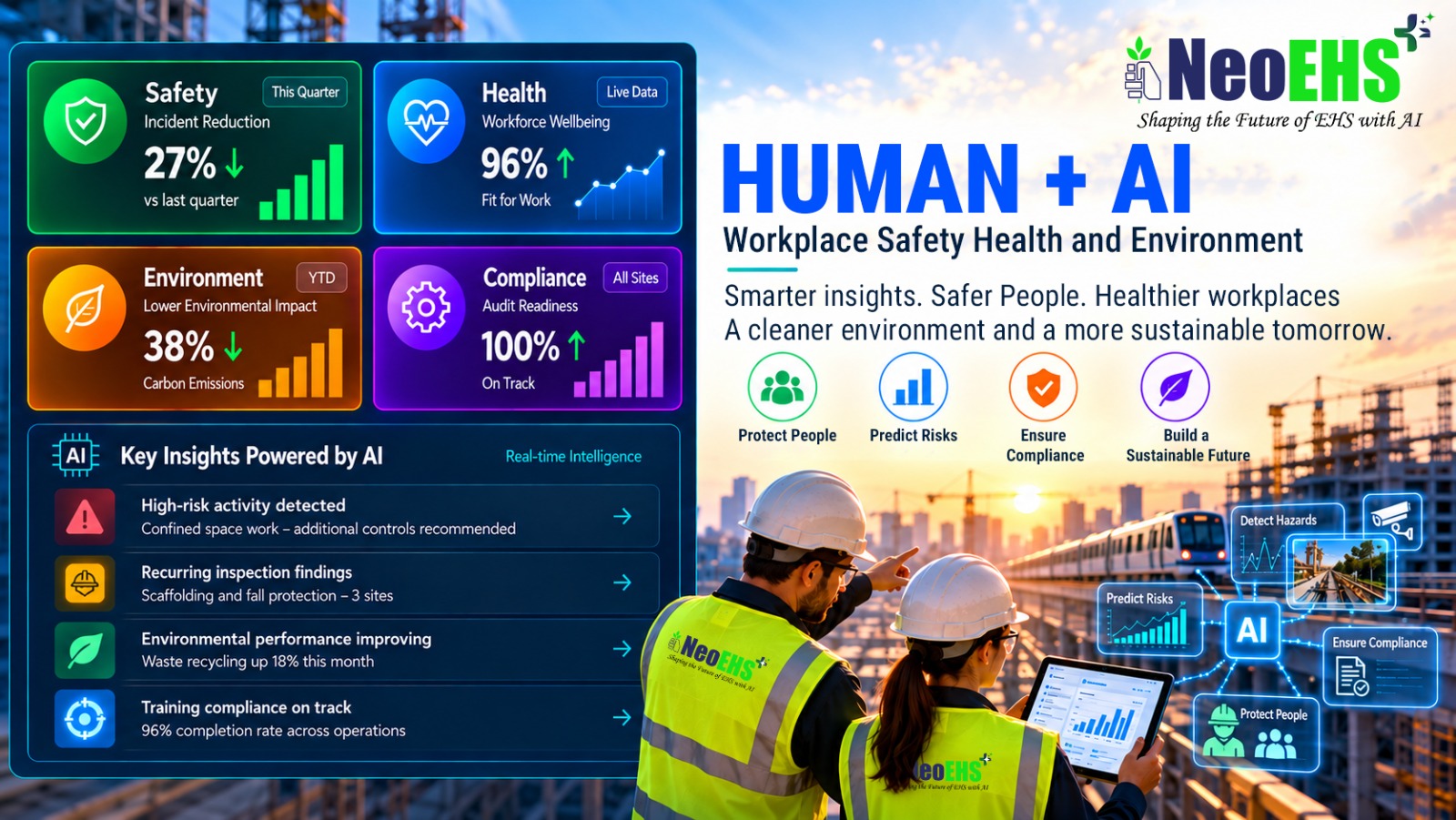
The Future of Workplace Safety Is Not Human or AI. It Is Human + AI.
What Does Human + AI Mean in Workplace Safety?
Human + AI in workplace safety is a collaborative approach in which artificial intelligence helps safety professionals analyze information, identify patterns, recognize potential hazards, and prioritize preventive actions, while people remain responsible for assessing conditions, verifying controls, and making safety-critical decisions.
It combines two complementary strengths.
Humans bring practical experience, situational awareness, ethical judgment, communication, and accountability.
AI can assist with reviewing large volumes of records, recognizing patterns, organizing evidence, and identifying issues that deserve closer examination.
Neither capability is sufficient on its own.
An AI system may identify an unusual trend in equipment inspection records. But a qualified maintenance engineer must determine whether the equipment is safe to operate.
A computer vision application may flag a possible fall-protection concern. But a competent safety professional must verify the actual conditions and determine the appropriate response.
An AI-assisted risk assessment may suggest hazards based on similar activities. But the people responsible for the work must confirm that those hazards and controls are appropriate for the current location.
The most valuable role of AI is to make human safety expertise more informed, consistent, and effective.
Why Traditional Workplace Safety Management Needs to Evolve
Most organizations already generate substantial amounts of EHS information.
Every day, safety teams record incidents, near misses, hazards, inspection findings, audit observations, permits, training records, and corrective actions.
The problem is not always a lack of data.
It is the difficulty of turning that information into timely decisions.
Consider a company operating several construction projects.
One project reports repeated scaffolding defects. Another records falling-object near misses. A third identifies gaps in work-at-height supervision.
When these findings remain in separate spreadsheets, emails, and paper registers, the organization may fail to recognize a broader pattern.
The same weakness can appear in manufacturing plants, ports, mines, power stations, and railway maintenance facilities.
Traditional reporting often answers the question:
“What happened?”
A more mature safety management approach also asks:
-
What conditions are changing?
-
Which hazards are appearing repeatedly?
-
Are critical controls being verified?
-
Which corrective actions remain ineffective?
-
Where should supervisors focus their attention?
-
What can we learn before a serious incident occurs?
Connected digital EHS systems, supported by appropriate analytics and AI, can make these questions easier to investigate.
Seven Ways Human Expertise and AI Can Improve Workplace Safety
1. Recognizing Hazards That Might Otherwise Be Overlooked
Experienced safety professionals recognize hazards through observation, technical knowledge, and familiarity with operations.
AI can provide another source of information.
For example, computer vision systems may be configured to identify defined conditions in images or video, such as potential PPE noncompliance, proximity to restricted areas, or selected equipment and pedestrian interactions.
These systems depend on camera coverage, image quality, model accuracy, and the conditions in which they are deployed.
They can miss hazards or generate incorrect alerts.
That is why computer vision should be used as a supporting tool, with suitable privacy safeguards and human verification.
A flagged image is a reason to investigate—not proof that a safety violation has occurred.
2. Turning Incident Reports Into Preventive Learning
Incident management is one of the most important opportunities for better safety intelligence.
An organization may record hundreds of incidents and near misses over several years.
Each report contains potentially useful information about activities, locations, contributing factors, equipment, and failed controls.
However, recurring patterns may remain difficult to identify when reports are reviewed individually.
AI-assisted analysis can help group similar events, identify recurring descriptions, and highlight relationships that deserve further investigation.
For example, several incidents across different facilities may involve inadequate isolation verification.
Recognizing that pattern can help management review its isolation procedures, supervision, and training.
But AI cannot independently establish the root cause of an incident.
Investigators must evaluate the evidence, interview relevant personnel, and examine organizational and technical factors.
Explore NeoEHS EHS Management Software to understand how connected EHS information can support more structured safety management.
3. Making Risk Assessments More Consistent and Actionable
Hazard identification and risk assessment are fundamental to workplace safety.
Yet the quality of risk assessments can vary between departments, contractors, and locations.
Some assessments are detailed and specific. Others rely heavily on generic templates.
AI-assisted workflows may help reviewers identify missing information, suggest hazards for consideration, or compare assessments with approved internal reference material.
For example, a risk assessment for maintenance work near energized equipment should consider the actual energy sources, isolation requirements, access conditions, and potential interactions with other activities.
AI may help identify relevant questions.
It cannot verify the physical condition of the equipment or establish that isolation has been completed.
A risk assessment becomes valuable only when its controls are appropriate, understood, implemented, and verified.
4. Strengthening Safety Inspections and Corrective Actions
Many organizations conduct regular safety inspections but struggle to close the findings effectively.
An inspection identifies a defective guardrail.
The finding is recorded.
A corrective action is assigned.
The action is marked complete.
But has the guardrail actually been repaired and verified?
Digital inspection and corrective-action workflows can help organizations maintain clearer records of findings, ownership, deadlines, evidence, and verification.
AI-assisted analysis may also help identify recurring deficiencies across sites.
For example, repeated temporary edge-protection failures across several construction projects could indicate a wider problem involving installation standards, contractor supervision, or inspection quality.
The goal should not be to produce more inspection records.
It should be to reduce the time between identifying a hazard and establishing an effective control.
5. Improving Permit to Work Coordination
High-risk activities often require coordination between operations, maintenance, contractors, and safety personnel.
Examples include confined space entry, hot work, electrical maintenance, excavation, and work at height.
A digital Permit to Work system can help organize requests, authorization steps, risk assessments, and supporting records.
AI-assisted review may help flag incomplete information or potential inconsistencies that require attention.
However, no digital approval can substitute for physical isolation, gas testing, worksite inspection, or other required safety verification.
A permit is effective only when the conditions of authorization are actually satisfied.
Learn more about NeoEHS Permit to Work Software.
6. Supporting More Meaningful Safety Training
Workplace safety training should reflect the actual risks employees face.
A general induction may be suitable for introducing site rules, but it may not adequately prepare someone for a specialized high-risk task.
AI-assisted training systems may help organize learning content, identify knowledge gaps, or recommend relevant training material based on roles and activities.
For example, a contractor involved in confined space work may require different training from a warehouse forklift operator.
AI can help coordinate information.
Competency must still be demonstrated through appropriate training, assessment, practical experience, and authorization.
Completing an online module does not automatically establish competence.
7. Giving Leadership Better Visibility Into Critical Risks
Senior management often receives safety dashboards showing incident rates, inspection totals, audit scores, and overdue actions.
These indicators can be useful, but they do not always reveal whether serious hazards are adequately controlled.
A more effective dashboard should help leaders understand:
-
Which high-consequence hazards are present
-
Whether critical controls have been verified
-
Where significant corrective actions remain open
-
Which activities have repeated safety deficiencies
-
Whether contractor performance requires intervention
-
Where environmental or occupational health risks are increasing
AI-assisted analysis can help summarize complex information and identify patterns.
Management must still examine the underlying evidence and decide what action is required.
Human + AI in Different Industries
The value of combining people and technology becomes clearer when we look at actual workplace activities.
| Industry | Potential AI contribution | Essential human responsibility |
|---|---|---|
| Manufacturing | Analyze equipment inspection trends and recurring hazards | Verify machine guarding, isolation and maintenance controls |
| Construction | Review inspection findings and identify repeated high-risk conditions | Confirm fall protection, lifting plans and site-specific precautions |
| Ports and Maritime | Analyze equipment interactions, observations and permit information | Manage cargo operations, traffic interfaces and work authorization |
| Power Plants | Highlight recurring maintenance, isolation or inspection issues | Verify energy controls and authorize hazardous work |
| Mining | Analyze inspection trends and defined equipment interaction risks | Assess ground conditions, equipment operations and emergency readiness |
| Metro and Railway | Connect maintenance observations, audit findings and work records | Verify track access, electrical isolation and operational safety arrangements |
These are practical application possibilities, not claims that every feature is deployed or validated in every NeoEHS installation.
The effectiveness of any AI-assisted application depends on implementation quality, available data, technical validation, and operating conditions.
Can Artificial Intelligence Prevent Workplace Accidents?
AI can help organizations identify potential risks earlier, improve information analysis, and support preventive decisions. But it cannot guarantee that accidents will be prevented.
An AI model may recognize a pattern associated with previous incidents.
That does not mean the model can accurately predict when or where the next incident will occur.
Accidents often involve changing conditions, human interactions, equipment failures, organizational decisions, and combinations of factors that may not be fully represented in historical data.
For this reason, organizations should avoid treating AI risk scores as certainty.
The more practical objective is to use AI to support earlier investigation and stronger preventive action.
Success should be evaluated through evidence of better risk control, not simply the number of AI alerts generated.
The Biggest Risk: Overconfidence in AI
As AI becomes more common in EHS software, organizations must guard against a new type of operational risk: assuming that an intelligent system is always correct.
AI applications can produce false positives, miss important conditions, misinterpret information, or reflect weaknesses in their training data.
An automated summary may overlook a critical detail.
A computer vision model may misidentify an object.
A risk recommendation may be inappropriate for a particular work environment.
These limitations matter because workplace safety decisions can have serious consequences.
Responsible implementation requires clear boundaries.
Organizations should establish:
-
Defined use cases and intended outcomes.
-
Appropriate validation before operational deployment.
-
Competent human review of safety-critical outputs.
-
Clear ownership of decisions and corrective actions.
-
Data protection and worker privacy safeguards.
-
Monitoring for errors, performance drift and unintended consequences.
-
A process for challenging, correcting or rejecting AI recommendations.
AI should never become an excuse to weaken supervision, reduce necessary field verification, or transfer accountability away from responsible personnel.
What Human Expertise Still Does Better
Technology can process information at scale, but experienced safety professionals contribute capabilities that are difficult to reproduce reliably.
A safety officer may recognize tension between contractors that suggests communication problems.
An experienced engineer may notice that a maintenance method is technically unsuitable even when the documentation appears complete.
A supervisor may understand that a worker is hesitant to report a hazard because of production pressure.
A site leader may recognize that repeated shortcuts indicate a deeper problem with planning and resources.
These situations require context, empathy, judgment, and leadership.
They also demonstrate why safety culture cannot be automated.
A workplace where employees fear reporting concerns will not become safer simply because it installs AI software.
Trust, openness, competence, and management commitment remain essential.
How NeoEHS Supports a Human-Centered Approach to Safety Intelligence
NeoEHS is an AI-powered Environment, Health and Safety software platform designed to support connected EHS management processes.
Its broader approach brings together activities such as incident reporting, hazard observations, risk assessment, inspections, audits, Permit to Work, corrective actions, contractor management, and environmental management.
Connecting these workflows can help organizations reduce fragmented information and improve visibility across their operations.
For example, an inspection finding may lead to a corrective action. A recurring hazard may require a revised risk assessment. An incident investigation may identify weaknesses in training or permit controls.
When this information is managed through connected processes, safety teams have a better opportunity to understand how individual findings relate to wider operational risks.
AI-assisted capabilities can add value by helping professionals review information, identify patterns, and prioritize further attention.
The central principle remains unchanged:
NeoEHS should support the people responsible for safety—not replace their professional judgment.
Explore the NeoEHS platform and its EHS software capabilities.
A Practical Roadmap for Introducing Human + AI Safety Management
Organizations do not need to introduce every AI capability at once.
A phased approach is often more effective.
Step 1: Identify a Real Operational Problem
Start with a specific challenge.
Examples include delayed corrective-action closure, inconsistent risk assessments, repeated permit deficiencies, or difficulty comparing incident trends across facilities.
Avoid introducing AI simply because it is available.
Step 2: Improve Data Quality
Review the completeness, consistency, and reliability of existing EHS records.
Incomplete incident descriptions and inconsistent hazard categories can undermine AI-assisted analysis.
Step 3: Establish a Reliable Digital Workflow
Ensure that responsibilities, approvals, records, and verification steps are clear.
AI cannot compensate for a poorly designed safety process.
Step 4: Pilot a Defined AI Use Case
Choose a manageable application with measurable outcomes.
For example, evaluate whether AI-assisted incident classification helps investigators review reports more efficiently without increasing errors.
Step 5: Keep People Responsible for Decisions
Define who reviews AI outputs, verifies the evidence, and authorizes corrective action.
Step 6: Measure Actual Safety Value
Consider measures such as corrective-action effectiveness, risk assessment quality, critical-control verification, investigation quality, and time required to resolve significant hazards.
Step 7: Improve and Expand Carefully
Review system limitations, user feedback, privacy implications, and operational results before extending the application to other sites or activities.
Frequently Asked Questions
Will AI replace workplace safety officers?
AI may automate selected administrative and analytical tasks, but safety professionals remain essential for field verification, regulatory interpretation, risk decisions, worker engagement, and accountability.
What is human-centered AI in EHS?
Human-centered AI in EHS means designing AI applications to support safety professionals, with clear human oversight, transparent limitations, and responsibility for safety-critical decisions remaining with qualified people.
How can AI help prevent workplace incidents?
AI can assist by analyzing historical reports, identifying recurring hazards, reviewing inspection trends, and highlighting issues for preventive investigation. It cannot guarantee accident prevention.
Can AI perform workplace risk assessments?
AI can support parts of the assessment process, such as organizing information and suggesting hazards for review. Competent personnel must confirm site-specific conditions, appropriate controls, and implementation.
What are the benefits of AI-powered EHS software?
Potential benefits include more efficient information review, improved visibility of recurring issues, better coordination of safety workflows, and stronger management reporting. Results depend on data quality, implementation, and human use.
Is computer vision reliable for workplace safety monitoring?
Computer vision can identify defined visual conditions under suitable circumstances, but performance varies with lighting, camera position, environmental conditions, and model design. Human verification and appropriate safeguards remain necessary.
How should companies evaluate AI safety software?
Organizations should assess the actual use cases, integration requirements, data protection, validation evidence, accuracy under relevant conditions, human oversight arrangements, and measurable operational value.
Does ISO 45001 require artificial intelligence?
No. ISO 45001 establishes requirements for an occupational health and safety management system. It does not require organizations to use AI or purchase AI-powered software.
The Future of Workplace Safety Belongs to Human + AI
The next chapter of workplace safety will not be defined by how many tasks organizations automate.
It will be defined by how effectively they use technology to strengthen prevention, improve decisions, and support the people responsible for keeping workplaces safe.
AI can help connect information.
Human expertise gives that information meaning.
AI can identify patterns.
Experienced professionals determine what those patterns mean in the real world.
AI can suggest where attention may be needed.
People verify the conditions, establish the controls, and take responsibility for action.
The future of workplace safety is not about choosing between human intelligence and artificial intelligence. It is about bringing both together to create safer, more informed, and more resilient workplaces.
Discover Human-Centered EHS Intelligence With NeoEHS
Explore how NeoEHS connects safety management workflows with digital technology and AI-assisted intelligence.
Website: www.neoehs.com
Email: info@neoehs.com
NeoEHS — Safer People. Greener Operations. A Sustainable Tomorrow.