Construction Contractor Management System: Connecting Every Subcontractor, Safety Process and Project
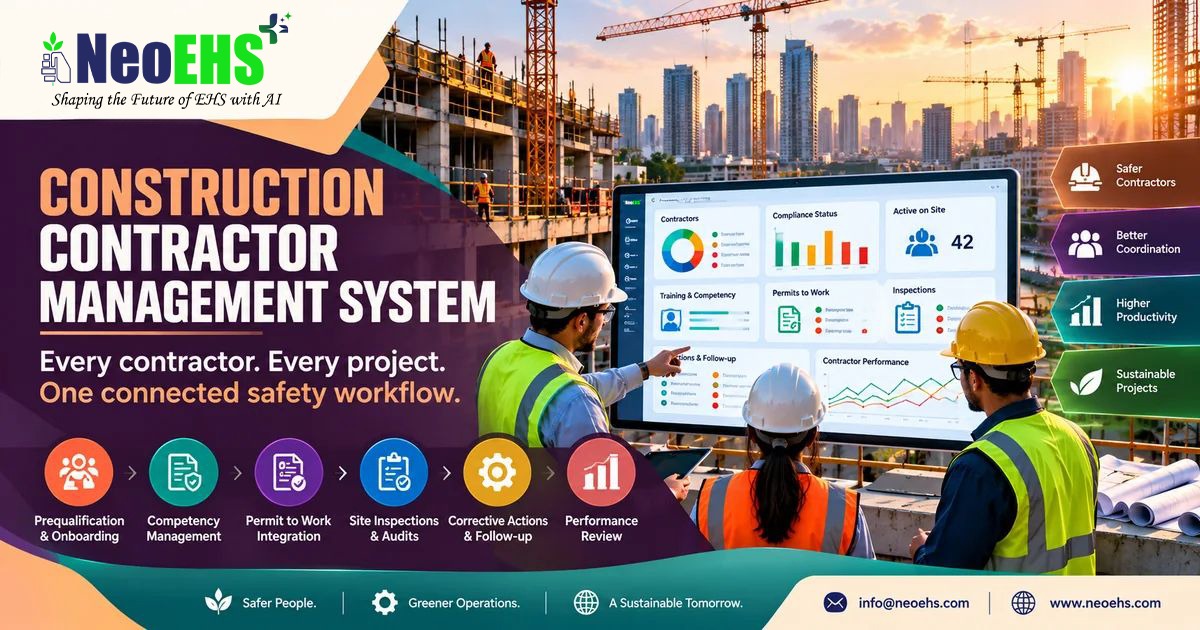
From contractor onboarding and competency verification to digital permits, site inspections and AI-powered EHS intelligence.
A major construction project may have dozens of subcontractors operating at the same time.
One contractor is responsible for structural works. Another manages electrical installation. Specialist teams handle façade installation, scaffolding, lifting operations, mechanical services and finishing works.
Every contractor brings its own workforce, equipment, qualifications, documentation and safety procedures.
Now consider the information that a project manager needs before authorising work:
-
Is the contractor approved to operate on the project?
-
Are the workers appropriately trained and competent?
-
Are mandatory certificates and equipment inspection records current?
-
Has the activity been assessed for relevant hazards?
-
Are the necessary work permits approved?
-
Are previous inspection findings still unresolved?
-
Is another contractor performing conflicting work nearby?
On many construction projects, answering these questions requires searching through spreadsheets, emails, shared folders and separate applications.
The information exists, but it is fragmented.
A construction contractor management system helps bring these activities into a coordinated digital process, improving visibility, accountability and control across the contractor lifecycle.
For construction organisations managing complex projects, this is increasingly an operational management requirement rather than simply an administrative convenience.
What Is a Construction Contractor Management System?
A construction contractor management system is a structured process, supported by software, for managing contractor information, qualifications, onboarding, work authorisations, safety activities, performance and closeout across construction projects.
It connects the people responsible for contractor selection, site operations, health and safety, procurement and project delivery.
An effective system helps answer three important questions:
Who is authorised to work? Contractor approval, worker competency and site access requirements.
What work is authorised? Approved activities, relevant risk assessments, permits and coordination requirements.
Are the required controls being maintained? Field inspections, incident findings, corrective actions and performance monitoring.
Unlike a standalone contractor database, an integrated contractor management system can connect these records with day-to-day construction activities.
That distinction matters because contractor safety cannot be managed effectively through documentation alone.
Why Traditional Contractor Management Becomes Difficult on Large Projects
Information Is Spread Across Multiple Systems
Procurement maintains contractor registrations.
Human resources or administration teams maintain worker records.
HSE departments manage training, incidents and inspections.
Site supervisors maintain work permits and daily activity records.
When these processes are disconnected, project teams can struggle to establish a consistent picture of contractor readiness and performance.
Documentation Changes Frequently
Contractor licences, insurance documents, worker qualifications, equipment inspection records and training certifications may have different renewal periods.
Manual tracking increases the administrative burden and can make it harder to identify records requiring review.
Workforce Mobilisation Is Dynamic
Construction teams change as project phases progress.
New workers arrive, specialist subcontractors are mobilised, and equipment is moved between work areas.
A contractor approved during mobilisation may introduce new personnel or activities requiring additional checks.
Multiple Projects Need Consistent Oversight
A construction company operating several projects may use different forms, spreadsheets and reporting practices at each site.
This makes it difficult to compare contractor performance or apply consistent minimum requirements.
Site Findings Do Not Always Reach Decision-Makers
A supervisor may identify a recurring contractor safety issue, but the information may remain within a local inspection report.
Without connected reporting and review, management may miss patterns developing across work areas or projects.
The Complete Construction Contractor Management Lifecycle
A well-designed system should support the contractor from initial evaluation through final project closeout.
1. Contractor Registration and Prequalification
Before a contractor is engaged, the organisation should assess whether it has the capability and resources to perform the proposed work.
Typical information includes:
-
Company registration and relevant licences.
-
Insurance and contractual documentation, where applicable.
-
Previous project experience.
-
Safety management arrangements.
-
Competent supervisory personnel.
-
Worker training and qualifications.
-
Equipment management procedures.
-
Relevant incident and enforcement history.
-
Arrangements for managing lower-tier subcontractors.
Digital prequalification workflows can help standardise submissions, document reviews and approval decisions.
The depth of evaluation should reflect the risk and complexity of the work.
A specialist lifting contractor, for example, may require a different level of technical evaluation from a contractor undertaking low-risk office fit-out work.
2. Contractor Onboarding and Mobilisation
Prequalification confirms suitability for consideration or appointment.
Onboarding establishes whether the contractor is ready to begin work on a particular project.
This may involve site induction, emergency information, supervisor designation, equipment checks, worker competency verification and review of project-specific safety requirements.
A digital system can help organise these requirements and record their status.
Importantly, completing an onboarding workflow does not independently establish that every worker is competent or that the work area is safe.
Those matters require appropriate verification.
3. Worker Competency and Certification Management
Construction activities often require task-specific skills and authorisations.
Examples include crane operation, rigging, electrical work, scaffolding, equipment operation and certain confined-space activities.
A contractor management system can maintain structured records of worker qualifications, training and relevant certification dates.
It can also support review workflows for expiring documents and competency requirements.
Where integrated with site access or work-authorisation systems, such information may help responsible personnel make more informed approval decisions.
4. Risk Assessment and Work Planning
Before work begins, relevant hazards must be identified and appropriate controls established.
Depending on the activity, documentation may include Job Safety Analyses (JSA), Job Hazard Analyses (JHA), task risk assessments, method statements or Risk Assessment and Method Statements (RAMS).
Contractor management becomes more effective when these records can be connected to the contractor, activity, location and responsible supervisor.
This helps reduce uncertainty over which assessment applies to a particular work package.
5. Digital Permit-to-Work Management
Higher-risk activities may require formal work authorisation.
Examples include hot work, electrical isolation, confined-space entry, excavation and certain lifting or maintenance activities, depending on applicable requirements.
A connected Permit-to-Work process can help manage requests, supporting documents, approvals, validity periods and closure records.
It can also support coordination where multiple contractors are operating in the same area.
A permit is a control-of-work mechanism—not a substitute for competent supervision or physical verification of safety measures.
6. Site Inspections and Contractor Monitoring
Once work begins, the contractor's actual performance becomes more important than its submitted documents.
Site inspections help supervisors evaluate work conditions, equipment, housekeeping, access arrangements and the implementation of agreed controls.
Mobile inspection tools can support photographs, observations, action assignment and follow-up.
Findings can be associated with relevant contractors and work areas to improve traceability.
7. Incident, Near-Miss and Corrective Action Management
Contractor-related incidents and near misses provide important learning opportunities.
An integrated system can connect incident reports with investigation findings, responsible parties, corrective actions and verification records.
For example, repeated access-control deficiencies across several subcontractors may indicate a weakness in overall project coordination rather than an isolated contractor problem.
Corrective actions should be verified as effective, not simply marked complete.
8. Contractor Performance Evaluation and Demobilisation
At project completion, contractor evaluation should consider more than whether the work was delivered on schedule.
Relevant safety-performance information may include repeated deficiencies, quality of corrective actions, supervision effectiveness, training compliance and adherence to agreed work controls.
These findings can inform future contractor selection and project planning.
How an Integrated Contractor Management Workflow Operates
Consider an electrical subcontractor mobilising to a large commercial building project.
<escape>Step 1 — Registration:</escape> The subcontractor submits company information, required documentation and nominated supervisors.
<escape>Step 2 — Review:</escape> Responsible personnel evaluate the submissions and identify missing requirements.
<escape>Step 3 — Workforce onboarding:</escape> Workers complete relevant induction and competency checks.
<escape>Step 4 — Work planning:</escape> The contractor submits applicable risk assessments and supporting work documents.
<escape>Step 5 — Authorisation:</escape> The responsible team reviews the work area and approves required permits.
<escape>Step 6 — Execution:</escape> Supervisors monitor the activity and conduct field inspections.
<escape>Step 7 — Corrective actions:</escape> Any deficiencies are assigned, addressed and verified.
<escape>Step 8 — Performance review:</escape> The project team reviews contractor records and lessons learned.
The benefit of a connected system is that information generated at one stage can remain available to support later decisions.
This example describes a recommended operational workflow, not a claim that every integration or automation is available in every NeoEHS deployment.
How AI Can Strengthen Construction Contractor Management
AI can support contractor management by helping organisations interpret large volumes of operational information.
Its effectiveness depends on the quality of available data, the application and appropriate human oversight.
AI-Assisted Document Processing
Where implemented, document extraction technologies may help organise information from contractor submissions, training records or certificates.
However, extracted information still needs appropriate validation, especially when it affects safety-critical authorisations.
Incident and Inspection Trend Analysis
AI-assisted analysis can help identify recurring themes in inspection findings, incident narratives and near-miss reports.
For example, repeated observations involving temporary electrical installations may indicate a need for focused contractor reviews or stronger coordination.
Contractor Risk Prioritisation
Analytics may help identify contractors or work packages requiring additional attention based on unresolved findings, repeated deviations or other relevant indicators.
Such prioritisation should not be treated as a definitive judgement about contractor competence.
Management Dashboards and Decision Support
Connected data can help project leaders review contractor readiness, outstanding actions, permit activity and inspection findings.
AI-assisted summaries may support management review, provided the underlying information is accurate and traceable.
Predictive Safety Intelligence
Predictive models may support investigation of emerging patterns, but they cannot reliably guarantee that a particular contractor will or will not experience an incident.
Human review remains essential.
What Should a Construction Contractor Management Dashboard Show?
A useful dashboard should help different users answer different operational questions.
For a project director, the priority may be understanding overall contractor readiness and unresolved critical issues.
For an HSE manager, the focus may be recurring findings, overdue actions and critical-control performance.
For a site supervisor, the immediate concern may be work authorisation, contractor interfaces and activities scheduled for the day.
Useful dashboard measures can include:
| Dashboard measure | Management purpose |
|---|---|
| Contractors registered and approved | Visibility of contractor onboarding status |
| Workers awaiting competency review | Identification of outstanding verification requirements |
| Documents approaching expiry | Planning timely document reviews |
| Active work permits | Visibility of authorised work activities |
| Overdue corrective actions | Escalation of unresolved findings |
| Repeat inspection deficiencies | Identification of recurring control weaknesses |
| Contractor-related near misses | Support for investigation and learning |
| Contractor performance trends | Informed management review |
These indicators are illustrative recommendations. The availability of particular dashboard measures depends on system configuration and data sources.
How NeoEHS Supports Connected Contractor Safety Processes
NeoEHS is an AI-powered Environment, Health and Safety management platform designed to support connected EHS operations.
For construction organisations, its relevant functional areas include:
Contractor Management: Organising contractor-related information and safety-management activities.
Training and Competency Management: Supporting records and review of relevant training and competency requirements.
Risk and Hazard Management: Managing hazard information, risk assessments and associated controls.
Permit-to-Work: Supporting structured authorisation and documentation of activities requiring formal work control.
Safety Inspections: Recording field findings and tracking required actions.
Incident Management: Supporting incident and near-miss reporting, investigation and organisational learning.
Corrective and Preventive Actions: Assigning and tracking measures intended to address identified deficiencies.
EHS Dashboards and Analytics: Bringing operational information together for management visibility.
These capabilities can support organisations seeking greater consistency across multiple contractors, construction sites and project teams.
Specific automated eligibility rules, system integrations, AI models and deployment options should be confirmed during solution evaluation.
Explore NeoEHS Construction Safety Solutions and NeoEHS Permit-to-Work Software.
Construction Contractor Management and ISO 45001
ISO 45001 provides an international framework for occupational health and safety management.
Its requirements concerning procurement, contractors, operational control, worker participation and continual improvement are relevant to contractor management.
A digital system may support recordkeeping, communication and workflow consistency.
However, using software does not automatically establish ISO 45001 conformity or compliance with national construction safety legislation.
Construction companies must evaluate applicable legal requirements and maintain effective operational controls.
How to Choose Construction Contractor Management Software
Before selecting a platform, construction leaders should consider:
-
Lifecycle coverage: Can the system support contractor information from prequalification through closeout?
-
Project-level visibility: Can contractor records be associated with specific sites, work packages and activities?
-
Competency management: Can the organisation review relevant worker qualifications and training information?
-
Work-control integration: Can risk assessments and permits be connected to contractor activities?
-
Field usability: Can supervisors record inspections and observations efficiently?
-
Corrective-action tracking: Can responsibilities, deadlines and verification records be maintained?
-
Reporting: Can management identify recurring deficiencies and unresolved issues?
-
Access control: Are permissions appropriate for different organisations and roles?
-
Security and privacy: Are contractor and worker records protected according to applicable requirements?
-
Implementation practicality: Can the system fit existing processes without creating unnecessary administrative work?
The best system is not necessarily the one with the largest number of features.
It is the one that supports reliable decisions, clear responsibilities and effective controls within the organisation's actual operating environment.
Frequently Asked Questions
What is construction contractor management software?
It is software used to organise and manage contractor information, prequalification, onboarding, competency records, work authorisations, inspections, corrective actions and performance reviews across construction projects.
How is contractor management software different from a contractor database?
A contractor database primarily stores information. A broader management system supports workflows, responsibilities, approvals, field monitoring and performance review.
Can contractor management software integrate with Permit-to-Work systems?
Yes, integration is technically possible and can help connect contractor authorisation with work permits and risk assessments. Availability depends on the software and implementation.
Can AI automatically approve construction contractors?
AI may assist with document processing or identifying missing information. Final approval for safety-critical work should remain subject to appropriate human verification and organisational authorisation.
What is the role of contractor competency tracking?
It helps organisations maintain visibility of relevant training, qualifications and certification records and identify items requiring review.
Can one system manage contractors across multiple construction projects?
Multi-project contractor management is a common software requirement. Organisations should confirm whether a platform supports the required project structure, permissions and reporting.
Does contractor management software guarantee legal compliance?
No. Software can support compliance-related processes, but legal compliance depends on applicable requirements, actual practices, competent oversight and effective controls.
Conclusion: Connected Contractor Management Supports Better Construction Decisions
Construction projects depend on the coordinated work of multiple contractors.
Managing those relationships through disconnected records makes it harder to maintain visibility of contractor readiness, authorised activities, changing risks and unresolved safety issues.
A connected construction contractor management system helps bring these processes together.
It can support better information flow between procurement, project management, supervisors and HSE teams while providing clearer records of responsibilities and decisions.
AI-assisted analytics may add value by helping organisations recognise patterns and prioritise attention.
But technology is most effective when it supports competent people, reliable processes and verified field controls.
The future of contractor management is not simply digitising contractor documents. It is connecting contractor information with the work actually happening on site.
Explore AI-Powered Contractor Safety Management with NeoEHS
Discover how NeoEHS connects contractor-related EHS activities with risk management, Permit-to-Work, inspections, incident reporting, corrective actions and management dashboards.
Website: https://www.neoehs.com
Email: info@neoehs.com
NeoEHS — Safer People. Greener Operations. A Sustainable Tomorrow.