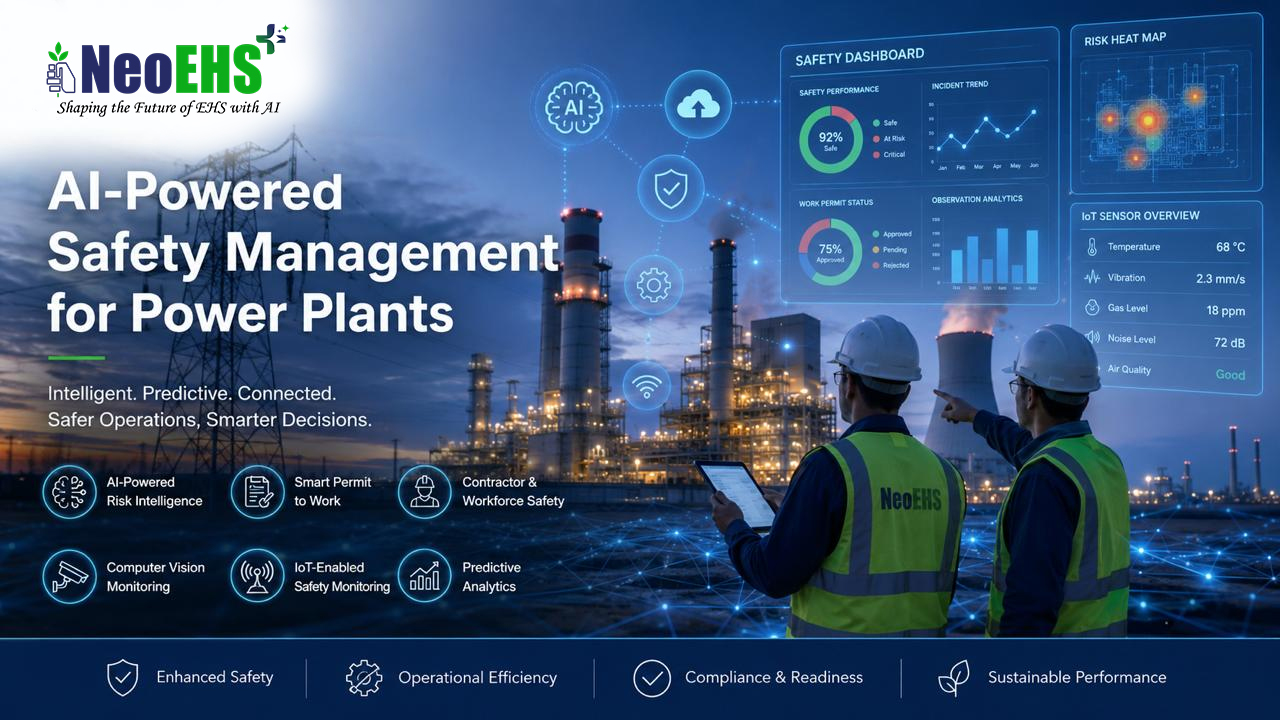
AI-Powered Safety Management for Power Plants | NeoEHS
Power plants are among the most complex and safety-critical industrial environments in the world.
Workers operate around high-voltage electrical systems, boilers, turbines, generators, steam, chemicals, heavy machinery, confined spaces, hazardous energy, work at height, and demanding maintenance activities.
In such an environment, safety cannot depend only on periodic inspections, paper-based checklists, or reacting after an incident occurs.
AI-powered safety management for power plants is changing the way organizations identify hazards, manage risk, monitor operations, investigate incidents, and protect workers.
NeoEHS, an AI Powered Environment, Health and Safety (EHS) System, helps power generation companies move from reactive safety management to a more connected and proactive approach—bringing together risk management, permit to work, incident management, inspections, observations, training, contractor management, emergency management, environmental monitoring, and AI-powered analytics in one platform.
The goal is simple:
Identify risks earlier. Take action faster. Make every safety decision more informed.
What Is AI-Powered Safety Management for Power Plants?
AI-powered safety management uses artificial intelligence, automation, connected data, analytics, and digital workflows to help power plants identify and manage workplace safety risks more effectively.
Instead of treating safety information as isolated records, an AI-powered EHS platform can connect information from:
- Risk assessments
- Permit to Work
- Lockout/Tagout
- Safety observations
- Inspections
- Audits
- Incidents and near misses
- Contractor activities
- Training and competency
- PPE management
- Emergency preparedness
- Equipment and operational data
- IoT sensors
- CCTV and computer vision
- Environmental monitoring
This creates a more complete picture of what is happening across the plant.
For example, a single repeated observation may not appear serious on its own. But if the same observation occurs repeatedly around a particular piece of equipment, during a specific shift, or among a particular contractor group, the combined data may reveal an emerging risk.
That is where AI can provide value: not simply storing information, but helping safety teams recognize patterns and prioritize action.
Why Power Plants Need a More Intelligent Safety Management Approach
Power generation involves multiple layers of risk operating simultaneously.
A maintenance team may be working on electrical equipment while another contractor performs hot work nearby. At the same time, operators may be managing pressure systems, rotating equipment, chemicals, and process conditions.
A safety management system therefore needs to understand more than individual activities.
It needs to connect:
People + Equipment + Work + Hazards + Permits + Competency + Environment + Historical Safety Data
This is particularly important when maintenance, shutdowns, turnarounds, construction, or contractor-intensive activities increase the number of people and tasks operating simultaneously.
OSHA's electric power generation requirements include hazard assessment and controls for hazardous energy, while its guidance emphasizes identifying current worksite conditions and potential hazards before work begins.
An intelligent EHS platform can help organizations digitize these processes and provide a more consistent view of risk.
How AI Is Transforming Power Plant Safety Management
1. AI-Powered Risk Identification
Traditional risk assessments are often performed as structured exercises around a specific job or process.
AI can add another layer by analyzing historical EHS information and identifying recurring patterns.
NeoEHS can help safety teams analyze information such as:
- Previous incidents
- Near misses
- Safety observations
- Inspection findings
- Audit findings
- Permit deviations
- Repeated corrective actions
- Contractor performance
- Training gaps
- Equipment-related observations
The objective is not to replace experienced safety professionals.
Instead, AI helps them see patterns across large amounts of information that may be difficult to identify manually.
Example
Suppose a power plant records repeated observations involving inadequate isolation during maintenance activities.
Individually, each observation may be assigned to a department and closed.
An AI-powered system can help identify the recurrence and highlight:
Repeated hazardous-energy control observations → specific equipment → specific work type → specific contractor/team → increased risk
The safety team can then investigate the underlying control weakness rather than simply closing individual observations.
2. AI-Powered Permit to Work Management
Permit to Work (PTW) is one of the most important controls for high-risk activities in power plants.
Common permits may include:
- Hot Work Permit
- Electrical Work Permit
- Confined Space Entry Permit
- Work at Height Permit
- Excavation Permit
- Lifting Permit
- Cold Work Permit
- Isolation / LOTO Permit
- Radiography Permit
- Breaking Containment Permit
- Chemical Handling Permit
An AI-powered PTW system can help validate whether the proposed work aligns with required safety controls.
NeoEHS can connect permit information with:
- Job hazard assessments
- Risk assessments
- Isolation requirements
- Worker competency
- Contractor qualifications
- Required training
- PPE requirements
- Previous observations
- Simultaneous activities
- Permit conflicts
- Approval workflows
This creates a more connected approach to work authorization.
3. Intelligent Lockout/Tagout and Energy Isolation
Energy isolation is a critical safety control during maintenance.
OSHA's power-generation requirements address hazardous-energy control, including lockout/tagout practices for servicing and maintenance where unexpected energization, startup, or release of stored energy could cause injury.
NeoEHS can digitize and connect energy isolation workflows with:
- Permit requests
- Equipment identification
- Isolation points
- Authorized personnel
- LOTO procedures
- Verification
- Permit status
- Job completion
- Restoration
The platform can provide visibility into whether required controls have been completed before work proceeds.
Important: AI should support—not replace—approved isolation procedures, competent personnel, physical verification, and site-specific safety controls.
4. AI-Powered Safety Observation Management
Safety observations are one of the most valuable sources of leading-indicator data in a power plant.
But collecting thousands of observations is not enough.
The real value comes from understanding them.
NeoEHS can help classify and analyze observations involving:
- Unsafe acts
- Unsafe conditions
- PPE non-compliance
- Electrical hazards
- Housekeeping
- Work at height
- Confined spaces
- Lifting activities
- Fire safety
- Chemical handling
- Machine guarding
- Contractor activities
- Environmental conditions
AI can assist with:
- Observation classification
- Risk prioritization
- Trend identification
- Recurring issue detection
- Suggested corrective actions
- Smart assignment
- Escalation
- Hotspot identification
This helps transform observations from a reporting exercise into a leading-indicator intelligence system.
5. Predictive Safety Analytics
One of the most promising applications of AI in EHS is predictive analytics.
Instead of asking:
"What happened?"
organizations can increasingly ask:
"What risk patterns are developing?"
NeoEHS can analyze historical and current EHS data to identify patterns associated with elevated risk.
Potential indicators include:
- Increasing safety observations
- Repeated permit violations
- Overdue corrective actions
- Contractor performance deterioration
- Increasing training gaps
- Recurring equipment-related observations
- Increased near-miss frequency
- Repeated audit findings
- Expiring certifications
- High-risk work concentration
This can help safety leaders focus their attention where it is most needed.
6. AI-Powered Incident and Near-Miss Investigation
When an incident or near miss occurs, investigation teams need to understand not just the immediate event but also the conditions surrounding it.
NeoEHS can connect incident information with:
- Previous observations
- Risk assessments
- Permits
- Training records
- Contractor records
- Equipment information
- Inspection findings
- Audit findings
- Corrective actions
AI can help investigators organize information, identify recurring themes, suggest areas for further investigation, and support structured root-cause analysis.
The final investigation should always remain under the control of qualified safety and investigation professionals.
7. Computer Vision for Power Plant Safety
Power plants increasingly use CCTV and connected visual technologies.
When integrated appropriately, AI-powered computer vision can provide additional safety monitoring capabilities.
Potential use cases include:
- PPE compliance monitoring
- Restricted-area access detection
- Unsafe-zone entry
- Worker proximity to hazardous equipment
- Vehicle and pedestrian movement
- Blocked access or emergency routes
- Safety barricade violations
- Fire or smoke detection, depending on the technology and deployment
Rather than replacing safety personnel, computer vision can act as an additional layer of observation.
Human expertise + AI monitoring = stronger situational awareness.
8. IoT-Based Safety Monitoring
Modern power plants generate large amounts of operational and environmental data.
IoT devices can provide information from connected sensors and equipment.
Depending on the plant's architecture, NeoEHS can integrate relevant data sources such as:
- Gas detection
- Temperature
- Pressure
- Air quality
- Noise
- Environmental parameters
- Worker location
- Smart PPE
- Wearable devices
- Equipment status
- Emergency alarms
Combining IoT data with EHS information can help safety teams move closer to real-time risk visibility.
9. Contractor Safety Management
Contractors play a major role in power plant maintenance, shutdowns, construction, and specialist activities.
Managing contractor safety manually becomes increasingly difficult as the contractor workforce grows.
NeoEHS can manage the contractor lifecycle from:
Registration → Prequalification → Document Verification → Competency → Training → Induction → Permit → Work → Performance → Requalification
The platform can track:
- Contractor qualifications
- Employee competency
- Certifications
- Training
- Insurance
- Work authorization
- Previous performance
- Safety observations
- Incidents
- Permit compliance
- Corrective actions
AI-driven analytics can help identify contractors with increasing risk indicators or declining performance.
10. AI-Powered Training and Competency Management
A worker may have years of experience and still require specific training for a particular task, equipment type, or site.
NeoEHS can connect competency requirements with:
- Job roles
- Permits
- Contractor assignments
- Certifications
- Training
- Equipment
- High-risk activities
The system can identify training gaps and upcoming certification or training expiries.
This helps ensure that competency is treated as an active safety control rather than simply a document stored in a database.
11. Emergency Management and Response
Power plants need robust emergency preparedness for scenarios such as:
- Fire
- Explosion
- Electrical incidents
- Chemical release
- Gas release
- Equipment failure
- Medical emergency
- Confined-space emergency
- Severe weather
- Security incidents
NeoEHS can support emergency preparedness through:
- Emergency plans
- Response procedures
- Emergency contacts
- Drills
- Training
- Equipment readiness
- Emergency observations
- Action tracking
- Incident reporting
AI and analytics can help organizations identify weaknesses from previous drills and emergency events.
12. Environmental and Occupational Health Monitoring
Power plant safety is not limited to physical injury prevention.
Organizations also need to manage environmental and occupational health risks.
NeoEHS can support monitoring and management of areas such as:
- Air quality
- Emissions
- Waste
- Chemical exposure
- Noise
- Occupational health
- Environmental incidents
- Resource consumption
- Carbon emissions
- Regulatory compliance
This creates a broader Environment, Health, Safety and Sustainability management framework.
AI-Powered Safety Dashboard for Power Plant Management
Senior management should not have to read hundreds of reports to understand plant safety.
NeoEHS provides dashboards that can bring critical information together.
Management dashboards can include:
Safety Performance
- Total incidents
- Near misses
- Safety observations
- High-risk observations
- Corrective action status
Permit Performance
- Active permits
- High-risk permits
- Permit deviations
- Expiring permits
- Permit trends
Contractor Performance
- Contractor safety score
- Training compliance
- Permit compliance
- Incident performance
- Open corrective actions
Risk Intelligence
- Top risks
- Emerging risks
- Risk hotspots
- Recurring hazards
- High-risk activities
Training & Competency
- Training completion
- Certification status
- Competency gaps
- Expiring certifications
Environmental Performance
- Emissions
- Waste
- Environmental observations
- Environmental incidents
What Are the Benefits of AI-Powered Safety Management in Power Plants?
The biggest benefit is not simply automation.
It is better decision-making.
An intelligent EHS system can help power plants:
Identify risks earlier
Use historical and real-time information to identify emerging patterns.
Reduce manual administration
Digitize inspections, permits, observations, approvals, and compliance workflows.
Improve safety visibility
Give management a real-time view of safety performance across sites and departments.
Strengthen contractor management
Monitor contractor competency, compliance, permits, training, and performance.
Improve corrective-action closure
Track ownership, deadlines, escalation, and evidence.
Strengthen compliance
Maintain structured records supporting internal controls and applicable regulatory requirements.
Improve worker engagement
Make reporting and safety participation easier through mobile and digital workflows.
Support continuous improvement
Use data from incidents, observations, inspections, audits, and risks to improve the safety management system.
AI Does Not Replace Safety Professionals
There is an important distinction between AI-assisted safety management and fully automated safety decision-making.
AI can analyze information, identify patterns, prioritize risks, and recommend actions.
But critical safety decisions should remain subject to:
- Competent safety professionals
- Qualified engineers
- Authorized personnel
- Site procedures
- Regulatory requirements
- Physical verification
- Management controls
For example, AI can identify that an isolation-related risk may exist. It should not be treated as a substitute for the authorized person's physical verification of isolation.
This principle is especially important in power generation, where hazardous energy can have severe consequences.
How NeoEHS Creates a Connected Power Plant Safety Ecosystem
The real strength of an AI-powered EHS platform comes from connecting information.
Imagine a power plant where:
Risk Management
connects to
Permit to Work
which connects to
Contractor Management
which connects to
Training & Competency
which connects to
Safety Observations
which connects to
Incident Management
which connects to
Corrective Actions
which connects to
AI Predictive Analytics
Instead of separate systems operating in isolation, NeoEHS creates a connected safety ecosystem.
This provides safety leaders with a much clearer understanding of what is happening, why it is happening, and where preventive action may be required.
AI-Powered Safety Management and ISO 45001
ISO 45001 provides a framework for organizations to establish and improve occupational health and safety management systems, including hazard identification, risk assessment, legal compliance, emergency planning, incident investigation, worker participation, auditing, and continual improvement.
NeoEHS can support organizations in digitizing many of these activities through connected workflows, records, dashboards, and analytics.
However, software itself does not make an organization ISO 45001 compliant. Compliance depends on how the organization implements its management system, controls risks, fulfills applicable requirements, and continually improves its OH&S performance.
Power Plant Safety Management: From Reactive to Predictive
Traditional safety management often follows this cycle:
Incident → Investigation → Corrective Action
A modern AI-powered approach aims to move further upstream:
Data → Pattern → Risk Signal → Preventive Action → Safer Outcome
That is the opportunity presented by AI.
The objective is not to predict every accident with certainty.
The objective is to identify meaningful risk signals earlier and help people act before those signals become serious events.
Why Choose NeoEHS for Power Plant Safety Management?
NeoEHS combines EHS management, AI, automation, analytics, IoT integration, and operational workflows into one platform.
NeoEHS brings together:
- AI Powered Risk Management
- AI Powered Permit to Work
- Incident Management
- Safety Observation Management
- Contractor Management
- Inspection Management
- Audit Management
- Training & Competency Management
- Emergency Management
- Compliance Management
- PPE Management
- Environmental Management
- Waste Management
- Air Quality Monitoring
- Carbon Emission Management
- IoT-Based Safety Monitoring
- Computer Vision Integration
- Predictive Analytics
- AI-Powered Dashboards
This connected approach helps power generation organizations move toward proactive and data-driven EHS management.
The Future of Power Plant Safety Is Intelligent, Connected and Proactive
Power plants will continue to become more digitally connected.
Sensors will generate more data. Workers will use smart devices. CCTV systems will become more intelligent. Equipment will generate operational signals. EHS teams will have access to more information than ever before.
The challenge will not be collecting data.
The challenge will be turning that data into meaningful safety decisions.
That is where AI-powered EHS platforms such as NeoEHS can make a difference.
By connecting people, processes, equipment, contractors, permits, risks, incidents, observations, training, and environmental information, organizations can create a more complete picture of operational risk.
And ultimately, better safety management is not about having more technology.
It is about using technology to help people make better decisions before something goes wrong.
Frequently Asked Questions
What is AI-powered safety management for power plants?
AI-powered safety management uses artificial intelligence, automation, analytics, connected data, and digital EHS workflows to help power plants identify hazards, assess risks, monitor safety performance, manage corrective actions, and make more informed preventive decisions.
How can AI improve power plant safety?
AI can analyze large volumes of EHS information to identify recurring observations, risk patterns, compliance gaps, training needs, contractor performance trends, and other indicators that may require preventive attention.
What are the major safety risks in power plants?
Power plants can involve risks associated with electrical systems, hazardous energy, rotating machinery, steam and pressure systems, chemicals, confined spaces, work at height, lifting operations, fire, maintenance activities, and contractor work. Specific risks depend on the plant type, equipment, processes, and work activities.
Can AI replace safety professionals in power plants?
No. AI should support safety professionals by providing data analysis, pattern recognition, prioritization, and recommendations. Critical safety decisions, physical verification, engineering controls, and authorized work procedures remain the responsibility of appropriately qualified personnel.
Can NeoEHS manage Permit to Work for power plants?
Yes. NeoEHS can support digital Permit to Work workflows for high-risk activities including hot work, electrical work, confined space entry, work at height, lifting, excavation, isolation/LOTO, and other organization-defined permits.
Can NeoEHS manage contractor safety?
Yes. NeoEHS can manage contractor registration, prequalification, documentation, competency, training, induction, permits, workforce deployment, safety performance, compliance, and contractor scorecards.
Can NeoEHS integrate IoT and CCTV?
NeoEHS can support integration with IoT devices, connected safety technologies, CCTV, and AI-powered computer vision depending on the organization's technology architecture and integration requirements.
How does predictive analytics help power plant safety?
Predictive analytics can identify patterns in historical and current safety data—such as recurring observations, increasing corrective actions, contractor performance changes, or repeated permit deviations—to help safety teams prioritize preventive action.
Does NeoEHS support ISO 45001?
NeoEHS can support the digitization and management of many processes associated with an occupational health and safety management system, including risk management, incident management, inspections, audits, training, corrective actions, compliance, and continual improvement. Organizations remain responsible for implementing and maintaining their own ISO 45001 management system.
Conclusion
AI-Powered Safety Management Is Becoming a Strategic Advantage for Power Plants
For power generation companies, safety is not just a compliance requirement. It is fundamental to business continuity, workforce protection, operational reliability, asset protection, and long-term sustainability.
AI can help EHS teams move beyond fragmented records and reactive reporting toward a connected approach where risks are identified earlier, information is easier to understand, and preventive action becomes more targeted.
NeoEHS brings AI-powered EHS management to the power generation industry—connecting risk, permits, incidents, observations, contractors, training, inspections, compliance, IoT, environmental data, and analytics in one intelligent platform.
Ready to Make Power Plant Safety Smarter?
Discover NeoEHS — AI Powered Environment, Health & Safety Software for Power Generation.
Book a Demo | Talk to a NeoEHS Expert | Explore AI-Powered EHS
#PowerPlantSafety
#AIinEHS
#AISafetyManagement
#PowerGeneration
#EHSSoftware
#PredictiveAnalytics
#PermitToWork
#ContractorSafety
#IndustrialSafety
#WorkplaceSafety
#RiskManagement
#IoTSafety
#ComputerVision
#NeoEHS
- AI Powered EHS Software
- Risk Management
- Permit to Work
- Incident Management
- Safety Observation Management
- Contractor Management
- Inspection Management
- Training Management
- Emergency Management
- Environmental Management
- Predictive Analytics
- IoT-Based Safety Management